Everforth: Can a Staffing Company Become a Consulting Company?
I. The New Name, the Old Question
On April 24, 2026, a company that most of Wall Street still thought of as a staffing firm changed its name. ASGN Incorporated became Everforth, Inc., and the ticker on the New York Stock Exchange switched from ASGN to EFOR.1 The filing that announced it was short and almost aggressively undramatic. No shareholder vote was required, stockholders' rights did not change, and the same legal entity, with the same subsidiaries, went on operating under a new banner.1 Nothing in the plumbing moved. What moved was the story the company wanted to tell about itself.
That story is now written across its investor materials. Everforth describes itself as a technology and digital engineering company organized around a handful of core solution areas, a business that helps large enterprises and federal agencies modernize their systems and deploy artificial intelligence.2 Its chief executive, Ted Hanson, has argued that "the last mile" of the AI value chain will be IT services, meaning that whoever builds the models, somebody still has to wire them into a bank's general ledger or an agency's personnel system.2 It is an appealing pitch. It is also a pitch that a great many companies have made since 2023, and the question for anyone who owns or is considering this stock is simple to state and hard to answer: is the new name a description of what the business has become, or a description of what management hopes it will become?
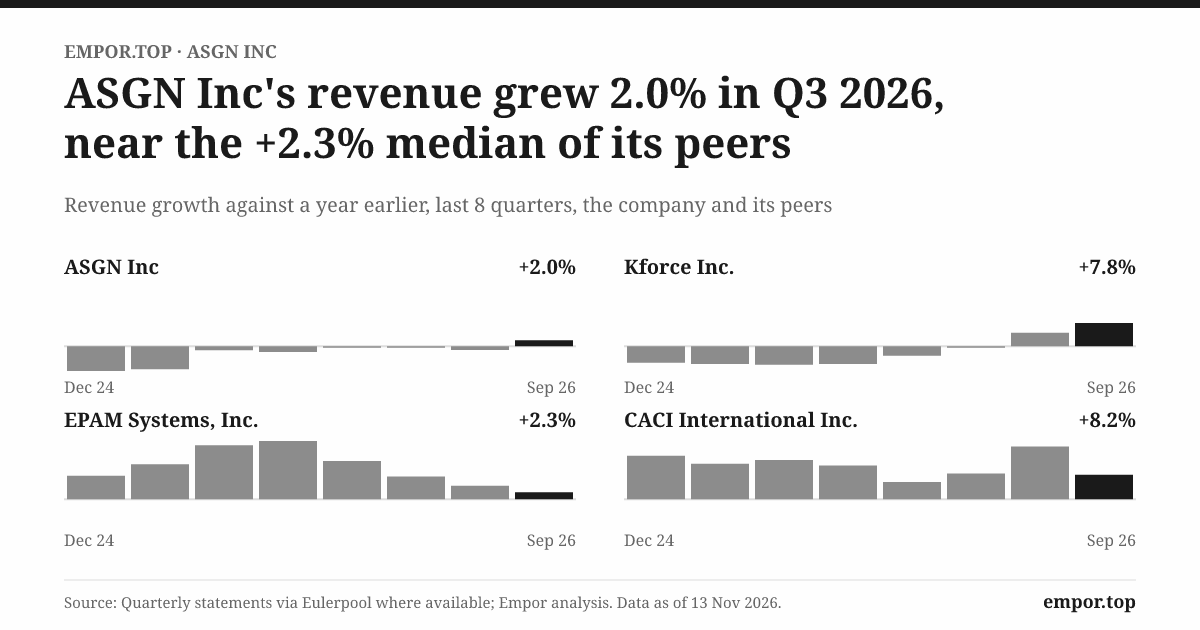
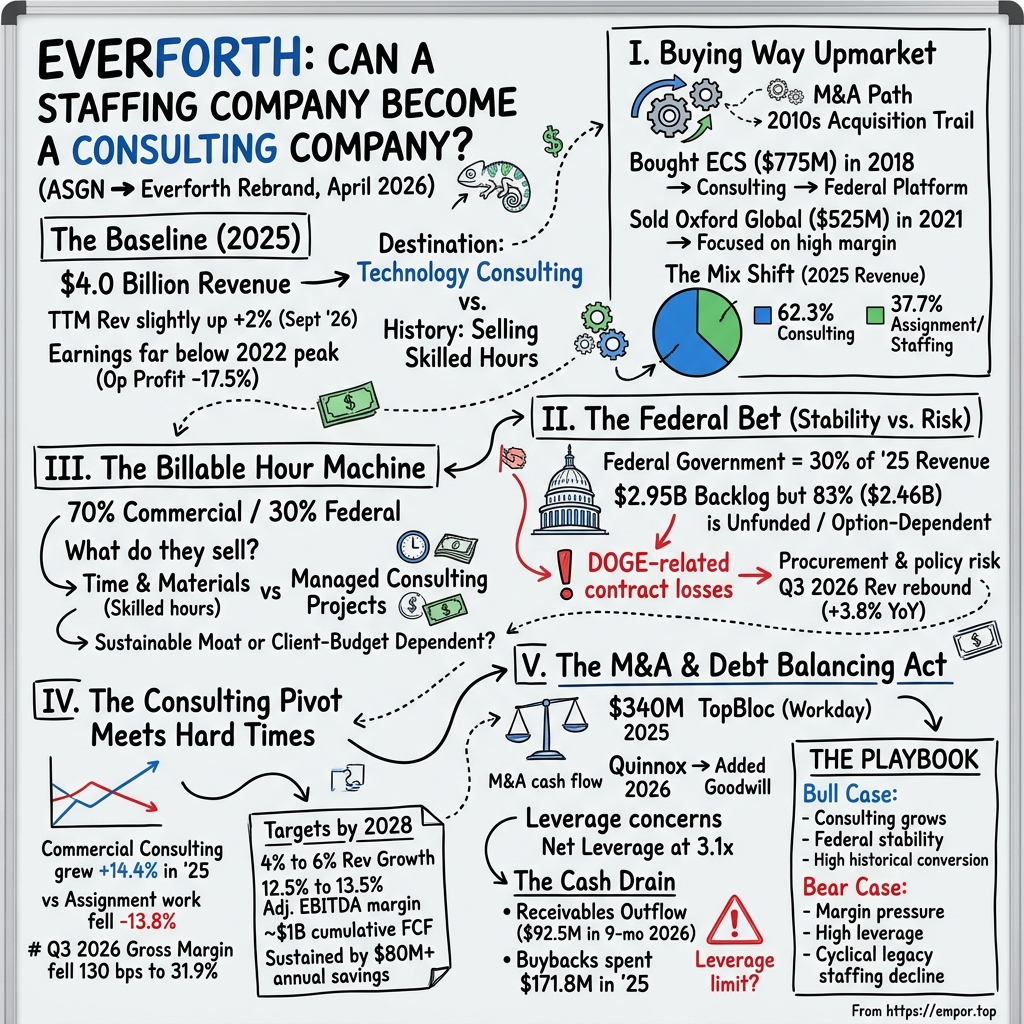
The timing makes the question sharper. When the rebrand landed, the company had just come through two and a half years of shrinking revenue. Sales peaked at about $4.6 billion in 2022.3 They fell in 2023, fell again in 2024, and fell almost 3% more in 2025, to about $4.0 billion.4 Only in the third quarter of 2026, five months after the new name went up, did revenue finally grow again year over year, by about 2%, to roughly $1.03 billion for the quarter.5 That is a turn, but a gentle one. Picture a ship that has stopped drifting backward, not one that has caught the wind.
Profit tells a harsher story than revenue. In 2022 the company earned about $410 million of operating profit, close to nine cents on every dollar of sales.3 By 2025 that had fallen to about $230 million, under six cents on the dollar.4 Across those three years operating profit shrank at roughly 17.5% a year, and net profit at about 25% a year, as interest costs and a rising tax rate took bigger bites out of a smaller pie.4 In the twelve months to September 2026 operating profit slipped further, to roughly $180 million, and net profit to under $70 million.6 The first nine months of 2026 produced about $125 million of operating income, against about $174 million in the same stretch of 2025.6 So the company that changed its name was not a company in triumph. It was a company in the middle of a recovery it had not yet proved.
That gap between label and ledger is the spine of this story, and it breaks into three questions that will follow the story all the way to the epilogue. The first is whether consulting, the project work that management wants to be known for, can grow fast enough to replace the shrinking pool of assignment work, the classic business of placing a skilled contractor at a client for a few months. The second is whether federal contracts, which now make up about 30% of revenue, steady the company through the commercial cycle or simply swap one kind of risk for another, trading the moods of corporate IT budgets for the moods of Congress and the executive branch.4 The third is whether a company that has been buying businesses and buying back its own shares can keep doing both while it brings its debt down.
To see why those questions matter, it helps to hold the arithmetic in your head. In 2025, about 62% of revenue came from what the company calls consulting and about 38% from assignment work.4 That sounds like a consulting company already. But consulting at Everforth still mostly means selling the time of skilled people, usually billed by the hour, and the company employed about 19,600 billable professionals on a full-time-equivalent basis against about 2,800 internal staff.4 Divide the revenue by the billable head count and you get roughly $200,000 per billable person per year. That is a useful reminder of what the business is at its core: a very large, very sophisticated market for professional hours.
The new name, then, says software, AI, digital engineering. The history says staffing. The financial statements say a business that has been earning less for three years and has only just begun to grow again. None of that makes the rebrand empty. Companies do change what they are, and sometimes a name is the first public signal of a change that has been building inside for a decade. But a name is a promise, and investors are owed the evidence that the promise is being kept.
To weigh that evidence properly, the story has to go back to the beginning, to a company that started out placing laboratory technicians, and to the series of acquisitions that turned it into something its founders would barely recognize.
 Subscribe on LinkedIn
II. A Staffing Company Learns to Buy Its Way Upmarket
The company that became Everforth was incorporated in 1985 as On Assignment, and its first line of business was called Lab Support: placing contract scientists and technicians into laboratories that needed extra hands for a project or a busy season.7 It was a straightforward idea. A pharmaceutical company that needed three chemists for six months did not want to hire them permanently, so it rented them, and On Assignment took a cut of the hourly rate. The business lived and died on one thing, the willingness of clients to spend on flexible labor, and that willingness rose and fell with the economy.
For most of its first three decades, the company grew by doing what staffing companies do: buying other staffing companies. Its own 10-K put it plainly. Expansion into other professional staffing markets came through acquisitions and internal growth.7 The decisive purchase of that era came in May 2012, when On Assignment bought Apex Systems, a privately held IT staffing and services firm headquartered in Richmond, Virginia.7 Apex was a big bite, and it moved the center of gravity of the whole company from laboratories to technology. In December 2013 came CyberCoders, a permanent-placement recruiter out of Irvine, California, and in June 2015 came Creative Circle, a Los Angeles firm placing designers and other creative talent.7 By then the company had a portfolio of brands that could fill almost any skilled-professional seat a corporate client might have open. What it did not have was a meaningful foothold in the largest single buyer of technology services in the world, the United States government.
The ECS bet
That changed on January 31, 2018. On Assignment announced it would pay $775 million in cash for ECS, a federal contractor based in the Washington area that specialized in cybersecurity, cloud and IT modernization for government agencies.8 The sellers were ECS's founder and majority owner, Roy Kapani, and the private investment firm Lindsay Goldberg.8 On the same day, the company said it would rename itself ASGN, effective with the closing, which was expected on April 2, 2018.8 So the Everforth rebrand of 2026 was not the company's first identity change. The previous one was also tied to a bet on a new kind of work.
ECS was not a startup. It came with roughly $586 million of estimated 2017 revenue, about $68 million of estimated adjusted EBITDA, a backlog of around $1.6 billion, and long-term contracts that averaged about five years.8 Washington Technology, the trade publication that covers the federal contracting world, described the deal as ASGN's first entry into government IT, and noted that ECS had been an active consolidator itself, with management talking about reaching $1 billion of revenue by 2021 through organic growth and acquisitions.9 ECS's chief executive, George Wilson, summed up what the change in ownership meant for his business in five words: "Same strategy, same management team, more resources."9
The price deserves a moment. On the company's own estimates, $775 million was a bit more than 11 times ECS's expected adjusted EBITDA and about 1.3 times its revenue.8 That is not a bargain-bin price for a services business, and it is not an outlandish one for a cleared, growing federal contractor. What the multiple cannot tell anyone is whether the deal created value, because that depends on what ECS earned in the years afterward relative to the cash and debt that paid for it. The financing tells its own story: the company lined up a $1.6 billion debt commitment and expected funded debt of about 3.7 times its pro forma adjusted EBITDA after the deal.8 On Assignment, in other words, borrowed heavily to buy its way into government work. A structural sweetener helped. Because the deal was set up as an asset purchase, the company expected about $12 million a year of cash tax savings for fifteen years.8
The strategic logic was clean. Commercial staffing is cyclical, and the federal government buys technology on multiyear contracts that do not evaporate the moment a recession looms. The company's own framing was that ECS opened up a government services market of roughly $129 billion.8 Combined, the company would have more than 24,000 billable consultants, about 2,900 of them holding security clearances.8 That clearance number is the quiet heart of the deal. A cleared engineer cannot be conjured on demand, and clearance is a real barrier to entry in parts of federal work.
Pruning the old roots
Three years later, the company made the mirror-image move. On July 1, 2021, ASGN announced that it had agreed to sell Oxford Global Resources, a unit it had owned since 2007, to an affiliate of the private equity firm H.I.G. Capital for $525 million in cash.10 Oxford supplied on-demand high-end consulting talent for niche IT, healthcare, life sciences and engineering clients, and it accounted for a bit under 12% of ASGN's revenue in the first quarter of 2021.10 Hanson, by then president and chief executive, called the sale "a pivotal moment" and said the proceeds would go toward the company's "highest growth, highest margin units."10 On the same day, ASGN bought the Infor business unit of Avaap, an enterprise-software integrator, to strengthen commercial consulting.10 One door closed and another opened in the same press release.
The Oxford announcement contains two numbers that matter enormously for what came later. Commercial consulting, Hanson said, had reached an annual revenue run rate of roughly $470 million, and the federal business had surpassed $1 billion in revenue.10 So the ECS platform had hit the billion-dollar mark that its management had talked about in 2018, helped along by acquisitions. And commercial consulting, the business the company now wants to be known for, was still small next to the overall staffing machine.
Fast forward to 2025, and the shape of the company had changed in a way the headline revenue figure hides. By 2025, consulting had become the larger part of the business.4 On the 2025 numbers, commercial consulting was on the order of $1.3 billion, which is close to three times the run rate Hanson cited in 2021. Part of that growth was organic. Part of it was bought, because the Infor unit, TopBloc and other deals all landed in that line.
That is the honest verdict on the first act of this story. The pivot toward consulting has a real operating footprint, not a slide-deck footprint. But it was assembled with acquisitions as much as with organic growth, and the company paid for those acquisitions with borrowed money and retained cash. The unresolved question that followed was whether these newer capabilities would grow faster than the old staffing business shrank. The federal leg, the first and largest of those capabilities, is where that question first got tested.
III. The Federal Bet Bought Stability—and a New Kind of Risk
When ECS came through the door in 2018, management presented federal technology as a second pillar standing beside commercial staffing and consulting. The logic of a second pillar is that it holds the roof up when the first one wobbles. Commercial clients cut contractors fast when budgets tighten. Federal agencies, at least in theory, keep spending through the business cycle, because their budgets are set by appropriations, not by quarterly earnings calls. By then, the federal business had passed $1 billion of revenue, and in 2022 it brought in about $1.15 billion with roughly $89 million of segment operating income.3
To understand what that pillar actually is, it helps to understand how the government buys. Everforth's federal contracts come in three main flavors.4 In time-and-materials work, the agency pays an agreed hourly rate for each engineer plus eligible expenses, which is the government version of staffing. In cost-reimbursable work, the agency pays the contractor's allowable costs plus a fee, which keeps the contractor safe from overruns but caps the upside. And in firm-fixed-price work, the contractor promises a deliverable for a set price, earning a better margin if it delivers efficiently and eating the loss if it does not. The contracts typically run three to five years.4 That length is the source of the stability. A five-year task order for an agency's cloud migration is not going to disappear in one bad quarter.
What backlog is, and what it is not
The stability shows up in a number contractors love to quote: backlog. At the end of 2025, Everforth reported about $2.95 billion of federal backlog.4 Against roughly $1.2 billion of annual federal revenue, that looks like nearly two and a half years of work already in hand. But the details matter. Of that $2.95 billion, about $2.46 billion was unfunded or dependent on the government exercising options.4 Only about $490 million, roughly a sixth of the total, was money Congress had actually appropriated and agencies had actually obligated to the contracts. That funded slice is about five months of federal revenue.
The distinction is not a technicality. Think of backlog as a restaurant reservation book. The funded portion is the tables where the guests have already paid a deposit. The unfunded and optional portion is the tables where someone called and said they would probably come, unless their plans changed. Government contracts are written with option years precisely so the government can walk away, rebid the work, or cut scope without breaching anything. A backlog figure is a pipeline, not a promise.
The customer structure adds another layer. No individual client other than the federal government accounted for more than 10% of Everforth's 2025 revenue.4 But federal agency contracts where the company was the prime contractor, taken together, made up about 26% of revenue.4 Everforth does not break that down by agency or name its largest federal customers, and it does not disclose top-five or top-ten customer concentration.4 So the right way to think about it is that the company has thousands of commercial clients and one giant customer with many departments, a customer that makes its own rules about procurement, pricing and contract termination.
The year the customer changed its mind
In 2025, that customer changed its mind about a lot of things at once. The new administration's Department of Government Efficiency set out to cut federal spending and headcount, and by late February agencies had been directed to prepare plans for mass layoffs.11 Contracts across the federal IT world came under review. In May, Reuters reported that the federal government's own human-resources agency, the office leading the DOGE-driven job cuts, had cancelled a sole-source award to Workday.12 That detail is worth holding onto, because Everforth had just spent $340 million buying a Workday consultancy, a deal that comes later in the story.
Everforth's federal revenue fell about 3.3% in 2025, and management attributed the decline primarily to the loss of certain contracts associated with DOGE initiatives.4 The company has not named those contracts or the agencies involved.4 Segment operating income in Federal came in at about $95 million for the year; Federal accounted for roughly 30% of company revenue.4
Here the record answers a question that a bullish narrative tends to skip. Was federal work really a stable pillar? Over the full arc since 2021 the answer is: more stable than commercial staffing, but not a growth engine. Federal revenue was a bit over $1 billion in 2021, about $1.15 billion in 2022, and about $1.2 billion in 2025.1034 That is low-single-digit growth over four years, in a period when the company was also buying federal capabilities. Segment profit edged up from about $89 million to about $95 million over those three years.34 The pillar held. It did not lift the roof.
And 2025 showed the specific new risk it carries. Government contract awards and extensions can feel like moats, but they are only as durable as the political will behind them. A recompete can go to a rival. A policy shift can end a program early. The bargaining power of a sovereign buyer is not a theoretical concern; it showed up in Everforth's own revenue line.
By the third quarter of 2026, the federal line had turned. Federal revenue was about $311 million, up about 3.8% year over year.5 New awards in the quarter were about $584 million, a book-to-bill of 1.9, meaning the company won nearly two dollars of new contract value for every dollar it billed.5 That is a strong quarter. But a single quarter of awards is noisy, and the trailing twelve-month book-to-bill was still about 0.9, which means that over a full year the company won slightly less new work than it burned through.5 Total backlog stood at about $2.9 billion, roughly flat with the start of the year.5
There was a cost to the recovery. Federal gross margin slipped by about half a percentage point to 19.8%, which the company attributed to more work coming from lower-margin cost-reimbursable contracts.5 That is the trade-off in plain sight: the government will give you more stable work, but on that kind of contract it also caps how much you earn on it. A quarter earlier, Federal gross margin had actually improved, which management credited to efforts to improve portfolio profitability.2 So the margin story in Federal is not a straight line in either direction; it is a function of which contracts are winning.
The verdict on the federal bet is therefore a narrowed one. It diversified the customer base and added visibility, which is real value in a business as cyclical as staffing. But it did not make Everforth immune to shocks, it did not deliver fast growth, and much of its headline backlog is contingent. The tests that will show whether this pillar is stabilizing are concrete: trailing book-to-bill back above one, a rising funded share of backlog, segment revenue growth that holds through the next budget cycle, and a gross margin that does not erode as cost-reimbursable work grows.
Federal is still the smaller of the two engines, though. Seventy cents of every revenue dollar comes from commercial clients, and to understand them, you have to understand what Everforth actually sells when a corporate technology team picks up the phone.
IV. The Business Is Still a Market for Skilled Hours
Imagine a regional bank that has decided to move its loan-servicing system to the cloud. Its own technology team is stretched thin, the project has a deadline set by the board, and the work requires a mix of skills the bank has never needed all at once: a cloud architect, a few data engineers, a security specialist, a project manager who has done this before. The bank's chief technology officer has two broad options. One is to call a staffing firm and rent the individual people, managing them in-house. The other is to hire a consulting firm to own a defined piece of the outcome, staffing it and managing it under a statement of work. Everforth sells both. The story of the past four years is the story of the first option shrinking and the second one growing, and the question of whether the second can grow fast enough.
Start with how the money is made. Most of Everforth's services are sold on a time-and-materials basis, priced at negotiated hourly labor rates plus eligible materials and expenses.4 So if a data engineer is billed at a certain rate and works 160 hours in a month, the client pays for 160 hours. Everforth pays the engineer, pays the payroll taxes and benefits, and keeps the difference as gross profit. Revenue rises with hours worked and with the rate per hour. It does not depend on Everforth owning software, licensing intellectual property or building a product the client keeps. That is both the beauty and the limitation of the model. It requires very little capital: the company spent only about 1% of revenue on capital expenditure in each of the past three years.4 But it also means the company's revenue is, in large part, a direct function of how many billable people are working and at what price.
Two businesses sharing one name
Within the commercial segment there are really two businesses. Assignment work is the classic staffing model. A client needs a specialist, Everforth supplies one, and the client directs the work. Consulting is closer to a project: Everforth scopes a piece of work, staffs it with a team, manages delivery, and is accountable for the result. Some commercial consulting is sold on a fixed-price basis, which can improve margins when the team delivers efficiently but adds risk if the work takes more effort than the estimate assumed.4 That fixed-price exposure is the one place in the commercial business where Everforth can lose money on a job it executes badly, and the company does not disclose how much of commercial revenue it represents.
The downturn of 2023 to 2025 pulled these two businesses in opposite directions. In 2025, assignment revenue fell about 13.8%, while consulting revenue, across both segments, grew about 5.1%.4 Commercial consulting on its own grew about 14.4%.4 And yet total revenue still fell 2.9% for the year, because the shrinking assignment business was large enough to outweigh the growth elsewhere.4 The mix shift is real and visible. It just has not been large enough, fast enough, to make the whole company grow.
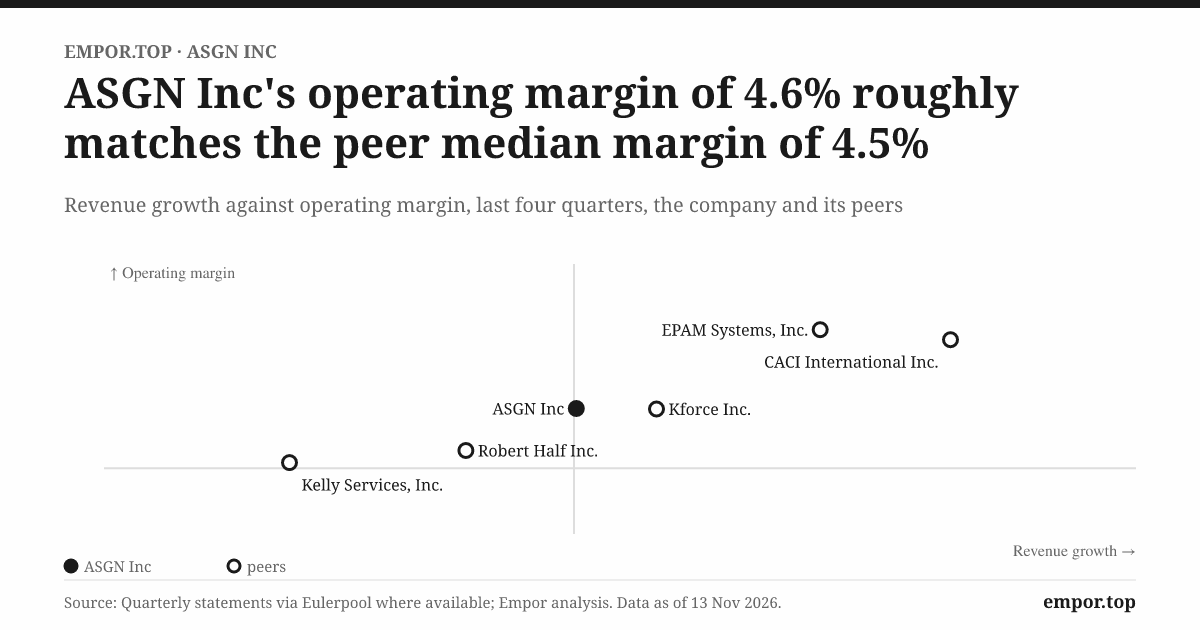
Look at the two segments side by side and the economics become clearer. In 2025, the commercial segment generated about 70% of revenue and about $287 million of segment operating income. The federal segment generated about 30% of revenue and about $95 million of segment operating income.4 Commercial work is more profitable per dollar of revenue, in large part because its gross margins run around 32% while federal gross margins sit near 20%.45 One caution matters here: segment operating income is not the same thing as the company's consolidated operating profit. The two segment numbers add up to roughly $380 million, but the company reported only about $230 million of consolidated operating profit for 2025, because corporate costs, amortization of acquired intangibles and other items sit outside the segments.4 The segments look healthier than the whole.
Compare that with the peak and the cycle comes into focus. In 2022, the commercial segment brought in about $3.4 billion of revenue and about $411 million of segment operating income.3 By 2025 it was down to roughly $2.8 billion of revenue and $287 million of segment income.4 So commercial revenue fell by around a sixth from its peak and commercial segment profit by about 30%. That is what operating leverage looks like in reverse in a people business. When hours fall, the company can cut contractors almost immediately, but its recruiters, account managers and offices cannot be cut as quickly, so profit falls faster than revenue.
The structure of the industry explains why price is hard to defend. A corporate buyer of IT talent can use multiple staffing vendors at once, and large companies routinely maintain lists of approved suppliers who compete on rate and speed for each open requisition. They can bring work in-house when they decide a capability is strategic. They can move work offshore. Government buyers can rebid contracts when they expire. None of that is unique to Everforth, but it means that the burden of proof for a durable advantage is high. Everforth does not publish client retention rates, win rates, or a price-realization series that would show whether it can raise rates faster than its costs. Without that evidence, the most a skeptical investor can say is that the company has scale, relationships and a reputation for filling hard-to-fill roles, which are assets, but not proof of switching costs.
Scale is one of the few things that can be benchmarked. Robert Half, the largest US-listed professional staffing firm, reported about $5.4 billion of revenue in 2025.13 Kforce, a more focused technology staffing firm, reported about $1.3 billion.14 Everforth, at about $4.0 billion, sits between them in size. But the three are not like-for-like. Robert Half has a large finance and accounting staffing business and a consulting arm, Protiviti; Kforce is almost entirely technology staffing; and Everforth has a federal business neither of the others has. They are context for scale, not tidy comparisons for margins or valuation.
Listening for the difference between demand and adjectives
The best place to hear how management sees demand is the earnings call, and the third-quarter 2026 call on October 28 was a good test. In the prepared remarks, Hanson argued that enterprise software platforms "would become a primary channel for deploying AI across the enterprise," and Sadasivam Iyer, the president, said hyperscale cloud clients cited "people, power and equipment" as the factors limiting the AI build-out.5 Those are vivid phrases, but they are claims about the world, not measurements of Everforth's business.
The measurements are more modest. The commercial IT consulting book-to-bill on a trailing twelve-month basis was about 1.1, meaning the company signed slightly more consulting work than it delivered over the year.5 A quarter earlier that figure had been about 1.2.2 So bookings are still running ahead of billings, but by a narrowing margin. Security and risk bookings were up more than 40% year to date, which is a genuine bright spot, but the company does not say how large that practice is relative to the whole.5 The commercial segment's revenue grew only about 1.2% year over year in the third quarter, to about $720 million.5
That is the honest picture of the business today. The mix is shifting toward consulting, and the company is winning work in areas like security and enterprise platforms. But much of the business still rises and falls with client budgets, billable capacity and labor economics, and the company provides limited evidence of recurring revenue or switching costs. The question is whether the shift toward consulting will eventually be large enough to change those economics, and 2025 was the year that question got its first hard test.
V. The Consulting Pivot Meets Its First Hard Test
There are two stories one can tell about what happened to Everforth's revenue mix in 2025, and they lead to very different conclusions.
The first story is the one management tells. In this version, the company has spent years deliberately migrating toward higher-value consulting, building capabilities in cloud, data, cybersecurity and enterprise platforms such as Workday, and 2025 simply revealed the results: consulting grew while low-value assignment work faded. The second story is less flattering. In this version, the mix shifted mostly because clients cut flexible staffing faster than they cut committed consulting projects. When budgets tighten, the first thing a chief technology officer does is release contractors, because they can be let go with a phone call. Consulting projects, by contrast, are harder to stop midstream. So the mix shift is partly a cyclical artifact, and when demand recovers, assignment work might rebound and the mix could drift back.
The record does not let either story win outright, but it does constrain them. Begin with the strategic claim. If consulting were a genuine engine of structural growth, it should have been able to hold up the company's total earnings through the downturn. It did not. The company's revenue and operating profit both fell sharply over that period, even as management pursued a consulting-led strategy.34 The consulting business grew; the company shrank anyway. That does not reject the strategy, but it does narrow it. The defensible claim today is not "Everforth has become a consulting company that is resistant to the cycle." It is "Everforth has a growing consulting business that has not yet been large enough to offset its cyclical one."
The cyclical story has its own problem, though. Commercial consulting grew strongly in 2025, too quickly to be explained only by clients being slower to cancel projects.4 Some of that growth was acquired: TopBloc joined in March 2025, and its revenue landed squarely in commercial consulting.15 Everforth does not publish an organic growth rate for commercial consulting that strips out acquisitions, which is exactly the number an investor would most like to have.
Where the margin went
The deeper problem in 2025 and 2026 has been margins, and here the company's own explanations are specific enough to test. In the third quarter of 2026, consolidated gross margin was about 28.3%, down about 1.1 percentage points from a year earlier.5 In the commercial segment, gross margin fell about 1.3 points, to 31.9%.5 Management gave two reasons. The first was a lower mix of permanent placement revenue. When a recruiter places a candidate in a permanent job, the client pays a one-time fee, typically a percentage of the new hire's first-year salary, and there is almost no direct cost against it. That makes permanent placement among the highest-margin work in staffing, and when companies stop hiring permanently, as many did in 2025 and 2026, that high-margin sliver evaporates first. The second reason was foreign exchange at the company's delivery center in Mexico, where costs are incurred in pesos.5 Foreign subsidiaries generated only about 2% of revenue but about 6% of cost of services in the first nine months of 2026, which means a stronger peso can lift costs without lifting revenue.6
The second quarter told the same story: commercial gross margin down about 0.9 points, again because of a lower mix of permanent placement revenue and exchange rates in Mexico.2 So the commercial margin pressure has been persistent across at least two quarters, and its causes are partly cyclical (permanent placement) and partly structural to the company's own delivery model (offshore and nearshore costs).
Then there is the gap between gross margin and operating margin. In 2022, gross margin was about 29.9% and operating margin about 8.9%.3 In 2025 operating margin was about 5.8%.4 Some of that decline is the drop in revenue spreading fixed costs thinner. Some of it is ongoing costs for restructuring and integration, which the company labels "strategic planning" expenses: about $8.3 million in the third quarter of 2026 alone.5 Those costs sit between the adjusted EBITDA margin that management emphasizes, about 10.3% in the third quarter, and the operating margin of about 5.5% that a GAAP reader sees.56
The technology narrative deserves proportional treatment. Everforth points to demand in AI, cybersecurity, cloud and enterprise platforms, and there is evidence that some of it is real, including those security bookings. But the company does not report standalone revenue or profit for any of these offerings.4 Alliances with large software vendors, certified technical staff and rising bookings in a niche are signs of capability. They are not proof that a material new profit pool exists until they show up in revenue, utilization and margins. Artificial intelligence, in particular, cuts both ways for a business that sells hours. It can create demand for integration and data work, and it can also make each engineer more productive, which reduces the number of hours a client needs to buy. The company itself flags AI as both an opportunity and a potential pressure on labor hours and pricing.4
The promise for 2028
Against that starting point, management set out three-year organic financial targets: revenue growth of 4% to 6% a year, an adjusted EBITDA margin of 12.5% to 13.5% by 2028, and roughly $1 billion of cumulative free cash flow over the period.16 The company says part of the margin plan is a structural cost program with annual savings of about $80 million.165 Put those targets beside the starting point and the size of the ask becomes clear. Revenue in the third quarter of 2026 grew about 2%, below the low end of the target range.5 The adjusted EBITDA margin was about 10.3% in that quarter and about 9.6% in the second quarter, so reaching 12.5% means adding two to three points of margin in about two years.52 Each point of margin on $4 billion of revenue is about $40 million of profit. So the plan needs something like $100 million or more of additional adjusted EBITDA, which is roughly what the cost program alone is meant to deliver, before any help from growth or mix.
On the October call, Jeff Silber of BMO asked about internal hiring and the path back to higher margins. Hanson answered with a number: an adjusted EBITDA margin of 12.5% "or slightly higher" by the end of 2028, adding that there was "no glass ceiling."5 It was a concrete answer, and concrete is better than vague. But a reaffirmed target is a statement of confidence, not evidence of delivery. The plan rests on three separate levers, revenue growth, gross-margin expansion and cost savings, and each needs to show up separately in the reports. Growth is running below target. Gross margin has been falling, not rising. Cost savings are the lever most under management's control, which is why they will be the first to show and the easiest to overstate.
The verdict is therefore narrower than the rebrand. The shift toward consulting is real, and some of it is being won in the right places. But it has not yet demonstrated that it can lift consolidated earnings through a weak cycle, and the next proof is sustained organic consulting growth with stable margins. Until then, the company has been reaching for growth the other way, by buying it.
VI. The $340 Million Question
On March 4, 2025, ASGN announced that it had closed the acquisition of TopBloc, a consultancy built around implementing enterprise platforms, Workday above all, the cloud software that large organizations use to run human resources, payroll and finance.15 The total consideration was $340 million, paid about 90% in cash and 10% in stock.154 On the same day, the company announced a leadership change: Sadasivam "Shiv" Iyer, who had led Accenture's consulting and industry operations across the United States, Canada and Latin America, became president, succeeding Rand Blazer, who became executive vice chairman.15 The pairing was deliberate. A consulting-led strategy got a consultancy acquisition and a consulting executive in the same week.
The rationale is easy to follow. When a large company decides to move its HR and finance systems to Workday, it hires an implementation partner to configure the software, migrate data, connect it to other systems and train staff. Those projects can run for many months and often lead to follow-on work. Hanson said the deal "ideally positions" the company to capitalize on enterprise resource planning and Workday opportunities.15 To retain the talent that made TopBloc valuable, the company granted restricted stock to 41 key TopBloc employees, vesting over two to four years.15 That vesting schedule is a reminder of what was really purchased. In a people business, the asset walks out the door every evening, and the acquirer has to give it reasons to come back in the morning.
What can and cannot be benchmarked
Investors naturally want to know whether $340 million was a good price. The honest answer is that the company did not disclose enough about TopBloc to say. The closing announcement gave no revenue or profit figure for the business.15 What can be measured is scale and accounting. Relative to Everforth's 2025 revenue of about $4.0 billion, the deal was about 8.5% of a year's sales.4 And of the $340 million, about $249 million was booked as goodwill, which is the portion of the price that could not be assigned to identifiable assets like customer relationships or software.4 In plain terms, roughly three-quarters of the price was a bet on future earnings that the books cannot see yet.
The 2026 deal followed the same pattern. In the first quarter of 2026, Everforth acquired Quinnox and recorded about $137 million of goodwill for it.65 The company did not disclose the purchase price or Quinnox's revenue in its quarterly earnings releases. What the releases do show is that goodwill and intangible assets rose from about $2.6 billion at the end of 2025 to about $2.9 billion by mid-2026, and long-term debt rose to about $1.44 billion by June.2
Goodwill on that scale matters for a reason that goes beyond accounting. At the end of 2025, the company's shareholders' equity was about $1.8 billion.4 Goodwill and intangible assets, at around $2.6 billion, were larger than the entire equity base.2 That means that if you strip out the acquired goodwill, the company's tangible net worth is negative. It is not a solvency problem for a business that generates cash, but it does mean that shareholders' equity is mostly a record of what the company paid for other companies, and the value of that equity depends on those acquisitions earning their keep.
The best way to judge the acquisition program is against the company's own history. ECS, bought for $775 million in 2018, delivered a billion-dollar federal business by 2021, which is real scale.10 But federal revenue has barely grown since, and the segment produced about $95 million of operating income in 2025.4 Against a purchase price of $775 million, before counting the later federal acquisitions folded in, that is a pre-tax segment return of roughly 12%, respectable but not spectacular, and earned on a base that has been flat for four years. Oxford tells the other side of the story. Bought in 2007, it was sold in 2021 for $525 million when management decided it no longer fit.10 That was a capital-allocation decision that returned cash. Whether it was well-timed is harder to say, because the money went into a consulting strategy whose returns are still being measured.
The pattern that emerges is a company that expands its portfolio by acquisition and occasionally prunes it, without a published record of the return on each deal. That is common in services companies. It is also exactly what a skeptical investor should push on.
Two uses for the same dollar
Imagine an activist investor in a meeting with management. The first question would be about sequencing. If the consulting strategy is attractive enough to justify the rebrand, why does it need acquisitions to deliver its growth, and why keep buying back stock when net leverage stood at about 3.1 times on the third-quarter call?5 Every dollar spent on a consultancy or on a share repurchase is a dollar not spent reducing debt, and with interest costs absorbing a growing share of profit, that trade-off is not abstract.
The second question would be about execution capacity. The company is simultaneously integrating TopBloc and Quinnox, running its cost program, and trying to reaccelerate organic growth.16 Those programs compete for the same scarce resources: management attention and the cash flow of a business whose profits have shrunk. Cost programs in people businesses carry a particular risk. Cut too deep in recruiting or sales, and the growth that the plan depends on never arrives.
Management's answer, to judge from the third quarter, has been to slow the buybacks and focus on debt. The company repaid about $53 million of debt in the quarter and did not highlight share repurchases.5 That is the right sequencing for a balance sheet at 3.1 times leverage. But it is a recent change, and it follows two years of heavy buybacks and two acquisitions.
The verdict on the $340 million question is therefore open but not hostile. TopBloc and Quinnox fit the stated strategy of building enterprise-platform consulting. But the disclosed data do not establish their standalone returns or a comparable acquisition multiple, so value creation remains to be proved, against debt and against organic growth. The things to watch are acquired revenue contribution, segment margins, any signs of goodwill impairment, and net debt after acquisitions and buybacks. Strategic fit is not proof of success. To see why the debt question has become so pressing, the story has to follow the cash.
VII. Cash That Funded Buybacks—and Debt That Came Back
For most of its history, this company had one financial trait that made almost every other debate easier: it turned profit into cash, and then some. Over the twelve years from 2014 through 2025 it reported about $2.1 billion of cumulative net profit and generated about $3.3 billion of cash from operations, roughly $1.55 of operating cash for every dollar of reported profit.4 After capital spending, free cash flow over the period came to about $2.9 billion.4 That is an enviable record, and it is not an accident. A staffing and consulting business has almost no factories or inventory to finance, and its accounting profit is held down by non-cash charges, chiefly the amortization of intangible assets from all those acquisitions and stock-based pay. In 2025, for instance, about $114 million of net income became about $328 million of operating cash flow, with depreciation and amortization, stock compensation and deferred taxes doing most of the lifting.4
So where did nearly $3 billion of free cash go? Not to dividends; the company paid none over the entire period.4 Not to the bank account either: cash and short-term investments ended 2025 at about $161 million, only about $124 million more than at the end of 2013.4 The money went into acquisitions, including ECS, TopBloc and a string of smaller deals, and into share repurchases. In 2024 alone the company spent about $329 million buying back 3.5 million shares, and in 2025 about $172 million buying back 3.1 million more.4 In November 2025 the board approved a new $1 billion repurchase authorization, which the company described as the largest in its history.17 Against a market value that, by November 2026, was only about $1.5 billion, that authorization is large enough to retire about two-thirds of the company at today's price, if the cash ever existed to use it.
Buybacks have done what buybacks do. The share count fell, which supported per-share results through a period of falling profit. But capital returned to shareholders is capital unavailable for debt reduction, and that trade-off became visible in 2026.
The receivables swing
Here is the scene that should give a careful investor pause. In the first nine months of 2026, operating cash flow fell to about $129 million, from about $226 million in the same period a year earlier.6 Profit had fallen too, but the bigger driver sat on the balance sheet: a cash outflow of about $93 million tied to a build-up in accounts receivable.6 Net receivables rose from about $674 million at the end of 2025 to about $786 million at the end of September 2026.64
Receivables are simply money clients owe for work already delivered. In a business that bills by the hour, they are the bridge between doing the work and getting paid for it, and they tend to rise when revenue grows. But third-quarter revenue was only about 5% higher than in the fourth quarter of 2025, while receivables rose by about 16%.6 Annualize the third quarter's revenue and the September balance works out to roughly 70 days of sales outstanding, well above the 62 days at the end of 2025 and back near the 71-day peak of 2022.43 Part of the increase in the balance sheet figure likely arrived with Quinnox, which would not show up as an operating cash outflow; the $93 million outflow is the portion that came from the existing business taking longer to collect.
None of this means anyone is failing to pay. The company's allowance for credit losses was only about $5.5 million at the end of 2025, tiny relative to the receivables balance, and the company says it estimates expected losses using its experience, ageing and specific reviews.4 Many federal and large corporate clients simply pay slowly, and the timing of a quarter's end can shift collections by weeks. But Everforth does not publish an ageing schedule or an unbilled-revenue balance, so there is no way to see from outside whether the swing is timing or something stickier.46 The free cash flow in the third quarter was about $47 million, about 44% of adjusted EBITDA, while management targets 60% to 65% conversion for the full year.5 The fourth quarter, traditionally a strong collections quarter, will tell whether the receivables come back.
Debt that came back
The balance sheet tells the second half of the story. Borrowings were about $415 million at the end of 2014.7 The ECS financing pushed them above $1 billion in 2018, and they have stayed there since.84 At the end of 2025, long-term debt was about $1.17 billion, a mix of a revolving credit line, two term loans and $550 million of senior notes.4 By September 2026, after the Quinnox purchase, it had risen to about $1.39 billion.6 In July 2026 the company refinanced, replacing its old revolver and one of its term loans with a new five-year $600 million revolver due 2031.26 At September 30, about $227 million of that line was still available, and cash stood at about $148 million.5
Here a careful reader needs to keep two ideas apart. The first is covenant headroom. At the end of 2025, the company's senior secured leverage ratio, as its lenders define it, was about 1.5 times, comfortably below the 3.75 times maximum.4 That means the company is far from tripping its loan agreements. The second is the real cost of the debt. Net leverage, as management measures it on its own adjusted EBITDA, was about 3.1 times on the third-quarter call, against a target of 2.5 times or below.5 Interest expense in 2025 was about $68 million, or roughly 30% of operating profit; pre-tax income was about $163 million.4 Those numbers describe a company with plenty of access to credit but a debt load that is heavy relative to its shrunken earnings.
The company appears to have recognized that. The third-quarter debt repayment and pause in share repurchases included about $9 million of senior notes bought back on the open market.5 That is a meaningful change of posture from 2024, when buybacks consumed more than $300 million. It is also a sign that the record of cash conversion, as strong as it is, did not by itself protect the company from having to choose.
The verdict here is direct. The long-run cash record is real and stronger than the profit line suggests. But the latest working-capital reversal and the higher debt mean that capital-allocation flexibility is less secure than that historical conversion ratio implies. Cash conversion is a habit worth trusting, but it has to be checked every year. And the people responsible for making those choices are the next part of the story.
VIII. The Team Behind the Turnaround Plan
Ted Hanson came to the top job from IT staffing, not from consulting, and he did not start at On Assignment. He arrived through the 2012 acquisition of Apex Systems, the Richmond IT staffing firm, where he had been chief financial officer.17 He became president of the combined company in December 2016, chief executive in May 2019, and joined the board the following month.17 Richmond's business community inducted him into its Business Hall of Fame in 2023.17 His background matters for understanding the company's choices. Hanson came up in IT staffing, in a business where you win by being fast and responsive to clients' talent needs. He is now trying to lead the company into a business where you win by owning outcomes and building deep expertise in platforms and industries. That is a different skill set, and part of the job has been to bring in people who have it.
The most visible example is Sadasivam "Shiv" Iyer, who became president in March 2025.17 Iyer began his career at Wipro Infotech in India, worked his way up at the consultancy A.T. Kearney, and joined Accenture in 2010, eventually leading its Americas consulting and Industry X business.17 At Accenture, his remit included getting value out of acquisitions and scaling organically through investments in AI and industry capabilities.17 Those are precisely the two jobs Everforth needs done: integrate TopBloc and Quinnox, and turn technical capability into growth.
Marie Perry, the chief financial officer, joined in 2022 and was promoted to CFO that August.17 Before that she was CFO of the US division of Brink's, and earlier CFO and chief administrative officer of Jamba Juice, after a long run in finance at Brinker International, the restaurant company.17 It is an unusual résumé for a technology services CFO, and an instructive one: restaurant and logistics finance is all about cost control and cash discipline in businesses with thin margins. Those are exactly the disciplines Everforth's 2028 plan requires.
The board carries the company's staffing roots. Two of its directors, Brian Callaghan and Edwin Sheridan, co-founded Apex Systems in 1995 and joined the board when it was sold in 2012.17 Sheridan alone owned about 1% of the shares, and directors and executive officers as a group owned about 3.2%.17 There is no controlling shareholder. The largest disclosed holders are index and quantitative investment managers: BlackRock, at about 14% as of its last filing, though that filing dates from November 2024; Vanguard, at just under 5% as of September 2026; and AQR, at just under 3%.171819 At the end of 2025, the company had only 27 holders of record, with most shares held through brokers and custodians.4 It is a widely held stock with no anchor owner and few insiders with large stakes, which places most of the accountability on the board and on the pay system.
Pay, and what it rewards
That pay system is worth a close look, because it is where incentives and the 2028 plan meet. Hanson's reported total compensation rose from about $6.9 million in 2023 to about $8.3 million in 2024 and about $10.5 million in 2025.17 Over the same years net profit fell from about $219 million to about $113 million.4 Most of the 2025 package, about $7.8 million, was stock awards, with about $1.6 million of non-equity incentive pay and no separate bonus.17
The headline number exaggerates the disconnect somewhat. Reported stock-award value is the grant-date value of shares that may or may not vest, and the company's own scorecard shows that performance did bite. The annual cash bonus is weighted 80% on adjusted EBITDA and 20% on revenue, and for 2024 those targets were achieved at about 46% and 62%.17 For 2025, the bonuses paid out slightly below target.17 Most strikingly, the performance share units granted in 2023, with a performance period ending in 2025, paid out at zero.17 So the realized pay is less than the headline. But the design deserves scrutiny. The long-term awards are measured on three-year average growth in net operating profit after tax, and the payout schedule still pays half the target award if that profit falls about 18.5% a year.17 A plan that rewards executives for profit shrinking by nearly a fifth annually sets a low bar for the downside. And the grant values themselves kept climbing while earnings fell. Shareholders approved the 2025 pay plan with 98.7% of votes cast, which is strong evidence that investors were comfortable, but it is not proof of future execution.17
What they said, and what happened
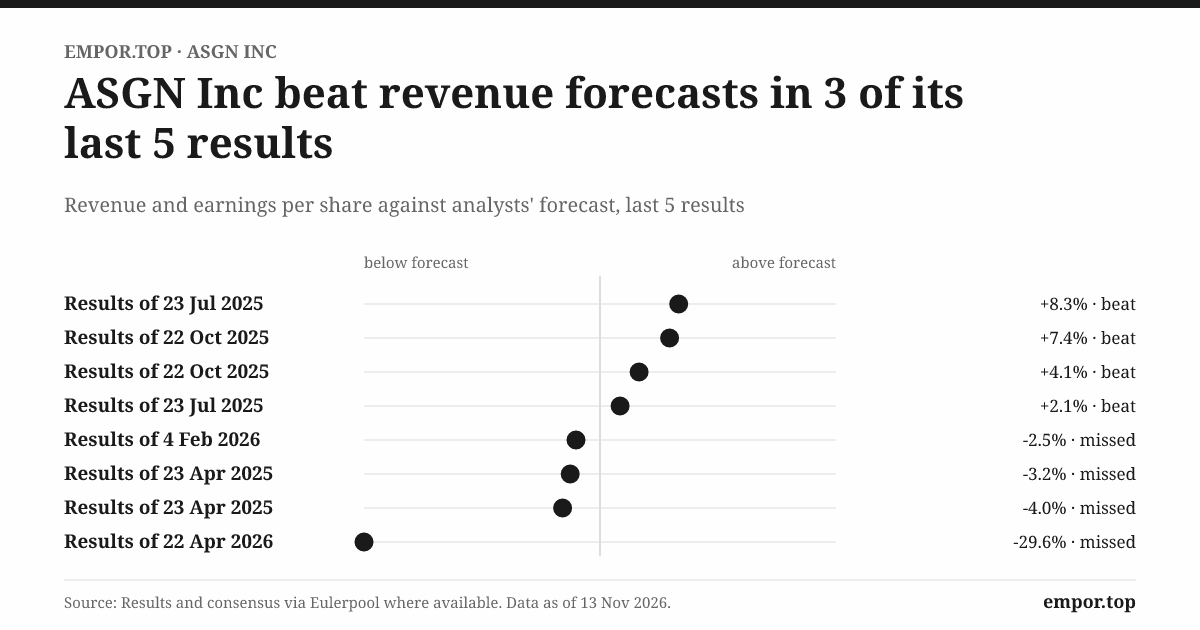
The other way to judge management is to compare what they said with what happened. The company's own bonus scorecard is unusually candid here. For 2024, the adjusted EBITDA and revenue goals were achieved at only about 46% and 62%, because, in the board's words, macroeconomic conditions had hurt performance after the targets were set.17 Plans built on an expected recovery kept meeting a market that did not recover. In 2026 the record has been better on near-term guidance. Third-quarter revenue of about $1.03 billion and adjusted EBITDA of about $106 million both came in above the top of the ranges management had given in July.52 Management has also been specific in its explanations: the federal losses tied to DOGE, the fall in permanent placement, the peso. Those are concrete and checkable, not vague.
On the third-quarter call, the concrete parts of the story were the federal awards and the margin target. The parts still pending were the size and timing of the commercial recovery, where management spoke of improving momentum but has not yet shown consistent organic growth. The verdict on the team is balanced. Hanson has stayed through a hard transition, has brought in outside consulting talent, and has hit recent quarterly guidance. But compensation rose while profit fell, a long-term incentive plan that tolerates large declines does not obviously align with a recovery plan, and the 2028 targets will be the real test of credibility. That brings the story to the question of what the market thinks all of this is worth.
IX. Analysis & Bear vs. Bull Case
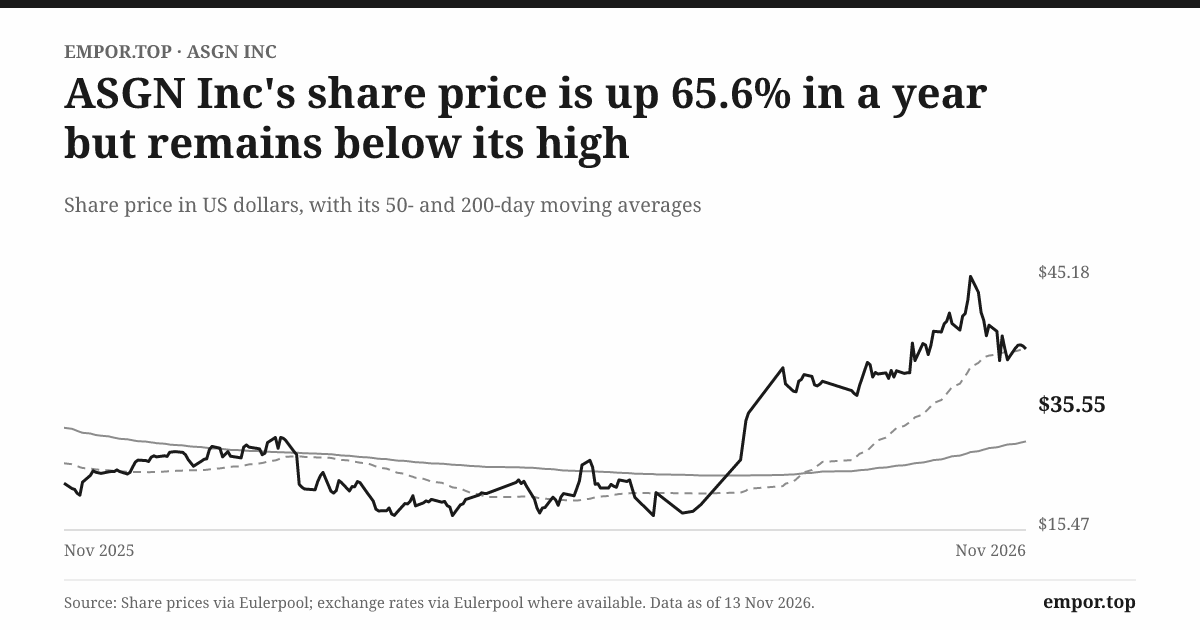
On November 13, 2026, Everforth's shares closed at about $35.55, giving the company a market value of about $1.5 billion and an enterprise value, including debt, of about $2.8 billion.20 Within the past year the stock had touched a low near $17, and its 52-week high was about $43.60, which means the shares had roughly doubled off the bottom while still sitting almost a fifth below their recent peak. The one-year volatility of about 68% is more typical of a speculative technology stock than an established services company. Over five years, the shares had at one point fallen by about 73% from peak to trough. That violent path tells you how uncertain the market has been about what this business is.
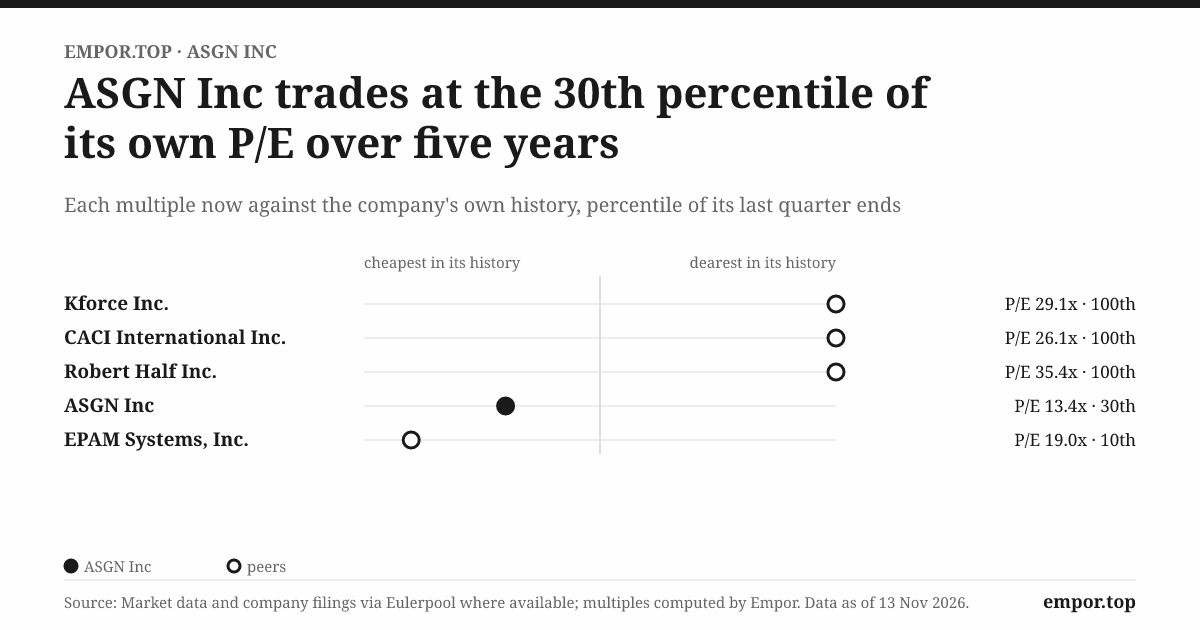
On trailing earnings of about $1.63 a share, the stock trades at about 13.4 times, below its own five-year median of about 15.7 times.6 On enterprise value to EBITDA it is about 9.4 times, and the free cash flow yield, using the past twelve months of free cash flow, is about 13%. The price to book value is about 0.8, but that book value is mostly goodwill, as the acquisition story showed. For context, ManpowerGroup, a much larger and lower-margin general staffing company, traded at about 6.7 times EV/EBITDA in late October 2026.21 Everforth trades at a premium to a general staffing company but at a discount to its own recent history. The market is pricing it as something in between a staffing company and a consulting company, and that is about right.
The real question the multiples cannot settle is whether earnings are near a trough or structurally lower. On trough earnings, a P/E of 13 is cheap. On a permanently lower base, it is fair. A quick way to see what the market assumes: at about $2.8 billion of enterprise value, if the company were to reach management's 2028 margin target on revenue growing at 4% to 6% a year, its adjusted EBITDA would be roughly $550 million to $650 million, implying a multiple of only four to five times today's enterprise value. The market is not paying for that outcome. It is paying for something closer to today's earnings with a modest recovery.
The bull case runs like this. Consulting is now more than 60% of revenue, and commercial consulting has grown through a downturn, with bookings running slightly ahead of billings.45 Federal awards in the third quarter were strong, giving the company a second demand engine that is not tied to corporate IT budgets.5 The company's historical cash conversion has been excellent, and even after the 2026 receivables swing, free cash flow relative to the market value is high. Management has a credible cost program, has brought in a senior consulting executive, and has hit its recent quarterly guidance. If commercial demand recovers, the operating leverage that hurt on the way down helps on the way up. And at a P/E below the company's own median, investors are not being asked to pay for a perfect recovery.
The bear case is equally coherent. Assignment work has shrunk and may not come back if AI tools reduce demand for contract developers. Total earnings are well below 2022 levels and still falling year over year. Gross margins in the commercial segment are under pressure from causes that are only partly cyclical: lower permanent placement revenue and offshore costs. A large part of federal backlog is unfunded, and federal margins are falling as cost-reimbursable work grows. Leverage has risen after acquisitions, and buybacks have competed with debt reduction. The company does not report organic consulting growth, client retention, or receivable ageing, which makes it harder to verify the recovery story. And the 2028 targets require a margin expansion that has not started yet.
The industry's structure helps explain why both cases have force. Buyers have significant power: corporate clients use multiple vendors and can rebid work or bring it in-house, while the federal government sets the rules of procurement and can cancel programs, as 2025 showed. Supplier power is real too, because the scarce input is skilled technical talent, and that talent can move to competitors, to clients, or to freelance work. Rivalry is intense and fragmented, ranging from global consulting firms such as Accenture and large offshore IT services providers to staffing firms such as Robert Half and Kforce. Barriers to entry are modest in commercial staffing but higher in cleared federal work, where security clearances, past performance and contract vehicles take years to build. And the threat of substitution is rising: AI can augment a consultant's productivity, but it can also reduce the number of billable hours a client needs to buy.
Hamilton Helmer's framework of seven sources of lasting advantage gives a useful way to test the moat. Of the seven, scale economies, network effects, counter-positioning, switching costs, brand, cornered resources and process power, Everforth has a plausible claim to only a few, and only partly. In federal work, cleared personnel, past performance and agency relationships function as a kind of cornered resource and switching cost, because an agency cannot easily replace a cleared team mid-contract. But that advantage is contract-specific, not company-wide, and recompetes regularly test it. In commercial work, scale offers some recruiting and delivery advantages, but nothing in the filings establishes a durable cost advantage, high client retention, or a proprietary platform. The moat is plausible in specific contracts, not proven across the company.
The investment spine, then, comes down to this. Everforth might win because it has technology talent across both commercial and federal markets, a consulting mix that is growing, and a cost program that, if delivered, can lift margins even without strong growth. It might not win because assignment work keeps shrinking faster than consulting can grow, because pricing power in a fragmented industry is weak, and because the company has been allocating capital to acquisitions and buybacks before the recovery is established.
Three numbers will settle the argument. The first is commercial consulting organic growth: today the company reports consulting book-to-bill of about 1.1 on a trailing basis but does not separate organic from acquired growth, and that separation is what matters.5 The second is gross margin, consolidated and by segment, which fell in the third quarter.5 The third is net debt relative to operating cash flow and receivables, after the latest leverage and working-capital deterioration.56
The risks are best understood as mechanisms, not headlines. Federal budget fights and recompetes can remove contracts. AI can change both the number of hours clients buy and the price they pay. Receivables growth can suppress cash even when profit holds. And interest expense competes directly with reinvestment and debt reduction. Comparing the second- and third-quarter calls shows management becoming more concrete about margins and federal awards and slightly more cautious about the timing of the commercial recovery. The fourth-quarter and full-year 2026 results will be the next check against the targets and the current guidance.
X. Playbook: Business & Investing Lessons
There is a particular kind of courage required to change a business while it is still earning money the old way. Everforth's history is a sequence of such moments: buying ECS, selling Oxford, buying TopBloc, renaming the company. Each was a bet on a different future, and each left lessons that reach well beyond this one company.
The first lesson comes from ECS. In 2018, a staffing company paid $775 million to enter the federal market overnight, and it worked, in the sense that it bought a real business with real contracts and cleared people. Federal revenue has grown only modestly since 2022, and the company attributed some 2025 contract losses to DOGE initiatives. A new market can be bought in one transaction; a durable advantage has to be earned contract by contract.
The second comes from the Oxford sale and the TopBloc purchase. Together, they show the tension in a portfolio strategy: the logic of each move can be clear while the returns remain unknown. A portfolio strategy is only as good as the price paid and the business kept.
The third comes from the receivables swing of 2026. Everforth's long record of producing more cash than profit allowed it to buy businesses and buy back shares. Then cash got tied up in client invoices. Cash conversion is a record, not a promise; watch what working capital does this year.
The fourth comes from the 2028 targets and the pay that sits beside them. Management has set specific, testable goals and has hit its recent quarterly guidance. The pay system still raises questions about alignment. A confident forecast becomes credible one delivered quarter at a time.
And there is a caution that belongs to Everforth and no other company. The mix has changed, but the business still sells people's time in a market shaped by cycles, labor constraints and customer bargaining power. A better mix changes how much those forces hurt. It does not remove them.
XI. Epilogue
Tonight, Everforth sits at an interesting point in its own story. It has a new name, a reaffirmed three-year plan, revenue that has just started to grow again, and a balance sheet that is carrying more debt than management wants. The company's fourth-quarter guidance calls for revenue of about $965 million to $995 million and adjusted EBITDA of about $93 million to $103 million, with three fewer billing days than in the third quarter.5 The company's 2028 targets now frame every report that follows.165
The next year will provide several clear moments of truth. The first is whether commercial consulting grows organically, and whether assignment revenue stops shrinking, without acquisitions doing the work. If organic consulting growth reaches the high single digits while assignment work stabilizes, the mix shift becomes a growth story. If reported growth depends mostly on bought revenue, the rebrand is still more aspiration than achievement.
The second is whether the cost program shows up in margins without hollowing out the sales and recruiting capacity the growth plan depends on. A margin that rises while bookings fall would be a warning, not a victory.
The third is whether the federal pipeline converts. The third quarter's strong awards need to turn into funded backlog and then revenue, and federal gross margin needs to hold as cost-reimbursable work grows. The next budget cycle, and whatever the government decides about the contracts it reviewed in 2025, will matter more than any single quarter's award number.
The fourth is cash. The fourth quarter is usually a strong collections period. If receivables days come back toward the low sixties and full-year free cash flow lands near management's conversion target, the 2026 swing will look like timing. If they do not, investors should press harder for an ageing schedule.
The last is debt. Progress toward management's leverage target would show that the company can fund its strategy and repair its balance sheet at the same time. Another acquisition or a return to heavy buybacks before that progress would raise the question this whole story has been circling: is the company building a consulting business, or buying one?
XII. Outro
Go back to that NYSE ticker screen in April 2026, the letters ASGN replaced by EFOR. It was a small change on a screen, and a large claim about the future. Behind the new letters is the same business it has always been at heart: tens of thousands of skilled people selling their hours to clients who can always buy those hours elsewhere, while the company depends on collecting invoices before that work turns into cash.
Everforth has changed what it wants to sell. Whether customers will buy enough of it, at better economics, to change what the company is worth is the only question that the name cannot answer. That answer will come the old-fashioned way, one quarter of revenue mix, margin, cash and debt at a time.
References
-
Name and ticker change Form 8-K — Everforth, Inc., 2026-04-24 ↩↩
-
Q2 2026 Earnings Release — Everforth, Inc., 2026-07-29 ↩↩↩↩↩↩↩↩↩↩
-
2025 Annual Report and Form 10-K — Everforth, Inc., 2026-02-25 ↩↩↩↩↩↩↩↩↩↩↩↩↩↩↩↩↩↩↩↩↩↩↩↩↩↩↩↩↩↩↩↩↩↩↩↩↩↩↩↩↩↩↩↩↩↩↩↩↩↩↩↩↩↩↩↩
-
Everforth (EFOR) Q3 2026 Earnings Call Transcript — The Motley Fool, 2026-10-28 ↩↩↩↩↩↩↩↩↩↩↩↩↩↩↩↩↩↩↩↩↩↩↩↩↩↩↩↩↩↩↩↩↩↩↩
-
Q3 2026 Quarterly Report on Form 10-Q — Everforth, Inc., 2026-10-30 ↩↩↩↩↩↩↩↩↩↩↩↩↩↩
-
On Assignment to Acquire ECS Federal — On Assignment, Inc., 2018-01-31 ↩↩↩↩↩↩↩↩↩↩
-
ASGN closes ECS deal to enter federal market — Washington Technology, 2018-04-03 ↩↩
-
ASGN Announces Agreement to Sell Oxford Global Resources — ASGN Incorporated, 2021-07-01 ↩↩↩↩↩↩↩↩
-
US federal agencies directed to prepare for mass layoffs, memo shows — Reuters via Investing.com, 2025-02-26 ↩
-
US federal HR agency leading DOGE job cuts cancels sole-source Workday award — Reuters via Investing.com, 2025-05-09 ↩
-
ASGN Completes Acquisition of TopBloc — ASGN Incorporated, 2025-03-04 ↩↩↩↩↩↩↩
-
Three-Year Organic Financial Targets — Everforth, Inc., 2025 ↩↩↩↩
-
2026 Proxy Statement — Everforth, Inc., 2026-04-27 ↩↩↩↩↩↩↩↩↩↩↩↩↩↩↩↩↩↩↩↩
-
Schedule 13G/A for Everforth — Vanguard Capital Management, 2026-10-30 ↩
-
Schedule 13G/A for Everforth — AQR Capital Management, 2026-11-12 ↩
-
ManpowerGroup Valuation and Financial Data — Aephel, 2026-10-28 ↩
 LinkedIn
 WhatsApp
 Reddit
 Hacker News
 Email
 Kindle
 RSS Feed
 Spotify
 Apple Podcasts
 Amazon Music
 Audible
 YouTube