Ellington Financial: The Mortgage Bets Behind a 13% Yield
I. The dividend that has to survive the portfolio
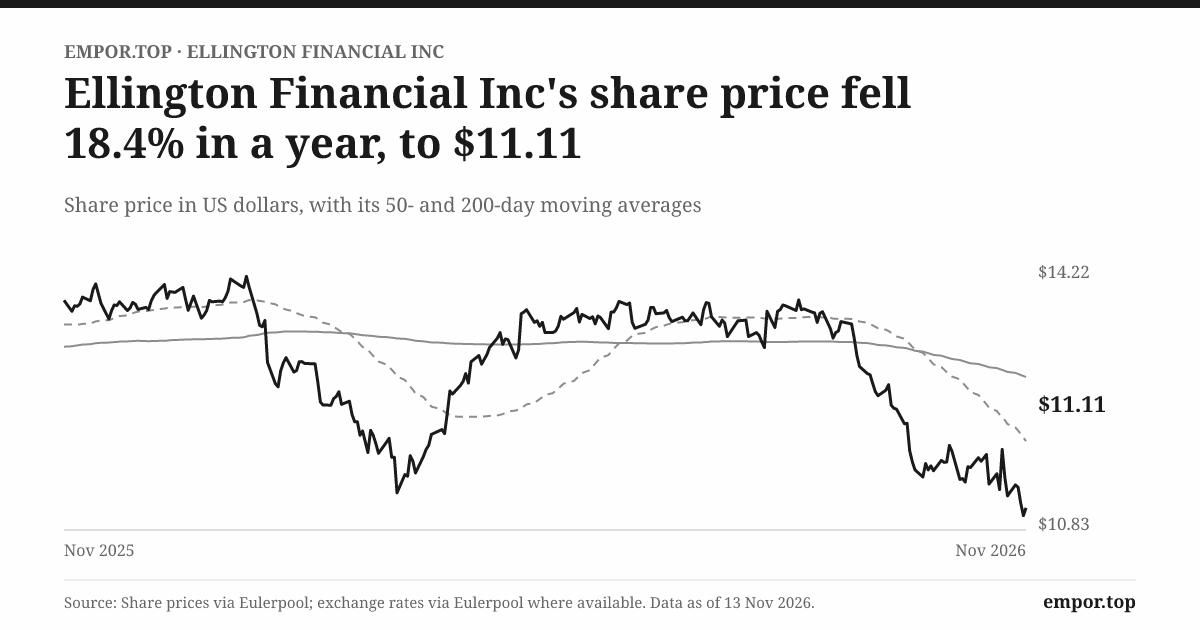
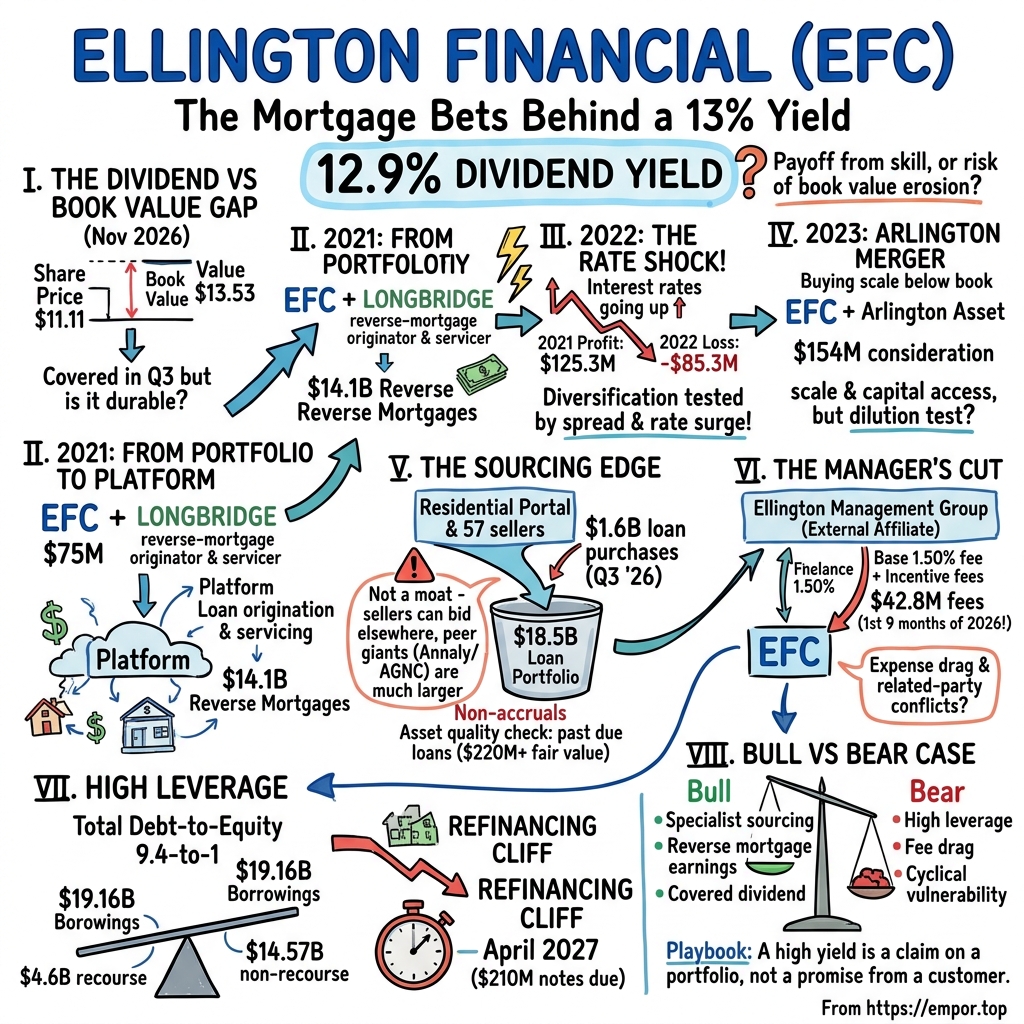
On Friday, November 13, 2026, a share of Ellington Financial changed hands for $11.11.[^1] Seven weeks earlier, at the end of September, the company had told its shareholders that each common share was backed by $13.53 of book value: the net worth of its loans, securities, hedges and operating businesses, after subtracting everything it owed and the claims of its preferred stockholders.1 Put those two numbers side by side and the market was offering a dollar of Ellington's stated common equity for roughly 82 cents.
That discount is the first puzzle. The second is the cheque that arrives in the mail. Ellington pays its dividend monthly, and in the third quarter of 2026 those payments added up to 39 cents a share.1 On the trailing twelve months of payments the stock yields about 12.9%; annualise the current 39-cent quarterly rate and the figure at an $11.11 price is closer to 14%.[^1] In a world where a ten-year Treasury yields a fraction of that, a number like this does not happen by accident. It is either the reward for skill the market has failed to recognise, or the price of risks the market can see and does not want to carry.
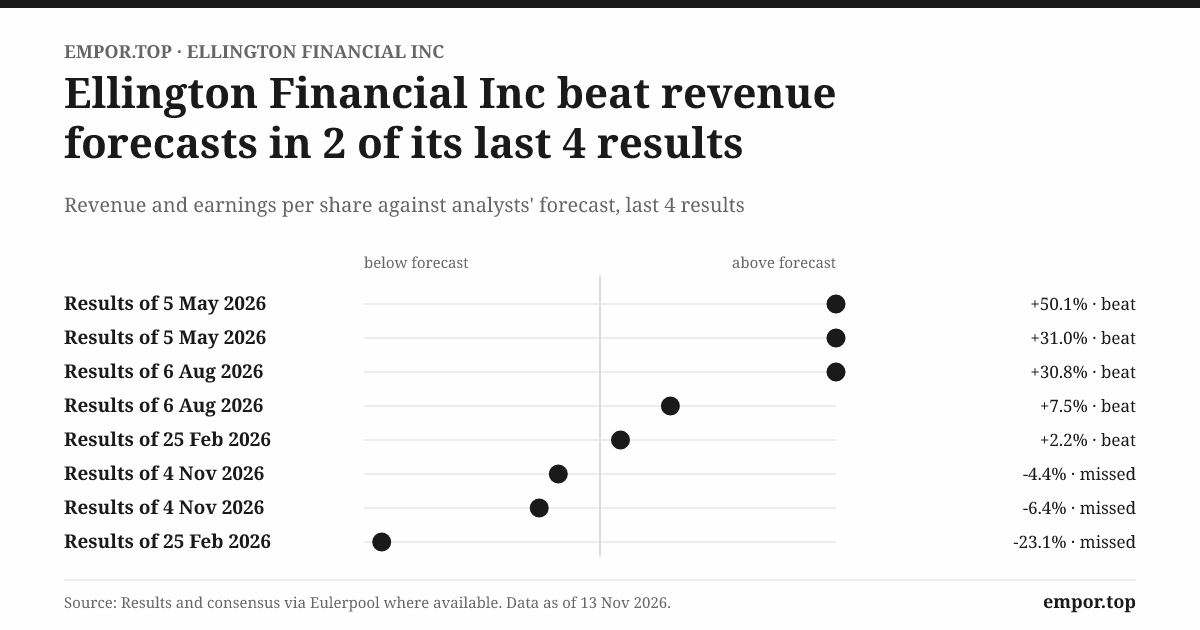
Ellington's own scorecard for the quarter leaned toward the first reading. The company reported adjusted distributable earnings, its preferred measure of the recurring income available to pay dividends, of 45 cents per share, comfortably above the 39-cent dividend.1 GAAP earnings, which include the swings in market value of everything the company owns, were 31 cents per diluted share, below the dividend.1 So the same quarter produced two different answers to the question every income investor asks first: did the company earn what it paid out? On the company's measure, yes, with about 15% to spare. On the accountant's full-cost measure, no.
That gap is not a trick. It is the business. Ellington Financial is not a bank that collects deposits and lends to customers who come back every year. It is a listed portfolio of mortgage-related assets, financed mostly with borrowed money, run by an outside manager. Its "revenue" is the interest its loans and securities throw off, plus fees from originating and servicing reverse mortgages, plus or minus the change in market value of those assets and the derivatives that hedge them. Its "cost of goods sold" is the interest it pays to repo lenders, securitization bondholders and noteholders. When interest rates jump, when mortgage spreads widen, when borrowers pay off early or stop paying altogether, or when lenders pull back, all of those lines move at once.
That is why the book value matters more than any single quarter's earnings. A mortgage investor that pays a fat dividend while its book value bleeds is not paying a yield; it is returning capital with extra steps. A mortgage investor that pays a fat dividend while book value holds, through a full cycle of rates and credit, is doing something genuinely difficult. Over the five years to November 2026 the stock's worst peak-to-trough fall was about 40%, a reminder that the market has not always given Ellington the benefit of the doubt.[^1]
Who buys a stock like this, and why does that matter? Mostly income investors, many of them individuals attracted by a monthly cheque, alongside index funds that own it because it sits in REIT and small-cap benchmarks. That shareholder base tends to anchor on the dividend rate. It is less likely to anchor on book value per share, which is published once a quarter and moves for reasons that take some explaining. The risk of that mismatch is obvious: a company can keep its dividend steady for a long time while its underlying capital shrinks, and the shareholders who watch only the cheque will notice last.
So the story that follows turns on a handful of questions. Can Ellington's network for sourcing loans and its long specialist experience produce returns that repeat, not just returns that happened? Did the two biggest strategic moves of the past five years, taking full ownership of the reverse-mortgage lender Longbridge and absorbing the listed mortgage investor Arlington Asset Investment, make each share more valuable, or just make the company bigger? And can a balance sheet that borrows more than nine dollars for every dollar of equity protect book value and the dividend when funding or credit turns hostile?
One boundary needs drawing before the story starts, because it trips up even experienced readers. Ellington Financial Inc., ticker EFC on the New York Stock Exchange, is one client of a much larger private firm, Ellington Management Group. EFC's results include its consolidated subsidiaries, including Longbridge, and the securitization trusts it consolidates on its balance sheet.2 They do not include the hedge funds, separate accounts and other businesses that Ellington Management Group runs for other investors. The people overlap; the money does not. Keeping that line clear is essential, because the relationship between the listed company and the private firm that manages it is one of the central threads of this story.
The thread starts with how a mortgage portfolio decided it wanted to own a mortgage company.
 Subscribe on LinkedIn
II. From mortgage portfolio to operating platform
On December 1, 2021, Ellington Financial announced that it would buy the rest of Longbridge Financial, a reverse-mortgage lender based in New Jersey in which it already held a large minority stake.[^4] The seller was Home Point Capital, a mortgage originator that had been riding the refinancing boom and was about to discover how fast that boom could end. EFC agreed to buy Home Point's 49.6% interest for about $75 million.[^4] By the time the deal closed in October 2022, the mortgage world had turned upside down, and Home Point reported receiving approximately $38.9 million in cash at closing.3 The gap between the headline price and the cash at closing reflects adjustments under the deal terms; what matters for this story is that EFC took full control of an operating lender at a moment when most mortgage lenders were shrinking.
To understand why that was a strange and interesting move, it helps to know what EFC had been until then. The company was formed in 2007 as a vehicle for Ellington Management Group,4 the mortgage specialist founded in December 1994 by Michael Vranos, who had run the mortgage-backed securities business at Kidder Peabody before that firm was broken up.[^7] Ellington's founding generation came out of the trading floors where Wall Street learned to slice home loans into bonds, and the firm's reputation was built on modelling those bonds, buying them when they were mispriced and hedging the interest-rate risk away. EFC's common shares began trading on the New York Stock Exchange on October 8, 2010.4 Laurence Penn has run the company as chief executive since 2007, and Vranos remains co-chief investment officer alongside Mark Tecotzky.5
For most of its public life EFC was what its name implied: a financial portfolio. It bought non-agency mortgage bonds, agency mortgage pools, consumer loans, small-balance commercial loans and other credit, financed them with repurchase agreements, hedged them with swaps and short Treasury positions, and paid out most of what it earned. It had no customers in the ordinary sense. It had counterparties.
Longbridge was different. A reverse mortgage lets a homeowner aged 62 or older borrow against their home's equity without making monthly payments; the loan balance grows over time and is usually repaid when the borrower moves out, sells or dies. Most reverse mortgages in the United States are Home Equity Conversion Mortgages insured by the Federal Housing Administration, which a lender can pool into securities guaranteed by Ginnie Mae. A growing slice are proprietary reverse mortgages for more valuable homes, which carry no government insurance and are financed through private securitizations. Longbridge originates both kinds, services loans after they are made, and sells or securitizes the output.4
The logic of owning it was a chess move rather than a land grab. A pure investor buying reverse-mortgage bonds competes with every other buyer for the same paper. An investor that owns the lender gets first sight of the loans, controls underwriting and servicing, and can choose whether to hold the assets, finance them, securitize them or sell them. The originator earns a gain when it sells loans; the investor earns interest when it holds them. Owning both lets EFC decide where along that chain to take its profit.
The scale today is the clearest sign of how that bet has grown. In the third quarter of 2026 Longbridge originated $676.3 million of reverse mortgages.1 At September 30, EFC's balance sheet carried $18.5 billion of loans, and $14.1 billion of that was reverse mortgages.2 Most of those reverse loans sit inside securitization structures EFC consolidates, which is why its balance sheet looks enormous relative to its equity. That is a crucial detail: the reverse-mortgage book is the single biggest reason EFC's total borrowings and total assets ballooned after 2022.
Yet the earnings tell a more modest story about Longbridge itself. In the third quarter, EFC's investment portfolio segment contributed $61.1 million of net income to common stockholders; the Longbridge segment contributed $12.5 million.1 On the company's adjusted distributable measure, Longbridge generated $8.6 million.1 Longbridge is real, measurable and profitable. It is also clearly the junior partner. Roughly five dollars of quarterly profit came from the investment portfolio for every dollar from the operating platform.
There is also a cost line that a pure portfolio never had. In the first nine months of 2026, Longbridge ran up $90.0 million of operating expenses, mostly salaries and benefits, with some technology and marketing.2 A securities portfolio does not need loan officers or call centres. An origination and servicing business does, and those costs do not shrink when volumes do.
The growth claim deserves a careful test. Volume has risen. But in the third quarter, management told analysts that Longbridge's origination margins narrowed and that gains on proprietary reverse-mortgage securitizations fell from the prior quarter.6 That is the familiar pattern of mortgage origination everywhere: when volumes grow, competition and funding costs shave the profit on each loan, and securitization gains move with investor appetite for the bonds. Origination volume is the headline, but the economic scorecard for Longbridge is the trio of volume, margin and segment earnings read together. A quarter of rising volume with falling margins is not growth in the sense shareholders should care about.
The deeper question is what Longbridge can do that an outside originator and servicer cannot. The bullish answer is integration: EFC can price loans knowing exactly how it will finance them, and it can capture the securitization economics rather than paying them away. The skeptical answer is that the reverse-mortgage market is small, government programmes set much of the product's terms, and the largest independent lenders have their own securitization machines. What EFC has not published is a comparison showing that loans it originates through Longbridge earn better net returns, after funding costs and management fees, than the same capital would earn buying comparable assets from third parties. Until that evidence exists, Longbridge reads as a solid platform that gives EFC access and optionality, not yet as proof of a superior franchise.
And it is worth remembering when this platform arrived. EFC closed on Longbridge in October 2022, at the end of the most violent year for mortgage markets in decades, which is where the next part of the story begins.
III. 2022: the rate shock behind the diversification story
In the spring of 2022, mortgage investors watched the ground move under them almost daily. The Federal Reserve had begun raising rates in March and was signalling much more to come; mortgage rates leapt; the spread between mortgage yields and Treasury yields widened sharply as banks and the Fed itself stepped back from buying mortgage bonds. Ellington reported a loss for the first quarter of 2022, and on its call management described a rapidly changing rate environment, presenting the decline in book value as moderate and crediting its interest-rate hedges and diversified credit portfolio for limiting the damage.[^10]
That framing was not wrong about the first quarter. It was incomplete about the year. By the time EFC reported its fourth quarter, 2022 had produced a net loss attributable to common stockholders of $85.3 million, against a profit of $125.3 million in 2021.[^11] A swing of more than $200 million in a single year, for a company whose common equity was then on the order of $1 billion, is the kind of number that ends careers at some firms. It also arrived in the same year EFC was buying the rest of Longbridge, so management was simultaneously absorbing a loss and enlarging its commitment to mortgage origination.
The mechanism is worth slowing down for, because it is the mechanism that drives every future stress test. Think of EFC's portfolio as a shop full of goods valued at market prices every quarter, bought partly with a bank loan that the bank can recall at short notice. When rates rise, the market value of fixed-rate mortgage assets falls, because new loans pay more. When mortgage spreads widen, which means investors demand more yield for holding mortgages rather than Treasuries, those values fall again, and the hedges, which mostly protect against Treasury rate moves, do not offset the spread move. Funding costs rise at the same time, because repo lenders charge more and ask for bigger cushions of collateral. And loan originators, including Longbridge, find that borrowers vanish when rates jump, so origination volumes and gain-on-sale margins drop just as the portfolio is losing value. Four separate legs of the business, which in calm years look diversified, are all being pushed by the same hand.
That is the honest lesson of 2022. Diversification did not fail completely: EFC did not collapse, did not suspend its dividend, and remained profitable on many of its credit positions. But diversification across asset types offers less protection than it appears to when the shock is a market-wide repricing of interest rates and mortgage spreads. In that kind of storm, the correlation between the legs goes up, and the hedges protect against only part of the move.
Leverage amplified the lesson. By the end of 2022, EFC's total debt-to-equity ratio, including borrowings inside consolidated securitizations, was about 10.2 to 1.[^11] A large part of that jump reflected consolidating Longbridge's reverse-mortgage securitizations rather than new recourse borrowing, and the distinction between those types of debt matters a great deal, as the balance-sheet story later shows. But a reader looking at a company with ten dollars of debt per dollar of equity, in the year it lost money, can be forgiven for asking how much of a shock the equity could absorb.
What changed after 2022 is visible in the shape of EFC's borrowing rather than its size. By 2026, roughly three-quarters of the company's debt sat inside securitizations rather than on short-term repo lines, a structure that ties the funding of each pool of loans to the life of those loans.2 That is the institutional memory of 2022 written into the balance sheet: a mortgage investor that once depended heavily on repo, which can be pulled at the worst moment, has moved toward funding that cannot be called because prices fell. The improvement is real, though it is easier to build such a structure in a calm market than to prove it works in a disorderly one.
The pandemic offers a longer-cycle check, and it points in the same direction. In the first quarter of 2020, when market liquidity in mortgage credit evaporated in a matter of weeks, EFC reported an economic loss of about 16% on its equity for the quarter.[^12] That is a quarter's worth of book value, not a quarter's earnings. The company responded by strategically shrinking its agency mortgage portfolio to free up liquidity and reduce the risk of margin calls it could not meet.7 It survived, and the recovery in subsequent quarters was real. But the sequence revealed how a leveraged mortgage portfolio behaves under stress: marks fall first, financing tightens second, and the manager's best tool is selling assets into a weak market to protect the rest.
There is an even older version of the same lesson in the Ellington family history. In October 1998, as the near-collapse of Long-Term Capital Management froze mortgage-bond markets, Ellington's private hedge funds auctioned roughly $1.5 billion of mortgage securities over the Columbus Day weekend to meet margin calls from their lenders.8 Nobody should map the private firm's 1998 experience onto today's listed company, which has different capital and different funding. What it shows is that the people running EFC have lived through funding crises before, which cuts both ways: experience is an asset, but so is the humility of knowing that skill does not stop margin calls.
The fair test to carry forward is simple to state and hard to pass. Can EFC preserve its common book value per share through a combined rate, spread and credit shock, without having to sell new shares below book value to plug the hole? The record through 2020 and 2022 says the company can survive such episodes. It does not yet say the company can come through one with book value intact. The recovery after 2022 was partly earned and partly bought, because the company used the turbulent years that followed to make its largest acquisition, paid entirely in its own shares.
IV. Arlington: buying scale below book
On May 30, 2023, the mortgage-REIT sector was still nursing the wounds of the previous year. Shares across the group traded well below book value; investors had lost faith in the industry's ability to protect equity when rates moved. That morning, Ellington Financial and Arlington Asset Investment announced that EFC would acquire Arlington in an all-stock merger.9
Arlington was a small, long-listed mortgage investor based in Virginia with a history that ran back through several incarnations, and by 2023 its shares sat at a deep discount to the value of its assets. EFC's offer valued Arlington at about $154 million.9 Against Arlington's unaffected share price that represented a premium of roughly 73%, a number that would usually make shareholders of the acquirer nervous. But against Arlington's diluted tangible book value, the offer was a 15% discount.9 Arlington's shareholders were expected to end up owning about 15% of the combined company.9
Those two reference points tell different stories, and neither one settles the question. The 73% premium shows how cheaply the market was valuing Arlington's stock; the 15% discount to tangible book shows that EFC was, on paper, paying less than the stated value of the net assets it was buying. That argues against the simplest overpayment charge. If Arlington's assets were worth what Arlington said they were worth, EFC was buying a dollar for about 85 cents and paying in its own shares. In the investor presentation that accompanied the deal, management framed the merger as accretive to book value per share and promised benefits from greater scale, better access to capital markets and spreading fixed costs over a larger base.10
What Arlington added was a balance sheet: a portfolio heavy in agency mortgage-backed securities and mortgage servicing rights investments, along with the liabilities and preferred securities that came with it.10 Arlington had outstanding senior notes and preferred stock, and in a merger those obligations do not disappear; they become the acquirer's. EFC issued about 11.7 million common shares to Arlington's holders when the deal closed in December 2023.4 It also assumed Arlington's preferred stock, which became new series of EFC preferred, adding a layer of claims that sits ahead of common shareholders.4
Something else was happening that summer that changes how this deal looks in hindsight. Barely a month after announcing Arlington, on July 3, 2023, EFC announced a second all-stock merger, this time with Great Ajax, a REIT focused on re-performing and non-performing residential loans. By October 20, the Great Ajax deal had been terminated by mutual agreement, and EFC agreed to pay Great Ajax $16 million, $5 million in cash and $11 million by buying Great Ajax shares at $6.60 each.11 An analyst at Keefe, Bruyette & Woods attributed the break-up to underperformance in Great Ajax's assets and a divergence in the two stocks after the announcement, noting EFC's shares had fallen about 11% while Great Ajax's rose about 9%.12
That episode belongs next to the Arlington story because it tests the claim that EFC's acquisitions reflect patient, disciplined capital allocation. Two simultaneous all-stock mergers in a single summer look like a manager eager to grow the vehicle it is paid to manage. Walking away from one of them, and paying to do so, can be read as discipline, a refusal to complete a deal whose economics had soured. It can equally be read as evidence that the diligence came after the announcement rather than before. The honest reading is somewhere between: the company was willing to cut a deal loose, which is to its credit, but it had to pay $16 million to fix a commitment it should not have needed to fix.
So did Arlington create value? The falsification test is per-share outcomes, not size. After the merger, EFC's total equity grew from about $1.2 billion at the end of 2022 to about $1.8 billion by the end of 2025, and its total borrowings rose from about $12.4 billion to about $17 billion.4 Diluted earnings per share were $1.17 in 2023, $1.63 in 2024 and $1.48 in 2025.4 Those are better than the 2022 loss, but they were earned on a share count that kept rising, because EFC continued to issue new common stock through at-the-market programmes and follow-on offerings after Arlington. Book value per common share, meanwhile, sat in the low-to-mid teens, ending the third quarter of 2026 at $13.53.1
That record does not show Arlington destroying value. It also does not show Arlington creating a step change in per-share earnings power. The merger made the company bigger and probably cheaper to run per dollar of equity, which is the sort of benefit a larger REIT does capture; spreading a public company's fixed costs over more equity is real. But scale in a mortgage REIT is not like scale in software. A bigger portfolio does not, by itself, earn a higher return on each dollar. The edge has to come from what the manager buys and how it finances it, and from not issuing too many shares along the way.
The arithmetic of an all-stock deal makes the point sharper. When a company pays with its own shares, what matters is not the price against the target's book value alone, but that price relative to how the market values the acquirer's own shares. If EFC's stock was itself trading below its own book value at the time, then each new share it handed to Arlington's holders carried a claim on more than a dollar of EFC's book for every dollar of market value. Buying Arlington at 85 cents on the dollar with currency that was also discounted is a far less striking bargain than the headline suggests; the true accretion depends on the gap between the two discounts, and then on whether Arlington's assets were really worth their stated marks. That is why the promise of book-value accretion in the deal presentation could only ever be confirmed after closing, as Arlington's portfolio was absorbed, re-marked and in part sold or refinanced. The precise contribution of the Arlington assets to EFC's later earnings is not something the company breaks out, which is itself part of the answer: once merged, the deal disappears into the larger balance sheet, and only the per-share totals can judge it.
It is also important not to blur Arlington with Longbridge. Longbridge was the purchase of an operating platform, paid largely in cash, with a strategic rationale about controlling the supply of an asset. Arlington was the purchase of a listed balance sheet at a discount to stated book, paid in stock, with a rationale about scale and capital access. Adding their prices together, or treating them as one strategy, would overstate the coherence of the plan. They were two different bets made by the same manager in the same stressed market.
The question Arlington leaves behind is whether the larger EFC buys better assets than the smaller one did. That depends on the engine that feeds the portfolio, which is where the company's claimed edge actually lives.
V. The sourcing edge, and the limits of a mortgage moat
Somewhere in a quiet corner of the American mortgage industry, a small lender closes a loan to a self-employed borrower whose income does not fit the boxes that Fannie Mae and Freddie Mac require. The lender has no desire to hold that loan for thirty years. It wants to sell it, quickly, to someone who will pay a fair price and settle on time, so it can lend the money again. In the third quarter of 2026, Ellington bought $1.6 billion of residential loans from 57 such sellers through its residential loan purchasing portal, management told analysts on the earnings call.6
That picture is the heart of the bull case. EFC's claim is that it has built a network of originators who bring it loans that sit outside the standard government-backed mortgage machine: non-qualified mortgages for borrowers with unusual incomes, short-term bridge loans to property investors who renovate and resell homes, small-balance commercial real estate loans, consumer loans, reverse mortgages and an assortment of mortgage-related securities. Those assets are less standardised than agency mortgage bonds, which means they require more expertise to price and more work to finance, and in theory that friction is where a specialist earns a better return.
The market structure explains both the opportunity and the limits. Mortgage investing is crowded at the top. In the third quarter of 2026, Annaly Capital Management reported total assets on the order of $130 to $146 billion, and AGNC Investment reported a balance sheet of similar magnitude.13[^20] EFC's balance sheet, at roughly $19 billion of assets, is a fraction of either. But the comparison is not like for like. Annaly and AGNC are dominated by agency mortgage-backed securities, where credit risk is guaranteed by government-sponsored entities and the game is about interest-rate and spread management at enormous scale. EFC's mix of reverse mortgages, non-QM loans, bridge loans, commercial loans, securities and other credit is a different business. It competes less with the agency giants than with private credit funds, insurers, other specialist REITs, and the securitization desks of banks and asset managers, all of whom also want high-yielding mortgage credit.
Run that landscape through Michael Porter's five forces and the shape of the competitive problem becomes clearer. Loan sellers, the suppliers in this business, have real bargaining power: a lender with a pool of non-QM loans can ask several buyers to bid, and 57 sellers in a quarter suggests breadth, not exclusivity. Funding providers, the repo lenders and securitization bond buyers, hold perhaps the most power of all, because their terms determine whether a loan that yields 8% earns the REIT a double-digit return on equity or a single-digit one. Rivalry is intense and visible, both among mortgage REITs and among the private credit pools that have flooded into residential lending. Substitutes for EFC's role, as the buyer of last resort for non-standard loans, are plentiful when markets are calm. Barriers to entry are modest for anyone with capital and a credit team, though high for anyone who wants to originate and service reverse mortgages under federal programme rules. The forces that matter most here are the two flanking the company: the sellers who supply its loans and the lenders who fund them.
It is worth being precise about how the portfolio actually makes money, because it explains why the usual scorecards fail. The first engine is net interest income: the yield on loans and securities minus the cost of the debt that funds them. The second is Longbridge's origination and servicing income, earned when loans are made, sold or securitized and serviced afterwards. The third is securitization economics: when EFC pools loans into bonds and sells the senior slices, it typically retains the riskiest, highest-yielding pieces and can lock in long-term, non-recourse financing for the rest. The fourth is realised and unrealised gains and losses on assets and hedges, which can dwarf the first three in a volatile quarter.
That fourth engine is why reported revenue growth tells investors so little here. On standardised data, EFC's quarterly revenue jumped more than 100% year over year in several quarters across late 2025 and the first half of 2026, then fell 19% year over year in the third quarter of 2026, while operating profit dropped by about 72%.1 Nothing in the underlying business changed that violently. Asset prices and hedge marks did. Over the first nine months of 2026, EFC reported $209.6 million of total other income, more than its $183.8 million of income before tax and equity-method earnings.2 In the third quarter alone, $73.9 million of losses on securities and loans were offset by gains on derivatives and on secured borrowings that the company carries at fair value.2 When a portfolio's quarterly results are dominated by two large numbers cancelling each other out, revenue and operating margin comparisons should not be read like those of a company selling products under contract.
So the sourcing claim has to be tested where it matters: in credit outcomes. At September 30, 2026, EFC held residential mortgage loans with $245.9 million of unpaid principal that were at least 90 days past due and on non-accrual status, carried at a fair value of $220.2 million.2 Commercial loans with $57.1 million of unpaid principal were in the same state, carried at $52.8 million.2 Both figures were lower than at the end of 2025, when the residential and commercial non-accrual balances were $276.6 million and $64.8 million of principal respectively.2 That improvement is a genuine positive. So is the fact that the company already marks these loans below their principal balances, which means some expected loss is already reflected in book value.
But scale those numbers against what is at risk. Roughly $300 million of seriously delinquent loans by principal sits against common equity of around $1.7 billion. The question is not whether the delinquent loans exist; every credit portfolio has them. It is whether the fair-value marks are right, and whether collateral recoveries, when the homes and commercial properties are eventually sold, come in at or above those marks. That is where an underwriting edge would show up most clearly: in realised losses that consistently come in below what the market feared.
There is also a commitment that extends the risk forward. At quarter-end, EFC had $265.6 million of unfunded commitments to purchase residential transition loans, the short-term bridge loans that investors use to renovate homes.2 Bridge lending has been one of the fastest-growing corners of private credit, which is exactly why it warrants care: rapid growth in a niche tends to compress pricing and loosen terms.
Where does this leave the moat claim? The evidence supports a narrower version of it. EFC has broad sourcing access, long experience in non-standard mortgage credit and reverse mortgages, and a credit book whose delinquencies were falling in 2026. That is a capability. It is not, on the record, a durable moat, because sellers can and do sell to many buyers, funding terms are set by markets EFC does not control, and the company does not publish risk-adjusted returns by channel that would let an investor compare its outcomes with peers across a full cycle. The forward test is plain: if the sourcing network is an edge, it should show up as better realised credit outcomes and higher net returns on equity than peers in comparable assets, not merely as more loans purchased.
And an investor trying to judge that edge runs immediately into the question of who, exactly, is doing the sourcing, and what they are paid for it.
VI. The manager is part of the investment
One fact reframes the entire company: Ellington Financial Management LLC, the entity that manages EFC, has no employees of its own.5 The people who pick EFC's loans, negotiate its financing, run its hedges and write its quarterly letters are employees of Ellington Management Group, the private firm. EFC pays the manager; the manager relies on the private firm's staff; and the private firm also runs money for other clients. When an investor buys EFC shares, they are buying a portfolio, but they are also hiring a team they cannot directly employ, on terms they did not negotiate.
That arrangement is common among mortgage REITs, and it has real advantages. A small listed company gets access to a deep bench of analysts, traders, modellers and lawyers that it could never afford to build on its own. Ellington Management Group has spent three decades building relationships with loan sellers, securitization buyers and repo lenders, and EFC benefits from that network from day one. The founding generation's experience in mortgage markets, including the crises of 1998, 2008 and 2020, is not something a newly formed REIT could buy.
The cost is visible in the fee structure. EFC pays a base management fee of 1.50% a year on its adjusted operating-partnership equity, and an incentive fee linked to adjusted net income over the trailing four quarters above a hurdle rate.2 In the first nine months of 2026, the company incurred $21.8 million of net base fees and $21.0 million of incentive fees, a combined $42.8 million that amounted to about 18.8% of its total expenses.2 On top of that, EFC reimbursed the manager $20.0 million for operating costs over the same period, and at September 30 it owed the manager $9.7 million.2
Expressing those fees as a share of revenue would be misleading, because EFC's revenue line swings with asset marks. Expressing them against equity is more instructive. A 1.5% base fee on equity, at a time when the portfolio's leverage is close to ten to one, is a fee charged on the shareholders' capital, but the manager is effectively being paid to run a balance sheet many times larger. Add incentive fees and reimbursed expenses, and the annual cost of the management relationship runs to roughly 5% of common equity. Against a target dividend yield in the low teens, that is a material slice of the economics, and it is paid whether or not book value per share rises.
The relationship goes beyond fees. EFC buys loans from originators in which Ellington affiliates have interests, under related-party agreements; it has guaranteed borrowings of one such originator up to a cap of $15.0 million, with nothing drawn at September 30.2 It holds beneficial interests in affiliate-sponsored trusts whose residential loans and foreclosed properties had an underlying balance of about $2.2 billion.2 The proxy explains that cross-transactions between EFC and other Ellington accounts must be at prevailing market prices, and that principal transactions require approval from EFC's independent directors.5 Those safeguards are real. They manage the conflict; they do not remove it. When the same firm sources an asset, sets its price, earns fees on the vehicle that buys it, and runs other funds that may want the same asset, the shareholder is relying on governance and integrity rather than on arm's-length market forces.
How have the people at the top behaved? Laurence Penn has led EFC since 2007, which makes him one of the longest-serving chief executives in the mortgage-REIT sector.5 His compensation is not paid by EFC. The proxy estimates, however, that about $9.4 million of the $29.9 million in base and incentive fees EFC paid the manager in 2025 could reasonably be associated with the compensation of executives whose pay EFC does not reimburse.5 Chief financial officer JR Herlihy is in a different position: EFC partly reimburses his pay, and his reported compensation from the company was $1.15 million in 2025, up from about $1.05 million two years earlier.5 Those are modest figures by the standards of financial-services executives; the economic incentive that matters most sits in the fee stream to the manager, not in individual pay packages.
Ownership aligns some of that incentive. Michael Vranos personally held about 3.39 million shares, or 2.7% of the company, in the proxy's March 2026 snapshot.5 That is a meaningful personal stake, large enough that he feels a fall in the share price. It is also small relative to the fee stream, which grows with equity regardless of whether that equity was raised above or below book value.
Shareholders have noticed, mildly. At the May 2026 annual meeting, 3.27 million votes were cast against the say-on-pay resolution, and independent director Stephen Dannhauser received 10.33 million withheld votes, the most among the nominees.14 Both proposals passed comfortably. In context, these are not signs of revolt. They are a small but recorded minority signalling that the independent board's oversight of the manager is where investors look first. Four of the five directors are independent, and the chair, Ronald Simon, is independent.5
The skeptical investor's question writes itself. EFC's affiliate sources loans, sets their price, finances them and is paid for all of it. What independent, comparable disclosure would show that those affiliate-sourced assets earn more than the same capital could earn elsewhere after all fees, reimbursements, rebates and credit losses? EFC does not publish returns by sourcing channel net of the management relationship, and it does not compare those returns with an external benchmark. Until it does, the value of the manager is something investors infer from the overall track record, and that track record is exactly what the rest of this story is testing.
The fees, after all, are paid out of a balance sheet. And it is the balance sheet, more than anything the manager says, that determines whether the dividend survives the next storm.
VII. A high yield meets a highly levered balance sheet
At the end of September 2026, Ellington's balance sheet carried $19.16 billion of borrowings against roughly $2 billion of total equity.2 Management summed it up as a total debt-to-equity ratio of 9.4 to 1, alongside a weighted-average remaining term on its repo borrowings of 8.9 months.1 Read the first number alone and EFC looks like a bank with a fraction of a bank's capital. Read the second alone and it looks like a company that must refinance most of its short-term funding before next summer. Neither reading is quite right, and the difference between them is the most important technical idea in this story.
The key is who can come after the company if things go wrong. Of the $19.16 billion in borrowings, $14.57 billion were non-recourse, and $4.60 billion were recourse.2 Non-recourse debt is mostly the senior bonds of securitizations that EFC consolidates on its balance sheet: if the loans inside a securitization trust go bad, the bondholders can take the loans, but they cannot reach into EFC's other assets. Picture a set of sealed tanks. Each securitization holds its own loans and its own debt, and a leak in one does not drain the others. EFC's equity in each tank is the retained, riskiest slice, so it absorbs the first losses, but its maximum loss on that tank is what it has invested.
Recourse debt is different. Repo loans, the company's unsecured senior notes and other corporate borrowings are claims against EFC itself. Measured on that basis, the company's leverage was a little over 2 to 1, a very different picture from 9.4.2 That is why ratings agencies and fixed-income investors focus on the recourse number, and why comparing EFC's total leverage directly with an agency REIT's leverage, or with a bank's, would mislead. The non-recourse structure is the reason EFC can carry a $14 billion reverse-mortgage book without that book threatening the company in the same way short-term borrowing would.
But non-recourse is not risk-free. The value of EFC's retained slices moves with the market, and those marks flow straight into book value. And recourse funding still transmits shocks. Repo is the main channel. A repo loan is a short-term sale-and-repurchase agreement: EFC sells a bond or a loan to a dealer and agrees to buy it back later at a slightly higher price, which is economically a collateralised loan. If the value of the collateral falls, the dealer asks for more cash or more collateral, the dreaded margin call. If the dealer declines to roll the loan when it matures, EFC has to find another lender or sell the asset. An 8.9-month average remaining term is long by the standards of mortgage-REIT repo, and the lengthening of that tenor was one of the reasons Moody's cited when it moved its outlook on EFC to positive, but it still means that most of the recourse repo book reprices within a year.[^22]
The funding ladder has a third rung: unsecured notes, the most stable money EFC can raise, because they do not depend on collateral marks. The next clear test there is $210 million of senior notes due in April 2027.2 In September 2026, EFC sold $150 million of new unsecured notes paying 7.375% and maturing in 2030.1 Those two numbers describe the refinancing problem neatly. The company has already prefunded most of the April 2027 maturity, but at a coupon that reflects a sub-investment-grade borrower in a market where money is not cheap. Every dollar refinanced at around 7.4% must be invested in assets yielding enough above that to justify the risk, after the manager's fees.
Moody's view is helpful context, and it deserves to be read precisely. On September 8, 2026, the agency affirmed EFC's Ba3 corporate family rating and the B1 rating on the operating partnership's backed senior unsecured debt, and changed the outlook on both to positive from stable.[^22] EFC's summary of the action credited improved funding tenor and stability, solid earnings and improving asset quality.[^22] A positive outlook is a statement that an upgrade is more likely than a downgrade over the next year or two. It is not an upgrade, and Ba3 remains three notches below investment grade. The agency's full rationale, including the conditions that would reverse the outlook, sits in Moody's own rating action, not in the company's announcement.
Now place the dividend inside this structure. Over the long run, EFC has routinely paid out more in dividends than it reported in GAAP net income. In 2025, dividends paid came to about 126% of net profit; across the ten years to 2025, the median payout ratio was about 122%.4 A company that consistently pays out more than its accounting earnings is either earning more cash than its GAAP figures show, which can be true when unrealised mark-to-market losses depress net income temporarily, or it is gradually returning capital. Book value is the referee. If book value per share holds steady across years of payouts above GAAP earnings, the gap was mostly accounting noise. If book value drifts down, shareholders were being paid partly with their own money.
The third quarter's adjusted distributable earnings of 45 cents, against a 39-cent dividend, is the company's answer for the most recent quarter. But the measure needs to be read with the company's own caveats. Adjusted distributable earnings exclude realised and unrealised gains and losses on many assets and hedges, along with certain other items; EFC acknowledges that its calculation may differ from those of other REITs and that the measure excludes items that can affect the cash available for distribution.1 In plain English: it strips out the noise, but some of the noise is real money. A hedge loss realised in cash is still a loss of cash. A loan written down because the borrower defaulted is still a loss to equity, even if the measure treats it as non-recurring. Investors who want to judge dividend coverage honestly should track adjusted distributable earnings and book value per share together, never one without the other.
There is a related source of confusion worth clearing up. Some standardised data services show Ellington generating positive operating cash flow of around $509 million in 2025. EFC's own audited cash-flow statement shows the opposite: $925.5 million of net cash used in operating activities in 2025, after $241.9 million and $430.5 million used in 2023 and 2024.4 The filed statement should prevail. The main driver is mechanical: in 2025, Longbridge and EFC's other lending channels funded and bought $946.6 million more mortgage loans held for sale than they sold, and under accounting rules that build-up counts as an operating outflow.4 For a mortgage originator and investor, neither the positive nor the negative figure is evidence of profit converting into cash. Growth in loans held for sale consumes operating cash by construction, and fair-value gains appear in net income without any cash arriving. The cash that pays the dividend ultimately comes from interest received, loan sales, securitizations and new financing, and in a growing portfolio, financing does much of the work.
One more item shows why GAAP results also need adjusting with care. Over the first nine months of 2026, EFC recorded $17.0 million of income from a litigation settlement.2 That is a genuine gain, but it is not one the company can repeat, and a reader comparing 2026 earnings with prior years should mentally set it aside.
At the end of September, EFC held $269.5 million of cash, plus restricted cash and a securities portfolio of about $1.23 billion, a portion of it in U.S. Treasuries used partly for hedging.2 That liquidity is the shock absorber for margin calls. The company reported that it was in compliance with its financial covenants.1
So the balance-sheet verdict comes out more nuanced than either the bulls or the bears tend to state it. Securitization does make most of the leverage non-recourse, and the lengthening of repo tenor is a real improvement. But recourse financing, repo terms that reset within a year, and the market-value sensitivity of the retained securitization slices mean a funding shock still passes straight through to common equity. The things to watch are simple and concrete: delinquency and non-accrual balances, realised loan losses, repo tenor, and book value per share after dividends. Those four readings, more than any adjusted earnings figure, decide whether the yield is sustainable.
Which brings the story to the question every investor ultimately has to answer: what is the market paying for, and what would have to be true for it to be wrong?
VIII. Analysis & Bear vs. Bull Case
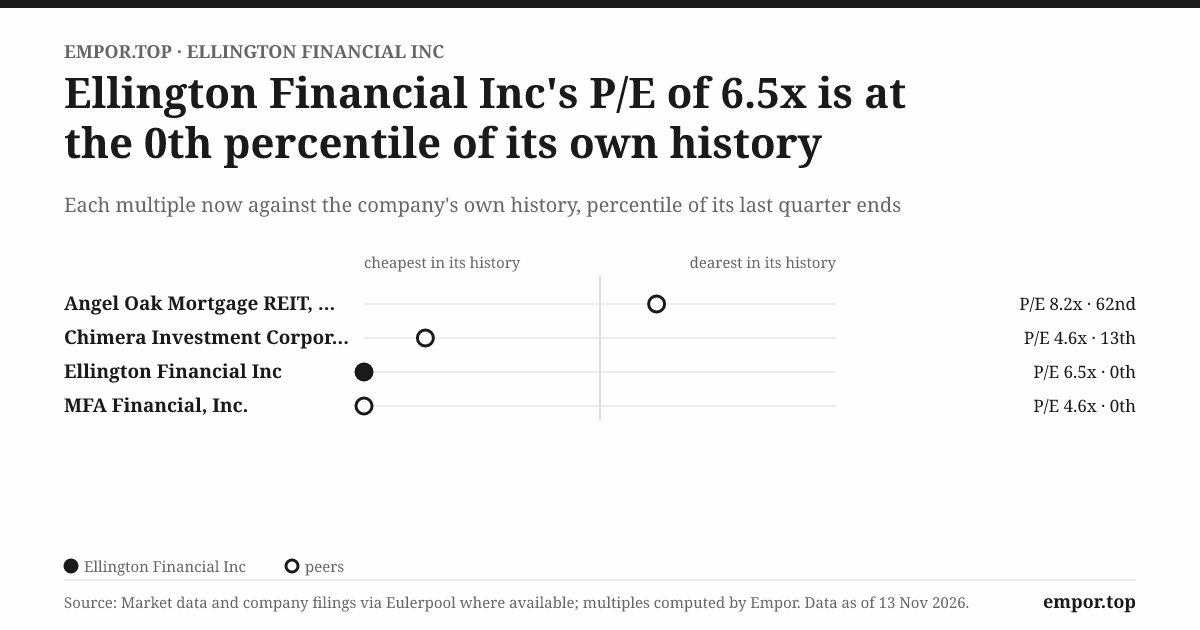
On November 13, 2026, the market priced Ellington Financial at $11.11 a share.[^1] Against its trailing twelve months of diluted earnings, about $1.66 a share, that is a price-to-earnings multiple of roughly 6.5 times, below the stock's own five-year median of about 8.4 times.[^1] Against the company's September book value of $13.53 per common share, the stock traded at about 0.82 times book.1 Screens that show a higher book value per share, near $15.45, and a price-to-book ratio of 0.7 are not measuring the same thing as the company's common book value, which excludes the claims of preferred stockholders; the company's own figure is the right one to use. The stock's one-year volatility was about 18%, modest for a mortgage REIT, but the deepest fall over five years was about 40%.[^1]
What does that price assume? A mortgage REIT trading at 0.82 times book is a REIT the market expects either to lose some of that book value, or to earn a return on it below what investors require. If EFC could reliably earn a return on common equity of about 13% to 14%, roughly its dividend yield on book value, while holding book value flat, a discount to book would be hard to justify. The market is saying it does not fully believe both halves of that sentence at once. Its scepticism is not unique to EFC; mortgage REITs have traded at discounts to book across much of the past several years. But it frames the debate exactly.
Begin with the bull case, at its strongest. EFC's sourcing network and Longbridge give it access to non-standard mortgage assets. The improving credit book, dividend coverage and longer funding tenor suggest the model is working. Its management team has navigated past stress without suspending the dividend, and a new investor buys the portfolio below stated book.
Then the bear case, equally concrete. The 2020 and 2022 stress episodes showed how quickly EFC's earnings and book value can turn. Leverage and credit marks remain risks, as does the cost of the external manager, which was about 5% of common equity a year including reimbursements. Share count has grown through the Arlington merger, a January 2026 offering and at-the-market issuance. And the company's history of paying out more than its GAAP earnings means book value has to do a lot of work to justify the yield.
Weigh the competitive position through Hamilton Helmer's seven powers, which ask what lets a business earn returns above its cost of capital for a long time. Scale economies are limited: EFC is far smaller than Annaly or AGNC, and in mortgage credit, size helps with funding and fixed costs but does not compound into a structural cost advantage. Network effects are absent; a loan seller does not benefit because other sellers use the same buyer. Counter-positioning has a weak version: EFC's willingness to buy non-standard, operationally heavy assets is something the agency giants choose not to do, but private credit funds have no such inhibition. Switching costs are low for loan sellers, who can and do sell to multiple buyers. Brand matters a little with sellers and funding counterparties, because reliability in settling trades and paying on time builds trust, but it does not set prices. A cornered resource could be argued in Longbridge's licences and servicing platform, and in Ellington's three decades of mortgage data and models, though neither is unique. Process power, the embedded know-how of pricing complex mortgage credit, is the most plausible power EFC has. It is also the hardest to prove, because it shows up only as superior risk-adjusted returns over a full cycle, and EFC does not publish returns in a form that permits that comparison against peers. The supplier and funding pressures already described, sellers who can shop their loans and lenders who set the terms, are the two forces most likely to compete any such advantage away.
The verdict from that exercise is that EFC's edge, where it exists, is a process and access edge, not a structural moat. That narrows the claim rather than rejecting it. A specialist with genuine process power can earn attractive returns for long stretches; it simply has to keep earning them, quarter after quarter, in a market where the advantage is never locked in.
Management discipline has to be judged on the same terms: by what was done with capital, not what was said. The record contains five big moves. Longbridge, bought for a modest sum relative to EFC's equity, has grown into a meaningful platform, though still a junior earnings contributor with narrowing margins. Arlington was bought below stated tangible book, paid in shares, and made the company larger without yet showing a step change in per-share earnings. Great Ajax was announced and then abandoned within four months at a cost of $16 million.11 Preferred stock has been both issued and redeemed; in the first nine months of 2026, EFC redeemed $115 million of preferred while issuing $225.7 million of net new common equity.2 And common shares have been sold repeatedly, including 8.775 million shares in January 2026 for $117.2 million of net proceeds, about $13.36 a share.2
The most recent pair of decisions shows the pattern clearly. During the third quarter, EFC sold about 2.5 million shares through its at-the-market programme at an average price of $13.61, just above the quarter-end book value of $13.53.1 After the quarter ended, with the share price lower, it repurchased 329,045 shares at an average of $11.44.1 Issuing near book and buying back well below it is exactly the right direction of trade for shareholders, and that deserves recognition. But the scale differs sharply: millions of shares issued against a few hundred thousand repurchased. Selling shares at or barely above book adds little to book value per share once offering costs are counted, while it grows the equity base on which the manager's base fee is charged. That is not an accusation of bad faith; it is the structural incentive of external management, and the record so far is consistent with it. Future capital decisions should be measured against one yardstick: does each one raise book value per common share or the cost of funding?
Ownership adds a modest signal. BlackRock held about 13.2% of the shares in the March 2026 snapshot, and Vanguard reported about 5% at the end of September 2026.5[^23] These are largely index and broad institutional holders, not concentrated activist investors. No controlling shareholder exists.
What would an activist push for? Probably three things: a fee structure that tightens as the equity base grows, so that scale benefits shareholders rather than the manager; issuance discipline that permits new equity only at a meaningful premium to book; and disclosure of returns by sourcing channel and by affiliate relationship, net of fees. None of those is exotic. Each would let shareholders test the manager's edge directly.
Which leaves three numbers that settle the case better than any narrative. The first is book value per common share after dividends, latest reading $13.53. The second is adjusted distributable earnings per share against the dividend, latest reading 45 cents against 39, read always alongside the reconciliation to GAAP. The third is credit and funding together: non-accrual loans, which fell from about $341 million of principal at the end of 2025 to about $303 million in September, alongside recourse repo tenor of 8.9 months.21 If those three hold through a credit and funding cycle, the bull case was right. If book value erodes while adjusted earnings hold, the dividend was being paid from capital.
The bull case and bear case, in the end, are arguing about the same thing: per-share returns through a cycle. That makes the lessons of this story more general than one company.
IX. Playbook: Business & Investing Lessons
Picture the third-quarter results landing. Adjusted distributable earnings covered the dividend, with the measure's caveats. Both statements are true. Both are necessary. Holding them together is the whole skill of owning a company like this one.
The first lesson is that a high yield is a claim on a portfolio, not a promise from a customer. A utility's dividend rests on customers who pay their bills every month; a consumer brand's rests on shoppers who come back. EFC's monthly dividend rests on the spread between what its loans yield and what its funding costs, minus the marks that markets impose each quarter. When the marks are kind, the yield looks generous and safe. When they are not, as in the first quarter of 2020 or across 2022, the same yield is paid out of a smaller pot. Investors who buy the yield without watching the pot are not collecting income; they are collecting a share of their own capital and calling it income.
The second lesson is that scale only earns its keep when it compounds per share. Arlington's scale benefits have to show up in book value and earnings per common share rising after the deal. Bigger balance sheets spread fixed costs and win better financing terms, which are real benefits. But a listed vehicle whose manager is paid on equity has a built-in reason to grow, and the only proof that growth was for shareholders is book value and earnings per common share rising after the deal. Any acquisition of a listed peer should be judged that way, years after the fact, not on the day the premium is announced.
The third lesson is that a sourcing network is an advantage only when the loans perform. A broad network is valuable: it means first look at more loans and more chances to say no. But a network that buys more loans in a booming niche can just as easily leave EFC adverse-selected into buying loans other buyers rejected. The test of the network is how its non-accrual balances are eventually resolved. A buyer of non-standard mortgage credit proves its edge on the way out of a loan, not on the way in.
The fourth lesson is the one specific to the structure. When the manager is also the dealmaker, measure the return after the manager gets paid. EFC's manager sources loans, negotiates funding, picks acquisitions and is paid on the equity it manages, plus incentives on income. That arrangement can work well; it gives a small public company a team it could not otherwise hire. But the only return that matters to a shareholder is the one left after fees and expense reimbursements. Until a company like this shows returns by channel net of all of that, investors are trusting the team rather than measuring it.
Beneath all four sits a wider point for anyone building or backing a financial business. Earnings that come from marking assets to market are a measurement, not a harvest. Only realised outcomes over a cycle show whether the measurement was right.
Those lessons point straight at what comes next.
X. Epilogue
Tonight, Ellington Financial stands between two kinds of evidence. Behind it lies a quarter in which the company's preferred measure covered the dividend, and a positive outlook from Moody's. Ahead lies the April 2027 maturity of $210 million of senior notes, the next clear point at which the funding structure is tested in the open market, and the quarterly results that will show whether the third quarter was a pattern or a peak.2
The first moment to watch is that refinancing. Much of the maturity is effectively prefunded; what matters is the rest of the funding ladder when April arrives. If EFC enters the second quarter of 2027 with repo tenor still lengthening, its unsecured debt laddered out to 2030 and beyond, and no need to issue common equity below book to bridge the gap, the positive outlook will have been earned. If the company leans on share issuance at prices near or below book, or pays sharply higher coupons to roll its debt, the funding story will have hit its limit.
The second moment is the dividend run. One quarter of adjusted distributable earnings above the dividend is a data point; four in a row, with book value per share holding near or above $13.53 after those payments, would be a trend. The opposite pattern, adjusted earnings covering the dividend while book value slips, would be the clearest signal that the measure is flattering the economics.
The third moment is Longbridge. Its recent margin pressure and lower securitization gains leave a question about the reverse-mortgage platform. If segment earnings rise with volume over the next several quarters, the 2021 decision to take full control will look like a genuine strategic asset. If volume grows while earnings stall, Longbridge will look more like an expensive way to source loans the investment portfolio could have bought elsewhere.
The fourth moment is credit. Falling non-accrual balances are good news; realised losses on those loans, when the properties are sold, will reveal whether the fair-value marks were conservative or optimistic. A credit cycle in non-QM, bridge lending or small-balance commercial property would be the most direct test yet of the sourcing edge.
None of these events will settle whether EFC's model works. It plainly functions. What remains open is repeatability: whether the per-share numbers can hold up through changing funding and credit conditions, rather than merely rise in benign ones. The decisive evidence will not be another quarter of portfolio growth. It will be a run of book value and earnings per share that survive a stress.
XI. Outro
Go back to that Friday in November: Ellington's shares at $11.11, below book, and a 39-cent quarterly dividend paid monthly.[^1]1 Most high-yield stocks are a bet on a business: a pipeline, a utility, a tobacco brand whose customers keep coming back. Ellington Financial is something else. It is a bet on judgment. Each share is a slice of the Ellington team's opinions about tens of thousands of mortgages, held together by securitization trusts, repo lines and unsecured notes that together carry close to $20 billion of borrowings.
The yield is visible today. It arrives every month, and it is easy to count. The skill is invisible until the weather turns, when marks fall, lenders ask for collateral and borrowers stop paying. Only then does a shareholder learn whether the people they hired protected tomorrow's book value or spent it. That is what makes this stock unlike a conventional income investment: the dividend is the headline, but the story is written in the balance sheet.
References
-
Ellington Financial Reports Third Quarter 2026 Results — SEC, 2026-11-04 ↩↩↩↩↩↩↩↩↩↩↩↩↩↩↩↩↩↩
-
Form 10-Q for the quarter ended September 30, 2026 — SEC, 2026-11-06 ↩↩↩↩↩↩↩↩↩↩↩↩↩↩↩↩↩↩↩↩↩↩↩↩↩
-
Home Point Capital Form 8-K on Longbridge Stake Sale Closing — SEC, 2022-10-03 ↩
-
Form 10-K for the year ended December 31, 2025 — SEC, 2026-03-02 ↩↩↩↩↩↩↩↩↩↩
-
Ellington Financial Q3 2026 Earnings Call Transcript — Stock Analysis, 2026-11-05 ↩↩
-
Form 10-K for the year ended December 31, 2020 — SEC, 2021-03-01 ↩
-
After Ellington Hedge Fund Unloads $1.5B of Mortgage Bonds, Wall St. — American Banker, 1998-10 ↩
-
Ellington Financial and Arlington Asset Investment Announce Merger Agreement — SEC, 2023-05-30 ↩↩↩↩
-
Ellington Financial and Great Ajax Announce Mutual Termination of Merger Agreement — SEC, 2023-10-20 ↩↩
-
Ellington takes stake in Great Ajax after merger cancellation — National Mortgage News, 2023-10 ↩
-
Annaly Capital Management Q3 2026 Results — Annaly, 2026-10-20 ↩
-
2026 Annual Meeting Voting Results, Form 8-K — SEC, 2026-05-28 ↩
 LinkedIn
 WhatsApp
 Reddit
 Hacker News
 Email
 Kindle
 RSS Feed
 Spotify
 Apple Podcasts
 Amazon Music
 Audible
 YouTube