Consolidated Edison: Powering New York for Two Centuries
I. Introduction & Episode Roadmap
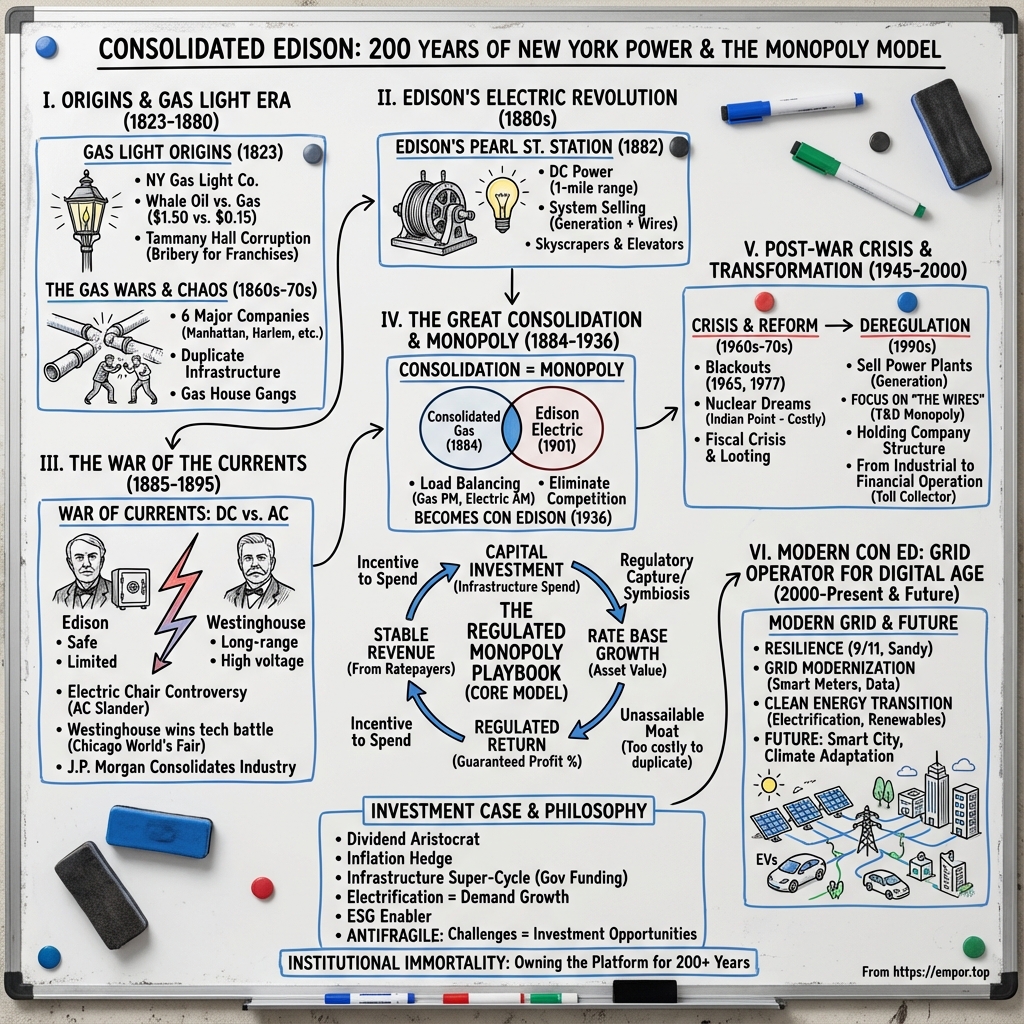
On a side street in Lower Manhattan sits an unremarkable, slightly askew manhole cover. Beneath it lies one of the most unusual capital assets in American finance: a lattice of copper and paper-insulated cable, some of it laid before World War II, serving buildings whose tenants generate more revenue in an afternoon than the utility earned in its first half-century. No competitor can construct a duplicate network, nor would regulators allow one. The entity that owns this plant has traded on the New York Stock Exchange, under various corporate structures, longer than any other listed company in the United States.
The business originated on March 23, 1823, when the New York State Legislature chartered the New-York Gas Light Company—a speculative venture to pipe manufactured coal gas under cobblestone streets when the city still relied on whale oil and tallow. Two centuries later, Consolidated Edison, Inc. is a holding company valued at roughly $39 billion in market capitalization, with trailing twelve-month revenue near $16.9 billion and more than $65 billion in assets. It delivers electricity to about 3.5 million customers, gas to roughly 1.1 million, and pressurized steam through underground pipes to about 1,600 buildings across 660 square miles of New York City and Westchester County.18
While Consolidated Edison is often categorized as a predictable utility, its core model represents a two-century study of what occurs when a private enterprise holds physical control over the underground space beneath premier real estate in exchange for regulatory rate oversight. The central financial question is not whether this arrangement creates a durable competitive moat, but what return the asset base actually yields, who controls the distribution, and how frequently the company has discovered that regulated returns remain stable only until state policy shifts.
Three themes define this operational and financial trajectory.
The first is infrastructure as destiny. The physical geometry of Manhattan—vertical density, an absence of overhead utility lines, and more than a century of underground plant accumulation—creates what strategist Hamilton Helmer terms a Cornered Resource. Yet the same physical barrier that excludes competitors imposes costs unseen by Sun Belt utilities: excavating a Midtown street to replace a transmission feeder is exponentially more expensive than stringing overhead lines across open terrain. The competitive moat and the capital intensity are two sides of the same structural reality.
The second is the monopoly social contract. Consolidated Edison does not earn an unrestricted market return; it earns an allowed return set periodically by the New York Public Service Commission. These rate proceedings are adversarial, with state advocates, consumer groups, environmental intervenors, and New York City officials participating on the opposing side.4 The utility's allowed return on equity historically ranges from roughly 9.25% to 9.60% on an equity capital layer of about 48% to 50%—a modest, regulated return subject to regulatory revision.
The third is capital allocation under a constraint. A regulated utility expands earnings primarily by deploying capital into assets approved for inclusion in its rate base. This dynamic creates a steady compounding mechanism alongside a structural incentive to deploy capital. Consolidated Edison spent a decade developing an unregulated renewable energy portfolio, determined that public markets discounted the asset class, and sold the business to RWE in 2023 for an enterprise value of $6.8 billion.[^4] Whether that sequence represents disciplined capital recycling or a costly strategic detour remains a key debate among investors, one that cannot be evaluated merely by accepting corporate statements at face value.
The history spans Tammany Hall gas franchises, Thomas Edison’s Pearl Street Station, the landmark 1974 dividend omission that disrupted utility sector yield expectations, the 1977 blackout, and Superstorm Sandy. Today, Consolidated Edison operates in a modern landscape where customers pay among the highest electricity rates in North America, regulators mandate multi-billion-dollar decarbonization investments, and the long-term investment thesis depends on whether state political structures continue to support cost recovery on that expanding capital base.
 Subscribe on LinkedIn
II. Gas Light Origins & Tammany Hall: The Franchise Moat (1823–1884)
Picture Broadway in the winter of 1825: mud, horse traffic, and a row of iron posts topped with flickering flames fed by coal gas from a plant near the East River. Passersby crossed the street to avoid them. Gas was widely believed to be poisonous, explosive, and immoral—a fair assessment on the first two counts, given that early manufactured gas was roughly half hydrogen and carbon monoxide, distributed through wooden mains.
The New-York Gas Light Company was organized by Samuel Leggett, president of Franklin Bank, alongside investors including shipbuilder and land speculator Henry Eckford. Their charter from the 46th New York State Legislature granted something far more valuable than gas-making technology: the right to open city streets. Everything Consolidated Edison is today descends from that single clause. The gas was the product; the right-of-way was the asset.
The franchise is the business. This structural reality shaped corporate behavior for the next two centuries. Distilling coal into gas was already well understood in London by 1812. Laying mains beneath streets without political authorization was impossible. Consequently, competition in nineteenth-century New York was never primarily technological—it was municipal, defined by which firm could secure digging permits from the Common Council and, later, the Board of Aldermen.
Which meant it was about Tammany Hall.
By the late 1860s, under William M. "Boss" Tweed, New York's system of municipal consent was fully industrialized. Franchise grants, street-opening permits, and paving contracts moved through a Board of Aldermen responsive to financial inducement. Gas companies were active participants in this ecosystem, and the underground rights-of-way secured during those decades form the identical corridors carrying Consolidated Edison's distribution plant today. The modern spatial moat was constructed within a political environment that would be illegal now.
The competitive era that followed proved chaotic. Six rival gas companies operated across Manhattan—New York, Manhattan, Metropolitan, Municipal, Knickerbocker, and Harlem. They behaved as unregulated infrastructure competitors typically do when fixed capital costs are high and products are undifferentiated: cutting prices below cost in contested districts and laying duplicate mains along the same streets. Crews from competing firms occasionally clashed underground over physical turf. While New Yorkers briefly received cheap gas, company margins collapsed, streets were repeatedly torn up, and the city received a permanent lesson in the economic inefficiency of duplicate distribution networks.
That experience laid the intellectual foundation for the natural-monopoly model. If a single network of underground pipes is more efficient than six competing systems, a central governance question follows: who determines the prices charged by that sole provider? The American regulatory answer empowered the state to set utility rates, constrained by constitutional protections against uncompensated property takings. Regulators could set rates, but could not reduce them so severely as to confiscate property, establishing that utility owners were entitled to a fair return on capital devoted to public service. In early New York rate disputes, Consolidated Gas's property valuation was contested at roughly $56 million, establishing a permanent battleground over what counts as the capital base.
That regulatory framework provides an opportunity to earn a fair return on prudently invested capital, but guarantees nothing beyond it. It does not assure that specific capital outlays will be deemed prudent, that returns will match alternative investments, or that cost recovery will be prompt. Every major financial disruption in Consolidated Edison's history has occurred within the gap between that regulatory opportunity and actual capital recovery.
By 1884, years of price competition had exhausted the rival gas companies, compelling them toward consolidation. Yet just three blocks from Wall Street, a new technology had already arrived that would render manufactured gas obsolete as the enterprise's primary earnings engine within fifty years.
III. Edison, Pearl Street, & War of the Currents: Electrifying Manhattan (1880–1901)
On September 4, 1882, at three in the afternoon, Thomas Edison—or by some accounts, his associate John Lieb—closed a switch at 257 Pearl Street, illuminating lamps in the Wall Street offices of Drexel, Morgan & Co. The location was strategic. Edison selected Lower Manhattan not simply for its electrical demand, but to demonstrate the technology directly to the financiers capable of funding its expansion.
Edison had formed the Edison Electric Light Company in 1878 with capital from a syndicate including J.P. Morgan, Spencer Trask, and members of the Vanderbilt family. In December 1880, he organized the Edison Illuminating Company of New York to build and operate the central station. The infrastructure relied on six 100-kilowatt direct-current dynamos—nicknamed "Jumbos," each weighing 27 tons—powered by steam engines. The plant fed an underground copper conductor network serving an initial base of 82 customers and roughly 400 incandescent lamps.
Why Pearl Street mattered more than the light bulb. While the incandescent bulb was a notable invention, Pearl Street established a commercial utility model. Edison recognized that electricity could be commercialized similarly to manufactured gas: centrally generated, distributed through subterranean mains, metered at the consumer site, and billed monthly. Sizing his system's pricing against prevailing gas light rates, Edison positioned electricity as a direct utility substitute rather than a luxury novelty. Modern central-station utilities descend from this commercial architecture, with Consolidated Edison as its direct corporate successor.
Customer adoption expanded rapidly for early infrastructure standards, reaching 508 customers and over 10,000 lamps by 1884. After a fire destroyed the station in 1890, it was rebuilt and operated until its retirement in 1895, when larger centralized power plants rendered small localized stations uneconomic—an early example of asset obsolescence driven by scale rather than physical wear.
Then came the competition between power standards.
Direct current (DC), Edison's system, delivers electricity in a single direction at low voltage. Its primary technical limitation stems from resistance losses, which increase with the square of the current. Transmitting low-voltage power over long distances required either impractically thick copper conductors or accepting severe energy losses, limiting an Edison station's effective service radius to roughly one mile. Conversely, alternating current (AC)—advocated by George Westinghouse and built on Nikola Tesla's polyphase patents—reverses voltage direction periodically. This property allows transformers to step AC up to high voltages for long-distance transmission with low current and minimal line loss, then step it down for end-use distribution.
Functionally, direct current operated like a network of neighborhood bakeries, each restricted to serving a few surrounding streets, whereas alternating current functioned like a central mill connected to a rail line, capable of distributing output across an entire region.
In response, Edison launched a hostile public relations campaign against alternating current. Working with engineer Harold P. Brown, Edison's associates organized public electrocutions of animals using Westinghouse equipment to associate AC with danger. They also assisted in designing the first electric chair—powered by alternating current—used in an 1890 judicial execution. The campaign attempted to brand AC as inherently hazardous, but ultimately failed to stem its adoption.
By the late 1890s, alternating current had won the standard for generation and transmission. Yet Manhattan's original DC network persisted beneath city streets for more than a century. It continued powering elevator motors and building systems in older structures, supported by conversion substations that rectified AC to DC for a diminishing customer base. Consolidated Edison did not decommission its final legacy DC service until 2007.
This 125-year operational tail illustrates the nature of urban distribution infrastructure: rather than being upgraded via complete technological replacement, the plant physically accretes, requiring ongoing maintenance alongside partial modernization. For investors, this long legacy explains why Consolidated Edison's capital expenditures remain permanently elevated, why grid modernization is a continuous line item rather than a finite project, and why the network's replacement cost creates an insurmountable barrier to entry.
Meanwhile, corporate consolidation was preparing to unite the gas and electric businesses under a single entity.
IV. The Great Merger & Monopoly Economics: Building Con Ed (1901–1970)
On November 11, 1884, the six exhausted gas competitors merged into the Consolidated Gas Company of New York. The move followed standard infrastructure consolidation logic: halt price competition on a commodity distributed through duplicate fixed plant and shift focus to generating regulated returns on the asset base.
For seventeen years, gas and electricity operated under separate capital structures despite a clear commercial trend: electric incandescent lamps were capturing gas's core illumination market. In 1901, Consolidated Gas resolved the conflict by acquiring the New York Edison Company, the successor to Edison Illuminating. In doing so, the gas monopoly purchased the entity rendering its primary product obsolete.
This marked the first major capital-allocation decision in the company's history. Rather than defending its legacy product, Consolidated Gas purchased the substitute, preserving its customer base and subterranean right-of-way. The underlying asset was not gas itself, but the exclusive franchise to deliver energy beneath Manhattan streets. This principle of technology-agnostic infrastructure ownership became a recurring theme through subsequent shifts into steam, nuclear power, and modern building electrification.
Between 1901 and 1936, Consolidated Gas executed a sustained utility roll-up, absorbing more than thirty local electric and gas companies across New York City's five boroughs and Westchester County. Integrating these isolated neighborhood systems into a unified grid provided clear operational economics: a broader network allowed the utility to share reserve generating capacity across non-coincident peak demand periods. In a distribution network, scale functions not as a marketing tool, but as a mechanism to lower required capital investment per unit of reliable service.
By 1936, electricity generated roughly three-quarters of gross operating revenue, prompting the firm to rename itself Consolidated Edison Company of New York, Inc. (CECONY)—the operating utility that continues to produce the vast majority of the holding company's earnings.
In 1954, Consolidated Edison acquired the New York Steam Company, taking ownership of the world's largest commercial district-heating system. Instead of individual buildings operating standalone boilers, central plants generate high-pressure steam and route it through insulated underground mains to supply heating, hot water, and absorption-chilled air conditioning. The network serves major landmarks—including the Empire State Building, the United Nations headquarters, and Rockefeller Center—spanning a footprint from Battery Park to 96th Street.
While accounting for only about 5% of total revenue, the steam system illustrates the durability—and vulnerability—of Manhattan's underground utility footprint. Superheated urban steam mains carry distinct operational risks, highlighted by a fatal 2007 main explosion near Grand Central Terminal. Yet the system reflects the core franchise model: a capital-intensive network in a high-density footprint that prospective competitors cannot replicate, serving captive customers. In the current policy environment, however, the system faces strategic friction, as a heating grid reliant primarily on natural gas conflicts with state decarbonization mandates.
The company's primary post-war expansion focused on nuclear power. Consolidated Edison acquired land in Buchanan, New York, in 1954 to build the Indian Point Nuclear Generating Station, commissioning Unit 1 in September 1962. The investment was designed to address local operational constraints: New York City faced severe air pollution from fossil-fuel generators, fuel oil required maritime transport into the harbor, and nuclear power offered abundant, low-marginal-cost baseload electricity 35 miles up the Hudson River.
Within four decades, virtually every component of this mid-century model—owned nuclear generation, heavy reliance on fuel oil, and full vertical integration from power generation to end-user metering—was reversed under regulatory and financial pressure. While the 1901 Edison acquisition secured a growing distribution monopoly, the early commitment to nuclear power demonstrated that long-lived utility assets carry compounding operational and regulatory risks. Ultimately, a utility's longevity often depends less on flawless strategic forecasting than on holding rights-of-way for essential service delivery when market conditions change.
The immediate financial reckoning, however, arrived with the oil price shocks of the 1970s.
V. The Inflection Points: 1974 Dividend Shock, Blackouts, & Sandy (1974–2012)
In the spring of 1974, Charles Luce, chairman of Consolidated Edison, faced cash-flow projections showing the company could no longer pay its dividend. Luce was not a career utility executive; he was a lawyer from Washington State who had led the Bonneville Power Administration and served as Under Secretary of the Interior before joining Con Edison in 1967 as a public-power advocate tasked with running America's most unloved investor-owned utility. On April 23, 1974, the board omitted the quarterly dividend for the first time in 89 years.6
The market impact extended far beyond a single firm. In 1974, utility common stock was treated not as a growth asset, but as a bond substitute held by retirees, trusts, and income funds under the assumption that dividend payments were as reliable as electrical service. Con Edison had paid dividends continuously since 1885. The omission read not as isolated corporate distress, but as a structural breakdown in the utility asset class. Shares across the sector dropped sharply, while Con Edison's own stock plummeted nearly 80 percent, falling from the high teens into the low single digits. The stock required more than a decade to recover its prior valuation.
The underlying financial mechanism illustrates why regulated utility business models can fail despite apparent stability.
Con Edison had retired its coal-fired generation in 1972 to meet stringent New York air-quality standards, leaving the utility roughly 85 percent dependent on oil. When the 1973 OPEC embargo sent crude prices surging, Con Edison's fuel bill mounted rapidly. Although fuel expenses were legally recoverable from ratepayers, regulatory approval operated with a four-month lag. For a third of a year, the utility purchased fuel at inflated market prices while billing customers at historical rates, funding the shortfall with internal working capital at a time when short-term borrowing costs were spiking and two major power plants were mid-construction.
The resulting crisis demonstrated that a regulated utility rarely falters from a lack of theoretical profitability; it falters from cash-flow timing. Profit represents an accounting figure established through regulatory proceedings, whereas cash remains an unyielding operational constraint. The episode falsified the premise that an allowed regulatory return guarantees short-term financial solvency.
The financial rescue highlighted the political nature of utility balance sheets. Luce negotiated a $612 million deal allowing the Power Authority of the State of New York to acquire two unfinished facilities—Astoria Unit 6 and Indian Point Unit 3—converting an unsustainable capital expenditure obligation into immediate liquidity. By effectively nationalizing cash-draining generating assets, the state stabilized the utility, establishing a precedent that when Con Edison's public service duties collide with balance-sheet constraints, the ultimate resolution is political.
System reliability crises further underscored these vulnerabilities. While the 1965 Northeast blackout stemmed from a regional cascade and the 2003 failure affected the broader Eastern Interconnection, the blackout of July 13–14, 1977, belonged entirely to Con Edison. Lightning strikes on Hudson Valley transmission corridors, compounded by equipment failures and operator errors, triggered a complete system collapse across New York City during a municipal fiscal crisis and heightened public anxiety. The resulting outage led to widespread looting and arson across multiple boroughs, injuring hundreds of police officers and resulting in thousands of arrests. The political and regulatory backlash prompted a comprehensive overhaul of protective relaying, reserve margins, and system restoration protocols, establishing the operational reliability culture the company emphasizes today.
Thirty-five years later, physical risk shifted from transmission lines to coastal waters. On October 29, 2012, Superstorm Sandy pushed a record storm surge into Lower Manhattan. Con Edison's substations, built under historical assumptions regarding sea levels and river flooding, suffered severe inundation. The East 13th Street substation experienced a cataclysmic failure visible across the borough, cutting power to more than a million customers and leaving Lower Manhattan dark for days across some of North America's premier commercial real estate.
Con Edison responded with a climate-resilience capital initiative exceeding $1 billion, installing submersible transformers, perimeter flood walls, elevated control systems, and smart sectionalizing switches to isolate flooded network segments without shutting down entire service territories.
Regulatory mechanics alter how investors must evaluate adaptation capital. Under rate-of-return regulation, both storm-damaged assets and subsequent hardening investments expand the regulated rate base. Unlike merchant power producers, Con Edison is not economically penalized for asset destruction; it earns a regulated return on the capital deployed to remediate and fortify its grid, subject to prudence reviews and potential regulatory penalties for service failures, such as those imposed after outages in 2019. The growth in climate-adaptation capital expenditures is structurally real because cost recovery is passed to ratepayers rather than absorbed by equity holders.
This dynamic set the stage for the subsequent era, when Con Edison sought to generate returns outside the scope of regulatory rate oversight.
VI. Transformation & Capital Realignment: Deregulation to the $6.8B RWE Sale (1998–2023)
The 1990s brought a structural concept to electric utilities that had already reshaped airlines, trucking, and telecommunications: unbundling the monopoly. Policy makers argued that power generation was a competitive business where any builder could construct a power plant, whereas transmission and distribution remained natural monopolies. Unbundling meant separating generation from delivery, allowing independent generators to compete while the distribution utility earned a regulated return on its grid infrastructure.
New York embraced restructuring in 1998. Consolidated Edison reorganized into a holding company, Consolidated Edison, Inc. (listed on the New York Stock Exchange under the ticker ED), designating CECONY as its regulated operating subsidiary and selling off its merchant generating plants.2 The enterprise that had built Pearl Street station exited the business of electric generation in New York City almost entirely.
Strategically, this was the most consequential restructuring in the modern history of the enterprise, and state regulatory mandates largely compelled it rather than voluntary corporate choice. Yet it produced a far cleaner business model: eliminating fuel price volatility on the income statement, merchant power price risk, and large-scale plant construction risk of the type that had triggered the 1974 financial crisis. What remained was the insulated distribution core—the wires, pipes, and exclusive franchise.
The holding-company structure also provided balance-sheet capacity for acquisitions. In 1999, Consolidated Edison acquired Orange and Rockland Utilities for approximately $790 million, adding contiguous regulated electric and gas service territory across southeastern New York, northern New Jersey, and northeastern Pennsylvania. Orange and Rockland proved to be a practical acquisition: adjacent, regulated, operationally aligned, and still generating roughly 8% to 10% of consolidated earnings a quarter-century later. It remains a benchmark for sensible utility consolidation.
A contrasting outcome followed almost immediately. In 1999, Consolidated Edison agreed to acquire Northeast Utilities for roughly $3.8 billion, aiming to create a regional energy supplier across New York and New England. By 2001, the deal collapsed amid deteriorating market conditions, disputes over power supply contracts, and regulatory friction. The failure precipitated years of breach-of-contract litigation over responsibility for the termination.
That episode serves as an important counterweight to claims of uninterrupted capital discipline. Consolidated Edison attempted a transformational, out-of-territory acquisition; the transaction simply unravelled. Discipline enforced by a broken transaction and prolonged litigation differs from discipline by design—providing a relevant baseline for evaluating the larger strategic pivot that followed.
During the 2010s, Consolidated Edison pursued another major capital expansion into non-regulated operations.
The Clean Energy Businesses division expanded from a modest initiative into a major unregulated enterprise—developing, owning, and operating utility-scale solar generation across the United States. The segment eventually grew into one of the largest solar asset owners in North America, with a portfolio of roughly 3 gigawatts. The operational rationale appeared coherent: the utility possessed project development expertise, the tax-equity structure of renewable projects benefited a large corporate taxpayer, and renewable generation offered growth opportunities beyond the constraints of regulated distribution rates.
Public markets, however, consistently discounted the strategy for nearly five years. The issue was not asset quality, but structural alignment. Equity markets value regulated utilities for predictable yield and renewable developers for earnings growth, assessing each through distinct valuation multiples and coverage analysts. A holding company containing both was priced according to the lower valuation multiple. Furthermore, the capital intensity of the renewable business competed directly with the regulated utility's capital expenditure program, forcing Consolidated Edison to issue new equity—diluting existing shareholders—to fund non-regulated assets that public markets refused to reward.
The strategic resolution occurred on October 1, 2022, when German utility RWE agreed to acquire the Clean Energy Businesses division. The transaction closed on March 1, 2023, at an enterprise value of $6.8 billion, generating net cash proceeds to Con Edison of roughly $5.2 billion.3[^4][^5] For RWE, the purchase significantly expanded its presence in the United States, lifting it into the top tier of American clean-energy owners.[^5]
The capital allocation impact was immediate and direct: Consolidated Edison canceled a planned common equity offering of roughly $850 million, reduced holding-company debt, and channeled the remaining capital into its regulated New York investment program—funding rate base growth with asset sale proceeds instead of with new shares.[^4]
What should investors conclude from this trajectory? A rigorous assessment is narrower than management's preferred narrative. The divestiture simplified the corporate structure, avoided equity dilution, and eliminated non-regulated market exposure. However, it does not demonstrate a long-term culture of strict capital allocation, given that executive leadership built the non-regulated portfolio over a decade and executed the sale into a buoyant 2022 market only after years of persistent equity discounting. A balanced verdict evaluates the transaction as an effective exit from a strategic detour—narrowing the corporate narrative from proactive capital discipline to responsiveness under investor pressure. The ongoing test for management is straightforward: whether capital deployment remains strictly within its core regulated footprint while minimizing equity dilution relative to its capital expansion plan.
What remained after the divestiture was a nearly pure regulated utility. It is worth taking apart.
VII. Modern Con Ed: Segment Breakdown, Utility Economics, & Rate Base Dynamics
Strip away two centuries of narrative, and Consolidated Edison, Inc. today operates as a holding company structured around three distinct business units.
CECONY forms the core of the enterprise. It serves roughly 3.5 million electric customers, 1.1 million gas customers, and about 1,600 steam customers across New York City and Westchester County, producing approximately ninety percent of consolidated earnings.1 Within CECONY, electric delivery contributes the vast majority of revenue, gas accounts for roughly a fifth, and steam provides the remainder. Its regulated rate base stands in the mid-$30 billion range, compounding historically at roughly six to seven percent annually.
Orange and Rockland Utilities serves approximately 300,000 electric and 140,000 gas customers across suburban and exurban territories in New York and New Jersey. Contributing roughly eight to ten percent of net income, it operates as a smaller, structurally similar utility, offering regulatory diversification across state lines without departing from the core distribution model.
Con Edison Transmission represents the smallest segment, contributing a few percent of earnings through regulated transmission assets and interests in projects designed to bring upstate wind, solar, and Canadian hydroelectric power into the New York City load center. Rather than a major current earnings driver, this unit functions primarily as a financial option on New York's clean-energy infrastructure transition—one that yields limited near-term return until projects achieve full operation.
Understanding the utility's underlying financial engine requires examining its regulatory economics.
A regulated utility does not set consumer prices in an open market. Instead, regulators determine the total revenue the utility is permitted to collect—the revenue requirement—and set customer rates to hit that target. This revenue requirement is built from the bottom up: prudently incurred operating expenses, asset depreciation, taxes, and a return on the capital invested in plant used to serve customers. That capital base constitutes the rate base. The allowed return equals the rate base multiplied by the authorized weighted average cost of capital, with the equity portion earning an allowed return on equity currently in the range of 9.25% to 9.60% on an equity layer around 48% to 50%.4
The central mechanical rule governing the sector is straightforward: earnings growth equals rate base growth, provided the utility achieves its allowed return. The enterprise does not expand earnings simply by selling more kilowatt-hours; it grows by deploying capital into assets that regulators approve for inclusion in the rate base. This dynamic creates a distinct economic model—an asset-heavy enterprise where capital intensity serves as the engine of earnings growth rather than a drag on margin.
Two structural mechanisms provide significantly greater earnings stability today than during the 1974 liquidity crisis. First, fuel and purchased-power costs are passed directly to ratepayers through rapid reconciliation mechanisms, avoiding the severe multi-month cash-flow lags that previously drained working capital. Second, the Revenue Decoupling Mechanism severs the link between revenue and sales volume: if customers consume less electricity due to energy-efficiency initiatives, mild weather, or rooftop solar installations, the utility trues up to its authorized revenue rather than losing earnings.4 Decoupling enables a New York utility to promote customer conservation programs without undermining its financial model. Furthermore, New York state regulators typically establish multi-year rate plans spanning three years, reducing the frequency of adversarial proceedings and creating a predictable investment horizon.
Where skeptical analysis is required. Revenue decoupling insulates the utility from volumetric fluctuations, but it does not guarantee total cost recovery. Three key structural risks operate outside this protection.
First, regulatory lag on capital deployment. While capital expenditures accrue continuously, utility rates reset only periodically. Capital deployed between formal rate cases yields no immediate return until officially integrated into the rate base, meaning an accelerating capital expenditure program can drag achieved returns on equity below authorized levels. Consequently, tracking the gap between authorized and earned return on equity provides a clearer indicator of financial health than evaluating allowed returns in isolation.
Second, prudence disallowances and penalties. State regulators hold discretionary authority to review capital outlays. Outlays judged imprudent are excluded from the rate base, while operational failures can trigger regulatory financial penalties—such as those assessed after the July 2019 outages in Manhattan and Brooklyn. Although historical penalties have remained modest relative to total net income, the regulatory enforcement mechanism imposes real downside risk.
Third, and most critical, rate affordability, which represents the ultimate constraint on rate base expansion and is examined fully in Section X.
Ultimately, the elegance of the utility model also highlights its structural fragility. Every dollar of earnings growth requires deploying capital into long-lived assets whose ultimate cost recovery depends on a political commission accountable to utility ratepayers. That regulatory compact remains viable when utility rates rise gradually; it faces increasing strain when customer bills escalate rapidly.
VIII. Current Leadership, Governance, & Capital Allocation Discipline
Timothy Cawley became chief executive of Consolidated Edison, Inc. in early 2021 and subsequently assumed the role of chairman. His background—more than three decades inside the company, an engineering degree, and prior service as president of CECONY and chief executive of Orange and Rockland—is typical for the utility industry but reveals management's operational focus.7 He is an internal operator who built his career in grid management rather than a financier brought in to restructure the corporate portfolio.
That background shapes strategic choices. Utility chief executives generally fall into two categories: operational insiders and transactional outsiders. Consolidated Edison elevated an insider just before executing the largest divestiture in its modern history. That sequence suggests the sale of the clean-energy business to RWE reflected portfolio correction driven by public market discounts rather than an externally imported strategic vision. Cawley's public messaging has remained consistent: management prioritizes executing the regulated capital program, meeting reliability and safety targets, and managing customer bill impacts during the clean-energy transition.1[^11]
The surrounding executive team reflects a similar internal orientation, with leaders in regulatory affairs, grid operations, safety, and finance drawn primarily from within the utility sector. The governance record shows little of the aggressive external hiring that typically precedes a strategic shift.
Executive compensation aligns with standard utility industry practices. A substantial performance-share component ties to adjusted earnings-per-share growth and total shareholder return relative to a utility peer index, alongside operational scorecards covering employee safety, grid reliability, clean-energy goals, and customer service.7 Reliability performance hinges on two core industry metrics: the System Average Interruption Frequency Index, which tracks how often customers lose power annually, and the System Average Interruption Duration Index, which measures total outage duration. Consolidated Edison's urban network architecture—using meshed secondary grids rather than the radial feeders typical of suburban systems—delivers high reliability because a meshed system can isolate individual component failures without interrupting service to customers. This design makes the company's distribution system one of the most structurally resilient urban grids in North America.
Insider stock ownership remains modest in absolute terms. Executives at a utility protected from hostile takeovers, restricted from aggressive leverage, and governed by regulated returns rarely accumulate founder-level equity stakes. Management alignment depends primarily on performance share units and board-selected scorecard metrics, providing institutional governance rather than direct ownership incentives.
The capital plan defines corporate strategy. Consolidated Edison has outlined a multi-year capital program of $28 billion to $30 billion from 2024 through 2028.[^2][^11] Electric transmission and distribution account for the bulk of this spending, targeting grid modernization, regional load growth, storm hardening, and expanded substation capacity. A smaller portion supports clean-energy transmission and steam system maintenance, while a significant allocation funds safety upgrades and the replacement of leak-prone gas mains. That gas capital outlay introduces a structural tension with state policy: the utility is investing billions in natural gas infrastructure with multi-decade book lives even as New York climate legislation seeks a sharp reduction in building gas use. If building electrification accelerates, regulators will either force ratepayers to fund accelerated depreciation or leave the utility exposed to stranded-asset risk—making gas asset recovery a key regulatory issue to monitor.
The dividend remains the holding company's primary equity appeal, featuring more than five consecutive decades of annual increases, an annualized payout exceeding $3.40 per share, and a target payout ratio between 60% and 70% of adjusted earnings.18 Notably, this expansion streak originated in the years immediately following the 1974 dividend omission. The record reflects decades of deliberate balance-sheet restoration rather than unbroken historical stability, a distinction that underscores how past financial distress reshaped management's commitment to income investors.
Management targets long-term adjusted earnings-per-share growth of 5% to 7%, a range the company has consistently met in recent years. Achieving earnings targets in a utility protected by revenue decoupling, multi-year rate plans, and an expanding rate base reflects disciplined regulatory execution rather than market outperformance. The critical operational benchmark for investors is whether earned return on equity matches authorized levels as capital deployment accelerates.
That financial test will take place against a competitive position that appears nearly unassailable on paper.
IX. Competitive Strategy, 7 Powers, & Future Growth Vectors
Consider a hypothetical entrant attempting to capture Consolidated Edison's electricity delivery customers in Manhattan. Even with unlimited capital, a competitor would face insurmountable structural barriers. Building a parallel distribution network is impossible without subsurface rights beneath New York City streets. Even if municipal authorization were granted, constructing a duplicate network would be physically and financially impractical, requiring tens of thousands of miles of underground cable threaded through congested utility corridors already shared with subways, water, sewer, gas, steam, and telecommunications infrastructure. Rooftop solar cannot bypass the delivery grid when a fifty-story commercial tower has fifty floors of electrical demand beneath a single roof. On-site generation faces severe urban constraints regarding air-quality permits, fuel delivery, space, and noise, restricting its viability to select large campuses. Finally, direct competition for delivery service is legally barred by exclusive franchise grants.
Applied to Hamilton Helmer's Seven Powers framework, Consolidated Edison relies primarily on a single, dominant advantage alongside a structural overlay.
Cornered Resource is the enterprise's primary power: exclusive physical occupancy of subterranean rights-of-way beneath the highest-density real estate in North America, anchored by a network of more than 100,000 miles of underground cable. This resource is cornered not by patent protection, but by geography and urban history, neither of which can be replicated through capital alone.
Scale Economies operate genuinely, though within regulatory limits. Serving high load density yields substantial throughput per mile of plant, spreading fixed costs across a large revenue base. Under rate-of-return regulation, however, efficiency gains are largely passed to ratepayers rather than retained as profit margin; scale lowers customer bills rather than boosting corporate returns.
Switching Costs in the traditional sense do not apply, because switching delivery providers is legally unavailable rather than merely costly. While New York permits retail energy supply competition—allowing customers to purchase electricity from third-party suppliers—the physical wires, meters, billing infrastructure, and regulated delivery margins remain Consolidated Edison's regardless.
The remaining categories of the framework offer little applicability: the utility possesses no meaningful brand power, counter-positioning, internet-style network effects, or proprietary process power beyond standard operational execution.
Michael Porter's Five Forces framework yields an equally stark picture. The threat of new entrants is virtually nonexistent, and competitive rivalry within the franchise territory is zero by law. The threat of substitutes remains low for core urban delivery, though marginal risks exist: behind-the-meter solar, battery storage, and microgrids are expanding in the outer boroughs and Westchester County. If distributed resources achieve scale, they could erode delivery volumes while leaving fixed network costs unchanged, creating a cost-shifting issue that revenue decoupling addresses accounting-wise but political bodies handle poorly. Supplier power is moderate and concentrated among transformer, cable, and switchgear manufacturers, where global lead times have lengthened significantly since 2022, creating a tangible operational constraint on capital execution.
Buyer power presents the critical inversion. Individually, Consolidated Edison's customers possess no leverage. Collectively, they hold substantial power. Unable to switch delivery providers, ratepayers organize, vote, intervene in rate proceedings, and apply pressure on elected officials who appoint state regulators. The utility's primary long-term vulnerability is not a corporate competitor, but a political constituency.
Against that structural backdrop, several primary growth vectors emerge.
The largest driver is electrification-driven load growth. For decades, New York City's electricity demand remained largely flat as energy-efficiency improvements offset economic expansion. That trend has shifted. State climate legislation—specifically the Climate Leadership and Community Protection Act—mandates economy-wide emissions reductions and a 100% zero-emission electricity requirement by 2040, driving policy pressure to transition building heating from gas to electric heat pumps and transportation from gasoline to electricity.5 Each conversion shifts energy demand from a fossil-fuel delivery system to the electric grid, requiring capital investment to reinforce distribution lines and substations. Heating electrification is especially impactful: it risks shifting New York City from a summer-peaking system to a winter-peaking grid, requiring a fundamental redesign of system planning rather than incremental capacity additions.
A related growth driver involves transmission bottlenecks. New York's renewable generation assets are located predominantly upstate and offshore, while peak demand is concentrated downstate. Resolving this spatial mismatch requires expanding transmission capacity into New York City—a market targeted by Con Edison Transmission, alongside planned interconnection infrastructure for offshore wind projects landing in Brooklyn and Queens. Commercial execution, however, warrants caution. New York's offshore wind sector has experienced turbulence, marked by contract renegotiations and project cancellations as financing costs and supply-chain pressures rose. Consolidated Edison's primary exposure lies on the regulated interconnection and delivery side rather than in generation economics—a less risky position, though still dependent on third-party project completion.
Two smaller growth initiatives supplement these core drivers. The EV make-ready program provides funding for distribution-side charging infrastructure, representing regulated capital deployment that directly supports rate base growth. Meanwhile, thermal energy networks—utility-scale shared geothermal and waste-heat loops authorized under state pilot legislation—attempt to give the gas and steam franchises a decarbonized future by utilizing existing subterranean rights-of-way. While innovative, these networks remain small and unproven at commercial scale, functioning as long-term strategic options rather than immediate growth drivers.
The investment thesis for Consolidated Edison centers on this balance: state policy mandates a decade of substantial, rate-base-expanding capital deployment for a spatial monopolist, while the ultimate constraint remains public tolerance for the resulting customer rate increases.
X. Historical Falsification & Stress Test: Testing the Con Ed Thesis
A thesis that has never been tested is not a thesis—it is a hope. Consolidated Edison offers the rare advantage of a two-century operating history, allowing every core structural claim about the enterprise to be checked against historical episodes where those assumptions failed. Four primary claims define the investment thesis.
Claim one: Regulated utility earnings are stable, and the dividend is secure. The strongest disconfirming evidence in the corporate record is the 1974 dividend omission, when the company suspended its payout for the first time in 89 years and lost roughly 80 percent of its equity value.6 How heavily should that historic collapse weigh on the modern thesis? Meaningfully, but with clear boundaries. The specific catalyst—a four-month regulatory lag in recovering surging fuel expenses during a major construction program—has been mitigated by modern fuel-adjustment mechanisms, revenue decoupling, and the divestiture of merchant generation. The verdict is narrowed, not rejected: while current structural reforms eliminate the specific 1974 catalyst, the broader systemic risk—a sudden cost surge encountering a slow regulatory true-up—remains inherent to rate-of-return regulation. The key metric to monitor is the gap between authorized and earned return on equity during periods of cost inflation.
Claim two: Management allocates capital with consistent discipline. The historical record contains two major missteps: the $3.8 billion Northeast Utilities transaction that collapsed into years of litigation, and a decade-long expansion into unregulated renewable energy that was ultimately unwound. While the 2023 sale of the Clean Energy Businesses division to RWE generated favorable cash proceeds, the transaction represents an effective exit rather than disciplined initial capital deployment. The verdict: the claim survives only in a weak form. Management has demonstrated competence in responding to investor pressure and executing divestitures, but the strong claim—that leadership reliably avoids value-dilutive expansion in the first place—is unproven by history. The critical indicator of a breakdown in discipline would be any new, non-regulated or out-of-territory acquisition.
Claim three: Nuclear power and owned generation provided valuable long-term optionality. The historical record disproves this assertion. Indian Point Unit 1 was permanently shut down in 1974; Unit 3 was sold to the state under financial distress that same year; and the remaining units were sold to Entergy in 2001 before the facility was completely retired in 2021 amid sustained political opposition. Consolidated Edison's exit from nuclear power was total and, in its initial stage, involuntary. The broader strategic lesson is that the utility has rarely retained ownership of a politically controversial asset in New York across its full economic life—a historical pattern directly relevant to evaluating the terminal value of its natural gas distribution network today.
Claim four: The subterranean distribution network is operationally impermeable. Superstorm Sandy dismantled the assumption of flood immunity, requiring more than $1 billion in climate-hardening investments, while the July 2019 outages in Manhattan and Brooklyn demonstrated that even secondary mesh grids remain vulnerable to equipment failures and regulatory penalties. The claim holds only in the context of the corporate moat—no physical shock has ever endangered the exclusive franchise or blocked ultimate capital recovery. However, the premise of complete operational invulnerability is unsupported by grid history.
A comprehensive stress test of the enterprise centers on a single metric and a single policy question.
The affordability wall. Consolidated Edison's residential electricity rates range from the high 20s to low 30s of cents per kilowatt-hour—nearly double the national average in the mid-teens. Much of that premium reflects structural costs outside management's control, including underground excavation, high urban labor rates, state taxes, and municipal property taxes that rank among the utility's largest single line items. However, retail customers respond to total bill amounts rather than line-item expense allocations, and management's multi-year investment program relies on deploying tens of billions of dollars in new capital that customers must ultimately service.
The central question for investors is straightforward: At what rate level does the New York Public Service Commission limit annual rate base growth below historical 6% to 7% levels? Management maintains that capital expenditures are mandated by state climate legislation and that regulators recognize the required trade-offs.[^11] Yet that argument relies on policy precedent rather than guaranteed future approval. The definitive confirmation will be whether upcoming rate orders continue authorizing requested capital deployments and allowed returns as customer bills rise—the single largest strategic uncertainty facing the holding company.
Cost of capital further compounds this dynamic. Operating with more than $25 billion in long-term debt alongside periodic equity offerings, Consolidated Edison functions as an inherently capital-dependent enterprise. When market interest rates rise, borrowing costs escalate immediately, whereas authorized returns on equity reset only during formal rate proceedings—recreating a regulatory lag structurally similar to 1974, albeit on a smaller scale. Rising yields also narrow the spread between utility dividends and fixed-income alternatives, compressing the equity valuation multiple that attracts income-focused investors.
Cybersecurity represents a distinct operational tail risk. A major compromise of grid control systems across New York City represents an operational hazard that regulatory decoupling mechanisms and rate base accounting cannot immediately remedy, standing as a material risk factor in corporate disclosures.[^2]
XI. Analysis, Valuation, & Bull vs. Bear Investment Case
Trading between $111 and $113 per share, Consolidated Edison carries a market capitalization near $39 billion. That valuation translates to a forward earnings multiple in the high teens to around 20 times, an enterprise value near 12 times EBITDA, a price-to-book ratio of roughly 1.8, and a dividend yield of approximately 3%.89
These multiples represent a premium for a utility, making it crucial to examine what investors are buying. In a rate-regulated enterprise, the price-to-book ratio carries explicit analytical weight: it reflects the market's expectation of how much value the utility can generate above each dollar of rate base over time. A price-to-book ratio near 1.8 times signals market confidence that Consolidated Edison will earn close to its authorized return while compounding its rate base. That premium reflects less an appraisal of physical assets than an evaluation of regulatory stability.
The bull case, stated at its strongest.
First, the distribution moat is structurally durable. Delivering electricity through subterranean conductors beneath Manhattan does not present a conventional technology replacement risk, as alternative delivery networks remain physically and legally prohibited.
Second, capital growth is driven by policy rather than organic demand expansion. Under state legislation mandating a zero-emission electric grid by 2040 alongside broader economy-wide decarbonization, the capital expenditure program functions as a statutory requirement rather than discretionary management expansion.5 A utility bound by legal mandates maintains a distinct buffer against economic downturns.
Third, the corporate profile is risk-reduced following the 2023 divestitures, eliminating merchant power generation, development risk, and direct commodity price volatility from earnings, while funding capital deployment partly through asset sale proceeds rather than common equity dilution.[^4]
Fourth, the structural transition toward building heating and transportation electrification shifts regional energy consumption from fossil fuels to the electric grid, leaving Consolidated Edison as the sole delivery provider across its urban footprint.
The bear case, stated at its strongest.
First, the investment thesis relies fundamentally on the ongoing alignment of a politically appointed regulatory commission governing a territory where customers already face electricity rates roughly double the national average. That regulatory dependency represents the central risk factor across the enterprise.
Second, the capital-heavy business model is highly sensitive to interest rates. Higher borrowing costs increase interest expense across a growing debt stack, while elevated Treasury yields compress the valuation premium sought by income-focused equity investors.
Third, operational execution faces material headwinds. Supply chains for critical grid equipment such as transformers and high-voltage cabling remain constrained, skilled labor shortages persist, offshore wind projects underlying transmission planning have experienced cancellations and repricing, and the downstate interconnection queue creates a persistent bottleneck.
Fourth, long-term asset recovery for the natural gas segment presents a structural challenge. The utility continues deploying capital into gas distribution infrastructure with multi-decade book lives even as state policy targets a reduction in building fossil-fuel consumption. Recovering those investments from a diminishing customer base risks accelerating bill increases for remaining users, while compressing depreciation timelines heightens near-term rate pressure. Either outcome threatens to slow the rate of net asset compounding.
Against industry peers, Consolidated Edison occupies a distinct position. Relative to diversified utility holding companies with merchant generation or non-regulated divisions, it exhibits lower earnings volatility alongside reduced upside optionality. Compared with Sun Belt utilities experiencing customer growth, Consolidated Edison expands its rate base through mandated grid modernization and system replacement rather than population expansion—offering stable capital deployment within a rigorous regulatory climate. Its valuation premium over average utility peers stems from its urban franchise density and multi-year investment runway, while its discount to premium sector names reflects the political and regulatory complexity of its New York operating environment.
The key performance indicators. Three specific metrics define the operational trajectory.
The first is the earned return on equity versus authorized return on equity at CECONY. This spread reflects the net impact of regulatory lag, operational efficiency, capital disallowances, and performance penalties, offering a direct measurement of financial execution.
The second is rate base growth authorized in formal rate orders, as distinguished from projected capital expenditure targets outlined in investor disclosures. Management capital plans reflect deployment goals, whereas approved rate orders determine actual earnings generation.
The third is the trajectory of total residential customer bills. The complete delivered monthly bill, rather than the isolated volumetric rate, serves as the primary gauge of consumer rate tolerance and regulatory headroom.
XII. Playbook: Business & Investing Lessons
Lesson one: The durable moat was physical space, not technology. Every energy delivery technology the company deployed over two centuries was eventually superseded—manufactured coal gas, direct current, oil-fired generators, and nuclear power. What survived through every technological shift was the exclusive right to occupy the subterranean space beneath New York City's streets. When evaluating infrastructure businesses, the central analytical question is not what assets they operate, but what physical space they occupy—and whether that occupancy can be replicated by a competitor.
Lesson two: A regulated return is a contract, and contracts have counterparties. The nineteenth-century legal doctrine that the state may set utility rates but cannot confiscate private property established the modern utility asset class. Yet that framework guarantees only an opportunity to earn a fair return, not an entitlement—a distinction demonstrated in 1974 when cash-flow lags resulted in a suspended dividend and an 80 percent stock collapse. The broader lesson for investors is that when a firm's earnings are authorized by a political body rather than determined by open market competition, analyzing that governing institution is indistinguishable from analyzing the enterprise itself.
Lesson three: Conglomerate discounts are real, and markets signal them before management acts. Public equity markets discounted Consolidated Edison's valuation multiple for years due to its non-regulated renewables division before management executed the 2023 sale to RWE. While that divestiture simplified the corporate structure and freed capital for core operations, a successful exit does not retroactively validate a decade-long strategic detour. Capital locked in non-regulated assets earned returns that management never publicly reconciled against what core regulated deployment would have produced.
Lesson four: In capital-intensive businesses, liquidity kills before profitability does. Chairman Charles Luce's 1974 sale of two uncompleted power plants to the state power authority was not a proactive strategic asset sale; it was an emergency liquidity intervention. It succeeded because a state entity possessed both the political mandate and balance-sheet capacity to absorb the capital burden. Most private enterprises lack a public backstop. The broader analytical lesson is to model cash-flow timing and working-capital cycles separately from reported net income, especially when regulatory cost recovery operates with a time lag.
Lesson five: The incentive structure is the story. Under rate-of-return regulation, an enterprise that earns a return on deployed capital faces a structural incentive to expand its asset base. That dynamic creates an effective compounding engine when grid investments are genuinely necessary, but risks becoming a value trap if capital is over-allocated. Because the primary external check is a regulatory commission attempting to balance infrastructure requirements against customer bill affordability, determining which side of that line a multi-billion-dollar capital program occupies is the central task of utility analysis.
XIII. Epilogue: The Next 200 Years of Urban Infrastructure
The electrical grid Thomas Edison built was a one-way street: power generated at a central station, pushed outward through conductors, and consumed at the destination. Early distribution systems worldwide were designed on that structural premise, and Consolidated Edison's is the oldest among them.
That central premise is now breaking down. Rooftop solar feeds power backward into circuits engineered for one-way flow. Building and vehicle batteries store and dispatch energy. Building electrification shifts gas heating loads into winter electric peaks the grid was never sized to carry, while data center expansion adds concentrated demand in unequipped locations. The network is becoming multi-directional, requiring real-time sensing, automated switching, and software orchestration that did not exist when most of the underground plant was installed.
Consolidated Edison's position in this transition is both privileged and constrained. It is privileged because whatever form New York City's future energy architecture takes, power will flow through subterranean conductors and rights-of-way that this enterprise owns and no competitor can replicate. It is constrained because management cannot dictate the pace of change: state legislation sets the mandate, the Public Service Commission approves the rate base, and the customer pays the bill.
What the two-century record demonstrates is not an unbroken history of management brilliance, but the extraordinary durability of an indispensable spatial moat. Consolidated Edison owned assets that remained necessary through repeated strategic and operational missteps: a nineteenth-century gas price war, a war of the currents fought with public animal electrocutions before losing to alternating current, an abandoned nuclear generation bet, a 1974 dividend omission that disrupted the utility asset class, the 1977 blackout, Superstorm Sandy's substation inundation, and a decade-long foray into non-regulated renewables ultimately sold under persistent public market discounting.
That is the reality of infrastructure endurance: survival driven not by corporate foresight, but by physical necessity. The core investment question for the coming decade is narrower and sharper than the two-century arc suggests: whether New York's political and regulatory institutions will continue to allow a private holding company to earn an authorized return on the tens of billions of dollars required to electrify the city, at a moment when customer bills are already among the highest in the nation. The physical infrastructure will be built either way; which entity earns a return on that capital remains the central question being decided.
References
-
Consolidated Edison, Inc. — Company Website and Investor Information ↩↩↩↩
-
SEC EDGAR Search & Filings, CIK 0001047862 — U.S. Securities and Exchange Commission ↩
-
RWE to Buy Con Edison's Renewable Energy Unit for $6.8 Billion — Reuters, 2022-10-01 ↩
-
Rate Cases, Orders and Regulatory Documents — New York State Department of Public Service ↩↩↩
-
New York Climate Leadership and Community Protection Act (CLCPA) — New York State Climate Action Council ↩↩
-
Con Ed Omits Quarterly Dividend for First Time in 89 Years — The New York Times, 1974-04-24 ↩↩
-
Corporate Governance and Leadership — Consolidated Edison, Inc. ↩↩
-
Consolidated Edison Inc. Company Profile and Market Data — The Wall Street Journal ↩↩↩
-
Consolidated Edison Inc. Stock Quote and Financial Overview — Bloomberg ↩
 LinkedIn
 WhatsApp
 Reddit
 Hacker News
 Email
Email Kindle
 RSS Feed
 Spotify
 Apple Podcasts
 Amazon Music
 Audible
 YouTube