Encore Capital Group: The Business of Buying Yesterday's Debt
I. The $208 Million Swing
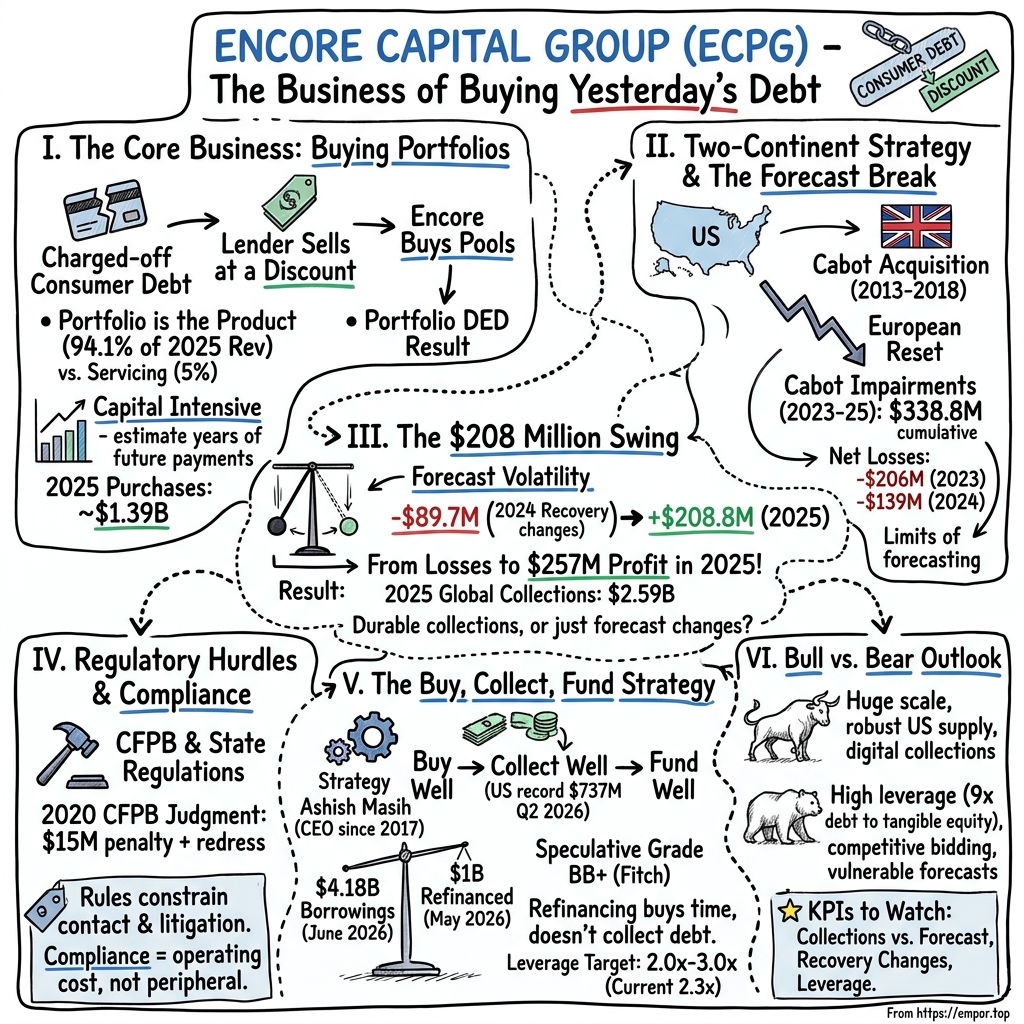
Somewhere in a San Diego office, a model ran again. It looked at millions of accounts that banks had long ago given up on, credit card balances that had gone unpaid for months, been written off, and then sold, and it asked the same question it asks every quarter: how much of this money will these people still pay back, and when? In 2024 the answer had kept coming back smaller. In 2025 it came back larger, and the difference was enormous. Encore Capital Group's revisions to its expected recoveries added $208.8 million to revenue in 2025, after subtracting $89.7 million in 2024 and $82.5 million in 2023.1
That one line explains more about Encore than almost anything else in its accounts. It is not a fee or a sale. It is a change of opinion, the company's own updated forecast of what strangers will repay on debts they stopped paying years earlier, and under the accounting rules that govern purchased receivables, a change of opinion flows straight into revenue. So when the forecasts turned, the income statement turned with them. Encore lost about $206 million in 2023 and about $139 million in 2024, then earned roughly $257 million in 2025.1 A company that had spent two years writing down its European business and trimming its expectations suddenly looked like one of the most profitable consumer finance businesses in America.
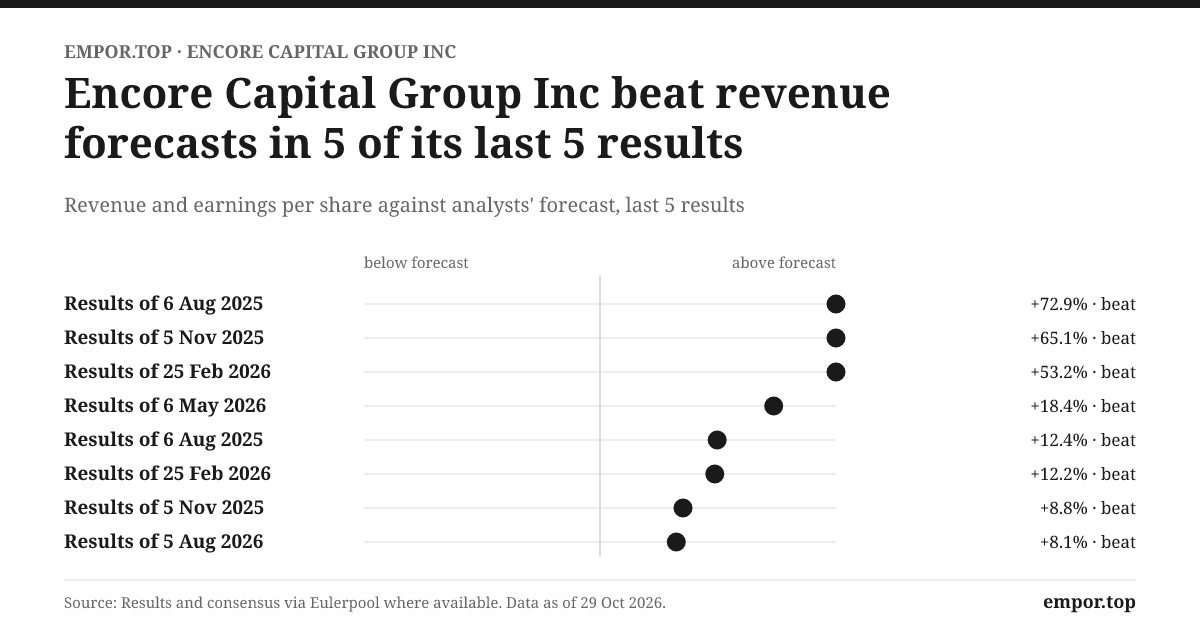
The obvious reading is that Encore fixed something. Collections did rise sharply, by almost a fifth in 2025 to about $2.59 billion, which is cash, not opinion.1 But the size of the swing in forecasts is the reason a careful investor cannot stop at the headline. Roughly a third of a billion dollars separates the forecast revisions of 2024 from those of 2025. Encore's 2025 profit before tax was about $336 million.1 Put those two numbers next to each other and the uncomfortable truth appears: a reversal in forecast revisions of about that size, in the other direction, would have been enough to turn a record year back into something much closer to a loss. The rebound is real because the cash collections are real. Whether it is durable depends on whether the newer forecasts prove right as the portfolios age.
That is the wager at the heart of this business, and it is worth stating plainly before the story begins. Encore buys defaulted consumer debt for a fraction of its face value. It collects on that debt over many years, through letters, calls, digital payment plans and, when consumers can pay but do not, lawsuits. It funds those purchases mostly with borrowed money. It wins when it buys at a price that leaves room for error, collects more than it expected at a reasonable cost, and borrows cheaply enough that the spread is still attractive after interest. It loses when any one of those three breaks for long enough, and it loses faster because the debt magnifies every mistake.
Three other tensions run beneath that wager. The first is geography. Encore is two businesses wearing one ticker: Midland Credit Management in the United States, which has been growing quickly, and Cabot Credit Management in Britain and continental Europe, which produced most of the pain of 2023 and 2024. Can the American engine keep pulling a weaker European car? The second is capital allocation. Encore has been buying back its own shares while running a balance sheet that its rating agency still calls speculative grade. Does that fit, or is it a bet layered on top of a bet? The third is conduct. Debt collection is one of the most regulated activities in consumer finance, Encore has already been through two federal enforcement actions, and the rules that govern how a collector may call, text or sue a consumer directly shape how much it can recover and at what cost.
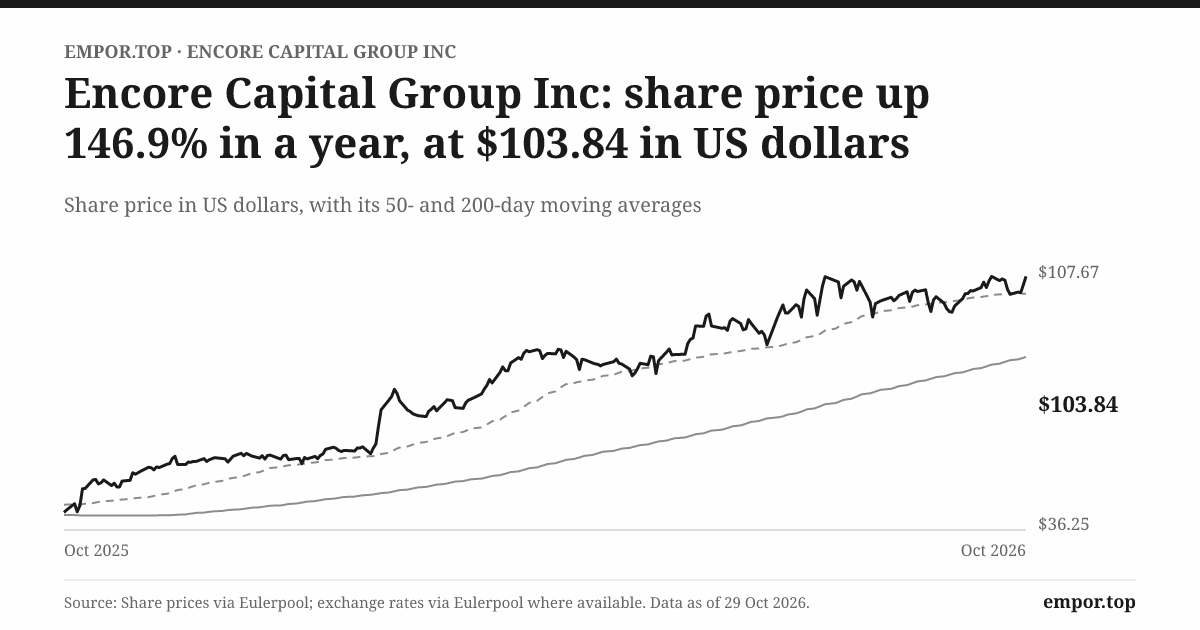
Here is where the company stands on the day this story is written. In 2025, Encore reported revenue of about $1.77 billion, and debt purchasing accounted for 94.1% of it.1 The rest came mainly from servicing other people's debt for fees. The shares closed on October 29, 2026, at $103.84, which was the high of the past year and more than two and a half times the 52-week low of $40.90.[^2] The market valued the equity at about $2.2 billion and the whole enterprise, including debt, at about $6.9 billion.[^2] The stock trades at about 7.4 times trailing earnings. That sounds cheap, and in absolute terms it is a low multiple, but it is well above Encore's own five-year median of 4.8 times.[^2] Investors are paying more for each dollar of Encore's earnings than at almost any point in the recent past. The question is whether they are paying for a franchise or for a forecast.
To answer that, the story has to go back to the moment Encore decided that America was not big enough.
 Subscribe on LinkedIn
II. From a U.S. Debt Buyer to a Two-Continent Company
By the early 2010s, Encore had been buying charged-off American consumer debt for years. It had gone public in July 1999, selling 2.25 million shares at $10 apiece, and its core operating subsidiary, Midland Credit Management, had become one of the largest buyers of defaulted credit card balances in the country.2 The American market was large, but it was also mature, crowded with rivals and increasingly scrutinized by a brand-new federal regulator, the Consumer Financial Protection Bureau. Growth required either buying more of the same paper at higher prices or finding new paper somewhere else.
Britain was the obvious somewhere else. It had a deep consumer credit market, a long history of banks selling defaulted debt and a legal system in which collectors could pursue consumers through the courts. In July 2013, Encore acquired a controlling stake in Cabot Credit Management, one of the leading British debt buyers.3 It was a bold step for a company whose identity had been entirely American, and it changed what shareholders owned. Encore was no longer a U.S. collector with a side interest abroad. It was building a second home.
The second move came quickly. In February 2014, Cabot agreed to buy Marlin, another major British debt purchaser, for £295 million in cash, about $481 million at the time, funded entirely with debt that Cabot raised.3 Marlin was not a carbon copy of Cabot. It ran a mature legal collections operation focused on consumers who could pay but would not, which complemented Cabot's strength with consumers willing to work out a payment plan.3 Encore's chief executive at the time, Ken Vecchione, said the deal "aligns perfectly" with the company's strategy and that Encore was "well positioned" to benefit from consolidation in the British market.3 The combined company would be the largest unsecured debt buyer in the United Kingdom, with promised cost and revenue synergies and an expected boost to Encore's earnings per share in the first year.3
The financing detail matters more than it seems. A debt-funded acquisition of a debt buyer stacks leverage on leverage: Marlin's own portfolios were valued on forecasts of what British consumers would repay, and the price Cabot paid was funded by borrowings that would need servicing whatever those consumers did. The acquisition accounting recorded $326.8 million of goodwill, the premium paid over the identifiable assets.4 Goodwill in this industry is a strange thing. It represents the value of a platform, its people, its seller relationships and its collection know-how, over and above the portfolios it owns. It is also the first thing to go when the forecasts for that platform weaken.
In May 2018, Encore completed the journey by agreeing to buy the rest of Cabot from its private equity co-owner, J.C. Flowers.[^6] The consideration was £175.5 million in cash plus 5 million newly issued Encore shares.[^6] Management presented the deal as accretive to earnings and said it expected returns above 15%.[^6] The logic was coherent. Full ownership would simplify a complicated structure, let Encore consolidate Cabot's cash flows without a minority partner taking a share, and give it a single platform from which to allocate capital between America and Europe depending on where returns looked best. That flexibility to move money between continents is something Encore's rating agency still lists among its strengths today.5
Then came the test of time. Between 2023 and 2024, Encore recorded goodwill impairments tied to Cabot of $238.2 million and $100.6 million, a combined $338.8 million.46 That figure is strikingly close to the goodwill booked on Marlin alone, though the impairments related to Cabot's reporting unit as a whole rather than to any single deal. An impairment is an admission, in accounting language, that the future cash flows a business is expected to produce no longer justify the value on the books. It does not mean the cash was lost in the year of the charge. The cash was spent years earlier, when the acquisitions were made. The impairment simply records that the forecast underpinning that spending has been reset.
It would be easy, and too strong, to say Encore overpaid for Europe. The company does not publish a clean set of deal multiples that would allow a comparison with similar acquisitions, and over the years between 2013 and 2023, Cabot did collect billions in cash and contribute to Encore's earnings. What the record does show is narrower and still important. The returns promised at the time of the 2018 buyout were, on the evidence of the later write-downs, not delivered as planned. International reach gave Encore a larger platform and more places to deploy capital. It did not give it immunity from forecasting error, and it may have added a second market in which that error could occur.
That leaves the question that the rest of this story will try to answer. Did a bigger footprint and a larger portfolio make Encore better at the three things that matter, buying, collecting and funding, or did it just give the company more exposure to the same risk of being wrong about what consumers will repay? To judge that, it helps to understand exactly what Encore sells, and why its revenue can move in ways that its cash does not.
III. The Portfolio Is the Product
Picture a credit card account at a large American bank. The cardholder stopped paying perhaps six months ago. The bank has sent letters, made calls and eventually, as regulators require, charged the balance off, meaning it has written the loan down to zero on its own books. The debt still legally exists. The consumer still owes it. But the bank no longer wants to spend money chasing it, and it would rather turn a dead asset into a little cash today. So it bundles that account with thousands of others into a portfolio and offers it to a handful of qualified buyers.
Encore is one of those buyers. Before it bids, it has to answer a question that sounds simple and is fiendishly hard: if it pays a few cents on the dollar for this pool, how much will it collect over the next ten or fifteen years, and how fast? The answer depends on who these consumers are, how old the debt is, whether previous collectors have already tried, what the economy will do, what the law allows and how good Encore's own operations are at reaching people and agreeing on a plan they can keep. Encore's forecasts span up to fifteen years. At the end of June 2026, it expected to collect about $10.2 billion over a 180-month horizon, with about $8.7 billion of that expected within the first seven years.7 Those estimated remaining collections, known in the industry as ERC, are the closest thing this company has to an order book.
Debt purchasing produced about $1.67 billion of revenue in 2025, or 94.1% of the total,1 while servicing, in which Encore collects on behalf of others for a fee, contributed about 5%.1
The accounting follows from that reality, and it is worth slowing down to explain, because almost every misunderstanding about Encore comes from here. When Encore buys a portfolio, it records it at the purchase price and works out the implied rate of return that would turn that price into the forecast stream of collections. Each period, it recognizes revenue as that rate applied to the remaining balance, much as a bank recognizes interest on a loan. That is the steady part. Then comes the volatile part. If consumers pay more than forecast in a given quarter, the excess shows up as revenue. If Encore decides that future collections will be higher or lower than it previously thought, it recalculates the value of the portfolio and books the difference immediately. Encore calls the combination "changes in recoveries."1
A household analogy helps. Imagine buying a fruit orchard and recording its value based on how many apples you expect it to produce over the next fifteen years. Each year you book some income as the orchard ages toward harvest. If a good season brings in more apples than expected, you book that too. And if you decide, after a few strong seasons, that the trees will produce more apples every year from now on, you mark up the orchard immediately and book that as income today, even though the extra apples have not yet been picked. Encore's 2025 profit included a great deal of fruit still on the tree.
This is why reported revenue can move differently from cash. In the second quarter of 2026, for instance, changes in recoveries totaled about $71 million. Of that, about $53 million reflected collections that had already come in above forecast, and about $18 million reflected higher expectations for the future.8 The first part is cash in the door. The second is a raised forecast. Both lift revenue. Across 2025 as a whole, the $208.8 million of favorable recovery changes lifted reported revenue, and then, in the cash-flow statement, the company had to subtract that same amount in reconciling net income to cash from operations, because it was not cash received in that form.1 In 2023 and 2024, the process ran in reverse: unfavorable revisions depressed earnings and were added back in the cash-flow reconciliation.
There is a second accounting wrinkle that makes conventional free cash flow almost useless for judging Encore. When Encore buys a portfolio, the purchase is an investing outflow. When it collects money, the part that represents a return of the original principal is an investing inflow. Only the revenue part runs through operating cash flow. So Encore's cash from operations sat in a narrow band of about $152 million to $156 million each year from 2023 through 2025, through two loss years and one record profit year.1 The figure that would conventionally be called free cash flow, about $127 million in 2025, sounds modest against roughly $257 million of net income, but it omits both the largest outflow, more than a billion dollars a year of portfolio purchases, and the largest inflow, the principal portion of more than $2.5 billion of collections.1 Reading Encore's free cash flow as if it were a software company's would be like judging a farmer's year by the price of fuel while ignoring both the seed and the harvest.
For the same reason, many standard business ratios are poor fits here. A portfolio of charged-off debt is not inventory sitting on a shelf, and it is not a trade receivable owed by a customer who bought goods on 60-day terms. Measures like debtor days, inventory turnover or a cash conversion cycle, which help when analyzing a manufacturer or a retailer, say little about whether Encore's assets are worth what it says they are. Encore does not publish trade receivable ageing for its portfolio, because the portfolio is not valued that way; it is valued through pool forecasts and recovery revisions.1
What does matter is simpler to state and harder to measure. For each year's purchases, known as a vintage, does Encore eventually collect more than the forecast that justified the price it paid, after the cost of collecting it and the cost of the money it borrowed to buy it? Encore publishes collection multiples by vintage, the ratio of cumulative collections to purchase price, and those numbers are the closest thing to a scorecard. At the end of 2025, its 2023 American vintage had collected about 1.3 times its purchase price, and its 2024 vintage about 0.9 times.1 Neither is finished. The 2024 vintage, after a little over a year, had not yet collected what it cost. That is normal in this business, where most of the cash arrives over several years.
The investor's operating test is now clear. Revenue at Encore is the output of a model applied to a portfolio. Cash collections are the output of operations applied to consumers. Over time those two must agree, and when they do not, the gap shows up as recovery revisions and, eventually, impairments. The next question is whether Encore has a real edge in producing the cash side of that equation, or whether its recent strength is mostly a product of a favorable American market.
IV. A Bigger U.S. Book, and a Smaller Margin for Error
In the second quarter of 2026, Encore's American business did something it had never done before. Midland Credit Management bought $372 million of portfolios in a single quarter, a record, including a burst of opportunistic purchases in the spot market.8 In the same three months, Encore collected a record $737 million globally, up 13% from a year earlier, with the American business alone collecting a record $572 million, up 17%.8 The United States accounted for 84% of everything Encore bought that quarter.8 Ashish Masih, the chief executive, opened the call by saying Encore had "affirmed our industry leadership."8
It was a strong quarter by any measure, and it fit a longer arc. In 2024, the American business bought about $1 billion of portfolios, a record at the time, and collected about $1.6 billion, up 20%.6 In 2025, American purchases rose another 18% to about $1.17 billion.9 Across both continents, Encore bought about $1.4 billion of portfolios in 2025 and collected about $2.59 billion.1 Masih's description of the company in his 2025 shareholder letter was blunt: "Encore is the largest debt buyer in the most attractive consumer credit market in the world."9
To understand whether that scale is an advantage, it helps to understand how the market works. Banks and other originators that sell charged-off debt choose among a small number of qualified buyers. They care about price, but they also care about who will be calling their former customers, because a collector's misconduct can come back to haunt the bank's brand and its regulatory standing. Much of Encore's American buying runs through forward-flow agreements, in which a bank commits to sell its newly charged-off accounts to a buyer over a set period at agreed terms; the rest happens in spot sales, one portfolio at a time.1 Encore does not disclose the length of its forward-flow contracts or any minimum purchase commitments, and it does not name its sellers, though it warns that purchases in any period can be concentrated among a few large sellers and that losing one could be hard to replace.1 Price is set by supply, by the competition among bidders and by each bidder's estimate of how much consumers will repay.
Supply has been plentiful. On the second-quarter call, Masih pointed to revolving credit balances near record levels and a credit card charge-off rate of about 4%, which by his estimate implied more than $50 billion of annualized net charge-offs in the American market.8 More defaulted debt means more portfolios for sale, and when supply is ample, buyers have more choice and sellers have less leverage. That is the backdrop against which Encore has been buying aggressively.
The closest public comparison is PRA Group, Encore's longtime rival. In 2025, PRA reported about $1.21 billion of portfolio purchases and about $1.19 billion of portfolio revenue.10 Encore bought somewhat more, about $1.4 billion, and its debt-purchasing revenue was meaningfully larger.1 The comparison is rough. The two companies define segments and revenue differently, they operate in overlapping but not identical markets, and neither publishes a market share that would settle who leads where. What it does suggest is that Encore is one of the two largest listed operators in this industry, and the larger of the two by purchasing in 2025. At the same time, PRA's results underline how thin the line between scale and success can be. A peer comparison at the time of writing showed PRA with negative trailing earnings and trading below its book value.11 Size alone did not protect PRA from a difficult stretch, which is a useful caution against treating size as an automatic advantage for Encore.
So what might a large operator genuinely do better? There are four plausible mechanisms. The first is data. A company that has bought and collected millions of accounts over decades has a history of how similar consumers behaved, which in principle allows it to price a new portfolio more accurately than a newcomer. The second is seller relationships. Banks prefer to sell to buyers they trust, and a long record of compliant behavior can win access to forward-flow agreements that smaller rivals cannot get. The third is compliance cost. Running a collection operation that satisfies federal and state rules, with call recording, disclosures, dispute handling and legal oversight, is expensive, and those fixed costs weigh less on a large operator. The fourth is operating efficiency: the ability to invest in technology and digital payment channels that lower the cost of each dollar collected.
Encore's management argues all four, and on the second-quarter call Masih laid out what he described as a virtuous cycle. Better collection efficiency, he said, lets Encore win more of the portfolios it wants, and because the company is not using all of that advantage to cut its bids, returns are rising.8 He also said that better collection efficiency had offset slightly higher American portfolio prices.8 That is an important admission tucked inside a bullish answer: prices are going up. In a market where sellers can choose among buyers, rising prices are exactly what one would expect when supply is ample but competition for it is intense, and they are the mechanism by which returns get competed away.
The evidence for an edge is real but bounded. Collections have grown faster than purchases, management says all of its American and European vintages are performing at or above their revised forecasts, and the company's pre-tax return on invested capital rose from about 7.5% in 2024 to about 13.7% in 2025 by its own measure.98 What the record does not yet show is that Encore earns superior lifetime returns on its purchases relative to peers, or that it has pricing power over sellers. A company that has the best data in the industry can still overpay if it bids into a hot market, and the 2024 vintage's sub-one collection multiple at year-end 2025 is a reminder that the final scorecard on recent buying is years away.1
The clearest proof that scale and data do not guarantee returns comes from Encore itself, on the other side of the Atlantic. Britain was supposed to be the second engine. Instead, British consumer lending slowed, consumers became more cautious, and delinquencies and charge-offs stayed low, which meant less fresh debt for sale and stiff competition for what came to market.9 Cabot, with all of Encore's data and know-how behind it, cut its expected recoveries and exited markets in 2024.6 The same company, the same models and the same management produced a record in one market and a reset in the other.
That leaves two questions to carry through the rest of the story. Are collections running ahead of forecast for each vintage, especially the large ones bought in 2024, 2025 and 2026? And after the price paid, the cost of collecting and the cost of borrowing, are those vintages earning more than the capital costs? Europe answered those questions badly in 2024, and how it happened is the most revealing chapter in Encore's recent history.
V. When the European Forecasts Broke
The fourth quarter of 2024 was when Encore stopped hoping and started cutting. By then, Cabot had been a problem for more than a year. In 2023, Cabot had already suffered a $238.2 million goodwill impairment.4 The hope had been that Britain would stabilize. Instead, the company decided to restructure Cabot, exit underperforming markets and reset its forecasts.6
The market exits came in two steps. In the third quarter of 2024, Cabot left the Spanish secured non-performing loan market, and in the fourth quarter it left the Italian non-performing loan market, selling the related portfolios and with them the expected recoveries that had been booked against them.6 Those were not core British operations, but they were places where Encore had chosen to put capital in pursuit of European diversification, and walking away from them was an admission that those bets had not worked.
Then came the forecasts. In the fourth quarter, Encore recorded a negative $129 million change in expected recoveries.6 About two-thirds of that related to the British business, and the rest was split between other continuing European operations and the market exits.6 In the same quarter, Encore recorded a further $101 million goodwill impairment.6 Together with other asset impairments, these charges produced a fourth-quarter loss of roughly $225 million and pushed Encore to a full-year loss for the second consecutive year.6
It is tempting to describe all this as "non-cash charges," and in a narrow sense that is true. But that framing misses what happened: the charges marked down money Encore had invested years earlier in Cabot, Marlin and European portfolios, reflecting lower expected returns than the company had told itself and its shareholders to expect.
Comparing the two years helps clarify the nature of the problem. The 2023 charge was larger in goodwill terms, but 2024 was in some ways more revealing: Encore cut both the value of Cabot's platform and its forecasts for portfolios already owned, indicating less optimism not only about what Cabot might earn on future purchases but also about what it would collect on purchases already made.
Management's response, in the 2024 annual report, was that the restructuring had put Cabot "on a more solid footing."6 It also noted that Cabot's collections in 2024 had actually risen 8% to about $588 million, and that its purchases had jumped 36% to about $353 million, much of that in a single $200 million fourth quarter that included opportunistic spot purchases.6 Management cautioned that this level of European buying was not expected to continue in 2025.6 The picture was of a business that was still collecting and still buying, but whose forecasts had been too high and whose carrying value had to come down.
How did that statement hold up? The 2025 record offers partial vindication. There was no further goodwill impairment in 2025, and the group's recovery revisions turned sharply positive.1 The 2025 shareholder letter described Cabot as having delivered "stable, predictable performance and solid returns" after its right-sizing, while acknowledging that European conditions remained "more mixed," with slowing British bank lending and cautious consumers keeping charge-offs low.9 By the second quarter of 2026, Cabot's collections were about $164 million, flat from a year earlier, and its purchases about $72 million.8 Masih described British conditions as still "subdued," and emphasized operational improvements and cost management, including bringing best practices from the American business to Cabot.8 On the call, he also said that every vintage at both Midland and Cabot was showing positive changes in recoveries.8
That is encouraging, but notice what it actually tells an investor. Flat collections and modest purchases are consistent with a business that has stopped getting worse. They are not consistent with a growth engine. And positive revisions after a large downward reset are partly what one would expect: when forecasts are cut aggressively, it becomes easier to beat them. The real test of Cabot's rebased forecasts is not whether they are exceeded in the first year or two after the reset but whether they hold over the full life of the portfolios.
There is also a credibility question that deserves direct treatment. Encore's management did not hide the Cabot problem once it decided to deal with it, and the 2024 actions were specific: named market exits, a quantified recovery cut and an explicit statement that European purchasing would slow. That is more than many companies offer when an acquisition disappoints. But the problem took two years and two rounds of goodwill impairment to address fully, and the earlier forecasts and carrying values, which management had stood behind, turned out to be too optimistic. Fitch, in its 2026 review, noted the goodwill impairments and under-collections of 2023 and 2024 as the reason net income suffered and said it did not expect further material impairments or under-collections, while keeping impairment on its list of possible downgrade triggers.5
The historical record, then, narrows the claim that Encore's forecasting process is reliably accurate: the same process produced forecasts that later had to be cut. What the record does not do is erase the American business's separate performance, which during the same years was buying and collecting at record levels. The fair conclusion is that Encore's forecasting is good enough to run a large, profitable business and fallible enough that investors should watch vintage-level results rather than taking the forecasts on trust.
One more thing determines how much Encore can collect, and it has nothing to do with models or markets. It is the law.
VI. Collections, Conduct and the Cost of Staying in the Market
On September 9, 2015, the Consumer Financial Protection Bureau brought an action against Encore Capital Group and three of its subsidiaries, Midland Funding, Midland Credit Management and Asset Acceptance Capital Corp, accusing them of using deceptive tactics to collect bad debts.12 The case was resolved through a consent order, an agreement in which the company accepted a set of conduct requirements without the matter going to trial.12 For a company whose entire business depends on contacting consumers and, when necessary, suing them, an order governing how it does those things was not a side issue. It was a direct constraint on the production line.
Five years later, the bureau came back. On September 8, 2020, the CFPB filed a lawsuit in federal court in San Diego alleging that Encore and the same subsidiaries had violated the 2015 consent order and had again violated the Fair Debt Collection Practices Act and the Consumer Financial Protection Act.13 The bureau described the companies as the largest debt buyer and collector in the United States.13 The case was settled quickly. On October 16, 2020, the court entered a stipulated final judgment requiring Encore to pay $79,308.81 in consumer redress and a $15 million civil money penalty, to make certain disclosures to consumers, to refrain from collecting time-barred debt unless it first made specific disclosures, and to continue complying with conduct provisions from the 2015 order for another five years.13
The details deserve to be read carefully. The redress figure was small, which suggests the bureau did not identify large-scale financial harm in the conduct it pursued. The penalty was substantial for a regulatory matter, and the extension of the earlier conduct requirements was arguably the most consequential term, because it meant the bureau's rules for how Encore collected would remain in force well into the 2020s. These were the regulator's allegations and an agreed resolution. They are not evidence about how Encore collects today, and no trial determined the company's liability. But they do establish that the federal government twice concluded that Encore's collection practices required intervention, and that the second time was for alleged violations of the order resulting from the first.
The overhang has not fully disappeared. Encore's 2025 annual filing says the company remains subject to ancillary investigations by state attorneys general into historical collection practices, in addition to the routine flow of consumer lawsuits under federal debt collection, credit reporting and telephone consumer protection laws.1 It had settled with several states and was in discussions with others about potential resolutions.1 The company describes the possible outcomes as penalties, restitution or requirements that change how it operates, but it does not quantify the aggregate exposure or say when the matters might be resolved.1 Investors therefore face unquantified exposure whose size Encore has chosen not to estimate in public.
Why does this matter so much for the economics? Because the channel that produces a recovery also determines its cost. When a collector can reach a consumer by phone, email or text and agree on a payment plan, the cost of that collection is relatively low. When rules restrict those communications, or when a consumer cannot be reached, the collector's main alternative is litigation, filing suit to obtain a judgment and then enforcing it. Encore's own filing warns that blocked communications can push collections toward higher-cost legal channels.1 Legal collection is slower, more expensive and, as the CFPB's cases showed, more exposed to procedural error. A tightening of the rules on contact, documentation or time-barred debt does not just add a compliance cost; it can change the shape of the collection curve on every portfolio Encore owns, and therefore change the value of those portfolios.
This is also where the competitive argument and the regulatory argument meet. If compliance is expensive and complex, it favors established operators with the scale to afford legal teams, call monitoring and technology. Sellers, too, prefer buyers who will not embarrass them. In that sense, regulation may help create the kind of barrier to entry that a large player like Encore benefits from. But it is a barrier with a sharp edge. Being large makes Encore a more visible target for enforcement, and the reputational cost of a misstep falls not only on Encore but on the banks that sold it the debt. Fitch lists regulatory intervention that weakens the franchise or business model among the events that could prompt a downgrade.5
Management's current framing emphasizes technology and the consumer. On the second-quarter 2026 call, Masih credited new technology, digital capabilities and operational innovation for the record collections in the United States, and described consumer payment behavior as stable, consistent with what banks and card issuers were reporting.8 Encore's annual bonus plan for executives gives 15% weight to a consumer experience measure and applies a risk management multiplier, a design that at least puts conduct into the pay formula.14 What the company does not publish is a breakdown of collections by channel, the share coming through digital versus legal routes, or complaint and dispute rates that would let an outsider verify that the shift toward technology is improving outcomes for consumers as well as for shareholders. Analysts on the call did not press the point.8
The tension that carries forward is a genuine one. Technology can lower the cost of each dollar collected and can make the process less adversarial for consumers who want to settle. If that is what is driving Encore's record collections, it is a durable improvement. But collection gains that come from more aggressive contact, or from pushing more accounts into litigation, would be fragile, because they invite exactly the kind of enforcement that Encore has already experienced twice. The difference between those two versions of the story is not visible in the headline numbers. It will show up over time in the outcome of the remaining state matters, in the volume of consumer complaints, and in whether collection costs keep falling as collections rise.
Which brings the story to the person responsible for navigating all of it.
VII. Ashish Masih's Buy, Collect and Fund Strategy
Ashish Masih does not come across as a showman. On earnings calls he speaks in the measured language of an engineer explaining a process, and that is roughly what he is. He earned a bachelor's degree in mechanical engineering from the Indian Institute of Technology in New Delhi, a master's in manufacturing systems engineering from Lehigh University and an MBA from Wharton.14 Before Encore, he spent time as a consultant at McKinsey and KPMG Consulting and then eight years in senior credit card roles at Capital One, from 2001 to 2009.14 That last stint matters. Capital One built its business on the idea that credit could be priced account by account using data and testing, and Masih arrived at Encore in 2009 with that worldview. He worked in operations and corporate development, became president of Midland Credit Management in late 2016, and took over as Encore's chief executive in June 2017.14
His framing of the business is disciplined and repeated almost word for word across calls. Encore's "value engine," he says, rests on three linked decisions: buy portfolios at attractive returns, collect efficiently, and fund the business competitively through low-cost capital and a strong balance sheet.8 It is a useful framework because it maps exactly onto how the business can fail. The test of a framework, though, is not whether it is coherent but whether the person stating it has delivered on it.
The supporting team has changed recently. Tomas Hernanz became chief financial officer in April 2025, succeeding Jonathan Clark.141 Hernanz is a product of the European business: he joined Cabot in 2016, became its CFO in 2022 and had earlier worked at Ondra Partners, Goldman Sachs and Citigroup.14 The choice of a CFO who ran Cabot's finances through its reset is notable. It can be read as continuity, putting someone who knows the European problem intimately in charge of group finance, or as a sign that the group is comfortable with how that reset was handled. Either way, the person now responsible for Encore's funding saw at close range what happens when European forecasts break.
How is Masih paid, and does it align him with shareholders? His summary compensation for 2025 was about $8.1 million.14 A separate measure the proxy calls "compensation actually paid," which tries to capture the change in value of equity awards, came to about $13.3 million, larger mostly because Encore's share price rose sharply and lifted the value of his unvested stock.14 That second figure tells an investor more about the stock than about the pay committee's generosity. The pay design itself puts most of the weight on results. The annual bonus is funded 60% by adjusted EBITDA, with the rest split among consumer experience, people and strategic goals, and long-term equity is split among time-vesting shares, units tied to return on invested capital and units tied to shareholder returns relative to a small-cap financial index.14 About 87% of the CEO's target pay is at risk.14 Masih personally owned about 1.4% of the company as of April 2026, and directors and executives together held about 3.0%.14 That is meaningful money for an individual, giving some alignment, but it is not founder-level ownership, and the largest holders are institutions, led by BlackRock with about 16.9%.14
Shareholders have been supportive. The say-on-pay vote at the 2025 annual meeting won about 98% support, and at the June 2026 meeting about 18.0 million shares voted in favor against roughly 313,000 against.1415 These votes show that institutional shareholders accept the pay design. They do not prove operational credibility, and they followed a period in which the share price recovered strongly, which tends to make shareholders generous.
Now the harder part: testing the framework against the record of Masih's own tenure. The European reset happened on his watch. He had been chief executive for six years when the first Cabot impairment came, so this was not an inherited problem. The 2018 Cabot buyout was one of the defining capital decisions of his early tenure.[^6] On the "buy well" leg of his own framework, Europe is a clear miss. The fair counterweight is that the American business, which he ran before becoming chief executive, has performed strongly through the same period, and that when he did act on Europe, the actions were specific and quantified. Improvement in America does not excuse the European miss. It does show that the miss was not a failure of the entire operating model.
On the "fund well" leg, the record is better. Encore's leverage, measured as net debt to adjusted EBITDA, fell from 2.9 times at the end of 2023 to 2.3 times by the end of the second quarter of 2026, inside its stated target range of 2 to 3 times.698 That is a consistent direction during a period of record purchasing, which suggests the company has managed to grow the portfolio without stretching the balance sheet further by its own measure.
The capital allocation decision that most deserves an activist's scrutiny is the share buyback. In 2025, Encore repurchased about $89.5 million of its own stock, roughly 9% of the shares outstanding.19 In the first half of 2026 it bought back another $47 million.7 On the call, Masih listed capital priorities in order: buying portfolios first, share repurchases second, and returns on invested capital as the guiding test.8 With hindsight, the 2025 buybacks look well timed. The share price has more than doubled from its 52-week low, so shares retired at those levels were bought far below today's price.[^2] But hindsight is not a capital allocation policy. Every dollar spent on buybacks is a dollar not available to buy portfolios or reduce debt, and it reduces the equity base underneath a balance sheet that carries about $4 billion of borrowings. Fitch, which otherwise praised Encore's improving collections, specifically warned that buybacks "could still put pressure on tangible equity" if collections weaken.5 A skeptical investor would ask a simple question: if Encore genuinely believes its newest portfolios offer the best returns in years, why is it spending money on its own shares instead of buying more of them, and what return threshold did the board use to decide?
The second-quarter 2026 call offered management's latest claims to test. Encore raised its collection guidance for 2026 to between $2.8 billion and $2.85 billion, said purchases would likely come in near the top of a $1.4 billion to $1.5 billion range, and guided to earnings per share of $13 to $14, including about $1 of cost from the refinancing.8 Masih said newer purchases were showing better returns and that 2026 vintages were "performing as expected."8 These are concrete, testable statements, and that is to his credit. They are also exactly the kind of statements that, in Europe a few years earlier, had to be revised. Credibility here is earned one quarter of collections at a time, and Masih's balance is positive in America, negative in Europe and still being written on capital returns.
The funding leg of the framework is where the story turns next, because the balance sheet is what makes every other decision possible, and what makes every mistake more expensive.
VIII. The Balance Sheet Behind Every Bid
In May 2026, Encore went to the bond market and refinanced about $1 billion of debt.7 It issued $750 million of high-yield notes due in 2032 and €325 million of floating-rate notes due in 2033, at lower coupons than the debt they replaced.8 It had already extended and enlarged its global revolving credit facility to $1.485 billion, maturing in 2029.75 In July, it announced a call of its $230 million of convertible notes due 2029.8 After these moves, management said, Encore had no material debt maturities until 2028.8 For a company whose entire model depends on borrowing to buy portfolios, pushing out maturities and lowering coupons is the equivalent of an airline locking in fuel prices for the next several years.
It was not free. Retiring the old debt early meant paying call premiums and writing off unamortized issuance costs, and Encore recorded a loss on extinguishment of about $30.5 million in the second quarter.7 Management said the hit would cost about $1 of earnings per share for 2026.8 The trade is a familiar one: pay a known cost today to reduce interest expense over the following years. Its value depends on Encore actually keeping its portfolios funded at lower cost through the cycle, which in turn depends on collections holding up.
Why does all of this matter so much? Because of a basic mismatch of timing. When Encore buys a portfolio, it pays the full price up front. The collections from that portfolio arrive over years, and the bulk of them typically come in during the first several years. To keep buying at the pace it has, more than a billion dollars a year, Encore needs to fund the gap between what it pays today and what it will collect tomorrow. Debt fills that gap. As long as collections come in at or above forecast, the debt is serviced comfortably and the spread between portfolio returns and borrowing costs accrues to shareholders. If collections fall short, the debt does not shrink to match. Leverage turns a forecasting miss into a balance sheet problem.
Encore's borrowings stood at about $4.18 billion at the end of June 2026.7 At the end of 2025, they were about $4.0 billion, net of issuance costs, and the company reported that it was in compliance with its covenants and had about $814 million available under its global senior facility.1 Two clarifications help keep the picture accurate. First, that borrowing figure is genuine funded debt; Encore's operating lease liabilities, about $65 million at the end of 2025, are a separate and much smaller item that should not be added to it carelessly.1 Second, the large "investments" line on Encore's balance sheet is not a portfolio of Treasury bills or corporate bonds that could be sold to repay debt in an emergency. It is the debt portfolio itself, the charged-off consumer receivables valued on their forecast collections.1 Encore's actual cash was about $183 million at the end of June 2026.7 The company's liquidity comes from collections and from its credit lines, not from a hoard of securities.
How leveraged is Encore? The answer depends on which ruler is used, and the difference is instructive. Management measures leverage as net debt divided by adjusted EBITDA, a measure that adds back the portion of collections that represents the return of principal on portfolios. By that measure, leverage was 2.3 times at the end of the second quarter of 2026, comfortably inside the 2 to 3 times target.8 Fitch's comparable measure was 2.5 times at the end of 2025, down from 2.7 times a year earlier.5 Those numbers describe a company that can service its debt from the cash its portfolios throw off. Fitch's interest coverage figure, adjusted EBITDA of about five times interest expense, reinforces that.5
But Fitch also looks at a second ruler: debt to tangible equity, which strips goodwill out of the equity base. On that measure, Encore was at about 9 times at the end of 2025, down from 14 times a year earlier, but still high, largely because so much of Encore's book equity consists of goodwill from its acquisitions.5 This ratio answers a different question. Rather than asking whether Encore can pay its interest, it asks how much real loss-absorbing capital stands behind the debt if the portfolios turn out to be worth less than the forecasts say. At 9 times, the cushion is thin. That is why the same agency that moved Encore's outlook from negative to stable in May 2026, and affirmed its BB+ rating, also said upgrade potential was "limited" in the near to medium term and would require a material increase in tangible equity.5
That BB+ rating sits one notch below investment grade. It is a respectable rating for a company in a cyclical, leveraged and regulated industry, and the move to a stable outlook was a genuine positive, driven, in Fitch's words, by "improved collections performance."5 Fitch also credited Encore's leading franchise, substantial management experience and "adequate long-term pricing discipline."5 Yet the list of things that would push the rating down reads like a summary of this story's central risks: impairments, a sustained fall in collections, material portfolio write-downs, leverage persistently at the high end of the 2 to 3 times range, capital management that reduces tangible equity, and regulatory intervention.5
Here is where the buyback decision becomes a balance sheet decision. Each repurchase reduces the equity that sits beneath roughly $4 billion of debt, at the same time as the company continues to finance portfolio purchases with borrowings. If collections keep outperforming, retained earnings will rebuild tangible equity and the buybacks will look like intelligent use of surplus cash. If collections disappoint, the buybacks will have shrunk the cushion at exactly the wrong moment. That is not a case for or against buybacks. It is a reminder that in a leveraged business, returning capital and preserving resilience compete for the same dollars.
The watchpoints for the balance sheet are therefore concrete. Leverage through the next downturn, not in a year of record collections, is the true test of the 2 to 3 times target. The cost of funding matters because each percentage point of interest on about $4 billion of borrowings is a large slice of pre-tax profit; management guided to about $295 million of interest expense for 2026.8 Covenant headroom under the credit facility, which Encore reported it met at year-end, needs to stay comfortable. And the next material refinancing, now pushed out to 2028, will reveal whether Encore can roll its debt on similar terms in whatever credit market exists then.
The refinancing bought Encore time and some interest savings. It did not change the fundamental arithmetic of a business that borrows against forecasts. With the operating story, the regulatory constraints and the balance sheet laid out, it is time to pull the threads together and ask the investor's question directly: what has to remain true for Encore to win from here, and what could break the case?
IX. Frameworks and the Bull-versus-Bear Case
On October 29, 2026, Encore's shares closed at $103.84, their high for the year.[^2] Twelve months earlier, investors had been able to buy them for about $41.[^2] Over the past five years, the stock had at one point fallen 62.5% from a prior peak.[^2] That range, from despair to a 52-week high within a year, is the market's own verdict on how hard this business is to value. At about 7.4 times trailing earnings, Encore looks cheap against almost any broad market. Against its own five-year median of 4.8 times, it looks expensive.[^2] The equity is worth about $2.2 billion, but the enterprise, including debt, is worth about $6.9 billion, which means roughly two-thirds of the capital in the business belongs to lenders.[^2] Operating margin in 2025 was about 35%, an excellent figure, but it came after a year in which the margin was about 12% and another in which it was close to zero.[^2]
To judge what that price assumes, it helps to step back and examine the structure of the industry. Michael Porter's five forces offer a useful starting map. The bargaining power of suppliers, here the banks and lenders that sell charged-off debt, is substantial. Sellers can choose among several qualified buyers, run competitive processes and switch forward-flow partners when contracts end. Encore's own filing warns that purchases can be concentrated among a few large sellers and that losing one could be hard to replace.1 Rivalry among existing buyers is intense: PRA Group and a group of private buyers compete for the same portfolios, and Masih's acknowledgment that American prices had risen slightly is the visible sign of that competition.8 The threat of new entrants is moderated by capital requirements, compliance costs and the importance of seller trust, but it is not zero, since private capital can and does enter when returns look attractive.
The remaining two forces fit this industry awkwardly. The "buyers" in a conventional analysis are the customers who pay for a product. Encore's payers are consumers who did not choose Encore and cannot switch to a competitor; their bargaining power comes not from choice but from their own financial capacity and from the law. That is why conventional customer concentration analysis is a poor fit: there is no single large customer to lose, but there is a regulatory framework that defines what can be asked of millions of small ones. Substitutes, in the sense of alternative ways for banks to handle defaulted debt, exist in the form of keeping debt in-house or using contingency collection agencies rather than selling outright. Taken together, the forces describe an industry where the supply side has meaningful power, competition limits pricing, and regulation constrains the collection process. That is not a structure that naturally produces high returns for everyone. It rewards whoever is best at pricing and collecting, and punishes anyone who bids too high.
Hamilton Helmer's seven powers framework asks a sharper question: does Encore have a durable advantage that lets it earn returns above its cost of capital in a way competitors cannot copy? Of the seven, three are plausible. Scale economies may exist in compliance, technology and data, where fixed costs spread across a larger portfolio lower the cost per dollar collected. A form of cornered resource may exist in Encore's decades of account-level collection history, which a newcomer cannot buy. And process power may be developing in the collection operations Masih credits for recent outperformance. The others look weak. Encore has no network effects. It has no meaningful switching costs for sellers, who can and do sell to multiple buyers. Its brand, in consumer terms, is not something people seek out. And counter-positioning, a business model incumbents cannot copy without damaging themselves, does not apply to an industry in which every major player does broadly the same thing.
The evidence for even the plausible powers is incomplete. Encore does not publish market share, exclusive supply arrangements or contract terms that would prove privileged access to sellers. It does not publish lifetime returns by vintage compared with peers, which would be the clearest test of a data advantage. And its own European history shows that data and process did not prevent a major forecasting error in a market where conditions changed. The moat, in short, is plausible but unproven. Scale and data probably help. Whether they help enough to earn persistently superior returns, rather than merely survive in a competitive market, is the open question.
The bull case starts with supply. American credit card balances are high and charge-offs are running around normal levels, which means a steady flow of portfolios to buy.8 Encore's purchases have been rising, its collections have been rising faster, and its 2025 collections outperformed forecast enough to generate the large favorable revisions that drove the profit rebound.1 The second quarter of 2026 brought record collections, management raised its full-year collection guidance, and leverage improved to 2.3 times.8 The refinancing pushed out maturities and lowered funding costs, and Fitch moved its outlook to stable.5 If the newest vintages perform as management says, Encore's earnings power over the next few years could be higher than the market's historical multiple implies, and the operating leverage from flat headcount and modest capital spending would amplify the gains. Encore's workforce, about 7,350 people, has been roughly flat for three years while purchases have grown, which shows how much incremental collection volume the existing platform can absorb.1
The bear case starts with the same numbers seen from the other side. A large part of 2025's profit came from favorable recovery revisions, which are opinions about the future, not cash in hand. Cabot required major forecast cuts and impairments in 2023 and 2024, proving that Encore's models can be wrong by large amounts. Competition for portfolios is pushing prices up, and higher prices compress the room for error on each vintage. Regulation can restrict collection channels, raise costs or require restitution, and Encore still faces unresolved state attorney-general investigations whose cost it does not estimate. And debt magnifies all of these risks: at 9 times debt to tangible equity, a meaningful forecasting miss would be felt directly by shareholders, and buybacks have thinned the cushion.
How should an investor weigh management's case? On delivery, the record is mixed but improving. Leverage has moved steadily toward the low end of the target range. Collections have grown strongly. The 2026 refinancing showed that Encore can access capital markets on favorable terms. Against that, the 2018 Cabot buyout's promised returns were contradicted by later impairments, and the Cabot course correction in 2024 came after a year of hoping the problem would resolve itself. The BB+ rating, below investment grade, is a reminder that independent credit analysts still see real risk in the business model.
A sensible valuation frame for Encore, then, does not start with the 2025 earnings per share and apply a multiple. It starts by asking what Encore earns across a full credit cycle, including the bad years, and what return each vintage earns after its purchase price, collection costs and funding costs. Over the past five years, Encore's net profit has grown at only about 4% a year, because the strong years and the loss years largely offset each other.[^2] Over ten years, the growth rate looks far more impressive, about 19% a year, but that partly reflects a weak starting point.[^2] The truth lies in the cycle, not in any single year. The current multiple, low in absolute terms and high relative to Encore's own history, suggests the market is beginning to believe that 2025's profitability is closer to normal than 2023's and 2024's losses were. That belief may be right. It is a bet on the forecasts.
Three numbers will tell investors whether that bet is paying off. The first is collections against forecast, by vintage, which Encore reported at 108% of the expected level for the first half of 2026.8 The second is the direction of changes in expected recoveries, which turned strongly positive in 2025 and remained positive in the second quarter of 2026, at about $71 million.8 The third is leverage after purchases and buybacks, which has been falling and stood at 2.3 times at mid-2026.8 If all three keep moving in the right direction, the bull case strengthens. If any one reverses, the case weakens quickly.
X. Lessons from the Recovery Forecast
Encore's recent history condenses into a handful of lessons, and each belongs to this company more than to any other.
The first lesson is that in a forecast business, the forecast is part of the product. Encore's revenue depends on estimates of what consumers will repay, and the swings in those estimates and Cabot's write-downs show how much the business depends on getting them right. For investors, the key question is how much of a result came from cash collected and how much from a changed opinion about cash still to come. For founders and operators in any business built on long-dated estimates, from insurance to venture lending, the lesson is that the model's errors do not stay in the model. They arrive later, all at once, as charges.
The second lesson is that buying more debt is growth only if the price leaves room for error. Encore's recent buying surge looks like expansion, and it may well be. But paying more for a portfolio leaves less cushion if consumers repay less than expected. The 2024 American vintage, which had collected less than its purchase price at the end of 2025, is a reminder that the verdict on today's buying will not arrive for years. Volume is visible immediately. Returns are revealed slowly. In any business where capital is deployed long before the payoff, growth in deployment should be judged by the returns it eventually earns, not by the size of the cheque.
The third lesson is that a refinancing buys time; it does not collect the accounts. Encore's 2026 refinancing extended maturities and lowered coupons, at an upfront cost. Neither the cost nor the benefit changed how much any consumer will pay on any account Encore owns. The refinancing gave the company longer to prove that its forecasts are right. Funding strength is real and valuable in this business, because it allows Encore to keep buying when weaker competitors cannot. But it is a complement to collection performance, not a substitute for it. Investors who see a refinancing and conclude the risk has gone have mistaken the runway for the destination.
The fourth lesson is that a good capital allocator can return cash and still overreach. Encore's buybacks look shrewd in hindsight, given the share price's subsequent rise. Yet the warning about tangible equity, the high debt-to-tangible-equity ratio and the Cabot buyout's disappointing returns point to the same tension: in a leveraged business, every capital decision reduces the margin for error somewhere else. Returning capital to shareholders and buying portfolios are both reasonable uses of cash. Doing both aggressively, with borrowed money underneath, is a bet that the good years will continue. The best capital allocators in leveraged industries are often defined less by what they buy than by the cushion they refuse to spend.
The fifth lesson is the one most specific to Encore. In debt collection, regulatory discipline and collection economics are inseparable, because the channel that produces a recovery also determines its cost and its legitimacy. A dollar collected through a voluntary digital payment plan is cheap and durable. A dollar collected through a lawsuit is expensive and exposed. A dollar collected through a practice a regulator later deems deceptive may have to be returned, with a penalty attached. Encore's enforcement history and remaining state investigations are not a separate legal footnote to its financial story. They are part of its cost structure. The company that collects best over the long run will not be the one that collects most aggressively, but the one whose methods survive scrutiny.
XI. Epilogue
Tonight, Encore stands at the high-water mark of its recent recovery. Its share price is at its 52-week high, and recent operating and financing results mark a sharp turn from the losses of 2023 and 2024.
But the most important measures are not yet visible. The next annual results will show a full year of portfolio purchases, the cost and savings of the 2026 refinancing, and how management's raised collection expectations compared with what consumers actually paid. Management told investors to expect collections and portfolio purchases near the top of its 2026 guidance ranges.8 If collections land at or above guidance while purchases stay near the top of the range, Encore will have shown that it can grow the portfolio and grow collections together, which is the core of the bull case. If collections come in short, the gap will appear first in the recovery revisions, and the market will be reminded how quickly a positive revision can turn negative.
The recovery revisions themselves are the next thing to watch, especially at Cabot, whose forecasts were reset in 2024, and in the newer American vintages bought at higher prices. Management's claims about those vintages will be tested, one quarter at a time, by actual collections against original forecasts.8
The balance sheet will tell its own story. Investors should compare portfolio purchases and buybacks with leverage, interest expense and tangible equity after the refinancing. If Encore can keep buying at its current pace, continue to repurchase shares and still see leverage hold or fall, it will have demonstrated that its cash generation is strong enough to support all three. If leverage starts rising toward the top of the range, Fitch has said that could prompt a downgrade.5
And the legal story is not finished. The unresolved state matters also remain a watchpoint; their outcomes could affect collection methods and costs. Any shift in federal or state rules on how collectors can contact consumers will also be visible in collection costs and in the mix of channels Encore uses.
All of these threads lead back to the central question. Does Encore convert its scale and data into better lifetime returns on the debt it buys, or do competition and forecast risk eventually take those gains back? The evidence so far is more encouraging than it was two years ago. It is not yet conclusive. The answer will come from portfolios that have not finished paying out, bought at prices that have been rising, in an economy that has not yet been tested by a recession since Encore's American buying surge began. Until those vintages mature, the rebound remains a promise backed by records, but still a promise.
XII. Outro
A charged-off account is, in the bank's eyes, a failure. On Encore's balance sheet, it becomes a long-dated forecast about whether a stranger will pay, how much and when. That transformation is the business.
The recovery estimates that produced the $208 million swing at the start of this story are both Encore's revenue engine and its central risk. When they rise, Encore looks brilliant. When they fall, as they did in Europe, losses arrive in a rush. In between, people on telephones and websites and in courtrooms collect cents on the dollar from consumers who once owed it all.
Unlike a conventional lender or collector, Encore makes its bet after default, on whether the price it paid today will turn out to be less than what consumers repay over the years to come.
References
-
Encore Capital Group, Inc. Form 10-K for 2025 — SEC, 2026-02-25 ↩↩↩↩↩↩↩↩↩↩↩↩↩↩↩↩↩↩↩↩↩↩↩↩↩↩↩↩↩↩↩
-
Encore Announces Cabot's Acquisition of Marlin — SEC, 2014-02-10 ↩↩↩↩↩
-
Fitch Revises Outlook on Encore to Stable; Affirms Long-Term IDR at BB+ — MarketScreener, 2026-05-22 ↩↩↩↩↩↩↩↩↩↩↩↩↩↩
-
Form 10-Q, Quarter Ended June 30, 2026 — SEC, 2026-08-05 ↩↩↩↩↩↩↩
-
Q2 2026 Earnings Call Transcript — Stock Analysis, 2026-08-05 ↩↩↩↩↩↩↩↩↩↩↩↩↩↩↩↩↩↩↩↩↩↩↩↩↩↩↩↩↩↩↩↩↩
-
CFPB Enforcement Action Against Encore and Subsidiaries — CFPB, 2015-09-09 ↩↩
-
CFPB Settlement of Lawsuit Against Encore and Subsidiaries — CFPB, 2020-10-16 ↩↩↩
-
2026 Definitive Proxy Statement — SEC, 2026-04-29 ↩↩↩↩↩↩↩↩↩↩↩↩↩
-
2026 Annual Meeting Voting Results, Form 8-K — SEC, 2026-06-16 ↩
 LinkedIn
 WhatsApp
 Reddit
 Hacker News
 Email
 Kindle
 RSS Feed
 Spotify
 Apple Podcasts
 Amazon Music
 Audible
 YouTube