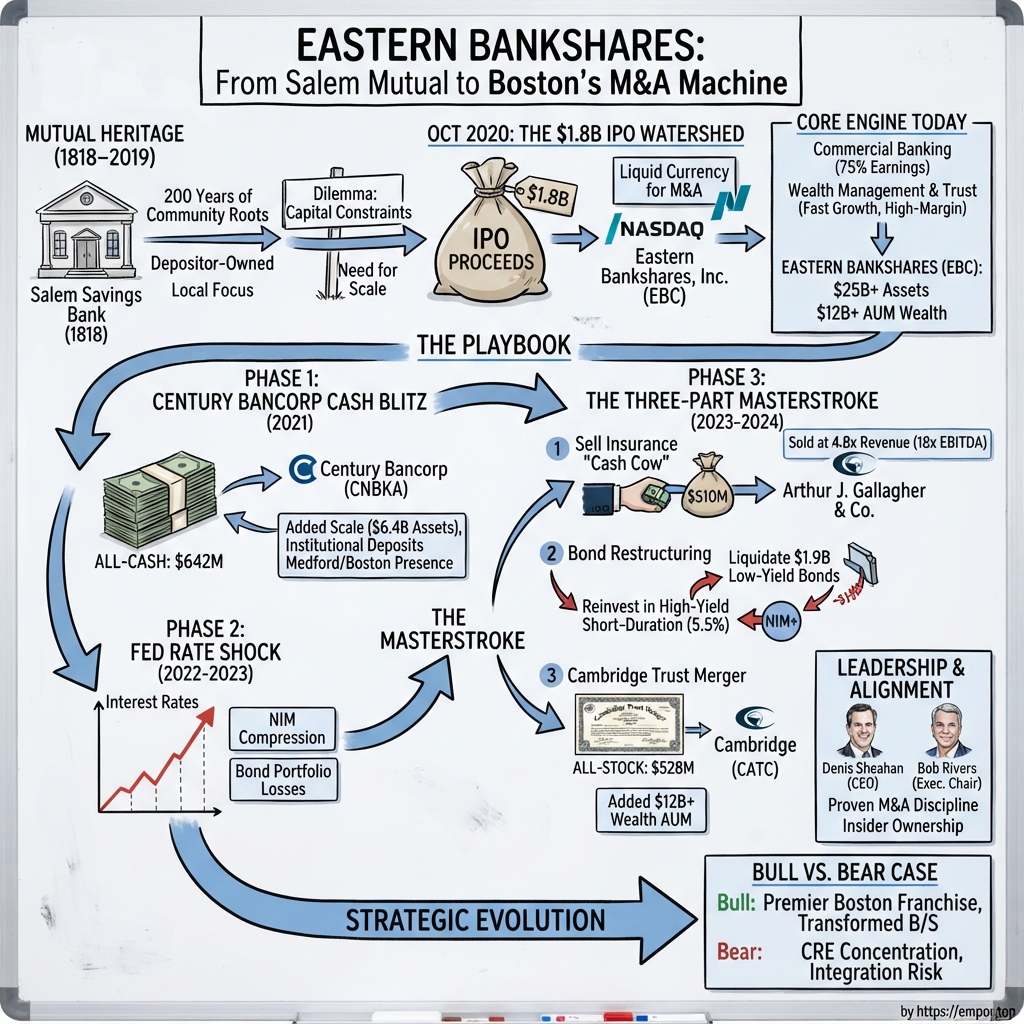
Eastern Bankshares: Boston's 200-Year-Old Mutual That Became a Banking M&A Machine
I. Introduction & Episode Roadmap (00:00 - 07:30)
On the morning of July 24, 2026, a conference line opened in Boston and a man with a soft Irish cadence began reading numbers that would have been unimaginable to the institution he now runs: record operating net income, up 20% in three months; a return on tangible equity above 15%; and an efficiency ratio of 49% — meaning the bank spent forty-nine cents to generate a dollar of revenue, a figure that puts it in the upper tier of American regional banks.1 The man speaking was Denis Sheahan, and until two years earlier he had been the chief executive officer of a competitor.
That single fact — that the chief executive of Eastern Bank is the former chief executive of a bank Eastern acquired — captures something essential about this company. Eastern Bankshares was founded in Salem, Massachusetts in 1818, when James Monroe was in the White House and Salem's fortunes still rode on the China trade.2 For 202 years, it operated as a mutual savings bank: owned by its depositors, accountable to a self-perpetuating board, and structurally incapable of issuing stock. It grew slowly, distributed philanthropic grants, and stayed local.
Then, in October 2020 — during the pandemic, with the Federal Reserve pinning interest rates near zero — Eastern converted to a public company and raised roughly $1.8 billion in a single stroke.3 What followed was one of the most aggressive capital deployment sequences in recent American regional banking: a $642 million all-cash acquisition of a family-controlled Boston institution;4 a severe encounter with the 2022–2023 rate shock that erased nearly $1 billion of paper equity; the sale of a decades-old insurance brokerage for half a billion dollars in cash;5 an all-stock merger that handed the CEO's chair to the acquired company's boss;6 and, in 2025, another $490 million deal that pushed the balance sheet past $30 billion.7
Along the way, the balance sheet nearly tripled. By the second quarter of 2026, Eastern carried $31.1 billion of assets, $23.7 billion of loans, $25.9 billion of deposits, and $11.5 billion of wealth management assets.1 Whatever else one concludes about the path, the strategic objective that justified the conversion — reaching a scale at which a local bank can afford to compete against national institutions — was achieved, and achieved quickly.
The core question this story asks is simple and unsentimental: Eastern converted a two-century accumulation of retained earnings into a war chest, then spent it. Did that spending create value, or did it merely create size?
Size is the easiest thing in banking to buy and the hardest to justify. Any bank with a stock currency and a willing seller can add assets; whether those assets earn more than the capital they consume is a separate question that takes years to answer.
As of mid-2026, the honest answer is mostly the former, but with important caveats that management does not emphasize and that investors should scrutinize. The company's reported profitability today is genuinely stronger than it was three years ago. However, a meaningful slice of that improvement comes from purchase accounting — an accounting mechanism that flatters earnings after an acquisition before fading over time. Untangling durable operating strength from temporary accounting benefits is the central analytical exercise here.
There is a broader reason this particular story is worth detailed analysis. Mutual-to-stock conversions are a recurring feature of American banking — dozens of thrifts and savings banks have completed them, and a handful more will do so in future cycles. Each conversion releases a pool of capital accumulated over decades and entrusts it to a management team that has never allocated capital under public-market scrutiny. Eastern is among the largest such conversions ever completed, making it a revealing case study in post-conversion capital allocation. The lessons here generalize across the industry.
The analysis follows a clear sequence. First, the mutual inheritance: two centuries of depositor ownership, a philanthropic identity that became a genuine brand asset, and the structural trap that eventually forced a decision. Second, the 2020 conversion and how a sudden influx of capital alters management incentives. Third, the Century Bancorp purchase — scale bought with cash. Fourth, the rate shock, which was less a crisis for Eastern than a slow suffocation of earnings power. Fifth, the 2023–2025 transformation: selling the insurance business, restructuring the securities portfolio, acquiring Cambridge Trust and its wealth franchise, and absorbing HarborOne. Sixth, how the bank actually generates earnings today, and whether its competitive moat is durable. Seventh, the leadership team and its track record against prior commitments. And finally, the investment case for and against owning the stock, the key downside risks, and the core metrics that will reveal quarter by quarter whether the transformation holds.
A note on methodology before proceeding: banks are unusually easy to misread because the two primary determinants of their value — the true cost of funding and the true quality of loans — are partly matters of judgment and fully visible only in hindsight. This account relies heavily on management's statements during earnings calls over several years, specifically focusing on unscripted analyst Q&A. Prepared remarks describe a company as it wishes to be seen. The Q&A — where analysts like Laurie Hunsicker of Seaport, Damon DelMonte of KBW, and Matthew Breese of Stephens press for spot rates, loan-level detail, and the composition of criticized loan buckets — provides far greater signal.
It begins, as New England stories often do, with a group of merchants worried about what their workers were doing with their wages.
 Subscribe on LinkedIn
II. The 200-Year Mutual Heritage & Community Roots (1818–2019) (07:30 - 18:00)
Salem in the spring of 1818 was a town coming down from a spectacular high. Its wharves had made it, briefly, one of the richest ports in America; its captains had opened the pepper trade with Sumatra and the tea trade with Canton. But the War of 1812 had strangled the shipping business, the deep-draft vessels of the new century were beginning to favor Boston's harbor, and Salem's mercantile aristocracy could see the arc of decline even if they could not yet name it.
On April 15, 1818, more than sixty of the town's businessmen — among them the mathematician and navigator Nathaniel Bowditch, whose American Practical Navigator was already the working bible of the merchant marine — founded Salem Savings Bank.2 The purpose was not profit. It was to give mechanics, laborers, sailors' wives, and domestic servants a safe place to put small sums, at a time when the alternative was a mattress or a moneylender. This was the savings bank movement in its original, faintly Utopian form: an institution designed to encourage thrift among people whom commercial banks did not want as customers.
The legal structure that carried that mission was the mutual. A mutual savings bank has no shareholders. Its capital is simply the accumulation of two centuries of retained profits, held in trust for depositors. No one can buy it. No one can sell it. No activist can write a letter. The upside of this arrangement is patience: a mutual can take a fifty-year view because nobody is measuring it against a quarterly consensus. The downside is that it can only grow as fast as it earns, and it can only acquire what it can pay for out of accumulated surplus.
The economics of that arrangement explain everything that follows. A mutual's capital compounds like a savings account with no withdrawals: every dollar of profit not given away stays inside the institution forever, with no dividend and no buyback to interrupt it. Over two centuries that produces an enormous, silent pool of value belonging, legally, to nobody in particular — a structure that yields institutions of remarkable durability and, often, remarkable inertia.
For most of two centuries, patience was enough. Salem Savings became Eastern Bank, spread down the North Shore and into Boston, absorbed smaller mutuals, and — crucially — did something unusual for a savings bank: it became a commercial lender. By the time Bob Rivers reflected on the transformation in 2023, more than 70% of Eastern's loan book was commercial, a mix that would have been unrecognizable to the institution of the 1980s, when Eastern had $2.1 billion in assets and 28 branches.8 Eastern also built an insurance brokerage inside the bank, a business that by the 2010s was generating significant fee income.
That shift from savings bank to commercial lender is the single most important transition that occurred at Eastern in the twentieth century, and it happened slowly enough that almost nobody outside the company noticed. A savings bank makes home loans against collateral. A commercial bank makes loans against cash flow, which requires underwriting judgment, industry knowledge, and relationship officers who can evaluate a operating business. Building that capability inside a mutual — without the equity currency to buy it or the stock compensation to hire it — took decades of patient recruitment. It is the reason Eastern was able to compete for Boston's middle market when the opportunity arose.
The bank also distributed capital systematically through philanthropy. Since 1999, Eastern has donated roughly a tenth of its net income each year to charitable causes through its foundation — a policy that by the end of 2025 had cumulated to more than $240 million in giving since 1994.9 From an analytical perspective, this is not an economic moat; no depositor accepts a lower interest rate because a bank funds local legal services. But it functions as a brand asset in a specific, local market. In Greater Boston, where municipal treasurers, hospital executives, university administrators, and nonprofit boards form an interconnected professional network, sustained community presence provides meaningful distribution benefits. Eastern effectively turned charitable giving into a customer acquisition channel.
The physical franchise that grew alongside the foundation explains the deposit economics that became critical in later years. Eastern spread outward from Salem in concentric arcs: down the North Shore, into Boston proper, south toward the coast, and north into New Hampshire — reaching more than 125 branch locations by the end of 2025.9 The footprint consists primarily of suburban storefronts in communities like Lynn, Peabody, and Quincy, alongside small business lobbies. While physical branches represent a declining asset in general retail banking, a dense regional branch network remains an effective mechanism for gathering low-cost operating deposits.
By the late 2010s, however, the mutual structure became a operational bottleneck. Eastern had reached roughly $11.6 billion in assets at the end of 2019 with about $1.6 billion of equity — a well-capitalized institution by conventional measures, but one whose growth was constrained by the arithmetic of its retained earnings.10 Three distinct pressures converged. First, technology: the fixed costs of modern mobile banking software, treasury management systems, and cybersecurity infrastructure do not scale down proportionally for a $12 billion institution. Second, regulation: post-2008 compliance requirements impose fixed administrative costs that disproportionately burden smaller banks. Third, competition: national competitors like Bank of America, Citizens, and JPMorgan Chase were expanding aggressively in Boston with substantial capital resources.
A mutual cannot address these pressures by issuing equity. It cannot use stock to fund acquisitions or grant equity-based compensation to attract commercial lending talent. Eastern's board faced a structural choice common to large mutual institutions: convert to a public entity or accept a capped growth rate.
A permanent ceiling was not inherently catastrophic. Many mutuals maintain subscale, local franchises that effectively serve depositors without public shareholder demands for higher returns. The decision to convert was therefore strategic rather than strictly financial. Management concluded that remaining a mutual risked gradual market share loss as larger institutions captured profitable commercial relationships.
At the same time, mutual-to-stock conversions alter leadership incentives. Conversion creates equity-based compensation structures and provides stock currency for acquisitions that increase organizational scale. While the strategic rationale aligned with broader industry consolidation trends, executive decision-makers were also direct beneficiaries of the structural change.
The board ultimately resolved to convert — initiating the process in 2020.
III. The October 2020 IPO Watershed: Unlocking the War Chest (18:00 - 30:00)
On its face, the timing seemed counterintuitive. Eastern announced its intention to convert into a public company in 2020, a year when the American economy suffered widespread shutdowns, unemployment spiked into double digits, and banks nationwide built heavy loan-loss reserves against an unquantifiable recession. Investors were hardly clamoring for exposure to Massachusetts commercial real estate.
The mechanics of a mutual-to-stock conversion explain why the transaction was so transformative. In a standard initial public offering, a company sells shares and existing owners either cash out or accept dilution. In a mutual conversion, there are no existing owners. The bank’s accumulated equity—two centuries of retained earnings, in Eastern’s case—remains inside the institution. The bank then sells brand-new shares to depositors, employees, and the public, and all of those proceeds also remain inside the bank. Stock buyers effectively purchase a claim on a capital pool consisting of their new cash plus everything the mutual had accumulated over two centuries. Consequently, converted mutuals routinely trade below tangible book value at inception while carrying far more capital than immediate operations require.
Eastern’s offering closed on October 14, 2020. The bank sold roughly 179.3 million shares at $10.00 apiece, raising approximately $1.79 billion in gross proceeds, including nearly 15 million shares purchased by its employee stock ownership plan. The company then donated roughly 7.5 million shares to its charitable foundation—endowing the philanthropy with equity rather than funding it out of future operating income.3 The stock began trading on the Nasdaq under the ticker EBC the following day.
The subscription priority enforced a distinct economic logic. A conversion offering grants first priority to existing depositors, followed by employees and the benefit plan, before opening to the general public. As a result, the depositors whose balances funded decades of retained earnings received the first right to purchase shares. Because of this structural transfer, regulatory authorities subject mutual conversions to extensive administrative scrutiny before approving an offering.
The transaction dramatically altered the balance sheet. Eastern ended 2019 with about $1.6 billion of equity. By the end of 2020, capital had more than doubled to roughly $3.43 billion against total assets of $15.96 billion.10 The bank’s equity-to-assets ratio exceeded 21%. For context, a typical well-run American commercial bank operates with a tangible common equity ratio between 7% and 10%, meaning Eastern carried more than double the capital its underlying operations required.
A commercial bank funds itself primarily through deposits, utilizing equity as a buffer against asset losses. Carrying double the required regulatory capital provides maximum safety, but it imposes a severe structural drag on financial performance.
This structural shift marks the central turning point in Eastern’s modern history. Excess capital depresses return metrics because the equity denominator expands immediately while operating earnings do not. The conversion did not automatically make Eastern more profitable; instead, it provided capital flexibility and strategic optionality unavailable under the mutual structure. Long-term value creation would depend entirely on how management deployed that capital.
Public equity markets reacted cautiously. Newly converted banks often trade below tangible book value because investors discount balance sheets that cannot generate competitive returns on unallocated capital. That discount reflects market skepticism regarding future reinvestment yields. Eastern’s stock would spend years navigating that valuation penalty, as investors evaluated subsequent deployment decisions rather than the initial offering itself.
In its initial pitch to public shareholders, management emphasized four core strengths: its position as the largest Boston-headquartered community bank; a low-cost, granular deposit base built over decades; a commercial lending operation generating strong volume relative to asset size; a fee-generating insurance agency; and a conservative credit culture with historical charge-off rates below peer averages. Yet this strategic framing contained subtle vulnerabilities, relying on an insurance subsidiary that Eastern would sell three years later and a securities portfolio that would soon generate substantial mark-to-market pressure.
While the core thesis reflected the bank’s operating baseline, it left an urgent allocation question unanswered: how to invest nearly $1.8 billion in fresh capital during a period of weak organic loan demand, surging stimulus deposits, and near-zero interest rates.
The distribution of shares created a distinct governance profile. Nearly 15 million shares were allocated to the employee stock ownership plan, and approximately 7.5 million shares were donated directly to the charitable foundation.3 Combined, these two blocks placed roughly one-eighth of the total equity in the hands of employees and a local philanthropic entity. This structure established a higher level of insider and community ownership than is typical for newly public commercial banks.
Management effectively had three mechanisms for deploying its capital surplus: share repurchases, organic loan and securities growth, or bank acquisitions. Eastern eventually pursued all three, though regulatory constraints limited its timing. For example, pending merger reviews restrict buyback activity, a constraint Eastern encountered in 2023 when its repurchase authorization lapsed while the Cambridge Trust acquisition awaited regulatory approval.8 Initially, Eastern deployed a large portion of its cash into fixed-income securities—a widespread industry strategy in 2020 and 2021 that would create severe balance-sheet drag when interest rates rose. Before that rate shock materialized, however, management initiated the acquisition that fundamentally altered the bank's scale.
IV. M&A Phase I: The Century Bancorp Cash Blitz (2021) (30:00 - 43:00)
If Eastern was Boston's institutional mutual, Century Bank was its corporate opposite: a family-controlled business, built over a single founder's lifetime, and managed with the tight focus of an entrepreneur who never relinquished the helm.
Marshall Sloane founded Century Bank in Somerville in 1969 and remained chairman into his late eighties.11 Century did not attempt to serve every banking segment. Instead, it targeted a distinct niche: the operational accounts of municipalities, hospitals, universities, and non-profit institutions across Greater Boston.
That focus carried distinct balance-sheet advantages. Institutional operating accounts function as highly effective liabilities. A municipal payroll account does not yield-chase like a retail saver; balances remain largely in transactional checking accounts because the relationship is operational rather than purely financial. Century assembled a $6.4 billion balance sheet around this low-cost funding model, supported by 27 branches in Greater Boston.12
On April 7, 2021, Eastern announced an agreement to acquire Century Bancorp. The transaction closed on November 12, 2021, with Century shareholders receiving $115.28 per share in cash, valuing the deal at approximately $642 million.413
For Eastern, the strategic rationale extended beyond deposit volume. Century's client roster included marquee Boston-area institutions—municipal treasuries, regional healthcare systems, and universities—representing operational relationships that take decades to build and are difficult to displace. Acquisition provided the primary viable path to capture those institutional positions.
Three structural aspects of the transaction warrant analytical scrutiny.
First, the deal was fully funded with cash. Eastern deployed roughly $642 million from its post-IPO capital surplus without issuing shares. For a bank trading below tangible book value—a common valuation condition for recent mutual conversions—using equity currency would have proven dilutive to shareholders. Allocating excess low-yielding cash reserves represented a disciplined use of capital. The purchase price equaled approximately 10% of Century's total assets, reflecting a full valuation for a specialized funding franchise.
Second, the merger addressed succession for Century's controlling family while offering operational scale. Selling to an established in-market buyer with regulatory standing provided a clear exit strategy. Jim Fitzgerald, Eastern's chief financial officer at the time, later observed that Eastern's M&A transactions secured regulatory approvals faster than industry benchmarks because they involved in-market consolidations between institutions with strong regulatory track records.8
Third, the transaction expanded Eastern's existing liability base. Century injected substantial low-cost deposits into an institution that already carried surplus liquidity relative to its organic loan origination capacity. Eastern's total assets expanded to $23.5 billion at year-end 2021, up from $15.96 billion at year-end 2020.10 Because loan expansion did not keep pace with deposit growth, management directed the excess funds primarily into fixed-income securities.
The deposit mix also introduced operational volatility. While municipal deposits offer low funding costs, they exhibit marked seasonality. Tax collection schedules drive temporary balance spikes, followed by predictable outflows for municipal payrolls and debt service. In the third quarter of 2023, Eastern experienced a municipal deposit decline of approximately $375 million alongside the runoff of a $230 million non-core term deposit inherited from Century, requiring short-term wholesale borrowings to offset the outflow.8 Managing seasonal liabilities requires maintaining liquid, low-yielding buffers.
The acquisition succeeded in expanding Eastern's scale, securing a durable funding franchise and making Eastern the largest independent bank headquartered in Massachusetts. However, the ultimate economic return on acquired liabilities depends on asset deployment. Acquiring low-cost deposits yields strong returns when matched with productive loan growth; absent sufficient loan demand, acquired liquidity flows into low-yielding investment portfolios.
Following the acquisition, Eastern redeployed its expanded deposit base into fixed-income securities during a period of historically low yields. Within four months of the deal's completion, the Federal Reserve initiated its sharpest monetary tightening cycle in four decades, setting up significant structural balance-sheet pressure.
V. The Federal Reserve Rate Shock & The Bond Portfolio Dilemma (2022–2023) (43:00 - 56:00)
Here is the simplest way to understand what happened to Eastern — and to the broader American regional banking sector — in 2022.
A bank that buys a ten-year bond yielding 1.75% promises itself it will earn 1.75% annually for a decade. If market yields subsequently rise to 4.5%, that bond does not default; it continues paying its contractual coupon. However, its market price declines because investors will not pay face value for a 1.75% yield when higher returns are available. Under accounting rules, bonds classified as available-for-sale must be marked to market, with unrealized losses flowing into shareholders' equity through accumulated other comprehensive income. The bank incurs no immediate cash loss, but it loses paper book value while locking a large share of its balance sheet into fixed low yields as funding costs climb.
Eastern's accumulated other comprehensive income shifted from positive $54 million at year-end 2020 to negative $923 million by the end of 2022.10 Total shareholders' equity fell from $3.43 billion to $2.47 billion over the same period despite uninterrupted operational profitability. On paper, duration risk had erased nearly $1 billion of the capital raised during the public conversion.
The income statement reflected this asset drag over subsequent quarters. Eastern's net interest margin — the spread between asset yields and funding costs — compressed to 2.77% by the third quarter of 2023, with management guiding expectations toward the mid-2.60s for the fourth quarter.8 For a bank with Eastern's core deposit franchise, that margin compression highlighted a structural mismatch: fixed-rate assets remained locked at pandemic-era yields while liability costs repriced rapidly. Overall deposit costs rose from 1.22% to 1.33% in a single quarter that year, with interest-bearing deposit costs escalating even faster.8
The industry tracks liability repricing sensitivity through deposit beta: the percentage of a central bank rate change passed on to depositors. If the Federal Reserve raises benchmark rates by 100 basis points and a bank's average deposit cost rises by 45 basis points, its deposit beta is 45%. A low beta reflects deposit stability, whereas a high beta indicates reliance on rate-sensitive funding. Through the 2022–2023 tightening cycle, Eastern's cumulative deposit beta ran at approximately 46%, and management signaled to investors that future cycles would likely reflect a similar figure with lags.19 This metric quantified the funding stability derived from its branch network and municipal operating relationships.
That funding structure insulated Eastern during the regional banking turmoil of spring 2023. When Silicon Valley Bank failed in March 2023, its vulnerability stemmed from concentrated, uninsured deposits within a single interconnected sector that withdrew liquidity rapidly. Eastern's deposit base consisted primarily of retail accounts, small business operational balances, municipal accounts, escrow, and payroll deposits distributed across eastern Massachusetts. Liquidity risk remained low, with wholesale borrowings constrained to roughly 5% of total assets, which management framed as a competitive advantage.8 Regulatory capital cushions also remained substantial, with a common equity tier 1 ratio of 16% through the third quarter of 2023.
Unrealized bond losses represent an earnings drag rather than an immediate liquidity crisis, becoming a capital issue only if an institution is forced to sell assets to satisfy deposit outflows. Because Eastern maintained a granular deposit base, management could hold underwater securities toward maturity without forced liquidations. This dynamic shielded the bank from run risk, though it left earnings capacity constrained.
Maintaining balance-sheet safety without earnings growth presented a strategic challenge. Having converted to public ownership to deliver equity returns, the bank's depressed return on tangible equity fell short of post-conversion targets.
Management initiated portfolio restructuring earlier than many regional peers. In the first quarter of 2023, Eastern sold approximately $1.9 billion of low-yielding available-for-sale securities, realizing $333.2 million in pre-tax losses to reinvest the proceeds into higher-yielding assets.14 The transaction exchanged an immediate hit to equity for an improved earning-asset yield, trading book value to remove a ongoing margin drag.
A secondary balance-sheet adjustment targeted syndicated loan exposure. Eastern sold roughly $200 million of shared national credits at a $2.7 million loss, an outcome near economically neutral after releasing associated credit loss reserves.8 Chief Financial Officer Jim Fitzgerald noted that because overall funding remained tight, shedding non-relationship syndicated participations preserved balance-sheet capacity for core local commercial clients. Unlike relationship loans, syndicated participations provide interest spreads without generating deposit balances or fee-based treasury management services.
Concurrently, credit pressures emerged in commercial real estate. Three investor office properties totaling $26 million moved to non-performing status during the third quarter of 2023 — all Class B assets in Boston's Financial District, originated prior to the pandemic at loan-to-value ratios around 60%, where rising vacancies and declining cash flows led sponsors to halt debt service.8 Eastern established specific reserves and pursued workouts rather than discounted note sales. While manageable relative to total capital, the defaults illustrated how hybrid work reduced demand for mid-tier urban office space, eroding equity cushions despite conservative initial loan-to-value ratios.
The bond portfolio sale also created an accounting complication. Because realizing the securities loss placed Eastern in a net tax loss position, the bank established a valuation allowance of approximately $15 million against its deferred tax assets, reflecting uncertainty over whether near-term taxable income would absorb the deduction.8 Restructuring the investment portfolio resolved an income drag but generated a temporary tax accounting penalty.
Absorbing that valuation allowance required generating a substantial taxable gain — an asset Eastern already held on its balance sheet.
VI. The Three-Part Masterstroke: Insurance Sale, Bond Restructuring, & Cambridge Trust (Sept 2023–July 2024) (56:00 - 1:15:00)
On September 19, 2023, Eastern executed an unusual double announcement: two transformational transactions on a single morning. The bank agreed to sell its insurance brokerage and simultaneously agreed to merge with a competitor in a deal that would eventually transfer the chief executive role to that competitor's leader.
Part 1: Selling the cash cow. Eastern Insurance Group had operated as part of the bank for two decades, generating steady, recurring commission revenue with negligible capital consumption and no credit risk. Eastern sold the business to Arthur J. Gallagher & Co. for approximately $510 million in cash, in a deal that closed on October 31, 2023.515 Gross consideration came in at $515 million and produced an after-tax gain of $294.5 million, comfortably above the roughly $260 million management had guided to weeks earlier.168
Why sell a profitable unit? Two pragmatic reasons stood out alongside a third that management framed more delicately. The pragmatic drivers: insurance brokerage valuations in 2023 hovered near historic highs as consolidators like Gallagher paid premium multiples for scale, while Eastern remained a subscale owner of an asset worth more to a dedicated broker. Furthermore, Eastern urgently needed unencumbered capital that was not tied down by unrealized bond losses. The delicate rationale: bank-owned insurance agencies represent conglomerate structures that public markets often discount unless management can prove clear revenue synergies — something Eastern had not convincingly established.
Part 2: The restructuring — and a myth worth correcting. Popular retellings of this period suggest Eastern used the insurance windfall to fund its bond portfolio cleanup. The actual operational sequence reveals a more nuanced dynamic.
The $1.9 billion securities sale occurred first, in the first quarter of 2023, six months before the insurance sale was announced. What the insurance gain actually accomplished was preserving the tax value of that earlier decision: the large taxable gain allowed Eastern to eliminate the $15 million valuation allowance it had been forced to record, and to apply a normal tax rate against its results.8 The insurance proceeds were also deployed to pay down wholesale borrowings that had been used to plug the gap left by seasonal municipal deposit outflows.8
The distinction matters for how investors evaluate management. The idealized narrative — sell the crown jewel at the peak, use the cash to fix the bond book, and expand net interest margin by 30 basis points overnight — implies a single act of prescient timing. The actual record reflects a more grounded reality: a management team that restructured under pressure in the first quarter, encountered an unexpected tax accounting constraint, and subsequently monetized a non-core asset into a strong seller's market to relieve that constraint. That represents systematic sequential problem-solving rather than clairvoyance.
Part 3: Cambridge Trust. The second announcement that September morning was an all-stock merger with Cambridge Bancorp valued at approximately $528 million — offering 4.956 Eastern shares for each Cambridge share, representing an implied price of $13.41 per Eastern share and a 24% premium to Cambridge's 30-day average price.6
Cambridge was relatively compact — carrying $5.5 billion in assets, $4.0 billion of loans, $4.4 billion of deposits, and 22 branches — but it owned an asset Eastern lacked: a private bank and wealth management business with $4.4 billion of client assets under management and administration, and a brand with genuine cachet among Boston's professional and academic wealth.6 Cambridge Trust served a distinct client demographic, including tenured university faculty, biotech founders, and multi-generational family trusts.
Strategically, the merger operated as a fee-stream swap. Having relinquished roughly $100 million in annual insurance commission revenue, Eastern replaced it with investment advisory fees — also recurring, capital-light, and credit-risk-free, but with a fundamentally different risk profile. Insurance commissions track policy premiums, which remain sticky and inflation-indexed. Advisory fees track financial market valuations, which fluctuate. Eastern consciously exchanged a defensive fee stream for a market-sensitive one.
One structural choice within the Cambridge deal was particularly revealing. Eastern chose not to fold Cambridge Trust into its primary brand. Instead, the combined private banking and wealth management divisions retained the Cambridge Trust name, reflecting management's explicit reasoning that the brand carried distinct standing in its markets.6 Acquirers rarely surrender their own name on a key operating division. Doing so signaled a clear-eyed assessment that in wealth management the brand itself represents much of the product, while also easing advisor retention during integration.
The deal closed on July 12, 2024, with Eastern issuing roughly 39.2 million shares.17 The resulting governance structure proved unusual: Denis Sheahan, Cambridge's chairman, president, and CEO, became CEO of Eastern; Bob Rivers moved to executive chair; Quincy Miller became president and chief operating officer; and David Rosato, formerly CFO of Berkshire Hills Bancorp and People's United, arrived as chief financial officer on August 1.17 Eastern acquired a company one-fifth its size and installed that company's executive leadership at the top of the combined institution — a notable board decision regarding internal executive succession.
The coda: HarborOne, and the promise to stop. On April 24, 2025, Eastern agreed to acquire HarborOne Bancorp — a $5.7 billion, 30-branch bank headquartered in Brockton, founded in 1917 as a credit union, with a residential mortgage origination platform and a footprint reaching south of Boston and into Rhode Island.7 The consideration totaled $490 million in stock and cash, with HarborOne holders electing 0.765 Eastern shares or $12.00 cash per share, and roughly 85% ultimately selecting stock. The transaction targeted approximately $55 million of annualized cost savings — about 40% of HarborOne's operating expense base — with 16% projected earnings accretion and a tangible book value earnback of 2.8 years.7 The transaction closed on November 1, 2025, and core systems conversion was completed in February 2026.1819
HarborOne served a distinct strategic purpose compared to the prior two acquisitions. Century was driven by deposit funding, and Cambridge provided fee income and executive talent. HarborOne established geographic reach into the South Shore and Rhode Island while introducing a residential mortgage platform that Eastern had previously underweighted. CFO David Rosato outlined a measured outlook, expecting mortgage banking to stabilize at 8% to 10% of total fee income while characterizing the platform as an option on refinancing volume and a mechanism to originate residential loans for the balance sheet if Eastern ever wants them.19 Eastern subsequently chose to keep residential balances flat through 2025 and 2026, allocating capital instead toward home equity lines and commercial credit.
Two accounting details from the HarborOne closing deserve attention. First, Eastern early-adopted a revised credit-loss accounting standard that eliminated the day-two reserve on acquired loans, which acted to marginally reduce future accretion income and marginally help tangible book value.19 Second, the inherited $298 million investment portfolio was liquidated within days of closing, with proceeds used to retire HarborOne's wholesale funding. Both represented tactical balance-sheet adjustments that influence reported operating results.
During the January 2026 earnings conference call, Bob Rivers stated that the bank would not pursue further acquisitions and would focus entirely on organic growth and returning capital to shareholders. Denis Sheahan echoed that commitment in his remarks and again under direct questioning.20 After completing four acquisitions in four years, the acquirer declared an end to its dealmaking phase.
Whether that commitment holds remains a key analytical test for investors assessing the durability of Eastern's post-conversion strategy.
VII. Core Business Mechanics, Segment Economics, & Economic Moat (1:15:00 - 1:30:00)
Stripped of its acquisition history, Eastern in 2026 operates as a straightforward business with three core components: gathering low-cost deposits, lending them out at an attractive spread, and selling investment advisory services to the wealthier segment of its customer base.
The spread engine. In the second quarter of 2026, Eastern generated $251.9 million in net interest income on a net interest margin of 3.66% — a marked recovery from the 2.77% margin recorded three years earlier.1 Total loans stood at $23.7 billion against $25.9 billion in deposits, yielding a loan-to-deposit ratio of 91% on total assets of $31.1 billion, while the average cost of deposits held at 1.47%.
Composition matters as much as volume. Commercial lending serves as the primary driver: Eastern originated $2.5 billion in commercial loans in 2025, split roughly evenly between commercial and industrial credit and commercial real estate, expanding standalone loan volume by approximately $1 billion, or 5.6%, excluding acquisitions.19 This organic expansion occurred prior to closing the HarborOne transaction, providing clear evidence that loan growth does not rely entirely on M&A.
Funding a $31 billion balance sheet at an average cost below 150 basis points, even while money market funds offer substantially higher yields, reflects the tangible value of Eastern's two-century deposit inheritance. The deposit base consists largely of operational checking, escrow, municipal accounts, and small business balances—funds maintained for daily transactions rather than rate-chasing yield.
However, this low-cost deposit franchise faces persistent competitive pressure. Throughout 2026, management acknowledged intensifying competition from both smaller local banks bidding for liquidity and national institutions expanding in Boston. During the second-quarter earnings call, Chief Financial Officer David Rosato described competition as "relatively constant" but added that he saw "no reason with current market expectations of higher rates that competition will lessen."21 Average deposit costs edged up one basis point during the quarter to 1.47%, with the June spot rate reaching 1.51%. Management anticipates two to three basis points of quarterly deposit cost creep, which will largely absorb the yields gained from repricing assets higher.21
The repricing tailwind — and its limits. In early 2026, Eastern introduced a disclosure schedule detailing maturity timelines and yields for its fixed-rate assets. Approximately $2.8 billion of fixed-rate loans mature or reprice within three years, alongside $1.5 billion in securities cash flows currently carrying a low weighted-average book yield of 2.86%, compared to new commercial origination yields between 5.75% and 6.00%.22 This structural repricing provides a multi-year earnings tailwind independent of Federal Reserve rate adjustments, as legacy low-yielding assets systematically roll into current market yields.
The accretion asterisk. Evaluating Eastern's core earning power requires distinguishing structural operating strength from temporary accounting benefits. In bank acquisitions, acquired loan books are written down to fair value. Interest rate marks accrete back into net interest income over time, generating real cash flow that eventually fades as loans mature.
Eastern's purchase accounting accretion averages approximately $19.5 million per quarter, contributing 28 basis points to the reported net interest margin—totaling roughly $80 million for full-year 2026, with about $40 million scheduled for the second half.21 Consequently, nearly a quarter-percentage-point of the headline 3.66% margin reflects temporary accretion from the Century, Cambridge Trust, and HarborOne transactions. While management transparently provides a decay schedule, forward-looking earnings models must offset the asset repricing tailwind against this diminishing accretion. On a core basis, margin expansion appears far more modest than the headline figures imply.
Wealth management. The bank's second operating pillar reached $11.5 billion in total wealth management assets by mid-2026, including a record $10.6 billion in assets under management, up from $10.1 billion at year-end 2025.119 Investment advisory fees constitute the largest component of noninterest income, accounting for approximately 40% of operating fee income in the fourth quarter of 2025.19
Asset management provides capital-light fee income that scales with asset growth without consuming bank capital. The central strategic question is whether Eastern can generate durable organic growth in this segment. When asked about competitive dynamics during the second-quarter call, Chief Executive Denis Sheahan highlighted internal cross-selling potential: "If you go back just a few years, the primary fee business at Eastern was insurance. Now the primary fee business is wealth management. So when you think of the opportunity that our colleagues in the retail branch division and in commercial lending have to refer, it is they are thinking now about wealth, whereas in the past, they might have been thinking about insurance."21
This strategy relies on retraining Eastern's branch and commercial lending networks to direct commercial and retail clients toward wealth management. Initial results indicate positive momentum, with organic net inflows reaching approximately $200 million in the fourth quarter of 2025 and nearly $400 million in the first quarter of 2026.1922 While these inflows reflect organic client acquisition rather than market appreciation, confirming long-term execution will require sustained performance over multiple years.
The rest of the fee line, and why diversification here is thinner than it looks. Beyond wealth management, Eastern's noninterest revenue relies on transactional streams, including deposit service charges, card interchange, mortgage banking fees, and commercial interest-rate swap income. Following the HarborOne acquisition, card fees and deposit charges expanded, while swap income reached its highest level since 2023—a gain management attributed to hiring specialized talent in foreign exchange and derivatives sales.19
However, quarterly fee comparisons are distorted by accounting items unrelated to core operations. Eastern maintains rabbi trust accounts for executive benefit obligations, with mark-to-market adjustments passing through noninterest income and partially offsetting benefit expenses. Market fluctuations caused significant quarter-over-quarter fee volatility in both the first and second quarters of 2026, moving in opposite directions.2122 CFO David Rosato advised analysts to assume net neutral results when modeling this line item, indicating that reported fee fluctuations should not be mistaken for underlying operational momentum.
The securities book, rebuilt. The investment portfolio that created substantial duration drag in 2022 has been restructured down to approximately $4.4 billion at year-end 2025, with management targeting an investment book equal to about 15% of total assets.19 Portfolio yields have gradually improved as legacy low-coupon bonds mature, while unrealized losses shrank to roughly $277 million by the end of the first quarter of 2026.22 Rather than expanding the securities book, management has directed cash flows toward commercial lending pipelines, maintaining a conservative stance on interest rate risk.
The competitive board. Eastern occupies a distinct middle-market position in New England banking. Smaller regional peers—such as Brookline Bancorp, Independent Bank Corp, Washington Trust, and Salem Five—lack Eastern's operational scale and digital banking budget. Conversely, national institutions like Bank of America, JPMorgan Chase, Citizens Financial Group, and M&T Bank possess far greater scale but operate with centralized credit processes. Executive Chair Bob Rivers framed this position by noting that Eastern holds the fourth-largest deposit market share in Greater Boston and remains the largest independent bank headquartered in Massachusetts.19 Addressing competition from national banks on an earnings call, President Quincy Miller emphasized this market focus: "we carve out our own niche here as, you know, $30 billion local community bank, we offer a great value proposition for clients who are looking for that."21
Whether that positioning constitutes a durable competitive moat or simply effective market segmenting remains a key question for long-term investors.
VIII. Current Leadership, Management Credibility, & Capital Allocation (1:30:00 - 1:45:00)
The structure of Eastern's executive succession offers a clear window into the bank's strategy.
Denis Sheahan served from 2015 until 2024 as chairman, president, and CEO of Cambridge Bancorp and Cambridge Trust, building a private banking and wealth management franchise around a specific client segment while maintaining conservative credit metrics.23 He arrived at Eastern in July 2024 as chief executive officer following the merger—a transition reflecting the board's view of the target's leadership as a strategic asset. His public communication style emphasizes operating detail over promotional rhetoric. Asked in 2026 about competition in wealth management, he noted that the market remained "consistently competitive," that new entrants were arriving, and that Eastern was "in the early innings."21
Bob Rivers provides institutional continuity. He joined Eastern in 2006 as vice chair and chief banking officer, becoming president in 2007, chief operating officer in 2012, a director in 2015, and CEO and chair in 2017.24 As chief executive, he led the mutual conversion, the Century acquisition, the sale of the insurance agency, and the merger with Cambridge. He remains executive chair and chair of the board—a structure that concentrates significant governance authority in a non-CEO role, though without public evidence of internal friction.
David Rosato brought more than 35 years of community and regional banking experience to the chief financial officer role, including nine years as CFO of People's United Financial and a prior tenure as CFO of Berkshire Hills.17 His emphasis on financial transparency is reflected in detailed public disclosures, including asset repricing schedules, accretion decay tables with explicit footnotes for analysts,19 and unprompted spot margin and deposit rate metrics.22 While granular disclosure does not guarantee performance, it indicates an open analytical posture.
Testing the record against commitments. Evaluating management's operational record requires testing performance against prior commitments across four distinct areas.
First, transaction execution. On the HarborOne acquisition, execution aligned with announced targets. At closing, management disclosed that the final credit mark of $104 million landed essentially at original estimates, while the interest rate mark of $246 million was modestly higher.19 The projected $55 million in annualized cost savings was fully realized in the run rate by mid-2026, with Rosato confirming on the second-quarter earnings call that "those cost saves are basically done. The 40% that we advertised."21 Total one-time merger charges reached approximately $67 million.22 Similarly, on the Cambridge Trust merger, actual accretion over the transaction's life tracked original projections.19
Second, earnings guidance. Management's guidance record shows early adjustment when conditions shift. Eastern entered 2026 forecasting 3% to 5% loan growth and a full-year net interest margin of 3.65% to 3.75%. By the second quarter, management narrowed loan growth expectations to 3% to 4%, while lowering net interest income guidance to between $1.005 billion and $1.020 billion and margin expectations to 3.60% to 3.65%.21 Management cited specific drivers: weak first-quarter loan origination, purchase accounting accretion running below forecast, and heightened deposit competition. Management had telegraphed this downside risk during the first-quarter call, when Rosato noted concern about ending up "on the lower end of that range."22 Concurrently, the bank raised its deposit growth forecast, lowered credit loss provision guidance, and tightened expense expectations.
Third, capital allocation discipline. Eastern's stated policy is to manage its common equity tier 1 capital ratio down from 13.10% toward approximately 12%—the median for the KBW regional bank index—through share repurchases and dividends.21 Execution has followed this framework: the company repurchased 3.9 million shares in the first quarter of 2026 and 3.6 million shares in the second quarter at an average price of $20.03, alongside a 15% increase in the quarterly dividend to $0.15 per share—marking the sixth consecutive annual dividend increase since the IPO.2122 Total capital returned in the second quarter reached approximately $106 million, supported by a new 5% repurchase authorization through late 2027.
Rosato highlighted the strategy behind the buyback pace by distinguishing between a core repurchase volume funded by organic earnings and an opportunistic tranche scaled to valuation, noting that as the stock outperformed the regional bank index, "we are trading at a higher valuation."21 Adjusting repurchase activity based on market valuation reflects disciplined capital management rather than mechanical share-count reduction.
Narrative consistency over time also supports credibility. During the late-2023 margin compression, management prioritized balance-sheet strength, liquidity, and expense control. By early 2026, as profitability improved, priorities shifted toward organic growth, capital returns, and operating efficiency. When purchase accounting accretion fell short of initial expectations in early 2026, management disclosed the deficit directly rather than masking it within broader metrics.21
Fourth, the M&A pledge. The commitment to halt acquisitions remains unverified by time. Asked in January 2026 about the firmer stance on M&A, Sheahan stated: "we're not pursuing acquisitions. We're entirely focused on the growth of this company."19 Given a five-year sequence involving four major transactions, investors maintain reasoned skepticism. While the commitment is explicit and prominent in investor communications, its durability will be tested when prospective regional targets become available.
Alignment and reporting dynamics. The employee stock ownership plan established at conversion aligns workforce incentives with equity performance, while six consecutive years of dividend increases reflect a sustained commitment to shareholder distributions.22 However, evaluating underlying profitability requires monitoring the divergence between reported and adjusted results. Eastern's preferred metric—operating net income—excludes merger expenses, securities losses, lease impairments, and discrete tax items. Following three acquisitions and two portfolio restructurings in five years, these exclusions have recurred regularly. While management provides full reconciliations, evaluating long-term value creation requires tracking reported net income and tangible book value alongside adjusted figures.
The recurring nature of portfolio adjustments warrants ongoing scrutiny. In the first quarter of 2025, Eastern executed a second securities portfolio restructuring, selling approximately $1.3 billion in low-yielding bonds and recognizing $269.6 million in pre-tax non-operating losses in exchange for an estimated $35 million in annual pre-tax earnings accretion.14 Although each restructuring presented defensible stand-alone economics, the repeated reliance on portfolio sales highlights the ongoing income drag from legacy securities and underscores how operating metrics exclude costs stemming from prior balance-sheet decisions.
IX. Strategic Position: Helmer's 7 Powers & Porter's 5 Forces (1:45:00 - 1:57:00)
Frameworks are only useful if an analyst is willing to let them return an unflattering answer. Applied honestly, Eastern’s competitive position is compelling in a narrow, geographic sense, but unremarkable in a structural one.
Switching costs — the strongest power, and it is real. A middle-market business that maintains its operating checking, treasury management, lockbox, payroll interface, letters of credit, and revolving credit line at one bank does not switch providers for a modest 15-basis-point yield improvement. Transferring operations requires rebuilding payment infrastructure, re-papering debt covenants, and establishing a new credit relationship with an unfamiliar loan officer. The friction is even higher for a municipal treasurer bound by statutory collateral rules, and operates similarly for a private wealth client whose trust documents designate the institution. This operational stickiness explains the trajectory of Eastern’s funding costs. Through an aggressive tightening cycle and the integration of a higher-cost deposit base, Eastern’s average deposit cost declined from 1.55% in the third quarter of 2025 to a spot rate of 1.42% by March 2026 — falling even as merger activity added more expensive liabilities.22 That trend reflects switching costs translating directly into net interest margin protection.
Scale economies — moderate, and increasingly binding. Management’s core thesis holds that $20 billion to $30 billion in assets represents the optimal scale to absorb regulatory and technology overhead while retaining operational agility. The evidence supports the cost-absorption argument: Eastern’s efficiency ratio improved from over 57% in the fourth quarter of 2024 to 50.1% a year later, reaching 49.0% by the second quarter of 2026.191 However, that efficiency gain stemmed primarily from acquired cost synergies rather than organic operating leverage. Scale economies achieved through acquisitions are non-repeatable once dealmaking stops — precisely the stance management has now adopted. Going forward, efficiency gains must rely on technology adoption and organic revenue expansion. Chief Executive Denis Sheahan’s artificial intelligence roadmap — framed around deepening client insights and prompting relevant product recommendations rather than aggressive headcount reductions — represents the current strategy.22 It remains an initiative without demonstrated financial results.
Cornered resource — weak, despite the marketing. Eastern’s two-century history and active philanthropic presence are genuine brand assets that open doors in New England’s tight-knit business community. Yet a brand does not constitute a cornered resource under Hamilton Helmer’s framework unless competitors are structurally barred from replicating it. National institutions like Bank of America allocate far larger philanthropic budgets in total dollars. What Eastern possesses is a high degree of relationship density among a specific network of Massachusetts institutions — an asset closer to a localized network effect than a proprietary resource, and one vulnerable to aggressive pricing by well-capitalized competitors.
Counter-positioning — arguably the sharpest edge. The structural limitation facing megabanks is their inability to grant local commercial lenders true credit authority. Centralized underwriting is an essential feature of a national bank’s business model, which explains why a $30 million commercial proposal in Quincy receives a slower, more standardized evaluation from Chase than from Eastern. Management frequently highlights its ability to offer local decision-making alongside the product breadth typically associated with larger banks. This value proposition functions effectively as both a client pitch and a recruiting tool, with Sheahan describing Eastern as an attractive destination for senior lenders seeking credit decision rights after leaving national institutions.1921 This advantage remains durable because larger competitors cannot replicate it without altering their own unit economics.
Process power — the quiet one, and the hardest to verify. If Eastern holds an underappreciated advantage, it lies in its credit underwriting process. The bank’s historical charge-off rate across economic cycles has outperformed regional peers. This discipline reflects an institutional routine rather than individual oversight: long-time chief credit officer Dan Sullivan developed the credit framework over 27 years before transitioning authority to a 25-year internal veteran, while the commercial banking leadership was filled internally as well.8 Process power represents an organizational capability embedded in daily routines that competitors cannot copy simply by hiring individual talent. Routinely re-underwriting every investor commercial real estate loan above $5 million represents exactly this type of labor-intensive process — enabling management to inform analysts in 2026 that an extensive portfolio review revealed no unexpected findings. The key caveat is that credit process power can only be validated during a severe economic downturn, a test Eastern has not faced as a public company.
Two structural powers are conspicuously absent from Eastern’s portfolio. The business exhibits no network effects, as individual depositors derive no direct utility when new clients join the bank. Nor does Eastern possess pricing power, as it cannot command premium loan spreads based on brand strength alone; to win commercial accounts against lower-cost competitors, it must price competitively. Consequently, any investment thesis treating Eastern as a compounder must rely on rigorous cost management, underwriting discipline, and prudent capital allocation rather than structural pricing power.
Michael Porter’s five forces framework further clarifies the competitive landscape.
Rivalry among existing competitors: intense. Greater Boston remains one of the most contested regional banking markets in the country. Competition for deposits is intensifying from both regional peers and national institutions, with larger competitors pricing aggressively — at times, CFO David Rosato noted, specifically to acquire primary client relationships to support wealth management expansion.22 Within wealth management, new market entrants arrive frequently, though Rosato observed that many focus on ultra-high-net-worth accounts above Eastern’s core target market.22 Addressing whether Boston’s market dynamics were shifting toward new entrants on the second-quarter call, Sheahan maintained that local franchise loyalty remained intact.21 That assessment reflects management's perspective, and deposit market share data will provide the ultimate verification over time.
Bargaining power of buyers: elevated. Bank depositors face negligible friction when seeking higher-yielding alternatives. The primary counterweight remains operational deposit stickiness, making noninterest-bearing commercial balances the critical metric for funding stability.
Threat of substitutes: material. Money market funds serve as direct alternatives for excess liquidity, while digital platforms and robo-advisors target entry-level wealth clients. However, neither alternative fully replaces an integrated commercial banking relationship.
Bargaining power of suppliers: regulatory oversight. For commercial banks, the primary "supplier" is the regulatory supervisory framework, which dictates approval timelines for acquisitions, capital requirements, and share repurchase limits — with management noting that each new buyback program requires explicit regulatory clearance.22 Conversely, regulatory adjustments can provide positive capital relief; management estimated that proposed Basel III rules reducing risk weightings on specific assets could add roughly 100 basis points to risk-based capital ratios, expanding share buyback capacity.22
Threat of new entrants: persistent through acquisition. Market entry rarely occurs through new charter formations. Instead, competitors enter by acquiring existing New England franchises or establishing local commercial lending desks and recruiting established bankers. Both tactics remain active in Eastern’s footprint.
Compared against local independent institutions — such as Brookline Bancorp, Independent Bank Corp’s Rockland Trust, and Washington Trust — Eastern holds a clear scale advantage. Operating across overlapping New England footprints, these peers face the same fixed cost burdens that Eastern managed through conversion. Eastern’s edge over local peers stems not from proprietary technology, but from its capacity to spread compliance, IT, and treasury management overhead across a $31 billion balance sheet. Against national competitors like Bank of America, JPMorgan Chase, Citizens, and M&T Bank, the dynamic reverses on scale, while Eastern competes on responsiveness and local relationship density. Eastern’s competitive standing is best characterized as narrow: highly effective for specific middle-market clients in eastern Massachusetts, but constrained in broader structural pricing power.
Net assessment: Eastern’s competitive advantages are real, localized, and defensible against similarly sized regional institutions. They do not represent structural moats against national megabanks, nor do they grant pricing power over loan spreads. That reality establishes a ceiling on potential returns on capital — framing the key risks and counter-arguments that follow.
X. Skeptical Stress Test & Material Risk Radar (1:57:00 - 2:08:00)
Imagine an activist investor reading the last three years of filings cold. What would they push on?
"You sold the golden goose." Eastern divested a fee business generating roughly $100 million of annual revenue — recurring, capital-light, uncorrelated to markets — and replaced it with advisory fees that rise and fall with the S&P 500. Management effectively conceded the mechanics of this when it guided 2026 fee income assuming no market appreciation, which is a polite way of saying that a meaningful chunk of the fee line is a leveraged bet on equity markets.19 The exposure showed up cleanly in the first quarter of 2026: wealth assets still grew on strong net inflows, but market weakness offset a portion of the gain, and a separate line — income on investments held for employee retirement benefits — swung negative, subtracting $3.6 million from noninterest income quarter over quarter.22 It swung the other way in the second quarter, adding $8.9 million.21 The rebuttal is that Eastern got a top-of-cycle price for insurance and that wealth has structurally better growth. Both are probably true. But the volatility of reported fee income is now materially higher than it was, and investors should not mistake a good equity quarter for operating momentum.
"You have integrated three banks in four years." Century in 2021, Cambridge in 2024, HarborOne in 2025 — with a core systems conversion for the last of these in February 2026. Every one of those events consumed management attention, risked customer attrition, and imported an unfamiliar loan book. The specific evidence so far is reassuring: deposit retention from HarborOne has tracked expectations, non-performing loans have declined for two consecutive quarters, and the credit marks came in as underwritten.2119 The specific evidence that gives pause: criticized and classified loans rose in the acquired HarborOne portfolio in both the first and second quarters of 2026 as Eastern refined risk ratings on loans it now knows better than it did at diligence.2122 Management characterized the affected loans as presenting no risk of loss. That may well be right. It is also exactly what a management team says before it turns out to be partly wrong, and it deserves monitoring rather than acceptance.
"Your reported earnings are flattered by accounting." Already addressed, but worth stating in activist terms: strip out roughly $80 million of 2026 accretion and the margin narrative changes character. Management's counter is legitimate — the asset repricing schedule shows a comparable tailwind arriving from the other direction — but the burden of proof sits with the company to demonstrate core margin expansion as accretion decays.
"You promised no more deals. Prove it." Covered above. The buyback pace is the proof mechanism: capital returned is capital that cannot be spent on a bank.
Myth versus reality: "Boston office will sink the regional banks." The consensus narrative through 2024 and 2025 held that Greater Boston's commercial property market — hit simultaneously by hybrid work and a biotech funding drought that emptied lab space — would inflict serious damage on local lenders. For Eastern specifically, the evidence has not supported the strong form of that claim. Office exposure is a mid-single-digit share of loans, reserved at five to six cents on the dollar, with criticized balances declining and the largest office non-performers already resolved through property sales rather than write-offs. The far larger commercial real estate category is multifamily, where the fundamental driver is a regional housing shortage rather than a demand collapse. The reality is less dramatic than the narrative: a contained problem in a small portfolio, actively managed, with management stating plainly that it believes the worst of the office issues is behind it while cautioning that it remains "realistic" about the outlook.22 The residual risk is not office. It is the correlation of everything else to one metropolitan economy.
Now the risk radar proper — restricted to what is actually material to this business.
Commercial real estate, specifically office. This is the headline risk for every Boston-area lender and it is genuinely improving, not deteriorating. Eastern's investor office portfolio stood at roughly $1.1 billion, about 5% of total loans, at the end of 2025, with 16% criticized or classified and a 5% reserve; by the first quarter of 2026 the portfolio was around $1.0 billion, 4% of loans, with criticized balances down and a 6% reserve.1922 Management re-underwrites every investor office loan of $5 million or more annually and completed that exercise in the first quarter with "no unexpected findings."22 Total commercial real estate is $9.5 billion, of which the largest slice — $3.1 billion — is multifamily, a category in which Eastern's legacy portfolio has had no non-performing loans and no charge-offs for over a decade, supported by a chronic Greater Boston housing shortage.19 The honest read: office is a contained, well-reserved, shrinking problem, not an existential one. The residual risk is concentration — this is a single-metro lender, and a genuine Boston recession would hit loans, deposits and wealth fees simultaneously.
Deposit beta and margin compression. Discussed at length; the mechanism is that Eastern is roughly interest-rate neutral, so the risk is not the level of rates but the intensity of local price competition. Management's own sensitivity work suggests 25 basis points of curve steepening or flattening is worth only one to two basis points of margin.21
Life sciences and private credit exposure. Boston's biotech corridor has been through a severe funding winter, and lending to non-depository financial institutions has become an industry-wide concern. Eastern addressed both directly and specifically: limited life science exposure, and lending to non-depository financial institutions of a little over $500 million — roughly $120 million to affordable housing organizations, about $250 million to REITs lending in Eastern's own multifamily market, and roughly $100 million of fully-followed asset-based credits.1922 That is a granular answer, which is the right kind of answer.
Execution and technology. The systems conversions are done. The next execution risk is subtler: Eastern has committed to organic growth in a market where organic growth is hard, with an AI program whose payoff is asserted rather than demonstrated, and a home equity origination platform being rebuilt because the legacy one could not scale.22 These are ordinary operating risks. They are also, now that M&A is off the table, the entire growth story.
Talent — a risk and an opportunity pointing the same direction. New England banking consolidation has continued around Eastern, and each transaction dislocates bankers and clients. Asked on the second quarter call whether the sale of Webster Financial created an opening in Connecticut, Sheahan said Eastern would welcome talent opportunities in any market it operates in, noting the company already has a wealth management office there.21 That is opportunistic and sensible. It is also a reminder that the same dynamic runs in reverse: Eastern's own lenders and wealth advisors are portable assets, and the relationships that constitute the franchise walk out of the building every evening. In a business where a single commercial banker can carry a nine-figure book, retention risk is not a footnote.
Funding flexibility. One quiet strength deserves mention because it is what turns a liquidity scare into a non-event. Eastern's wholesale borrowings are small and used as a shock absorber — roughly $350 million at the end of the second quarter of 2026, down sharply because deposit growth outran loan growth in the quarter. Rosato described moves of $100 million to $200 million in that line as immaterial, which is only true for a bank whose deposit base can actually absorb the swing.21 The cost differential is stark: those borrowings priced around 3.75% against average deposit costs well below half that. Every dollar of deposit growth that displaces a dollar of borrowing is straightforward margin.
Regulatory and cyclical. Bank capital rules remain in flux; a favorable outcome adds buyback capacity, an unfavorable one removes it. Cybersecurity and third-party risk are permanent line items for any institution of this size. And provision expense — guided down to $25–30 million for 2026 from an original $30–40 million — is a function of an economy that has been cooperative and might not stay that way.21
XI. The Investment Story Spine: Bull vs. Bear Case & Key KPIs (2:08:00 - 2:18:00)
Why Eastern wins from here.
The bull case does not rely on heroic assumptions. Instead, it rests on three straightforward mechanical drivers.
The first is asset repricing. A substantial portion of Eastern's loan and investment portfolios was originated at low pandemic-era rates, and those fixed-rate assets reprice on a disclosed timetable over the next three years. Provided commercial loan yields hold near current levels, this rollover generates predictable revenue growth through maturity turnover. Operating leverage from the HarborOne integration reinforces this yield tailwind, having lowered Eastern's efficiency ratio to 49% — a structural improvement over the 57%-plus baseline recorded in 2024.119
The second is capital return discipline. Management is targeting a reduction in the common equity tier 1 ratio from 13.10% toward 12%, generating capital faster than 3% to 4% organic loan expansion can consume.21 Consequently, share repurchases reduce overall share count — declining from 224.4 million diluted shares at year-end 2025 to 217.6 million by June 2026 — while tangible book value per share continues to compound.1921 Sustaining steady tangible book value growth while distributing surplus capital represents an efficient return model for shareholders.
The third is wealth management expansion. Converting a fraction of commercial and retail banking relationships into wealth management clients generates fee income that requires no regulatory capital and carries no credit risk. Chief Executive Denis Sheahan's characterization of this strategy as being in its "early innings" establishes a testable growth thesis that subsequent net fee flows will confirm or refute.
Why the case breaks.
The bear case is equally mechanical, beginning with the purchase accounting accretion cliff. Accretion contributes roughly 28 basis points to current net interest margin, representing temporary income that fades as acquired portfolios mature. If deposit competition drives up funding costs, higher deposit expense will erode asset repricing gains — matching Chief Financial Officer David Rosato's observation that the two forces "should offset each other," with rising deposit costs consuming repricing gains.21 For an interest-rate neutral bank, margin expansion stalls if competition offsets portfolio turnover.
The second vulnerability is geographic concentration. Eastern's commercial lending, real estate portfolios, deposit franchise, and wealth clients are concentrated within a fifty-mile radius of Boston. In-market consolidation cannot provide geographic diversification. Consequently, a localized economic shock in Boston commercial real estate or biotech employment would simultaneously affect loan quality, deposit balances, and wealth management fees.
The third challenge is organic growth. Having renounced M&A, Eastern must achieve 3% to 4% annual loan expansion in a market where regional and national competitors actively target the same commercial accounts, while defending its core deposit base against aggressive pricing. While a record pipeline of nearly $1 billion at the end of June 2026 indicates strong origination activity, pipeline figures do not guarantee closed transactions.21
Finally, valuation upside is more constrained than in prior years. At conversion in 2020, Eastern traded below book value with substantial excess capital. By mid-2026, following share price outperformance relative to regional peers and buybacks executing above $20 against a tangible book value of $13.13 per share, the stock no longer offers the same margin of safety.119 Management's own capital allocation framework reflects this shift by moderating repurchase volume as valuation multiples expand.
What the bull case actually requires management to prove. Stripped to its core, the optimistic thesis depends on three unresolved assertions: that Eastern can sustain mid-single-digit organic loan growth against expanding national competitors; that wealth management net inflows can maintain momentum without acquisitions; and that management will maintain its pledge to pause M&A. Each proposition is verifiable over subsequent quarters, but none is established fact today.
Expectations must also account for structural limits on return metrics. Operating return on tangible common equity around 15% represents a solid outcome for a regional bank, but one currently supported by temporary purchase accretion and ongoing capital deployment. A realistic outlook frames Eastern as a profitable, well-managed regional institution compounding book value at a steady pace, rather than a business possessing structural advantages that produce outsized long-term returns.
The three metrics that will actually tell the story.
One: net interest margin excluding purchase accounting accretion. Tracking core margin separate from purchase accounting accretion reveals whether asset repricing gains exceed deposit cost creep. Core margin expansion validates structural earning power, whereas flat or declining core margin indicates reported results depend on expiring accounting adjustments.
Two: organic wealth management net flows, separated from market appreciation. Disaggregating organic asset inflows from equity market performance demonstrates whether cross-selling initiatives are building a durable fee franchise to replace legacy insurance revenues. Net flows that stall while total assets rise solely from market appreciation would indicate that fee growth remains market-dependent.
Three: deposit costs alongside the loan-to-deposit ratio. This combination serves as the primary gauge of deposit franchise durability. Deposit costs rising faster than regional peer averages, or a rising loan-to-deposit ratio driven by stagnant deposits, would signal competitive pressure on funding. Eastern's 91% loan-to-deposit ratio at mid-2026 provides operational flexibility; monitoring this metric offers an early indicator of balance-sheet health.1
XII. Epilogue & Playbook Lessons (2:18:00 - 2:25:00)
There is a narrative of this story framed around triumph, and another framed around caution. The central analytical insight is that both interpretations rest on the exact same set of facts.
The triumph case highlights a 208-year-old institution recognizing that its mutual structure constrained growth, converting to public ownership during the 2020 economic downturn, and deploying the proceeds to purchase operational scale, a high-net-worth wealth management franchise, and a broader regional footprint that would have taken decades to build organically. Along the way, Eastern absorbed a nearly $1 billion mark-to-market hit to equity during the 2022–2023 rate shock without experiencing liquidity distress, restructured its securities portfolio twice, sold its insurance agency near valuation peaks, and recruited new chief executive leadership through acquisition. Operating return on tangible common equity expanded from single digits to above 15%, while the efficiency ratio improved from the high 50s to 49%.
The caution case underscores that nearly all of this financial improvement stemmed from transactions. Eastern has now publicly committed to pausing the M&A strategy that drove its five-year expansion, operating in a Greater Boston market where organic growth is aggressively contested by both national megabanks and local community peers. Furthermore, reported net interest margins remain temporarily elevated by purchase accounting accretion. Over the next five years, long-term value creation will depend on an unproven capability: generating sustainable organic growth without relying on acquisitions.
For students of bank capital allocation, four strategic lessons emerge for corporate operators, alongside a crucial takeaway for public market investors.
Structure is destiny until it isn't. A mutual institution can outlast competitors for two centuries and still find that its ownership structure ultimately constrains growth and competitiveness. The 2020 conversion released capital accumulated since 1818. However, unlocking accumulated equity and generating sustainable forward returns are fundamentally different exercises, determined entirely by subsequent capital allocation decisions.
The willingness to divest a strong asset is rarer than the appetite to acquire one. Eastern's insurance brokerage was profitable and internally valued. Selling the unit required greater strategic discipline than acquiring Century Bancorp, converting a subscale subsidiary into cash when liquidity and tax offsets were urgently needed. Corporate management teams frequently struggle to divest legacy units; identifying leadership willing to monetize non-core assets at favorable valuations provides a meaningful signal to investors.
Scale in banking functions as a threshold rather than a continuous slope. Management's perspective—that an institution requires $20 billion to $30 billion in assets to absorb compliance and technology overhead while maintaining localized credit decision-making—defines a baseline requirement rather than a durable competitive moat. Reaching $31 billion in assets secures operational viability against fixed-cost inflation; it does not confer structural advantages over similarly sized regional peers. The next scale tier, where megabanks capture true technology cost economics, remains an order of magnitude larger and unattainable through regional M&A. Consequently, scale grants Eastern the capacity to compete in its core market, but does not guarantee superior returns.
Beware the capital war chest. The most instructive phase of Eastern's post-conversion history was not an acquisition, but the period between October 2020 and early 2022 when the bank held surplus capital and deposit liquidity that exceeded organic loan demand. Deploying that excess liquidity into low-yielding, fixed-rate securities exposed the balance sheet to severe duration risk when interest rates rose, resulting in nearly $1 billion in unrealized paper losses. Excess capital provides optionality, but unallocated capital creates pressure to deploy funds into suboptimal assets. Management's policy of reducing its common equity tier 1 ratio toward peer medians through dividends and share repurchases reflects a clear recognition of that historic drag.
Finally, a key takeaway applies directly to public market investors: disclosure quality serves as a primary signal of management discipline. Eastern provides detailed asset repricing timelines, purchase accounting accretion decay schedules, spot interest margins, spot deposit costs, and granular exposure metrics for investor commercial real estate and non-depository financial institutions, while comparing final transaction marks against initial guidance. This voluntary disclosure framework enables investors to evaluate management claims directly against operating results. Over long investment horizons, transparency in reporting correlates with operational accountability.
The institution founded in Salem in 1818 to safeguard the deposits of local workers has transformed into a $31.1 billion commercial banking and wealth management enterprise headquartered in Boston, characterized by ongoing share repurchases and leadership recruited via acquisition. Whether this evolution represents two centuries of continuity or a fundamental structural reinvention depends on analytical perspective. What remains clear is that Eastern's two-century mutual era has concluded, and future performance will be measured quarter by quarter in public equity markets.
References
-
Eastern Bankshares, Inc. Reports Second Quarter 2026 Financial Results — Eastern Bankshares, Inc. / StockTitan, 2026-07-23 ↩↩↩↩↩↩↩↩
-
Eastern Bankshares, Inc. Announces Completion of Mutual to Stock Conversion and Stock Offering — Eastern Bankshares, Inc. (SEC Form 8-K Exhibit 99.1), 2020-10-14 ↩↩↩
-
Eastern Bankshares, Inc. and Century Bancorp, Inc. Enter Into Definitive Agreement To Merge — Business Wire, 2021-04-07 ↩↩
-
Eastern Bankshares selling insurance business to Gallagher for $510 mln — Reuters, 2023-09-19 ↩↩
-
Cambridge Bancorp Enters Into Definitive Agreement to Merge with Eastern Bankshares, Inc. — PR Newswire, 2023-09-19 ↩↩↩↩
-
Eastern Bankshares, Inc. and HarborOne Bancorp, Inc. Enter Into Definitive Agreement To Merge — Business Wire, 2025-04-24 ↩↩↩
-
Eastern Bankshares (EBC) Q3 2023 Earnings Call Transcript — The Motley Fool, 2023-10-27 ↩↩↩↩↩↩↩↩↩↩↩↩↩↩
-
Eastern Bankshares, Inc. Reports Fourth Quarter 2025 Financial Results — Eastern Bankshares, Inc., 2026-01-22 ↩↩
-
Eastern Bankshares, Inc. Form 10-K for the fiscal year ended December 31, 2025 — U.S. Securities and Exchange Commission, 2026-03-02 ↩↩↩↩
-
Marshall Sloane, 88, still in charge at Century Bank — The Boston Globe, 2014-04-26 ↩
-
Eastern Bankshares, Inc. and Century Bancorp, Inc. Enter Into Definitive Agreement To Merge — Century Bancorp, Inc. (SEC Form 8-K Exhibit 99.1), 2021-04-07 ↩
-
Eastern Bankshares, Inc. Announces Completion Of Merger With Century Bancorp, Inc. — Business Wire, 2021-11-12 ↩
-
Eastern Bankshares, Inc. Reports First Quarter 2025 Financial Results — Business Wire, 2025-04-24 ↩↩
-
Arthur J. Gallagher & Co. Completes Acquisition of Eastern Insurance Group, LLC — PR Newswire, 2023-10-31 ↩
-
Eastern Bankshares, Inc. Reports Fourth Quarter 2023 Financial Results — Eastern Bankshares, Inc., 2024-01-25 ↩
-
Eastern Bankshares, Inc. Announces Successful Merger With Cambridge Bancorp, And Names David Rosato New Chief Financial Officer — Cambridge Trust, 2024-07-15 ↩↩↩
-
Eastern Bankshares completes acquisition of HarborOne Bancorp — Investing.com, 2025-11-03 ↩
-
Earnings call transcript: Eastern Bankshares Q4 2025 beats EPS forecasts — Investing.com, 2026-01-23 ↩↩↩↩↩↩↩↩↩↩↩↩↩↩↩↩↩↩↩↩↩↩↩↩↩
-
Eastern Bankshares, Inc. (EBC) Q4 2025 Earnings Call Transcript — Seeking Alpha, 2026-01-23 ↩
-
Earnings call transcript: Eastern Bank tops Q2 2026 profit estimates — Investing.com, 2026-07-24 ↩↩↩↩↩↩↩↩↩↩↩↩↩↩↩↩↩↩↩↩↩↩↩↩↩↩
-
Earnings call transcript: Eastern Bankshares Q1 2026 misses forecasts, stock dips — Investing.com, 2026-04-24 ↩↩↩↩↩↩↩↩↩↩↩↩↩↩↩↩↩↩↩↩↩↩
 LinkedIn
 WhatsApp
 Reddit
 Hacker News
 Email
Email Kindle
 RSS Feed
 Spotify
 Apple Podcasts
 Amazon Music
 Audible
 YouTube