Electronic Arts: The Empire of Digital Entertainment
I. Introduction & Gaming Industry Context
On the evening of August 4, 2026, Electronic Arts — a company that had traded publicly since the George H.W. Bush administration, navigating the collapse of Atari, the transition away from physical discs, the rise of mobile app stores, and four technology cycles — ceased public trading. Shareholders received $210 in cash per share as a consortium led by Saudi Arabia's Public Investment Fund, Silver Lake, and Jared Kushner's Affinity Partners acquired 100% of the company in a transaction valued at approximately $55 billion.1 The deal marked the largest leveraged buyout on record, bringing a 35-year public market run to a close with a final wire transfer.
What makes the buyout notable is less the size of the valuation than what the consortium actually acquired. The buyers were not purchasing a hit factory; video game hits are notoriously unpredictable, and the industry's history is filled with publishers that collapsed after betting on creative output. Instead, the consortium acquired a high-margin recurring revenue engine disguised as an entertainment publisher: a model in which tens of millions of players regularly purchase digital soccer players, football playbooks, and cosmetic weapon items, driving a commercial cycle that renews every autumn.
Financial results from EA's final year as a public company illustrate the model. For fiscal year 2026, ended March 31, 2026, EA reported record net bookings of $8.026 billion, up 9% year over year, while net revenue rose just 1% to $7.531 billion.2 That divergence between bookings and revenue reflects an accounting structure central to live-service games. Live services and other recurring streams generated $5.383 billion of the $7.531 billion total, accounting for roughly 71 cents of every revenue dollar.2 Operating cash flow reached a record $2.553 billion, up 23% year over year.2 A business that began in the 1980s shipping software in cardboard packaging now converts roughly one-third of its revenue directly into operating cash flow.
This transformation raises a central analytical question: how did a company founded on the ideal that game programmers were artists — selling its first titles in gatefold vinyl record packaging with portraits of developers — evolve into one of the most commercially optimized entertainment enterprises in the industry, and does that model possess the durability needed to justify a $55 billion buyout?
The answer reflects a combination of structural advantages and strategic missteps. EA established two durable assets: exclusive, multi-decade licensing agreements for major global sports leagues, and an in-game digital marketplace that converts one-time game purchasers into recurring spenders. At the same time, the publisher accumulated a long record of shuttered acquisition targets, enforced a proprietary game engine mandate that delayed multi-year development pipelines, and fielded a monetization framework that European regulators have scrutinized as illegal gambling. Both dynamics define EA's operational history, with the technical and regulatory challenges testing the limits of its core cash engine.
The analysis examines this evolution: from Trip Hawkins' album-art vision to Larry Probst's licensing strategy; the expansion through acquisitions and the subsequent studio closures; the financial impact of Ultimate Team; the operational hurdles of the Frostbite engine; the FIFA franchise rebranding and its implications for brand equity; Andrew Wilson's thirteen-year tenure as chief executive; and the financial leverage introduced by the go-private transaction.
 Subscribe on LinkedIn
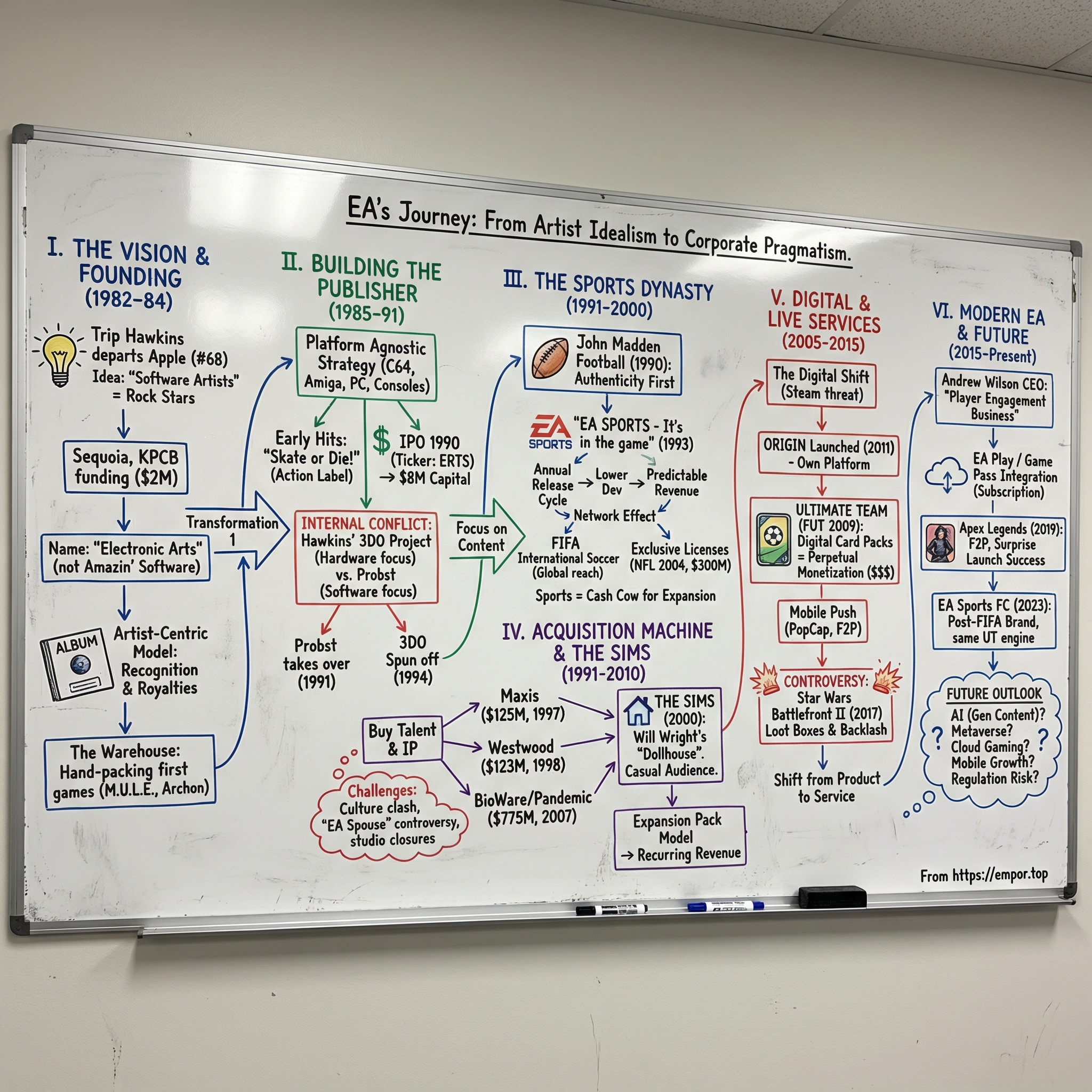
II. The Trip Hawkins Vision & Founding Story (1982–1991)
In 1982, 28-year-old Trip Hawkins left his role as Apple's director of strategy and marketing. Employee number 68 at Apple, Hawkins held stock in a company that had recently completed its initial public offering, alongside degrees from Harvard and Stanford. He also possessed a long-standing interest in games, having attempted to market a self-designed football board game during his youth. Hawkins left Apple with a core thesis: personal computers were poised to become primary entertainment devices, and game developers would emerge as mainstream creative stars.
Hawkins raised approximately $2 million in venture capital from Don Valentine of Sequoia Capital and Kleiner Perkins Caufield & Byers. Valentine provided desk space at Sequoia while Hawkins established the business. Initially named Amazin' Software, early employees resisted the title, prompting a November 1982 rebrand to Electronic Arts — a name chosen to mirror United Artists as a distribution house centered on creative talent.
The company's early packaging reflected this ethos. EA shipped floppy disks in square, gatefold jackets styled like vinyl record albums, complete with designer credits and programmer photographs. A 1983 advertisement framed the ambition directly: "Can a Computer Make You Cry?" The initial lineup — including Hard Hat Mack, Pinball Construction Set, Archon, and M.U.L.E. — debuted on May 20, 1983, packaged manually by early employees in a South San Francisco warehouse. Later that year, EA released One on One: Dr. J vs. Larry Bird, among the earliest sports games to feature licensed professional athletes and an early indicator of the commercial strategy that would later define the publisher.
Hawkins' second strategic decision focused on commercial distribution. Rather than relying on third-party distributors that controlled shelf space and extracted margins, EA built an internal direct sales force to negotiate directly with retailers. By the mid-1980s, EA expanded this infrastructure through its "Affiliated Labels" program, distributing third-party titles for a fee. While the developer-centric branding built EA's reputation, the direct distribution infrastructure generated its cash flow — establishing a recurring tension between creative house and logistics enterprise.
EA went public on the Nasdaq on March 26, 1990, under the ticker ERTS, at a split-adjusted price of roughly $0.52 per share; the symbol was changed to EA in December 2011. While the trajectory from that initial valuation to the 2026 buyout at $210 per share highlights long-term equity growth, the founder's subsequent trajectory proved less enduring.
In 1991, Hawkins stepped back from day-to-day operations to launch 3DO, an effort to establish a standardized hardware platform for licensed console games. He remained EA's chairman until 1994. Priced at $699 at its 1993 launch, 3DO failed commercially against competitors such as Sony's PlayStation. Hawkins correctly anticipated the growth of the console market, but the dominant platform belonged to hardware manufacturers rather than his consortium.
His successor, Larry Probst, came from a sales background and operated with a different operational focus. Where Hawkins emphasized software developers as creative artists, Probst viewed EA primarily as a rights and distribution company. Under Probst, EA phased out promotional campaigns centered on individual developers, shifted from publishing partner games to acquiring studios outright, and prioritized long-term intellectual property rights and league licensing. Over time, corporate league branding replaced the original album-style developer packaging.
This shift proved commercially effective over the subsequent two decades, laying the foundation for EA's financial growth while establishing operational and cultural dynamics that would challenge the publisher in later years.
III. The Sports Dynasty & Exclusive License Moats (1991–2008)
The origin of EA Sports began on a train in 1984, when Hawkins set out to convince NFL broadcaster John Madden to endorse a football simulation. Traveling by rail due to a fear of flying, Madden agreed on one condition that nearly derailed the project: the game had to feature eleven players per side to replicate authentic football, rather than a simplified seven-on-seven arcade format. That requirement delayed development for years as mid-1980s hardware struggled to render twenty-two active sprites, but it forced EA to build a simulation anchored in tactical fidelity — complete with playbooks, formations, and strategic coaching decisions.
John Madden Football debuted on the Apple II in 1988 and reached its commercial turning point on the Sega Genesis in 1990. The Genesis release established a console franchise built around authentic sports coverage, a prominent personality, and a real-world event calendar that reset every autumn.
This annualization model predated digital distribution and served as a foundational financial innovation for the publisher. Traditional game publishers faced volatile earnings tied to unpredictable release schedules, where a delay of two quarters could impair an entire fiscal year. A sports publisher holding official league licenses operated with the predictability of a subscription business tied to hard renewal dates. Roster updates, athlete movements, and playbook changes prompted a significant portion of consumers to buy the new edition each year, regardless of the extent of underlying code improvements. This recurring demand smoothed EA's cash flows in an otherwise cyclical industry and established an operational rhythm that sustained the business for decades.
EA structured its brand architecture around this model, launching its sports label in 1991 as the Electronic Arts Sports Network with a fictional broadcast presentation. After trademark friction with ESPN forced a rename to EA Sports, the publisher introduced its signature tagline, "If it's in the game, it's in the game." The slogan framed technical fidelity while signaling comprehensive league licensing, assuring players access to official teams, authentic player rosters, and real stadiums.
This focus on authenticity set the stage for the strategic maneuver that redefined EA's competitive moat.
For years, EA's sports titles competed primarily on product quality. In 2004, Take-Two Interactive and Sega released ESPN NFL 2K5 at a budget price point of $19.99, directly challenging Madden, which retailed at $49.99. NFL 2K5 won critical praise, posing a structural threat not just to EA's market share, but to its pricing power. If players accepted twenty dollars as the benchmark price for a sports simulation, the profit margins supporting annualized publishing would compress permanently across the industry.
Rather than competing purely on game features, EA secured its position through exclusive rights. In December 2004, EA signed an exclusive licensing deal with the NFL and the NFL Players Association, making it the sole publisher authorized to produce simulation football games featuring official teams and players. EA subsequently replicated this strategy across its portfolio, securing exclusive or dominant rights with collegiate sports organizations, FIFA and national federations, the PGA Tour, the NHL, and later Formula 1 via its acquisition of Codemasters.
In strategic terms, these agreements created a classic "cornered resource"—preferential access to a valuable asset that competitors cannot replicate at any price because it is contractually locked. Competitors adapted over time—Take-Two's 2K franchise returned to football in 2021 through non-simulation arrangements while maintaining dominance in basketball with NBA 2K—but rivals remained locked out of the core simulation categories that generated EA's primary cash flows. By 2011, Forbes estimated the stand-alone value of the EA Sports brand at $625 million, reflecting the financial strength of its licensed sub-brand.
For investors, the underlying insight extends beyond securing valuable licenses. EA effectively shifted a creative competition, where it faced intense product pressure, into a contractual contest decided by capital allocation. While effective as a defensive moat, this strategy introduced a long-term operational vulnerability: a publisher accustomed to relying on licensing protection risks underinvesting in core software design. Later technical setbacks with the Frostbite engine and development challenges within non-sports franchises illustrated the downstream risks of this posture.
Furthermore, contractual exclusivity remains tied to fixed expiration dates and independent partners. Leagues, federations, and player associations monitor publisher cash flows carefully during renewal cycles to maximize their licensing fees. That tension would eventually trigger one of the most significant franchise breakups in interactive entertainment. Before facing those renegotiations, however, EA spent three decades attempting to expand its portfolio by acquiring external development studios outright.
IV. The Acquisition Machine: M&A Playbook & Comp Analysis (1991–2021)
Over thirty years, a consistent narrative has emerged from interviews with founders of acquired studios: Electronic Arts initially promises creative autonomy, but within a few development cycles, milestone pressures tighten, schedules compress, sequels are mandated, and the independent studio is eventually folded into EA's broader corporate structure.
EA has deployed well over $3 billion on studio acquisitions across its history. The financial and creative outcomes are sharply barbelled: a small number of exceptional successes offset a long tail of value destruction—an outcome that warrants direct analysis rather than a simple tally.
Distinctive Software (1991) was the first and arguably most value-accretive deal EA executed. The Vancouver-based studio became EA Canada, generating both Need for Speed and, in 1993, the original FIFA International Soccer. In a single purchase of an independent development house, EA acquired two multi-decade franchises, one of which grew into the largest sports video game property in the industry. At the time, neither party fully recognized the scale of the assets acquired.
Maxis (1997, approximately $125 million) brought in co-founder Will Wright, whose design philosophy differed sharply from EA's corporate approach. Wright's The Sims, released in 2000, expanded EA's reach by attracting a demographic that was roughly half female and largely new to video games. The franchise generated billions of dollars in lifetime revenue and remains an active live-service business twenty-six years later. Maxis stands as the clearest evidence that corporate ownership under EA can, under the right conditions, amplify creative work rather than suppress it.
Westwood Studios (1998, approximately $123 million) offers a contrasting counterpoint. Westwood pioneered the modern real-time strategy genre with Command & Conquer. Following the acquisition, EA relocated personnel and pushed sequels that drifted from the core appeal of the originals, ultimately shuttering the studio in 2003. While the intellectual property survived, the team that created its value was dispersed.
BioWare and Pandemic (2007, approximately $775 million via VG Holding Corp.) represented EA's most ambitious creative purchase. BioWare had developed critically acclaimed titles including Baldur's Gate, Knights of the Old Republic, and Mass Effect. The acquisition provided EA with two major story-driven franchises—Mass Effect and Dragon Age. However, it also included Pandemic Studios, which EA closed in 2009, just two years after the purchase. Furthermore, the deal set up a long-term friction between BioWare's writing-driven development model and EA's internal technology mandates.
PopCap Games (2011, over $750 million including earnouts) serves as a benchmark for overpayment. EA acquired the creator of Plants vs. Zombies and Bejeweled near the peak of industry enthusiasm for casual PC and early mobile gaming. EA then pushed the portfolio toward free-to-play monetization models that altered the core appeal of the titles. Substantial headcount reductions followed within two years. While the strategic rationale—reaching demographic segments EA could not expand into organically—was sound, the transaction price and post-acquisition execution eroded asset value.
Respawn Entertainment (2017) stands out as EA's most successful studio acquisition, offering an instructive operational model. EA acquired Respawn for $151 million in cash at close, with total consideration capped at roughly $455 million including equity and performance-based earnouts. Founded by Jason West and Vince Zampella following their departure from Activision's Infinity Ward, Respawn delivered Titanfall, Apex Legends—a free-to-play battle royale title that grew into a multi-billion-dollar franchise—and Star Wars Jedi: Fallen Order alongside its sequel Survivor, which re-established EA's standing with the Star Wars license. Crucially, Respawn retained substantial operational independence, notably securing permission to use Epic Games' Unreal Engine rather than adopting EA's mandated internal game engine.
Codemasters (2021, approximately $1.2 billion) and Glu Mobile (2021, approximately $2.1 billion) closed within ten weeks of each other at the peak of pandemic-era gaming valuations. Codemasters represented a direct strategic acquisition, allowing EA to outbid Take-Two Interactive, consolidate the racing genre, and secure the Formula 1 license alongside Need for Speed. Glu Mobile proved far more difficult to justify. EA paid a substantial premium for mobile scale via Design Home, Covet Fashion, and Tap Sports Baseball, only to face Apple's 2021 App Tracking Transparency privacy changes, which altered mobile user-acquisition economics and created sustained headwinds for EA's mobile net bookings in subsequent years.
Historical falsification: does EA's M&A playbook actually scale creative IP?
Across two decades of investor communications, EA's management framed studio acquisitions around a central thesis: acquiring independent teams allows the publisher to scale creative intellectual property across a shared platform of technology, distribution, and global marketing.
The historical record across multiple management regimes reveals a recurring pattern that challenges that claim. Origin Systems (Ultima, acquired 1992) was closed in 2004. Bullfrog Productions (Populous, Theme Hospital, acquired 1995) was absorbed and shuttered by 2001. Westwood Studios was closed in 2003, Pandemic Studios in 2009, Mythic Entertainment in 2014, and Visceral Games (Dead Space) in 2017, with its in-development Star Wars project canceled. While each closure was defended at the time by specific operational metrics, the aggregate pattern shows an integration framework that repeatedly converted distinctive development houses into generic production capacity.
Evaluated in context, however, studio closures are common across an industry where consolidation frequently presents integration challenges for peers such as Activision, Ubisoft, and Microsoft. EA's notable successes—Maxis during its first decade and Respawn throughout its tenure—share specific operational conditions: the acquired studios preserved their creative direction, retained key leadership, and, in Respawn's case, maintained autonomy over their underlying technology stack.
The evidence suggests a refined conclusion: EA's acquisition strategy creates durable value when purchasing distribution-compatible teams while preserving their operating culture, but destroys value when treating creative studios as fungible internal capacity to be redirected. For investors monitoring future integration efforts, the clearest indicator of impairment occurs when an acquired studio is reassigned to support another franchise, signaling that the original creative asset is being written down regardless of its book value.
Yet while M&A consumed significant capital, the primary driver of EA's modern financial model was developed internally—emerging not from an external acquisition, but from an experimental feature within its soccer franchise.
V. The Digital Transformation & Ultimate Team Golden Goose (2009–2022)
The origin of EA's most lucrative internal innovation is disputed in detail but clear in structure. During development of FIFA 09, a small team at EA Canada designed an experimental mode where players opened digital packs of virtual trading cards to construct custom rosters. It shipped as optional downloadable content with modest internal expectations. Within a few years, however, the mode evolved into the most profitable product feature in the history of interactive sports entertainment.
FIFA Ultimate Team and its sibling Madden Ultimate Team succeeded by combining four psychological and economic mechanisms never previously unified in a sports title.
First, the collection loop. Cards arrive randomly in virtual packs with a heavily skewed distribution of outcomes. Rare cards representing elite athletes serve as both functional performance upgrades and digital status symbols. The model digitized the traditional sports trading card business, extracting recurring revenue at zero marginal cost of goods.
Second, the marketplace. In-game trading allows players to exchange cards using virtual currency, establishing a peer-to-peer secondary market complete with liquidity, price discovery, and speculation. That liquidity creates a network effect: a higher volume of active traders deepens market utility and reinforces asset valuations, establishing a defensive moat that competitors cannot easily replicate without an established user base.
Third, the annual reset. Every autumn, player collections reset to zero with the release of the new annual title. A user who invested substantial capital building a squad must rebuild from scratch, embedding planned obsolescence directly into a digital asset library.
Fourth, competitive matchmaking, which links card quality to win probability, converting player spending directly into competitive advantage and social status.
The economic consequence was a structural shift in unit margins. A traditional $60 physical game required sharing proceeds with retailers and platform owners while absorbing physical manufacturing and logistics expenses. By contrast, Ultimate Team packs generate digital gross margins exceeding 80% from players who have already purchased the base software. At its peak, FIFA Ultimate Team alone generated well over $1.5 billion in annual revenue.
This monetization structure explains the divergence between net bookings and GAAP revenue introduced in Section I. Net bookings reflect cash spent by consumers during a specific period, whereas GAAP accounting defers a portion of live-service revenue over the estimated operational lifecycle of the online content. When net bookings grew 9% while GAAP revenue grew just 1% in fiscal 2026, it indicated that consumer spending on live services was expanding faster than recognized on the income statement. In live-service publishing, net bookings serve as the leading indicator of demand, while GAAP revenue operates as an accounting echo.
EA amplified these margins through direct digital distribution. Launching the Origin PC platform in 2011—later rebranded as the EA app—allowed the publisher to sell PC titles directly to consumers, bypassing the standard 30% digital storefront commission. Combined with the broader consumer transition from physical media to downloads, EA's gross margin expanded from the low-to-mid 60% range historically into the mid-to-high 70% range. That expansion stemmed primarily from disintermediation—removing physical retailers and logistical costs from the distribution stack—rather than operational efficiency alone. However, console and mobile platforms continue to enforce standard storefront fees, leaving EA subject to platform fees across its primary revenue-generating channels.
Historical falsification: are live services really non-cyclical, low-risk recurring revenue?
Throughout a decade of investor communications, EA management maintained that live services convert volatile, hit-driven game publishing into predictable recurring cash flow.
The regulatory disconfirmation emerged first. In November 2017, EA released Star Wars Battlefront II featuring a progression framework where real-money loot crates unlocked key characters. Consumer backlash escalated rapidly; an EA response explaining the mechanics became the most downvoted comment in Reddit's history, and Disney executives intervened directly regarding the management of the Star Wars brand. EA disabled all in-game microtransactions hours before the global launch.
The regulatory fallout reshaped compliance requirements. In April 2018, Belgium's Gaming Commission ruled that paid randomized loot boxes constituted illegal gambling under national law, a stance echoed by regulators in the Netherlands. EA subsequently disabled microtransaction currency sales in Belgium, while European authorities expanded scrutiny of randomized mechanics. Because randomized card packs represent the primary revenue engine of Ultimate Team rather than an ancillary feature, legal restrictions against randomized purchases threaten core product monetization rather than simple margin adjustments.
The commercial disconfirmation followed in fiscal performance. Live services net bookings contracted approximately 2% in fiscal 2024 to $5.425 billion from $5.530 billion, driven by declining engagement in Apex Legends and foreign exchange headwinds.3 In January 2025, EA lowered its third-quarter net bookings guidance from $2.4–2.55 billion down to approximately $2.21 billion, citing weaker performance from EA Sports FC 25 alongside Dragon Age: The Veilguard, which recorded roughly 1.5 million players in its initial two months—nearly 50% below internal forecasts.45 EA's stock dropped by double digits following the announcement.4
The January 2025 guidance reduction highlighted a core vulnerability in the recurring-revenue thesis. It demonstrated that even Global Football—EA's primary revenue asset, long framed as insulated from gaming cycles—remains subject to quarterly revenue shortfalls of hundreds of millions of dollars on short notice.
Consequently, the premise that live services provide fully predictable revenue is rejected in its strong form and refined into a narrower operational reality: live services deliver higher gross margins and lower performance variance than packaged software, but they remain cyclical and capital-intensive. Franchises require continuous content reinvestment, remain vulnerable to annual execution quality, and rely on monetization mechanics facing active regulatory scrutiny in key markets.
The counterweight to this volatility emerged in fiscal 2026. EA reported record net bookings of $8.026 billion, driven by mid-single-digit growth in Global Football across FC 26, FC Online, and FC Mobile, alongside a double-digit recovery in Apex Legends net bookings following consecutive years of decline.2 The turnaround demonstrated the underlying durability of EA's key properties, while confirming that ongoing execution—rather than business model structure alone—determines performance stability.
Before achieving that recovery, however, EA spent nearly a decade demonstrating how internal management mandates could disrupt product development independently of external market forces.
VI. Tech Unification Failure: The Frostbite Engine Friction (2011–2020)
The strategic logic behind technology unification is compelling for any multi-studio software enterprise.
A game engine serves as the foundational software framework for game development, controlling rendering, physics, animation, audio, and level creation tools—functioning as both operating system and development workshop. Historically, EA’s internal studios operated on fragmented technology stacks: DICE in Stockholm developed Frostbite for Battlefield, BioWare licensed Epic Games' Unreal Engine, and other studios maintained custom proprietary tools. Licensing external software incurred recurring royalty payments to third parties, while maintaining disparate internal engines created duplicated engineering overhead and prevented staff from transferring smoothly across projects.
Around 2011, EA leadership mandated that internal studios standardize development on Frostbite. Management framed a clear commercial case: eliminate third-party royalties, enable engineering mobility across studios, share technical enhancements globally, and amortize the costs of a central engine team across the publisher's entire portfolio.
The core operational thesis was straightforward: standardizing on a single unified technology stack across all studios reduces development costs and accelerates game production schedules.
The execution, however, revealed a fundamental mismatch between engine architecture and creative portfolio requirements. As journalist Jason Schreier documented in a series of industry investigations for Kotaku, Frostbite was engineered specifically for large-scale first-person shooters featuring destructible environments. It performed exceptionally well within that genre. But because the Battlefield series had never required them, Frostbite lacked essential systems for narrative role-playing titles: native inventory management, dialogue trees, quest tracking, and persistent save-game systems.
BioWare’s development teams were forced to build foundational role-playing tools inside a shooter engine before core game design could begin. Schreier’s reporting on Mass Effect: Andromeda detailed a turbulent development cycle in which the studio spent years troubleshooting engine technology and procedural-generation experiments, leaving a severely compressed schedule for production; the title launched in March 2017 to weak critical reviews, prompting EA to put the franchise on hold.[^6] A subsequent investigation into Anthem revealed even broader operational friction: years elapsed without settled design decisions, engine constraints amplified scope confusion, and development staff suffered widespread burnout.6 Anthem shipped in February 2019, underperformed commercially, and a planned multi-year overhaul was formally canceled in 2021.
When Battlefield 2042 launched in November 2021 to severe technical issues and widespread player criticism, the broader impact of the policy became clear: the Frostbite mandate not only failed to generate cross-studio synergies outside the shooter genre, but it also disrupted a decade of creative output across EA's core studios.
The thesis that a forced single-engine mandate reduces costs and accelerates development is rejected. The counterfactual was demonstrated within EA itself: Respawn Entertainment, which retained operational autonomy upon its 2017 acquisition, negotiated an exemption to build Star Wars Jedi: Fallen Order on Epic's Unreal Engine. Respawn delivered the game in November 2019 on schedule to critical and commercial success—operating under the same parent company, financial targets, and distribution umbrella, but using an alternative technology strategy.
EA management eventually course-corrected, though without formal public acknowledgment. The mandatory-Frostbite policy was quietly retired, and BioWare returned to Unreal Engine for its next Mass Effect title. There was no investor-day presentation acknowledging that a decade-long technology mandate had failed to achieve its objectives.
That silence remains relevant to evaluating corporate governance and execution track records. EA has historically allowed strategic failures to recede quietly rather than accounting for them publicly. For investors evaluating current centralized technology initiatives—such as generative AI efficiency mandates across heterogeneous creative teams—this history serves as an instructive precedent regarding top-down engineering mandates.
VII. Respawn, Apex Legends, & The Free-to-Play Counterweight (2017–Present)
On February 4, 2019, Electronic Arts departed from standard industry practice by launching a flagship title without prior announcements, marketing campaigns, review embargoes, or pre-orders. The free-to-play battle royale shooter Apex Legends debuted unannounced across PlayStation 4, Xbox One, and PC.
The stealth release served a clear strategic purpose. With Epic Games' Fortnite dominating the battle royale market, an announced competitor faced unfavorable pre-launch comparisons. Releasing the game unannounced bypassed pre-release market friction and eliminated the multi-hundred-million-dollar marketing budget typical of major AAA game launches, allowing organic player adoption to drive initial momentum.
The strategy generated rapid scale. Apex Legends reached 50 million players in its first month—a faster adoption trajectory than Fortnite achieved over a comparable timeframe. EA established an organic free-to-play shooter franchise overnight, capturing a younger, non-sports demographic in a category where it previously held no market presence.
Beyond initial player acquisition, Apex Legends assumed a vital structural role within EA's broader portfolio. While publisher revenues remained heavily concentrated in annualized sports games serving returning sports fans, Apex established a secondary monetization engine centered on cosmetic microtransactions rather than competitive gameplay advantages. This cosmetic model carried materially lower regulatory risk than the randomized card packs powering Ultimate Team.
However, operating a live-service shooter requires a continuous development cycle distinct from the annualized sports calendar. While sports titles rely on predictable autumn release events, live shooters must sustain player engagement every few weeks. Each seasonal update requires continuous investment in new characters, maps, weapons, battle passes, and balance adjustments for a non-committed player base. Engagement declines and monetization friction in Apex Legends created persistent revenue headwinds through fiscal 2024 and much of fiscal 2025, drawing ongoing scrutiny from equity analysts.
Performance stabilized in fiscal year 2026: Apex Legends net bookings finished the fiscal year up double digits, with the strongest bookings quarter of the year in Q4, as engagement and monetization improved.2 Executive leadership attributed the recovery to sustained reinvestment in core gameplay rather than a single seasonal event. The rebound indicated that mature live-service titles can recover engagement through disciplined support—a critical capability for a publisher managing an aging live-service portfolio.
From an analytical perspective, a single year of growth following three years of contraction indicates operational manageability through capital reinvestment rather than permanent structural expansion. The key valuation metric remains whether double-digit growth can be sustained across multi-year cycles or whether fiscal 2026 performance primarily reflects a favorable comparison against a depressed baseline.
Respawn's overall performance under EA ownership provides strong empirical support for the studio autonomy thesis outlined in Section IV, though its operations remain subject to broader corporate discipline. Project cancellations—including a Star Wars first-person shooter shelved in 2025—alongside workforce reductions across EA’s studio network, demonstrate that even premier acquired studios remain subject to portfolio adjustments.
While Apex Legends proved EA could build a successful franchise outside traditional sports, the publisher soon faced a broader test of structural durability: whether its sports ecosystem could withstand the loss of its most recognizable global brand name.
VIII. The FIFA Divorce & The EA SPORTS FC Rebrand (2022–Present)
In 2022, Electronic Arts faced a major strategic decision involving its most valuable intellectual property: the single most recognizable brand name in its product portfolio—printed on the cover of the world's best-selling sports video game for three decades—was set to double in cost while introducing new operational restrictions.
The public announcement arrived on May 10, 2022: after three decades, EA and FIFA would end their partnership following FIFA 23, and EA would rebrand its football franchise as EA Sports FC beginning in 2023.[^8]
The financial terms of the split explain why EA chose to move away from the governing body's brand. The existing arrangement cost EA approximately $150 million annually. FIFA's reported ask for renewal exceeded $1 billion per four-year World Cup cycle—roughly $250 million to $300 million annually, effectively doubling the previous rate.7 Furthermore, FIFA sought to restrict EA's rights in adjacent commercial areas—including esports, digital collectibles, and non-simulation software—while reserving the right to license the FIFA name to rival publishers for competing football products.
Rather than paying double for a narrower license from a partner intending to monetize the brand elsewhere, EA determined that renewing the contract was commercially unviable.
The decision rested on a critical distinction between brand name and underlying licensing rights. FIFA supplied only the four letters on the cover and the official World Cup tournament mode. It did not control the licensing rights for players, clubs, or domestic leagues. Those rights stemmed from roughly 300 separate licensing agreements that EA held directly—including FIFPro for approximately 19,000 professional players, alongside individual contracts with major leagues and clubs.
Management reasoned that player attachment resided in authentic teams, real-world stars, domestic competitions, and the Ultimate Team squads users had spent years building—not in the FIFA acronym. The core brand equity resided in the cornered licensing resources EA owned directly rather than the umbrella name it rented.
The falsification test was clean and measurable. The operational risk was explicit: removing the most recognized name in sports gaming from the box risked confusing casual buyers who searched for "FIFA" by reflex, depressing retail sell-through, and eroding the Ultimate Team spending base.
Initial commercial results validated management's thesis. Following the launch of EA Sports FC 24 in September 2023, EA delivered record net cash provided by operating activities of $2.315 billion in fiscal year 2024.3 The franchise retained its core player base, demonstrating that consumer demand was tied to the underlying simulation engine and player licenses rather than the governing body's name.
The transition, however, introduced ongoing operational costs and risks. Re-anchoring the franchise required elevated marketing expenditures to establish the new brand. Moreover, EA Sports FC 25 underperformed in fiscal 2025, forcing a mid-quarter guidance reduction with Global Football accounting for the majority of the shortfall.4 While the rebrand survived, the franchise remained vulnerable to product execution and player engagement.
In fiscal year 2026, the property recovered, delivering mid-single-digit Global Football net bookings growth across console, FC Online, and FC Mobile.2 Across three release cycles, a clear operational pattern emerged: the name change did not impair the franchise's structural moat, but annual financial performance continues to depend on product quality and gameplay execution.
EA's football moat remains anchored in its direct league, club, and player licenses alongside Ultimate Team's secondary marketplace liquidity. Eliminating FIFA removed one escalating licensing fee while leaving roughly 300 independent licensing agreements intact, each carrying its own renewal timeline. For its part, FIFA has sought alternative development partners, though no competing publisher has captured meaningful market share.
The rebrand demonstrated management's willingness to execute a high-stakes, non-reversible operational change based on a structural analysis of its licensing stack—raising broader analytical questions about how executive leadership managed the publisher's remaining strategic priorities.
IX. Current Management, Governance & Capital Allocation
Andrew Wilson's path to the CEO office is unusual for a company of EA's size. Born in England, raised in Australia, he joined EA in 2000 and spent most of his career inside the sports business, eventually running EA Sports — which means he was operationally close to Ultimate Team during the exact years it transformed the company's economics. He became CEO in September 2013, at 38, in the wake of John Riccitiello's resignation following a period of severe underperformance.
Wilson inherited a company that had just been voted "Worst Company in America" in a consumer poll two years running — an absurd designation for a game publisher competing against banks and airlines, but a real signal about brand damage from always-online DRM, the SimCity launch disaster, and aggressive monetization. His tenure has been defined by two things: an unrelenting push toward digital, direct, and recurring revenue, which worked; and a repeated pattern of high-profile product failures that management has tended to absorb quietly rather than explain in detail.
CFO Stuart Canfield, who took the role in 2023 after running finance for EA's studios organization, has been the architect of the margin and cost-discipline narrative — including the restructuring announced in early 2024 that reduced headcount by roughly 5% and cancelled projects including a Star Wars title in development. On the Q1 FY26 call in July 2025, Canfield framed the quarter's beat as "highlighting the resilience of our live services and the breadth of our portfolio," while Wilson pointed toward "the most exciting launch slate in EA's history" — a reference to Battlefield 6 and FC 26.8 That framing turned out to be defensible rather than promotional, which is not always the case with EA's forward language.
Laura Miele, President of EA Entertainment and Technology, has run the non-sports studio organization through the most turbulent period — the Frostbite unwind, the BioWare restructuring, and repeated studio consolidations.
On incentive alignment. EA's executive long-term incentive structure has been tied principally to net bookings, operating income, and relative total shareholder return against broad technology and market indices. This is worth pausing on analytically. Net bookings as a primary metric rewards customer spending in period — which is the right demand signal, but which also creates a structural incentive toward aggressive in-game monetization, since a dollar extracted from an existing Ultimate Team player counts identically to a dollar from a new customer acquired by making a better game. That is not an accusation; it is an observation about what the compensation system optimizes for, and it is consistent with the direction EA's products have actually moved.
On capital allocation, the record is genuinely mixed and should be read as such.
The shareholder-return side was disciplined and substantial. EA returned approximately $1.505 billion to stockholders in fiscal 2024 through buybacks and dividends, operating under a $5 billion three-year repurchase authorization.3 In fiscal 2025 the company repurchased shares aggressively, including $1.375 billion in the March 2025 quarter alone — 9.8 million shares.2 Then, in fiscal 2026, repurchases went to zero in the fourth quarter, for the obvious reason that the company was under a signed merger agreement.2 The dividend continued at $0.19 per share quarterly.2
Buying back roughly 10 million shares in a single quarter at prices well below the eventual $210 take-out was, with hindsight, accretive for continuing holders. But it is worth being precise about the sequencing: EA repurchased heavily in the quarters following the January 2025 guidance cut and share-price decline, which is at least the correct direction of counter-cyclicality.
The M&A side is where the skeptical investor presses hardest. An activist looking at this company in 2024 would have built the case around a simple observation: roughly $3.3 billion deployed on Glu Mobile and Codemasters at the top of the cycle in 2021, followed by a mobile business facing structural headwinds; a decade of development spend at BioWare producing two commercial failures; a Star Wars project cancelled after years of investment; and a Battlefield franchise that produced 2042 before it produced Battlefield 6. Against that, the company generated over $2.5 billion in annual operating cash flow anyway — which is either evidence of extraordinary underlying business quality, or evidence of how much value the core franchises were carrying for everything else. Both readings are defensible; the second one is more uncomfortable and probably more accurate.
To management's credit, the post-2021 posture shifted. There have been no large speculative studio acquisitions since Glu. Capital went instead to organic franchise investment — the return of college football, the rebuilding of Battlefield, and continued investment in the FC ecosystem. Whether that constitutes learned discipline or simply an unattractive acquisition environment is not distinguishable from outside.
Reading the calls over time is the most useful credibility exercise available here. On the Q4 FY24 call on May 7, 2024, management defended the live-services trajectory while Apex Legends was visibly weakening, and pointed analysts toward College Football 25 as the growth catalyst; analysts pressed repeatedly on mobile profitability and on the decay rate of live services.[^11] College Football 25 did in fact launch in July 2024 as a genuine success — a franchise revived after an eleven-year absence caused by litigation over player likenesses, made possible by the NCAA's name-image-likeness reforms. Two quarters later, the January 2025 guidance cut arrived from an entirely different direction: the football franchise management had not flagged as at risk.
That is the honest summary of EA management's forecasting record. The named catalysts have generally delivered. The misses have come from the assets assumed to be safe.
Which is precisely the question the new owners have levered $20 billion of debt against.
X. Industry Structure, Competitive Landscape & 7 Powers Analysis
The economics of interactive entertainment are shaped by an industry-wide platform fee that no third-party publisher can avoid.
When a player spends $20 on FC Points on a PlayStation console, Sony collects roughly 30%. The same commission structure applies on Microsoft's Xbox, Apple's App Store, and Google Play. While Electronic Arts handles software development, carries production risk, funds league licenses, and maintains online servers, platform operators control the digital storefronts and extract nearly one-third of gross consumer spending. For a business selling zero-marginal-cost digital goods, platform fees represent the single largest drag on operating margins—and one that remains structurally unavoidable due to platform control over hardware ecosystems.
This dynamic explains why proprietary PC storefronts like Origin and the EA app carry strategic weight out of proportion to their overall revenue share, serving as direct-to-consumer channels that bypass third-party fees. It also highlights the structural asymmetries distinguishing EA from its key rivals.
Microsoft acquired Activision Blizzard in 2023 for $69 billion, placing Call of Duty—the primary competitor to EA's Battlefield—under the ownership of a platform holder that collects commissions from rival publishers while operating Xbox Game Pass. Microsoft can leverage games as subscription acquisition tools, funding them through platform rents—an advantage EA cannot replicate as a standalone publisher. Although EA Play is integrated into Game Pass tiers to generate distribution revenue, the arrangement cedes direct customer relationship management to Microsoft. This platform ownership creates a competitive asymmetry that limits EA's long-term pricing power regardless of its licensing portfolio.
Take-Two Interactive offers the closest direct peer comparison, combining a dominant sports simulation in NBA 2K with a live-service spending model and top-tier intellectual property in Grand Theft Auto. However, the financial profiles differ significantly: Take-Two's financial results depend heavily on multi-year, episodic mega-releases, whereas EA's cash flows benefit from annual sports releases. While annualization offers smoother cash flow predictability, the revenue revisions in early 2025 demonstrated that annual releases remain vulnerable to cyclical execution risk.
Epic Games exerts structural influence as the creator of Fortnite—the free-to-play benchmark that reshaped live-service monetization—and the developer of Unreal Engine, which has become the industry-standard technology powering broad segments of interactive entertainment, including EA's own titles following its internal engine pivot. Epic also mounted direct legal challenges against Apple and Google over storefront commissions, allowing publishers like EA to benefit from antitrust pressure on platform fees without absorbing the litigation costs.
An evaluation of EA's competitive position through Hamilton Helmer's 7 Powers framework illustrates where its strategic moats hold and where structural vulnerabilities persist:
Cornered Resource (High, but time-bounded): Exclusive simulation agreements with the NFL and NFLPA, collegiate sports licenses, direct rights with FIFPro, UEFA, the Premier League, La Liga, and the Bundesliga, alongside Formula 1 rights via Codemasters, represent EA's most formidable strategic barrier. However, each agreement relies on fixed-term contracts with counterparties that monitor publisher cash flows during renewal negotiations. The 2022 FIFA split demonstrated the financial friction that occurs when a licensor demands a larger share of franchise economics.
Network Effects (High): Ultimate Team's secondary marketplace maintains deep trading liquidity and matchmaking pools that expand with scale, creating network dynamics that potential competitors cannot easily replicate. Yet because this marketplace relies on randomized digital card packs, it remains directly exposed to regulatory interventions targeting loot-box mechanics.
Switching Costs (High within a season, weaker across seasons): Player investment in squad building, social networks, and accumulated gameplay expertise creates strong annual lock-in. However, the annual release cycle forces EA to re-earn those switching costs every autumn when player progress resets. The model relies on the absence of alternative licensed simulations, making switching costs interdependent with EA's cornered resource advantages.
Scale Economies (Medium to High): With AAA game production and marketing budgets regularly exceeding $200 million per title, EA amortizes fixed development, quality assurance, localization, and infrastructure expenses across tens of millions of units. However, technology scale is bounded; as the Frostbite mandate demonstrated, centralizing core engineering across disparate game genres can create operational drag.
Counter-Positioning (Medium): The transition to EA Sports FC illustrated counter-positioning dynamics: EA restructured its licensing cost base in a manner unreplicable by prospective competitors, who would need to assemble hundreds of individual licenses without possessing an established user base to absorb the cost.
Process Power and Brand (Low to Medium): EA's ability to deliver high-fidelity sports titles on an annual schedule reflects deep institutional process knowledge. Conversely, the parent corporate brand carries limited positive equity among core consumers due to past monetization disputes; commercial value resides almost entirely within individual franchise brands rather than the publisher's corporate identity.
A broader analysis using Porter's Five Forces underscores these dynamics. Supplier power represents the industry's primary structural pressure, exerted both by platform holders taking 30% storefront commissions and by sports governing bodies controlling exclusive licensing rights. Buyer power is fragmented individually but formidable in aggregate, as demonstrated by consumer backlashes over microtransactions. Threat of substitutes remains high and expanding as interactive games compete with broader digital entertainment, including Roblox, Fortnite, short-form video, and streaming platforms. Threat of new entrants in licensed simulation sports is minimal due to high capital requirements and exclusive contracts. Finally, competitive rivalry is intense yet segmented, with EA and Take-Two maintaining dominant positions across non-overlapping sports categories.
The composite picture reveals a publisher occupying a defensible position within a structurally challenging industry. EA's long-term defensibility relies on contractual licensing rights and marketplace network effects rather than proprietary technology or corporate brand equity—a key distinction for evaluating the enterprise's long-term cash flow durability.
XI. Historical Falsification Summary & Bull vs. Bear Case
Evaluating Electronic Arts' operational history requires testing four central management claims against empirical evidence.
Claim one: studio acquisitions scale creative intellectual property. Tested against integration outcomes across three decades, the claim is disconfirmed by the closures of Origin, Bullfrog, Westwood, Pandemic, Mythic, and Visceral, alongside the financial erosion of PopCap. Narrowed, not rejected: the M&A playbook generates durable value specifically when EA acquires an intact, autonomous culture and preserves its operating independence. Respawn and early-era Maxis serve as primary proof cases, indicating that future success depends on whether acquired studios retain independent creative leadership and software tools.
Claim two: live services provide non-cyclical recurring revenue. Tested against engagement cycles and franchise performance, the claim is disconfirmed by the live-service contraction in fiscal 2024, the multi-year decline of Apex Legends, the launch struggles of Battlefield 2042, and the January 2025 Global Football guidance reduction. Rejected in its strong form. Live services deliver higher gross margins and lower performance volatility than packaged software, but they demand continuous reinvestment, remain vulnerable to annual execution quality, and face ongoing regulatory scrutiny of randomized microtransactions. Fiscal 2026's record bookings demonstrate that the model can recover, but not that it is immune to cyclical decay.
Claim three: proprietary technology unification lowers development costs. Tested across diverse genres, the claim is disconfirmed by a decade of operational friction under the Frostbite engine mandate, with Respawn’s successful use of Unreal Engine serving as an internal control. Rejected. Management quietly retired the single-engine policy without formal public acknowledgment—a governance precedent relevant to future top-down engineering and efficiency mandates.
Claim four: EA Sports FC retains its market power without the FIFA brand name. Tested by ending the governing body's license, the claim remains intact, supported by record operating cash flow in fiscal 2024 and Global Football growth in fiscal 2026. The bounded reality: EA's competitive moat rests on direct player and league licenses alongside Ultimate Team marketplace liquidity rather than the governing body's acronym. However, product execution issues during FC 25 demonstrated that eliminating brand-licensing risk does not eliminate operational product risk, while hundreds of individual league agreements require ongoing contract renewals.
The bull case
The bullish thesis rests on EA's ownership of two structural assets that competitors cannot easily replicate: exclusive simulation rights to American football and an extensive global soccer licensing stack paired with interactive sports gaming's primary liquid secondary marketplace. Surrounding these assets is a commercial model that converted roughly $8.0 billion of customer spending into $2.553 billion of operating cash flow in fiscal 2026, with live services generating 71% of total revenue alongside high digital margins on incremental sales.2
Fiscal 2026 performance addressed several operational concerns across the portfolio. Battlefield 6 sold over 7 million copies in its first three days following an October 10, 2025 launch—the largest launch in franchise history—with players completing over 172 million matches during its opening weekend.910 Beyond immediate revenue, the launch restored a major non-sports property following prior development setbacks. Meanwhile, Apex Legends returned to double-digit net bookings growth, Global Football expanded across three separate product lines, and the revived college football franchise continued to scale.
Longer-term optionality remains centered on global soccer. As the world's most popular sport, soccer offers opportunities for expansion if EA can extend its interactive gaming base into a broader digital platform encompassing media, competition, and community features.
The bear case
The primary risk facing Electronic Arts is revenue concentration. The vast majority of operating profit originates from Global Football and Madden NFL, leaving the enterprise dependent on two core franchises. The January 2025 guidance reduction illustrated this sensitivity, as a softer release for a single title reduced quarterly net bookings by hundreds of millions of dollars.
Platform fees impose a permanent ceiling on gross margin expansion across console and mobile channels, where platform owners also compete directly in software and subscription services.
Regulatory exposure at the monetization layer represents a material tail risk. Legal rulings in Belgium and the Netherlands classifying paid randomized loot boxes as illegal gambling, combined with ongoing European regulatory scrutiny, target the specific randomized pack mechanics that drive Ultimate Team's profitability. A broader prohibition on randomized microtransactions in major markets would require a fundamental restructuring of EA's primary monetization engine.
Simultaneously, development costs for major AAA titles continue to escalate, yielding uncertain returns outside annualized sports franchises—a trend highlighted by BioWare's extended development cycles.
Finally, capital structure leverage introduces new operational constraints. The LBO transaction added approximately $20 billion of debt against a business that generated roughly $2.55 billion of operating cash flow in its best year.12 While peak cash flows cover debt service comfortably, an execution setback similar to FC 25 under a heavy interest load would test financial flexibility. Rather than insulating management from short-term market pressures, private ownership replaces public quarterly expectations with rigid annual debt-service requirements.
The KPIs that actually matter
Evaluating EA's trajectory under private ownership requires tracking three key operational metrics:
1. Live services net bookings growth, segmented by Global Football and non-sports properties. This metric indicates whether the recurring-revenue engine remains intact. Segmenting performance is critical to ensure that strength in Global Football does not mask engagement decay across the broader portfolio.
2. Global Football net bookings per annual cycle. As the publisher's primary earnings asset and the source of past guidance revisions, this figure reflects the combined health of EA's licensing agreements, marketplace liquidity, and annual product execution.
3. Operating cash flow conversion rate (operating cash flow relative to net bookings). Under a heavily leveraged capital structure, cash flow conversion measures financial flexibility by reflecting the net impact of development cost inflation, licensing fees, and platform commissions.
Following the go-private transaction, the reporting frequency and detail of these metrics will depend on debt covenant disclosure requirements rather than SEC public filing rules, giving management greater control over financial transparency.
XII. Looking Forward: Capital Structure & Future Outlook
The transaction that closed on August 4, 2026, was announced on September 29, 2025, following eleven months of regulatory reviews. The process included European Commission antitrust clearance on July 23, 2026, approval under the Foreign Subsidies Regulation on July 31, and CFIUS sign-off by July 30.1 The final ownership structure gave Saudi Arabia's Public Investment Fund approximately 94% of the equity, with Silver Lake holding 5.5% and Affinity Partners holding 1.1%. The transaction was funded with roughly $36 billion in equity and $20 billion in debt underwritten by JPMorgan — an unusually concentrated underwriting risk for a buyout of this magnitude.1 Andrew Wilson remained as chief executive officer.
Management framed the privatization around a familiar strategic thesis: enabling long-term investment free from the expectations of quarterly public markets. For a developer whose flagship titles require four to six years of development and hundreds of millions of dollars in capital, escaping ninety-day earnings scrutiny offers operational benefits, particularly given how fiscal-year deadlines contributed to past development friction during the Frostbite era. Executive commentary following fiscal year 2026 framed the completed debt process and transaction closing as unlocking long-term strategic opportunities.2
However, private ownership replaces public market oversight with strict financial obligations. While privatization eliminates quarterly earnings reporting, it does not relieve quarterly cash flow demands. Serving $20 billion in debt imposes rigid operating requirements that can exceed the pressure of public equity analysts. Leveraged buyouts in hit-driven creative sectors carry a documented operational risk: when debt service is structured against peak-year cash flows, subsequent product delays or execution missteps often force spending cuts in creative pipelines, impairing the development of future releases. Whether the Public Investment Fund's sovereign capital base and extended investment horizon alter this dynamic remains an open question that will take years to test.
The transaction also introduces broader governance considerations. A sovereign wealth fund controlling 94% of the world's major football publisher — while maintaining broader industry investments through Savvy Games Group and preparing for Saudi Arabia to host the 2034 FIFA World Cup — creates strategic alignment beyond standalone cash flow optimization. While patient capital could support long-term ecosystem expansion, corporate decision-making will now reflect an owner with broader national strategic objectives.
On AI in production, EA management has publicly emphasized integrating machine learning into its development pipeline — targeting procedural asset creation, automated localization, and automated quality assurance — to address the cost inflation of AAA game development. The economic rationale is clear: art production, animation, and testing represent a substantial share of modern development budgets. However, EA's past experience with the Frostbite mandate offers a cautionary precedent regarding top-down technology initiatives across heterogeneous creative teams. Demonstrating the success of this strategy will require empirical evidence, such as shortened development cycles on major titles or stable development costs per title at constant scope, rather than announcements of AI software integration.
Regarding subscriptions, EA Play remains integrated into Xbox Game Pass tiers, generating distribution revenue while ceding direct customer relationship management on consoles. Across the interactive entertainment industry, the subscription model presents an unresolved trade-off: subscription tiers smooth cash flows and expand audience reach, but they cap financial upside on major releases while directing players through platform-owner storefronts.
The publisher's five-year outlook centers on three operational questions. First, can EA Sports FC transition from an annualized product into a broader digital platform — encompassing competitive play, media, mobile, and community features to deepen its network effects? Second, can Battlefield 6 sustain its October 2025 launch momentum into a multi-year live-service franchise, avoiding the post-launch engagement drops of past releases? Third, will Ultimate Team's randomized card pack monetization survive ongoing European regulatory scrutiny?
Forty-four years after Trip Hawkins left Apple to champion game developers as creative artists, the publisher named after United Artists operates under sovereign ownership, carries the largest leveraged buyout debt load on record, and generates the majority of its profits from digital sports marketplaces. Whether this trajectory represents a departure from its founding principles or the logical expansion of the distribution infrastructure Hawkins established alongside them remains a subject of debate. What remains clear is the underlying structure of the enterprise today: two dominant sports licensing moats, a liquid in-game digital marketplace, a historical record of integration challenges with acquired studios, and — for the first time in thirty-six years — no public market ticker to continuously price its performance.
References
-
Saudi PIF and Kushner's Affinity finalize $55 billion EA deal — CNBC, 2026-08-05 ↩↩↩↩
-
EA Delivers Record Fiscal Year in Net Bookings and Operating Cash Flow — Electronic Arts Q4 FY26 Earnings Release, 2026-05-05 ↩↩↩↩↩↩↩↩↩↩↩↩
-
Electronic Arts Inc. Form 10-K for the Fiscal Year Ended March 31, 2024 — U.S. Securities and Exchange Commission ↩↩↩
-
EA shares plunge 11% after lowering outlook on weaker-than-expected results of Dragon Age: The Veilguard and EA Sports FC 25 — Game World Observer, 2025-01-23 ↩↩↩
-
'Dragon Age: The Veilguard,' 'EA Sports FC 25' Drag Down EA Earnings — Variety, 2025-01-23 ↩
-
How BioWare's Anthem Went Wrong — Kotaku (Jason Schreier), 2019-04-02 ↩
-
EA Sports FC and the FIFA licensing divorce — Front Office Sports, 2022-05-11 ↩
-
Electronic Arts Reports Q1 FY26 Results — Electronic Arts, 2025-07-29 ↩
-
Battlefield 6 shatters records becoming the biggest launch in franchise history — Electronic Arts, 2025-10-16 ↩
-
'Battlefield 6' Sells 7 Million Copies — Forbes, 2025-10-16 ↩
 LinkedIn
 WhatsApp
 Reddit
 Hacker News
 Email
Email Kindle
 RSS Feed
 Spotify
 Apple Podcasts
 Amazon Music
 Audible
 YouTube