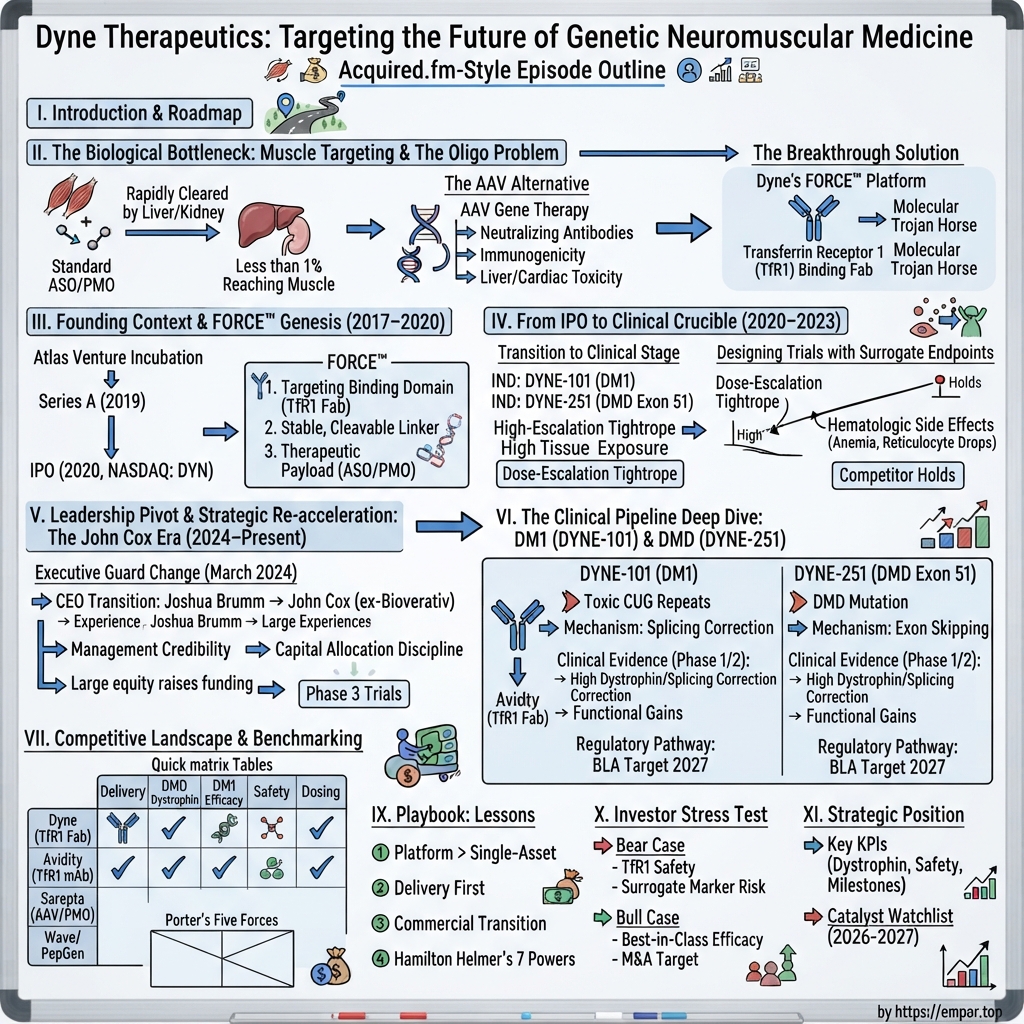
Dyne Therapeutics: Targeting the Future of Genetic Neuromuscular Medicine
I. Introduction & Episode Roadmap
On the morning of December 8, 2025, a small Waltham, Massachusetts biotech with no commercial product, no revenue, and an accumulated deficit approaching $1.4 billion published a single figure that reshaped its market valuation: 5.46%.
That figure represented the mean level of dystrophin — the essential structural protein missing in patients with Duchenne muscular dystrophy — that Dyne Therapeutics measured in muscle biopsies from 24 boys treated with its lead drug candidate for six months, adjusted for muscle content in the samples.1 The result was statistically significant, with a p-value below 0.0001, and coincided with directional improvements across all six prespecified functional endpoints.1 Dyne shares rose roughly 14% following the disclosure.
Six months earlier, the company had experienced a sharp decline in market value. On June 17, 2025, Dyne disclosed that its second lead candidate — targeting myotonic dystrophy type 1 — faced a delayed timeline for regulatory submission, sending the stock down 21.4% to close at $10.86.2 Class-action shareholder investigations were announced within weeks.3
These two market reactions illustrate the central thesis behind Dyne's valuation. The company's equity value is driven not by sales, operating margins, or market share, but by two core variables: whether its targeted delivery technology effectively transports therapeutic payloads into human muscle, and whether regulatory authorities accept the surrogate biomarker data as sufficient evidence for approval. Other operational factors — including balance sheet management, executive leadership, and competitive positioning — remain downstream of these clinical milestones.
As of late August 2026, Dyne Therapeutics (DYN, NASDAQ Global Select) maintained a market capitalization of approximately $4.9 billion, with shares trading near $26 within a 52-week range of $11.92 to $27.31 — a valuation spread reflecting the binary nature of its clinical pipeline.4 The company held approximately $1.3 billion in pro forma cash following a July 2026 equity offering, while reporting a net loss of $178.6 million for the second quarter of 2026.5
The core hook. For three decades, genetic medicine has possessed the theoretical tools to treat various neuromuscular disorders. Short synthetic nucleic acid strands — antisense oligonucleotides (ASOs) and phosphorodiamidate morpholino oligomers (PMOs) — can bind faulty RNA transcripts to promote degradation or modify splicing. While the underlying chemistry is established, systemic delivery remains a primary hurdle. When administered intravenously, these therapies predominantly concentrate in the liver and kidneys, leaving skeletal muscle, which accounts for roughly 40% of total body mass, with minimal tissue exposure.
The proposed solution. Dyne's FORCE platform conjugates the oligonucleotide payload to an antibody fragment targeting transferrin receptor 1 (TfR1), a receptor highly expressed on muscle cells for iron uptake. By utilizing this receptor-mediated endocytosis pathway, the therapeutic leverages an existing cellular transport mechanism. However, Dyne is not the only developer pursuing TfR1-targeted delivery, making competitive execution a critical component of the investment outlook.
What this piece covers. The biological constraints of delivering genetic therapies to muscle tissue, and why first-generation adeno-associated virus (AAV) gene therapies encountered safety and durability limits. The origin of Dyne through its incubation at Atlas Venture and the design of its platform architecture. The company's 2020 public listing, subsequent clinical trials, and dose-escalation strategy. The March 2024 appointment of Chief Executive Officer John Cox and the restructuring of the senior management team. A detailed assessment of Dyne's two lead investigational assets — z-rostudirsen for Duchenne muscular dystrophy amenable to exon 51 skipping, which carries a Prescription Drug User Fee Act (PDUFA) target action date of January 21, 2027,6 and z-basivarsen for myotonic dystrophy type 1, a program undergoing regulatory recalibration. The competitive landscape, which shifted significantly in February 2026 following Novartis's $12 billion acquisition of Dyne's primary peer.7 The company's balance sheet structure and cash runway. Finally, an analysis of the key execution and regulatory risks facing the business.
The core question for investors: Dyne has demonstrated reproducible, placebo-controlled biological activity in clinical trials. However, the company has yet to establish whether regulators will grant accelerated approval based on its biomarker data, whether commercial payers will provide broad reimbursement, or whether an organization without established commercial operations can execute two rare-disease launches within fourteen months against a global pharmaceutical competitor.
 Subscribe on LinkedIn
II. The Biological Bottleneck: Muscle Targeting & The Oligo Problem
Consider a delivery service capable of reaching any address in a city — provided that address is the liver.
That metaphor accurately reflects the state of oligonucleotide therapeutics for most of the past three decades. Biochemists successfully engineered these molecules to remain stable in the bloodstream, bind their target RNA strands with high specificity, and enter hepatocytes with predictable reliability. The commercial fruits of that engineering are well established: a generation of approved, liver-targeted RNA therapies relying on sugar molecules that hepatic cells readily absorb from circulation.
Muscle tissue presents a far more difficult target. Unconjugated antisense oligonucleotides (ASOs) and phosphorodiamidate morpholino oligomers (PMOs) administered intravenously follow the body's natural systemic circulation. A significant portion is filtered by the kidneys and excreted, while another share accumulates in the liver and other clearance organs. What ultimately reaches skeletal muscle — and critically, cardiac and smooth muscle — represents a small fraction of the total dose. Furthermore, most of the material that reaches muscle tissue fails to cross the intercellular space into the cytoplasm and nucleus where therapeutic activity occurs.
The 1% problem, and why it defined a market
The clearest illustration of this limitation is eteplirsen (marketed as Exondys 51), the first exon-skipping therapy approved for Duchenne muscular dystrophy. Eteplirsen is an unmodified PMO administered via weekly intravenous infusions. The U.S. Food and Drug Administration (FDA) granted accelerated approval in 2016 based on dystrophin protein expression measured in patient muscle biopsies. In a December 2025 disclosure, Dyne framed the comparison directly, highlighting that its investigational candidate produced dystrophin levels roughly ten times higher than the 0.3% of normal reported for eteplirsen.8
That comparison warrants an important qualification omitted from corporate press releases. Cross-trial comparisons of dystrophin levels carry substantial methodological variance: analytical assays, biopsy sites, patient age cohorts, and tissue-adjustment techniques differ across studies. Dyne's muscle-content adjustment, which corrects for fat and fibrous scar tissue in biopsy samples, represents a methodological choice that can inherently elevate reported values in later-stage patients. Consequently, investors must treat Dyne's dystrophin figures as evidence of clear biological activity rather than definitive proof of superior clinical efficacy over competitor therapies.
Nevertheless, the core structural challenge remains clear. First-generation exon-skipping therapies restored dystrophin only in small fractions of a percent, leaving the clinical benefit of such marginal restoration debated for nearly a decade. The primary obstacle was not sequence design, but the inability to achieve adequate cellular delivery.
Attempting to overcome poor distribution by increasing dosage introduces severe pharmacological trade-offs. Elevating systemic oligonucleotide exposure triggers recognized class toxicities, including renal toxicity from proximal tubule accumulation, platelet reduction, complement activation, and infusion-site reactions. Alternative approaches, such as peptide-conjugated PMOs, introduced distinct renal and electrolyte safety signals. Brute-force dose escalation could not resolve systemic distribution constraints.
The AAV detour, and the price of a one-time cure
While oligonucleotide developers struggled with systemic transport, gene therapy emerged as a prominent alternative: delivering a functional gene copy using an engineered viral vector in a single administration.
Adeno-associated virus (AAV) gene therapy represented an innovative approach, producing the Duchenne field's first commercial blockbuster in Sarepta Therapeutics' Elevidys, which delivers a truncated micro-dystrophin gene sequence. The commercial model initially appeared compelling, offering high single-dose pricing without ongoing manufacturing burdens.
However, AAV technology introduced fundamental biological constraints. Viral capsids feature limited packaging capacity, necessitating the use of truncated micro-dystrophin rather than full-length genes. Pre-existing neutralizing antibodies render a subset of patients ineligible, while treatment induces high-titer antibodies that prevent repeat dosing. Crucially, high systemic viral vector doses carry severe immunogenicity risks.
These safety concerns materialized substantially in 2025. Following cases of acute liver failure and patient fatalities in Duchenne clinical trials for Elevidys, the FDA mandated a boxed warning covering serious liver injury and acute liver failure, including fatal outcomes, while restricting the approved label to ambulatory patients aged four and older.9 In response, Sarepta suspended commercial distribution to non-ambulatory patients and announced a major corporate restructuring in July 2025, eliminating approximately 500 positions — representing 36% of its workforce — to reduce annual operating expenses by roughly $400 million.10
For Dyne, these regulatory and commercial developments altered the competitive dynamics of the Duchenne market. The heightened safety profile of AAV gene therapies increased market interest in redosable, non-viral therapeutic approaches that generate recurring revenue without vector-induced immunogenicity.
Why transferrin receptor 1 became the key
The core thesis of Dyne's therapeutic platform relies on the metabolic profile of muscle tissue, which requires significant iron uptake. Iron circulates bound to transferrin, a transport protein that binds transferrin receptor 1 (TfR1) on muscle cell membranes. Upon binding, the receptor-protein complex enters the cell via receptor-mediated endocytosis, after which the receptor recycles back to the cell surface to repeat the process. This pathway functions as a continuous cellular transport mechanism in active muscle tissue.
Conjugating a therapeutic payload to a ligand targeting TfR1 converts passive systemic diffusion into active cellular transport, shifting the drug from passive circulation to receptor-driven uptake.
However, molecular design within this pathway requires precise engineering. Weak TfR1 binding prevents sufficient cellular internalization, whereas excessively strong binding causes receptor degradation instead of recycling. Because TfR1 also mediates iron uptake in developing red blood cells, impairing receptor recycling can induce systemic anemia. Dyne addressed this constraint by selecting a monovalent antigen-binding fragment (Fab) rather than a full-length antibody. The Fab format is smaller, single-armed, exhibits a shorter circulatory half-life, and reduces receptor cross-linking that triggers degradation.8 Demonstrating whether this Fab-based design yields a superior therapeutic index compared to full-length antibody conjugates remains a central evaluation factor for the market.
Determining how to construct an efficient delivery vehicle — rather than selecting the nucleic acid payload itself — defined the founding rationale of Dyne's technology platform.
III. Founding Context & The FORCE™ Platform Genesis (2017–2020)
Atlas Venture's Cambridge office often builds biotech companies from within—assembling the science, recruiting the executive team, and seeding the entity directly from its own ranks rather than backing an outside founder. Dyne Therapeutics followed this exact playbook.
The company emerged from stealth on April 3, 2019, launching with a $50 million Series A round led by Atlas Venture—which had incubated and seeded the venture—alongside Forbion and MPM Capital.11 Romesh Subramanian, a scientist with a background in RNA therapeutics, served as founding chief executive. The initial focus was laser-targeted. "We are launching with a singular goal: to change the lives of patients with DM1 and other serious muscle diseases," Subramanian stated at launch, designating myotonic dystrophy type 1—a rare disorder affecting roughly 40,000 people in the United States—as the initial priority.11
To build its scientific team, Dyne recruited directly from the established industry leader. Catherine Stehman-Breen, a former executive at Sarepta Therapeutics, joined as chief medical officer, while Bruce Wentworth, a former Sarepta research director, became a senior science advisor.11 In personnel terms, Dyne was constructed in part by leaders from the very company whose first-generation chemistry it aimed to supersede—veterans who had witnessed the delivery bottleneck from the inside and concluded that solving it required targeted delivery rather than modified chemistry.
Jason Rhodes, the Atlas partner who led the initial backing, assumed the role of board chairman and continues to serve in that position. Rhodes' tenure represents the most consistent element of Dyne's governance across seven years and multiple executive transitions—providing strategic continuity, while also raising valid questions regarding board independence for a company that has reorganized much of its operational leadership.
The three-part architecture
The FORCE platform rests on three distinct engineering components, each carrying independent operational and biological risks.
The targeting head. The platform utilizes a monovalent antibody fragment, or Fab, designed to bind transferrin receptor 1. Selecting an antibody fragment rather than a full-length immunoglobulin prioritized deeper tissue penetration and efficient receptor recycling over an extended systemic half-life. Smaller fragment molecules diffuse more readily through capillaries into dense muscle tissue, though rapid clearance requires higher or more frequent dosing to maintain therapeutic levels.
The linker. Positioned between the targeting fragment and the therapeutic cargo is a chemical tether engineered to satisfy two competing demands: maintaining absolute stability within blood circulation while achieving rapid cleavage inside the target cell. Premature release dumps systemic payload into the bloodstream, re-establishing liver toxicity risks at far higher cost. Conversely, delayed or incomplete cleavage traps the compound within cellular endosomes, preventing therapeutic interaction in the cytoplasm.
The payload. Dyne tailored its oligonucleotide chemistry to specific disease mechanisms rather than standardizing a single cargo type across all indications. For Duchenne muscular dystrophy, the company selected a phosphorodiamidate morpholino oligomer, or PMO, that masks a splicing signal to force exon skipping, thereby restoring the genetic reading frame and producing a shortened yet functional dystrophin protein.8 For myotonic dystrophy type 1, it deployed an antisense oligonucleotide engineered to degrade disease-causing toxic RNA transcripts. By pairing a unified delivery vehicle with indication-specific cargo, Dyne framed FORCE as a multi-disease platform rather than a single-asset delivery technology.
Going public into the window
On September 17, 2020, Dyne completed its initial public offering on the Nasdaq under the ticker symbol DYN, pricing an upsized transaction at $19.00 per share to raise approximately $233 million in gross proceeds.12 Chief Executive Officer Joshua Brumm, who took the helm in 2019, led the public listing.
The IPO highlighted two key structural dynamics of clinical-stage biotech financing. First, market timing was exceptionally favorable: Dyne went public during the buoyant biotech financing environment of late 2020 despite being a preclinical enterprise without human safety or efficacy data. Second, the capital raised was modest relative to long-term clinical development costs. Annual research and development expenditure grew from approximately $11 million in 201913 to over $398 million by 2025.14 Rather than fully funding operations, the public debut primarily established access to institutional equity markets capable of sustaining multi-year clinical trials.
This capital intensity generated substantial equity dilution over time. Dyne's weighted-average share count expanded from roughly 45.4 million shares in 2019 to approximately 128.4 million in 2025, while its accumulated deficit grew to nearly $1.40 billion by the end of 2025.13 Every step of preclinical and clinical progress required continuous equity issuance.
Following its public debut, Dyne spent two years executing preclinical studies, animal models, and chemistry, manufacturing, and controls scale-up. Producing antibody-oligonucleotide conjugates requires integrating two distinct manufacturing disciplines: biological protein production for the Fab fragment and synthetic chemical synthesis for the oligonucleotide payload. Dyne relies entirely on third-party contract development and manufacturing organizations for its Fab fragments, chemical linkers, and oligonucleotide payloads.15 For a company anchored to a conjugated delivery platform, this outsourced supply network represents a permanent structural dependency rather than a temporary setup.
By late 2021, Dyne had secured Investigational New Drug clearances from regulatory authorities, setting the stage for its initial clinical trials in human patients.
IV. From IPO to Clinical Crucible: Navigating Early Readouts (2020–2023)
A distinct silence typically settles over a clinical-stage biotechnology company between dosing its first patient and disclosing its initial human data. For Dyne, that waiting period spanned nearly three years following its public debut.
The company designed its two lead clinical programs as global, randomized, placebo-controlled, double-blind Phase 1/2 studies using multiple-ascending-dose escalation. The DELIVER trial enrolled ambulatory and non-ambulatory males aged 4 to 16 with Duchenne muscular dystrophy amenable to exon 51 skipping, featuring a 24-week placebo-controlled period followed by a 24-week open-label extension and a 96-week long-term extension.8 Meanwhile, the ACHIEVE trial evaluated a parallel architecture in adult patients with myotonic dystrophy type 1.
This trial structure reflected a clear regulatory strategy. Primary endpoints centered on safety, tolerability, and baseline changes in dystrophin protein levels measured by Western blot — surrogate biomarkers rather than direct measures of clinical function.8 Dyne designed these early studies to support accelerated approval, an FDA pathway allowing marketing authorization based on a surrogate marker "reasonably likely to predict" clinical benefit, subject to post-approval confirmation. Biopsy schedules, secondary functional assessments, and long-term extensions were all structured to build a registrational filing.
While surrogate endpoints offer an established route in severe genetic diseases, the strategy relies entirely on regulatory interpretations that remain outside a company's direct control.
The tightrope: how much is too much
Dose escalation in transferrin receptor 1 (TfR1)-targeted therapeutics carries unique biological trade-offs. Rather than standard off-target toxicities, the primary risk is target-mediated: because TfR1 also imports iron into developing red blood cells, aggressive receptor binding could theoretically induce anemia, reticulocyte suppression, or impaired systemic iron regulation under chronic administration.
Class-level safety concerns emerged in September 2022, when the FDA placed a partial clinical hold on new enrollment in Avidity Biosciences' AOC 1001 trial — Dyne's closest peer comparison, utilizing a full-length antibody conjugate — following a serious adverse event in a 4 mg/kg cohort participant.16 Independent expert evaluations later determined the event was a rare case of bilateral lateral geniculate nucleus ischemia with no clear biological link to the therapeutic, leading the FDA to lift the hold in May 2023.17
Although the event did not establish a systemic class defect, it demonstrated to investors how a single clinical incident could halt development for eight months, heightening regulatory scrutiny across TfR1-targeted assets just as Dyne began escalating its own clinical doses.
Dyne established its operational dose limits during Duchenne trial testing. In an updated DELIVER data report on September 3, 2024, the company disclosed two serious adverse events in the 40 mg/kg cohort, both of which resolved with full participant recovery.18 Dyne chose not to advance the 40 mg/kg dose, selecting 20 mg/kg administered every four weeks for its registrational program — a level intended to maximize dystrophin expression while remaining below the threshold of adverse safety signals.
Across its broader safety dataset, Dyne reported primarily mild-to-moderate treatment-emergent adverse events, most frequently fever and headache, with no treatment-related serious adverse events reported in core datasets.1 By its December 2025 topline readout, the Duchenne trial accumulated approximately 1,441 doses across 86 participants representing roughly 113 patient-years of follow-up, recording two serious adverse events during extended follow-up — malaise and pyrexia — from which both patients fully recovered.1 While encouraging for a Phase 1/2 study, these data represent short-term exposure; the long-term hematologic safety profile can only be confirmed through multi-year clinical tracking.
The burn, and the beginning of the treadmill
As clinical development progressed, operating costs escalated significantly. Annual research and development expenditure increased from approximately $121 million in 2021 to $143 million in 2022 and $211 million in 2023, generating net losses of $149 million, $168 million, and $236 million across those three fiscal years.13 By the end of 2023, Dyne held roughly $123 million in cash and cash equivalents — representing approximately six months of operating runway at its prevailing spending rate.13
This financial dynamic underscores the capital intensity of platform biotechnology: early-stage developers remain continuously reliant on equity financing to sustain operations. To extend its cash runway, Dyne completed a public offering in January 2024, raising $300.1 million in gross proceeds at $17.50 per share.19 Executed prior to major clinical efficacy readouts, the offering provided vital liquidity, though at a valuation well below levels reached four months later.
That capital injection set up the next major transition in Dyne's evolution — marked not only by clinical data milestones, but by a restructuring of corporate leadership.
V. Leadership Pivot & Strategic Re-acceleration: The John Cox Era (2024–Present)
In March 2024, six weeks before releasing the most consequential clinical data in its history, Dyne executed a transition at the chief executive level.
On March 25, 2024, the company announced that Joshua Brumm was stepping down after five years to pursue healthcare investing, and that John Cox would succeed him as president, chief executive officer, and director, effective immediately.20 While Brumm remained as an adviser through the transition and corporate statements described the departure as amicable, the timing—occurring directly ahead of initial human efficacy readouts and planned registrational trials—underscored the board's shift toward operational and commercial execution.
The operator they hired
John Cox brought a background focused on drug manufacturing and commercial operations rather than early-stage scientific discovery.
Cox spent fourteen years at Biogen, rising to executive vice president of global commercial and technical operations, overseeing large-scale biologic manufacturing and global commercialization.20 He subsequently served as chief executive officer of Bioverativ, Biogen's 2017 hemophilia spin-off, expanding the business to approximately $1.1 billion in annual revenue and 500 employees prior to its acquisition by Sanofi.20 From 2019 to 2022, he led Repertoire Immune Medicines.20 His academic background includes degrees in cell biology and an MBA from the University of Michigan.20
Viewed against Dyne's strategic requirements, the executive selection aligned with the company's upcoming operational demands. The central questions facing the business shifted from early delivery proof-of-concept to complex execution: scaling Fab-oligonucleotide conjugate manufacturing while maintaining product quality, navigating registrational filing requirements with regulatory agencies, and establishing a targeted rare-disease commercial organization to identify and serve patients across global neuromuscular centers.
"I was drawn to the recent compelling clinical data for the DM1 and DMD programs," Cox stated upon taking the role.20 Board Chairman Jason Rhodes described the appointment as an opportunity to secure leadership with deep operational experience.20 Subsequent management actions reflected a rapid pivot toward commercial readiness.
Rebuilding the house
Within six months of Cox's appointment, Dyne restructured its executive leadership. On September 3, 2024, the company named Doug Kerr—a physician-scientist with over 25 years of clinical development experience across Shire and Biogen—as chief medical officer, succeeding Wildon Farwell, who remained through late 2024 to assist with registrational handoffs.21 Johanna Friedl-Naderer joined as chief commercial officer, and Lucia Celona was appointed chief human resources officer.21 Concurrently, Chief Operating Officer Susanna High and Chief Business Officer Jonathan McNeill departed.21 Erick Lucera serves as chief financial officer.21
The leadership restructuring signaled an operational shift from research management toward late-stage development and commercialization, while the elimination of partnering-focused executive positions indicated an intent to build an independent commercial infrastructure rather than out-license core assets.
The board of directors underwent a parallel transition. Barry Greene—former chief executive of Sage Therapeutics and former chief operating officer of Alnylam Pharmaceuticals—joined the board.22 Brian Posner and, in December 2025, Vikram Karnani were subsequently appointed.23 Rhodes remained board chairman throughout the governance evolution.
The credibility ledger
An assessment of management execution under Cox highlights contrasting outcomes across Dyne's two lead investigational assets.
On the Duchenne program, management met its stated operational milestones precisely. The company committed to submitting a Biologics License Application (BLA) in the second quarter of 2026 and initiating a confirmatory Phase 3 trial in the same period.24 It completed both objectives. Following submission, the FDA accepted the BLA under priority review and assigned a Prescription Drug User Fee Act (PDUFA) target action date of January 21, 2027.6
Conversely, the development timeline for the myotonic dystrophy program experienced repeated extensions.
In January 2025, Dyne outlined plans to run a registrational expansion cohort of approximately 32 patients at a 6.8 mg/kg dose administered every eight weeks, utilizing three-month splicing correction as a surrogate endpoint to support a BLA submission in the first half of 2026.25 On June 17, 2025, following a Type C meeting with the FDA, the company disclosed a revised protocol designating video hand-opening time—a direct measure of myotonia—as the primary endpoint, while extending target enrollment completion to the fourth quarter of 2025, data readout to mid-2026, and BLA submission to late 2026.2 Although the FDA granted breakthrough therapy designation to the program, which the company highlighted in its release,2 investor focus centered on the regulatory delay, driving Dyne shares down more than 21% that day.3
The timeline experienced a second shift when enrollment extended past the fourth quarter of 2025. Dyne reached its 60-patient enrollment target in the first quarter of 2026 and allowed active screening participants to complete onboarding, concluding enrollment at 71 participants in June 2026.26 Topline clinical data were rescheduled for the first quarter of 2027, with the regulatory submission pushed to the third quarter of 2027.5
These adjustments reflect two distinct market interpretations. Proponents emphasize that aligning on a clinical functional endpoint required expanding cohort size and managing complex clinical execution in an adult multisystem disease. Skeptics note that the initial timeline depended on a surrogate endpoint that lacked formal regulatory alignment, imposing financial and schedule costs on shareholders. Between January 2025 and July 2026, the projected regulatory submission date for the myotonic dystrophy program moved back by more than a year, even as Duchenne development advanced according to schedule.
Capital allocation with a sense of timing
Dyne's financing strategy under Cox has reflected active balance sheet management, raising equity capital following positive clinical readouts and utilizing debt financing during periods of market volatility.
In May 2024, two days after releasing initial human efficacy data, Dyne completed a public equity offering of 10.5 million shares at $31.00 per share, raising $325.5 million in gross proceeds—nearly double its share price from January.27 In June 2025, following the market reaction to the myotonic dystrophy timeline adjustment, the company secured a $275 million senior debt facility with Hercules Capital, drawing $100 million at closing with remaining tranches tied to clinical, regulatory, and commercial milestones.28
Following the release of Duchenne clinical data in December 2025, Dyne returned to the equity market, pricing an upsized offering at $18.44 per share on December 9 that ultimately raised $402.5 million gross after underwriters exercised their option in full.29 In July 2026, following BLA filing acceptance, the company raised again: issuing 21,045,000 shares at $20.50 per share, generating roughly $431 million gross and about $405 million net.30 Additionally, Dyne expanded its Hercules facility to $400 million in June 2026.5
This sequential financing strategy enabled Dyne to build substantial cash reserves while balancing equity dilution against debt utilization. This capital positioning sets up the core evaluation for investors: the strength, clinical profile, and commercial readiness of Dyne's lead therapeutic assets.
VI. The Clinical Pipeline Deep Dive: DM1 (DYNE-101) & DMD (DYNE-251)
A neurologist testing for myotonic dystrophy will sometimes just ask the patient to shake hands, then let go. In a healthy person, the hand opens instantly. In a person with DM1, it doesn't — the muscle contracts fine but cannot relax, and the fingers uncurl slowly, like something thawing. That delay, timed on video, is called video hand-opening time. It became, in 2025, the most important number in Dyne's myotonic dystrophy program, and the reason its filing schedule moved by a year.
Asset one: z-basivarsen (DYNE-101) for myotonic dystrophy type 1
What goes wrong. DM1 is caused by an expansion of a repeating three-letter sequence in the DMPK gene. The gene still transcribes, but the resulting RNA — carrying hundreds or thousands of repeats — never leaves the nucleus. It clumps into foci and acts like flypaper for a protein family called MBNL, whose job is to supervise RNA splicing across the genome. With MBNL sequestered, splicing goes wrong not in one gene but in dozens, producing the wrong protein variant in muscle, heart, brain, and gut. The result is a genuinely systemic disease: myotonia, progressive weakness, cardiac conduction defects that can kill suddenly, daytime somnolence, cognitive and gastrointestinal involvement. Roughly 40,000 people in the United States live with it.11
This is why DM1 is such an attractive target for antisense. The toxic agent is an RNA molecule sitting in the nucleus. Destroy it and MBNL is released, splicing normalizes, and — in principle — the entire downstream cascade reverses. There is no need to replace a missing protein or edit a gene; you simply have to remove garbage from a room.
What Dyne built. Z-basivarsen pairs the TfR1-binding Fab with an antisense oligonucleotide that recruits the cell's own RNase H enzyme to degrade the toxic DMPK transcript. The registrational regimen is 6.8 mg/kg administered every eight weeks — a materially lighter dosing burden than the Duchenne program.25
What the data showed. In January 2025, Dyne reported that muscle biopsies from the 6.8 mg/kg cohort demonstrated substantial knockdown of DMPK RNA and robust splicing correction at three months, accompanied by early and sustained improvement in hand-opening time, gains on the five-times sit-to-stand test and the ten-meter walk/run, and improvement on quantitative myometry — where strength gains of roughly 10% at six months increased to about 20% at twelve months relative to baseline.25 Across roughly 56 patients and about 855 doses with more than 72 patient-years of follow-up, the company reported no drug-related serious adverse events.25
Strip out the enthusiasm and what remains is genuinely notable: a dose-dependent chain from molecular target engagement through splicing normalization to functional improvement, with the functional improvement deepening over time rather than fading. That last property is important, because it is what you would expect if the drug were regenerating muscle rather than transiently masking symptoms — and it is not what a placebo effect typically does.
Where the regulator intervened. Dyne's plan had been to seek accelerated approval on splicing correction — specifically a composite splicing index — as the surrogate endpoint, on the logic that spliceopathy is the disease's proximate mechanism.25 Following the May 2025 Type C meeting, that changed. The FDA indicated that hand-opening time could serve as an intermediate clinical endpoint reasonably likely to predict clinical benefit, and Dyne submitted a revised protocol with it as primary.2
This is a subtle but consequential shift, and it cuts both ways. A regulator that prefers a functional measure over a molecular one is a regulator applying a higher evidentiary bar, and it cost Dyne twelve months. But an approval won on a measured clinical function is far more defensible with payers than one won on a splicing index that no insurance medical director will ever understand. The delay bought a stronger commercial asset. Investors were charged for it in real time.
Where it stands. The registrational expansion cohort closed at 71 participants in June 2026, with topline data planned for the first quarter of 2027 and a potential accelerated-approval submission in the third quarter of 2027 for a possible first-half-2028 launch.5 The confirmatory Phase 3, HARMONIA, began dosing in July 2026: approximately 150 participants randomized one-to-one to 6.8 mg/kg or placebo every eight weeks over 48 weeks, with five-times sit-to-stand as the primary endpoint and secondary measures spanning muscle function, central nervous system manifestations, and patient- and clinician-reported outcomes.31 The program carries breakthrough therapy designation.2
Note the endpoint asymmetry: the accelerated-approval cohort is powered on myotonia, the confirmatory trial on lower-limb strength and balance. Those are different biological claims. A drug can plausibly fix relaxation failure without measurably improving how fast a patient rises from a chair five times. That divergence is a real, underdiscussed risk in the confirmatory phase.
Asset two: z-rostudirsen (DYNE-251) for Duchenne exon 51
What goes wrong. Duchenne is caused by mutations in the DMD gene that disrupt the reading frame, so the cell's protein-building machinery loses the thread and produces essentially no dystrophin. Without dystrophin, the membrane around each muscle fiber tears under the mechanical stress of ordinary contraction. Muscle progressively dies and is replaced by fat and scar. Symptoms typically appear between ages three and five, spreading from upper arms and pelvis outward; cognitive and neuropsychiatric involvement is common. Approximately 12,000 individuals in the United States and 16,000 in the European Union live with the disease.8
The trick. Exon skipping does not fix the mutation. It instructs the splicing machinery to leave out an additional nearby segment — exon 51 — so that what remains fits back into frame. The resulting dystrophin is shorter than normal but functional, converting, in effect, a lethal disease into a milder one. The catch is that this only works if the patient's specific mutation happens to be correctable by removing exon 51. That subgroup is the largest single exon-skipping population in Duchenne, but it is still a minority of the roughly 12,000 U.S. patients; Dyne has not published its own estimate of the exon-51-amenable count.
The data. The registrational expansion cohort of DELIVER enrolled 32 boys aged 4 to 16, with 24 randomized to 20 mg/kg every four weeks and 8 to placebo.1 At six months, muscle-content-adjusted dystrophin reached 5.46% of normal, a roughly seven-fold increase from baseline, with unadjusted dystrophin at 2.87% — both statistically significant at p below 0.0001.1 Improvement relative to placebo appeared across all six prespecified functional endpoints, with nominal statistical significance on time-to-rise velocity and ten-meter walk/run velocity, directional improvement on the North Star Ambulatory Assessment, stride velocity at the 95th centile, and upper-limb performance — and, notably, preserved lung function at six months where the placebo group declined.1
The lung-function result is the one a careful reader should sit with longest. Respiratory failure is a leading cause of death in Duchenne. A six-month preservation signal in a 32-patient trial is not proof of anything; it is a hypothesis worth confirming. But it is a hypothesis about mortality, not about walking speed, and that is a different category of claim.
Earlier cohorts had shown the dose-response underneath this. In September 2024, the 20 mg/kg cohort read out at 3.71% unadjusted and 8.72% muscle-content-adjusted dystrophin at six months, with 10 mg/kg patients escalated to 20 mg/kg in the open-label extension continuing to improve from six to twelve months.18 The apparent decline from 8.72% to 5.46% between the 2024 cohort and the 2025 registrational cohort is not a deterioration in the drug; it reflects different patient populations, including non-ambulant patients with less remaining muscle. But it is exactly the kind of number a short-seller can weaponize, and management has not addressed the comparison directly in its public materials.
Where it stands. The FDA accepted the biologics license application in July 2026, granted priority review, and set a target action date of January 21, 2027, with the company continuing to guide to a first-quarter 2027 U.S. launch if approved.6 The confirmatory Phase 3, FORZETTO, began in May 2026: roughly 90 participants receiving 20 mg/kg or placebo every four weeks for 72 weeks, with change in rise-from-floor velocity at week 73 as the primary endpoint, aligned with the FDA and intended to support both U.S. traditional approval and ex-U.S. applications.32 The molecule carries breakthrough therapy, fast track, and rare pediatric disease designations plus orphan drug status in the United States, Europe, and Japan.8
The dosing comparison matters commercially. First-generation exon skippers require weekly intravenous infusion. A monthly infusion is not a trivial convenience improvement for a family managing a progressive childhood disease — it is the difference between roughly 52 and 12 infusion appointments a year.
The optionality nobody is paying for yet
Behind the two lead programs sits the actual platform claim.
In July 2026, the FDA cleared Dyne's investigational new drug application for DYNE-302 in facioscapulohumeral muscular dystrophy, the third most common muscular dystrophy and one with no approved therapy.33 FSHD is caused by inappropriate expression of DUX4, an embryonic gene that is normally silenced in adult muscle and is toxic when it isn't. Dyne's preclinical work reported robust knockdown of the DUX4 transcriptome and, more provocatively, reversal of existing muscle-fiber damage — a claim that, if it held in humans, would reframe the disease as partially reversible rather than merely arrestable.33 The planned Phase 1 is a randomized, placebo-controlled, double-blind multiple-ascending-dose study in ambulatory adults, with safety as the primary endpoint and pharmacodynamic measures including muscle DUX4 transcriptome and plasma levels of KHDC1L, a DUX4-regulated biomarker Dyne identified independently.33
Beyond that: four additional Duchenne development candidates targeting exons 53, 45, 44, and 55, and DYNE-401 for Pompe disease.515 TfR1 is also expressed at the blood-brain barrier, which is the basis for the platform's central-nervous-system ambitions — an idea with genuine scientific pedigree and, at Dyne, no human data.
The investment translation is straightforward. If the FORCE platform is validated, the exon-53/45/44/55 candidates are close to derisked engineering exercises against a proven vehicle, and FSHD is a large untreated market. If TfR1 delivery has a ceiling that emerges only in chronic use, all of it goes at once. Platform companies do not have partially correlated pipelines. They have one bet, expressed several ways.
VII. Competitive Landscape & Industry Benchmarking
On February 27, 2026, the competitive landscape in muscle-targeted RNA medicine reshaped dramatically: Novartis completed its acquisition of Avidity Biosciences for $72 per share in cash, representing roughly $12 billion in total consideration.7
Avidity was Dyne's direct peer—pursuing the same transferrin receptor 1 delivery mechanism, advancing along a parallel clinical timeline, and reaching human trials first. Novartis agreed to the acquisition in October 2025 at a 46% premium to bolster its late-stage neuroscience pipeline, requiring Avidity to spin out its early-stage precision cardiology assets into a standalone entity prior to closing.34 The deal stood as the largest acquisition of Chief Executive Officer Vas Narasimhan's tenure at Novartis.
For Dyne shareholders, the acquisition delivered two conflicting signals.
On one hand, a major pharmaceutical firm established a $12 billion valuation for a muscle-targeted oligonucleotide platform whose lead candidates were unapproved at announcement. This transaction provided a concrete benchmark for Dyne's therapeutic category, calculated by an acquirer with deep technical diligence. Placed against Dyne's market capitalization of approximately $4.9 billion, the valuation gap highlighted potential upside for its underlying technology.4
On the other hand, Dyne's chief rival in myotonic dystrophy ceased to be an independent biotech constrained by capital markets. Instead, the program gained the backing of Novartis—bringing global commercial operations, established neuroscience field units, and substantial capital to support a product launch.
Where the two platforms actually differ
The primary technical difference between the two platforms lies in vehicle design. Avidity constructs antibody-oligonucleotide conjugates using full-length monoclonal antibodies against TfR1, whereas Dyne utilizes monovalent antigen-binding fragments (Fabs). Full antibodies offer longer circulatory half-lives, potentially enabling less frequent dosing schedules. Conversely, Fab fragments diffuse more readily into tissue and reduce receptor cross-linking that can trigger cellular degradation.
Neither format has demonstrated superior clinical efficacy in a head-to-head trial, and no direct comparative study is planned. Cross-trial evaluations remain subject to methodological variances across patient populations, study designs, and analytical assays.
In myotonic dystrophy, the competition represents a direct timing race. Avidity completed enrollment for its global Phase 3 HARBOR trial of del-desiran—enrolling approximately 150 patients aged 16 and older—in July 2025, targeting a 54-week topline readout in the second half of 2026 with video hand-opening time as the primary endpoint.35 Earlier Phase 1/2 findings published in The New England Journal of Medicine showed an average 40% reduction in toxic DMPK RNA alongside improvements in myotonia, muscle strength, and mobility across 38 participants.36
Comparing project schedules highlights a strategic challenge for Dyne. While Avidity expects Phase 3 trial data in late 2026, Dyne projects reading out its registrational expansion cohort in the first quarter of 2027 and submitting for regulatory approval in the third quarter of 2027.5 Consequently, a Novartis-supported competitor could enter the market first with full Phase 3 functional data rather than relying on a surrogate biomarker. In a rare condition affecting approximately 40,000 U.S. patients concentrated within specialized neuromuscular centers, an early market entrant can secure physician relationships, establish insurance coverage precedents, and gain commercial inertia.
Dyne maintains that its eight-week dosing schedule and functional profile present a competitive alternative, but that thesis remains unvalidated in late-stage comparative trials. This timeline gap stands as a key operational risk, stemming directly from Dyne's earlier twelve-month regulatory recalibration.
In Duchenne muscular dystrophy, the competitive dynamic favors Dyne. Avidity's Duchenne candidate, del-zota, targets exon 44 rather than exon 51, placing the two programs in distinct patient sub-populations; Avidity pursued an accelerated approval submission based on its EXPLORE44 trial, having guided its filing to the first quarter of 2026 after incorporating expanded manufacturing data.37 As a result, Dyne's z-rostudirsen remains the sole TfR1-targeted conjugate with an accepted regulatory application for exon 51 skipping.
Dyne's primary competitor in exon 51 is Sarepta Therapeutics, which faces operational headwinds. Following label restrictions limiting Elevidys to ambulatory patients and the addition of a boxed warning, Sarepta lowered its 2026 net product revenue guidance to $1.2–$1.3 billion—down from a previous ceiling of $1.4 billion—while reducing adjusted research and development expenses by 58% year over year post-restructuring.38 Sarepta announced it would maintain support for Elevidys and its three commercial PMOs while shifting future pipeline investments toward small interfering RNA platforms.38
This market environment provides Dyne with a strategic opening in Duchenne exon 51. The company is advancing z-rostudirsen against first-generation weekly PMO infusions that historically demonstrated lower dystrophin restoration, competing against an incumbent undergoing corporate reorganization. This position forms a central pillar of the positive investment thesis for Dyne's Duchenne program.
Broader competitive developments in exon skipping highlight the technical complexity of targeted delivery. PepGen discontinued its Duchenne development candidates in May 2025 after its peptide-conjugated oligonucleotide yielded 4.26% exon skipping but only 0.59% of normal dystrophin protein at a 10 mg/kg dose, prompting a pivot to myotonic dystrophy.39 That outcome demonstrated that RNA splice modification does not automatically translate into functional protein expression. Conversely, Wave Life Sciences reported 48-week results from its FORWARD-53 study of WVE-N531 in exon 53, demonstrating muscle-content-adjusted dystrophin levels averaging 7.8% that stabilized between weeks 24 and 48.40 Wave's platform—utilizing stereopure oligonucleotide chemistry without a receptor-targeting conjugate—presents an alternative approach to muscle delivery that bypasses conjugate transport vehicles altogether.
Reading the industry structure
Analyzing the neuromuscular disease market through standard competitive frameworks highlights key structural dynamics:
- Industry Rivalry: Competition centers on clinical efficacy metrics and regulatory approval timelines rather than price discounting. In rare genetic disorders, specialized therapies divide a defined patient population, making early entry and clinical differentiation primary competitive drivers.
- Payer Influence: While prescribing physicians select therapies, commercial payers determine reimbursement. Insurers scrutinize high-cost orphan drugs approved on surrogate biomarkers. Consequently, generating validated functional data remains essential for securing broad insurance coverage and commercial adoption.
- Barriers to Entry: Developing antibody-oligonucleotide conjugates requires specialized expertise across protein engineering, synthetic chemistry, chemical linker integration, and dual-modality manufacturing, backed by receptor-binding patent portfolios. While these requirements deter early-stage entrants, established pharmaceutical companies can acquire market access through major acquisitions, as demonstrated by Novartis.
- Threat of Substitutes: Over a multi-year horizon, next-generation technologies present long-term competitive risks. In vivo gene editing designed to permanently correct genetic mutations, or novel viral capsids with improved safety profiles, could position chronic exon-skipping therapies as transitional solutions. While recurring infusion models offer predictable revenue streams, they remain susceptible to single-administration curative options.
Dyne's competitive outlook differs significantly across its lead programs. In Duchenne exon 51, the company maintains a strong near-term position with a candidate advancing against an incumbent facing operational challenges. In myotonic dystrophy, Dyne trails a direct competitor backed by a global pharmaceutical company with extensive commercial resources. The company's ability to fund these parallel execution paths forms the central strategic question for its next phase of growth.
VIII. Capital Allocation, Financial Architecture & Pipeline Optionality
A single line in Dyne's second-quarter 2026 financial report captures the scale of its transition. The company reported $898.5 million in cash, cash equivalents, and marketable securities as of June 30, 2026, stating that this capital—combined with net proceeds from its July equity offering—would fund operations into the second quarter of 2028, alongside a quarterly net loss of $178.6 million.5
Together, those figures outline a distinct financial profile. Pro forma cash stands at roughly $1.30 billion, projected to sustain operations across eight quarters. That implies an average forward quarterly burn rate of nearly $160 million—a noticeable increase from the roughly $123 million per quarter implied when Dyne previously reported that its $1.1 billion balance as of December 31, 2025, would extend runway into the first quarter of 2028.145
This spending expansion reflects the financial mechanics of transitioning to a commercial enterprise. Manufacturing validation batches, commercial inventory scale-up, field sales forces, medical affairs, patient-support systems, and two simultaneous Phase 3 clinical trials all converge within an 18-month window. However, this trajectory also requires examining the common assumption that Dyne is fully funded through commercialization. Funding operations into the second quarter of 2028 is fundamentally distinct from achieving cash-flow breakeven. The interim period—during which an initial rare-disease launch generates early revenue against a $700 million annual operating expense structure—represents a critical execution window.
How the money was spent
Dyne's historical expense trends highlight its operational priorities. Annual research and development expenditure expanded 42%, rising from $281 million in 2024 to $398 million in 2025, while general and administrative expenses grew more moderately from $62 million to $70 million.14 Consequently, annual net loss widened from $317 million to $446 million.14 In the second quarter of 2026, quarterly research and development expenses reached $152.2 million, up from $99.2 million in the prior-year period, driven by clinical development and manufacturing activities across the lead candidates, while general and administrative expenses rose from $16.6 million to $29.5 million.5
The growth in general and administrative costs marks a notable shift. A near-doubling of administrative expenses in a pre-revenue biotechnology business typically reflects the build-out of commercial operations. Dyne is assembling commercial infrastructure ahead of regulatory decisions, establishing an operational foundation that carries fixed costs ahead of the January 21, 2027 PDUFA action date.
The dilution ledger
Evaluating Dyne's long-term capital allocation requires examining its reliance on equity markets. Scientific progress across the platform has been financed through continuous equity issuances, recorded directly in the company's share count.
Dyne's weighted-average shares outstanding grew from 45.4 million in 2019 to 59.7 million in 2023, reaching 94.1 million in 2024 and 128.4 million in 2025.13 By the second quarter of 2026, the weighted-average share count reached approximately 165.5 million.5 Over a three-year period, the expanded share base effectively tripled the underlying equity denominator.
Management's execution of individual offerings showed varied market timing. The May 2024 public offering at $31.00 per share captured favorable market valuation.27 The decision in June 2025 to draw on debt financing rather than issue equity during a valuation trough demonstrated balance-sheet discipline.28 Conversely, capital raises in January 2024 at $17.50 per share and December 2025 at $18.44 per share were priced below earlier peak trading levels, diluting long-term shareholders' percentage ownership in the underlying technology platform.1929
The overall record indicates that management has executed equity sales opportunistically within the structural requirement of maintaining multi-year clinical liquidity.
The debt question
Dyne's senior credit facility with Hercules Capital introduces structured obligations alongside cash reserves. Venture debt facilities in development-stage biotechnology typically involve covenants, milestone-gated tranches, and asset collateralization. The facility was established with an initial $100 million drawn at closing, three milestone-dependent tranches totaling $115 million, and a final $60 million tranche subject to lender approval, before its total capacity was expanded to $400 million in June 2026.285
Given current pro forma cash reserves, debt service does not present near-term solvency risks. Instead, the primary consideration concerns strategic flexibility. Secured debt terms can involve consent requirements that influence corporate actions during strategic inflection points, such as major corporate restructurings or acquisition negotiations. The debt facility acts as a minor constraint on strategic optionality rather than an immediate liquidity risk.
Build versus buy
Dyne has pursued an entirely internal development model, eschewing external asset acquisitions. The TfR1-binding Fab, chemical linkers, oligonucleotide payloads, and exploratory programs in facioscapulohumeral muscular dystrophy and Pompe disease were generated through internal research. This contrasts with the frequent industry practice of in-licensing late-stage clinical assets to diversify risk, reflecting a strategic focus on demonstrating platform delivery capabilities rather than aggregating disparate assets.
This concentrated structure entails specific trade-offs. The entire pipeline depends on a single targeted delivery mechanism. If transferrin receptor 1-targeted delivery encounters unexpected clinical or safety limitations under long-term administration, the risk impacts the broader development pipeline simultaneously. Conversely, this single-platform focus maintains clear corporate architecture for potential acquirers, offering pure-play exposure to muscle-targeted RNA delivery without secondary assets requiring divestment. Novartis's $12 billion acquisition of Avidity Biosciences establishes a recent strategic benchmark for verified muscle-delivery platforms.7
However, that acquisition benchmark leaves open the fundamental operational question: whether Dyne can translate its underlying platform science into a sustainable, independent commercial enterprise.
IX. Playbook: Business & Investing Lessons
Strip away the biology and Dyne is a case study in a classic strategic question: is it better to own a product or to own the infrastructure that makes products possible?
Lesson one: the platform bet is a correlated bet
The standard pitch for platform biotechnology is diversification — multiple shots on goal. Dyne's pipeline is often framed this way, and the logic holds to a point: proving transferrin receptor 1 (TfR1) delivery in one disease genuinely reduces technical risk in the next.
However, investors must distinguish which risks are mitigated. Platform validation removes delivery risk from subsequent programs, but it does not diminish target biology, endpoint selection, or regulatory judgment risks. Dyne's own clinical record illustrates this boundary: the same delivery vehicle, validated in Duchenne muscular dystrophy to the point of a regulatory filing, could not protect the myotonic dystrophy program from a year-long schedule delay driven by endpoint negotiations.
Furthermore, platform correlation works symmetrically. A fundamental delivery failure — such as chronic hematologic toxicity from sustained TfR1 binding, an immunogenic reaction to the antibody fragment, or a manufacturing defect in conjugation — would impair every pipeline candidate simultaneously. The model provides multiple shots on goal, but relies on a single underlying mechanism.
Lesson two: in RNA medicine, delivery is the product
The first two decades of RNA therapeutics focused on refining therapeutic payloads through backbone chemistries, sugar modifications, and sequence optimization. While those advances produced approved therapies, systemic delivery encountered a plateau outside the liver.
Comparative clinical data demonstrates that delivery, rather than chemical synthesis, has become the primary constraint. PepGen's discontinued Duchenne program generated measurable exon skipping but produced negligible dystrophin protein, showing that transporting a molecule near a target site does not ensure functional activity.39 Dyne's dose-escalation data — where dystrophin levels expanded with higher dosing until safety considerations set the operational ceiling — points in the same direction.18
The broader investment lesson is clear: in fields where the biological mechanism is defined but clinical delivery lags, value accrues to platforms that solve tissue distribution rather than incremental payload refinements. That structural advantage explains why targeted delivery vehicles command a strategic premium from major pharmaceutical acquirers.
Lesson three: hire for the next problem, not the current one
Replacing a chief executive six weeks before a pivotal data disclosure typically suggests governance friction. At Dyne, the decision reflected a strategic pivot: the board recognized that the primary corporate challenge was shifting from scientific proof-of-concept to late-stage manufacturing, regulatory navigation, and commercial execution, prompting a leadership transition ahead of that operational phase.20
This transition illustrates a recurring pattern in biotechnology. Proactive leadership changes avoid forcing scientific founders into managing complex commercial launches, which demand distinct operational capabilities. However, operator transitions carry secondary risks: executives arriving mid-development may establish ambitious operational schedules that underlying clinical trials struggle to meet, as reflected in the revised guidance timeline for Dyne's myotonic dystrophy program.
Lesson four: which of Helmer's powers actually apply
Evaluating Dyne through Hamilton Helmer's 7 Powers framework highlights the specific competitive dynamics governing pre-revenue biotechnology firms.
Cornered resource represents the primary source of competitive protection. Patent protection covering specific TfR1-binding epitopes, linker chemistries, and defined conjugate structures creates a defensible barrier, forcing competitors to design alternative constructs. However, patent duration is finite, and the commercial clock begins running years before market entry.
Process power serves as a secondary, underappreciated barrier. Engineering a Fab-oligonucleotide conjugate with consistent drug-to-antibody ratios and commercial yields requires specialized technical know-how that cannot be rapidly duplicated. Under Dyne's operating model, however, this capability resides largely within third-party contract manufacturers.15
Scale economies apply narrowly within commercial operations. Neurologists treating Duchenne exon 51 also treat exon 53, myotonic dystrophy, and facioscapulohumeral muscular dystrophy. Operating a unified field force across four indications through a concentrated network of specialist centers provides genuine operating leverage — making the strongest financial case for maintaining independent operations.
The remaining powers offer limited protection. Network effects do not exist in therapeutic development. Switching costs are low, as physicians can transition patients to alternative therapies during subsequent treatment cycles. Brand equity carries minimal weight with commercial payers evaluating clinical endpoints. Finally, counter-positioning — which Dyne held against first-generation weekly PMO infusions — is inherently temporary, lasting only until incumbents adapt or newer modalities emerge.
Dyne's competitive moat is real but narrower and more time-bound than broad "platform" designations suggest — an essential distinction for assessing long-term corporate valuation.
X. Investor Stress Test, Risk Radar & Bear vs. Bull Thesis
An activist investor reviewing Dyne's disclosures in late 2026 would focus less on the underlying science—which has demonstrated clear biological activity in early trials—and more on the structural vulnerabilities that could impair the business case. Four primary execution and regulatory risks define the downside scenario.
Bear case one: the receptor is also a red-blood-cell gate
The mechanism underlying the FORCE platform represents its primary long-term biological risk. Transferrin receptor 1 is not exclusive to muscle tissue; it acts as the primary iron intake pathway for rapidly dividing cells, including erythroid precursors in bone marrow. Sustained, long-term administration of a receptor-targeting therapeutic over decades could induce subclinical anemia, reticulocyte suppression, or impaired iron homeostasis that short-duration trials cannot detect.
Dyne's safety dataset remains manageable through early testing: the majority of adverse events were mild or moderate, most frequently fever and headache, with the serious adverse events reported in extended follow-up resolving fully.1 The company halted dose escalation at 40 mg/kg following two serious adverse events in that cohort.18
However, multi-year chronic exposure data for transferrin-receptor-targeted conjugates across broad patient populations does not yet exist. The relevant safety precedent is not found in traditional oligonucleotides, but in chronically administered biologics that interact with hematopoiesis. This risk cannot be fully evaluated in the short term and requires long-term tracking through extension studies and eventual post-marketing surveillance.
Bear case two: the regulatory ground is moving
Accelerated approval based on surrogate biomarkers represents the core premise of Dyne's near-term valuation. Delays or changes to that pathway would push potential commercial revenue back by years while increasing cash consumption.
Precedent for regulatory recalibration is already established in Dyne's development record. The FDA declined to accept a composite splicing index as a surrogate endpoint for the myotonic dystrophy program, requiring a functional measure instead and extending the development timeline by a year.2 Concurrently, the agency's framework for rare-disease development has shifted: in February 2026, the FDA issued draft guidance outlining a "plausible mechanism" framework alongside signs of a default expectation for single adequate trials supported by confirmatory evidence—a posture described by regulatory experts as simultaneously more flexible on data volume and more demanding on study quality.41 Leadership changes within the FDA's Center for Biologics Evaluation and Research occurred during the same period.41
This evolving stance presents mixed implications for Dyne. A regulatory framework prioritizing biological mechanisms benefits candidates with clear biomarker responses. Conversely, an emphasis on rigorous study design and functional outcomes places greater scrutiny on small patient cohorts evaluated via muscle biopsy. This environment surrounds the Duchenne application, indicating that the January 21, 2027 Prescription Drug User Fee Act target action date carries inherent regulatory uncertainty.6
A secondary risk involves post-approval obligations. If accelerated approval is granted, confirmatory trials must confirm clinical benefit. FORZETTO evaluates rise-from-floor velocity at week 73, while HARMONIA measures five-times sit-to-stand performance at 48 weeks.3231 Conditional approvals subject to failing confirmatory studies face potential market withdrawal.
Bear case three: second place in myotonic dystrophy
The commercial risk in myotonic dystrophy type 1 centers on market arrival sequence. If a Novartis-backed competitor establishes a commercial presence through 2027 while Dyne completes its regulatory review, the addressable opportunity for a second entrant shifts from broad market capture to residual adoption—primarily patients who fail or tolerate initial therapy poorly, newly diagnosed individuals, and cases where clinical differentiation prompts a therapy switch. In rare diseases managed by a concentrated network of specialist centers, early market entry builds persistent commercial momentum.
Dyne's competitive positioning relies on an eight-week dosing schedule and functional profile. However, neither advantage has been evaluated in head-to-head trials required for payer differentiation.
Bear case four: the size of the prize in Duchenne
While exon 51 skipping represents the largest amenable subgroup in Duchenne muscular dystrophy, the total U.S. patient population is approximately 12,000 individuals, with exon 51 candidates representing a fraction of that overall market.8 Consequently, an isolated exon 51 franchise cannot fully support the company's valuation.
To address this constraint, Dyne is advancing four additional exon-skipping candidates covering exons 53, 45, 44, and 55.5 However, each asset requires separate clinical development, regulatory evaluation, and manufacturing scale-up. This pipeline expansion extends development timelines and increases capital requirements against a balance sheet funded into the second quarter of 2028.5
The governance and disclosure questions
Three additional operational and governance factors warrant investor evaluation.
First, board independence. Board Chairman Jason Rhodes has led governance since the company's inception as a partner at Atlas Venture. While early-stage incubation benefits from venture continuity, late-stage commercialization typically demands independent board oversight focused on public market accountability. The board has added experienced operators, including Barry Greene, who brings executive experience in RNA commercialization from Alnylam and corporate leadership from Sage Therapeutics.22
Second, disclosure symmetry. Corporate reporting has emphasized muscle-content-adjusted dystrophin figures, highlighted cross-trial comparisons against historical competitor baselines, and omitted direct reconciliation between the 8.72% dystrophin level reported in the 2024 cohort and the 5.46% figure observed in the 2025 registrational cohort.181 While each disclosure reflects standard reporting choices, the cumulative presentation highlights favorable metrics, underscoring the importance of analyzing detailed trial datasets.
Third, litigation overhang. Following the June 2025 disclosure of timeline adjustments in the myotonic dystrophy program, class-action shareholder investigations were launched regarding the accuracy of corporate guidance.342 Although regulatory guidance revisions during clinical development represent standard operational events rather than legal non-compliance, active shareholder litigation creates administrative oversight and highlights the capital market sensitivity surrounding clinical timelines.
The bull case, tested
The positive investment case relies on several verified clinical and strategic factors.
The efficacy signal is real and replicated. Biopsy data demonstrated statistically significant dystrophin expression in a placebo-controlled cohort, accompanied by directional improvements across all six prespecified functional endpoints and preserved respiratory function relative to placebo decline.1 In myotonic dystrophy, data demonstrated a continuous link from molecular target engagement to functional improvement that deepened over extended treatment periods.25
The dosing profile provides a commercial differentiator. A monthly dosing schedule in Duchenne and an eight-week regimen in myotonic dystrophy present operational advantages over weekly intravenous infusion protocols for patients and care centers.825
The competitive position in exon 51 is defined. Dyne advances its Duchenne candidate against an incumbent facing operational restructuring, a market constrained by boxed warnings on gene therapies, and no competing transferrin-receptor conjugate in the same exon cohort.938
Strategic valuation benchmarks exist. Novartis's $12 billion acquisition of Dyne's direct peer establishes that major pharmaceutical firms value muscle-targeted RNA platforms as strategic assets.7 While Dyne offers pure-play platform exposure, takeover logic represents an analytical valuation benchmark rather than an operational strategy.
Pipeline optionality extends beyond lead assets. The facioscapulohumeral muscular dystrophy candidate addresses an untreated indication where preclinical studies demonstrated knockdown of toxic transcript expression and structural muscle fiber recovery.33 However, clinical efficacy remains to be established as Phase 1 testing begins.
Where this nets out
The positive investment case rests on validated platform mechanics, favorable competitive dynamics in Duchenne exon 51, and near-term regulatory review. The risk profile centers on unquantified long-term target safety, evolving regulatory standards, a well-capitalized competitor leading in myotonic dystrophy, and ongoing capital requirements ahead of commercial cash flow.
Dyne's clinical dataset establishes clear biological activity across its target indications. The company's valuation over the coming operational period will depend directly on the FDA's regulatory decision regarding its Duchenne application by the January 2027 action date.
XI. Strategic Position, Key KPIs & What to Watch
For a development-stage biotechnology company with no commercial revenue, traditional operating metrics such as price-to-earnings ratios or operating margins offer limited analytical value. Instead, assessing Dyne's valuation requires evaluating a small set of core performance indicators that will validate or disprove its underlying investment thesis.
The metrics that actually matter
1. Durability and consistency of biological effect across cohorts. The primary metric is not any single headline readout, but whether dystrophin protein restoration and RNA splicing correction maintain consistent magnitude across larger, longer, and more diverse patient cohorts—and whether functional improvements deepen or attenuate over time. Dyne's development history illustrates the importance of this metric: the 2025 registrational Duchenne cohort generated a lower muscle-content-adjusted dystrophin level than the 2024 Phase 1/2 cohort, reflecting a broader patient population that included non-ambulatory boys.118 Demonstrating reproducible biological activity across broader patient profiles is essential to validating FORCE as a generalizable delivery platform.
2. Chronic safety, specifically hematologic and renal monitoring. Tracking hemoglobin levels, reticulocyte counts, and iron homeostasis markers across long-term extension studies serves as the critical test of transferrin receptor 1-targeted delivery over extended periods. In addition, monitoring renal function remains necessary due to established class-level accumulation risks associated with oligonucleotide therapies. Long-term safety datasets, rather than initial trial summaries, will determine whether the platform's target-mediated profile supports chronic multi-year administration.
3. Regulatory milestone conversion. Management's capacity to execute against public operational schedules provides a key gauge of corporate discipline. To date, Dyne has met its stated target dates in the Duchenne program while extending its regulatory timelines in the myotonic dystrophy program, highlighting a strategic contrast in development predictability across its two lead assets.62
Financial metrics—including cash runway, share count expansion, and quarterly burn rate—remain downstream outcomes of these three clinical and regulatory drivers.
The calendar
The eighteen months following August 2026 present a sequence of pivotal clinical, regulatory, and competitive catalysts:
January 21, 2027 (PDUFA Action Date): The FDA is scheduled to render a regulatory decision on Dyne's Biologics License Application for z-rostudirsen in Duchenne muscular dystrophy amenable to exon 51 skipping.6 A key early signal during review is whether the agency convenes an advisory committee to evaluate the surrogate biomarker dataset.
First Quarter 2027 (DM1 Data Readout): Dyne is scheduled to report topline data from the 71-participant registrational expansion cohort of z-basivarsen in myotonic dystrophy type 1, with video hand-opening time serving as the primary endpoint.265 This readout represents the primary binary clinical event for the myotonic dystrophy franchise.
Second Half of 2026 into 2027 (Peer Phase 3 Readout): Avidity Biosciences, backed by Novartis, is expected to report 54-week Phase 3 HARBOR data for del-desiran in myotonic dystrophy.35 The outcome will define the late-stage competitive environment for the indication, establishing a functional benchmark for Phase 3 clinical efficacy.
Third Quarter 2027 (DM1 Regulatory Submission): Dyne plans to submit an accelerated-approval application for z-basivarsen in myotonic dystrophy type 1, targeting potential commercial launch in the first half of 2028.5
Ongoing Development & Initial Commercialization: The company continues to advance enrollment and evaluation in its confirmatory Phase 3 trials—FORZETTO in Duchenne with a week 73 primary endpoint and HARMONIA in myotonic dystrophy with a 48-week endpoint.3231 Early clinical progress also includes initial human safety data for DYNE-302 in facioscapulohumeral muscular dystrophy following July 2026 IND clearance.33 Concurrently, an approved Duchenne launch would generate the initial real-world metrics on payer reimbursement, market uptake, and commercial execution for an organization building its initial sales infrastructure.
This final phase marks a transition in the company's risk profile. While clinical biomarker data and regulatory filings provide partial evidence regarding delivery mechanics and safety, Dyne's ability to execute rare-disease commercial launches and secure reimbursement remains unproven.
XII. Outro & Essential References
Seven years ago, Dyne Therapeutics began as a thesis inside a venture capital office: that genetic medicine had failed muscle tissue not because of the therapeutic payload, but because of the mailing address. Two chief executives, roughly $2.4 billion in paid-in capital, and a nearly threefold increase in share count later, that thesis has yielded placebo-controlled human evidence across two indications, a lead application under priority regulatory review, and a peer platform that a global pharmaceutical company valued at $12 billion.137
What the company has not yet produced is a single dollar of commercial revenue, an approved product, or definitive data establishing the safety profile of a transferrin-receptor-targeted therapy administered chronically over decades.
The generalizable lesson from Dyne's progression reflects a broader shift across genetic medicine: designing the nucleic acid sequence and refining backbone chemistry are largely established engineering tasks. What separates an academic concept from a commercial therapeutic is targeted tissue delivery—transporting the molecule into target cells in adequate concentrations without inducing systemic toxicity. Platforms that resolve tissue distribution for specific target organs position themselves to capture structural value across subsequent pipeline payloads.
Dyne has built a compelling clinical dataset indicating that its platform addresses muscle delivery. Whether that technical achievement yields a sustainable business now depends on four primary catalysts: the FDA's regulatory decision in January 2027, a clinical data readout shortly thereafter, execution in a competitive race where Dyne trails in its larger indication, and long-term target safety. Those metrics will dictate the company's ultimate trajectory.
References
-
Dyne Therapeutics Announces Positive Topline Results from Phase 1/2 DELIVER Trial of Z-Rostudirsen in Duchenne Muscular Dystrophy (DMD) — BioSpace, 2025-12-08 ↩↩↩↩↩↩↩↩↩↩↩
-
Dyne Therapeutics Announces FDA Breakthrough Therapy Designation for DYNE-101 and Updated Plan for Accelerated Approval in DM1 Following Type C Meeting — BioSpace, 2025-06-17 ↩↩↩↩↩↩↩
-
Dyne Therapeutics, Inc. Class Action Lawsuit Investigation — DYN — Levi & Korsinsky ↩↩↩
-
Dyne Therapeutics (NASDAQ: DYN) Stock Price and Chart — TradingView ↩↩
-
Dyne Therapeutics Reports Second Quarter 2026 Financial Results and Recent Business Highlights — GlobeNewswire, 2026-07-29 ↩↩↩↩↩↩↩↩↩↩↩↩↩↩↩
-
Dyne Therapeutics Announces U.S. FDA Acceptance of Biologics License Application (BLA) for Z-Rostudirsen in Exon 51 Duchenne Muscular Dystrophy (DMD) — GlobeNewswire, 2026-07-20 ↩↩↩↩↩↩
-
Novartis successfully completes acquisition of Avidity Biosciences, strengthening late-stage neuroscience pipeline and advancing xRNA strategy — Novartis, 2026-02-27 ↩↩↩↩↩
-
Dyne Therapeutics Announces Positive Topline Results from Phase 1/2 DELIVER Trial of Z-Rostudirsen — StockTitan, 2025-12-08 ↩↩↩↩↩↩↩↩↩
-
FDA Approves New Safety Warning and Revised Indication that Limits Use for Elevidys Following Reports of Fatal Liver Injury — U.S. Food and Drug Administration ↩↩
-
Sarepta Therapeutics Announces Strategic Restructuring and Pipeline Prioritization Plan and Provides Update on ELEVIDYS Label — Sarepta Therapeutics, 2025-07 ↩
-
Dyne Therapeutics Launches With $50 Million Series A to Treat Muscle Diseases — BioSpace, 2019-04-03 ↩↩↩↩
-
Dyne Therapeutics Announces Closing of Initial Public Offering — GlobeNewswire, 2020-09-21 ↩
-
Dyne Therapeutics, Inc. Form 10-K for the fiscal year ended December 31, 2025 — U.S. Securities and Exchange Commission, 2026-03-02 ↩↩↩↩↩↩
-
Dyne Therapeutics Reports Fourth Quarter and Full Year 2025 Financial Results and Recent Business Highlights — Dyne Therapeutics, 2026-03-02 ↩↩↩↩
-
Dyne Therapeutics, Inc. SEC 10-K Report — TradingView News ↩↩↩
-
FDA slaps partial hold on Avidity's lead program, docking dystrophy study over serious adverse event — Fierce Biotech, 2022-09 ↩
-
FDA Removes Partial Hold for Myotonic Dystrophy Agent AOC 1001 — NeurologyLive, 2023-05 ↩
-
Dyne Therapeutics Announces New Clinical Data from Phase 1/2 DELIVER Trial of DYNE-251 in Duchenne Muscular Dystrophy — CureDuchenne, 2024-09-03 ↩↩↩↩↩↩
-
Dyne Therapeutics Announces Pricing of $300.1 Million Public Offering of Common Stock (Form 8-K, Exhibit 99.1) — U.S. Securities and Exchange Commission, 2024-01 ↩↩
-
Dyne Therapeutics Announces CEO Transition — BioSpace, 2024-03-25 ↩↩↩↩↩↩↩↩
-
Dyne Therapeutics Announces Key Leadership Appointments — GlobeNewswire, 2024-09-03 ↩↩↩↩
-
Dyne Therapeutics Appoints Barry Greene to Board of Directors — BioSpace ↩↩
-
Dyne Therapeutics Appoints Vikram Karnani to Board of Directors — BioSpace, 2025-12 ↩
-
Dyne Therapeutics Reports First Quarter 2026 Financial Results and Recent Business Highlights — GlobeNewswire, 2026-05-11 ↩
-
Dyne Therapeutics Reports New Clinical Data Showing Compelling Impact on Multiple Measures of Myotonic Dystrophy Type 1 (DM1) — Dyne Therapeutics, 2025-01-10 ↩↩↩↩↩↩↩
-
Dyne Therapeutics Announces Completion of Enrollment in Registrational Expansion Cohort of ACHIEVE Trial of Z-Basivarsen for Myotonic Dystrophy Type 1 (DM1) — GlobeNewswire, 2026-06-03 ↩↩
-
Dyne Therapeutics Announces Pricing of $325.5 Million Public Offering of Common Stock — GlobeNewswire, 2024-05-22 ↩↩
-
Dyne Therapeutics Secures Up to $275 Million in Debt Financing from Hercules Capital — GlobeNewswire, 2025-06-30 ↩↩↩
-
Dyne Therapeutics Announces Pricing of Upsized $350.0 Million Public Offering of Common Stock — GlobeNewswire, 2025-12-10 ↩↩
-
Dyne Therapeutics Announces Pricing of Upsized $375 Million Public Offering of Common Stock — Dyne Therapeutics, 2026-07-21 ↩
-
Dyne Therapeutics Announces Initiation of Phase 3 HARMONIA Trial of Z-Basivarsen in Myotonic Dystrophy Type 1 (DM1) — Dyne Therapeutics, 2026-03 ↩↩↩
-
Dyne Therapeutics Announces Initiation of Phase 3 FORZETTO Trial of Z-Rostudirsen in Duchenne Muscular Dystrophy (DMD) — Dyne Therapeutics, 2026-05 ↩↩↩
-
Dyne Therapeutics Announces U.S. FDA Clearance of Investigational New Drug (IND) Application for DYNE-302 in Facioscapulohumeral Muscular Dystrophy (FSHD) — GlobeNewswire, 2026-07-28 ↩↩↩↩↩
-
Novartis agrees to acquire Avidity Biosciences, an innovator in RNA therapeutics, strengthening its late-stage neuroscience pipeline — Novartis, 2025-10-26 ↩
-
Avidity Biosciences Announces Completion of Enrollment for HARBOR, the First Global Phase 3 Trial of Delpacibart Etedesiran (del-desiran) for Treatment of DM1 — PR Newswire, 2025-07 ↩↩
-
The New England Journal of Medicine Publishes Results from Phase 1/2 MARINA Trial of Delpacibart Etedesiran (del-desiran) for Treatment of Myotonic Dystrophy Type 1 — PR Newswire ↩
-
Avidity Biosciences Announces Positive Pre-BLA Meeting with U.S. FDA for del-zota in DMD44 with a Submission Planned for Q1 2026 — PR Newswire, 2025-10 ↩
-
Sarepta Therapeutics Announces Second Quarter 2026 Financial Results and Recent Corporate Developments — Business Wire, 2026-08-05 ↩↩↩
-
PepGen to Focus on Development of Promising DM1 Program Following 10 mg/kg PGN-EDO51 Update — Business Wire, 2025-05-28 ↩↩
-
WVE-N531 Shows Sustained Dystrophin Production in Phase 2 Trial of Duchenne Muscular Dystrophy — NeurologyLive ↩
-
FDA Advances a "Plausible Mechanism" Framework for Rare Disease Drug Development and Signals a Shift to a Single Trial with Confirmatory Evidence Default for All Drugs — Arnold & Porter, 2026-02 ↩↩
-
INVESTOR ALERT: Pomerantz Law Firm Investigates Claims On Behalf of Investors of Dyne Therapeutics, Inc. — DYN — GlobeNewswire, 2025-08-01 ↩
 LinkedIn
 WhatsApp
 Reddit
 Hacker News
 Email
Email Kindle
 RSS Feed
 Spotify
 Apple Podcasts
 Amazon Music
 Audible
 YouTube