Leonardo DRS: Out of the Proxy Shadows and Into the Line of Fire
I. Introduction & Episode Roadmap
There is a peculiar document filed every spring with the U.S. Securities and Exchange Commission by a company headquartered in Arlington, Virginia. Buried past the executive compensation tables and the director biographies sits a passage that reads less like corporate governance and more like a hostage negotiation. It names five people — a retired four-star general, a former Homeland Security advisor, a former Pentagon acquisition chief, a former State Department official, a former NASA administrator — and explains that these five individuals, and only these five individuals, are permitted to vote the shares of the company's majority owner.
The majority owner is an Italian aerospace conglomerate that holds roughly 71% of the stock. It cannot vote those shares itself. It cannot see the classified data. It cannot walk unescorted into certain buildings it technically owns. The document notes, almost in passing, that the arrangement dissolves automatically if the Italians ever drop below 50% and the U.S. government agrees that the risk has passed.1
This is Leonardo DRS, Inc. (NASDAQ: DRS), and it is one of the strangest structures in American public markets: a company that is simultaneously a controlled subsidiary of a foreign, partially state-owned enterprise and a fully independent U.S. defense contractor cleared to build the propulsion system for America's next-generation nuclear ballistic missile submarine.
The numbers, as of mid-2026, are the kind that make defense investors sit up. Revenue reached $3.648 billion in fiscal 2025, up 13% year over year. Bookings hit $4.2 billion, the fourth consecutive year of a book-to-bill ratio of 1.2x or better.2 In the first quarter of 2026 the company posted funded backlog of $4.686 billion — a record — and raised full-year guidance to a range of $3.90 billion to $3.975 billion in revenue.3
But the interesting question is not whether the numbers are good. In a defense sector where Congress appropriated $839 billion for the U.S. military in fiscal 2026, plenty of numbers are good.4 The interesting question is the one this story exists to answer: how does a company spend fourteen years inside a government-mandated governance cage, emerge onto NASDAQ through a side door in Israel, and end up with a market position that its own giant competitors depend on?
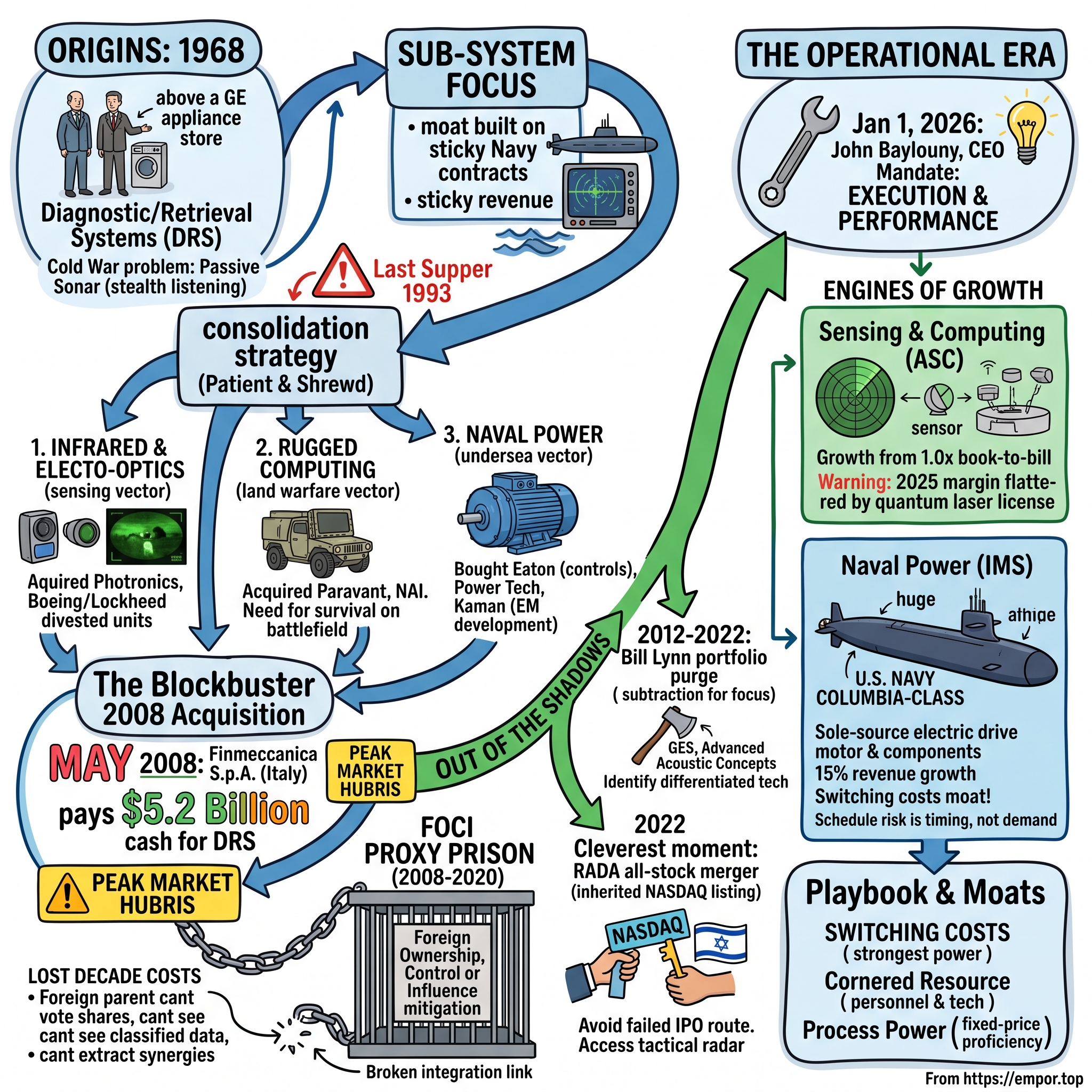
The spine of the story runs like this. It begins above a General Electric appliance store in Mount Vernon, New York, in 1968, with two engineers who figured out how to listen for Soviet submarines without making a sound. It moves through the post–Cold War consolidation that killed dozens of defense firms and made this one a serial acquirer. It arrives at May 2008, when Rome-based Finmeccanica S.p.A. paid $5.2 billion in cash for DRS Technologies — an enterprise value struck at what turned out to be almost the exact top of the defense M&A cycle, and closed into the teeth of the global financial crisis.
It then goes quiet for a decade, because the acquisition triggered the strictest foreign-ownership mitigation instrument the U.S. government has: a Proxy Agreement. It reawakens in 2012 with the arrival of William J. Lynn III, a former Deputy Secretary of Defense who spent a decade cutting the portfolio down to its load-bearing walls. It reaches its cleverest moment in 2022, when DRS merged with an Israeli tactical radar company and inherited its NASDAQ listing rather than doing an IPO — after a conventional IPO attempt had failed a year earlier. And it hands off on January 1, 2026, to John Baylouny, a thirty-five-year company engineer whose mandate is not dealmaking at all.
Several things widely believed about this company turn out to be wrong, and this article will say so where the filings contradict the consensus. Leonardo S.p.A. does not own 80.5% of DRS; it owns approximately 71%, and it has already sold down once. The 2025 margin compression in the naval segment was not primarily caused by submarine shipyard delays; the filings say the opposite. And the growth in the sensing segment's margins last year came almost entirely from a one-time licensing transaction that will not repeat. Each of those corrections matters to the investment case, and each is documented in primary sources.
 Subscribe on LinkedIn
II. Cold War Origins & Diagnostic/Retrieval Systems (1968–1990)
The founding scene has an appealing modesty to it. In the late 1960s, two engineers named David Gross and Leonard Newman set up shop above a General Electric appliance store in Mount Vernon, New York — a five-person company incorporated in Delaware in 1968, with operations beginning the following spring.56 They called it Diagnostic/Retrieval Systems, a name so generically technocratic that it tells you nothing, which was probably the point. Everyone eventually just used the acronym.
What Gross and Newman were actually working on was one of the defining technical problems of the Cold War at sea.
Here is the problem in plain terms. If you want to find a submarine, the obvious method is active sonar: send out a loud acoustic pulse — the "ping" of every submarine movie ever made — and listen for the echo. It works. It also announces your exact position to every vessel within range, including the one you are hunting. In a shooting war, pinging is roughly equivalent to walking through a dark house with a flashlight pointed at your own face.
The alternative is passive sonar: say nothing, and simply listen. A submarine is not silent. Its reactor coolant pumps hum, its propeller shaft turns, its machinery vibrates, and all of that radiates into the water as sound. The trouble is that the ocean is astonishingly noisy. Waves, marine life, shipping traffic, and thermal layers produce a wall of acoustic clutter. Somewhere inside that wall is the faint, rhythmic signature of a Soviet nuclear attack boat.
What Gross and Newman built was the machinery for pulling that signal out of that noise. Their passive sonar processing, in the company's own account of its history, "enabled the U.S. ships to use signal processing to distinguish the sound of submarine engines amid the clutter of ocean noises without having to 'ping' the target, which contributed to stealth."5 Hydrophones towed behind a ship or hull-mounted picked up raw acoustic energy; DRS equipment converted it into something a sonar operator could read on a display and act on. The milestone contract was the AN/SQR-17 passive sonar system for the U.S. Navy.5
This matters for understanding everything that came after, because it established the shape of the business. DRS did not build ships. It built the specific, difficult, mission-critical box that went inside somebody else's ship. Its customer was the U.S. Navy. Its competitive position rested not on scale or brand but on being the firm that had solved a narrow problem better than anyone else and had accumulated decades of program-specific know-how doing it.
That model threw off enough cash to fund growth for a decade. By 1979, DRS had outgrown Mount Vernon and moved its headquarters to Oakland, New Jersey, with annual revenue of $36 million and 400 employees.5 Two years later came the moment that converted a research boutique into a public contractor: in 1981, DRS listed on the American Stock Exchange, raising $33 million.5 It is a small detail worth getting right — this was AMEX, not NASDAQ, and the company would not move to the New York Stock Exchange until 2002.5 Leonard Newman, who had been a director since the founding, served as chairman from 1971 and as chief executive until May 1994 — a twenty-three-year run at the top of a company he built from a five-person shop.7
For investors, the lesson embedded in this era is genuinely durable, and it explains why DRS still exists when so many of its 1970s contemporaries do not. Sole-source or near-sole-source technical dominance on a critical defense program produces revenue that is extraordinarily sticky. Once the Navy has designed a combat system around your processing hardware, trained its sailors on your displays, and written its maintenance procedures against your equipment, switching is not a procurement decision — it is a program.
But the same concentration that produces the moat produces the vulnerability. A company that lives entirely inside U.S. Navy anti-submarine warfare is a company whose fortunes are perfectly correlated with one line item in one service's budget. That was a magnificent place to be from 1968 through 1989, when the entire strategic rationale of the American surface fleet was hunting Soviet boats.
And then, rather abruptly, there were no more Soviets.
III. Post-Cold War Survival & The Expansion Era (1990–2008)
In the autumn of 1993, a group of defense industry chief executives gathered for dinner at the Pentagon. The host was Secretary of Defense Les Aspin. Aspin opened with a line that has since become the most quoted sentence in modern defense industrial history: in about fifteen minutes, he told the room, you're going to find out what this is about — and you probably aren't going to like it.8
Deputy Secretary of Defense William Perry then delivered the message, illustrated with a graph. The defense budget was collapsing. The Pentagon could no longer sustain the number of contractors sitting at that table. Some of them would have to merge, and some of them would have to disappear. The evening entered industry lore as the "Last Supper," and over the following decade it did exactly what Perry said it would: dozens of independent primes collapsed into a handful of giants.8
DRS was not in the room. It was far too small — a company doing under $60 million in annual revenue against primes measured in the billions.7 But the Last Supper defined the terrain on which DRS would play for the next fifteen years, and the company read the terrain shrewdly.
The strategic insight was this: consolidation among the primes meant the primes were being forced to divest non-core divisions to satisfy antitrust regulators and to focus on platform integration. Lockheed Martin, Boeing, and Raytheon were becoming assemblers of enormous systems — aircraft, missiles, ships. The subsystem businesses inside them were suddenly available, often cheap, and often orphaned. If you were small, patient, and had cash, the wreckage of the Last Supper was a shopping list.
DRS went shopping. Across roughly a decade it executed something in the order of two dozen acquisitions, and the pattern in them is unmistakable: every one moved the company further from its dangerous dependence on Navy acoustics and deeper into technologies the Army and Air Force would need.
The first vector was electro-optics and infrared. DRS acquired Photronics, described in company history as a leader in electro-optics used in Army, Navy, and Air Force weapon fire-control and guidance systems.5 It later absorbed Boeing's uncooled thermal imaging business, Lockheed Martin's electro-mechanical systems unit, and Raytheon's ground electro-optical and focal plane array businesses — three divested crown jewels from three different primes.5
It is worth pausing on why infrared mattered so much, because it became one of the two pillars the modern company stands on. An infrared sensor does not detect light; it detects heat. Every object emits thermal radiation as a function of its temperature, which means an infrared imager sees a warm human body against cool ground, a running engine against a cold hillside, or a recently fired weapon against ambient terrain — in total darkness, through smoke, and through most weather. In the 1990s this was transitioning from exotic to essential. Night vision for dismounted soldiers, target acquisition for attack helicopters, missile-warning systems for aircraft: all of it ran on the ability to build focal plane arrays that could resolve small temperature differences at long range. This is genuinely hard physics and hard manufacturing, and there were never many companies that could do it.
The second vector was ruggedized computing. DRS acquired Paravant, NAI Technologies, and European Data Systems, which together made it a leader in rugged battlefield computers for the U.S. and British armies, and picked up General Atronics for command-and-control systems.5 The unglamorous truth of land warfare electronics is that the difficulty is not the computing — it is surviving. A display screen inside a Bradley Fighting Vehicle must work after being shaken at high frequency for years, in 130-degree desert heat and sub-zero cold, coated in dust, while the vehicle's main gun fires. Commercial hardware disintegrates. Building electronics that do not is a specialized discipline with specialized qualification standards, and it is a business protected less by patents than by the sheer cost of proving your box survives.
The third vector, quietly, was naval power. DRS bought the Navy Controls Division of Eaton, a supplier of naval electrical power distribution and control systems, along with Power Technology Inc. and the electromagnetic development center of Kaman Corporation.5 At the time this looked like a modest bolt-on. Two decades later it would turn out to be the single most consequential capability the company ever assembled.
The financial arc across this period is remarkable. Revenue was $57.8 million in fiscal 1994.7 The company renamed itself DRS Technologies in 1997 to reflect that it was no longer a sonar shop, and hit a $500 million annual sales target by 2002.5 Then it accelerated hard: revenue of $987 million in fiscal 2004, $1.31 billion in fiscal 2005, $1.74 billion in fiscal 2006.9
The step change came on January 31, 2006, when DRS completed the acquisition of Engineered Support Systems, Inc. for total consideration of $1.93 billion, plus the assumption of $78.5 million of ESSI debt — $43.00 per share, split between $30.10 in cash and a fraction of a DRS share valued at $12.90.9 ESSI brought military support equipment, sustainment, and logistics services. Revenue reached $2.82 billion in fiscal 2007 and $3.30 billion in fiscal 2008.9
By then, sales to the Department of Defense — directly and through prime contractors — generated $3.1 billion, or 93% of consolidated revenue.9 DRS had grown roughly fifty-seven-fold in fourteen years and had become the definitive mid-tier American defense electronics firm: too specialized to be commoditized, too diversified to be hostage to a single service, and profitable enough to be extremely attractive to anyone who wanted a foothold in the world's largest defense market.
Which, in the spring of 2008, someone in Rome did.
IV. The Blockbuster 2008 Acquisition: Peak Market Hubris
To understand what Finmeccanica S.p.A. was thinking in May 2008, you have to understand the problem that had frustrated every European defense company for thirty years.
The U.S. defense budget is not merely the largest in the world; it is larger than the next several combined. For a European contractor, it is the only market that truly matters for scale. And it is effectively closed. Not by tariffs, but by classification. The most valuable American defense work requires facility clearances, personnel clearances, and access to classified information — and the U.S. government has an entire regulatory apparatus dedicated to ensuring foreign entities cannot get at any of it. You cannot export your way in. You have to own your way in, and then accept the terms.
Finmeccanica, the Rome-based aerospace and defense group in which the Italian state held a controlling influence, decided to pay for the ticket.
On May 12, 2008, it announced it would acquire 100% of DRS Technologies for $81.00 per share in cash — a transaction valued at approximately $5.2 billion, or €3.4 billion, inclusive of roughly $1.2 billion in net debt following the conversion of DRS's convertible notes. The price represented a 27% premium to the closing share price on May 7, 2008, and a 32% premium to the thirty-day average on the NYSE.10 Chief executive Pier Francesco Guarguaglini framed it as consolidating Finmeccanica's international role and entering the U.S. market "as a key player."10
Here the outline's benchmarking requires an honest correction. It is widely asserted that Finmeccanica paid roughly 15x EBITDA against industry comparables of 10x–12x. That framing is directionally consistent with how the deal was received at the time, but the specific multiple is not disclosed in any of the primary transaction documents. The filings state the price per share, the enterprise value, and the premiums to market — nothing more. What can be said with confidence is that the premium was substantial, the timing was catastrophic, and the outcome was expensive. Those three facts are documented; the precise multiple is not, and it is better to say so than to manufacture precision.
The timing is where this becomes a genuine case study. Consider the calendar. DRS stockholders voted to adopt the merger agreement on September 25, 2008 — ten days after Lehman Brothers filed for bankruptcy.11 The Committee on Foreign Investment in the United States completed its review and permitted the merger to proceed on October 15, 2008, during the most violent weeks of the global financial crisis.12 The deal closed on October 22, 2008, with Finmeccanica confirming an enterprise value of $5.2 billion including approximately $1.6 billion of assumed indebtedness.13
So Finmeccanica agreed to pay a peak-cycle premium in a pre-crisis market and wrote the check into a post-crisis one. And the defense cycle turned almost immediately behind it. U.S. defense spending plateaued, then contracted, culminating in the Budget Control Act of 2011 and the sequestration mechanism that followed — a period of flat-to-declining procurement that lasted years.
The bill came due in 2012, and it is quantifiable. In its 2012 consolidated financial statements, Finmeccanica recorded a goodwill impairment of €1,148 million in its Defence and Security Electronics segment. Of that, €155 million related to Selex ES and approximately €993 million related mainly to DRS — driven, the company wrote, by "budget cuts in the main domestic markets and, with specific reference to DRS, also taking account of the further negative effects... arising from the rolling out of the sequestration process."14 That single write-down contributed to a Finmeccanica net loss of €786 million for the year.14
Roughly a billion euros of value, acknowledged as destroyed, four years after signing. Finmeccanica would rebrand itself Leonardo S.p.A. effective January 1, 2017, adopting the name of the Renaissance polymath.15 The rebrand did not change the arithmetic.
The analytical takeaway is not simply "they overpaid," which is the easy and slightly lazy conclusion. It is more specific: cross-border defense acquisitions carry a structural valuation trap. The strategic prize — access to the U.S. market — is real and cannot be obtained any other way, which means the buyer's willingness to pay is anchored to strategic necessity rather than to cash flow. Meanwhile the very regulations that make the asset valuable also prevent the buyer from extracting the synergies that would justify the premium. Finmeccanica bought a market-access option and then discovered the option came with a clause forbidding it from exercising most of the things it thought it was buying.
That clause has a name, and it is the subject of the next chapter.
V. The FOCI "Proxy Prison" & The Lost Decade (2008–2020)
Imagine you are a senior executive at Leonardo S.p.A. in Rome. Your company owns, on paper, the overwhelming majority of an American defense contractor. You cannot vote its shares. You cannot see its classified programs. There are facilities on its property list you cannot enter without escort and authorization. If you want to combine one of your European products with one of its American ones, you face a regulatory process. And an independent auditor reports annually on whether the wall between you and your own subsidiary is holding.
This is not a metaphor. It is the operative reality of a Proxy Agreement, and it governed DRS for the entire period following the acquisition.
The legal foundation is a concept called Foreign Ownership, Control or Influence — FOCI. Under the National Industrial Security Program Operating Manual, a company operates under FOCI whenever a foreign interest has the power, direct or indirect, to direct or decide matters affecting the company's management or operations in a manner that could result in unauthorized access to classified information.16 Once a cleared contractor falls under FOCI, it must mitigate that influence or lose its facility clearances — and for a company where the Department of Defense generates the overwhelming majority of revenue, losing facility clearances is not a setback but an extinction event.
The U.S. government offers a menu of mitigation instruments of escalating severity. The lighter ones permit the foreign parent to retain board representation with restrictions. The Proxy Agreement sits at the severe end: it strips the foreign owner of its voting rights entirely and vests them in cleared U.S. citizens.
Two facts explain why DRS drew the strict instrument rather than a lighter one. First, the nature of the work: submarine propulsion, intelligence sensing, electronic warfare. Second, and more decisively, the ownership chain does not stop at a private Italian company. As the filings disclose plainly, the Italian state beneficially owns approximately 30.2% of Leonardo S.p.A.'s voting power.1 DRS is therefore not merely foreign-owned; it is indirectly influenced by a foreign government, albeit an allied NATO one. That is the profile that draws the heaviest mitigation available.
The mechanics, as described in the current agreement, are precise. Shares owned by Leonardo US Holding, LLC and indirectly by Leonardo S.p.A. are voted through proxy holders who must be independent of any current or prior affiliation with Leonardo and must maintain adequate security clearances. Those proxy holders are appointed by US Holding in consultation with the parent — but the appointments are subject to approval by the Defense Counterintelligence and Security Agency, and the proxy holders must sit on the DRS board. The agreement requires a Government Security Committee composed of all proxy holders, requires the audit committee to appoint an independent auditor for an annual audit of the books and records, and requires the board to meet at least four times a year in addition to separate proxy holder meetings. Critically, it restricts the company's ability to share facilities and personnel with — or receive services from — Leonardo S.p.A. or its other subsidiaries.1
The proxy holders vote the parent's shares "in the same manner and to the same extent as if they were the absolute owners of such shares in their own right," with all actions requiring a majority vote and each proxy holder entitled to one vote. On certain matters they vote in their sole discretion without consulting the owner at all. They may declare or suspend dividends only after prior consultation with US Holding.1 Five proxy holders serve staggered three-year terms — as of the 2026 proxy statement, Dr. Louis R. Brothers, General George W. Casey, Jr., Reuben Jeffery III, Kenneth J. Krieg, and Frances F. Townsend.1 The company entered into an Amended and Restated Proxy Agreement in March 2025 with the parties and the U.S. Department of War.1
Note the counterparty's name. In the 2026 filings, the department is referred to as the Department of War, reflecting the renaming of what generations knew as the Department of Defense.1
Now the investor question: what did this structure actually cost?
The honest answer is that the cost was real but is harder to isolate than the popular narrative suggests. The clearest documented costs are operational and strategic rather than a measurable multiple discount, because for most of this period DRS had no public equity for the market to discount. What the filings do establish is that the company was legally constrained from sharing facilities and personnel with its parent — meaning the single most obvious source of value in a cross-border acquisition, integration, was substantially foreclosed.1 The parent could not deploy its balance sheet freely into the subsidiary without regulatory friction. The subsidiary could not casually adopt the parent's European product portfolio.
The result was corporate purgatory during precisely the wrong decade. Sequestration-era budgets meant the U.S. defense market was flat to down. A mid-tier contractor in that environment normally has two moves: consolidate aggressively while assets are cheap, or get acquired. DRS could do neither easily. It could not run an aggressive M&A program using its parent's capital without triggering review, and it could not be sold without unwinding a structure that had taken years to negotiate.
There is a counter-argument that deserves airing, because it is the more interesting one. The Proxy Agreement also protected DRS. It guaranteed the company operational independence under an independent board, subject only to limited enumerated consent rights of the majority stockholder covering material mergers, acquisitions, and the incurrence of debt.17 In practice, this meant that a subsidiary of a European conglomerate was run by Americans, for the American customer, without Rome's ability to impose group strategy on it. Many acquired subsidiaries would trade a lot for that.
The Proxy Agreement, in other words, was simultaneously a cage and a charter. What it lacked was anyone with the credibility to negotiate its boundaries in Washington — which is exactly the gap DRS filled in 2012.
VI. The Portfolio Purge: Navigating the DC Corridor under Bill Lynn (2012–2022)
On January 25, 2012, Finmeccanica announced that William J. Lynn III would become chairman and chief executive of DRS Technologies.18
It is difficult to overstate how unusual this hire was. Lynn had stepped down as the 30th U.S. Deputy Secretary of Defense less than a year earlier — the second-ranking civilian official in the entire American defense establishment, the person who runs the building day to day while the Secretary handles strategy and politics. Before that, under President Clinton, he had served four years as Under Secretary of Defense (Comptroller), the Pentagon's chief financial officer, and had directed Program Analysis and Evaluation, the internal shop that adjudicates which programs live and die. Between government tours, from 2002 to 2009, he was senior vice president of government operations and strategy at Raytheon.18
So DRS hired someone who had been the Pentagon's CFO, the Pentagon's chief analyst, the Pentagon's chief operating officer, and a major prime contractor's chief Washington strategist. As Deputy Secretary he had also been the public face of the Defense Department's cyber strategy, authoring a widely read 2010 essay in Foreign Affairs laying out the case for treating cyberspace as an operational domain of warfare.
The strategic logic was not primarily about winning contracts — that is a crude reading of what former officials are useful for, and in practice conflict-of-interest rules constrain it. The logic was that DRS's central problem was structural and regulatory. It needed someone who understood the FOCI apparatus from the inside, who could speak credibly to DCSA, who understood how the Pentagon's budget process would treat a foreign-owned supplier, and who could construct a path back to a normal corporate existence. Lynn was arguably the single best-qualified person alive for that specific job.
What he did with it took a decade, and the substance of it was subtraction.
The DRS that Lynn inherited was the product of the acquisition binge described earlier — a company that had bought two dozen businesses in pursuit of scale and diversification, and that consequently contained a great deal that was merely fine. Services businesses. Sustainment and logistics work inherited from Engineered Support Systems. Network integration. These generated revenue and were not unprofitable, but they carried structurally lower margins, competed on price rather than technology, and consumed management attention that the differentiated hardware businesses needed.
The purge culminated in 2022, and two transactions define it.
The larger was the sale of Global Enterprise Solutions. On March 21, 2022, DRS agreed to sell GES — a satellite communications and IT network integration business — to SES Government Solutions, a wholly owned subsidiary of Luxembourg-based SES S.A., for a selling price of $450 million subject to working capital adjustments. The transaction completed on August 1, 2022, producing cash proceeds of $427 million after adjustments and an aggregate pretax gain, net of transaction costs, of $309 million — $239 million after tax.17[^19]
That gain figure is the analytically interesting number, and it deserves unpacking. DRS disclosed that GES generated operating earnings of $13 million for the year ended December 31, 2022.17 A business producing modest operating earnings sold for $450 million and generated a pretax gain of $309 million, meaning the carrying value of the assets was a small fraction of what a strategic buyer would pay. SES wanted GES because it fit SES's own satellite services strategy — the buyer was purchasing a customer relationship and a government market position that was worth far more inside a satellite operator than inside a defense electronics company. This is textbook portfolio management: identifying an asset whose value to someone else materially exceeds its value to you, and acting on it.
The second transaction was the exit from Advanced Acoustic Concepts, LLC — a joint venture in which Thales Defense & Security was the minority partner. The DRS board approved the divestiture in February 2022; a definitive agreement followed on April 19, 2022, selling the DRS share of the equity investment to Thales for $56 million; the transaction completed on July 8, 2022, producing an aggregate pretax gain of $31 million, or $22 million net of taxes.17
There is a poignancy to this one that is easy to miss. Advanced Acoustic Concepts was undersea acoustics — the direct lineal descendant of what Gross and Newman started doing above the appliance store in Mount Vernon. DRS sold the business it was founded on. That is either admirable discipline or a warning about how far a company can drift from its origins, and reasonable investors can disagree. What is not debatable is that it was consistent: Lynn was not trimming; he was reshaping the company around a thesis.
The thesis was that DRS should own only businesses where it possessed genuine technical differentiation and where the customer could not easily substitute. Everything else — however profitable, however historically resonant — was capital that belonged somewhere else.
The proceeds mattered as much as the focus. Roughly half a billion dollars of after-tax cash arrived in 2022, and it arrived precisely when DRS needed a clean balance sheet, because Lynn was simultaneously trying to solve the harder problem: how to get the company back onto a public exchange.
He had already tried the conventional route once. It had not worked.
VII. The RADA Backdoor Public Merger: Returning to the Stage (2022)
On March 24, 2021, Leonardo S.p.A. issued a short and rather deflating press release. The initial public offering of DRS was postponed. The stated reason was blunt: "adverse market conditions did not allow an adequate valuation of DRS." The offering would be reconsidered, the company said, "when market conditions are more favorable and a successful IPO at an appropriate valuation for this strategic business can be achieved."19
The registration statement had been filed and was public.20 The roadshow had happened. And the price talk came back below what the seller was willing to accept.
It is worth being precise about why, because the failure is more instructive than the eventual success. The equity market in the first quarter of 2021 was not adverse in any general sense — it was, in fact, one of the more exuberant IPO windows in modern memory. What was adverse was the market's appetite for this specific asset: a defense electronics company whose parent would retain control, whose governance ran through a proxy board, and whose float would be a minority slice. Investors were being asked to buy a permanent minority position in a controlled company with an unusual regulatory overlay, in a sector then trading at unremarkable multiples. They demanded a discount. The seller declined to grant it.
That is the honest reading of March 2021: the market priced the FOCI structure and the controlled-company status, and the price was not one Rome wanted to accept.
Fifteen months later, DRS solved the problem by not asking the market the same question.
On June 21, 2022, Leonardo announced that Leonardo DRS would acquire 100% of the share capital of ראדא תעשיות אלקטרוניות RADA Electronic Industries Ltd. in an all-stock merger, with RADA shareholders receiving 19.5% equity ownership in Leonardo DRS and Leonardo maintaining 80.5%.21 RADA, based at 7 Giborei Israel Street in Netanya, Israel, was described as a leading provider of advanced software-defined military tactical radars serving critical infrastructure protection, border surveillance, active military protection, and counter-drone markets.2122
The transaction completed on November 28, 2022, with NASDAQ trading in the combined company effective November 29 and Tel Aviv Stock Exchange trading effective November 30. Each issued and outstanding RADA ordinary share was converted into one share of DRS common stock, and the combined entity had pro forma 2021 revenue of approximately $2.7 billion and adjusted EBITDA of approximately $305 million.23 The accounting purchase consideration recorded for RADA was $511 million.17
On valuation benchmarking, another correction is required. The outline cites a roughly $670 million valuation and a 12.0x EV/EBITDA multiple against a peer average of 13.5x. Those specific figures are not disclosed in the merger announcement, the closing filings, or the annual reports reviewed for this article. What the filings do state is the $511 million purchase consideration recorded for accounting purposes and the 19.5%/80.5% equity split.1723 Readers should treat the multiple comparison as unverified.
What was genuinely clever here was structural, and it deserves to be understood on its own terms rather than as a piece of financial engineering trivia.
An IPO is a sale of stock. It requires the market to agree on a price at a single moment, and it gives every prospective buyer a veto — they simply decline to participate, and the deal breaks. A reverse merger with an already-listed company is not a sale of stock. It is an exchange of stock. The listing does not have to be purchased from investors at a price they set; it comes attached to the target. DRS did not have to persuade the market to value the whole company. It only had to persuade RADA's shareholders that 19.5% of the combined entity was worth more than 100% of RADA.
That is a fundamentally easier argument, and RADA shareholders had good reason to accept it. They were exchanging a concentrated position in a single-product Israeli radar company — dependent on a handful of programs, exposed to Israeli political and security risk, thinly traded — for a liquid position in a $2.7 billion diversified American defense contractor that could sell RADA's radars into the U.S. Army through relationships RADA could never have built alone.
The strategic prize was equally real. RADA's core product was the Multi-Mission Hemispheric Radar, which carries the U.S. military designation AN/VPS-2. In plain language: a small, software-defined radar that watches the entire sky above a vehicle at once. Traditional radars mechanically rotate a dish, which means that for most of any given second the radar is pointed away from any particular threat. A software-defined active electronically scanned array steers its beam electronically, with no moving parts, and can effectively watch everywhere simultaneously — and because the behavior is defined in software, the same physical hardware can be re-tasked for new threats through code rather than through redesign.
That property turned out to be extraordinarily well-timed. The MHR had been selected in 2018 as part of the Leonardo DRS mission equipment package for the U.S. Army's Initial Maneuver Short-Range Air Defense program.24 In October 2020, General Dynamics Land Systems — the prime — received $1.2 billion for 144 anti-aircraft Strykers over five years, with DRS providing the radar and integrating the weapons package.[^26] A $204 million follow-on for additional mission equipment packages came in September 2021.25
Then drones changed warfare. The conflicts of the 2020s demonstrated that cheap unmanned aircraft, deployed in volume, could threaten armored formations that had been considered nearly invulnerable to anything short of dedicated air power. Suddenly every Western army needed exactly what RADA made: an affordable radar that could detect small, slow, low-flying objects and cue a weapon at them. DRS had bought that capability, for stock, roughly at the moment the market for it inflected.
A postscript on the listing: on September 27, 2023, DRS announced it was voluntarily delisting from the Tel Aviv Stock Exchange, taking effect roughly three months later. Lynn's explanation was that concentrating market activity on a single exchange served the company and its stockholders.26 The NASDAQ listing was unaffected. The Israeli exchange had been the vehicle for getting public; once public, its dual listing simply fragmented liquidity.
The backdoor had served its purpose. What lay behind it was a company that now had to justify itself on operating performance.
VIII. Segment Deep Dive: The Engines of Growth vs. The Moat
Leonardo DRS reports through two segments, and they are almost perfect opposites in character. One is a portfolio of relatively fast-moving sensing and computing products sold across many programs. The other is a small number of enormous, decades-long naval programs. Understanding the difference — and the very different ways each can disappoint — is most of what an investor needs.
Advanced Sensing and Computing: breadth, and a one-time number that flatters it
The Advanced Sensing and Computing segment generated $2.355 billion of revenue in fiscal 2025, up 11% year over year, representing roughly 65% of the company total. Segment adjusted EBITDA was $316 million, a margin of 13.4%, up 100 basis points from 12.4% the prior year.2
That margin improvement is the number most likely to mislead, and it is worth dismantling carefully.
In the fourth quarter of 2025, DRS entered a ten-year agreement to license its laser intellectual property for quantum applications to what it described only as "a leading quantum computing technology company." The agreement totaled $100 million and was recognized at a net present value of $73 million, booked into both fourth-quarter and full-year 2025 revenue and adjusted EBITDA, entirely within ASC.2 The counterparty's identity was not disclosed in the press release, the annual report, or on the earnings call.
Strip that $73 million out and the picture inverts. Excluding the license, ASC would have produced roughly $2.28 billion of revenue and approximately $243 million of segment adjusted EBITDA — a margin near 10.6%, meaningfully below the prior year's 12.4% rather than above it. The company's own commentary supports this reading: full-year ASC segment adjusted EBITDA growth, it stated, "was driven by higher volume and the quantum laser IP license agreement but was offset by increased investment in internal research and development and higher material input costs."2
This is not an accusation of impropriety. DRS disclosed the item clearly, quantified it precisely, and separated it in its own table of non-routine items. That is good disclosure. But an investor who reads "ASC margins expanded 100 basis points" without reading the footnote reaches the opposite conclusion from the one the underlying business supports.
The license itself is genuinely interesting. It traces to Daylight Solutions, acquired in 2017 for $150 million, a San Diego company specializing in quantum cascade lasers.27 A quantum cascade laser is a semiconductor laser engineered to emit in the mid-infrared, tunable across wavelengths — militarily valuable for infrared countermeasures that defeat heat-seeking missiles, and for detecting chemical signatures at distance. On the fourth-quarter call, John Baylouny explained the licensee "are using the quantum laser technology that we make for military use to excite the ions for quantum use," framing it as monetizing non-core applications while keeping DRS focused on "the military defense space." He noted it was the second such opportunity.28
That framing is credible and the economics are excellent — but it should be understood as what it is: high-margin optionality that recurs unpredictably, not a business line. Investors should not capitalize it.
Underneath the noise, the ASC growth drivers are real. Full-year bookings reflected demand for advanced infrared sensing, naval network computing, tactical radars, and airborne and intelligence sensing.2 The first quarter of 2026 gave a cleaner read: ASC revenue of $559 million, up 9%, with segment adjusted EBITDA of $62 million and margin of 11.1% — up 290 basis points year over year, attributed to improved program execution, favorable mix, and higher volume.3 That expansion, achieved without a licensing windfall, is the more meaningful evidence.
One caution on segment momentum: ASC bookings were $429 million in the first quarter of 2026 against $669 million a year earlier, a book-to-bill of 0.8x versus 1.3x.3 Quarterly bookings in defense are lumpy and a single soft quarter proves little. But ASC's full-year 2025 book-to-bill was 1.0x, down from 1.2x in 2024.2 Two consecutive periods of order intake merely matching or trailing revenue is worth watching in a segment whose entire investment case rests on structural growth.
Integrated Mission Systems: one program, and a very large moat
The Integrated Mission Systems segment produced $1.307 billion of revenue in fiscal 2025, up 15% — the faster-growing of the two — while segment adjusted EBITDA fell slightly to $137 million and margin contracted 160 basis points to 10.5%.2
The crown jewel here is the U.S. Navy's Columbia-class ballistic missile submarine, and the scale of the position is unusual for a mid-tier supplier. In January 2024, DRS announced contracts valued at over $3 billion when fully funded, running through shipset 12, covering the permanent magnet main propulsion electric motor, propulsion motor drives, switchgear, and propulsion controls, with manufacturing across Fitchburg, Massachusetts; Menomonee Falls, Wisconsin; Danbury, Connecticut; and High Ridge, Missouri.29 Trade reporting has described DRS as the sole producer of electric drive propulsion system components for the program.30
The technology deserves explanation because it is the reason the moat exists. Traditional nuclear submarines use mechanical drive: the reactor makes steam, the steam spins turbines, and the turbines connect through a reduction gearbox to the propeller shaft. Gears mesh. Meshing gears generate tonal noise at predictable frequencies — which is precisely what enemy passive sonar listens for, in a satisfying echo of what DRS was originally built to do.
Electric drive severs that mechanical chain. The turbines drive generators producing electricity; the electricity drives a large electric motor turning the shaft. There is no gearbox. The propulsion train becomes quieter, and — equally important for a modern warship — the ship's power becomes a shared pool that can be allocated between propulsion and other systems rather than being locked into a driveshaft.
Delivering that at submarine scale is brutally hard. The motor must produce many megawatts, fit inside a pressure hull, run for decades between overhauls, survive shock loading from underwater explosions, and be quieter than the gearbox it replaces. DRS delivered the first production main propulsion motor after factory acceptance testing in August 2022, shipping it to General Dynamics Electric Boat for the lead ship.31
To build capacity, DRS selected Berkeley County, South Carolina in February 2024 for a roughly $120 million investment: a 140,000-square-foot facility in Goose Creek, in the Charleston area, creating 58 jobs.32 In February 2025 the Navy committed $45 million through contracts with HII's Newport News Shipbuilding to fund a 40,000-square-foot expansion for steam turbine systems and generators.33 The facility opened in January 2026, with Baylouny framing it against the Department of War's stated need to strengthen the industrial base.34 The annual report discloses the South Carolina building sits on land leased for 25 years ending in 2050 — an unambiguous statement about intended duration.4
Now, the correction that matters most in this section.
The outline attributes the IMS margin decline to Columbia-class shipyard delays. The primary filings say close to the opposite. DRS disclosed that IMS segment adjusted EBITDA and margin declined in both the fourth quarter and the full year "caused by the headwind from the legacy foreign ground surveillance program conclusion," and that this non-routine item "overshadowed operational leverage from higher volume and improved program profitability of the Columbia Class program in both periods."2
The legacy item was a fourth-quarter memorandum of understanding concluding work on a decade-old foreign ground surveillance program, producing a $67 million negative impact to revenue and a $65 million headwind to adjusted EBITDA, all within IMS.2 Baylouny characterized it on the call as an unanticipated loss driven by technology evolution and obsolescence, called it "unusual and isolated," and said the company did "not see any other program with similar characteristics."28
So the correct reading of fiscal 2025 is nearly the mirror image of the outline's: Columbia-class execution improved and was a positive contributor; a single unrelated legacy foreign program consumed $65 million of segment EBITDA and drove the reported decline.
The first quarter of 2026 corroborated this decisively. IMS revenue was roughly flat at $295 million, but segment adjusted EBITDA rose to $43 million and margin expanded 90 basis points to 14.6%, driven by strong execution "led by Columbia Class."3 When JPMorgan's Alexander Ladd asked on the call whether Columbia represented an unlock, CFO Michael Dippold attributed the improvement to execution across the segment "with the largest contributor being Columbia Class."35 IMS bookings were $456 million against $322 million a year earlier — a book-to-bill of 1.5x.3
The two segments therefore present opposite risk profiles. ASC offers many programs, faster growth, real technology differentiation, and exposure to input costs and mix. IMS offers fewer programs, enormous switching costs, capital intensity, and concentration risk in a single Navy program whose schedule DRS does not control.
Managing that combination now falls to someone who has never run a public company.
IX. The Operational Era: John Baylouny Takes the Helm (2026–Present)
On October 29, 2025, Leonardo DRS announced its leadership transition. John Baylouny would become president and chief executive officer and join the board, effective January 1, 2026, succeeding William J. Lynn III, who was retiring after fourteen years.36
The outline's suggestion that Lynn moved to an executive chairman role is incorrect. He retired from both the chief executive and chairman positions. Frances Fragos Townsend — a director since 2009, chair of the compensation committee, and one of the five proxy holders — was elected board chair, also effective January 1, 2026.361 The separation of the chair and chief executive roles is a governance improvement worth noting, and one of the few cases where a controlled company's mandated structure produces a better outcome than it otherwise might: the proxy holder requirement guarantees an independent chair.
Baylouny is a different creature from his predecessor entirely, and the contrast is the point of this chapter.
He has spent more than thirty-five years at DRS. He served as chief operating officer from late 2018, and before that as chief technology officer and general manager of Land Systems and Advanced ISR. He holds a master's degree in electrical engineering from Stevens Institute of Technology and a bachelor's in electrical engineering from Fairleigh Dickinson University.36 He came up through the New Jersey engineering culture the company was built on and was present for essentially every transformation described in this article.
Lynn's value proposition was that he knew the Pentagon's decision-making machinery from the inside and could navigate a regulatory structure almost no one understood. Baylouny's is that he knows what is happening on the factory floor in Menomonee Falls.
Whether that is the right trade depends on what problem the company actually faces now, and the case that it is correct is reasonably strong. The portfolio has been reshaped. The listing exists. The proxy structure is stable under an amended agreement. What remains is execution against a record backlog: delivering multi-megawatt motors on schedule, ramping a new South Carolina facility, holding margins while material costs move, and converting a 1.2x book-to-bill into revenue. Those are engineering and operations problems, not Washington problems.
The early evidence is favorable but short. First-quarter 2026 revenue was $846 million, up 6%, with net earnings of $62 million, up 24%, and adjusted EBITDA of $105 million, up 28% — margin expansion of 210 basis points to 12.4%.3 Baylouny's own framing was that results "meaningfully outperformed expectations thanks to disciplined execution, program momentum and sustained demand."3 One quarter is one quarter, and a new chief executive inheriting favorable program timing should not be mistaken for a new chief executive creating it. But it is a better start than the alternative.
The continuity anchor is Michael Dippold, chief financial officer since January 1, 2017. He joined DRS in 2006, served as vice president and assistant controller and then senior vice president and corporate controller before taking the CFO role, and spent three years at KPMG working on defense clients including DRS. He holds an accounting degree from Penn State.
Here management credibility can be assessed on behavior rather than rhetoric, and the record is mixed in instructive ways.
At its 2024 Investor Day, DRS published a three-year framework covering 2024 through 2026: organic revenue growth of 4% to 7%, an adjusted EBITDA margin of approximately 14% by 2026, and conversion of adjusted net earnings to free cash flow of 80% to 90%. It also stated a target of deploying 75% to 100% of free cash flow toward value-enhancing M&A, with optimal net leverage of approximately 2x adjusted EBITDA.37
Measured against that framework, three observations follow.
First, revenue growth has run well ahead of the plan — 13% in fiscal 2025 against a 4%–7% organic target.2 That is a beat, though it flatters somewhat given the licensing item.
Second, the margin target looks close but not yet delivered. Fiscal 2025 adjusted EBITDA margin was 12.4%, flat year over year, and the raised 2026 guidance implies roughly 13.0% to 13.6% at the range.23 Reaching "approximately 14%" by the end of 2026 would require the upper end and then some. Management has not abandoned the target, but it has not yet earned it either.
Third — and this is the item a skeptical investor should press hardest — the free cash flow conversion target has quietly walked down. Investor Day said 80% to 90%. On the fourth-quarter 2025 call the 2026 figure was cited as 80%. On the first-quarter 2026 call, Dippold guided to approximately 75% of adjusted net earnings for the year.2835 That is a fifteen-point erosion from the top of the original range, communicated incrementally rather than announced. The underlying reason is not hidden — capital expenditures rose more than 60% in 2025 and are guided to approximately 5% of revenue in 2026, funding the South Carolina facility and tactical radar capacity.2835 Fiscal 2025 free cash flow was $227 million against net earnings of $278 million.2 Investing ahead of demand is defensible and probably correct. But an investor holding management to its own published framework should note that a target was lowered without being framed as a change.
On capital allocation, the record cuts both ways in an interesting manner. DRS said it would deploy 75% to 100% of free cash flow into M&A. It has executed no material acquisitions since the RADA merger. Baylouny's framing on the fourth-quarter call was that "our top priority has always been and will continue to be organic investments first," and that the company would "be kind of picky" about M&A.28
The charitable reading is discipline: defense assets have traded at elevated multiples through this cycle, and declining to buy at the top is exactly what the 2008 Finmeccanica story teaches. The skeptical reading is that a published capital deployment target went unmet for two years without a formal revision, and that the company ended 2025 with $647 million of cash and only $191 million drawn on its facility — moving to no outstanding borrowings and $328 million of cash by the end of the first quarter.23 Against a ~2x net leverage target, DRS operates at net cash. That is either prudence or under-optimized balance sheet capacity, and an activist would argue the latter.
The company has been returning capital modestly: $96 million of dividends in 2025 at $0.36 per share, plus $35 million of buybacks covering 893,292 shares.2 That is roughly 58% of free cash flow returned — meaningful, but not the profile of a company deploying its balance sheet aggressively.
X. Playbook: Business & Investing Lessons
Three transferable lessons emerge from this history, and each carries a limiting condition that matters as much as the lesson.
Lesson 1: Be the subsystem standard, not the prime.
DRS has never built an aircraft, a ship, or a tank, and has never tried. It builds the radar that goes on the Stryker, the motor that goes in the submarine, the infrared sensor that goes in the targeting pod. This is a deliberate position in the value chain, and it has three specific advantages.
It avoids competing with customers. General Dynamics Land Systems is the prime on the air defense Stryker; DRS supplies the radar into it.[^26] Electric Boat builds the submarine; DRS supplies the propulsion. A company trying to be a prime would be bidding against these firms. A subsystem supplier sells to all of them, which is why the phenomenon is properly called coopetition rather than competition.
It concentrates capital on differentiated technology rather than integration. Prime contracting is substantially a program management business — enormous fixed costs, thin margins on integration, and exposure to the total cost of platforms that can be cancelled outright.
And it produces platform-agnosticism, a word Baylouny used explicitly in describing 2025 results.2 If your radar can go on multiple vehicles, you are not betting on any one program surviving budget review.
The limiting condition: subsystem suppliers have less pricing power against a prime who is itself squeezed, and no direct relationship with the ultimate customer on some programs. When the prime slips schedule, you slip with it while controlling nothing.
Lesson 2: The governance prison has an exit door — but the door is narrower than it looks.
The DRS story is frequently told as a company escaping the FOCI structure. That is not what happened, and the distinction is important.
DRS did not escape. It is still under a Proxy Agreement, amended and restated as recently as March 2025.1 What it did was obtain a public listing and a market price despite the structure — using divestitures to clean the portfolio and a reverse merger to bypass the price-discovery problem that had sunk the 2021 IPO.
The genuine exit door exists and is written into the agreement: the Proxy Agreement terminates automatically if US Holding holds less than 50% of outstanding shares and DCSA determines FOCI mitigation is no longer necessary.1 That is a specific, disclosed threshold. Leonardo held approximately 71% as of the 2026 proxy statement.1 The gap between 71% and 50% is the distance between the current structure and a genuinely normal American public company — and, as the next section explores, that gap is simultaneously the largest opportunity and the largest overhang in the story.
Lesson 3: Align with the uncontested priorities of the defense budget.
Defense spending is often described as cyclical, which is true in aggregate and misleading in detail. Within any budget, some lines are contested and some are not. The sea-based leg of the nuclear triad is not contested; Columbia-class replaces the aging Ohio-class boats that carry a substantial share of deployed U.S. strategic warheads, and there is no serious constituency for letting that capability lapse. Counter-drone air defense is not contested either, for the blunt reason that recent conflicts demonstrated what happens to formations that lack it.
DRS's revenue concentrates in exactly these areas. Its 2025 revenue split across the U.S. government ran 36% Navy, 36% Army, 3% Air Force, and 5% other agencies, with 20% from foreign governments and commercial sales.4 Roughly 80% of total revenue came from U.S. government contracts directly or as a subcontractor.4
The limiting condition is that "politically insulated" describes program survival, not program timing or funding rate. A program can be universally supported and still be slowed by appropriations delays, industrial base constraints, or shipyard capacity. Insulation protects against cancellation. It does not protect against schedule.
XI. Moats & Strategic Position: Hamilton Helmer's 7 Powers
Strip away the narrative and ask the war-game question: if a well-capitalized competitor set out tomorrow to take DRS's most valuable positions, what exactly would stop them?
Switching costs — the strongest power in the portfolio. Helmer defines switching costs as the value loss a customer incurs by moving to an alternative. In naval propulsion, that loss is close to prohibitive. The Columbia-class electric drive system is not a component bolted into a finished hull; it is a design premise. Hull arrangement, electrical architecture, cooling, shock isolation, and acoustic signature modeling were all engineered around specific motor characteristics. Replacing the supplier means requalifying hardware to nuclear-submarine standards, revalidating acoustic performance, and re-running shock qualification — a process measured in years on a program already managing schedule pressure. The cost is not the price of the motor. It is the delay to the nuclear deterrent.
The same logic holds, in weaker form, in tactical radar. Once the mission equipment package for an air defense Stryker is integrated, qualified, and fielded as the SGT Stout, swapping the radar means requalifying the whole kill chain.[^26]25 Strong, but not Columbia-strong: vehicles are cheaper to modify than submarines, and the Army buys in annual increments.
Scale economies — real but narrower than claimed. The outline positions the South Carolina facility as a scale barrier. That is partly right and worth qualifying. A $120 million purpose-built facility is a meaningful capital barrier, but $120 million is not prohibitive for RTX, BAE Systems, or General Electric.32 The real barrier is not the building — it is that the building is useless without decades of accumulated design knowledge, existing qualification, and an incumbent position on the only program that needs it at this scale. The capital is the visible part of a barrier that is mostly intangible.
Note also the co-investment structure: the Navy committed $45 million through Newport News toward the expansion.33 When a customer funds your capacity, it has revealed both that it wants the capacity and that it does not have an easy alternative. That is stronger evidence of competitive position than the facility itself.
Cornered resource — moderate, and partly time-limited. The tactical radar software and the quantum cascade laser intellectual property qualify.27 But software-defined radar is an active field with many well-funded participants, and the technology is not a permanent lock. The stronger cornered resource is arguably the workforce: approximately 7,300 employees as of December 31, 2025, many holding security clearances that take months to years to obtain.4 A cleared engineer with submarine propulsion experience is a genuinely scarce resource, and one that competitors cannot simply hire around quickly.
Process power — the underrated one. Helmer's process power describes embedded organizational know-how that competitors cannot replicate quickly even with full information. DRS's ability to execute fixed-price production contracts profitably is exactly this. Firm-fixed-price contracts generated $3.205 billion of the company's $3.648 billion of 2025 revenue — approximately 88%.4 Under those contracts the company bears cost overruns entirely.4 Doing that profitably, at scale, across dozens of programs, is a manufacturing and estimating discipline built over decades.
The powers DRS conspicuously lacks are network economies, branding, and counter-positioning. There is no network effect in submarine motors, no brand premium when the customer is a government contracting officer running a competition, and nothing about the business model that incumbents cannot copy. This is a moat built on switching costs and process, not on structural economics.
Porter's Five Forces, applied concretely:
Threat of new entrants: very low. The barriers compound. A new entrant needs facility clearances, cleared personnel, qualified production processes, past performance history that contracting officers weigh explicitly, and the capital to fund development before revenue. The company's own filings note it holds positions "for which we are the incumbent supplier or have been the sole or dual supplier for many years."4
Bargaining power of buyers: high, and structurally so. The Department of War is a monopsony. It sets the terms, audits the costs, can unilaterally use or license patented technologies subject to reasonable compensation, and can terminate contracts for convenience.4 The mitigating factors are sole-source positions on priority programs and the fact that no single contract represented more than 10% of 2025 revenue.4 That last figure genuinely matters: it means no single contract loss is existential, even as the customer is singular.
Threat of substitutes: low. There is no commercial substitute for a submarine propulsion motor. The substitution risk is doctrinal rather than technological — if the Army decided directed-energy weapons or a different sensing architecture were the answer to drones, radar demand could shift. That is a real long-horizon risk, though DRS's laser portfolio provides partial hedging.
Competitive rivalry: high but segmented. DRS states it competes with divisions of large primes, mid-tier and smaller defense companies, and certain non-traditional entrants, and acknowledges that several competitors are substantially larger and can devote greater resources to research and development.4 That last admission deserves weight. DRS spent $129 million on company-funded independent research and development in 2025, up sharply from $92 million in 2024 and $82 million in 2023.4 That is a serious 40% increase and explains part of the flat margin — but it is a rounding error against what RTX or Lockheed Martin can spend. DRS cannot win by out-investing. It wins by picking niches the giants find too small and defending them with incumbency.
The "non-traditional companies" reference points at the more interesting long-term threat: venture-backed defense technology firms operating on software timelines and commercial cost structures, competing precisely in autonomy, sensing, and counter-drone. They lack DRS's qualification history and clearances. They also lack its legacy cost structure.
XII. Current Risk Radar & Skeptical-Investor Stress Test
Risk 1: The germanium squeeze
On July 3, 2023, China's Ministry of Commerce announced export controls on gallium and germanium, effective August 1, 2023.38 Antimony controls followed, announced in August 2024 and effective September 15, 2024.39 Then on December 3, 2024, China went further, stating that in principle the export of gallium, germanium, antimony, and superhard materials to the United States was not permitted.40
Germanium is not a household element, but for this company it is close to load-bearing. According to the U.S. Geological Survey, the major U.S. end uses of germanium are fiber optics, infrared optics, semiconductor and solar applications, and radiation detectors.41 Germanium is the standard material for lenses and windows in thermal imaging systems, because it is transparent in the infrared band the way glass is transparent to visible light. Ordinary glass blocks infrared entirely. If you are building a thermal sight, you need germanium optics — or something exotic.
The supply position is uncomfortable. The USGS put U.S. net import reliance above 50%, with germanium metal imports from 2020 to 2023 sourced 51% from China, 27% from Belgium, 15% from Germany, and 5% from Russia, and noted China remained the leading global producer and exporter in 2024. Prices rose from $1,550 to $2,950 per kilogram between January and September 2024.41 A near-doubling in the input cost of a material with no ready substitute, controlled by a strategic competitor.
DRS named the exposure explicitly. The 2025 annual report stated the company had "experienced delays attributable to supply shortages, including but not limited to germanium," and — more pointedly — that increased cost at completion included "the impact of cost increases tied to germanium used in our optics and infrared programs that increased our cost of revenues for the period within our ASC segment."4 The fourth-quarter release attributed margin contraction partly to "increased material input costs."2
Here another outline claim requires correction. The assertion that DRS qualified "germanium-free" alternatives such as chalcogenide glass does not appear in any DRS filing or call reviewed for this article. Chalcogenide glass is a documented substitute for germanium in infrared applications — but that documentation comes from the USGS, not from DRS.41 Attributing it to the company would be unsupported.
What DRS actually described is different and, arguably, more credible because it is mundane. On the fourth-quarter 2025 call, Dippold said constraints were "contained," citing recycling initiatives, strategic allocations from customers, securing more reliable North American and European sources, long-term supply agreements, co-investment in dedicated refining capacity, rolling repricing, and contractual protections against future shocks.28 Earlier, in the third quarter of 2025, Lynn had said the company was "making steady progress on strengthening Germanium supply."42
The evidence suggests this worked. On the first-quarter 2026 call, asked directly about availability, Dippold said the company "certainly have had a better result on the margin side because of the raw material costing, especially germanium," and ASC's 290 basis point margin expansion reflected "favorable raw material costs including germanium" alongside radar mix.35 External conditions eased too: China suspended its export prohibition on the relevant materials to the United States on November 9, 2025, running until November 27, 2026.43
The investor conclusion is genuinely two-sided. Management identified a supply risk, described a specific mitigation plan, and the subsequent numbers moved in the direction the plan predicted — a point in favor of credibility. But the improvement coincided with a Chinese policy suspension that DRS did not cause and cannot control, and that suspension has a stated expiry inside 2026. Distinguishing management's mitigation from geopolitical luck is not currently possible from public data, and investors should be honest that the test has not yet been run under renewed restriction.
Risk 2: Columbia-class schedule
The outline states that labor shortages at General Dynamics Electric Boat produced a 17-month delay on the lead boat. The delay is real; the attribution needs correcting.
Per the Congressional Research Service, the Navy announced an estimated 12- to 16-month delay in delivery of the first Columbia-class boat on April 2, 2024, following a shipbuilding review. The 17-month figure came from the Navy's own FY2026 budget submission, not from Electric Boat.44 The causes were distributed across the industrial base rather than concentrated at one yard: Secretary of the Navy Carlos Del Toro identified late delivery of the turbine generator by subcontractor Northrop Grumman as among the most significant challenges, while the bow dome from HII's Newport News slipped from May 2025 to June 2026.44 The Navy declared a schedule breach for SSBN 826 in November 2024.44
The GAO documented the structural cause: a lack of workers trained in trades like welding and metal fabrication, limited workforce and industrial capacity at component suppliers, and a qualification process that can take years for new suppliers to complete.4544
But the most recent data point cuts the other way. In February 2026, the program executive officer for Strategic Submarines said an acceleration plan had pulled first delivery back to 2028 — nine months ahead of the revised schedule — with the boat approximately 65% complete.46 That followed the delivery of the bow section to Electric Boat in November 2025.47
For DRS specifically, the mechanism to understand is that schedule risk on this program is primarily a timing risk rather than a demand risk. The boats will be built; the Navy has no alternative for the sea-based deterrent. Delays push revenue recognition right and can create inefficiency as production plans are resequenced. They do not remove the revenue. And as established, Columbia has recently been a positive contributor to DRS margins rather than a drag.
The bear case
The parent overhang — larger than the outline states, and already demonstrated.
The outline says Leonardo retains 80.5%. That was true on the day the RADA merger closed. It has not been true since November 2023, when Leonardo US Holding sold 18,000,000 shares at $17.75 in a secondary offering, with underwriters fully exercising an option for 2,700,000 more — 20,700,000 shares total, taking Leonardo to approximately 72.3%.4849 The FY2025 annual report and the 2026 proxy statement put current ownership at approximately 71%, or 189,745,073 shares.41
This changes the risk from hypothetical to demonstrated. Leonardo has shown it is a willing seller when it wants capital, and it executed that sale at $17.75 per share. A skeptical investor should assume further sell-downs are a question of when, not whether — particularly given European rearmament and Leonardo's own capital needs.
The two-sided nature is what makes this the most interesting item in the story. Every share Leonardo sells increases DRS's public float and liquidity, broadens the shareholder base, and moves toward the disclosed 50% threshold at which the Proxy Agreement can terminate.1 The overhang and the catalyst are the same event. A large secondary would pressure the stock in the short term and structurally improve the company over the long term.
The specific unknowable is pace. Leonardo has not published a schedule for reducing its stake, and the ownership question was not discussed on either the fourth-quarter 2025 or first-quarter 2026 earnings calls.2835 The absence of a stated policy on the largest single governance variable is a legitimate disclosure criticism.
Fixed-price risk — substantially larger than the outline suggests.
The outline describes "a portion" of the backlog as fixed-price development work. The reality is more concentrated: approximately 88% of 2025 revenue came from firm-fixed-price contracts, against $443 million from flexibly priced cost-type and time-and-materials work.4 Under fixed-price terms DRS keeps cost savings and bears cost overruns; where fixed-price-incentive-fee terms apply, overruns are shared up to a ceiling above which DRS bears everything.4
This is the single most important structural fact about the company's earnings quality, and it explains the germanium episode entirely. When an input cost doubles on a fixed-price contract, there is no automatic pass-through. The margin absorbs it. Management's mitigation — rolling repricing and contractual protections — is a direct response, but those protections apply to future contracts, not to backlog already priced.28
An investor should hold two thoughts simultaneously. Fixed-price predominance is evidence of confidence and of production maturity — it means DRS is largely manufacturing known things rather than developing unknown ones, which is generally the safer position. But it converts every unhedged input cost shock and every execution stumble directly into earnings, with no contractual cushion. In an inflationary or supply-constrained environment, this is the mechanism through which bad news arrives.
Two further items a skeptic would raise. The company conducts significant business and manufacturing activities in Israel and holds a building on land leased from the Israeli Land Authority through 2034; the annual report explicitly flags war and armed hostilities in the region as a risk to personnel, property, and operations.4 The tactical radar business that drove the growth narrative sits substantially in a conflict zone. And the 2025 results contained two separate non-routine items in a single quarter — one favorable, one unfavorable, netting to a modest $6 million revenue benefit and $8 million EBITDA benefit.2 The disclosure was clean, but a company that surfaces a $65 million legacy program loss and a $73 million licensing gain in the same period is a company where headline segment metrics require reading the footnotes before drawing conclusions.
The KPIs that matter
Three metrics carry most of the signal for this business, and none of them is revenue growth.
Book-to-bill ratio. In a business where revenue is recognized over multi-year programs, orders lead revenue by years. DRS delivered four consecutive years at 1.2x or better through 2025.2 Sustained readings below 1.0x would signal the growth story is ending long before revenue reflects it.
Segment adjusted EBITDA margin, adjusted for non-routine items. Given fixed-price concentration, margin is the direct readout on execution and input costs. The critical discipline is to strip the one-time items, because as 2025 demonstrated, headline segment margins moved in the opposite direction from the underlying business in both segments.
Free cash flow conversion of adjusted net earnings. This is where capital intensity, working capital discipline, and the capacity build all surface. Management's own target has moved from 80%–90% at Investor Day to approximately 75% for 2026.3735 Whether it stabilizes there or continues drifting is the cleanest available test of whether the current investment cycle is a discrete build-out or a permanent step up in capital intensity.
XIII. Epilogue: The Outlines of Tomorrow's Battlefield
In May 2026, four months into Baylouny's tenure, Leonardo DRS raised its full-year outlook. Revenue guidance moved to $3.90–$3.975 billion from $3.85–$3.95 billion; adjusted EBITDA to $515–$530 million from $505–$525 million; adjusted diluted earnings per share to $1.26–$1.30 from $1.20–$1.26.3 At the midpoint, the implied adjusted EBITDA margin sits around 13.2% — up from 12.4% in 2025, and closing on but not yet reaching the approximately 14% the company told investors it would achieve by the end of 2026.237
A raise in the first quarter is a modest positive signal. It is also the easiest quarter in which to raise, and the guidance increase roughly matches the first-quarter beat rather than implying acceleration through the year. Investors should read it as confirmation that the year started well, not as evidence of a step change.
Three things are worth watching from here, and each is falsifiable.
Whether the growth in sensing is real without the one-timers. The 2025 ASC margin expansion was manufactured by a licensing agreement, and the underlying margin declined. The first quarter of 2026 showed genuine expansion without such help.23 Two or three more quarters of clean margin improvement in ASC would establish that the radar and infrared mix shift is structurally accretive. A reversion toward 2025's underlying levels would suggest the segment's economics are more input-cost-driven than technology-driven.
Whether the South Carolina facility ramps profitably. A new plant is a margin drag before it is a margin contributor — fixed costs arrive before volume does. Charleston-area operations opened in January 2026 into a program that is simultaneously being accelerated.3446 Ramping a first-of-kind assembly and test operation while the customer pulls schedule left is precisely the situation in which fixed-price contracts punish execution errors. Success here would validate the capital intensity that has been suppressing free cash flow conversion. Difficulty would call the entire capacity thesis into question.
Whether Leonardo sells, and how the market absorbs it. This is the largest single variable and the least predictable, because it depends on decisions made in Rome for reasons that have nothing to do with DRS. Each sell-down is dilutive to the stock in the moment and accretive to the structure over time, and the destination — the 50% threshold at which the Proxy Agreement can dissolve — remains twenty-one percentage points away.1
The larger question this story poses is whether the assets DRS spent fifty-eight years accumulating are the right assets for the conflicts that are actually coming.
The evidence is reasonably encouraging on that point, though not conclusive. The two capabilities the company has bet on — detecting and defeating cheap aerial threats, and quietly propelling submarines — sit at opposite ends of the modern threat spectrum, and both have been validated by events rather than by forecasts. The drone did more to prove the radar thesis than any market study could. The persistence of great-power nuclear competition did the same for the propulsion thesis.
What remains unproven is whether a mid-tier supplier spending $129 million a year on internal research can keep pace against primes spending multiples of that and against venture-funded entrants unencumbered by legacy cost structures.4 DRS's answer, implicitly, is that it does not need to keep pace everywhere — only in the narrow niches where it is already the incumbent and where switching costs make incumbency worth something.
That is a coherent strategy. It is also, precisely, the strategy that has worked since two engineers above a Mount Vernon appliance store figured out how to hear a submarine without making a sound. The company has changed owners, continents of ownership, exchanges, and chief executives. The underlying proposition — be indispensable in a place too small for giants to bother with and too hard for newcomers to enter — has not changed at all.
Whether it survives contact with the next decade is the open question, and the filings will answer it long before the narrative does.
References
-
Leonardo DRS, Inc. Definitive Proxy Statement (DEF 14A) — SEC EDGAR, 2026-04-03 ↩↩↩↩↩↩↩↩↩↩↩↩↩↩↩
-
Leonardo DRS Announces Financial Results for Fourth Quarter and Full Year 2025 (Form 8-K, Exhibit 99.1) — SEC EDGAR, 2026-02-24 ↩↩↩↩↩↩↩↩↩↩↩↩↩↩↩↩↩↩↩↩
-
Leonardo DRS Announces Financial Results for First Quarter 2026 (Form 8-K, Exhibit 99.1) — SEC EDGAR, 2026-05-05 ↩↩↩↩↩↩↩↩↩↩↩
-
Leonardo DRS, Inc. Annual Report on Form 10-K for fiscal year 2025 — SEC EDGAR, 2026-02-27 ↩↩↩↩↩↩↩↩↩↩↩↩↩↩↩↩↩↩
-
Fifty Years of Innovation Excellence — Leonardo DRS company history brochure ↩↩↩↩↩↩↩↩↩↩↩
-
DRS Technologies, Inc. Annual Report on Form 10-K, fiscal year ended March 31, 2008 — SEC EDGAR, 2008-05-30 ↩
-
Diagnostic/Retrieval Systems, Inc. Annual Report on Form 10-K, fiscal year ended March 31, 1995 — SEC EDGAR, 1995 ↩↩↩
-
"The Last Supper": How a 1993 Pentagon dinner reshaped the defense industry — WBUR On Point, 2023-03-01 ↩↩
-
DRS Technologies, Inc. Form 10-K — Selected Financial Data and Engineered Support Systems acquisition — SEC EDGAR, 2008-05-30 ↩↩↩↩
-
Finmeccanica to Acquire DRS for US$5.2 billion (€3.4 billion) (Form 8-K, Exhibit 99.1) — SEC EDGAR, 2008-05-12 ↩↩
-
DRS Technologies Stockholders Approve Merger with Finmeccanica (Form 8-K, Exhibit 99.1) — SEC EDGAR, 2008-09-25 ↩
-
CFIUS Completes Review of Finmeccanica–DRS Merger (Form 8-K, Exhibit 99.1) — SEC EDGAR, 2008-10-15 ↩
-
Finmeccanica Completes Acquisition of DRS Technologies for 5.2 billion U.S. dollars (Form 8-K, Exhibit 99.1) — SEC EDGAR, 2008-10-22 ↩
-
Finmeccanica 2012 Consolidated Financial Statements and Report on Operations — Finmeccanica S.p.A., 2013 ↩↩
-
Leonardo Completing Name Change on New Year's Day — Defense News, 2016-12-30 ↩
-
Leonardo DRS, Inc. Annual Report on Form 10-K for fiscal year 2024 — FOCI and NISPOM discussion — SEC EDGAR, 2025-03-03 ↩
-
Leonardo DRS, Inc. Form 10-K for fiscal year 2024 — divestitures, proxy agreement and RADA purchase consideration — SEC EDGAR, 2025-03-03 ↩↩↩↩↩↩
-
DRS Technologies Appoints William J. Lynn Chairman and Chief Executive Officer — Finmeccanica/Leonardo, 2012-01-25 ↩↩
-
Leonardo Announces Postponement of the DRS Initial Public Offering — Leonardo S.p.A., 2021-03-24 ↩
-
Leonardo DRS, Inc. Registration Statement on Form S-1 — SEC EDGAR, 2021 ↩
-
Leonardo DRS and RADA Agree to an All-Stock Merger — Leonardo S.p.A., 2022-06-21 ↩↩
-
Leonardo DRS / RADA Electronic Industries Registration Statement on Form S-4/A — SEC EDGAR, 2022-09-02 ↩
-
Leonardo DRS Completes Merger with RADA Electronic Industries (Form 8-K12B, Exhibit 99.1) — SEC EDGAR, 2022-11-28 ↩↩
-
RADA to Deliver MHR Radar for US Army's IM-SHORAD Programme — Army Technology, 2018-07-03 ↩
-
Leonardo DRS to Supply Mission Equipment Packages for M-SHORAD Increment 1 — Army Technology, 2021 ↩↩
-
Leonardo DRS Announces Voluntary Delisting from the Tel Aviv Stock Exchange (Form 8-K, Exhibit 99.1) — SEC EDGAR, 2023-09-27 ↩
-
Daylight Solutions Acquired by Leonardo DRS for $150 Million — Laser Focus World, 2017-03-10 ↩↩
-
Leonardo DRS (DRS) Q4 2025 Earnings Call Transcript — The Motley Fool, 2026-02-24 ↩↩↩↩↩↩↩↩
-
Leonardo DRS Awarded Contracts for U.S. Navy Columbia-Class Submarine Program — Leonardo DRS, 2024-01-10 ↩
-
Leonardo DRS to Open $120 Million Facility for Columbia Component Assembly — Inside Defense, 2026-01-22 ↩
-
Leonardo DRS Delivers Electric Propulsion Equipment for 1st Columbia Submarine — Naval News, 2022-08-31 ↩
-
Leonardo DRS Selects Berkeley County to Establish Company's First South Carolina Operation — Office of Governor Henry McMaster, 2024-02-27 ↩↩
-
Leonardo DRS Receives $45M Navy Investment Commitment to Bolster U.S. Submarine Industrial Base — Leonardo DRS, 2025-02-24 ↩↩
-
Leonardo DRS Opens 140,000-Square-Foot Naval Power and Propulsion Facility in South Carolina — Defence Industry Europe, 2026-01-23 ↩↩
-
Leonardo DRS (DRS) Q1 2026 Earnings Call Transcript — The Motley Fool, 2026-05-05 ↩↩↩↩↩↩
-
Leonardo DRS Announces Board and CEO Transition — Leonardo DRS, 2025-10-29 ↩↩↩
-
Leonardo DRS 2024 Investor Day Press Release (Form 8-K exhibit) — SEC EDGAR, 2024 ↩↩↩
-
China Imposes New Export Controls on Two Minerals Critical to the Manufacture of Semiconductors — Mayer Brown, 2023-07 ↩
-
China's Antimony Export Restrictions: Impact on US National Security — Center for Strategic and International Studies, 2024 ↩
-
China Rare Earth and Critical Mineral Export Ban — Center for Security and Emerging Technology, Georgetown University, 2024-12 ↩
-
Mineral Commodity Summaries 2025: Germanium — U.S. Geological Survey, 2025-01 ↩↩↩
-
Leonardo DRS Announces Financial Results for Third Quarter 2025 (Form 8-K, Exhibit 99.1) — SEC EDGAR, 2025 ↩
-
China Suspends Export Prohibition on Superhard Materials to US — Fastmarkets, 2025-11 ↩
-
Navy Columbia (SSBN-826) Class Ballistic Missile Submarine Program: Background and Issues for Congress (R41129) — Congressional Research Service, 2025-12-04 ↩↩↩↩
-
Columbia Class Submarine: Program Lacks Essential Schedule Insight amid Continuing Construction Challenges (GAO-24-107732) — U.S. Government Accountability Office, 2024-09-30 ↩
-
Acceleration Plan Pulls First Columbia Sub Delivery Back to 2028, 65% Complete — ExchangeMonitor, 2026-02-20 ↩↩
-
Major Milestone for US Navy's Future Nuclear-Armed Submarine — Newsweek, 2025-11-24 ↩
-
Leonardo DRS, Inc. Prospectus Supplement (Form 424B7) — Secondary Offering of 18,000,000 Shares — SEC EDGAR, 2023-11-16 ↩
-
Leonardo Announces Completion of Secondary Offering of a Minority Stake — Leonardo S.p.A., 2023-11-22 ↩
 LinkedIn
 WhatsApp
 Reddit
 Hacker News
 Email
Email Kindle
 RSS Feed
 Spotify
 Apple Podcasts
 Amazon Music
 Audible
 YouTube