Dole plc: The Race to Get the Fruit to Market
The $48 Million Gain in a Business Built on Bananas
Picture a container terminal on the Pacific coast of Ecuador. For decades, a terminal like this one has been where a banana's commercial life begins. Fruit cut green in the plantations of the coastal lowlands arrives by truck in cardboard boxes, is checked, stacked into refrigerated containers, and loaded onto ships bound for North America and Europe. For a fruit company, a port is not a trophy asset. It is a choke point it would rather control than rent.
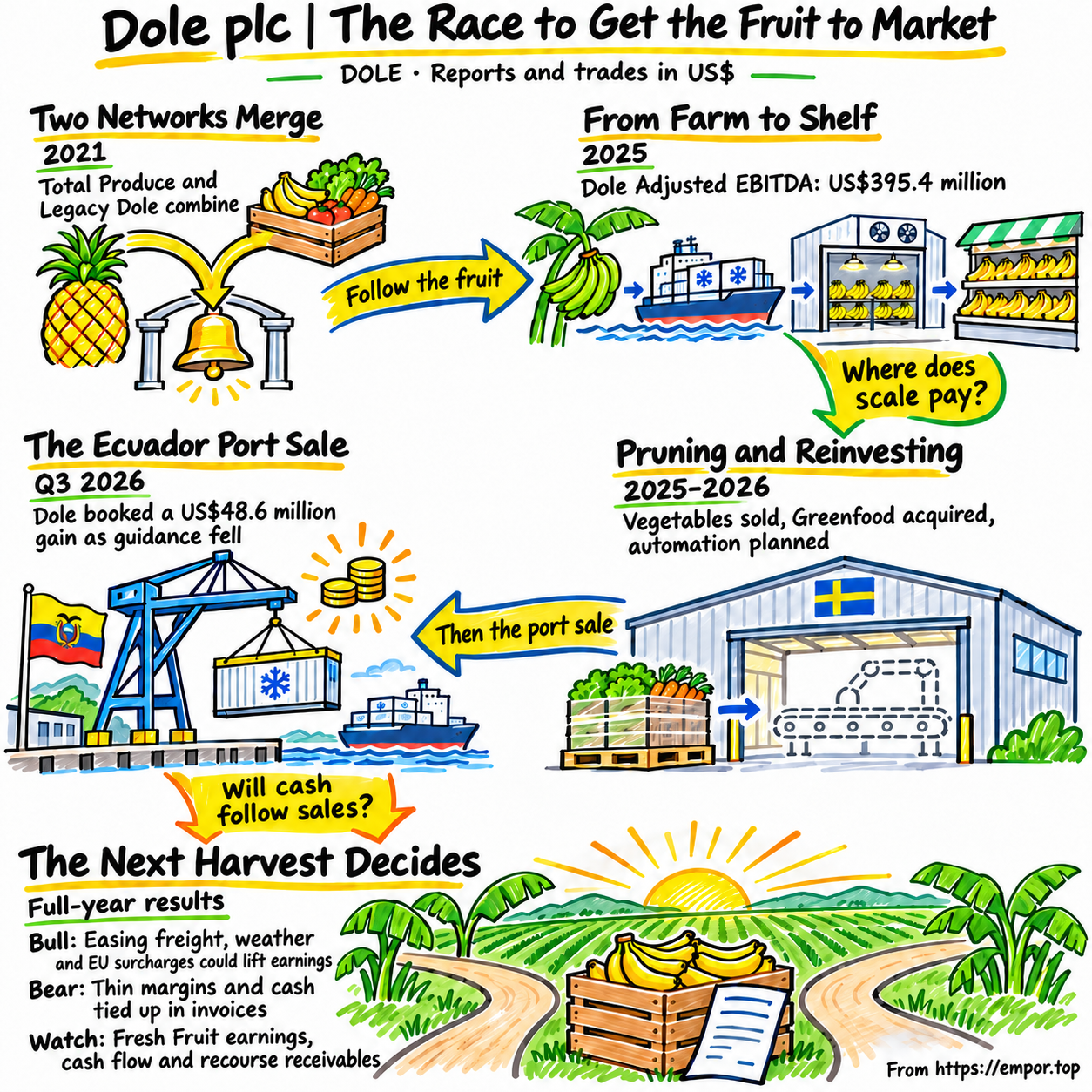
In the third quarter of 2026, Dole plc sold its Ecuador port, and the sale did something that ordinary banana trading rarely does in a single quarter: it delivered a lump of profit all at once. The disposal added a $48.6 million gain, and Dole's reported net income rose as a result.1 In the same results release, management lowered its full-year outlook. Before the quarter, Dole had been guiding to Adjusted EBITDA of about $400 million for 2026; after it, the target became $380 million to $390 million.1
That combination is the paradox at the centre of this story. A company sells a piece of its network, books a gain, reports better earnings, and in the same breath tells investors that the business it actually runs will earn less than it expected. Headlines can be written either way. One version says Dole had a good quarter. The other says the core engine is sputtering and an asset sale papered over it. Neither is quite right, and the gap between them is where an investor has to do the work.
The gain is real money, but it is the kind that happens once. You can sell a port only one time. Adjusted EBITDA, the measure Dole itself steers by, strips out such gains precisely so that investors can see how much the fruit, the ships, the ripening rooms and the distribution centres earn on their own. And on that measure, the year was going backwards. Over the first nine months of 2026, revenue rose 5.9% to about $7.2 billion, yet Adjusted EBITDA fell from $322.7 million to $301.1 million, a decline of roughly 7%.1 More fruit was being sold for more dollars, and less profit was coming out the other end. Management, on the Q3 call, pointed to higher fuel and shipping costs, weather, and the availability of fruit as the reasons.2
To be fair to the quarter, it was not all bad news dressed up by a disposal. Third-quarter Adjusted EBITDA itself rose about 4% from a year earlier, and cash generation over the nine months improved sharply against a weak 2025.1 The port proceeds also pulled leverage down to about 1.3 times EBITDA.1 But a healthier balance sheet bought with an asset sale is not the same thing as a healthier business, and that distinction runs through everything that follows.
So the story has three questions to answer. The first is whether a global produce network can earn dependable returns at all, in an industry with thin margins where a tropical storm or a stalled ship can erase a quarter's profit. The second is whether Dole's recent pruning and reinvestment, selling vegetables and a port while buying a Nordic distributor, is actually making that network better. The third is whether the company's cash generation can keep pace with its growth, or whether the invoices pile up faster than the money arrives.
A word on what "Dole" means here, because the name carries more than a century of history and a good deal of confusion. Dole plc is the Irish-incorporated company listed on the New York Stock Exchange in 2021, formed when Total Produce combined with the business now called Legacy Dole.3 Its results consolidate the subsidiaries it controls. They do not include the full revenue of the affiliates it owns only partly and accounts for as equity investments, businesses that reported about $2.1 billion of revenue between them in 2025, which does not appear in Dole's own top line.4 When this story says Dole earned something, it means the listed company, not the brand on the sticker and not every business that ever carried the name.
That listed company is young, and how it came to be explains a lot about the structure investors own today. It began with a minority stake, a merger, and an IPO priced at sixteen dollars a share.
 Subscribe on LinkedIn
The Merger That Put Two Produce Networks Under One Ticker
For most of the twentieth century, the two halves of what is now Dole plc lived in different worlds. One was an American legend. The Dole name traces back to James Dole's pineapple business in Hawaii, and over generations it became one of the most recognized names in fresh fruit, a banana and pineapple empire with farms in Latin America, ships on the oceans and a brand that shoppers knew on sight.5 In 2013 the company was taken private by its longtime controlling shareholder, David Murdock, and its fresh-fruit operations sat inside a private group connected to Castle & Cooke.5
The other half was Irish and much less famous outside the trade. Total Produce, based in Dublin, was a distributor and marketer: it bought fruit and vegetables from growers around the world, ripened, packed and delivered them to supermarkets, and made its money on the handoffs rather than on owning the land. It had built itself through dozens of acquisitions of regional produce distributors across Europe, Scandinavia and North America.5 Where Dole was a brand with farms, Total Produce was a network with relationships.
The two met in 2018, when Total Produce bought a 45% stake in Dole Food Company.6 That stake matters for anyone tempted to draw a long growth chart. Because Total Produce owned less than half, it did not consolidate Dole's revenue. It booked its share of Dole's profit as a single line, the way an investor records a minority holding.6 Any chart that shows Total Produce's revenue jumping in 2021 is not showing growth. It is showing an accounting change, as a business that had been off the books came onto them.
The Bet on One Ticker
In February 2021, the two sides announced that they would combine fully and list the merged company in New York.7 The pitch was scale. The companies presented the combination with estimated 2020 revenue of about $9.7 billion and Adjusted EBITDA of about $379 million, and presented the combined business as a global leader in fresh produce.7 Those were illustrative, combined estimates built from the two predecessors' numbers, and the F-1 cautioned that its pro forma figures did not indicate what the combined company would actually have earned.5 They were an advertisement for the size of the platform, not a record of its results.
The mechanics went like this. Immediately before the IPO, Total Produce shareholders held 82.5% of the new company and the Castle & Cooke parties held 17.5%.6 Dole plc filed its registration statement on July 2, 2021, and on July 30 it sold 25.0 million new shares at $16 each, followed in August by about 1.78 million more to the underwriters.8 The net proceeds, $398.9 million, went to repaying debt.8 In other words, the public offering was largely a deleveraging event. New shareholders were buying into a company whose first act with their money was to pay down what the predecessors had borrowed.
S&P Global, rating the new company at formation, gave it a preliminary BB issuer rating with a stable outlook, two notches below investment grade, and focused on the financing and debt structure of the transaction.9 That rating is now five years old and should be read as a snapshot of the starting line rather than as today's assessment, but it captured the basic trade the merger made. It created scale and a liquid public vehicle, and it carried inherited debt and the complexity of joining a brand-and-farm business to a distribution-and-relationships business.
What the Merger Did Not Prove
Did the combination create a stronger operating platform, or mostly a bigger company? The record so far is too short to settle it. The listed company has only a handful of full years, interrupted by the sale of the vegetables business, smaller divestitures, acquisitions and big currency swings. The numbers that would prove superior economics, a rising margin or a return on capital clearly above the cost of money, have not yet shown up in a sustained way. Adjusted EBITDA in 2025 was $395.4 million, only modestly above the illustrative $379 million that the companies advertised for 2020, even though reported revenue had reached about $9.2 billion.47 Five years later, the scale was there; the evidence that scale had produced better margins was not.
That is not a condemnation. In an industry this fragmented, holding margins steady through a period of freight spikes, inflation and storms is itself an achievement of sorts. But it frames how investors should read the history. The Hawaiian pineapple legend and the Dublin acquisition machine are separate chapters with separate accounts. There is no ten-year Dole plc growth series to admire or to fear, only a few years of a combined company still finding out what it is good at.
To find that out, it helps to forget the corporate structure for a moment and follow the product. A banana is a good place to start, because nothing about it waits.
A Box of Fruit, a Ship, and a Supermarket Shelf
A banana is harvested green, and from that moment a clock starts. On a farm in Honduras, Costa Rica or Ecuador, workers cut the stem, wash and grade the fruit, and pack it into the familiar cardboard box. Some of those farms are Dole's own; a large share of the fruit comes from independent growers who sell to Dole under supply arrangements.4 Within a day or so the boxes are in refrigerated containers, held cool enough to slow the fruit's ripening but not so cold that it is damaged. Then comes the sea crossing, often well over a week to North America and longer to Europe, on vessels that Dole owns or charters.4
At the destination port, the fruit is trucked to a ripening centre. Here the business shows its hidden craft. Bananas are ripened in sealed rooms where temperature and ethylene gas, a natural ripening hormone, are carefully controlled so that a supermarket receives fruit that will turn yellow on the shelf on schedule, not in the stockroom. Then the boxes go onto trucks for delivery to a retailer's distribution centre or directly to stores. Every step is a handoff, and every handoff is an opportunity to add value or to lose it.
That journey is what Dole sells. It grows some produce itself, sources much of it from outside growers, and earns revenue by marketing, distributing, ripening and processing fruit and vegetables and by carrying commercial cargo for others on its ships.4 It sells bananas and pineapples, but also berries, citrus, kiwis, avocados, salads and hundreds of other lines through its diversified distribution businesses in Europe and the Americas.4
Nine Billion Dollars, Four Cents of Profit
The scale is enormous. In 2025, Dole reported revenue of $9.17 billion.4 Adjusted EBITDA, its measure of earnings before interest, tax, depreciation, amortization and one-off items, was $395.4 million.4 Put those two figures side by side and the economics come into focus. For every $100 of produce Dole sold, roughly $4.30 was left over before the company paid for its ships and buildings to wear out, paid interest on its debt and paid tax. After those costs, the slice shrinks further: reported net income in 2025 was $82.0 million, less than a cent on each dollar of sales.4
That thin margin is the most important fact about the company, because it explains why revenue is a poor guide to economic power. When a business keeps four cents of every dollar, a small change in costs becomes a large change in profits. If the price Dole pays to buy fruit from outside growers rises by a couple of percent, or the cost of fuel for its ships jumps, or a storm wipes out part of a crop it was counting on, the effect on earnings can be far larger in percentage terms than the change in revenue. Volumes, product mix, freight and spoilage all sit between the top line and the bottom line, and each can move earnings sharply.
Perishability is what makes the plot tense. A manufacturer that cannot sell a batch of screws this month can keep it in a warehouse and sell it next month. A produce company cannot. Dole's filings describe its products as highly perishable and needing to be sold soon after harvest.4 If a harvest window is missed, the fruit is lost. If a ship is delayed, the fruit arrives riper than the customer wanted and may have to be sold at a discount. If market prices are weak when a cargo lands, the company cannot simply wait for a better day. The bargaining position of a seller holding goods that rot is fundamentally weaker than that of a seller holding goods that keep.
Not a Subscription Business
Investors trained on software might look for recurring revenue, multi-year contracts and customers locked in by minimum commitments. Dole's filings describe something different. Revenue is driven by the volume of produce sold and the prices achieved, with volume rebates and sales incentives paid to retail customers.4 The company does not quantify a recurring-revenue share, a standard contract length or minimum purchase commitments.4 Many customer relationships are long-lived in practice, because a supermarket needs bananas every week of the year, but the economics are set by volume and price in each period rather than by a contract that guarantees the next year's earnings.
This is a physical, commodity-linked business, seasonal in its rhythm and cyclical with the weather. It also means the business is shaped by currency in a way that can fool the eye. Dole sells a great deal in euros, sterling and Swedish krona and reports in dollars. When those currencies strengthen against the dollar, reported revenue rises even if not a single extra box is sold. In the first nine months of 2026, currency translation added about $119 million to the European segment's revenue growth; excluding currency and acquisitions, European revenue grew only about 1.9%.3
Where does technology fit? Artificial intelligence is not about to replace a banana. The plausible uses are in the operating machinery: forecasting demand, routing ships and trucks, allocating scarce fruit among customers, monitoring food safety. These are real opportunities in a business where small efficiencies matter, but Dole's filings do not describe a material AI revenue stream, nor do they quantify a specific AI threat.4 For now, the technology question is about whether Dole can run its chain of handoffs a little better and a little cheaper than its rivals.
And that leads to the obvious next question. If the average dollar of revenue earns so little, which parts of Dole earn more than average, and which carry the volume without carrying the profit?
The Segment That Sells Less but Earns More
Lay Dole's three segments side by side for 2025, and the picture surprises anyone who assumes the biggest division must be the most important.
The largest by revenue is Diversified Fresh Produce in Europe, the Middle East and Africa, which Dole calls EMEA. It is the old Total Produce heartland: distribution businesses across Ireland, the United Kingdom, the Netherlands, Spain, Scandinavia and beyond, moving a huge range of fruit and vegetables to retailers and wholesalers. It produced $4.02 billion of revenue in 2025.4 Next comes Fresh Fruit, the old Dole core of bananas and pineapples, sourced from Latin America and shipped on Dole's own vessels, with $3.62 billion.4 The third is Diversified Fresh Produce in the Americas and the rest of the world, at $1.66 billion.4
Now look at what each one earned. EMEA delivered $150.0 million of Adjusted EBITDA, Fresh Fruit $189.8 million, and the Americas and rest-of-world segment $55.6 million.4 Europe supplied about 44% of segment sales; Fresh Fruit supplied about 48% of segment earnings. The banana and pineapple business, smaller by revenue, was the largest profit engine in the company.
The reason is visible in the margins. Fresh Fruit kept a little over five cents of EBITDA from each dollar of sales; EMEA kept under four cents, and the Americas distribution business a bit over three.4 Owning or controlling the chain from farm to ripening room, as Fresh Fruit does for bananas and pineapples, captures more of the value along the way than buying from growers and reselling into a crowded distribution market. But that integration has a price: it concentrates the company's most profitable activity in a part of the business that is most exposed to weather in the tropics and to the cost of ocean freight.
The Squeeze of 2025
The year 2025 showed how quickly that main profit pool can weaken. Fresh Fruit's Adjusted EBITDA fell by $25.0 million, about 11.6%, from the year before.4 Management laid out three causes. The first was higher market sourcing costs: when Dole buys fruit from independent growers at prevailing market prices, a tight market means paying more. The second was Tropical Storm Sara, which struck Honduras in November 2024 and damaged farms there, cutting the volume of Dole's own fruit and forcing it to buy more on the open market at higher prices.4 The third was higher shipping costs, including a disruption in Dole's vessel operations that management said had been resolved.4
The point of this decomposition is not to excuse the decline but to understand it. Each of the three causes is a version of the same vulnerability. When Dole's own supply is interrupted, it has to buy from someone else at whatever the market charges, and the integrated model's margin advantage narrows. When the ships cost more to run, there is no easy way to pass every dollar on to a supermarket buyer who has competing offers. The largest profit pool in the company is also the one that sits closest to the weather and the sea.
Rehabilitating the Honduran farms cost money too. Dole spent about $16 million in 2025 on that work, a cost covered by insurance proceeds.4 The insurance meant the cash came back, but the lost fruit and the higher sourcing costs in the meantime did not.
Europe Grew, but Look Closely
EMEA's 2025 story was healthier on the surface. Revenue grew 7.4% on Dole's like-for-like basis, which strips out acquisitions and currency, and reported revenue also benefited from favorable exchange rates.4 That is genuine operational growth in a business that the market often treats as a dull distribution utility, and it is part of what makes the bull case for Dole more than a banana story. Europe added volume and earnings while the fruit business took its hit.
The Americas and rest-of-world distribution business also showed operational growth in 2025.4 Its margins are the thinnest of the three, but it gives Dole a footprint in North American distribution that complements the banana and pineapple flows coming up from the south.
Then 2026 Repeated the Pattern
The first nine months of 2026 tell an uncomfortable version of the same story. Revenue rose 5.9%, which sounds like a company on the move.1 But a meaningful part of the growth came from currency, especially in Europe, and from acquisitions. Adjusted EBITDA fell about 7%, to $301.1 million.1 On the Q3 call, management cited higher fuel and shipping costs, weather and fruit availability as the pressures.2 More dollars in, fewer dollars kept: the gap between reported growth and underlying earnings was the headline that the port gain obscured.
For context on scale, Fresh Del Monte Produce, Dole's closest listed rival in bananas and pineapples, reported 2025 net sales of about $4.32 billion.10 Mission Produce, the avocado specialist, reported fiscal 2025 net sales of about $1.38 billion.[^11] Those figures make Dole, at about $9.2 billion, clearly the largest of the listed produce companies by sales. But they are scale markers, not a market-share league table. Fresh Del Monte's mix leans more heavily on its own production and packaged products, Mission is concentrated in one fruit, and Dole's European distribution business has no direct equivalent at either. Dole does not publish a comparable market-share series, so any claim that it is gaining or losing share across its categories cannot be tested from its own disclosures.
The segment picture therefore sets up the central puzzle for the rest of the story. Dole's most profitable business is also its most volatile one, and its biggest business by sales is a low-margin distributor. Is there something in that structure that gives Dole a lasting edge over its rivals and its customers, or is it simply a very large participant in a very competitive chain?
The Moat Has to Survive the Grocery Buyer
Imagine the produce buyer at a large European supermarket chain on a Monday morning. Her stores will sell bananas every day of the year, along with berries in spring, stone fruit in summer and avocados always. She needs fruit that arrives on time, ripe to the right shade, safe to eat and priced at a level her shoppers will accept. She has a list of suppliers who can provide it, and she knows each of them would like her business. Now imagine a grower in Costa Rica or Peru on the same morning. His crop will be ready whether or not a buyer is. He needs someone who can move it, quickly, to markets thousands of miles away.
Dole lives between those two people, and its economics are decided by how much each of them needs it. This is the real test of a moat in fresh produce. A brand, a fleet or a network of ripening centres is only an advantage if it lets the company earn better returns than a rival with less of those things, and the place where that is proved or disproved is the negotiation with the grocery buyer and the grower.
Who Holds the Power
Start with the buyer. Retailers can source through competing distributors and directly from growers, and many of the largest chains run their own buying operations across several suppliers. Dole's disclosures show that no single customer exceeded 10% of its revenue in 2023, 2024 or 2025, and none exceeded 10% of receivables at the end of 2024 or 2025.4 That is a meaningful reassurance. The company is not hostage to one giant account, the way some food suppliers are to a dominant American discounter.
But the disclosure has limits, and it is worth being exact about them. It says that no single customer crossed 10%. It does not tell investors what share the top five or top ten customers represent, because Dole does not publish those figures.4 A company could have several customers each just under the threshold and still be heavily dependent on a handful of supermarket groups. Concentration appears limited at the disclosed line; it is not proven to be low in every product or country.
Then the supplier. Growers depend on channels that can move perishable crops, which gives a large buyer like Dole some leverage. But that leverage swings with the weather. When fruit is plentiful, growers compete to sell, and Dole can buy well. When a storm or a drought shrinks supply, the power shifts to whoever still has fruit, and Dole pays up, as the 2025 Fresh Fruit squeeze showed. Perishability cuts both ways in these negotiations.
The competitive set is broad. In bananas and global fresh produce, the most direct rivals are Fresh Del Monte and Chiquita. In avocados, Mission Produce is a scale player. Below them are regional distributors, specialist marketers and local growers in every category and country. In a market this fragmented, a retailer rarely has to accept terms it dislikes for long.
What the Brand Is Worth on Paper, and on the Shelf
Dole's most visible asset is its name. The Dole brand is recorded as an intangible asset of about $306 million on the balance sheet, a value set when the company accounted for the merger.4 KPMG, Dole's auditor, singled out the valuation of that brand and of the goodwill in the Fresh Fruit unit as its critical audit matter for 2025, because the assumptions behind it, particularly the discount rate and the royalty rate the brand could theoretically command, were sensitive to small changes.4
That is worth sitting with. An accountant's appraisal of a brand is an estimate of what someone might pay to license the name, not proof that shoppers pay more for a banana with a Dole sticker. The cleanest test of brand power is whether the company can hold or raise its prices when costs rise. In the 2025 Fresh Fruit margin squeeze, earnings fell by more than a tenth.4 If the brand conferred strong pricing power, more of those costs would have been passed on. The evidence does not say the brand is worthless; it says that the brand did not prevent a significant margin squeeze when it was tested.
The More Concrete Edge
The more defensible case for Dole's advantage is operational. It has sourcing options in many countries, so a storm in one region need not mean empty shelves. It has cold-chain expertise, the ships and ripening rooms and temperature controls that keep fragile produce sellable. It has long relationships with retailers across Europe and North America, and the ability to redirect produce from one market to another when prices or demand shift. For a supermarket buyer, a supplier who reliably delivers a full order of correctly ripened fruit, week after week, is worth something, even if that something rarely shows up as a premium price.
What would prove that edge? Evidence of service levels, customer retention, price realization or cost advantages relative to rivals. Dole does not quantify any of those as a moat in its filings. It does not publish fill rates, multi-year retention data or a comparison of its delivered cost per box against competitors. The advantage is plausible, rooted in physical assets and relationships that would be expensive to replicate, but it is not demonstrated in the numbers investors can see.
The measured conclusion, then, is that Dole is a scaled distributor and marketer with a strong brand, operating in an industry where the buyer has alternatives and the supplier's power rises with every bad harvest. Its advantage is intact but unproven. No comparable market-share series or customer-retention figure settles the question, and the thin margin is the strongest evidence that whatever edge exists is being shared with customers rather than captured by shareholders.
A company that knows its edge is narrow has one obvious lever: concentrate on the parts of the portfolio where the edge is widest, and leave the rest. Dole pulled that lever, and the most telling example took two attempts.
The Vegetable Sale That Took Two Tries
In the spring of 2023, Dole thought it had found the exit. Its Fresh Vegetables division, the American business that made packaged salads and sold fresh vegetables, had never fitted neatly with the fruit-and-distribution machine at the heart of the merged company. It was capital-hungry, competitive and dominated by a few large processors. So Dole agreed to sell it to Fresh Express, one of the biggest names in American bagged salads, for about $293 million.11
Then Washington looked at the deal. The U.S. Department of Justice's Antitrust Division concluded that the acquisition would reduce the number of major packaged-salad competitors in the United States from three to two, with consequences for grocery shoppers and retailers.12 Faced with the department's concerns, Fresh Express abandoned the acquisition in March 2024.12 It was a rare case in which Dole's competitive position was analyzed in public by a regulator, and the regulator's view was essentially that the salad business was a concentrated market where Dole was one of only three serious players. Being one of three was apparently enough to make Dole's division valuable to a competitor, and too valuable for the competitor to be allowed to buy it.
The Second Attempt
Dole kept trying. In August 2025, it completed the sale of Fresh Vegetables to an affiliate of Arable Capital.13 The consideration was $140 million, a figure that included a $50 million seller note, meaning Dole lent part of the purchase price to the buyer, and a potential $10 million earn-out tied to future performance.13 The division's net assets had a carrying amount of $141.8 million, and Dole recorded a pre-tax loss on disposal of $14.7 million.4 It also retained two facilities, in Huron, California and Yuma, Arizona.4
Put the two attempts side by side, and the arithmetic is uncomfortable. The first deal valued the division at about $293 million, mostly in cash. The second delivered $140 million in headline consideration, of which a sizeable part was a loan Dole made to the buyer and another part depended on future results. Between the two lay more than two years of uncertainty, during which the business remained on Dole's books and in management's attention.
It is fair to note that the two deals may not have covered exactly the same set of assets, given the retained facilities, and that the first price was an offer the government never allowed to close. A buyer facing no antitrust risk had less reason to pay a strategic premium. But the outcome is still the outcome: the eventual consideration was materially below the earlier proposed price, came partly as seller financing and produced an accounting loss.
What the Exit Says About Capital Allocation
Dole describes itself as more focused after the sale, and in one sense that is plainly true.4 It no longer runs a salad-processing business that competed against much larger, specialized rivals, and management can devote capital and attention to fruit and distribution. Strategically, leaving a business that you cannot run as well as the market leaders is a sensible decision.
But focus and value creation are different claims. The sale terms and the disposal loss do not show that the exit created value for shareholders; they show that Dole accepted a lower price to get out. A skeptical investor would ask what the division would have been worth if it had been fixed rather than sold, and whether the original acquisition of that business by the predecessor companies had ever earned its keep. Dole does not publish the division's lifetime returns, so the full verdict cannot be reached. What can be said is that the pruning was real and that its price was disappointing.
The vegetables sale was not the only exit. In 2024, Dole sold its stake in Progressive Produce, a North American business, for $117.7 million of sale proceeds.11 That was another decision to slim the portfolio, and a consequential one for anyone comparing one year with another, because the disposal removed revenue and earnings from the base. Year-on-year comparisons across 2023 to 2025 are therefore muddied by what left the company, not just by what grew inside it.
Buying While Selling
At the same time, Dole kept buying where it wanted to grow. In July 2026, it closed the acquisition of Greenfood Fresh Produce, a Nordic distributor, for about $30.4 million.14 The deal expands Dole Nordic and adds a fresh-produce distribution facility in Helsingborg, Sweden.14 It is a small acquisition by Dole's standards, but it shows the shape of the strategy: shed businesses with weak competitive positions, and add bolt-ons in regions where Dole's distribution network is already strong.
Was the price sensible? The honest answer is that the record does not allow a judgment either way. Dole does not disclose Greenfood's standalone earnings or the multiple it paid, so the deal cannot be benchmarked against comparable transactions in the industry. The planned automation and logistics investments at Helsingborg are a rationale, not evidence of returns. Investors will need to track integration costs, EMEA margins and the facility's utilization before deciding whether this was a smart addition or simply another building to fill.
And there is a recurring theme hiding in these deals. Each disposal brought in cash, each acquisition spent some, and the balance between them shaped the debt. Yet the most important cash question for Dole has nothing to do with buying or selling businesses. It is whether the produce business, left to itself, turns its profits into money in the bank.
Receivables: The Cash That Has to Catch the Boat
Think about what a strong sales quarter looks like from inside Dole's finance department. Ships have landed, ripening rooms have run at capacity, trucks have delivered thousands of pallets to supermarkets across two continents. The revenue is booked. But the supermarkets have not paid yet, because they rarely pay on delivery. Meanwhile the next season's crop has to be bought from growers, the next ships have to be fuelled, salaries are due, and the interest on the debt arrives on schedule. A good quarter fills the ledger with invoices; the cash comes later, and sometimes much later than the bills.
That is why cash conversion, the share of accounting profit that turns into actual cash, is the central financial stress test for Dole. In a business with a 4% margin, a modest increase in the time customers take to pay can absorb more cash than the business earns.
The 2025 Bridge
In 2025, Dole's continuing operations generated $123.2 million of operating cash flow, against $127.9 million of income from those operations.4 On the surface, that is almost one-for-one. But cash flow had fallen from $298.6 million in 2023 to $123.2 million in 2025, more than halving in the final year.4
The explanation lies in working capital. Receivables, the money customers owed, absorbed $124.8 million of cash in 2025.4 Inventory absorbed a further $68.0 million.4 The company partly offset those uses by taking longer to pay its own suppliers, as payables and accrued liabilities provided about $60 million.4 Strip it down and the picture is simple: Dole sold more, and a large share of the extra sales sat on its balance sheet as money not yet collected.
Some of that is mechanical. When revenue grows and currencies like the euro strengthen, the dollar value of receivables rises too. Year-end trade receivables rose to about $540 million from about $474 million.4 But mechanics do not change the consequence. Cash that is tied up in receivables cannot pay down debt or fund new ships.
The Better Nine Months
The first nine months of 2026 looked far better. Operating cash flow was $123.7 million, compared with just $26.9 million in the same period of 2025.3 Dole reported a year-to-date free-cash-flow inflow of $59.3 million, against an outflow in the prior-year period.1 Receivables still absorbed $141.2 million over the nine months, but inventory released cash and payables provided about $122 million.3
It would be tempting to call that a turnaround. It is too early. Dole's business is seasonal, and working capital swings sharply through the year as harvests, shipments and customer payments ebb and flow. A nine-month comparison captures one shape of that seasonal cycle, not a full year. The improvement owed much to paying suppliers more slowly, which is a lever that can be pulled only so far before suppliers push back. The full-year figure, measured after a complete seasonal cycle, is the one that will show whether conversion has genuinely recovered.
Selling the Invoices
There is a second mechanism that affects how the cash looks, and it deserves careful explanation. Like many produce and food companies, Dole sells some of its receivables to banks and financing firms. Instead of waiting sixty or ninety days for a supermarket to pay, Dole hands the invoice to a financier, receives most of the cash immediately, and the financier collects from the customer. On the balance sheet, the receivable disappears, or in accounting language is derecognized.
The crucial detail is whether the arrangement is "with recourse" or "without recourse." Without recourse, if the customer fails to pay, the financier bears the loss. With recourse, Dole may have to make the financier whole. By September 2026, Dole had derecognized $270.0 million of receivables under facilities with recourse and $19.4 million under non-recourse facilities.3 At the end of 2025, those figures had been $222.9 million and $24.2 million.4 The recourse portion grew by almost $50 million in nine months.
Why does that matter? Because selling invoices accelerates cash. If Dole sells more receivables in a period, its operating cash flow looks stronger than it would have otherwise, even though the underlying speed at which customers pay has not changed. And with recourse, some credit risk remains with Dole. None of this is improper; it is a common treasury tool, and Dole discloses it. But it means that part of the nine-month cash improvement may reflect greater use of these facilities rather than better collection. Investors should read operating cash flow alongside the amount of recourse receivables sold.
There is a limit to what can be said about customer quality. Dole's allowance for doubtful accounts was modest, about $17 million at September 2026, and the company says historical credit losses have not been significant relative to revenue.3 It does not publish an invoice-aging schedule or customer-specific overdue balances, so there is no basis to say that any particular customer is paying late. The receivables build is a matter of scale and timing, not of an identified bad debt.
Getting the Debt Number Right
Finally, the debt. After the Ecuador port sale, Dole reported net debt of $491.3 million at the end of September 2026.1 That figure deducts cash from total borrowings. Gross debt, before netting off cash, was considerably higher, at about $787 million in the quarterly filing.3 The difference between the two is the cash pile, swollen by the port proceeds. Both numbers are true; they answer different questions. Net debt tells you how much Dole would owe if it used all its cash to repay lenders. Gross debt tells you how much it actually borrowed and must refinance in time.
The port sale clearly helped the net figure, but it was a one-off. The question that follows is what Dole does with the cash it has, and whether its investment plans are building the network or merely maintaining it.
A $30 Million Nordic Bet, and the Cost of Keeping Fruit Moving
Helsingborg sits on the Swedish side of the narrowest point of the Øresund, the strait that separates Sweden from Denmark. Ferries have crossed the few kilometres to Helsingør for centuries, and the city has long been a logistics town, a place where goods from the continent enter Scandinavia. The Greenfood acquisition brought Dole a fresh-produce distribution site in Helsingborg of about 26,500 square metres, roughly the size of four football pitches under one roof.14
Management did not present the purchase as a simple bolt-on. It described a multi-year development plan for the site, with investment in warehouse automation, robotics, inventory systems and logistics improvements.141 The idea is to turn a regional distribution centre into a more automated hub for Dole Nordic, the Nordic distribution business that came with the Total Produce side of the merger.
At that price, Greenfood was a modest bet in financial terms.14 Its importance is less about its size than about what it signals: Dole is willing to spend money on the physical machinery of distribution in Europe, where it already has scale, at the same time as it is shrinking elsewhere.
The Capex Puzzle
To understand whether Dole is investing enough, look at what it spends to keep its network running. In 2025, capital expenditure was $121.5 million, up from $82.4 million in 2024.4 Spending of that size is about 1.3% of revenue, a level typical for a distribution-heavy food business rather than a capital-intensive manufacturer. Part of the 2025 increase was the roughly $16 million spent rehabilitating the Honduran farms after Tropical Storm Sara, covered by insurance.4 Dole says its research and development costs are not material, which fits a business whose innovation lies in operations rather than in laboratories.4
Then, in 2026, management lowered its routine capex guidance to about $90 million.1 Spending over the first nine months was about $64 million, compared with about $93 million in the same period of 2025.1 That reduction coincided with the cut in EBITDA guidance, and it raises an important question. Is lower capex a sign of discipline, timing or deferral?
Each answer has a different meaning for investors. If it reflects discipline, Dole is cutting low-return projects and keeping the important ones, which would improve free cash flow without harming the business. If it reflects timing, projects have slipped into 2027 and spending will rebound. If it reflects deferral, the company is postponing maintenance or upgrades it will eventually need, flattering near-term cash flow at the expense of future reliability. In a business where a broken ripening room or a delayed ship costs money directly, deferral would show up eventually in logistics performance and margins. Dole has not broken down the reduction in enough detail to settle the question, so the test is what happens to asset condition, service levels and segment margins over the next couple of years.
What the Balance Sheet Really Shows
The balance sheet has strengthened. In 2025 Dole refinanced its main credit facilities, replacing them with a $600 million revolving facility, a $250 million Term Loan A and a $350 million term loan from the Farm Credit system, an American network of agricultural lenders.15 The term loans mature in 2030 and 2032, which removed near-term refinancing pressure.3 After the port sale, net leverage fell to about 1.3 times.1
Here, though, the investor has to separate two things that the headline merges. Lower leverage achieved by selling a port is not the same as lower leverage achieved by generating cash from the produce business. The port proceeds are not repeatable. If EBITDA continues to slip and working capital continues to absorb cash, leverage could rise again even without any new borrowing. The refinancing bought time; the port sale bought a cushion; neither is evidence that the operating engine is producing more cash than before.
Dole has also returned some cash to shareholders. In the first nine months of 2026, it repurchased about 1.8 million shares for $24.6 million, with $75.4 million remaining under its authorization.1 Buying back stock while cutting capex and EBITDA guidance is a choice some investors will welcome, as a sign of confidence in the valuation, and others will question, as a use of cash that could have funded the network or reduced debt further.
Testing the Capital Allocation Record
The fairest way to judge Dole's capital allocation is not a checklist of good intentions but the record of what happened to past decisions. The Fresh Vegetables exit took two attempts and brought a disappointing price, with part of the consideration in seller financing.1213 The Progressive Produce sale brought in solid proceeds but shrank the base.11 The port sale delivered a gain and lower debt but removed a piece of logistics infrastructure that the company had, until recently, chosen to own.
Against that record, Greenfood is a reasonable, small-scale expansion in a region where Dole has strength. But the company has not disclosed Greenfood's standalone earnings or the deal multiple, so there is no basis for claiming that Dole overpaid or that it bought cheaply. The purchase price was modest and the strategic logic is clear; the return is still unknown.
Capital allocation is ultimately the responsibility of the people running the company. And in May 2026, Dole's shareholders delivered an unusual message about one of them.
The CEO Has Shares; the CFO Faced a Vote
The annual general meeting of an Irish plc is usually a quiet affair. Resolutions pass with overwhelming majorities, directors are re-elected, the auditor is reappointed, and the results are filed with little fanfare. At Dole's 2026 meeting, most of that happened as expected. But when the votes on the re-election of Chief Financial Officer Jacinta Devine were counted, more than ten million shares had been cast against her, about 18.6% of the votes.16 She was re-elected comfortably, but in the world of corporate governance, a protest vote of nearly one in five is a signal that some shareholders want to be heard.
The vote does not explain itself. Shareholders can vote against a director for many reasons: concerns about board composition or independence, about the CFO's dual role as a board member, about remuneration, about the financial reporting record, or about guidance and performance. Dole's proxy and AGM materials do not identify a specific cause, and without a public statement from the dissenting holders, attributing a motive would be speculation. What can be said is that the dissent was notably sharper than in the year before, and that it targeted the person most responsible for the financial disclosures this story has been examining.
The People in Charge
To understand the vote, it helps to know the team. Rory Byrne has been chief executive of Dole plc since its formation in 2021, after leading Total Produce before the merger.17 He is a produce-industry lifer, steeped in the acquisition-led distribution model that built the Irish company, and his tenure spans the merger, the IPO, the vegetable exits and the Greenfood deal. Jacinta Devine became CFO in 2022 after a long career within the group's finance function, and she joined the board the same year.17 Johan Lindén, the chief operating officer, has also served since 2021.17
Above them sits the Executive Chair, who also chairs Balmoral, a company with which Dole has property arrangements.4 This is not a founder-controlled company in the American sense, and no single shareholder holds a majority.17 But it is a company whose leadership is long-tenured and closely connected to the Total Produce heritage.
Ownership and Pay
The executives own shares, though not in founder-sized amounts. Byrne held about 0.56% of the company, Lindén about 0.20% and Devine about 0.06%, according to the 2026 proxy.17 At recent share prices, Byrne's stake is a meaningful personal investment, enough to align his interests with shareholders to some degree, but small relative to the company. Equity awards include restricted stock units that vest over time and others tied to market conditions, such as relative share-price performance.17
The pay record invites scrutiny. Byrne's 2025 fixed salary was €834,364, with a target annual incentive of the same amount and a target equity award of about €1.25 million.4 His 2025 annual incentive paid out $1.294 million, based on a financial-performance rating of 137.13% of target.4 That rating sat against a year in which reported net income fell from $143.4 million to $82.0 million.4
It is important to explain that comparison fairly. Reported net income includes items such as asset write-downs, disposal losses, foreign-exchange effects and discontinued operations that do not map directly to the measures used in the incentive scorecard, which are typically based on adjusted earnings and cash measures. A CEO can be rewarded for hitting operating targets in a year when accounting net income falls for reasons outside the scorecard. But an incentive paid well above target in a year of falling reported profit is exactly the kind of outcome that prompts shareholders to ask whether the targets were demanding enough.
The Voting Sequence
The 2026 dissent did not arrive from nowhere. At the 2025 AGM, the lead independent director, Rose Hynes, received about 1.57 million votes against, the Executive Chair Carl McCann about 1.37 million, and the auditor ratification about 1.58 million.18 Those were small protests. The 2026 vote against Devine, at more than ten million shares, was an order of magnitude larger, which suggests that at least one sizeable holder had moved from acquiescence to open challenge.16
The share register helps explain who has the weight to deliver such a vote. The 2026 proxy listed Pale Fire Capital, a Czech investment group, at 9.8%, Scott Limited at 7.7% and Victory Capital Management at 5.2%.17 Pale Fire's October 2026 Schedule 13D amendment reported about 9.6 million shares, acquired for roughly $112 million, indicating that it had kept buying.19 A 13D filing signals that a holder may seek to influence the company, rather than simply holding passively. Pale Fire's filings do not state how it voted on Devine, and it would be wrong to assume it was the source of the dissent. But the presence of a concentrated, active holder accumulating close to a tenth of the company is the kind of ownership shift that changes governance dynamics.
The Related Party Question
There is also a related-party relationship to examine, in proportion. Balmoral, chaired by Dole's Executive Chair, generated $3.0 million in net expenses for Dole in 2025, through leases, subleases and property-management services.4 That is about 0.03% of revenue, small in financial terms. The 2025 AGM separately approved the Balmoral leases.18 The relationship is disclosed and modest. It is relevant to oversight because it involves the most senior figure on the board, not because the amounts move the economics.
Credibility Through the Guidance
The best way to judge management credibility is to watch how it handles a miss. The 2026 guidance cut is the clearest recent test. Management had pointed to Adjusted EBITDA of about $400 million and then lowered that to $380 million to $390 million.1 On the Q3 call, the explanation centred on higher fuel and shipping costs, weather and El Niño-related fruit availability, and a roughly $16 million European shipping-cost headwind relative to the original outlook.21
Those explanations are specific, and the $16 million figure is a quantification that many companies would not offer. But they are also almost entirely external. A skeptical investor would want to hear what management controls: price increases negotiated with European customers, changes in sourcing mix, cost reductions in the network, contractual changes to pass on fuel costs as North American customers already accept. A guidance cut explained only by weather and freight, without a credible plan to reduce exposure to weather and freight, leaves the next cut equally possible.
That is the subject the next season will decide.
The Next Harvest Is the Real Forecast
The Q3 call's roughly $16 million European freight headwind illustrates the exposure.2 For a company with a 4% margin, each item is a direct threat. Fuel is the biggest variable cost of running reefer ships. El Niño shifts rainfall and temperature patterns across Latin America, affecting yields and quality in banana and pineapple growing regions. European freight costs reflect both shipping rates and the lack of automatic pass-through mechanisms in many European contracts.
Three Different Mechanisms
It helps to separate these mechanisms because they work in different ways. Weather affects how much fruit is available and how good it is. When Dole's own farms produce less, it has to buy more from the market, usually at higher prices, and quality problems can increase waste. Fuel and freight affect delivered costs. They raise the cost of each box landed in Rotterdam or Philadelphia, regardless of the price at which the fruit was bought. Foreign exchange affects reported revenue without necessarily changing the economics. When the euro strengthens, European revenue in dollars rises, but the underlying volume and margin in euros may not have changed at all.
That last point explains much of the 2026 puzzle. Reported revenue growth was helped by stronger European currencies, while the cost pressures were real costs in local currency. Revenue growth looked healthy; earnings growth was negative.
Why the Same Shock Hits Differently
The difference between North America and Europe is instructive. In North America, many Dole contracts include fuel surcharges, mechanisms that adjust prices when fuel costs rise.2 In Europe, such protection is weaker.2 So when fuel and freight costs climb, North American earnings are partly shielded, while European earnings take more of the hit. That is why management quantified a specific European freight headwind. It is also why the next round of European contract negotiations matters. If Dole can win wider surcharge protection in Europe, part of the freight risk shifts to customers. If it cannot, the risk remains on its own margin.
The Risks That Belong to This Business
The risks that matter for Dole are tied to the mechanics of its chain. Crop disease is the deepest of them: banana growers worldwide have long worried about Fusarium wilt Tropical Race 4, a soil fungus that devastates Cavendish plantations, and any spread into major Latin American growing areas would threaten supply. Weather and storms, as Tropical Storm Sara showed, can wipe out farms and raise sourcing costs in a single night. Shipping disruptions, whether from vessel failures, port congestion or global trade bottlenecks, translate directly into spoilage and higher costs. Currency and interest-rate exposure affect reported results and debt costs. Customer working capital affects cash. And execution at Helsingborg will test whether Dole can deliver a complex automation project on time and on budget.
The contingent liabilities deserve their proper scale. The Q3 filing reports about $72 million of letters of credit, bank guarantees and surety bonds, plus about $7 million of guarantees for equity-method investees.3 Management says potential payments under these arrangements are not significant.3 Dole also carries legacy litigation and tax matters, including past use of the pesticide DBCP, environmental property claims and tax disputes in several countries, matters that descend from Legacy Dole's long history.4 Management has accrued what it believes are adequate amounts and does not expect these claims to have a material effect.3 Those are management's assessments rather than final resolutions, and legacy agricultural litigation has a way of resurfacing, but there is no disclosed evidence that any single matter threatens the company.
On credit, the S&P BB preliminary rating from 2021 is historical context only.9 The more relevant picture today is the 2025 refinancing, with maturities out to 2030 and 2032, and leverage of about 1.3 times after the port sale.151 That is a comfortable position, as long as EBITDA and cash flow hold.
Three Numbers to Watch
If investors could track only three indicators, these would be the ones. The first is Fresh Fruit Adjusted EBITDA, along with management's commentary on sourcing and shipping costs, because that segment is the largest profit pool and the most exposed to weather and freight. Its latest full-year reading, for 2025, was about $190 million, down more than a tenth.4 The second is like-for-like segment revenue and Adjusted EBITDA, stripping out currency and acquisitions, because reported growth has been flattered by both. European like-for-like revenue growth slowed to about 1.9% in the first nine months of 2026, from 7.4% in 2025.34 The third is operating cash flow alongside recourse receivables sold, because cash conversion is the central financial test and receivables sales can disguise the true picture.3
The Q2 and Q3 2026 calls, read together, show how the outlook shifted between the summer and the autumn and how management explained the change. The test for the coming quarters is whether the explanations move from describing external costs to quantifying mitigation: prices raised, sourcing changed, costs cut.
All of which brings the story to the question investors ultimately have to answer.
Analysis & Bear vs. Bull Case
Set the two numbers side by side one more time. Revenue of about $9.2 billion. Adjusted EBITDA of about $395 million.4 Then add a third: the 2026 guidance cut, which signalled that the coming year would be weaker than management had expected.1 Is Dole a scaled operator with a credible route to better returns, or a thin-margin business whose cash and earnings remain exposed to every season?
What the Market Is Saying
Start with valuation, as data rather than verdict. A September 2026 snapshot of market data put Dole at about 6.9 times trailing EV to EBITDA, compared with a median of about 7.4 times for a group of listed produce peers.20 Dole's own history, measured the same way, ranged from about 7.2 times to 8.0 times between 2022 and 2025.21 On EV to revenue, Dole traded at about 0.22 times, far below the peer median of about 0.60, which reflects its lower margins rather than any obvious bargain.20 On price to earnings, Dole was above the peer median, at about 20 times versus 17, which reflects how depressed its reported net income had become.20
The peer set is imperfect. It includes Mission Produce and Seneca Foods alongside Fresh Del Monte, businesses with different product mixes and margin structures.20 And the snapshot is dated. What the numbers suggest is that the market is pricing Dole at a slight discount to peers and to its own history on an EBITDA basis, consistent with skepticism about the durability of its earnings. A discount is a clue that the market doubts the recovery. It is not proof of mispricing.
The Bull Case
The bull case rests on distribution scale and category breadth. Dole's reach across growers, ports, ships, ripening centres and retailers may let it serve customers reliably and shift between sourcing regions when one is hit by weather. Its European and Americas distribution businesses showed operational growth in 2025, with like-for-like European revenue up 7.4%.4 The portfolio is more focused after exiting vegetables. The balance sheet is stronger after refinancing and the port sale. The valuation already discounts some of the risk. If freight costs ease, weather normalizes and Dole wins better surcharge protection in Europe, earnings could recover meaningfully from a depressed base, and the market multiple could expand back toward its history.
The Bear Case
The bear case rests on margins, volatility and cash. Fresh Fruit, the largest profit pool, saw earnings fall by more than a tenth in 2025 as sourcing and freight costs rose.4 Revenue growth in 2026 has not translated into EBITDA growth, and guidance has been cut.1 Cash conversion weakened sharply in 2025, and the 2026 improvement relies on payables and receivables facilities.3 The vegetables exit came at a disappointing price. Management incentives paid above target in a year of falling reported profit, and a notable share of investors voted against the CFO. If the next season brings another storm, another freight spike or another round of European cost pressure, there is little margin of safety.
The Forces at Work
Michael Porter's five forces framework helps explain why the economics are so tight. Buyer power is meaningful: supermarkets can multi-source, and no single customer is large enough to dominate, but collectively retailers hold the stronger hand. Supplier power swings with the weather: growers are weak when fruit is plentiful and strong when it is scarce. The threat of new entrants is moderate; building a global sourcing and cold-chain network is expensive, but regional distributors and growers can enter locally with little capital. Substitutes are everywhere, since a shopper who finds bananas too expensive buys apples. And rivalry is intense, with Fresh Del Monte, Chiquita, Mission and hundreds of regional players competing for the same shelf space.
Perishability amplifies every one of these forces. A company holding inventory that rots cannot bargain from strength.
Hamilton Helmer's seven powers framework asks what durable advantage could let Dole earn above-average returns. Scale economies are the most plausible power: a larger network can spread fixed costs of ships, ripening centres and sourcing teams across more volume. But the evidence that scale produces superior margins is thin, since Dole's margins are not visibly higher than those of smaller rivals. Switching costs appear low; retailers can move volume between suppliers with relative ease. Network effects do not apply. Counter-positioning does not describe Dole's strategy. Cornered resources might include specific farms or port access, but Dole has been selling some of those assets. Process power, the accumulated know-how of running a complex cold chain, is real but hard to measure. Brand is recognized, but as the 2025 margin squeeze showed, it does not obviously deliver premium price realization.
The conclusion from both frameworks is consistent. Dole has scale and operating capability, but neither framework identifies a power strong enough to overcome the industry's structural pressures. The advantage is real enough to keep the company competitive; it has not been shown to make it unusually profitable.
Stress-Testing Management
An activist examining Dole would focus on a few questions. Why did the vegetables exit take two attempts and end at a far lower price? Why was the 2026 guidance cut, and what is the plan to reduce exposure to the causes? Why did the CEO's incentive pay out above target in a year of falling profit? Why did a significant share of shareholders vote against the CFO? And how much of the improved cash flow in 2026 is genuine, versus timing and receivables sales? None of these questions implies wrongdoing. Each is a test management needs to pass with evidence rather than explanations.
What Would Change the Balance
The evidence that would shift the case is clear. Full-year 2026 segment earnings, especially Fresh Fruit. Cash flow after working capital for the full year. Recourse receivables activity. And Greenfood's contribution after integration. If those numbers improve, the bull case gains strength. If they deteriorate, the bear case does.
Playbook: Business & Investing Lessons
Go back to the banana that left a farm in Honduras with a selling window measured in days. Dole's story is what happens when one company tries to own enough handoffs to make money from the whole chain.
The first lesson is that in perishables, the route to market is part of the product. A banana that arrives green when the customer wanted yellow, or late when the promotion has ended, is worth less than the same banana on time. Dole's ships, ripening rooms and distribution network are not overhead; they are the service a retailer is buying. For founders building businesses around fragile goods, the logistics are not a cost to be minimized but a capability to be designed.
The second is that a billion dollars of sales can still leave very little room for a bad season. The 2025 Fresh Fruit squeeze, after Tropical Storm Sara and higher freight costs, showed how quickly earnings can fall.4 Dole sells more than $9 billion of produce a year and keeps about four cents of each dollar before the costs of its assets and debt.4 For investors, revenue is a measure of how big the bet is, not how good it is.
The third is that a sale can lower debt without proving the business is healthier. The Ecuador port sale illustrates the distinction: it delivered a $48.6 million gain and pulled leverage down to about 1.3 times, even as management cut its EBITDA outlook.1 Investors who read the headline profit and the leverage ratio without reading the guidance would have drawn the wrong conclusion.
The fourth is that the invoice is not the cash. Dole's cash-conversion record illustrates the gap: receivables absorbed about $125 million in 2025, and by September 2026 the company had sold $270 million of receivables to financiers with recourse.43 A company can report profits while its cash sits in customers' accounts, and selling invoices can accelerate cash flow. The test of a business is not what it books; it is what it collects.
The fifth is that a distribution centre is an option until customers and margins prove it. Helsingborg's planned robotics and automation may make it a more efficient hub for Nordic produce.14 Or it may become another expensive building in a low-margin network. The value of a physical asset in distribution depends entirely on the volumes it handles and the margins it earns, and those take years to show.
Epilogue
Tonight, as the 2026 harvest season winds down, Dole is in the middle of several unfinished stories. It is integrating Greenfood and beginning the longer-term development of Helsingborg. It is finishing a year under lower guidance, with the company expecting Adjusted EBITDA between $380 million and $390 million.1 The company expects routine capex of about $90 million, lower than it originally planned.1 And it carries net debt of about $491 million after the port sale.1
The next moment that matters is the full-year 2026 result, due early in 2027. It will show whether EBITDA landed within revised guidance, and how much of the year's reported profit came from operations versus asset sales, foreign exchange or unusual items. If EBITDA lands at the top of the range and operations drive the improvement, the guidance cut will look like prudence. If it lands at the bottom, or below, the credibility questions will sharpen.
Then there is Fresh Fruit. The margins in bananas and pineapples, and the split of freight costs between North America and Europe, will show whether the 2025 squeeze was a temporary event or a new normal. If Dole wins better surcharge protection in Europe, the freight risk becomes partly its customers' problem. If not, the next fuel spike lands on its margin again.
Cash flow through a full seasonal cycle will be the third test. A full-year operating cash figure, alongside the balance of recourse receivables sold, will reveal whether the nine-month improvement reflected stronger conversion or seasonal timing and financing.
Greenfood's integration costs, the Helsingborg investment and like-for-like European performance will be the fourth. A small acquisition can still teach investors a great deal about management's ability to integrate and improve what it buys.
And finally, there is the governance question left unsettled by the 2026 vote. Will the board explain the dissent against the CFO, engage with the shareholders who cast those votes, or change anything in response? Silence is also an answer, and investors will notice which one they receive.
The central questions of this story remain open. Can a global produce network earn dependable returns? Is the pruning and reinvestment improving the business? Can cash keep pace with growth? The next twelve months will provide evidence on all three.
Outro
A banana passes from a grower's hands to a ship to a supermarket shelf, and Dole must manage the forces that shape its condition and price.
The port sale lifted reported profit for one quarter. But the business begins again with the next harvest and the next shipment, and no gain on a disposal changes what has to happen between the farm and the shelf. Dole's product is fruit; its business is the race to get it there.
References
-
Dole plc Reports Third Quarter 2026 Results — Dole plc (SEC Form 8-K exhibit), 2026-11-09 ↩↩↩↩↩↩↩↩↩↩↩↩↩↩↩↩↩↩↩↩↩↩↩
-
Third Quarter 2026 Earnings Call Transcript — Dole plc, 2026-11-09 ↩↩↩↩↩↩
-
Form 10-Q for the quarter ended September 30, 2026 — Dole plc, 2026-11-09 ↩↩↩↩↩↩↩↩↩↩↩↩↩↩↩
-
Form 10-K for the year ended December 31, 2025 — Dole plc, 2026-03-02 ↩↩↩↩↩↩↩↩↩↩↩↩↩↩↩↩↩↩↩↩↩↩↩↩↩↩↩↩↩↩↩↩↩↩↩↩↩↩↩↩↩↩↩↩↩↩↩↩↩↩↩↩↩↩↩↩
-
Form 10-K for the year ended December 31, 2022 — Dole plc, 2023 ↩↩↩
-
Total Produce and Dole Food Company Announce Combination — Dole plc, 2021-02-17 ↩↩↩
-
Form 20-F for the year ended December 31, 2021 — Dole plc, 2022-03-21 ↩↩
-
Dole plc Assigned Preliminary 'BB' Issuer Credit Rating — S&P Global Ratings, 2021 ↩↩
-
Form 10-K for the year ended December 31, 2024 — Dole plc, 2025-03-12 ↩↩↩
-
Fresh Express Abandons Proposed Acquisition of Dole's Packaged Salad Business in Response to Antitrust Concerns — U.S. Department of Justice, 2024-03-28 ↩↩↩
-
Dole plc Announces Sale of its Fresh Vegetables Division to Arable Capital — Dole plc, 2025-08-05 ↩↩↩
-
Dole plc Announces Strategic Acquisition in the Nordic Region — Dole plc, 2026-07-02 ↩↩↩↩↩↩
-
Dole plc Announces Refinancing of Credit Facilities — Dole plc (SEC exhibit 99.2), 2025-05-01 ↩↩
-
2026 Annual General Meeting Voting Results — Dole plc (SEC filing), 2026-05-21 ↩↩
-
2025 Annual General Meeting Voting Results — Dole plc (SEC Form 6-K), 2025-05-22 ↩↩
-
Schedule 13D/A filed by Pale Fire Capital regarding Dole plc — SEC, 2026-10 ↩
-
Q3 2026 Food and Beverage Quarterly Review — Lincoln International, 2026 ↩↩↩↩
-
Dole plc Financial Ratios — Stock Analysis, accessed 2026-11-28 ↩
 LinkedIn
 WhatsApp
 Reddit
 Hacker News
 Email
 Kindle
 RSS Feed
 Spotify
 Apple Podcasts
 Amazon Music
 Audible
 YouTube