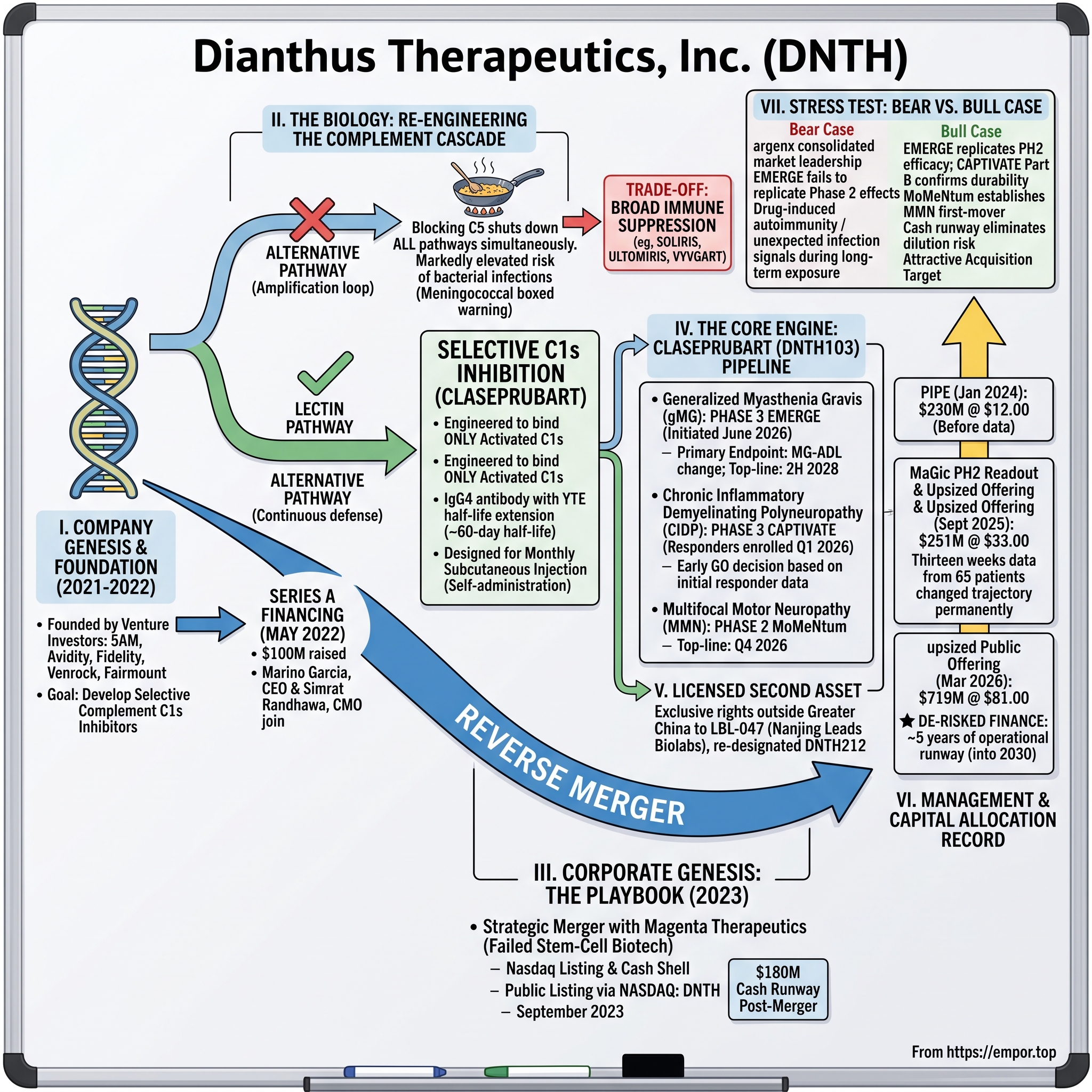
Dianthus Therapeutics: Re-Engineering the Complement Cascade
I. Introduction & Episode Roadmap
On a Monday morning in early September 2025, a small New York biotech with roughly two hundred employees and no approved products released thirteen weeks of data from sixty-five patients. By the time the market closed, the trajectory of Dianthus Therapeutics had changed permanently.
The data came from MaGic, a Phase 2 study in generalized myasthenia gravis, an autoimmune disease in which a patient's own antibodies attack the electrical junction between nerve and muscle. Patients receiving the 600-milligram dose of the company's lead antibody improved by 5.4 points on the MG-ADL scale, a survey evaluating a patient's ability to chew, swallow, hold up their head, and breathe. Placebo patients improved by 2.8 points, yielding a p-value of 0.0006.1 For observers of small-cap biotech readouts, the critical metric was in the safety section: no drug-related serious adverse events, no discontinuations, and no treatment-related serious bacterial infections.1
That absence of serious bacterial infections underpins the company's core investment thesis. It helps explain why a firm that generated essentially zero product revenue in its history carried a market capitalization of roughly $4.5 billion by late July 2026, with shares trading near $107 against a fifty-two-week low of $18.08.2 Between those two price points lies a dramatic market re-rating, along with demanding expectations built into the stock price.
The $10 Billion Autoimmune Frontier
Dianthus Therapeutics, Inc. (NASDAQ: DNTH) is a clinical-stage biotechnology company built on the premise that a therapy can selectively disable the specific arm of the immune system driving certain autoimmune diseases without suppressing broader immune defenses.
The target market is established and expanding. Two drug classes—complement inhibitors and FcRn antagonists—have turned previously difficult-to-treat neuromuscular conditions into multi-billion-dollar commercial franchises. argenx, the Dutch-Belgian biopharmaceutical company whose FcRn antagonist Vyvgart defined the modern category, reported $4.2 billion in global net product sales for 2025, representing roughly 90% year-over-year growth across approximately 19,000 patients worldwide.3 Alexion, now a subsidiary of AstraZeneca, built the original complement market with Soliris and its successor Ultomiris, while UCB markets two additional competing therapies. Each of these products treats overlapping patient populations with generalized myasthenia gravis and chronic inflammatory demyelinating polyneuropathy.
Into this crowded market enters a company whose clinical value rests primarily on a single molecule.
The Core Thesis
That candidate is claseprubart, formerly DNTH103—a monoclonal antibody engineered to bind exclusively to the active form of the C1s complement protein. It incorporates half-life extension technology designed to enable subcutaneous administration as infrequently as once every four weeks.4
The investment thesis consists of four distinct propositions, each capable of succeeding or failing independently. First, that selectively blocking the classical complement pathway provides sufficient therapeutic benefit without the broader immune suppression caused by existing therapies. Second, that sparing alternative complement pathways meaningfully reduces the infection risks that forced boxed warnings and mandatory vaccination protocols onto C5 inhibitors. Third, that a low-volume, infrequent subcutaneous injection provides a durable commercial advantage against competitors that have also introduced subcutaneous formulations. And fourth, that these findings hold up as the drug advances from small Phase 2 trials into large, placebo-controlled Phase 3 studies, where many candidate therapies fail.
None of those four propositions is fully proven. Two have encouraging early clinical support, one remains an unproven commercial hypothesis, and the fourth will not be resolved until the second half of 2028.5
Episode Architecture
This report examines how a company formed by venture investors in 2021, taken public in 2023 through a reverse merger with a failed stem-cell biotech, and funded through three successive equity raises attained a $4.5 billion valuation based on sixty-five patients and a mechanistic argument.
The chapters ahead cover six main themes: * The underlying biology, assessing whether active-site selectivity represents a true clinical breakthrough or a minor technical distinction; * The corporate backstory and reverse-merger structure from the 2023 biotech downturn; * The pipeline, spanning three neuromuscular indications at different stages of clinical development, alongside a licensed second asset from China; * The competitive war-game against argenx, AstraZeneca, and UCB; * The company's capital allocation record, which extended its cash runway from two years to five years over an eighteen-month period; * A stress test detailing bull-case assumptions, bear-case risks, and key operational catalysts.
The evaluation begins with the biology, which serves as the core foundation of the business model.
 Subscribe on LinkedIn
II. The Science & The Biology: The Complement Cascade & Active-Site C1s
Imagine a medieval castle with three independent alarm systems. One is triggered when a guard visually identifies a known enemy banner. Another is triggered by a tripwire across the moat. The third is a watchman who simply screams every few seconds regardless, on the theory that constant noise deters intruders. All three alarms feed into the same defense: boiling oil poured from the ramparts.
That is roughly how the complement system operates—a cascade of roughly thirty proteins circulating in blood plasma, making it one of the oldest components of the immune system, predating antibodies themselves. It exists to mark pathogens for destruction, summon inflammatory cells, and ultimately punch holes in the membranes of invading organisms through a structure called the membrane attack complex.
Three Doors Into One Room
The three alarm systems represent the three activation pathways. The classical pathway is the visual identification system: it fires when antibodies bind to a target and the C1 complex recognizes that antibody cluster. The lectin pathway is the tripwire, triggered by sugar patterns found on microbial surfaces. The alternative pathway is the screaming watchman—a low-level, continuously active loop that amplifies whatever the other two initiate and provides baseline surveillance against bacteria.
In autoimmune disease, the problem is that the visual identification system has been given the wrong target. In generalized myasthenia gravis, patients produce antibodies against the acetylcholine receptor at the neuromuscular junction—the docking station that enables a nerve to signal a muscle to contract. Those antibodies cluster on the patient's own tissue. The classical pathway reads the cluster exactly as designed, activates, and pours the boiling oil onto the patient's own neuromuscular junction. The membrane attack complex physically destroys the receptor-dense folds of the muscle membrane. The nerve signal arrives, but the muscle cannot respond. Eyelids droop, swallowing fails, and in severe cases the diaphragm stops functioning.
The therapeutic logic follows immediately: block the cascade, stop the damage. The key operational question is where to block it.
The Classical Complement Dilemma
The first generation of complement drugs targeted C5—a protein far downstream, where all three pathways converge just as the membrane attack complex assembles. Soliris and Ultomiris work this way. This approach established a highly effective place to intervene, creating a multi-billion-dollar rare disease franchise.
It also carried a specific and severe trade-off. Blocking C5 shuts down the terminal output of all three pathways simultaneously—including the alternative pathway that provides continuous defense against encapsulated bacteria. Patients on C5 inhibitors face a markedly elevated risk of meningococcal disease. Consequently, these drugs carry boxed warnings, require patients to be vaccinated against Neisseria meningitidis before initiating therapy, and mandate that prescribers operate under restricted distribution programs. For a patient, that creates a permanent baseline vulnerability and lifelong monitoring obligations.
An intuitive analogy clarifies the trade-off: blocking C5 is like shutting off the main water line to a building because one apartment has a leaking pipe. It stops the leak, but it leaves every resident without water.
What Claseprubart Actually Does Differently
Claseprubart intervenes at the top of the classical pathway at C1s—the enzymatic engine inside the C1 complex that, once activated, cleaves the next proteins in the cascade to drive downstream signaling. Blocking C1s halts the classical pathway at its origin while leaving the lectin and alternative pathways structurally intact.4
The more specific engineering feature defines the drug's identity. C1s circulates in the bloodstream primarily in an inactive, zymogen form—a switched-off enzyme waiting for an activation signal. Claseprubart was engineered to bind exclusively to the activated form.4 This distinction matters for a practical reason: the inactive pool is vast, and an antibody that bound to it would be absorbed immediately, requiring large doses to reach the small fraction of active C1s driving tissue damage. By ignoring the inactive pool, claseprubart achieves deep pathway suppression at a dose small enough to fit into a standard syringe rather than an infusion bag.
Understanding this chain of causation is essential, as the distinction is frequently inverted in commercial discussions. Active-site selectivity is not primarily a safety feature; it is a potency and volume feature. The safety argument stems from targeting C1s instead of C5. These two engineering innovations are distinct, and only one has been tested directly against a competitor in a clinical trial.
The Half-Life Problem, and the YTE Answer
A standard human IgG antibody survives in circulation for approximately three weeks before being recycled by FcRn, a salvage receptor that rescues antibodies from intracellular degradation and returns them to the bloodstream. In the 2000s, antibody engineers discovered that a three-amino-acid modification to the antibody's tail—known as the YTE mutation set—significantly increases its binding affinity for the salvage receptor in acidic cellular environments. Gripping the receptor more tightly increases recycling and extends circulating survival.
Dianthus incorporated YTE into claseprubart. In its Phase 1 program in healthy volunteers, across seven single- and multiple-ascending-dose cohorts totaling fifty-two subjects, the drug demonstrated a half-life of approximately sixty days alongside potent classical pathway inhibition.6 A sixty-day half-life represents an unusually long terminal duration for a therapeutic antibody, making monthly—and potentially less frequent—subcutaneous dosing mathematically viable rather than aspirational.4
For patients, the practical implication is substantial. Moving from a hospital infusion chair every few weeks to a two-milliliter injection at home alters the burden of chronic disease management. In chronic conditions requiring decades of treatment, route and frequency of administration often determine commercial market share.
The Risk Nobody Talks About Enough
A potential vulnerability accompanies this mechanism, and the company has disclosed it within its regulatory filings. Individuals born with genetic deficiencies in early classical complement components experience significantly elevated rates of systemic lupus erythematosus. The classical pathway performs essential immunological housekeeping by clearing cellular debris and immune complexes before they trigger autoimmune responses. Long-term pharmacologic inhibition of this pathway could theoretically replicate that deficiency.
Regulatory authorities monitored this risk closely, prompting Dianthus to screen clinical trial participants for anti-nuclear antibodies—a standard lupus serology marker—and conduct routine ongoing safety monitoring. In March 2026, Dianthus announced that the FDA had agreed in writing to eliminate baseline ANA screening, discontinue routine ANA testing, and reclassify the theoretical concern from systemic lupus to drug-induced lupus—a reversible condition that resolves upon treatment discontinuation. The company reported zero cases of drug-induced lupus or systemic lupus across the claseprubart program to date.7
This regulatory shift represented a meaningful de-risking event and catalyst for the company. However, it reflects a reclassification of a theoretical risk based on an absence of signals in small, short-duration trials. At the time of the agreement, the claseprubart safety database comprised a Phase 1 study, a thirteen-week Phase 2 trial, and an open-label extension. Because drug-induced autoimmunity typically manifests over multiple years of continuous exposure, the theoretical risk has been downgraded rather than eliminated, with long-term safety remaining to be established in larger Phase 3 trials.
Which brings us to how this company came to exist at all — and to a story that begins with someone else's catastrophe.
III. Corporate Genesis & The Reverse Merger Playbook
On January 25, 2023, Magenta Therapeutics issued a press release detailing a critical trial setback. A participant in the third dose cohort of its Phase 1/2 trial for MGTA-117—an antibody-drug conjugate designed to condition patient bone marrow prior to stem cell transplantation—experienced respiratory failure and cardiac arrest at the 0.08 mg/kg dose level. The event was classified as a Grade 5 serious adverse event—the scale's designation for a fatality—and was assessed as possibly related to the drug. Magenta voluntarily paused dosing and reported the case to the FDA as a suspected unexpected serious adverse reaction.8
Eight days later, on February 2, 2023, the company announced it would halt development of its programs entirely and begin a comprehensive review of strategic alternatives.9 In biotech parlance, the scientific pipeline had ended; remaining assets consisted of a Nasdaq listing, a cash balance, and a corporate structure seeking a target.
The Other Side of the Trade
Roughly two hundred miles south, a very different company was looking for exactly that vehicle.
Dianthus Therapeutics had launched publicly on May 3, 2022, announcing a $100 million Series A financing led by 5AM Ventures, Avidity Partners, and Fidelity Management & Research, alongside Wedbush Healthcare Partners and founding investors Fairmount, Tellus BioVentures, and Venrock Healthcare Capital Partners.10 Marino Garcia had joined as President and Chief Executive Officer in November 2021, with Simrat Randhawa joining as Chief Medical Officer and Lonnie Moulder serving as Board Chair.10 The company's stated plan at launch was to advance DNTH103 into clinical trials that year.10
Dianthus was structured around the standard venture model: built upon a specific mechanistic hypothesis, managed by commercial and clinical operators, and supported by an investor syndicate prepared to finance multiple development stages. Fairmount, co-founded by Tomas Kiselak, was a co-founder of Dianthus, with Kiselak serving on the board from inception until stepping off in March 2025.11
By early 2023, Dianthus was advancing toward Phase 1 data readouts and required public-market capital. However, traditional public offerings were largely inaccessible. The biotech IPO window that opened wide in 2020 and 2021 had largely closed, leaving crossover investors with losses and new issues trading below offer prices. For a pre-Phase 2 biotech company, a standard IPO was functionally off the table.
The September 2023 Execution
The two companies announced their merger agreement on May 3, 2023, exactly one year to the day after the Dianthus launch.12 The transaction closed on September 11, 2023. Magenta executed a 1-for-16 reverse stock split minutes before the merger became effective, converting each Dianthus share into 0.2181 Magenta shares, and the combined company began trading as DNTH on the Nasdaq Capital Market on September 12, 2023.13
The transaction structure mirrored standard reverse-merger mechanics in biotechnology. Dianthus shareholders—including participants in a concurrent $70 million private placement—were projected to own approximately 78.7% of the combined company, with legacy Magenta holders retaining roughly 21.3%, subject to adjustment based on Magenta's net cash at closing.12 This adjustment mechanism aligns valuation with net cash, ensuring the private company buys the shell's liquid capital rather than its legacy programs.
The $70 million private placement was led by Fidelity, with participation from Catalio Capital Management, 5AM Ventures, Avidity Partners, Wedbush Healthcare Partners, and founding investors Fairmount, Tellus BioVentures, and Venrock.12 Combined post-closing cash was expected to be approximately $180 million, funding operations into mid-2026.12
Under this structure, Dianthus avoided raising primary capital directly from public equity markets. Instead, it raised private capital from familiar investors while using the merger to secure a public listing. The transaction allowed the company to enter Nasdaq with nearly three years of operational runway.
Did Dianthus Overpay?
Evaluating the acquisition cost requires distinguishing between cash value and market access.
In a reverse merger, the private acquirer effectively pays for two assets: the shell's net cash and the certainty of a clean public listing. While net cash has a direct dollar value, listing certainty carries structural advantages. Traditional IPOs typically incur underwriting fees of roughly seven percent of gross proceeds, require six to nine months of regulatory preparation, and expose pricing to prevailing market conditions. A reverse merger trades a fixed, pre-negotiated equity stake for closing certainty.
With legacy shareholders retaining roughly 21% of the equity in exchange for Magenta's cash, the effective premium paid for the listing was modest. The primary advantage was strategic timing. Dianthus secured a Nasdaq listing and a three-year cash runway during a severe biotech financing downturn. While peer companies spent 2023 and 2024 reducing staff and deferring pipelines, Dianthus proceeded with patient enrollment.
The transaction also depended on the nature of the shell company's failure. Magenta's dissolution stemmed from a single clinical toxicity event rather than financial restatements, fraud, or legal liabilities, leaving an unencumbered balance sheet. Distressed biotechs remain viable merger shells primarily when corporate winding-down is swift and liabilities are well defined.
Whether contingent value rights tied to legacy Magenta assets were included in the final transaction structure is not detailed in the reviewed closing disclosures, and this report does not assert their presence.
The public listing established the operational platform for Dianthus. What followed—three successive capital raises over twenty-six months—depended on data generated in the clinical program.
IV. The Core Engine: DNTH103 Pipeline & Materiality Sizing
There is a moment in every single-asset biotech story where the narrative evolves from a single drug candidate into a portfolio of clinical shots on goal using that same core molecule. For Dianthus, that transition arrived in the first quarter of 2026, unfolding faster than management had originally signaled to investors.
The Economic Weight Question
Evaluating Dianthus requires establishing financial proportion. Claseprubart accounts for the vast majority of the company's valuation. The lead antibody is currently in Phase 3 development across two indications and Phase 2 in a third. Virtually every component of the commercial buildout—including the hiring of a chief commercial officer in March 2025—is structured around its potential market launch.11
The second clinical asset, DNTH212, is undergoing Phase 1 safety testing in healthy volunteers and represents early-stage optionality. While strategically aligned, it is not yet a primary valuation driver. The company's publicly disclosed clinical pipeline consists strictly of claseprubart and DNTH212; a program designated "DNTH226" does not appear in regulatory filings reviewed for this report, and its existence is not asserted here.
DNTH212 entered the pipeline through external licensing rather than internal discovery. On October 16, 2025, Dianthus acquired exclusive rights outside Greater China to LBL-047, a bifunctional fusion protein developed by Nanjing Leads Biolabs.14 Financial terms included $30 million upfront inclusive of near-term milestones, $8 million upon initiating a Dianthus-led Phase 1 trial, up to $962 million in aggregate regulatory, development, and commercial milestones across multiple indications, and tiered royalties ranging from mid-single digits to low double digits on net sales outside Greater China.14
The molecule features a dual-action mechanism: it targets BDCA2 on plasmacytoid dendritic cells to suppress type 1 interferon production, while simultaneously inhibiting BAFF and APRIL to impair B-cell function and autoantibody generation.14 In practical terms, it attacks autoimmune activity along two pathways—curbing early inflammatory signaling and reducing autoantibody production. Priority indications include Sjögren's disease, systemic lupus erythematosus, and dermatomyositis, with healthy volunteer safety data expected in the second half of 2026.5
This transaction illustrates a broader industry pattern: in-licensing candidates discovered in China to reduce internal development costs. While capital-efficient, this strategy is widely deployed across biotechnology, progressively narrowing the cost advantage. The deal also expands Dianthus from its core neuromuscular focus into rheumatology. Management has described the common thread across its portfolio as infrequent subcutaneous self-administration.14 However, dosing convenience represents a delivery feature rather than deep clinical expertise in a distinct therapeutic category.
Indication One: Generalized Myasthenia Gravis
Generalized myasthenia gravis causes debilitating muscle fatigue that worsens with physical activity. Everyday functions—holding up one's head, speaking clearly, or swallowing food—become increasingly difficult throughout the day. In severe cases involving myasthenic crisis, respiratory muscle failure requires mechanical ventilation. Because patients manage the disease over decades, therapeutic speed, efficacy, and administration burden heavily influence prescribing choices.
The Phase 2 MaGic trial evaluated sixty-five adults with acetylcholine receptor antibody-positive generalized myasthenia gravis. Participants were randomized to receive subcutaneous claseprubart at either 300 milligrams in a two-milliliter volume or 600 milligrams in a four-milliliter volume every two weeks after a loading dose, or placebo, during a thirteen-week randomized period followed by a fifty-two-week open-label extension.1
Both dosage cohorts demonstrated statistically significant improvements on the patient-reported MG-ADL scale and the physician-evaluated QMG score by Week 1.1 In a chronic neuromuscular condition, rapid onset of effect offers meaningful clinical utility when managing acute disease flare-ups. Furthermore, the 300-milligram and 600-milligram doses showed nearly identical efficacy at every evaluation point, allowing Dianthus to advance the lower-volume, two-milliliter formulation into Phase 3 rather than a more burdensome four-milliliter presentation.1
Secondary endpoints provided additional detail for the 300-milligram cohort: minimal symptom expression reached 37 percent compared to 14 percent on placebo with a p-value of 0.0550, while the composite MGC score improved by 8.7 points versus 3.1 points, and quality-of-life scores improved by 6.1 points versus 3.9 points.1 Although the minimal symptom expression outcome narrowly missed conventional statistical significance, the overall Phase 2 data supported pivotal development.
These findings warrant measured interpretation. A sixty-five-patient sample size is modest, and placebo responses in myasthenia gravis trials can be substantial, as demonstrated by the 2.8-point placebo improvement in MaGic. Cross-trial comparisons against approved therapies remain methodologically unreliable due to differences in baseline patient severity, geographic distribution, and prior treatments. While MaGic confirmed classical pathway inhibition and demonstrated a favorable short-term safety profile, it did not establish clinical superiority over existing treatment options.
Following an end-of-Phase 2 meeting with the FDA completed in the first quarter of 2026,15 claseprubart received Orphan Drug Designation for myasthenia gravis in May 2026. On June 29, 2026, Dianthus initiated the Phase 3 EMERGE trial, enrolling approximately 195 AChR-antibody-positive participants to evaluate 300-milligram subcutaneous dosing on both two-week and four-week schedules against placebo, with change from baseline in MG-ADL as the primary endpoint and top-line results anticipated in the second half of 2028.5 Simrat Randhawa, Executive Vice President and Head of R&D, noted that the trial design incorporated key learnings from the Phase 2 program.5
Two structural choices in the EMERGE design carry analytical weight. Evaluating a four-week dosing schedule directly in a registrational trial builds the extended-dosing hypothesis into the primary regulatory submission. However, if the four-week cohort underperforms the two-week arm, it could complicate label claims and commercial differentiation. Additionally, a 195-patient target is relatively compact for a Phase 3 trial in this disease, leaving limited margin for error if the treatment effect in a broader population proves smaller than observed in Phase 2.
Indication Two: Chronic Inflammatory Demyelinating Polyneuropathy
Chronic inflammatory demyelinating polyneuropathy, or CIDP, involves autoimmune destruction of the myelin sheath surrounding peripheral nerves. As insulation degrades, nerve signal transmission slows, causing progressive limb weakness and sensory loss. Standard care relies heavily on intravenous immunoglobulin—pooled plasma-derived antibodies requiring long infusions, incurring high annual costs, and remaining subject to human plasma donor supply constraints.
Dianthus structured its Phase 3 CAPTIVATE trial using an enriched randomized-withdrawal design divided into two parts. In Part A, an open-label phase, all participants receive claseprubart, with responders identified by achieving at least a one-point improvement on the adjusted INCAT disability scale relative to baseline.15 In Part B, confirmed responders are randomized into a double-blind, placebo-controlled withdrawal period of up to fifty-two weeks to evaluate relapse prevention, followed by an open-label extension.15
This study design mirrors the clinical strategy argenx utilized for Vyvgart Hytrulo in CIDP. While efficient because non-responders are excluded before randomization, it measures whether a drug maintains clinical stability in pre-selected responders rather than evaluating efficacy across an unselected population. Regulators accept this trial structure for approval, though commercial payers often scrutinize the distinction during coverage determinations.
Dianthus originally targeted approximately forty patients to complete Part A, projecting a 50 percent response rate based on historical C1s inhibition data.15 In the first quarter of 2026, the company announced an early GO decision after reaching twenty confirmed responders with fewer than forty participants completing Part A.15 On the Q1 2026 earnings call, Chief Executive Officer Marino Garcia characterized the period as a pivotal milestone, emphasizing that the response threshold was crossed ahead of expectations.16
Crossing this responder threshold early confirms biological activity and indicates an initial response rate above the company's 50 percent baseline projection. However, because Part A lacks a placebo control, this benchmark does not measure treatment separation. The definitive test of therapeutic durability will occur during Part B, with Dianthus expecting to provide updated timing guidance by the end of 2026.15
Indication Three: Multifocal Motor Neuropathy
Multifocal motor neuropathy is a rare, slowly progressive condition that selectively targets motor nerves while leaving sensory function intact. Patients experience asymmetric muscle weakness, often beginning in the hands, and typically depend on indefinite immunoglobulin therapy to maintain physical function. No complement inhibitors or FcRn antagonists are currently approved for MMN.
The Phase 2 MoMeNtum trial is a global, randomized, double-blind, placebo-controlled study enrolling thirty-six patients with documented immunoglobulin dependence. Following baseline stabilization, participants receive subcutaneous claseprubart or placebo every two weeks for seventeen weeks. The primary endpoint evaluates safety and tolerability, while secondary endpoints assess time to IVIg retreatment, time to relapse, and changes in muscle and grip strength.17 The FDA cleared the trial protocol in June 2024,17 and top-line data are expected in the fourth quarter of 2026.15
While a thirty-six-patient study serves as a proof-of-concept trial rather than a registrational study, a positive signal on retreatment timing would provide the first clinical evidence that classical complement pathway inhibition alters MMN progression. In an indication lacking approved targeted options, such a result would establish a first-mover pipeline opportunity and support advancement into pivotal trials.
V. The Competitive Landscape: David vs. The Autoimmune Goliaths
In 2017, when Alexion won approval for Soliris in generalized myasthenia gravis, the commercial team executing the launch was led in the United States by a neurology executive named John C. King. In March 2025, Dianthus hired him as Chief Commercial Officer.11
That hiring decision reflects the company's broader commercial strategy. Dianthus is not relying solely on novel biology; it is attempting to out-execute entrenched competitors using commercial leaders who helped build the existing market. King previously served as Chief Commercial Officer at Ra Pharma before UCB acquired the company for $2.5 billion, giving him direct experience with the subcutaneous C5 peptide that became Zilbrysq.11 Concurrently, Dianthus appointed Sujay Kango, former Chief Executive Officer of Tmunity and former Chief Commercial Officer of Acceleron, to its board of directors.11
The Map
Four main competitive groups define the market landscape.
AstraZeneca / Alexion maintains the foundational complement franchise anchored by Soliris, the first-in-class C5 inhibitor, and Ultomiris, its longer-acting successor. This incumbent position benefits from deep physician relationships, established reimbursement coverage, and a rare-disease commercial infrastructure developed over two decades. However, because C5 inhibition broadly shuts down terminal complement activity, these therapies carry boxed warnings for serious meningococcal infections — the primary safety limitation Dianthus aims to address.
argenx represents the primary commercial benchmark in the category. Its lead therapy, Vyvgart, is an FcRn antagonist rather than a complement inhibitor. Instead of extending the circulating life of a single engineered antibody, it blocks antibody recycling to accelerate the clearance of all circulating IgG antibodies, including pathogenic autoantibodies. This mechanism delivered $4.2 billion in 2025 net product sales, representing roughly 90 percent year-over-year growth across approximately 19,000 patients worldwide, supported by global approvals in generalized myasthenia gravis and CIDP, alongside a prefilled-syringe presentation currently on the market.3
That delivery format is commercially significant. The convenience gap Dianthus seeks to exploit has narrowed as argenx expanded beyond intravenous infusions to introduce subcutaneous formulations and prefilled syringes into an established patient base.
UCB fields two therapies operating through distinct mechanisms: Rystiggo, an FcRn antagonist, and Zilbrysq, a subcutaneous C5 peptide. By the end of 2025, these products reached more than 2,400 and 1,300 myasthenia gravis patients, respectively, contributing to UCB's portfolio of key growth drivers that generated over €3.3 billion in total net sales.18 The performance of these therapies highlights a key market dynamic: even well-funded products from established pharmaceutical companies can experience patient adoption rates substantially below the market leader.
Sanofi frequently appears in competitive comparisons due to Enjaymo, an intravenous C1s inhibitor approved for cold agglutinin disease that established mechanistic proof-of-concept for target pathway inhibition. However, Recordati acquired global rights to Enjaymo from Sanofi for $825 million upfront plus up to $250 million in commercial milestones in a transaction that closed in November 2024.19 For Dianthus, Enjaymo demonstrates that C1s inhibition is an approvable mechanism in humans while illustrating the commercial ceiling of a biweekly intravenous presentation, which yielded peak annual sales expectations in the low hundreds of millions rather than billions.
The Actual Battlefield
Beyond mechanistic distinctions, the primary commercial question centers on prescribing behavior: when treating a newly diagnosed generalized myasthenia gravis patient who has failed first-line corticosteroid therapy, which drug class do neurologists select?
Currently, prescribers predominantly select FcRn antagonists. argenx established an early market footprint, invested extensively in physician education, and secured broad reimbursement, leaving complement inhibitors positioned primarily in later lines of treatment. This prescribing pattern forms the core commercial challenge for late-stage entrants.
Dianthus bases its commercial strategy on three primary arguments.
Convenience. A two-milliliter self-administered injection every two or four weeks offers a favorable dosing profile relative to weekly or cyclical FcRn regimens. While meaningful to patients, dosing convenience alone rarely displaces an established market leader in specialty markets where physicians drive treatment decisions.
Safety. Safety offers the strongest theoretical differentiation. FcRn antagonists broadly reduce total IgG levels, including protective antibodies, while C5 inhibitors require boxed warnings for bacterial infection risks. If claseprubart achieves regulatory approval without a boxed warning or a restricted distribution program — the target profile management has explicitly stated it is pursuing1 — it would secure a structural advantage in a chronic condition requiring long-term care. However, this positioning remains subject to Phase 3 safety evaluations and multi-year observations regarding potential drug-induced autoimmunity.
Sequencing. Mechanistic complementarity supports a sequential treatment model. Because complement inhibitors and FcRn antagonists target distinct stages of disease pathogenesis, patients with incomplete responses to one class may benefit from adding or transitioning to the other. This rationale establishes a viable second-line market opportunity, albeit one addressing a smaller patient volume than first-line therapy.
In summary, Dianthus has combined a differentiated pipeline candidate with an experienced commercial executive team, but it has not generated direct head-to-head clinical data against market leaders. Current assertions of clinical differentiation rely on cross-trial comparisons. Until the Phase 3 EMERGE trial completes, the commercial rationale rests on mechanism and convenience — factors that require validation in pivotal clinical settings.
That dynamic shifts attention to management's operational execution: how effectively leadership has met its development timelines, and how its financial stewardship has positioned the company for upcoming registrational readouts.
VI. Management & Capital Allocation Record
In March 2026, with its stock trading above $80 — more than four times where it had been a year earlier — Dianthus sold equity.
It sold a lot of it. The offering priced on March 11 at $81.00 per share for 7,313,582 shares plus pre-funded warrants for another 402,468, raising approximately $625 million.20 When the underwriters exercised their option in full, the deal closed the following day at approximately $719 million in gross proceeds.21 Jefferies, TD Cowen, Evercore ISI, Stifel, Guggenheim Securities and William Blair ran the books.21
That is the single most important capital allocation decision in this company's history, and it tells you more about management than any strategy slide.
The Financing Sequence
The pattern is consistent and it is worth laying out chronologically, because the discipline is in the sequence rather than in any individual raise.
The company arrived on Nasdaq with roughly $180 million and a runway into mid-2026.12 Four months later, on January 22, 2024 — well before any Phase 2 data — it announced a $230 million private placement, selling 14,500,500 shares at $12.00 alongside pre-funded warrants for another 4,666,332, with Bain Capital Life Sciences, RA Capital Management, Avidity, Fairmount, Venrock, RTW Investments, Great Point Partners, Octagon Capital and Janus participating.22 Then on September 9, 2025 — the day after the MaGic results — it priced an upsized public offering of 6,487,879 shares at $33.00 plus pre-funded warrants for 1,112,121 more, for approximately $251 million.23 And then March 2026, at $81.00.
Read those three prices in order: $12.00, $33.00, $81.00. Each raise was executed immediately after a value-creating event, at a materially higher price than the last, with the largest raise at the highest price. Dilution measured in dollars raised was enormous; dilution measured in ownership given up was, by clinical-stage biotech standards, well managed. Weighted average shares outstanding in the first quarter of 2026 were roughly 48 million.16
The result is a balance sheet that has almost nothing in common with the one this article's outline anticipated. Dianthus ended 2025 with $514.4 million and guidance for a runway into 2028.15 Following the March offering, it ended the first quarter of 2026 with approximately $1.2 billion in cash, cash equivalents and investments — against total liabilities of about $46 million — and guided to a runway into 2030.16
A five-year runway is not normal for a company with two Phase 3 programs running. It is closer to what a commercial-stage company carries. The practical consequence is that Dianthus no longer needs the capital markets to be open in order to complete EMERGE, complete CAPTIVATE, and read out MMN. It has removed financing risk from the equation entirely — which, for a biotech, is the single most valuable thing a treasury can do.
The counter-argument is worth stating plainly: raising $1.2 billion against a molecule with sixty-five patients of randomized efficacy data is also an enormous bet on one outcome. If EMERGE fails, the cash becomes a liquidation value rather than an operating asset, and the shareholders who funded it at $81.00 will have paid for optionality that did not exist.
The Cost Curve
The spending is scaling in the way a company transitioning from Phase 2 to Phase 3 should. Research and development rose to $145.6 million in 2025 from $83.1 million in 2024, including $10.1 million of stock-based compensation, while general and administrative rose to $34.3 million from $25.0 million, including $12.7 million of stock-based compensation.15 Net loss widened to $162.3 million, or $4.20 per share, against $84.9 million and $2.55 in 2024.15 The first quarter of 2026 continued the trajectory: R&D of $34.5 million versus $27.0 million a year earlier, G&A of $12.5 million versus $7.3 million, and a net loss of $40.8 million, or $0.85 per share.16
Two things stand out. First, G&A grew faster in percentage terms than R&D in the most recent quarter — the signature of commercial buildout ahead of an approval that is at minimum two years away. That is a defensible investment given the hiring of a commercial leadership team, but it is also cash burned on infrastructure for a product that may never launch. Second, stock-based compensation in G&A exceeded that in R&D in 2025 despite R&D being four times larger in cash terms. That is worth watching; it is not unusual for a company issuing inducement grants and executive equity during a re-rating, but it is a real transfer of value from shareholders.
The People
Marino Garcia is not a scientist, and that is the point. He joined in November 2021 after a career built almost entirely in commercial strategy and business development: Senior Vice President of Corporate and Business Development at Zealand Pharma from 2018 to 2021, Executive Vice President and Chief Strategy Officer at Synergy Pharmaceuticals from 2014 to 2018, head of business development at Aptalis when Forest Laboratories acquired it in 2014, and Vice President of US Commercial Operations at Aspreva before Vifor acquired it in 2007, with earlier roles at Merck, Pfizer and Eli Lilly.24 He holds an MBA from Ivey Business School and a Bachelor of Commerce from Concordia.24
That resume reads as a dealmaker's, and the company's behavior matches: a reverse merger, an in-licensing transaction, and three opportunistic financings. It is a background well suited to the next two years and a legitimate question mark for the two after that, since none of it includes running a commercial launch as chief executive.
Simrat Randhawa joined as Chief Medical Officer at launch and now serves as Executive Vice President and Head of R&D.105 He brought more than twenty years spanning clinical practice and industry, most recently as Senior Vice President of Clinical and Medical Affairs at Aurinia Pharmaceuticals, with prior senior roles at Novartis and BioMarin and earlier work at McKinsey; he holds an MD from Drexel and an MBA from Columbia.25 Aurinia is a useful line on that resume — it is a company that took a rare autoimmune therapy through approval and launch.
Ryan Savitz serves as Executive Vice President, Chief Financial Officer and Chief Business Officer. Susan Kalled joined as Chief Scientific Officer, bringing more than twenty-five years in discovery research and partnerships.26
Readers should note that the leadership roster differs materially from some third-party summaries in circulation; the names above reflect the company's own recent disclosures and press releases.
Credibility, Tested
The right way to assess management here is against its own prior statements, and on that test the record is good.
Guidance for the MaGic readout was met. The end-of-Phase 2 FDA meeting happened in the first quarter of 2026 as indicated.15 Phase 3 EMERGE initiation was guided for mid-2026 and announced June 29, 2026.5 The CIDP GO decision came early rather than late.15 Runway guidance has been revised upward, not downward, at each step — into mid-2026 at the merger, into 2028 at year-end 2025, into 2030 after the March raise.121516 For a clinical-stage company, hitting four consecutive guided catalysts on or ahead of schedule is genuinely uncommon.
The activist-style questions are narrower but real.
The related party. Dianthus licensed DNTH103 rights in Greater China to Zenas BioPharma under a June 2022 agreement, following a September 2020 option agreement. This was a related-party transaction: Fairmount beneficially owns more than 5% of Dianthus and is also a 5%-or-greater holder of Zenas, with board seats at both.27 The arrangement predates the public listing and appears properly disclosed, and it is the source of the small license revenue and deferred revenue on the balance sheet. But a founder-investor sitting on both sides of a territorial license for the company's only meaningful asset is exactly the structure that deserves ongoing scrutiny, particularly if China becomes commercially relevant.
Insider selling. CFO Ryan Savitz sold shares during 2026, including a disposition of his entire direct holding executed under a trading plan adopted in December 2025, while retaining an option position.28 Rule 10b5-1 plans adopted well in advance are the correct mechanism and the timing is defensible. It is still a data point that the finance chief monetized direct equity into strength.
Concentration risk in disclosure. The company's communications lean heavily on "best-in-class" and "potentially best-in-class" framing.114 That is standard biotech language, and readers should treat it as aspiration rather than finding.
The ownership base has responded to the execution record. Institutional holders filing 13Fs rose to 250 at the end of the first quarter of 2026 from 169 the prior quarter, with 97 new positions initiated and reported holdings of roughly 62 million shares.29 A specialist-heavy register becoming a broadly institutional one is what a successful re-rating looks like — and it also means a larger cohort of holders whose conviction has never been tested by a clinical failure.
For the live version of how management defends the story, the place to look is the calls.
VII. Primary Sources & Earnings Call Insights
The most revealing moment of a biotech earnings call is rarely found in the prepared remarks. It occurs when an analyst declines to accept management's framing.
What the Prepared Remarks Emphasize
Across recent quarters, executive commentary has remained notably consistent — a positive indicator for a clinical-stage company, where narrative drift often signals underlying operational friction. Announcing full-year 2025 financial results, Chief Executive Officer Marino Garcia outlined the corporate ambition as "building a leading neuromuscular franchise with a target product profile that aims to combine best-in-class efficacy and safety with the convenience of an infrequent, subcutaneous, self-administered autoinjector."15 Those same three pillars — efficacy, safety, and convenience — featured prominently in the MaGic trial readout, where Garcia stated that the data "strongly support our best-in-class target product profile for claseprubart 300mg/2mL Q2W in gMG."1 They reappeared during the DNTH212 acquisition announcement, which highlighted the shared thesis across both pipeline candidates: "validated mechanisms and patient friendly convenience of infrequent S.C. self-administration."14
The phrasing merits attention: target product profile. Management is describing the clinical profile it intends to demonstrate rather than one already established in registrational trials. That distinction is often lost in secondary market commentary.
The clinical messaging on earnings calls has been noticeably more cautious than the commercial framing. Discussing the MaGic results, Head of R&D Simrat Randhawa emphasized endpoint consistency over treatment magnitude, noting that clinical improvement was observed "in both treatment arms across multiple standard MG efficacy metrics."1 Demonstrating consistent trends across secondary endpoints in a sixty-five-patient study provides supportive proof-of-concept; it does not constitute proof of clinical superiority over existing therapies.
Where Analysts Push
Sell-side inquiries — driven by analysts from the underwriting syndicate that includes Jefferies, TD Cowen, Evercore ISI, Stifel, Guggenheim Securities, and William Blair21 — routinely return to a question that clinical trials have not addressed.
The fundamental commercial question is straightforward: if complement inhibitors and FcRn antagonists demonstrate broadly comparable improvements on the MG-ADL scale in separate studies, and FcRn therapies hold a first-mover advantage across thousands of active patients, what prompts a neurologist to alter prescribing habits?
Management's response relies on disease biology rather than comparative statistics. The two drug classes target distinct nodes in disease progression: FcRn antagonists accelerate the clearance of circulating pathogenic antibodies, whereas C1s complement inhibitors prevent those antibodies from triggering terminal membrane destruction at the neuromuscular junction. From this mechanism, management argues that patients achieving incomplete responses on FcRn therapy represent an addressable market for complement inhibition.
While biologically plausible, this argument reflects the standard positioning of a second-mover market entrant. Validating this hypothesis requires clinical data in patients with prior FcRn exposure — a subpopulation that the 195-patient Phase 3 EMERGE trial, designed with change in MG-ADL as its primary endpoint, is not specifically structured to isolate.5
The Questions With Concrete Answers
Three areas on recent calls produced specific disclosures rather than strategic framing.
Dose and volume selection. The decision to advance the 300-milligram dose in a two-milliliter volume rather than the 600-milligram dose in a four-milliliter volume was driven by trial data rather than delivery preferences. Efficacy outcomes between the two cohorts were statistically indistinguishable across evaluation points, allowing the company to select the lower volume.1 This decision directly supports the self-administration thesis, accompanied by MaGic safety reporting indicating that injection site reactions were infrequent and mild.1
Regulatory status on lupus risk. Addressing theoretical safety concerns, the March 2026 agreement with the FDA to eliminate baseline ANA screening and reclassify systemic lupus risk as drug-induced lupus provided management with a documented regulatory resolution to a persistent mechanistic objection.7 This determination allows the company to address safety inquiries using formal regulatory feedback rather than internal risk assessments.
Immunogenicity disclosure. Anti-drug antibody data — which measure whether patients develop neutralizing antibodies that impair long-term efficacy — were omitted from the top-line MaGic announcement.1 For an engineered antibody incorporating YTE half-life extension technology intended for chronic administration, long-term immunogenicity represents a primary clinical variable that remains to be characterized in the ongoing open-label extension.
Overall, management has addressed operational and regulatory milestones with technical specificity while responding to commercial positioning questions with mechanistic arguments. This balance reflects the status of a clinical-stage biotech that has generated encouraging preliminary data but has yet to conduct head-to-head comparative trials against established market leaders.
VIII. Playbook: Business & Biotech Investing Lessons
Stripping away the specific molecule leaves four transferable lessons that reoccur across biotechnology companies, immune cascades, and capital markets.
1. Selectivity as Counter-Positioning
Hamilton Helmer's concept of counter-positioning describes a newcomer adopting a model that an incumbent cannot copy without damaging its existing business. In pharmaceuticals, the equivalent is a mechanism an incumbent cannot adopt without implicitly acknowledging a flaw in its marketed product.
The meningococcal boxed warning on C5 inhibitors is neither a manufacturing defect nor a formulation choice; it is the direct consequence of where those drugs intervene in the complement cascade. AstraZeneca cannot alter Ultomiris to preserve defenses against encapsulated bacteria without changing its target. Doing so would require developing a new molecule, conducting new trials, and signaling to prescribers that a long-established therapy carries risks that a newer alternative avoids.
The broader lesson is that the most defensible product differentiation stems from architectural design choices that an incumbent cannot retrofit. Advantages rooted in structure endure because execution improvements can be copied, whereas architectural changes force an incumbent to cannibalize its existing franchise.
The accompanying caveat is equally straightforward: a theoretical safety advantage becomes a commercial asset only when reflected on a regulatory drug label. Until then, it remains a pitch-deck assumption.
2. Half-Life as a Business Model Decision
A common misconception in pharmaceutical strategy treats a molecule's pharmacokinetics as a minor technical detail. The Dianthus trajectory illustrates why drug delivery profiles dictate commercial structure.
Route and frequency of administration dictate a therapy's commercial distribution channel. An intravenous product requires infusion center access, buy-and-bill reimbursement, site-of-care contracting, and dedicated scheduling infrastructure, obligating patients to organize schedules around clinical appointments. Conversely, a low-volume subcutaneous injection dosed monthly flows through specialty pharmacy directly to a patient's home, requiring little beyond refrigeration.
These delivery models represent distinct operating structures with differing cost dynamics, payer negotiations, and switching friction. An infusion patient maintains a relationship with a care site, whereas a self-injecting patient maintains a relationship with a prescription. The latter position is often easier for an entrant to win, yet equally easier to lose to subsequent competitors.
Half-life extension is therefore more than a chemistry enhancement; it is a fundamental strategic decision determining a company's commercial model. In chronic conditions managed over decades, administration route and frequency can influence market share as significantly as marginal efficacy gains.
3. Reverse Merger Arbitrage
The 2023 biotech downturn established a reusable financial playbook. When public equity markets close to initial public offerings, the primary assets remaining in distressed public biotechs are Nasdaq listings and liquid cash. Both can be acquired on negotiated, predictable terms rather than through volatile IPO book-building processes.
The success of this structure depends on three specific conditions. First, the shell company must have failed without unquantified liabilities or legal encumbrances while retaining a clean cash balance. Second, the acquiring private company must secure a committed investor syndicate for a concurrent private placement—the primary capital injection that funds ongoing operations beyond the shell's remaining cash. Third, the transaction exchange ratio must adjust based on net cash at closing, protecting both parties against balance-sheet discrepancies.
When properly executed, this mechanism yields what Dianthus secured in late 2023: a public listing and multi-year operational runway established during a severe biotech financing downturn. The broader insight is that market dislocations offer structural opportunities for well-syndicated companies, and that access to specialized capital serves as a distinct competitive advantage in capital-intensive sectors.
4. Pipeline-in-a-Product
A validated biological target functions as a reusable platform. Once C1s inhibition demonstrates proof-of-concept in a classical-pathway-driven condition, the same molecule, manufacturing process, formulation, and commercial infrastructure can be deployed across adjacent indications. The incremental investment required for each expansion becomes the cost of a clinical trial rather than a full discovery program.
This model offers meaningful operating leverage, explaining why Dianthus is pursuing three neuromuscular indications simultaneously rather than sequentially. It also underpins the commercial logic of rare-disease franchises, where a single specialized field force targeting a defined physician network can support multiple indications.
The core risk in this approach lies in resource allocation discipline. Each additional indication consumes capital and executive bandwidth, creating the risk of spreading development capabilities across too many trials simultaneously. This dynamic leads to the critical operational test: whether a single-molecule strategy can withstand clinical or commercial headwinds under market stress.
X. Strategic Position, Investor Stress Test, & Bear vs. Bull Case
A useful discipline before evaluating any story stock is establishing what must happen for the current valuation to hold, along with the specific developments that would invalidate each premise.
Seven Powers, Honestly Applied
Counter-positioning represents the strongest of the company's competitive claims due to the architectural structure of C1s inhibition. However, it must be evaluated against the dominant market incumbent—argenx—rather than legacy C5 providers. Against an FcRn antagonist, counter-positioning carries less force: argenx faces no structural barrier to developing or acquiring a complement inhibitor, and major pharmaceutical companies frequently field therapies across multiple mechanistic classes for the same condition, as UCB currently does.
Process power and intellectual property require careful qualification. Composition-of-matter protection for an engineered antibody provides meaningful exclusivity. However, claims that patent coverage extends into the 2040s cannot be independently verified from public disclosures alone; patent duration for a molecule disclosed in the early 2020s depends on filing dates, continuation applications, and potential regulatory extensions that remain unconfirmed. Patent life is best treated as an open diligence item rather than a settled factor.
Cornered resource is the weakest claim. While a high-concentration, low-viscosity subcutaneous formulation adds utility, drug formulation is a competitive field served by numerous specialized providers. It represents a temporary head start rather than a durable monopoly.
The competitive advantage that matters most is not on the standard list: scale economies in the specialist sales channel. Neuromuscular diseases are managed by a concentrated network of specialized neurologists at academic medical centers. argenx has established commercial relationships across this prescriber base, treating approximately 19,000 patients across two approved indications.3 That distribution network compounds in value while Dianthus conducts clinical trials.
Porter's Five Forces
Rivalry is intense and escalating. Four well-funded competitors are vying for overlapping patient populations, led by an incumbent generating 90% annual growth.3
Threat of new entrants is high in terms of underlying capital. Major pharmaceutical manufacturers possess the balance sheets and timelines required to develop competitive molecules. However, the barrier to entering the market with a differentiated clinical profile in a crowded therapeutic category is substantially higher—and rises as standards of care advance.
Buyer power rests with commercial payers and pharmacy benefit managers. While rare disease therapies historically commanded strong pricing power, late entrants into generalized myasthenia gravis face far more demanding reimbursement negotiations than pioneering drugs encountered. Without demonstrated head-to-head superiority, differentiation in convenience or safety secures market access rather than premium pricing. Long term, the Inflation Reduction Act's drug price negotiation framework introduces an additional consideration for products achieving broad commercial scale.
Supplier power is moderate. Biologics contract manufacturing is a competitive sector, though specialized capacity for high-concentration subcutaneous formulations remains somewhat constrained.
Substitutes remain a persistent force. Intravenous immunoglobulin remains the established standard of care in CIDP and MMN, while corticosteroids remain first-line therapy in myasthenia gravis. Both options are far less costly than novel biologics and deeply entrenched in clinical practice. Overcoming established prescribing habits often proves more challenging than competing against rival brand-name drugs.
Myth vs. Reality
Myth: Dianthus has demonstrated best-in-class efficacy. Reality: the company generated statistically significant Phase 2 results against placebo across sixty-five patients, but it has conducted no comparative head-to-head trials against any approved therapy.1 A best-in-class profile represents management's target product profile rather than an established clinical fact.
Myth: the safety advantage is fully established. Reality: the absence of drug-related serious bacterial infections over thirteen weeks aligns with the biological mechanism, but the underlying safety database remains small and limited in duration.1 While the regulatory reclassification of the systemic lupus concern was a positive development,7 it reflected the reclassification of a theoretical risk based on early data rather than a multi-year safety confirmation.
Myth: the company faces immediate dilution risk. Reality: this assumption is contradicted by recent balance sheet expansion. Holding approximately $1.2 billion in liquid assets and projecting an operational runway into 2030, Dianthus has largely removed near-term financing risk through its Phase 3 readouts.16
Myth: CAPTIVATE's early GO decision confirmed efficacy in CIDP. Reality: the decision confirmed that the open-label response rate exceeded the company's 50% internal planning benchmark ahead of schedule.15 Efficacy relative to placebo will be determined exclusively by Part B of the study.
The Three KPIs That Matter
The core investment proposition rests on three near-term operational metrics:
1. EMERGE enrollment velocity and the performance of the monthly-dosing cohort. Enrollment progress across 195 patients in a global study competing for the same clinical sites as rival trials provides the clearest measure of operational execution.5 Within the trial, the monthly-dosing arm supports the commercial convenience thesis; if the four-week schedule demonstrates inferior efficacy to two-week dosing, the product's differentiation narrows to a two-week injection competing against established two-week options.
2. The MoMeNtum trial readout. Enrolling thirty-six patients in an indication lacking approved targeted options, this study evaluates time to immunoglobulin retreatment as a key secondary endpoint.17 It offers the earliest indication of whether classical pathway inhibition provides therapeutic utility beyond myasthenia gravis, arriving well ahead of pivotal Phase 3 data.
3. Long-term immunogenicity and suppression durability in open-label extensions. For a chronic, lifelong therapy, clinical utility depends on whether neutralizing anti-drug antibodies develop over prolonged exposure to impair drug pharmacokinetics. Open-label extension studies represent the primary venue where multi-year immunogenicity data will emerge.
The Bull Case
Under the optimistic scenario, claseprubart replicates its Phase 2 efficacy in the Phase 3 EMERGE trial with a clean safety profile, securing regulatory approval without a boxed warning or restricted distribution program. CAPTIVATE Part B confirms relapse prevention, expanding the addressable market into CIDP, while MoMeNtum establishes a first-mover position in MMN. The commercial leadership team leverages its prior launch experience to capture market share within a category growing at high double digits.3 A five-year cash runway allows the company to reach these milestones without additional equity dilution.16 Given strong pharmaceutical demand for de-risked rare disease assets—exemplified by UCB's $2.5 billion acquisition of Ra Pharma11—the company becomes an attractive acquisition target prior to building a full commercial field organization.
The Bear Case
Under the pessimistic scenario, argenx consolidates its market leadership while Dianthus completes its clinical program. By the projected launch window in 2029,5 the installed base of patients on FcRn therapy expands further, prescriber habits solidify, and delivery improvements narrow the convenience gap. Complement inhibitors remain restricted to second- and third-line settings, yielding lower market penetration and pricing power than anticipated.
Alternatively, clinical efficacy fails to replicate at scale. Historical Phase 2 treatment effects in myasthenia gravis have compressed during larger Phase 3 trials, leaving a 195-patient study with limited margin for lower-than-expected response rates amid global placebo variability.
Finally, safety concerns could re-emerge over extended exposure. The emergence of drug-induced autoimmunity, immunogenicity, or unexpected infection signals during long-term treatment would undermine the primary thesis supporting the candidate's development.
These risks sit against a market valuation of approximately $4.5 billion2 anchored by a randomized clinical database of sixty-five patients in a single indication.1 With shares trading significantly above their fifty-two-week low,2 current equity pricing reflects high expectations well ahead of the company's late-2028 pivotal readouts, requiring sustained execution across a multi-year period without intermediate Phase 3 data updates.
XI. Epilogue & Outro
The Dianthus story is, at its core, an argument about precision.
The first generation of complement drugs worked by shutting down the entire system near its output and accepting the resulting safety trade-off — an approach that created a multi-billion-dollar market while leaving patients vulnerable to serious bacterial infections. The bet Dianthus has made is that protein engineering now enables a more targeted intervention: block only the misfiring pathway, bind only the activated form of the enzyme, and extend the molecule's half-life so a patient can manage a chronic condition at home rather than in a hospital.
The corporate strategy mirrors the scientific approach. Rather than pursue capital through an illiquid IPO window, the company secured a public listing through a reverse merger and financed itself privately. Rather than discover a second asset internally, it licensed one. Rather than raise capital out of necessity, it raised funds opportunistically — three times, at escalating valuations, building a balance sheet that outlasts its current clinical development timeline.
What has actually been demonstrated remains narrower than the market capitalization suggests. A biological mechanism proved effective in sixty-five patients over thirteen weeks. A response rate in an open-label CIDP cohort ran ahead of projections. Regulatory feedback downgraded a theoretical safety concern. Those represent concrete operational achievements delivered on or ahead of schedule — and management's execution record provides tangible evidence of discipline. Yet none of these preliminary milestones resolves the ultimate clinical and commercial outcome.
What to Watch
The near-term clinical calendar remains clearly defined. Top-line data from the Phase 2 MoMeNtum trial in multifocal motor neuropathy are expected in the fourth quarter of 2026 — marking the first test of whether classical-pathway inhibition extends beyond myasthenia gravis in an indication with no approved complement or FcRn therapies.15 Guidance on the timing of CAPTIVATE Part B, the placebo-controlled withdrawal phase evaluating whether early CIDP responses endure, is expected by year-end 2026.15 Phase 1 healthy volunteer data for DNTH212 are anticipated in the second half of 2026, determining whether the licensed second asset advances into patient studies.5
Meanwhile, the pivotal EMERGE trial launched at the end of June 2026 is enrolling approximately 195 patients globally, with top-line readouts expected in the second half of 2028.5 Everything between now and then is operational preparation.
References
-
Dianthus Therapeutics Announces Positive Data for Claseprubart (DNTH103) from the Phase 2 MaGic Trial in Generalized Myasthenia Gravis — GlobeNewswire, 2025-09-08 ↩↩↩↩↩↩↩↩↩↩↩↩↩↩↩↩
-
Dianthus Therapeutics, Inc. (DNTH) Stock Quotes & Financial Profile — Reuters, 2026 ↩↩↩
-
argenx Reports Full Year 2025 Financial Results and Provides Fourth Quarter Business Update — argenx SE / GlobeNewswire, 2026-02-26 ↩↩↩↩↩
-
Approach and Pipeline — Dianthus Therapeutics, Inc., 2026 ↩↩↩↩
-
Dianthus Therapeutics Announces Initiation of Phase 3 EMERGE Trial of Claseprubart in Generalized Myasthenia Gravis — BioSpace, 2026-06-29 ↩↩↩↩↩↩↩↩↩↩↩
-
Dianthus Therapeutics Announces Positive Top-line Phase 1 Data and Debuts Trading on Nasdaq as DNTH — Dianthus Therapeutics, Inc., 2023 ↩
-
Dianthus Therapeutics, Inc. Form 8-K — FDA agreement on ANA screening and drug-induced lupus reclassification, 2026-03 ↩↩↩
-
Magenta Therapeutics Voluntarily Pauses the MGTA-117 Phase 1/2 Dose-Escalation Clinical Trial to Investigate Drug Safety — GlobeNewswire, 2023-01-25 ↩
-
Magenta Therapeutics to Explore Strategic Alternatives — GlobeNewswire, 2023-02-02 ↩
-
Dianthus Therapeutics Launches with $100M to Develop Selective Antibody Complement Therapeutics to Treat Severe and Rare Autoimmune Diseases — PR Newswire, 2022-05-03 ↩↩↩↩
-
Dianthus Therapeutics Strengthens Strategic Commercial Leadership With Appointment of John C. King as Chief Commercial Officer and Welcomes Sujay Kango to Board of Directors — GlobeNewswire, 2025-03-05 ↩↩↩↩↩↩
-
Dianthus blooms public via Magenta reverse merger, bringing $70M PIPE — Fierce Biotech, 2023-05-03 ↩↩↩↩↩↩
-
Magenta Therapeutics Announces Completion of Merger with Dianthus Therapeutics and Implementation of Reverse Stock Split — GlobeNewswire, 2023-09-11 ↩
-
Dianthus Therapeutics Announces Exclusive License Agreement with Leads Biolabs for DNTH212 — GlobeNewswire, 2025-10-16 ↩↩↩↩↩↩
-
Dianthus Therapeutics Highlights Recent Business Achievements, Including GO Decision for Phase 3 CAPTIVATE CIDP Trial, and Reports Q4 and FY 2025 Financial Results — BioSpace, 2026-03 ↩↩↩↩↩↩↩↩↩↩↩↩↩↩↩↩↩
-
Dianthus Therapeutics Highlights Recent Business Achievements and Reports Q1 2026 Financial Results — GlobeNewswire, 2026-05-05 ↩↩↩↩↩↩↩
-
Dianthus Therapeutics Announces FDA Clearance to Initiate Phase 2 Trial of DNTH103 in Multifocal Motor Neuropathy (MMN) — GlobeNewswire, 2024-06-12 ↩↩↩
-
Strong Execution Fueling Sustained Company Growth — UCB, 2026-02-26 ↩
-
Hogan Lovells advises Recordati on the acquisition of the global rights to Enjaymo (sutimlimab) from Sanofi — Hogan Lovells, 2024 ↩
-
Dianthus Therapeutics, Inc. Announces Pricing of Upsized $625 Million Underwritten Public Offering — GlobeNewswire, 2026-03-11 ↩
-
Dianthus Therapeutics, Inc. Announces Closing of its Upsized $719 Million Underwritten Public Offering — GlobeNewswire, 2026-03-12 ↩↩↩
-
Dianthus Therapeutics Announces $230 Million Private Placement — GlobeNewswire, 2024-01-22 ↩
-
Dianthus Therapeutics, Inc. Announces Pricing of Upsized $251 Million Underwritten Public Offering — BioSpace, 2025-09-09 ↩
-
Marino Garcia — President, CEO & Board Member at Dianthus Therapeutics — The Org, 2026 ↩↩
-
Simrat Randhawa — Chief Medical Officer at Dianthus Therapeutics — The Org, 2026 ↩
-
Dianthus Therapeutics Strengthens Leadership Team with Appointment of Susan Kalled, Ph.D., as Chief Scientific Officer — BioSpace ↩
-
Dianthus Therapeutics, Inc. Form 10-Q for the quarterly period ended March 31, 2024 — U.S. Securities and Exchange Commission, 2024 ↩
-
Dianthus Therapeutics CFO Ryan Savitz sells $3.16 million in shares — Investing.com, 2026 ↩
-
Dianthus Therapeutics (NASDAQ: DNTH) Quarterly Report (10-Q) and institutional ownership summary — Stock Titan, 2026 ↩
 LinkedIn
 WhatsApp
 Reddit
 Hacker News
 Email
Email Kindle
 RSS Feed
 Spotify
 Apple Podcasts
 Amazon Music
 Audible
 YouTube