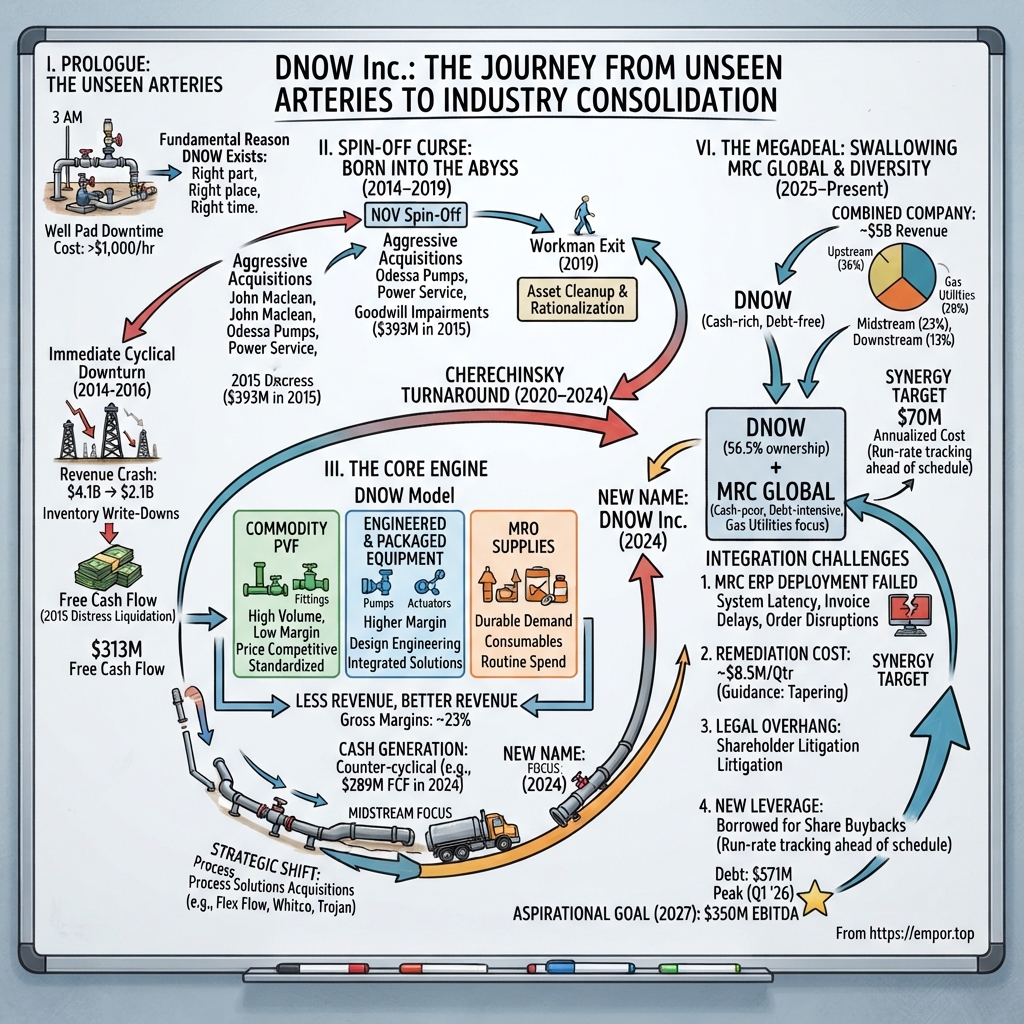
DNOW Inc.: The Arteries of Energy and the Great PVF Consolidation
I. Prologue & The Unseen Arteries of the Oilfield
Picture a well pad in the Delaware Basin at three in the morning. The drilling rig has moved on, the hydraulic fracturing crew is gone, and what remains is a quiet network of steel: a wellhead, a separator, several storage tanks, a flare stack, and hundreds of feet of pipe joined by flanges, gaskets, and valves. Few people photograph this part of the energy business. Investor presentations showcase towering rigs, offshore platforms, and liquefied natural gas export terminals glowing against the Gulf Coast sky. Yet if a single valve on that pad seizes or a gasket blows, production halts until a replacement arrives. The component itself might cost less than a nice dinner, but the deferred oil and gas can cost thousands of dollars for every hour the well sits idle.
That asymmetry—between how little a part costs and how much its absence costs—is the fundamental reason DNOW exists. DNOW does not drill wells, manufacture valves, or own pipelines. It is an industrial distributor of pipe, valves, and fittings (known across the trade as "PVF"), alongside pumps, measurement systems, electrical supplies, and packaged process equipment. The business earns its margin by placing the right part, with the required compliance documentation, in the right basin, before an operator incurs downtime.
The scale of the modern enterprise came into focus in 2025, when DNOW reported revenue of $2.82 billion, up 19% from the prior year, with $388 million generated from less than two months of owning its primary long-time rival.1 That competitor was MRC Global. DNOW agreed to acquire the company on June 26, 2025, in an all-stock transaction in which MRC shareholders received 0.9489 DNOW shares for each MRC share, valuing the deal at roughly $1.5 billion including MRC's net debt.2 The transaction closed on November 6, 2025.[^3] Today, the combined company operates roughly 350 service and distribution locations in more than 20 countries.2 By August 2026, management was guiding to full-year revenue of $5.0 billion to $5.1 billion for its first complete year as a combined business.[^4]
On paper, the deal represents a smaller player absorbing its chief competitor. Spun off in 2014 directly into one of the sharpest crude downturns in decades, DNOW spent much of its first six years retrenching, writing down goodwill, and closing branches. By 2024, it had restructured into a debt-free, cash-generating distributor whose leadership emphasized capital discipline and walking away from low-margin business. Then management redirected that conservative posture toward a transformative acquisition of MRC Global.
The integration brought immediate operational complications. In August 2025, weeks before shareholders voted on the transaction, MRC Global launched a new enterprise resource planning system in the United States—the core software backbone governing customer orders, inventory tracking, and billing.3 The deployment faltered. By February 2026, DNOW's chief executive officer told analysts that resolving the issues was "a much heavier lift than previously known," sending the stock down roughly 19% in a single trading session as shareholder litigation followed.45 A business long grounded in balance-sheet conservatism now carried debt, faced legal overhangs, and had to manage two distinct enterprise software platforms simultaneously, all while asking investors to trust that the combination would generate materially higher earnings than either firm produced alone.
This analysis examines that trajectory. It begins with the company's lineage, tracing roots that DNOW dates back to 1862 through National Supply, Oilwell Supply, Wilson, and National Oilwell Varco. It reviews the 2014 spin-off that arrived alongside falling oil prices, and the operational turnaround led by David Cherechinsky, a career finance executive who became chief executive officer. It assesses the acquisition strategy—including Flex Flow, Whitco, Trojan, and the combination with MRC Global—and evaluates the underlying competitive dynamics through Hamilton Helmer's 7 Powers framework and Michael Porter's Five Forces. Finally, it tests key investment claims against the company's operating record, addressing a central strategic question: has consolidation made DNOW a structurally superior business, or simply a larger operator in a cyclical industry?
Answering that requires returning to where the industry began: the logistical challenge of moving industrial iron to remote wellheads.
 Subscribe on LinkedIn
II. The Spinoff Curse: Born into the Abyss (2014–2019)
Iron for the oil patch
The oldest ancestor DNOW claims is an oilfield equipment business founded in 1862, only three years after Edwin Drake's well in Pennsylvania kicked off the American oil industry. From that root came Oilwell Supply in 1878, followed by National Supply in 1894 and Wilson Supply in 1921.6 These operations functioned as the general stores of the early oil patch, supplying wildcatters with pipe, rope, engines, and fittings—often on credit, and often in boomtowns that had not existed a year prior.
For most of the twentieth century, these supply houses were owned by steelmakers that treated them as captive distribution channels for their tubular goods. U.S. Steel bought Oilwell Supply in 1930, and Armco Steel acquired National Supply in 1958. In 1987, the two entities merged to create National Oilwell. The combined company went public in 1996 and subsequently merged with Varco in 2005 to form National Oilwell Varco, or NOV.6
NOV then initiated an aggressive acquisition push across the distribution landscape. In 2012, it acquired Wilson, the distribution business previously owned by Schlumberger, as well as CE Franklin, a Calgary-based distributor with 39 branches across western Canada. For CE Franklin, NOV agreed to pay C$12.75 per share, or approximately C$240 million, representing a 36% premium.67 By the conclusion of that buying campaign, NOV controlled one of the largest oilfield supply networks in North America.
Yet just two years later, NOV chose to separate the business. The rationale lay in the contrasting economics of manufacturing and distribution. NOV's core identity rested on engineered capital equipment: drilling rigs, top drives, and blowout preventers—high-margin machinery protected by proprietary designs and intellectual property. Industrial distribution was the structural opposite. It tied up substantial working capital in inventory and accounts receivable, generated thin operating margins, and diluted NOV's consolidated returns on capital. Spinning off distribution allowed NOV shareholders to retain a pure-play, high-margin equipment manufacturer while giving the distribution network the autonomy to fund its own expansion. That, at least, was the thesis.
The worst possible birthday
The spin-off took effect at 5:00 p.m. Eastern time on May 30, 2014. NOV shareholders received one share of the newly formed entity for every four NOV shares held, with regular-way trading commencing on the New York Stock Exchange on June 2 under the ticker "DNOW."8 Incorporated as NOW Inc., the enterprise operated commercially under the DistributionNOW and Wilson Export brands, fielding a global footprint of more than 300 branches and over 5,000 employees under the leadership of Robert Workman as president and CEO.8
Initial performance as an independent public company appeared strong. In its debut quarter, DNOW generated $952 million in revenue and $27 million in net income.9 For the full year 2014, revenue reached $4.1 billion.10 On an annualized basis, the distributor operated at the scale of an entrenched industry leader, projecting the profile of a platform poised to consolidate market share.
Instead, the spin-off marked the crest of an energy supercycle. Crude benchmarks began sliding in mid-2014 and dropped steadily into early 2016. Upstream operators responded by slashing drilling and completion budgets. Distributors absorbed the shock immediately, because exploration-and-production clients could cancel pipe orders far faster than they could choke back flowing oil wells. DNOW's top line fell to $3.0 billion in 2015 and slid further to $2.1 billion in 2016, erasing nearly half of the company's annual revenue base in twenty-four months.10
How a distributor bleeds
An industry downturn penalizes an industrial distributor through a specific mechanical trap. When upstream demand evaporates, the company is left holding warehouse yards of pipe, valves, and fittings purchased at peak inventory valuations. As prevailing steel prices decline, customers demand price cuts, forcing painful inventory write-downs on uninstalled iron. Meanwhile, the overhead required to support a boom-era distribution footprint—long-term facility leases, trucking fleets, counter staff, and remote yard crews—continues to burn cash whether an operator places an order or not.
Management responded with sweeping retrenchment. Between late 2014 and the end of 2015, DNOW cut roughly 1,200 legacy employees—about 23% of its non-acquired workforce—and closed or consolidated 46 branches, reporting that the measures removed $196 million in annualized costs.[^13] The accounting consequences were swift. DNOW recognized $393 million in goodwill impairments across 2015, split between $255 million in the third quarter and $138 million in the fourth, effectively wiping out the remaining goodwill in its U.S. reporting unit. Compounded by a $129 million after-tax valuation allowance against deferred tax assets, DNOW closed the fourth quarter of 2015 with a net loss of $249 million.[^13]
Here, however, emerged the defining cash dynamics of distribution: DNOW generated $313 million in free cash flow in 2015, even as its income statement registered steep accounting losses.[^13] When an industrial distributor contracts, it stops restocking inventory and collects outstanding customer receivables, liquidating its working capital back into cash. Consequently, a distributor's cash generation can appear most robust precisely when its underlying business activity looks most distressed.
Buying into the fall
This period complicates the view of DNOW as an inherently conservative capital allocator. Rather than preserving liquidity as commodity benchmarks plummeted, the young distributor embarked on an aggressive acquisition campaign. In the first half of 2015, DNOW closed four acquisitions totaling roughly $257 million, primarily expanding in the United States, the United Kingdom, and Norway.11 In March 2015, it acquired Scotland-based John Maclean & Sons Electrical for an undisclosed sum to extend its footprint into offshore electrical supplies.12 That summer, DNOW agreed to buy Odessa Pumps, a distribution and pump-service business operating across Texas and New Mexico, for about $170 million, closing the transaction on July 31, 2015, while agreeing in July to purchase Challenger Industries, which closed in the fourth quarter.11[^13] DNOW's 2015 annual report highlighted MacLean, Machine Tools Supply, North Sea Cables, Odessa Pumps, Challenger, and Oaasis among its additions that year,13 followed by the purchase of Power Service in 2016.10
Strategically, several of these purchases laid the groundwork for what would later become DNOW's higher-margin process solutions business, particularly in specialized pump systems. Operationally, the timing proved adverse. Spending in regions like the North Sea collapsed almost immediately, saddling DNOW's International segment with long-term operational headwinds. The aggressive deal pace also compromised liquidity: by the close of 2015, DNOW had drawn $108 million against its credit facility while holding just $90 million in cash.[^13] The notion that DNOW had always maintained a debt-free balance sheet was historically inaccurate; debt-free conservatism emerged during the subsequent Cherechinsky era, not at the company's inception.
Workman's exit
Revenue rebounded alongside drilling activity through 2017 and 2018, but the business struggled to consistently earn its cost of capital. On November 1, 2019, Workman stepped down as CEO and vacated his board seat, with director Dick Alario, the former head of Key Energy Services, stepping in as interim chief executive.14 Another major round of asset cleanup followed in the fourth quarter of 2019, when DNOW booked $81 million in additional goodwill impairments—$54 million in International and $27 million in Canada—along with a $38 million trade-name abandonment charge. The company also executed its first post-spin-off divestiture, selling its cutting-tools business for $28 million. By February 2020, DNOW had rationalized its footprint from 285 locations at year-end 2017 down to 225, with head count falling below 4,000 employees.[^18]
The Workman era closed with a sobering record. The company had acquired assets near a cyclical peak, written down substantial portions of the capital it deployed, and remained bound to volatile commodity cycles beyond its control. What survived, however, was an extensive branch network, enduring customer alignments across major oil basins, and an internal finance team that had managed through every write-down. One veteran of that finance leadership was about to take the helm.
III. The Core Engine: Segments, Unit Economics, & Working Capital
A day at the counter
Arriving at a DNOW branch in Odessa, Texas, before dawn reveals an environment that looks far more like an industrial depot than a technology business. Pickup trucks idle outside, field workers in flame-resistant coveralls wait at the service counter, racks display valves marked with specific part numbers, and the adjacent yard holds pipe organized by diameter, wall thickness, and metallurgy. In the back office, a logistics coordinator organizes a "hot-shot" run—a rapid, dedicated delivery of a single replacement part—to an active well pad two hours away. The workflow is devoid of glamour, yet replicating that local presence and rapid response at national scale remains difficult.
What DNOW actually sells
The company's product catalog is best understood across three distinct tiers.
The first and largest category is commodity PVF: carbon steel line pipe, fittings, flanges, gaskets, and manual valves. These components form the circulatory infrastructure of any fluid handling system. They represent high-volume, standardized merchandise where pricing tracks raw steel markets closely. Because one compliant flange is functionally identical to another, commercial buyers routinely pit competing distributors against one another on price.
The second tier comprises engineered and packaged equipment: specialized pumps, automated valves fitted with electric or pneumatic actuators, digital measurement stations, and pre-assembled equipment skids. A skid packages complex process equipment bolted onto a structural steel base, fully assembled and pressure-tested before shipment so field crews can install it immediately upon arrival. Here, customers pay for design engineering, modular assembly, and field labor reduction rather than raw tonnage. As a result, distributors tend to command higher gross margins on engineered packages because the customer is procuring an integrated operational solution rather than a commoditized part.
The third tier consists of maintenance, repair, and operating supplies—commonly grouped as MRO: personal safety gear, hand and power tools, electrical fittings, and routine job-site consumables. These are high-volume, lower-ticket stock-keeping units purchased repeatedly against operating budgets rather than major capital expenditure authorizations. That operational funding structure makes MRO demand more durable through drilling slowdowns than new-well capital spending.
DNOW does not disclose a granular revenue breakdown across these three product categories in its public financial filings. Consequently, market assumptions that engineered process solutions account for a fixed percentage of revenue while generating an outsized share of total gross profit cannot be verified from reported segment financials and should be treated as estimates. What the company does report regularly is its performance by geographic segment and, following the MRC Global transaction, its revenue mix by end market.
The three segments before the merger
In 2024, the final reporting year before the acquisition, DNOW posted revenue of $2.37 billion, virtually unchanged from 2023.15 Beneath that headline stability, however, the three geographic reporting segments diverged significantly:
- United States: Revenue rose to $1.88 billion from $1.75 billion, supported by the Whitco acquisition and resilient midstream project activity.
- Canada: Revenue declined to $253 million from $282 million.
- International: Revenue fell to $240 million from $290 million.15
Operationally, DNOW had already evolved into a predominantly domestic enterprise carrying a diminishing international footprint. Canadian results fluctuate with upstream budgets in the Montney formation, oil-sands turnaround cycles, and the seasonal logistics of frozen muskeg roads. The International segment depends on the lumpy procurement schedules of offshore North Sea and Middle Eastern projects. Both regions operate far from DNOW's primary logistics hub in the U.S. Gulf Coast.
The combination with MRC Global reinforced this domestic orientation. In the second quarter of 2026, the U.S. segment accounted for $1.11 billion of the combined company's $1.31 billion in consolidated revenue, while Canada contributed $47 million and International added $151 million.16 Across the domestic footprint, management reported an end-market distribution markedly different from legacy operations: upstream exploration and production accounted for 36%, gas utilities represented 28%, midstream infrastructure stood at 23%, and downstream refining and industrial facilities made up the remaining 13%.[^4] Regulated gas utilities had historically formed the core of MRC Global's business model. Following the merger, they represent more than a quarter of DNOW's domestic revenue.
Why distributors exist at all
Given that industrial distribution operates on modest operating margins, a persistent question is why oil and gas producers do not bypass distributors to buy directly from valve and pipe manufacturers. The economic justification emerges from the mismatched operational requirements on either side of the supply chain.
A valve manufacturer optimizes for manufacturing efficiency: long, uninterrupted production runs shipped in full truckloads to regional distribution centers. It is unequipped to deliver an individual two-inch ball valve to a remote pad in Reeves County in the middle of the night, manage 60-day trade credit for hundreds of small independent operators, or staff field representatives who maintain personal relationships with local lease operators.
Exploration-and-production operators require the opposite arrangement. They need small quantities of hundreds of disparate parts delivered on demand, accompanied by meticulous compliance documentation—specifically mill test reports certifying metallurgical properties and origin. Maintaining local warehouses in every operating basin or employing expansive internal procurement teams would impose prohibitive overhead on oilfield operators.
The industrial distributor bridges this gap. By aggregating demand, securing manufacturer volume discounts, maintaining field inventory near active basins, extending working-capital financing, and managing delivery logistics, the distributor absorbs the friction of the supply chain. Increasingly, distributors also oversee vendor-managed inventory, placing secure trailers or stocking supply rooms on customer properties and billing items only as field crews consume them. The distributor's gross margin—the spread between manufacturer wholesale costs and realized sales prices—funds this logistical infrastructure. DNOW reported gross margins of 23.7% in 2022 and 22.5% in 2024.1715 Following the integration of MRC Global, profitability shifted lower: the combined business posted an adjusted gross margin of 20.8% in the second quarter of 2026.[^4]
That compression carries strategic implications. Margin erosion in the wake of a merger justified by purchasing scale suggests practical boundaries to supplier leverage—a tension examined in Section VII.
The seesaw
This brings the analysis back to the cash generation paradox observed during the 2015 downturn. An industrial distributor's principal assets are inventory and customer receivables. Offset by accounts payable owed to equipment manufacturers, these balances dictate working capital requirements.
During cyclical expansions, working capital expands in tandem with sales. The distributor must procure inventory in advance of customer orders and fund extended payment terms on larger billing volumes, requiring cash outlays before booked profits materialize. When customer demand contracts, the mechanics reverse: management halts replenishment orders, liquidates existing inventory, collects outstanding receivables, and converts working capital into liquidity.
DNOW's financial record underscores this counter-cyclical dynamic. In 2020, as the pandemic hammered oilfield activity, revenue dropped 45% to $1.62 billion and the company posted a net loss of $427 million; yet year-end cash balances surged to an unprecedented $387 million with zero long-term debt, up from $183 million the prior year.18[^18] Conversely, when revenue rebounded 31% to $2.14 billion in 2022, management noted that the business expanded "without consuming cash from operations"—a milestone that highlighted operating cash flow was essentially breakeven during an energy upcycle.17 In 2024, when top-line growth flattened, free cash flow climbed to $289 million, an outcome Cherechinsky noted was "nearly twice our projections."15
For investors, annual free cash flow reflects where an industrial distributor sits within the commodity cycle rather than its underlying earnings power. A comprehensive evaluation requires measuring cash conversion across an entire multi-year cycle, assessing cumulative free cash flow relative to operating EBITDA rather than relying on single-year results. A distributor generating substantial cash during an industry slump is largely monetizing its balance sheet. Demonstrating positive cash generation while funding top-line growth is the far more rigorous operational test.
DNOW's executive team understood this cash dynamic thoroughly. The strategic question after 2019 was whether finance-trained leadership could leverage that operational discipline to build a more durable enterprise.
IV. The Cherechinsky Turnaround: From Pipe Peddler to Process Solutions (2020–2024)
The accountant takes the chair
In the spring of 2020, the oilfield came close to a complete standstill. As pandemic lockdowns emptied highways and crude storage neared capacity, operators halted drilling programs almost overnight. DNOW recognized $320 million in impairments against goodwill, intangibles, and long-lived assets in the first quarter alone. Within months, the company reduced its workforce by 1,250 employees to roughly 3,150 people and sold or closed 25 locations in a single quarter.[^23]
On June 1, 2020, amid that severe retrenchment, the board named David Cherechinsky president and chief executive officer, effective immediately, with interim chief executive Dick Alario transitioning to executive vice chairman.19
Cherechinsky did not fit the archetype of a glad-handing oilfield dealmaker. He joined NOV in 1989 and spent his career in finance, rising to vice president of finance for NOV's distribution and transmission segment. After the 2014 spin-off, he served as DNOW's corporate controller and chief accounting officer from February 2014 to February 2018, then as chief financial officer until his elevation to CEO.1920 A certified public accountant,20 he brought a balance-sheet perspective to operational leadership. On his first earnings call as CEO, he noted that it was his thirty-second year with the company and his first in the top job, adding that he had hired his successor as CFO, Mark Johnson, twelve years earlier.[^26] Johnson, too, was an internal finance veteran who had served as DNOW's chief accounting officer and corporate controller.19
The distributor was now led by two career accountants who had personally tabulated and booked the write-downs of the preceding six years. That institutional memory informed the operating philosophy that followed. On the same call, Cherechinsky gave the turnaround its operating doctrine, declaring that the company was being resized for an energy market that was "not lower for longer, but lower forever." At the time, DNOW held $269 million in cash with zero debt, marking its strongest net cash position since the spin-off.[^26]
The doctrine: less revenue, better revenue
The core premise of the turnaround was straightforward: sacrifice unprofitable volume to build a healthier business. For years, distributors had chased top-line scale through low-margin line-pipe contracts—large orders shipped directly from steel mills where the distributor absorbed credit and counterparty risks for razor-thin markups. Cherechinsky moved to curtail low-return commitments, close underperforming branches, and reallocate working capital toward product categories where DNOW could command better pricing.
The footprint reflected that discipline. By the end of 2020, DNOW operated roughly 195 locations with 2,450 employees, down from 225 locations and just under 4,000 workers in early 2020.18[^18] Revenue in 2021 fell to $1.63 billion—less than half its 2014 level—yet the business carried far lower fixed overhead.1710 By 2022, DNOW returned to revenue growth without burning cash, turning its working capital about seven times a year and generating a 23.7% gross margin.17 Net income reached $247 million in 2023, though that total was inflated by a $126 million release of a tax valuation allowance—an accounting credit rather than cash operating profit that should be set aside when assessing normalized earnings.15
A critical perspective is essential here: much of this financial recovery coincided with a broader industry upswing. U.S. drilling activity rebounded from 2021 through 2023, and supply bottlenecks alongside steel-price inflation lifted margins across the distribution sector. Separating internal operating gains from cyclical momentum is challenging. The clearest evidence of structural change arrived in 2024: revenue remained flat, yet EBITDA excluding other costs held at $176 million, or 7.4% of revenue, and cash generation set a company record.15 That resilience indicated that a leaner cost base, rather than market tailwinds alone, was protecting margins.
The pivot to process solutions
The second pillar of the turnaround was an intentional shift toward engineered products. After 2015, DNOW largely halted acquisitions of traditional branch networks. Whitco Supply, detailed in the following section, was the company's first acquisition of a traditional U.S. "energy centers" branch network since 2015, following ten consecutive transactions in process solutions.[^27] Those deals focused primarily on specialized pumps, fluid handling, and emissions-reduction hardware. In December 2022, for example, DNOW spent $59 million on two acquisitions that added greenhouse-gas emissions-reduction technology and expanded its pump offering.17
The strategic rationale centers on customer retention and pricing power. When an operator buys an engineered water-transfer package or a vapor-recovery unit, it is purchasing a functional solution: reduced flaring, regulatory compliance, or reliable fluid transport. Because these skid-mounted systems require custom engineering and integration, the purchase cannot easily be rebid on price alone like a pallet of commodity flanges. In theory, that dynamic fosters stickier commercial relationships and supports higher margins.
The constraint on this narrative is one of scale. DNOW does not disclose process-solutions revenue separately in its financial filings, and upstream exploration and production remains its largest single domestic customer segment. Process solutions function as a margin-enhancing layer atop a traditional PVF business, not a standalone substitute for it.
New name, same pipes
On January 9, 2024, the company announced it would change its legal name from NOW Inc. to DNOW Inc., effective January 19, while keeping its NYSE ticker.21 Management framed the change as aligning the corporate entity with its recognized trade brand and signaling aspirations beyond the oil patch. On the first-quarter 2024 earnings call, Cherechinsky said the updated logo represented "seeds planted in 1862 when we were founded."[^27]
Rebranding is straightforward; the more demanding test of management's vision lay in how it deployed the capital accumulated across four years of strict balance-sheet discipline. That shift moved DNOW from internal operational restructuring to aggressive industry consolidation.
V. Capital Allocation & The M&A Playbook: Flex Flow, Whitco, and Balance Sheet Purity
The fortress
Throughout the Cherechinsky era, DNOW's balance sheet served as its defining corporate signature. At the close of 2021, 2022, 2023, and 2024, the company operated without funded debt while carrying cash balances ranging between $212 million and $313 million.1715[^29] That profile stood out in an industrial distribution sector where peers routinely relied on debt facilities to finance inventory and chase top-line expansion. Competitor MRC Global, by comparison, carried a $350 million term loan drawn in October 2024 to redeem its preferred stock.22
The strategic rationale behind DNOW's liquidity reserve was simultaneously defensive and opportunistic. In an industry downturn, an unencumbered balance sheet meant no senior lender could force asset liquidations or restrictive covenants. In an upswing, liquidity provided the capacity to acquire assets from distressed competitors. The ultimate test of that framework, however, lay in how effectively management deployed the accumulated capital.
Case study 1: Flex Flow, the rental wedge
In April 2021, as oilfield activity began a tentative post-lockdown recovery, DNOW completed the purchase of Flex Flow from GR Energy Services for $90 million in cash alongside contingent consideration.23 Flex Flow specialized in horizontal pumping systems, or H-pumps: multi-stage centrifugal pumps mounted horizontally on mobile trailers to inject, transfer, and dispose of high-pressure fluid. At closing, the business operated a fleet of roughly 240 trailer-mounted units deployed for rent, sale, and field service across the Permian, SCOOP/STACK, Haynesville, Bakken, and Montney basins.23
The transaction diverged from DNOW's traditional distribution model in key respects. Unconventional shale wells produce substantial volumes of subterranean brine alongside crude oil and natural gas, water that operators must collect, transport, and reinject for the entire producing life of the asset, regardless of whether new wells are actively being drilled. A pump fleet earning monthly rental fees on produced-water handling tracks existing well maintenance rather than new drilling budgets, insulating revenue from sudden swings in rig counts. The rental model also generated recurring cash flows rather than transactional, one-off supply sales.
Assessing the investment's standalone financial return remains difficult because DNOW does not report Flex Flow's financial results separately in its public filings, leaving the ultimate return on that $90 million investment unverified. Operationally, however, leadership continued to build around water infrastructure. In November 2024, DNOW announced the acquisition of Trojan Rentals, a provider of mobile pump rentals, automated transfer systems, and layflat hose for water sourcing, transfer, recycling, and disposal, for $114 million in cash.2415 By 2026, management characterized its broader Water Solutions platform as an annualized business generating between $100 million and $150 million.[^4] While commercially viable, that volume still represented a modest share of a consolidated revenue base targeting $5 billion.
Case study 2: Whitco, midstream on the cheap
On February 6, 2024, DNOW announced an agreement to acquire Whitco Supply in an all-cash transaction. Founded in 2003 by the Dawes family and based in Broussard, Louisiana, Whitco operated eight supply branches staffed by roughly 230 employees.25 The transaction closed on March 12, 2024.26 On DNOW's first-quarter 2024 earnings call, Cherechinsky disclosed a purchase price of approximately $185 million, describing the valuation multiple as "in the 5, 6 range" and noting that midstream infrastructure—including pipeline networks, compressor stations, and gas-processing plants—generated 60% to 80% of Whitco's revenue.[^27]
That transaction multiple represents management's characterization. Because neither the baseline EBITDA nor a formal peer benchmark was disclosed in public filing documents, the investor thesis that Whitco was acquired at a steep discount to prevailing public-market multiples remains plausible but unverified. The industrial logic, however, was evident. Whitco expanded DNOW's midstream distribution reach precisely as capital spending on natural gas infrastructure accelerated, driven by Gulf Coast liquefied natural gas export terminals and power demand for artificial intelligence data centers. By mid-2026, management reported that midstream revenue for the combined company had surpassed a $1 billion annualized run rate for the first time.[^4] While Whitco alone did not account for that volume, the deal positioned DNOW in front of a structural spending cycle.
Management outlined this framework on the fourth-quarter 2023 earnings call, ranking capital priorities as organic reinvestment first, accretive strategic acquisitions second, and share repurchases third. Cherechinsky told analysts that DNOW remained "highly acquisitive, looking for quality companies that meet our financial requirements," adding that fourth-quarter buybacks totaled just $1 million because the company "was saving up for that purchase."[^29]
Buybacks: the modest channel
DNOW adopted share repurchases late and with restraint. The board authorized the company's first share repurchase program on August 3, 2022, approving an $80 million authorization running through year-end 2024.27 Actual repurchases totaled $50 million across 2023.[^29] In January 2025, the board expanded the authorization, establishing a new $160 million repurchase program that doubled the scope of the original mandate.28
This cautious pace drew scrutiny from market observers. Between 2021 and 2024, DNOW generated strong operating cash flows and held several hundred million dollars in liquidity on its balance sheet, returning only a small portion directly to equity holders. A conventional capital-allocation critique argued that holding substantial uninvested cash during an inflationary period depressed overall returns on invested capital.
Management countered that maintaining dry powder preserved the balance-sheet capacity to execute an industry-shaping combination without relying on debt to fund the purchase price. In practice, that defense was only partially realized. The acquisition of MRC Global was structured as an all-stock transaction rather than a cash purchase, and DNOW was ultimately required to arrange substantial new credit facilities to refinance MRC's outstanding indebtedness. The liquidity reserve provided a balance-sheet cushion during integration rather than the cash to fund the takeover.
Skin in the game and what gets paid for
Executive compensation structures offer insight into how management evaluated corporate priorities. Under the incentive plan disclosed in the 2025 proxy statement, annual cash bonuses were weighted 70% toward adjusted EBITDA targets and 30% toward working capital as a percentage of revenue. Long-term performance-based share awards were tied 50% to relative total shareholder return against an industrial peer group, 25% to EBITDA growth, and 25% to return on capital employed. Executive ownership policies required the CEO to hold shares equivalent to six times base salary.20 As of March 2026, Cherechinsky held 1,163,864 shares along with options, and his total reported compensation for 2025 stood at approximately $7.1 million.29
This compensation framework established mixed incentives. Rewarding working-capital efficiency aligns directly with the operating demands of industrial distribution, incentivizing managers to maintain lean inventories and minimize uncollected receivables. Similarly, tying long-term awards to return on capital employed penalizes value-destructive dealmaking. However, absolute EBITDA serves as the predominant performance metric across both short- and long-term programs. Because consolidating two major distributors doubles the top line and mechanically inflates consolidated EBITDA, absolute earnings targets can trigger higher compensation payouts even if returns on a per-share basis dilute. Evaluating how the board adjusts post-merger baseline performance metrics in subsequent proxy disclosures remains essential for assessing executive alignment.
The verdict on discipline
DNOW's capital allocation under Cherechinsky demonstrated greater discipline than the 2014–2019 era, though its execution was not without compromise. The aggressive 2015 acquisitions occurred near the peak of a cycle and ultimately required heavy impairments. The subsequent transactions—Flex Flow, targeted fluid-handling and emissions acquisitions, Whitco, and Trojan—proved more modest in size, lower in valuation, and strategically focused on midstream and process solutions, even if individual asset returns remained obscured in consolidated reporting. Meanwhile, capital returns through repurchases remained secondary.
The central premise—that years of balance-sheet austerity positioned DNOW to lead an industry consolidation on favorable terms—was validated by the decision to absorb MRC Global. Yet the execution of that transaction simultaneously dismantled the very structure that enabled it: the debt-free fortress balance sheet was retired to bring the rival inside. How DNOW navigated that fundamental trade-off is the central focus of the following section.
VI. The Megadeal: Swallowing MRC Global & The Duopoly Consolidation (2025–Present)
The other family
Understanding the enterprise DNOW absorbed requires tracing its roots back to Charleston, West Virginia, on February 15, 1921. That was the day Jerry McJunkin founded McJunkin Supply to serve the Appalachian gas fields. More than half a century later, in 1977, Lew Ketchum established Red Man Pipe & Supply in Tulsa. The two entities merged in July 2007, backed by Goldman Sachs Capital Partners, to form McJunkin Red Man, which was later rebranded as MRC Global.30
MRC evolved along a different path than DNOW. Its primary commercial foundation became gas utilities—the local distribution companies managing subterranean pipeline networks under municipal streets, driven by regulated pipe-replacement mandates. In 2024, MRC generated $3.01 billion in sales, with gas utilities contributing $1.10 billion, or 37%. Downstream, industrial, and energy transition projects generated $970 million, while production and transmission infrastructure accounted for $943 million.22
This complementary footprint formed the core industrial rationale for the merger. While legacy DNOW concentrated on upstream exploration and midstream infrastructure alongside an expanding process-solutions offering, MRC brought entrenched relationships with gas utilities and refining facilities—counterparties governed by predictable maintenance cycles and regulatory mandates. On paper, the combined enterprise offered greater insulation from commodity cycles than either distributor could sustain independently.
MRC had also navigated significant corporate restructuring in the months preceding the sale. In April 2024, the distributor entered into a cooperation agreement with activist hedge fund Engine Capital, appointing Engine's Daniel Silvers to its board.31 In October 2024, MRC repurchased all of its convertible preferred stock, which had remained outstanding since 2015, for $361 million, financed primarily through a newly arranged $350 million term loan.22 By December 2024, it agreed to divest its Canadian distribution business to Emco.32 In corporate finance, a firm that streamlines its capital structure, accommodates an activist shareholder on its board, and carves out peripheral foreign operations is typically preparing for a sale.
The deal
On June 26, 2025, DNOW and MRC Global announced their merger.2 The primary terms included:
- Consideration: MRC shareholders received 0.9489 DNOW shares per MRC share, representing an 8.5% premium to MRC's 30-day volume-weighted average price.
- Ownership: On a fully diluted basis, legacy DNOW shareholders owned approximately 56.5% of the combined company, with MRC shareholders holding roughly 43.5%.
- Transaction value: The combined enterprise value totaled approximately $3.0 billion.
- Synergies: Management targeted $70 million in annualized pre-tax cost synergies within three years of closing, projecting double-digit accretion to adjusted earnings per share in the first year.
- Leadership and governance: Cherechinsky remained CEO, Johnson CFO, and Alario chairman, with the board expanding from eight to ten directors to incorporate two representatives from MRC.2
The synergy target warrants scrutiny, as external market commentary frequently misquotes it as a range of $60 million to $80 million across two years. Management's official baseline was $70 million realized annually within three years of closing.2 Relative to a combined top line of roughly $5 billion, that target represents approximately 1.4% of sales—a meaningful increment for an industrial distributor operating with mid-single-digit EBITDA margins, but hardly a transformative windfall.
Regulatory review proceeded without friction. Both companies submitted their Hart-Scott-Rodino notifications on August 1, 2025, and the statutory waiting period expired on October 6 without a second request for information from antitrust authorities.3334 That clearance reflected the fragmented landscape of the broader industrial supply sector: federal regulators did not view the combination of the two largest energy PVF distributors as creating dominance in any relevant market. That outcome provides an important reality check on assertions that the merger created an unassailable monopoly with unfettered pricing power.
The shareholder vote on September 9, 2025, passed decisively, with 94.8 million DNOW shares voted in favor of issuing the transaction equity and just 38,288 against.35 Ahead of the meeting, several shareholder lawsuits alleging deficient proxy disclosures were filed, prompting DNOW to issue supplemental disclosures that mooted the complaints.36
The ERP time bomb
The integration encountered a severe operational disruption almost immediately. In industrial distribution, an enterprise resource planning system functions as the operating central nervous system: every customer order, warehouse pick ticket, physical shipment, billing invoice, and vendor payment flows through it. Replacing that core architecture while maintaining ongoing commercial fulfillment is notoriously perilous.
MRC initiated its U.S. ERP rollout in August 2025, seeking to replace a legacy mainframe architecture that had operated for more than three decades. In its third-quarter 2025 regulatory filing, MRC disclosed "significant, unexpected challenges" that disrupted order processing, shipping logistics, system integrations, and timely customer invoicing, contributing to a $120 million sequential decline in revenue from the second quarter. The company also identified a material weakness in internal controls over inventory cycle counts and concluded that its disclosure controls were not effective.3 For that quarter, MRC reported sales of $678 million, down 15% from the preceding three months.37
DNOW's initial public commentary struck an optimistic tone during its third-quarter 2025 earnings call on November 5, 2025, the day before the transaction closed. Vice President of Investor Relations Brad Wise characterized MRC's new software as "a state-of-the-art system." Cherechinsky indicated that MRC had framed the disruption "as an isolated onetime event," adding, "We see it as a moment in time and recoverable."[^46]
That confidence eroded three and a half months later. Reporting fourth-quarter 2025 financial results on February 20, 2026, DNOW pointed to "persistent challenges related to the U.S. MRC Global ERP system transition" and withheld full-year financial guidance.38 Addressing analysts on the call, Cherechinsky acknowledged that the integration hurdles represented "a much heavier lift than previously known." He detailed a software platform that suffered from pervasive latency, degraded customer service, demanded extensive manual interventions, and compelled the distributor to carry elevated safety stock. At its worst, Cherechinsky disclosed that processing certain legacy supplier invoices required up to 20 minutes each.4 Impaired by these operational snarls and inventory valuation adjustments, DNOW's GAAP gross margin dropped to 7.1% in the fourth quarter against an adjusted gross margin of 22.6%, driving a quarterly net loss of $147 million.1
The repair job
Management responded with aggressive operational triage. DNOW deployed more than 200 additional field personnel alongside a dedicated help desk and initiated an emergency migration of MRC's upstream and midstream branches onto DNOW's established SAP platform. By July 2026, the company had converted 17 distribution facilities—sites that Cherechinsky noted internal staff colloquially described as having been "liberated."[^4] Leadership estimated the direct cost of the remediation at approximately $8.5 million per quarter, guiding that these expenses would decline by roughly $1 million in each of the third and fourth quarters of 2026.[^4]
The commercial fallout across MRC's legacy accounts was substantial. During the first-quarter 2026 earnings presentation, management disclosed that MRC's domestic revenue had fallen by $94 million, or 16%, compared to the prior-year period. Approximately three-quarters of that decline was concentrated in upstream and downstream accounts, with "nearly all" the attrition centered among roughly two dozen major customer accounts.[^48] Regulated gas utilities, by comparison, proved far more resilient, logging a 15% sequential revenue increase in the second quarter of 2026.[^4] Rebuilding commercial relationships with alienated upstream and downstream operators required price concessions; as Cherechinsky told an analyst, regaining lost business required offering "teaser level margins to get back in the door."[^4]
Cash, debt, and the end of the fortress
The merger brought an end to DNOW's debt-free era. At closing, MRC's existing asset-based loan facility and term loan were repaid and terminated.39 DNOW replaced those obligations with an $850 million asset-based revolving credit facility led by Wells Fargo, maturing in November 2030.40 Consequently, DNOW exited 2025 carrying $411 million in funded debt, having entered the year with none.40 Full-year operating cash flow in 2025 totaled $155 million against $21 million in capital expenditures, leaving free cash flow of approximately $134 million—a sharp contraction from the $289 million generated in 2024.4015
Funded debt peaked at $571 million at the end of the first quarter of 2026, as inventory imbalances and delayed billing cycles pushed operating cash flow to negative $95 million.[^48] Concurrently, DNOW directed a record $50 million toward share repurchases. Cherechinsky acknowledged that this marked the first time the company had incurred debt to finance buybacks, justifying the move as taking advantage of "this deep valuation gap caused by the stock market's reaction to our ERP conversion challenges."41
Operating cash flow rebounded in the second quarter of 2026. The distributor posted a record $133 million in operating cash flow and $124 million in free cash flow, allowing DNOW to reduce total debt to $474 million and net debt to $360 million, bringing leverage down to 1.7 times EBITDA.42 Working capital metrics improved in tandem: days sales outstanding dropped from 69 to 62 days, and working capital normalized to 19.4% of revenue.[^4] In August 2026, management raised full-year revenue guidance to between $5.0 billion and $5.1 billion, with an expected EBITDA margin approaching 4.5%.[^4]
Myth vs. reality: the "$5.5 billion-plus" combination
A popular narrative during the announcement framed the transaction as creating an industrial distribution powerhouse with $5.5 billion to $6.0 billion in pro forma annual revenue. Disclosed operating results tell a more modest story. MRC's 2024 revenue base of $3.01 billion included its Canadian distribution business, which was subsequently divested,22 while its domestic volume contracted during the ERP disruptions.[^48] Management's projected 2026 revenue guidance of $5.0 billion to $5.1 billion serves as the more reliable operational anchor. Furthermore, the anticipated 2026 EBITDA margin of roughly 4.5% remains well below the 7.4% margin DNOW earned on its own in 2024.[^4]15
In practical terms, in its first full year as a merged enterprise, DNOW is substantially larger but less profitable per dollar of sales than it was as an independent business. The overarching investment case now depends on closing that profitability spread. While management has characterized achieving $350 million in EBITDA by 2027 as "plausible," executives have explicitly emphasized that this figure does not represent formal guidance.[^4] Whether that target is credible depends on the structural dynamics examined in the following section: what specific competitive advantages, if any, provide this combined business with durable pricing power and defensible margins?
The lawsuit
The transaction also introduced an unresolved legal overhang. On April 28, 2026, shareholder rights law firm Hagens Berman announced an investigation into whether DNOW had understated the severity of MRC's ERP conversion issues, pointing to the roughly 19% single-day stock decline that followed the February 2026 earnings release.5 A securities class action lawsuit was subsequently filed on behalf of DNOW shareholders who held stock as of the August 5, 2025 record date for the merger vote. The complaint alleges that the joint proxy statement "negligently understated" the operational risks and disruption posed by MRC's software deployment, establishing a deadline of October 2, 2026, for lead plaintiff motions.43
A text search of the filed joint proxy statement and prospectus for the terms "ERP" and "enterprise resource" yields no matches.33 In its Form 10-Q for the second quarter of 2026, DNOW did not specifically single out the lawsuit, stating that no pending legal proceedings were expected to have a material adverse effect on its financial condition.16 While disclosure lawsuits under Section 14(a) of the Securities Exchange Act are routine after public mergers and often result in dismissals or modest settlements, this litigation remains anchored to documented operational failures and sharp divergences in management's public statements between November 2025 and February 2026, making it an overhang that warrants ongoing monitoring.
VII. 7 Powers, Porter's 5 Forces, & The Historical Falsification Layer
The war room
Picture a procurement director at a major Permian producer—one of the consolidated operators running thousands of active wells. The two largest PVF distributors in her supply chain have just combined into a single entity. Her response is neither surprise nor panic. Instead, she convenes her category team with three specific directives: compile an inventory of every stock-keeping unit where the merged distributor is now the sole qualified supplier, secure competing quotes from regional distributors for each line, and draft a revised rebate schedule that reflects the operator's expanded purchasing leverage.
That exercise captures how DNOW's competitive moat actually functions. The company's defensive perimeter is not built against Silicon Valley startups or digital aggregators; it is built to withstand the purchasing departments of sophisticated, cost-conscious energy producers.
Hamilton Helmer's 7 Powers
Applying Hamilton Helmer's 7 Powers framework clarifies the structural boundaries of industrial distribution:
Scale economies: real, but on the cost side. The combined company procures more PVF than any other energy distributor in North America, generating volume rebates from manufacturers, fuller truckloads, and higher throughput across its distribution centers. Synergy tracking provides concrete evidence of these efficiencies: management raised its estimate of first-year synergies from $17 million at announcement to $23 million in February and approximately $30 million by May 2026, characterizing the revision as "a full pull forward of timing rather than a change in scope" while keeping the three-year target of $70 million unchanged.[^48]1 Yet while procurement scale reduces internal operating costs, it does not translate into pricing power over end customers.
Switching costs: moderate. DNOW embeds its digital product catalogs directly into customer enterprise resource systems, while trailer-mounted inventory and on-site consignment programs make it the default supplier on remote pads. However, the ERP disruption served as a real-time test of customer stickiness. When MRC's order fulfillment faltered, roughly two dozen major accounts shifted their purchasing to competing distributors quickly enough to drive a 16% year-over-year decline in MRC's domestic revenue.[^48] Customers who can redirect procurement volumes that swiftly are not structurally locked in.
Process power: moderate. Coordinating hundreds of thousands of stock-keeping units, tracking metallurgical mill test reports, executing emergency hot-shot deliveries, and stocking remote yards requires decades of accumulated operational expertise. Conversely, MRC possessed that same domain know-how and still stumbled during its system migration, illustrating how vulnerable process power becomes when the underlying software infrastructure breaks down.
Cornered resource, network economies, counter-positioning, branding: weak or absent. DNOW owns no proprietary extraction technology or exclusive mineral rights. Adding another exploration-and-production client creates no direct network utility for existing customers. As an entrenched incumbent rather than an insurgent challenger, the company cannot employ counter-positioning, while in the PVF sector, branding serves primarily as a baseline check for commercial reliability rather than a driver of premium pricing.
The strategic verdict: DNOW's structural advantages are rooted in cost-side purchasing scale and logistics reliability. Neither confers meaningful pricing power over large commercial buyers.
Porter's Five Forces
Michael Porter's Five Forces framework confirms a demanding industry landscape:
Buyer power: high. Upstream operator consolidation has concentrated purchasing authority among fewer, larger producers, while regulated gas utilities procure materials through formal competitive tenders tied to public budgets. These counterparties possess both the incentive and the logistical sophistication to multi-source their requirements across multiple vendors.
Supplier power: moderate. Standard line pipe and commodity fittings are produced across dozens of domestic and international steel mills, though trade policy introduces operational friction. In its second-quarter 2026 filing, DNOW highlighted the impact of tariffs under Sections 232, 301, and 122 of trade statutes, reporting that the company "successfully collaborated with our customers to implement tariff pass-throughs" even as selected downstream capital projects faced delays or cancellations.16 Specialized valve manufacturers and actuation producers command greater pricing leverage than commodity steel mills, but the supplier base remains broadly competitive.
Threat of substitutes: low. Hydrocarbons and industrial fluids require physical conveyance through steel and alloy infrastructure. There is no digital or chemical substitute for a pipe, a valve, or a flange.
Threat of new entrants: low to moderate. Building a nationwide distribution footprint backed by approximately $1 billion in inventory—DNOW's carrying balance at mid-2026—imposes prohibitive capital hurdles on potential startups.[^4] However, regional distributors do not need to replicate a national branch network to compete effectively; they need only capture high-volume lines and key customer relationships within specific basins.
Rivalry: moderate. While the merger eliminated DNOW's primary public rival, the broader competitive field remains active. In 2013, Sumitomo Corporation acquired Edgen Group, the parent of pipeline distributor Edgen Murray, for $12 per share following Edgen's $2.06 billion in 2012 sales.44 Broadline industrial distributors, regional supply houses, and direct-from-mill manufacturer programs continually compete for regional volume. Tellingly, neither DNOW's 2025 Form 10-K nor MRC's 2024 Form 10-K listed specific competitors by name,4022 underscoring that competition is dispersed across a fragmented trade landscape rather than concentrated in a formal oligopoly.
The falsification layer
Strategic frameworks provide a conceptual starting point, but evaluating an investment thesis requires testing its core premises against empirical operating results. Testing the three foundational claims of the bull case against DNOW's historical disclosures reveals significant tension between theory and practice:
Claim 1: "Scale gives the combined company pricing power and expanding gross margins."
The mechanism that invalidates this claim is customer multi-sourcing: large operators split procurement across multiple suppliers and rebid supply contracts whenever a distributor attempts to push through margin increases.
Disclosed results contradict the thesis of structural margin expansion. DNOW reported gross margins of 23.7% in 2022 and 22.5% in 2024, which contracted to an adjusted gross margin of 20.8% in the second quarter of 2026 following the integration of MRC Global.1715[^4] During the first quarter of 2026, management acknowledged margin compression as MRC lagged in recovering tariff, freight, and procurement cost increases, compelling the distributor to offer "teaser level margins" to win back alienated customers.[^48][^4] Furthermore, antitrust regulators allowed the statutory waiting period to expire without issuing a second request, indicating that federal authorities viewed the energy PVF market as unconcentrated and competitive.34
Verdict: narrowed. Purchasing scale delivers demonstrable cost synergies that are running ahead of initial schedules, but it does not afford pricing power over large commercial buyers. The metric that would refute this finding is adjusted gross margin returning to and sustaining levels above DNOW's pre-merger performance once ERP remediation concludes.
Claim 2: "Process solutions, water, and new markets like data centers insulate DNOW from upstream volatility."
The mechanism that invalidates this claim is commercialization lag: emerging end markets expand at a measured pace and remain too small to counterbalance the core cyclical energy business.
Public disclosures show modest absolute contributions from non-traditional lines. Management increased its full-year 2026 data-center revenue forecast from approximately $30 million in May to between $40 million and $50 million in August, alongside characterizing Water Solutions as generating between $100 million and $150 million on an annualized basis.[^48][^4] Measured against full-year revenue guidance of $5.0 billion to $5.1 billion, data-center sales represent roughly 1% of consolidated turnover, while upstream oil and gas remains the company's single largest domestic end market.[^4] The meaningful operational diversification DNOW achieved stemmed from acquiring MRC's regulated gas-utility portfolio, not from organic growth in transition verticals.
Verdict: intact but unproven. Emerging markets provide commercial optionality, but they do not yet serve as primary earnings drivers. The evidentiary threshold for this claim requires multi-year disclosure demonstrating process-solutions and water revenues growing faster than the core distribution network through an upstream drilling contraction.
Claim 3: "Acquisition discipline preserves balance-sheet strength."
The mechanism that invalidates this claim is operational integration failure compounded by financial leverage.
The evidence is decidedly mixed. Structuring the MRC transaction as an all-stock merger prevented the direct addition of purchase-price debt, but DNOW refinanced MRC's existing debt, shifting from a zero-debt position to peak funded debt of $571 million in the first quarter of 2026 while borrowing to repurchase shares for the first time in corporate history.[^48]41 This mirrors the legacy pattern from 2015, when an acquisition spree ahead of a market downturn culminated in $393 million in goodwill write-downs.[^13] The combination with MRC created $435 million in goodwill, revised upward from an initial $383 million estimate.1640
Verdict: narrowed. A net leverage ratio of 1.7 times EBITDA remains manageable, particularly in light of second-quarter operating cash generation.42 However, the pre-merger characterization of a debt-free "fortress" balance sheet no longer applies, and historical precedent demonstrates that goodwill booked during market reorganizations can prove vulnerable to impairment. The trigger that would falsify management's record of capital discipline is any impairment of MRC-related goodwill; conversely, the confirming evidence would be funded debt trending back toward zero while realizing the targeted $70 million in annualized synergies.
Each of these verdicts ultimately traces back to executive judgment and operational execution, making management credibility the critical factor to evaluate next.
VIII. Management Credibility, Incentives, & The Governance Stress Test
Three calls, three tones
Reviewing DNOW's earnings calls across eighteen months reveals a marked shift in executive posture.
On the fourth-quarter 2023 call in February 2024, Cherechinsky struck an assertive tone. He described 2023 as "our best year yet," guided to 2024 free cash flow of up to $150 million, and framed Whitco as a way to "bring together 2 highly complementary businesses and expand DNOW into the midstream space."[^29] DNOW went on to generate $289 million in free cash flow in 2024, nearly doubling that initial guidance.15 On its core operations, leadership established a track record of setting conservative targets and exceeding them.
On the third-quarter 2025 call in November, the day before the merger closed, Cherechinsky adopted a reassuring stance. He relayed MRC's characterization that its ERP disruptions were "an isolated onetime event" and maintained that DNOW viewed them as "a moment in time and recoverable," while Vice President of Investor Relations Brad Wise described the software as "a state-of-the-art system."[^46] Although evaluating an operational backbone DNOW did not yet control, management chose to publicly endorse its target's assessment.
On the fourth-quarter 2025 call in February 2026, that posture turned into sobering candor. Cherechinsky acknowledged that resolving the software disruption was "a much heavier lift than previously known," withheld full-year financial guidance, and conceded that "we are not really sure when the resolution happens."4 While management addressed the operational disruption directly once the breakdown materialized and outlined specific remediation measures, the sharp divergence from its November commentary sits at the center of the credibility debate and forms the factual core of subsequent shareholder litigation.
The operating record indicates that leadership ran legacy DNOW with precision, but underestimated the systemic friction inside the business it acquired. It then swung from public reassurance to sharp retrenchment, withdrawing guidance entirely in February 2026 before reinstating it in May.[^48] Consequently, leadership's credibility now rests on whether its post-crisis commitments—specifically reducing quarterly remediation expenses by roughly $1 million per quarter, migrating remaining branch locations onto SAP, and hitting targeted working-capital releases—are achieved on schedule.[^4]
The activist's memo
If a skeptical activist shareholder were assessing DNOW's post-merger footprint, the critique would likely center on three operational and strategic friction points.
First, working capital redundancy. Operating two overlapping branch footprints across the same production regions inevitably creates duplicate inventory. Management stated that it expects to release an additional $25 million to $50 million each from inventory and receivables, having already lowered working capital to 19.4% of revenue.[^4] An activist would press for deeper and faster reductions, particularly in basins where legacy DNOW and MRC service locations sit within miles of one another.
Second, portfolio simplification. The combined distributor now serves a disparate client base spanning upstream producers, midstream pipeline operators, regulated gas utilities, industrial refiners, and international capital projects—each characterized by distinct procurement cycles and capital constraints. MRC's prior engagement with Engine Capital demonstrated that activist funds already scrutinize this sector.31 An outside challenger could advocate carving out the stable, rate-regulated gas-utility division from the more cyclical upstream supply operations. Whether such financial engineering would create durable value remains debatable, as that steady utility revenue provides the very earnings diversification used to justify the merger.
Third, capital return discipline. Funding share repurchases with borrowed capital while in the middle of a complex operational integration marked an aggressive departure for an enterprise that long defined itself by balance-sheet austerity. While the transaction proved tactically profitable as the stock rebounded following second-quarter 2026 results, the policy precedent is notable. Through the second quarter of 2026, DNOW had repurchased roughly 6.1 million shares for $75 million, leaving approximately $48 million remaining under its $160 million board authorization.16
Audit, accounting, and disclosure
Beyond quarterly operational metrics, several governance and accounting signals warrant investor attention.
Auditor change. On May 21, 2025, DNOW dismissed Ernst & Young, which had served as the company's independent auditor since 2013, and appointed KPMG following a competitive selection process, with no accounting disagreements reported.45 The timing—roughly five weeks before announcing the MRC Global acquisition—is notable but routine, as corporate boards periodically rotate audit firms after extended tenures and the regulatory filing noted no disputes.
Critical audit matters. KPMG's report on DNOW's 2025 consolidated financial statements highlighted two critical audit matters: evaluating the fair value of roughly $280 million in acquired MRC customer-relationship intangible assets, and establishing the sufficiency of audit evidence over revenue given "multiple IT systems with differing configurations."40 The second designation is particularly uncommon in distribution, representing formal recognition by the external auditor that operating two disparate enterprise software platforms simultaneously posed tangible risks to the verification of reported revenue.
Inventory accounting. In the fourth quarter of 2025, DNOW converted its U.S. inventory accounting to the last-in, first-out (LIFO) method, supported by a preferability letter from KPMG.40 In an inflationary steel market, LIFO assigns the most recent, higher purchase costs to cost of goods sold, lowering reported accounting profits and reducing tax liabilities. Combined with purchase-accounting fair-value marks from the acquisition, this change widened the spread between GAAP results and adjusted gross margins, underscoring why investors comparing historical periods must distinguish carefully between reporting conventions.
MRC's legacy liabilities. Prior to the merger, MRC disclosed a material weakness in internal controls over inventory cycle counts.3 In addition, public filings for the combined company disclosed roughly 444 asbestos-related lawsuits encompassing approximately 497 claims against the MRC Global (US) subsidiary.16 While these represent longstanding historical liabilities rather than new operational exposures, they transferred directly to DNOW as part of the transaction.
To date, equity holders have broadly supported leadership. Say-on-pay advisory approval received approximately 96% support at the 2026 annual meeting,46 while the company's equity base remained anchored by passive index funds and institutional asset managers, led by BlackRock at roughly 14% and Vanguard at about 10%.29 With no concentrated founding family or activist anchor serving as an internal check on management, oversight falls entirely to the board of directors and the ongoing scrutiny of the courts.
What does all this history teach beyond DNOW itself? The next section distills the lessons.
IX. The Playbook: Durable Business & Investing Lessons
Lesson 1: Balance-sheet conservatism buys options, not immunity
In 2020, DNOW entered one of the sharpest oilfield downturns in modern history holding zero debt and $269 million in cash.[^26] Because it carried that liquidity cushion, the distributor avoided dilutive equity offerings or distressed rescue financing, preserving the flexibility to fund targeted, opportunistic acquisitions while competitors retrenched. That resilience illustrates the classic case for maintaining a conservative balance sheet in a cyclical business.
Yet balance-sheet conservatism is an operational resource to be deployed, not an unalterable corporate identity. DNOW ultimately spent that accumulated cushion to absorb MRC Global, taking on funded debt in the process. The strategic validity of that choice will not be determined by the merger announcement itself, but by whether the combined business can retire its debt and re-establish a net-cash position before the next commodity downcycle arrives. Capital discipline demonstrated only during the depths of an industry slump represents only half the required discipline; preserving that strength through an expansion is the far more rigorous test.
Lesson 2: Revenue is not the scoreboard
In 2014, DNOW generated $4.1 billion in revenue supported by an expansive distribution footprint built for an energy supercycle that was already unwinding. Within six years, the company had written off the vast majority of its goodwill.10[^13][^23] By contrast, in 2024, on a top line of $2.4 billion, DNOW generated $176 million in EBITDA excluding other costs and delivered a record $289 million in free cash flow.15 An enterprise operating at roughly half the nominal revenue volume generated substantially higher economic value for equity holders.
The combination with MRC Global tests whether management continues to adhere to that operating doctrine. The merged distributor operates at roughly twice the top-line scale of standalone DNOW in 2024, but carries a lower guided operating margin.[^4] If leadership genuinely prioritizes margin quality over headline volume, it will demonstrate a willingness to walk away from low-margin legacy accounts, even at the expense of nominal revenue targets. However, management's acknowledgment that it offered "teaser level margins" to recapture alienated customers indicates that top-line volume pressures remain an active countervailing force.[^4]
Lesson 3: The "ugly" middleman is hard to disintermediate, and hard to run
For more than two decades, technology analysts frequently predicted that digital platforms and direct-to-consumer software marketplaces would eliminate traditional industrial distributors. In energy PVF, disintermediation failed to materialize because the core value of an industrial distributor is fundamentally physical: maintaining staging yards in active basins, deploying delivery trucks before dawn, providing certified metallurgical documentation, and employing field personnel who understand site-level operating constraints. Digital software cannot substitute for an emergency hot-shot run to a remote well pad.
Yet the integration of MRC Global underscores an operational paradox. The same logistical complexity that shields an industrial distributor from external digital disruption leaves it acutely vulnerable to internal systems failure. A distributor's enterprise resource planning platform governs hundreds of thousands of stock-keeping units, thousands of negotiated customer pricing matrices, and intricate manufacturer rebate structures. When that software layer falters, the physical distribution network loses its coordination. For DNOW, the primary technological vulnerability was never competitive disruption from external aggregators; it was the internal execution risk of its own core software.
Lesson 4: How rivals actually consolidate
Why did two entrenched rivals ultimately merge through an all-stock transaction? Because equity represented the only viable transaction currency for both counterparties. Neither enterprise possessed the borrowing capacity to execute a cash buyout without incurring perilous debt burdens in an inherently volatile commodity sector. Structuring the combination as an all-stock transaction apportioned operational risk alongside potential upside: MRC's legacy shareholders received a 43.5% equity stake in the combined enterprise and consequently absorbed 43.5% of the subsequent integration and software disruptions.2
That outcome provides a broader lesson for industrial consolidation. In cyclical sectors, all-stock combinations offer the most resilient structural path to consolidation, yet they redistribute operating risks rather than resolving them. Furthermore, the operational due diligence demanded of the acquiring board is far heavier than standard financial reviews suggest. DNOW's directors recommended a transaction with an 8.5% premium while the target was initiating an enterprise-wide software migration whose operational hazards leadership subsequently characterized as a far heavier lift than previously recognized.24
These lessons frame the core investment question. The following section examines both sides of the case.
X. The Bull vs. Bear Case, Valuation, & Key Forward KPIs
The bull case
The bull case begins with the operational progress management has reported. First-year synergies are pacing ahead of the initial $17 million schedule, tracking at approximately $30 million on an exit-rate basis for 2026, while the three-year target of $70 million remains in place. Direct software-remediation expenses, running at roughly $8.5 million per quarter, are guided to taper as additional branch facilities transition to SAP.[^4] If both trajectories persist, a substantial portion of the profitability spread between standalone 2024 DNOW and the combined enterprise narrows mechanically, even without an uplift from broader energy markets.
End-market diversification provides a second pillar. Midstream revenue has surpassed a $1 billion annualized run rate, propelled by liquefied natural gas export infrastructure, feed-gas pipelines, and gas-fired power generation supporting data centers. Meanwhile, revenue from gas utilities reached an eleven-quarter high in the second quarter of 2026, supported by regulatory mandates for pipe-replacement programs.[^4] Because these end markets depend on long-term infrastructure planning and regulated utility budgets, they exhibit lower correlation with cyclical crude drilling than legacy upstream operations.
The third pillar centers on cash conversion. In the second quarter of 2026, the combined enterprise generated $124 million in free cash flow.42 If working-capital discipline approaches legacy DNOW norms and operations sustain positive free cash flow throughout integration, debt reduction and share repurchases can advance in parallel. In that environment, management's aspirational 2027 EBITDA figure of $350 million—characterized as plausible while explicitly framed as non-guidance—would translate to an enterprise earning nearly double its standalone 2024 EBITDA.[^4]15
The bear case
The bear case interprets that same operational dataset from a more skeptical vantage point. Guided 2026 EBITDA margins approaching 4.5% sit well below the 7.4% margin DNOW generated as an independent entity in 2024.[^4]15 Reaching the aspirational $350 million earnings target requires compounding assumptions of roughly 7% top-line growth alongside a 30-basis-point expansion in gross margins.[^48] In an industry governed by commodity cycles, compounding multiple expansion assumptions introduces significant forecasting risk.
Customer retention presents a second vulnerability. The software disruption demonstrated that a concentrated cohort of major accounts can redirect purchasing volumes rapidly when fulfillment stumbles. Retaining or regaining those accounts with discounted pricing may recover nominal top-line volumes, but at the expense of profitability.[^48][^4] Concurrently, ongoing consolidation among exploration-and-production operators reduces the total number of commercial buyers while enhancing their procurement leverage over supply chains.
Third, commodity pricing and trade policy introduce cyclical distortions. In the second quarter of 2026, hot-rolled coil steel averaged approximately $1,046 per ton, rising 13% sequentially, while crude oil averaged roughly $96 per barrel.16 Ascending steel prices temporarily inflate an industrial distributor's reported revenues and margins on inventory acquired at lower historical costs. When benchmark steel prices turn downward, the dynamic reverses: realization spreads narrow and uninstalled inventory faces potential impairment. That sequence drove the heavy write-downs of 2015 and 2016, and tariff-supported price premiums remain vulnerable to sudden reversals.
Finally, legal and accounting overhangs linger. The shareholder securities class action remains in its preliminary procedural stages.43 Concurrently, external auditors identified revenue recognition across disparate information-technology environments as a critical audit matter,40 while credit exposure ticked higher, with the allowance for credit losses expanding from $14 million to $20 million.16 Individually manageable, these factors collectively reflect an organization still navigating an intricate operational integration.
Valuation framing
Rather than assigning a target multiple, valuation analysis is clearer when framed around what investors are being asked to underwrite. The constructive thesis requires confidence that the merged company can migrate back toward legacy DNOW's margin profile while sustaining its enlarged revenue base, framing current earnings as a cyclical and operational trough. The skeptical perspective contends that the transaction structurally diluted the enterprise into a lower-margin distributor burdened by ongoing integration risk, implying that current earnings represent a normalized run rate.
The spread between these two interpretations—roughly three percentage points of EBITDA margin across a $5 billion revenue platform—amounts to approximately $150 million in annual operating profit. That operational variance, rather than short-term crude fluctuations, sits at the heart of the valuation debate. Ultimately, any durable equity rerating requires demonstrating financial stability through an industry downcycle, distinguishing sustainable execution from brief cyclical upswings that preceded historical retrenchments.
The three KPIs to watch
-
Adjusted gross margin. This provides the most direct test of whether purchasing scale generates lasting economic value. A sustained recovery toward pre-merger levels would validate procurement synergies and commercial discipline. Conversely, persistent margin erosion would indicate that sophisticated buyers are capturing the financial benefits of distribution scale.
-
Working capital as a percentage of revenue. This metric indicates how effectively leadership coordinates two overlapping physical supply chains into a unified logistical network. Management reported working capital at 19.4% of revenue in the second quarter of 2026.[^4] Progressive reductions would substantiate inventory optimization and release cash, whereas an uptick would highlight working-capital duplication.
-
Synergy run-rate against the $70 million target. This represents management's primary public commitment.2 Achieving that annualized run rate on schedule would reinforce the credibility of longer-term earnings aspirations. A timeline extension or cost overrun, particularly if elevated system-remediation expenses persist, would undermine investor confidence in post-merger execution.
What the numbers cannot capture on their own is what kind of enterprise DNOW has fundamentally become. That is where the analysis concludes.
XI. Epilogue: The Arteries of Energy
Return to the well pad in the Delaware Basin. A valve that fails at three in the morning still requires replacing, and a physical truck still has to deliver it. That logistical constraint has changed little since the early days of the oil patch, and digital software is unlikely to alter it over the coming decade. What has shifted is who dispatches the truck. Following the consolidation of MRC Global, that delivery is far more likely to belong to DNOW.
The company's trajectory traces a distinct corporate cycle. Spun off in 2014 directly into an oil downturn, DNOW spent its early years writing down peak-cycle acquisitions and replacing its founding leadership. Then, guided by finance-trained executives who operated under the doctrine of an energy market "lower forever," it rebuilt itself into a leaner, cash-generating distributor before moving to absorb its primary long-time rival.
That expansion creates an operational paradox. DNOW engineered its recovery by shrinking: walking away from low-margin volume, exercising balance-sheet discipline, and prioritizing cash conversion over top-line growth. Today, the enterprise is larger, more indebted, and operationally more complex than at any prior point in its history. Its future now depends on whether the habits that stabilized a two-billion-dollar business can be successfully applied across a five-billion-dollar platform.
For investors, the defining forward test is less about commodity price swings than internal execution: completing the software migration, delivering the targeted seventy million dollars in cost synergies, releasing redundant working capital, and resolving shareholder litigation. Management has established a tangible record of executing demanding, unglamorous distribution work. It also has a documented history of underestimating integration and operational risks during moments of major expansion, in 2015 and again in 2025. The physical arteries of energy will continue to flow either way. Whether shareholders capture the economic value moving through them will depend on which chapter of that historical record the next two years resemble.
References
-
DNOW Reports Fourth Quarter and Full-Year 2025 Results — DNOW Inc., 2026-02-20 ↩↩↩
-
DNOW and MRC Global to Combine, Creating a Premier Energy and Industrial Solutions Provider (Form 8-K Exhibit 99.1) — U.S. Securities and Exchange Commission, 2025-06-26 ↩↩↩↩↩↩↩↩
-
MRC Global Inc. Form 10-Q for the Quarter Ended September 30, 2025 — U.S. Securities and Exchange Commission, 2025-11 ↩↩↩
-
DNOW (DNOW) Q4 2025 Earnings Call Transcript — The Motley Fool, 2026-02-20 ↩↩↩↩
-
DNOW Inc. (DNOW) Faces Investor Scrutiny Amid Reality Check Against November Comments About MRC Global ERP Issues, Stock Down 19% on News — Hagens Berman via GlobeNewswire, 2026-04-28 ↩↩
-
National Oilwell Varco to Acquire CE Franklin for CAD$12.75 per Common Share — Newswire.ca, 2012-05-30 ↩
-
National Oilwell Varco Completes Spin-Off of NOW Inc. (Form 8-K Exhibit 99.2) — U.S. Securities and Exchange Commission, 2014 ↩↩
-
NOW Inc. Reports Second Quarter 2014 Results (Form 8-K Exhibit 99.1) — U.S. Securities and Exchange Commission, 2014 ↩
-
NOW Inc. Form 10-K for Fiscal Year Ended December 31, 2016 — U.S. Securities and Exchange Commission, 2017 ↩↩↩↩↩
-
NOW Inc. Form 10-Q for the Quarter Ended June 30, 2015 — U.S. Securities and Exchange Commission, 2015 ↩↩
-
NOW Inc. Acquired John Maclean & Sons Electrical Ltd — MarketScreener, 2015-03 ↩
-
NOW Inc. Form 10-K for Fiscal Year Ended December 31, 2015 — U.S. Securities and Exchange Commission, 2016 ↩
-
NOW Inc. Announces Leadership Transition (Form 8-K Exhibit 99.1) — U.S. Securities and Exchange Commission, 2019-11-01 ↩
-
DNOW Reports Fourth Quarter and Full-Year 2024 Results (Form 8-K Exhibit 99.1) — U.S. Securities and Exchange Commission, 2025-02-13 ↩↩↩↩↩↩↩↩↩↩↩↩↩↩↩
-
DNOW Inc. Form 10-Q for the Quarter Ended June 30, 2026 — U.S. Securities and Exchange Commission, 2026-08 ↩↩↩↩↩↩↩↩
-
NOW Inc. Reports Fourth Quarter and Full-Year 2022 Results (Form 8-K Exhibit 99.1) — U.S. Securities and Exchange Commission, 2023-02-16 ↩↩↩↩↩↩↩
-
NOW Inc. Reports Fourth Quarter and Full-Year 2020 Results (Form 8-K Exhibit 99.1) — U.S. Securities and Exchange Commission, 2021-02-17 ↩↩
-
NOW Inc. Names David Cherechinsky President and Chief Executive Officer (Form 8-K Exhibit 99.1) — U.S. Securities and Exchange Commission, 2020-06-01 ↩↩↩
-
DNOW Inc. 2025 Definitive Proxy Statement (DEF 14A) — U.S. Securities and Exchange Commission, 2025 ↩↩↩
-
NOW Inc. Announces New Corporate Legal Name, DNOW Inc. — DNOW Inc., 2024-01-09 ↩
-
MRC Global Inc. Form 10-K for Fiscal Year Ended December 31, 2024 — U.S. Securities and Exchange Commission, 2025 ↩↩↩↩↩
-
NOW Inc. Completes Flex Flow Acquisition — DNOW Inc., 2021-04-05 ↩↩
-
DNOW Expands Service Offerings with Acquisition of Trojan Rentals, LLC — DNOW Inc., 2024-11-26 ↩
-
DNOW Inc. Announces Acquisition of Whitco Supply — DNOW Inc., 2024-02-06 ↩
-
DNOW Completes Acquisition of Whitco Supply — DNOW Inc., 2024-03-12 ↩
-
NOW Inc. Announces $80 Million Share Repurchase Program (Form 8-K Exhibit 99.2) — U.S. Securities and Exchange Commission, 2022-08-03 ↩
-
DNOW Announces $160 Million Share Repurchase Program (Form 8-K Exhibit 99.1) — U.S. Securities and Exchange Commission, 2025-01-24 ↩
-
DNOW Inc. 2026 Definitive Proxy Statement (DEF 14A) — U.S. Securities and Exchange Commission, 2026 ↩↩
-
Cooperation Agreement between MRC Global Inc. and Engine Capital (Form 8-K Exhibit 10.1) — U.S. Securities and Exchange Commission, 2024-04-01 ↩↩
-
MRC Global Announces Agreement to Sell Canada Business to Emco Corporation (Form 8-K Exhibit 99.1) — U.S. Securities and Exchange Commission, 2024-12-16 ↩
-
DNOW Inc. and MRC Global Inc. Joint Proxy Statement/Prospectus (Form 424B3) — U.S. Securities and Exchange Commission, 2025-08 ↩↩
-
DNOW Inc. Form 8-K (Expiration of HSR Waiting Period) — U.S. Securities and Exchange Commission, 2025-10 ↩↩
-
DNOW Inc. Form 8-K (Special Meeting Voting Results) — U.S. Securities and Exchange Commission, 2025-09-09 ↩
-
DNOW Inc. Form 8-K (Supplemental Disclosures Regarding Merger Litigation) — U.S. Securities and Exchange Commission, 2025-08-29 ↩
-
MRC Global Announces Third Quarter 2025 Results — MRC Global Inc., 2025-11 ↩
-
DNOW Reports Fourth Quarter and Full-Year 2025 Results (Form 8-K Exhibit 99.1) — U.S. Securities and Exchange Commission, 2026-02-20 ↩
-
MRC Global Inc. Form 8-K (Completion of Merger and Termination of Credit Facilities) — U.S. Securities and Exchange Commission, 2025-11-06 ↩
-
DNOW Inc. Form 10-K for Fiscal Year Ended December 31, 2025 — U.S. Securities and Exchange Commission, 2026 ↩↩↩↩↩↩↩↩
-
DNOW Reports First Quarter 2026 Results (Form 8-K Exhibit 99.1) — U.S. Securities and Exchange Commission, 2026-05-07 ↩↩
-
DNOW Reports Second Quarter 2026 Results (Form 8-K Exhibit 99.1) — U.S. Securities and Exchange Commission, 2026-08-06 ↩↩↩
-
DNOW Investors Have Opportunity to Lead DNOW Inc. Securities Lawsuit Filed by The Rosen Law Firm — PR Newswire, 2026-09 ↩↩
-
Sumitomo Corporation Completes Acquisition of Edgen Group — Sumitomo Corporation, 2013-11-21 ↩
-
DNOW Inc. Form 8-K (Change in Registrant's Certifying Accountant) — U.S. Securities and Exchange Commission, 2025-05-21 ↩
-
DNOW Inc. Form 8-K (Annual Meeting Voting Results) — U.S. Securities and Exchange Commission, 2026 ↩
 LinkedIn
 WhatsApp
 Reddit
 Hacker News
 Email
Email Kindle
 RSS Feed
 Spotify
 Apple Podcasts
 Amazon Music
 Audible
 YouTube