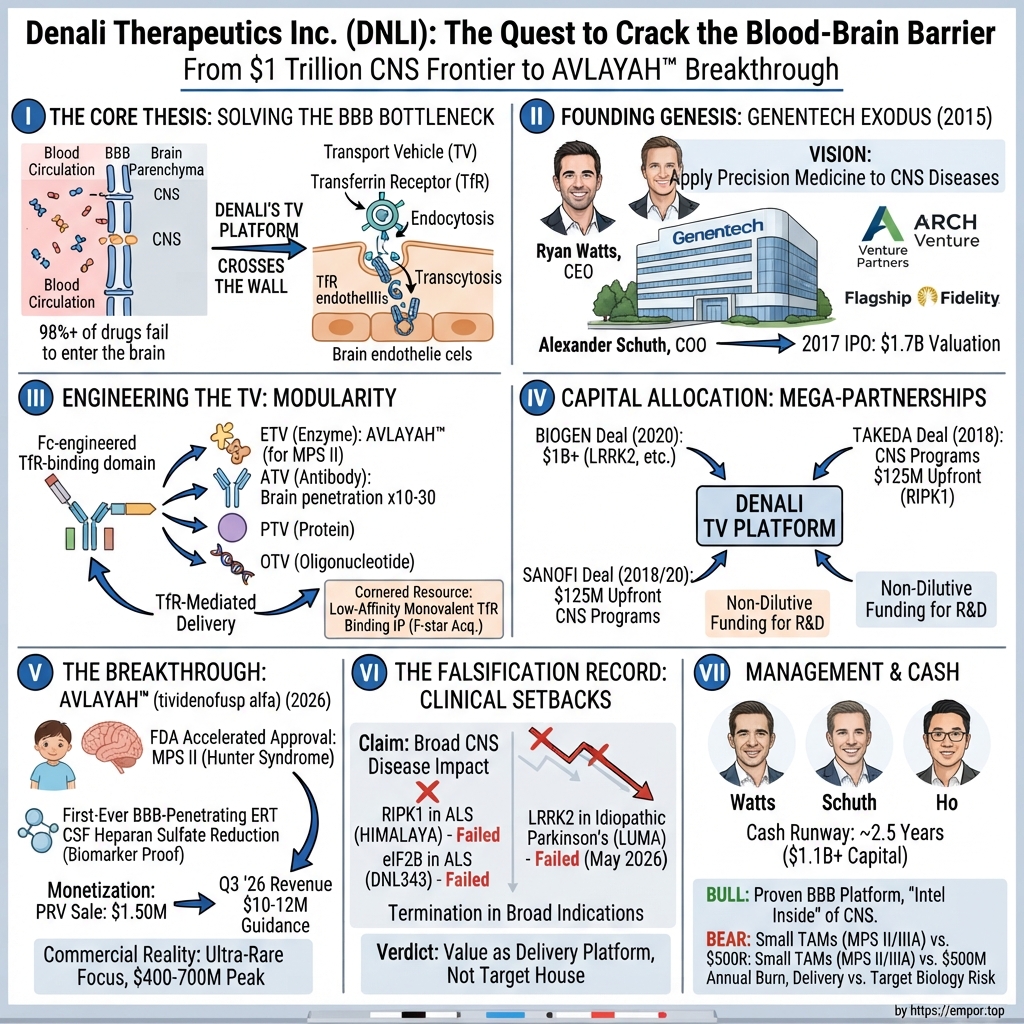
Denali Therapeutics Inc. (NASDAQ: DNLI): The Quest to Crack the Blood-Brain Barrier
I. Introduction & Episode Roadmap
In the final week of March 2026, a South San Francisco biotechnology company that had not commercialized a drug in its eleven-year history received the regulatory decision around which drug developers build their business models.
The U.S. Food and Drug Administration granted accelerated approval to AVLAYAH (tividenofusp alfa-eknm) for the neurologic manifestations of Hunter syndrome—a rare inherited metabolic disorder that causes complex sugar molecules to accumulate toxically in a child's cells, including those in the brain.1 The decision marked the first FDA approval for a biologic engineered to cross the blood-brain barrier by binding to the transferrin receptor, an iron-transport protein that studs the brain's blood vessels.2
Eight weeks later, the company delivered news of a very different nature. On May 21, 2026, Denali Therapeutics and Biogen reported that LUMA—a 648-patient Phase 2b study evaluating the LRRK2 inhibitor BIIB122 in early-stage Parkinson's disease—had missed its primary endpoint and key secondary endpoints. The partners promptly discontinued development of the asset in idiopathic Parkinson's disease.34
Those two events, occurring less than two months apart, frame Denali's central investment tension. The company accomplished a formidable technical milestone by proving in human trials, to regulatory standards, that a large protein can cross the blood-brain barrier and clear a toxic cellular substrate. Yet over the preceding two years, multi-billion-dollar opportunities in amyotrophic lateral sclerosis (ALS) and Parkinson's disease have eroded across successive clinical readouts.
The financial contrast is stark. In its first full commercial quarter ending June 30, 2026, AVLAYAH generated $3.6 million in net product revenue.
During the same three-month period, Denali posted a net loss of $127.6 million.2 The company closed June with approximately $940 million in cash and marketable securities—a liquidity position that expanded beyond $1.1 billion in July after selling the rare pediatric disease priority review voucher awarded with AVLAYAH's approval for $195 million in gross proceeds.2 Set against that balance sheet is an accumulated deficit of $2.31 billion accrued since inception.5 By late August 2026, with shares trading near $24, public markets valued the company at roughly $3.8 billion.6
This divergence raises fundamental questions about Denali's classification: Is it a commercial rare-disease company with a modest initial product, a delivery-platform licensor in waiting, or a neuroscience discovery house whose target selection has faltered in the indications required to support a $3.8 billion valuation?
The core analytic challenge stems from the magnitude of difference between Denali's technical achievement and its commercial scale. Pharmaceutical history offers numerous examples of technical breakthroughs that failed to become commercial franchises, and central nervous system development remains among the most risk-laden sectors in medicine.
Denali presents a distinct profile within that history. It did not fail to demonstrate its delivery technology in humans. Rather, after validating its transport platform, the company encountered biological complexity in the broader disease indications where potential commercial returns were most concentrated.
The industry's persistent focus on central nervous system targets reflects the market opportunity. Neurodegenerative conditions represent one of medicine's largest unaddressed therapeutic markets. Alzheimer's disease, Parkinson's disease, ALS, and lysosomal storage disorders collectively affect tens of millions of people, a patient population expanding alongside global demographic aging.
Yet for decades, pharmaceutical success rates in neurodegenerative trials hovered near zero, prompting many large drugmakers to downsize or shutter their internal neuroscience divisions during the early 2010s.
That historic failure rate reflected two distinct challenges: biological uncertainty regarding disease etiology, and mechanical barriers to drug delivery. The brain is uniquely protected by a vascular barrier that excludes most systemic therapies.
Solving the delivery mechanism does not guarantee therapeutic success, but it eliminates a primary physical barrier that has historically compromised central nervous system drug candidates. Establishing a reliable delivery route creates a potential toll road for internal pipeline assets and external licensing partners—the foundational premise of Denali's business model.
This analysis examines that premise across four sections. First, the mechanical problem: the structure of the blood-brain barrier, why 98% of large molecules cannot cross it, and how Denali engineered its transport vehicle. Second, the platform strategy: how Denali secured roughly $1 billion in non-equity capital from partners including Biogen, Sanofi, and Takeda, and where those collaborations stand today.
Third, commercial execution: the financial mechanics of launching an ultra-rare orphan drug into a U.S. patient population estimated by the FDA at approximately 500 individuals.7 And fourth, the clinical record: an assessment of Denali's trial history to evaluate which elements of the core investment thesis remain supported by empirical evidence.
 Subscribe on LinkedIn
II. The Blood-Brain Barrier Wall & Genentech Origins (2015–2017)
To understand why three senior Genentech scientists departed one of the industry's leading neuroscience research groups in 2015, one must examine what they had spent the preceding decade observing: a series of costly clinical failures.
Genentech had long pursued the amyloid hypothesis of Alzheimer's disease, advancing candidate antibodies such as crenezumab and, through parent company Roche, gantenerumab. The core barrier was not necessarily antibody design, but basic vascular physiological constraints. An intravenously infused monoclonal antibody is a large protein, whereas the blood-brain barrier consists of a continuous sheet of brain endothelial cells joined by tight junctions, structured to restrict the passage of large systemic proteins.
Only a tiny fraction of an infused antibody dose—less than one percent—reaches brain tissue, a constraint Denali's regulatory filings describe as the primary reason most large-molecule therapeutics fail to achieve effective concentration levels in the brain.8 The traditional industry response was to escalate dosage, which increased systemic exposure, cost, and toxicities—such as amyloid-related imaging abnormalities, infusion reactions, and peripheral side effects—without resolving the underlying transport constraint. In effect, developers were attempting to water a garden by flooding the street outside.
Ryan Watts had directed neuroscience discovery within Genentech. A molecular biologist who spent more than a decade at the company, Watts left not because his scientific concepts were rejected, but because large corporate research structures are primarily optimized to advance validated targets rather than develop enabling infrastructure technologies whose utility depends on transporting other therapeutic payloads.
In May 2015, Watts founded Denali alongside Alexander Schuth, who had led neuroscience business development and brought contract structuring expertise that would later help secure nearly $1.5 billion in partner capital, and Marc Tessier-Lavigne, former Genentech research chief and a highly cited neurobiologist. The founding strategy inverted conventional drug development: solve the blood-brain barrier delivery mechanism first, then select disease targets.
Tessier-Lavigne's involvement provided significant early scientific credibility—he became president of Stanford University the following year—though his standing later became complicated. In July 2023, following an investigation into research papers he had co-authored, Stanford's Board of Trustees announced his resignation as president. The independent review concluded he had not personally engaged in research misconduct, but found that manipulated data appeared in papers from his laboratories and that he had failed to take sufficient steps to correct the scientific record.9 Tessier-Lavigne is not listed among Denali's executive officers in the company's 2025 annual report.8 Operationally, Watts has served as the company's executive and scientific leader throughout its history.
Denali launched in May 2015 with an initial investment commitment of $217 million—an unusually large series A round for an early-stage venture with no clinical-stage assets—backed by ARCH Venture Partners, Flagship Ventures, Fidelity Biosciences, and the Alaska Permanent Fund.1011 The company took its name from North America's highest peak, signaling its focus on one of medicine's most persistent engineering challenges.
Why the money came so easily. Major pharmaceutical firms had spent a decade scaling back internal neuroscience investments due to high clinical trial failure rates, extended development timelines, and variable diagnostic endpoints. That institutional retreat created favorable conditions for venture financing: an unaddressed therapeutic market with a clear mechanical bottleneck that a dedicated platform developer might address.
Rather than positioning itself around a single therapeutic molecule, Denali pitched a delivery platform intended to transport multiple modalities—including antibodies, enzymes, and oligonucleotides—across the blood-brain barrier.
Denali also acquired existing clinical targets. In June 2016, the company secured an exclusive license from Genentech to a portfolio of small-molecule inhibitors targeting LRRK2—a kinase whose mutations represent the most common known genetic risk factor for Parkinson's disease—for an $8.5 million upfront payment, a $1.5 million technology transfer fee, and up to $315 million in potential milestone payments.8 This transaction remains strategically notable: Denali's flagship Parkinson's candidate was an in-licensed small molecule relying on conventional target biology, rather than an asset derived from its proprietary transport platform.
The IPO. On December 8, 2017, Denali completed an initial public offering at $18 per share, raising $250 million in gross proceeds through the sale of 13.9 million shares and listing on the Nasdaq Global Select Market.12 It marked the largest biotechnology IPO of 2017, accomplished before the company had advanced a candidate past Phase 1 safety trials.
The transaction established a capital-raising pattern that persisted across Denali's first decade: securing substantial capital based on platform mechanics ahead of clinical proof. Supportive investors viewed the market response as validation of a broadly applicable delivery technology. Critics noted that the company remained a heavy consumer of capital, accruing $2.31 billion in lifetime losses while operating a commercial unit that, by mid-2026, generated less revenue in a quarter than the business consumed in three days of operations.25
Evaluating Denali's valuation depends not on the size of its capital raises, but on whether its transport engineering demonstrates repeatable clinical efficacy. That question centers on the platform's structural design.
III. Building the Platform: The Science & Engineering of the Transport Vehicle
That structural design begins with the physiological constraints of the blood-brain barrier. Rather than an impenetrable wall, the barrier functions as a strictly regulated cellular checkpoint. Small, lipid-soluble compounds—such as nicotine, caffeine, and certain psychiatric small molecules—pass through relatively unhindered. Large, water-soluble biologics, however, are routinely excluded from central tissue.
The brain nevertheless requires essential nutrients such as iron, which enters brain endothelial cells bound to the transport protein transferrin. Transferrin docks onto transferrin receptors on the cellular surface, initiating a vesicular transit process known as receptor-mediated transcytosis that ferries the protein into the central nervous system.
Denali's Transport Vehicle platform operates by engineering an active tag for that natural transport pathway. The company embeds a transferrin-receptor binding site directly into the Fc domain—the constant region forming the base of a Y-shaped antibody—rather than attaching targeting fragments to the binding arms as competing approaches frequently do.8 Brain endothelial cells recognize the engineered Fc domain, internalizing and transporting the vehicle along with its attached therapeutic cargo across the blood-brain barrier.
Three core engineering features define the platform's design:
Monovalent binding. The engineered Fc domain carries the receptor-binding site on only one of its two chains. Engaging two transferrin receptors simultaneously causes receptor cross-linking, which triggers cellular degradation rather than transport. Denali's monovalent design engages single receptors sequentially to preserve receptor recycling.8
Tuned affinity. Transport efficiency requires precise binding calibration: insufficient affinity prevents cellular uptake, whereas overly tight binding prevents the therapeutic payload from releasing into brain tissue after crossing the vascular wall. Denali optimizes both binding affinity and the specific structural contact points to maximize net brain exposure.8
Toggleable effector function. Transferrin receptors are also heavily expressed on peripheral reticulocytes, the precursor cells to mature red blood cells. A therapeutic that binds transferrin receptors while retaining active immune-effector function risks triggering immune-mediated destruction of immature red cells, leading to anemia. Denali selectively modifies or silences effector function depending on the therapeutic application. In its corporate filings, the company explicitly identifies anemia as "a known liability associated with targeting TfR."8
This modular architecture underpins Denali's commercial strategy. The standardized Fc backbone can be fused to multiple therapeutic modalities: enzymes (Enzyme Transport Vehicle, or ETV, used in AVLAYAH), antibodies (ATV), proteins such as progranulin (PTV), or antisense oligonucleotides (OTV). In animal models, TV-enabled antibodies and enzymes achieved brain exposures 10 to 30 times higher than unmodified versions, while TV-enabled oligonucleotides demonstrated more than a thousand-fold increase in brain exposure in non-human primates compared to systemically administered unmodified oligonucleotides.2
That increase in preclinical exposure highlights why Denali maintained platform investment despite broader clinical setbacks. Antisense oligonucleotides—short synthetic genetic strands designed to halt target protein production—represent highly targeted therapeutic agents but cannot naturally cross the blood-brain barrier from the bloodstream. Conventional delivery requires repeated intrathecal injections into spinal fluid, an invasive procedure with limited scalability for large neurodegenerative patient populations.
Replacing intrathecal injections with routine intravenous infusions would substantially broaden the addressable market for central nervous system oligonucleotide therapies. By November 2025, Denali's clinical dataset encompassed more than 200 participants receiving over 11,000 total doses of TV-enabled candidates, with some patients on treatment for over five years—providing an initial empirical record for the delivery technology.8
The unresolved technical question: immunogenicity. All engineered biologics carry the risk of inducing anti-drug antibodies. While immunogenicity often presents as a manageable tolerability or clearance issue for standard biologics, neutralizing antibodies against a transport shuttle could systematically block brain delivery in patients requiring lifelong chronic therapy.
Denali contends that because its binding site consists of a short amino-acid sequence integrated directly into a native Fc region rather than a foreign fused protein domain, the vehicle retains structural similarity to endogenous antibodies, mitigating immunogenic and infusion-related responses.8 While multi-year clinical data support this rationale, long-term immunogenicity risks can typically be fully characterized only through expanded real-world exposure across commercial patient cohorts.
Consolidating the intellectual property. The foundational Fc-engineering technology originated at UK-based F-star Biotechnology, whose Modular Antibody Technology enabled the insertion of novel antigen-binding sites into antibody constant regions. After initiating a collaboration in August 2016, Denali exercised an option in May 2018 to acquire F-star Gamma—the entity holding the core platform rights—for $24 million upfront in a transaction valued at up to $471 million including regulatory and commercial milestones.138 Denali holds ten proprietary patent families covering the Transport Vehicle platform, with earliest expirations projected for 2038, embedded within a broader portfolio of over 1,600 owned and licensed patents and applications.8 Notably, corporate filings show that the earliest issued patents licensed from F-star were expected to expire in 2026, meaning Denali's long-term patent protection relies primarily on its proprietary follow-on filings rather than the original licensed estate.8
Where the platform has already failed. While delivery platform validation reduces mechanical transport risk, it does not guarantee clinical success across individual therapeutic targets. In August 2023, Denali and Takeda discontinued TAK-920/DNL919, an ATV-enabled antibody targeting TREM2 for Alzheimer's disease.
Although the molecule demonstrated biomarker activity in cerebrospinal fluid without serious adverse events at lower doses, moderate and reversible hematologic changes—reflecting the known reticulocyte toxicity of transferrin receptor targeting—emerged at higher dose levels, restricting the asset's therapeutic window in chronic Alzheimer's disease.1415 The outcome illustrated that successful brain delivery and target engagement do not alter the intrinsic toxicological constraints of the underlying payload or receptor biology.
Ultimately, Denali has established that its engineered Fc shuttle reliably transports large molecules across the blood-brain barrier in humans and achieves measurable pharmacodynamic effects. However, facilitating transport does not ensure that an attached payload will demonstrate acceptable safety or therapeutic efficacy. Each candidate must independently satisfy safety, dose-response, and immunogenicity criteria—a distinction that became central as Denali expanded its platform through major corporate partnerships.
IV. Capital Allocation & The Mega-Partnership Era (2018–2022)
In August 2020, amid a global pandemic that had slowed broader pharmaceutical dealmaking, Denali executed a collaboration that significantly altered its financial risk profile. Biogen—then facing challenges in its Alzheimer's portfolio and seeking to reinforce its neurodegeneration pipeline—agreed to co-develop Denali's LRRK2 inhibitor program for Parkinson's disease.
The financial commitments were substantial for a Phase 1 asset. Upon closing the transaction in October 2020, Biogen paid $560 million upfront and separately purchased 13,310,243 newly issued Denali shares for $465 million at a premium to the prevailing market price.168 Denali also became eligible to receive up to $1.125 billion in potential development and commercial milestone payments.
Under the agreement, the companies split global development costs 60/40, with Biogen absorbing the larger share, while sharing U.S. commercial profits and losses equally. Biogen assumed responsibility for commercialization outside the U.S. and China in exchange for paying tiered royalties to Denali.16 Crucially, Biogen secured a right of first negotiation over select Transport Vehicle-enabled programs—transforming the collaboration from a single-asset license into an explicit corporate endorsement of Denali's delivery platform.
The Biogen deal formed part of a broader corporate partnering strategy. In November 2018, Sanofi's Genzyme unit paid $125 million upfront to co-develop a RIPK1 inhibitor program covering both brain-penetrant and peripherally restricted compounds, with up to roughly $495 million in potential milestone payments tied to the peripheral assets alone.8 Takeda had previously established a collaboration in 2018 to evaluate Transport Vehicle-enabled candidates, later focusing development on a progranulin replacement therapy for frontotemporal dementia and an ATV-enabled TREM2 antibody.8
Takeda's participation reflected a distinct risk allocation. Rather than acquiring a single late-stage candidate, the Japanese pharmaceutical maker secured early-stage positions in Transport Vehicle-enabled biologics—specifically the progranulin program for frontotemporal dementia and the TREM2 antibody for Alzheimer's disease—with option and milestone commitments distributed over time.8 Where Biogen invested heavily in a small molecule with a conventional target mechanism, Takeda acquired early, lower-cost exposure to the delivery platform itself.
In total, these transactions provided Denali with substantial non-dilutive and non-equity capital long before commercialization. Through June 30, 2026, the company accumulated $115.0 million from Takeda, $225.0 million from Sanofi, $565.0 million from Biogen, and $62.5 million from an additional third party in upfront collaboration and research payments, alongside gross cost-sharing reimbursements of $58.2 million from Takeda, $16.2 million from Biogen, and $13.7 million in specified reimbursements from Sanofi.5 Partner equity investments contributed an additional $575.0 million through stock purchase agreements.5 Across upfront fees, cost reimbursements, and equity premiums, Denali secured nearly $1.6 billion in partner capital prior to its first commercial drug approval.
Management deployed that capital to fund early clinical development across partnered small molecules while preserving unencumbered rights to its internal enzyme replacement franchise—the rare lysosomal storage disorder programs that eventually yielded the company's first commercial product. This capital allocation strategy enabled Denali to retain 100% of AVLAYAH's global commercial economics, as external partners focused their initial dealmaking on larger neurodegenerative indications.
However, large corporate collaborations introduce structural constraints. Partnered programs operate under joint governance, where trial protocols, dosing regimens, readout schedules, and development halts require consensus between organizations with differing risk tolerances and strategic priorities. A partner shifting internal resources away from neuroscience can slow clinical momentum without formally terminating an agreement.
Furthermore, in-licensed assets carry layered financial obligations. Denali's LRRK2 program remained subject to its original licensing agreement with Genentech, which entailed up to $315 million in potential milestone payments plus net sales royalties; Denali paid $15 million under this obligation through the end of 2025, with remaining milestone liabilities shared equally with Biogen after their deal closed.8 Upfront partner capital effectively monetizes future commercial upside, yielding immediate liquidity in exchange for reduced long-term margins.
The collaboration record presents a stark contrast. Over time, each of Denali's three major corporate partnerships unwound, beginning well before the primary clinical readouts:
- Sanofi (RIPK1): The initial RIPK1 candidate, DNL747, was discontinued in early-stage testing due to chronic toxicology findings, prompting a pivot to the backup molecule DNL788. Following the discontinuation of Phase 2 studies of DNL788 in ALS and multiple sclerosis in 2024, Denali and Sanofi signed a side letter on February 24, 2025, terminating Sanofi's rights to the entire CNS RIPK1 portfolio. Sanofi retained rights only to eclitasertib, a peripherally restricted compound evaluated in ulcerative colitis.8
- Biogen (Platform Options & Amyloid Beta): In August 2023, Biogen amended its agreement to waive its option to a second program and relinquish its right of first negotiation over Transport Vehicle assets. In July 2024—nearly two years before the LUMA Parkinson's trial read out—a subsequent side letter terminated Biogen's license to Denali's TV-enabled amyloid beta program and ended the platform option agreement entirely, with Denali confirming it expects no future milestones or royalties from the arrangement.8
- Takeda (DNL593): On April 3, 2026, Takeda notified Denali that it was terminating its collaboration on DNL593 for frontotemporal dementia. Denali regained global rights and the complete intellectual property portfolio, with both companies attributing the decision to strategic portfolio considerations rather than interim safety or efficacy findings.17
Denali also moved to divest non-core discovery assets. In January 2025, spin-out entity Tenvie Therapeutics launched with $200 million in financing led by ARCH Venture Partners, F-Prime Capital, and Mubadala Capital, acquiring a portfolio of small-molecule programs and a discovery team from Denali.18 The divestment reflected a strategic refocusing away from unencumbered small-molecule discovery to concentrate corporate resources on the Transport Vehicle platform.
This transaction history provides two contrasting analytical conclusions. Financially, the incoming partner capital provided substantial non-dilutive funding that sustained platform engineering and ultimately supported the development of an approved biologic—a tangible capital allocation result. However, the premise that large-pharma partnerships served as validation of platform technology has not been borne out by subsequent developments.
All three major collaboration partners ultimately returned their rights to Denali's CNS programs—Biogen relinquishing platform option rights prior to the Phase 2b Parkinson's readout, and Takeda exiting a candidate despite reported interim safety clearance. Regardless of internal portfolio shifts at Biogen, Sanofi, or Takeda, these departures prevent the partnerships from being interpreted as ongoing validation of the underlying transport shuttle. As of August 2026, Denali has not disclosed any external licensing agreement in which a third party pays to apply its own proprietary payload to the Transport Vehicle platform.
Consequently, the responsibility for validating the platform's commercial and therapeutic breadth rests entirely with Denali's internal execution—a proof of concept achieved first in a small, specialized disease population.
V. The Breakthrough: AVLAYAH (Tividenofusp Alfa) & The Ultra-Rare Commercial Reality
For two decades, families of children diagnosed with neuronopathic Hunter syndrome have maintained a frustrating clinical routine. Weekly enzyme infusions effectively treat peripheral symptoms—preventing organ enlargement, joint stiffness, and airway obstruction. Yet language skills recede, learning stalls, and cognitive abilities deteriorate because the systemic biologic cannot cross the blood-brain barrier. Clinicians have long described the standard of care as treating every systemic manifestation except the central neurodegeneration.
Hunter syndrome (Mucopolysaccharidosis II, or MPS II) is a rare inherited metabolic disorder caused by mutations in the gene encoding iduronate-2-sulfatase, an enzyme required to break down cellular glycosaminoglycans such as heparan sulfate. Without functional enzyme activity, toxic substrates accumulate in cells throughout the body and brain. Since 2006, the primary treatment has been Takeda's Elaprase (idursulfase), an enzyme replacement therapy costing approximately $500,000 annually per patient.7 While Elaprase manages peripheral organ damage, it does not cross into the central nervous system, leaving the severe neuronopathic form of the disease to progress unhindered.
The regulatory path. The scientific case for AVLAYAH rested on a surrogate biomarker. Rather than awaiting multi-year cognitive endpoint data in a small pediatric population, Denali proposed using cerebrospinal fluid (CSF) heparan sulfate—a direct chemical measure of central substrate clearance—as an intermediate endpoint reasonably likely to predict clinical benefit.
In September 2024, the FDA formally agreed that CSF heparan sulfate reduction could serve as a surrogate endpoint supporting accelerated approval.19 The decision established a crucial regulatory precedent for transport-enabled biologics targeting neurodegenerative lysosomal storage disorders.
Clinical evidence supporting the filing was published in the January 1, 2026 issue of the New England Journal of Medicine, detailing an open-label Phase 1/2 trial of 47 participants aged four months to thirteen years across enzyme-naïve and previously treated cohorts.2021 At 24 weeks, CSF heparan sulfate levels fell by an average of 91%, with 93% of participants achieving levels below the upper limit of normal. Urinary heparan sulfate declined by nearly 90%, while serum neurofilament light chain—a marker of active neuronal injury—showed sustained reductions over extended treatment. Infusion-related reactions were the most common treatment-related adverse events, diminishing in frequency with continued dosing.20
The FDA granted accelerated approval on March 25, 2026, for treating the neurologic manifestations of MPS II in pediatric patients weighing at least 5 kilograms, prior to advanced cognitive impairment.1 Commercial distribution commenced in April 2026.5 Denali is conducting the global Phase 2/3 COMPASS study as a confirmatory trial, designed also to support adult label expansion and international regulatory filings.222
Commercial economics and launch mechanics. The FDA estimates the U.S. Hunter syndrome population at approximately 500 patients.7 AVLAYAH's weight-based pricing ranges from an estimated $270,000 annually for a 10-kilogram patient to roughly $800,000 for a 30-kilogram patient, representing a premium over existing peripheral therapies.237 Because pediatric patients gain weight as they grow, revenue per patient expands mechanically over time.
In its first full commercial quarter ending June 30, 2026, Denali reported $3.6 million in net product revenue, guiding to $10.0 million to $12.0 million for the third quarter.2 Management disclosed reaching approximately 80% of specialized healthcare centers treating eligible patients, establishing published coverage policies across more than 50% of covered lives, and securing reimbursement across 14 state Medicaid programs.2 Executive leadership noted initial treatment demand exceeded internal expectations.2
However, two disclosure factors complicate revenue projections. First, management explicitly declined to disclose exact patient start counts or enrollment forms during the earnings call, citing individual patient journey variability.23 While understandable given the small patient pool, this lack of operational detail prevents outside analysts from separating underlying patient volume growth from inventory stocking and weight-based price escalations. Second, Denali reported a second-quarter cost of goods sold of just $0.1 million because pre-approval manufacturing expenses were previously charged to research and development.2 As zero-book-cost inventory is consumed, reported product gross margins will normalize downward.
Confirmatory obligations and financial encumbrances. Accelerated approval functions as a regulatory loan contingent on post-marketing confirmation. The COMPASS trial must demonstrate tangible clinical benefit across cognitive and developmental endpoints over multi-year periods.22 Failure to confirm clinical efficacy could lead to regulatory withdrawal, jeopardizing both commercial revenue and the regulatory precedent for follow-on pipeline assets. With neuronopathic cohort enrollment completed in December 2025, the timeline for confirmatory data is set.21
The approval also generated immediate non-dilutive liquidity through an associated Rare Pediatric Disease Priority Review Voucher. Denali agreed to sell the voucher in June 2026 and closed the transaction in July for $195 million in gross proceeds.2 The voucher sale provided more cash than AVLAYAH will likely generate in product revenue over its first two years combined.
To fund commercial development, Denali previously monetized a portion of the product's top-line revenue. In December 2025, the company executed a synthetic royalty agreement with Royalty Pharma for up to $275 million in exchange for a 9.25% royalty on global net sales. Royalty Pharma paid $200 million upon FDA approval in March 2026, with an additional $75 million contingent on European regulatory approval by late 2029. The royalty obligation terminates once cumulative payments reach a 3.0x return cap, or 2.5x if achieved by the first quarter of 2039.85 Denali accounts for the transaction as a debt liability rather than revenue.5
The materiality test. Even under optimistic adoption scenarios, including international expansion and adult label extensions, an ultra-rare orphan drug serving a small patient population—encumbered by a 9.25% royalty stream—yields peak annual revenues estimated in the low hundreds of millions of dollars. Set against Denali's quarterly operating expenses of $134.1 million in the second quarter of 2026 alone, AVLAYAH cannot independently support the company's cost structure.5
AVLAYAH successfully validates the Transport Vehicle technology in humans and establishes a working regulatory blueprint. However, its ultimate financial contribution remains modest relative to Denali's capital requirements. The company's valuation depends on expanding the delivery platform into broader neurodegenerative indications—the central premise tested across its broader clinical pipeline.
VI. The Falsification Record: High-Stakes Clinical Setbacks & Broad-CNS Disillusionment (2020–2026)
Every platform biotechnology company makes two core promises: first, that its delivery technology functions, and second, that the technology unlocks large therapeutic markets. Over the three years leading into mid-2026, Denali accumulated clinical evidence regarding that second promise, and the results have repeatedly disappointed investors.
Claim one: Denali's small-molecule programs against neuroinflammation and cellular stress will scale to mass markets.
The RIPK1 program served as a primary test of that thesis. RIPK1 regulates pathways governing neuroinflammation and programmed cell death, presenting a mechanism theoretically applicable across amyotrophic lateral sclerosis (ALS), Alzheimer's disease, and multiple sclerosis—a broad potential utility that initially justified Sanofi's $125 million upfront investment.
On February 14, 2024, Denali disclosed that the Phase 2 HIMALAYA study of SAR443820/DNL788—which randomized 305 ALS patients in a two-to-one ratio against placebo over 24 weeks—had missed its primary endpoint measuring functional decline.24 A companion Phase 2 study in multiple sclerosis was also discontinued in 2024, leading Sanofi to terminate its central nervous system license in February 2025.8 The outcome left a key neuroinflammatory mechanism without demonstrated clinical efficacy across two major indications.
The RIPK1 pipeline had experienced an earlier developmental setback. The initial candidate, DNL747, was stopped in early clinical testing following chronic toxicology findings, requiring Denali and Sanofi to restart development with a backup compound. While candidate substitution is relatively common in early-stage research, the reset delayed the eventual Phase 2 ALS readout by several years, consuming valuable capital and development time in a shifting competitive landscape.
A second broad-indication candidate targeting cellular stress met a similar fate. DNL343, an eIF2B activator engineered to suppress the integrated stress response in ALS, was evaluated in Regimen G of the HEALEY ALS Platform Trial. In January 2025, Denali reported that DNL343 had failed to meet its primary endpoint of slowing disease progression and improving survival through 24 weeks, showing no statistically significant separation from placebo on key secondary measures of muscle strength or respiratory function.2526 Although the compound demonstrated acceptable safety and tolerability, it provided no measurable clinical benefit.
Claim two: LRRK2 inhibition will slow progression in broad idiopathic Parkinson's disease.
The small-molecule LRRK2 inhibitor BIIB122 represented Denali's largest commercial opportunity, anchoring its major partnership with Biogen. The Phase 2b LUMA study enrolled 648 patients aged 30 to 80 with early-stage Parkinson's disease, evaluating time to confirmed disease worsening using combined motor and daily-living rating scales.
On May 21, 2026, Denali and Biogen announced that BIIB122 had failed to slow disease progression compared to placebo and missed key secondary endpoints assessing disability and activities of daily living.3 Consequently, the partners discontinued development in idiopathic Parkinson's disease.34
The LUMA trial provided a rigorous, well-powered test of the LRRK2 hypothesis in a broad population of 648 patients.3 Because earlier Phase 1 studies had already confirmed target engagement, the trial's failure across primary and secondary endpoints indicated that inhibiting the kinase did not meaningfully alter disease progression in broad idiopathic Parkinson's disease, rather than reflecting an issue with trial design or endpoint selection.
Following the LUMA outcome, Denali shifted its LRRK2 efforts entirely to a narrower genetically defined subgroup. The company continues to independently conduct the Phase 2a BEACON study in patients confirmed to carry pathogenic LRRK2 mutations—who represent a small fraction of overall Parkinson's cases—with clinical data expected in the first half of 2027.2 What was originally underwritten as a mass-market disease-modifying therapy has been reduced to a niche genetic indication with heightened clinical risk.
Weighing it. Across three distinct programs spanning ALS, multiple sclerosis, and Parkinson's disease, Denali achieved zero clinical successes in broad neurodegenerative indications. While this record might suggest poor target selection, a closer analysis reveals three specific implications for the company's business model and valuation:
First, none of these small-molecule failures involved the Transport Vehicle platform. RIPK1 inhibitors, eIF2B activators, and LRRK2 inhibitors were designed as conventional small molecules capable of crossing the blood-brain barrier independently. Their failures reflect the high historical risk of neurodegenerative target biology—the same baseline failure rate that previously prompted large pharmaceutical companies to downsize internal neuroscience research. Denali's outcome in small molecules mirrors broader industry experience.
Second, the clinical record clarifies Denali's enterprise valuation basis. Investors cannot value the company as a superior target-discovery engine, given the lack of empirical evidence supporting its unencumbered neurodegeneration targets. Instead, validated evidence exists primarily for its delivery platform—demonstrated by a transport-enabled biologic that crossed the blood-brain barrier, cleared target substrates, reduced biomarkers of neuronal injury, and secured FDA approval. Denali is fundamentally a delivery-platform developer whose valuation hinges on its transport shuttles and the clinical viability of attached payloads.
Third, efficient delivery cannot overcome unviable target biology—a limitation Denali demonstrated on its proprietary platform. Its TAK-920/DNL919 TREM2 antibody successfully engaged microglial biomarkers in the brain, yet was discontinued due to reticulocyte toxicity and a narrow therapeutic window, without demonstrating plaque clearance or clinical benefit.1415 In contrast, AVLAYAH succeeded because its target biology is well established: replacing a deficient enzyme directly clears accumulating substrate.
The ultimate test of whether the Transport Vehicle platform can unlock broad commercial markets rests on upcoming clinical readouts. Denali's pipeline includes two transport-enabled Alzheimer's candidates—DNL628, an antisense oligonucleotide targeting tau, and DNL921, an anti-amyloid antibody—alongside its progranulin program for frontotemporal dementia and the BEACON LRRK2 study, all expecting biomarker or proof-of-concept data in 2027.2 These readouts, rather than initial AVLAYAH sales, will determine whether Denali's platform can successfully expand beyond rare metabolic disorders into major neurodegenerative markets.
VII. Current Management, Balance Sheet, & Capital Allocation Discipline
Ryan Watts has run Denali since he co-founded it, and the most striking feature of his tenure is what has not changed. Read the company's 2018 materials and its 2026 materials side by side and the core thesis is materially unchanged: solve delivery, then treat neurodegeneration with the modality breadth that oncology takes for granted.
Watts kept his July 2026 plenary address at the Alzheimer's Association International Conference in London on that same theme.2 In an industry where strategy decks get rewritten after every failed readout, narrative consistency across a decade and three major clinical failures is a genuine and verifiable credibility marker.
Management has also been direct about misses. The LUMA, HIMALAYA and DNL343 failures were disclosed as failures, with primary and secondary endpoint outcomes stated plainly and development decisions announced alongside the data rather than deferred into a subsequent quarter.32425 No repositioning of a failed endpoint as a subgroup victory; no vague language about "encouraging trends."
The discipline is less clean on timelines. In the fourth-quarter 2025 release, Denali expected initial FTD-GRN patient data in 2026.21 By the second-quarter 2026 release, that had slipped to 2027, with the explanation that a longer observation period was needed to assess treatment effects on biomarkers including neurofilament light chain, which declines gradually.2 The explanation is biologically reasonable.
It is also a slip on the single most important non-commercial catalyst the company had for the current year, in a program whose partner had just walked away — and investors are entitled to weigh those facts together.
The leadership question. Carole Ho had been chief medical officer and head of development since 2015 — a founding-team member and the clinical architect of the programs that produced the approval.
On November 6, 2025, Denali announced she was departing to become executive vice president and president of Lilly Neuroscience at Eli Lilly, with Peter Chin, a neurologist who joined Denali in 2019 and led the enzyme franchise and late-stage development, named acting chief medical officer.27 The same release announced the appointment of Tim Van Hauwermeiren, co-founder and chief executive of argenx, to the board.27
Three things about that are worth stating without dramatizing. Chin's background is precisely the right one for a company whose near-term value sits in the enzyme franchise. Van Hauwermeiren has built one of the more successful commercial-stage biotechs of the past decade, and adding that experience ahead of a launch is sensible.
But losing your founding clinical leader to a competitor with its own blood-brain barrier ambitions, four months before your first product approval, is a real loss of institutional knowledge, and Denali's second-quarter materials did not announce a permanent chief medical officer.227 Alexander Schuth, the other surviving co-founder, holds the combined chief operating and financial officer role.
Governance and ownership. Denali's shareholder register is concentrated among specialist investors, and its annual report explicitly flags that these holders, acting together, may significantly influence matters requiring stockholder approval — noting the board nomination and election of a director designated by Baker Brothers Life Sciences under a nominating agreement.8 Baker Bros.
Advisors participated directly in the December 2025 financing, acquiring pre-funded warrants alongside a reported position exceeding 25 million shares.28 A crossover fund with a board seat buying more stock at the moment of maximum pre-approval risk is a meaningful signal of insider conviction. It is also a concentration of influence that a governance-minded investor should track rather than celebrate.
Where the money went, and how fast it is going. The burn trajectory is worth reading as a strategic statement rather than a cost line. Research and development spending rose from $396.4 million in 2024 to $418.8 million in 2025, driven by external costs across multiple preclinical and clinical Transport Vehicle programs and by the build-out of the Salt Lake City large-molecule manufacturing site; general and administrative expense rose from $105.4 million to $136.6 million as commercial launch preparation absorbed headcount.21 Net loss widened from $422.8 million in 2024 to $512.5 million in 2025.21 In other words, Denali spent more in the year after two major clinical failures than in the year before them, and the increase went into the platform and the launch rather than into the failed mechanisms.
That is a coherent allocation of resources consistent with what management has said it believes. It is also, in a company with no product revenue at the time, a very expensive conviction.
The balance sheet, and the word "non-dilutive." Denali ended June 2026 with about $940 million of cash and marketable securities, above $1.1 billion pro forma for the voucher sale, against a second-quarter net loss of $127.6 million and a 2025 full-year net loss of $512.5 million.221 Research and development spending ran $418.8 million in 2025 and $97.0 million in the second quarter of 2026, with selling, general and administrative expense rising to $36.3 million as commercial infrastructure came online.212 The company employed approximately 503 people at the end of 2025, across South San Francisco, a Salt Lake City manufacturing site and Zurich.8 Denali did not publish an explicit cash-runway date in its second-quarter release.
Now test the "financed non-dilutively by partners" story against the equity record. Through June 30, 2026, Denali had raised approximately $956.1 million in net proceeds from public offerings of common stock, plus $499.3 million net in a February 2024 private placement of shares and pre-funded warrants, plus $575.0 million from partner stock purchases.5 The December 2025 offering added 9,142,857 shares and warrants for 2,285,714 more, with underwriters exercising for another 746,468 shares in January 2026.521 As of June 30, 2026, 159,755,526 shares were outstanding with 28,331,779 pre-funded warrants still unexercised, and a $400 million at-the-market facility established in February 2025 sat undrawn.5
The accurate characterization is therefore mixed: Denali raised an unusually large amount of partner and royalty capital and diluted shareholders repeatedly, including a $200 million equity raise three months before an approval decision it was confident enough about to have pre-sold a royalty on.
The Royalty Pharma agreement is often described as non-dilutive; it is dilutive to the product's economics rather than to the share count, and it is carried as debt.5 With more than $1.1 billion on hand against roughly $125 million of quarterly cash burn, Denali is funded for a multi-year stretch of readouts without a raise. Whether it chooses to raise anyway, as it has consistently done when the window is open, is a separate question — and the historical answer is that it does.
VIII. Strategic Moats & Helmer 7 Powers / Porter's 5 Forces Analysis
Evaluating Denali's strategic position through formal competitive frameworks clarifies what prevents better-capitalized rivals from replicating its platform.
Cornered resource — real, but narrower than advertised. Denali controls ten patent families covering its Transport Vehicle platform with earliest expirations projected for 2038, alongside twelve families covering its enzyme replacement franchise within a broader portfolio of more than 1,600 owned and licensed patents and applications.8 This estate protects a specific engineering solution: monovalent, affinity-tuned, Fc-embedded transferrin receptor binding with toggleable effector function.
However, this intellectual property does not constitute a monopoly on transferrin-receptor transport. Japan's JCR Pharmaceuticals secured domestic approval for pabinafusp alfa (Izcargo) in March 2021—five years before AVLAYAH's clearance—for MPS II, using its proprietary transferrin-receptor-targeting fusion technology to deliver iduronate-2-sulfatase into the central nervous system.29 Denali's regulatory distinction is a U.S. approval, not the underlying delivery concept.
Furthermore, Denali's competitive disclosures outline a crowded field developing receptor-mediated transport technologies, including JCR, Roche (including Genentech), Eli Lilly (including Prevail), AbbVie, Regeneron, BioArctic, Alector, Bicycle Therapeutics, Ossianix, Vect-Horus, Sanofi, and ABL Bio.8
Roche represents the most direct competitive test. Its candidate trontinemab rebuilds gantenerumab on Roche's Brainshuttle platform to target transferrin receptor 1. Interim clinical data demonstrated amyloid-related imaging abnormalities in under 5% of participants, compared to published rates of 13% for lecanemab and 24% for donanemab.
Roche has advanced trontinemab into a Phase 3 prevention trial.30 In Alzheimer's disease—the largest central nervous system market—a competitor's transport-enabled antibody is years ahead of Denali's candidate DNL921, which anticipates proof-of-concept data in 2027.2 Denali's cornered resource protects its specific therapeutic constructs, but it does not corner the delivery category.
Process power — plausible, but unproven at commercial scale. Manufacturing stable, low-immunogenicity Fc-fusion enzymes, validating central nervous system biomarker assays, and executing clinical trials in small rare-disease populations require complex operational capabilities that Denali has executed once.
The company relies on a hybrid manufacturing model combining contract development organizations such as Lonza with its own facility in Salt Lake City—a 60,000-square-foot site leased through 2039—and reported $104.7 million in total contractual obligations as of June 30, 2026, including $91.9 million tied directly to commercial product supply.85 Under Hamilton Helmer's 7 Powers framework, process power demands accumulated operational capabilities that competitors cannot readily replicate. A single approved biologic demonstrates initial technical execution, but not yet sustainable process power.
Counter-positioning — largely absent. Counter-positioning occurs when incumbents cannot adopt a new business model without cannibalizing existing operations. Large pharmaceutical firms face no structural disincentive to develop transport shuttles, and major competitors are advancing internal platforms. Denali maintains a technical head start rather than a counter-positioned structural advantage.
Switching costs — modest and asymmetric. For pediatric patients established on weekly infusions, transitioning between biologic therapies presents clinical and logistical disruptions that create patient stickiness. However, this dynamic also constrains Denali: established peripheral therapies possess a two-decade installed base, requiring Denali to convince physicians and payers to transition patients to AVLAYAH.
Porter's Five Forces analysis. Evaluating industry structure reveals significant operational and competitive headwinds:
- Buyer power: High and expanding. In rare pediatric conditions, Medicaid accounts for a substantial proportion of reimbursement, leading Denali to emphasize state Medicaid coverage decisions in its initial commercial disclosures.2 With annual pricing reaching up to $800,000 for older pediatric patients and an accelerated approval based on surrogate biomarkers rather than direct cognitive outcomes, payers are incentivized to enforce strict utilization controls, prior authorizations, and specialist center mandates. Delays in reimbursement approval can materially impact revenue adoption, making confirmatory trial results critical for both regulatory and payer validation.22
- Threat of substitutes: High and structural over the long term. Alternative therapeutic modalities—including gene therapies, direct central nervous system administration, and competing transport shuttles—are in development across lysosomal storage disorders by developers such as JCR, RegenxBio, Kyowa Kirin (via Orchard Therapeutics), and Ultragenyx.8 While gene therapies offer potential single-dose cures, development challenges remain evident; for example, the FDA rejected RegenxBio's gene therapy candidate for Hunter syndrome prior to AVLAYAH's approval.7 Consequently, substitute threats are evolving gradually, defining a multi-year window for Denali to expand its platform across additional therapeutic payloads.
- Competitive rivalry: Intense and asymmetric. Denali competes against global pharmaceutical corporations capable of funding late-stage clinical programs from operating cash flows, creating a competitive environment where rivals can advance competing shuttles rapidly.
- Supplier power: Moderate. Denali historically relied on contract development and manufacturing organizations such as Lonza for commercial biologic supply.8 Transitioning biologic manufacturing processes introduces operational risks, making the establishment of its Salt Lake City facility a strategic effort to mitigate supplier concentration.
Strategic synthesis. Denali's competitive advantage rests on a validated regulatory precedent, a proprietary patent estate extending to 2038, and specialized manufacturing and biomarker capabilities developed over a decade. However, these assets represent a time-delimited head start rather than a category monopoly. Denali's commercial window is actively contested by well-capitalized competitors advancing alternative transport technologies across major neurodegenerative markets.
IX. The Investment-Story Spine: Bull vs. Bear Stress Test
Why Denali wins from here. The bull case relies on three primary arguments, the first of which is now an established regulatory fact: the Transport Vehicle operates successfully in human subjects, as validated by the FDA's accelerated approval of AVLAYAH.
That regulatory milestone shifts the platform's core uncertainty from whether large proteins can be engineered to cross the blood-brain barrier to determining which specific therapeutic payloads merit transport. Crucially, the decision established a regulatory blueprint. The FDA's agreement that cerebrospinal fluid heparan sulfate reduction serves as a surrogate endpoint reasonably likely to predict clinical benefit creates a clear developmental pathway for follow-on enzyme programs.191
Denali is already executing against that blueprint. Its zafinofusp alfa candidate (DNL126) for Sanfilippo syndrome type A—a condition currently lacking approved treatment options—demonstrated substantial reductions in cerebrospinal fluid and urinary heparan sulfate in early testing, including normalization of central biomarker levels alongside a safety profile consistent with traditional enzyme replacement therapies.
With a confirmatory Phase 3 study underway, management expects to submit a Biologics License Application seeking accelerated approval in 2027.2 If this regulatory model proves repeatable, the marginal development cost and risk for subsequent enzyme programs should decline, supporting a broader portfolio of transport-enabled therapies for conditions such as Pompe disease, MPS I, and Gaucher disease associated with Parkinson's.2
The third argument for upside centers on platform optionality: out-licensing the transport shuttle to external drug developers as a standardized delivery engine for central nervous system biologics. Based on empirical evidence, however, this remains the speculative leg of the thesis. Denali has disclosed no third-party platform licensing transactions, while its three major pharmaceutical partners have systematically returned asset rights rather than expanding their collaborations.817 Consequently, external platform licensing represents an unpriced call option rather than a reliable operational plan.
Why Denali fails. The bear case begins with fundamental financial arithmetic. Operating with annual expenses of roughly $500 million, Denali relies on a single commercial product addressing an estimated U.S. patient population of approximately 500 individuals, while nearly ten percent of global net sales are encumbered by a synthetic royalty agreement.78 Even under favorable adoption scenarios, an ultra-rare orphan franchise plausibly builds toward a business generating low hundreds of millions of dollars in annual revenue—a viable commercial enterprise, but one insufficient on its own to justify a multi-billion-dollar market valuation.
Justifying that valuation requires success in large neurodegenerative indications, where Denali's high-potential programs have repeatedly failed in clinical trials. The pattern of those setbacks indicates that blood-brain barrier transport was not the binding constraint on therapeutic efficacy in Alzheimer's disease, Parkinson's disease, or ALS; rather, underlying target biology presented the primary obstacle.
The company's discontinued TREM2 antibody provided a clear illustration of this limitation: the shuttle successfully delivered the antibody across the vascular barrier to engage its central target, yet the candidate ultimately failed due to reticulocyte toxicity and a narrow therapeutic window.14 As a result, the platform-extension thesis now rests primarily on two transport-enabled Alzheimer's programs set to report clinical data in 2027—entering a competitive market where Roche's shuttle-enabled candidate trontinemab has advanced into Phase 3 testing, while Eli Lilly and Eisai maintain approved therapies.308
Beyond clinical readouts, Denali faces several structural risks. Long-term immunogenicity remains an unresolved question for chronic fusion-protein administration; while Denali maintains that its monovalent Fc design minimizes immune recognition, definitive safety profiles require multi-year real-world patient data.8 Reimbursement headwinds are also active, given AVLAYAH's premium pricing structure and initial clearance based on surrogate biomarkers.
Confirmatory trial execution represents a structural vulnerability: should the Phase 2/3 COMPASS study fail to demonstrate tangible clinical benefit, the FDA could revoke accelerated approval, eliminating both product revenue and platform validation.22 Finally, capital requirements remain significant, as funding prospective Phase 3 programs in frontotemporal dementia or Alzheimer's disease would require cash reserves exceeding current liquidity, from a management team with a consistent history of raising equity capital when market windows open.5
Three consensus narratives, tested against the record.
"The FDA approval de-risks the pipeline." This assertion is only partially accurate. The approval removes regulatory-path risk for enzyme replacement programs targeting lysosomal storage disorders characterized by measurable cerebrospinal fluid substrates—a repeatable model currently being applied to the Sanfilippo syndrome program.219 However, it provides no derisking for broad neurodegenerative programs in Alzheimer's or Parkinson's disease, where surrogate endpoints remain contested across the industry and clinical success depends fundamentally on target biology.
"Denali is a platform company, so failures of individual assets don't matter." This argument presents a misleading view of enterprise value, as a platform's commercial worth equals the cumulative success of the payloads it carries.
Three of the four primary therapeutic indications Denali originally pursued have yielded clinical discontinuations, and the TREM2 program demonstrated that delivering a payload into the brain does not prevent candidate failure.14 Individual assets represent the primary mechanism by which delivery platforms generate economic returns.
"Big pharma partnerships validate the technology." This premise is contradicted by the historical record. Rather than validating long-term platform utility, the counterparty actions across all three major collaborations led to returned rights and terminated option agreements.817 What the deal history actually demonstrates is management's capacity to structure favorable upfront financing terms during early platform development.
The activist's script. A critical institutional investor evaluating Denali's strategy would put three specific questions to the board of directors. First, why does a company generating approximately $45 million in annualized product revenue maintain nearly $400 million in annual research and development spending, and would shareholder value be better served by focusing resources strictly on the validated rare-disease enzyme franchise—particularly given that the Tenvie Therapeutics spin-out established management's ability to divest non-core assets?18 Second, if the delivery platform possesses broad commercial utility, why has no external drug developer licensed the technology, and why did all three initial partners terminate their central nervous system programs? Third, why does a commercial-stage enterprise decline to disclose exact patient start counts, withholding the primary operational metric required to model product launch trajectory?23
In summary, Denali's delivery mechanism has satisfied its central engineering test, demonstrating human brain penetration, regulatory approval, and initial repeatability in a second rare-disease program. Conversely, the company's target-selection track record in broad indications has been disproven by trial failures, while the thesis of expanding into major neurodegenerative markets remains unproven ahead of critical 2027 clinical readouts. Finally, the narrative that corporate partnerships validate the platform is contradicted by the deal record and can no longer support a credible investment thesis.
X. Playbook & Key Takeaways for Biotech Founders & Investors
Eleven years, roughly $2.3 billion in cumulative losses, three abandoned target mechanisms, three unwound mega-partnerships, and one approved drug for a few hundred children. Read one way, that history presents a cautionary tale. Read another, it represents the price of admission for solving a delivery problem that had stymied drug developers for decades. The useful output is neither verdict, but rather the transferable lessons—and Denali's history supplies five clean ones for biotech founders and investors.
Solve a physical constraint, not a hypothesis. Denali's most durable asset is not a single theory about Alzheimer's or Parkinson's disease. It is a piece of transport engineering that moves biologic cargo across a physical vascular barrier, retaining value regardless of which neurodegenerative hypothesis succeeds.
Companies built around a specific target mechanism get one trial cycle per hypothesis; companies built around a delivery constraint get a trial cycle for every payload attached to the vehicle. That distinction explains Denali's clinical record: every major failure stemmed from an unproven target biology, whereas its regulatory success came from applying its delivery shuttle to a disease with established underlying biology.
Partner capital funds the science; it does not validate it. Denali secured nearly $1.6 billion in upfront partner payments, research funding, and equity purchases, successfully buying a decade of operational runway.5 Yet that non-dilutive capital did not constitute third-party scientific validation.
Biogen relinquished its platform option rights across 2023 and 2024, Sanofi terminated its central nervous system collaboration in February 2025, and Takeda exited its partnership in April 2026—all prior to or independent of Phase 2 readout data.817 Founders should take upfront capital and cost-sharing commitments to fund development, but investors cannot interpret a corporate check as an endorsement of therapeutic efficacy.
Biomarkers can secure approval; only market size builds a business. The cerebrospinal fluid substrate reduction demonstrated by AVLAYAH established a reusable regulatory blueprint for rare pediatric neurodegenerative conditions.19 However, that precedent does not alter the underlying commercial reality: Hunter syndrome affects roughly 500 patients in the United States, its premium price faces stringent payer scrutiny, and its long-term market access remains tied to post-approval confirmatory trials.722 Regulatory clearance validates the delivery shuttle, but commercial scale requires a broader patient population.
Never confuse delivery with biology. Achieving thirty times higher brain exposure with an ineffective therapeutic payload yields thirty times more of a non-functional asset. Denali demonstrated that boundary on its own platform when a transport-enabled antibody reached its target in the brain but was discontinued due to narrow therapeutic margins.14 For investors, evaluating platform developers requires a two-part diligence test: verifying that the transport shuttle operates in humans, and confirming independent biological evidence that the payload can alter disease progression. Denali answered the first question with FDA approval; for the broad indications driving its valuation, the second question remains unanswered.
Divest parts of the narrative that lack strategic alignment. The spin-out of Denali's small-molecule discovery portfolio into Tenvie Therapeutics offers a compelling operational lesson. By divesting those assets, management surrendered the initial optionality that attracted its earliest corporate partners, concentrating corporate resources on the single transport capability that had succeeded in human trials.18 Strategic narrowing is difficult to execute because it requires public acknowledgement that prior development paths were unviable. Denali demonstrated that discipline once. Whether management repeats that focus if future clinical readouts disappoint will test whether that capital allocation discipline represents an enduring policy or a single exception.
XI. Outro & Key Metrics to Watch
Denali enters the second half of 2026 as a commercial-stage enterprise—a fundamental operational transition. Each upcoming quarter will yield verifiable financial metrics that either validate or challenge management's core narrative, creating a far stricter accountability regime than the decade of pre-commercial biomarker data that preceded it.
Three core metrics carry nearly all of the informational weight.
One: The AVLAYAH revenue trajectory, read against payer conversion. Third-quarter revenue guidance of $10.0 million to $12.0 million provides the first operational test of management's launch forecasting.2 Because dosing is weight-based and pediatric patients grow, top-line revenue can expand without adding new patients. Consequently, the crucial relationship to monitor is sequential revenue growth measured against commercial access progress, which currently stands at more than 50% of covered lives under published commercial policies and 14 state Medicaid programs.2 If quarterly revenue outpaces access expansion over successive periods, adoption is deepening within already-covered patient populations. Conversely, if access expands while sales stall, commercial conversion remains the primary bottleneck.
Two: The 2027 platform readouts, structured by proof of concept. Four scheduled catalysts cluster within a single window: the zafinofusp alfa Biologics License Application filing and potential second accelerated approval in Sanfilippo syndrome type A, biomarker data from the progranulin program in frontotemporal dementia, initial clinical biomarker readouts from the tau oligonucleotide program in Alzheimer's disease in the first half of the year, and safety and proof-of-concept data from the anti-amyloid antibody candidate.2 The Sanfilippo readout tests whether the rare-disease enzyme template is repeatable—representing the highest-probability, but lowest-commercial-ceiling, outcome.
The Alzheimer's readouts will evaluate whether the transport platform can successfully address major therapeutic markets. These programs are not clinically interchangeable, and positive results in rare enzyme replacement should not be interpreted as validation for broad neurodegenerative candidates.
Three: Quarterly cash burn relative to liquidity, and management's capital allocation choices. Supported by more than $1.1 billion in pro forma liquidity against a quarterly net loss of roughly $125 million, Denali maintains multiple years of operational runway.25 With an undrawn $400 million at-the-market equity facility and a persistent track record of raising capital when market conditions permit, the primary strategic question is behavioral rather than financial: will management fund upcoming development off its existing balance sheet, or will it issue additional equity following favorable clinical news?5
Two metrics are deliberately excluded from this priority list because they carry less analytical significance than market commentary suggests. Quarterly research and development expenditure is not a key performance indicator; Denali's high burn rate reflects an intentional capital allocation strategy, and viewing spending changes as a proxy for financial discipline confuses project inputs with clinical outcomes. Similarly, the Phase 2a BEACON study in genetically defined Parkinson's disease carries limited broad commercial weight: the addressable patient population is small, the underlying target mechanism failed in a larger Phase 2b trial in broad Parkinson's disease, and a positive readout would alter Denali's addressable market far less than proof-of-concept data in Alzheimer's disease.
The single event with the greatest capacity to alter Denali's long-term valuation remains the furthest on the horizon. The Phase 2/3 COMPASS confirmatory study will determine whether AVLAYAH's accelerated approval transitions into full regulatory clearance.22 Until those clinical results arrive, the foundation of Denali's commercial platform rests on a surrogate biomarker that regulators have accepted as reasonably likely to predict clinical benefit—a standard that encapsulates both the technical promise and the lingering clinical risk of the enterprise.
References
-
Denali Therapeutics Announces U.S. FDA Approval of AVLAYAH (tividenofusp alfa-eknm) for Treatment of Hunter Syndrome (MPS II) — GlobeNewswire, 2026-03-25 ↩↩↩
-
Denali Therapeutics Reports Second Quarter 2026 Financial Results and Business Highlights — Form 8-K Exhibit 99.1, U.S. SEC, 2026-08-06 ↩↩↩↩↩↩↩↩↩↩↩↩↩↩↩↩↩↩↩↩↩↩↩↩↩↩↩
-
Biogen and Denali Therapeutics Provide Update on Phase 2b LUMA Study of BIIB122 (DNL151) in Early-Stage Parkinson's Disease — GlobeNewswire, 2026-05-21 ↩↩↩↩↩
-
Biogen axes Denali-partnered Parkinson's prospect after phase 2 flop — Fierce Biotech, 2026-05 ↩↩
-
Denali Therapeutics Inc. Quarterly Report on Form 10-Q for the quarter ended June 30, 2026 — U.S. SEC ↩↩↩↩↩↩↩↩↩↩↩↩↩↩↩↩↩
-
Denali Therapeutics Inc. Overview & Market Data — Wall Street Journal ↩
-
FDA clears Denali drug in 'clear step' for rare disease biotechs — BioPharma Dive, 2026-03 ↩↩↩↩↩↩↩
-
Denali Therapeutics Inc. Annual Report on Form 10-K for the year ended December 31, 2025 — U.S. SEC, 2026-02-26 ↩↩↩↩↩↩↩↩↩↩↩↩↩↩↩↩↩↩↩↩↩↩↩↩↩↩↩↩↩↩↩↩↩↩
-
Board of Trustees Statement — Release of Report and Announcements — Stanford University Board of Trustees, 2023-07 ↩
-
Denali Therapeutics Launches with Initial Investment to Discover and Develop Treatments for Neurodegenerative Diseases — PR Newswire, 2015-05 ↩
-
UPDATED: Ex-Genentech dream team garners $217M to launch neurodegenerative player Denali — Fierce Biotech, 2015-05 ↩
-
Denali Therapeutics Announces Pricing of Initial Public Offering — GlobeNewswire, 2017-12-08 ↩
-
Denali acquires F-star's blood-brain barrier bispecific antibody tech in deal worth up to $471M — Fierce Biotech, 2018-05 ↩
-
Takeda, Denali drop Alzheimer's asset after phase 1 peak reveals 'narrow therapeutic window' — Fierce Biotech, 2023-08 ↩↩↩↩↩
-
Biogen and Denali to Collaborate on LRRK2 Program for Parkinson's Disease and Certain TV Platform-Enabled Programs for Neurodegenerative Diseases — Press Release dated August 6, 2020, U.S. SEC ↩↩
-
Denali Therapeutics Regains Full Rights to Investigational Therapy DNL593 (PTV:PGRN) for GRN-related Frontotemporal Dementia — GlobeNewswire, 2026-04-03 ↩↩↩↩
-
Tenvie Therapeutics Launches with $200 Million to Deliver Breakthrough Small Molecule Therapies — GlobeNewswire, 2025-01-08 ↩↩↩
-
Denali Therapeutics Announces Successful Meeting with the FDA and Plans to File for Accelerated Approval of Tividenofusp Alfa (DNL310) for the Treatment of MPS II — GlobeNewswire, 2024-09-03 ↩↩↩↩
-
An Intravenous Brain-Penetrant Enzyme Therapy for Mucopolysaccharidosis II — New England Journal of Medicine, 2026-01-01 ↩↩
-
Denali Therapeutics Reports Fourth Quarter and Full Year 2025 Financial Results and Business Highlights — Form 8-K Exhibit 99.1, U.S. SEC, 2026-02-26 ↩↩↩↩↩↩↩↩
-
A Phase 2/3 Study of Tividenofusp Alfa (DNL310) in Participants With MPS II (COMPASS) — ClinicalTrials.gov, NCT05371613 ↩↩↩↩↩↩
-
Denali Therapeutics (DNLI) Q2 2026 Earnings Call Transcript — Yahoo Finance, 2026-08-06 ↩↩↩
-
Sanofi stumbles in HIMALAYA trial, chalking up phase 2 ALS fail in another blow to Denali alliance — Fierce Biotech, 2024-02 ↩↩
-
Denali Therapeutics Announces Topline Results for Regimen G Evaluating eIF2B Agonist DNL343 in the Phase 2/3 HEALEY ALS Platform Trial — BioSpace, 2025-01 ↩↩
-
DNL343 Falls Short of Primary End Point in Phase 2/3 HEALEY-ALS Platform Trial — NeurologyLive, 2025-01 ↩
-
Denali Therapeutics Announces Board and Executive Leadership Updates — BioSpace, 2025-11-06 ↩↩↩
-
Form 4 — Baker Bros. Advisors LP, Denali Therapeutics Inc., filed 2025-12-15, U.S. SEC ↩
-
JCR Pharmaceuticals Announces Approval of IZCARGO (Pabinafusp Alfa) for Treatment of MPS II (Hunter Syndrome) in Japan — Business Wire, 2021-03-23 ↩
-
Roche Unveils PrevenTRON, a Phase 3 Prevention Trial of Trontinemab in Cognitively Unimpaired Individuals at High Risk of Alzheimer Decline — NeurologyLive ↩↩
 LinkedIn
 WhatsApp
 Reddit
 Hacker News
 Email
Email Kindle
 RSS Feed
 Spotify
 Apple Podcasts
 Amazon Music
 Audible
 YouTube