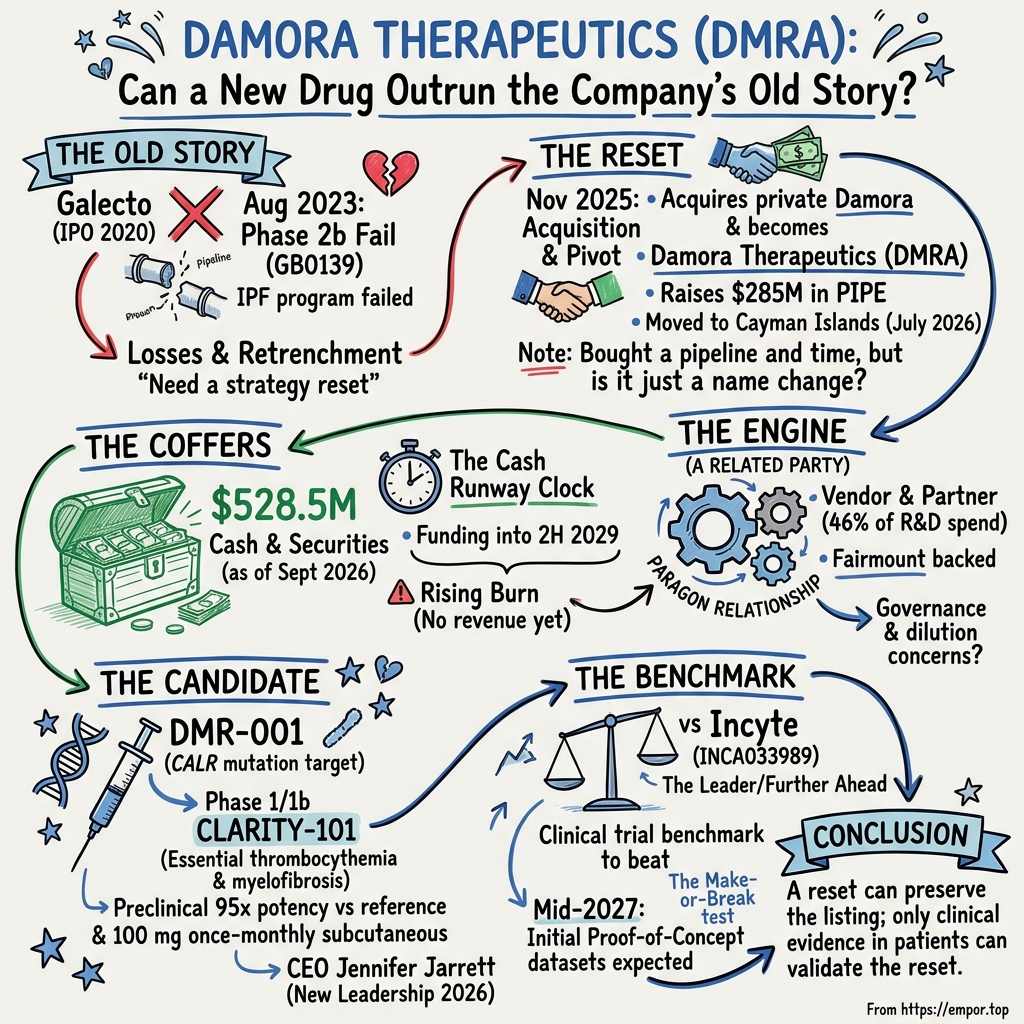
Damora Therapeutics: Can a New Drug Outrun the Company’s Old Story?
I. The Company Changed Its Name Before Its Lead Drug Reached Patients
On November 10, 2025, a small Nasdaq-listed biotech with a Danish heritage and a short, bruising history did something that, on paper, looked like a magic trick. Galecto, Inc., ticker GLTO, announced it was acquiring a private company called Damora Therapeutics.1 Damora had been founded only that August, and it owned no approved product, no revenue and no patient data.2 What it did hold were option rights to antibody programs designed by Paragon Therapeutics, a discovery shop tied to the life-sciences investor Fairmount.3 On the same day, Galecto signed an agreement to sell convertible preferred stock to investors for about $285 million.4 Two days later the money was expected to land.4
That pairing is the heart of this story. A public company whose own science had run aground received, in a single week, a new pipeline and more cash than it had ever raised in its life as a listed company. Then the identity followed the money. In March 2026, Galecto became Damora Therapeutics and swapped GLTO for a new ticker, DMRA.3 In July, it moved its legal home from Delaware to the Cayman Islands, converting every share one for one.5 By September 30, 2026, the renamed company sat on $528.5 million of cash, cash equivalents and marketable securities.2 Its lead drug, an antibody called DMR-001, had only just entered its first human trial, and the company was telling investors that the first two proof-of-concept datasets would arrive beginning in mid-2027.[^6]
So which is it? Did a struggling public biotech find a credible new future, or did it mainly acquire a new name and a very large bank balance? The honest answer, on November 22, 2026, is that nobody knows yet, and the reason nobody knows is precise. The acquisition and the financing bought the listed company time and a new lead program. They have not shown that the drug works in patients. Every interesting claim about Damora, from the size of its market to the potency of its antibody, is a claim about what may happen once patients are dosed and measured. Until then, the company is a funded hypothesis.
It helps to be exact about who the protagonist is, because the name on the door can mislead. The listed issuer is the same legal entity that went public as Galecto in October 2020, when it sold about 5.67 million shares at $15 each in an initial public offering.6 The November 2025 deal was not a new IPO, and it was not a reverse merger in which the private company's history replaced the public one's. It was an acquisition, accounted for as a purchase of assets, with a private placement alongside it.3 That matters because the financial record before late 2025 belongs to Galecto's fibrosis and cancer business, not to the private Damora startup. When the article later talks about a decade of losses, a failed trial or an auditor's warning, those belong to this listed company. The young antibody programs arrived with the purchase, along with a web of obligations to Paragon that now shape the company's costs and future royalties.2
Changing the name and the corporate domicile changed how the company presents itself to the world. It did not change a single data point about whether DMR-001 can lower a patient's platelet count or shrink a swollen spleen. The Cayman redomestication is a legal and tax decision, and the new ticker is a branding decision. Neither is clinical evidence. That gap between identity and proof is what makes Damora unusual even by the standards of clinical-stage biotech, where most companies at least carry a single scientific thread from their founding to their first pivotal trial. This one broke the thread and tied on a new one.
Two questions will run through everything that follows. The first is a race: can DMR-001 produce convincing clinical evidence before the cash runway tightens and the company has to ask shareholders for more? The second is a relationship: is Paragon, the antibody designer behind every molecule Damora owns, a durable source of differentiated medicines, or a costly dependency whose ties to Damora's largest shareholder create conflicts that minority investors must watch? To see why both questions carry weight, the story has to go back to the trial that made Galecto look for a new future in the first place.
 Subscribe on LinkedIn
II. A Fibrosis Drug Failed, and Galecto Had to Find Another Future
In August 2023, the people running Galecto opened the results of a trial they had been building toward for years. GALACTIC-1 was a Phase 2b study of GB0139, an inhaled drug meant to treat idiopathic pulmonary fibrosis, a disease in which the lungs scar and stiffen until breathing fails.7 It had enrolled 173 patients who were not taking either of the two approved fibrosis drugs, randomized them two to one between a 3-milligram dose of GB0139 and placebo, and followed them for 52 weeks.7 The question was simple: would patients on the drug lose lung capacity more slowly?
They did not. In fact, the numbers ran the wrong way. On the measure doctors use to track the disease, forced vital capacity, the patients on GB0139 lost on average about 317 milliliters over the year, while those on placebo lost about 127.7 Serious adverse events, including worsening of the disease, occurred in about 8% of treated patients versus about 1% on placebo, though deaths were similar between the arms.7 The trial had missed its primary endpoint, and the company said something even more damaging for a drug built on a specific biological idea: levels of galectin-3, the protein GB0139 was meant to block, rose in both arms, so there was "no confirmation of target engagement."7 In plain terms, the company could not show the drug had done to its target what it was designed to do.
Hans Schambye, Galecto's chief executive, said the company was "very disappointed" that the results did not support further development.7 Galecto discontinued the lung program and said it would focus on severe liver disease instead, with its oral galectin-3 inhibitor GB1211 slated for a Phase 2a trial in decompensated cirrhosis, "subject to obtaining additional financing."7 That last phrase is the tell. On July 31, 2023, Galecto held about $49 million in cash and investments and was aiming to stretch it "into 2025."7 The trade press described the move bluntly: Galecto had canned its lung fibrosis work and pinned its hopes on a liver drug.8
To appreciate how big a reset this was, it helps to remember what Galecto had been at its IPO. It was a galectin company. Its founding thesis was that galectin proteins drive fibrosis and help tumors evade the immune system, and that blocking them with small molecules could treat diseases from lung scarring to cancer.6 Alongside GB0139 and GB1211, it had a third program, GB2064, aimed at an enzyme involved in fibrotic tissue.[^10] The IPO prospectus sold a platform: a single biological idea that could be deployed across several diseases.6 GALACTIC-1 was that idea's largest test in patients, and it failed on both efficacy and evidence of mechanism.
What came next was retrenchment, and the income statement showed it clearly. Galecto's net loss fell from about $62 million in 2022 to about $38 million in 2023 and about $21 million in 2024.[^10]9 A casual reader might mistake that slope for improving business performance. It was the opposite. There was still no product revenue. The losses shrank because the company stopped spending on programs it could no longer afford or justify, and by the end of 2024 it employed just five full-time people.3 The auditor's report on Galecto's 2024 financial statements carried a going-concern explanatory paragraph, the accountant's formal way of saying there was substantial doubt the company could keep funding itself for the next year.3 Along the way, in 2024, Galecto bought an early cancer asset from Bridge Medicines, paying with preferred shares rather than scarce cash.9 It was the move of a company still looking for a story it could finance.
Then came 2025, when the loss line exploded to about $210 million.3 Here the headline is genuinely misleading, and a long-term investor should resist it. About $174 million of that loss was a single accounting entry: acquired in-process research and development, the value the company assigned to the Damora programs it bought in November.3 Under U.S. accounting rules, when a company buys early-stage drug programs that have no alternative future use, it expenses their value immediately rather than carrying it as an asset. So the 2025 loss is not a measure of the business getting worse. Most of it is the bookkeeping shadow of a purchase made with shares. Strip that entry out, and the underlying spending looks like what it was: a small company preparing to become a larger one.
How much should Galecto's record temper confidence in what came next? The fair answer is: some, but not in the way a cynic would argue. GALACTIC-1 does not prove that Damora's antibodies will fail. They are different molecules, built by a different team, aimed at a different target in a different organ system, with a far more direct biological rationale. The failure belongs to the listed company's capital-allocation history, not to the science it now owns. What it does prove is the gap between a plausible mechanism and a clinical result. Galecto's galectin idea had preclinical support, an IPO and years of work behind it, and the first large trial could not even confirm the drug was hitting its target. That is the bounded lesson: technical promise and clinical proof must be kept in separate boxes until patients merge them.
By the autumn of 2025, Galecto had a listing, a handful of employees, a liver program that needed money it did not have, and an auditor's doubt hanging over the balance sheet. It also had something more valuable than it may have looked: a clean public shell with a Nasdaq listing, a cap table that could absorb a new owner, and a board willing to deal. Somebody with a pipeline and a checkbook was about to notice.
III. The PIPE Bought a Pipeline—and Left the Purchase Price Hard to Judge
The transaction that arrived on November 10, 2025, was built like a piece of financial engineering, because it was one. Galecto merged two subsidiaries into private Damora and its affiliate, making Damora a wholly owned subsidiary, and the company described the deal as intended to be tax-free.4 In exchange, Damora's owners received about 265,000 ordinary shares of Galecto, plus roughly 16,400 shares of Series B preferred stock and roughly 4,200 shares of Series C preferred.4 Each preferred share was designed to convert into 1,000 ordinary shares, subject to conditions including a shareholder vote.4 Read the headline share count and the sellers seemed to receive almost nothing. Read the preferred terms and they received the equivalent of more than 20 million ordinary shares. That is why headline share counts and ownership percentages for Damora are incomplete without conversion assumptions.
Stockholder approval was not needed for the merger itself, and the deal was structured so that it did not have to be.4 Preferred shares that carry no vote and convert only after shareholder approval let a buyer hand over a controlling-sized economic stake without triggering the Nasdaq rules that would require an immediate vote on a large share issuance. It is a common structure in biotech recapitalizations, and it is efficient. It also means minority holders vote on dilution after the deal has already been struck.
On the same day, Galecto agreed to sell about 39,600 more Series C preferred shares to investors for roughly $285 million in gross proceeds, or about $267 million after costs.43 Fairmount led that private placement, and Fairmount was already central to the Paragon relationship that had produced the Damora programs.13 The 8-K does not state a per-share price for the common-equivalent, but a simple division of the disclosed figures gives roughly $7.20 for each underlying ordinary share.4 Hold that number, because it will matter.
The board changed the same day. Three Galecto directors resigned, and three people from Fairmount joined: Peter Harwin, a managing member of Fairmount; Chris Cain, its director of research; and Julianne Bruno, a growth partner and former chief operating officer of CRISPR Therapeutics.4 Lori Firmani, who had been Galecto's finance lead, was appointed chief financial officer, and Schambye and the general counsel received retention agreements payable by the end of April 2026.4 Lock-ups of 180 days covered certain Damora holders and Galecto insiders.4 It was a handover, executed in a single filing.
Two smaller details in that filing say a great deal about who the deal was built for. A registration rights agreement required the company to file a resale registration statement within 45 calendar days of the financing closing, so that the PIPE investors' shares could be resold freely once converted.4 And the 8-K flagged plans for a later redomicile and possibly a reverse stock split.4 The first detail gave the new money a clear exit path. The second foreshadowed the Cayman move that would come in July. Neither is unusual, but together they show a transaction designed by sophisticated investors who had done this before, and who negotiated their liquidity and the company's future legal shape on day one, before a single new trial had begun.
What exactly did Galecto buy? Private Damora had been created only three months earlier to hold option rights to programs developed by Paragon.2 When the company valued what it acquired, more than 90% of the fair value sat in a single item: the option to license DMR-001, DMR-002 and DMR-003.3 That point matters more than it first appears. The deal did not buy three independently validated drugs. It bought the right to license three related antibody programs aimed at the same target, the mutant form of a protein called calreticulin, from the company that designed them. The total accounting value, $174.3 million of acquired in-process R&D, was expensed in 2025.3
Was that a fair price? This is where the story gets uncomfortable for anyone hoping for a tidy verdict. The filings do not provide a clean standalone cash purchase price, because the consideration was paid in stock whose value depended on the financing that came with it. There is no directly comparable clinical-asset benchmark either, since the programs were preclinical and private. The $174.3 million accounting charge is a valuation estimate the company had to make under the rules; it is not, by itself, proof of overpayment or of value. A skeptic would say the original Galecto shareholders surrendered most of their company for a set of license options on molecules nobody had yet given to a human. A defender would say the Galecto shareholders owned a near-empty shell with a going-concern warning and received a stake in a funded pipeline they could never have assembled alone. Both descriptions are accurate.
The more useful tests are dilution and progress, and the dilution came fast. In February 2026, three months after the PIPE, the company sold about 16.6 million ordinary shares to the public at $19 each, raising about $295.5 million after costs.2 Through September it raised another $34.3 million through an at-the-market program, which lets a company sell shares into the market a little at a time, and it still had about $115 million of capacity left.2 That same February, holders converted Series C preferred into 42 million ordinary shares.2 At September 30, the remaining Series B and C preferred could still convert into about 18.1 million more ordinary shares.2 Paragon's affiliate Paramora also held warrants for about 628,000 shares at $23.01.2
Put the two prices side by side and the economics of the reset come into focus. The PIPE investors paid roughly $7 per underlying share in November 2025. Public buyers paid $19 in February 2026. Nothing clinical had happened in between: no patient had yet received DMR-001. The insiders who supplied capital when the company was a shell were rewarded for taking that risk, and the public market, by its willingness to pay more than double within three months, marked up the same pipeline on the strength of a story, a competitor's data and a large cash pile. That is not evidence of wrongdoing; early risk capital is supposed to buy cheaper. It is evidence that the people closest to Paragon entered on the best terms, and that later shareholders are paying for a scientific promise that still awaits its first readout.
Taken together, the capital raised since November 2025 is about $600 million net. It turned a company that had doubted its own survival into one of the better-funded early clinical-stage biotechs in its niche. The acquisition should therefore be judged over time by three things: whether DMR-001 hits its clinical milestones, how much it costs to advance the programs, and whether the company keeps meaningful economics after the obligations it owes Paragon. The first of those tests is the one the market is really pricing, and it brings the story to the drug itself, and to the rival that already has patient data in hand.
IV. The First Drug Has to Beat the Leader in the Clinic
Somewhere in Australia and the United States in 2026, the first patients with two rare blood cancers began receiving an injection under the skin, once every four weeks. The trial is called CLARITY-101, a Phase 1/1b study of DMR-001 in essential thrombocythemia and myelofibrosis.[^6] The starting dose is 100 milligrams, given subcutaneously, and the study uses a Bayesian dose-escalation design that enrolls patients with both diseases together.10 Those patients, at least during dose escalation, have already tried at least one prior therapy or cannot tolerate standard treatment.10 Management told a UBS conference audience on November 17, 2026, that sites reported waiting lists.10 It is the first moment in this company's renamed life when its science meets a human body.
To understand why that moment matters, it helps to understand the disease. Essential thrombocythemia and myelofibrosis belong to a family of blood cancers called myeloproliferative neoplasms, in which the bone marrow produces too many blood cells. In essential thrombocythemia, the marrow overproduces platelets, the cells that make blood clot, putting patients at risk of clots and bleeding. Myelofibrosis is the harsher sibling: the marrow scars, blood production moves to the spleen, which can swell dramatically, and patients suffer fatigue, night sweats, weight loss and anemia. A meaningful share of patients with these diseases carry a mutation in the gene for calreticulin, a protein that normally helps fold other proteins inside the cell.[^13]
The mutated version is a rogue. Its tail is rewritten, and the broken protein latches onto the receptor that normally tells the marrow to make platelets, switching it on permanently, like a doorbell jammed in the pressed position. The elegant part, from a drug designer's point of view, is that the rewritten tail exists only on the cancerous cells. Normal cells do not have it. So an antibody that recognizes only the mutant tail could, in principle, hit the disease-driving clone while leaving healthy blood production alone. That is the idea behind DMR-001, and it is also, crucially, the idea behind Incyte's INCA033989.
The mutations come in different shapes. The two most common are called Type 1 and Type 2, and there are many rarer intermediate variants; in Damora's language, everything that is not Type 1 is "non-Type 1."10 This detail is where the competitive story lives. Damora's CEO told the UBS audience that in Incyte's study, Type 2 patients made up about 55% of essential thrombocythemia patients and about 40% of myelofibrosis patients, and that Incyte's response rates in Type 2 essential thrombocythemia, at about 50%, trailed its roughly 80% in Type 1.10 Those are management's characterizations of a competitor's data, offered in a setting designed to make the case for its own drug. But they identify the gap Damora wants to fill: a "pan-mutant" antibody that works equally well across mutation types.10
How big is the prize? Jennifer Jarrett, Damora's CEO, has framed it repeatedly. About 45,000 U.S. patients carry the mutation across the two diseases, roughly a third of all patients with essential thrombocythemia or myelofibrosis, and she called that "a TAM in the U.S. of over $10 billion," using the industry's shorthand for total addressable market.10 The next day, at the Jefferies conference, she described the U.S. market as "well north of $10 billion."11 That number deserves a firm label. It is management's market framing, and it assumes future efficacy, approval, adoption across lines of therapy and pricing that no drug in this class has yet established. A market estimate is not a market.
The rival that already has the data
Here the story turns from biology to war-gaming, because Damora is not first. Incyte, the company behind the JAK inhibitor ruxolitinib that already anchors myelofibrosis treatment, has been testing INCA033989 in patients and reporting results at the major hematology meetings. At the American Society of Hematology meeting in December 2025, Incyte presented updated data in essential thrombocythemia and new data in myelofibrosis.[^15][^16] By then the FDA had granted the program Breakthrough Therapy designation, in November 2025.[^17] At the European Hematology Association meeting in June 2026, Incyte reported that 87% of essential thrombocythemia patients reached a hematologic response and 70% a complete response, with responses arriving in a median of about two weeks.[^17]
In Type 1 patients at doses of 750 milligrams and above, 81% achieved a durable complete hematologic response.[^17] In myelofibrosis, given alone, the drug produced a 35% reduction in spleen volume at week 24 in about 27% of evaluable patients, a meaningful symptom improvement in about half at best, and an anemia response in 60% of evaluable anemic patients, with no dose-limiting toxicities reported.[^17] Incyte is also testing it in combination with ruxolitinib.[^17]
Those are company-reported, interim, early-phase figures from small groups. But they do two things at once for Damora. They validate the target: an antibody aimed at mutant calreticulin can produce fast, deep responses in human beings, which removes the single largest risk that hangs over most first-in-class biology. Jarrett acknowledged as much at UBS, pointing to Incyte's data as proof of concept for the field and claiming that Incyte had gained about $8 billion of market value after its EHA presentation.10 And they set a high bar. A later entrant can no longer win by showing that the target works. It has to show that its version works better, more conveniently or in more patients.
Incyte's head start is real. At Jefferies, Damora's chief operating officer, Sherwin Sattarzadeh, described Incyte's essential thrombocythemia Phase 3 design as 750 milligrams every two weeks with titration up to 2,500 milligrams based on platelet count, and Jarrett said Incyte was "only about two years ahead."11 "Only" is doing a lot of work in that sentence. In a rare disease, a two-year lead means the first drug can be approved, priced and placed into treatment guidelines, while hematologists build experience with it, before the second drug has finished its pivotal study. The challenger then has to persuade doctors to switch from a drug that works.
What Damora says is different, and how much of it is proven
Damora's case rests on three claims. The first is potency across mutations. Jarrett told the UBS audience that, across a panel of 10 mutations including Type 1, Type 2 and eight intermediate variants, with three experiments per mutation, DMR-001 averaged a 95-fold potency advantage over a reference version of Incyte's antibody.10 The company's materials describe the advantage across non-Type 1 mutations.[^6][^13] Damora said it synthesized that reference molecule itself from Incyte's published patent.10 The second claim is half-life. DMR-001 is engineered to last longer in the body, which is what allows dosing every four weeks rather than Incyte's every two; management says the drug has a "much better PK profile," the pharmacologists' term for how a drug moves through and lingers in the body, though no numeric human half-life has been given.1011 The third is convenience: a subcutaneous injection, eventually from an auto-injector pen, rather than an intravenous infusion.10
There is a quiet piece of regulatory cleverness here too. Jarrett explained at Jefferies that because DMR-001 is "Fc-null," meaning it has been engineered not to recruit the immune system, and binds the same spot on the mutant protein as Incyte's antibody, regulators accepted that Damora could lean on Incyte's safety data to start at a dose of 100 milligrams.11 At UBS, Sattarzadeh called that starting dose "significantly higher" than Incyte's.10 Starting higher can save months of dose escalation. It is a classic fast-follower advantage: the leader pays to discover that the target is safe, and the follower uses the map.
Now the test. The 95-fold figure is preclinical and company-generated, measured in a laboratory against a molecule Damora made itself from a patent. It is not a head-to-head clinical trial, and potency in a dish does not automatically translate into deeper responses in a patient. Incyte's drug already produces complete responses in most Type 1 patients; there is a ceiling to how much better a more potent antibody can do there. The real question is whether potency closes the Type 2 gap, and the only way to answer it is the CLARITY-101 data. Likewise, a longer half-life is a hypothesis about convenience until human pharmacokinetic data show that a monthly dose keeps the target covered over the whole interval, which management says it expects.11 And a cleaner dosing schedule matters only if safety and response depth hold up.
The verdict on the preclinical edge, then, is that it narrows to a smaller claim: DMR-001 has a plausible design advantage aimed at a real gap in the leader's profile, but no evidence yet that the advantage survives contact with patients. The KPI that would confirm it is the response rate in Type 2 and other non-Type 1 patients, measured against Incyte's figures at comparable follow-up. The event that would falsify it is a first dataset in which non-Type 1 patients respond no better than they do on Incyte's drug, or in which monthly dosing lets the response fade before the next shot.
The new antibody must also show where it fits in care. Essential thrombocythemia today is managed with cytoreductive drugs that lower blood counts, and myelofibrosis with JAK inhibitors that shrink spleens and ease symptoms without reliably changing the course of the disease. Will a mutant-calreticulin antibody replace those drugs, come before them or combine with them? At Jefferies, analyst Akash Tewari pushed on precisely that question, and Jarrett said "the predominant view is that monotherapy is probably better," while also saying the company liked "the idea of combining JAKs."11 Tewari also pressed on whether the FDA would accept measures like the fraction of mutant cells in the blood as evidence of disease modification, and Sattarzadeh conceded that "the regulatory science" needs time to catch up.11 Those are honest answers to hard questions, and they show the field is still defining what winning looks like.
The combination question is not academic, because Incyte is already generating the answer. In its June 2026 update, Incyte reported that among myelofibrosis patients receiving INCA033989 together with ruxolitinib, about 55% achieved at least a 25% reduction in spleen volume at week 24 and about 30% achieved a 35% reduction, with anemia responses in about a third of evaluable patients.[^17] Those are small groups, but they show the leader testing its antibody both alone and layered on top of the drug most myelofibrosis patients already take. If combination with a JAK inhibitor becomes the standard in myelofibrosis, the owner of the JAK inhibitor holds a structural advantage in designing, running and marketing that regimen. Damora would then need either its own combination data, built on a competitor's drug, or a monotherapy result strong enough to make the combination unnecessary.
The ambition is not modest. At UBS, Jarrett said the goal is to "start a phase III by the middle of 2028."10 She also argued that a rival program Eli Lilly had just acquired was at least 12 months behind Damora, and that Incyte's own next-generation antibody was at least six months behind.10 So the competitive field is crowding even before the first Damora data: the leader, the leader's follow-on and a newly arrived pharmaceutical giant. Set against a trial that opened in 2026 and expects initial proof-of-concept data beginning mid-2027, a Phase 3 start by mid-2028 leaves little slack for surprises in dose selection or enrollment.[^6] The clinical readouts, not a market-size estimate or a preclinical potency ratio, will decide whether this lead has an investable edge. And every one of those readouts will be generated with molecules that came from the same place.
V. Paragon Is the Engine, the Vendor and a Related Party
Open Damora's quarterly filing and one name keeps surfacing in places that are usually kept apart. It appears again as the company's largest research vendor. It appears a third time in the related-party notes, where accountants disclose dealings with entities that are connected to the company's insiders. At Jefferies, Jarrett put it plainly: "All of our molecules today came from Paragon."11 At UBS she described Paragon as a company whose sole business is making antibodies, and called its antibodies "best-in-class."10
Start with what Damora is not. There is no recurring commercial revenue to analyze, no customer concentration, no pricing, no retention curve. The company says it has no approved products and has generated no product revenue.2 The counterparties that matter today are not buyers but suppliers: research providers, clinical sites, contract manufacturers and, above all, Paragon. In the third quarter of 2026 the company sold GB3226 and other legacy assets to one unnamed buyer for $750,000 upfront, plus potential milestones and royalties.2 It was a small, one-off cleanup of Galecto's past, not a customer business. With no product sales, there is no customer moat to credit. Whatever advantage Damora has must come from its science and its money.
How the engine is paid
The Paragon relationship works like this. Paragon performs research and development services for Damora and is reimbursed for its actual costs plus a markup.2 In the first nine months of 2026, Paragon provided about $34.5 million of services, which was about 46% of Damora's reported R&D expense for the period.2 In 2025, the figure was about $22.1 million.3 Nearly half of every research dollar flows to one partner, which is connected to the company's largest shareholder.
But that $34.5 million needs dissecting, because not all of it was cash. About $11.9 million was the non-cash cost of warrants granted to Paramora, a Paragon affiliate that receives annual equity grants as part of the arrangement.2 So the cash vendor spend was closer to $23 million, while the rest was paid in a claim on Damora's future share count. That is a cleverly aligned structure: Paragon's affiliate profits most if Damora's stock rises. It is also a dilution channel that does not appear in the cash-flow statement. Meanwhile, the amount Damora owed related parties fell from about $17.2 million at the end of 2025 to about $5.0 million at September 30, 2026, which means the company paid down a backlog of Paragon bills during the year.2
The licenses are the second layer. In November 2026, Damora exercised its options and licensed DMR-001 and DMR-002 from Paragon, with exclusive worldwide rights.2 Each licensed product carries up to $22 million in development, clinical and regulatory milestones, plus tiered royalties in the low-to-mid single digits on future net sales.2 For a drug with a multibillion-dollar ambition, those are not punishing terms; a royalty in that range leaves the vast majority of product economics with Damora. DMR-003, the third program, remains unlicensed.2 So the company's ability to advance its full portfolio depends on decisions and terms still to come, and on a counterparty that is not fully independent.
Where the conflict lives
Fairmount owns more than 5% of Paragon, appointed Paragon's board and holds contractual approval rights over Paragon's executive appointments.3 It is also Damora's largest shareholder, with about 12.9 million shares, or 19.99% on the proxy's stated basis, as of April 2026.12 And three of Damora's directors are affiliated with Fairmount.12 Jarrett, at UBS, described Paragon as "wholly owned by Fairmount," a looser characterization than the filings, which describe ownership above 5% plus control rights; either way, the economic and governance links are deep.103 When Damora decides whether to license DMR-003, how much research to buy from Paragon, or whether to negotiate the markup, the shareholder that benefits on one side of the table is connected to the shareholder that benefits on the other.
None of this establishes that the arrangement is unfair. The proxy says all standing board committees consist solely of independent directors, and four of the seven directors are not affiliated with Fairmount or Paragon.12 Cost-plus pricing is standard for research services, and Fairmount's capital is what made the company viable. Affiliation alone is not misconduct, and investors should not infer it. But a skeptical investor would want to see three things disclosed more fully than they are: how the independent directors review Paragon's statements of work and markup, whether alternative antibody-engineering or development suppliers are ever benchmarked against Paragon, and how the DMR-003 option will be priced when the time comes. The 2026 proxy and the quarterly filing describe the relationship and its amounts; they do not describe a competitive benchmarking process.
So is Paragon an engine or a dependency? The evidence says it is both, and the two cannot be separated. It is a material source of scientific capacity for a company that had seven full-time employees at the end of 2025.3 It is also a material economic dependency, with nearly half of R&D flowing to it and every current molecule traceable to it. If Paragon's antibodies are as good as management says, Damora has outsourced its most important capability to a specialist and kept most of the economics. If they are not, Damora has little in-house discovery capacity to fall back on. The metric to watch is the share of R&D going to Paragon as clinical costs at outside sites and manufacturers rise; if it stays near half even as trials expand, the company remains a Paragon satellite more than an independent drug developer.
Which raises a more immediate question than governance. Whatever the arrangement costs in principle, how long can the company afford it in practice?
VI. The Cash Runway Is a Clock, Not a Clinical Result
At September 30, 2026, Damora's balance sheet looked like a fortress built for a company that had not yet fought a battle. It held about $350 million in cash and cash equivalents, including money-market funds and U.S. Treasuries, and about $179 million in marketable debt securities maturing within two years.2 Together, that was $528.5 million.2 There were no borrowings. Lease liabilities, mostly for a new Waltham, Massachusetts headquarters signed in August 2026, came to about $1.1 million.2 For a company whose 2024 financial statements had carried a going-concern warning, the turnaround in liquidity was total. The auditor's report on 2025 dropped that paragraph.3
Against that pile, the company's first major patient data remain ahead. Management expects its cash to fund operations into the second half of 2029.[^6] That estimate is the company's clearest near-term financial strength. It is also a management forecast, not a rating or a guarantee, and it rests on assumptions about how fast trials enroll and how much they cost. No credit rating exists, and none is needed: with no debt, the financing question is not interest coverage but how much new equity the company will need, and when.
Reading the burn
The cleanest way to see the economics is to compare what the company lost with what it actually spent. In the first nine months of 2026, Damora reported a net loss of about $90.9 million and an operating cash outflow of about $59.7 million.2 The $31 million gap has two sources. About $16 million came from non-cash items, mostly share-based compensation, plus the Paramora warrant cost.2 Another $15 million came from changes in working capital, essentially bills incurred but not yet paid and similar timing effects.2 That second piece deserves care. A working-capital benefit is not earnings; it is a timing gift that tends to reverse as vendor and related-party balances come due. So the true cash cost of running the company over those nine months was probably closer to the net loss, less the non-cash charges, than the reported cash outflow suggests.
Where is the money going? R&D expense was about $6 million in 2024 and about $27 million in 2025, and it climbed to about $75 million in the first nine months of 2026.32 The increase over the prior-year period included about $26 million more for chemistry, manufacturing and controls, the work of producing a clinical-grade antibody consistently and at scale; about $15 million more for clinical and preclinical activity; and the $11.9 million warrant charge.2 That breakdown says something about strategy. Damora is spending heavily on manufacturing before it has efficacy data, which is a bet that it will need drug supply for expansion cohorts and a later pivotal trial quickly. If the drug works, that spending will look prescient. If it does not, it will have been the most expensive part of the experiment.
The company also earned about $12 million in other income over nine months, mostly about $11.1 million of extra interest on the enlarged securities balance, along with the $750,000 gain on the legacy asset sale.2 Treasury income is a genuine offset, covering roughly a sixth of the operating loss, but it is a by-product of having raised money, not of having built a business. As the cash is spent, and if interest rates fall, it will shrink.
A couple of smaller exposures sit in the footnotes, and they are worth a sentence precisely because they are small. The company's Danish and Swedish subsidiaries, legacies of Galecto's Scandinavian roots, keep their books in euros, while the group reports in dollars, and the filings disclose no currency hedging policy.23 Foreign-exchange losses were only about $21,000 in the first nine months of 2026, trivial against an operating loss in the tens of millions.2 The balance sheet also carried an R&D tax-credit receivable of about $814,000 and prepaid contract research of about $1.5 million.2 With no customers, these are the company's only receivables, and the collection risk is the timing of tax refunds, not anyone's ability to pay. The Galecto past survives mainly as a few European bank accounts and a tax claim.
Here is the clue that matters most. At the nine-month burn rate, about $80 million a year, $528.5 million would last more than six years. Management's runway guidance, into the second half of 2029, implies about three years. Simple arithmetic therefore says that the company expects to spend at roughly twice its current pace on average, perhaps more, as CLARITY-101 expands, DMR-002 and DMR-003 enter the clinic and a Phase 3 approaches. That is not a criticism; it is what a biotech that succeeds in Phase 1 is supposed to do. But it reframes the cash pile. It is not seven years of safety. It is about three years of an accelerating program, ending around the time a Phase 3 that starts in mid-2028 would still be running.
Measured against the company's own history, the risk is not that it runs out of money soon. It is that the next large capital need arrives before the evidence is decisive. Galecto in 2023 had about $49 million and a runway "into 2025," and it had to retrench.7 Damora in 2026 has more than ten times as much. The difference is scale and timing, not the underlying model: a pre-revenue company converts shareholder capital into clinical evidence, and the evidence has to arrive before the capital runs out. Most of the time, in biotech, the good news and the next financing arrive together, because a positive readout is the moment a company can raise on the best terms. A disappointing readout, by contrast, can leave a funded company with a large cash balance and a shrinking reason to spend it.
The KPI to watch here is quarterly operating cash burn, read alongside trial enrollment and the runway guidance. The latest reading is about $60 million over nine months, and the direction of spending is clearly up. If burn rises in step with milestones, the runway guidance holds. If burn rises while timelines slip, the gap between the cash clock and the clinical clock will widen, and the dilution question will return sooner. And because this is a company where the person setting that pace is new, the clock is also a test of leadership.
VII. The New CEO Inherits a Strategy That Has Already Changed Twice
When Jennifer Jarrett took over as chief executive on March 30, 2026, she walked into a company that had changed its identity three times in four years.13 It had been a galectin platform company at its IPO, a liver-disease company after GALACTIC-1, a would-be cancer company after the Bridge Medicines deal, and now a mutant-calreticulin company with a new name. Her predecessor, Hans Schambye, had left effective February 10, 2026.12 Lori Firmani remained as chief financial officer, a role she had held since August 2024.12 Jarrett's job was not to invent a strategy. It was to execute one that had been chosen for her by a shareholder-led transaction, with money that had already been raised.
Jarrett's background explains why she was chosen. She previously served as chief operating officer and chief financial officer of Arcus Biosciences, a cancer-drug developer known for large pharmaceutical partnerships, and held a corporate development and capital markets role at Uber.13 It is an operator's and financier's résumé, built around raising capital, negotiating partnerships and running late-stage development organizations. For a company whose next three years involve spending several hundred million dollars, managing a complex related-party relationship, and potentially negotiating with large pharmaceutical companies, that profile fits. It does not substitute for a Damora operating record, which at this point is less than eight months long.
Her disclosed offer letter set a base salary of $695,000 and a target annual bonus of 55% of salary, plus equity awards.13 That is standard pay for a well-funded clinical-stage biotech. The more telling number is ownership. The April 2026 proxy listed no beneficial shares for Jarrett and 0.40% for all then-current directors and executive officers as a group.12 That snapshot predates later equity grants, and her options give her strong upside if the stock rises. But on the proxy date, the people running the company owned very little of it outright, while Fairmount, through the transaction, owned roughly a fifth. Incentive alignment at Damora runs mainly through options and through the major shareholder, not through executives' own invested capital. Subsequent Form 4 filings, which report insider trades and grants, are the place to track whether that changes.
Schambye's tenure is worth recalling only briefly, because the former CEO is not the current story. He was paid about $1.3 million in 2025, including a cash bonus of about $679,000, the year the company was rescued by an acquisition rather than by its own science.12 The board rewarded him for completing the transaction that ended his own strategy. That is a reasonable outcome for a CEO who found a buyer for a shell, but it is a reminder that biotech pay often rewards deals as well as data.
The transaction documents also show how the transition was engineered. When the deal was signed, Firmani's salary rose from $300,000 to $375,000 as she stepped into the CFO role, and Schambye and the general counsel received retention bonuses payable at the earlier of April 30, 2026, or a termination without cause.4 Retention arrangements of that kind are designed to keep the old team in place long enough to hand over the keys. Schambye left in February, before that date, and the board recruited an outside CEO within weeks.1213 The sequence suggests the new owners always intended a leadership change, which is consistent with a company whose strategy had been chosen by its new shareholders rather than its old managers.
The governance signals around the transition are bounded but reassuring. At the April 2026 annual meeting, say-on-pay passed with about 51.4 million votes for and about 3,500 against, an overwhelming margin.14 Two director nominees received about 29,000 withheld votes each, a trivial amount.14 The company also changed auditors, from EY's Danish affiliate to Ernst & Young LLP in the United States, effective April 17, 2026, with no disagreements or reportable events.12 That change fits a company whose center of gravity moved from Copenhagen to Massachusetts. None of these signals proves future performance. They show only that the shareholders who voted, many of them the same investors who funded the deal, were content.
The better test of credibility is how management talks when questioned, and how that compares with what happens later. At the November conferences, Jarrett and Sattarzadeh gave specific answers on several points: the 100 milligram starting dose, the every-four-week schedule, the Bayesian escalation design, the decision to run trials in Australia and the U.S., and the target of a Phase 3 start by mid-2028.1011 They were candid that Incyte's data had validated the target, and that regulatory endpoints for disease modification were unsettled.1011 On the other hand, the most quotable claims, the $10 billion market and the 95-fold potency advantage, are management's framing, and the remarks about competitors being months behind are assertions about other companies' programs that outsiders cannot verify.
The record so far is too short to judge execution. The test will be whether those milestones arrive on time and the runway guidance holds.
The questions management did not get are as revealing as the ones it did. At UBS, the analyst's line of inquiry was largely open and friendly, though he did press on whether investors should benchmark Damora against Incyte's Type 2 data specifically, and whether frontline patients would need combination therapy.10 Management's answer on why Incyte had chosen particular combination strategies was, by its own framing, speculation about a competitor's thinking.10 Neither conference produced a discussion of cash runway or spending.1011 That is normal for a company months away from its first data, but it means the market's live conversation with Damora is almost entirely about science and competition, and very little about capital. The quarterly filings carry that second conversation, and they are where investors should look for it.
VIII. The Investment Case Turns on Proof, Focus and Dilution
Picture two documents side by side. On the left, Incyte's June 2026 data release: hundreds of words describing complete hematologic responses, spleen reductions, anemia responses and a Breakthrough Therapy designation.[^17] On the right, Damora's quarterly filing: a trial open, patients dosing, no efficacy data, and a note that preferred shares remain convertible into about 18.1 million ordinary shares, before warrants or further at-the-market sales.2 That contrast is the investment case in miniature. One company has evidence. The other has money, a hypothesis and a capital structure that will expand before the evidence arrives.
Why it could win
The bull case begins with the target. Mutant calreticulin is now one of the cleaner validated targets in hematology, because Incyte's data show that antibodies against it can produce rapid, deep responses with good tolerability.[^17] Most biotech failures are biology failures; Damora does not carry that risk in the same way Galecto did with galectin-3. Second, there is a real gap in the leader's profile. If Damora's management is right that Incyte's drug works less well in Type 2 patients, and that Type 2 patients make up around half of the essential thrombocythemia population, then a drug that closes that gap would address a meaningful share of the market.10 Third, convenience matters in chronic diseases that patients live with for years. A monthly subcutaneous injection, eventually from a pen, is a better experience than an intravenous infusion every two weeks.10 Fourth, the company has the money to find out: current cash should fund it through multiple planned evidence points, if burn and execution stay near plan.[^6]
Why it may not
The bear case is just as concrete. Incyte is roughly two years ahead by management's own estimate, and its drug already achieves complete responses in most Type 1 patients.11[^17] Incyte also owns ruxolitinib, already anchors myelofibrosis prescribing, and is testing the combination, which gives it distribution, data and relationships with the same hematologists Damora must persuade.[^17] Preclinical potency and convenience do not establish superior efficacy or a tolerable long-term regimen. Even if DMR-001 is more potent, it may produce similar responses; antibodies can saturate a target, and beyond saturation more potency does nothing. Meanwhile, the field is getting crowded: Incyte's own next-generation antibody and Eli Lilly's newly acquired program are, by Damora's account, close behind.10 Add Paragon dependence, rising burn and material dilution, and the bear case says Damora is paying a premium to be a fast follower in a race the leader may already have locked up.
There is a third reading that sits between bull and bear, and the November conferences made it hard to ignore. If, as the UBS analyst noted, Eli Lilly had just bought its way into mutant calreticulin, then large pharmaceutical companies see this target as worth paying for.10 That raises the strategic value of any credible program in the class, including Damora's, whether as a partnering candidate or a takeover target. But strategic interest cuts both ways. A Lilly-backed competitor brings a commercial machine and a balance sheet far beyond Damora's, which makes the field more crowded and the bar for a small company's differentiation higher. Optionality is not value until someone pays for it, and the price anyone would pay will depend on the same mid-2027 data that everything else depends on.
The five forces and the seven powers
Michael Porter's five forces framework, applied to a company with no product, is a thought experiment about the market it hopes to enter. The threat of substitutes is high: JAK inhibitors, cytoreductive drugs and Incyte's antibody all compete for the same patients. Rivalry is intensifying, with at least four mutant-calreticulin programs from Incyte, Lilly and Damora at various stages. Buyer power, in the form of payers and hematologists, will be strong for a second or third entrant that must justify a price against an incumbent. Supplier power is unusually high, because Paragon designed every molecule and receives cost-plus fees, milestones and royalties. The threat of new entrants is moderate: the target is now validated, which lowers the scientific barrier and invites more competitors, while clinical-development costs keep the financial barrier high.
Hamilton Helmer's seven powers framework asks what durable advantage could let a company earn returns above its cost of capital. Damora currently has none of the classic powers in force. It has no scale economies, network effects, switching costs or brand, because it has no product. The candidate power is what Helmer calls a cornered resource: proprietary molecules with superior properties, protected by patents. But the resource is shared in a sense: Paragon, not Damora, is the engine that produced it, and the strongest version of the claim depends on clinical data that do not yet exist. If DMR-001 proves clearly better in Type 2 patients and on dosing, the company could build a modest counter-positioning advantage against Incyte's every-two-week IV regimen. For now, the moat is a hypothesis.
The activist's questions
A skeptical long-short investor, or an activist, would push on a few things. What patient-level result would justify advancing DMR-001 into Phase 3, and what would cause management to stop or narrow the program? The company has said where it wants to go, but not what would make it turn back. What clinical milestone is each incremental dollar buying, especially the manufacturing dollars spent before efficacy data? How will the independent directors evaluate Paragon's pricing and the DMR-003 option, given that Fairmount sits on both sides? And why should the company keep raising capital through an at-the-market program before its first data, when it already has about three years of runway?
Valuation, for now, must stay open. No earnings or sales multiple is meaningful for a pre-revenue, loss-making company, and no defensible clinical-stage peer comparison has been assembled here. What can be said is what the share price assumes. A company with more than $500 million of cash and an unproven Phase 1 asset is priced on the probability that DMR-001 shows a clear advantage over Incyte in 2027, and on the size of the market it could then capture. Any valuation work should start from the fully diluted share count, including the roughly 18.1 million ordinary shares embedded in the preferred stock, the Paramora warrants and the remaining at-the-market capacity.2
Three KPIs will decide the case. The first is the response rate in non-Type 1 patients in CLARITY-101, which has no reading yet. The second is quarterly operating cash burn, at about $60 million over the first nine months of 2026 and rising.2 The third is the fully diluted share count, which is likely to grow before any commercial value exists. All three are about converting capital into evidence, and that is also the lesson of the company's strange path.
IX. Lessons from a Company That Had to Start Again
In just three years, the same listed company went from a failed trial to a funded pipeline whose lead drug has yet to produce a patient response. Few public companies compress that much reinvention into so few years, and the compression is itself the lesson.
The first lesson is that a reset can preserve the listing, but only evidence can validate the reset. Galecto's shareholders kept a Nasdaq ticker and ended up with a stake in a funded company. But the listing was always the least valuable part of the business; it was the vehicle, not the cargo. What the new owners bought was a chance to test a hypothesis in public markets. A ticker change is a legal event. A response rate is a business event.
The second lesson comes from GALACTIC-1: biological rationale and promising preclinical work can fail in human trials, and when they fail, they can fail completely. GALACTIC-1 showed that the galectin thesis, despite years of laboratory support, could not deliver in patients. Damora's mutant-calreticulin thesis is stronger, because a competitor has already shown the target works in people. But the specific claim that matters for Damora, that its antibody is meaningfully better, rests on exactly the kind of laboratory evidence that betrayed Galecto before. A 95-fold advantage in a dish is a reason to run a trial, not a reason to expect its result.
The third lesson is that a large raise creates time, but it also raises the bar for capital discipline. With a small balance, every dollar is a survival question. With a large one, a company can afford to manufacture ahead of data, run three programs in parallel and build a headquarters. That is sometimes correct, because speed matters against a competitor two years ahead. But each milestone should reduce uncertainty about efficacy, safety or dose. Spending that does not reduce uncertainty is just spending.
The fourth lesson is about platforms and dependency. A relationship like Damora's with Paragon can accelerate discovery dramatically. It also concentrates the company's scientific and economic dependency in one connected network, where the investor that funds the company also influences the supplier that designs its products. For founders, the lesson is that outsourced discovery is a powerful accelerant. For investors, it is that in such structures, the alignment of interests must be read in the related-party notes, not assumed from the press release.
The deepest lesson is the one that applies to every biotech, and that Damora's journey makes unusually vivid. A funded story becomes an investment case only when patients, not models, transaction accounting or market estimates, confirm the mechanism. Damora has bought another chance. It has not yet demonstrated a durable drug-development advantage. The difference between those two things will be measured in the next two years.
X. The Next Two Years Will Decide What the PIPE Bought
Tonight, patients are enrolling in CLARITY-101 in Australia and the United States.10 Somewhere in a laboratory, Paragon's scientists are working on programs that Damora has yet to license. And Incyte, by Damora's own account, is already further ahead in essential thrombocythemia.11 The race is under way, and the first lap will be timed in mid-2027.
That is when Damora expects to release its first proof-of-concept datasets.[^6] What should investors look for? First, safety at the 100-milligram starting dose and above, since a cleaner safety profile is part of the case. Second, the mutation mix: how many enrolled patients are Type 2 or other non-Type 1, because that is where the company claims its edge. Third, response depth and durability in those patients, compared against Incyte's figures at similar follow-up times. Fourth, pharmacokinetics: whether a monthly dose keeps the drug at effective levels across the whole interval. A result that shows strong, durable responses in Type 2 patients on monthly dosing would turn the hypothesis into a credible clinical edge. A result that shows responses similar to Incyte's, with no clear Type 2 advantage, would turn Damora into a fast follower competing mainly on convenience. A result that shows weaker responses, or a safety signal, would reopen the question of what the PIPE actually bought.
Before that, the pipeline has its own milestones. The company planned a regulatory submission for DMR-002, its Fc-enhanced antibody designed to recruit the immune system for sicker patients, in the fourth quarter of 2026, and for DMR-003, a T-cell engager aimed at refractory myelofibrosis, in 2027.[^21]10 Jarrett said DMR-002 would be in the clinic before Incyte's next-generation antibody.10 Those programs are future options, not current value drivers, until their clinical and economic paths become clearer. They also cost money, and each one that enters the clinic will add to the burn that the runway guidance has to absorb.
DMR-003 carries its own warning label. T-cell engagers, antibodies that physically tether the patient's immune cells to cancer cells, can be powerful in heavily treated patients, but they can also trigger cytokine release syndrome, an inflammatory storm that requires careful monitoring. Sattarzadeh himself pointed to a rival bispecific from Johnson & Johnson with roughly 40% rates of that syndrome and about half of patients experiencing serious adverse events, and noted that its response rates in late-line essential thrombocythemia had fallen short of expectations.10 He offered that as evidence of the gap Damora hopes to fill. It is equally evidence of how hard the gap is to fill. And DMR-003 remains unlicensed, so even the option on it still has to be bought from Paragon.2
Investors should track quarterly operating cash use alongside the runway estimate. The current guidance extends into the second half of 2029; any change in spending or timing will alter the financing and dilution outlook.[^6] They should also revisit the Paragon license economics and governance disclosures as milestones, royalties and the DMR-003 decision become concrete. The next decisive evidence is DMR-001 patient data, interpreted against Incyte's results and Damora's actual burn. Everything else is context.
XI. Outro
In November 2025, a company with a failed lung drug and a going-concern warning signed papers that gave it a new pipeline and a new future. By September 2026, it had more than half a billion dollars in the bank. The drug that justified the transformation had not yet produced a measured response in a patient.
That is what makes Damora unusual even by biotech standards: the company changed everything about itself except the one thing that matters. The defining image is not the new ticker, the Cayman redomestication or the $10 billion market claim. It is a patient in an Australian clinic, receiving a monthly injection, whose platelet count in the weeks that follow will begin to answer the question that half a billion dollars could only postpone: can a laboratory advantage survive the clinic, and can the company turn a bought runway into evidence before investors are asked to fund the next chapter?
References
-
Galecto Announces Acquisition of Damora Therapeutics — GlobeNewswire, 2025-11-10 ↩↩
-
Form 10-Q for quarter ended September 30, 2026 — Damora Therapeutics, Inc., SEC, 2026-11-04 ↩↩↩↩↩↩↩↩↩↩↩↩↩↩↩↩↩↩↩↩↩↩↩↩↩↩↩↩↩↩↩↩↩↩
-
Form 10-K for year ended December 31, 2025 — Damora Therapeutics, Inc., SEC, 2026-03-19 ↩↩↩↩↩↩↩↩↩↩↩↩↩↩↩↩↩↩
-
Acquisition of Damora Therapeutics, Form 8-K — Galecto, Inc., 2025-11-10 ↩↩↩↩↩↩↩↩↩↩↩↩↩↩
-
Redomestication, Form 8-K — Damora Therapeutics, Inc., 2026-07-16 ↩
-
Galecto Announces Topline Results from Phase 2b GALACTIC-1 Trial of GB0139 — Galecto, Inc., SEC, 2023-08-15 ↩↩↩↩↩↩↩↩↩
-
Galecto Cans Lung Fibrosis Med After Phase 2 Fail, Pivots to Liver — Fierce Biotech, 2023 ↩
-
Form 10-K for year ended December 31, 2024 — Galecto, Inc., SEC, 2025-03-19 ↩↩
-
UBS Global Biopharma Conference Transcript — Damora Therapeutics, 2026-11-17 ↩↩↩↩↩↩↩↩↩↩↩↩↩↩↩↩↩↩↩↩↩↩↩↩↩↩↩↩↩↩
-
Jefferies Global Healthcare Conference Transcript — Damora Therapeutics, 2026-11-18 ↩↩↩↩↩↩↩↩↩↩↩↩↩
-
Definitive Proxy Statement — Damora Therapeutics, Inc., 2026-04-29 ↩↩↩↩↩↩↩↩↩
-
CEO Appointment and Compensation, Form 8-K — Damora Therapeutics, Inc., 2026-03-23 ↩↩↩↩
-
Annual Meeting Voting Results, Form 8-K — Damora Therapeutics, Inc., 2026-04-28 ↩↩
 LinkedIn
 WhatsApp
 Reddit
 Hacker News
 Email
 Kindle
 RSS Feed
 Spotify
 Apple Podcasts
 Amazon Music
 Audible
 YouTube