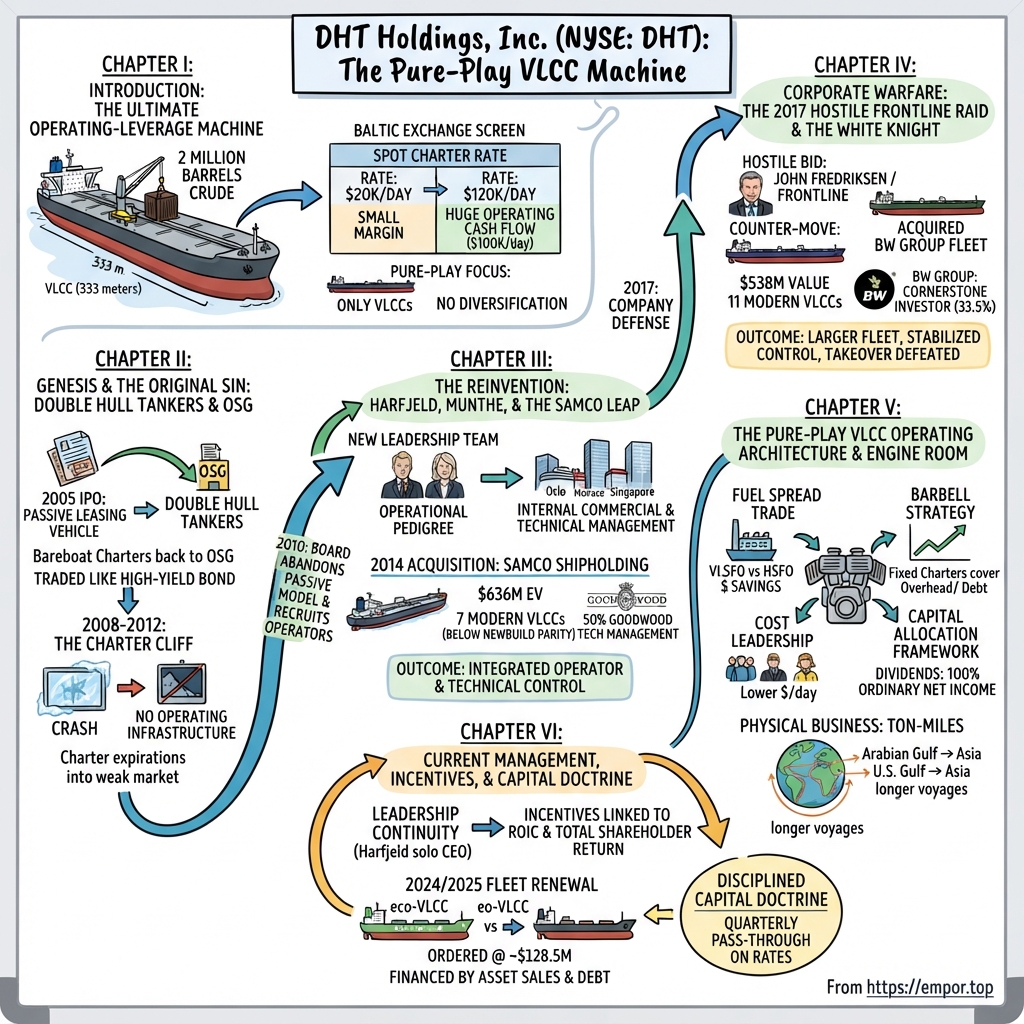
DHT Holdings, Inc. (NYSE: DHT): The Pure-Play VLCC Machine
I. Introduction: The Ultimate Operating-Leverage Machine
A rectangle of steel 333 meters long—longer than the Eiffel Tower is tall—sits low in the water off Ras Tanura, Saudi Arabia, taking on two million barrels of crude oil through cargo hoses as thick as a person's torso. That single hull carries roughly a day's worth of total petroleum consumption for a country the size of Germany or the United Kingdom. Commissioning such a vessel costs roughly $130 million at a South Korean shipyard, yet it requires a crew of only about twenty-five mariners. Its commercial existence ultimately hinges on a single daily quote displayed on a Baltic Exchange screen: the spot charter rate.
That benchmark dictates the entire economic outcome. When a Very Large Crude Carrier, or VLCC, earns $20,000 a day, the vessel struggles to cover operating costs and capital charges. When the rate spikes to $120,000 a day, that identical hull generates roughly $100,000 in pre-tax operating cash flow every twenty-four hours—an annualized run rate of approximately $36 million from a single asset. Nothing about the ship changes. The crew remains the same, and the physical asset is unaltered. Only the clearing price of global maritime freight shifts.
DHT Holdings, Inc. was designed to serve as a pure financial conduit for that operational leverage. Incorporated in the Marshall Islands, with executive offices spanning Bermuda, Monaco, Oslo, Singapore, and Mumbai, DHT owns and operates tankers exclusively in the VLCC segment.1 The company holds no product tankers, no dry bulk carriers, no offshore drilling units, and no capital-intensive alternative fuel ventures. Its operational fleet numbers in the mid-twenties, supplemented by several newbuilds under construction at South Korean shipyards, structured without the conglomerate diversification typical of legacy shipping empires.
This corporate simplicity highlights the central tension in shipping equity analysis. Bulk maritime transport has historically ranked among the most notorious destroyers of investor capital. The sector remains fragmented, the service is entirely commoditized, the counterparties include the world's most sophisticated state and multinational energy traders, and supply-side discipline routinely breaks down during market peaks. Shipowners habitually order new tonnage during cyclical highs when liquidity is abundant, only to take delivery years later as the market enters a downturn—a boom-and-bust dynamic that has repeated for generations.
Over the decade leading up to 2026, however, DHT transformed itself from a distressed corporate cast-off—a passive vessel-leasing entity spun out of the now-bankrupt Overseas Shipholding Group—into an active operator committed to returning 100% of ordinary net income as quarterly cash dividends while managing daily cash breakevens down toward the high teens of thousands of dollars.2 Whether that financial architecture creates a durable competitive advantage or simply represents disciplined management of an inherently hostile macro cycle remains the central debate for investors.
The company's story unfolds across six chapters. First, the origins: a 2005 spin-out from Overseas Shipholding Group conceived as a high-yield financial vehicle, which entered the 2008 financial crisis without independent commercial operations. Second, the turnaround: how executives Svein Moxnes Harfjeld and Trygve P. Munthe dismantled the passive chartering model after 2010 to build an integrated operating fleet. Third, the corporate defense: John Fredriksen's 2017 hostile takeover bid, countered by a shareholder rights plan, an equity-financed fleet acquisition from Andreas Sohmen-Pao's BW Group, and cross-jurisdictional litigation in New York and the Marshall Islands. Fourth, the operating playbook: exhaust gas scrubbers, a barbell chartering strategy that balances spot upside with term coverage, cost containment, and a strict capital allocation framework. Fifth, the competitive assessment: evaluating whether a pure-play commodity shipowner can construct an economic moat. And sixth, an empirical review testing each strategic premise against the company's operational and financial record.
The story begins where every maritime cycle turns: with an industry boom that made a flawed corporate design look like an enduring business model.
A key analytical principle governs this evaluation. DHT operates with virtually no proprietary technology, zero customer switching costs, and no pricing power, running assets that any well-funded rival can purchase. Standard equity evaluation frameworks—measuring durable moats, customer retention, or compounding platform flywheels—provide little utility here. Instead, an investor must evaluate the execution of a handful of capital allocation decisions made under extreme cyclical volatility: when to acquire tonnage, when to divest, how to structure debt, and how to distribute windfall cash flow during market peaks. With a consistent management team executing this playbook for roughly fifteen years, DHT presents a distinct natural experiment in maritime finance—and an instructive case study in capital discipline.
 Subscribe on LinkedIn
II. Genesis & The Original Sin: Double Hull Tankers & OSG
In the autumn of 2005, the crude tanker market stood near the peak of a historic cyclical expansion. China had entered the World Trade Organization four years earlier, driving oil consumption at rates that outpaced nearly every major forecast from the prior decade. Crude volumes moving from the Arabian Gulf to Asian refining hubs in Ningbo, Daesan, and Chiba strained the global fleet's carrying capacity. At the same time, regulatory mandates were constricting vessel supply. Following the 1989 Exxon Valdez disaster, the U.S. Oil Pollution Act of 1990 and subsequent International Maritime Organization regulations mandated an accelerating phase-out schedule for single-hull tankers. Serviceable older vessels were barred from international trade routes just as shipyard berths across South Korea and Japan were booked years in advance.
Into this supply-constrained market, Overseas Shipholding Group—then one of the world's largest independent tanker operators—launched a dedicated corporate vehicle whose name resembled a regulatory compliance standard: Double Hull Tankers, Inc. The initial public offering priced in October 2005 on the New York Stock Exchange.3 OSG contributed seven vessels—three VLCCs and four mid-sized Aframax tankers—extracting $412.6 million in cash proceeds while retaining an equity stake of roughly 47%.
The internal mechanics of that transaction defined the company's subsequent vulnerabilities. Double Hull Tankers employed no commercial chartering brokers, maintained no technical management department, vetted no maritime crews, negotiated no fuel supply contracts, and lacked direct relationships with the marine assurance desks of international oil majors. Instead, OSG bareboat-chartered all seven ships back under multi-year, fixed-rate contracts, retaining full operational, technical, and crewing responsibilities. The publicly traded company functioned primarily as a tax-advantaged holding entity for physical assets and lease paper—an equity structure designed to trade like a high-yield synthetic bond for investors seeking shipping cash flows without shipping operational risk.
That structure functioned smoothly only while both foundational assumptions held: that the counterparty remained solvent and that the contracts remained in force. The model could not survive the simultaneous breakdown of both.
Freight rates surged to historic highs in 2007 and early 2008, with spot earnings for benchmark VLCCs briefly crossing $150,000 per day. When the global financial crisis hit in late 2008, international trade contracted sharply. Letters of credit froze, global refinery throughput fell, and daily spot earnings for crude tankers dropped toward—and during weak weeks beneath—basic vessel operating expenses. In that $5,000 to $10,000 daily band, vessel owners were effectively subsidizing cargo transit. OSG had already sold its remaining 47% equity stake into the public market in 2007, eliminating the sponsor alignment that investors had relied upon at the IPO.
With the sponsor gone, the charter expiration schedule presented an existential hazard. The original fixed charters were due to expire into the weakest freight environment in a generation. Upon redelivery, Double Hull Tankers would take possession of physical tonnage it had no organizational infrastructure to employ: no broker network, no technical management desk, and no formal vetting approvals from energy majors such as Shell or ExxonMobil. Without an operating organization, an asset-leasing vehicle facing contract expirations ceases to function as an ongoing business and resembles a deferred liquidation. The distress of its former parent confirmed the severity of the cycle: OSG filed for Chapter 11 bankruptcy in November 2012.
The corporate failure illustrates a broader principle in asset finance. An asset-backed investment vehicle that lacks the operational capability to re-employ its underlying hardware, and holds no countercyclical liquidity, does not eliminate commercial volatility; it merely transfers that volatility from the periodic income statement to the residual terminal value. Contractual cash flows can appear stable throughout the charter term, but once the agreements expire, the equity absorbs the full volatility of a spot freight market the entity has never operated in.
Facing this impending charter cliff in 2010, the board abandoned the passive yield-vehicle model and recruited seasoned shipping executives to build an integrated operating platform.
A coda on the 2005 structure
The original Double Hull Tankers vehicle offers an enduring lesson in maritime capital allocation. The 2005 entity was marketed on the premise that long-term, fixed-rate charters could turn an inherently cyclical commodity business into a predictable yield asset. Instead, fixed charters merely deferred cyclical exposure, concentrating accumulated market and refinancing risks into a single contract-renewal window. Operating cash flows remained smooth until the charters expired, at which point the absence of an internal operating apparatus left the entity defenseless.
That crisis established the strategic foundation for DHT's modern operating model. Although the company continues to employ fixed-rate time charters—a key element of the barbell chartering strategy examined in later sections—it has never again relied on financial contracts as a substitute for internal operational capability. The company treats fixed charters as an analytical financial overlay across an industrial operating company, rather than an operating substitute. For investors evaluating asset-backed yield structures across shipping and infrastructure, the Double Hull Tankers episode provides a direct diagnostic test: observe what the company can do on the day the contracts expire.
III. The Reinvention: Harfjeld, Munthe, & The Samco Leap
The two executives who took charge in September 2010 brought an operational pedigree foreign to DHT’s origins as a passive financial conduit. Svein Moxnes Harfjeld was a seasoned Norwegian maritime executive formed within the Bergesen and BW orbit—the constellation of Norwegian and Hong Kong shipowning houses that had spent decades moving gas, crude, and dry cargo across the Pacific. He had served as chief executive of BW Offshore and as an executive director at Bergesen d.y. and World-Wide Shipping.1 Trygve P. Munthe brought a complementary background in maritime finance and commercial management. Appointed as co-CEOs—a shared leadership structure that frequently falters in corporate governance—the pair led the company together for nearly a decade without public discord.
Their initial moves were structural rather than promotional. The company reorganized as DHT Holdings, Inc. under Marshall Islands corporate law, a common domicile in public maritime shipping that provides an established legal regime while avoiding tax frictions that could trap capital offshore. Harfjeld and Munthe then began dismantling the passive leasing model, establishing internal commercial and technical capabilities across Oslo, Monaco, and Singapore. They built direct chartering relationships with international oil majors and Asian state refiners, securing vessel approvals across the vetting regimes required to bid on top-tier crude cargoes.
That technical approval process forms the bedrock of crude tanker economics. Major energy producers do not simply charter the cheapest available vessel. Every ship chartered by companies such as Shell or ExxonMobil must pass rigorous inspection regimes—historically the Ship Inspection Report Programme, or SIRE, and its updated iteration, SIRE 2.0—evaluating maintenance condition, crew competence, safety management systems, and operational history. A tanker that fails vetting is not merely disadvantaged; it is disqualified from premium oil-major business and relegated to lower-tier charterers offering weaker counterparty credit and discounted freight rates. Vetting approval does not confer an economic moat—hundreds of competing tankers maintain compliance. Instead, technical quality serves as a non-negotiable cost of entry, while operational lapses represent an immediate corporate hazard.
The company's primary strategic inflection arrived four years later. In September 2014, DHT acquired Singapore-based Samco Shipholding Pte. Ltd. for $317 million in cash and the assumption of $319.6 million in debt, representing an enterprise value of approximately $636.6 million.4 The acquisition delivered seven modern, high-specification VLCCs averaging roughly four and a half years of age, constructed at leading South Korean shipyards, with several vessels backed by multi-year time charters to established counterparties.
From a capital allocation perspective, the transaction arithmetic was compelling. The implied purchase price equated to roughly $91 million per four-year-old on-the-water VLCC with commercial employment in place. At the time, ordering a newbuilding from a premier South Korean shipyard cost in the high $90 million to low $100 million range—requiring an investor to wait two to three years before the hull generated its first dollar of freight revenue. Acquiring modern, on-the-water tonnage below newbuild parity with immediate cash generation offered clear cyclical advantages. The sellers were European private equity funds facing standard investment horizon limits—a recurring dynamic in maritime finance, where fund liquidation mandates routinely transfer assets to cyclical industrial buyers at attractive entry multiples.
The most consequential element of the Samco acquisition, however, was not an individual tanker. It was a 50% equity stake in Goodwood Ship Management Pte. Ltd., a Singapore-based technical manager. In a single transaction, DHT transitioned from fully outsourcing technical operations to controlling a captive platform managing crewing, vessel maintenance, drydock supervision, and vetting compliance. An enterprise that four years earlier possessed no operating infrastructure now co-owned the technical apparatus that governed its fleet.
Munthe stepped down in 2019, leaving Harfjeld as sole President and Chief Executive Officer—a leadership tenure that by 2026 exceeded fifteen years at the same company and in the same vessel segment.1 In an industry characterized by executive turnover and frequent strategic pivots across cyclical swings, that continuity provides an empirical baseline: the executive leadership that acquired tonnage during the 2014 cyclical lull remained in place to evaluate newbuild orders a decade later, enabling investors to assess a sustained capital allocation record rather than the shifting priorities of successive management teams.
That operational stability and clean balance sheet did not go unnoticed. A modernized, conservatively levered VLCC owner with no controlling equity sponsor presents an attractive acquisition profile. In January 2017, the tanker sector's most aggressive corporate consolidator, John Fredriksen, initiated a hostile takeover attempt.
What the Samco deal proved about the operating model
Between the close of the Samco transaction in 2014 and the end of 2016, DHT's operational fleet more than doubled, fundamentally shifting the company's operating profile. The acquired vessels were modern, fuel-efficient units built at tier-one South Korean yards. In crude shipping, fuel consumption represents an essential commercial variable: bunker fuel is typically a voyage's largest single direct operating cost, meaning an older VLCC consuming ten additional metric tons of fuel per day at sea incurs a structural margin disadvantage on every spot fixture. Operating modern, fuel-efficient hulls functions less as a luxury than as a structural cost advantage across every voyage.
The transaction also highlighted the company's capital structure strategy. DHT funded its expansion primarily through asset-backed bank debt with disciplined, amortizing repayment schedules rather than non-amortizing, high-yield bullet debt.10 While amortizing bank facilities absorb free cash flow that might otherwise fund equity distributions during cyclical peaks, they provide vital downside protection during market downturns. Because principal balances decline steadily as vessels age, loan-to-value ratios remain contained even as physical asset values deteriorate. Tanker operators forced to refinance large bullet debt maturities during freight-rate troughs face severe balance-sheet distress—a vulnerability that compromised several of DHT's public peers over the same market cycle.
Why timing beats scale in ship purchases
The Samco transaction crystallized an enduring reality of maritime investing that resurfaced in 2017 and 2024: total returns in commodity shipping are governed primarily by asset entry prices rather than day-to-day operating performance. Exceptional technical management can optimize operational costs by perhaps $1,000 to $2,000 per day. In contrast, acquiring a VLCC at $70 million rather than $110 million alters the capital carrying cost by an order of magnitude. In a commoditized freight market where spot rates are cleared by open auction and individual owners possess no pricing power, asset purchase timing represents management's primary economic lever.
This dynamic redefines executive capability in the tanker industry. Management quality depends less on routine vessel operations than on countercyclical capital discipline: the restraint to avoid ordering speculative tonnage during market exuberance, combined with the liquidity and balance-sheet capacity to acquire prime assets when distressed sellers are forced to liquidate. That operational and financial framework served as the foundation for DHT's response when corporate raiders arrived in 2017.
IV. Corporate Warfare: The 2017 Hostile Frontline Raid & The White Knight
John Fredriksen had spent decades executing a consistent playbook across shipping cycles: acquiring vessels during market troughs, employing financial leverage, and consolidating rivals when his equity traded at a premium to net asset value. By early 2017, his flagship, Frontline Ltd., maintained a diversified crude tanker fleet, an aggressive balance sheet, and an equity valuation that commanded a premium often enjoyed by retail-favored tanker equities. DHT, by comparison, held modern vessels, a conservative capital structure, and no anchor shareholder positioned to block an outside approach.
In January 2017, Frontline disclosed an ownership position of roughly 16% in DHT and delivered an unsolicited all-stock acquisition proposal, initially offering an exchange ratio of 0.725 Frontline shares for each DHT share, later raised to 0.80.5 The public rationale centered on consolidation logic: combining the two fleets to create the largest independent non-state VLCC owner and attempting to extract commercial pricing leverage from a fragmented market.
DHT's board, chaired by Erik A. Lind, repeatedly rejected the proposal.6 The directors' objections were substantive: Frontline's fleet was older on average, its financial leverage was materially higher, and the acquisition currency consisted of Frontline equity that DHT's board argued traded at an inflated valuation. Accepting the offer would have meant trading modern, lightly levered assets for a diluted claim on older, more heavily indebted tonnage. To defend against creeping control, the board adopted a one-year shareholder rights plan in January 2017 with a 10% trigger—a poison pill designed to halt further open-market share accumulation while management evaluated strategic alternatives.
A standard critique in corporate finance applies to such measures: shareholder rights plans often protect incumbent management as effectively as they protect public investors, and boards rejecting acquisition premiums do not always act exclusively on commercial merits. The decisive test of a defensive mechanism lies in how leadership uses the time the rights plan provides.
DHT used that window to execute a structural counter-transaction. In March 2017, the company agreed to acquire the entire VLCC fleet of Singapore-based BW Group—eleven vessels, comprising nine on-the-water tankers averaging under five years of age and two high-specification newbuildings under construction at Hanwha Ocean (then Daewoo Shipbuilding & Marine Engineering, or DSME)—for total consideration of approximately $538 million.7 The financial structure proved as consequential as the headline price: roughly $177.4 million in cash, approximately $256 million in DHT equity—issued as 32 million common shares alongside preferred stock convertible into an additional 15.7 million common shares—and roughly $104 million in assumed shipyard debt obligations.
The transaction achieved three strategic objectives simultaneously. First, DHT acquired premier South Korean-built tonnage at an age-adjusted discount to prevailing secondhand market values. Second, it introduced Andreas Sohmen-Pao's BW Group as a cornerstone investor holding roughly 33.5% of the expanded equity base, with Sohmen-Pao joining DHT's board. Third, the equity issuance diluted Frontline's hostile ownership position from roughly 16% down to the low teens overnight. A transaction that offered standalone commercial logic also rendered Frontline's hostile takeover bid mathematically unviable.
Frontline challenged the defense in court, filing lawsuits against DHT, Harfjeld, and BW Group in both the New York County Supreme Court and the High Court of the Marshall Islands. The complaints alleged breach of fiduciary duty, improper director entrenchment, and an unlawful shareholder rights plan.8 Both courts dismissed the claims.9 The New York court dismissed the action in April 2017, and the Marshall Islands court followed in June.[^10] The legal rationale in both jurisdictions turned on the same principle: a board of directors that responds to an unsolicited equity offer by completing an asset-backed acquisition justifiable on independent commercial grounds is exercising legitimate business judgment rather than improper entrenchment. Frontline subsequently liquidated its position.
Evaluating the ultimate shareholder outcome depends on a counterfactual that cannot be settled empirically: Frontline shares generated respectable returns over subsequent years, and DHT investors accepting the 0.80 exchange ratio would not have faced catastrophe. The verifiable outcome, however, was consequential: DHT emerged with a larger, younger fleet, an established strategic anchor investor with deep maritime credibility, and a shareholder register where roughly a third of the equity was controlled by an industrial owner operating on multi-year horizons rather than quarterly trading cycles. For an enterprise that began as a passive spin-out with no committed long-term owner, the transaction completed a vital structural repair.
With the operating fleet substantially enlarged and corporate control stabilized, the strategic focus transitioned from takeover defense to operational design: determining how the capital structure and commercial fleet should be calibrated across full freight cycles.
The forgotten variable: a shareholder with a twenty-year clock
The most enduring legacy of the 2017 battle was not the addition of eleven tankers, but the arrival of an industrial maritime group with generational investment horizons. Tracing its lineage through World-Wide Shipping and the Sohmen and Bergesen enterprises, BW Group controls fleets across crude, product, liquefied gas, and dry bulk shipping. Anchoring roughly a third of the equity with such an owner reshapes corporate behavior in ways that do not appear directly on financial statements: it dampens pressure from short-term trading sentiment, deters future hostile takeover attempts, and adds boardroom leadership seasoned across multiple complete freight cycles.
Yet concentrated ownership also introduces potential governance frictions. A cornerstone investor that is itself a major diversified shipowner is not a passive index fund. Commercial interests could theoretically diverge over vessel disposal timing, corporate combinations, or related-party transactions. Public filings and proxy disclosures through 2026 show no evidence of such conflicts, though that record reflects past regulatory reporting rather than a structural guarantee. In practice, concentrated strategic ownership serves simultaneously as DHT's most effective takeover defense and its primary governance concentration.
V. The Pure-Play VLCC Operating Architecture & Engine Room
Every tanker company eventually confronts the diversification question, and most choose to expand across vessel classes. Frontline operates VLCCs, Suezmaxes, and Aframax/LR2 tankers. International Seaways runs both crude and refined product carriers. Euronav, before its combination into CMB.TECH, diversified into alternative fuels and multi-segment maritime logistics. The commercial logic appears straightforward: distinct shipping segments peak along different timelines, so blending asset classes should theoretically smooth earnings across cyclical swings.
DHT rejected that premise, pursuing an intentionally narrow operational focus. In cyclical asset classes, smoothing corporate earnings is an exercise investors can execute independently by assembling a portfolio of public equities; it does not inherently require a corporate management team to operate segments outside its core operational competence. Furthermore, maritime diversification frequently introduces internal cross-subsidies, where cash generated by a high-performing vessel class funds capital expenditures in an underperforming one. Under that dynamic, capital allocation decisions are often shaped by corporate incentives rather than market clearing prices. A dedicated VLCC operator offers a more transparent proposition: undiluted exposure to long-haul crude trade, leaving capital allocation across segments to individual shareholders.
The VLCC represents the lowest-cost mechanism for transporting crude oil across open oceans, dominating primary trade routes from the Arabian Gulf, the U.S. Gulf Coast, and West Africa to Asian refining centers. Hull scale constitutes the core operational technology: doubling deadweight capacity does not double steel requirements, crew count, or fuel consumption per ton-mile.
The case against the pure-play, stated fairly
That single-segment focus also carries distinct structural vulnerabilities that diversified competitors routinely emphasize.
Industry cycles across tanker classes do not move in strict lockstep. Refined product tankers have historically enjoyed robust freight markets while crude tankers faced depressed earnings, and vice versa. An operator generating operating cash flow in one segment during another's trough can acquire discounted assets without issuing dilutive equity or raising expensive debt. That balance-sheet flexibility represents an established mechanism for countercyclical asset accumulation.
A single-segment structure can also limit strategic agility. If the long-haul crude transport market encounters secular headwinds—the terminal-value question facing fossil fuel logistics—a pure-play operator possesses no established corporate infrastructure to pivot toward adjacent trades. CMB.TECH's strategic shift toward alternative fuels and multi-segment operations represents an explicit hedge against that scenario. DHT's counterargument is that corporate diversification programs in shipping have historically destroyed shareholder value more frequently than the cyclical risks they sought to mitigate, and that equity investors can manage structural transitions more cost-effectively across liquid markets.
Neither strategic posture can be validated in the abstract. A pure-play architecture does, however, provide operational and financial transparency. An investor can model the equity with a limited number of operational variables without the risk of unexpected capital allocation into peripheral shipping sectors. In a sector where management discretion has historically faced investor skepticism, structural transparency carries tangible capital-markets value.
The fuel-spread trade
The most financially impactful operational decision of Svein Moxnes Harfjeld's tenure was not a vessel transaction, but a calculated position on the pricing differential between marine fuel grades.
Effective January 1, 2020, International Maritime Organization regulations capped the sulfur content of marine bunker fuel at 0.5%, down from the historical 3.5% ceiling. Shipowners faced two primary compliance paths: purchase compliant Very Low Sulfur Fuel Oil, or VLSFO, at a market premium, or install an exhaust gas cleaning system, commonly called a scrubber. A scrubber washes sulfur oxides from exhaust streams, permitting a vessel to continue consuming cheaper High Sulfur Fuel Oil, or HSFO. In practice, the system functioned as an upfront capital investment in filtration that permitted a vessel to burn the discounted fuel grade indefinitely.
The investment return depended on the price differential between the two fuels, termed the Hi-5 spread. A fully laden VLCC at sea consumes roughly 45 metric tons of fuel per day. When VLSFO traded at a $150 to $250 premium per metric ton over HSFO, a scrubber-equipped vessel saved between $7,000 and $11,000 daily in voyage fuel expenses. In the spot market, where charterers pay a fixed freight rate and the shipowner absorbs bunker costs, those fuel savings flowed directly into realized time-charter-equivalent earnings.
DHT retrofitted most of its fleet across 2018 and 2019, positioning its vessels ahead of the regulatory transition. During subsequent energy market dislocations—notably in 2020 and following the 2022 global energy shocks—the fuel spread widened substantially, allowing the company to recover its retrofit capital rapidly while generating premium time-charter-equivalent earnings relative to non-scrubber peers.
Yet that pricing advantage represents a temporary market spread rather than an enduring competitive barrier. The Hi-5 differential remains a commodity price relationship that fluctuates with refinery throughput and crude quality, occasionally compressing below $100 per metric ton and narrowing scrubber paybacks. Competing tanker owners possessed identical access to retrofit technology and largely equipped their fleets over time. The scrubber program reflected disciplined balance-sheet execution on a quantifiable, finite market opportunity rather than a proprietary structural moat.
The barbell
The company's commercial fleet deployment follows a balanced commercial framework. A tanker owner can commit vessels to multi-year time charters at fixed daily rates or trade them in the spot market on single voyages. Operating exclusively in the spot market provides maximum revenue upside during rate spikes but leaves the balance sheet fully exposed during downturns. Conversely, locking the entire fleet into long-term charters stabilizes cash flows during market troughs but forfeits the cyclical operating leverage that attracts equity capital to tanker operators.
DHT employs a barbell chartering structure. A baseline portion of the fleet—typically six to ten vessels—operates under multi-year time charters with established energy counterparties. Contractual cash flows from this fixed charter book are calibrated to cover corporate overhead, including general and administrative expenses, cash interest payments, and scheduled bank debt amortization. Sizing the fixed book to cover corporate debt service and overhead lowers the effective cash breakeven on the remaining spot-trading vessels toward basic daily vessel operating expenses. Consequently, when spot freight rates surge, incremental charter revenues flow largely into operating cash flow and ordinary net income rather than servicing fixed capital charges.
Management has characterized this commercial posture across quarterly presentations as securing the operational patience necessary to avoid chartering spot vessels at disadvantageous rates during freight troughs.[^11] While structurally sound, the strategy is not proprietary; competing operators utilize comparable portfolio designs. The framework also incorporates an inherent commercial trade-off: fixed charters that protect cash flows during market downturns cap earnings during cyclical rate spikes. Allocating fleet capacity between spot and term employment constitutes an active commercial judgment, and fixing excessive tonnage ahead of a sustained rate rally can cap cyclical equity performance.
Cost leadership
Underpinning these commercial decisions is the day-to-day management of vessel operating costs: crewing expenses, technical stores, lubricants, marine insurance, routine maintenance, and accruals for mandatory drydockings. DHT has maintained daily operating expenses in the upper $8,000s to approximately $9,000 per vessel, compared to a Western-managed peer average more commonly situated between $9,500 and $10,500 per day.10 Fleet cash breakevens have ranged from the mid-teens to the low $20,000s per day, fluctuating with interest rates, drydocking schedules, and debt amortization terms.
An operational cost difference of $1,000 per day per ship may appear modest against daily freight rate volatility. Across a fleet of roughly two dozen tankers over an entire year, however, that efficiency translates into approximately $9 million in annualized pre-tax earnings generated purely through technical discipline. That variance represents the tangible economic scope of the Goodwood technical management integration: measurable and operationally meaningful, yet insufficient on its own to insulate equity returns from a freight market where daily spot rates can swing by $100,000.
This dynamic illustrates the governing reality of maritime equity investing: while operational discipline yields single-digit millions in annual cost savings, macro freight cycles drive swings measured in hundreds of millions of dollars. The decisive variable for equity returns remains how management deploys capital across those cycles.
The physical business, explained plainly
Behind abstract financial metrics lies an exacting physical logistics process. When an energy charterer needs to transport two million barrels of crude from the Arabian Gulf to an Asian import terminal, commercial brokers publish cargo specifications alongside a designated loading window, known as a laycan. Tanker owners with vessels capable of reaching the loading terminal within that calendar window submit commercial bids. Bids are quoted in Worldscale points—a percentage of a standardized notional freight rate established for specific maritime routes, allowing charterers to evaluate pricing across voyages of varying distances and port costs. The charterer awards the cargo, and the owner calculates time-charter-equivalent earnings by subtracting bunker fuel expenses, port charges, and canal transit tolls from gross revenue, dividing the net balance by the total round-trip voyage duration, including the unladen ballast voyage.
The ballast leg carries critical economic implications. A tanker completing discharge at a terminal in Ningbo, China, carries no cargo on its return leg; it must sail empty toward the Arabian Gulf, the Atlantic Basin, or another loading region at the owner's expense. Strategic vessel positioning—selecting discharge ports, timing repositioning voyages, and determining whether to accept a lower freight rate to reposition tonnage into a stronger regional market—is managed daily by commercial chartering teams. These positioning choices compound across a vessel's operating year, creating meaningful divergence in realized time-charter-equivalent earnings between owners operating comparable physical hardware.
Scheduled drydockings represent another recurring operational requirement. Maritime regulatory regimes require commercial tankers to undergo comprehensive shipyard drydock inspections every two and a half to five years. During drydocking, vessels undergo hull cleaning, anti-fouling recoating, and propulsion machinery overhauls. Beyond direct capital expenditures, drydockings remove a vessel from commercial service for several weeks. Scheduling shipyard stays during cyclical freight lulls rather than market peaks requires close operational alignment—an operational workflow that an integrated technical manager like Goodwood can coordinate more directly than a third-party service provider managing drydocks on a transactional basis.
VI. Current Management, Incentives, & The Capital Allocation Doctrine
Shipping cycles follow an established pattern. Freight rates spike, cash floods into owner balance sheets, and management teams, flush with capital, order newbuildings at peak shipyard pricing. Two to three years later, those vessels deliver simultaneously into a market depressed by the collective order book. The cash accumulated during the boom is converted into depreciating steel ordered at cyclical peaks, leaving equity holders to absorb the downturn, often through dilutive restructuring or rights offerings.
In August 2022, DHT formalized a capital allocation framework intended to constrain that behavior: distributing 100% of ordinary net income as quarterly cash dividends.2 The company defines ordinary net income to exclude non-cash mark-to-market adjustments and one-off items such as gains or losses from vessel sales, aligning payouts with recurring operational earnings rather than accounting fluctuations.
The mechanism functions as an explicit capital discipline policy. Paying out all ordinary net income removes management's discretion over retained operating earnings. Major capital projects must therefore be funded through dedicated debt facilities, equity issuance, or asset divestitures—subjecting capital deployment to external market scrutiny rather than internal cash accumulation. For public shareholders, the policy converts the equity into an unhedged, quarterly pass-through on tanker freight rates, allowing investors rather than management to decide whether operating proceeds should be reinvested into maritime assets.
Two analytical qualifications apply to that framework. First, ordinary net income is an accrual metric rather than a cash flow measure. Because vessel depreciation represents a substantial non-cash expense, significant operating cash flow remains inside the company after dividends, providing funds for debt service and capital expenditures. The policy restricts capital accumulation, but it does not represent a complete cash drain. Second, gains from vessel sales are excluded from ordinary net income, leaving asset-sale proceeds at management's disposal. Both design choices preserve operational flexibility, but they mean the dividend framework is not an absolute constraint on reinvestment.
The leadership team administering this framework comprises three primary figures:
Svein Moxnes Harfjeld, President and CEO, who has led the company since 2010, was appointed to the board of directors in October 2025.1 In corporate governance terms, placing the sole executive officer on the board reduces the structural separation between oversight and execution, even though the board chair remains independent.
Laila C. Halvorsen, Chief Financial Officer since 2018, joined DHT in 2014 as Vice President of Finance and Controller following an earlier career at Western Bulk.1 Halvorsen has managed the liability side through relationships with established Nordic and European shipping lenders, including DNB, Nordea, ING, and SEB. For a cyclical company, relying on amortizing commercial bank credit rather than non-amortizing high-yield bonds keeps covenants tied to ship values and ensures principal balances decline as vessels age.
Erik A. Lind has served on the board since the 2005 initial public offering and as independent chairman since 2011, bringing roughly four decades of maritime and banking experience and providing institutional continuity connecting the original spin-out to the modern operating platform.1
Management incentive structures are weighted toward restricted stock and long-term equity grants tied to return on capital employed and relative total shareholder return against a peer group of tanker owners, rather than fleet expansion or deadweight tonnage growth.1 That incentive design addresses a common governance issue in shipping, where executive compensation tied to fleet scale can incentivize speculative asset accumulation. While direct insider equity ownership remains modest, strategic alignment is anchored by BW Group's cornerstone equity holding.
The newbuild wave, and the tension inside it
In February 2024, DHT contracted four high-specification eco-VLCCs—divided between HD Hyundai Samho and Hanwha Ocean—for delivery in 2026 at an average price of approximately $128.5 million per hull, subsequently exercising an option for an additional sister vessel at Hanwha Ocean scheduled for delivery in August 2028.11 The company arranged financing through operating cash flow, committed bank facilities, and capital unlocked from divesting older tonnage, including 2006- and 2007-built units such as DHT Scandinavia, DHT Lotus, and DHT Peony, which generated realized capital gains.12 The 100% net income dividend framework remained active throughout the contracting process.
That order program tests the company's countercyclical capital doctrine. Contracting newbuildings at roughly $128.5 million in 2024 did not represent a distressed acquisition. Shipyard prices had escalated over the preceding two years and hovered near multi-decade nominal highs. Management maintained on earnings calls that these orders represented fleet renewal rather than net expansion—divesting older tonnage while accepting delivery of fuel-efficient replacements to keep the aggregate ship count steady—pointing out that replacement costs across the broader fleet had risen in tandem.13 Divesting twenty-year-old vessels into a firm secondhand market to fund modern, compliant tonnage differs materially from levering an enterprise to pursue speculative fleet expansion.
Nevertheless, capital discipline ultimately depends on asset returns. The newbuildings must generate an adequate return on a $128.5 million per-vessel cost basis, which requires global ton-mile demand to remain firm into the 2030s. If freight markets weaken prematurely, those contracts will carry the capital burden typical of mid-to-high cycle shipyard commitments. DHT executed a bounded capital commitment at elevated pricing, structured with asset sales and debt rather than unconstrained expansion, and constrained by a dividend policy that limited balance-sheet overextension.
The ultimate financial outcome remains tied to the structural balance of the global fleet and international crude flows.
Reading management through the calls
Evaluating executive execution across shipping cycles requires assessing narrative consistency over multiple operating periods. Across quarterly earnings presentations, DHT's management has maintained a consistent commercial framing: emphasizing cash breakeven discipline, detailing the spot-and-fixed barbell structure, presenting capital outlays as fleet renewal rather than asset growth, and declining to project future spot rates.[^11]13 When questioned by analysts regarding elevated shipyard pricing, the choice of quarterly dividends over share repurchases, or the rationale for fixing term charters during firm spot markets, leadership has pointed to specific operational criteria: justifying shipyard outlays through replacement costs and proceeds from older vessel sales, prioritizing predictable cash dividends over discretionary buybacks, and sizing term cover against corporate overhead and debt service rather than speculative rate views.13
Consistency across conference calls does not ensure cyclical accuracy; an executive team can maintain a coherent strategy while misjudging macro supply and demand. However, a stable analytical framework demonstrates that corporate reporting is measured against stated principles rather than retrofitted to justify quarterly performance. A departure from that consistency—such as an unannounced modification of the dividend payout policy or an attempt to reclassify speculative fleet expansion as routine renewal—would indicate a change in the capital allocation discipline established since 2022.
What an owner actually competes on
Commodity tanker operations ultimately hinge on four operational and financial variables, listed in order of economic impact. First, asset entry price, which determines capital carrying costs and residual equity value across cycles. Second, capital structure and debt amortization, which dictate whether an operator can survive freight troughs without distress. Third, commercial deployment, encompassing the balance between fixed charters and spot trading, alongside voyage-by-voyage positioning. And fourth, daily technical operating costs. DHT has established a track record of disciplined execution across each category, reflecting the operational requirements of a dedicated commodity price-taker.
VII. Competitive Landscape, Industry Structure, & Global Macro
Conventional market share carries little economic weight in the VLCC segment. When international traders such as Unipec or Vitol enter the market to charter a 270,000-metric-ton crude cargo from Basrah to Ningbo, commercial shipbrokers canvass every prompt vessel in the Arabian Gulf. The fixture is awarded to the most competitive vetting-compliant bidder. Vessel branding confers zero pricing power; clearing rates are determined purely by open-market supply and demand at the loading window.
Competitor fleet profiles and corporate strategies nevertheless influence the broader supply dynamics that govern freight rates:
Frontline plc remains John Fredriksen's flagship and the largest publicly traded independent tanker company by fleet value. Diversified across VLCCs, Suezmaxes, and Aframax/LR2 tankers, Frontline maintains an aggressive capital structure and historically trades at a persistent retail liquidity premium in equity markets.
CMB.TECH, created through the combination of Euronav and the Saverys family's clean-cleantech platform following an extended control dispute with Fredriksen, has pivoted away from pure crude logistics toward ammonia and hydrogen propulsion, alongside multi-segment dry bulk and offshore marine operations. The strategic divergence from DHT is pronounced: while CMB.TECH concluded that long-term decarbonization requires transforming the operating model into a diversified green transport platform, DHT maintains that shareholder value in crude transport comes from running fuel-efficient conventional tonnage and distributing operating cash flows.
International Seaways operates a diversified fleet of crude and product carriers exceeding seventy vessels. That multi-segment fleet structure dampens its operational leverage to spot VLCC rates relative to a dedicated pure-play owner.
Okeanis Eco Tankers, controlled by the Alafouzos family, operates a modern, fully scrubber-fitted fleet of VLCCs and Suezmaxes delivering strong per-vessel economics, though with a smaller public float and more limited trading liquidity.
State fleets operate under distinct commercial and strategic mandates. Bahri, the national shipping carrier of Saudi Arabia, manages a large VLCC fleet carrying captive baseload volumes for Saudi Aramco. In China, COSCO Shipping Energy Transportation commands the world's largest tanker fleet, deployed primarily to support national energy security rather than to maximize returns on invested capital. Because state-backed owners order tonnage according to industrial policy rather than freight-rate economics, a substantial portion of global vessel supply remains insulated from standard market clearing mechanisms—a structural supply factor that independent commercial owners cannot control.
The fragmentation that never resolves
The fundamental structure of the crude tanker sector is defined by its extreme fragmentation: the combined holdings of the largest publicly listed independent VLCC operators represent well under one-fifth of the active commercial fleet. The remaining capacity is distributed among national oil companies, state shipping lines, Asian and Greek private shipping dynasties, and single-vessel entities financed by regional banks and private equity.
This fragmented structure is neither accidental nor temporary. Commercial vessels are financed on an asset-by-asset basis, meaning the minimum efficient scale for entering the tanker business is a single ship. Any private operator with relationship banking access and roughly 40% equity can acquire a vessel and enter the trade. Consequently, corporate mergers among listed players merely shift ownership between entities that collectively lack the scale to influence market pricing.
The practical consequence for equity investors is that corporate consolidation cannot engineer commercial pricing power. Because listed tanker operators remain price-takers in an open auction market, equity returns are governed almost entirely by balance-sheet structure, debt amortization terms, and the discipline of asset-purchase timing—the primary operational variables management can control.
Ton-miles, and why distance is the product
In crude shipping, freight demand is measured not in absolute barrels, but in ton-miles: the volume of cargo transported multiplied by the distance sailed. A crude shipment traveling six thousand nautical miles absorbs twice as much vessel capacity as an identical cargo moving three thousand miles. Consequently, geopolitical and logistical disruptions that alter trade routes can expand or contract effective tanker supply far more rapidly than changes in underlying oil consumption. Over recent years, three developments have redrawn the global maritime map.
First, maritime security threats in the southern Red Sea diverted commercial traffic away from the Bab el-Mandeb Strait and around Africa's Cape of Good Hope, adding ten to fourteen sailing days to affected voyages. By keeping vessels at sea for extended periods, these longer routes absorb tanker supply and tighten market balances without requiring a single hull to be scrapped.
Second, Western sanctions targeting Russian, Iranian, and Venezuelan crude created a bifurcated operating environment: a segmented "shadow fleet" of several hundred aging, opaquely owned, and often inadequately insured tankers dedicated to sanctioned trades.[^16] For compliant operators such as DHT, that division presents a complicated dynamic. On one hand, older tonnage has exited mainstream commercial trade, leaving blue-chip charterers and international energy majors to compete for a smaller pool of vetted, compliant vessels. On the other hand, those older ships remain physically afloat rather than being sent to shipbreaking yards. If sanctions were to normalize, that displaced tonnage could re-enter compliant commercial trades, creating an immediate influx of competing capacity. The shadow fleet effectively represents a deferred supply overhang governed by geopolitical decisions outside the shipping industry's control.
Third, global crude production has steadily shifted westward, representing the most favorable structural tailwind for large crude carriers. Expanding output across the U.S. Gulf Coast, Brazil's offshore pre-salt basins, and Guyana increasingly flows to Asian refining centers. Voyages from the Atlantic Basin to East Asia typically require thirty-five to forty-five days of sailing time each way—roughly double the transit duration of traditional routes from the Arabian Gulf. Every barrel sourced from the Atlantic Basin rather than the Middle East absorbs substantially more fleet capacity per transit.
Together, these shifts demonstrate that recent strength in the VLCC market has been driven less by headline oil consumption—which has grown at modest rates—than by crude moving longer distances across more complex trade corridors. While these structural patterns provide an operational benefit, they remain subject to geopolitical reversals, underscoring why commodity shipping advantages rarely endure without strict capital discipline.
Myth versus reality
Three persistent narratives across the tanker sector warrant direct empirical scrutiny against the operating record.
Myth: consolidation creates pricing power. Reality: It does not. Ocean freight rates are cleared at the margin by whichever compliant vessel is available in the loading window and willing to bid. Even the largest theoretical combinations of listed independent shipowners would control only a fraction of the fleet—nowhere near the critical mass required to withhold capacity or dictate terms to sovereign oil companies and international trading houses. Corporate scale in shipping generates modest savings in vessel procurement and administrative overhead, but the industry's historical record shows that periodic waves of consolidation have never produced structural improvements in returns on capital.
Myth: modern eco-spec vessels command a premium that invariably justifies shipyard prices. Reality: Only conditionally. Fuel-efficient hulls achieve higher net time-charter-equivalent earnings because bunker fuel is paid directly by the owner on spot voyages and factored into charter hire on time contracts. However, the economic value of that efficiency fluctuates with bunker prices. When fuel price spreads narrow, the capital expenditure premium demanded for a newbuild over a seasoned secondhand vessel often exceeds the net present value of anticipated fuel savings. Modern technical specifications are essential to satisfy Tier-1 oil-major vetting, but high-cost newbuilding orders do not guarantee return on investment.
Myth: the dividend represents pure yield. Reality: In asset-intensive shipping, dividend distributions represent cash generated from an asset base that depreciates toward scrap value over a finite operating life of twenty to twenty-five years. A substantial portion of quarterly cash payouts during a market peak represents a return of capital embedded in aging steel rather than perpetual compounding yield. For equity investors, total shareholder return must be measured against net asset value per share over full cycles, making fleet renewal at disciplined entry valuations just as vital as the headline distribution policy.
VIII. Strategic Frameworks: 7 Powers & Porter's 5 Forces
Applying Hamilton Helmer's 7 Powers framework to an independent crude tanker owner reveals how few structural competitive advantages exist in bulk maritime transport.
Network Economies: Absent. A tanker's commercial utility to an oil trader does not increase because other charterers use the same fleet. Each voyage is an isolated, bilateral transaction cleared on independent terms.
Switching Costs: Absent. A charterer's decision to hire a rival owner's vessel for the next voyage carries virtually no frictional or financial cost. Once a vessel discharges its cargo, the commercial relationship terminates until the next open fixture.
Branding: Absent in a pricing sense. While maintaining a rigorous technical reputation is essential to secure approvals from oil-major vetting desks, that compliance merely provides a ticket to bid. It does not enable an owner to command a premium freight rate over another vetted competitor in the same loading window.
Cornered Resource: Absent. Commercial shipyards in South Korea, Japan, and China sell identical tonnage to any entity capable of securing bank financing and equity capital. Maritime crews, bunker fuel, and spot cargo fixtures are sourced from open, liquid global markets.
Scale Economies: Weak. Volume discounts on hull coatings, marine lubricants, and technical stores, combined with spreading general and administrative expenses across a broader vessel base, yield modest cost savings. A fifty-ship tanker owner does not command a decisive unit-cost advantage over a well-run twenty-five-ship operator. This dynamic represents a central reality of tanker economics: operational scale fails to deliver structural pricing power or unit-cost dominance, explaining why waves of corporate consolidation—including Frontline's unsolicited 2017 bid—have consistently failed to generate the enduring economic returns their proponents promised.
Process Power: Moderate, representing the company's primary operational advantage. The integrated Goodwood technical management platform, consistent vetting compliance, and proactive drydock scheduling deliver a measurable daily operating cost advantage of $1,000 to $1,500 per vessel relative to Western peer averages. Over full operating cycles, that discipline generates meaningful cumulative cash flow. However, because rival owners can replicate those practices by investing in high-quality technical management, this advantage reflects sustained operational execution rather than an unassailable structural barrier.
Counter-Positioning: Partial. DHT's commitment to distribute 100% of ordinary net income as quarterly cash dividends establishes a distinct posture against competitors whose business models depend on retaining cash flow to finance speculative fleet expansion or conglomerate diversification. An acquisitive legacy peer cannot easily adopt DHT's distribution model without compromising its growth narrative. Yet the limits of this posture are clear: a capital return policy is a board commitment rather than a proprietary asset. It can be replicated by competitors or modified by DHT if cyclical conditions deteriorate.
Evaluating the industry through Michael Porter's Five Forces framework underscores these competitive pressures:
Bargaining power of buyers: Extremely high. Commodity trading desks such as Unipec, Vitol, and Trafigura, alongside multinational energy majors, procure maritime transport through competitive spot auctions where the marginal available vessel dictates the clearing rate. No independent shipowner possesses the market leverage to dictate terms to these counterparties.
Rivalry among existing competitors: Extremely high. The global crude tanker fleet remains deeply fragmented, with the top five publicly traded independent owners collectively commanding well under a fifth of active VLCC capacity. Because the underlying service—delivering crude oil without contamination or delay—is functionally identical across compliant operators, competition centers almost exclusively on price and vessel positioning.
Bargaining power of suppliers: High. Premier commercial shipyards command significant pricing leverage. Berths at major South Korean and Japanese yards have faced extended congestion from high-margin container and liquefied natural gas carrier orders, with China State Shipbuilding Corporation (CSSC) and its domestic peers absorbing much of the remaining global demand. Shipyards routinely capture a substantial share of cyclical windfalls by raising newbuilding prices precisely when shipowners are flush with liquidity.
Threat of substitutes: Low. Overland pipelines cannot span open oceans, and air freight cannot move bulk liquids economically. For transporting two million barrels of crude oil across hemispheres, large crude carriers face no viable technological substitute over any foreseeable commercial horizon.
Threat of new entrants: Structurally moderate, though cyclically constrained. The industry's severe capital intensity, stringent banking requirements, and scarce shipyard delivery slots through the late 2020s create near-term barriers to entry. Structurally, however, the sector lacks licensing restrictions or proprietary operational hurdles. Whenever freight rates surge and cyclical returns expand, outside capital and speculative investors consistently re-enter the market.
This synthesis presents a sobering conclusion for investors seeking compounding franchises. DHT operates in an industry devoid of proprietary structural protections, sells an undifferentiated commodity service to sophisticated global buyers, and procures its core hardware from shipbuilders with pricing power. The company's competitive edge consists of disciplined technical management, a transparent capital-return policy, a low operating cost structure, and an aligned cornerstone shareholder. While these attributes make DHT a compelling operator within its peer group, they do not alter the volatile economics of the underlying maritime cycle.
That distinction—that DHT's advantages are relative rather than absolute—provides the foundation for testing the company's operating record against its historical claims.
The activist's version of the same analysis
A long/short equity investor evaluating the sector rarely focuses on abstract strategic frameworks; they look for mismatches. At DHT, that mismatch lies between the quality of corporate execution and the economics of the underlying asset class. A company can be well governed, conservatively levered, and transparently managed, yet still prove to be a disappointing investment if purchased at the wrong point in the cycle—because in a price-taking commodity business, freight-rate volatility drives far more return variance than managerial skill.
The corollary defines the central challenge of shipping equities. The moments when a tanker operator appears most attractive on trailing financial metrics—surging net income, double-digit dividend yields, and optimistic conference calls—are structurally the moments closest to peak asset valuations and aggressive shipyard ordering. Conversely, the moments the sector looks most distressed are when order books are depleted and the foundation for the next cyclical recovery is quietly being assembled. Trailing dividend yield in bulk shipping functions almost as a contrarian indicator: evaluating DHT primarily on its current payout without examining asset replacement costs, shipyard capacity, and vessel age profiles risks misreading the entire investment cycle.
This dynamic does not diminish the company's operational achievements. Rather, it clarifies what DHT is: a disciplined, transparent, low-cost operating vehicle designed to translate cyclical volatility into direct cash returns, delivering the precise commodity exposure it advertises without obscuring underlying market risks. That structural clarity may represent the company's most distinctive attribute.
IX. The Historical Falsification Layer: Stress-Testing the Thesis
Claim 1: "DHT's low cash breakeven provides structural cost insulation."
The mechanism capable of falsifying this premise is straightforward: a market downturn severe and prolonged enough that spot freight rates fall below vessel cash operating costs, triggering asset impairments, debt covenant stress, or dilutive emergency equity offerings.
The historical record contradicts the absolute version of this claim. Between 2011 and 2013, and again from 2021 through early 2022, headline spot VLCC earnings collapsed to just a few thousand dollars per day, with reported net earnings turning negative on benchmark Baltic Exchange routes once voyage bunker costs were deducted. A daily cash breakeven in the high teens of thousands of dollars offers little protection when the spot market clears at $5,000 per day. DHT reported consecutive quarterly net losses throughout that 2021–2022 trough—with the first quarter of 2022 among the most depressed—as worldwide crude inventory drawdowns and OPEC+ production restraint sharply curtailed cargo volumes.
Verdict: the claim narrows. The evidence supports a more bounded conclusion: DHT's low operating costs and disciplined, amortizing debt profile have historically allowed the company to weather multi-year freight troughs without resorting to dilutive equity raises—a meaningful distinction from peers forced to issue shares at cyclical bottoms. However, the record provides no evidence of a structural cash-flow floor. As an absolute price-taker, DHT remains entirely exposed to market downturns. The decisive future test will be whether management can navigate the next sustained freight trough without dilutive equity issuance or lender covenant relief.
Claim 2: "Tanker supply is structurally constrained because shipyards are full."
This stood among the most widely repeated bullish arguments between 2022 and 2023, when the global VLCC order book hovered near historic lows of roughly 2% to 3% of the existing fleet—an unusually low figure in an industry prone to chronic speculative over-ordering.
That constraint proved temporary. Across 2024 and 2025, Chinese shipbuilders—including New Times Shipbuilding, Hengli Heavy Industry, and Dalian Shipbuilding—expanded and reactivated shipyard capacity, prompting a sharp acceleration in VLCC orders. Consequently, the global order book climbed into the 8% to 10% range of the active fleet by late 2025 and into 2026. The apparent supply constraint was not a permanent structural barrier; it was an ordinary construction lag.
Verdict: the strong claim is rejected outright. The maritime cycle's oldest axiom reasserted itself: elevated freight rates invariably summon new shipyard capacity and fresh orders. What survives is a narrower, calendar-bound dynamic: because shipyard construction lead times span two to three years, net fleet deliveries remain relatively subdued through roughly 2027, after which the 2026 to 2028 order cohort enters commercial service. This dynamic represents a temporary cyclical window rather than an enduring moat, carrying an expiration date dictated by shipyard delivery schedules. The primary operational metric to monitor remains the global order book as a percentage of the existing fleet, reported monthly across maritime brokerage data.
Claim 3: "Counter-cyclical discipline guarantees superior acquisition returns."
The 2014 Samco Shipholding acquisition and the 2017 BW Group fleet purchase represent sound historical executions: both transactions secured modern, South Korean-built tonnage at discounts to prevailing newbuild parity, and both generated long-term value.
Yet the historical record is not without missteps, and the assertion that countercyclical discipline guarantees superior returns collapses under scrutiny. In 2015, DHT acquired secondhand VLCCs at valuations exceeding $95 million per vessel, only to see their market values slide toward $60 million during the 2016–2017 market downturn. Those asset purchases added debt amortization and balance-sheet pressure just as freight rates deteriorated—executed by the same executive team, in the same vessel segment, barely a year after the Samco transaction.
Verdict: intact but bounded, and explicitly unproven for the current cohort. DHT's record demonstrates a solid multi-decade acquisition average rather than an infallible ability to time shipping cycles. Contracting newbuilds between 2024 and 2026 at approximately $128.5 million per hull represents mid-to-high cycle capital pricing by historical standards, and their lifetime returns depend on global ton-mile demand extending well into the 2030s. The commercial success of that fleet renewal must ultimately be evaluated on realized return on capital employed across an entire freight cycle, rather than the initial financing structure.
Claim 4: "Long-term optionality in crude transportation remains robust."
The mechanism capable of undermining long-term terminal value is straightforward: peak global crude oil demand coupled with tightening international carbon regulations.
Disconfirming trends are already visible in operational data rather than theoretical models. Growth in Chinese crude imports decelerated across 2024 and 2025 as electric vehicle adoption exceeded half of domestic passenger car sales and liquefied natural gas-powered heavy commercial trucks displaced diesel at scale. Because China represents the primary destination for global long-haul VLCC voyages, a structural plateau in Chinese consumption poses an immediate challenge to cargo demand. Concurrently, the phased inclusion of shipping in the European Union Emissions Trading System and the implementation of FuelEU Maritime have introduced escalating carbon costs on conventional marine fuels, with prospective International Maritime Organization decarbonization frameworks poised to extend similar regulatory costs globally.
Verdict: the terminal-value claim is the weakest link in the investment thesis and remains unproven. An offsetting commercial dynamic—lengthening average transit distances as Asian refiners source barrels from the Atlantic Basin—has preserved ton-mile demand even as physical volume growth slowed. Yet that dynamic represents a race between increasing voyage distance and flattening volumetric demand, with decarbonization presenting an unmistakable secular trend. The primary forward indicator of structural impairment would be a definitive peak in Chinese crude imports combined with restrained Middle Eastern export volumes, a development that would contract vessel employment and trigger broad asset write-downs across the crude tanker fleet.
A governance-focused evaluation of the kind an activist investor might conduct highlights several targeted vulnerabilities. A skeptic would find little fault with operational complexity or corporate disclosure, as DHT's pure-play fleet and quarterly financial reporting remain straightforward. Instead, analytical scrutiny centers on specific structural points: a consolidated executive leadership where the chief executive also occupies a board seat; a 33.5% strategic anchor shareholder whose broader corporate interests span the global maritime industry, serving simultaneously as an institutional buffer and a potential governance concentration; substantial shipyard commitments contracted at elevated pricing while a 100% net income dividend framework constrains internal cash retention; and a distribution policy designed to be inherently volatile, where an investor evaluating the stock on peak trailing yields faces a payout that can drop by 80% within a year without any underlying operational breakdown.
Weighing the four tests together
Evaluating the four empirical tests together produces a nuanced picture that challenges both unbridled optimism and excessive skepticism. One claim—the notion of an enduring supply constraint—is rejected outright. Two claims narrow substantially: operational cost insulation functions solely as the capacity to absorb freight troughs without dilutive equity restructuring, while countercyclical asset deployment reflects a disciplined historical average rather than an infallible market-timing capability. The fourth claim, regarding long-term terminal value, remains unresolved, representing the variable upon which the greatest proportion of future enterprise value depends.
That division is revealing. The attributes that withstand empirical testing center entirely on defensive resilience: enduring cyclical downturns, preserving equity, containing operating expenditures, and avoiding speculative over-expansion during market peaks. In contrast, the claims that fail or remain unproven depend on exogenous upside factors: shipyard supply bottlenecks, precise acquisition timing, and sustained secular demand growth. This evidence points to a central reality of DHT's business model: the company's demonstrated competence is fundamentally defensive, while its economic returns remain governed by volatile macro forces outside its control.
For equity investors, that distinction does not diminish the investment case. A disciplined price-taker capable of maintaining solvency while over-leveraged competitors face distress is uniquely positioned to acquire tonnage during cyclical troughs—the precise context that enabled DHT's most value-accretive transactions. However, this dynamic clarifies where enduring shareholder value is generated: not from current on-the-water hardware, and not from cyclical dividend distributions, but from preserving the balance-sheet liquidity required to deploy countercyclical capital when the market inevitably turns. That strategic option retains value only if the company's financial structure remains intact when that opportunity arrives.
X. Bull vs. Bear Case & Key KPIs
Why this wins from here
The bull case does not rest on DHT outperforming its peers in any dramatic operational sense. Instead, it relies on three commercial mechanisms.
The first is fleet demographics. More than 30% of the active global VLCC fleet exceeds fifteen years of age, and roughly 15% has passed twenty years—an operating threshold where hulls approach practical demolition and face mounting hurdles passing tier-one vetting inspections. Compounding that aging profile, the International Maritime Organization's Carbon Intensity Indicator ratings and Energy Efficiency Existing Ship Index standards penalize less efficient hulls, pushing them to reduce sailing speeds or forfeit commercial acceptability. That regulatory pressure does not make older tonnage disappear; rather, it displaces those vessels into sanctioned or secondary trades, leaving modern, vetted tonnage to serve premium charterers.
The second mechanism is ton-mile geography. Persistent sanctions keep the shadow fleet segregated from mainstream commercial routes, while expanding Atlantic Basin crude production continues to take market share from Middle Eastern barrels in Asian refinery slates. Both dynamics extend average voyage distances, absorbing vessel capacity.
The third mechanism is DHT's operating leverage and payout policy. Because contractual cash flows from the fixed-charter book cover corporate overhead and debt service, the remaining spot vessels operate with an incremental cash breakeven close to basic daily vessel operating expenses. Consequently, every $10,000-per-day increase in realized spot time-charter-equivalent earnings translates into roughly $0.50 to $0.60 per share in annualized net income. Under the policy of distributing 100% of ordinary net income, that cash flows directly to shareholders as quarterly dividends rather than accumulating in a corporate treasury. Investors receive an unhedged, quarterly pass-through on global freight volatility, with reinvestment risk largely minimized.
What breaks the case
Chinese demand. If electric vehicle adoption, high-speed rail, and liquefied natural gas-powered commercial trucking cause Chinese crude imports to plateau or decline, the primary source of long-haul tanker demand will stop growing. Longer voyage distances can temporarily offset plateauing import volumes, but they cannot compensate for a secular contraction indefinitely.
The expanding order book. Reactivated and expanded shipyard capacity across China has already unwound the supply-constraint narrative. A wave of vessel deliveries scheduled between 2026 and 2028 arriving into a decelerating demand environment creates the classic conditions for a cyclical freight trough—a delivery cohort that includes DHT's own contracted newbuilds.
OPEC+ production policy. Sustained crude export restraint by Saudi Arabia and its OPEC+ partners removes physical cargoes at the source. This dynamic drove the industry-wide freight collapse and DHT's consecutive quarterly net losses during 2021 and 2022, underscoring a critical volume variable entirely beyond any shipowner's control.
Escalating carbon regulation. The phased inclusion of maritime transport in the European Union Emissions Trading System, alongside FuelEU Maritime and prospective International Maritime Organization carbon levies, systematically transfers value from owners of conventional tonnage to regulators. These compliance costs fall directly on the heavy fuel oil-burning vessels that comprise DHT's operational fleet.
The overarching structural constraint. Governing all four factors is the industry's fundamental economic reality: bulk shipping provides no durable economic moat. DHT's operational strengths—contained operating expenses, amortizing bank debt, a transparent dividend payout, and a supportive cornerstone shareholder—dictate how effectively it competes against rival tanker owners. They do not determine whether owning crude tankers is an attractive investment at any given point in the freight cycle. Conflating operational competence with cyclical immunity remains the most pervasive pitfall in shipping equity analysis.
The three KPIs that matter
For ongoing monitoring, the investment thesis distills into three core metrics—setting aside aggregate revenue, headline EBITDA, and fleet count.
1. Realized spot time-charter-equivalent (TCE) per day. This figure governs the enterprise. Disclosed each quarter alongside preliminary bookings for the subsequent period, realized spot earnings directly determine net income and the resulting cash dividend. Relative to freight rate volatility, other operating variables function as secondary considerations.
2. All-in daily fleet cash breakeven. This metric defines balance-sheet endurance. Combining vessel operating expenses, corporate overhead, cash interest, and scheduled debt amortization into a single daily dollar figure per ship, it provides the most direct test of financial discipline. The critical benchmark to watch is whether fleet cash breakeven remains below $20,000 per day as newbuild deliveries arrive alongside incremental debt service.
3. The Hi-5 fuel spread. This price differential between very low sulfur fuel oil and high sulfur fuel oil dictates the earnings premium generated by scrubber-equipped vessels over unscrubbed tonnage. Because it is an external market price rather than an internal accounting figure, it reveals how much of DHT's margin advantage stems from fuel-market dynamics that can narrow as global refining balances shift.
Monitoring these three indicators captures the core operating mechanics. What they cannot resolve is whether global logistics will require two million barrels of crude transported across open oceans in 2035—a terminal-value question that shadows every commercial tanker and is repriced by the market with each turn of the cycle.
The three KPIs, and why not more
In most corporate enterprises, an extensive dashboard is necessary because enterprise value compounds through numerous incremental variables: customer retention, product attach rates, distribution expansion, and incremental pricing power.
In a commoditized, price-taking shipping business, virtually all of those compounding mechanisms are absent.
Top-line revenue is the clearing price of a spot auction. Daily operating costs are largely fixed per vessel and adjust incrementally. Fleet scale shifts by only a handful of hulls in any given year. Expanding the KPI dashboard in this environment does not produce deeper insight; it merely creates the illusion of analytical precision.
Realized spot TCE reflects the clearing price global markets deliver. Fleet cash breakeven reveals how much of that cash the business retains and whether cost discipline endures. The Hi-5 fuel spread isolates how much of realized premium earnings depends on temporary refinery spreads rather than structural operational advantages.
Together, these three metrics capture the economic reality of the enterprise. In a pure-play tanker operator, nearly every other operational disclosure is either downstream of these variables or secondary to the broader cycle.
References
-
DHT Holdings, Inc. Investor Relations & Financial Disclosures ↩↩↩↩↩↩↩
-
DHT Holdings, Inc. Adopts New Capital Allocation & Dividend Policy Distributing 100% Net Income — GlobeNewswire, 2022-08-11 ↩↩
-
Overseas Shipholding Group / Double Hull Tankers Initial Public Offering Filings — U.S. Securities and Exchange Commission, 2005-10-18 ↩
-
DHT Holdings Completes Acquisition of Samco Shipholding Pte. Ltd. — DHT Holdings Press Releases, 2014-09-16 ↩
-
Frontline Launches Unsolicited Hostile Bid for DHT Holdings — Reuters, 2017-01-29 ↩
-
DHT Holdings Rejects Unsolicited Proposal from Frontline and Adopts Shareholder Rights Plan — Reuters, 2017-01-30 ↩
-
DHT Buys BW Group's VLCC Fleet for $538m While Fending Off Frontline Bid — Seatrade Maritime News, 2017-03-24 ↩
-
Frontline vs. DHT: Corporate Governance and Takeover Defenses in Marshall Islands Maritime Entities — Cravath, Swaine & Moore LLP Case Review, 2017-05-01 ↩
-
New York Court Dismisses Frontline Suit Against DHT and BW Group — Reuters, 2017-04-19 ↩
-
DHT Holdings, Inc. Annual Report on Form 20-F for the Fiscal Year Ended December 31, 2024 — SEC EDGAR, 2025-03-20 ↩↩
-
DHT Holdings Signs Shipbuilding Contracts for Eco-Design VLCCs at Hanwha Ocean and HD Hyundai Samho — DHT Holdings Press Releases, 2024-02-27 ↩
-
DHT Holdings SEC EDGAR Filings Archive (CIK 0001336429) — U.S. Securities and Exchange Commission ↩
-
DHT Holdings Reports Fourth Quarter and Full Year 2024 Financial Results & Conference Call Transcript — Seeking Alpha, 2025-02-06 ↩↩↩
 LinkedIn
 WhatsApp
 Reddit
 Hacker News
 Email
Email Kindle
 RSS Feed
 Spotify
 Apple Podcasts
 Amazon Music
 Audible
 YouTube