Digi International: The Boring Router Company That Became an ARR Machine
I. Cold Open & Roadmap
Picture a trader scrolling a list of the best-performing technology stocks of the past year. The names are the ones everyone expects: AI chip designers, data-center power suppliers, cloud platforms. Then, somewhere in the list, a company from Hopkins, Minnesota, that sells cellular routers, serial-port gear, and temperature sensors for restaurant walk-in freezers.
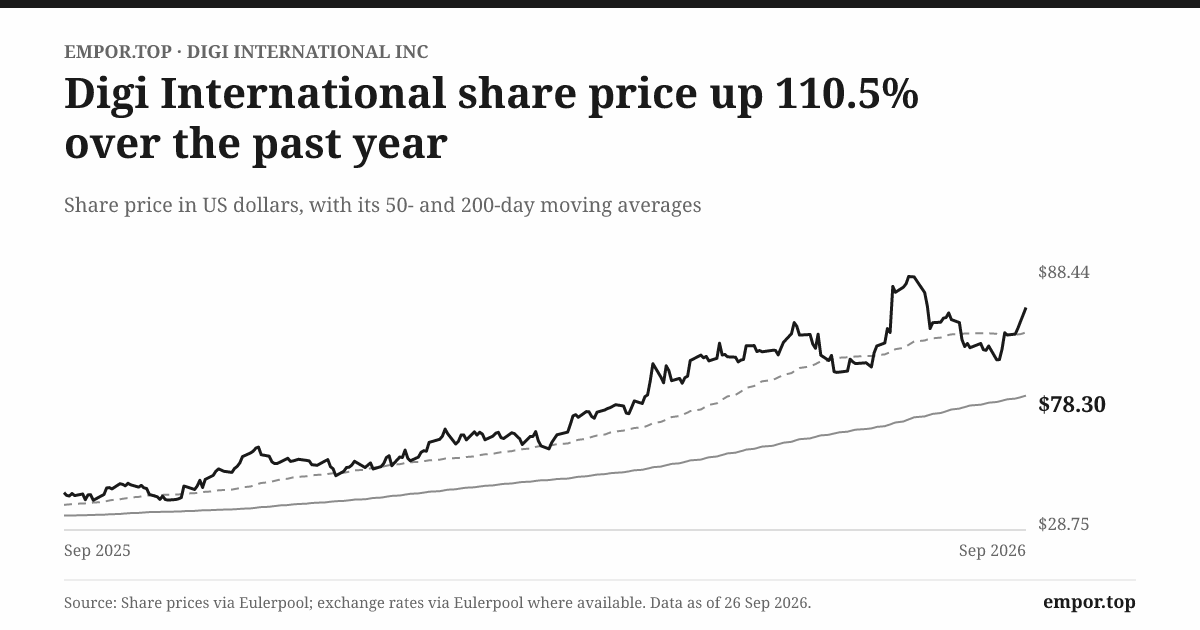
Digi International's shares closed at $78.30 on September 25, 2026, after trading as low as $34.41 and as high as $86.84 over the prior 52 weeks.1 At the peak, that was a move of roughly two and a half times from the bottom of the range, turning a company that had spent most of its life as a small-cap footnote into one valued at close to $3 billion.1
The obvious question is what changed. The quick answer is "AI data centers," and that is part of it. The better answer runs back to December 2014, when a board that had watched a decade of flat revenue brought in an outsider who had built and sold a trucking-telematics company. His plan was simple to say and hard to do: turn a hardware company into one that collects recurring subscription revenue.
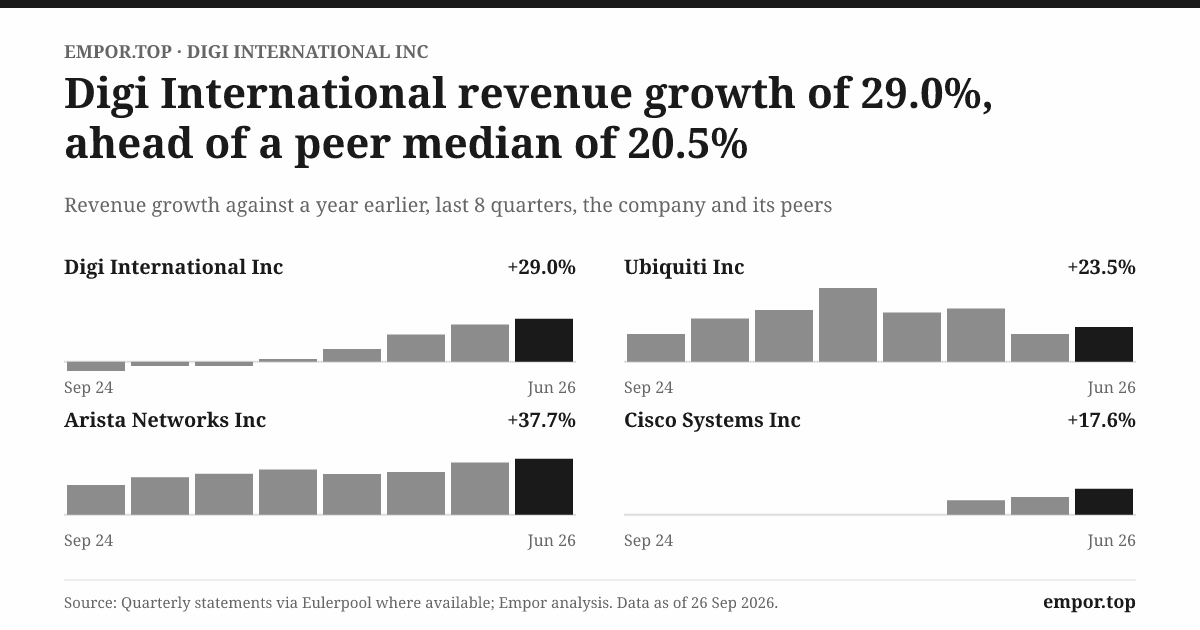
By the third quarter of fiscal 2026, Digi reported annualized recurring revenue (ARR) of $191 million, up 52% year over year, on quarterly revenue of $138.7 million.2 Management guided fiscal 2026 revenue to $529–533 million and adjusted EBITDA to $146–147.5 million, and it repeated a public target of $200 million of ARR and $200 million of adjusted EBITDA by fiscal 2028.2
ARR is worth defining once, because the whole story turns on it. It is the yearly value of the subscriptions and service contracts in force at a given moment. If a customer pays $100 a month to have a router monitored, that adds $1,200 of ARR. A company with a lot of ARR starts every year with much of its revenue already booked, which is why investors will pay more for a dollar of it than for a dollar of one-time hardware sales.
That is the promise. The tension is whether it is real platform economics or something more fragile: a cyclical hardware business that has been re-rated on the back of a debt-funded acquisition machine and an AI data-center story that has never been through a downturn.
This story follows that question through four decades. It covers the serial-port origins, the lost decade, the Konezny playbook, the acquisitions that built the recurring-revenue business (including one bought at a price that would look reckless today), the competitive position of the hardware core, the data-center option, and the financial record. Along the way it checks management's favorite claims against the company's own history, because some of them survive that test better than others.
The first stop is a much older Digi, one that sold boxes and hoped people would buy more of them.
 Subscribe on LinkedIn
II. Origins: Serial Ports to M2M (1985–2007)
The first Digi product was the sort of thing nobody photographs. In the mid-1980s businesses were filling up with minicomputers and early PCs that had to talk to terminals, printers, modems, and cash registers. The plumbing that made that happen was the serial port, a basic connector that sends data one bit at a time. Digi, incorporated in Minnesota in 1985, built boards and boxes that let one computer handle many serial connections.3
It was a good business because it was dull. A retailer that wired its point-of-sale terminals through Digi hardware did not rip it out on a whim. Console servers and terminal servers, which let IT staff reach and control equipment remotely, became part of the wiring of data centers and branch offices. Once installed they stayed for years.
The weakness came with the strength. Serial connectivity was a shrinking niche as Ethernet and the internet took over. By the turn of the century Digi's core market was eroding, and the company needed somewhere new to go.
Joe Dunsmore became CEO in October 1999 and chairman in May 2000.4 His answer was to follow device connectivity wherever it went next. In October 2001 Digi agreed to buy NetSilicon, a maker of embedded chips that gave electronic devices Ethernet and internet connections, for about $50 million in stock.5 Dunsmore argued that the market for network-enabled devices in point-of-sale and industrial automation was just forming and that NetSilicon had an early position through its OEM channel.5
That deal set the direction for the next ten years. Digi moved from connecting computers to connecting machines. The industry term was M2M, for machine-to-machine: vending machines reporting their stock, utility meters sending readings, pipeline sensors reporting pressure. As cellular networks spread and cellular modules got cheaper, Digi added cellular routers and gateways to its embedded modules and its XBee short-range radio line.
The XBee line needs a short explanation, because it still sits in Digi's catalog four decades later. An XBee is a small radio module about the size of a postage stamp. An engineer designing a smart thermostat or a factory sensor does not want to design a radio, get it certified, and debug it, so they buy one that already works and solder it onto their own board. Digi is paid once per module. Its advantage is that, once the product ships, the manufacturer has little reason to swap the radio out.
Two details from this period matter for today's investor. First, the NetSilicon deal was paid for with stock, so Digi has a long history of issuing shares for acquisitions. That becomes relevant when current management describes its strategy as non-dilutive. Second, the company bought technology but not recurring revenue. Every router shipped was a single sale, and next quarter started from zero.
That model was about to hit a ceiling. The seven years that followed became the base rate any Digi bull has to beat.
III. The Lost Decade and the Boardroom Reset (2007–2014)
Imagine the Hopkins boardroom in early 2014. The directors had in front of them a company with a respected brand, a broad product line, a clean balance sheet, and almost no growth. Revenue was $204 million in fiscal 2011, $191 million in fiscal 2012, $195 million in fiscal 2013, and $183 million in fiscal 2014.[^6] Industry conferences were full of talk about the "Internet of Things," yet the company that had been connecting things since the 1980s was shrinking.
Profitability was worse. In fiscal 2014 Digi reported operating income of about $4.4 million on $183 million of revenue, and on some measures its EBIT was close to zero.[^6] A business that has spent years in a growing category and ends up barely profitable has a problem that engineering alone will not fix.
The diagnosis in hindsight is that Digi sold hardware into many fragmented niches and had no recurring component to build on. Each quarter it had to win orders again. R&D spending stayed around $30 million a year, heavy for a company this size.[^6] Competitors with more scale or lower costs could undercut on price, and customers had no strong reason to pay a premium.
On April 23, 2014, Digi announced that Dunsmore, who was President, CEO, and Chairman, would retire by year-end, and that the board had hired Spencer Stuart to run the search.4 The press release was warm. Lead director Ahmed Nawaz credited Dunsmore with starting the "transformation to a company focused on providing high-quality machine-to-machine networking solutions."4 The numbers were less generous about how far that transformation had come.
The person the board chose was an unusual pick. Ron Konezny was not a networking-hardware executive. He had co-founded and run PeopleNet, a Minnesota company that made onboard computers and fleet-management software for trucking and sold it largely on a subscription basis.6 Trimble bought PeopleNet in 2011, and Konezny then ran Trimble's global transportation and logistics division as it grew through acquisitions including TMW Systems and ALK Technologies.7 Trade press reported that the division reached nearly 1,500 employees and more than 2 million remotely managed assets.7
Before PeopleNet he had been a senior consultant at Cap Gemini Ernst & Young, focused on international telecommunications, and he held a BA from Northwestern.6 His résumé was essentially a list of what Digi lacked: subscriptions, software that sat on top of hardware, and a record of buying businesses and integrating them.
He took over as President and CEO on December 17, 2014.6 His public remarks were modest, about being "excited to join the Digi team" in wireless M2M and IoT.6
The main point for investors is that the modern Digi story starts here, in fiscal 2015. The earlier history mostly serves as a baseline. The 2007–2014 record shows what Digi looked like as a hardware-only company: flat sales, thin margins, and no compounding. Every later claim about a "flywheel" should be measured against that.
The next question is what an outsider from the trucking world actually did with the company.
IV. The Konezny Playbook: Segments, ARR, and the "Flywheel"
Konezny's first move was an accounting change, and it mattered more than most accounting changes do. He divided Digi into two reporting segments that made the new strategy visible from outside.
The first, which eventually took the name IoT Products & Services, contained the traditional business: cellular routers and gateways, XBee radio modules, embedded computing boards, and console servers. The second, originally called Solutions and later IoT Solutions, held businesses that sold ongoing services and subscriptions, not boxes. Digi's fiscal 2018 10-K noted that IoT Solutions had gone from zero revenue in fiscal 2015 to almost 11.8% of total revenue in fiscal 2018.8
The split let investors do something they could not do before, which was to watch the recurring side grow on its own. It also committed management publicly. Once there is a segment called Solutions, the market expects it to get bigger.
The second move was to make ARR a headline metric. Digi now reports ARR for each segment, and management ties its long-term targets to it.2 The incentive plan does the same. In fiscal 2025 the executive cash bonus was weighted 40% on ARR, 30% on adjusted EBITDA, and 30% on revenue.9
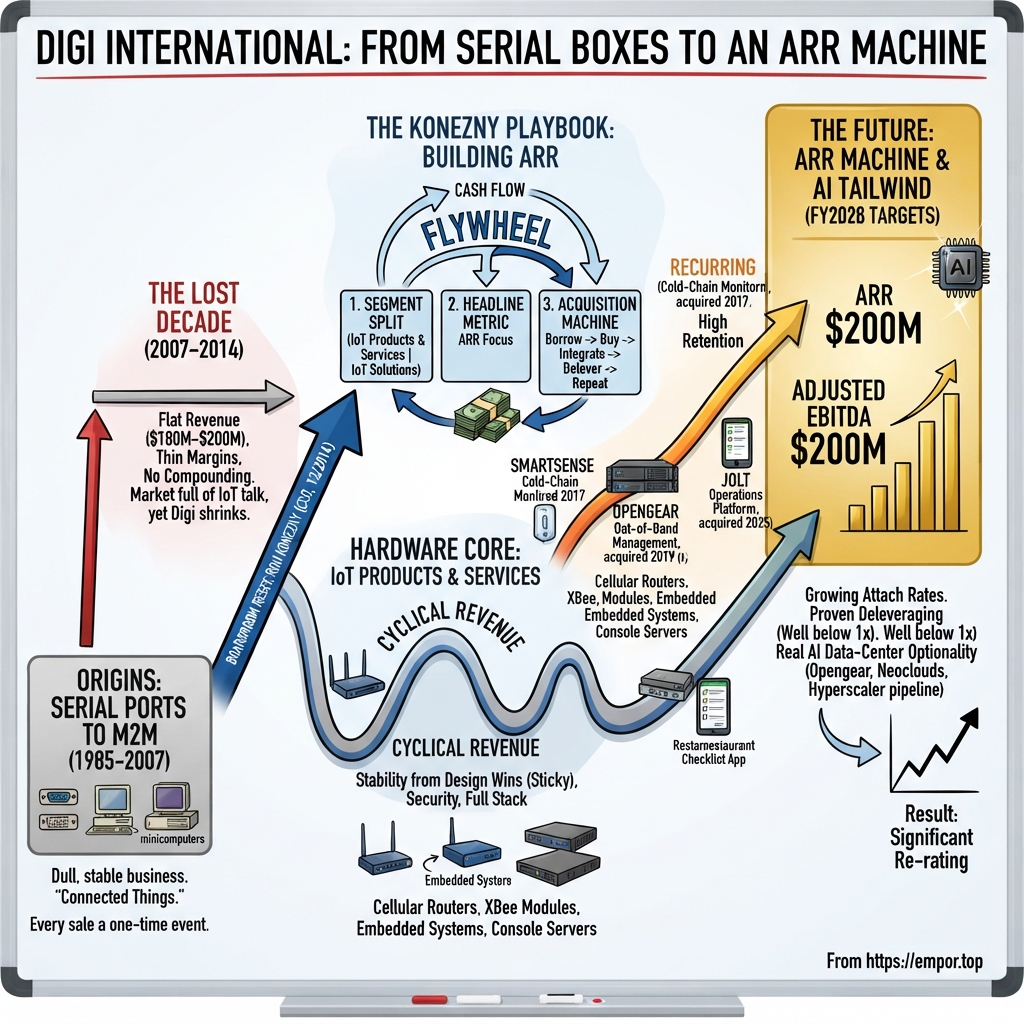
The third move, repeated for a decade before anyone gave it a name, was acquisitions. On the Q3 fiscal 2026 call Konezny laid out the model in four words: "acquire, integrate, generate, compound."2 Digi borrows to buy businesses with recurring revenue, moves them quickly onto shared systems, uses the combined cash flow to pay down the debt, and then does it again.
He also made a pointed claim about capital structure. "It's a strategy that we feel protects the equity investor because we're using debt," he said. "We're not diluting the shareholder."2
That is the claim to check first, because the record is more mixed than the slogan.
Myth vs. reality: the non-dilutive flywheel. The deleveraging part holds up. After the Ventus deal in late 2021, which Section VI covers, Digi carried more than $230 million of borrowings at the end of fiscal 2022.10 By Q3 fiscal 2026 net debt was down to $81 million, and management said leverage was "well below 1" times EBITDA.2 That was after spending roughly $196 million on Jolt and Particle in the preceding year (Section VI).1112 Paying down that much debt while continuing to buy is a real result, not just a talking point.
The "not diluting the shareholder" part is less clean. On March 3, 2021, eight months before the Ventus acquisition, Digi priced a public offering of 3.5 million shares at $19.50, raising about $68.3 million in gross proceeds for purposes that included possible acquisitions.13 Digi ended fiscal 2021 with about $152 million in cash, and its Ventus 8-K said the deal was funded with "cash on hand" plus the new $350 million credit facility.1014 Some of the equity raised in early 2021 very likely went into the biggest deal in the company's history.
The share count shows the long-run effect. Weighted average basic shares were about 27.1 million in fiscal 2018 and about 37.0 million in fiscal 2025.83 Some of that growth came from stock compensation and some from the 2021 offering. Either way, owners of the company in 2018 have a noticeably smaller share of it today.
The patience test. The early record also deserves attention, because the flywheel did not start turning quickly. Revenue was about $204 million in Konezny's first fiscal year, $203 million in fiscal 2016, and about $182 million in fiscal 2017, lower than the year before he arrived.[^6]8 Part of that was deliberate pruning of low-margin product lines, and part was the difficulty of shifting a hardware company's mix. For three years the new CEO had to persuade a board and shareholders that a flat top line concealed a changing business underneath.
That matters when judging management. Konezny was not an instant turnaround story. The strategy took most of a decade to appear clearly in consolidated results, and it did so mainly through acquisitions, not through organic acceleration of the legacy business. Investors who credit management with patience should also accept that the model's results depend heavily on dealmaking.
The fair conclusion is narrower than the slogan. Since 2021 the flywheel has been funded with debt and has delevered quickly, and that part of the record is good. The broader claim that the strategy has protected shareholders from dilution does not hold over the full Konezny period. The thing to watch is the diluted share count after each future acquisition. If it stays flat, the claim gets stronger. If a large deal brings another equity raise, the slogan becomes a preference and nothing more.
The playbook needed businesses to buy. The first ones were small, and they came from an unlikely place: restaurant refrigerators.
V. Building IoT Solutions: The SmartSense Roll-Up and Opengear (2015–2020)
Start in the walk-in cooler of a hospital pharmacy or a fast-food kitchen. Vaccines, insulin, raw chicken, and dairy all have to stay within a narrow temperature range. For decades staff checked this with a clipboard: someone read a thermometer a few times per shift and wrote down a number. If a compressor failed overnight, nobody knew until morning, and by then thousands of dollars of inventory were spoiled and a health-code violation might be on the way.
That clipboard became Digi's first recurring-revenue business. Starting in 2015 Konezny's team bought a series of small companies that replaced it with wireless sensors, cloud dashboards, and automatic alerts. The fiscal 2018 10-K describes SMART Temps, acquired in January 2017, as a provider of real-time foodservice temperature management and pharmacy services.8
The largest piece was TempAlert. On October 23, 2017, Digi bought the Boston company, which had started at MIT, for $45 million in cash, with further payments tied to revenue above set thresholds in 2018 and 2019.15 Digi called it the fourth strategic acquisition in 24 months and said the combined temperature-and-task monitoring business covered nearly 35,000 customer sites across healthcare, transportation, industrial, and foodservice.15
These units were combined and eventually branded SmartSense. The economics were very different from the router business. A router sale happens once. A sensor network in a grocery chain produces a monthly subscription for as long as the chain keeps selling food, and switching vendors means retraining staff, reinstalling sensors, and moving compliance records, which few operators want to deal with.
This is Digi's first example of the switching-cost mechanism that most of the bull case depends on. SmartSense makes it easy to see: once a subscription is built into a customer's compliance workflow, it tends to stay.
Scale is where caution is needed. Cold-chain monitoring has large incumbents, including Carrier's Sensitech and Emerson's monitoring lines, and SmartSense was assembled from small companies. The margins and retention can be attractive while the business is still modest in size. Digi has not disclosed SmartSense's standalone revenue or margins, so outsiders cannot check its unit economics directly.
The deal that later defined this period went in a different direction. On November 7, 2019, Digi agreed to buy Opengear for $140 million in cash upfront, plus up to $15 million more depending on 2020 revenue.16 Opengear, founded in 2004 and based in Edison, New Jersey, with R&D in Silicon Valley and Brisbane, made out-of-band management equipment.16
Out-of-band management sounds dull and matters a great deal. A data center is full of servers, switches, and routers controlled over the main network. If that network fails, perhaps because of a bad configuration change, engineers may be locked out of the equipment they need to repair it. An out-of-band device acts as a separate back door: its own connection, often cellular, that lets an engineer reach and restart equipment when the main network is down. It works like the emergency stairwell in an office tower. Nobody thinks about it until the elevators stop.
In 2019 Konezny described the deal as a portfolio combination, "hardware enabled and software defined," with complementary products in failover-to-cellular and out-of-band management.16 It was financed with cash on hand and a $150 million BMO Harris debt facility and was expected to be immediately accretive.16 The rationale was an adjacency with Digi's older console-server business. It did not mention AI.
That is why Opengear needs careful benchmarking. With hindsight it looks like a bargain. By fiscal 2025 management said the Opengear console-server business was about half data center and half edge, and it called Opengear a major beneficiary of AI infrastructure spending.17 A roughly $140–155 million price for what is now a key growth driver looks cheap.
The hindsight has to be discounted, though. The 2019 case was about adjacency, and the data-center boom came later. Management deserves credit for buying a good asset at a fair price and for running it well. It does not deserve credit for predicting the AI build-out, because it never said it did. The more useful comparison is with deals that had their thesis priced in from the start. The biggest of those came two years later, near the top of a market cycle.
VI. The Ventus Bet: Digi's Biggest, Most Expensive Deal (2021)
November 2021 was a strange time to buy anything. Software multiples were close to their highest levels ever. At the same time, the global electronics supply chain was in the worst shape of its modern history: container ships waited offshore, chip lead times ran to a year, and freight costs had multiplied. Digi's fiscal 2022 10-K later described "container ship backlogs, energy shortages in certain parts of the world, and components and material shortages" that caused "shortfalls in available components" and higher costs.10
Against that backdrop, on November 1, 2021, Digi closed the largest acquisition in its history. It paid $347.6 million in cash, subject to working-capital adjustments, for Ventus Holdings.14 To finance it, Digi signed a $385 million credit agreement with BMO Harris as agent, consisting of a $350 million Term Loan B and a $35 million revolver.14
Ventus sold Managed Network-as-a-Service, or MNaaS. The idea is that many businesses with lots of remote locations, such as ATMs, lottery terminals, retail stores, and medical sites, do not want to run their own wide-area networks. Ventus provides the routers, the wired and wireless connections, the monitoring, and the support for a monthly fee. For the customer the network becomes a utility bill. For Ventus it is a subscription.
Konezny called Ventus "by far the biggest move" in shifting Digi from "one-time hardware" to "annualized recurring revenue."18 It was Digi's third acquisition of 2021 and the ninth under his leadership, and it brought in more than 100 employees at a company that had about 650.18 The Star Tribune reported that the price was just over eight times Ventus's annualized recurring revenue.19
The overpay test. Eight times ARR was a high price even in 2021, and a large one for a company of Digi's size. The acquisition cost more than Digi's entire fiscal 2021 revenue of about $309 million.10 Even after heavy repayments in the first year, Digi finished fiscal 2022 with roughly $238 million of borrowings.10 For a company that had spent most of its history with no meaningful debt, that was a serious bet on the balance sheet, made just as interest rates were about to rise sharply.
The 2022 operating record shows how exposed the position was. In the Q3 fiscal 2022 release management mentioned "supply chain and inflationary challenges" squeezing product-segment gross margins, and it tied guidance to supply chain and macro conditions.20 Demand was not the issue: Konezny cited "another strong quarter of bookings leading to increased backlog."20 The issue was getting parts. A leveraged company that could not ship its orders was in a riskier position than the headline growth rates suggested.
It held up. Total ARR reached $92 million in Q3 fiscal 2022, up 157% year over year, almost all of it from the Ventus deal, and consolidated gross margin rose to 55.5%.20 Fiscal 2022 revenue came in at about $388 million.10
The headcount figures show how much organization Digi was absorbing at once. The company had 516 employees at the end of fiscal 2018 and about 790 at the end of fiscal 2022.810 In roughly four years it had increased its workforce by half, bought Opengear and Ventus, moved much of its hardware revenue onto a new subscription model, and dealt with the worst component shortage in its history. That it did not suffer a visible integration failure during this period is probably the strongest single piece of evidence for the management team's operating ability. It is stronger evidence than any of the deal prices.
It also sets a limit. The organization grew to 913 people by fiscal 2025, which is slower growth than in the Ventus years, even as ARR and acquisition activity increased.3 Either the company has become much more efficient, or it is running close to capacity. The financial results so far point to efficiency. The next large integration will show which it is.
Comparing deal prices, and why the easy lesson is wrong. The bull argument is that Digi has since become more disciplined on price. On January 27, 2026, Digi bought Particle, an edge-to-cloud IoT platform with about $20 million of ARR growing at double digits, for roughly $50 million in cash.12 That is about 2.5 times ARR, a third of the Ventus multiple.
Jolt makes that argument harder to sustain. On August 18, 2025, Digi paid $145.5 million in cash for Jolt Software, an operations-execution platform for restaurants and retailers, which had more than $20 million of ARR in its fiscal year ended January 2025.11 That is roughly seven times ARR, not far from the Ventus multiple, paid in a much cooler market. Management expects Jolt to add $11 million of annualized adjusted EBITDA by the end of calendar 2026.11
The record therefore does not show a steady move toward cheaper deals. It shows one premium deal in 2021, another close to premium in 2025, and a low price for Particle in 2026. Particle's price may reflect the specific situation more than a change in philosophy, since venture-backed IoT platforms have had a difficult funding environment. The accurate description is that Digi pays up for businesses it considers strategic, and it has usually made those deals work through integration and cost savings, not through buying cheaply. That is a real skill, but it is not the same as buying cheaply, and it depends more on good execution.
Resolution. On the numbers Digi has disclosed, Ventus has held up. At the end of fiscal 2025, IoT Solutions ARR was $120 million, 79% of the company's $152 million total, with Ventus and SmartSense as its core.317 By Q3 fiscal 2026 Solutions ARR had grown to $131 million, up 36%, including Jolt.2 The multiple was high and the timing was bad, but the asset has grown, and the debt taken on for it had been largely repaid by the end of fiscal 2025.17
The remaining question is how big the result is. Paying eight times ARR only makes sense if the business grows and throws off cash for many years, and Ventus has grown. Digi does not report Ventus's standalone growth, churn, or margins, so the claim that the deal was vindicated rests on segment totals that also include SmartSense and Jolt. The judgment is plausible but cannot be fully checked from outside.
Recurring revenue explains the re-rating. Most of Digi's revenue, though, still comes from the hardware business, and that is where the competitive fight takes place.
VII. The Core Engine: IoT Products & Services — Industry Structure and Competitive Position
Think of a wind farm on a North Dakota ridge, a traffic-signal cabinet on a highway off-ramp, or a kiosk in a remote gas station. Each has a small, rugged box somewhere inside with an antenna and a SIM card that keeps the asset connected to its owner's control room. If the box fails, a technician has to drive out. If it is hacked, someone else controls the asset. For these customers the price of the box matters much less than how often it fails.
That is the market IoT Products & Services serves, and it is still most of Digi. The FY2025 10-K puts the segment at roughly three-quarters of revenue, with IoT Solutions at about a quarter.3 On fiscal 2025 revenue of $430 million, the hardware-led segment accounted for more than $300 million.17
The product line has four main parts. Cellular routers and gateways connect remote equipment to the network. XBee modules are small radios that engineers solder into their own products. Embedded systems, including ConnectCore boards, are the computing cores inside other companies' devices. Console servers, including the Opengear line, are the out-of-band equipment covered in Section V.
The competitive map
In cellular routers and gateways Digi is an established player but not the leader. Berg Insight's 2022 analysis ranked Ericsson-owned Cradlepoint as the clear market leader, followed by Lithuania's Teltonika Networks, which had grown almost 100% in 2021, then Cisco, Sierra Wireless, and Digi.21 Those five together had about $625 million of 2021 router and gateway revenue and 54% of a roughly $1.15 billion market.21
Beyond them is a long list of competitors. Berg Insight named MultiTech, Lantronix, Systech, and Casa Systems in the U.S.; 映翰通 InHand Networks, Peplink, 宏电 Hongdian, 鲁邦通 Robustel, and Advantech in Asia-Pacific; and HMS Networks, NetModule, Westermo, RAD, and others in EMEA.21 The market is fragmented, competitive, and under steady price pressure from lower-cost Asian manufacturers.
So Digi is roughly the fifth-largest company in a market where the leader is several times its size. It cannot win by being the biggest.
The leader's position is itself a warning about how this market works. Cradlepoint became dominant through enterprise branch networking, which is a larger and more IT-driven market than Digi's industrial niches, and it was then acquired by a telecom-equipment giant. Teltonika grew almost 100% in a single year from Lithuania by competing on price and product breadth.21 Neither followed Digi's playbook. Scale in this industry can come from very different directions, and Digi's route of rugged, secure, subscription-attached devices for industrial and regulated customers is one viable route among several, not the dominant one.
How Digi says it wins
Management gives three reasons: reliability built over four decades, security, and a full stack in which the device, the cellular connectivity, and the Digi Remote Manager software come from one vendor. The honest assessment is that most of the evidence for reliability comes from Digi's own customer research and messaging. There is little independent data on win rates or share shifts, and Digi does not disclose share figures of its own.
The stronger argument is switching costs through design wins. When a medical-device maker or kiosk manufacturer designs an XBee module or embedded board into its product, the component stays through the product's life, often five to ten years. Changing it means re-engineering, re-certifying, and re-testing, and nobody does that to save a few dollars a unit. Helmer's 7 Powers framework counts this as a real, though limited, form of power. It protects the installed base but does not win new designs.
Management's attach-rate strategy is meant to deepen that. Every router or console server shipped is an opportunity to sell a subscription for remote management, extended warranty, or connectivity. On the fiscal 2025 call management said attach rates were 100% on some product lines and 50–75% on others, and it expected full attainment by fiscal 2028.17 Particle, bought in January 2026, adds edge-to-cloud software that lets developers push code to devices across more than 350 cellular networks without handling SIMs separately, a service billed as a subscription.12
The effect on segment ARR has been large, but mostly through acquisition. Particle raised Products & Services ARR from $32 million to about $52 million at closing.12 By Q3 fiscal 2026 segment ARR was $60 million, up 100%.2 Most of that doubling came from Particle, which means organic attach-rate growth in the hardware segment is a smaller figure than the headline.
How it could lose
The core risk is commoditization at the low end. Chinese module and router makers, led by companies in the 移远通信 Quectel class for modules, compete on cost in ways a U.S. company that manufactures through contractors in Thailand, Mexico, Taiwan, and Cambodia cannot match on price.3 Digi's answer is to avoid that part of the market and sell into regulated, security-sensitive, and U.S. government-adjacent applications where supplier origin matters. That is a sensible position but a limited one.
At the top end the risk runs the other way: very large data-center customers may build out-of-band capability themselves. That is covered in Section VIII.
There is also a concentration risk that the diversified-customer story does not mention. The FY2025 10-K disclosed that a single distributor customer in the Products & Services segment accounted for 13% of consolidated revenue.3 Distributors pass products through to many end customers, so this is not the same as depending on one buyer. It still means a single commercial relationship has meaningful influence over the segment.
The hardware cycle
The most important thing to understand about this segment is that it is cyclical. Total company revenue peaked at about $445 million in fiscal 2023, fell to about $424 million in fiscal 2024, and recovered only to $430 million in fiscal 2025, up about 1%.317 With IoT Solutions growing through that period, the arithmetic implies the hardware core was flat to down in fiscal 2025. Customers had over-ordered during the shortages and then worked down inventory for two years.
The rebound has been sharp. Products & Services revenue was $100 million in Q3 fiscal 2026, up 25% year over year.2 Some of that growth deserves skepticism. On the same call management said memory shortages were "getting all the headlines" and spreading, and that customers were thinking "I better get my order in."2 Orders placed ahead of expected shortages pull demand forward, as they did in 2021–22. That period ended with two years of inventory digestion.
The conclusion for this segment is a smaller version of the growth story. The hardware business is a stable, mid-sized, cyclical franchise with real design-win stickiness, a growing layer of attached subscriptions, and no demonstrated pricing power. What makes it valuable is that it carries the recurring software sold on top of it. The part of Digi that is changing the company's valuation is the smaller segment, and its most-discussed asset sits inside AI data centers.
VIII. IoT Solutions and the Data-Center/AI Tailwind — Sizing a Real but Early Optionality
The large AI data centers under construction today consume electricity on the scale of small cities and are packed with extremely expensive GPUs. Each rack of servers connects to switches, power distribution units, and storage, and every one of those devices needs a back door for the moment the main network fails. A few seconds of downtime on a GPU cluster costs real money. Out-of-band management, the emergency stairwell from Section V, has gone from a nice-to-have to a budget line.
This is the reason investors paid more for Digi. First, though, it is important to be clear about which segment holds which asset.
IoT Solutions held about a quarter of Digi's fiscal 2025 revenue but $120 million of its $152 million ARR at fiscal year-end, about 79%.317 It is where Ventus, SmartSense, and now Jolt sit. In Q3 fiscal 2026 segment revenue was $39 million, up 41%, and ARR was $131 million, up 36%.2 This business is fully commercial. Customers pay monthly and the revenue compounds.
Opengear, which accounts for most of the AI discussion, reports inside the hardware-led Products & Services segment. The data-center thesis and the ARR thesis are related but separate. Opengear sells mainly equipment, with software and subscriptions attached.
What management actually said
On the Q3 fiscal 2026 call management described Opengear's momentum as broad, covering both edge campus and data center. Konezny said: "We've been the solution of choice for a lot of the neo clouds that have been looking to deploy assets and maintain visibility and control."2 Neoclouds are the newer GPU-rental providers that have grown with AI demand, companies that build data centers quickly and need infrastructure management to work immediately.
On hyperscalers, the largest cloud companies, he was careful: "We've also been knocking on the doors of hyperscalers... those are longer sales cycles. They're very hard to predict... [we] certainly don't embed any of those expectations into our forward guidance."2
That restraint says something about management's credibility. With the stock near its high and investors asking about AI, promoting a hyperscaler pipeline would have been easy. Management declined to, and it kept the most speculative upside out of guidance.
Discipline check on commercialization
Having a technical foothold does not mean having booked revenue. As of the Q3 fiscal 2026 call, Digi had not disclosed a signed hyperscaler contract, a dollar value for one, or a multi-year commitment.2 Management's statement from the fiscal 2025 call that the console-server business is about half data center and half edge is the most concrete measure available.17 Digi does not report Opengear's revenue, growth, or backlog separately.
Its history of turning emerging technologies into revenue argues for patience. Digi talked about M2M and IoT for more than a decade before the Konezny era, and the category grew while Digi's revenue did not (Section III). Being well positioned in a hot category did not produce growth then. The data-center opportunity has a better foundation, since customers are buying today, but investors should wait for disclosed figures before building a thesis on it.
The logic is sound, however. Out-of-band management is close to Digi's core: it combines cellular connectivity, a hardened device, and remote-management software, all of which Digi already sells. This is optionality that builds on existing capability, not a move into unfamiliar territory.
There is also a two-sided risk. The hyperscalers that could drive Opengear's upside are the customers most able to design their own out-of-band hardware or buy it from contract manufacturers at cost. Large buyers have the most bargaining power. A single hyperscaler win would be meaningful, and it would come with tough pricing and the ongoing risk that the customer brings the work in-house.
Neoclouds bring a less obvious risk of their own. Many are young companies building capacity with borrowed money on the assumption that AI demand keeps compounding. They purchase quickly while financing is available and can stop just as quickly when it is not. If part of Opengear's recent strength comes from this buyer group, it is tied to AI credit conditions, and that link has not been tested through a slowdown in AI capital spending. Digi discloses no customer figures for this group, so the size of the exposure is unknown.
Where the near-term case actually rests
Commercially, IoT Solutions depends on SmartSense and Ventus, now joined by Jolt. Management said Jolt and Particle integrations had "gone very well, hitting their targets that we have committed to both internally and externally."2 On the fiscal 2025 call it said it had "a clear vision of the combined platform" for SmartSense and Jolt and had "integrated the teams."17 These businesses carry the segment. Opengear in data centers is an option layered on top of them.
The reasoning behind Jolt is worth spelling out, because it shows where SmartSense is going. Jolt sells operations software to restaurants, retailers, and foodservice operators: task checklists, digital food-safety compliance, employee scheduling, team communication, and label printing.11 SmartSense sensors already sit in many of the same kitchens and record temperatures automatically. Together the two products let Digi move from "we monitor your freezer" to "we run your store's daily compliance routine." The more of a manager's day that runs through the combined product, the harder it becomes to replace, which is the switching-cost mechanism from Section V extended across a larger part of the customer's workflow.
The risk is the usual one for combined software products: cross-selling that looks straightforward in the acquisition presentation and turns out slow in practice. Management's $11 million EBITDA synergy target for Jolt by the end of calendar 2026 gives investors a near-term, measurable check.11 Meeting it would be real evidence of integration. Quietly dropping it would be a clear warning.
It is worth estimating how much of the recent ARR growth is organic. Total ARR of $191 million in Q3 fiscal 2026 was up 52% from about $126 million a year earlier.2 Jolt and Particle each brought roughly $20 million at acquisition.1112 Taking out about $40 million of acquired ARR leaves organic growth in the low 20s percent. That is healthy but well below the headline rate, and it is the figure that tells investors how the existing business is doing.
DANI
Management also introduced "DANI," or Digi Artificial Network Intelligence, a natural-language interface for Digi Remote Manager. A customer can simply ask, "How is my network performing today?"2 On monetization Konezny said: "Over time, there could be a chance to monetize that, but that's not the priority at the moment."2
The right way to read DANI is as a retention and usability feature that may lower churn. It is not a revenue line, and management has not described it as one.
With the segments covered, the next question is whether the financial statements confirm the story.
IX. The Financial Engine and Management's Track Record
Twice a year, Konezny and CFO Jamie Loch give a version of the same presentation: ARR up, gross margin up, debt down, repeat. For a sophisticated investor, repetition by itself is not evidence. What matters is whether the figures behind it have held up over a full cycle. They mostly have, with a few details worth noting.
Gross margin: the clearest proof of mix shift
Digi's gross margin was about 45% in fiscal 2018, near 50% in fiscal 2014, and about 63% in fiscal 2025.8[^6]3 In Q3 fiscal 2026 it was 64.8%, up 130 basis points year over year.2
Both endpoints need context. Fiscal 2018 was a low point, not a normal year. Before Konezny, in fiscal 2011, gross margins were above 50%.[^6] Measured against that pre-Konezny level, the improvement is about 13 points, not 20. That is still a large change for a company that sells physical products, and it is the best evidence that the move to recurring revenue is real.
Management frames it carefully. On the Q3 call it described its gross-margin "base camp" as "low to mid-60s," with "the floor of that camp" around 62–63%, and it expects further gains of roughly 10–15 basis points a year as higher-margin ARR grows.2 Management is describing a slow climb with a floor, not a sharp rise. Hardware cycles, component costs, and tariffs can still push margins toward the bottom of that range. Calling the shift "structural" is justified only in the sense management uses: the floor has risen. It does not mean margins will keep climbing indefinitely.
Deleveraging, with actual numbers
Section IV covered the deleveraging trend. The recent pace is the most useful new evidence. Digi had repaid the Ventus-era debt by the end of fiscal 2025, as it had promised, then re-borrowed for Jolt.17 It ended fiscal 2025 with about $168 million of long-term debt and about $22 million of cash.3 It then spent roughly $50 million on Particle.12 By Q3 fiscal 2026 net debt was $81 million.2
That is roughly $100 million of net paydown in three quarters while also making an acquisition. It depends on cash generation. Fiscal 2025 free cash flow was $105 million, and management said cash conversion was above 100% of adjusted EBITDA.172 Few companies of Digi's size have borrowed this much and paid it down this quickly.
The GAAP-to-adjusted gap
Adjusted EBITDA, the metric in Digi's 2028 target, excludes the amortization of acquired intangibles, stock compensation, and deal costs. For a serial acquirer, amortization is the largest of these. Fiscal 2025 depreciation and amortization was about $34 million, and interest expense was about $6 million, down from about $25 million in fiscal 2023 as debt was repaid.3 The falling interest line is a direct benefit of deleveraging. The steady amortization line is the long-lasting accounting cost of buying ARR rather than building it.
Neither is a warning sign in itself. Amortization is a non-cash charge, and cash flow is the better gauge. But investors comparing Digi with organically grown peers should know that GAAP earnings will stay well below adjusted earnings as long as the acquisition model keeps running, and that the gap will widen with each new deal.
Guidance discipline
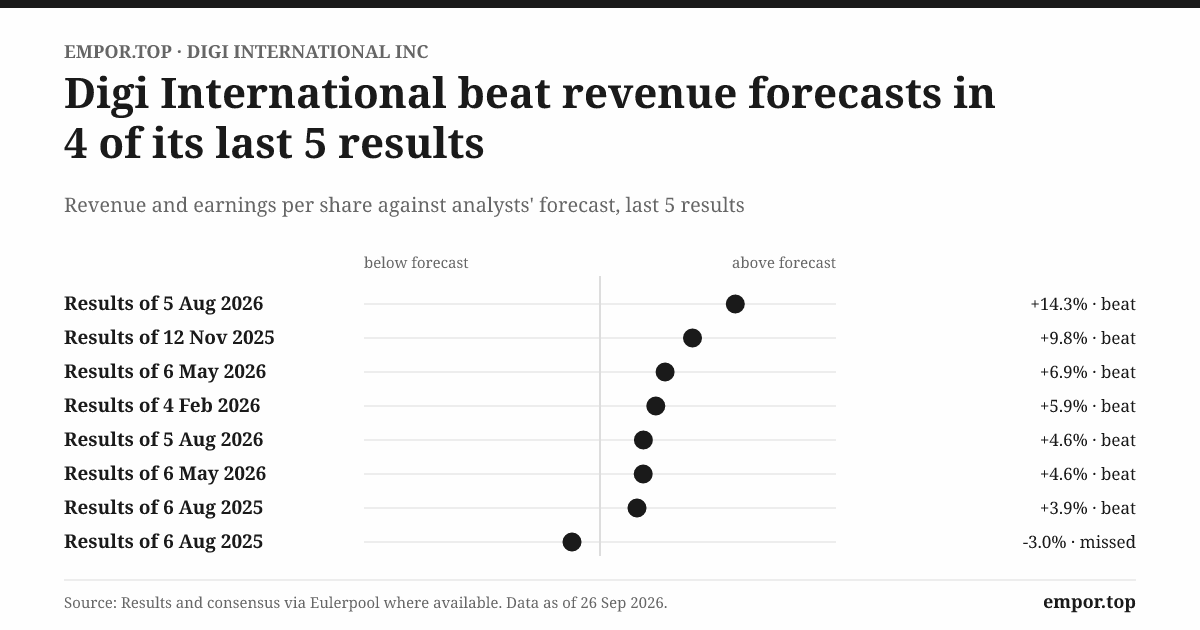
The recent record shows consistent beats and raises. In Q4 fiscal 2025 revenue was $114 million against consensus near $110 million, and adjusted EPS was $0.56 against about $0.51. First-quarter fiscal 2026 guidance also came in above expectations, and the stock rose 7% on the day.22 In Q3 fiscal 2026 adjusted EBITDA grew 47% and adjusted EPS reached $0.75.2
Fiscal 2025 also included a miss that the proxy disclosed openly. The cash bonus paid out at 147% of target because adjusted EBITDA and ARR exceeded their targets, while revenue missed its threshold.9 A board that shows a revenue miss in its own pay disclosure is being transparent. It also shows that the fiscal 2025 revenue plan was not met, which is consistent with the hardware slowdown described in Section VII.
There is one more credibility point. Management's 2028 targets of $200 million ARR and $200 million adjusted EBITDA have stayed the same across the fiscal 2025 and Q3 fiscal 2026 calls.172 Consistency does not prove the targets will be hit. It does mean that if they are missed, it will be easy to see.
Ownership and incentives
The proxy lists Konezny as owning 564,766 shares, about 1.5% of the company, and all directors and executive officers together at about 3.4%.9 At the September 25, 2026 price, his stake is worth roughly $44 million.1 That is meaningful for him personally, though it is not the concentrated ownership of a founder.
Cash pay is modest for a company of this value. Konezny's fiscal 2025 base salary was $587,000 and his bonus was $949,179. Loch's base salary was $420,000 and his bonus was $308,700.9 Equity awards add more. The bonus metrics of ARR, EBITDA, and revenue match the strategy. Nearly 95% of votes cast at the prior annual meeting approved executive pay.9 Satbir Khanuja is the non-executive chairman, so the chair and CEO roles are split, unlike under Dunsmore.9
The main outside holders are index and long-only investors: BlackRock at about 15.6%, Conestoga Capital Advisors at about 10.3%, and Vanguard at about 8.4%.9 Conestoga, a small-cap growth manager, is a large, concentrated active holder, and changes in its position are worth watching in 13F filings.
The assessment here is that the evidence from behavior is stronger than the evidence from ownership. A decade of consistent strategy, disclosed targets, beat-and-raise quarters, and the Ventus debt repayment all support management credibility. Ownership is fine but not remarkable. Investors should not treat the CEO's long tenure as proof of alignment.
Insider transactions
After a run like the one in 2025–26, executives commonly exercise options and sell shares, and Form 4 filings will show whether that has happened and how much. Routine, disclosed selling is not a red flag in itself. The thing to watch is whether the scale of selling changes, particularly around future acquisitions or guidance changes.
With the financial record reviewed, the investment case can be stress-tested from both sides.
X. Bull vs. Bear — Stress-Testing the "Why It Wins From Here" Case
Imagine two portfolio managers at the same table with the same 10-K. One thinks they are looking at a Midwestern version of Roper Technologies, a serial acquirer of niche recurring-revenue businesses that compounds for decades. The other thinks they are looking at a router company that borrowed money, bought subscriptions, and caught a fortunate AI tailwind at the top of the cycle. Both can support their view with the numbers.
The bull case
The bull argues that the transformation has already happened. IoT Solutions went from zero revenue in fiscal 2015 to the core of a $191 million ARR base, about 36% of fiscal 2026 guided revenue.28 Gross margin has risen more than ten points from its pre-Konezny level. The acquisition model has a full cycle behind it: Digi borrowed $350 million, integrated the business, repaid the debt, and borrowed again for Jolt.
On top of that sits a data-center option that management is careful not to oversell, and 2028 targets that current guidance puts within reach. At the fiscal 2026 midpoint, adjusted EBITDA of about $147 million needs roughly 17% annual growth over two years to reach $200 million.2 If ARR keeps growing at the guided rate of at least 27%, $200 million could arrive before fiscal 2028.2
Myth vs. reality: "Digi is an AI stock." The market's recent enthusiasm partly treats Digi as an AI infrastructure company. The evidence supports a much smaller claim. The data-center side of Opengear is one part of one product line inside the hardware segment, and management says roughly half of console-server demand comes from edge campuses, not data centers.17 Most of the company's recurring revenue comes from restaurant compliance software, managed networks for ATMs and retail sites, and device-management subscriptions, none of which depend on GPU spending. Management has kept hyperscaler upside out of guidance.2 Digi is a diversified IoT company with some exposure to AI infrastructure. Valuing it as an AI company would require revenue disclosures that do not yet exist.
The bear case
The bear's first point is that this is a serial-acquirer story, and serial acquirers are only as good as their next deal. The model depends on affordable debt and on targets priced sensibly. Jolt at roughly seven times ARR shows that Digi will still pay a high price in a normal market (Section VI).
Second, the company is small for what it is doing. Digi had 913 employees at the end of fiscal 2025.3 That team runs two segments, several brands, a contract-manufactured hardware line, and a program of regular acquisitions, and it plans to add more businesses. The more deals, the more strain on management capacity and the more exposure to losing key people.
Third, geography. More than 70% of revenue comes from North America, with Europe at 15–20%.17 That is a narrow base if U.S. industrial spending slows.
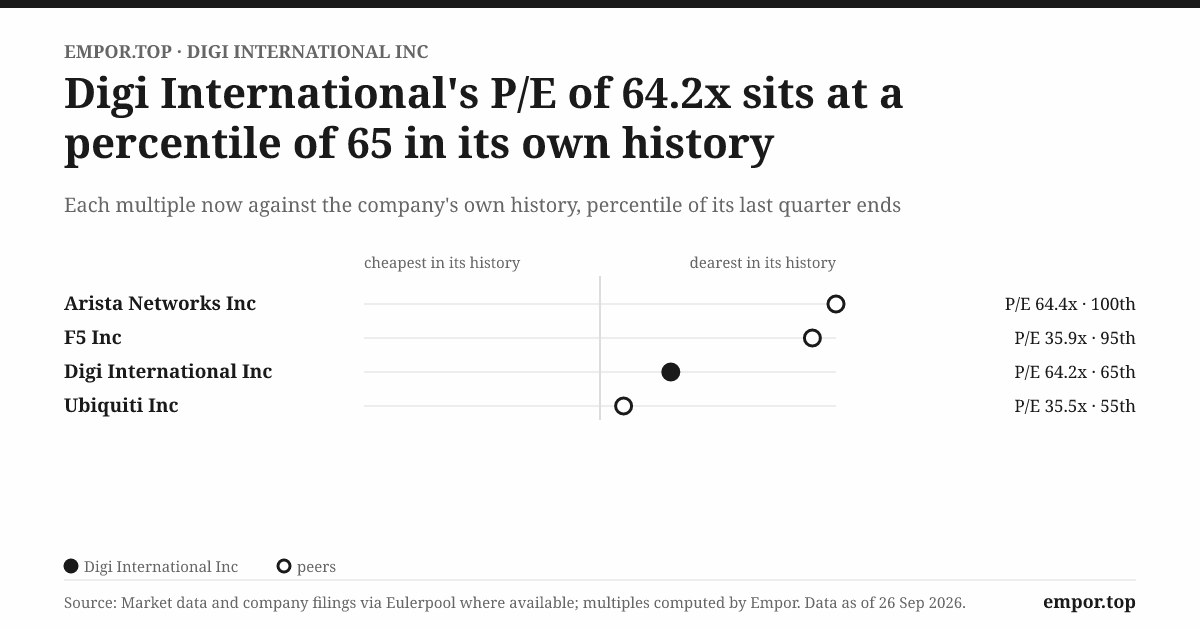
Fourth, the bar has risen. A stock that rose about 2.5 times from its low has to deliver a stream of beats and raises just to stay where it is. The hardware core that fell in fiscal 2023–25 is now growing, helped in part by customers ordering ahead of shortages (Section VII).
Fifth, the growth story is narrower than the headline figures. ARR up 52% is roughly low-20s organic. Hardware revenue up 25% comes after two down years and includes some pull-forward.
Porter's Five Forces, briefly
Buyer power is moderate. The customer base is spread across industrial, OEM, and enterprise buyers, with one distributor at 13% of revenue as the notable exception.3 It will rise sharply if hyperscalers become important customers. Supplier power is high in stressed periods. The 2021–22 shortages showed that component vendors can limit Digi's shipments regardless of demand, and management's comments on memory shortages suggest another tight period may be starting.102 Threat of substitutes is real in commodity modules and routers and low in regulated monitoring workflows. Threat of new entrants is low for scale players and high for low-cost niche vendors. Rivalry is intense but spread across a fragmented top five and a long tail.21
Helmer's 7 Powers, honestly applied
Switching costs are the one power the evidence supports clearly. They show up in design-win stickiness and in subscriptions embedded in customer workflows, such as SmartSense compliance logs and Ventus-managed networks. Scale economies are not present, since Digi is roughly fifth in routers.21 Network effects are not present either, because the value of one customer's monitoring does not rise when another customer signs up. Counter-positioning applies only a little: Digi's bundle of hardware, connectivity, and software is harder for pure-hardware Asian vendors to copy, but Cradlepoint and Cisco offer similar bundles. Cornered resource, process power, and branding are weak or unproven. Integration speed may be a form of process power, but seven deals over ten years is too few to establish it.
The activist's memo
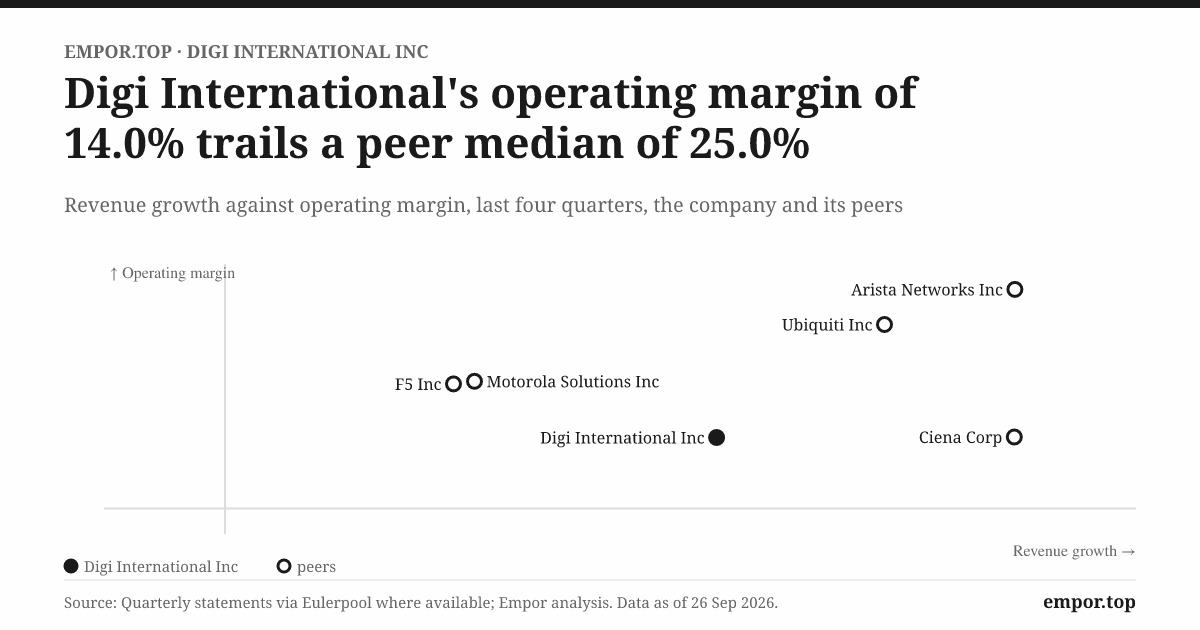
A skeptical investor would ask five things. Why does the company not report Opengear, Ventus, SmartSense, and Jolt separately, so investors can judge each deal on its own results? Why pay nearly seven times ARR for Jolt in 2025 if the lesson from Ventus was price discipline? What is organic ARR growth, stated directly and not left for readers to calculate? How much of the 2021 equity raise went into Ventus, and would management rule out issuing equity for a future large deal? And is adjusted EBITDA, which excludes acquisition-related charges and stock compensation, becoming the main scorecard while GAAP net income stays much smaller? Fiscal 2025 GAAP net income was about $41 million, compared with $108 million of adjusted EBITDA.317
None of these are accusations. They are the disclosure gaps a serious investor would want closed.
Net assessment
This review found no activist involvement, no restatement, and no qualified auditor opinion in the filings it covered, which were the FY2018, FY2022, and FY2025 10-Ks and the FY2025 proxy. That does not guarantee there are no issues.81039 The case for management credibility rests on a consistent execution record.
Taking the evidence together, the "transformation" claim survives in a slightly smaller form. Digi is now a hardware company with a substantial and growing recurring-revenue business, not a pure platform company. Its main competitive advantage is switching costs, not scale or network effects. Its acquisition machine works when integration goes well and does not rely on buying cheaply. The item that would test this most directly is the next large acquisition: its price, how it is funded, and how quickly Digi delevers afterward.
Those are the stakes. The next section covers the specific mechanisms that could hurt the business.
XI. Risk Radar
Every risk in this section connects to something Digi has already been through. Earlier episodes are the best guide to how each one could play out.
Tariffs and supply chain. Digi's hardware is built by contract manufacturers in Thailand, Mexico, Taiwan, and Cambodia, and the FY2025 10-K names new or higher international tariffs and geopolitical tensions as risks.3 Tariffs on imports from those countries raise costs directly on hardware that makes up most of revenue. The 2021–22 shortages already showed the model's sensitivity to component and freight shocks: guidance was limited by parts availability, not demand.20 Management's Q3 fiscal 2026 remarks about memory shortages spreading suggest that exposure is increasing again.2
Cybersecurity, with an ironic twist. Digi sells equipment meant to keep critical infrastructure secure and reachable, and its 10-K lists unknown security vulnerabilities, cloud dependence, and data breaches as material risks.3 For most companies a breach is costly. For Digi it would damage the core of its sales pitch. An incident involving Digi Remote Manager or Opengear devices in a customer's data center would cause reputational harm far beyond its direct cost, because security is one of the main reasons customers choose Digi over cheaper vendors.
Integration and deal-flow risk. The acquisition model has to keep running. Management says it tracks "hundreds of opportunities" and is actively evaluating "10 or 20" at a time.2 The 2028 ARR target implies continued acquisitions. A failed integration, a large write-down, or a period without reasonably priced targets would directly slow the growth management has committed to. A 913-person organization has limited capacity to absorb problems (Section X).
Rates and refinancing. Every major Digi deal since 2019 has used floating-rate bank debt, including the BMO-led Term Loan B for Ventus.14 Leverage is low now. The model, though, is built to re-borrow for the next acquisition, so rate exposure returns every time it works. A large deal financed at the wrong point in the rate cycle would slow deleveraging and could push management toward equity funding.
Accounting judgment: goodwill and intangibles. A decade of acquisitions has left most of the balance sheet as purchased value. At the end of fiscal 2025 Digi carried about $393 million of goodwill and $351 million of other intangible assets, together about $744 million of roughly $923 million in total assets.3 That is the normal result of paying well above book value for subscription businesses. It also means Digi's reported equity depends on the assumptions behind annual impairment tests. If an acquired unit such as Ventus or Jolt misses its plan in a downturn, a write-down would show up in GAAP results even if cash flow held up. This is the accounting line to watch.
Distributor channel inventory. The distributor that accounted for 13% of fiscal 2025 revenue (Section VII) creates a second-order risk.3 Distributors increase inventory when shortages loom and cut it when conditions ease. That happened across the industry after 2022, and management's comments on customers hurrying to place orders suggest stocking may be happening again now.2 If so, part of the current hardware rebound will have to be given back later, whatever end demand does.
Hyperscaler commoditization. The data-center demand that supports the bull case can also work against Digi. If the largest cloud operators design out-of-band management themselves, or require white-label pricing, the high-end market for Opengear could shrink just as it becomes important. Management's decision to keep hyperscalers out of guidance partly acknowledges this.2
Taken together, these risks are cyclical and operational, not existential. They are the kind of risks that turn a strong year into a flat one, and in a stock priced for strong years, a flat one matters a great deal.
XII. Durable Business & Investing Lessons
After a decade of this story, three lessons apply beyond Digi.
First, an old-line hardware company can build a recurring-revenue business, and the proof shows up in two places. One is gross margin: Digi's floor moved from roughly 50% to the low 60s, which acquisition announcements alone cannot produce. The other is how fast debt falls after a deal: Digi repaid the Ventus-era borrowing within about four years and cut debt again within a year of Jolt. Acquisition press releases are the least informative part. Margins and debt repayment show whether the model works.
Second, deal prices depend on the market environment, so credit for discipline should be given carefully. It is tempting to compare 8x ARR for Ventus in 2021 with 2.5x for Particle in 2026 and conclude that management learned its lesson. The Jolt purchase at about 7x in 2025 does not fit that conclusion, and the general decline in software valuations explains much of the gap. What Digi has shown is that it can make fully priced deals pay off through integration. That is a valuable ability, but it is not the same as buying cheaply, and it depends on continued good execution.
Third, technical footholds are options, not revenue, and management's own wording shows the difference. When a CEO says an opportunity is "very hard to predict" and excluded from guidance, investors should believe that. Opengear in hyperscale data centers and DANI are real, but they are not yet financial results. They become results only when management discloses contracted revenue.
A fourth, quieter lesson concerns patience in turnarounds. Digi's reinvention took a decade, and for its first three years it looked like a failure on the income statement. Investors who judged Konezny on revenue in fiscal 2017 would have seen no progress. The metrics that eventually showed the change, ARR and gross margin, were not the ones the market was watching at the start. When an old company says it is transforming itself, the right move is to identify the leading indicator management has committed to and track that, not the headline figure that will lag it by years.
That lesson applies in both directions. The same patience that rewarded early believers in Digi's ARR strategy should make current holders cautious about assuming the next decade will look like the last one. The easy phase of the mix shift, when a small recurring base could double through a few acquisitions, is finished. At $191 million of ARR, every additional point of growth takes a larger deal or a stronger organic engine.
XIII. What to Watch — KPIs and Forward Triggers
For investors following Digi, the main indicators are few.
ARR growth and mix. This is the central metric. Watch total ARR, the split between Products & Services ARR (attach rates and Particle) and Solutions ARR (Ventus, SmartSense, Jolt), and the organic rate once acquisitions are removed. If product-segment ARR keeps growing after Particle's contribution is lapped in early 2027, the attach-rate strategy is working. If it stalls, recurring revenue is still concentrated in the businesses Digi bought.
Gross margin against the "base camp." Management has set its own marker at low-to-mid-60s with a floor of about 62–63%.2 Holding that range through a hardware downturn or tariff shock would confirm that the mix shift is durable. Falling below it would suggest the improvement was more cyclical than management has said.
Net leverage after the next acquisition. Deleveraging is the real test of the acquisition model. When the next deal closes, watch how much Digi borrows, whether it issues any equity, and how many quarters it takes for net debt to fall back below 1x EBITDA.
A secondary item is any disclosed hyperscaler contract, dollar figure, or multi-year commitment for Opengear. That would be the first evidence that the AI data-center opportunity is producing contracted revenue. Until then it is only an option.
References
-
Digi International (DGII) Stock Price & Overview — Stock Analysis, 2026-09-25 ↩↩↩
-
Digi International (DGII) Q3 2026 Earnings Call Transcript — The Motley Fool, 2026-08-12 ↩↩↩↩↩↩↩↩↩↩↩↩↩↩↩↩↩↩↩↩↩↩↩↩↩↩↩↩↩↩↩↩↩↩
-
Digi International Form 10-K, Fiscal Year 2025 — U.S. SEC, 2025-11-21 ↩↩↩↩↩↩↩↩↩↩↩↩↩↩↩↩↩↩↩↩
-
Digi International Announces CEO and Chairman Joseph Dunsmore to Retire (Form 8-K Exhibit 99.1) — U.S. SEC, 2014-04-23 ↩↩↩
-
Digi International buys NetSilicon for $50 million to enter embedded chip market — EDN, 2001-10-30 ↩↩
-
Digi International Hires Industry Vet as CEO — Heavy Duty Trucking, 2014-12 ↩↩↩↩
-
Konezny Departing Trimble to Become CEO at Digi — Transport Topics, 2014-12 ↩↩
-
Digi International Form 10-K, Fiscal Year 2018 — U.S. SEC, 2018-11-21 ↩↩↩↩↩↩↩↩
-
Digi International DEF 14A Proxy Statement, FY2025 Annual Meeting — U.S. SEC, 2025-12 ↩↩↩↩↩↩↩↩
-
Digi International Form 10-K, Fiscal Year 2022 — U.S. SEC, 2022-11-23 ↩↩↩↩↩↩↩↩↩
-
Digi Acquires Jolt to Accelerate ARR Growth — SmartSense by Digi, 2025-08-18 ↩↩↩↩↩↩
-
Digi Acquires Particle to Accelerate ARR Growth — Digi International, 2026-01-27 ↩↩↩↩↩↩
-
Digi International Announces Pricing of Public Offering of Common Stock — Digi International, 2021-03-03 ↩
-
Digi International Form 8-K, Ventus Holdings Acquisition and Credit Agreement — U.S. SEC, 2021-11 ↩↩↩↩
-
Digi International Acquires TempAlert (Form 8-K Exhibit 99.1) — U.S. SEC, 2017-10-26 ↩↩
-
Digi International to Acquire Opengear — Opengear, 2019-11-07 ↩↩↩↩
-
Digi International (DGII) Q4 FY2025 Earnings Call Transcript — The Motley Fool, 2025-11-13 ↩↩↩↩↩↩↩↩↩↩↩↩↩↩↩
-
Digi International Inks $347M Deal to Buy Networking Services Firm — Twin Cities Business, 2021-11 ↩↩
-
Hopkins-based Digi International makes $347M acquisition to bolster IoT business — Star Tribune, 2021-11 ↩
-
Digi International Reports Third Fiscal Quarter 2022 Results (Form 8-K Exhibit 99.1) — U.S. SEC, 2022-08-04 ↩↩↩↩
-
Market for cellular IoT gateways and routers rallies after (and despite) Covid impact — RCR Wireless News, 2022-11-01 ↩↩↩↩↩↩
-
Why Digi International Stock Crushed It Today — The Motley Fool, 2025-11-13 ↩
 LinkedIn
 WhatsApp
 Reddit
 Hacker News
 Email
Email Kindle
 RSS Feed
 Spotify
 Apple Podcasts
 Amazon Music
 Audible
 YouTube