Definium Therapeutics: From Psychedelic Hype to Clinical Breakthrough
I. Introduction & Episode Roadmap
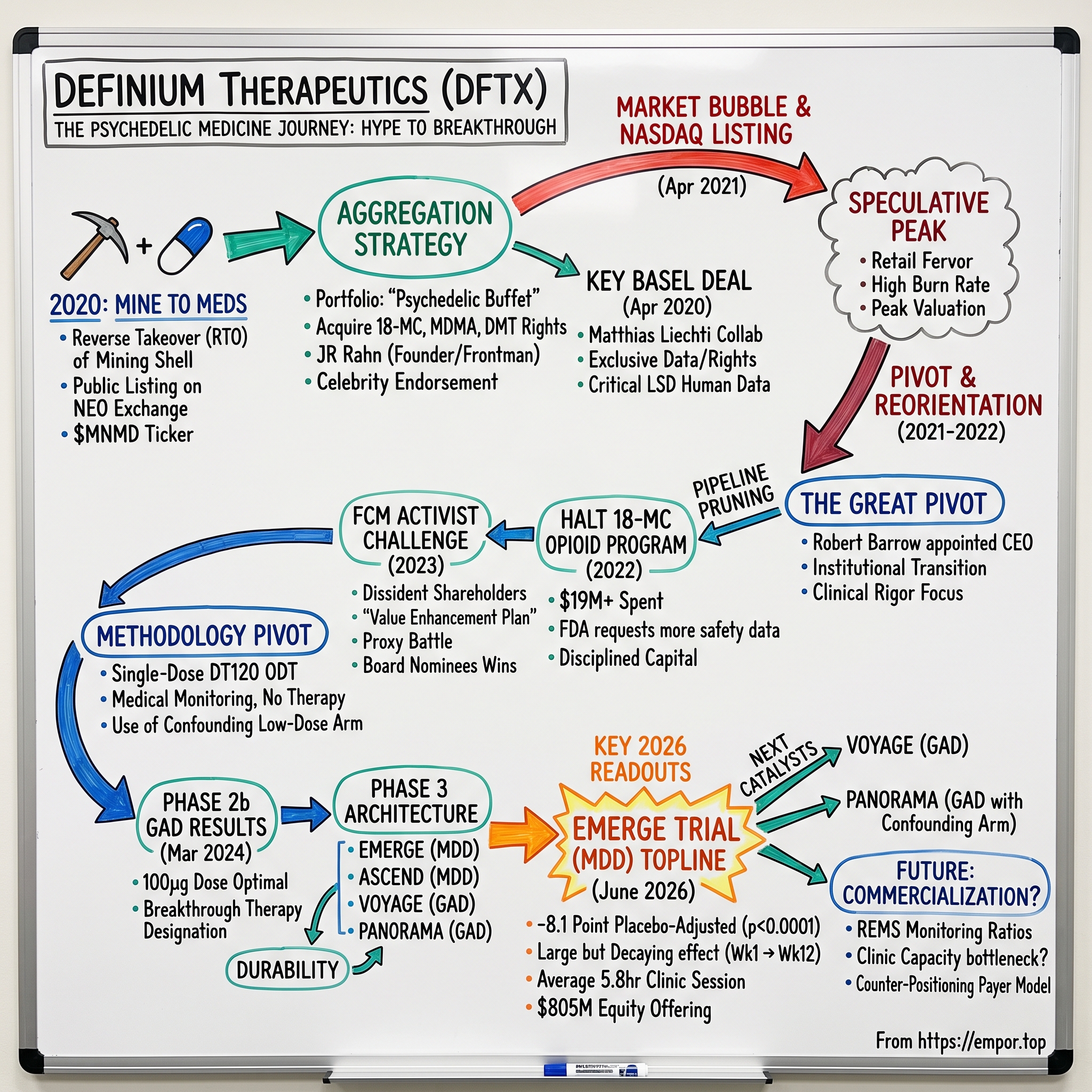
On the morning of June 22, 2026, a biopharmaceutical company that six years earlier had been a shell of a Canadian gold-mining operation released trial data unprecedented in modern psychiatry. In a randomized, double-blind, placebo-controlled Phase 3 trial named Emerge, a single dose of a pharmaceutical-grade LSD tablet produced an 8.1-point placebo-adjusted improvement on the Montgomery-Åsberg Depression Rating Scale at Week 6, with a p-value below 0.0001.2 For context, conventional daily antidepressants typically achieve regulatory approval with placebo-adjusted differences of two to four points after months of continuous use. Definium reported its 8.1-point difference after a single administration in a single afternoon, with patients cleared to leave the clinic in under six hours on average.
Three days later, the company closed an $805 million equity offering at $34.00 per share.22 Eighteen months earlier, those same shares had traded in penny-stock territory.
That rapid transformation defines the company's trajectory. Definium Therapeutics, Inc. (NASDAQ: DFTX) is the business formerly known as Mind Medicine (MindMed) Inc.—ticker MNMD—an entity that was, at various points in its brief history, a symbol of the 2020–2021 speculative bubble in psychedelic medicine, a retail trading favorite backed by a Shark Tank celebrity, the target of a bitter small-cap proxy contest, and, more recently, a late-stage clinical operator holding FDA Breakthrough Therapy Designation with four Phase 3 trials running simultaneously.13 On January 12, 2026, management retired the MindMed name entirely; the shares began trading as DFTX the following day.1
The central question this analysis examines is straightforward yet high-stakes: can a single, proprietary oral dose of pharmaceutically formulated lysergide displace—or complement—the SSRIs and SNRIs that have defined the treatment of generalized anxiety disorder and major depressive disorder for three decades? Management frames the market opportunity as immense. Chief Commercial Officer Matt Wiley told investors that roughly 4.2 million U.S. adults have cycled through two or more treatments without sustained benefit, and that capturing just 1% of this target population—using Johnson & Johnson's Spravato as a pricing proxy—would represent a $2 billion annual revenue opportunity.5 That figure reflects internal management modeling rather than an independent market forecast, and it depends on an unresolved sequence of regulatory approvals, product labeling, clinic monitoring requirements, and insurance reimbursement policies.
What follows is an examination of how a promotional retail favorite evolved into an institutional biopharmaceutical operator, and an evaluation of the evidence supporting that pivot. Four analytical threads run through the story.
The first is organizational transition: how leadership inherited a narrative-driven company and reoriented it around rigorous clinical trial design, and what that shift cost in time, capital, and market credibility. The second is pipeline rationalization as strategy: Definium's most consequential decisions were arguably the research programs it eliminated rather than the ones it funded. The third is governance under fire: a proxy challenge led in part by a company co-founder forced a public referendum on corporate spending and operational discipline. The fourth is commercial execution: a therapy requiring a patient to remain in a clinic for five to eight hours under medical supervision is not a standard prescription pill. It functions as a clinical procedure, dependent on facility workflows, staffing ratios, specialized billing codes, and healthcare provider economics.
Each thread points to the same critical test. As of August 1, 2026, Definium has reported one positive Phase 3 readout—in depression.2 The two pivotal trials in generalized anxiety disorder, Voyage and Panorama, have not yet reported topline data; management has guided to readouts in the early and late third quarter of 2026, respectively.4 The company is scheduled to report second-quarter results on August 6, 2026.36 Everything the market has priced—with shares trading in the low $40s in late July 2026, up from $13.39 at the end of 2025—rests on data that does not yet exist.65
That is the setup. The origin is stranger.
 Subscribe on LinkedIn
II. Genesis: The Psychedelic Renaissance & Capital Markets Innovation
In February 2020, a Canadian resource firm whose principal asset had been a mining property completed a plan of arrangement, transferring its public listing to a startup with no revenue, no proprietary clinical data, and a plan to develop LSD as a prescription pharmaceutical. The subordinate voting shares began trading on the NEO Exchange on March 3, 2020, giving MindMed a distinction that defined its initial two years: the first psychedelic pharmaceutical company to list on a public stock exchange.7
The listing route reflected market realities. Reverse takeovers of dormant resource shells are uncommon for institutional drug developers, but in 2019 and 2020, conventional life-science underwriters were not financing psychedelic clinical development. Canadian capital markets, having recently funded the commercialization of legal cannabis, provided an available exchange framework and an investor base accustomed to speculative retail stories.
Two founders, two theories of the company
MindMed was founded in May 2019 by JR (Jamon) Rahn and Stephen Hurst, an unconventional but deliberate pairing.9 Rahn served as the public frontman—a former Uber operations manager turned startup evangelist, fluent in venture capital rhetoric, comfortable on media platforms, and convinced that mainstream psychiatry required radical disruption. Hurst brought traditional pharmaceutical experience as the former head of Savant HWP, where he oversaw the development of 18-methoxycoronaridine (18-MC), a synthetic ibogaine derivative designed to eliminate the parent molecule's hallucinogenic and cardiac toxicity while preserving its potential therapeutic effect on opioid withdrawal.9
In September 2019, five months after founding, MindMed acquired the 18-MC program from Savant.9 The strategy was straightforward: acquire an asset with an established regulatory history rather than spend years on early discovery.
That transaction established MindMed's early blueprint—aggregation over invention. The company did not build an in-house discovery engine; instead, it assembled option rights on molecules long characterized by academic and underground research, aiming to translate that existing knowledge into FDA-compliant clinical assets.
The Basel bet
The early company's most consequential deal was signed in April 2020. MindMed entered into an exclusive global collaboration with University Hospital Basel, securing rights to clinical data, compounds, and patents from the laboratory of Dr. Matthias Liechti covering lysergide and MDMA research, in exchange for research funding, milestone payments, and commercial royalties.8
The value of that agreement far exceeded its balance-sheet cost. Since the 1990s, a small group of European academic institutions—led by Basel—had conducted human studies with psychedelics under regulatory exemptions. In doing so, Liechti's lab generated essential dose-response, pharmacokinetic, and safety data that commercial startups could neither quickly replicate nor buy outright. Human clinical data cannot be backdated or artificially compressed; even well-capitalized competitors remained bound by the calendar.
The lead molecule presented a distinct intellectual property challenge. Lysergide was first synthesized by Albert Hofmann at Sandoz in 1938, making it older than lithium's clinical adoption and older than SSRIs by half a century. Because the base molecule sits in the public domain without composition-of-matter patent protection, MindMed faced an underlying commercial risk from day one.
Building the buffet
Throughout 2020 and 2021, MindMed assembled a broad portfolio that critics characterized as a psychedelic buffet: LSD research in anxiety and ADHD, an R-enantiomer MDMA program, DMT development, the 18-MC opioid asset, an LSD "neutralizer" project, and digital medicine initiatives. For a retail investor base buying into a macro theme, portfolio breadth was the main attraction. Each new indication generated headlines and expanded the perceived total addressable market.
Yet for an organization that would ultimately need to finance rigorous Phase 3 clinical trials, that same breadth created an unsustainable operational and financial overhang.
The listing, the celebrity, and the peak
The market valuation escalated rapidly. Early backers included Shark Tank investor Kevin O'Leary, whose involvement served primarily as a retail marketing channel that reached non-institutional investors.10 In April 2021, MindMed uplisted to Nasdaq under the ticker MNMD, entering the U.S. market near the peak of retail speculative activity, shortly after meme-stock trading dynamics demonstrated that early-stage biotech stories could command multi-billion-dollar market caps without late-stage clinical proof.
The underlying valuation logic remained inherently precarious: at its peak market capitalization, MindMed had not yet completed a single randomized, double-blind, placebo-controlled efficacy trial for its lead asset. The stock traded as a liquid proxy for the broader psychedelic sector rather than an asset backed by de-risked clinical data.
When retail trading momentum subsided through 2021 and 2022, accompanied by rising interest rates that tightened capital across speculative biotech, MindMed was left with a retail-dominated shareholder base, a fragmented pipeline built for media exposure, and a burn rate tailored to buoyant capital markets.
That shift raised the core operational question for the company's next phase: how to pivot when the narrative that financed its creation no longer clears the market.
III. The Great Pivot: Management Transition & Professionalization
The transition began with a leadership change that proved to be a pivotal turning point, even as much of the retail shareholder base initially viewed it with skepticism.
In June 2021, roughly two months after the Nasdaq uplisting, JR Rahn stepped down as chief executive officer and director. Robert Barrow, who had joined the company in January 2021 as chief development officer, was appointed CEO.1112 The transition shifted leadership from an entrepreneurial founder focused on public promotion to a clinical pharmacologist. Rahn framed his departure around the company's evolving needs, stating that MindMed required executives equipped to execute late-stage clinical trials and navigate complex regulatory pathways.11
Who Robert Barrow is, and why it mattered
Barrow presented a stark contrast to his predecessor. His background centered on drug development—the technical machinery of investigational new drug applications, protocol design, statistical analysis plans, and regulatory engagement. On investor conference calls, his approach proved consistent: answering questions regarding probability of success by detailing study design, referring commercial questions to his commercial officer, and repeatedly emphasizing "disciplined execution."5
In the biopharmaceutical sector, repeated management mantras test whether operational decisions align with stated strategy. For Definium, the critical test was whether leadership possessed the discipline to discontinue legacy programs that no longer justified capital allocation.
Pruning, with the receipts
The first major program eliminated was the asset around which the company was originally founded. MindMed suspended the MM110 (18-MC) opioid-withdrawal program in the third quarter of 2022 following a Phase 1 trial, announcing that further development would depend on non-dilutive funding or strategic partnerships. The FDA had signaled that additional safety data would be required before initiating a Phase 2a study—a requirement demanding months or years of preclinical effort—for a program that had already absorbed more than $19 million since its acquisition from Savant.14
This decision illustrated the operational shift between the company's two eras. Under its founding strategy, 18-MC was a compelling narrative asset: a non-hallucinogenic derivative targeted at the opioid crisis. Under the new management approach, it represented an unfunded preclinical package standing between the company and a costly Phase 2 trial that could not be justified alongside a pivotal psychiatric program.
Other initiatives quietly wound down. Early-stage Phase 2a projects in acute and chronic pain failed to progress and were removed from investor presentations.14 By 2023, corporate updates reoriented the pipeline around MM120 for psychiatric conditions and MM402—an R-enantiomer MDMA candidate—for autism spectrum disorder. MM402 entered clinical development with a single-ascending-dose trial in healthy volunteers in the fourth quarter of 2023.13
What remained reflected strict capital allocation. DT402, as MM402 was renamed, remains active as a Phase 2a program in autism spectrum disorder—an indication with significant unmet need and no FDA-approved therapies addressing its core social-communication characteristics.5 The study design remains compact, structured as a signal-detection trial using repeated intra-day measures, patient- and caregiver-reported outcomes, and digital behavioral metrics such as voice, facial expression, and eye tracking.5 Rather than a secondary commercial pillar, it functions as an exploratory asset. Financial disclosures reflect this resource prioritization: in the first quarter of 2026, DT402 accounted for a $300,000 increase in research and development expenses, compared to $15.2 million for DT120.24
Rebuilding the science around the placebo problem
The more complex operational pivot was methodological, addressing a fundamental vulnerability in psychedelic medicine trials.
Psychedelic drug trials face a structural design challenge uncommon in traditional drug development: the acute psychoactive treatment quickly reveals itself. A patient receiving a 100-microgram dose of LSD recognizes within an hour that they have not received a placebo. This functional unblinding risks compromising double-blind trial integrity, as patients expecting therapeutic benefit may report inflated improvements. For regulators, the central requirement is isolating the drug's pharmacological effect from expectancy biases.
Early psychedelic research compounded this issue by combining drug administration with mandatory psychotherapy, introducing additional unblinded variables. Definium altered this approach by designing trials around a single drug administration paired against an inert placebo, utilizing medical monitoring rather than protocol-mandated therapy, and assessing primary endpoints six to twelve weeks post-dose.45
Chief Medical Officer Dan Karlin outlined the strategy behind this protocol design. In two of the four Phase 3 studies, the company incorporated a low-dose 50-microgram arm described not as an analytical dose, but as a methodological tool to confound participants' ability to guess their treatment assignment.5 At the same time, the company maintained that an inert placebo remains the appropriate control for establishing primary efficacy.5
This methodology represents a calculated, albeit debated, trial design. While some clinical trial experts advocate for active comparators to control for acute psychoactive effects, Definium's dual-track approach pairs direct inert placebo comparisons in initial studies with confounding arms in subsequent trials. Consistent effect sizes across both designs would provide strong evidence against unblinding bias, whereas diverging results would present regulatory complications.
For investors, this clinical structure represented a multi-year bet on FDA regulatory standards—at a time when the broader psychedelic sector was approaching a critical test of those very assumptions.
Before that regulatory test arrived, however, Barrow had to navigate an intense internal challenge from the company's own shareholders.
IV. The Shareholder War: FCM Activism & Governance Stress Test
By late 2022, MindMed shares had surrendered most of their gains from the 2021 peak, the pipeline had been sharply pruned, and a group of early investors concluded that management's professionalization effort was simply burning capital at a slower pace.
They organized to challenge leadership. FCM MM Holdings, LLC was formed as a special-purpose vehicle representing nine early MindMed investors, including Dr. Scott Freeman—a co-founder and former chief medical officer—and Chad Boulanger.15 Freeman's nephew, Jake Freeman, had previously gained public attention for a lucrative meme-stock trade, giving the campaign a media profile that activist campaigns in micro-cap biotech rarely command.
The dissident case
FCM's argument, detailed in proxy filings and a public "Value Enhancement Plan," reflected a classic activist critique of clinical-stage biotechnology: the company was spending excessively, diluting shareholders to fund that burn rate, compensating executives without demonstrating milestones, and pursuing a clinical pipeline that would require more capital than the market would reliably supply.15 FCM nominated four director candidates and campaigned aggressively, offering to lock up its own shares until June 2025 as a pledge of alignment.
That critique highlighted a genuine vulnerability. For a pre-revenue company with a retail-dominated shareholder base, a cash runway measured in quarters, and a lead candidate that had not yet completed Phase 2b testing, management faced valid scrutiny over cost structure and capital discipline. Dilution was not a theoretical concern for investors who bought near market tops; subsequent financing rounds at depressed valuations permanently reduced their equity stake.
The defense, and what it was really about
Management countered that FCM's proposed spending cuts would undermine the trial standards required to unlock asset value. In psychiatric drug development, registration-quality trials require substantial operational investment: clinical sites must be monitored, trial raters trained and calibrated, patient attrition carefully managed, and data collected to meet FDA approval standards. Skimping on trial execution risked generating ambiguous data that could derail regulatory filings.
The board, chaired by Carol Vallone, nominated six candidates: CEO Robert Barrow, Dr. Suzanne Bruhn, Dr. Roger Crystal, David Gryska, Andreas Krebs, and Vallone.16
An awkward meeting, and a nuanced outcome
The 2023 annual general meeting proved more complex than simplified headlines suggested.
The meeting convened on June 15, 2023, but adjourned immediately without conducting business due to the lack of a quorum. It reconvened on June 21, 2023, where shareholders elected all six management nominees.16 The following day, FCM issued a statement claiming it had secured a majority of retail votes, expressing frustration that institutional holders backed incumbent management, and raising procedural objections regarding meeting mechanics.17
The outcome revealed a structural shift in the company's investor base. Management won the official proxy vote through institutional support, while FCM mobilized much of the retail audience that had initially funded the company. By mid-2023, a venture that began as a retail trading phenomenon was governed by the decisions of institutional funds—a transition inherent to institutional professionalization, even as it alienated early retail backers.
That governance friction left a lingering imprint. Definium's subsequent SEC filings continued to highlight prior activist friction and potential future governance disruptions among corporate risk factors.8 While standard in public filings, proxy contests impose tangible costs, consuming executive attention, generating legal expenses, and maintaining pressure on board governance.
What the episode actually revealed
The strategic lesson lies in what the contest tested.
FCM's thesis implied that MindMed's assets retained greater value within a smaller, leaner corporate structure. Management maintained that the assets carried little value without the rigorous investment needed to generate FDA-grade clinical data. Subsequent milestones—including FDA Breakthrough Therapy Designation, publication in JAMA, four active Phase 3 studies, and a positive pivotal readout—validated management's clinical execution strategy.3182
However, the question of long-term dilution remains central to the financial analysis. Through a 2024 offering at $6.00 per share, a 2025 offering at $12.25, and an $805 million offering in 2026 at $34.00, the company roughly doubled its share count compared to pre-pivotal levels.202122 Early shareholders who held through the proxy fight own a significantly smaller fraction of an enterprise now valued far higher. Whether that tradeoff constitutes sound capital allocation depends entirely on the ultimate clinical and commercial success of the lead program—shifting the focus directly to the clinical data itself.
V. Core Asset Deep-Dive: DT120 (Lysergide D-Tartrate) Science & Phase 3 Architecture
Strip away the cultural baggage and DT120 is a small molecule with a well-characterized target and a genuinely unusual dosing paradigm. Understanding both is necessary to evaluate anything else about this company.
What the drug does, in plain terms
DT120 is lysergide D-tartrate, delivered as an orally disintegrating tablet — a wafer that dissolves on the tongue rather than a capsule that has to be swallowed and processed.
Its primary pharmacological action is agonism at the serotonin 5-HT2A receptor, which is densely expressed in the cortex. The useful mental model is not "the drug floods the brain with serotonin," which is what SSRIs are loosely described as doing. It is closer to this: the 5-HT2A receptor sits on cortical neurons like a master switch for plasticity. Activating it appears to trigger a burst of dendritic and synaptic growth — the physical remodeling of connections between neurons. Compounds that do this have been given the name psychoplastogens.
The analogy that holds up reasonably well: chronic daily antidepressants are like continuously applying a mild corrective force to a system that has settled into a bad configuration — you must keep applying it, and if you stop, the system drifts back. A psychoplastogen is closer to briefly heating the system so it becomes malleable, letting it re-settle, and then letting it cool. If the metaphor holds, you would expect a rapid effect from a single administration and persistence long after the drug has cleared the body. That is exactly the profile Definium claims to have demonstrated, and it is also why "durability" is the word the company uses more than any other.
The word deserves scrutiny rather than acceptance, and we will apply it below.
The orally disintegrating tablet is not a cosmetic choice. The company licensed exclusive U.S., U.K., and E.U. rights to Catalent's Zydis freeze-dried ODT platform for all lysergide formulations in August 2023.8 Barrow has described the practical effect as faster absorption, which the company believes translates into a cleaner resolution of acute effects — meaning patients finish their sessions sooner.5 In a therapy whose commercial economics are governed by how long a patient occupies a clinic chair, shaving hours off the session is not a formulation detail. It is the business model.
The Phase 2b result that started everything
The dataset that turned MindMed from a story into a company was a Phase 2b study in generalized anxiety disorder: 198 adults aged 18 to 74 with moderate-to-severe GAD, enrolled across 22 outpatient psychiatric research sites in the United States between August 2022 and August 2023, randomized across four dose levels plus placebo.18
The results, announced on March 7, 2024 and later published in JAMA, established 100 micrograms as the optimal dose. Patients receiving it showed a 21.9-point reduction on the Hamilton Anxiety Rating Scale at Week 12, with a 65% clinical response rate and a 48% clinical remission rate sustained to that point — from a single administration, with no protocol-mandated psychotherapy.3419
The same day, the FDA granted Breakthrough Therapy Designation for MM120 in GAD.3 BTD is not approval and confers no evidence of efficacy; what it provides is intensified FDA guidance and a commitment to expedited review. Its real value to a company at this stage is procedural — a working relationship with the agency that shapes protocol design before the pivotal trials rather than after.
Now the caveat, which management has itself put on the record. The Phase 2b placebo response was, in Barrow's own description, "remarkably high."5 He attributed it to the trial's structure: with five arms and only one being placebo, participants had roughly an 80% chance of receiving some dose of drug, and around a third of placebo recipients guessed they were on active treatment.5 A high placebo response makes a positive result harder to achieve, so clearing it is genuinely impressive. But it also means the Phase 2b effect size was measured against an inflated comparator, and the honest reading is that the study established a signal, not a magnitude.
Phase 3: the architecture
The pivotal program is unusually broad for a company of this size — four registration studies running at once across two indications.425
Emerge tested DT120 ODT 100 µg against placebo, 1:1, in 149 fully enrolled participants with major depressive disorder, with a primary endpoint at Week 6.425 Ascend, the second MDD study, is a 2:1:2 design across 100 µg, 50 µg, and placebo, targeting 175 participants.25 Voyage is the first pivotal GAD trial: 214 fully enrolled participants, 1:1 against placebo, with the primary endpoint at Week 12 — a full 12 weeks after a single dose.428 Panorama, the second GAD study, uses the 2:1:2 structure with the confounding 50 µg arm against an updated target of 200 participants.429 Each includes a Part B open-label extension following patients for up to a year, with retreatment triggered when symptoms return to moderate severity or worse.5
A fifth study, Haven, in post-traumatic stress disorder, is planned to initiate in 2027 with approximately 200 participants randomized 1:1, primary endpoint at Week 8.425
The pace deserves a note of its own. The first patient was dosed in Voyage in December 2024, and in Panorama shortly afterward.2627 Fully enrolling two pivotal psychiatric trials — one of them requiring participants to spend a supervised day at a clinic and then return for twelve weeks of assessments — inside roughly a year is fast by the standards of the indication. Enrollment speed in psychiatry is usually a proxy for two things: the intensity of patient demand for an alternative, and the quality of the site network a sponsor has built. Both readings favor Definium, and neither says anything about whether the drug works.
Two design details carry disproportionate weight. First, the Part B extension is doing quiet double duty: Karlin has said the guarantee of eventual open-label access is part of why dropout rates in the blinded phase have been "remarkably low," which matters enormously because missing data at a 12-week endpoint is the standard way psychiatric trials fail.5 Second, protocol-specified blinded sample-size re-estimations conducted at the halfway point led the company to state that Voyage and Panorama are now powered at 99% or greater to detect a 5-point placebo-adjusted difference — a claim that is contingent on nuisance parameters holding in the final analysis, and that says nothing about whether the drug produces a 5-point difference.5
The Emerge readout: what the data showed, and what it did not
On June 22, 2026, Definium reported Emerge topline. The trial met its primary endpoint: MADRS change from baseline at Week 6 was -13.3 for DT120 versus -5.2 for placebo, a placebo-adjusted difference of -8.1 points (p<0.0001).2
Two secondary numbers matter more than the headline. At Week 1, the placebo-adjusted difference was -14.2 points (DT120 -17.6, placebo -3.4). At Week 12, it was -7.3 (DT120 -11.0, placebo -3.6).2 Response — at least a 50% improvement — reached 35% on drug versus 7% on placebo at Week 6, and remission 24% versus 3%.2 On safety, the company reported that 99% of treatment-emergent adverse events were mild to moderate, transient, and predominantly confined to the dosing day, with no serious adverse events and no suicidality signal.2 Patients met end-of-session criteria in an average of 5.8 hours, a median of 5.1, with 100% compliance by hour eight.2
Barrow called the results "unprecedented and highly differentiated."2 The magnitude relative to precedent supports the "differentiated" half of that claim. But three observations complicate the picture, and a neutral reader should hold all of them.
First, the drug's advantage is largest immediately and erodes over time — from 14.2 points at Week 1 to 8.1 at Week 6 to 7.3 at Week 12. It remains highly significant throughout, and the persistence of a 7-point separation twelve weeks after one dose is a genuinely new phenomenon in depression. But "durable" is doing work here; the accurate description is "large and decaying, still large at three months."
Second, the placebo arm behaved unusually. A 5.2-point MADRS improvement at Week 6 in a modern MDD trial is low — the field's chronic complaint is placebo responses of 8 to 12 points that swallow drug effects — and the placebo arm then worsened between Weeks 6 and 12, drifting from -5.2 to -3.6.2 An unusually suppressed placebo response is exactly what functional unblinding would produce in a two-arm trial: patients who correctly deduce they received nothing lose the expectancy benefit that normally lifts placebo arms. Definium's own Phase 2b experience is the mirror image of this, and management has argued the mechanism openly, predicting that lower drug-allocation ratios and guaranteed Part B access would push placebo response toward or below historical averages.5 They were right about the direction. The question a regulator will ask is whether the magnitude of the gap is a drug effect, an expectancy effect, or both — and it is the single most important unresolved scientific question in this story.
Third, a 35% response rate is not, in absolute terms, extraordinary for depression. What is extraordinary is the 7% placebo comparator. The differentiation lives in the contrast, and the contrast is precisely what unblinding could distort.
This is why Panorama — the GAD study with the 50 µg confounding arm — may be the most informative readout of the entire program, more than Voyage. If a study designed to muddy participants' guesses produces an effect size in the same neighborhood as a two-arm study, the unblinding objection loses most of its force. If it does not, the company will have a difficult conversation with an advisory committee.
The IP question
Because lysergide itself has been off-patent since before the FDA looked anything like its modern self, Definium's protection has to be constructed rather than inherited. As of February 19, 2026, the company reported 12 issued U.S. patents, 29 pending U.S. applications, one pending PCT application, and foreign counterparts, covering lysergide compositions, methods of use, and formulations, as well as R(-)-MDMA and prodrugs. The portfolio expires between 2041 and 2044, before any Hatch-Waxman extension.8
Layered on top is the exclusive Zydis ODT license, which is arguably the more practical barrier: a generic entrant would need either a different formulation route or a different delivery partner, and would then need to demonstrate bioequivalence to a product whose commercial value depends substantially on how quickly its acute effects resolve.8
This is a real moat, but it is a formulation-and-method moat, not a composition-of-matter moat, and those are historically more contestable. Investors should treat 2041 as an aspiration supported by a portfolio, not as a date on a calendar.
Which leaves the question that no amount of clinical data can answer on its own: even if the drug works, can it actually be delivered?
VI. Commercialization Economics, Clinic Workflow, & Competitive Landscape
At the operational level, the underlying unit of production is straightforward. A patient arrives at an outpatient psychiatric clinic in the morning and is settled into a comfortable room equipped with a recliner. The patient takes an orally disintegrating tablet, and medical staff monitor them for the next five to eight hours. A clinician remains present in the room throughout the session; under FDA direction during clinical trials, a second monitor observes, potentially remotely via video.5 By mid-afternoon, once end-of-session criteria are met, the patient is discharged.
This care model operates as a half-day outpatient procedure rather than a standard daily prescription pill. Consequently, Definium's commercial viability depends on whether healthcare practices can integrate this procedure routinely, efficiently, and profitably.
The demand side
The target market is substantial and markedly underserved. Generalized anxiety disorder (GAD) and major depressive disorder (MDD) rank among the most prevalent psychiatric conditions. Existing standard-of-care treatments—primarily SSRIs and SNRIs—require weeks to achieve efficacy, offer incomplete or inconsistent relief for many patients, and carry side-effect profiles such as sexual dysfunction, weight gain, emotional blunting, and withdrawal symptoms that drive high rates of treatment discontinuation.5
Definium's commercial leadership has quantified its primary target market at approximately 4.2 million U.S. adults who have failed two or more prior therapies without achieving sustained benefit, accounting for diagnostic overlap.5 To support its health-economic narrative with commercial payers, the company published a healthcare-claims analysis in CNS Spectrums in July 2026, documenting frequent treatment switching, early discontinuation, and extended care gaps among individuals with generalized anxiety disorder—signaling active market-access preparation ahead of potential launch.36
Chief Commercial Officer Matt Wiley highlighted an additional market dynamic: generalized anxiety disorder is under-coded in ICD-10 diagnostic claims relative to its actual clinical prevalence, largely because decades without novel therapeutic options reduced incentives for precise coding.5 Should DT120 gain regulatory approval, clinician coding practices may shift. This implies that management's total addressable market projections rely partly on diagnostic behavioral changes that the drug's commercial availability itself would need to catalyze.
The bottleneck argument, and management's answer
The principal critique of interventional psychiatric models centers on clinical capacity. Skeptics argue that physical room availability, operating hours, and specialized staffing constraints will bottle up patient adoption regardless of clinical efficacy.
Chief Executive Officer Robert Barrow rejected this capacity bottleneck thesis. Addressing investor inquiries regarding facility requirements, Barrow asserted that existing clinical capacity is "far in excess" of model projections, contending that adapting a treatment space requires spending "a few hundred dollars" to furnish an existing room, and characterizing "infrastructure" as "far too heavy-handed of a word."5
This operational disagreement represents a core divergence between executive expectations and market caution. Johnson & Johnson's Spravato—an esketamine nasal spray administered under medical supervision in certified clinics—established that in-office interventional psychiatric billing and logistics can function at scale. However, Spravato's initial commercial trajectory unfolded more gradually than expected due to administrative and workflow friction. While Definium emphasizes that DT120 involves shorter sessions and far less frequent dosing than esketamine, those operational advantages remain unproven in commercial practice.
REMS, monitors, and the number that matters most
Any regulatory approval for DT120 will almost certainly include a Risk Evaluation and Mitigation Strategy (REMS) defining facility certification and patient oversight rules. Within that framework, the required staffing ratio represents the critical commercial variable.
Definium is actively building a clinical case for a single-monitor requirement. Chief Medical Officer Dan Karlin outlined a protocol designed to capture data on the specific contributions of primary and secondary monitors during trial sessions—including remote observers—to demonstrate to regulators that a single in-person monitor ensures patient safety, noting that other approved therapies with acute psychoactive effects leave staffing ratios to clinical discretion.5
The economic impact of this regulatory distinction is substantial. A five-to-eight-hour session requiring two licensed healthcare professionals consumes ten to sixteen clinician-hours per patient. A single-monitor mandate cuts that requirement to five to eight hours, effectively halving operational labor costs for administering practices. Consequently, the specific monitoring language approved by regulators will directly dictate clinic profitability and practice adoption rates.
Getting paid
Definium's proposed reimbursement strategy relies on established procedural pathways. Wiley indicated that established coverage mechanisms for interventional therapies support the feasibility of securing a permanent Healthcare Common Procedure Coding System J-code for DT120 post-launch.5 In the interim, commercial planning focuses on establishing transitional billing mechanisms for launch prior to securing dedicated permanent codes.5
The value proposition for health insurers centers on offset costs: a single treatment delivering months of symptom control compares favorably against years of daily prescriptions, clinical dose titrations, and secondary medical expenditures. However, this model encounters a structural friction in commercial health insurance. Because subscriber turnover is frequent, an insurer absorbing an upfront procedural cost may see the long-term savings accrue to a subsequent plan. Consequently, payer scrutiny is likely to focus on the immediate timing of cost realization rather than the overall therapeutic benefit.
Myth versus reality
Four prevalent market assumptions surround Definium, each presenting distinct analytical nuances.
First, the narrative framing as a pure "psychedelic play" misinterprets the commercial model. Definium operates fundamentally as an interventional psychiatry enterprise utilizing a psychoactive compound. Its clinical protocols incorporate no mandatory psychotherapy or integration sessions, relying solely on medical monitoring during the treatment window.5 Commercialization centers on a standardized outpatient procedure rather than a therapeutic framework.
Second, interpreting regulatory setbacks for peers as a broad rejection of the drug class overstates the issue. The FDA's Complete Response Letter issued to Lykos Therapeutics cited specific study-execution deficiencies, including functional unblinding, clinical site conduct, cardiac monitoring gaps, and durability data.32 Meanwhile, Compass Pathways progressed its COMP360 psilocybin candidate into a rolling New Drug Application using a national priority voucher, demonstrating an active regulatory pathway for neuro-active compounds.31
Third, treating Breakthrough Therapy Designation as a proxy for eventual approval mistakes procedural support for regulatory endorsement. Breakthrough status is granted based on preliminary clinical evidence to expedite review processes and agency interaction.3 Similar designations have been granted to peer candidates pursuing related psychiatric indications.33
Fourth, assuming clinical capacity will rigidly bottleneck rollout remains an untested premise. Management contends existing facility space can be adapted at minimal expense, while cautious analysts cite historical adoption curves from earlier interventional launches.5 Ultimately, commercial throughput will be governed by the specific monitoring ratios established in the final drug label.
Evaluating these market perceptions reveals a complex narrative landscape. While three of these assumptions tend to overstate the company's immediate advantages or market readiness, others oversimplify its operational hurdles—reflecting the tension between Definium's retail origins and its institutional evolution.
The competitive war game
Definium operates alongside several biopharmaceutical developers advancing novel psychiatric candidates, each highlighting different strategic trade-offs.
Compass Pathways (NASDAQ: CMPS) represents the most direct peer and holds a regulatory head start. In June 2025, Compass reported Phase 3 data for COMP360, a synthetic psilocybin formulation, showing a 3.6-point placebo-adjusted MADRS reduction at Week 6 (p<0.001) among 258 patients with treatment-resistant depression in its COMP005 trial.30 Its second pivotal study, COMP006, demonstrated sustained clinical benefit through six months, positioning Compass to target a complete rolling New Drug Application submission in the fourth quarter of 2026.31
This peer comparison highlights a clear contrast: while Definium reported a larger placebo-adjusted effect size in major depression, Compass's advanced timeline means it will encounter FDA advisory committee scrutiny, establish initial REMS standards, and test commercial billing channels first. Success by Compass would pioneer infrastructure for the category, whereas operational or regulatory friction could create headwinds for subsequent entrants.
Lykos Therapeutics serves as an operational cautionary tale. On August 9, 2024, the FDA issued a Complete Response Letter for Lykos's midomafetamine (MDMA) application in post-traumatic stress disorder, requiring an additional Phase 3 trial due to concerns over functional unblinding, site conduct, cardiac safety profiling, and symptom durability.32 Lykos paired its drug directly with mandatory psychotherapy in trial protocols, complicating the isolation of pharmacological effects from psychological interventions. Lykos has not announced a resubmission timeline.32
Definium's trial architecture—evaluating the drug as a standalone pharmaceutical, omitting mandated psychotherapy, employing medical monitoring, and incorporating low-dose control arms—was explicitly structured to mitigate these specific regulatory hurdles. However, whether these design choices fully satisfy regulatory standards will depend on upcoming Phase 3 readouts.
AtaiBeckley, formed through the combination of atai Life Sciences and Beckley Psytech in November 2025, is advancing BPL-003, an intranasal mebufotenin benzoate formulation with Breakthrough Therapy Designation for treatment-resistant depression. Following an End-of-Phase 2 meeting with the FDA on March 3, 2026, the company initiated Phase 3 testing in the second quarter.33
AtaiBeckley's value proposition centers on rapid metabolic clearance, aiming to shorten required in-clinic monitoring sessions and address chair-time bottlenecks directly.
These individual corporate trajectories unfold against a broader industry repricing of central nervous system therapeutics. In December 2023, Bristol Myers Squibb agreed to acquire Karuna Therapeutics for $14 billion, following AbbVie's $8.7 billion acquisition of Cerevel Therapeutics.3435 Major pharmaceutical companies committed over $22 billion in a single month to secure late-stage neuroscience assets, reversing years of reduced investment in the sector. Definium's market valuation reflects this broader sector re-rating, with investors underwriting the company both as an independent commercial operator and as a potential acquisition target.
In summary, Definium possesses the highest reported efficacy difference among classic psychedelic candidates and a clinical trial structure designed to address historical regulatory objections. However, it trails Compass Pathways in timing, and its commercial economics remain closely tied to final REMS monitoring specifications.
That commercial and regulatory outlook directs attention to Definium's capital deployment and balance sheet management.
VII. The Rebrand, Capital Deployment, & Balance Sheet Resilience
On January 12, 2026, the company announced it would stop being MindMed, with shares trading as DFTX on January 13.1
Corporate rebrands are frequently cosmetic, but this transition reflected a strategic repositioning tailored to a shifting audience. The original MindMed name fit the 2020 retail investment cycle—evocative of consciousness and tailored to early speculative markets. By 2026, corporate priorities required appealing to institutional healthcare specialists, FDA reviewers, commercial payers, and clinical prescribers. The choice of "Definium Therapeutics" adopted a conventional institutional tone typical of mid-cap biopharmaceutical operators.39 The updated corporate identity prioritizes late-stage clinical psychiatry over broad psychedelic branding.37 Underneath, the legal entity remains unchanged, filing under the same SEC central index key used since 2020—a sign that the rebrand relabeled the corporate identity without altering its regulatory history.38
The corporate announcement coupled the rebranding with its operational trajectory: a late-stage psychiatric pipeline targeting three Phase 3 clinical readouts during 2026, DT120 ODT backed by Breakthrough Therapy Designation, four active Phase 3 trials across generalized anxiety disorder and major depressive disorder, and DT402 for autism spectrum disorder.1 Chief Executive Officer Robert Barrow framed the transition as reflecting "disciplined execution, scientific leadership, and accessible treatments."1 The shift formally marked the conclusion of the company's early promotional phase.
Financing: a ladder, not a treadmill
Definium's capital history reflects two distinct operational eras. Under founding leadership, equity raises were opportunistic and heavily dilutive. Under current management, capital transactions have been systematically tied to clinical milestones at expanding valuations.
On March 7, 2024—coinciding with Breakthrough Therapy Designation and Phase 2b durability data—the company priced an underwritten public offering of 16,666,667 shares at $6.00 alongside a concurrent private placement of 12,500,000 shares at the same price to new investors including Deep Track Capital and Commodore Capital, generating roughly $175 million in gross proceeds.20 The entry of specialist biotech funds financed the pivotal Phase 3 program while transitioning the shareholder base away from retail momentum investors.
Subsequent capital raises built on that institutional foundation. On October 31, 2025, Definium closed an underwritten offering of 21,131,250 shares at $12.25 per share, raising approximately $259 million in gross proceeds.21 On June 25, 2026—three days after reporting positive topline data from the Emerge trial—the company closed an upsized offering of 23,676,471 shares at $34.00 per share, including full exercise of the underwriters' option, securing $805 million in gross proceeds and roughly $758 million net to fund research and development, pre-commercial preparation, and working capital.22
This execution pattern indicates a disciplined strategy of raising capital into clinical momentum at rising share prices. However, that balance sheet expansion came at the cost of equity dilution. The company had 99,698,129 shares outstanding as of February 19, 2026, expanding to roughly 133 million shares following the June 2026 offering.86 Consequently, early shareholders saw their percentage ownership interest significantly reduced.
The burn, and where it goes
The company's spending trajectory illustrates its transition into late-stage clinical and pre-commercial operations. Research and development expenses reached $117.7 million in 2025, compared to $65.3 million in 2024. That $52.4 million increase was driven overwhelmingly by $44.7 million in expenditures for the DT120 program and $9.3 million in expanded research headcount.23 Definium reported a full-year net loss of $183.8 million for 2025.23
Operational spending accelerated during the first quarter of 2026. Research and development expenses grew to $41.5 million, up from $23.4 million in the prior-year period, while general and administrative expenses rose to $17.7 million from $8.8 million.24 The growth in general administrative costs reflected investments in stock compensation, commercial-preparedness spending, corporate and government affairs, and legal and patent expense.24
Definium reported a first-quarter net loss of $77.1 million, though roughly $20 million represented a non-cash mark-to-market adjustment on financing warrants issued in 2022. This accounting adjustment stemmed from share price appreciation from $13.39 at December 31, 2025 to $18.90 as of March 31, 2026.245 Because equity gains increase warrant liabilities under GAAP accounting, the resulting mark-to-market shift widens headline net losses without impacting operational cash flow. As management prepares to report second-quarter financial results on August 6, 2026, evaluating operational cash burn offers a clearer gauge of financial health than non-cash accounting adjustments.36
Runway
Definium closed 2025 with $411.6 million in cash, cash equivalents, and investments, up from $273.7 million a year prior. Liquid reserves stood at $373.4 million as of March 31, 2026, with management guiding to a runway into 2028 on both dates.2324 Adding roughly $758 million in net proceeds from June positions the company with well over $1 billion in capital entering the second half of 2026, against an annualized operating burn rate running somewhere in the range of $250 million to $300 million per year.2224
This balance sheet reserve establishes a fundamentally different risk profile from the one that existed during the 2023 proxy contest. Definium can fund the remainder of its pivotal program, a New Drug Application submission, and a meaningful portion of a commercial build without returning to market—removing the financing-under-duress scenario that damages many clinical-stage biotechs following an unexpected trial result. While this capital cushion buys operational independence, it does not eliminate readout risk itself; it provides the company the resilience to survive an adverse result rather than indifference to it.
The strategic conclusion remains clear: on capital allocation, management has operated consistently with its stated commitments, raising capital at improving share prices tied to clinical catalysts and provisioning the enterprise with substantial reserves entering its pivotal trial readouts.
VIII. Playbook: Key Business & Investing Lessons
Strip out the psychedelics, and Definium's seven-year trajectory yields four transferable business and investment lessons.
Lesson 1: A narrative-funded company can be converted into an execution company, but the conversion costs the original shareholder base.
MindMed raised its foundational capital by selling a macro narrative to retail investors. Transforming that entity into an institutional biopharmaceutical operator required ending the speculative programs that fueled early enthusiasm, replacing the founder who embodied the initial story, and repeatedly issuing equity to institutional funds focused on late-stage clinical assets. Each of those decisions aligned with clinical evidence, but together they shifted ownership and governance away from the retail investors who funded the company's inception. The 2023 proxy contest reflected that displaced retail base attempting to reassert control.
For investors evaluating a company mid-conversion, the key indicator is whether management is willing to make choices that alienate its early backers. Executive teams that prioritize preserving initial retail sentiment rarely complete institutional transitions. The counter-risk is equally significant: management can use "professionalization" as cover for sustained capital burn without accountability, making strict verification of operational milestones essential. Definium delivered on its declared clinical timelines.
Lesson 2: In clinical-stage biotech, the kill decision is the capital allocation decision.
The 18-MC program possessed an appealing story, an established regulatory history, and more than $19 million in cumulative expenditure.14 Management halted development because satisfying additional FDA safety requirements would demand significant time and capital that could not be justified alongside a pivotal psychiatric trial.14 Early-stage pain and chronic-pain programs were discontinued with similar speed.14
That discipline produced structural portfolio concentration: by the first quarter of 2026, a single lead program absorbed virtually all incremental research spending.24 Concentration carries undeniable risk, as an adverse readout can impair most of an enterprise's equity value. Yet dispersing capital across low-probability assets routinely causes clinical-stage biotechs to exhaust cash without producing registration-quality data. Definium's narrowed focus provided a transparent clinical asset that institutional markets could underwrite.
Lesson 3: Design the trial for the commercial model you intend to sell, not the one that maximizes the effect size.
Combining psychotherapy with a psychoactive compound may enhance acute treatment effects, but it yields a therapeutic model requiring specialized clinicians, multi-hour sessions, and non-existent reimbursement coding—while introducing a secondary unblinded variable that creates regulatory vulnerability, as demonstrated by the Lykos review.32
Definium chose to evaluate standalone drug administration under medical monitoring rather than protocol-mandated therapy, sacrificing potential incremental efficacy in favor of a standardized procedure that psychiatric practices can integrate and commercial payers can reimburse. That decision illustrates a broader operational principle: the highest-performing prototype in a controlled setting is rarely the version that scales commercially. Commercial delivery constraints must define initial product design.
Lesson 4: In regulated industries, competitor failures serve as early protocol reviews when anticipated.
The Complete Response Letter issued to Lykos highlighted functional unblinding, trial conduct, cardiac monitoring, and symptom durability as primary regulatory concerns for psychoactive Drug Applications.32 Definium's pivotal program addresses each issue through structural design: employing confounding low-dose arms in two of four studies, eliminating therapy-conduct variables through drug-alone administration, and establishing primary endpoints six to twelve weeks post-dose to evaluate durability as an explicit efficacy metric.45
Timing remains the critical nuance. Definium finalized its Phase 3 protocols prior to the August 2024 regulatory action, indicating that its trial design reflected internal methodological strategy rather than reactive adjustments. While pre-existing alignment provides a stronger signal than a reactive redesign, it also commits the company to its current architecture. Should FDA standards regarding functional unblinding evolve further, modifying fully enrolled pivotal trials would present major operational challenges.
IX. Strategic Analysis: Helmer's 7 Powers, Porter's 5 Forces, & Bull vs. Bear View
Helmer's 7 Powers: which ones are real
Cornered Resource — partially real. The exclusive worldwide rights to Dr. Liechti's Basel laboratory output, and the accumulated human data underlying them, constituted a genuine cornered resource in 2020: an asset a competitor could not replicate at any speed.8 Six years on, its value has migrated. The proprietary asset today is the Phase 3 dataset itself plus the exclusive Zydis ODT license, which meaningfully constrains a fast-follow formulation.8 Breakthrough Therapy Designation is sometimes described as a moat; it is not. It is a process accelerator that any competitor with comparable data can obtain — AtaiBeckley's BPL-003 holds one.33
Process Power — plausible but unproven. The strongest candidate here is not formulation chemistry but trial execution in a category where execution is the primary failure mode. The evidence is suggestive: fully enrolled pivotal trials completed roughly on guided timelines, dropout rates low enough that blinded sample-size re-estimation raised statistical power to 99%, and a monitoring duration reduced from 12 hours in Phase 2 to a 5.8-hour average in Phase 3 through formulation and protocol adjustments.52 Process power requires an advantage to be difficult to replicate and capable of deepening over time. Definium plausibly holds an organizational edge in running supervised-dosing psychiatric trials. Whether that capability translates into commercial operations remains unproven.
Counter-Positioning — real, and the most compelling power here. DT120's commercial model is structurally hostile to the incumbent paradigm. Traditional psychiatric pharma monetizes adherence, relying on patients taking daily medication for years. Definium proposes a single administration offering months of benefit, monetized as an episodic procedure. An incumbent cannot easily copy this without cannibalizing a chronic-dosing franchise, and the salesforce, distribution, and reimbursement infrastructure required are fundamentally different. That is textbook counter-positioning.
The caveat is that counter-positioning is only valuable if the new model is superior, and here the payer dynamics bite: episodic, high-upfront-cost, high-durability therapies face reimbursement friction because their savings arrive later and often accrue to subsequent health plans.
Scale Economies, Network Economies, Switching Costs, Branding — largely absent. Definium possesses no scale advantage, no network effects, and no marketed product to generate switching costs or brand equity. All four powers remain inapplicable.
Porter's Five Forces
Barriers to entry: very high. FDA registration for a Schedule I controlled substance requires DEA-compliant manufacturing, licensed clinical sites, and roughly half a decade of clinical trials. Definium's own trajectory — moving from IND to pivotal data in roughly five years, at a cost reflected in its R&D expenses — serves as the entry cost baseline.523
Threat of substitutes: high in overall volume, weak in the target segment. Generic SSRIs, SNRIs, benzodiazepines, and buspirone are inexpensive and widely available. Any patient who responds adequately to them is not a candidate for DT120. The target population is explicitly restricted to patients who have failed two or more prior therapies.5 The threat of substitutes limits the overall market ceiling rather than displacing DT120 directly.
Bargaining power of buyers: high and rising. Pharmacy benefit managers and commercial payers control formulary access, and a supervised in-office therapy incurs both drug costs and professional facility fees. The claims analysis published in CNS Spectrums and the health-economic modeling behind the company's market-access strategy directly reflect these commercial realities.365 Prescribers represent a second buyer group governed by practice economics, as clinics must generate sufficient margin on chair-hours, and their adoption hinges on procedural reimbursement codes that Definium has not yet secured.5
Bargaining power of suppliers: moderate and concentrated. The company relies on third-party contract development and manufacturing organizations (CDMOs) and clinical research organizations (CROs) for drug supply and trial execution, and depends on a single partner for the ODT formulation technology that drives its session-length advantage.8 Exclusive licenses exclude competitors but concentrate supply-chain dependency.
Competitive rivalry: intensifying, but not yet on price. Compass Pathways, AtaiBeckley, and other peers are competing on regulatory sequencing rather than price, as none currently has an approved product on the market. The immediate rivalry centers on establishing the initial REMS precedent, setting billing benchmarks, and demonstrating clinical adoption.3133
The KPIs that actually matter
Three metrics warrant close tracking:
-
The placebo-adjusted effect size in Voyage and Panorama — and their comparative alignment. The absolute magnitude matters: management has stated that a placebo-adjusted improvement of 4 points or greater at 6 to 12 weeks would compare favorably with existing treatments and peer candidates.5 However, the comparison between the two studies serves as the critical signal, as Voyage uses a standard two-arm design while Panorama includes the confounding 50 µg arm. Convergent results across both trials would substantially counter functional unblinding critiques, whereas diverging outcomes would reinforce them.
-
Durability of separation at Week 12 and beyond, alongside Part B retreatment intervals. Data from Emerge showed the drug-placebo gap narrowing from Week 1 to Week 12.2 The commercial model and health-economic rationale depend on how long therapeutic benefits persist and how frequently re-dosing is required. The Part B open-label extension, which monitors patients for up to a year with retreatment triggered upon symptom recurrence, will provide the initial real-world evidence.5 Retreatment frequency will directly determine annual revenue per patient and inform payer value propositions.
-
The final REMS monitoring requirement — specifically, single- versus dual-monitor staffing. This operational requirement directly dictates commercial economics. Requiring one monitor versus two cuts clinician labor costs in half, shaping practice economics, adoption speed, and peak market penetration. Definium's efforts to document individual monitor contributions during trial sessions are explicitly structured to support a single-monitor label.5
Cash runway is omitted from this priority list. With over $1 billion in capital following recent offerings and guided runway extending into 2028, financing is no longer the immediate operational constraint.2224
The activist stress test
A skeptical analysis highlights five key vulnerabilities:
First, program concentration. Virtually all equity value rests on a single molecule across two indications, with both GAD trial readouts expected within weeks of each other. Definium has retained full global rights rather than licensing ex-U.S. territories to a partner who could validate the asset and share development expenses.
Second, the accelerating expense structure. General and administrative expenses more than doubled year-over-year to support pre-commercial preparation prior to receiving regulatory approval.24 Critics note that expanding commercial overhead ahead of pivotal data mirrors the spending patterns challenged during the 2023 proxy contest, now operating at a much larger scale.
Third, placebo response variability. A clinical program characterized by a high placebo response in Phase 2b and a suppressed placebo response in Phase 3 presents potential measurement challenges. Management offers mechanistic rationales for both outcomes.5 However, post-hoc explanations across differing trial results do not equate to predictive consistency.
Fourth, governance structure. The chief executive officer retains a board seat, and prior activist friction remains a documented corporate risk factor.816 Furthermore, a primary determinant of commercial success — the final REMS monitoring ratio — remains entirely subject to regulatory discretion.
Fifth, valuation metrics. At current trading levels, the market capitalization reflects multi-billion-dollar expectations for a pre-revenue enterprise.6 Comparing this valuation against historical pharmaceutical transactions — such as Bristol Myers Squibb's $14 billion acquisition of Karuna or AbbVie's $8.7 billion purchase of Cerevel — indicates that current prices already embed significant assumptions of regulatory approval and commercial execution.3435 Consequently, disappointing clinical readouts leave substantial downside risk.
The bull case
In the optimistic scenario, DT120 replicates its Emerge-scale effect size in Voyage and Panorama, with consistent results across both trials neutralizing unblinding objections. Leveraging two years of Breakthrough Therapy Designation collaboration, the FDA approves a REMS specifying a single monitor and an average session duration under six hours. Compass Pathways enters the market first, establishing clinical infrastructure, coding, and reimbursement frameworks. Definium then launches with superior effect size, shorter session times, and less frequent dosing. Dedicated J-codes and monitoring codes follow established interventional precedents. Definium files for both GAD and MDD, leveraging overlapping clinical evidence. Certified clinics adopt the therapy efficiently, tapping into the 4.2 million treatment-failure population. Backed by over $1 billion in cash, Definium either executes an independent commercial rollout or attracts an acquisition premium from a major pharmaceutical firm seeking a late-stage CNS platform.53134
The bear case
In the cautious scenario, Voyage and Panorama generate divergent results or produce effect sizes below Emerge, raising functional unblinding concerns before an FDA advisory committee — the same body that rejected the first psychedelic NDA.32 The FDA requires an additional clinical trial or mandates dual monitoring under a restrictive REMS, impairing clinic profitability. Commercial payers impose stringent prior authorization requirements, gating access behind documented generic failures. Chair-time capacity constraints prove more restrictive than management's projections, resulting in a gradual adoption curve similar to Spravato's rollout. Concurrently, commercial burn rates exhaust cash reserves faster than revenue accumulates. Furthermore, because lysergide is a public-domain molecule, corporate IP protection relies on formulation and method patents that face eventual generic challenges.8
What to watch, and when
The immediate operational benchmark is the second-quarter financial update scheduled for August 6, 2026, which will detail post-offering cash balances, commercial spending, and underlying operating burn.36 The primary clinical catalysts follow shortly thereafter: topline data from Voyage guided for early third quarter 2026, followed by Panorama late in the third quarter.4
Ultimately, the investment thesis depends on an unresolved empirical question. Definium has reported the largest single-dose effect size in modern interventional psychiatry within a trial designed to address historical regulatory hurdles. However, that result was generated in a two-arm study with a suppressed placebo control. Upcoming Phase 3 readouts will determine whether that efficacy signal reflects true pharmacological performance or trial-design artifacts.
References
-
MindMed Rebrands to Definium Therapeutics, Advancing a Leading Late-Stage Psychiatry Pipeline with Three Phase 3 Readouts Expected in 2026 — Definium Therapeutics, 2026-01-12 ↩↩↩↩↩
-
Definium Therapeutics Announces Positive Topline Results from Phase 3 Emerge Study of DT120 Orally Disintegrating Tablet (ODT) in Major Depressive Disorder — BioSpace, 2026-06-22 ↩↩↩↩↩↩↩↩↩↩↩↩
-
MindMed Receives FDA Breakthrough Therapy Designation and Announces Positive 12-Week Durability Data From Phase 2b Study of MM120 for Generalized Anxiety Disorder — Definium Therapeutics, 2024-03-07 ↩↩↩↩↩
-
Definium Therapeutics (DFTX) maps DT120 ODT Phase 3 readouts and PTSD expansion — Form 8-K summary, StockTitan, 2026 ↩↩↩↩↩↩↩↩↩↩
-
Definium Therapeutics Q1 2026 Earnings Call Highlights — Yahoo Finance, 2026-05-07 ↩↩↩↩↩↩↩↩↩↩↩↩↩↩↩↩↩↩↩↩↩↩↩↩↩↩↩↩↩↩↩↩↩↩↩↩↩
-
Definium Therapeutics, Inc. (DFTX) Stock Price, News, Quote & History — Yahoo Finance, 2026-07-31 ↩↩↩
-
Mind Medicine (MindMed) Inc. Completes Reverse Takeover Transaction — MindMed, 2020-02-27 ↩
-
Definium Therapeutics, Inc. Files Annual Report (Form 10-K, fiscal year ended December 31, 2025) — StockTitan / SEC, 2026-02-26 ↩↩↩↩↩↩↩↩↩↩↩
-
How will mind-bending startups fare on the public markets? — Fortune, 2020-02-28 ↩
-
Psychedelic Bulletin: MindMed CEO Steps Down; Atai Targets $2.3bn Valuation — Psychedelic Alpha, 2021-06 ↩↩
-
MindMed Streamlines Leadership with Further Emphasis on Integrating Psychedelic Drug Development with Digital Medicines and Therapeutics — Nasdaq, 2021-06-09 ↩
-
MindMed Provides Corporate Update and 2023 Outlook — PR Newswire, 2023-01 ↩
-
MindMed Shelves 18-MC for Opioid Use Disorder and Further Cuts Pipeline — Psychedelic Spotlight, 2022 ↩↩↩↩↩
-
Mind Medicine (MindMed) Inc. — Form PREC14A (FCM MM Holdings proxy materials) — SEC.gov, 2023-04-20 ↩↩
-
MindMed Announces Election of All Six Company Nominees at Annual Meeting — Mind Medicine (MindMed) Inc., 2023-06-21 ↩↩↩
-
FCM Received Significant Support from Shareholders, Disappointed that Passive Investors Saw Fit to Give Incumbent Directors Another Chance to Disappoint — GlobeNewswire, 2023-06-22 ↩
-
Single Treatment With MM120 (Lysergide) in Generalized Anxiety Disorder: A Randomized Clinical Trial — JAMA / PubMed Central, 2025 ↩↩
-
Journal of the American Medical Association (JAMA) Publishes Results from First-Ever Randomized, Placebo-Controlled Clinical Trial Assessing the Dose-Dependent Efficacy of MM120 (Lysergide D-Tartrate, LSD) in Generalized Anxiety Disorder (GAD) — BusinessWire, 2025-09-04 ↩
-
Mind Medicine (MindMed) Inc. Announces Pricing of Underwritten Offering of Common Shares and Concurrent Private Placement — Mind Medicine (MindMed) Inc., 2024-03-07 ↩↩
-
Mind Medicine (MindMed) Inc. Announces Closing of Approximately $259 Million Public Offering, Including Full Exercise of the Underwriters' Option to Purchase Additional Shares — BusinessWire, 2025-11-03 ↩↩
-
Definium Therapeutics, Inc. Announces Closing of $805 Million Upsized Public Offering, Including Full Exercise of the Underwriters' Option to Purchase Additional Shares — BioSpace, 2026-06-25 ↩↩↩↩↩
-
Definium Therapeutics Reports Full-Year 2025 Financial Results and Business Updates — BusinessWire, 2026-02-26 ↩↩↩↩
-
Definium Therapeutics Reports First Quarter 2026 Financial Results and Recent Highlights — BusinessWire, 2026-05-07 ↩↩↩↩↩↩↩↩↩
-
Definium Therapeutics Highlights DT120 ODT (Lysergide Tartrate) Clinical Advancements and Commercial Strategy at Investor and Analyst Day — Definium Therapeutics, 2026-04-22 ↩↩↩↩
-
MindMed Announces First Patient Dosed in Phase 3 Voyage Study of MM120 in Generalized Anxiety Disorder (GAD) — Definium Therapeutics, 2024-12-16 ↩
-
MindMed Announces First Patient Dosed in Panorama, the Second Pivotal Phase 3 Study of MM120 in Generalized Anxiety Disorder — Mind Medicine (MindMed) Inc. ↩
-
A Phase 3 Trial of MM120 for Generalized Anxiety Disorder (Voyage), NCT06741228 — ClinicalTrials.gov ↩
-
A Phase 3 Trial of MM120 for Generalized Anxiety Disorder (Panorama), NCT06809595 — ClinicalTrials.gov ↩
-
Compass Pathways Successfully Achieves Primary Endpoint in First Phase 3 Trial Evaluating COMP360 Psilocybin for Treatment-Resistant Depression — Compass Pathways, 2025-06-23 ↩
-
Compass Pathways Successfully Achieves Primary Endpoint in Second Phase 3 Trial Evaluating COMP360 Psilocybin for Treatment-Resistant Depression — Compass Pathways, 2026 ↩↩↩↩
-
Lykos Therapeutics Announces Complete Response Letter for Midomafetamine Capsules for PTSD — PR Newswire, 2024-08-09 ↩↩↩↩↩↩
-
AtaiBeckley Announces Successful End-of-Phase 2 Meeting for BPL-003 in Treatment-Resistant Depression — AtaiBeckley Inc., 2026-03 ↩↩↩↩
-
Bristol Myers Squibb Strengthens Neuroscience Portfolio with Acquisition of Karuna Therapeutics — Bristol Myers Squibb, 2023-12-22 ↩↩↩
-
Bristol Myers to acquire brain drug developer Karuna for $14B — BioPharma Dive, 2023-12-22 ↩↩
-
Definium Therapeutics Press Releases (July 2026 announcements, including Q2 2026 results date, Wired for Worry initiative, and CNS Spectrums claims study) — Definium Therapeutics, 2026-07 ↩↩↩↩↩
-
Definium Therapeutics Corporate Website — Definium Therapeutics ↩
-
SEC EDGAR Filing System: Definium Therapeutics, Inc. (CIK 0001813814) — SEC.gov ↩
-
Definium points the way forward as MindMed drops old identity — Fierce Pharma, 2026-01 ↩
 LinkedIn
 WhatsApp
 Reddit
 Hacker News
 Email
Email Kindle
 RSS Feed
 Spotify
 Apple Podcasts
 Amazon Music
 Audible
 YouTube