Dauch: The Axle Maker That Doubled Its Bet
I. The $330 Million Promise
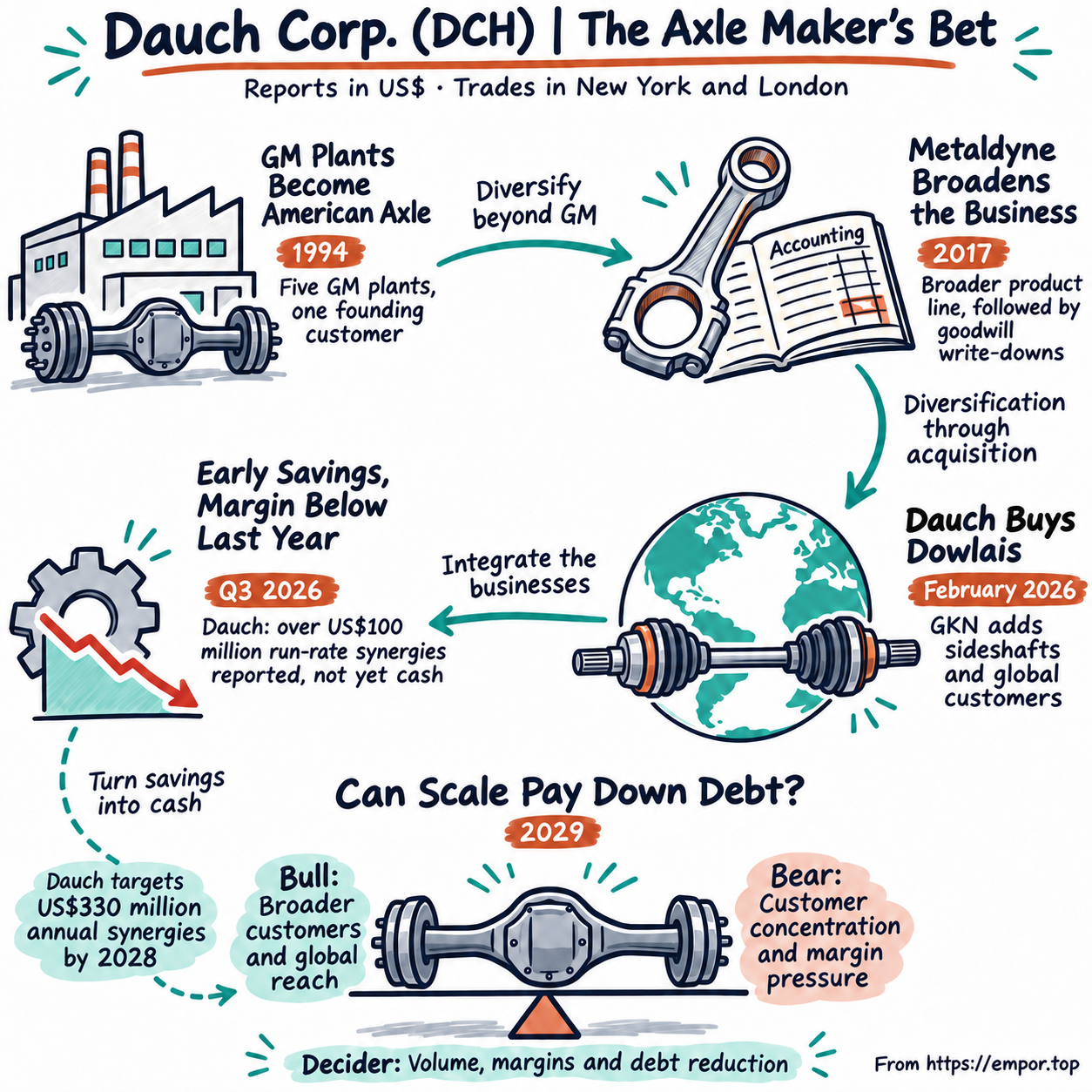
On November 17, 2026, the management team of Dauch Corporation stood in front of investors with a new number to defend. It was $330 million: the yearly cost savings the company now said it would wring out of its combination with Dowlais by 2028.1 Until that day, the target had been $300 million. The extra $30 million was a small adjustment in dollar terms. Its message was bigger: the integration was running ahead of plan, so the company felt confident enough to raise the bar before the first combined year had ended.
The rest of the Capital Markets Day presentation had the same ambition. For 2029, management laid out a business earning an adjusted EBITDA margin of 14.5% to 15%, converting more than 5% of its sales into free cash flow, and carrying net debt of less than twice its adjusted EBITDA.1 As a scorecard, this is unusually specific. A company that wants to be judged on vague words like "transformation" does not publish a margin range, a cash conversion rate and a leverage ceiling with a date attached. Dauch did, which means that within roughly three years outside investors will be able to tell whether the deal worked.
There was also a progress report. Management said it had already reached $100 million of run-rate synergies, the year-one goal, well before the first anniversary of the deal.2 "Run-rate" is a word worth slowing down on. It means the yearly savings the company expects from actions already taken, such as a closed office, a combined purchasing contract or a cut role, if those actions were in place for a full twelve months. It is not $100 million of cash already banked, and it is certainly not $100 million of extra profit already visible in the income statement. In the same quarter that management celebrated the milestone, the adjusted EBITDA margin came in below the prior-year level.2 That gap between the promise and what the first combined year has actually shown runs through this whole story.
To see why it matters, it helps to be precise about what Dauch is. The company that trades on the New York Stock Exchange under the ticker DCH used to be called American Axle & Manufacturing, a Detroit-area supplier of axles, driveshafts and forged metal parts that for three decades lived and died by General Motors' truck schedule. On February 3, 2026, it completed its acquisition of Dowlais Group, the British-listed holding company for GKN Automotive and GKN Powder Metallurgy, and renamed itself after its founding family.3 The company's annual report for 2025 describes only the legacy American Axle business. Dowlais shows up in the consolidated accounts only from the closing date.43 So the jump in reported sales in 2026 is mostly arithmetic: two companies' revenues added together, not one company growing.
That boundary frames the three questions this story has to answer. The first is whether the deal created a stronger competitive position, or simply a larger one. The second is how much of Dauch's growth is purchased rather than earned, because a supplier that buys revenue while its original business shrinks is a different investment from one that wins new work. The third, and the one with a deadline, is whether the enlarged company can earn its way down from the debt it took on to do the deal.
All three questions sit on top of an unglamorous business. Dauch's largest end market is the automotive driveline: the hardware that takes power from an engine or electric motor and delivers it to the wheels. It also forges, machines and sinters metal parts. Its reported results are shaped by things largely outside its control, including how many trucks and SUVs its customers choose to build in a given month, what happens to the price of steel and aluminum, which it largely passes through to customers, how smoothly new vehicle programs launch, and how much the company is spending to combine two organizations.4 When results come in, the first job is to separate those forces from the underlying business.
The $330 million target, in other words, is not the story. It is the hypothesis. The story is whether a supplier that has spent its entire life tied to the production plans of a few automakers can finally convert scale into a better business, and whether the second big acquisition of its modern era goes better than the first. To understand why investors are entitled to be skeptical, it is worth going back to the day five General Motors plants became somebody else's problem.
 Subscribe on LinkedIn
II. Five Plants, One Customer
In February 1994, General Motors announced that it would sell five of its parts plants to an investor group.5 The plants made axles, driveshafts, forgings and related parts, mostly for GM's own trucks, and they were exactly the kind of operation a struggling automaker in the early 1990s wanted off its books: old, unionized and expensive. Inside GM, they were a cost center. The buyers wanted to turn them into a business.
The man at the center of that bet was Richard E. Dauch, known to everyone in Detroit as Dick. He had played football at Purdue, joined General Motors in 1964, and spent his career on factory floors, including a stint at Volkswagen and a long run at Chrysler, where he rose to executive vice president of worldwide manufacturing before leaving in 1991.6 Dauch was a manufacturing evangelist in the old style: loud about quality, obsessive about plant discipline, and convinced that American factories could compete if they were run properly. When American Axle & Manufacturing began operating as a stand-alone supplier on March 1, 1994, he became its president and chief executive, and later its chairman.6
The deal had a built-in tension that would define the next thirty years. On the first day, the new company had essentially one customer, the same company that had just sold it the plants. GM had an incentive to keep buying, because the plants supplied parts for its most profitable vehicles and no other supplier could easily take over that volume. But AAM had to persuade GM to keep sending work at competitive prices, and it had to do so while trying to win business from anybody else. An industrial carve-out like this starts life as a captive supplier with a new logo. Its first strategic task is to stop being captive.
For a while, that task went slowly. At one point GM accounted for something like 99% of American Axle's revenue.7 By 1999, after the company had gone public, the share had fallen to 86%, and management told investors it expected the figure to drop further as new business from other automakers came in.8 Sales were growing quickly, close to $3 billion in 1999, because GM's full-size truck and SUV boom of the late 1990s was the best possible market for a company that made heavy axles.8 It was a wonderful position as long as Americans kept buying pickups and Suburbans, and as long as the plants kept running.
In 2008, neither held. On February 26 of that year, about 3,600 United Auto Workers members at AAM's original Detroit-area and New York plants went on strike over the company's demand for deep wage and benefit cuts.9 Because AAM supplied axles for GM's most important trucks, the strike rippled outward almost immediately, forcing GM to stop production at assembly plants across North America.9 The company counted the stoppage at 87 days. It ended in May with a contract that gave AAM what it had asked for: much lower wages for its legacy hourly workforce, buyouts and plant closures.9 At almost the same moment, high fuel prices and the onset of the financial crisis were crushing demand for exactly the vehicles AAM supplied. The strike cut sales, and the collapse in truck and SUV volumes kept pressure on long after the workers were back.
The 2008 concessions were a turning point in AAM's cost base. The company emerged with a far cheaper manufacturing footprint, more plants in Mexico and a structure that could survive the downturn. But the strike also exposed the limits of cost-cutting as a strategy. Lower labor costs did not change the fact that AAM's revenue depended on how many full-size GM trucks rolled off assembly lines. Dick Dauch could make the plants efficient. He could not make GM build more Silverados.
He died in August 2013 at the age of 71, after his son David Dauch had taken over as chief executive.6 David had grown up inside the company his father built and had spent years running sales and operations before taking the top job. He inherited a leaner supplier, but one still deeply tied to a single customer. The family name stayed on the door, and in 2026 it went onto the company itself. But the strategy David pursued was not his father's plant-by-plant improvement. It was transformation by acquisition, and it would be tested twice.
That dependence proved stubborn. By 2023, GM represented 39% of legacy AAM's sales; by 2025, the figure had risen back to 44%, with Ford at 15% and Stellantis at 13%.4 Some of that drift reflected the success of GM's full-size truck programs and some reflected AAM's own portfolio choices, including the sale of its business in India.4 But the direction is telling. Three decades after the carve-out, the original customer was gaining share of AAM's revenue again, not losing it.
The labor question did not stay in 2008 either. On June 1, 2026, Dauch announced a work stoppage at its plant in Three Rivers, Michigan, which builds axles for GM's full-size pickups.10 Nearly 1,000 UAW members walked out, and union leaders framed the strike partly as an effort to recover what workers had given up eighteen years earlier.11 The walkout lasted roughly ten days. The contract ratified by workers in mid-June included wage increases of 36% over four years.12 For a company promising investors a higher margin by 2029, that agreement is not a footnote. It is a reminder that plant economics are negotiated, not fixed, and that a single plant's labor dispute can still threaten the production schedule of the company's largest customer.
So the founding bargain has held for more than thirty years. AAM was built on manufacturing capability and proximity to a giant customer. That gave it scale and steady volume. It also meant the company's fortunes tracked a handful of truck programs at one automaker, and that cutting costs could only ever be part of the answer. By the mid-2010s, David Dauch had concluded that the rest of the answer had to be bought.
III. The $3.3 Billion Bet on Metaldyne
On November 3, 2016, American Axle announced that it would acquire Metaldyne Performance Group, a Michigan-based maker of engineered metal components that had been assembled by private-equity owners from several older suppliers.13 The price was about $1.6 billion in cash and stock, plus the assumption of roughly $1.7 billion of MPG's net debt.13 Including that debt, AAM was paying about $3.3 billion for a business with around $2.8 billion of annual revenue, at a time when AAM itself had roughly $4 billion of sales.13 The deal closed in April 2017.14
The industrial logic was easy to explain. AAM made axles and driveshafts, the big assemblies that sit under a vehicle. MPG made the smaller precision parts that go inside engines, transmissions and drivelines: forged and powder-metal components, connecting rods, valve bodies, and castings. Put them together and AAM would no longer be just an axle company. It would be a broad supplier of metal-formed components with more customers, more products and less dependence on GM. Management also argued the combination would be powertrain-agnostic, able to supply parts whether vehicles ran on gasoline, hybrid systems or batteries.13
It also came with a set of promises. AAM told investors it expected $100 million to $120 million of annual cost synergies by 2018, split mainly between overhead and purchasing savings.13 It expected the combined company's net debt to stand at about 3.5 times adjusted EBITDA at closing, and it set a target of reducing that ratio to 2 times by the end of 2019.13 Those numbers are worth holding onto. A decade later, Dauch would tell investors it aimed to get net leverage below 2 times, this time by 2029.1
Was the price fair? The best benchmark comes from the transaction materials. AAM paid about 6.8 times MPG's estimated 2016 EBITDA. A group of comparable publicly traded suppliers selected for the analysis traded at a median of 5.2 times and an average of 5.4 times.13 Including the expected synergies, AAM's effective price fell to about 5.5 times.13 The headline number, then, was a meaningful premium to where similar companies traded, though not far outside the range of the peer group. On a synergy-adjusted basis, it looked roughly in line with the market. In plain language, AAM paid a full price, and it justified that price by counting on cost savings it had not yet achieved.
That is not unusual in supplier deals. What makes MPG a useful case study is what came next.
The impairment trail
In 2018, barely a year after closing, AAM recorded a goodwill impairment of roughly $405 million.15 Goodwill is the accounting residue of an acquisition: the part of the purchase price that exceeds the fair value of the assets bought. When a company writes it down, it is effectively admitting that the cash flows it expected from part of the business are now lower than what it paid. In 2019, AAM took another charge of about $440 million in its Metal Forming segment, the division built largely from MPG.16 In 2020, as the pandemic shut down auto production, it wrote off about $510 million more across its Driveline and Metal Forming segments.16
Those three charges add up to well over a billion dollars, but they need careful interpretation. They were driven partly by lower projected cash flows in some product lines and partly by pandemic-era market changes that hit every supplier. They also were not solely about MPG: the 2020 charge covered Driveline, which was mostly legacy AAM. So the impairments do not prove the entire MPG premium was wasted. What they do show is forecast risk. The cash flows AAM expected when it agreed to the price did not materialize on the expected timeline, and the company's accountants concluded more than once that the book value of its businesses needed to come down. That weakens any simple claim that scale alone created value.
The longer-run sales record tells a similar story. Legacy AAM's sales jumped from about $3.9 billion in 2016 to about $6.3 billion in 2017, almost entirely because MPG was added.14 By 2025, sales were about $5.8 billion, below the 2017 level, and the company reported a small net loss for the year.4 That outcome mixes several things that should be kept apart. AAM sold or exited some businesses after the deal, including its India operations in 2025, and the mix of vehicles its customers built shifted over time.4 It also had to absorb a pandemic, a chip shortage that idled assembly lines for months, and the 2023 UAW strikes against the Detroit automakers. Still, the bottom line is hard to escape. Eight years after buying a business with nearly $3 billion of revenue, the enlarged company was smaller than it had been in the first full year of the combination, and its profitability was thin.
The fairest verdict on MPG is therefore a narrow one. The deal did diversify AAM's product line and its customer list, and the synergies AAM promised may well have been achieved. But it did not produce a business that grew, it did not deliver the deleveraging AAM promised on its original timeline, and it left behind more than a billion dollars of impairments. As a template for buying resilience, it was at best incomplete.
Which made the next deal so striking. In January 2025, David Dauch announced another large acquisition, again pitched as diversification, again built on cost synergies, again financed with a mix of stock and debt. The question investors had to ask was whether he was repeating the old pattern of leverage and forecast resets, or had learned enough from it to do better. Before answering that, though, it is worth asking a more basic question: what exactly does a company like this sell?
IV. What Does an Axle Supplier Actually Sell?
Picture a new pickup truck program at an automaker, years before the first vehicle reaches a dealership. Engineers define how much torque the vehicle needs to deliver, how much it will weigh, whether it will have four-wheel drive, whether a hybrid or electric version is planned. Then the automaker's purchasing team sends requests for quotation to a short list of suppliers able to design and build the axles, driveshafts and differentials. The winner spends the next couple of years co-engineering parts with the customer, building tooling and qualifying production lines. Only then does steady production begin, and with it, steady revenue for as long as the vehicle stays in production, usually several years and sometimes much longer.
That is the business Dauch is in. It supplies axles, sideshafts, driveshafts, differentials and power transfer units, plus a wide range of forged, machined and sintered metal parts.3 Its revenue is recognized when it ships parts to customers.4 So the main driver of how much it sells is simple: how many vehicles its customers build on the programs Dauch has won.
Why "recurring" is not the same as subscription
It is tempting to call this recurring revenue, and in a loose sense it is. Once Dauch wins a program, it can expect repeat orders for years. But the comparison with a software subscription breaks down quickly. Dauch's filings do not disclose company-wide minimum purchase commitments or a standard contract length.4 The customer decides how many vehicles to build, and therefore how many parts to order. If a truck program sells poorly, or an automaker cuts shifts to manage inventory, Dauch's volumes fall with it, while many of its plant costs stay the same. Customers can also delay, shrink or cancel programs, as several automakers did with electric vehicle plans in 2024 and 2025.
Price adds another layer. Much of the cost of raw metal is passed through to customers, so when steel and aluminum prices rise, Dauch's reported sales go up even if it ships exactly the same number of parts. Currency moves do the same for sales made in euros, pounds or yuan.4 Investors therefore have to look past headline sales growth and ask what happened to volume and mix: how many parts the company shipped, and whether those were higher- or lower-margin parts.
After the Dowlais acquisition, Dauch reports two segments. In the first nine months of 2026, Driveline generated about $6.15 billion of sales to outside customers and about $792 million of segment adjusted EBITDA, a margin of roughly 13%.3 Metal Forming generated about $2.09 billion of external sales and about $264 million of segment adjusted EBITDA, a margin of about 12.6%.3 So Driveline is roughly three-quarters of the company on both sales and profit, and Metal Forming is the remaining quarter. The two now earn similar margins, which is worth noting given how much of Metal Forming's history was written in impairment charges. But the segments include different mixes of legacy and acquired businesses, and the comparison is not like-for-like with any prior year.
Where Dauch competes, it claims to lead. At its Capital Markets Day, the company estimated its global share at about 30% in rear beam axles, 36% in sideshafts, 47% in front drive units and 53% in power transfer units, the gearbox that sends power to the rear wheels in all-wheel-drive vehicles.1 Those are big numbers, and the sideshaft and all-wheel-drive positions come mostly from GKN, which has been one of the world's leading makers of constant-velocity joints for decades. They are also the company's own estimates, built from its own market models rather than from independent industry data. They show where Dauch believes it has scale. They do not, on their own, show that it earns a premium price for that scale.
The competitive field includes Dana, which reported about $7.5 billion of sales in 2025, and Magna, a much larger diversified supplier, along with Japanese, Korean, Chinese and European Tier 1 companies and the automakers' own in-house operations.17 Company-wide revenue comparisons show relative size, not head-to-head share in Dauch's niches. But they make one point clear: Dauch, after Dowlais, is one of the largest pure-play driveline suppliers in the world.
Who holds the power
Michael Porter's framework is useful here, applied once and briefly. Buyer power is high. Automakers are a concentrated group of very large customers that decide production schedules, run competitive bids for each new program, and can split work between suppliers. Even after Dowlais, three customers account for more than half of Dauch's sales.3 Supplier power is moderate: metal costs are mostly passed through, but stressed sub-suppliers can disrupt production, as Dauch itself discovered in 2026. The threat of new entrants is low, because building axles and sideshafts at automotive scale and quality requires years of qualification and heavy capital investment. Substitution risk comes mainly from technology change, as electric vehicles integrate the motor, gearbox and axle into a single unit that automakers may choose to build themselves. Rivalry is intense and global.
The result is a familiar shape. Supplier qualification and manufacturing know-how protect programs Dauch has already won, because switching suppliers mid-program is expensive and risky for an automaker. But at the next sourcing decision, every program is open again. Dauch's moat is real in the middle of a vehicle's life and much thinner at its beginning.
That brings up the powertrain question. Management argues that its products serve combustion, hybrid and electric vehicles alike, and in a general sense that is true: every vehicle needs to get power to its wheels.1 Some of the company's own numbers support the idea. Dauch estimates that a typical combustion vehicle uses about 2.1 sideshafts and a battery electric vehicle about 2.3, so the shift to electric drive does not shrink its largest acquired product line.1 It also estimates that it can supply more than $2,500 of content on an electric vehicle where it is the primary driveline supplier.1 But those are potential content figures for an idealized program, not booked revenue. The company does not disclose how much of its revenue or profit already comes from electric vehicle programs, so investors cannot test how well the claim converts into business. Electric drive units integrate more of the system, which could favor a supplier with Dauch's breadth, or could shift value to automakers and motor makers.
The central moat test, then, is not whether Dauch is big. It is whether it can preserve its awards and its price realization through model changes and new launches, or whether it has to keep cutting costs to keep its place. That question became sharper on the day the company decided to double in size.
V. Dowlais: Cheaper Than the Last Deal, Larger Than the Old Company
On January 29, 2025, American Axle announced that it had agreed to combine with Dowlais Group, the London-listed company that held GKN Automotive and GKN Powder Metallurgy.18 The backstory matters. GKN was one of Britain's oldest industrial names, a company whose roots went back to the eighteenth-century ironworks at Dowlais in South Wales. In 2018, the turnaround investor Melrose Industries won a bitterly contested hostile takeover of GKN, ran the businesses for several years, and in 2023 spun the automotive and powder metallurgy operations out as Dowlais while keeping the aerospace business.19 Dowlais was, in effect, the leftover industrial half of a famous British company, trading on the London market at a low valuation.
AAM's offer valued Dowlais's equity at about £1.16 billion, a premium of 25% to its share price the day before the announcement and 45% to its three-month average.18 Reuters put the total deal value at about $1.4 billion.20 By the time the transaction closed in February 2026, the purchase price was about $1.7 billion, reflecting movements in share prices and currency.3 Dowlais shareholders received a mix of cash and newly issued AAM shares, ending up with roughly 49% of the combined company.18
The headline multiple is where the contrast with MPG becomes sharp. AAM said the implied enterprise value was about 4.1 times Dowlais's 2023 adjusted EBITDA, falling to about 3.0 times if the full projected synergies were counted.18 The MPG deal, by comparison, was announced at 6.8 times EBITDA before synergies.13 On that basis, AAM paid substantially less for each dollar of Dowlais earnings than it had for MPG's, and the synergy-adjusted price looks inexpensive by any industrial standard.
Price alone does not settle the question, though. A low multiple can reflect a bargain, or it can reflect a market that saw problems clearly. Dowlais had a history of sluggish margins, exposure to European automakers struggling with weak demand, and a powder metallurgy business whose future depended on combustion engines. The real return on the deal will depend on what Dauch does with what it bought: whether the cost savings arrive, whether the acquired businesses hold their volumes, and how much integration and debt costs consume along the way.
The strategic fit
The industrial logic is cleaner than MPG's was. Legacy AAM was a North American truck and SUV specialist heavily tied to GM's full-size pickups. GKN Automotive was a global leader in sideshafts and all-wheel-drive systems, with deep relationships with European and Asian automakers and a significant presence in China. GKN Powder Metallurgy made sintered metal parts, a technique in which metal powder is pressed into shape and then heated until it fuses, producing precise parts with little waste.19 Combined, the companies had pro forma revenue of about $12 billion and a footprint spanning every major automotive region.18
In a sense, the deal swapped geographic concentration for global breadth. Where AAM was strong in North American rear axles, GKN was strong in front-wheel and all-wheel-drive systems worldwide. Management argued the combination would make Dauch the leading driveline supplier across every type of vehicle propulsion.18 That claim deserves the same treatment as the market-share estimates: plausible, but a statement of strategy rather than proven commercial outcome.
What it cost to pay for it
The financing turned AAM into a much larger and more leveraged company. Dauch issued approximately 117 million new shares to Dowlais holders, and raised the number of authorized shares from 150 million to 375 million.19 The cash part of the price was financed with bond proceeds and term loan borrowing, and total debt rose substantially after closing.3 The company also took the opportunity to list its shares in London, though it raised no new money there.19 Ahead of closing, AAM hedged its currency exposure by buying £571 million forward; when the contract settled, it produced about $66 million of cash.3 That was a useful bonus, not a source of returns.
The acquisition also changed how concentrated Dauch's customer base looked. In the first nine months of 2026, GM accounted for about 30% of consolidated sales, Stellantis 13% and Ford 11%, and no other customer exceeded 10%.3 Compared with the 44% GM share in legacy AAM's 2025 figures, that is a dramatic shift. It is also mostly arithmetic. GM's share fell because the denominator grew with Dowlais revenue, not because legacy AAM sold less to GM or more to anyone else. A larger customer list can dilute concentration on paper before the legacy business wins a single new program.
The verdict on the price, then, is cautiously favorable on the evidence available. The Dowlais deal was announced at a lower multiple than MPG and at a modest valuation relative to its projected synergies. Whether that was the right price will depend on outcomes that have only begun to appear. Dauch had bought a much larger company. Its first full year would show whether it had bought a better one.
VI. The New Dauch Meets Its First Full Year
On November 6, 2026, David Dauch opened the third-quarter earnings call with a statement of progress. The company, he said, had achieved more than $100 million of run-rate synergies, hitting its first-year target well ahead of the deal's anniversary.2 The quarter's sales were about $2.91 billion, and adjusted EBITDA was about $359 million.2 By any measure, Dauch was now a much bigger company than the American Axle of a year earlier.
Then came the number that undercut the celebration. Adjusted EBITDA as a share of sales was 12.3%, down from 13.0% in the third quarter of 2025, measured on a combined basis.2 The company was saving money on integration, but its margin was going backward.
The quarter itself had been rough on the factory floor. Production of Ram heavy-duty pickups, an important Stellantis program for the legacy business, fell about 15% from a year earlier, and GM took downtime at its large-pickup plants in September and early October to launch a new generation of trucks.2 Both are reminders of the supplier's basic condition: two of the most important inputs to Dauch's quarter were decisions made in somebody else's boardroom.
Two companies, two stories
Separating the businesses explains part of it. Legacy Dauch, essentially the old American Axle, earned adjusted EBITDA of about $193 million in the quarter, compared with $196 million a year earlier, broadly flat.2 Dowlais contributed approximately $140 million.2 But Dowlais's prior-year results included about $30 million of one-time commercial settlements, payments from customers that inflated earnings in that period and would not recur.2 Strip those out, and the combined business is in somewhat better shape than the headline comparison suggests. Leave them in, and the combined margin looks like it is shrinking.
Management explained the rest of the margin pressure on the call. It pointed to stress among its own second- and third-tier suppliers, which it called "somewhat elevated," to inflation in fuel and energy costs that "take time to mitigate or recover," and to customer schedule adjustments that created "pockets of some production volatility."2 Those costs offset part of the gains from productivity and synergies. In legacy Dauch, unfavorable volume and mix took about $10 million out of the quarter, while Metal Forming and overhead improved.2 In other words, management said the synergies were real, but so were the headwinds, and in the third quarter the headwinds were roughly winning the tie.
The full-year guidance revision captured the same tension in a single line. Management raised its 2026 sales outlook to between $10.8 billion and $10.875 billion, from $10.6 billion to $10.8 billion, while cutting its adjusted EBITDA outlook to $1.35 billion to $1.375 billion, from $1.36 billion to $1.425 billion.2 More revenue, less profit. Much of the sales increase came from metal pass-throughs and currencies, which inflate the top line without making the business more profitable.2
The analyst questions went straight at that gap. Tom Narayan of RBC asked about a step-down of roughly $50 million in the implied fourth quarter and whether it would spill into 2027. Christopher May, the chief financial officer, attributed it to four or five fewer production days and roughly $10 million of additional inflation, and said recovering inflation from customers would take time, "similar" to the painful catch-up of 2022.2 Joseph Spak of UBS drew out a detail that changes how the guidance cut should be read: a $50 million item tied to non-designated Dowlais derivatives was non-cash and would "burn out relatively quickly."2 Dan Levy of Barclays pushed on the 2022 analogy itself, a year in which suppliers absorbed inflation for months before automakers agreed to share it.
Two other exchanges filled in the map of the new company. Asked by James Mulholland of Deutsche Bank whether synergies could come faster, David Dauch repeated the original mix and told analysts to "hold tight for future discussions," a hint at the raised target unveiled eleven days later.2 On Europe, where GKN brought a large manufacturing footprint into a weak market, he said the footprint was "directionally" where it needed to be, with some restructuring still planned.2 On China, he described volumes at the company's joint venture with HASCO as "fairly steady."2 That joint venture matters more than its low profile suggests: management guided to $70 million to $80 million of equity income from it for 2026, a meaningful sum next to a company whose GAAP results were still in the red.2
The pattern in those answers is consistent. Management attributed most of the pressure to outside forces: supplier distress, energy inflation, customer schedules. That may well be accurate, and the answers were specific rather than evasive. It is also the familiar language of a supplier that does not set its own production volume, and it means that the synergy program has to work harder simply to hold margins steady. The one bright commercial note on the call was a next-generation award for propshafts, sideshafts and electronic limited-slip differentials on a European luxury SUV running into the 2030s, exactly the kind of cross-selling the combination was supposed to make possible.2 Dauch did not name the customer.
Integration has a price, too. In the first nine months of 2026, Dauch reported about $196 million of restructuring and acquisition-related costs.3 The run-rate savings are a yearly number; the restructuring costs are cash already spent. For the deal to create value, the savings must not only arrive, they must exceed what it cost to produce them, and they must survive the pressure customers apply when they renegotiate prices.
The record behind the promise
At the Capital Markets Day eleven days later, management raised the synergy target from $300 million to $330 million by 2028.1 It laid out a stepped path, from the $100 million already reported to $200 million in year two, up from a prior year-two target of $180 million, and then the new total.1 The extra $30 million is a new claim, not a delivered benefit.
The composition of the target shifted, too, and that detail matters more than the headline. When the deal was announced, about half of the $300 million was supposed to come from purchasing: negotiating better prices from suppliers, resourcing parts and saving on freight. The rest was split between overhead, at about 30%, and operations, at about 20%.21 In the revised plan, purchasing falls to about 30% of a larger total, while overhead rises to about 35% and operations to about 35%, partly by reallocating insourcing projects, bringing work previously bought from outside into Dauch's own plants.1 That is a reasonable change for a company whose own suppliers are under stress. It also moves more of the target from contract renegotiation, which tends to show up quickly, to footprint and plant changes, which tend to take longer and cost more to execute.
The company was candid about that cost. Its Capital Markets Day materials assumed roughly one dollar of cash spent for every dollar of run-rate synergy achieved.1 In 2026 alone, Dauch expects about $405 million of non-operating cash costs, combining acquisition costs, restructuring and synergy implementation, falling to less than $230 million in 2027, less than $190 million in 2028 and less than $75 million in 2029.1 The synergies, in other words, are being bought as well as found.
How much weight should investors give it? David Dauch's record cuts both ways. He led the MPG deal, which produced a broader company but also more than a billion dollars of impairments and a legacy business smaller in 2025 than in 2017. He oversaw the sale of the India business. He has now delivered the first Dowlais milestone early. The synergy targets on MPG were credible; the leverage target was not met on its original timeline; the business's overall trajectory disappointed. The lesson from that record is not that the new targets are unreliable. It is that cost synergies are the part of an acquisition plan that management controls most directly, and they are rarely where acquisitions fail. The harder part is revenue and margin durability, and that is where MPG's forecasts went wrong.
The engineering budget is another place to watch. Legacy AAM spent about 2.5% to 2.6% of its sales on research and development between 2023 and 2025.4 The combination plan included a reduction of about 2.5% of the combined workforce, including around 70 overlapping R&D roles.19 In the first nine months of 2026, consolidated R&D was about 2% of sales, though that ratio includes Dowlais and is not directly comparable to legacy AAM's.3 Removing duplicate engineering roles is sensible. Cutting deep enough to harm the company's ability to win and launch new programs would be expensive in ways that would not show up for years.
One more change is coming. In October, Dauch announced that Nathan Iles would succeed Christopher May as chief financial officer on December 1, 2026, with May moving into the role of chief administrative officer.21 The handover will keep May inside the company and appears planned rather than abrupt. Unless it coincides with a change in guidance or financial discipline, it is a detail, not a turning point.
The verdict on the first combined year is therefore mixed. Integration is producing measurable savings, and management has met its first target early. But the larger revenue base has not yet delivered a higher quarterly margin, and run-rate synergies are a management-reported milestone, not cash already collected or proof of durable earnings growth. Which raises the question that matters most for the company's balance sheet: how much of all this is turning into cash?
VII. Cash Is Not the Same as Earnings
Look at Dauch's first nine months of 2026 two ways, and they tell different stories. On an accounting basis, the company lost about $143 million.3 On a cash basis, its operations generated about $193 million.3 Neither number alone captures what is happening, and the gap between them is the key to understanding the company's finances.
The biggest reason for the gap is depreciation and amortization, about $610 million over the nine months.3 Depreciation spreads the cost of factories and machines over their useful lives. Amortization does the same for intangible assets, such as customer relationships and technology, that were recorded at fair value when Dauch bought Dowlais. Both are charged against profit, but neither consumes cash in the period. Think of it like a company that paid for a building years ago and now records a slice of that cost every quarter: the expense shows up on the income statement, but no money leaves the bank. Much of Dauch's reported loss reflects precisely that kind of non-cash accounting on acquired assets.
Working capital pulled the other way. Receivables, the money customers owe for parts already shipped, consumed about $188 million of cash during the nine months, as the combined business grew its balances.3 Most of Dauch's customers are large automakers that pay within roughly 50 days, and the allowance for bad debts is small, so this is not a sign of customers failing to pay.4 It does mean that cash flow can swing sharply with the timing of shipments and payments.
So positive operating cash flow is not proof of healthy earnings. It is evidence that the business generates cash before accounting for the cost of the assets it consumes and before servicing its debt. And debt service has become a much larger claim on the business. In the first nine months of 2026, Dauch recorded about $266 million of interest expense.3 In the third quarter alone, net interest expense was about $81 million, compared with about $36 million a year earlier, before the acquisition debt arrived.2 Management cited a weighted-average interest rate on its long-term debt of around 7.1%, with about 81% of senior debt at fixed rates.21 To put that in proportion: interest consumed a sum larger than the company's entire operating cash flow over the same nine months. The fixed-rate structure protects Dauch from rising rates, but it also means the interest bill falls only as debt is actually repaid.
The debt and the deadline
At September 30, 2026, Dauch had total borrowings of about $5 billion against cash of about $800 million; management put net debt at about $4.1 billion.32 It had approximately $2.4 billion of liquidity, including that cash and undrawn credit lines, and after redeeming its remaining 2028 notes, no significant maturities until 2029.3 Some of the remaining Dowlais private placement notes carry maintenance covenants, and the company has reported no breach.3 Management put net leverage at 2.6 times on the third-quarter call.2 At Capital Markets Day, it framed year-end 2026 leverage at about 2.9 times on the basis it uses for its targets.1 The direction is the important part: leverage needs to come down by about a full turn to reach the below-2-times target.
That is why the 2029 plan matters, and it is worth walking through how management gets there. For 2026, Dauch expects about $290 million of adjusted free cash flow, roughly 2.7% of sales; on an unadjusted basis, after acquisition and restructuring outlays, the company expects to use cash this year.1 By 2029, management projects more than $575 million of adjusted free cash flow, above 5% of sales.1 The bridge is not mysterious. Adjusted EBITDA is supposed to rise from about 12.6% of sales to 14.5%–15%, capital spending is assumed to stay around 4% of sales, interest falls from about 3.2% of sales to about 2.7% as debt is repaid, and the share of EBITDA that becomes free cash rises from about 21% to about 35%.1 Every one of those lines depends on the one before it. If margins stall, debt falls more slowly, interest stays higher, and the cash conversion target slips with it.
The 2026 cash guidance already shows how that chain behaves under pressure. Even as management cut the year's adjusted EBITDA outlook, it narrowed adjusted free cash flow guidance to $270 million to $310 million, from $260 million to $325 million, rather than lowering it outright.2 Asked how, the CFO pointed to cash taxes, the timing of working capital and a planned reduction in capital spending.2 Those are legitimate levers, but they are the kind that can be pulled once. Trimming capital spending to protect a cash target is sensible in a single quarter; done repeatedly, it would collide with the engineering and launch capability the company needs to win the next round of programs.
Management set out its capital priorities in order: integrate the businesses, optimize costs, generate cash, sell selected non-core assets and strengthen the balance sheet. The company has already collected about $115 million from small divestitures since early 2025, including its China joint ventures, the Indian commercial-vehicle axle business and a cylinder liner business.1 Shareholder returns come later, but not as late as the 2029 leverage target suggests. Dauch said that once net leverage reaches 2.5 times, it will begin "a more balanced capital allocation approach," including buybacks or dividends.1 That is the right general order for a company in Dauch's position, and the explicitness is welcome. It also means capital returns could begin while the balance sheet is still more leveraged than management's own long-term goal. Leverage turns a good quarter into a deadline, and a buyback threshold set at 2.5 times is a choice investors should watch.
The credit agencies are not yet convinced either way. Fitch affirmed Dauch's issuer rating at BB-, with a stable outlook, in February 2026, around the time the Dowlais deal closed.22 Before the deal, S&P rated the company BB- with a negative outlook and Moody's had it at B1, stable.4 Those are solidly sub-investment-grade ratings, consistent with a highly leveraged cyclical supplier.
The tax overhang
There is one more liability investors should keep in proportion without ignoring it. The Internal Revenue Service is challenging the tax treatment of a Luxembourg subsidiary's Mexican branch. Dauch paid about $10 million in 2023 and then sued for a refund in the U.S. Court of Federal Claims, with a trial set for 2026.4 If the company loses, it estimates it could owe an additional $335 million to $385 million in tax and interest.4 Dauch says it believes its position is more likely than not to prevail. The outcome is unresolved. For a company trying to cut net debt by roughly a billion dollars over three years, a loss would be a meaningful setback, consuming a large share of a year's targeted free cash flow.
Currency and other income sit below the main story. Exchange-rate moves affect reported earnings, and the Dowlais hedge produced a one-time cash inflow at closing. In the first nine months of 2026, the company also booked a small gain on the business-combination derivative and equity-method income from joint ventures.3 None of that replaces operating performance.
So the cash picture offers breathing room, but not comfort. Much of the gap between earnings and cash reflects acquired-asset amortization and working capital timing, while interest has become a much larger claim on operating earnings. The real test is sustained free cash flow and debt reduction across a full combined year, with the IRS case hanging in the background. That brings the story to the question every investor ultimately has to answer: does Dauch have a credible reason to win from here?
VIII. Analysis & Bear vs. Bull Case
Set two pictures side by side. In the first, Dauch estimates that it holds leading positions in several global driveline categories, including sideshafts and power transfer units.1 In the second, GM alone still represents about 30% of the company's sales, and legacy AAM's revenue drifted from about $6.1 billion in 2023 to about $5.8 billion in 2025.34 One picture shows a global leader. The other shows a supplier still exposed to a handful of customers and struggling to grow its original business. The investment case depends on which picture proves more accurate.
The strongest argument for Dauch is breadth. The combined company has more balanced customer and geographic exposure than legacy AAM ever had, a broader product portfolio spanning rear axles, sideshafts, all-wheel-drive systems and powder metal parts, and measured leadership in several product categories. Its supplier relationships are embedded in vehicle programs that last years, which gives it visibility on volumes and makes it hard for customers to switch mid-program. Together, those features could make Dauch more resilient than legacy AAM was alone.
The deal economics support the bull case too. Dowlais was announced at about 4.1 times EBITDA before synergies, a much lower price than the 6.8 times AAM paid for MPG.1813 Management has reported its first-year synergy target as achieved ahead of schedule and raised the long-term goal.1 If those savings stick and flow through to cash, Dauch could deleverage faster than skeptics expect.
The bear case starts with the customer base. The three largest customers still account for more than half of Dauch's sales.3 Program delays, re-sourcing decisions or a downturn in North American trucks can still hit volumes, and because plants have high fixed costs, lower volumes hurt margins disproportionately. The 2026 Three Rivers strike showed how quickly labor issues can affect production for the largest customer.
The market backdrop offers little help. The industry forecast Dauch itself presented at Capital Markets Day had global light-vehicle production growing only about 1.1% a year from 2026 to 2030, with North America at about 1.4%, Europe at about 0.4% and China at about 0.2%, and described the outlook as modest through 2028.1 A supplier in a flat market grows only by winning share or adding content per vehicle, and both are fought for program by program against rivals with the same goal.
The second bear argument is that synergies are not a moat. Cost savings improve margins only if customers do not take them back in price negotiations, and in the first full year, adjusted margins were below the prior-year quarter despite the synergies.2 Integration costs were substantial. And the last major acquisition was followed by more than a billion dollars of goodwill impairments, against a promised leverage path that took far longer than planned.
Porter's forces, applied earlier, describe a business where buyer power is high, entry barriers are meaningful but not prohibitive, and rivalry is intense. Hamilton Helmer's 7 Powers framework helps sharpen what advantages Dauch might really have. The strongest candidate is scale economies: a supplier that builds more sideshafts or axles can spread engineering and tooling costs across more units, and Dauch's estimated share positions suggest it has that advantage in several categories. The second is switching costs: once a program is awarded and tooled, changing suppliers is expensive and risky for the automaker. Process power, the accumulated manufacturing know-how that is hard for rivals to replicate, may also apply, given GKN's long history in constant-velocity joints.
But Helmer's framework also asks whether those advantages produce persistent differential returns, and here the evidence is thin. Dauch's margins are in line with or below peers', its legacy business has not grown, and its customers can rebid programs at every model change. Network effects, brand power, counter-positioning and cornered resources do not meaningfully apply. The honest conclusion is that Dauch has scale and switching-cost advantages within programs, but not enough disclosed evidence to call them durable pricing power.
What the 2029 plan actually assumes
The Capital Markets Day plan is most useful for what it reveals about where management expects profit growth to come from. Dauch projects 2029 sales of about $11.5 billion. Starting from 2026 guidance of about $10.8 billion and adding January's Dowlais contribution gives a pro forma base of about $11.3 billion.1 So management's own plan calls for only about $200 million of net sales growth over three years: $200 million to $300 million from volume, mix and new business, partly offset by $50 million to $75 million of price reductions to customers.1 The company says it has already secured most of its primary programs through 2029, and the plan assumes North American full-size truck production stays roughly where it is.1
The profit walk tells the same story more sharply. Adjusted EBITDA is supposed to rise from a pro forma base of about $1.42 billion in 2026 to about $1.67 billion to $1.73 billion in 2029.1 Of that increase of roughly $250 million to $310 million, about $260 million comes from synergies still to be realized after 2026. Volume and mix contribute $40 million to $75 million, price-downs take away $50 million to $75 million, and operational productivity is assumed simply to offset inflation.1 Stated plainly, nearly all of the margin expansion in the 2029 plan is the synergy program. The underlying business, on management's own numbers, is expected to roughly tread water.
That is an honest plan, and it is also a narrow one. It does not ask investors to believe in a recovery in auto production or a burst of electric vehicle demand. But it does make the investment case almost entirely about execution of cost savings in a business where customers expect a price reduction every year. If synergies come in as promised, the targets look achievable. If they slip, or customers capture them through tougher pricing, there is little else in the plan to fill the gap.
What management's record says
How credible are management's claims? The record shows a team that sets specific targets and, on cost synergies, tends to hit them. It also shows a team whose broader forecasts have repeatedly been reset: the MPG deleveraging target, the growth implied by the MPG price, and the cash flows that underpinned goodwill. The 2026 calls distinguished carefully between controllable and uncontrollable pressures, which is helpful. The test is whether the next misses, if they come, are explained with the same specificity.
Governance signals are mixed rather than alarming. David Dauch's reported compensation was about $11.5 million in 2025, a year in which the company lost money, and shareholder support for the say-on-pay vote was below historical levels.23 At the 2026 annual meeting, the vote passed comfortably, with about 158 million shares in favor and about 10 million against.24 There is no controlling shareholder; BlackRock was the only holder above 5% in the latest proxy, and directors and executives as a group owned about 2%.23
Three measures matter more than any others. The first is organic volume and mix growth for each of the legacy businesses: whether legacy Dauch and legacy Dowlais are growing in the parts they ship, not just in reported sales. Legacy AAM's 2025 sales fell about 4.7%, driven by lower volumes and the India sale, which is the baseline to beat.4 The second is adjusted EBITDA margin, measured net of the cash cost of integration; the latest reading was 12.3%, down from 13.0% a year earlier.2 The third is net debt reduction and free cash flow conversion, against a 2029 target of below 2 times leverage.
What would an activist push on? Probably the portfolio: whether powder metallurgy, with its exposure to combustion engines, belongs in the company long term, and how quickly the promised divestitures will happen. Possibly the pay structure, given compensation that did not move with results. Certainly the pace of debt reduction, because every quarter of high leverage leaves the equity exposed to a downturn.
Without a dated share price and comparable multiples, a current valuation verdict would be guesswork. The investable question is operational: whether the targets are met. That question is easier to frame with a few lessons from the record.
IX. Playbook: Business & Investing Lessons
Go back to the November 2016 deal presentation for MPG. It promised a larger supplier, $100 million to $120 million of synergies and net leverage of 2 times by 2019.13 What followed was more than a billion dollars of impairments and a 2025 business smaller than its 2017 self.164 Now look at the November 2026 Capital Markets Day: a larger company again, $330 million of synergies, net leverage below 2 times by 2029.1 The deck has changed. The structure of the promise has not. That parallel is the source of the lessons Dauch teaches.
The first lesson is that a bigger customer list can dilute concentration on paper before the legacy business wins a single new program. GM's share of sales fell from 44% to about 30% overnight when Dowlais was added, but no new GM program was lost, and no new non-GM program was won, to cause it.43 For investors evaluating any acquisitive supplier, customer diversification through acquisition is real exposure reduction only if the acquired business keeps its customers and the legacy business does too. The percentage tells you about the denominator. It tells you nothing about the numerator.
The second is that a synergy target is an option management still has to earn. The $100 million of run-rate savings Dauch reported in its first year is a measurable achievement, but it is not cash collected, and it came alongside about $196 million of restructuring and acquisition costs and a lower quarterly margin.32 Raising the target to $330 million is a new claim on the future. Synergies only matter if they exceed the cost of producing them and if customers do not take them back in price. Treat each raised target as an option, valued at what remains to be earned.
The third is that a supplier's moat is tested at the next sourcing decision. Dauch's strengths, its scale, its qualification, its embedded engineering, protect programs during their production life. But the company discloses no minimum-volume commitments, and every new vehicle generation brings a new bid.4 The moment of truth for a component supplier is not the earnings call. It is the request for quotation, years before the parts ship. Investors who want to know whether Dauch's leadership is real should watch program awards and retention through model changes, because that is where pricing power either shows up or does not.
The fourth is that leverage turns a good quarter into a deadline. Dauch's interest bill more than doubled in a single year, and its plan requires net leverage to fall by about a full turn by 2029.21 In an asset-light business, a missed quarter is a disappointment. In a capital-intensive, highly leveraged supplier, it pushes the debt reduction timeline back, delays shareholder returns and raises the risk that the next downturn arrives before the balance sheet is ready. The MPG-era target of 2 times leverage by 2019 became a target of below 2 times by 2029; a decade is a long time to chase the same number.131
Put together, the lessons say one thing. Acquisition math is a starting hypothesis. Its value depends on volume durability, integration quality and whether cash actually reaches the balance sheet, and Dauch's own history shows how easily the hypothesis can go wrong.
X. Epilogue
Tonight, Dauch stands at an uncomfortable midpoint. The deal is done, the first synergy milestone is behind it and the 2029 targets are public. But the evidence that will decide whether the bet pays off has barely begun to arrive.
The first reporting cycle after the Capital Markets Day will be the first real test. Management has said it will give its formal 2027 outlook on the fourth-quarter call in February, and it has already previewed the shape of the year: continued synergy gains, launches of new truck programs, and inflation that will persist "at least in the early part of 2027."2 That call will show full-year numbers for the first combined year and, more importantly, whether the first year of the 2029 walk starts on schedule. A 2027 margin guide that begins climbing from the low 12s toward the plan would be the first evidence that the synergy math is reaching the income statement. A guide that leans on recoveries from customers that have not yet been negotiated would echo the slow catch-up of 2022. Investors should look first for volume and mix at each legacy business. Growth in underlying volumes at both businesses would support the case that the combination is creating revenue; sales gains driven only by metal pass-throughs, currency and acquired revenue would resemble MPG.
The second checkpoint is whether the path from $100 million toward $200 million and eventually $330 million in run-rate synergies continues on schedule.1 Watch whether those announcements show up in adjusted margins after restructuring outlays, and whether cash restructuring costs shrink as the program matures. A margin that rises toward the 2029 range would be strong confirmation. A margin stuck near 12% despite reported synergies would suggest customers or costs are absorbing the savings.
The third is debt reduction, including progress toward the 2.5-times capital-return threshold and the below-2-times goal.1 The moment the company crosses 2.5 times will be revealing. If it turns quickly to buybacks while the industry is soft, investors will learn something about how management weighs the equity against the balance sheet. If divestitures arrive and the proceeds go to debt, that would be a sign of discipline.
The fourth is customers. After the next launch cycles, the key data points are the shares of sales from GM, Stellantis and Ford, and the program awards Dauch wins in the categories where it claims leadership. If those categories keep winning, the market-share claims will have commercial substance.
Two external events also sit on the calendar. The IRS case in the Court of Federal Claims could add a substantial claim on the cash Dauch needs for debt reduction.4 The Three Rivers labor agreement will show over time how higher plant costs affect production continuity.12
None of these will settle the story alone. The next year can show whether acquired diversification comes with underlying growth and cash generation. The full integration and debt story will take until at least 2029 to resolve, and the gap between the $330 million promise and the reality of a cyclical, customer-driven business will remain the central tension until then.
XI. Outro
In 1994, Dick Dauch turned five General Motors plants into a company. For years, one customer represented more than nine-tenths of the business.78 Thirty-two years later, after the 2008 strike, the MPG deal and its impairments, and a transatlantic acquisition that doubled its size, GM remains the largest customer at roughly three-tenths of sales.3 The company now carries the founder's name, but it is a very different enterprise: global, diversified, heavily indebted and promising to turn its new scale into cash.
Picture an axle leaving a plant in Three Rivers, Michigan, bound for a pickup truck, or a sideshaft leaving a GKN factory for a crossover in Europe or China. Each one is a small proof that Dauch has won a place in somebody else's vehicle program. Whether it captures enough of the value along the way, enough to earn its way out of dependence and debt, is the question the founder's plants first posed, and the one his son's company still has to answer.
References
-
Dauch Capital Markets Day 2026 Presentation — Dauch Corporation, 2026-11-17 ↩↩↩↩↩↩↩↩↩↩↩↩↩↩↩↩↩↩↩↩↩↩↩↩↩↩↩↩↩↩↩↩↩
-
Q3 2026 Earnings Call Transcript — Stock Analysis, 2026-11-06 ↩↩↩↩↩↩↩↩↩↩↩↩↩↩↩↩↩↩↩↩↩↩↩↩↩↩↩↩↩↩↩↩
-
Form 10-Q for the quarter ended September 30, 2026 — SEC, 2026-11-06 ↩↩↩↩↩↩↩↩↩↩↩↩↩↩↩↩↩↩↩↩↩↩↩↩↩↩
-
Form 10-K for the year ended December 31, 2025 — SEC, 2026-02-13 ↩↩↩↩↩↩↩↩↩↩↩↩↩↩↩↩↩↩↩↩
-
General Motors to Sell Five Plants to Parts Manufacturing Firm — Los Angeles Times, 1994-02-22 ↩
-
American Axle Co-Founder Richard Dauch Dies at 71 — Michigan Public, 2013-08-03 ↩↩↩
-
SAE 2001: American Axle: $3.1 Billion and Climbing — WardsAuto, 2001-03 ↩↩
-
American Axle & Manufacturing First Quarter 2000 Press Release — The Auto Channel, 2000-05-04 ↩↩↩
-
Profiles of Significant Collective Bargaining Disputes of 2008 — U.S. Bureau of Labor Statistics ↩↩↩
-
Dauch Announces Work Stoppage at Three Rivers Facility — Dauch Corporation, 2026-06-01 ↩
-
UAW Strike at Michigan Supplier to GM Seeks Amends for 2008 — WardsAuto, 2026 ↩
-
UAW Ratifies Contract with American Axle in Three Rivers — WMUK, 2026-06-15 ↩↩
-
2017 MPG Acquisition Presentation — SEC, 2016-11-03 ↩↩↩↩↩↩↩↩↩↩↩↩
-
Form 10-K for the year ended December 31, 2018 — SEC, 2019 ↩
-
Dana Reports 2025 Financial Results — Dana Incorporated, 2026-02-18 ↩
-
Prospectus for LSE Admission and Dowlais Combination — Dauch Corporation, 2026-01-29 ↩↩↩↩↩
-
American Axle to Buy GKN Automotive Owner Dowlais in $1.4 Billion Deal — Reuters via StreetInsider, 2025-01-29 ↩
-
Fitch Rating Action Disclosure Form — Fitch Ratings, 2026-02-13 ↩
-
Amended Annual Meeting Results, Form 8-K/A — SEC, 2026-05-04 ↩
 LinkedIn
 WhatsApp
 Reddit
 Hacker News
 Email
 Kindle
 RSS Feed
 Spotify
 Apple Podcasts
 Amazon Music
 Audible
 YouTube