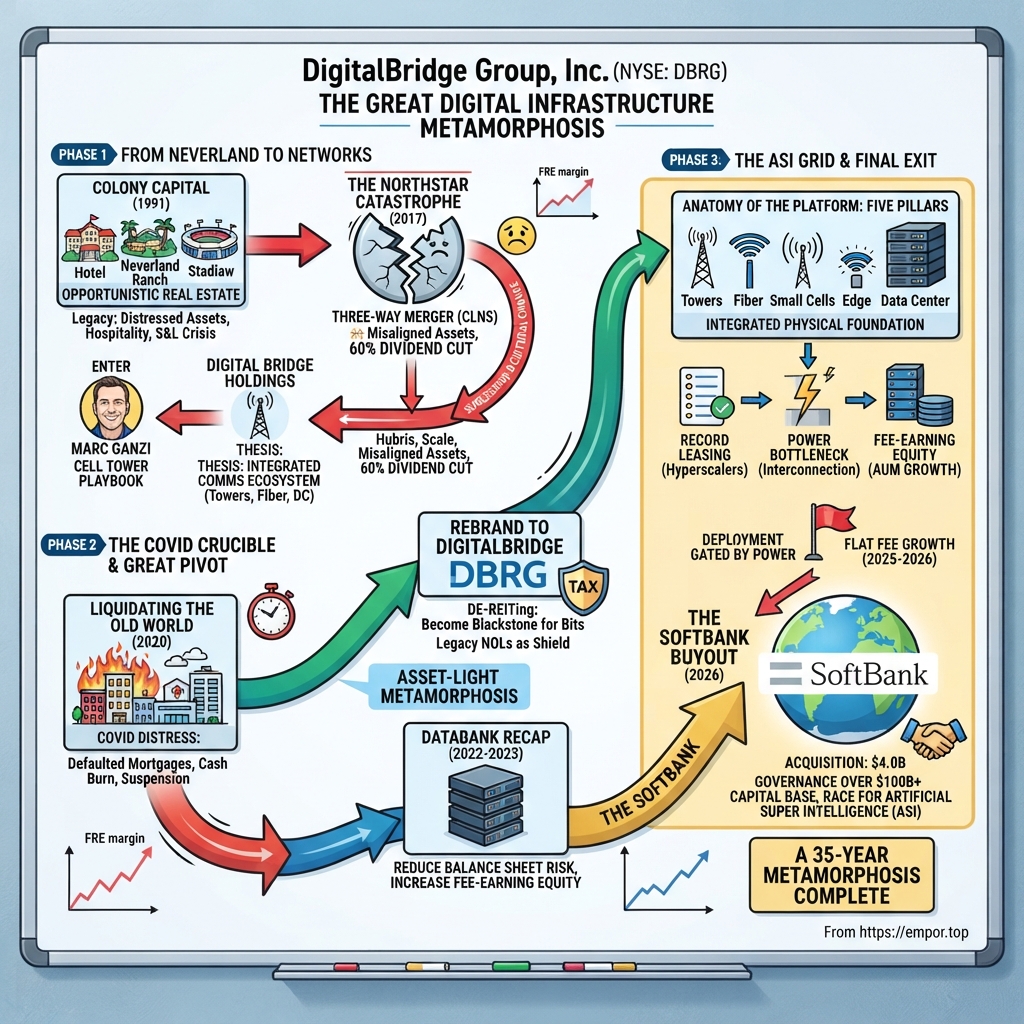
DigitalBridge Group, Inc. (NYSE: DBRG): The Great Digital Infrastructure Metamorphosis
I. Prologue & The $4 Billion Take-Private: SoftBank, Masa, and the Race for ASI (00:00 – 00:18) [18 Mins]
The Last Week of a Public Company
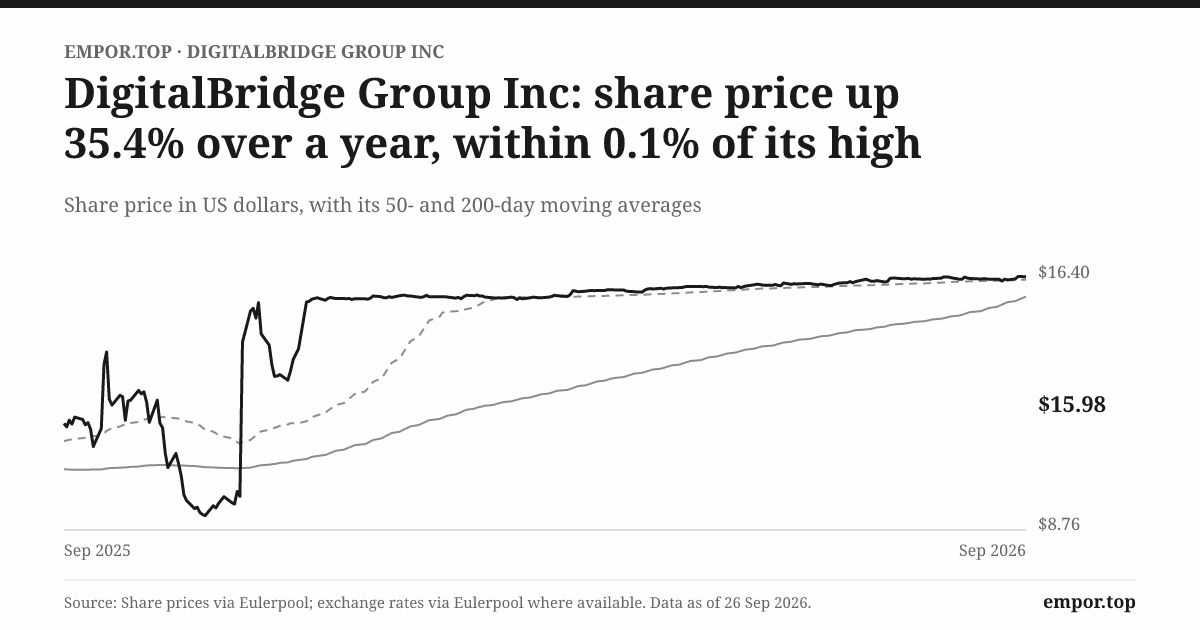
On the morning of September 22, 2026, a brief press release out of Boca Raton, Florida, marked the closing chapter of a corporate narrative that began thirty-five years earlier in the fallout of the American savings-and-loan crisis. DigitalBridge Group announced that it had secured all regulatory clearances required to complete its sale to SoftBank Group Corp., including approval from the Committee on Foreign Investment in the United States (CFIUS), the Federal Energy Regulatory Commission (FERC), and foreign investment authorities.[^1] Under the merger terms, the transaction was scheduled to close within five business days, followed by the delisting of the company's common stock from the New York Stock Exchange.[^1] With the shares trading just cents below the $16.00 cash buyout price, the market had effectively priced the deal as complete, waiting only for final settlement.
The transaction had been struck nine months earlier. On December 29, 2025, SoftBank agreed to acquire all outstanding common shares of DigitalBridge for $16.00 each in cash, valuing the business at an enterprise value of approximately $4.0 billion.1 The agreed price represented a 15% premium over the prior day's close and a 50% premium over the stock's unaffected 52-week average as of December 4, 2025, before transaction discussions leaked.1 Masayoshi Son framed the strategic rationale around a single requirement: the artificial intelligence era demands "more compute, connectivity, power, and scalable infrastructure," and DigitalBridge had established itself as "a leader in digital infrastructure."1 On April 23, 2026, roughly 96% of the votes cast by shareholders approved the merger.2
The nature of SoftBank's purchase is revealing. The Japanese conglomerate was not directly buying cell towers, fiber routes, or data centers; it was acquiring an asset manager. At the time of the announcement, DigitalBridge oversaw roughly $108 billion in digital infrastructure assets on behalf of institutional clients—including pension funds, sovereign wealth funds, and insurance balance sheets—while holding only fractional balance-sheet co-investments in the underlying properties.1 A $4.0 billion buyout gave SoftBank governance over a capital base more than twenty-five times larger. That structural asymmetry defined the firm's prior six years, explaining why the exit valuation felt like a welcome premium to recent buyers yet a steep discount to investors who bought during the peak valuations of 2021 and 2022.
The transaction is best understood as a purchase of organizational capability rather than physical real estate. An asset manager's underlying enterprise value resides in its institutional investor relationships, deal origination pipeline, and specialized operating personnel—intangibles that traditional balance-sheet accounting does not capture at replacement cost. SoftBank paid to secure all three at an inflection point when global technology and infrastructure investors were racing to secure electrical power, zoned land, and project financing for high-density computing clusters.
From Neverland to Neural Networks
The corporate trajectory has few parallels in modern finance. The firm originated as Colony Capital, the opportunistic real estate investment vehicle founded by Tom Barrack, known for acquiring distressed hotel debt, luxury resorts, and, famously, Michael Jackson's Neverland Ranch.3 In 2017, Colony engineered a three-way merger into a diversified real estate investment trust that promptly struggled under operational complexity and conflicting capital requirements. In 2019, Colony acquired a Boca Raton-based digital infrastructure investment firm run by cell-tower entrepreneur Marc Ganzi and initiated a succession plan. Over the subsequent three years, Ganzi divested the legacy hospitality holdings, healthcare facilities, and non-core real estate accumulated over three decades, surrendered the firm's REIT tax status, and repositioned what remained as a dedicated asset manager focused entirely on the physical network underpinning the internet. When the generative artificial intelligence investment wave arrived, that digital footprint emerged as some of the most contested physical capital in the global economy.
The Paradox at the Center
This evolution presents an intriguing valuation puzzle for institutional investors. By the close of 2025, DigitalBridge managed $41.0 billion in fee-earning equity, up from $35.5 billion a year earlier, while its annual fee-related earnings expanded 33% to $142 million.4 Its operating portfolio featured premier platforms including Vantage Data Centers, Switch, DataBank, Vertical Bridge, and Zayo—enterprises central to the physical rollout of artificial intelligence hardware. Yet the stock spent most of its post-transformation era trading far below its early-2022 highs, and SoftBank's $16.00 takeover offer represented a 50% premium over an unaffected 52-week baseline that stood near $10.67 per share.1
The public market's persistent discount on a pure-play manager operating in a high-demand sector stems from several distinct headwinds: an asset-management platform still working to reach the scale of multi-strategy alternative giants, an overhead structure carrying legacy costs from the Colony era, the unpredictable timing of large-fund capital closes, and portfolio expansion constrained by regional power interconnection queues. The valuation also reflected an unresolved structural question: how much economic rent generated by digital infrastructure asset management remains with the fund manager, and how much is captured by the utility providers, property owners, and hyperscale tenants that bracket it.
The Road Ahead
This examination traces that metamorphosis in sequence: from Colony Capital's opportunistic roots and Tom Barrack's dealmaking machinery, through the structural missteps of the 2017 NorthStar merger, to Marc Ganzi's cellular infrastructure playbook and the 2019 succession. It then reviews the 2020–2022 restructuring, the de-REITing process, and the introduction of the DBRG ticker. From there, the analysis details the mechanics of fee generation, mega-fund capital deployment amidst grid-power bottlenecks, competitive positioning against global private equity sponsors, a balanced audit of bull and bear arguments, and the overarching strategic lessons—returning full circle to SoftBank.
To understand how an investment firm that once held stakes in the Paris Saint-Germain football club came to serve as the physical operating foundation for Masayoshi Son's artificial super intelligence strategy, the story begins in Los Angeles in 1991, during an era when commercial real estate was among the most distressed asset classes in the United States.
 Subscribe on LinkedIn
II. The Colony Capital Genesis: Distressed Real Estate, Hollywood, and Sovereign Billions (00:18 – 00:36) [18 Mins]
A Dealmaker Reads the Wreckage
In 1991, the United States was navigating the fallout of the savings-and-loan crisis as the Resolution Trust Corporation liquidated portfolios of seized commercial properties and defaulted loans at steep discounts. Where most investors saw toxic exposure, Thomas J. Barrack Jr., a Los Angeles attorney-turned-dealmaker who had spent the 1980s as a principal with the Robert M. Bass Group, recognized an opportunity to acquire debt at deep discounts on the conviction that the underlying collateral would eventually recover.3 That year, he founded Colony Capital with an explicit mandate to acquire "out-of-favor real estate assets."3
Barrack assembled an initial investor syndicate anchored by patient, high-profile capital: Robert Bass, David Bonderman, Eli Broad, and prominent families across the Middle East and Asia.3 That capital base proved as consequential as the strategy itself. Moving fluidly between sovereign wealth circles in the Persian Gulf and executive suites in Southern California, Barrack established a reputation as a sponsor willing to structure complex transactions that mainstream institutions avoided. The operating model relied on direct relationships, contrarian timing, and substantial financial leverage—the classic opportunistic private equity playbook: acquire during market distress, maximize debt financing, and harvest during subsequent market recoveries.
The Trophy Years
Over the following two decades, Colony built a reputation on high-profile transactions that drew attention well beyond specialized trade publications. The firm acquired stakes in luxury hospitality flags including Raffles and Fairmont, assumed control of the Paris Saint-Germain football club prior to its eventual sale to the Qatar Investment Authority, and absorbed Michael Jackson's Neverland Ranch after issuing debt secured by the estate.3 Rather than random trophies, each asset represented a distressed or legally entangled situation where Colony's appetite for operational complexity and reputational friction allowed it to negotiate entry prices well below replacement cost.
Yet the traditional private equity structure imposed strict operational limits: closed-end funds. Under this framework, a sponsor must continually return to limited partners, market a successor vintage, deploy capital within defined investment windows, harvest assets, and repeat the cycle. While management and incentive fees were lucrative, the franchise remained only as secure as its most recent fundraising cycle; an underperforming vintage could bring the entire fundraising engine to a halt.
A second structural vulnerability lay embedded within the asset portfolio itself. Hotels, casinos, and leisure resorts function as operating businesses housed inside real estate wrappers: their cash flows depend on daily room rates and discretionary consumer spending rather than stable, multi-year commercial leases. That dynamic generates robust cash flow during economic expansions but leaves balance sheets exposed when business and leisure travel contract. Colony's reliance on hospitality-heavy assets would prove pivotal three decades later, when a global pandemic halted international travel and converted an operational revenue stream into a severe liquidity drain.
The Search for Permanent Capital
To break free from the cyclical fundraising treadmill, Barrack pursued permanent public capital. In September 2009, amidst the market dislocation following the global financial crisis, Colony Financial completed an initial public offering of 12.5 million shares at $20 each, launching a mortgage real estate investment trust tasked with buying discounted commercial mortgages and debt securities.5 The strategic appeal was straightforward: a publicly traded REIT provided permanent equity that never faced redemption deadlines, alongside liquid equity currency for future acquisitions, in exchange for distributing most of its taxable income as dividends.
In April 2015, Colony Financial advanced that strategy by internalizing its management structure. The REIT absorbed its external adviser, Colony Capital LLC, consolidating into Colony Capital, Inc.—an internally managed real estate operating and investment management firm with more than 300 employees across 14 offices.6 Public markets typically favor internalizations because they eliminate the inherent conflict of an external manager collecting base fees irrespective of shareholder performance. The integrated entity now owned both the underlying real estate assets and the fee-earning platform that raised institutional capital to acquire them.
The Strategic Trap
Yet the timing introduced fresh obstacles. By 2015, the most lucrative post-crisis distressed opportunities had already been resolved. Capitalization rates—the annual yield generated by a property's net operating income—had compressed significantly across commercial office buildings, hotels, and retail centers. Simultaneously, traditional real estate asset management fees were under pressure as mega-managers like Blackstone achieved unprecedented scale, prompting institutional limited partners to demand fee concessions. A mid-sized, diversified manager confronted a stark strategic fork: build deep sector specialization, or rapidly scale to institutional size.
Colony chose aggressive expansion. That choice would soon test a widely held assumption in commercial real estate: that broad diversification across property types and geographic markets inherently produces operational resilience. The ensuing chapter in the firm's history would serve as an unsparing test of that thesis.
III. The NorthStar Catastrophe: A Three-Way Merger Born in Hubris (00:36 – 00:58) [22 Mins]
The Biggest Real Estate Merger of the Year
On January 10, 2017, Colony Capital, NorthStar Asset Management Group, and NorthStar Realty Finance completed a tri-party merger into Colony NorthStar, with the consolidated entity trading on the New York Stock Exchange under the ticker CLNS.7 Managing approximately $58 billion in assets with an initial equity market capitalization near $9 billion, the partners promoted the transaction as the largest real estate merger of 2016.7 Tom Barrack assumed the role of Executive Chairman, NorthStar founder David Hamamoto became Executive Vice Chairman, and Colony veteran Richard Saltzman was named Chief Executive Officer.7
The strategic rationale centered on corporate scale and operating efficiencies. Management projected roughly $115 million in annual cost synergies, comprising $80 million in cash savings and $35 million in reduced stock-based compensation.7 The resulting platform was structured as an internally managed, diversified equity REIT spanning healthcare, industrial, hospitality, and real estate credit portfolios, paired with an institutional and retail investment management business. In theory, broader balance-sheet scale was expected to lower the cost of capital and insulate earnings against individual sector downturns.
What NorthStar Actually Brought
The structural flaw lay in the underlying assets. NorthStar Realty Finance had spent the late stages of the credit cycle assembling an aggressively levered balance sheet weighted toward senior housing, skilled nursing facilities, medical office buildings, select-service hotels, and subordinate debt positions. Simultaneously, NorthStar Asset Management generated revenue through a retail broker-dealer distribution network that marketed non-traded REITs to individual investors. Both operations were acutely cyclical and far more vulnerable to operational disruption and regulatory shifts than the diversified-yield narrative suggested.
The corporate integration proved equally challenging. Colony operated as a West Coast, relationship-driven opportunistic investor; NorthStar operated as a New York platform oriented around loan origination and retail equity syndication. Reconciling three distinct management cultures, divergent compensation models, and competing capital priorities paralyzed capital allocation at precisely the stage when public markets required decisive operational execution.
Historical Falsification: Did Scale Produce Resilience?
The primary thesis supporting the transaction was that greater balance-sheet scale would generate durable cash flows, reduce capital costs, and secure a predictable dividend. The company's subsequent operating results provide an empirical test of that premise.
For full-year 2017, Colony NorthStar reported a net loss of $333 million, culminating in a fourth-quarter net loss of $368 million driven largely by a $375 million write-down of goodwill and intangibles tied to the newly absorbed retail investment management business.8 Core funds from operations during the fourth quarter fell to $0.16 per share.8 CEO Richard Saltzman characterized 2017 as "on balance, a disappointing year," pointing directly to healthcare industry headwinds and distribution bottlenecks in the retail broker-dealer network.8
The financial strain quickly reached the dividend. On March 1, 2018, the board cut the quarterly payout from $0.27 to $0.11 per share—a 60% reduction—"targeting an annualized dividend of $0.44 per share" to align distributions with revised taxable income and operational cash flow.8 The stock fell by more than 20% in a single session.9 For an investor base that held the equity primarily for yield, the cut dismantled the core rationale for holding the shares.
Accounting clarity is critical when examining the magnitude of the downturn. While secondary commentary sometimes describes sudden multibillion-dollar impairments in late 2017, the fourth-quarter 2017 filings reveal a targeted goodwill write-down, with the larger losses materializing over subsequent fiscal years as management sold non-core assets at deep discounts to prior book values.8 The structural takeaway is that corporate overhead cuts are manageable because they remain under internal control; underlying property market dynamics are not. Eliminating administrative expenses cannot protect shareholder value if the acquired assets are fundamentally depreciating.
Verdict: the claim is rejected. The tri-party combination failed to generate operating resilience or protect shareholder distributions; within fourteen months of closing, the dividend had been reduced by 60% and equity valuation suffered severe impairment. The episode offers a clear lesson for public real estate investors: assembling uncorrelated, lower-quality balance sheets under a single corporate umbrella creates structural opacity, which public equity markets inevitably penalize with a conglomerate discount.
Barrack Takes the Wheel Again
The subsequent phase was an extended operational retreat. Colony NorthStar removed NorthStar from its corporate name, spun out its real estate credit holdings into a separate listed vehicle, and initiated an aggressive divestment campaign; by the close of 2017, the firm had monetized $4.9 billion of assets as part of a "simplification" plan.8 Barrack reasserted direct executive leadership, returning to the chief executive post by mid-2019.10
Yet an overlooked item in the fourth-quarter 2017 earnings release would dictate the firm's eventual survival. Alongside the corporate write-downs, management disclosed a $1.4 billion digital infrastructure fund partnership with a small firm called Digital Bridge.8 Treated as a routine commercial update at the time, that specialized platform would soon form the foundation for the entire enterprise's future.
IV. Enter Marc Ganzi: From Cell Towers to the Digital Infrastructure Thesis (00:58 – 01:20) [22 Mins]
The Kid Who Rented Rooftops
Marc Ganzi's career in commercial real estate began with an unglamorous asset class: the rights to install communications antennas on commercial rooftops and private parcels of land. After graduating from the Wharton School in 1993, and following an internship in the George H.W. Bush White House, he co-founded Apex Site Management, expanding it into one of the largest third-party managers of wireless and wireline communication sites in the United States.11 In 2000, Apex merged with SpectraSite Communications, creating one of the nation's largest telecommunications site portfolios at the time.11
The operational insight Ganzi drew from Apex was that the wireless sector's most durable economics did not belong to mobile carriers competing for consumer subscribers, but to the owners of the physical infrastructure those carriers could not operate without. A telecommunications tower operates much like a vertical toll road: once built and permitted, adding a second or third tenant requires minimal incremental capital expenditure, while each carrier pays long-term, escalating contractual rent. Tenant churn remains exceptionally low because relocating an antenna array requires extensive, costly radio-frequency network re-engineering.
Global Tower Partners: The Masterclass
Ganzi executed that operating thesis at institutional scale through his next venture, Global Tower Partners. GTP grew into one of the largest privately held tower operators in the United States before American Tower acquired the business in 2013 for $4.8 billion.11 For an owner-operator, the transaction represented a classic exit: assemble a portfolio of scarce, permitted physical sites, optimize tenant tenancy ratios, and monetize the stabilized assets by selling to a lower-cost-of-capital strategic buyer.
The unit economics that made GTP valuable became the foundation for Ganzi's broader career strategy. A communications tower with a single tenant functions as a roughly break-even real estate investment. Securing a second carrier directs nearly all incremental leasing revenue to operating profit, as land leases, structural steel, and municipal permits are already covered. Adding a third carrier transforms the site into one of the highest-margin assets in commercial real estate. The business rewarded disciplined site acquisition, municipal zoning navigation, and landlord negotiations rather than complex balance-sheet financial engineering, training Ganzi to evaluate digital infrastructure on an asset-by-asset basis.
Outside boardroom circles, Ganzi cut an atypical figure for an institutional infrastructure sponsor. A competitive polo player who captained U.S. national teams, competed alongside members of the British royal family, and founded major equestrian clubs in Aspen and Wellington, Florida,12 his executive style blended commercial salesmanship with technical fluency in physical network operations. That combination also established his hallmark on investor conference calls: a persistent inclination to frame each operating quarter as a historic inflection point for the broader digital infrastructure sector.
Digital Bridge Holdings: A Thesis Ahead of Its Time
In 2013, Ganzi co-founded Digital Bridge Holdings alongside Ben Jenkins, a former private equity executive at Blackstone.13 Their central thesis held that towers, small cells, dark fiber networks, and data centers were not discrete, isolated property sectors, but interconnected layers of a single communications ecosystem. Mobile data originated on a wireless device, passed through a cellular tower or small cell, traveled across subterranean fiber-optic conduits, and terminated inside a centralized data center housing enterprise cloud workloads. Controlling multiple components within that transit chain offered informational advantages, enabling an investor to detect tenant capacity demands across the network well before they registered in broader market data.
Digital Bridge assembled specialized operating businesses around that convergence model, including Vertical Bridge in wireless towers, DataBank in regional edge colocation, and Vantage Data Centers in wholesale hyperscale campuses.10 In partnership with Colony Capital, Digital Bridge established its first dedicated institutional fund, Digital Colony Partners, which reached a final close of $4.05 billion in May 2019.13 The fund demonstrated its deployment reach by partnering with EQT to take fiber-network operator Zayo Group private in a $14.3 billion leveraged buyout that closed in March 2020.14
The 2019 Deal: A Reverse Takeover in All but Name
On July 25, 2019, Colony Capital announced an agreement to acquire Digital Bridge Holdings for $325 million.13 The transaction's primary significance, however, lay in its governance terms rather than the upfront price. Barrack agreed that Ganzi would succeed him as chief executive officer within roughly 18 to 24 months, with Barrack returning to the role of executive chairman.10 At the time of the announcement, the combined enterprise oversaw approximately $60 billion in assets under management.10
In commercial reality, the transaction functioned as a reverse takeover. A legacy real estate investment trust encumbered by struggling, capital-intensive balance-sheet assets paid a modest cash sum to acquire a boutique specialist manager, simultaneously handing that manager's founder the reins of the entire public platform. While the acquisition price was relatively small, the underlying mandate was sweeping: liquidate the legacy portfolio of hospitality, healthcare, and retail properties, and rebuild the institutional asset manager entirely around digital infrastructure.
For public equity investors in 2019, the central strategic question was whether a cellular tower entrepreneur could orchestrate a complex, multi-billion-dollar liquidation of hotels and nursing facilities while simultaneously building an institutional investment franchise. Within eight months of the announcement, that challenge would intensify dramatically when the global pandemic shut down international travel and drained hospitality cash flows overnight.
Working alongside Ganzi was Ben Jenkins, who served as chief investment officer and later president, providing structural capital discipline to complement Ganzi's deal origination and public profile.15 That pairing of an expansive, sales-oriented chief executive with an underwriting-focused investment committee leader is a familiar dynamic in alternative asset management, helping explain why the digital infrastructure fund business continued raising institutional capital even as the public parent company confronted balance-sheet distress.
V. The COVID Crucible & The Great Pivot: Liquidating the Old World (01:20 – 01:44) [24 Mins]
March 2020: The Floor Falls Out
In the spring of 2020, Colony's legacy real estate portfolio suffered the severe operational vulnerabilities inherent in an overleveraged hospitality book during a sudden travel shutdown. During the second quarter of 2020, occupancy across the company's hotel properties plunged 62% year-over-year, and revenue per available room dropped 73% to $29.16 Confronting severe cash burn, Colony halted interest payments on its property-level mortgages. By June 30, 2020, roughly $3.28 billion of non-recourse debt stood in default, with hotel obligations accounting for the vast majority.16 In April 2020, the board suspended the common dividend to preserve liquidity.17
Public equity markets reflected the mounting insolvency risk, driving the share price down to levels that signaled material distress. For a company commanding an equity market capitalization near $9 billion following the 2017 tri-party combination, the collapse delivered an unsparing verdict on the NorthStar merger and the broader diversified-REIT structure.
The Activist at the Gate
Operational distress quickly invited governance pressure from within the shareholder register. Blackwells Capital, an activist investment firm holding a minority stake, launched a campaign nominating dissident directors and demanding an accelerated restructuring. In March 2020, Colony settled the dispute by entering into a cooperation agreement under which Blackwells withdrew its slate and agreed to customary standstill provisions, while Colony committed to nominating telecommunications veteran Jeannie Diefenderfer to its board of directors.[^19]18 Shareholders formally elected Diefenderfer at the annual meeting on May 5, 2020.18 The settlement agreement also established an unusual joint venture mechanism enabling Blackwells to participate in the financial upside of Colony share purchases.[^19]
Governance changes accelerated shortly thereafter. On July 1, 2020, Marc Ganzi formally assumed the roles of chief executive officer and president, advancing the succession timetable agreed to during the 2019 buyout.11 Corporate headquarters relocated from Los Angeles to Boca Raton, Florida. The operational signal to employees, institutional clients, and public markets was unmistakable: digital infrastructure was no longer an experimental growth silo alongside legacy real estate; it was the core enterprise.
The Fire Sale, Priced Honestly
What followed was a balance-sheet liquidation executed under acute market pressure. In September 2020, Colony agreed to sell six hospitality portfolios spanning 197 hotel properties and 22,676 rooms to real estate investment firm Highgate. The transaction generated just $67.5 million in gross cash proceeds, with the core economic relief delivered through the buyer assuming $2.7 billion of consolidated debt; Cerberus Capital Management subsequently joined Highgate as a co-investor, and the transaction closed in March 2021.1920
Receiving $67.5 million for nearly two hundred hotels appeared, on the surface, to be a severe loss of value. In financial reality, the transaction functioned as an orderly surrender of properties encumbered by underwater debt. The equity value across those portfolios had evaporated, rendering the assets deeply out of the money. For Colony, the strategic benefit lay not in cash proceeds, but in excising $2.7 billion in liabilities from the balance sheet while halting an operational cash drain that monopolized executive bandwidth.
The timing revealed management's underlying capital allocation priorities. Rather than holding the properties in anticipation of an eventual post-pandemic travel recovery that might recover marginal equity value, Ganzi prioritized balance-sheet de-risking: eliminate debt, eliminate operating cash losses, and refocus internal resources entirely on digital infrastructure. While market observers could question whether greater patience might have yielded higher net proceeds, corporate survival dictated the pace. A public parent entity burdened with billions in defaulted hospitality mortgages could not credibly market flagship digital infrastructure funds to sovereign wealth funds and public pension plans wary of corporate distress.
The firm applied the same divestment logic to its healthcare holdings. On February 28, 2022, DigitalBridge completed the $3.2 billion disposition of its Wellness Infrastructure portfolio—comprising more than 300 senior housing, skilled nursing, medical office, and hospital properties across the United States and the United Kingdom—to an investment consortium led by Highgate and Aurora Health Network.21 Net proceeds realized by DigitalBridge totaled just $316 million, structured as $161 million in cash alongside a $155 million, five-year seller's promissory note, while the buyer consortium assumed approximately $2.6 billion in consolidated property debt.21 As with the hotel disposition, the headline enterprise valuation reflected the scale of liabilities extinguished rather than equity capital returned to the balance sheet.
The Rebrand: Burying Colony
On June 22, 2021, Colony Capital formally rebranded as DigitalBridge Group, Inc., retiring the CLNY ticker on the New York Stock Exchange in favor of DBRG.22 Management framed the renaming as the operational milestone marking the firm's comprehensive repositioning as a dedicated digital infrastructure asset manager.23 The corporate symbolism was unmistakable: the Colony moniker, associated for three decades with opportunistic trophy acquisitions and the subsequent NorthStar balance-sheet collapse, was formally retired.
The final corporate transition coincided with external legal turbulence for the firm's founder. In July 2021, federal authorities arrested Tom Barrack on criminal charges alleging he had acted as an unregistered foreign agent for the United Arab Emirates; following a federal trial in November 2022, a jury acquitted him on all counts.[^26] By the time of the verdict, Barrack retained no executive, managerial, or board role at the organization he established thirty-one years earlier.
The balance-sheet restructuring preserved the corporate enterprise through an acute liquidity crisis, steering the parent entity past what could have resulted in Chapter 11 restructuring. Yet that survival exacted substantial costs borne directly by long-term shareholders. Selling non-core hospitality and healthcare portfolios during periods of acute cyclical distress crystallized steep equity write-downs. Furthermore, the transaction residues of the Colony era—expensive series of preferred stock, legacy tax obligations, and elevated corporate overhead—remained embedded on the corporate ledger. With the legacy assets largely excised, Ganzi confronted the fundamental organizational challenge: determining whether the reconstituted enterprise could operate effectively as a public real estate investment trust, or whether it needed to dismantle the very corporate structure Barrack had engineered a decade earlier to pursue permanent public capital.
VI. De-REITing & The Asset-Light Metamorphosis: Becoming Blackstone for Bits (01:44 – 02:08) [24 Mins]
The Wrong Wrapper
The operational friction confronting DigitalBridge in 2021 was analogous to a high-growth technology company bound by a statutory requirement to distribute ninety percent of its taxable income each year to an investor base prize-valuing dividend consistency above all else. Under federal tax rules, real estate investment trusts must return at least 90% of their taxable income to shareholders annually. While that framework suits property owners collecting stable, long-term commercial rents, it constrains an investment management business that requires retained balance-sheet liquidity to seed new fund strategies, fund general partner co-investments, and navigate episodic transaction timing. Real estate income investors reward predictable distributions; asset managers generate irregular incentive allocations, episodic carried interest, and transaction-driven performance fees.
The driving motivation behind abandoning that corporate wrapper was valuation arbitrage. Publicly listed alternative asset managers—including Blackstone, KKR, and Brookfield—historically traded at valuation multiples anchored to fee-related earnings that far exceeded the funds-from-operations multiples typical of diversified real estate investment trusts. If DigitalBridge could persuade public markets to value its platform as a specialized alternative asset manager rather than a real estate landlord, that multiple rerating alone promised to unlock more equity value than years of incremental property-level growth.
April 2022: Leaving the REIT World
On April 18, 2022, DigitalBridge announced that its board of directors had approved a transition to a conventional taxable C-corporation, confirming that the company would no longer elect REIT status for federal income tax purposes beginning in tax year 2022.24 Management indicated that the operational pivot would deliver "significant additional strategic flexibility" without triggering "material tax impacts," citing substantial legacy net operating losses and capital loss carryforwards accumulated during the Colony era.24
In financial reality, decades of commercial real estate distress were converted into a corporate tax shield. Net operating losses allow a corporate entity to offset future taxable income against accumulated historical losses. For a newly taxable C-corporation generating base management fees and carried interest, those accumulated loss carryforwards ensured that relinquishing REIT status would not produce an immediate cash tax burden. The severe asset write-downs of the NorthStar combination effectively subsidized the operating cash flow of the reconstituted business—representing one of the few instances where Colony's distressed legacy provided an operational benefit to its successor.
That same announcement disclosed a substantial capital commitment to consolidate the investment platform. DigitalBridge agreed to acquire the 31.5% minority interest in its investment management business held by institutional partner Wafra for an upfront consideration of $800 million—comprising $410 million in newly issued common stock and $390 million in cash—alongside a potential earnout of up to $125 million.24 Wafra had acquired that ownership interest as a strategic growth sponsor during the digital transformation's early phase. While buying out the minority interest restored full economic ownership of the fee stream to public shareholders, the transaction consumed significant corporate cash and required issuing common equity near what proved to be the cyclical peak of the firm's post-reorganization share price.
The DataBank Blueprint
The execution of the asset-light strategy was demonstrated most clearly through the recapitalization of DataBank, the firm's regional edge colocation business. In June 2022, DigitalBridge announced an agreement under which third-party institutional investors, led initially by Swiss Life Asset Management and EDF Invest, would acquire an equity stake in DataBank; the co-investment consortium expanded as Northleaf Capital Partners and Ardian joined the recapitalization.25 Through successive closings, DigitalBridge reduced its direct balance-sheet equity interest from 21.8% to 11.0% by November 2022, and ultimately to 9.87% by September 2023.26
When the multi-stage recapitalization concluded on September 14, 2023, DataBank was formally deconsolidated from DigitalBridge's financial reporting, removing approximately $4.6 billion in assets and $3.0 billion in liabilities from the corporate balance sheet.2627 Rather than absorbing the heavy capital expenditure requirements of a regional data center operator directly on its corporate books, DigitalBridge preserved a fractional co-investment stake, maintained managerial governance across the portfolio on behalf of its private funds, and expanded its recurring base of fee-earning equity.
In operating terms, the transaction resembled an owner-operator converting into a franchise manager: rather than financing physical properties, power substations, and cooling infrastructure with corporate leverage, DigitalBridge established the operating platform, directed institutional client capital into the assets, collected contractual management fees, and retained a modest balance-sheet participation. While the direct capital upside from individual data centers was diluted, corporate capital requirements declined substantially, and fee revenues became far more predictable.
Historical Falsification: Did Asset-Light Eliminate the Discount?
The core premise underlying the corporate restructuring was that liquidating balance-sheet assets and surrendering the REIT designation would allow DigitalBridge to trade at the premium valuation multiples and operating margins commanded by pure-play alternative asset managers.
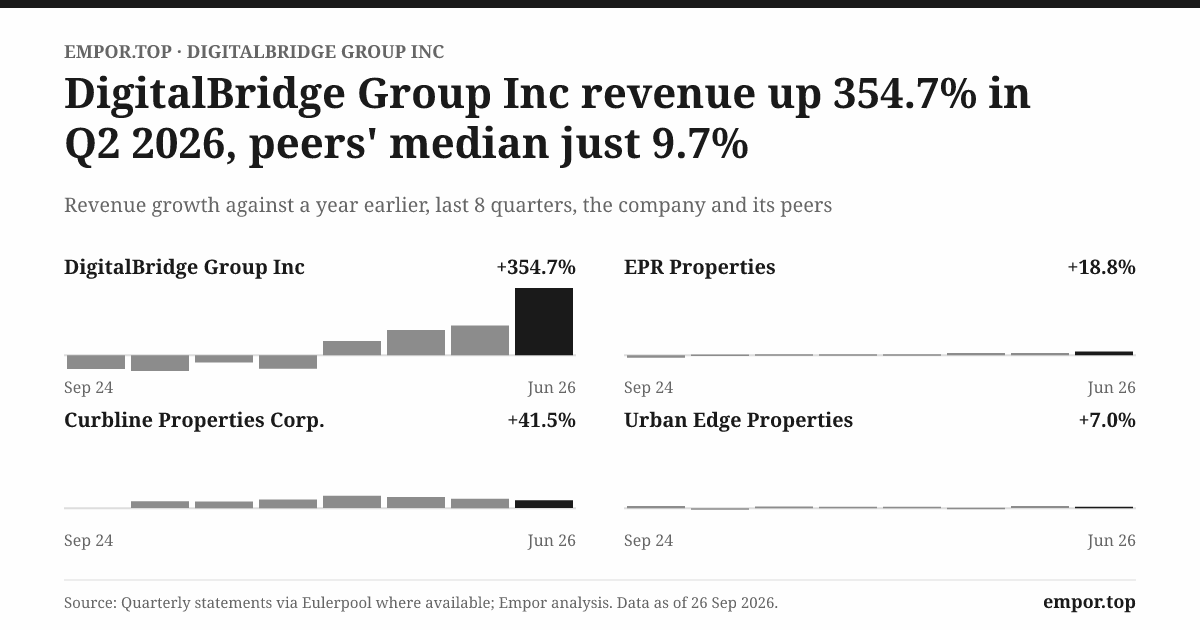
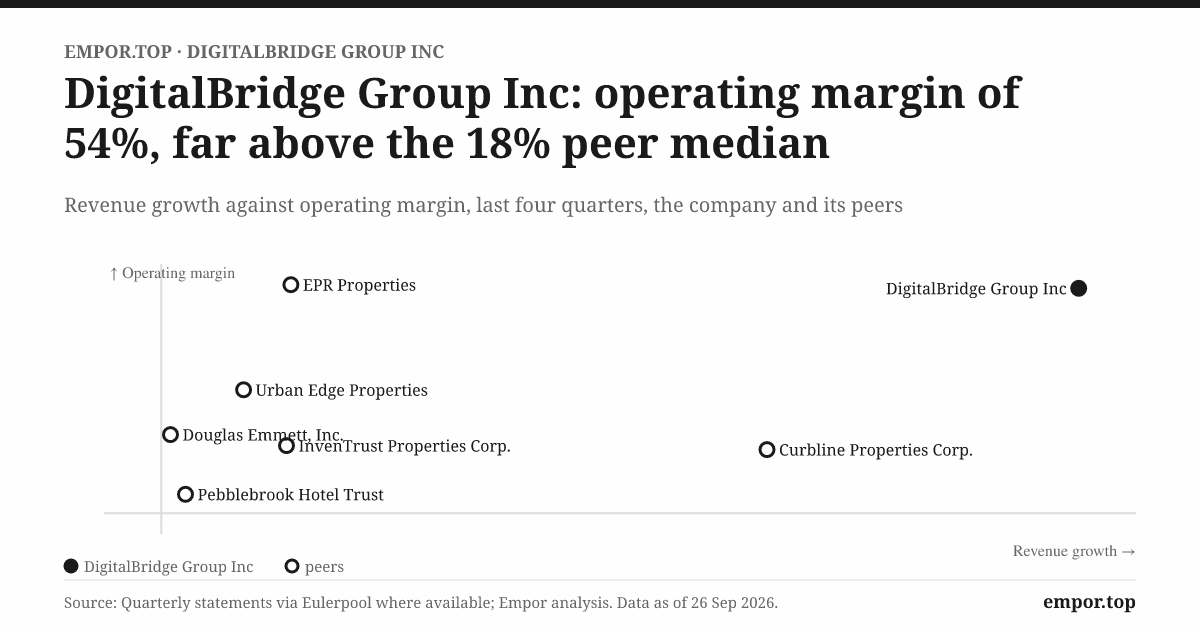
The empirical record shows that this expectation was only partially realized. Operating fundamentals did expand: annual fee revenues reached $375 million in 2025, while fee-related earnings grew to $142 million, lifting the firm's fee-related earnings (FRE) margin—calculated as fee-related earnings divided by fee revenue—from 32% in 2024 to 38% in 2025.4 Yet a 38% margin remained well below the 50%-plus operating margins standard among established alternative asset managers, and achieving it required several years of steady capital deployment. Furthermore, the margin expansion proved vulnerable to fundraising volatility; in the second quarter of 2026, the FRE margin retreated to 30%, accompanied by a 17% year-over-year decline in fee-related earnings.28
Simultaneously, the corporate capital structure remained encumbered by expensive financing instruments inherited from earlier transactions. At the close of 2025, DigitalBridge carried $822 million in preferred stock on its balance sheet with a blended distribution rate of 7.1%, requiring roughly $58 million in annual cash dividends that held payment priority over common equity—a sizable ongoing obligation measured against $142 million in full-year fee-related earnings.4 In practical terms, more than 40% of the firm's core operational earnings remained committed to servicing preferred equity issued during the Colony era.
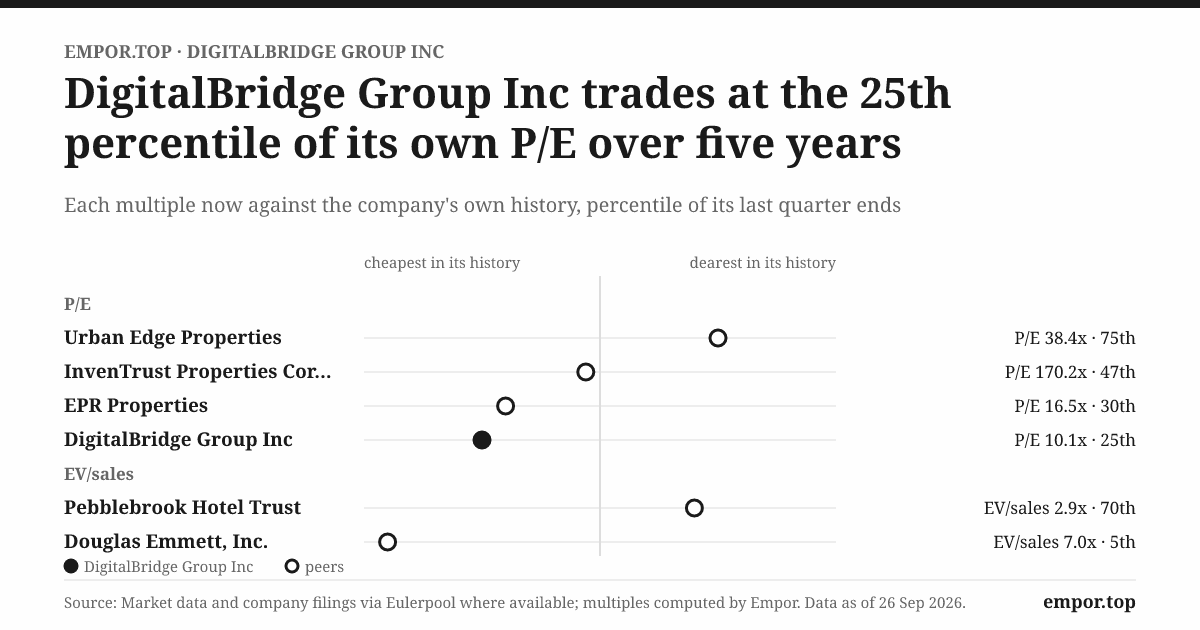
Public equity valuations reflected those structural burdens. Following a 1-for-4 reverse stock split in August 2022, the shares traded for the subsequent three years at valuations persistently depressed relative to their early-2022 levels.29 The 50% premium SoftBank offered over an unaffected 52-week baseline near $10.67 per share demonstrated how heavily public markets continued to discount the platform's standalone corporate structure.1
Verdict: the claim is narrowed. The asset-light transformation succeeded in eliminating the catastrophic balance-sheet solvency risks that threatened the enterprise in 2020, and it established a growing institutional fee stream. However, it failed to achieve the operating margins or valuation multiples characteristic of premier alternative asset managers. The revised reality is that DigitalBridge emerged as a specialized, sub-scale digital manager carrying significant legacy capital costs. The decisive benchmark that would have validated a true institutional rerating—a durable FRE margin above the mid-40% threshold independent of episodic catch-up fees—never materialized during the firm's tenure as an independent public company. To understand the operational forces governing those margins, the analysis must turn to the internal mechanics of the asset-management machine itself.
VII. Anatomy of the Platform: The Five Pillars & Segment Economics (02:08 – 02:38) [30 Mins]
A Tour of the Physical Internet
A single artificial intelligence query initiated on a smartphone illustrates the architecture of the modern physical internet. The prompt leaves the handset as a high-frequency radio signal and strikes an antenna mounted on a telecommunications tower—such as one operated by Vertical Bridge, which describes itself as the largest private owner and operator of wireless infrastructure in the United States, with more than 17,000 towers.[^33] From the tower, the data travels across terrestrial fiber conduits, such as Zayo's long-haul network, toward a centralized computing hub. If the query requires an advanced frontier model, it routes into a hyperscale campus operated by Vantage Data Centers or Switch, where thousands of graphics processing units draw megawatts of electrical power and generate heat requiring industrial cooling systems. The synthesized answer then retraces that transmission path across the network in fractions of a second.
DigitalBridge's managed private funds assembled equity stakes across nearly every link in that transmission chain. This operating architecture formed the basis of the firm's "five pillars" thesis: data centers, macro cell towers, fiber networks, small cells, and edge computing, underwritten not as distinct, isolated property sectors, but as an integrated communications ecosystem.
Pillar One: Data Centers, Where the Weight Sits
Within that five-pillar framework, data centers served as the platform's primary economic center of gravity. That pillar comprised three distinct operating businesses addressing different layers of enterprise demand: Vantage Data Centers develops wholesale hyperscale campuses for cloud service providers and artificial intelligence developers across North America, Europe, and Asia-Pacific; Switch operates large enterprise and hyperscale campuses, primarily in Nevada and other low-latency hubs; and DataBank provides colocation and regional edge capacity to enterprise customers across secondary U.S. markets. Their underlying business models differ substantially. Vantage leases massive blocks of computing capacity to a concentrated roster of creditworthy technology tenants on long-term contracts. DataBank sells modular power and rack space in smaller increments to hundreds of enterprise clients who prioritize local network proximity. Switch occupies a middle tier, characterized by proprietary high-density engineering designs and multi-tenant campuses.
The capital intensity across this pillar remains extraordinary. Developing a modern AI computing campus requires securing zoned land, electrical substations, utility transmission interconnections, industrial cooling plants, and physical shells long before a tenant energizes hardware or remits contractual rent. Consequently, the vast majority of DigitalBridge's institutional capital deployment and co-investment activity between 2023 and 2025 concentrated within this pillar. That capital intensity also left the data center segment acutely exposed to utility interconnection queues and regional electrical power bottlenecks.
Pillars Two Through Five: Towers, Fiber, Small Cells, and Edge
The remaining four pillars provided complementary operating profiles across the communications stack. Telecommunications towers operate as the platform's steady utility assets: long-term commercial leases, contractual annual rent escalators, and negligible tenant churn generate bond-like cash flows. Terrestrial fiber networks serve as the connective plumbing—essential to transport data between wireless nodes and compute clusters, but operationally complex, characterized by elevated maintenance capital expenditures and the constant risk of competitive route overbuilding. Small cells and distributed antenna systems provide network densification in metropolitan corridors, transit systems, and sports venues where macro towers cannot meet localized traffic density. Edge computing—decentralized micro data centers situated in close proximity to end users—represented one of the most heavily promoted concepts during the 2019–2021 fundraising cycle; however, its realized commercial revenue remained modest relative to initial industry projections, functioning more as strategic optionality than as an established profit pool.
For institutional fund investors, each pillar presents a divergent risk-and-return profile. Communications towers behave like inflation-hedged fixed income with modest volume upside. Fiber networks trade closer to traditional telecom operators, subject to enterprise customer churn, route pricing compression, and ongoing capital maintenance. Data centers operate as high-risk greenfield development vehicles during initial site acquisition and construction, transitioning into long-term infrastructure leases once utility power is delivered and tenant capacity is energized. Managing all five segments allowed DigitalBridge to market a comprehensive infrastructure menu to institutional limited partners, while simultaneously requiring the investment team to demonstrate underwriting expertise across businesses with fundamentally different unit economics.
How DigitalBridge Actually Makes Money
Understanding the corporate platform requires distinguishing the parent asset manager from the underlying physical infrastructure. DigitalBridge did not generate its primary corporate revenue from leasing tower antenna space or selling wholesale megawatts of data center capacity; those revenues accrued to the underlying portfolio companies. Instead, DigitalBridge earned contractual fees for managing the institutional equity that financed those assets. Four primary financial mechanisms governed this revenue engine:
Fee-earning equity under management (FEEUM) forms the contractual capital base against which management fees are assessed. At the end of 2025, this base stood at $41.0 billion, comprising $17.8 billion across the flagship DigitalBridge Partners fund series, $15.2 billion in dedicated co-investment vehicles, $3.6 billion in InfraBridge, $3.2 billion in core, credit, and liquid strategies, and $1.2 billion in separately capitalized portfolio companies.4 During 2025, gross capital inflows reached $7.5 billion against $2.1 billion in capital outflows, distributions, and realization events.4 Those outflows highlight the structural dynamics of closed-end private equity funds: as assets are harvested and equity is returned to limited partners, the fee-earning base naturally contracts, obligating the manager to sustain a continuous fundraising pipeline simply to maintain steady-state fee generation.
Management fees are assessed as an annual percentage of that capital base. Effective fee rates vary considerably across investment vehicles: flagship commingled funds command standard private equity management fees, whereas bespoke co-investment vehicles—syndicated to large sovereign wealth funds and public pension plans—command significantly discounted fee structures. Management noted on its third-quarter 2025 earnings call that average co-investment fee rates had reached approximately 70 basis points; while this reflected improved pricing discipline, it also underscored that roughly 37% of the firm's total fee-earning equity yielded fee rates well below those of the flagship commingled funds.30
Fee-related earnings (FRE) represent base management fees and advisory revenue minus compensation and corporate operating overhead—functioning as the alternative asset management sector's standardized metric for recurring operational profitability. DigitalBridge generated $142 million in fee-related earnings in 2025, achieving a 38% FRE margin.4 However, that headline profitability was augmented by "catch-up fees"—lump-sum retrospective payments collected when subsequent institutional investors join later closings of an existing fund. Excluding these retroactive payments, the firm's normalized FRE margin for the third quarter of 2025 stood at 34% rather than the reported 40%.31 Disentangling those episodic catch-up fees from baseline contract revenue is essential for evaluating the platform's underlying run-rate operating efficiency.
Carried interest and principal investments represent the platform's capital upside. Private fund structures typically award the general partner a contractual share of cumulative portfolio profits—historically 20%—once limited partners achieve a hurdle rate or preferred return. Alongside its fund management duties, DigitalBridge committed its own balance sheet to sponsor-level co-investments; at the close of 2025, the firm carried $1.45 billion in these general partner-affiliated investments.4 While carried interest and balance-sheet equity appreciation offer substantial upside during market expansions, they remain the most volatile and episodic component of asset management cash flows. Management cautioned analysts in late 2025 that the realization of accrued carried interest would materialize gradually over a three-to-five-year harvest window.30
Fundraising: The Engine and Its Speed
The trajectory of the flagship fund series illustrates both the expansion and the structural constraints of the franchise. The inaugural vehicle, Digital Colony Partners, concluded fundraising at $4.05 billion in May 2019.13 Its successor, DigitalBridge Partners II, closed in January 2022 at $8.3 billion, substantially exceeding its original $6.0 billion target during a peak period for global private equity allocations.32 The third vintage, DigitalBridge Partners III, announced in November 2025, secured more than $7.2 billion in primary commingled fund commitments alongside $4.5 billion in designated co-investment commitments, achieving $11.7 billion in aggregate capital formation.[^37]
A closer examination of those capital formation metrics reveals important structural shifts. Measured by total syndicated capital including co-investment, DBP III represented the largest fundraising campaign in the strategy's history. However, the core commingled fund—the flagship vehicle delivering the highest contractual management fee rates and full carried-interest economics—contracted from $8.3 billion to $7.2 billion, closing nearly four years after the second vintage during a prolonged industry-wide slowdown in institutional private equity allocations. While expanding the co-investment sleeve allowed DigitalBridge to meet the heavy capital requirements of large-scale AI data center developments, this structural shift toward lower-fee co-investment diluted the blended management fee rate across the broader platform.
Where the Economic Weight Resides
In corporate essence, DigitalBridge operated as an institutional asset-management wrapper positioned around hyperscale compute capacity and wireless network densification, relying on data centers for capital expansion and communications towers for cash flow stability. That operational concentration established the company's investment appeal during the artificial intelligence investment cycle of 2024 and 2025. Yet it also exposed the platform to acute structural vulnerabilities: when an investment strategy depends on a concentrated roster of technology hyperscalers navigating regional electrical grid constraints, fee activation and capital deployment proceed only as quickly as physical power substations and transmission lines can be energized.
This operational reality explains why public equity markets valued the company at a persistent discount. Institutional investors typically capitalize an asset manager's recurring fee-related earnings using premium valuation multiples, similar to recurring enterprise subscription revenues, while discounting episodic carried interest realizations and balance-sheet co-investments as volatile, lower-quality earnings. That valuation framework rewards alternative asset managers that demonstrate large, predictable, and high-margin fee-related earnings. DigitalBridge's central dilemma throughout its tenure as an independent public company was that a significant share of its economic value remained tethered to episodic transaction execution, fundraising closings, and capital-intensive balance-sheet co-investments—setting the stage for the physical power bottlenecks and deployment hurdles that defined its final operating chapters.
VIII. M&A, Capital Allocation, & The Power Bottleneck: Benchmarking the Megadeals (02:38 – 03:06) [28 Mins]
InfraBridge: Buying a Beachhead
On February 2, 2023, DigitalBridge completed the acquisition of AMP Capital's global infrastructure equity investment management business for $316 million, alongside potential contingent payments, subsequently rebranding the platform as InfraBridge.33 The transaction transferred four active investment funds and $5.6 billion in fee-earning assets—anchored by the $3.4 billion Global Infrastructure Fund II—and an operating management team led by Damian Stanley.33
The strategic rationale centered on diversification: InfraBridge provided an established operating bench, a regional footprint across Europe and Asia, and a portfolio spanning transportation, logistics, and digital assets. This footprint expanded DigitalBridge's commercial reach among institutional allocators seeking exposure beyond dedicated digital infrastructure. However, the subsequent operating trajectory revealed the friction in scaling acquired platforms. By the close of 2025, InfraBridge's fee-earning equity had contracted to $3.6 billion, falling well below the $5.6 billion acquired at closing.433 While capital run-off is normal as mature closed-end vehicles harvest assets and distribute proceeds, the core economic premise of buying an asset manager is raising successor vintages. Through 2025, the acquired capital base ran off faster than new commitments replaced it.
Verdict on the InfraBridge purchase: narrowed. The transaction added specialized operating personnel and established relationships across Europe and Asia, but the public record through 2025 does not show InfraBridge operating as an autonomous growth engine. The decisive benchmark that would alter this assessment is the successful closing of an institutional successor fund of commensurate scale.
Switch: A Top-of-Cycle Megadeal
In May 2022, DigitalBridge's investment management arm and IFM Investors agreed to take data center operator Switch private for $34.25 per share in cash, concluding an $11 billion leveraged buyout, inclusive of debt refinancing, on December 6, 2022.3435 Switch contributed expansive, power-secured campuses in Reno and Las Vegas, an established renewable-energy procurement pipeline, and proprietary high-density engineering designs shaped by a differentiated, founder-led culture.
The valuation reflected peak-cycle pricing. The transaction was structured during the first half of 2022, just as global central banks initiated the sharpest monetary tightening cycle in four decades, significantly elevating the debt financing costs that underpin leveraged buyouts. What ultimately insulated the underwriting thesis was not entry multiple discipline, but the subsequent surge in artificial intelligence compute demand. That acceleration rendered Switch's pre-contracted utility power and zoned land reserves far more valuable than when the transaction was struck. While the commercial outcome proved favorable, institutional analysis must distinguish market timing from underwriting conservatism: the investment's ultimate margin of safety owed far more to the macroeconomic timing of the AI wave than to initial valuation restraint.
ArcLight: The Last Public-Company Deal
The firm's most revealing capital allocation maneuver unfolded while the SoftBank buyout was pending. On May 27, 2026, DigitalBridge agreed to acquire ArcLight Capital Partners, a specialist infrastructure manager focused on power generation and electric transmission, for an upfront purchase price of $650 million alongside up to $400 million in contingent consideration tied to ArcLight's operational earnings between 2027 and 2029.36 The combined enterprise was projected to oversee more than $150 billion in consolidated assets, supported by cash and debt financing that included a commitment for a secured bridge loan facility of up to $500 million.36 Under the terms of the transaction, ArcLight was slated to operate as an autonomous investment division within DigitalBridge following the consummation of the SoftBank acquisition.36
The acquisition followed directly from the constraints of the power thesis: if electrical grid capacity forms the binding operational bottleneck on digital infrastructure deployment, acquiring a manager of generation facilities and transmission assets represents a logical upstream integration. Yet the execution risks mirrored earlier platform transactions. DigitalBridge's previous platform acquisition, InfraBridge, experienced a contracting fee base, and ArcLight represented a larger, earnout-heavy commitment negotiated while public common equity holders were awaiting cash settlement. Because common shareholders were slated to receive a fixed $16.00 per share regardless of transaction performance, the ultimate economic risk and operational ownership of the integration accrued directly to SoftBank.
The Generative AI Explosion
The demand fundamentals governing digital infrastructure shifted dramatically in late 2022. Commercial data center capacity requirements scaled from tens of megawatts per individual facility to hundreds of megawatts, before progressing to gigawatt-scale master-planned campuses. On January 9, 2024, Vantage Data Centers announced a $6.4 billion equity recapitalization led by DigitalBridge and Silver Lake, complemented by an independent €1.5 billion equity investment from AustralianSuper into Vantage's European operations.37 Strong institutional co-investment demand led the sponsors to upsize the global capital round to $9.2 billion by June 2024.38
By the third quarter of 2025, leasing across the operating portfolio reached unprecedented volumes. During the third-quarter investor call, Ganzi disclosed that portfolio companies had secured commitments for a record 2.6 gigawatts of new capacity, claiming approximately one-third of total U.S. hyperscale leasing activity during the period.30 Management highlighted Vantage's Frontier and Lighthouse development campuses as representing approximately $40 billion in cumulative project commitments, supported by a separate $1.6 billion equity co-investment from sovereign wealth funds GIC and ADIA into Vantage's Asia-Pacific platform.31 Addressing the physical realities of deployment, Ganzi emphasized the sector's utility constraints: "In today's environment, power is everything. You cannot build a 1 gigawatt AI campus without 1 gigawatt of power."30
Historical Falsification: Does Leasing Become Fees Quickly?
The core bull thesis throughout 2024 and 2025 maintained that historic leasing volumes across portfolio companies would translate rapidly into expanding management fees and operating cash flows for DigitalBridge. Signed leases from investment-grade hyperscale tenants provided verified commercial demand. However, the operational transmission mechanism separating a signed lease from parent-level fee realization involves three sequential hurdles: the portfolio business must arrange external project financing, the sponsor must convert that capital into fee-earning equity under management, and the facility must complete construction and grid energization so the property generates cash distributions.
Friction materialized at each stage. Utility interconnection timelines elongated significantly across major computing corridors; across the PJM Interconnection grid serving the Mid-Atlantic market, the duration from initial interconnection filing to commercial energization extended over multiple years, compounded by industry-wide manufacturing backlogs for specialized transformers and switchgear equipment.39 Corporate financial filings reflected those deployment delays. After expanding to $41.0 billion at the close of 2025, DigitalBridge's fee-earning equity stood at $40.2 billion by the end of June 2026—representing a modest 1% increase over the trailing twelve months—while quarterly fee-related earnings contracted 17%.284 Record leasing of 2.6 gigawatts in a single operating quarter failed to generate a commensurate near-term acceleration in corporate earnings.
To understand why electrical power emerged as the primary operational bottleneck, a data center is best evaluated as an industrial facility whose essential economic output is electricity converted into digital computation. While an enterprise colocation facility might consume a few megawatts of power, a hyperscale AI training campus requires hundreds of megawatts to more than a gigawatt—a load profile comparable to a mid-sized metropolitan area. Supplying that volume of power requires custom-engineered substations, dedicated high-voltage transmission spurs, and heavy step-down transformers, all subject to rigorous utility engineering reviews and regulatory queue sequencing. Concrete shells and server halls can be erected within months; utility transmission interconnections require years.
Verdict: the claim is narrowed. Tenant demand is substantiated by investment-grade hyperscalers and record contractual leasing volumes, but the conversion of signed leases into manager-level fee revenue is slow, episodic, and gated by physical infrastructure backlogs and capital formation schedules. The decisive metric tracking that transmission mechanism is organic fee-earning equity growth net of portfolio realizations; when that metric decelerates during a leasing expansion, economic value accrues to the underlying operating companies and direct co-investors rather than to the parent asset manager.
IX. Strategic Frameworks: Porter's Five Forces & Hamilton Helmer's 7 Powers (03:06 – 03:28) [22 Mins]
The War Room
Consider the investment committee whiteboard of a digital infrastructure manager during the midpoint of the decade. On one side stood a concentrated roster of technology hyperscalers: Microsoft, Amazon, Google, and Meta. On the other lay regional electrical utilities constrained by multi-year interconnection queues. Positioned in the middle was an expanding cohort of well-capitalized rivals—Blackstone, KKR, Brookfield, Stonepeak, and Global Infrastructure Partners (subsequently acquired by BlackRock)—alongside sovereign wealth funds that increasingly bypassed external sponsors to deploy capital directly. DigitalBridge's core commercial objective was to extract an asset-management fee for intermediating between those forces. Applying Michael Porter's Five Forces and Hamilton Helmer's 7 Powers framework provides a disciplined method for evaluating the structural defensibility of that position.
Porter's Five Forces
Bargaining power of buyers: high, on two distinct fronts. The first category of buyers comprises the limited partners who provide institutional capital. Sovereign wealth funds and public pension plans negotiated fee concessions, demanded extensive co-investment allocations, and increasingly deployed direct equity. The structural shift toward co-investment, carrying materially discounted fee rates, provided tangible evidence of limited-partner leverage.430 The second category of buyers comprises the hyperscale tenants. Technology conglomerates wielded vast balance sheets, constructed proprietary campuses when third-party development pricing escalated, and redirected compute workloads across geographic regions to exploit power availability.
Bargaining power of suppliers: exceptionally high. Regulated utilities control transmission interconnections, industrial manufacturers dictate lead times for step-down transformers, switchgear, and liquid cooling systems, and semiconductor availability governs deployment schedules. These suppliers did not compete for a sponsor's business in a conventional procurement market; they rationed scarce, inelastic physical capacity.
Threat of new entrants: moderate at the asset level, elevated via corporate acquisition. Developing a gigawatt-scale computing campus demands years of local zoning approvals, environmental reviews, and billions in capital expenditure. However, well-capitalized multi-strategy asset managers bypassed greenfield hurdles by acquiring established operating platforms outright. Blackstone's purchase of QTS, the joint acquisition of CyrusOne by KKR and Global Infrastructure Partners, and Brookfield's buildout of global data center and tower platforms illustrated how alternative asset giants bought immediate scale.
Threat of substitutes: low for the physical assets, substantial for the asset manager. No practical technological substitute exists for physical cell towers or energized data centers. Yet institutional capital readily substituted alternative avenues to access the asset class: generalist infrastructure funds, direct sovereign co-investments, and tenant-led self-builds.
Competitive rivalry: intense. Contests for power-secured land parcels, long-haul fiber rights-of-way, and wireless portfolios pitted DigitalBridge against global sponsors possessing substantially lower costs of capital, investment-grade parent balance sheets, and extensive cross-selling distribution networks.
The resulting industry structure reveals a fundamental asymmetry: while underlying digital infrastructure assets enjoy formidable commercial moats, the specialized asset manager's intermediary position remained fiercely contested. That distinction permeates Hamilton Helmer's framework.
The competitive dynamic with diversified mega-managers clarifies the challenge. Platforms such as Blackstone's QTS, Brookfield's telecommunications and data center businesses, and KKR's digital investments operated within global asset-management franchises commanding hundreds of billions of dollars in multi-strategy capital. Those institutions maintained integrated capital-raising channels across pension funds, sovereign entities, insurance balance sheets, and private wealth networks. DigitalBridge countered with pure-play sector focus, technical operating expertise, and execution speed. Its structural vulnerability was that diversified rivals could absorb lower baseline returns, commit multi-billion-dollar equity checks without syndication delays, and cross-sell limited partners across private equity, real estate, and credit strategies. Sector specialization commands premium economics primarily when market knowledge is proprietary or scarce. By 2024, the operational thesis of digital infrastructure had become mainstream institutional consensus.
Hamilton Helmer's 7 Powers
Cornered resource: genuine at the physical asset level, narrow at the manager level. A data center campus possessing an energized, large-scale utility interconnection in a power-constrained market represents a classic cornered resource that cannot be rapidly replicated. Yet that scarce resource is owned by the portfolio operating company and its private fund investors, not DigitalBridge Group. The parent asset manager's cornered resource was limited to early-mover relationships and a head start in identifying and optioning development sites before utility interconnection queues extended to multi-year horizons.
Switching costs: high for commercial tenants, moderate for fund investors. Wireless carriers rarely relocate antenna arrays given the operational friction of radio-frequency re-engineering, and hyperscale tenants do not vacate fully energized, customized server halls mid-lease. Those steep switching costs shielded the cash flows of underlying portfolio companies. Conversely, institutional limited partners faced low contractual barriers to shifting capital allocations to competing sponsors between fund vintages. The contraction of the core commingled flagship vehicle in DigitalBridge Partners III relative to its predecessor demonstrated that institutional capital actively exercised allocator mobility.32[^37]
Process power: the platform's most credible claim. The specialized operating teams led by Ganzi and Jenkins accumulated decades of experience navigating municipal zoning, carrier negotiations, and greenfield infrastructure development. That operational fluency was substantiated by the expansion of platforms such as Vantage Data Centers and Vertical Bridge into scaled operators capable of attracting substantial institutional co-investment from sponsors including Silver Lake, GIC, ADIA, and KKR.3831[^33] The structural constraint of process power in private equity, however, is that organizational capability resides in key investment professionals and operating executives rather than proprietary corporate patents, leaving it vulnerable to executive turnover.
Scale economies: moderate. Volume purchasing in procurement and construction hardware offered incremental efficiencies, but power purchase agreements and utility interconnections remained fundamentally local, while larger alternative peers wielded broader corporate purchasing power.
Network economies: negligible. A wireless tower in Ohio does not enhance the operational utility or leasing economics of a hyperscale data center in Texas. While managing multiple layers of the communications stack provided deal-sourcing intelligence and market visibility, it did not create true self-reinforcing network effects.
Counter-positioning: historically decisive, subsequently exhausted. Between 2019 and 2021, Colony Capital's radical decision to liquidate diversified legacy real estate and commit entirely to digital infrastructure represented a contrarian maneuver that established generalist incumbents were unwilling to execute. By 2024, however, every leading global alternative asset manager had established dedicated digital infrastructure and energy transition funds, neutralizing the early-mover advantage.
Branding: minimal with enterprise tenants, meaningful with institutional allocators. Hyperscale technology tenants underwrite leases on available electrical power, project delivery timelines, and commercial rental rates rather than sponsor brand identity. Among institutional allocators, however, the DigitalBridge franchise maintained meaningful brand equity as the pioneering pure-play manager in the digital infrastructure sector.
What the Frameworks Say Together
When evaluated in tandem, Porter's Five Forces and Helmer's 7 Powers yield a sobering structural verdict for public equity holders. The platform's most durable economic moats—cornered utility interconnections and tenant switching costs—resided at the portfolio company level, where cash flows accrued primarily to limited partners and direct co-investors. At the parent asset-manager level, DigitalBridge's primary competitive advantages—process power and specialized category branding—were dependent on individual personnel and subject to continuous fundraising cycles against diversified competitors possessing deeper balance sheets and lower capital costs.
This structural asymmetry explained why a long-horizon strategic conglomerate like SoftBank could value the franchise's specialized operating machinery far more aggressively than quarterly public equity markets. That fundamental divergence between asset-level quality and manager-level economics set the stage for the contentious debate between the bull and bear cases that defined the company's final years as a listed entity.
X. The Bear vs. Bull Stress Test & Management Credibility Audit (03:28 – 03:52) [24 Mins]
The People in the Room
Marc Ganzi served as chief executive officer from July 2020 and remained the board's sole non-independent director through 2025.15 Ben Jenkins, his co-founder, served alongside him as president and chief investment officer.15 Thomas Mayrhofer joined as chief financial officer in early 2024, succeeding Jacky Wu; he had spent nearly eighteen years at Carlyle in finance roles across private equity, energy, real estate, and credit, and previously served as CFO and then COO of alternative asset manager EJF Capital.40 Appointing a chief financial officer with deep pedigree at an established alternative asset manager signaled that DigitalBridge sought to be evaluated against multi-strategy private equity peers.
Myth vs. Reality: Five Popular Narratives
Myth: DigitalBridge owned the data centers. Reality: its investment funds owned the assets. DigitalBridge held minority equity stakes and managed the properties for institutional fees; following the DataBank deconsolidation, the corporate balance sheet carried mostly general-partner co-investments totaling roughly $1.45 billion.426
Myth: The pivot was completed in 2021. Reality: the Wellness portfolio divestment did not close until February 2022, and expensive Colony-era preferred stock remained on the balance sheet through 2026, structured to survive the SoftBank acquisition as preferred equity of the privatized entity.2141
Myth: Record leasing translates immediately into record fees. Reality: fee-earning equity remained essentially flat year over year by mid-2026, even after portfolio companies achieved record leasing volumes throughout 2025.2830
Myth: SoftBank paid an AI-bubble peak valuation. Reality: the $16.00 cash buyout price offered just a 15% premium over the final undisturbed trading session, with the widely cited 50% premium calculated against an unaffected 52-week average that had hovered near $10.67 per share.1
Myth: Management consistently achieved its stated performance targets. Reality: the team reached certain milestones, such as achieving its 2025 FEEUM objective one quarter ahead of schedule.31 However, operating margins remained persistently below those of established alternative asset managers, and operating trajectory reversed following 2025.28
The Three KPIs That Mattered
For institutional allocators and equity analysts evaluating the franchise, three operating metrics provided decisive signal.
First, organic FEEUM expansion, measured as new activated institutional capital minus distributions and realization events. This metric demonstrated whether the platform was capturing incremental institutional market share or simply recycling capital from mature fund vintages.
Second, normalized FRE margin excluding retrospective catch-up fees, which isolated baseline operational cost leverage from the episodic lump-sum payments tied to multi-stage fund closings.
Third, carried interest realization velocity, tracking how efficiently mature platforms such as Vantage Data Centers, Vertical Bridge, and DataBank were harvested above contractual hurdle rates, dictating whether accrued paper performance fees could be converted into distributable cash.
The Bull Case SoftBank Bought
The investment thesis supporting SoftBank's acquisition rested on tangible macro tailwinds. Frontier artificial intelligence models require an unprecedented physical rollout of hyperscale compute campuses, high-bandwidth fiber routes, and utility power generation. DigitalBridge's underlying operating companies had secured scarce transmission interconnections, zoned land banks, and deep relationships with investment-grade technology tenants, resulting in record leasing volumes across the portfolio.30
Fundraising momentum also demonstrated commercial demand: DigitalBridge Partners III, incorporating dedicated co-investment capital, achieved $11.7 billion in total commitments, representing the largest capital formation campaign in the strategy's history.[^37] Furthermore, the agreed acquisition of ArcLight Capital Partners positioned the platform to integrate power generation and transmission assets at the primary physical bottleneck constraining data center energization.36 For SoftBank, which had committed vast resources across semiconductor design, foundation models, and AI robotics, acquiring an established asset manager offered a proven vehicle to syndicate institutional capital alongside its own strategic investments.
The Bear Case That Capped the Stock
The counter-thesis that kept the public equity trading at a steep discount was grounded in structural vulnerabilities.
First, customer concentration: a small cohort of hyperscale technology developers drove the vast majority of data center leasing, meaning any moderation in corporate AI capital expenditure would impair tenant absorption, development yields, and third-party fund allocations simultaneously.
Second, competitive scale: managing approximately $41 billion in fee-earning equity left DigitalBridge at a severe disadvantage against multi-strategy giants such as Blackstone, Brookfield, and KKR, each of which operated scaled digital infrastructure portfolios while offering limited partners integrated multi-asset investment menus.
Third, balance-sheet drag: servicing $822 million of legacy preferred stock carrying a blended 7.1% distribution rate, combined with elevated corporate operating overhead, constrained the firm's FRE margins relative to alternative asset management peers.4
Fourth, fundraising cyclicality: contractual fee revenue stepped up intermittently alongside closed-end fund vintages, and the flagship commingled vehicle contracted from $8.3 billion in its second vintage to $7.2 billion in its third.32[^37]
Broader cyclical and regulatory headwinds compounded those constraints. Elevated interest rates increased borrowing costs for debt-financed tower and data center developments while compressing capitalization rates on long-term tenant leases, slowing capital recycling and asset harvesting. Technological risk remained nuanced: while more efficient algorithms could reduce the compute required per model query, historically lower computing costs expanded aggregate demand. Finally, regulatory review was underscored by the buyout itself, which required multi-agency scrutiny—including CFIUS and FERC approvals—before a foreign entity could assume control of an asset manager directing critical domestic communications and energy-linked infrastructure.[^1]
The Activist Audit
A rigorous corporate audit centers on three areas of operational friction:
Capital allocation discipline: Acquiring Wafra's minority stake for $800 million, absorbing InfraBridge only to see its fee-earning capital contract, and committing more than $650 million in upfront consideration for ArcLight while a buyout agreement was pending represented capital-intensive maneuvers that sat uneasily alongside the core commitment to an asset-light operating model.243336
Governance and key-person risk: Leadership remained centered around an assertive founder-CEO, accompanied by costly personnel disputes. According to reporting by the industry newsletter The Promote, an arbitration tribunal awarded former executive Jonathan Grunzweig approximately $14 million, including punitive damages, after DigitalBridge terminated him in 2022 and sought to repurchase his accrued carried interest for a nominal amount following his decision to post his private home as bail surety for Tom Barrack.42 While the complete corporate defense was not detailed in that reporting, the ruling served as a reminder that executive carried interest allocations and internal governance disputes could create material balance-sheet liabilities.
Corporate disclosure and transparency: Following the merger announcement with SoftBank, DigitalBridge ceased conducting quarterly investor conference calls and discontinued detailed forward financial guidance, following standard transaction protocol but leaving public shareholders without access to live executive questioning throughout 2026.24
Credibility Over Time
Marc Ganzi's reputation as an operational builder was substantiated by tangible results: the profitable expansion and sale of Global Tower Partners, the worldwide development of Vantage Data Centers, and sustained institutional capital raising across successive fund cycles. His track record as a public-company steward proved more nuanced. On quarterly earnings calls, he consistently framed market opportunities in expansive terms; when questioned by analysts regarding escalating competition from diversified private equity firms, he insisted that "differentiation isn't about press releases. Differentiation is about execution."30
That benchmark provides a fair standard for evaluation. The historical record demonstrated formidable operational execution at the underlying property level, contrasted with an asset-management parent whose operational earnings and fee margins expanded far more conservatively than executive commentary suggested. The public market's ultimate verdict was an all-cash sale at $16.00 per share—delivering a welcome cash exit for recent investors, yet settling well below the valuations commanded during the optimistic peaks of 2021 and 2022.
XI. The Playbook: Durable Business & Investing Lessons (03:52 – 04:10) [18 Mins]
1. The Curse of the Uncorrelated Conglomerate
The 2017 NorthStar combination was predicated on the premise that housing senior healthcare facilities, select-service hotels, industrial warehouses, and subordinate debt under a single corporate umbrella would deliver cash-flow stability and lower capital costs. Within fourteen months of closing, that structure resulted in a 60% dividend cut.8 Portfolio diversification mitigates risk only when investors can independently evaluate and price each constituent asset; when those businesses are underperforming and the consolidated balance sheet is opaque, public markets invariably penalize the entire platform with a conglomerate discount. That same dynamic later challenged DigitalBridge in a milder form, as public equity investors struggled to categorize the business as a real estate investment trust, a specialized alternative asset manager, or an asset-heavy holding company.
2. Sinking the Ships Works, but It Is Not Free
Liquidating Colony's legacy real estate assets was the most defensible strategic choice available to management in 2020. Incremental repositioning would have left the company attempting to service billions in defaulted hospitality mortgages during a global pandemic. Yet the financial toll of that turnaround was severe: legacy portfolios surrendered near cyclical lows for nominal cash equity, costly preferred stock obligations that outlasted the corporate transformation, and years of restructuring friction.19214 Decisive balance-sheet liquidations can rescue an enterprise from insolvency, but they rarely preserve value for legacy common shareholders.
3. Physics Beats Spreadsheets
Software scales at near-zero marginal cost, but digital infrastructure expands only at the physical speed of utility substations, high-voltage transformers, and industrial cooling plants. The divergence between record commercial leasing and flat fee-earning equity across 2025 and 2026 serves as the clearest illustration in DigitalBridge's operational record.3028 Underwriting artificial intelligence infrastructure purely as an unconstrained demand curve, without accounting for regional transmission constraints and equipment lead times, will consistently lead investors to overestimate the pace of cash-flow realization.
4. Permanent Capital and Closed-End Funds Sit Uneasily Together
Colony originally accessed public equity markets to secure permanent balance-sheet capital that would eliminate the continuous treadmill of marketing successor private equity vintages. DigitalBridge's final corporate structure, however, was an alternative asset manager whose revenues and margins fluctuated with multi-year fundraising cycles and episodic capital closings—a lumpy financial rhythm that quarterly public markets struggle to value. When public equity markets persistently apply a structural discount to a long-cycle asset manager, a sale to a long-horizon strategic acquirer becomes the natural culmination. In those transactions, the final takeover price tends to reflect the depressed public trading baseline far more than the private replacement value of the underlying franchise.
5. Customer Monopsony Limits Moats
When the primary commercial tenants are balance-sheet giants such as Microsoft, Amazon, Google, and Meta, bargaining leverage resides overwhelmingly with the buyers, except in localized corridors where energized utility power is exceptionally scarce. The durable competitive moats in digital infrastructure do not stem from corporate branding or executive relationships, but from physical, energized transmission interconnections and hard-to-replicate municipal rights-of-way—economic advantages that accrue directly to property-level operating companies and project co-investors. A third-party asset manager creates value primarily by identifying and securing those assets before utility queues lengthen, an underwriting capability that is valuable but constantly contested by well-capitalized multi-strategy peers.
A related lesson governs how investors evaluate complex corporate transformations from the outside. Throughout the artificial intelligence infrastructure expansion from 2023 onward, the operating indicators across DigitalBridge's underlying portfolio companies—leasing volumes, secured power capacity, and project-level equity syndications—appeared consistently robust. By contrast, the financial metrics of the listed parent manager—fee-related earnings margins, organic fee-earning equity growth, and the ongoing cash cost of legacy preferred equity—told a far more measured story. When asset-level commercial momentum and parent-level financial performance diverge, the parent company's cash flows invariably dictate the share price.
Those strategic lessons pass from the public markets into SoftBank's stewardship as the firm begins its private operating chapter.
XII. Epilogue: Delisting into SoftBank's Artificial Super Intelligence Grid (04:10 – 04:22) [12 Mins]
The Final Days on the Big Board
With regulatory clearances from CFIUS, FERC, and international authorities secured on September 22, 2026, the final transition off public markets became a matter of mechanical execution: transaction closing, cash settlement of $16.00 per share to common shareholders, and the formal delisting of the common equity from the New York Stock Exchange.[^1] The preferred shares followed a divergent path; DigitalBridge had announced in early September its plan to voluntarily delist its series of preferred stock from the NYSE, leaving those securities outstanding as unlisted obligations of the surviving private entity.4341
The platform's final months of public trading were marked by active dealmaking. DigitalBridge and its partners agreed to acquire the VodafoneZiggo mobile tower portfolio to establish an independent European tower platform, opened an operating office in Tokyo, established a Japanese data center development venture branded Nippon Gateway Infrastructure, and expanded into adjacent real assets through acquisitions in smart utility metering and electrified bus fleets.43 Whether those expansions signal an evolution of the digital infrastructure mandate or an early re-emergence of the diversified asset portfolio that Colony once struggled to manage remains an open question for the private platform's institutional limited partners.
Masayoshi Son's Endgame
For SoftBank, the strategic rationale centers on industrial integration. The Japanese conglomerate controls semiconductor designer Arm and has directed tens of billions of dollars toward generative computing, including a reported $41 billion capital commitment to OpenAI.44 What the group lacked was an established institutional fundraising apparatus capable of channeling third-party capital into physical, power-secured computing infrastructure. DigitalBridge provides that operating engine, structured to function as an autonomous asset-management platform continuing under Marc Ganzi's executive leadership.1 If completed, the pending acquisition of ArcLight Capital Partners extends that footprint directly upstream into electrical power generation and transmission assets.36
Yet the structural risks of the acquisition accompany the platform into private ownership. SoftBank's corporate history pairs transformative technology investments with steep portfolio write-downs, and its aggregate artificial intelligence commitments represent substantial exposure relative to its balance sheet. For DigitalBridge's institutional limited partners, the primary operational concern centers on fiduciary independence: ensuring that private fund allocations and asset deployment serve fund limited partners rather than the strategic priorities of the corporate parent. Navigating that structural tension—housing a fiduciary fund manager inside a technology conglomerate advancing its own artificial intelligence ecosystem—represents the defining governance challenge of the platform's next phase, unfolding away from quarterly public disclosures.
Several structural questions will determine how that private chapter is evaluated. First, whether an asset manager owned by a single strategic parent can continue raising multi-billion-dollar commingled funds from sovereign wealth funds and pension systems that may compete with, or harbor reservations about, SoftBank's corporate agenda. Second, whether a future flagship vintage can eclipse the $7.2 billion raised by the main DigitalBridge Partners III vehicle. And third, whether the accrued carried interest embedded across Vantage Data Centers, Vertical Bridge, Switch, and DataBank can be realized at valuations that justify the capital poured into physical infrastructure during the peak of the artificial intelligence investment cycle. The answers will emerge in confidential limited-partner reports rather than public regulatory filings, but they will ultimately determine how the $16.00 buyout price is evaluated in hindsight.[^37]
Closing Thought
Thirty-five years after Tom Barrack began acquiring distressed loans in the wake of the savings-and-loan crisis, the organization he founded departs the public markets in an unrecognizable form: not as a diversified landlord of hotels and nursing facilities, but as an asset manager directing the communications towers, terrestrial fiber routes, and power-constrained data center campuses that underpin artificial intelligence. The corporate metamorphosis was real, and so were its financial costs. Colony's equity holders endured a value-destroying tri-party merger, a severe liquidity crisis, and a balance-sheet liquidation that saved the franchise from insolvency while crystallizing permanent equity losses. DigitalBridge's shareholders owned a far higher-quality operating platform that public markets persistently discounted against multi-strategy alternatives peers. SoftBank now takes the wheel, inheriting the unresolved economic question that shadowed the firm across its public life: in the race to construct the physical architecture of artificial intelligence, how much durable economic rent belongs to the asset manager in the middle.
References
-
SoftBank Group to Acquire DigitalBridge for $4 Billion to Scale Next-Gen AI Infrastructure — DigitalBridge Group, Inc., 2025-12-29 ↩↩↩↩↩↩↩↩
-
DigitalBridge Stockholders Approve Acquisition by SoftBank Group Corp. (Form 8-K Exhibit 99.1) — U.S. Securities and Exchange Commission, 2026-04-23 ↩↩
-
Thomas Barrack, Jr: The LA Real Estate Titan Keeps Riding Waves — C-Suite Quarterly, 2013-03 ↩↩↩↩↩
-
DigitalBridge Fourth Quarter and Full Year 2025 Financial Results (Form 8-K) — U.S. Securities and Exchange Commission, 2026-02-25 ↩↩↩↩↩↩↩↩↩↩↩↩↩↩
-
Colony Financial, Inc. Form 10-Q for the Quarter Ended September 30, 2009 — U.S. Securities and Exchange Commission, 2009-11 ↩
-
Colony Financial, Inc. Completes Combination with Colony Capital, LLC to Form Colony Capital, Inc. — Business Wire, 2015-04-02 ↩
-
Colony NorthStar Completes Tri-Party Merger (Form 8-K12B Exhibit 99.1) — U.S. Securities and Exchange Commission, 2017-01-11 ↩↩↩↩
-
Colony NorthStar Announces Fourth Quarter and Full Year 2017 Financial Results (Form 8-K Exhibit 99.1) — U.S. Securities and Exchange Commission, 2018-03-01 ↩↩↩↩↩↩↩↩
-
Colony NorthStar down 23% after big miss, slash to dividend — Seeking Alpha, 2018-03-01 ↩
-
Barrack to Step Down as CEO as Colony Buys Digital Bridge — Bloomberg, 2019-07-25 ↩↩↩↩
-
Colony Capital Acquires Digital Bridge Holdings for $325 Million and Announces Planned Strategic Initiatives — Business Wire, 2019-07-25 ↩↩↩↩
-
Zayo Completes Transition to a Private Company — Zayo Group, 2020-03-09 ↩
-
DigitalBridge Group, Inc. Schedule 14A Definitive Proxy Statement — U.S. Securities and Exchange Commission, 2025 ↩↩↩
-
Colony Capital, Inc. Form 10-Q for the Quarter Ended June 30, 2020 — U.S. Securities and Exchange Commission, 2020-08 ↩↩
-
Colony Capital sinks 8.1% after suspending dividend — Seeking Alpha, 2020 ↩
-
Colony Capital, Inc. Form 10-Q for the Quarter Ended September 30, 2020 — U.S. Securities and Exchange Commission, 2020-11 ↩↩
-
Colony Capital Sells Six Massive Hotel Portfolios, Unloads $2.7B in Debt — Commercial Observer, 2020-09 ↩↩
-
Colony Capital Announces Closing of Hospitality Portfolios Transaction to Highgate and Cerberus — Business Wire, 2021-03-25 ↩
-
DigitalBridge Closes Sale of Wellness Infrastructure Business — DigitalBridge Group, Inc., 2022-02-28 ↩↩↩↩
-
DigitalBridge Group, Inc. Form 10-Q for the Quarter Ended June 30, 2021 — U.S. Securities and Exchange Commission, 2021-08 ↩
-
Colony Capital Announces Rebrand as DigitalBridge — Business Wire, 2021-06-08 ↩
-
DigitalBridge and Wafra Progress Strategic Partnership — DigitalBridge Group, Inc., 2022-04-18 ↩↩↩↩
-
DigitalBridge Announces Recapitalization of DataBank — DigitalBridge Group, Inc., 2022-06-16 ↩
-
DigitalBridge Group, Inc. Form 10-K for the Year Ended December 31, 2023 — U.S. Securities and Exchange Commission, 2024-02 ↩↩↩
-
DigitalBridge Completes DataBank Recapitalization — DigitalBridge Group, Inc., 2023-09-14 ↩
-
DigitalBridge Second Quarter 2026 Financial Results (Form 8-K) — U.S. Securities and Exchange Commission, 2026 ↩↩↩↩↩
-
DigitalBridge Completes One-For-Four Reverse Stock Split — DigitalBridge Group, Inc., 2022-08-23 ↩
-
DigitalBridge Q3 2025 Earnings Call Transcript — Investing.com, 2025-11 ↩↩↩↩↩↩↩↩↩
-
DigitalBridge Third Quarter 2025 Earnings Presentation (Form 8-K) — U.S. Securities and Exchange Commission, 2025-11 ↩↩↩↩
-
DigitalBridge Surpasses Target to Close Second Flagship Fund at $8.3 Billion — DigitalBridge Group, Inc., 2022-01-19 ↩↩↩
-
DigitalBridge Completes Acquisition of AMP Capital's Global Infrastructure Equity Investment Management Business — DigitalBridge Group, Inc., 2023-02-02 ↩↩↩↩
-
DigitalBridge and IFM Investors Complete $11 Billion Take-Private of Switch — DigitalBridge Group, Inc., 2022-12-06 ↩
-
Switch to be Taken Private by DigitalBridge Investment Management and IFM in $11 Billion Transaction — DigitalBridge Group, Inc., 2022-05-11 ↩
-
DigitalBridge and ArcLight Announce Strategic Combination to Form a Leading Alternative Asset Manager at the Convergence of Power, AI, and Digital Infrastructure — Business Wire, 2026-05-27 ↩↩↩↩↩↩
-
Vantage Data Centers Announces $6.4 Billion Equity Investment Led by DigitalBridge and Silver Lake — DigitalBridge Group, Inc., 2024-01-09 ↩
-
Vantage Data Centers Completes $9.2 Billion Equity Investment Led by DigitalBridge and Silver Lake — DigitalBridge Group, Inc., 2024-06-13 ↩↩
-
Can US infrastructure keep up with the AI economy? — Deloitte Insights ↩
-
DigitalBridge Announces CFO Transition — DigitalBridge Group, Inc., 2023-12-01 ↩
-
DigitalBridge Group, Inc. Definitive Merger Proxy Statement (DEFM14A) — U.S. Securities and Exchange Commission, 2026 ↩↩
-
How Tom Barrack's Arrest Sparked a Battle at DigitalBridge — The Promote ↩
-
SoftBank to acquire DigitalBridge for $4 billion as AI infrastructure push accelerates following $41 billion OpenAI investment — Intelligent CIO North America, 2026-01-02 ↩
 LinkedIn
 WhatsApp
 Reddit
 Hacker News
 Email
Email Kindle
 RSS Feed
 Spotify
 Apple Podcasts
 Amazon Music
 Audible
 YouTube