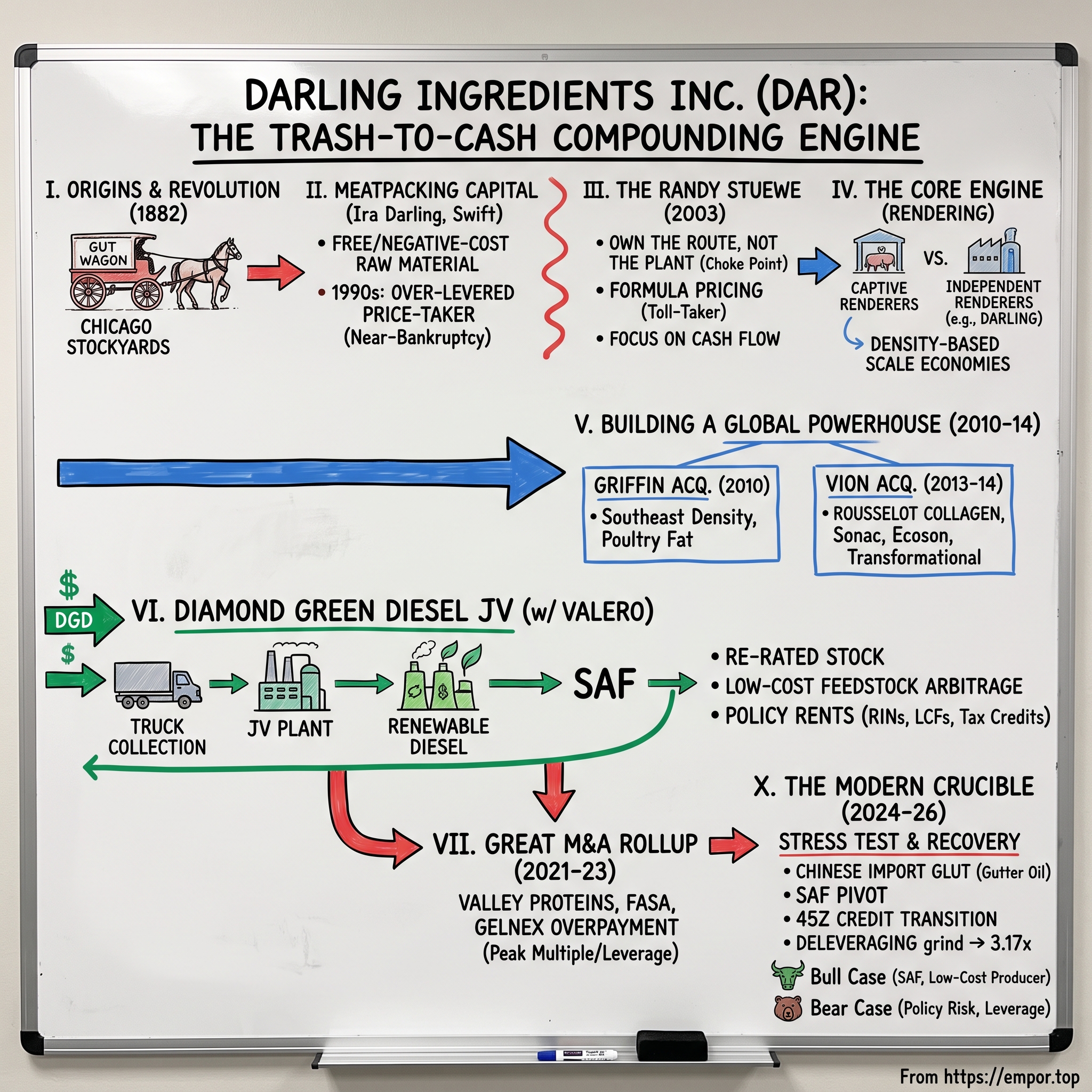
Darling Ingredients Inc. (DAR): The Trash-to-Cash Compounding Engine
I. Episode Roadmap & The Organic Recycling Revolution
There is a smell that clings to the loading dock of a rendering plant. It is the smell of the parts of the animal that no one at the dinner table wants to think about — the feathers, the bones, the offal, the grease scraped out of a restaurant fryer at two in the morning. For most of industrial history, that smell signified a problem. Somebody had to make it go away, and the people who did that work were treated the way garbage collectors and gut-wagon drivers have always been treated: as a necessary, invisible utility, paid a fee to remove what civilization would rather not see.
And yet the improbable truth of Darling Ingredients Inc. is that this same stream of waste — collected from slaughter lines, grocery back rooms, and restaurant grease traps across four continents — has become one of the most contested raw materials on the planet. The fat that Darling boils out of animal carcasses and the used cooking oil it vacuums out of fryers now feeds hydrotreaters that produce renewable diesel and sustainable aviation fuel, the low-carbon molecules that oil majors and airlines are scrambling to secure. The company that started as a sanitation partner to Chicago's slaughterhouses in the era of horse-drawn carriages has ended up holding a critical bottleneck in the energy transition.
That is the contrast at the heart of this story. On one side sits the old, unglamorous business of rendering: smelly, capital-heavy, treated for a century as a waste-disposal chore that nobody wanted to own. On the other side sits a set of premium markets — renewable fuels earning government carbon credits, and biotech-grade collagen peptides sold into nutrition, sports supplements, and pharmaceuticals — that carry margins the founders could never have imagined. The same molecule that was worth pennies as soap stock in 1900 can, in 2026, carry a government credit worth more than the fuel it becomes.
The thesis worth testing across the next three hours is this: Darling is neither a plain commodity processor nor a speculative green-tech bet. It is best understood as an industrial logistics network. Over more than a century it built a dense web of collection routes and processing plants that lets it capture organic waste at the lowest cost, keep the processing margin in-house, and then arbitrage those molecules into whichever end market — feed, food, or fuel — is paying the most in a given quarter. The interesting question is not whether that machine is clever. It plainly is. The question is how durable the moat really is, how much of the recent profit was a policy-driven windfall rather than an earned advantage, and whether a management team that spent 2022 and 2023 stretching the balance sheet has genuinely earned back the discipline it once preached.
That last question is not academic. Between 2023 and 2026 this company's headline earnings roughly halved and then roughly doubled again, and almost none of that swing was caused by anything happening inside a Darling plant. Understanding what actually drives the profit — and what merely rents it — is the entire analytical exercise.
Here is the road we will travel:
- The Chicago origins — Ira Darling, Gustavus Swift, and the 19th-century meatpacking hub.
- The Randy Stuewe reset — from a near-bankrupt price-taker to a cash-generative platform after 2003.
- The core engine — the logistics, unit economics, and regional oligopolies of rendering.
- The Griffin and Vion inflections (2010–2014) — buying domestic density and a global collagen crown jewel.
- The Diamond Green Diesel joint venture — the masterstroke with Valero that re-rated the stock.
- The M&A rollup and the leverage squeeze (2021–2023) — Valley Proteins, FASA, and the Gelnex overpayment debate.
- The modern crucible (2024–2026) — the Chinese import glut, the 45Z credit transition, and the aviation-fuel pivot.
- The investor playbook — Helmer's 7 Powers and Porter's Five Forces, the bull and bear cases, and the KPIs that actually matter.
Let us begin where the smell began: in the stockyards of Chicago.
 Subscribe on LinkedIn
II. The Meatpacking Capital: Ira Darling & Swift Origins (1882–1990s)
Picture Chicago in the 1880s. The Union Stock Yards on the South Side had become the beating, bloody heart of American industry — a square mile of pens, chutes, and killing floors where railroads funneled cattle and hogs from the western plains to be slaughtered, dressed, and shipped east in the refrigerated cars that Gustavus Swift had pioneered. The city that Carl Sandburg would later christen "Hog Butcher for the World" was producing meat on a scale humanity had never seen. It was also producing something else, in mountains: blood, bone, hooves, fat, viscera, and spoiled trim. A steer yields a great deal that never reaches a butcher's counter, and in the packed, fetid air of the yards, all of that had to go somewhere.
Into that problem stepped Ira C. Darling, who in 1882 established Ira C. Darling & Company as a rendering partner to the meatpacking trade.1 The arrangement was symbiotic in the most literal sense. The packers — Swift chief among them — needed their waste hauled away before it became a biohazard and a public-health scandal. Darling needed raw material. What looked to the slaughterhouse like a disposal cost was, to a renderer, a feedstock that arrived free or better than free. Boil it down, and the same offal became tallow for soap and candles, grease for lubricants, and meal for fertilizer and animal feed.
This was the primitive circular economy, running a century before anyone thought to give it a name or a marketing budget. And it is worth pausing on how radical the arrangement was in commercial terms. In almost every other industry, a company pays for its raw materials. Here, the supplier paid the manufacturer to take them away. That inversion — negative-cost input — is the founding economic anomaly of the rendering trade, and it is the same anomaly that makes the business fascinating today.
That founding logic — that the value sits in capturing and transforming waste, not in the animal itself — is the genetic code the modern company still runs on. But recognizing the logic and profiting reliably from it turned out to be two very different things, and the intervening century was less a smooth compounding story than a long lesson in how commodity exposure can humble even a structurally advantaged business.
Through the first half of the 20th century the company grew alongside the American appetite for meat, following the packers as they decentralized out of Chicago and into regional plants across the Midwest and South. Rendering was, in that era, a fragmented cottage industry — hundreds of family firms, each serving a handful of local abattoirs, each too small to matter. Post-war consolidation swept through it, and in 1962 a merger produced the Darling-Delaware Company, a larger regional operator with the beginnings of a genuine multi-state footprint.1 By 1993 it had been reorganized and rebranded as Darling International Inc. and taken public.1
Going public, though, exposed the flaw that would nearly kill it. The problem was structural, and it is worth stating precisely because it explains everything that follows. A renderer collects raw material whose only real value is the commodity fats and proteins it yields, and it sells those outputs — tallow, yellow grease, meat-and-bone meal — into brutally cyclical markets driven by soybean oil, palm oil, and livestock feed demand. For most of its history Darling behaved as a passive price-taker: it agreed to pay slaughterhouses a fixed price for raw material, then hoped the finished tallow would sell for more. When fat and meal prices rose, the company looked brilliant. When they fell, margins did not merely compress — they inverted, because the payment obligation to suppliers did not fall with them.
Layer aggressive, debt-funded expansion on top of that volatility and you have a company betting its solvency on the direction of a commodity it could not forecast or control. The agricultural downturn of the late 1990s did exactly what such downturns do to over-levered price-takers. Prices fell, cash flow evaporated, covenants tightened, and by 2002 Darling was forced into a major financial restructuring with its stock trading for pennies.1 A 120-year-old company with a genuinely defensible network of collection routes had come within sight of being wiped out — not because the routes stopped working, but because of how the contracts and the balance sheet were arranged around them.
For investors, the takeaway from the first 120 years is not the romance of the founding. It is the cautionary half: an advantaged asset is not the same thing as a durable business. A company can own a genuine physical moat and still nearly destroy itself by wearing all the commodity risk and financing the downside with debt. Fixing that — turning a battered price-taker into something that could actually keep the margin its network captured — would require an outsider who had spent his entire career on the other side of that trade.
III. The Randy Stuewe Reset: Professionalizing the Route (2003–2009)
When Randall C. Stuewe walked into Darling in February 2003, he inherited a company that had just survived its own funeral.1 The stock had traded under a dollar during the restructuring. The plants were scattered and localized, the supplier contracts were an inherited patchwork negotiated plant by plant over decades, and the culture was that of a survivor flinching at every tick in the tallow market. Morale was, by most accounts, at the floor.
Stuewe was not a rendering lifer, and that mattered enormously. He came out of the grain and protein trading world — a veteran of ConAgra and Cargill — where he had spent years around commodity desks and processing plants and had learned, in his bones, how commodity businesses actually make or lose money. The lesson from that world is counterintuitive to outsiders: you almost never make durable money betting on the flat price. You make it on the spread, the basis, the logistics, the storage, and above all on structuring contracts so that somebody else carries the price risk. Stuewe arrived at a company that had spent a century doing the opposite.
The reset had three legs, and each is worth understanding because together they explain why the modern company survives cycles that would have killed the old one.
The first was a reframing of what Darling actually owned. The company had assumed for a century that its value lived in the rendering plants — the cookers and presses that turned carcasses into tallow. Stuewe argued that the plants were the commodity part of the business. Anyone with capital and a permit can build a cooker; the technology is roughly a century old and not proprietary. The scarce, genuinely defensible asset was the route: the trucks, the drivers, the pickup schedules, the local relationships, and the physical collection network that fed the plants. Almost no one can rebuild a dense web of thousands of daily pickups that a competitor spent decades assembling, one restaurant and one butcher at a time. Own the collection, and you own the choke point. Everything downstream is negotiable.
The second was to stop betting the company on commodity prices. Stuewe pushed hard, and over years, toward what the industry calls formula pricing. Instead of paying a slaughterhouse a fixed price for its raw material and praying that tallow held its value, Darling rewrote contracts so that both its collection fee and the price it paid for raw material floated with published end-market commodity prices. When fat prices fell, what Darling paid its suppliers fell in step. In effect, Stuewe pushed the flat-price risk back onto the packers who generated the waste in the first place, and repositioned Darling as a toll-taker earning a processing spread.
The analogy worth holding onto is the difference between a farmer and a grain elevator. The farmer lives or dies by the harvest price; the elevator earns a handling fee whether prices are high or low. Stuewe was converting Darling from farmer to elevator. It was slow, unglamorous, contract-by-contract work that generated no press releases, and it is the single most important reason the modern company can absorb commodity troughs that would have broken the 1990s version. It is also, notably, incomplete — as we will see, formula pricing softens the blow of a commodity collapse but does not eliminate it, because volumes and the absolute spread still move.
The third leg was cultural and financial: relentless focus on free cash flow and return on capital, deleveraging before growth, and only then bolt-on acquisitions funded by the cash the tighter machine threw off. Stuewe was blunt with employees and investors alike that the era of chasing volume for its own sake had ended. Underperforming plants were closed rather than nursed. Capital was rationed. As profitability stabilized through the mid-2000s, the stock that had traded for pennies began, quietly and without much Wall Street attention, to compound.
It is worth being precise about what Stuewe did and did not accomplish in this period, because the distinction matters for judging him later. He did not invent a technology, discover a new market, or create an advantage from nothing. He took a genuinely advantaged network that had been badly managed and re-engineered the contracts and the balance sheet so that the company could finally keep the margin its network was already capturing. That is an execution story rather than a genius-of-invention story — and execution stories, done consistently, are what justify a very long CEO tenure.
What he had not yet proven, by the end of the 2000s, was whether that same discipline would survive contact with large-scale acquisitions. Buying things is where operationally excellent managers most often destroy value, because the discipline that governs a plant budget rarely governs a deal room. The next decade would test exactly that — first at home, then across an ocean.
IV. The Core Engine: Rendering Economics & Industry Structure
Before we follow the money into fuels and collagen, it is worth slowing down and understanding, at ground level, why this unglamorous business is so hard to attack. Because if the moat is not real, nothing else in the story matters — the fuel joint venture and the collagen brands would just be a commodity processor's lucky adjacencies.
Start with what rendering actually is. Strip away the industrial vocabulary and it is cooking, on a monstrous scale. Trucks arrive at a plant carrying raw material: offal, bone, blood, feathers, restaurant fats, expired grocery meat, fallen livestock. It is ground down, then heated to drive off water and separate the solids from the fats. Out one side comes purified fat — tallow from cattle, choice white grease from hogs, poultry fat, yellow grease from used cooking oil. Out the other side comes dry protein — meat-and-bone meal, poultry meal, feather meal, blood meal. Those outputs go into livestock feed, pet food, oleochemicals, and, increasingly, fuel refineries. The chemistry has barely changed in a century. What changed dramatically is where those molecules can be sold and what someone will pay for them.
The industry splits into two camps, and the distinction matters enormously for competitive analysis. On one side sit the captive renderers — the giant meatpackers such as JBS, Tyson Foods, and Smithfield, which process their own slaughterhouse waste in-house. For them, rendering is a cost center bolted onto the kill floor, a way of recovering some value from a byproduct they were always going to generate. They do not compete for third-party raw material and they do not build collection routes.
On the other side sit the independent renderers, who aggregate raw material from thousands of third parties that have no plant of their own: grocery chains, independent butchers, small processors, and above all restaurants. Darling is the global leader of that independent camp. Its regional competition is real but geographically bounded — Baker Commodities on the U.S. West Coast, Sanimax across the U.S. Northeast and Canada, and SARIA, owned by Germany's Rethmann Group, across much of Europe. The independents' structural advantage is that they see the widest and most fragmented feedstock stream. And fragmentation, counterintuitively, is precisely where the moat lives.
To see why, follow a single restaurant grease trap. Darling installs a sealed collection tank behind the restaurant and charges the operator a service fee to vacuum out the used cooking oil on a set schedule.2 For the restaurant, this is not optional housekeeping. Grease disposal is a regulated and inspected obligation; pouring fryer oil down a drain is illegal in most jurisdictions and clogs municipal sewers, and a missed pickup, an overflow, or a spill can trigger a health-code violation that shuts the kitchen down. So the restaurant pays Darling to take the oil away. Then Darling filters and cleans that same oil and sells it as a premium low-carbon feedstock to a fuel refinery.
Read that again slowly, because it is the strangest and best feature of the business model. The company gets paid on the front end to collect the material, and paid again on the back end to sell it — a double dip on a molecule that arrived as somebody else's regulatory problem. Multiply that across the roughly 250,000 restaurant locations Darling services and you have a manufacturer that is paid to acquire its own raw material.2 Very few businesses in any industry have that shape.
Now the crucial part — the reason a well-funded competitor cannot simply build a rival network next door. Raw animal waste and used cooking oil are heavy, highly perishable, and foul. Raw offal begins degrading within hours, especially in summer heat, and rotting material yields lower-quality fat and protein. It therefore cannot be trucked long distances without spoiling or without freight costs that swamp the value of the material itself, which is measured in cents per pound. So the economics are ruthlessly local: whoever has the densest cluster of pickups and the nearest processing plant wins, because their trucks run full and their hauls are short.
A new entrant attempting to duplicate an established route starts with a handful of scattered customers and half-empty trucks driving long distances between them — what the industry calls empty-truck-miles — and bleeds cash on every run. Meanwhile the incumbent, whose truck passes fifty doors on a single street, can price below the newcomer's cost and still earn a comfortable margin. The entrant's only path is to buy density, which means buying an incumbent, which is why this industry consolidates rather than fragments.
This is a textbook density-based scale economy, and it produces something distinctive: not one national monopoly, but a mosaic of regional near-monopolies stitched together into a national company. Darling's market position in Georgia has almost nothing to do with its position in Oregon. Each region is its own fortress, defended by geography and perishability rather than by patents or brands.
For investors, that structure is the single most important fact about the base business, and it cuts two ways. On the positive side, it means the Feed segment is not really a commodity processor competing on price nationally; it is a portfolio of local logistics monopolies whose margins are protected by physics. That is a genuinely rare and hard-to-disrupt advantage — software cannot compete it away, and capital alone cannot rebuild it quickly.
On the cautious side, it is a mature, slow-growth base. You cannot conjure more slaughterhouses or restaurants into existence, and per-capita meat consumption in developed markets grows slowly at best. The moat is deep, but the pond is not getting much bigger. Organic growth in rendering is essentially GDP-like, and the margin still flexes with commodity prices even under formula pricing. Which is precisely why, once Stuewe had the domestic machine humming, growth had to come from two directions simultaneously: buying more density, and finding far richer end markets for the molecules that density produced.
V. Building a Global Powerhouse: The Griffin & Vion Inflections (2010–2014)
By 2010 Darling had money to spend and a clear philosophy about where to spend it: buy route density where it strengthened the network, and buy access to higher-value molecules wherever possible. The next four years produced two acquisitions that, between them, remade the company — one a disciplined tuck-in that validated the domestic playbook, the other a swing for the fences that changed what Darling fundamentally was.
The first was Griffin Industries. In November 2010 Darling agreed to acquire the privately held, family-run Griffin for roughly $840 million, closing the transaction that December.3 On a map, the fit was almost too neat to be true. Darling was strong across the Midwest and Northeast; Griffin dominated the Southeast, with deep rendering and bakery-byproduct operations across a region thick with poultry processing plants. Bolting the two together did not merely add revenue — it added density in territory where Darling had barely operated, folding thousands of new pickups onto routes that could immediately run fuller and shorter.
Griffin also brought two things that do not show up in a synergy model. One was a well-run bakery-feed business that converted stale and surplus baked goods into livestock feed — a different waste stream with the same underlying logic. The other was a family-business operating culture that meshed unusually well with Stuewe's cash-focused, no-frills approach, which is why the integration went smoothly rather than becoming the usual post-merger mess. Strategically, the Southeast poultry exposure would prove more valuable than anyone anticipated: poultry fat would become one of the most sought-after low-carbon-intensity feedstocks of the following decade.
Griffin was the reset thesis expressed as an acquisition: buy the network, capture the density synergy, keep the balance sheet discipline. It worked, and its success gave Stuewe the confidence — perhaps, in retrospect, a little too much of it — to think considerably bigger.
The second deal was of an entirely different order. In 2013 Darling agreed to acquire the Dutch-based Vion Ingredients for roughly €1.6 billion, a transaction of approximately $2.2 billion that closed in early 2014 and was transformational enough that the company renamed itself Darling Ingredients Inc. to mark the moment.[^4] Overnight, a North American rendering company became a global one, with operations across Europe, South America, and Asia.
Vion carried three assets that mattered. Rousselot was the crown jewel: the world's leading producer of gelatin and collagen peptides, selling purified protein into food, nutrition, and pharmaceutical markets at margins that dwarfed anything in commodity meal. Sonac specialized in blood plasma, food-grade proteins, and specialty fats — again, higher-value extraction from the same underlying raw material stream. And Ecoson was a European pioneer in converting organic residues into bio-phosphate fertilizer and green energy through anaerobic digestion, effectively a bet that Europe's waste regulations would keep tightening.
The strategic logic ran on two distinct tracks, and both are worth spelling out. The first was geographic. Vion planted Darling firmly in Europe, a market running roughly a decade ahead of the United States on low-carbon fuel mandates, organic-waste regulation, and animal-byproduct rules. That was not merely diversification for its own sake — it gave Darling a working preview of the regulatory future that would later reshape its American business, plus operating experience navigating exactly the kind of carbon-accounting regimes that would eventually determine DGD's profitability.
The second was value migration. Rousselot pulled Darling up the value chain, out of pure commodity rendering and into branded health-and-nutrition ingredients whose demand had almost nothing to do with the price of tallow. Consider what collagen actually is: the same structural protein that renderers had extracted from hides and bones for a century and sold cheaply as gelatin for jellies and capsules. Break those long protein chains into shorter fragments — peptides — and you have an ingredient that dissolves in cold water and is sold at multiples of the commodity price into joint-health supplements, sports nutrition, skin-health products, and pharmaceutical applications. Darling now owned the global leader in that conversion, along with the Peptan brand.2
There is a skeptic's footnote worth keeping on file. Vion was large, complex, and international, and it loaded Darling with meaningful integration risk and debt at a moment when its renewable-fuels bet was still tiny and entirely unproven. For several years afterward the collagen and specialty businesses delivered steady but distinctly unspectacular returns, and a fair number of investors wondered aloud whether Stuewe had overreached. The stock spent much of the mid-2010s going nowhere.
The verdict on Vion would ultimately hinge on something that, in 2014, barely registered on the income statement: a small joint venture on the Louisiana coast that was about to become the most valuable thing the company had ever built.
VI. The Diamond Green Diesel JV: The Ultimate ESG Arbitrage
Every great compounding story has a hinge — the one decision that, in hindsight, separates a good business from a great one. For Darling, the hinge was a handshake with an oil refiner. In January 2011 a Darling subsidiary and a subsidiary of Valero Energy Corporation formed Diamond Green Diesel Holdings, a 50/50 joint venture to build a plant that would turn Darling's fats into renewable diesel.3 At the time it was a rounding error on both companies' balance sheets and attracted almost no analyst attention. It would end up re-rating Darling's entire equity story.
To understand why the partnership was so effective, you have to see precisely what each side was missing. Valero had refineries, hydrogen supply, blending and distribution infrastructure, downstream trading desks, and deep institutional fluency in fuel regulation — everything required to manufacture and sell diesel at national scale. What Valero emphatically did not have was feedstock: a reliable, low-cost, low-carbon stream of fats and oils, which no amount of refining expertise can conjure. Darling had exactly that — the captive, physically hard-to-replicate supply of animal fats, poultry fat, and used cooking oil pouring out of its collection network — and almost none of Valero's downstream capability.
Put them together and each partner contributed precisely the half the other could not buy at any price. Crucially, they sited the DGD plant adjacent to Valero's refinery complex in St. Charles Parish, Louisiana, so Darling's fat could move directly into the hydrotreater without a commercial middleman taking a cut and without paying freight twice. The joint venture captured the entire chain from grease trap to fuel rack, and split it fifty-fifty. This is the physical-adjacency insight that most competitors, buying feedstock on the open market and shipping it, simply cannot replicate.
Now the technology, in plain terms, because it explains where the money comes from. Old-style biodiesel — the stuff of 2000s-era green enthusiasm — is chemically different from petroleum diesel. It is an ester, produced by a simpler chemical reaction, and it has real drawbacks: it gels in cold weather, degrades in storage, can attack certain seals and gaskets, and can only be blended into conventional diesel in limited proportions before engines complain.
Renewable diesel is a fundamentally different product. DGD's process hydrotreats the fats under high pressure with hydrogen, stripping the oxygen atoms out of the fat molecules and rearranging what remains into straight hydrocarbon chains. The output is chemically indistinguishable from ordinary petroleum diesel. It is a true drop-in fuel: it flows through existing pipelines, sits in existing tanks, and burns in existing engines with no modification and no blending limit. But it carries a greenhouse-gas footprint roughly 80% lower than fossil diesel, because its carbon came from animals and plants that recently absorbed it from the atmosphere rather than from carbon buried underground for a hundred million years.
That emissions gap is where the profit lives — and it is essential to be honest that the gap is monetized entirely by government policy. Three overlapping programs converted a low-carbon molecule into a subsidized one. The federal Renewable Fuel Standard obliges fuel blenders to incorporate renewable volumes and creates tradable compliance credits called RINs. California's Low Carbon Fuel Standard pays a credit that scales inversely with a fuel's certified carbon-intensity score, which is why waste fats — which carry no farming emissions, unlike soybean oil — score so well and earn so much. And for years a federal Blender's Tax Credit paid a flat dollar per gallon on top of everything else.
Stack those three and, in a strong market, a gallon of renewable diesel could earn more from credits than from the diesel itself. Darling and Valero had built a machine that manufactured exactly the molecule three separate governments were paying up to bring into existence. That is an extraordinary position — and an inherently contingent one.
And they scaled it relentlessly. DGD's first plant started up around 2013 at roughly 137 million gallons a year. Through successive expansions at St. Charles and then an entirely new complex at Port Arthur, Texas, capacity climbed past a billion gallons, reaching roughly 1.2 billion gallons a year by 2024 — making DGD the largest renewable diesel producer in North America and, because of its integrated, freight-light, captive-feedstock structure, among the very lowest-cost.4 For a stretch around 2021 and 2022, DGD's contribution to Darling's earnings became so large, and the market so eager to pay up for anything labelled green growth, that the stock decisively left its sleepy-renderer valuation behind.
Here the neutral analyst has to plant a flag, because this becomes the fault line running through the entire investment case. DGD's economics are genuinely extraordinary, but they decompose into two very different components. The integrated logistics, the adjacency to the refinery, the captive low-cost feedstock, and the operating scale are durable competitive advantages that Darling and Valero built and own. The dollar-a-gallon credit and the price of an LCFS ticket are not advantages at all — they are rents, set by legislators and regulators in Washington and Sacramento, and they can be rewritten, diluted, redirected to competitors, or allowed to expire without anyone at Darling having any say.
A business whose peak profits depend on the persistence of a subsidy carries a risk that no amount of route density can hedge. Holding that distinction clearly in mind — between the moat Darling built and the rent the government granted — is the key to reading everything that follows, starting with what the company did when the cash from that rent came flooding in.
VII. The Great M&A Rollup & The Leverage Squeeze (2021–2023)
By 2021 the renewable-fuels gold rush had gone thoroughly mainstream, and it created a peculiar problem for everyone except Darling. Marathon Petroleum, Chevron, Phillips 66 — one oil major after another announced plans to convert idle or marginal refineries into renewable diesel plants. The projects were enormous and the press releases were confident. But a hydrotreater is an expensive paperweight without fats and oils to feed it, and there is only so much animal fat and used cooking oil generated on Earth in a given year. The refiners had collectively built the demand and forgotten to secure the supply.
Feedstock prices did what feedstock prices do when a dozen buyers chase a physically fixed quantity. Tallow, yellow grease, and poultry fat went vertical. And Darling was sitting, quite literally, on the mines.
The rational response was to lock up as much feedstock and as much premium collagen capacity as possible while the company's stock and cash flow were both riding high. So Darling went shopping — aggressively, and on borrowed money.
In May 2022 it completed the roughly $1.1 billion acquisition of Valley Proteins, one of the last large independent renderers in the United States, capturing prized poultry fat and restaurant-grease routes across the Southeast and Mid-Atlantic.[^6] Strategically this was Griffin's logic aimed squarely at feeding DGD: more density, more low-carbon molecules, fewer independent alternatives for rival refiners to buy from. Reported at a mid-single-digit-to-high-single-digit multiple of EBITDA before synergies, it looked like a defensible price for a scarce asset.
In August 2022 Darling paid roughly $540 million for Brazil's FASA Group, planting the company in the world's largest cattle-exporting nation.5 The logic was elegant: Brazil generates enormous volumes of bovine tallow at costs well below North American levels, and that tallow could either be sold locally or shipped to feed DGD, lowering the joint venture's blended raw-material cost. It also gave Darling a real foothold in a growing agricultural economy rather than a mature one.
Then came the deal that turned a growth story into a cautionary tale. In early 2023 Darling completed the acquisition of Gelnex, a Brazilian collagen and gelatin producer, for roughly $1.2 billion, doubling down on the Rousselot franchise at the height of the collagen wellness boom.[^8] On its face, the strategic rationale was coherent and even conservative-sounding: add more high-margin, less-cyclical, non-energy cash flow to balance the volatile fuel business.
The problem was the price and, above all, the timing. Gelnex was acquired at a reported mid-teens multiple of EBITDA — roughly double what Darling had paid for Valley Proteins — and it landed at what turned out to be the simultaneous peak of the collagen cycle and of management's own confidence.
Add up the spree and Darling had committed roughly $3 billion to acquisitions in barely twelve months, financed overwhelmingly with debt.6 Total borrowings, which had sat near $1.5 billion at the end of 2021, ballooned toward $4.7 billion by the first quarter of 2023, and the bank-covenant leverage ratio jumped from a comfortable ~1.6x to roughly 3.2x.6 That ratio was simultaneously flattered and punished by timing — it carried Gelnex's full debt load but not yet a full year of Gelnex's earnings. Either way, a balance sheet that had been the company's proudest post-2003 achievement was suddenly stretched thin.
And then, with almost cruel precision, the cycle turned against nearly every assumption embedded in the shopping list. Interest rates spiked, making floating-rate debt materially more expensive to carry. LCFS credit prices began sliding. Renewable diesel margins compressed as all that announced refinery capacity finally came online and started competing for the same feedstock Darling had just paid up to secure. Collagen demand cooled from its pandemic-era froth as consumer supplement spending normalized. A company that had spent years telling investors it prized capital discipline above all had, by late 2023, levered itself near the top of a cycle and was staring at a multi-year deleveraging grind with buybacks effectively frozen.
This is the moment for an honest management assessment, because it is the strongest count in the bear's indictment and it deserves to be stated without flinching. Stuewe's defenders can argue reasonably that Valley Proteins and FASA were sound long-term moves bought at a moment of genuine strength — feedstock assets that a competitor would have taken if Darling had hesitated. Those deals have aged acceptably.
Gelnex is much harder to defend. Paying a peak multiple, with borrowed money, for a cyclical wellness ingredient business immediately before that cycle rolled over is precisely the category of undisciplined, top-of-market capital allocation that the entire 2003 reset was supposed to have permanently exorcised from this company's culture. The management team that had preached spread-not-flat-price and cash-flow-before-growth got caught doing exactly what over-levered commodity companies have always done at cycle peaks: extrapolating the good times.
To management's credit, they did not spend the following two years pretending otherwise. They halted major M&A, made deleveraging the stated first call on cash, and committed publicly to driving the covenant ratio back toward a 2.5x long-term target.7 Whether that commitment survives the next windfall is now a live entry in the credibility ledger that any long-term investor in this company has to keep. And it was about to be tested by a downturn that no amount of acquisition discipline could have hedged.
VIII. Segment Analysis: Sizing the Engine
Before we walk into the storm of 2024 through 2026, it helps to have a clear picture of the machine's three cylinders, because the entire investment debate turns on how differently they behave when conditions change. Darling reports in three segments — Feed, Food, and Fuel — and fiscal 2024 showed each doing a very different job.
Feed Ingredients is the bedrock. It is the rendering network itself — the trucks, the routes, the cookers — generating roughly $613.9 million of adjusted EBITDA in fiscal 2024, driven by collection volumes and the prevailing prices of fat and protein meal.4 But its strategic role is considerably larger than its own profit line suggests, because Feed is the funnel that supplies DGD. Every pound of fat Darling renders and channels into the joint venture is a pound whose downstream margin stays inside the Darling–Valero system rather than being sold at market to a rival refiner. Feed is where the cornered resource is physically captured; a large part of its value is realized two steps downstream.
Food Ingredients is the specialty cylinder — the Rousselot, Gelnex, Peptan, and Nextida collagen and gelatin brands — contributing about $294.9 million of adjusted EBITDA in fiscal 2024.4 Its assigned job in the portfolio is stability. Collagen demand comes from health, nutrition, and pharmaceutical customers whose purchasing has little correlation with tallow prices or diesel spreads, so Food is meant to act as ballast that steadies consolidated earnings when the commodity and energy cylinders misfire.
That is the theory, and it is worth testing rather than accepting. In practice, Food has proven more cyclical than the defensive label implies — gelatin competes globally, capacity additions matter, and consumer supplement demand ebbs and flows with discretionary spending. It has been a genuine stabilizer relative to Fuel, but not the bond-like annuity the segment description can suggest. That distinction is exactly why overpaying for Gelnex stung twice over: the segment acquired to reduce risk added balance-sheet risk of its own.
Fuel Ingredients is the volatile profit delta. It houses Darling's 50% equity share of DGD plus the European green-energy operations, and in fiscal 2024 it produced roughly $192.2 million of adjusted EBITDA — down sharply from about $373.9 million in 2023 as DGD margins compressed.4 That collapse tells you everything about the segment's character. It is high-beta, leveraged to policy, carbon-credit prices, and fuel spreads, capable of throwing off enormous cash in a good year and disappointingly little in a bad one. DGD sold 1.25 billion gallons in 2024 — an operational record — but earned only about $0.46 of EBITDA per gallon, versus far richer spreads the year before.4 Volume was not the problem; price was.
Roughly, the architecture looks like this:
          [ Feed Ingredients ]                  [ Food Ingredients ]
       (~$613.9M FY24 Adj. EBITDA)           (~$294.9M FY24 Adj. EBITDA)
                   |                                      |
         (renders waste fats)               (Rousselot & Gelnex collagen)
                   |                                      |
                   v                                      v
       [ Diamond Green Diesel JV ]                 [ premium health ]
       (~$192.2M FY24 Adj. EBITDA)                 [  & pharma markets ]
One structural feature deserves an accounting flag, because it materially affects how investors can analyze this company. Because DGD is a 50/50 joint venture, it is accounted for under the equity method — meaning its revenues, costs, and debt do not consolidate onto Darling's financial statements. Instead the most economically important asset in the portfolio reaches the income statement through a single equity-in-earnings line, supplemented by whatever cash dividends the JV distributes; Darling received $179.8 million in DGD cash dividends during fiscal 2024.4 This is entirely proper under GAAP, but it means an outside investor must reconstruct DGD's economics from management's per-gallon disclosures rather than reading them off a statement. Complexity of that kind is not fraud, but it does widen the range of reasonable valuations — and it is precisely the sort of structure an activist points to when arguing that a company is harder to value than it needs to be.
The picture that emerges is of a company with one stable base, one semi-defensive specialty, and one turbo-charged, policy-dependent swing factor. In a strong fuel year the third cylinder dominates the headlines and the multiple; in a weak one, the market discovers how much of the story had been riding on it. Fiscal 2024 and the year that followed were the stress test that revealed exactly what happens when the turbo cuts out.
IX. The Modern Crucible (2024–2026): Chinese Imports, SAF, and 45Z
For shareholders who bought Darling near its 2022 highs, the two years that followed were an expensive education in how quickly a policy-driven earnings stream can reverse. The stock fell hard from its peaks, and the reasons had remarkably little to do with the company's own execution. They had to do with the environment in which its most valuable cylinder operated.
The first blow was overcapacity. All those refinery conversions the majors had announced finally started up, and North America abruptly had more renewable diesel production capacity than there was cheap feedstock to feed it or blending demand to absorb it. The margin between raw fat and finished fuel — the spread on which DGD lived — compressed brutally. The numbers were stark: DGD's EBITDA per gallon fell to roughly $0.46 across 2024, and to just $0.40 in the fourth quarter, a fraction of the dollar-plus economics of the boom years.4 Full-year combined adjusted EBITDA dropped to about $1.08 billion in 2024 from roughly $1.61 billion in 2023, and net income fell to $278.9 million from $647.7 million.4
The second blow arrived from an unlikely direction: China. For several years, cheap used cooking oil imported from China — a stream sometimes bluntly called 地沟油 gutter oil in its country of origin — poured into U.S. West Coast ports. It was prized precisely because imported UCO, as a waste product, carried a low certified carbon-intensity score and therefore earned rich LCFS and RIN credits despite crossing an ocean to get there. That flood of cheap, low-CI material undercut the value of the domestic tallow and grease Darling collects, and it contributed to a collapse in California LCFS credit prices, which fell from around $200 toward roughly $50.
Sit with the irony for a moment. The very attribute that made Darling's molecules special — their low carbon score — was being commoditized by a subsidized import the company could not match on price. Darling had cornered the domestic resource only to discover that the rent attached to it could be competed away by a foreign one. It is the clearest possible demonstration that a cornered resource and a protected price are not the same thing.
Against that grim backdrop, management placed its next major bet on the sky. In the fourth quarter of 2024, DGD completed a conversion project at Port Arthur that allowed the plant to upgrade a substantial share of its output into sustainable aviation fuel — standing up what management described on the Q4 call as "the largest sustainable aviation fuel unit in the world," delivered under budget and ahead of schedule, with capacity of roughly 235 million gallons of neat SAF.478 Notably, management also disclosed that only about half of Port Arthur's production was being directed to the SAF line initially, with additional capacity to be added at Port Arthur or Norco as operating confidence grew.7
The strategic logic behind SAF is genuinely differentiated, and it is worth explaining because it is the strongest structural growth argument the company has. Aviation has no plausible path to electrification for long-haul flight — batteries are far too heavy to carry a widebody across an ocean, and that is a constraint of physics rather than of engineering effort or investment. Airlines facing tightening carbon mandates in Europe and voluntary corporate commitments elsewhere therefore have essentially no substitute for a drop-in low-carbon jet fuel. SAF also commands a price premium over renewable diesel. Put simply: if renewable diesel has become a crowded commodity with too many producers, SAF is, for now, a scarcer product sold to a customer base that has no alternative.
Then came the policy whiplash of 2025 and 2026. At the start of 2025 the federal support mechanism switched from the old dollar-a-gallon Blender's Tax Credit — paid to whoever blended the fuel, regardless of feedstock — to the new Clean Fuels Production Credit known as 45Z, paid to the producer and scaled explicitly to the carbon intensity of the feedstock. In principle this favored Darling enormously: genuinely low-CI waste fats should earn a materially richer credit than higher-CI alternatives like virgin soybean oil.
But the transition created enormous uncertainty, and management's own commentary reflected it. On the Q4 2024 call, executives said Treasury's guidance provided a "clear safe harbor" for accounting treatment while acknowledging that substantial uncertainty remained around feedstock certifications and destination rules.7 They also explained why LCFS credit prices had not rebounded as some expected, pointing to a large accumulated credit bank the market "really needs to eat through" before prices could recover — a candid, mechanical explanation rather than a deflection, and to their credit an accurate one.7 Analysts on that call pushed back sharply, questioning whether 45Z genuinely advantaged Darling or merely punished soybean-oil-based competitors, with one noting those producers faced roughly $0.80-per-gallon hits.7
There was also an accounting wrinkle worth flagging: a $59 million lower-of-cost-or-market inventory adjustment flowed through Darling's equity share of DGD, a non-cash charge that management said was disclosed in the audited financials and straightforward for analysts to isolate.7 That is the right disclosure posture, but it is a reminder that reported JV earnings in a volatile-price environment can contain non-cash noise that obscures underlying cash economics in either direction.
The resolution began arriving in early 2026, and it broke Darling's way. Regulatory clarity firmed up around a framework that rewarded low-carbon-intensity production, blunting the advantage cheap imports had enjoyed. The effect on DGD was immediate and dramatic. In the first quarter of 2026, DGD sold 272.4 million gallons at an average EBITDA of $1.11 per gallon — back above the dollar mark that signals a healthy renewable fuels market — and Darling's combined adjusted EBITDA leapt to $406.8 million from $195.8 million a year earlier, with net income of $134.3 million and Darling's 50% share of DGD contributing $151.2 million.9 Leverage, meanwhile, had come down to 3.17x, with management reiterating a target of net debt below $3 billion and describing itself as "focused on paying down debt."10
But the Q1 2026 call also contained a detail that complicates the tidy domestic-protection narrative, and it deserves emphasis precisely because it cuts against the bull story. Management indicated that DGD can profitably import international feedstocks and expected to increase soybean oil utilization during 2026, selecting whichever input is cheapest after adjusting for its carbon-intensity score.10 That is smart, flexible operating behavior — it is what a well-run refiner should do. But it undercuts the simpler thesis that 45Z functions as a protective wall around domestically rendered fat. The credit rewards carbon intensity, not nationality, and DGD optimizes accordingly. Investors should understand the recovery as a margin-environment improvement, not as a permanent regulatory moat around Darling's own molecules.
On the same call, management pointed to healthier trends in collagen, citing growth in Europe and Asia and Food segment EBITDA of $81 million against $71 million a year earlier, with the Nextida glucose-control product awaiting U.S. patents.10 They also noted the purchase of three Brazilian rendering assets out of a Patense Group bankruptcy — small, opportunistic, distressed-price deals that look considerably more like the pre-2021 Darling than the 2022–23 vintage.10 That is a modestly encouraging behavioral signal, though a genuinely small sample.
The neutral reading of this whole period is more measured than either the bull or bear caricature. The Q1 2026 snapshot is real and it is strong. But it is also the clearest possible illustration of the bear's core point: within roughly eighteen months, DGD's per-gallon economics ran from above a dollar, down toward forty cents, and back above a dollar — driven overwhelmingly by credit prices, import flows, and regulatory rulings, and hardly at all by anything Darling did to its plants or its routes. The recovery vindicates the quality of the assets. It does not repeal the volatility. An investor here is being asked, in effect, to underwrite the continued goodwill of policymakers. That is the wager, stated plainly, and it is the correct frame for the bull-and-bear analysis that closes the story.
X. The Playbook & Hamilton Helmer's 7 Powers
Strip away the smell and the subsidies and the analytical question becomes simple: what, precisely, protects Darling's profits from being competed away? Hamilton Helmer's 7 Powers framework is a useful scalpel here, and three of the seven apply to Darling with unusual clarity — while the absence of the other four is just as instructive.
The first and most important is the Cornered Resource. You cannot build a renewable diesel or SAF refinery without fats and oils, and the global supply of genuinely low-carbon-intensity waste fat and used cooking oil is physically bounded — it is a function of how many animals are slaughtered and how much oil restaurants fry with, neither of which responds to fuel prices. Darling's collection network gives it privileged, low-cost access to a large share of that scarce material across the Americas and Europe. This is the deepest and most durable of its advantages precisely because it rests on a physical constraint that no competitor can engineer around or out-spend.
The essential caveat, established in the previous section, is that the resource is cornered but its price is not. When subsidized imports or a policy change alter what a low-CI molecule is worth, the value of the corner falls even though the corner itself remains perfectly intact. Owning a scarce asset and controlling its price are different things, and conflating them is the most common analytical error made about this company.
The second power is Scale Economies, specifically the density-based variety already described. Cost per pickup falls as routes get denser, and Darling's routes are the densest in most territories where it operates. This is what converts rendering from a national price war into a mosaic of defensible regional oligopolies. It is worth noting this power is regional rather than global: Darling's density in Georgia confers no advantage in a region where a competitor is denser, which is why the industry consolidates market by market rather than through national share battles.
The third is High Switching Costs, concentrated in the grease-trap service business. For a restaurant, used-cooking-oil collection is a regulated, inspected obligation where the downside of failure — a spill, a missed pickup, a health-code citation that closes the kitchen for a weekend — vastly outweighs the few pennies a competitor might shave off the monthly fee. Darling supplies the equipment and the dependable scheduled service. The switching cost here is not primarily monetary; it is operational risk aversion, which is a stickier form of lock-in than price ever is.
What Darling conspicuously lacks is just as revealing. There are no meaningful Network Economies — a new restaurant customer does not make the service more valuable to existing ones. There is essentially no Branding power in the core business; no fleet operator chooses a diesel molecule by brand, though Peptan carries modest brand equity in collagen. There is no Counter-Positioning, since incumbents face no business-model conflict preventing them from competing. And there is no proprietary Process Power that rivals could not copy — hydrotreating is licensed technology and rendering is century-old chemistry.
The honest conclusion is that Darling's moat is real but narrow: it is about physical logistics and cornered molecules, full stop. That narrowness is partly a strength — logistics moats built on perishability and freight cost are remarkably resistant to disruption by software, by capital, or by clever new entrants. But it also means the company cannot escape its commodity and policy exposure through some clever intangible edge. There is no software layer, no brand premium, no ecosystem to fall back on when the spread compresses.
Porter's Five Forces rounds out the picture and locates the real dangers. Supplier power is moderate-to-high: large slaughterhouses have genuine bargaining leverage, but disposal regulations and the perishability of their waste force them to transact with a nearby processor, and formula pricing pushes the flat-price risk back onto them. Buyer power varies by segment — commodity fat buyers have plenty of alternatives, while pharmaceutical gelatin customers, who must qualify suppliers through lengthy validation, have far fewer. The threat of substitutes is low-to-moderate: battery-electric trucking and hydrogen could eventually erode renewable diesel demand over a long horizon, but SAF has no near-term substitute for long-haul aviation. Competitive rivalry in collection is low-to-moderate, muted by the transportation constraints that carve markets into regional fiefdoms — though rivalry for feedstock purchased on the open market is intense, since every new renewable refinery is a bidder.
The forces genuinely dangerous to Darling, though, sit outside Porter's classic frame entirely: new-entrant refiners bidding up feedstock they do not control, and governments unilaterally setting the credit prices that determine whether a gallon is highly profitable or barely breakeven. Any framework applied to this company has to make room for the regulator as an active participant rather than background context.
XI. The Investment Story Spine & Activist Stress Test
So put the pieces on the table and argue both sides honestly, because a company this cyclical rewards neither the cheerleader nor the reflexive skeptic.
The bull case rests on three legs. First, DGD is a genuinely low-cost producer of renewable diesel and increasingly of SAF, protected by integrated logistics, refinery adjacency, and captive feedstock — advantages that persist regardless of what credit prices do, and that widen relative to competitors precisely when margins are thin, because high-cost producers exit first. Second, sustainable aviation fuel is a structurally scarce, mandate-driven product for which airlines have no electrification escape hatch, giving Darling a growth runway that crowded renewable diesel no longer offers. Third, the collagen franchise provides a higher-margin, non-energy cash stream that dampens the cycle, and as leverage falls the company regains the option to return capital. Underpinning all three is the cornered-resource-plus-route-density moat that a century of network-building created and that capital alone cannot quickly replicate.
The bear case is equally coherent, and it is fundamentally about fragility. The balance sheet still carries roughly $4 billion of debt against a business whose most profitable cylinder swings violently; year-end 2024 covenant leverage sat near 3.9x, and even after real progress to 3.17x by Q1 2026 the company remains well above its own 2.5x target with limited room for error if the fuel cycle rolls again before deleveraging finishes.410 The premium valuation depends on government policy — 45Z, LCFS, the RFS — any of which a political shift could dilute or dismantle, instantly compressing DGD's margins exactly as the 2024 credit collapse demonstrated. And even the supposedly stable Feed and Food segments retain real commodity and cyclical exposure: formula pricing softens but does not eliminate the hit from a deep fall in fat and protein meal prices, and collagen demand proved considerably more cyclical than the defensive framing implied.
There is also a subtler bear point about the 45Z recovery specifically. If DGD optimizes across domestic and imported feedstocks based purely on carbon-intensity-adjusted cost — as management said it would in 2026 — then the credit regime is not really a wall protecting Darling's own rendered fat.10 It is a margin environment that DGD navigates skillfully. That is worth paying for, but it is worth paying less for than a genuine regulatory moat, and investors should price the difference.
An activist would press hardest on three fronts. Capital allocation is the first and most obvious: the Gelnex acquisition, bought at a peak multiple with borrowed money immediately before the cycle turned, is a legitimate charge that management abandoned its own stated discipline when the shopping got exciting — and shareholders paid for it directly through years of frozen buybacks, with only about $34.3 million of stock repurchased during 2024 while debt reduction consumed $353.4 million.7 Portfolio complexity is the second: a sprawling, multi-continent, three-segment structure spanning grease trucks, pharmaceutical gelatin, and a refining joint venture is genuinely hard for the market to value and invites a conglomerate discount. The obvious activist thesis writes itself — separate the collagen business, which serves entirely different customers with entirely different economics and would likely command a different multiple as a standalone.
Disclosure is the third front. The equity-method treatment of DGD means the single most important economic asset in the company reaches investors through one line and management's per-gallon commentary. Combined with non-cash inventory adjustments flowing through that same line, it forces outside investors to do reconstruction work that a consolidated structure would not require. None of this is improper, but an activist would argue — not unreasonably — that a company asking the market for a premium multiple should make its most valuable asset easier, not harder, to analyze.
Which brings us finally to the man who has run this company for 23 years. Randall Stuewe's record is, on balance, remarkable. He took a penny stock out of restructuring and built a global platform, rewired the contract structure that had nearly killed the company, and conceived a joint venture that few competitors matched and that funded everything since. That is genuine long-horizon value creation, and it is the strongest argument for extending management the benefit of the doubt on the current recovery plan.
But credibility is assessed through behavior over time rather than through career highlights, and the 2022–23 stretch is a real blemish. The same team that professed spread-not-price discipline levered up at a cycle top, missed guidance through late 2023 and 2024, and then spent two years digging out. The constructive reading is that they owned the mistake plainly on calls rather than blaming weather or one-offs, gave concrete mechanical explanations for weak results such as the LCFS credit bank overhang, halted major M&A, set specific numerical deleveraging targets, and have so far hit them — leverage did fall from 3.93x to 3.17x, and the only recent acquisitions have been small distressed purchases.710 Specific targets that are subsequently met are the strongest available evidence of a management team meaning what it says.
The skeptical reading is that discipline is easy to promise when a stretched balance sheet leaves no alternative. The real test arrives when the next windfall does — when DGD is printing dollar-plus gallons, the leverage target has been hit, and someone brings a compelling acquisition to the board. Investors do not have to resolve that debate today. They have to watch whether the behavior in the next up-cycle matches the language of this one.
XII. Epilogue & Key KPIs to Watch
A century and a half ago, Ira Darling built a business on the insight that the thing everyone else wanted to throw away was worth keeping. The modern company is a vastly grander expression of the same idea, but the lesson for investors is oddly unchanged from 1882: the durable advantages here are physical and unglamorous — dense collection routes, cornered molecules, integrated freight, adjacency to a refinery — while the spectacular profits of recent years were substantially borrowed from government policy that can be rewritten at any time. Owning the messy bottleneck is the moat. Renting the subsidy is the swing factor. Keeping those two clearly separated is the entire discipline of following this company.
Three metrics matter more than any others for tracking whether the machine is working, and readers can watch them directly each quarter without doing any arithmetic of their own.
The first is DGD's EBITDA margin per gallon. It is the purest available gauge of fuel profitability and the largest single driver of consolidated earnings, and it is where policy, feedstock spreads, credit prices, and operating efficiency all net out into one number. The swing from above a dollar, down to $0.40, and back to $1.11 within roughly eighteen months is precisely why this is the number to watch: a durable perch above about $1.00 signals a healthy renewable fuels market, while a slide back toward the forties signals the turbo has cut out again.94
The second is net debt and the bank-covenant leverage ratio. This single metric referees both the balance-sheet risk and management's credibility simultaneously, which makes it unusually informative. The stated goals are net debt below roughly $3 billion and long-term leverage of 2.5x; progress against those specific, publicly committed numbers — from 3.93x at the end of 2024 to 3.17x in early 2026 — is the concrete evidence of whether post-Gelnex discipline is real or rhetorical.410
The third is combined adjusted EBITDA across Feed, Food, and Fuel together. Because the three cylinders partially offset one another and because DGD reaches the income statement only through an equity line, the combined figure is the cleanest single read on the aggregate earning power of the whole system — and the fastest way to see whether a strong fuel quarter is quietly being given back by a weak commodity or collagen one.
The final surprise of the Darling story is how little the fundamental business has changed in 144 years, and how dramatically the world's willingness to pay for its output has. A sanitation utility became an energy company not by reinventing itself but by stubbornly remaining exactly what it always was — the low-cost owner of the physical, foul-smelling bottleneck where organic waste enters the economy — until the rest of the world decided that bottleneck was strategic. Whether it remains a compounding engine or reverts to being a cyclical commodity processor with a good joint venture depends, in the end, on questions of policy durability and capital discipline that even a very capable management team does not fully control. That tension is what a long-term investor in this company is actually underwriting, and it deserves to be watched with clear eyes rather than green ones.
References
-
Darling Ingredients Inc. Investor Relations — Company Overview and History ↩↩↩↩↩
-
Darling Ingredients Inc. — Official Website (services, collection network and brands) ↩↩↩
-
Darling Intl acquiring Griffin Industries — MEAT+POULTRY, 2010-11-11 ↩↩
-
Darling Ingredients Inc. Reports Fourth Quarter and Fiscal Year 2024 Results — Darling Ingredients, 2025-02-06 ↩↩↩↩↩↩↩↩↩↩↩↩
-
Darling Ingredients Inc. Announces Third Quarter 2022 Results — PR Newswire, 2022-11-08 ↩
-
Darling Ingredients Inc. Form 10-K, Fiscal Year 2023 — SEC EDGAR, 2024 ↩↩
-
Darling Ingredients Inc. (NYSE:DAR) Q4 2024 Earnings Call Transcript — Insider Monkey, 2025-02-06 ↩↩↩↩↩↩↩↩↩
-
Darling Ingredients Inc. 2026 Investor Day Presentation — Form 8-K, SEC EDGAR, 2026-05-11 ↩
-
Darling Ingredients Inc. Reports First Quarter 2026 Results — Form 8-K Exhibit 99.1, SEC EDGAR, 2026-04-29 ↩↩
-
Darling Ingredients Inc. (NYSE:DAR) Q1 2026 Earnings Call Transcript — Insider Monkey, 2026-04-29 ↩↩↩↩↩↩↩↩
 LinkedIn
 WhatsApp
 Reddit
 Hacker News
 Email
Email Kindle
 RSS Feed
 Spotify
 Apple Podcasts
 Amazon Music
 Audible
 YouTube