Dominion Energy: From Colonial Canals to AI's Power Grid
I. Introduction & Episode Roadmap
At 7:56 a.m. on July 22, 2026, a mechanical failure disabled a 230-kilovolt transmission line in Northern Virginia. What followed over the next ten minutes underscores the operational vulnerabilities facing electric utilities traditionally viewed as low-risk investments. Sensing the voltage sag, a cluster of data centers in the world's densest computing corridor disconnected from the grid and switched simultaneously to backup batteries and diesel generators. Roughly three gigawatts of demand — equivalent to the power consumed by a mid-sized country — vanished from the PJM Interconnection instantly. Power plants supplying that load suddenly had nowhere to direct their electricity, triggering voltage and frequency swings across the Eastern Interconnection.12
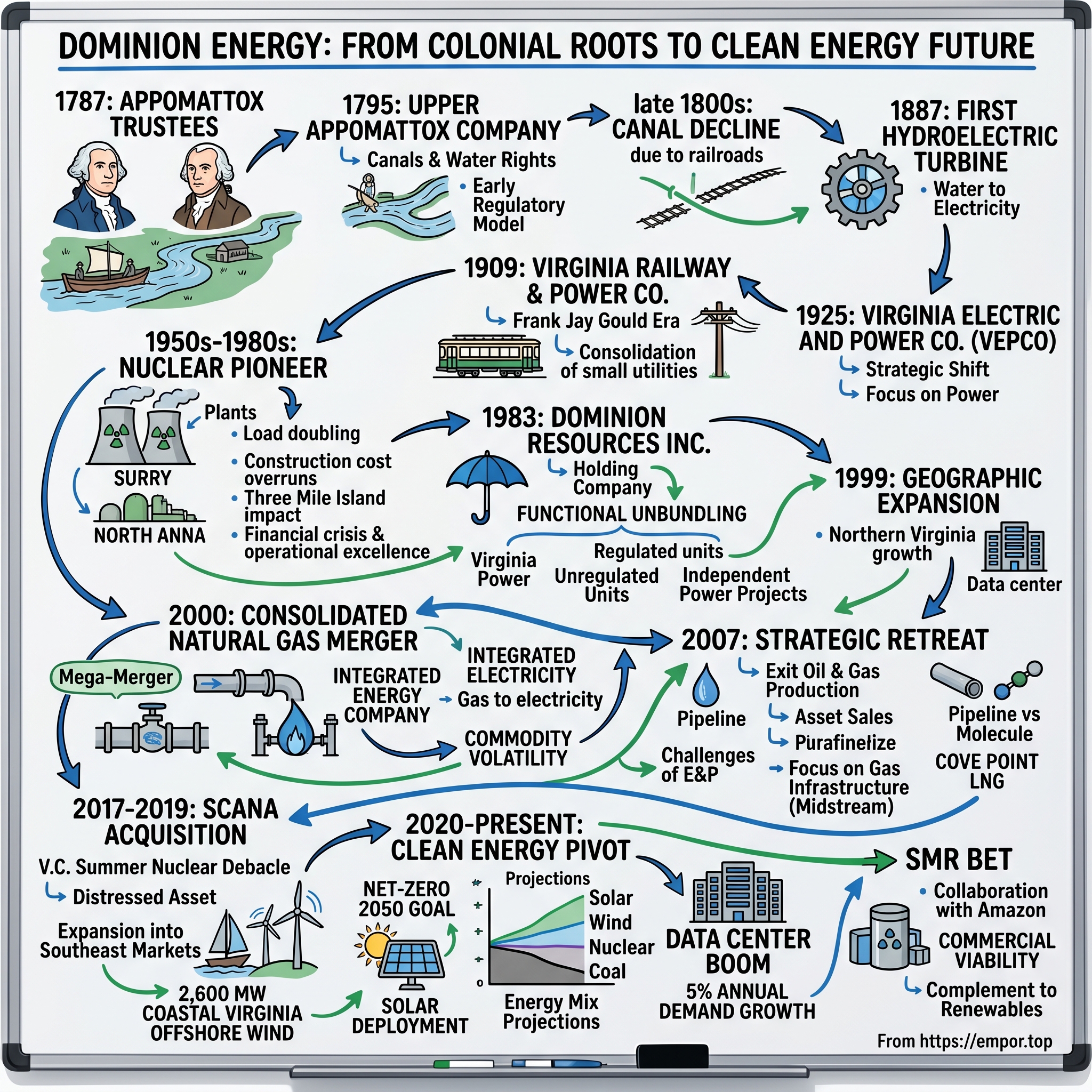
Although the grid held, the incident highlighted the unusual position Dominion Energy occupies. The company's corporate origins trace back to a 1787 act by the Virginia General Assembly to improve river navigation, with George Washington and James Madison serving among its early trustees.3 Two hundred thirty-nine years later, Dominion's transmission lines form the physical infrastructure supporting a substantial portion of global artificial-intelligence training capacity — while its largest commercial customers remain sophisticated and cautious enough to disconnect from its network in milliseconds.
As of September 2026, Dominion presents a complex financial picture. The stock closed at $65.84 on September 4, giving the company a market capitalization of nearly $58 billion and a dividend yield above 4% — a yield that reflects a dividend payout that has remained flat since 2020.4 The utility reported full-year 2025 operating earnings of $3.42 per share and set 2026 guidance between $3.45 and $3.69, targeting long-term annual operating growth of 5% to 7% through 2030.5 Dominion serves electric utility customers across Virginia, North Carolina, and South Carolina — a customer base that, when combined with NextEra Energy's six million Florida accounts, the companies estimate at roughly 10 million utility customers combined.6 To support this footprint, Dominion is executing a five-year capital expenditure plan of approximately $65 billion — up from the roughly $50 billion plan published a year earlier, an increase driven almost entirely by the electricity demand of Northern Virginia's data centers.7
That demand has become the defining driver of the company's growth strategy. In its second-quarter 2026 disclosure, Dominion reported 53.8 gigawatts of data center capacity in various contracting stages across its Virginia service territory — an 11% increase of 5.3 gigawatts in just seven months. Of that total, 12 gigawatts were bound by firm electric service agreements, 9.4 gigawatts fell under construction letters of authorization, and 32.4 gigawatts remained in early engineering stages.8 Commercial load now accounts for 48% of regulated sales, growing 8.5% on a weather-normalized basis over the trailing twelve months, while nine of the ten highest peak demand days in the history of the Dominion zone occurred in 2026.9 For an industry accustomed to 1% annual demand growth, this expansion represents a structural regime change.
Then, on May 18, 2026, the company's corporate structure faced a fundamental shift. NextEra Energy and Dominion announced an all-stock merger valued at approximately $67 billion. Under the proposed terms, Dominion shareholders would receive 0.8138 NextEra shares for each Dominion share, leaving them with a roughly 25.5% stake in what the companies describe as the world's largest regulated electric utility business.6 The Virginia State Corporation Commission opened its regulatory review under case number PUR-2026-00112 on July 15, scheduling public witness hearings for November 2026 followed by an evidentiary hearing beginning November 17.10 Consequently, Dominion's current valuation reflects its proposed exchange ratio and the likelihood of securing approvals from regulators in three states, the Federal Energy Regulatory Commission, and the Nuclear Regulatory Commission, amid growing public criticism from Virginia lawmakers.
The broader historical context explains how Dominion reached this inflection point. For two decades, Dominion operated as an integrated energy conglomerate, combining oil and gas exploration, interstate pipelines, liquefied natural gas exports, merchant generation, and natural gas utilities across six states. That expansion ended with a $2.8 billion write-off on a canceled pipeline project, an emergency acquisition of a utility troubled by nuclear project fraud prosecutions, and a 33% dividend reduction. Between 2022 and 2024, management restructured the business, divesting roughly $17.5 billion in assets to focus almost entirely on state-regulated electric utilities. Although that simplification stabilized operations, management ultimately agreed to a merger. Understanding that decision requires evaluating both the operational improvements Dominion achieved and the structural limitations it could not resolve independently.
The following analysis traces Dominion's trajectory across key operational and strategic dimensions: first, a review of its historical origins from colonial canals and streetcars to nuclear generation. Next, an examination of the conglomerate era and its financial aftermath, followed by a rigorous assessment of legacy claims against the historical record. The analysis then evaluates the strategic review, current segment economics, and the company's competitive standing within Northern Virginia's Data Center Alley. Finally, it assesses management's execution record relative to its guidance, examines capital exposure across offshore wind and small modular reactor megaprojects, and stress-tests the key risks to the investment thesis.
 Subscribe on LinkedIn
II. Succinct Historical Context: Canals, Gould, and VEPCO (1787–1980)
In 1787, the Virginia General Assembly appointed seven trustees to improve navigation on the James and Appomattox rivers so that hogsheads of tobacco could reach markets downstream. Among those trustees were George Washington and James Madison. The Upper Appomattox Company completed its canal by 1807.3
The through-line from that early canal to a modern utility is not historical sentiment; it is water rights and rights-of-way. Falling water provided the earliest industrial power, and companies that controlled dam sites controlled the capacity to spin generators. When the Appomattox enterprise's industrial water rights passed to successor companies at the turn of the twentieth century, they carried the physical franchise that electrification required.
Frank Jay Gould — son of Gilded Age railroad operator Jay Gould — acquired a successor to those interests and in 1909 assembled the Virginia Railway and Power Company, which operated streetcars across four Virginia cities and generated the electricity to run them.3 The arrangement reflected a common origin for early American utilities: electric generation developed as a byproduct of urban transit, since streetcars required constant power and generating plants sat idle overnight. Selling surplus power to homes and factories converted a cost center into a commercial franchise.
In 1925, a syndicate led by the New York engineering firm Stone & Webster acquired the business into a holding structure called Engineers Public Service and renamed the operating utility Virginia Electric and Power Company — known locally as VEPCO.3 What followed was the core regulatory bargain of the U.S. electric utility industry: exclusive operating territory in exchange for an obligation to serve all customers at rates approved as just and reasonable by a regulatory commission. That regulatory compact established VEPCO's modern business model, setting a precedent that would govern Dominion's future balance between regulatory compliance and corporate expansion.
Federal regulators eventually disassembled the holding company under the Public Utility Holding Company Act of 1935, leading VEPCO to emerge in 1947 as an independent, publicly traded utility serving roughly 450,000 customers.3 During the post-war expansion, utility executives focused primarily on building generation capacity to match steady demand growth. VEPCO brought the Surry nuclear station online in 1973 and North Anna in 1978, adding approximately 3.6 gigawatts of baseload capacity that continues to anchor the fleet today.3 Constructed in 1970s dollars and subsequently relicensed, these nuclear assets remain among the company's most efficient capital investments, generating electricity at low marginal costs in a region currently facing elevated power demand.
However, the 1970s also exposed structural risks that continue to affect Dominion's capital planning. In 1972, VEPCO planned two additional 882-megawatt units at Surry based on load forecasts assuming near double-digit annual demand growth. That growth failed to materialize. By March 1977, amid slowing demand, construction delays, environmental litigation, and stricter Nuclear Regulatory Commission rules, VEPCO canceled both units. Having spent $53 million and committed another $93 million, the utility faced roughly $146 million in total losses, which it sought to amortize through customer rates over ten years.11
This episode established a structural pattern that recurred in subsequent corporate crises: long-lead megaprojects justified by aggressive demand forecasts, followed by project cancellations or cost overruns when market conditions shifted, leading to regulatory disputes over cost recovery between shareholders and ratepayers. The pattern reappeared decades later, from the $2.8 billion pipeline write-off in 2020 to offshore wind cost pressures in 2026. The primary strategic challenge for Dominion has consistently centered on whether major capital projects can withstand long-term regulatory, political, and financial scrutiny.
A second enduring legacy from this era was institutional. During the 1970s and 1980s, VEPCO learned that the Virginia State Corporation Commission and the General Assembly held ultimate authority over utility cost recovery and rates. That environment shaped a corporate culture where legal, regulatory, and policy expertise often proved as decisive as engineering execution.
By 1983, VEPCO established Dominion Resources as its parent holding company, creating a corporate vehicle designed to house both regulated utility operations and unregulated growth initiatives.3 That structure set the stage for subsequent diversification efforts outside its traditional utility footprint over the following two decades.
III. The Conglomerate Era: CNG, E&P, SCANA, and the Pipeline Bust (2000–2020)
The late 1990s brought widespread market speculation and restructuring across the U.S. electric utility sector. As federal and state regulators pushed toward deregulation, prevailing industry wisdom held that survival belonged to large, diversified energy merchants rather than traditional regional monopolies. Under Chief Executive Officer Thomas Capps, Dominion set out to build a nationwide energy conglomerate.
On January 28, 2000, Dominion Resources completed its acquisition of Consolidated Natural Gas, paying approximately $6.4 billion in equity — comprising roughly 87 million Dominion shares and $2.9 billion in cash — while assuming CNG's existing debt.12 The Federal Trade Commission cleared the transaction on the condition that Dominion sell CNG's Virginia Natural Gas subsidiary to prevent overlapping utility monopolies in Hampton Roads.13 Virtually overnight, the mid-Atlantic electric utility transformed into a multi-state gas and power conglomerate controlling interstate pipelines, underground storage caverns, local distribution utilities in Ohio and Pennsylvania, and a substantial oil and gas exploration and production business.
The strategic logic behind the expansion was fashionable and initially lucrative. Managing both fuel supply and utility distribution offered a theoretical natural hedge: when natural gas prices surged and squeezed utility margins, the exploration and production division generated high profits. In practice, however, the structure created an equity story that traded like a volatile commodity fund, saddling a regulated business with a cost of capital that reflected its high-risk commercial operations.
When Thomas F. Farrell II became CEO in 2007, management moved to dismantle that commodity exposure. In a series of transactions that year, Dominion sold virtually its entire exploration and production portfolio: onshore assets in Texas, Michigan, and Alabama to Loews for about $4.0 billion; Rocky Mountain, Texas, and Louisiana reserves to XTO Energy for $2.5 billion; Gulf of Mexico holdings to Italy's Eni for $4.76 billion; and Canadian operations separately.1415 Total proceeds approached $14 billion. Farrell informed investors that the simplified company would generate operating earnings of approximately $6 per share in 2008.
That divestiture stands out as a disciplined capital-allocation decision in Dominion's recent history. Management unloaded a cyclical commodity business near the peak of a market cycle, deployed the proceeds to reduce complexity, and refocused on core operations. While shale gas expansion soon collapsed North American gas prices and eroded asset valuations, Dominion's exit protected balance-sheet value and provided immediate financial relief.
Following that exit from direct production, however, Dominion spent the subsequent decade rebuilding energy-adjacent risk under midstream infrastructure. Management converted the Cove Point terminal in Maryland from an LNG import facility into an export hub, created a midstream master limited partnership, and expanded into distant markets. In 2016, Dominion acquired Questar Corporation — a Rocky Mountain gas utility and pipeline operator — for $25.00 per share, or roughly $4.4 billion plus assumed debt, entering Utah, Wyoming, and Idaho despite minimal operational overlap with its Virginia core.16 The deal closed that September at a valuation that required years of sustained expansion to justify.
Dominion faced further balance-sheet pressure following the collapse of a rival utility's nuclear project in South Carolina. SCANA Corporation's utility subsidiary, South Carolina Electric & Gas, had spent roughly $9 billion constructing two Westinghouse AP1000 reactors at the V.C. Summer nuclear station. The project unravelled when Westinghouse filed for bankruptcy in 2017, forcing the utility to abandon construction after charging customers upfront under state cost-recovery statutes. The failure triggered ratepayer litigation, political pushback, and federal criminal fraud prosecutions against former SCANA executives who had concealed execution delays.
Dominion absorbed SCANA on January 2, 2019, in an all-stock transaction, acquiring its debt and providing customer rate relief as part of the regulatory approval process.[^17] Strategic rationale rested on securing fast-growing coastal service territories in South Carolina and applying Dominion's operational management. While customer growth in the region materialized as expected, the acquisition added billions of dollars in debt to a balance sheet already committed to major capital projects.
At the same time, Dominion's primary midstream initiative faltered. Conceived in partnership with Duke Energy as a 600-mile, 1.5 billion-cubic-feet-per-day pipeline from West Virginia shale fields across Virginia into North Carolina, the Atlantic Coast Pipeline formed the center of Dominion's infrastructure strategy. However, the project encountered intense opposition as it crossed the Appalachian Trail, national forests, and local communities. Federal appellate courts repeatedly vacated environmental and right-of-way permits. Although Dominion secured a legal victory at the U.S. Supreme Court in June 2020 regarding its Appalachian Trail crossing, management canceled the project three weeks later.
On July 5, 2020, Dominion and Duke formally abandoned the Atlantic Coast Pipeline, citing persistent legal risks and estimated construction costs that had escalated from $4.5 billion to $8 billion.[^18]17 The decision reflected a stark reality: securing single judicial victories could not prevent opponents from challenging subsequent permits and driving project costs to unsustainable levels. Dominion recorded a pre-tax charge of approximately $2.8 billion on the cancellation. Concurrently, the company announced the sale of substantially all of its gas transmission and storage operations — encompassing more than 7,700 miles of pipeline and roughly 900 billion cubic feet of storage capacity — to Berkshire Hathaway Energy for approximately $9.7 billion, including assumed debt.[^18]
The transaction allowed Berkshire Hathaway Energy to acquire strategic infrastructure assets from a seller seeking to reduce leverage quickly under market pressure.
The financial restructuring hit income-oriented investors directly. On November 4, 2020, Dominion reduced its quarterly dividend from $0.94 to $0.63 per share — a 33% cut designed to align distributions with the cash flows of a smaller, regulated utility footprint.18 For a shareholder base weighted toward retail investors relying on consistent income, the reduction broke an implicit yield expectation. The dividend cut drove significant shareholder turnover, erasing the valuation premium traditional utilities command for dividend reliability.
Two decades of aggressive portfolio shifts left Dominion with a repositioned operational footprint, higher debt levels, a lower dividend payout, and substantial value transferred to corporate buyers such as Loews, XTO, Eni, and Berkshire Hathaway. Evaluating how management subsequently navigated these structural constraints forms the core of Dominion's current strategic outlook.
IV. The Historical Falsification Pass: Testing Legacy Moat Claims
Every corporation presents a thesis for why it deserves investor capital. For copy editors and financial analysts alike, the essential task is not merely to restate management's narrative, but to test it against historical evidence — determining whether each claim holds, survives only in a narrowed form, or fails entirely.
Claim one: that combining regulated utilities with unregulated energy infrastructure produces superior risk-adjusted returns. This proposition served as Dominion's core operating strategy from 2000 through 2020. However, historical evidence — provided by the very management teams that promoted the model — contradicts the premise. The exploration and production arm was assembled and divested within seven years. The midstream operation was aggressively built and expanded through Questar and Cove Point, only to be dismantled: Dominion sold its gas transmission and storage assets to Berkshire Hathaway Energy in 2020 and divested its remaining interest in Cove Point in 2023. Meanwhile, the Atlantic Coast Pipeline — intended as the centerpiece of this infrastructure strategy — was canceled after generating approximately $2.8 billion in pre-tax charges.[^18] Each of these non-regulated businesses was ultimately monetized under conditions ranging from opportunistic sales to distressed exits, with proceeds applied largely to repair balance-sheet damage inflicted by the strategy itself.
This claim is rejected outright rather than merely narrowed. Combining regulated and unregulated assets failed to smooth corporate returns. Instead, the strategy inflated Dominion's cost of capital, diluted its appeal to traditional utility investors, and burdened the balance sheet with debt just as the core electric utility required massive capital deployment. Investors considering any future diversification should observe that Dominion's leadership spent the four years following 2022 arguing the exact opposite thesis to its shareholders.
Claim two: that Dominion possesses distinctive megaproject execution capability. Evaluating this claim requires distinguishing operational performance from development execution. Supporting the claim, the Surry and North Anna nuclear stations were constructed in the 1970s and have operated for five decades at high capacity factors. Furthermore, Dominion's nuclear operating reputation remains strong; Chief Executive Officer Robert Blue chairs the board of the Institute of Nuclear Power Operations, the industry's peer-review governing body.19
Countering that record, however, is a history of project disruptions: two planned Surry nuclear units were canceled in 1977 after substantial capital expenditure;11 the SCANA nuclear project in South Carolina was acquired only after its construction collapsed;[^17] the Atlantic Coast Pipeline was abandoned in 2020 despite a favorable U.S. Supreme Court ruling;[^18] and the company's coastal offshore wind project saw its capital estimate rise from $9.8 billion to approximately $11.65 billion, resulting in shareholder charges of $103 million in 2024, $258 million in 2025, and $95 million in the second quarter of 2026 for cost overruns excluded from customer rate recovery.20521
The evidence requires narrowing this claim severely. Dominion has demonstrated long-term operational competence with complex nuclear assets. It has not established a track record of completing greenfield megaprojects on budget within litigated or tightly capped regulatory frameworks. For investors, the decisive variable is legal and regulatory structure rather than pure engineering capability. Capital projects backed by legislatively mandated rate riders tend to deliver predictable returns. Conversely, initiatives exposed to protracted permitting battles or strict shareholder cost caps frequently erode equity value. That structural contrast separates the Atlantic Coast Pipeline failure from Virginia's rider-backed transmission and solar investments, making the offshore wind risk-sharing framework a pivotal contractual element in Dominion's asset portfolio.
Claim three: that Dominion is a dependable income vehicle. Management frequently highlights that Dominion has paid dividends for 44 consecutive years.22 However, continuity of payment is distinct from income protection. Following a 33% reduction in 2020, the annualized payout remained frozen at $2.67 per share through 2026. An investor who acquired shares for income in 2019 experienced a sharp initial dividend cut followed by six years without payout growth, during which cumulative inflation exceeded 20%.4 Consequently, purchasing power dropped significantly over a period when management repeatedly described its dividend policy as reaffirmed.
The broad assertion of dividend reliability is disconfirmed by the historical record. A narrower claim survives: since the 2020 restructuring, distribution payouts have been supported entirely by regulated utility earnings rather than volatile commercial gas operations, providing a more stable structural foundation. Yet validating this narrower thesis requires an actual increase in dividend distributions funded by utility cash flow while maintaining target credit metrics — a milestone Dominion did not achieve prior to proposing its merger. Under the terms of the NextEra Energy agreement, Dominion shareholders will receive the current dividend through transaction closing alongside a one-time cash payment of $360 million, before transitioning into equity of an acquirer with its own dividend track record.6
In sum, testing the three core legacy claims yields clear results: the diversification thesis is rejected outright; the megaproject execution claim is narrowed strictly to asset operation rather than greenfield construction; and the traditional income story is disconfirmed in its popular form. This structural backdrop defined the operational context inherited by management, setting the stage for the strategic review that followed.
V. The "Top-to-Bottom" Strategic Review & Transformation (2022–2024)
By late 2022, Dominion faced severe financial pressure driven by rapidly rising interest rates, which heightened borrowing costs for a utility heavily reliant on long-dated debt. The company's stock had underperformed the broader utility sector, while credit rating agencies signaled growing concern over leverage accumulated from the SCANA acquisition and an expanding capital investment program. At the same time, Dominion confronted tens of billions of dollars in projected capital expenditures in Virginia over the subsequent decade—commitments that its balance sheet could not easily absorb under existing market conditions.
On November 4, 2022, Dominion suspended its financial guidance and launched a comprehensive business review of its portfolio and financial position.[^25] In the utility sector, where the core investment thesis relies heavily on earnings predictability, suspending guidance signaled acute operational and financial uncertainty as management and the board re-evaluated long-term financial targets.
The thirteen-month review resulted in two major divestitures. In July 2023, Dominion agreed to sell its remaining non-controlling 50% interest in Cove Point LNG to Berkshire Hathaway Energy for approximately $3.5 billion, including roughly $3.3 billion in cash.[^26] This transaction consolidated Berkshire's ownership of the facility following its initial midstream acquisition in 2020.
Then, in September 2023, Dominion agreed to sell three natural gas distribution utilities—East Ohio Gas, Questar Gas (operating across Utah, Wyoming, and Idaho), and Public Service Company of North Carolina—to Enbridge for an aggregate enterprise value of $14.0 billion, consisting of $9.4 billion in cash and roughly $4.6 billion in assumed debt.[^27][^28]23 The transaction included the Questar assets acquired seven years earlier, with final closings occurring through 2024.
In total, Dominion divested approximately $17.5 billion in enterprise value during the strategic review, eliminating or retiring roughly $21 billion in debt obligations when counting assumed debt alongside cash proceeds used for debt reduction. At its March 2024 investor day, management framed the restructuring as a completed transformation into a pure-play electric utility, targeting a 5% to 7% annual operating earnings growth trajectory through 2030 without requiring substantial equity issuances.24
The portfolio simplification altered the company's risk profile. Regulated electric earnings provided greater cash-flow predictability, a lower cost of capital, and better alignment with traditional utility investors than merchant midstream operations. Deleveraging the balance sheet reduced refinancing risk in a higher-rate environment, while selling assets directly to strategic buyers such as Berkshire Hathaway Energy and Enbridge preserved transaction value.
However, absolute debt reduction proved temporary. Dominion reported total debt of roughly $44.2 billion at the end of 2023, which dropped to about $41.8 billion at the end of 2024 following asset sales. But by year-end 2025, total debt rose to approximately $48.9 billion, with net debt reaching near $48.7 billion—exceeding pre-review levels.25 Over the same two-year period, property, plant, and equipment expanded from $58.8 billion to $79.0 billion. Rather than reflecting operational slippage, the borrowing rebound stemmed directly from funding extensive regulated rate-base expansion across Virginia.
Furthermore, the label "pure-play regulated utility" required nuance regarding the company's asset base. Dominion's Contracted Energy segment, which accounts for roughly one-tenth of total earnings, includes the Millstone Power Station in Waterford, Connecticut. Millstone encompasses approximately 2,100 megawatts of nuclear capacity across two units licensed through 2035 and 2045, generating roughly 17 million megawatt-hours annually and supplying over 90% of Connecticut's carbon-free electricity.26 Unlike Virginia utility operations, Millstone operates outside traditional rate-base regulation, selling power under commercial contracts and wholesale market arrangements in New England. Consequently, a portion of Dominion's earnings remained exposed to regional power market fluctuations, though hedged by long-term agreements.
Ultimately, the strategic review reallocated corporate leverage rather than eliminating it—shifting debt from commodity-sensitive gas assets to regulated electric infrastructure earning commission-authorized returns. Evaluating the success of this shift relies on cash generation relative to debt burden; in that metric, Dominion reported funds from operations to debt above 15% for full-year 2025 and on a trailing twelve-month basis through the second quarter of 2026, exceeding management's target thresholds.8
This structural shift contextualizes the company's broader corporate trajectory. Eighteen months after completing a $17.5 billion divestiture program designed to establish a standalone, pure-play regulated utility, management agreed to an all-stock acquisition by NextEra Energy. Rather than securing long-term standalone independence, the multi-year transformation positioned Dominion for a sale—raising questions over whether management concluded that the utility could not independently fund the massive capital investment demanded by Virginia's expanding grid infrastructure.
VI. Segment Breakdown & Core Utility Economics
West of Washington along the Dulles Greenway lies what appears to be an unremarkable stretch of Loudoun County office parks. A closer inspection of the structures reveals windowless buildings, massive electrical switchyards, house-sized transformers, and rows of cooling units operating continuously even in midwinter. This cluster is Data Center Alley, a hub created by historical timing and network physics. The early internet's East Coast peering points were established in Northern Virginia, attracting dense fiber routes; as interconnection density grew, tech operators clustered nearby to minimize latency. On Dominion's second-quarter 2026 earnings call, management reported that commercial customers consistently cite Virginia's "unique network density, connectivity, and ecosystem advantages" as their primary reason for expanding in the region.9
Following its corporate divestitures, Dominion operates a streamlined segment structure. Dominion Energy Virginia—legally still Virginia Electric and Power Company—serves as the primary profit engine, generating $670 million in operating earnings, or $0.76 per share, in the second quarter of 2026. Dominion Energy South Carolina contributed $105 million, or $0.12 per share, while the Contracted Energy segment, which holds contracted solar and non-regulated generation assets, added $31 million.27 In practical terms, Virginia generates roughly three-quarters of consolidated operating earnings, South Carolina accounts for about one-eighth, and contracted operations provide the remainder.
How a regulated utility actually makes money. The core economic engine of a regulated utility rests on capital deployment rather than raw commodity sales. A utility invests capital to construct transmission lines, substations, and power plants. State regulators inspect those assets to determine what portion is "used and useful," incorporating approved investments into the utility's official rate base. Regulators then establish customer rates designed to cover operating expenses, depreciation, and taxes, while permitting an authorized return on equity calculated against that rate base. Consequently, long-term earnings growth depends on expanding the rate base rather than merely increasing volumetric electricity sales. This structural dynamic explains the strategic focus on data center expansion: serving 53.8 gigawatts of prospective demand requires substantial infrastructure investment, which directly inflates the rate base on which authorized returns are calculated.
In Virginia, key regulatory parameters were recalibrated during the 2025 biennial review. The State Corporation Commission rejected the full magnitude of Dominion's rate request, approving $565.7 million for 2026 and $209.9 million for 2027 against company requests of $822 million and $345 million, respectively.28 By granting roughly two-thirds of the requested increase in the cycle's primary rate case, state regulators demonstrated independent oversight rather than passive alignment with management.
Beyond the authorized revenue figures, the commission introduced a critical structural change by approving a distinct rate schedule, designated GS-5, for commercial customers requiring more than 25 megawatts of demand—a threshold targeted specifically at large data centers—effective January 1, 2027. Under GS-5 rules, customers in this class must pay for a minimum of 85 percent of their contracted distribution and transmission demand and 60 percent of their contracted generation capacity, regardless of actual electricity consumption.2930
This minimum-demand framework represents a significant structural risk shift for Dominion's capital program. When a technology company reserves a gigawatt of power capacity, Dominion must construct matching transmission lines, substations, and generating facilities. If the customer subsequently scales back its expansion, relocates workloads, or fails to reach projected utilization, the physical infrastructure remains in place. Historically, the burden of funding unutilized rate-base investments fell largely on captive residential and small commercial ratepayers. The GS-5 minimum-demand obligations reallocate a major share of potential stranded-asset risk directly back to large commercial developers. For equity investors, this mechanism translates speculative load projections into legally binding cash-flow commitments, mitigating a primary risk cited by critics of utility AI expansion.
The moat, tested properly. Applying Hamilton Helmer's competitive strategy framework, Dominion's primary competitive advantage stems from a cornered resource—specifically, its statutory franchise providing exclusive retail distribution rights across Northern Virginia's interconnection hub. No competing utility may supply retail electricity within Dominion's designated Virginia service territory, nor can rival developers construct competing 500-kilovolt transmission corridors into Ashburn. While this exclusive franchise yielded steady returns for decades, its economic value expanded sharply with the surge in artificial-intelligence infrastructure spending. However, because this competitive barrier relies on state statutory protections rather than proprietary technology, its longevity remains tied to ongoing political and regulatory support.
A secondary competitive advantage exists in process power, though its scope is narrower than corporate communications suggest. Dominion's decades of high-capacity nuclear operations at Surry and North Anna reflect demonstrated technical competence, providing a solid foundation for securing regulatory license renewals out to eighty years of operation. However, operational skill in managing mature nuclear plants does not automatically translate into successful execution on complex greenfield construction projects.
Evaluating the business through Michael Porter's Five Forces framework reveals a more complex competitive landscape than traditional utility models suggest. The threat of new entrants remains effectively zero due to statutory franchise protection. Conversely, supplier power is substantial and rising: offshore wind equipment suppliers are highly concentrated, while industry-wide lead times for large power transformers and high-voltage switchgear extend over several years, creating physical bottlenecks in converting customer contracts into energized revenue.
Buyer power presents another challenge to traditional utility assumptions. While residential ratepayers possess minimal bargaining leverage, major hyperscale technology companies represent sophisticated corporate buyers. These clients maintain active regulatory teams that intervene directly in state commission proceedings and possess political influence. More importantly, large commercial customers maintain alternative power options unavailable a decade ago.
This dynamic highlights the threat of substitutes, rendering the July 2026 transmission incident strategically significant. During that event, three gigawatts of data center load disconnected from the grid and transitioned smoothly to backup batteries and on-site diesel generators without operational disruption.12 PJM Interconnection had recorded two similar automated disconnect events of roughly 1,500 megawatts each in 2024 and 2025.2 While regional grid operators responded by evaluating stricter interconnection guidelines for large industrial loads,1 the incident demonstrated that data center operators can sustain self-sufficient generation. Behind-the-meter natural gas turbines and fuel cells become increasingly competitive as grid interconnection queues lengthen and wholesale capacity prices surge. In PJM's recent capacity auctions, clearing prices reached the FERC-approved price cap for two consecutive delivery cycles, jumping from $28.92 per megawatt-day for 2024–2025 to $329.17 per megawatt-day for 2026–2027, with the Dominion zone clearing above the system average.31 PJM's independent market monitor attributed approximately 40 percent of total clearing costs in a recent auction directly to expanded data center demand.32
Consequently, the threat of substitutes is expanding within the company's highest-growth customer segment. The key risk to Dominion's cornered-resource model stems not from rival electric utilities, but from large commercial clients choosing to self-generate on-site while purchasing only standby backup service from the centralized grid.
Myth versus reality, briefly. Three common market assumptions regarding Dominion's business warrant clarification. Myth: data center growth provides unconstrained profit. Reality: expanding grid capacity requires executing a $65 billion five-year capital program financed with debt and equity, earning strictly commission-authorized returns—a spread-based utility business rather than an unhedged windfall, where financial realization depends entirely on regulatory approval. Myth: utilities face zero competition. Reality: while protected from retail utility competitors, Dominion increasingly competes against the capital deployment and self-generation capabilities of its largest customers. Myth: the reported data center pipeline represents a guaranteed order backlog. Reality: less than one-quarter of the 53.8 gigawatts of reported demand is secured under firm electric service agreements, with the remaining capacity in preliminary engineering phases that do not yet constitute binding contractual obligations.8
Dominion Energy South Carolina, by contrast, operates as a steady earnings stabilizer. Serving Columbia and Charleston within a state benefiting from population and industrial growth, the segment delivers mid-single-digit rate-base expansion with limited political friction—a business segment acquired during the resolution of SCANA's nuclear project failure.
VII. Management Credibility, Governance, & Capital Allocation
Chief Executive Officer Robert M. Blue brings a legal and policy background to Dominion's leadership. He earned an undergraduate degree and MBA from the University of Virginia and a law degree from Yale, practiced law at Hogan & Hartson, and served as counselor and director of policy to the Governor of Virginia before joining Dominion in 2005. After directing the company's Power Delivery Group starting in 2017, Blue became president and CEO in October 2020—assuming leadership as the Atlantic Coast Pipeline was canceled and the dividend was reduced—and added the chairmanship in April 2021.19
This career path aligns with Dominion's primary strategic challenges over the preceding two decades, which hinged heavily on regulatory and legal frameworks rather than pure engineering execution. Management's policy-focused background coincided with key legislative and regulatory outcomes in Virginia, including rider-based capital recovery mechanisms under the Virginia Clean Economy Act, risk-sharing provisions for offshore wind, and the establishment of a dedicated commercial rate class for large data centers. Meanwhile, Steven D. Ridge, who became chief financial officer in 2023, executed the asset divestitures and served as the primary communicator on credit metrics, telling investors on the second-quarter 2026 call that he was "highly confident in our ability to deliver on our financial commitments, including 2026 operating EPS and credit targets," and describing the financial plan as striking "the right balance of appropriately conservative, but not unreasonably so."9
Evaluating management's record requires examining both historical commitments and recent execution.
Against management: Blue served as executive vice president and president of the Virginia utility during the years when the Atlantic Coast Pipeline was pursued and the Questar acquisition was completed. The 2022 guidance suspension acknowledged that previous multi-year financial projections were unviable, while the annual dividend payout has remained flat since 2020.
For management: Suspending guidance enabled management to re-evaluate strategic assumptions openly. Over the subsequent thirteen months, management executed $17.5 billion in asset sales at fair market valuations and subsequently achieved its recalibrated operating targets. Since the March 2024 investor day, financial guidance has remained consistent: full-year 2026 operating earnings per share guidance of $3.45 to $3.69 was reiterated with second-quarter results, and the 5% to 7% annual operating growth target through 2030 has held.275 This performance represents three consecutive years of execution stability following a decade of frequent strategic shifts.
On disclosure quality: Capital updates for the coastal offshore wind project provide a clear test of management transparency. The project's estimated cost was publicly revised from $9.8 billion to $11.4 billion in May 2026, and then to approximately $11.65 billion in July 2026, with management itemizing the specific drivers: revised network upgrade costs assigned by PJM, tariffs imposed in April 2026, and updated turbine installation projections.3320 The final turbine installation date was moved to the end of 2027.9 While these adjustments represent financial headwinds, the company disclosed the revisions transparently and absorbed the associated earnings charges as incurred rather than deferring recognition.
On analyst pushback: Management's responses during the second-quarter 2026 call offered measurable detail regarding operational challenges. Pressed on whether the offshore wind schedule could slip again, Blue grounded the revision in observed operational data—specifically load-out timing at Portsmouth Marine Terminal and actual jacking durations at difficult seabed locations—rather than in reaffirmed contractor promises.9 Asked whether the July grid disturbance implied a need for major incremental transmission spending, management said existing planned upgrades should suffice, which is a falsifiable claim that PJM's own post-event review will test.92 Asked about the new Mount Storm combined-cycle plant in West Virginia and Kennedy Station in South Carolina—together around five gigawatts of new gas capacity—management specified that Mount Storm is not incremental to the capital plan but an acceleration of spending already in the back end of it.9
On incentives and governance: Executive compensation design and performance metrics are detailed in the annual proxy statement, and investors evaluating alignment should read that document directly rather than accept characterizations of it.34 The dominant governance question in 2026 centers on the proposed NextEra Energy merger. Under the agreement, Blue would become president and CEO of regulated utilities within NextEra and take a board seat, with John Ketchum as chairman and CEO; the board would seat ten NextEra directors and four from Dominion.6 A CEO negotiating a transaction in which he receives a senior operating role at the acquirer faces an inherent tension between the purchase price achieved and his own post-merger position, a topic raised in merger-related shareholder litigation.
Evaluating management's overall record reveals a dual perspective. Management executed the complex work of simplifying an over-complicated company and subsequently delivered against its revised targets. Yet, having completed that restructuring, leadership concluded that the resulting utility should be acquired by a larger competitor. The most charitable reading is that Virginia's expanding grid capital requirements exceed what a standalone utility with a $58 billion market capitalization can finance efficiently, supporting Ketchum's public assertion: "Scale matters more than ever — not for the sake of size, but because scale translates into capital and operating efficiencies."6 The less charitable reading is that a company managing an offshore wind project exceeding its budget and facing future capital commitments opted for a sale at a 23 percent premium.35 Regulatory proceedings and future execution will ultimately test which interpretation holds.
VIII. The Dual Megaprojects: CVOW Offshore Wind & The SMR Bet
Twenty-eight miles off the coast of Virginia Beach, out of sight from shore, a specialized vessel named Charybdis — the first turbine installation ship constructed to Jones Act requirements, allowing it to load equipment from American ports with domestic crews — lifts house-sized nacelles onto monopiles driven into the Atlantic seabed. In January 2026, the vessel installed the project's first Siemens Gamesa turbine.36 On March 23, 2026, the Coastal Virginia Offshore Wind project delivered its first electricity to the grid, generating nearly 15 megawatts from a single turbine — enough to supply a few thousand homes.37
That modest milestone followed the most significant disruption in the project's history. On December 22, 2025, the Bureau of Ocean Energy Management issued a stop-work order suspending offshore construction — one of five East Coast offshore wind projects halted as the federal administration cited national security concerns regarding potential radar interference from turbine blades and towers. Dominion's stock dropped roughly 4% on the news.38 Within days, Dominion filed suit in the U.S. District Court for the Eastern District of Virginia in Norfolk, asserting the project was fully permitted and seeking an emergency injunction. The utility informed the court that the pause was costing more than $5 million per day in vessel-related expenses alone, exclusive of idle crews and stored equipment.39 In January 2026, a federal judge granted a preliminary injunction, ruling that the government had not sufficiently substantiated its claimed security threats. Construction resumed roughly three weeks after it stopped, though litigation remained pending, and the pause ultimately cost Dominion approximately $228 million.40
This sequence offers a clear illustration of the regulatory and political risks embedded in large-scale offshore infrastructure. Even with full state approval and valid federal permits, a major construction project remains vulnerable to sudden administrative interventions. Although Dominion secured judicial relief, the necessity of emergency litigation underscores an operational reality reminiscent of the Atlantic Coast Pipeline: holding formal regulatory approvals does not eliminate exposure to shifting federal policy or agency decisions.
The economics and who bears them. Designed to generate 2.6 gigawatts across 176 turbines, the project reached roughly 81% completion as of July 2026, with 31 operational turbines delivering over 450 megawatts to the grid.820 Total capital costs are currently estimated at approximately $11.65 billion, compared to the original regulatory baseline of $9.8 billion, with management citing a levelized cost of energy of around $83 per megawatt-hour in 2027 dollars.8
The cost-sharing structure approved by the Virginia State Corporation Commission determines whether this capital commitment results in rate-base growth or shareholder losses. Ratepayers absorb 100% of project costs up to $10.3 billion. Between $10.3 billion and $11.3 billion, costs are shared equally between customers and shareholders. Expenditures exceeding $11.3 billion — up to a statutory cap of $13.7 billion — must be absorbed entirely by shareholders.[^47]
With estimated expenditures now at approximately $11.65 billion, the project has crossed the threshold where all incremental overruns fall directly on equity holders. This mechanism accounts for the post-tax earnings charges Dominion recorded: $103 million in 2024, $258 million in 2025, and $95 million in the second quarter of 2026 for Virginia Power's share of costs not expected to be recovered from customers.521 Relative to 2025 operating earnings of $3.42 per share across roughly 860 million shares, these write-downs are painful rather than existential, but they reflect a persistent upward cost trajectory. Management has attributed recent budget revisions to external factors, including PJM network upgrade reassignments, April 2026 tariffs on imported materials including steel, weather and vessel contingencies, and installation-rate learning curves.2040
Management frequently contrasts its project with merchant offshore wind developments in the Northeast, where developers absorbed multibillion-dollar impairments or canceled projects outright when inflation hit fixed-price contracts with no cost-recovery mechanism. While a regulated cost-recovery framework provides superior protection in an inflationary environment, the shareholder cost cap converts the top slice of this project into something functionally equivalent to a merchant risk position. Critical operational protections remain: Dominion expects to energize its third offshore substation by the end of 2026, which management estimates will place roughly half the project investment into active service.9 Additionally, regulatory rules require the completed wind farm to maintain a three-year rolling average capacity factor of 42%, below which further customer cost recovery is at risk.[^47]
The SMR question. Small modular reactors represent Dominion's second major long-term technology initiative, though they currently generate no commercial revenue and represent strategic optionality rather than an active operating segment.
The underlying engineering concept aims to address the chronic cost overruns associated with traditional nuclear construction, such as the abandoned V.C. Summer project in South Carolina. Rather than constructing large, custom-engineered facilities on-site, manufacturers intend to produce standardized 100-to-300-megawatt reactor modules in factories, shipping them for repeated installation to lower unit costs along a manufacturing learning curve. For a utility serving energy-intensive artificial-intelligence data centers, the strategic appeal lies in providing firm, continuous carbon-free power — a baseload generation profile that intermittent solar and wind resources cannot supply without massive energy storage infrastructure.
Dominion initiated a formal evaluation of the technology in July 2024 by issuing a request for proposals to assess potential small modular reactor deployment at its North Anna nuclear site.41 In October 2024, Dominion signed a non-binding memorandum of understanding with Amazon to explore developing an SMR project of at least 300 megawatts near North Anna, while Amazon separately led a $500 million investment round in developer X-energy to support broader SMR capacity deployment.4243 Dominion's integrated resource plan incorporates potential SMR deployment starting in the mid-2030s alongside natural gas peaking units, solar installations, and storage resources.
These preliminary agreements reflect exploratory steps rather than commercial commitments. No commercial small modular reactor has been built or operated in the United States, nor has the Nuclear Regulatory Commission issued a combined construction and operating license for an SMR design at North Anna. Given the nuclear industry's historical base rate for converting technical milestones into on-budget generating capacity — as well as Dominion's past cancellations at Surry and the SCANA acquisition — investors must distinguish between early feasibility studies and contracted earnings. While the memorandum with Amazon signals genuine hyperscaler demand for firm clean power, initial spending remains bounded to site evaluation and early licensing, positioning SMR technology as a long-term option for the 2030s rather than a near-term earnings driver.
IX. Activist Stress Test, Risk Radar, & Bull vs. Bear Case
An activist stress test of Dominion's current strategic position begins with the terms of the proposed merger itself. Under the agreement, Dominion shareholders receive a fixed ratio of 0.8138 NextEra shares with no price collar or cash floor. At announcement, that ratio implied a value of roughly $75.97 per Dominion share — representing a 23 percent premium over the pre-announcement close, consistent with Goldman Sachs's utility-premium valuation range of $71.91 to $80.66.35 By September 4, 2026, with NextEra trading at $83.43, the implied value dropped to $67.89 per share against Dominion's closing price of $65.84.4 This leaves Dominion investors fully exposed to NextEra's stock price fluctuations, while the roughly 3 percent arbitrage spread reflects market skepticism regarding regulatory approval across three state commissions, federal agencies, and the Nuclear Regulatory Commission.
That regulatory scrutiny is formidable. The Virginia State Corporation Commission initiated its formal review under case PUR-2026-00112 on July 15, 2026, scheduling public witness sessions for early November followed by evidentiary hearings starting November 17.10 To ease passage, the companies offered $2.25 billion in customer bill credits across Virginia, North Carolina, and South Carolina over two years, including $1.78 billion dedicated to Virginia ratepayers — a concession that highlights the political resistance facing the transaction.6 On September 2, 2026, Virginia House Speaker Don Scott cautioned SCC Chair Kelsey Bagot that the merger should not proceed unless it protects customer affordability.44 Meanwhile, Bagot's refusal in August 2026 to recuse herself despite her prior employment as a NextEra attorney virtually guarantees procedural challenges to any final approval.45 Antitrust hurdles also loom outside Virginia: NextEra's Seabrook station in New Hampshire and Dominion's Millstone plant in Connecticut together represent about a quarter of New England's power supply and roughly half its carbon-free generation, prompting Massachusetts officials to intervene in Federal Energy Regulatory Commission proceedings over generation concentration.46 With closing targeted for the second half of 2027, the extended timeline leaves the deal vulnerable to shifting political and regulatory headwinds.
The second vulnerability centers on the capital plan and balance sheet. Dominion's $65 billion five-year capital plan is substantial relative to its $58 billion market capitalization and roughly $49 billion of existing debt.725 Funding this commitment requires continuous access to debt markets and ongoing equity dilution through at-the-market offerings. While management highlights funds from operations to debt above 15 percent and confirmed the completion of its 2026 equity issuance on schedule,89 critics note that these credit metrics are being tested just as construction outlays peak and offshore wind cost overruns absorb capital. Any operational setback — whether a further budget increase in offshore wind, an adverse rate decision, or a delay in data center energization — could rapidly compress these financial buffers.
The third risk involves demand concentration. Dominion's growth trajectory depends heavily on hyperscale technology firms whose long-term artificial-intelligence returns remain unproven. If capital spending in AI contracts, the 32.4 gigawatts of prospective load currently in early engineering stages represents the most vulnerable segment of demand, given that only 12 gigawatts is bound by firm electric service agreements.8 While the newly established GS-5 rate structure limits stranded-asset risk by imposing minimum-demand payments on large commercial customers, those protections take effect on January 1, 2027, and do not retroactively shield historical infrastructure investments.29
The fourth vulnerability is political pressure. Data center demand accounted for approximately 40 percent of total capacity costs in PJM's recent capacity auction, driving regional clearing prices to statutory caps for two consecutive delivery years and pushing residential utility bills higher.3132 Virginia lawmakers face growing voter frustration over rate increases driven by server facilities serving multi-trillion-dollar technology companies. The State Corporation Commission has already demonstrated a willingness to curtail Dominion's requested rate increases and impose stricter cost-allocation rules on commercial customers,2829 signaling a regulatory environment that is growing increasingly restrictive even before considering the political scrutiny accompanying an out-of-state acquirer.
Additional risk radar items require monitoring where they directly affect financial performance. Equipment supply chains remain constrained, as multi-year lead times for high-voltage transformers and specialized offshore wind turbines create execution bottlenecks. Import tariffs introduced in April 2026 on steel and key components have already driven offshore wind cost estimates higher.20 Elevated interest rates increase refinancing costs across a heavily leveraged balance sheet, while recurring accounting write-downs for unrecoverable offshore wind expenditures highlight the earnings sensitivity around management's cost-recovery assumptions under the state regulatory framework. Finally, system reliability risks persist; as demonstrated by the July 2026 grid disturbance, sudden load disconnections by hyperscale customers introduce operational instability that PJM regulators are currently evaluating.1
The bull case rests on unmatched geographic advantage. Dominion holds an exclusive distribution franchise over the world's most concentrated digital infrastructure hub during an era of unprecedented electricity demand growth, backed by a 53.8-gigawatt development pipeline and a regulatory structure designed to protect against stranded capital. Operations are now focused on state-regulated utilities generating predictable returns, funds from operations to debt exceed target thresholds, and the nuclear fleet provides low-cost baseload generation with decades of remaining operational life. Furthermore, the agreed merger offers a 23 percent valuation premium and an opportunity to join NextEra's larger, lower-cost balance sheet, while a transaction failure would leave investors holding a streamlined utility with improving core fundamentals.
The bear case highlights structural execution vulnerabilities. The coastal offshore wind project is 19 percent over its original baseline, with incremental overruns borne entirely by shareholders, completion delayed to late 2027, and ongoing exposure to federal regulatory interference. Dividend distributions have remained flat for six consecutive years, while total debt exceeds pre-restructuring levels. Growth remains dependent on speculative AI infrastructure investments and on commercial customers capable of disconnecting from the grid. Political scrutiny in Virginia is intensifying, while the proposed merger faces a complex multi-state regulatory review extending into late 2027, procedural challenges over commission leadership, and a fixed exchange ratio that binds shareholder returns to NextEra's stock performance.
Across major electric utility peers — including Duke Energy, Southern Company, and American Electric Power — data center growth has become a standard narrative. What distinguishes Dominion is extreme customer and geographic concentration. Relying on a single service territory and a single commercial sector amplifies both growth potential and structural risk, creating an investment profile that cannot be easily diversified.
X. Epilogue & Playbook Lessons
There is a structural symmetry to Dominion Energy's narrative trajectory. A company founded to move tobacco down a river spent the twentieth century building the infrastructure of an industrial state, spent the first two decades of the twenty-first century attempting to transcend that foundation through commodity diversification, failed expensively, returned to its core utility footprint — and then discovered that the ordinary regulated business it had reclaimed sat at the center of the American technology economy. Having reached that position, management agreed to sell the enterprise.
Four lessons worth carrying forward.
The first is about conglomerate drift in regulated industries. Dominion's two-decade expansion into exploration and production, interstate pipelines, and liquefied natural gas exports was not without tactical successes — such as the disciplined 2007 exploration exit. Yet the aggregate outcome produced a higher cost of capital, an uncertain equity thesis, billions of dollars in write-offs, and a 33% dividend cut. Regulated utility management teams possess a distinct core competency: operating long-lived infrastructure under state commission oversight and negotiating authorized returns on equity. That operational skill does not transfer seamlessly to competitive commodity markets. When a utility board evaluates diversification into adjacent unregulated businesses, the burden of proof rests heavily on proponents, and the historical base rate warrants significant skepticism.
The second is that legal structure beats engineering skill. The strategic divergence between the abandoned Atlantic Coast Pipeline and Virginia's rider-backed transmission and renewable programs stemmed not from construction execution, but from whether cost recovery was legislatively protected and whether permits were vulnerable to endless judicial challenge. Moreover, the coastal offshore wind project demonstrates that regulation itself is not a binary shield: a regulated asset can still expose equity holders to risk if the rate framework includes a strict cost cap that construction outlays subsequently exceed. When analyzing any utility megaproject, the cost-recovery mechanism is the investment — not the project's nominal megawatt capacity.
The third is that location can be a cornered resource, with an asterisk. Dominion's statutory franchise over Northern Virginia became extraordinarily valuable through geographic coincidence and network density. Controlling the physical grid at the epicenter of artificial-intelligence infrastructure functions as a tollbooth on computing expansion. However, franchises granted by state legislatures can be conditioned or recalibrated by those same bodies, while commercial customers large enough to deploy behind-the-meter generation maintain a credible option to bypass grid infrastructure. A cornered resource built on state statutory grants whose primary growth customers possess self-generation alternatives represents a powerful competitive position, but not an unassailable one.
The fourth is about the courage to simplify — and its limits. Management's decision in late 2022 to suspend financial guidance and re-evaluate strategic assumptions required institutional discipline and yielded a cleaner, more focused business. Yet that portfolio simplification repaired balance-sheet composition without resolving the fundamental constraint: Virginia's grid expansion requires more capital than a standalone utility of Dominion's scale can finance at an optimal cost of capital. The transformation culminated in a proposed acquisition. That outcome is not a failure of the restructuring, but its logical conclusion — serving as a reminder that stabilizing a balance sheet and maintaining independent strategic control are distinct achievements.
What to actually track. Three core metrics define the ongoing investment thesis, and they should be evaluated collectively rather than in isolation.
First, the data center pipeline's conversion rate — specifically, gigawatts moving from early substation engineering into firm electric service agreements, and the energization dates actually met. The headline 53.8-gigawatt pipeline figure represents prospective demand rather than a guaranteed backlog. The 12 gigawatts secured under firm agreements constitutes the binding contracted baseline. Tracking the conversion ratio between these figures over successive quarters provides the clearest empirical measure of whether artificial-intelligence power demand in Northern Virginia is converting into durable rate-base expansion or whether technology firms are holding speculative capacity reservations.
Second, cumulative offshore wind capital expenditure against the $11.3 billion shareholder threshold, alongside the installation schedule. Every dollar of capital expenditure above that $11.3 billion line represents a direct equity charge. Key indicators include quarterly unrecoverable cost write-downs, the planned late-2026 energization of the third offshore substation, and whether the final turbine installation schedule holds through the end of 2027. Once the completed wind farm enters service and joins the rate base, cost-overrun risk closes permanently; until commissioning, that financial exposure remains active.
Third, FFO-to-debt. Management targets a funds-from-operations-to-debt ratio in the mid-teens and has maintained performance above 15%. For a utility executing a $65 billion five-year capital program, this metric serves as the primary financial barometer: any sustained deterioration directly threatens credit ratings, elevates debt financing costs, forces incremental equity issuance, and ultimately constrains long-term rate-base growth.
One deliberate omission from this dashboard is the offshore wind capacity factor. While critical to long-term project returns and subject to the settlement's required 42% three-year rolling average, output cannot be meaningfully evaluated until the full 176-turbine array is fully operational, which will not occur until 2028 at the earliest.[^47] Evaluating overall asset performance based on preliminary generation from 31 turbines during construction would be misleading; formal performance tracking belongs in the post-commissioning phase.
Underlying these operational metrics is the central binary governing the company's medium-term outlook: whether the Virginia State Corporation Commission, state utility regulators in North and South Carolina, the Federal Energy Regulatory Commission, and the Nuclear Regulatory Commission approve transferring control of the utility powering Data Center Alley to an out-of-state acquirer based in Juno Beach, Florida. That determination will unfold in public regulatory hearings in Richmond — reflecting the same legislative oversight framework established when the Virginia General Assembly appointed seven trustees to manage river navigation in 1787.
References
-
PJM eyes data center, crypto reliability requirements after 3.8 GW of load trips offline — Utility Dive, 2026 ↩↩↩↩
-
PJM, Dominion Review Large Load Transfer Event — PJM Inside Lines, 2026 ↩↩↩↩
-
History of Power: Dominion Energy's Fluid Transition — POWER Magazine ↩↩↩↩↩↩↩
-
Dominion Energy (D) Stock Overview — Stock Analysis, 2026-09-04 ↩↩↩
-
Dominion Energy announces 2025 financial results — Dominion Energy, 2026-02-22 ↩↩↩↩
-
NextEra Energy and Dominion Energy to Combine, Creating the World's Largest Regulated Electric Utility Business — NextEra Energy, 2026-05-18 ↩↩↩↩↩↩
-
Dominion Energy forecasts annual profit below estimates, raises spending plan — Virginia Business, 2026 ↩↩
-
Dominion Q2 2026 slides: data centers surge, offshore wind 81% done — Investing.com, 2026-07-31 ↩↩↩↩↩↩↩
-
Earnings call transcript: Dominion Energy tops Q2 2026 estimates on revenue — Investing.com, 2026-07-31 ↩↩↩↩↩↩↩↩↩
-
Dominion-NextEra Merger Updates, Case PUR-2026-00112 — Virginia State Corporation Commission ↩↩
-
Vepco Cancels 2 Partially Built Nuclear Units — The Washington Post, 1977-03-19 ↩↩
-
Consolidated Natural Gas Company Form 10-Q — U.S. Securities and Exchange Commission, 2000 ↩
-
FTC Clears Proposed Merger of Dominion Resources and Consolidated Natural Gas — Federal Trade Commission, 1999-11 ↩
-
Dominion Sells More of Its Oil and Gas Assets — The Washington Post, 2007-06-04 ↩
-
Dominion Deals Offshore E&P Operations to Italy's Eni for $4.76B — Natural Gas Intelligence, 2007 ↩
-
Dominion-Questar Merger Clears Final Approval Hurdle — Power Engineering, 2016-09-14 ↩
-
Dominion and Duke Cancel Atlantic Coast Pipeline After Years of Delay — The Wall Street Journal, 2020-07-05 ↩
-
Dominion Energy Cuts Its Dividend by 33% — Nasdaq, 2020-11-04 ↩
-
2024 Virginia Business Person of the Year: Robert M. Blue — Virginia Business, 2024 ↩↩
-
Dominion offshore wind project cost rises nearly $300M — Utility Dive, 2026-07-31 ↩↩↩↩↩
-
Dominion Energy Announces Second-Quarter 2026 Results — Dominion Energy, 2026-07-31 ↩↩
-
Dominion Energy Investor Relations — Dominion Energy, Inc. ↩
-
Enbridge Buys Three Utilities from Dominion for $14 Billion — Reuters, 2023-09-05 ↩
-
Dominion Energy 2024 Investor Day Presentation — Dominion Energy, 2024-03-26 ↩
-
Dominion Energy, Inc. SEC Filings (CIK 0000715957) — U.S. Securities and Exchange Commission ↩↩
-
Dominion Energy Nuclear Connecticut, Millstone Power Station filing — Connecticut Siting Council, 2026-02-10 ↩
-
Dominion Energy Announces Second-Quarter 2026 Results — Business Wire, 2026-07-30 ↩↩
-
SCC Issues Order on DEV Biennial Review 2025 — Virginia State Corporation Commission, 2025 ↩↩
-
SCC Data Center Initiatives: Ensuring Data Centers Pay Their Own Costs — Virginia State Corporation Commission, 2026-02 ↩↩↩
-
Virginia Regulators Approve New Dominion Rates, Assign More Costs to Data Centers — Inside Climate News, 2026-01-07 ↩
-
PJM capacity prices set another record with 22% jump — Utility Dive ↩↩
-
Data centers were 40% of PJM capacity costs in last auction: market monitor — Utility Dive ↩↩
-
Dominion upbeat on offshore wind as cost estimate eases, sales rise — Utility Dive, 2026-05 ↩
-
Dominion Energy, Inc. Form DEF 14A (2026 Proxy Statement) — U.S. Securities and Exchange Commission, 2026 ↩
-
NextEra Energy Form 424B3 (Merger Proxy/Prospectus) — U.S. Securities and Exchange Commission, 2026 ↩↩
-
Coastal Virginia Offshore Wind begins delivering power — Utility Dive, 2026-03-24 ↩
-
First Power Flows from Biggest US Offshore Wind Farm — Offshore Wind, 2026-03-24 ↩
-
Trump halts wind projects, including Coastal Virginia Offshore Wind, Dominion stock drops 4% — CNBC, 2025-12-22 ↩
-
Dominion Energy sues federal government over offshore wind farm halt — Virginia Business, 2025-12 ↩
-
Pause on Virginia offshore wind farm cost Dominion more than $200M — WHRO, 2026-02-24 ↩↩
-
Dominion Energy and Amazon to explore advancement of Small Modular Reactor (SMR) nuclear development in Virginia — Dominion Energy, 2024-10-16 ↩
-
Amazon announces small modular reactor deals with Dominion, X-energy, Energy Northwest — Utility Dive, 2024-10-16 ↩
-
Amazon signs agreements for innovative nuclear energy projects to address growing energy demands — Amazon, 2024-10-16 ↩
-
Va. House speaker details 'concerns' about NextEra-Dominion merger in letter to state regulators — Virginia Mercury, 2026-09-03 ↩
-
SCC commissioner, former NextEra attorney declines to recuse herself from merger case — Virginia Mercury, 2026-08-19 ↩
-
What the NextEra-Dominion merger means for New England — CT Mirror, 2026-06-05 ↩
 LinkedIn
 WhatsApp
 Reddit
 Hacker News
 Email
Email Kindle
 RSS Feed
 Spotify
 Apple Podcasts
 Amazon Music
 Audible
 YouTube