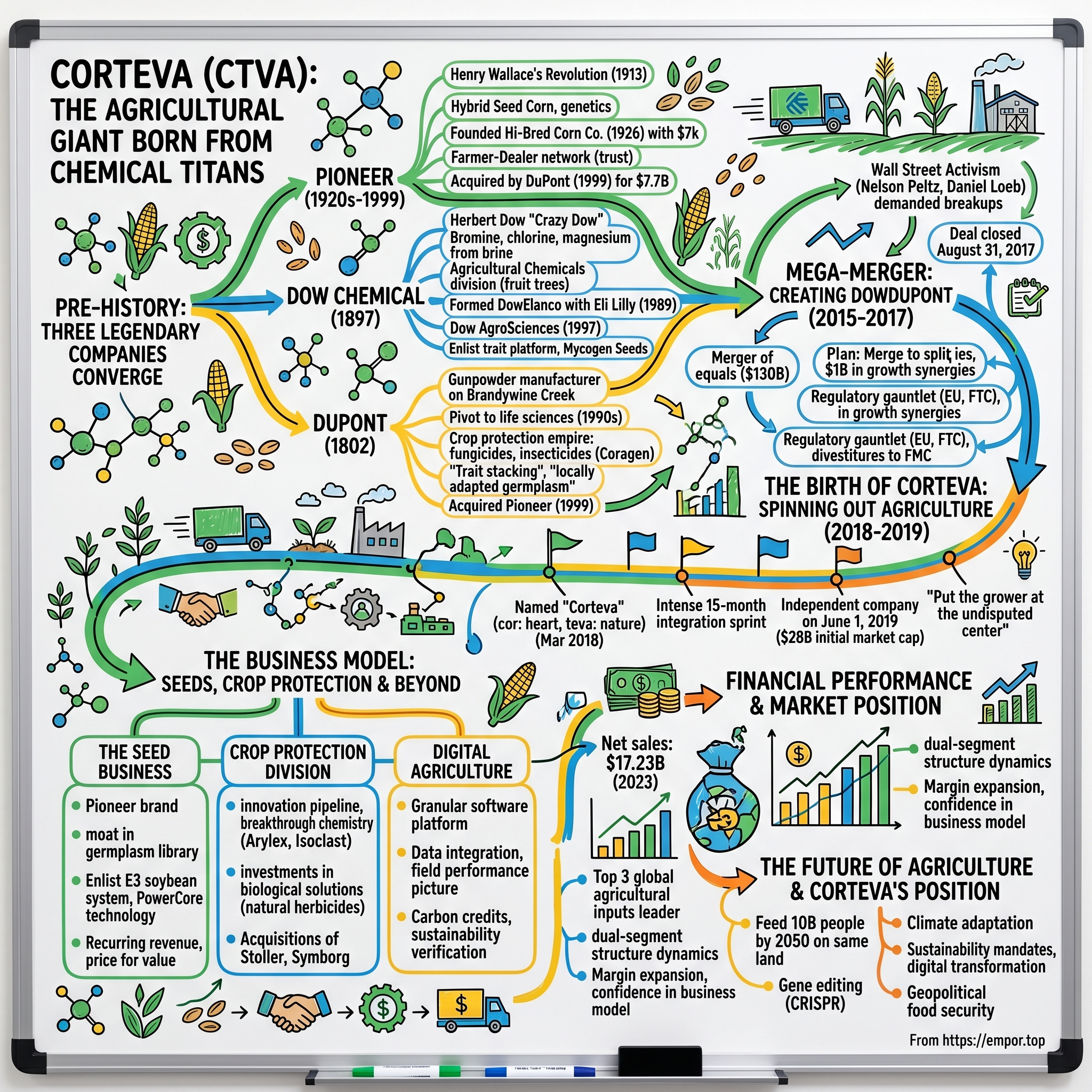
Corteva: The Agricultural Giant Born from Chemical Titans
I. Introduction & Episode Roadmap
On the last day of September 2026, a company that has existed for exactly seven years and four months will hold its final board meeting as a single entity. On October 1, Corteva Agriscience—the agricultural business assembled from the wreckage of the largest chemical merger in history—intends to break itself in half.1
This is the paradox that makes Corteva one of the most compelling case studies in modern industrial capitalism: it was created by a corporate split, and now it is ending by splitting again.
On paper, the company appears to be at its financial peak. Fiscal 2025 delivered net sales of $17.40 billion and operating EBITDA of $3.85 billion, crossing a 22% operating EBITDA margin for the first time as an independent entity.23 Free cash flow reached $2.87 billion, up from $1.21 billion just two years earlier.2 On what he described as his final earnings call leading the combined organization, Chief Executive Chuck Magro told investors that since 2019 Corteva had added roughly $1.7 billion of operating EBITDA and expanded margins by more than 750 basis points, while investing nearly $9 billion in research and returning close to $8 billion of cash to shareholders.4
Yet the board has concluded that the two halves are worth more apart. The seed and genetics business—comprising Pioneer, Brevant, and the Enlist trait franchise, representing roughly $9.9 billion of 2025 revenue—will spin off as Vylor, Inc. under Magro's leadership. The crop protection segment, generating roughly $7.5 billion of revenue, will retain the Corteva name under Luke Kissam, the retired Albemarle chief executive who joined the company on June 1, 2026.156
That decision is the analytical hinge of this story. If seeds and chemicals genuinely reinforce each other—if a farmer buying Pioneer corn is meaningfully more likely to buy Corteva herbicide, and if the R&D engines share real economics—then breaking them apart destroys value. Management's answer, delivered in the October 2025 announcement, was blunt: the two markets have diverged, and the opportunities ahead of them no longer rhyme.1 Investors are entitled to notice that this is close to the opposite of the argument Dow and DuPont made in 2015 when they built the combined company in the first place.
The industry structure. Global agricultural inputs are governed by four major companies: Bayer, Corteva, Syngenta (owned by Sinochem Holdings), and BASF, with FMC Corporation operating as a focused fifth in crop protection.7 This is not a duopoly or a simple monopoly, but an oligopoly with two distinct economic layers stacked on top of each other. Confusing those layers is the most common analytical error made about this company.
The top layer is genetics—proprietary, patent-protected, regulated into near-inaccessibility, and sold once a year in a purchase decision no farmer wants to get wrong. The bottom layer is molecules—patented for a period, then not, at which point generic manufacturers in China can produce the same active ingredient and undercut the originator by a wide margin. Both layers sell to the same customer through overlapping distribution channels, which is why they look like one business from a distance. Yet they behave nothing alike, and the corporate history that follows is the story of an organization slowly discovering that reality.
Myth versus reality. The consensus description of Corteva is "one of the Big Four agricultural input companies, a high-moat oligopolist." That is only half right. Roughly two-thirds of its 2025 segment profit came from seed, where the moat claim survives scrutiny.2 The remaining third came from crop protection, a segment where the company's own chief executive warned investors not to expect price recovery in its largest emerging market this year.4 A single "high-moat" label applied to the consolidated entity obscures more than it reveals—which is, not coincidentally, close to the argument the board itself made when deciding to split.
The thesis, stated so it can be tested. The bull argument for Corteva runs roughly like this: it is not a chemical company but a genetics platform—anchored by a century of proprietary corn and soybean germplasm, a trait licensing engine led by Enlist E3, and deep farmer relationships that generic competitors cannot buy. The bear argument is that half the company sells molecules into a market where Chinese generic producers set the clearing price, and that the seed moat is narrower than marketing suggests because germplasm without globally approved traits is a Ferrari without fuel.
Both arguments contain real evidence. This analysis holds each claim against Corteva's own execution record rather than management's slides.
The roadmap. The analysis begins with the three inheritances—Pioneer's genetics, Dow's chemistry, and DuPont's capital—and the uncomfortable fact that DuPont's seed business spent the 2000s paying royalties to a competitor. It then traces the DowDuPont merger and the $4.5 billion goodwill impairment that preceded the spinoff. Next comes Starboard Value's activist siege of the two-year-old company and the arrival of Chuck Magro, followed by a breakdown of both operating segments and the divergent economics driving them. The story examines the biologicals acquisitions, the $610 million Bayer settlement, and ongoing antitrust litigation. Finally, it tests the core thesis claims against disconfirming history, applies standard competitive frameworks, and outlines what would actually validate or break the investment case from here.
The stock has performed well recently, trading around $88 per share in early September 2026 for a market capitalization of roughly $59 billion, near its 52-week high.8 But over the five years through December 2025, a $100 investment in Corteva grew to $183, compared with $196 for the S&P 500.2 The company beat its chemical peers handily yet still lagged the broader index. That performance gap, more than any single quarter, is what the corporate separation is meant to close.
 Subscribe on LinkedIn
II. The Triple Heritage: Seeds, Synthetics, and Explosives (1802–2015)
In the spring of 1926, a thirty-seven-year-old Iowa farm journalist named Henry A. Wallace persuaded a small group of Des Moines businessmen to fund something that did not yet have an established market: a company to produce and sell hybrid seed corn.9
Wallace had not invented hybridization. What he recognized was its underlying commercial structure. Hybrid corn produces exceptional first-generation yields but degrades significantly in the second generation. A farmer who saves seed from a hybrid harvest gets a lower yield the following year, creating an incentive for repeat annual purchases. Wallace had identified a recurring revenue model in agriculture decades before enterprise software formalized subscription pricing.
The adoption curve was rapid. In 1933, roughly 1 percent of Iowa farmland was planted with hybrid seed; by 1943, nearly all of it was.9 Wallace went on to serve as Franklin D. Roosevelt's Secretary of Agriculture and later Vice President—a rare instance in American history of an entrepreneur building a market-dominant enterprise and subsequently regulating the sector he helped transform.
Genetics as accumulated capital
The germplasm library Pioneer assembled over the following decades represents the most difficult asset in this business model to replicate.
Germplasm is the library of parent plant lines a breeder crosses to create commercial hybrids. Each line represents decades of field testing across specific soil types, latitudes, disease pressures, and rainfall patterns. A corn hybrid optimized for Illinois may underperform in Nebraska. Building a germplasm library is not a project that can be funded quickly with capital; it is a compounding process requiring decades of selection. Vylor will carry more than 4,000 germplasm patents and more than 2,000 biotechnology patents into its independent operations—a portfolio built on field trials dating back to the 1930s.5
A useful analogy is a computing platform. Germplasm serves as the operating system, while biotech traits—such as insect resistance and herbicide tolerance—act as application software. A high-performing application running on an inferior operating system produces weak results. This technical interdependency historically tied trait developers and germplasm owners together, contributing to the strategic challenges DuPont faced in the 2000s.
DuPont entered the seed sector late. Following two centuries of corporate evolution—moving from gunpowder in 1802 to industrial chemicals, materials, and eventually life sciences in the 1990s—it expanded heavily into agriculture. DuPont acquired a 20 percent stake in Pioneer in 1997 and purchased the remaining 80 percent in March 1999 for approximately $7.7 billion in cash and stock, or $40 per share.[^10] At the time, it marked the largest bet that agricultural seeds were shifting into a high-margin technology market.
The Dow lineage
The company's other major predecessor originated in Midland, Michigan. Herbert Dow's 1897 electrochemistry startup began by extracting bromine from underground brine—an industrial process that established the firm's core operational instinct: lower unit manufacturing costs, then identify applications for bulk production. That approach expanded into a global chemical major whose agricultural division, DowElanco and later Dow AgroSciences, specialized in synthesizing, registering, and manufacturing active chemical ingredients. Its product line included 2,4-D, one of the earliest commercial selective herbicides, and chlorpyrifos, an insecticide sold under the trade name Lorsban whose litigation liabilities Corteva still carries today.2
That inheritance provided both technical strengths and long-term legal exposure. Dow's chemical division established a proprietary discovery engine—yielding current active ingredients such as Rinskor, Arylex, Isoclast, and Inatreq—alongside a low-cost production footprint that helped support crop protection margins in recent years. However, it also brought legacy obligations. Corteva's 2025 financial disclosures confirm ongoing personal-injury claims tied to historical chlorpyrifos exposure, as well as shared liabilities for per- and polyfluoroalkyl substances (PFAS) inherited from historical DuPont operations and managed under a cost-sharing agreement with Chemours.2
The tension nobody resolved
This combination embedded a fundamental structural tension within the combined enterprise—one that management's 2025 separation plan eventually acknowledged.
Crop protection chemistry and seed genetics operate on contrasting capital and operational cycles. A crop protection molecule is discovered in a laboratory, screened against pests, scaled in pilot facilities, and manufactured in capital-intensive plants that require high capacity utilization to cover fixed costs. Returns depend on throughput, plant efficiency, and unit production costs.
Seed genetics operates on an extended timeline. Plant breeding is a multi-year compounding process constrained by natural growing seasons. Capital deployment cannot accelerate biological growth; corn produces one crop per year, and field data arrives only at harvest. The business model requires modest physical infrastructure but significant time, with success depending on long-term germplasm development.
DuPont's legacy corporate structure—built over two centuries of heavy industrial chemical manufacturing—was aligned with the faster capital cycles of plant production. Integrating long-term genetics development within a corporate finance model designed for manufacturing assets proved difficult. This operational mismatch contributed to DuPont's inability to establish a dominant internal trait platform during the 2000s, establishing a historical precedent for the board's 2025 conclusion that seed and crop protection require separate capital allocation strategies.
The disconfirming record: germplasm was not enough
The commercial results of the 2000s highlighted a key vulnerability in relying solely on germplasm ownership.
While DuPont owned premier corn germplasm, Monsanto developed the dominant biotechnology traits. Roundup Ready—conferring glyphosate tolerance—became the standard trait package across American corn and soybean acreage. Lacking a comparable in-house trait platform, Pioneer licensed Monsanto's technology. This required Pioneer to pay royalties to its primary competitor to commercialize its own seed lines, shifting pricing power and margin capture to the trait provider. Corteva's filings reflect these legacy arrangements, noting that Roundup Ready remains a registered trademark of the Bayer Group—which acquired Monsanto in 2018—and that Corteva operated under licensing terms it later spent years litigating.2
This experience demonstrated that germplasm acts as a foundational defensive asset, whereas proprietary traits drive offensive pricing power. Germplasm without proprietary trait packages captures distributor-level returns rather than technology-level margins. Corteva's strategic moves since its 2019 spinoff—including the expansion of its Enlist E3 soybean platform, broader trait out-licensing, and a $610 million settlement to resolve legacy licensing disputes with Bayer—represent efforts to address those structural dependencies.
By 2015, DuPont's agricultural division combined high-value genetic assets with modest operating profitability inside a conglomerate targeted by activist investors advocating for a corporate breakup. That environment set the stage for the largest chemical merger in history.
III. The $130 Billion Crucible: DowDuPont's Mega-Merger & Financial Engineering (2015–2019)
On December 11, 2015, two of the oldest industrial enterprises in the United States announced a merger designed to dismantle both corporate structures.
The mechanics were complex and unprecedented in scale. Dow and DuPont agreed to an all-stock merger of equals, creating a combined entity with a market capitalization of roughly $130 billion. Dow Chief Executive Andrew N. Liveris was named executive chairman, while DuPont Chief Executive Edward D. Breen became chief executive of the combined organization. Shareholders of each firm took approximately 50 percent ownership. Within eighteen to twenty-four months of closing, the entity planned to spin off into three independent public companies focused on agriculture, materials science, and specialty products.10
The rationale hinged on pooling assets before dividing them. Dow's crop protection chemistry complemented DuPont's seed genetics, DuPont's performance materials fit alongside Dow's plastics, and the specialty chemical portfolios aligned into a third unit. Executing those asset transfers across separate corporate entities would have triggered significant tax and negotiation friction; an initial mega-merger provided a unified structure to execute three distinct exits.
Liveris framed the transaction as an industry-shaping move resulting from a decade-long strategic vision. Breen emphasized the underlying financial metrics, pointing to substantial near-term cost synergies and additional value creation expected from the eventual three-way split.10 Both executives were describing the same deal in distinct terms—industrial logic for marketplace positioning and financial engineering for shareholders seeking restructuring.
The activists in the room
This consolidation did not emerge from an internal strategic vacuum; it was forged under activist investor pressure. The sequence of events established a operational pattern that repeated in subsequent corporate developments.
At Dow, Daniel Loeb's Third Point accumulated a stake in early 2014 and urged management to spin off its petrochemicals business. Liveris resisted, maintaining that the board had an independent value-creation plan. In November 2014, to avoid a proxy fight, Dow added four independent directors—including two Third Point nominees—expanding the board from ten to thirteen members. Third Point, holding approximately 2.3 percent of outstanding shares, entered a one-year standstill agreement prohibiting proxy challenges and public criticism.26
At DuPont, Nelson Peltz's Trian Fund Management launched a proxy contest that went to a shareholder vote. Trian nominated four directors, including Peltz, at the May 2015 annual meeting. DuPont's incumbent director slate prevailed, but the margin was narrow, with Peltz securing 46 percent of votes cast.27 Chief Executive Ellen Kullman won the vote by four percentage points—a margin that signaled persistent shareholder discontent. Kullman retired in October 2015, and Breen, who had joined the board and assumed the chief executive role, announced the Dow merger seven weeks later.
The timeline reflects clear strategic causality. An activist investor pushed for DuPont's breakup. Management resisted, narrowly won the shareholder vote, and subsequently replaced its chief executive. The incoming leadership then executed a multi-way separation within two months—larger and more complex than initially proposed, but a structural breakup nonetheless.
That history informs current evaluations of the organization. The founding merger responded to activist pressure, its initial strategic alignment followed activist engagement, and its 2025 separation announcement came after extended margin scrutiny. Across three decades and three leadership teams, major corporate restructurings have consistently followed external investor pressure. While this pattern does not invalidate the current separation plan, it demonstrates why management's strategic rationales require independent verification.
The promises, and what became of them
The December 2015 merger announcement outlined specific financial targets: approximately $3 billion in run-rate cost synergies projected to create $30 billion in market value based on a ten-times EBITDA multiple, along with $1 billion in growth synergies. For the standalone agriculture company, management projected combined pro forma 2014 revenue of approximately $19 billion.10
Comparing those projections to subsequent performance illustrates the gap between initial transaction models and operational outcomes. Corteva reported net sales of $17.4 billion in fiscal 2025.2 Although regulatory divestitures modify the baseline asset mix, the trajectory indicates that eleven years after combining their seed and chemistry units to achieve operational scale, the standalone entity generated lower nominal revenue than the original pro forma benchmark, prior to adjusting for inflation. While management achieved and documented the promised cost synergies, growth synergies were not separately disclosed as realized.
Antitrust and the price of admission
Regulatory authorities required substantial asset remedies before approving the transaction. Combining Dow AgroSciences with DuPont Crop Protection created horizontal market overlaps that European and international antitrust agencies refused to clear without divestitures. To resolve these concerns, DuPont executed an asset swap with FMC Corporation: FMC acquired the divested crop protection assets—including the Rynaxypyr chewing-pest insecticide franchise, cereal broadleaf herbicides, and a significant portion of DuPont's crop protection research infrastructure—while DuPont received FMC's Health & Nutrition business plus $1.2 billion in cash. The transactions closed on November 1, 2017.11
To form the independent agricultural entity, the parent companies transferred a major insecticide product line and its associated research organization to a direct competitor. FMC continues to compete against Corteva using those acquired assets, meaning the future agricultural business bore the primary regulatory cost of the merger.
The write-down nobody talks about
In October 2018, DowDuPont filed the Form 10 registration statement for the agricultural spinoff while disclosing in a concurrent regulatory filing that DuPont would record a non-cash goodwill impairment charge of approximately $4.5 billion in its agriculture unit for the quarter ended September 30, 2018.12
Eight months before Corteva listed as an independent public company, its corporate sponsors reduced the book value of the agricultural business by $4.5 billion. Although management attributed the write-down to broader agricultural sector headwinds and currency fluctuations, the accounting adjustment confirmed that the carrying value assigned to the combined assets exceeded their long-term earning potential.
That valuation adjustment remains reflected on the balance sheet. At year-end 2025, Corteva reported $10.5 billion in goodwill and $8.3 billion in intangible assets, accounting for $18.8 billion of its $42.8 billion total asset base and $24.1 billion in book equity.13 With intangible assets representing a substantial portion of total capital, calculations of return on invested capital depend heavily on how purchase accounting metrics are treated.
The distribution
The corporate separation occurred in phases. Dow spun off on April 1, 2019. On June 1, 2019, DowDuPont completed the Corteva distribution, issuing one share of Corteva common stock for every three shares of DowDuPont held as of the May 24 record date. Corteva began regular trading on the New York Stock Exchange under the ticker CTVA on June 3, 2019.14
Corteva launched with established germplasm assets, a proprietary chemical pipeline, and an agricultural distribution network built over decades, operating alongside a corporate cost structure originally built for a conglomerate division. Aligning that cost structure with standalone market requirements became the primary strategic focus of its initial operational phase.
IV. Standalone Genesis & The Activist Siege (2019–2021)
Jim Collins had spent his entire career at DuPont. A chemical engineer by training and an agriculture executive by trajectory, he was the natural choice to run the company he had helped assemble. His first two years demonstrated a lesson that spinoff investors relearn every cycle: inheriting premier assets and operating a high-performing business are entirely different challenges.
The timing was unforgiving. Corteva began trading in June 2019, amidst a spring so wet that American farmers left millions of intended corn acres unplanted. For a company whose seed revenue depends directly on planted acreage, there was no worse opening quarter. The following year brought a global pandemic. Reported results for 2019 showed a net loss, and the operating margin the company generated entering 2020 fell far below what its asset quality implied.13
Yet weather was an excuse, not the full explanation. The deeper issue was structural and internal. Corteva was carrying corporate overhead scaled for a division of a $130 billion conglomerate rather than a standalone enterprise. It was managing three distinct legacy cultures under one roof: Pioneer's breeder-led seed division, Dow AgroSciences' manufacturing-focused chemical unit, and DuPont Crop Protection's commercial organization—each with its own systems, incentives, and internal identity. Meanwhile, its seed business remained a net payer of trait royalties, funneling a portion of every soybean bag's margin to a primary competitor.
None of this was secret, but the public narrative created friction. Management leaned heavily on merger synergy milestones—a metric inherited from the DowDuPont integration, measured against the promises of the 2015 announcement rather than the standalone profitability of the operating business. Synergy targets offered a convenient benchmark: management could hit cost-cutting milestones on schedule while operating margins stalled, because success was judged against an internal integration plan rather than peer performance.
That disconnect between reported restructuring progress and underlying earning power created an opening for activist scrutiny.
January 21, 2021: Starboard opens fire
Jeffrey Smith's Starboard Value is not a passive critic. The fund employs a forensic playbook: build a position, publish a detailed operational diagnosis, and seek board representation. Having held Corteva stock for roughly eighteen months, Starboard issued a public letter to the board outlining a severe critique of management.
Starboard, which disclosed a 1.6% stake in the company, stated that "a litany of missed promises and unforced errors" had deepened its conviction that current leadership was ill-equipped to maximize the value of Corteva's assets. The fund argued that the board's reluctance to replace leadership reflected a "broader preference for comfort and status quo." It noted that management continued to claim credit for escalating synergy milestones without delivering corresponding profit margin expansion, adding that if Corteva were conducting an open chief executive search, it would not interview the incumbent.15
Behind the public friction was a specific, testable analytical claim: Corteva was under-earning relative to its asset base due to operational inefficiencies rather than structural limitations. Subsequent operating results have largely validated that diagnosis. The margin expansion Corteva later presented as strategic execution originated in an activist critique that management initially resisted.
March 19, 2021: the settlement
Corteva avoided a prolonged proxy fight. On March 19, 2021, the company reached an agreement appointing three Starboard-nominated independent directors—David C. Everitt, Janet P. Giesselman, and Kerry J. Preete—to the board immediately, alongside a fourth independent director, Karen H. Grimes. Three incumbent directors stepped down. The board expanded temporarily from twelve to sixteen members before settling at thirteen.16
Independent Chairman Greg Page characterized the agreement as a "constructive outcome." Smith offered a measured public endorsement, noting that Starboard had "identified Corteva as a leader in its field with significant potential to improve both growth and profitability."16
The governance refresh carried long-term implications. Karen Grimes, who joined the board under the settlement, was later named independent chair of Vylor's board ahead of the 2026 separation.17 The board overhaul initiated by activist pressure ultimately supplied key leadership for the upcoming corporate split.
October 28, 2021: the operator arrives
Seven months after the settlement, Corteva's board appointed Chuck Magro as chief executive officer, effective November 1, 2021, succeeding Collins, who retired at year-end.18
Magro's background aligned directly with Starboard's operational critique. A chemical engineer who spent most of his career at Agrium, Magro served as president and chief executive of Nutrien from its formation in 2018 through April 2021, leading the organization following the Agrium–PotashCorp merger.18 He had managed a major agricultural supplier through a sharp commodity downturn and possessed extensive experience extracting operational efficiencies from merged entities. Rather than selecting a research scientist or a seed strategist, the board installed an executive experienced in operational integration and margin optimization.
Magro's initial strategy focused on operational discipline rather than major strategic pivots or large acquisitions. The early agenda emphasized productivity gains, SKU rationalization, exiting low-margin generic chemistry lines, reducing net trait royalty expenses, and tightening capital allocation. Corteva's performance from 2019 through 2021 highlights that its initial margin lag was largely self-inflicted and operational—providing the baseline for subsequent turnaround gains while illustrating the impact of lingering integration complexity.
V. Core Business Deep Dive: Seeds vs. Crop Protection
To understand why Corteva is separating, you have to understand that the two segments are not variations on a theme. They are different businesses with different customers' decision logic, different competitive structures, and different relationships to time.
In 2025, Seed generated net sales of $9,898 million and segment operating EBITDA of $2,636 million — a margin of roughly 26.6%. Crop Protection generated $7,503 million of net sales and $1,350 million of segment operating EBITDA, a margin of about 18.0%.2 Seed contributed 57% of revenue and 66% of segment profit. After $138 million of corporate expense, total operating EBITDA was $3,848 million on $17,401 million of sales.2
The Seed segment: selling certainty
A farmer buys corn seed once a year. The decision is irreversible for twelve months, and it determines the ceiling on everything that follows. Seed and traits represent a meaningful but not dominant share of per-acre input cost; they determine essentially all of the yield potential. That asymmetry is the entire economic foundation of the segment. A grower will not switch hybrids to save a few dollars an acre if there is any doubt about performance, because the downside of being wrong is an entire season.
This is why the Pioneer brand — sold in the United States through an owned farmer-dealer network rather than purely through distribution — retains pricing power that looks anomalous for an agricultural input.2 The brand is not aspirational. It is a risk-reduction device.
Enlist E3 and the trait reversal. The defining strategic act of Corteva's independent life was the decision, taken in 2019, to accelerate the conversion of its entire branded soybean portfolio to the Enlist E3 trait — a herbicide tolerance platform jointly developed with MS Technologies that confers tolerance to 2,4-D choline, glyphosate and glufosinate. The company committed to a compressed ramp and correspondingly reduced volumes carrying Bayer's Roundup Ready 2 Yield and Xtend traits.2
This was a genuine bet. It meant deliberately shrinking sales of the incumbent technology before the replacement had proven itself. It worked: substantially all of Corteva's branded soybean portfolio now carries Enlist E3 in proprietary Corteva germplasm, and Enlist E3 became the leading herbicide tolerance trait in U.S. soybeans, planted on more than 65% of U.S. soybean acres in 2025.219
Two things made it work, and only one of them was Corteva's doing. The first was formulation chemistry: 2,4-D choline is markedly less volatile than the dicamba formulations at the centre of the Xtend system, which meant fewer off-target drift complaints from neighbours. The second was that dicamba's regulatory troubles in the United States handed Corteva a window. Competitive luck and product merit are hard to separate here, and investors should resist the temptation to attribute all of a 65% share to engineering.
The out-licensing pivot. The more durable change is commercial rather than technical. Corteva has moved from being a net payer of trait royalties to a licensor, out-licensing traits and germplasm to third parties — including competing seed brands.2 In 2025, reduced net royalty expense was a named driver of the 19% increase in Seed segment EBITDA, alongside share gains in North America and Brazil.2 Management expects to be net royalty positive in 2026, roughly two years ahead of its original plan, and described the licensing business on the second-quarter 2026 call as running about three years ahead of schedule.4
That is a real and verifiable operating datapoint, and it changes the character of the earnings. Royalty income arrives with essentially no incremental manufacturing or selling cost, which means incremental licensing revenue drops through at very high margins. It is also the one part of the seed business that scales without acres.
The qualifier: out-licensing means arming competitors. Corteva is selling its trait technology to seed companies that then compete with Pioneer for the same farmer. Management's implicit judgment is that royalty economics on a competitor's acre beat losing that acre entirely. That is probably right in a mature market. It is not free.
The Crop Protection segment: selling molecules
Now the other business, where the customer logic inverts.
Crop protection products are consumables applied during the season in response to observed pest, weed and disease pressure. Farmers can delay, substitute, reduce rates, or buy a generic equivalent. Once an active ingredient's patent expires, chemistry is chemistry — and Chinese manufacturers of off-patent actives are extremely good at making it cheaply.
The 2023–2024 destocking cycle demonstrated the consequence with brutal clarity. Distributors across Latin America and North America had over-ordered during the post-pandemic supply scare, then faced high interest rates and falling crop prices. In 2024, Crop Protection net sales fell 5% to $7,363 million with price alone down 5%, and segment EBITDA declined 7% to $1,272 million.2 Volume actually grew; price collapsed anyway.
The 2025 recovery is instructive about what did and did not repair. Net sales rose 2% to $7,503 million on 5% volume growth, offset by a further 2% price decline and 1% adverse currency. Segment EBITDA rose 6% to $1,350 million — but the drivers management cited were raw material deflation, productivity savings and volume, not price.2 Margin improved roughly 70 basis points. The segment earned more money by costing less, not by charging more.
Where the pricing power actually lives. Corteva's answer is portfolio composition. The differentiated actives — Rinskor and Arylex herbicides, Isoclast insecticide, Inatreq fungicide — carry patent protection and command premiums. Management said on the second-quarter 2026 call that the new product portfolio would approach $2 billion of revenue in 2026 with essentially flat pricing in the first half and high-single-digit volume growth, and pointed to seven new active ingredients in the pipeline over the next decade, with Aviso next in line.4 Kissam, in his first investor appearance, said roughly two-thirds of the current portfolio is differentiated technology and emphasised that the business is not dependent on any single active, segment, crop or geography.4
Magro was candid about the rest. Asked directly whether high-single-digit price declines in Brazil were the new normal, he said Corteva does not think so — but then described a playbook that concedes the point in a different form. A pre-emergent herbicide came off patent, generics arrived, Corteva cut price as expected, and the company protected margin and share by attacking its own cost of production instead.4 He added that Corteva is not expecting price recovery in Brazil in 2026.
That exchange is the most useful thirty seconds on the call. It reframes crop protection defensibility away from pricing power and toward cost position and pipeline replenishment. Those are real advantages — a low-cost manufacturing base and seven new actives are not nothing — but they are the advantages of a good specialty chemical company, not of a technology franchise.
Biologicals. The newest layer is nature-derived inputs: microbials, plant hormones, biostimulants, biological nitrogen fixation. In 2025, Corteva's biologicals sales grew 9%, but the composition tells the story: volume up 16%, price down 7%.2 Rapid adoption, no pricing power yet.
The competitive field
Bayer remains the largest integrated player, carrying the debt and the glyphosate litigation legacy of its Monsanto acquisition. Syngenta, owned by 中国中化 Sinochem Holdings, brings state-backed capital and strength in Europe and Latin America. BASF is the premium fungicide specialist. FMC is the focused insecticide competitor — operating, as noted, partly with assets divested from DuPont as the price of the merger.711 Beneath all four sits a large and growing tier of generic manufacturers whose only strategy is price.
The Seed and Crop Protection businesses share a customer and almost nothing else. Which is the strongest argument management has for what it announced in October 2025.
VI. The Chuck Magro Turnaround & Capital Allocation Playbook (2021–2026)
Magro's tenure divides cleanly into two acts: an initial phase of operational repair followed by the decision, announced almost four years into his term, to divide the company.
Act one: the margin machine
The operational turnaround was methodical and measurably effective. Operating EBITDA expanded from $3,491 million in both 2023 and 2024 to $3,848 million in 2025.2 Operating earnings per share shifted from $2.69 in 2023 to $2.57 in 2024 before rising to $3.34 in 2025.2 Over the same span, free cash flow more than doubled, increasing from $1,214 million to $2,866 million.2 Concurrently, operating EBITDA margin exceeded 22% for the first time in the company's standalone history.3
These gains stemmed primarily from internal, controllable drivers: corporate-wide productivity initiatives, raw material cost deflation, SKU rationalization, and reduced net royalty expenses as the proprietary Enlist soybean platform replaced licensed trait packages. On the fourth-quarter 2025 earnings call, management quantified these operational improvements, citing approximately $340 million in net cost reductions alongside $90 million in Seed royalty savings, as well as more than $300 million in productivity gains within Crop Protection.20
Notably, very little of this margin expansion resulted from pricing power in Crop Protection. A substantial portion of the improvement instead reflected input cost deflation—a cyclical dynamic rather than a permanent operational capability. Chief Financial Officer David Johnson acknowledged this distinction during the second-quarter 2026 call, noting that of the roughly $1 billion in gross productivity and cost savings targeted in the 2024 three-year plan, a portion was driven by commodity deflation, which is "probably one element you will not see us" repeat in subsequent plans.4 This admission highlights that part of the margin expansion was temporary, qualifying claims that a 22%-plus margin represents a permanent structural baseline.
Credibility check. Evaluated against management commitments, Magro's execution record displays consistency. The 2024 investor day targets projected roughly $4.4 billion in operating EBITDA by 2027. In July 2026, management raised full-year 2026 guidance to between $4.1 billion and $4.3 billion while reiterating confidence in the 2027 benchmark.4 Licensing expansion and productivity programs are progressing ahead of initial schedules, offsetting lower-than-projected Crop Protection pricing. Management has generally maintained consistent messaging and publicly acknowledged headwinds—including Brazilian pricing pressure, tariffs, and second-half seasonal losses—rather than obscuring operational setbacks.
However, this execution occurred during a period marked by favorable raw material costs and an improving trait royalty mix. The current management team has yet to be tested by a severe industry demand shock comparable to the conditions experienced in 2019 and 2020.
The biologicals bet
Magro's primary M&A initiative occurred early in his tenure. On March 1, 2023, Corteva completed the acquisitions of Stoller Group—a prominent independent biologicals firm with a strong position in Latin America—and Symborg, a Spanish microbial technology developer specializing in biological nitrogen fixation.21 The purchase prices were $1,220 million for Stoller and $370 million for Symborg, inclusive of working capital adjustments. The Stoller transaction represented an enterprise value of approximately 12 times its expected 2022 standalone EBITDA, with the combined acquisitions partially funded via a $1 billion drawdown on a 364-day revolving credit facility.2
Investing roughly $1.6 billion established immediate scale in the industry's fastest-growing input category. The 12-times EBITDA multiple reflected market valuation rates rather than a discounted entry or an obvious overpayment.
Three and a half years after closing, the operational record remains mixed. While biologicals sales volumes have expanded at double-digit rates—indicating sustained grower adoption—realized product prices have declined. Furthermore, Corteva has not disclosed biologicals as a distinct profit center, and regulatory filings highlight an underlying issue: in the first quarter of 2024, Corteva negotiated a one-time indemnification payment from Stoller's former owners.2 Although Corteva did not disclose the underlying cause, an indemnification settlement within twelve months of closing indicates post-acquisition friction during integration.
In sum, Corteva secured a leading position in biologicals at a full but market-aligned valuation and drove volume growth, but it has not yet demonstrated that the category delivers higher profit margins than the traditional chemical products it complements.
Clearing the Bayer overhang
Legacy legal disputes with Bayer had increasingly constrained strategic flexibility. In August 2022, Bayer filed suit in Delaware state court, alleging that Corteva infringed two Bayer patents during the development of Enlist E3 and was obligated to pay royalties on sales from 2019 through 2029 under an agrobacterium cross-licensing agreement. Corteva counter-sued in federal court regarding its AAD-1 herbicide resistance technology and separately sought a declaratory judgment that Bayer could not collect royalties on the Roundup Ready Corn 2 trait following patent expiration.2
The litigation produced mixed interlocutory outcomes. In December 2024, the Patent Trial and Appeal Board invalidated three of Corteva's AAD-1 patents as unpatentable in a challenge initiated by Bayer and joined by gene-editing company Inari; Corteva appealed, leading to a stay in the federal court proceeding.2 Additionally, Corteva lost a summary judgment ruling on the Roundup Ready Corn 2 royalty dispute in September 2024, though it secured a favorable partial summary judgment in May 2025 affirming that patent expiration terminates royalty obligations.2
In January 2026, the companies reached a comprehensive settlement. Corteva agreed to pay $610 million and dismiss its AAD-1 claims, while the parties terminated the cross-licensing agreement. The settlement extinguished potential Enlist E3 royalty liabilities alongside disputed future royalty obligations under other agreements, while establishing new market-rate licensing terms for cotton traits. The agreement resolved all active litigation between the two firms.2
Management projected that the settlement accelerates the out-licensing of triple-stack corn traits to as early as 2027—roughly five years ahead of previous projections—and advances the timeline for a third-generation above-ground corn insect trait by approximately two years. Management also noted that the agreement opens U.S. cotton trait out-licensing and projected approximately $1 billion in cumulative earnings upside over the next decade.20
That $1 billion projection represents a long-term internal estimate rather than a guaranteed contractual cash flow. In contrast, the $610 million settlement payment required an immediate cash outlay, primarily executed in January 2026. This obligation increased accrued litigation liabilities on the balance sheet from $228 million at year-end 2024 to $874 million at year-end 2025, significantly weighing on first-half 2026 operating cash flow.24 Resolving an eight-year dispute with its primary competitor to expand trait licensing represents a coherent strategic choice, but the capital outlay is immediate while the projected benefits remain subject to future execution.
The antitrust matter that is not resolved
Corteva's distribution practices for crop protection products remain subject to active litigation, presenting an ongoing regulatory issue that contrasts with some simplified market accounts.
On September 29, 2022, the Federal Trade Commission and ten state attorneys general filed suit against Corteva and Syngenta, alleging that the companies used distributor "loyalty programs" to condition incentive payments on limiting purchases of generic alternatives, artificially inflating prices for farmers.22 Two additional states joined the federal lawsuit in December 2022, while Arkansas filed a separate action.2
Subsequent proceedings have developed along three distinct tracks. First, in January 2025, the federal multi-district litigation court ruled on Corteva's motion to dismiss private class actions, dismissing federal damages claims and 13 of 27 state consumer protection claims; trial proceedings on the surviving claims are scheduled to begin in 2027.2 Second, in June 2026, Corteva agreed to an $85 million settlement covering a class of over 100,000 farmers in the Middle District of North Carolina who purchased products containing acetochlor, rimsulfuron, oxamyl, or methoxyfenozide between October 2018 and May 2026. Corteva made no admission of wrongdoing in the settlement, which equaled approximately 10% of the damages estimated by the plaintiffs' expert witness, while litigation against Syngenta proceeded.23 Third, on August 14, 2026, Corteva agreed to pay $3.1 million to settle the action brought by the Arkansas attorney general.24
However, as of early September 2026, the FTC's enforcement action remains unresolved. The ongoing regulatory scrutiny presents a live overhang for Corteva's North American Crop Protection margins and distribution model.
Capital returns
Corteva's capital allocation strategy has prioritized consistent shareholder returns alongside ongoing balance sheet strength. In 2025, the company returned approximately $1.5 billion to shareholders through share repurchases and dividends, including a 6% increase in the quarterly dividend to $0.18 per share in July 2025. Share repurchases were executed under a $3 billion authorization approved in November 2024, following previous $2 billion and $1.5 billion buyback programs in 2022 and 2021.2 Research and development expenditures totaled $1,474 million in 2025, representing roughly 8.5% of net sales.13 Corteva ended 2025 in a net cash position, holding $4.5 billion in cash against $2.6 billion in total debt.13
This net cash balance provided the liquidity required to fund recent capital outlays, enabling Corteva to absorb the $610 million legal settlement, the $85 million class-action agreement, a $1.1 billion pension contribution, and corporate separation expenses while raising full-year financial guidance.4 The extent to which the two post-split entities maintain similar financial flexibility depends on their final capital structures, which management was still finalizing with credit rating agencies as of the second-quarter 2026 call.4
Act two: the split
On October 1, 2025, Corteva announced a board-approved plan to separate its Seed and Crop Protection businesses into two independent, publicly traded companies through a transaction structured to be tax-free for U.S. federal income tax purposes. Magro cited changing industry dynamics as the core rationale, noting that the long-term growth opportunities for seed genetics and crop protection chemistry no longer align.1
Preparations for the division have progressed on schedule. On May 4, 2026, Corteva named the standalone seed company Vylor Inc.—a corporate name derived from "valor," with a stylized letter "l" representing the negative space of a chromosome.5 On April 14, 2026, Luke Kissam was appointed chief executive of the standalone crop protection company, assuming the role on June 1.6 Both corporate boards have been appointed, Form 10 registration statements have been filed, and estimated annual separation dis-synergies were reduced from an initial run-rate projection of $100 million to approximately $25 million.417 Separate investor days for both companies were scheduled for September 15, 2026, at the New York Stock Exchange to present 2029 financial frameworks ahead of the targeted October 1 separation date.4
Market reaction to second-quarter 2026 financial results highlighted investor caution despite the raised full-year guidance. Second-quarter revenue of $6.38 billion fell below consensus estimates, even as operating earnings per share of $2.30 exceeded expectations, triggering a nearly 10% single-day decline in the stock.25 Overall product volumes declined 3% during the quarter, led by a 2% drop in Crop Protection due to North American purchasing timing.25 The market reaction underscores that investors are evaluating underlying volume trends alongside margin expansion as the organization prepares to launch two distinct public equity stories.
VII. Historical Falsification Layer: Testing Core Thesis Claims
Every investment case for Corteva rests on a small number of structural claims. This section tests each against the strongest disconfirming evidence in the company's own record, and states where that evidence leaves the claim.
Claim 1: "Germplasm and traits give Corteva durable pricing power in seed"
The disconfirming record. The strongest counter-evidence is not hypothetical; it is the two decades DuPont and Pioneer spent as a licensee. Through the 2000s, Pioneer owned the industry's premier germplasm library yet could not set prices because the traits farmers demanded belonged to Monsanto. Corteva's disclosures still detail the architecture of that dependency—including licensed Roundup Ready technologies now owned by Bayer, transition plans to phase out Roundup Ready 2 Yield and Xtend volumes, and years of subsequent litigation over what royalties were owed and for how long.2
A second piece of evidence lies in the Enlist E3 rollout initiated in 2019, which required global regulatory clearances before commercialization at scale—leaving the trait's value vulnerable to import approvals in key international markets. A third emerges from December 2024, when the Patent Trial and Appeal Board invalidated three AAD-1 patents underpinning Enlist corn technology.2 Corteva responded that its broader portfolio of patents covering Enlist traits and weed control systems would prevent any operational impairment to licensing or protecting Enlist E3.2 While that argument may hold, a competitor successfully invalidating three core patents illustrates the ongoing contestability of the company's technology moat.
Verdict: narrows the claim. Germplasm combined with a proprietary, globally approved, and patent-protected trait stack delivers pricing power—as evidenced by a 3 percent seed price increase and 340 basis points of segment margin expansion in 2025.2 Germplasm alone does not, as the 2000s demonstrated. Corteva's seed pricing power remains conditional on continuously refreshing its trait stack and defending it legally, requiring ongoing capital and legal commitments rather than relying solely on inherited assets.
What would confirm or falsify it: The trajectory of trait out-licensing revenue, specifically whether the triple-stack corn out-licensing unlocked by the Bayer settlement for 2027 delivers disclosed royalty income on schedule.
Claim 2: "Crop protection margins are defensible"
The disconfirming record. Historical performance largely refutes this claim in its broad form. In 2024, Crop Protection prices fell 5 percent and segment EBITDA dropped 7 percent despite higher volumes.2 In 2025, prices declined another 2 percent, with margin recovering solely due to raw material deflation and internal cost reductions.2 In the first half of 2026, pricing fell again, leading management to project further low-to-mid single-digit price declines through the second half.4 Three consecutive years of falling prices indicate a structural trend line rather than a temporary cyclical dip.
Management's account of an off-patent pre-emergent herbicide provides clear evidence: when generic competitors entered the market, Corteva lowered prices and defended margins through cost reduction.4 That operational dynamic reflects a cost-management discipline rather than true pricing power.
Regulatory scrutiny further challenges the claim. The FTC's lawsuit alleges that a portion of Corteva's U.S. Crop Protection pricing was sustained through distributor loyalty programs that restricted generic competition.22 Corteva has agreed to pay $85 million to settle farmer class actions and $3.1 million to settle claims in Arkansas, without admitting wrongdoing, while the FTC's action remains pending.2324 Regardless of the final legal outcome, future distribution arrangements are unlikely to replicate historical structures, suggesting that past North American margins tied to those practices should be evaluated cautiously.
Verdict: rejects the broad claim; leaves a narrower one intact but unproven. Off-patent chemistry lacks durable pricing power. The narrower surviving claim is that a portfolio focused on patented active ingredients and biologicals can maintain margins through product mix and cost leadership. Management's assertion that two-thirds of the current portfolio represents differentiated technology serves as the primary supporting metric—though it remains an un-audited management metric.4
What would confirm or falsify it: Whether Crop Protection EBITDA margin can expand in an environment of flat or rising raw material costs, given that previous margin gains relied heavily on input cost deflation.
Claim 3: "Biologicals are high-margin growth optionality"
The disconfirming record. Historical outcomes for agricultural technology acquisitions highlight significant challenges. Companies frequently acquire platform businesses at premium multiples, only to discover that field performance varies across soil, weather, and farm practices in ways lab trials cannot predict. Shelf-life stability presents formulation hurdles, while growers often reduce discretionary inputs during farm margin compressions. Furthermore, because biological products are derived from living organisms or natural substances, they inherently display greater performance variability than synthetic molecules with established modes of action.
Corteva's three-year track record indicates rising volume adoption without reflecting premium pricing power: biologicals sales grew 9 percent in 2025 as a 16 percent volume increase offset a 7 percent price decline.2 That followed a 3 percent sales contraction in 2024.2 Meanwhile, the acquisitions increased overhead and amortization expenses, with overall corporate amortization driven higher by intangible assets recognized from Stoller and Symborg.2 Additionally, an indemnification payment negotiated with Stoller's former owners in early 2024 points to early post-closing friction.2
Verdict: unproven optionality. The acquisitions established immediate market presence and scale at a standard industry multiple. However, evidence has not yet demonstrated that biologicals command premium margins or add incremental value rather than substituting for traditional chemistry sales. The initiative represents an ongoing strategic investment whose long-term economic return remains unverified.
What would confirm or falsify it: Whether post-separation financial reporting breaks out biologicals as a distinct segment with dedicated margins, and whether product pricing achieves positive momentum.
Claim 4: "This management team allocates capital well"
The disconfirming record. The broader corporate history predating current leadership includes notable capital misallocations. In the third quarter of 2018, prior to Corteva's spinoff, DowDuPont recorded a $4.5 billion goodwill impairment in its agriculture unit.12 Merger-related antitrust remedies required divesting a major insecticide franchise and significant research infrastructure to FMC.11 Today, $18.8 billion in goodwill and intangible assets remains on a $42.8 billion balance sheet, reflecting the historical cost of building the enterprise.13
Under current leadership, capital allocation has been disciplined: a major biologicals acquisition executed at market multiples, steady share repurchases, a rising dividend, research expenditures maintained at roughly 8.5 percent of sales, and a net cash balance sheet.213 The $610 million Bayer settlement will ultimately be evaluated by whether projected out-licensing revenues materialize.
Verdict: leaves the claim intact for current leadership, but with a limited track record. Magro's tenure spans under five years without facing a major industry downturn, and his primary M&A investment remains unproven. Characterizing current capital allocation as disciplined is supported by recent execution, but declaring it proven remains premature.
What would confirm or falsify it: The capital structures and shareholder return policies established for Vylor and Corteva following the separation, along with whether either entity uses its balance sheet to pursue acquisitions at valuations above previous benchmarks.
VIII. Helmer's 7 Powers & Porter's 5 Forces Analysis
Evaluating Corteva through competitive strategy frameworks clarifies why the board chose to separate the enterprise. A rigorous assessment highlights how market advantages differ across the two core divisions.
Helmer's 7 Powers
Cornered resource — strong, and genuinely rare. The germplasm library represents a durable asset that cannot be bought or rapidly replicated, as compiling it requires decades of field trials across diverse growing environments. The portfolio that Vylor will carry—comprising more than 4,000 germplasm patents and over 2,000 biotechnology patents—reflects nearly a century of cumulative selection.5 However, this advantage is fundamentally defensive; owning premier germplasm did not prevent DuPont's seed business from generating sub-par returns for two decades.
Scale economies — strong, and the primary entry barrier. Corteva allocated $1,474 million to research and development in 2025 against $17.4 billion in net sales, an investment scale that few competitors can match.13 Securing regulatory approval for a novel biotechnology trait or active ingredient costs hundreds of millions of dollars and spans several years across international regulatory bodies, including the U.S. Environmental Protection Agency, the U.S. Department of Agriculture, European authorities, and China's Ministry of Agriculture. Management's plan to introduce seven new active chemical ingredients over the coming decade represents a development pipeline that only a small group of global peers can maintain.4
Switching costs — moderate, and often overstated. A grower adopting Enlist E3 soybeans commits to a compatible herbicide program for that season, creating a practical link between seed selection and chemical applications. However, this commitment resets annually. Seed purchasing is an annual decision, and 2,4-D choline is an off-patent molecule. Customer stickiness stems primarily from dealer relationships and agronomic risk aversion rather than technical lock-in.
Branding — strong in North America, weaker elsewhere. Pioneer is one of the few consumer-grade brand names operating in an industrial supply market. Its commercial strength relies on a core economic asymmetry: the financial risk of choosing an underperforming seed line far exceeds the price differential between brands. That brand equity, however, does not translate with equal strength across all international markets or crop varieties.
Process power — moderate. Multi-generational plant breeding capability is a genuine organizational asset, as selecting optimal genetic crosses relies on institutional knowledge that is not fully codifiable. Nevertheless, primary peers including Bayer, Syngenta, and BASF maintain comparable breeding expertise.
Counter-positioning — weak, and mislabeled in standard descriptions. Counter-positioning requires a novel business model that incumbents cannot copy without harming their core operations. Licensing seed traits to competing brands does not fit this definition, as competitors such as Bayer have licensed trait platforms for decades. Out-licensing is a sound commercial strategy rather than a structural counter-positioning advantage.
Network effects — absent. The business features no mechanism by which adoption by one grower enhances product value for another. Assertions of network effects in this sector reflect a misapplication of the concept.
Porter's Five Forces
Threat of new entrants: very low. Substantial regulatory costs, high R&D intensity, and the extended timeframe required to build germplasm libraries make large-scale new entry nearly impossible. The primary point of entry comes from specialized gene-editing firms targeting specific intellectual property niches—illustrated by Inari joining Bayer's patent challenge against Corteva's AAD-1 technology.2 Focused, technically advanced entrants can challenge specific patent perimeters without duplicating full commercial operations.
Bargaining power of buyers: low in seed, moderate-to-high in crop protection. Corn hybrid buyers display low price sensitivity relative to potential yield loss. Conversely, growers purchasing off-patent crop protection products exhibit high price sensitivity and readily adopt generic alternatives. This structural division represents a key driver of the company's performance and underpins the rationale for splitting the business. Channel control adds further complexity: the FTC's antitrust litigation centers on whether distribution programs restrict generic market access, and a ruling that expands distributor autonomy would increase buyer power within North American crop protection.22
Bargaining power of suppliers: low, and currently a tailwind. Key chemical intermediates function as globally traded commodities. Corteva has benefited from falling raw material costs over two consecutive years.2 This dynamic creates an operational trade-off: inexpensive chemical intermediates lower Corteva's manufacturing costs while simultaneously reducing production costs for generic competitors. Additionally, management identified approximately $80 million in projected 2026 tariff headwinds, concentrated primarily on active ingredients imported from China.20
Threat of substitutes: low in the near term. Gene editing functions as an evolution of biotech traits rather than a replacement, while biological treatments currently complement synthetic chemicals rather than replace them. The primary substitution threat is regulatory intervention, as government agencies in Europe and other regions periodically restrict or ban specific active ingredients.
Competitive rivalry: high and asymmetric. Competitive dynamics vary significantly by peer. Bayer competes in trait technology while managing significant debt and legacy litigation obligations. Syngenta operates with state-backed capital and long-term investment horizons. BASF focuses on specialty fungicide chemistry, and FMC competes using crop protection assets acquired during the DowDuPont divestiture process. Beneath these established peers, generic manufacturers compete primarily on price.
The synthesis. Corteva's competitive position is strong overall, but its strength is unevenly distributed across operations. The seed business possesses cornered resources and brand equity that command technology-like valuation multiples. The crop protection division relies on scale economies characteristic of high-performing specialty chemical enterprises. Combining both divisions under a single corporate banner led financial markets to apply an intermediate valuation multiple to the consolidated firm. Capturing the valuation gap between these distinct business models represents the core rationale behind the October 2025 separation.
IX. Strategic Position, Bull vs. Bear Case & Key Forward KPIs
Three weeks before the corporate split, the investment cases for and against each successor company can be stated precisely.
The bull case
Seed is compounding through higher-margin licensing. Segment EBITDA grew 19% in 2025 on 4% sales growth, expanding segment operating margin by roughly 340 basis points.2 The driver mix—market share gains, pricing, product mix, and lower net trait royalty expenses—includes trait licensing, an income stream carrying minimal incremental operational expense. Management reported that the trait licensing business is running three years ahead of its internal plan and expects to become net royalty positive in 2026, two years ahead of schedule.4 If management's projections hold, the Bayer settlement opens triple-stack corn out-licensing as early as 2027 and grants access to U.S. cotton traits—markets previously inaccessible to Corteva.220 Meanwhile, Conkesta E3 soybean penetration in Brazil is projected to expand from mid-single digits in 2025 toward mid-teens in 2026 and high-single to low-double digits of the broader market by 2027.420
The crop protection portfolio shows product-level momentum. Crop Protection volume expanded 5% in 2025, supported by high-single-digit volume growth in novel active ingredients, bringing the new-product portfolio near $2 billion in annual revenue.24 The planned introduction of seven new active ingredients over the next decade represents a discovery pipeline that few specialty chemical peers can match.4
Operational execution during the separation remains tight. Corteva reduced its run-rate separation dis-synergy estimate from $100 million to roughly $25 million while simultaneously raising full-year financial guidance—demonstrating operational control during a complex corporate restructuring.4
Strong balance sheet flexibility. Ending 2025 in a net cash position, generating $2.87 billion in free cash flow, and returning $1.5 billion to shareholders provides both Vylor and standalone Corteva the financial flexibility to fund internal growth initiatives or maintain capital returns.213
The bear case
Crop protection pricing has declined for three consecutive years. Crop Protection segment margins expanded in 2025 primarily through raw material cost deflation and internal cost reductions, and the chief financial officer explicitly stated that commodity input deflation will not recur in future operating plans.24 A specialty chemical business whose margin expansion relies on falling raw material costs exhibits cyclical, rather than structural, pricing power.
Regulatory and antitrust litigation creates ongoing distribution risk. Corteva has paid $85 million to settle private class actions and $3.1 million to resolve state antitrust claims without admitting liability, with private litigation trials set for 2027 and the FTC's enforcement action still pending.22324 To the extent historical U.S. Crop Protection margins were supported by exclusive distributor incentive structures, future margin expectations should be evaluated cautiously.
Underlying product volume performance shows vulnerability. Second-quarter 2026 revenue missed consensus estimates due to a 3% overall volume decline, driving a 10% single-day decline in share price despite an earnings-per-share beat and elevated full-year guidance.25 Financial markets are signaling that margin expansion derived from cost reductions has largely been priced into current equity valuations.
Corporate separation removes operational diversification. Within the integrated corporate structure, seed earnings have historically buffered cyclical weakness in crop protection—a dynamic evident in 2025, when Seed EBITDA expanded 19% while Crop Protection EBITDA rose 6% against declining product prices.2 Post-separation, standalone Corteva operates purely as a specialty chemical company exposed to generic market competition without a high-margin seed business to cushion downturns.
Capital allocation frameworks remain incomplete. Management confirmed on the second-quarter 2026 call that it was still negotiating target capital structures for both successor entities with credit rating agencies.4 Final details regarding balance sheet leverage, dividend policies, and 2029 financial targets will not be presented until the September 15 investor presentation.4
Legacy chemical liabilities persist. Obligations for per- and polyfluoroalkyl substances (PFAS) under the Chemours memorandum of understanding, the EPA's November 2024 Superfund demand across six historical locations, and personal-injury claims tied to chlorpyrifos remain active, backed by $242 million in current and $733 million in non-current indemnification assets whose ultimate value depends on counterparty solvency.2
The activist stress test
If an activist investor were conducting a fresh review in September 2026, several strategic questions would dominate the analysis. First, why does a management team that spent five years arguing that seeds and crop protection chemistry reinforce each other now argue the opposite, beyond seeking higher standalone valuation multiples? Second, if net annual dis-synergies total only $25 million, what quantifiable economic synergies did the 2015 merger actually generate? Third, why does the balance sheet continue to carry $18.8 billion in goodwill and intangible assets following a $4.5 billion agriculture goodwill impairment prior to the initial listing, and will either successor board take a fresh write-down? Fourth, what exact contracted revenues support the projected $1 billion in ten-year earnings upside attributed to the Bayer settlement? Finally, what operational issues prompted the one-time indemnification payment negotiated with Stoller's former owners shortly after acquisition?
These questions represent the key operational and valuation metrics that institutional investors must evaluate during the September 15 presentation.
The three KPIs that matter
Evaluating the post-split outlook comes down to tracking three key performance indicators:
1. Seed trait out-licensing revenue. Trait licensing represents the highest-margin income stream across the enterprise, generating revenue without incremental manufacturing capital, selling expenses, or acreage exposure. Management stated that licensing execution is running three years ahead of schedule and that the Bayer settlement accelerates triple-stack corn out-licensing to 2027.420 Whether Vylor separately discloses and expands this revenue line serves as the primary test of the seed genetics platform thesis.
2. Crop protection price realization, evaluated independently from margin. Operating margins can be maintained temporarily through cost reductions and input cost deflation, whereas pricing power cannot be manufactured. Three consecutive years of falling crop protection prices represent the central bear argument; a sustained turn to flat or positive pricing—particularly in Latin America—will mark the true validation of the differentiated chemical portfolio strategy.
3. Seed volume and market share in North American corn and Brazilian soybeans. With Enlist E3 occupying over 65% of U.S. soybean acreage, future seed share expansion must come from corn and international markets.19 Management has put specific targets on the record for Conkesta E3 soybean trait adoption in Brazil.4 Because product volume drove recent quarterly revenue misses, volume metrics will indicate whether product mix and trait pricing can sustain top-line growth.
X. Playbook & Epilogue: Lessons for Founders & Corporate Strategists
Lesson 1: The value in a merger is often the separation it makes possible—and the market eventually charges a company for keeping disparate assets together. DowDuPont was never a conventional merger; it was a three-way asset swap wearing a merger's clothes. The combination was the mechanism, and the subsequent split was the product. The uncomfortable corollary is that this structural logic rarely stops. Seven years after being liberated from a chemical conglomerate, Corteva concluded the same reasoning applied to itself. Any executive celebrating a corporate spin-off as a terminal state should note that Corteva's board reached the opposite conclusion about the entity it created.
Lesson 2: Recurring revenue can be engineered into biology, but the mechanism must be defended continuously. Henry Wallace's hybrid corn functioned as a subscription business a century before the technology sector popularized the term, because the underlying genetics naturally punished seed-saving. Yet biological lock-in is not self-sustaining. DuPont owned high-performing germplasm throughout the 2000s and still surrendered pricing power to a competitor controlling the traits farmers demanded. Genetic lock-in must be renewed with each technology generation, defended in patent litigation, and cleared through regulatory bodies in every major market.
Lesson 3: Out-licensing turns competitors into customers—at the cost of arming them. Corteva's transition from paying trait royalties to collecting them represents a key structural shift in its business model, progressing ahead of management's original schedule. However, out-licensing also means Pioneer's proprietary technology now powers competing seed brands. That trade makes economic sense when market share gains are costly in a mature sector; it would be counterproductive in a growth market a company could capture outright.
Lesson 4: Constructive engagement with an activist beats a proxy fight—but requiring one signals board oversight gaps. Corteva's 2021 response to Starboard Value followed an effective playbook: seat independent directors, replace the chief executive with an operational leader suited to the diagnosis, and commit to explicit margin targets. Operating performance improved and the margin gap narrowed accordingly. The remaining qualification is that an outside investor identified the operational gap before the board acted, and the board subsequently required several more years to conclude that the seed and crop protection units required separate capital strategies.
Lesson 5: Distinguish what the numbers prove from what management asserts. Corteva's 22 percent operating EBITDA margin, $2.87 billion in free cash flow, 19 percent seed segment EBITDA growth, and 65 percent-plus soybean trait market share represent audited or externally verifiable metrics. Conversely, the projected $1 billion in cumulative earnings upside from the Bayer settlement, the claim that two-thirds of the crop protection portfolio is differentiated, and assertions that Brazilian pricing pressure is temporary represent management characterizations. Both categories belong in an analytical evaluation, but only verifiable metrics belong in a baseline valuation model.
Lesson 6: Litigation is a capital allocation decision, and it should be evaluated accordingly. Corporate managers often treat legal expenditures as routine overhead—disclosed in footnotes and excluded from primary operational metrics. Corteva's experience suggests a different lesson. The company spent roughly four years litigating trait royalties with Bayer, lost three patents during a competitor-initiated administrative review, and ultimately agreed to a $610 million settlement to resolve the dispute. Whether that expenditure yields adequate returns depends entirely on the out-licensing cash flows unlocked by the agreement. For corporate strategists, deciding to litigate and deciding to settle are both capital investments with distinct return profiles—and resolving disputes early often proves less costly than proceeding to a final verdict.
Lesson 7: Beware the metric that measures an internal plan rather than peer performance. The most instructive management pitfall in this corporate trajectory was a disclosure choice: for two years, an under-performing business reported progress against internal merger synergy targets while its operating margin gap relative to industry peers remained open. Management achieved its cost-reduction milestones on schedule, yet relative operational performance stalled. When a company's primary external reporting metric tracks an internal integration plan rather than peer benchmarks, investors should evaluate relative performance metrics independently.
Epilogue
There is an historical symmetry to how this narrative unfolds that Henry Wallace would have recognized. Wallace established an enterprise on a foundational genetic insight and subsequently argued that agricultural policy should be evaluated by grower prosperity. A century later, the business carrying his legacy germplasm is preparing for standalone independence—separating from the chemical operations that acquired, funded, and ultimately struggled to integrate it.
Vylor will launch with a century of accumulated germplasm selection, a trait franchise spanning over two-thirds of American soybean acres, and an expanding trait licensing operation. The standalone crop protection company will launch with seven active chemical ingredients in its development pipeline, a low-cost manufacturing footprint, an expanding biologicals portfolio, and a challenging pricing environment in key international markets. One enterprise operates as a plant genetics platform; the other functions as a specialty chemical manufacturer. For seven years, equity markets valued them as a unified entity, during which Corteva's total shareholder return trailed the S&P 500 over five years even as it comfortably beat its chemical peers.2
On October 1, 2026, financial markets will evaluate and price each business independently. Whether this corporate separation unlocks the standalone market valuation anticipated by the board—or highlights which division previously supported consolidated earnings—represents the central question institutional investors will monitor in the years ahead.
References
-
Corteva Announces Plan to Separate into Two Industry-Leading Public Companies — Corteva, 2025-10-01 ↩↩↩↩
-
Corteva, Inc. Annual Report on Form 10-K for the year ended December 31, 2025 — U.S. Securities and Exchange Commission, 2026-02-12 ↩↩↩↩↩↩↩↩↩↩↩↩↩↩↩↩↩↩↩↩↩↩↩↩↩↩↩↩↩↩↩↩↩↩↩↩↩↩↩↩↩↩↩↩↩↩↩↩↩↩↩↩↩
-
Strong 2H and Full Year 2025 Results Driven by Leading Technology, Disciplined Execution — Corteva / PR Newswire, 2026-02-03 ↩↩
-
Corteva (CTVA) Q2 2026 Earnings Call Transcript — The Motley Fool, 2026-08-07 ↩↩↩↩↩↩↩↩↩↩↩↩↩↩↩↩↩↩↩↩↩↩↩↩↩↩↩
-
Introducing Vylor: Corteva Spinoff to Propel Agriculture Further — Corteva, 2026-05-04 ↩↩↩↩
-
Corteva Announces CEO of its Future Crop Protection Company — Corteva, 2026-04-14 ↩↩
-
Corteva, Inc. Form 10-K, Item 1 Business — Competition — U.S. Securities and Exchange Commission, 2026-02-12 ↩↩
-
Corteva, Inc. (CTVA) stock quote and market data — Financial Modeling Prep, accessed 2026-09-07 ↩
-
DuPont and Dow to Combine in Merger of Equals (Exhibit 99.1) — U.S. Securities and Exchange Commission, 2015-12-11 ↩↩↩
-
FMC Corporation Completes Transformative Transactions with DuPont (Exhibit 99.1) — U.S. Securities and Exchange Commission, 2017-11-01 ↩↩↩
-
DowDuPont Inc. Form 8-K: Corteva Form 10 filing and agriculture reporting unit impairment — U.S. Securities and Exchange Commission, 2018-10-18 ↩↩
-
Corteva, Inc. consolidated financial statements, FY2025 Form 10-K — U.S. Securities and Exchange Commission, 2026-02-12 ↩↩↩↩↩↩↩↩
-
Corteva, Inc. Quarterly Report on Form 10-Q for the period ended June 30, 2019 — U.S. Securities and Exchange Commission, 2019-08 ↩
-
Starboard Value letter to the Board of Directors of Corteva, Inc. (Form DFAN14A) — U.S. Securities and Exchange Commission, 2021-01-21 ↩
-
Corteva Enters Agreement with Starboard Value (Form 8-K, Exhibit 99.1) — U.S. Securities and Exchange Commission, 2021-03-19 ↩↩
-
Corteva Announces Board of Directors for Advanced Seed and Genetics Spin-Off Vylor — Corteva, 2026 ↩↩
-
Corteva Appoints Chuck Magro Chief Executive Officer (Form 8-K, Exhibit 99.1) — U.S. Securities and Exchange Commission, 2021-10-28 ↩↩
-
Acres of Enlist E3 Soybeans Rising – So is Demand for Enlist Herbicides — Corteva Agriscience ↩↩
-
Corteva (CTVA) Q4 2025 Earnings Call Transcript — The Motley Fool, 2026 ↩↩↩↩↩↩
-
Corteva Agriscience Completes Acquisitions of Symborg and Stoller — Corteva, 2023-03-01 ↩
-
FTC and State Partners Sue Pesticide Giants Syngenta and Corteva for Using Illegal Pay-to-Block Scheme to Inflate Prices for Farmers — Federal Trade Commission, 2022-09-29 ↩↩↩
-
More Than 100K Farmers to Share in $85M Corteva Settlement in Crop Loyalty Case — DTN/Progressive Farmer, 2026-06-11 ↩↩↩
-
What Corteva's Arkansas AG Settlement Means for Loyalty and Rebate Programs — Troutman Pepper Locke, Regulatory Oversight, 2026-08 ↩↩↩
-
Corteva Reports Second Quarter 2026 Results — Corteva, 2026-07-30 ↩↩↩
-
Dow Chemical pact with Loeb's Third Point avoids proxy fight — The Globe and Mail, 2014-11-21 ↩
-
DuPont: Nelson Peltz got 46% of the vote in proxy fight — Fortune, 2015-06-04 ↩
 LinkedIn
 WhatsApp
 Reddit
 Hacker News
 Email
Email Kindle
 RSS Feed
 Spotify
 Apple Podcasts
 Amazon Music
 Audible
 YouTube