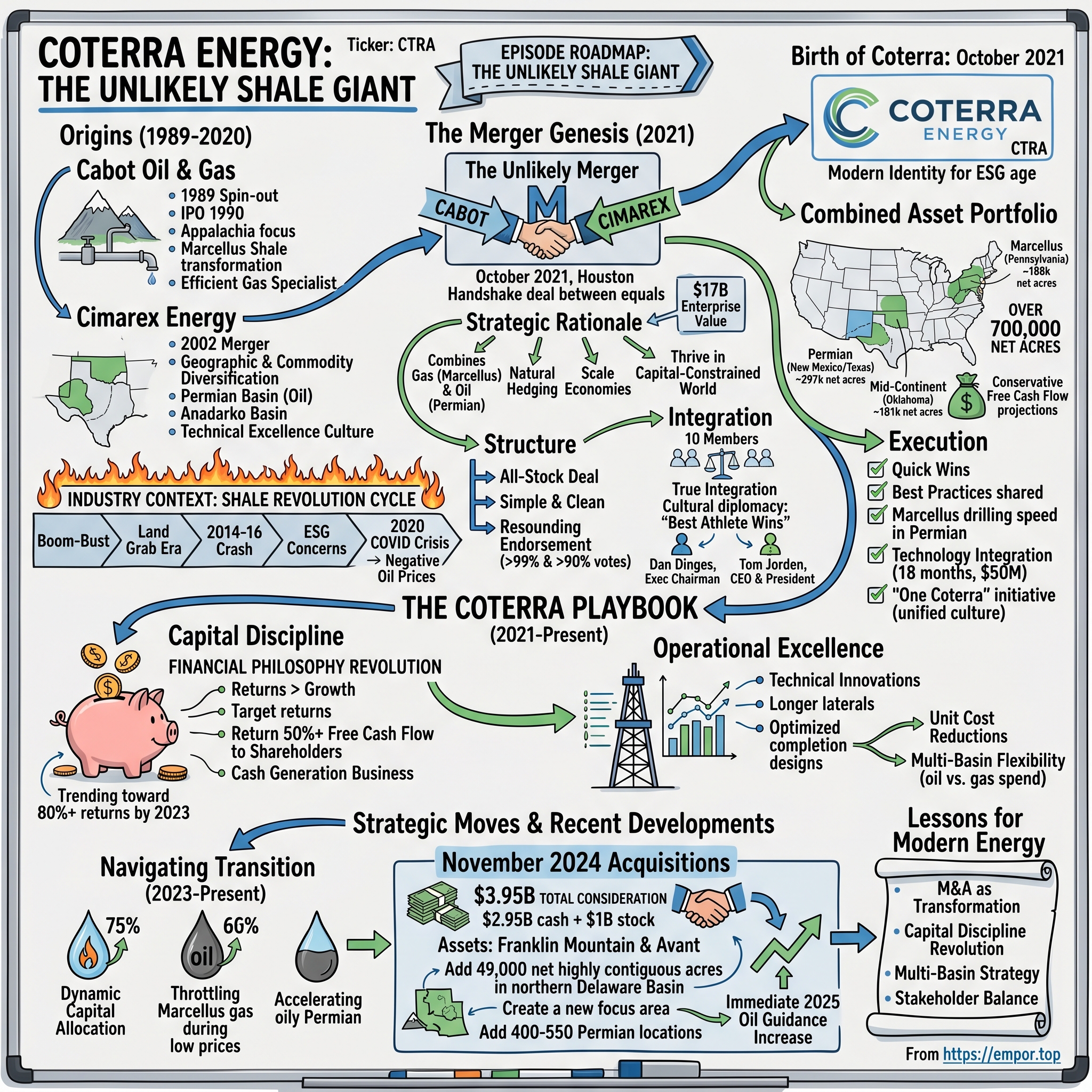
Coterra Energy: The Unlikely Shale Giant
I. Introduction & Episode Roadmap
Type Coterra's old investor-relations address into a browser today and something quietly final happens: the server throws a redirect, landing directly on Devon Energy's investor page instead. No error message, no farewell note—just a 301 redirect and a new landlord. That is how a $20 billion American energy company disappeared in 2026: not through bankruptcy or a fire sale, but via a URL rewrite.
Coterra Energy Inc. traded on the New York Stock Exchange under the ticker CTRA for four and a half years. It was born on October 1, 2021, from an all-stock "merger of equals" between Cabot Oil & Gas—a single-basin Appalachian dry-gas producer—and Cimarex Energy, a technically minded oil and liquids driller operating in the Permian Delaware and Anadarko basins.1 The transaction valued the combined enterprise at roughly $17 billion at announcement.2 Its independent run ended on May 7, 2026, when Devon Energy completed an all-stock acquisition in which each Coterra share converted into 0.70 Devon shares, representing an equity value of about $21.4 billion and a combined enterprise value near $58 billion.34
In between, Coterra conducted one of the more notable corporate experiments in modern American energy. Its strategy ran counter to prevailing market preference: while Wall Street demanded that shale producers operate as focused, single-basin pure plays, Coterra pursued a multi-basin structure. Management argued that owning tier-one dry gas in Pennsylvania, tier-one oil in New Mexico, and a liquids-rich swing asset in Oklahoma would allow the company to shift capital dynamically toward whichever hydrocarbon offered superior returns. By the end of 2025, the company held approximately 345,000 net acres in the Permian, 186,472 net acres in Pennsylvania's Marcellus Shale, and 207,966 net acres in Oklahoma's Anadarko Basin.5 Few American independents assembled a portfolio of that design, and fewer still did so intentionally.
That experiment ultimately received two evaluations: first from public equity markets, which consistently declined to award the stock a valuation premium, and later from an activist investor who publicly criticized the corporate structure three months before Coterra agreed to a sale.
This story tests three core analytical claims.
First, did commodity flexibility actually protect cash flow? The underlying operational mechanism was real: Coterra reallocated rigs between oil and gas plays in response to market signals. However, whether that operational agility generated a durable valuation premium remains a separate, less favorable question.
Second, did management honor its promised return-of-capital discipline? Coterra returned between 72% and 89% of free cash flow to owners in most years of its existence.56 Yet in late 2024, the company committed $3.95 billion to acquire Permian assets—financed substantially with debt—and then cut its Permian capital budget a few months later as oil prices weakened.78 Both records define the company's capital allocation history.
Third, how long does an environmental liability linger on a corporate balance sheet? Cabot's water-contamination dispute in Dimock, Pennsylvania, began in 2008 and persisted until a no-contest criminal plea in November 2022—entered under the Coterra name by a management team that had nothing to do with the original wells.9 Fourteen years proved a lengthy timeline for resolving a legacy reputational asset impairment.
Myth versus reality, up front
Three common assumptions about Coterra require clarification at the outset.
Myth: the merger was opposed by an activist campaign in 2021. Reality: the best-known activist critique of the Cabot–Cimarex combination was published in November 2025, more than four years after the deal closed, making it a retrospective indictment rather than an attempt to stop anything.10 Shareholders in both companies approved the original merger without organized opposition.
Myth: Cabot brought the balance sheet and Cimarex brought the assets, so Cabot holders got the better end. Reality: on a fully diluted basis, Cimarex holders received slightly more than half of the combined company—approximately 50.5% against 49.5%—and the surviving executive culture, chief executive, and operating philosophy were overwhelmingly Cimarex's.2 Cabot contributed the reserve base, which underwent a substantial write-down within the first full year of combined operations.
Myth: Coterra was sold because it was struggling. Reality: in its final full year, Coterra produced more than 780,000 barrels of oil equivalent per day, generated over $2 billion of free cash flow, and carried leverage below one turn.5 The sale reflected the structural challenges facing a mid-cap independent whose multi-basin strategy failed to trigger a market re-rating in an industry consolidating around scale.
The road ahead: the two distinct producers that merged; the transaction Wall Street initially questioned; the free-cash-flow performance versus its market valuation; the Lea County asset expansion; the structural analysis of Coterra's asset base; the activist campaign challenging the core strategy; and the final consolidation into Devon Energy.
 Subscribe on LinkedIn
II. Dual Roots: Cabot's Marcellus & Cimarex's Permian (1989–2020)
Two companies. Two cultures. Two entirely different theories of how to make money out of rock.
Cabot: the accidental monopolist of Susquehanna County
Cabot Oil & Gas began as the exploration and production arm of Cabot Corporation, the Boston specialty-chemicals house, and was floated as an independent NYSE-listed producer at the start of the 1990s under the ticker COG. For its first two decades it was profoundly unremarkable. The 2004 annual report describes a company with five scattered operating areas — the Appalachian Basin, the Rockies, the Anadarko Basin, the Texas and Louisiana Gulf Coast, and western Canada — and total proved reserves of roughly 1.2 trillion cubic feet equivalent, 94% of it natural gas.11 It was a diversified conventional gas company: many small positions, no dominant one, no obvious edge.
Then horizontal drilling and multi-stage hydraulic fracturing arrived, and Cabot did something most of its peers did not. Instead of spreading capital across all five regions, it concentrated almost everything on one county in northeastern Pennsylvania.
The geology justified the obsession. Susquehanna County sits over the thickest, most overpressured, most consistently gas-charged part of the Marcellus Shale. In plain terms: the reservoir there is deeper, hotter, and under more natural pressure than in most of Appalachia, so gas flows out faster and for longer with less help. The rock is also almost pure methane — "dry" gas, with essentially no oil or natural gas liquids mixed in. That makes processing cheap and the operational recipe simple. Cabot drilled the same well, over and over, on contiguous acreage it already controlled, and got progressively better at it.
The economics that resulted were genuinely exceptional for an American gas producer. Coterra's later disclosures show why the position mattered so much: as of year-end 2022, the Dimock field alone contained approximately 62% of the entire company's total proved reserves.1 One field in one Pennsylvania county held nearly two-thirds of the reserves of a company that also owned hundreds of thousands of acres in West Texas and New Mexico. That is a concentration few investors fully appreciated.
The thesis claim, and the record that tests it. The bull case on Cabot was that it owned a cornered resource — irreplaceable low-cost rock — and that low-cost dry gas, being the cleanest-burning fossil fuel, would earn an environmental, social and governance premium as the world decarbonized.
The record does not support the second half of that claim, and it complicates the first.
In 2008 and 2009, residents of Dimock Township — a rural crossroads in the middle of Cabot's core acreage — began reporting that their water wells had gone bad. Methane was migrating from Cabot's gas wells, through faulty cement and casing, into the shallow aquifer that families drank from. Some wells effervesced. One became famous: Josh Fox's 2010 documentary Gasland included footage of a homeowner setting tap water alight, and the image became the single most durable piece of anti-fracking iconography in the United States. Pennsylvania's Department of Environmental Protection issued orders and restricted Cabot's drilling in the affected area. Litigation followed. The Environmental Protection Agency investigated, then partially retreated, then was criticized for retreating.
For a decade, the company treated Dimock as a solved problem. It was not. In June 2020, a Pennsylvania grand jury investigation led to criminal charges: Cabot was charged with fifteen criminal counts relating to the contamination of drinking-water supplies in Susquehanna County.9 The grand jury's language was withering, condemning what it called the company's "long-term indifference to the damage it caused to the environment and citizens of Susquehanna County."12
The resolution came on November 29, 2022 — by which time the defendant was named Coterra Energy. The company pleaded no contest to a misdemeanor charge under Pennsylvania's Clean Streams Law, accepting criminal responsibility without admitting guilt, and agreed to pay $16.29 million to build a public water line for the affected community, cover bottled water in the interim, and pay affected residents' water bills for 75 years.912
Weigh that properly. The direct financial cost was small — $16.29 million against a company generating billions in annual cash flow. The strategic cost was not. The episode made aggressive expansion in Pennsylvania politically fraught for a decade, contributed to an environment in which new Appalachian pipeline capacity was fought to a standstill, and permanently attached a criminal environmental matter to the corporate history of what would become Coterra's largest reserve base. It also demonstrates something more general: the "clean gas earns a premium multiple" thesis was never validated by Cabot's own trading history. What the record supports is narrower and more useful — Cabot owned genuinely low-cost rock, and low-cost rock generates cash in upcycles. It does not support the claim that the asset was ESG-advantaged in the eyes of the market. The falsifying evidence was in the company's own docket.
Cimarex: engineers with a hurdle rate
Cimarex Energy was assembled in 2002 out of two unglamorous parts. Helmerich & Payne, the Tulsa drilling-rig company, spun off its oil and gas exploration and production business and merged it with Denver-based Key Production Company. Former H&P shareholders held roughly 65.25% of the new entity and Key holders about 34.75%.13 Key's chairman and chief executive, F.H. "Mick" Merelli, ran the combined company.
Culturally, Cimarex became the anti-promotional shale company. Where much of the industry in the 2010s was measured by production growth and acreage headlines, Cimarex was run by subsurface people who liked saying no. Its identity was built around science: three-dimensional seismic interpretation to see the rock before drilling it, careful measurement of how individual wells interfered with their neighbors, and a willingness to leave rigs idle when returns did not clear an internal hurdle.
The man who came to personify that culture was Thomas E. Jorden. A geophysicist by training, Jorden joined Key Production in 1993 as chief geophysicist, became Cimarex's executive vice president of exploration when the company was formed in 2002, and took over as chief executive and president in 2011 — later adding the chairmanship. He was not a deal lawyer or a landman who became a CEO; he was a data person who became one, and it showed in how he talked. Years later, on a Coterra earnings call, he would explain a difficult operational problem by observing that "we're a science-driven organization" and that "much as I'd love to say we walk on water, we occasionally have operational problems."14 That register — technical, faintly self-deprecating, allergic to hype — was the Cimarex inheritance.
The thesis claim, and the record that tests it. The bull case on Cimarex held that technical excellence and low completion costs made it structurally resilient — that good engineering could substitute for a good macro environment.
Two crashes falsified that in the most direct way available. The 2014–2016 oil collapse hit a company with essentially all of its revenue exposed to a single commodity complex in a single region. Then came 2020. Cimarex reported a net loss of $1.97 billion for the full year, or $19.73 per share, against a loss of $124.6 million the prior year, driven by non-cash impairments of oil and gas properties recorded across multiple quarters — including a goodwill impairment in the first quarter as the pandemic demand shock and the negative-price day in the WTI futures market tore through the sector.15
The conclusion here is not that Cimarex was badly run. It is that the claim was mis-specified. Technical skill compresses the cost of supply; it does not create insulation from price. A company with one commodity, one basin complex, and a high fixed asset base will write down assets in a crash no matter how good its geophysics are. Jorden absorbed that lesson. When he went looking for a merger partner, he was not looking for more of what he already had. He was looking for a different revenue line entirely — which is exactly what a Pennsylvania gas company could offer.
III. The 2021 Merger of Equals: Strategic Genius or Defensive Bailout?
In the spring of 2021, the American shale industry was emerging from its near-death experience with a new discipline. The prevailing playbook urged producers to stop growing, generate free cash flow, return cash to shareholders, and simplify the equity story. The preferred corporate model was the single-basin pure play: one region, one commodity, and one straightforward financial model.
On May 24, 2021, Cabot Oil & Gas and Cimarex Energy announced a transaction that ran directly counter to that consensus.
The architecture
The deal was structured as an all-stock merger of equals. Cimarex holders received 4.0146 Cabot shares for each Cimarex share, leaving Cabot shareholders with approximately 49.5% and Cimarex shareholders with roughly 50.5% of the combined entity on a fully diluted basis.2 Neither side paid a premium—a structure central to the strategic rationale, but one that quickly drew market scrutiny.
Governance split authority evenly between the two leadership teams. Dan O. Dinges—who joined Cabot as president and chief operating officer in September 2001 and spent two decades as chairman, president, and chief executive—became executive chairman. Thomas E. Jorden assumed the roles of chief executive and president. Cabot CFO Scott Schroeder retained the chief financial officer role, and the board seated five directors from each company.2 Corporate headquarters moved to Houston, while regional operating offices were maintained in Pennsylvania, Colorado, Oklahoma, and Texas.
Management outlined specific financial targets: roughly $100 million in annual general and administrative synergies within 18 to 24 months, a maintenance breakeven of $35 per barrel oil and $2 per million British thermal units gas, and net debt below 1.0 times EBITDA supported by $2.2 billion in pro forma liquidity at closing. The capital-return framework combined a base dividend with a quarterly variable payout targeting 50% of free cash flow, alongside a $0.50 per share special dividend following completion of the deal.2
Jorden summarized the core strategic thesis in three words: "Diversity pays in the long run."2 Behind that slogan lay an operational thesis rooted in commodity markets. In the United States, natural gas and crude oil prices respond to distinct market drivers: gas depends primarily on regional weather, storage levels, power generation demand, and LNG exports, whereas oil is shaped by international demand and global supply dynamics. Because the two commodities frequently move independently, owning tier-one positions in both allows an operator to reallocate capital toward whichever stream offers superior returns in a given macro environment without expanding total spending.
Why the market shrugged
Wall Street's skepticism focused not on the internal logic of the portfolio, but on its fit for public equity investors.
By 2021, energy investors were predominantly sector specialists seeking targeted exposure to either natural gas or crude oil. A combined producer generating 47% of its volume from gas and 53% from liquids offered neither cleanly. Gas-focused funds viewed Permian oil operations as an unwelcome distraction, while oil-focused funds saw Appalachian basis and transport constraints as unnecessary liabilities. As Doug Leggate of Wolfe Research later observed to Jorden on an earnings call, the company appeared "orphaned by the mix of your portfolio."16
The terms of the combination also raised questions for Cimarex equity holders. In agreeing to a zero-premium merger, Cimarex contributed premier Delaware Basin oil inventory in exchange for half-ownership of a combined company whose largest reserve concentration sat in a Pennsylvania township subject to an active criminal investigation—and whose natural gas depended on an Appalachian pipeline network facing severe regulatory and legal hurdles to expansion.
Retrospective accounts sometimes misdate the investor resistance to the deal. The most prominent activist critique of the merger—Kimmeridge Energy Management's claim that Cimarex shareholders were shortchanged and that multi-basin diversification lacked industrial logic—was published in November 2025, four years after the transaction closed.17 In 2021, both shareholder bases approved the deal without an organized proxy contest, enabling the transaction to close on October 1, 2021.18 Initial market opposition manifested not in voting blockades, but in sell-side skepticism and a persistent valuation discount. As a result, the multi-basin model was not put to a vote against a competing proxy challenge at closing; rather, it was evaluated over the subsequent four years by public market trading performance.
The first quarter as one company
Coterra responded to early valuation skepticism by deploying cash directly to investors. Alongside third-quarter financial results on November 3, 2021, the board raised the annual base dividend 14% to $0.50 per share, accelerated the first variable dividend by a full quarter, and declared a combined base-plus-variable quarterly payout of $0.30 per share—in addition to the $0.50 special dividend paid on October 22.18 Jorden framed the deployment as "just a first look at the power of Coterra's assets, financial strength, and commitment to peer-leading shareholder returns."18
During that initial earnings call, management outlined a counter-cyclical approach to capital allocation. Jorden and Schroeder stated that share repurchases would be evaluated against intrinsic value rather than executed on a fixed schedule, suggesting cash would be accumulated during market strength to fund buybacks during downturns. Addressing potential asset acquisitions in a busy M&A environment, Jorden maintained that Coterra possessed ample organic inventory and was not seeking external deals.
That posture would change over time. Three years later, Coterra committed nearly $4 billion to acquire Permian assets in a highly competitive market. How that expansion aligns with the company's founding principles of capital discipline forms a critical chapter in evaluating Coterra's long-term corporate track record.
IV. The Coterra Playbook: Capital Discipline & Returns (2021–2024)
For its first full year, the experiment looked like genius.
2022: the machine at full throttle
Russia invaded Ukraine in February 2022, European gas buyers scrambled for molecules, and both of Coterra's commodities went vertical at once. The company realized $94.47 per barrel of oil and $5.34 per thousand cubic feet of natural gas for the full year, excluding hedges, and produced 633,800 barrels of oil equivalent per day. Net income was $4.07 billion, or $5.09 per share. Free cash flow reached $3.94 billion.19
What Coterra did with that cash is the part worth studying. It returned $3.25 billion — 85% of free cash flow — split across $480 million of base dividends, $1.51 billion of variable dividends, and $1.25 billion of share repurchases.19 In an industry that had spent the 2010s converting record revenue into record drilling budgets, this was a genuine behavioral break.
It also exposed the flaw in the instrument. A variable dividend is, by construction, a promise to pay a lot when times are good and very little when they are not. It converts an equity into something closer to a royalty on the commodity strip. That is intellectually honest. It is also useless to any investor who needs to know what next year's income will be.
Coterra saw the problem and changed the design. Announcing 2022 results, the company raised the base dividend 33% to $0.80 annually, authorized a new $2.0 billion repurchase program, and explicitly re-ranked its priorities: base dividend first, share repurchases second, variable dividends third, with a continuing commitment to return 50% or more of free cash flow.19 This was a quiet admission that the variable dividend had not achieved what management hoped. Buybacks, at least, are discretionary without being disappointing.
2023–2024: the gas side breaks, and the machine actually flexes
Then natural gas collapsed. Mild winters, relentless Appalachian and Permian associated-gas supply, and an LNG export build-out that kept slipping to the right combined to crush the price. For Coterra, 2024 was the trough: the company realized $1.65 per thousand cubic feet of natural gas for the year, against $74.18 per barrel of oil.6
Read those two numbers together and the whole logic of the merger comes into focus. Roughly half the company's production volume was being sold into a market that had lost most of its value, while the other half was selling into a strong one. A single-basin Appalachian producer facing that year had one option: shrink. Coterra had another.
It used it. Through 2023 and 2024, capital moved decisively toward the Permian and away from the Marcellus. Total capital expenditures for 2024 came in at $1.76 billion — near the low end of guidance — while total production of 677,000 barrels of oil equivalent per day exceeded the high end.6 The company generated $1.21 billion of free cash flow in the trough year and returned $1.09 billion of it: $635 million in declared dividends and $451 million of buybacks, retiring 17.1 million shares at an average of $26.41.6 That was 89% of free cash flow returned in the single worst gas year of the company's existence.
The operational tactic deserves a plain-language explanation, because it is frequently described inaccurately. Coterra did not primarily shut in producing wells. It deferred turn-in-lines — finished wells that were drilled and fracked but not yet connected to sales. On the first-quarter 2024 call, management disclosed two completed Marcellus pads comprising twelve wells sitting finished and waiting, with the decision on bringing them online being made month by month, and told investors to expect no Marcellus projects online at all in the second quarter.20 Asked whether leaving completed wells shut in would damage them, Jorden pointed to a decade of Appalachian history of significant shut-ins and to the fact that these reservoirs produce very little water, so there was no meaningful degradation clock running.
This is a genuinely valuable form of optionality, and it is worth being precise about why. A completed, unconnected shale gas well is close to a stored inventory of molecules with a call option attached: the capital is already sunk, the gas is not going anywhere, and the operator can choose the month it monetizes. Cabot alone would have had the same tactical choice; what Coterra added was the ability to redirect the next dollar of drilling capital to an entirely different commodity rather than simply idling.
The thesis claim, and the record that tests it. Management's claim was that dynamic capital allocation insulates cash flow from commodity slumps. The record supports a narrowed version and rejects the broad one.
Supported: the mechanism functioned. Capital moved, production guidance was met or beaten, and the company continued generating and returning free cash flow through the worst gas price environment in years.
Rejected: the idea that shareholders were insulated. Free cash flow fell from $3.94 billion in 2022 to $1.21 billion in 2024 — a decline of roughly 70%.196 Basin flexibility softened the blow; it did not absorb it. And for income-oriented holders, the outcome was starker still. In 2022, base and variable dividends together totaled about $1.99 billion. In 2024, total declared dividends were $635 million — approximately what the base dividend alone would produce.196 The variable component, the innovation that was supposed to define the new shale compact, had effectively vanished from the payout when it was most missed.
The honest summary is this: multi-basin flexibility is a real operating advantage that reduces the amplitude of the cycle. It is not a hedge, it is not an insulator, and any framework that pays out a percentage of a cyclical cash flow will itself be cyclical. Investors who bought CTRA for dividend stability were buying the wrong instrument, and the 2022-to-2024 payout path is the proof.
Which raises the question that dominates the next chapter. If the multi-basin structure was working operationally but not being rewarded in the market, what does a management team do about it?
V. The Permian Land Grab: Franklin Mountain & Avant (2024–2025)
The answer, announced on November 13, 2024, was to buy more oil.
The deal
Coterra agreed to acquire assets from Franklin Mountain Energy and Avant Natural Resources for a total consideration of $3.95 billion—comprising $2.95 billion in cash and $1.0 billion in Coterra stock. The prize was roughly 49,000 net, highly contiguous acres in Lea County, New Mexico, in the northern Delaware Basin, which combined with Coterra's existing acreage to form an 83,000-net-acre focus area. Management estimated that the position added 400 to 550 net drilling locations across the Bone Spring, Harkey, Avalon, and emerging oily Lower Wolfcamp and Penn Shale formations. Projecting output from the new acreage, executives guided 2025 asset production to between 40,000 and 50,000 barrels of oil per day, or 60,000 to 70,000 barrels of oil equivalent per day. The transactions closed in the first quarter of 2025, with effective dates of October 1, 2024.21
Strategically, the logic was straightforward. Lea County holds some of the highest-quality oil rock in North America. Contiguity matters enormously in shale because it governs lateral length—the horizontal distance a wellbore extends through the reservoir—and longer laterals spread the fixed costs of vertical drilling and surface infrastructure over greater producing footage. Assembling acreage that converted a scattered footprint into a unified 83,000-acre development block reflected standard industrial logic rather than empire building.
Financially, however, the deal represented a departure from prior restraint. Coterra funded the cash portion using existing balance-sheet cash alongside new borrowing, including a $1 billion term loan. Consequently, total debt rose to $4.25 billion by the end of the first quarter of 2025 against $186 million in cash—pushing net leverage to roughly 0.9 times EBITDA, up from 0.4 times a year earlier.86
The reckoning, four months later
Then two things went wrong at once, and the sequence is instructive.
First, oil prices weakened sharply in the spring of 2025 amid tariff turmoil, OPEC supply additions, and recession fears. Second, and more embarrassing for a company built on a reputation for technical rigor, Coterra encountered an operational issue in its own rock.
The operational setback occurred at a development known as Windham Row, comprising 73 wells in Culberson County, Texas—51 in the Wolfcamp formation and 22 targeting the Harkey zone. During the May 6, 2025 earnings call, Jorden disclosed that several completed Harkey wells were producing abnormally high volumes of water. Diagnostic evidence indicated water was migrating behind the casing pipe from shallower geological zones—a localized near-wellbore mechanical issue rather than a reservoir or well-spacing flaw. In response, Coterra suspended Harkey drilling in the affected sector, shifted capital toward the Wolfcamp, and initiated remediation.1422
The disclosure was notable for its unvarnished tone. Blake Sirgo, then senior vice president of operations, told analysts that the team had previously drilled over 30 successful Harkey wells in Culberson County using identical wellbore designs and cementing protocols, noting: "We thought we were well calibrated. Sometimes the oilfield still surprises us."14 Sell-side analysts probed the operational implications: Doug Leggate questioned whether the issue signaled lost drilling inventory, while Betty Jiang of Barclays asked how the failure impacted projections for 2026. Executive leadership maintained that the defect was isolated and mechanical, and by the third quarter of 2025, Coterra completed its transition out of the Harkey remediation program.16
Concurrently, Coterra revised its capital spending plan. The company cut its 2025 Permian capital allocation by approximately $150 million—reducing its active Permian rig count from ten to seven in the second half of the year—while adding $50 million and two rigs in the Marcellus. This yielded a net $100 million spending reduction and lowered full-year capital guidance to between $2.0 billion and $2.3 billion.8 Explaining the adjustment on the call, Jorden offered a memorable distinction regarding corporate planning, characterizing fixed budgets as rifle shots and flexible allocation as guided missiles: "Once the trigger is pulled, the rifle shot is unchangeable. The guided missile can be adjusted and repositioned along the way."22 He cautioned, however, that macro volatility meant the company was aiming a guided missile at "a moving and unpredictable target."
The thesis claim, and the record that tests it. The claim under examination is capital-allocation discipline—specifically, that this management team would not chase assets at cycle peaks after promising it would not.
The disconfirming evidence is clear. In November 2021, Jorden told analysts that the company had plenty of organic inventory and was not hungry for acquisitions.18 Three years later, Coterra committed $3.95 billion—roughly three-quarters of it cash, largely debt-funded—to acquire assets in the northern Delaware Basin, one of the most competitively bid regions in North America. Within a single quarter of closing, management cut the drilling budget for those newly acquired assets while prioritizing repayment of the term loan used to buy them.8 Coterra retired $250 million of term loans in the first quarter of 2025 alone and made debt reduction the explicit priority for the year ahead of buybacks.8
The counter-evidence, however, demonstrates underlying operational strength. Initial production from the acquired properties met or slightly exceeded management's expectations during their first partial quarter of operation. For full-year 2025, oil, natural gas, and combined production volumes landed at or above the top end of original guidance. Operating cash flow expanded by 44%, while free cash flow grew 67% to reach $2.03 billion. By December 31, 2025, net debt fell to $3.70 billion, representing 0.8 times adjusted EBITDAX, and total capital returned to owners—including $680 million in declared dividends, $140 million in share buybacks, and $700 million in debt reduction—reached 75% of free cash flow.5
Evaluating the historical record yields a nuanced verdict. Coterra did not act recklessly: net leverage peaked below one turn of EBITDA, balance sheet repair proceeded rapidly within twelve months, and the underlying geology proved high quality. Nevertheless, the record refutes any notion that executive leadership remained immune to shale's recurring cycle. Management acquired high-cost assets near market highs, financed the transaction with debt, and subsequently trimmed its organic drilling program in the immediate aftermath—recapitulating the exact sequence capital discipline was intended to avoid. Ultimately, the long-term test of this strategy passed to Devon Energy: whether Lea County development delivers sustained capital efficiency justifying its acquisition cost, or serves as another example of shale M&A transferring enterprise value from acquirers to sellers.
VI. Segment Breakdown, Economics & Competitive Benchmarking
Strip away the strategic narrative, and Coterra operated as three distinct businesses tied together by a shared treasury and board.
The Permian: the earnings engine
By 2025, the Permian Basin drove the entire corporate enterprise. Full-year Permian production averaged 357,400 barrels of oil equivalent per day, comprising 151,700 barrels of oil, 653.5 million cubic feet of natural gas, and 96,700 barrels of natural gas liquids per day—with fourth-quarter Permian volumes reaching 399,000 barrels of oil equivalent per day as newly acquired Lea County assets ramped up.5
The underlying revenue asymmetry defined the portfolio's economics. Coterra realized $63.36 per barrel of oil in 2025 compared to $2.43 per thousand cubic feet of natural gas.5 On an energy-equivalent basis, a barrel of crude contains roughly six thousand cubic feet of natural gas, meaning oil generated more than four times the revenue of gas for the same energy content. That price spread underscores why the volume metric "barrels of oil equivalent" can mislead investors in mixed-hydrocarbon portfolios by measuring energy rather than monetary value.
The Permian's primary operational risk stemmed not from oil pricing, but from associated natural gas. Delaware Basin wells generate significant gas volumes as a by-product of crude extraction, frequently overwhelming regional pipeline capacity out of West Texas. Coterra's disclosures noted that pipeline bottlenecks and oversupply "in 2024, 2025, and early 2026 resulted in negative spot market pricing at times for natural gas, such as in the Permian Basin at the Waha Hub."5 During negative-pricing windows, operators were forced to pay buyers to accept gas. On Devon Energy's first-quarter 2026 earnings call, executives described managing these constraints by curtailing high-gas wells during negative-Waha periods, adding that upcoming pipeline additions would limit unhedged exposure to 10% to 15% of total volumes.23
The Marcellus: the low-cost asset the market stopped valuing
Marcellus Shale production averaged 342,200 barrels of oil equivalent per day in 2025, representing roughly 2.05 billion cubic feet of daily natural gas production.5 While the Marcellus supplied nearly half of total corporate production by volume, its revenue contribution lagged substantially due to the oil-to-gas price disparity and regional transport discounts. Appalachian natural gas routinely traded below the national Henry Hub benchmark. This local price discount, or basis, reflected structural takeaway constraints: northeastern Pennsylvania produced more natural gas than local demand could absorb or regional pipelines could export.
The Marcellus position was also central to Coterra's most significant accounting adjustment. The company's total proved reserves dropped from 2,892.6 million barrels of oil equivalent at year-end 2021 to 2,398.7 million at year-end 2022—a 17% reduction of approximately 494 million barrels of oil equivalent in Coterra's first full year of operations.1 The downward revision stemmed primarily from Marcellus well-performance adjustments, where tightly spaced wells exhibited steeper decline curves than isolated wells, alongside the removal of undeveloped locations unlikely to be drilled within five years.
While non-cash reserve revisions are routine across the exploration and production sector, the magnitude and timing of this write-down—occurring shortly after closing on assets contributed by Cabot—subsequently formed a core pillar of activist critiques examining the merger's underwriting assumptions.
The Anadarko: real optionality, honestly labeled
Anadarko Basin production averaged 82,400 barrels of oil equivalent per day in 2025 across 207,966 net acres in Oklahoma.55 Representing roughly one-tenth of total output, the asset served a designated strategic purpose. During Coterra's inaugural earnings call, Jorden described the Anadarko as a third profitable operating pillar that provided "a tremendous safety valve," while acknowledging that it lacked the running room of Pennsylvania or the Delaware.18 The asset functioned effectively as a flexible swing position: generating consistent cash flow while offering capital allocators a tertiary option for rig deployment.
Benchmarking: who Coterra was actually competing with
From a competitive standpoint, Coterra occupied an uncomfortable middle ground. On the natural gas side, equity markets benchmarked the company against pure-play operators such as EQT Corporation, Expand Energy (formed via the merger of Chesapeake Energy and Southwestern Energy), and Range Resources—producers that pursued maximum regional scale and midstream integration. On the crude oil side, peer comparisons focused on Delaware Basin operators including Diamondback Energy, Occidental Petroleum, and Devon Energy, alongside integrated majors expanding in the Permian.
This dual exposure contributed to a persistent conglomerate discount. During a November 2025 earnings call, Jorden framed the valuation positioning positively, noting that the stock sat "at the top of the stack of oil companies and at lower level of gas companies" and argued this was evidence the multi-basin structure was working.16 Market behavior, however, suggested an alternate interpretation: operating as a mid-tier producer across both asset classes prevented Coterra from capturing the valuation premiums awarded to pure-play scale operators in either commodity.
What actually mattered to track
Evaluating Coterra's multi-basin model required monitoring three core operational and financial metrics:
Delaware Basin capital efficiency. Because crude oil generated the majority of enterprise revenue, tracking Permian oil volume growth against capital expenditures revealed whether expanding oil production required escalating capital intensity over time—the primary indicator of inventory degradation.
Realized natural gas pricing relative to benchmarks. Comparing Coterra's realized price per thousand cubic feet against national Henry Hub quotes reflected the net financial impact of Appalachian basis differentials, Permian Waha exposure, and firm transportation contracts. Realized gas prices averaged $1.65 per thousand cubic feet in 2024 before recovering to $2.43 in 2025.65
Free cash flow conversion and return percentages. Management's core policy committed to returning 50% or more of free cash flow to shareholders. Actual distribution rates—85% in 2022, 77% in 2023, 89% in 2024, and 75% in 2025—provided empirical evidence on whether capital discipline persisted through major asset acquisitions and fluctuating commodity cycles.192465
VII. Strategic Framework: Helmer's 7 Powers & Porter's 5 Forces
Here is the uncomfortable part of analyzing any exploration and production company through the standard strategy frameworks: most of the boxes come back empty. That is not a failure of the company. It is the nature of a business that sells a molecule indistinguishable from every competitor's molecule into a market that sets one price.
Where power existed
Cornered Resource — the strongest claim, with a caveat. Helmer's cornered resource requires preferential access to a valuable asset on attractive terms. Coterra had two candidates. In Pennsylvania, the Dimock field concentration — 62% of total proved reserves at the end of 2022, still approximately 49% of proved reserves on a volumetric basis at year-end 2025 — represented control of the most gas-charged part of the Marcellus.15 In New Mexico, the Lea County block was genuinely tier-one oil rock.
The caveat is essential and belongs beside the claim rather than in a risk appendix: a cornered resource whose output cannot reach a market at a decent price is a partially stranded one. Appalachian basis discounts and negative Waha pricing are precisely the mechanisms by which rock quality fails to convert into realized margin. The 2022 reserve revision demonstrated something further — that even the measurement of the cornered resource was subject to material downward correction once denser development revealed how wells interfere with each other.1
Scale Economies — real but modest. Basin concentration allows multi-well pads and long laterals, which meaningfully reduce drilling and completion cost per foot of reservoir contacted. But Jorden himself argued repeatedly against overrating this. On the first Coterra call he made a striking observation: if scale alone determined cost structure, the supermajors would be the industry's low-cost operators, and plainly they are not. Beyond the thresholds required for long laterals, efficient infrastructure and procurement leverage, he argued, the gap between very large companies and "scrappy little companies" is small.18 That is a rare instance of a chief executive publicly discounting a power his own company possessed.
Process Power — the Cimarex inheritance, and its limits. Seismic interpretation, well-spacing science and completion design genuinely differentiated Cimarex and then Coterra; the practice of testing wider spacing against denser spacing and finding that fewer wells sometimes recovered similar volumes for materially less capital was a real analytical edge. But the Harkey water problem is the honest counterweight, and it appears in the record of the same organization: a team with more than thirty successful analog wells in the same county, using the same designs, still hit a cement and casing failure that forced a program pause.14 Process power in the subsurface is a matter of degree and probability, not of certainty.
The empty boxes. No brand power — no utility ever paid more for a Coterra molecule. No switching costs — buyers face none. No network economies. No counter-positioning: everything Coterra did was legally and technically available to competitors, and several ran the identical playbook.
The five forces, honestly applied
Buyer power: high. Refiners, utilities, petrochemical plants and LNG exporters purchase against public benchmarks. The producer is a price taker at the hub, and its only levers are transport contracts, marketing and hedging — none of which create durable advantage.
Supplier power: moderate and cyclical. Rigs, frac crews, sand, steel and labor tighten sharply when activity rises. Jorden's public position was notably non-adversarial — he described vendors as partners who need to earn a living and maintain safe equipment — but the economics are unforgiving: service cost inflation compresses producer margins exactly when commodity prices make drilling attractive.
Threat of substitutes: low near-term, real long-term. Renewables, storage and nuclear substitute for gas in power generation over decades, and electrification substitutes for oil in transport. Against that, the last several years have produced a countervailing force nobody modelled in 2021: data-center electricity demand. On the first-quarter 2024 call, with gas prices at their worst, management explicitly pointed to coming LNG export capacity and to forecasts of incremental gas demand from artificial-intelligence-driven data centers as reasons for structural optimism.20 That thesis is now partially validated by the market's willingness to pay far more for gas in 2025 than 2024, but it remains a demand forecast, not a contracted revenue stream, and no investor should treat it as the latter.
Rivalry: intense, but consolidating. Shale rivalry is not price competition in the conventional sense — it is competition for acreage, for crews, and for capital. The 2021–2026 consolidation wave changed the character of that rivalry by concentrating decision-making in fewer, larger, more capital-disciplined hands. Coterra was ultimately a participant on both sides of it.
Threat of new entrants: low at scale. The capital, inventory and permitting required to build a top-tier position from scratch are prohibitive, though private equity-backed operators like Franklin Mountain repeatedly proved they could assemble attractive blocks and sell them to public companies at full prices — which is, in effect, entry as a business model targeted at the incumbents' capital.
The spine, stated plainly
Why Coterra could win from here: a low cost of supply across two premier basins, genuine flexibility to redirect capital between uncorrelated commodities, a balance sheet that never approached distress, and demonstrated willingness to return the large majority of free cash flow rather than reinvest it.
What could break the case, and partly did: the market's refusal to pay for structural complexity; realized-price leakage through Appalachian basis and negative Waha pricing that rock quality alone cannot fix; the demonstrated fragility of reserve bookings under denser development; and the plain arithmetic that when oil and gas fall together, no amount of allocation flexibility helps, because there is nowhere to allocate to.
The last of those is the sharpest limitation of the entire multi-basin thesis, and it is worth stating without hedging: the strategy protects against divergence between commodities. It offers essentially nothing against correlation. Investors who bought it as a hedge misunderstood the product.
VIII. Management Credibility, Governance & Activist Stress Test
On the morning of November 4, 2025, Coterra's third-quarter earnings call opened normally. Near the end of his prepared remarks, however, Jorden addressed the looming challenge directly before analysts could raise it.
"Finally, we know that many of you have seen the letter that Kimmeridge released this morning," he said. He acknowledged that Coterra believed the letter contained "some factual errors," expressed respect for Kimmeridge's research, and stated the company's core objection: "We are disappointed that they have chosen to release a public letter without reaching out to us."1610
Wall Street analyst Doug Leggate opened the Q&A session by noting that Jorden had chosen to hit "the 800-pound gorilla right in the head."16
The management being tested
By late 2025, Jorden held all three top corporate roles: chairman, chief executive, and president. Former executive chairman Dan O. Dinges served until his term expired on December 31, 2022, after which Jorden was appointed chairman effective January 1, 2023.17 That consolidation of leadership became the starting point for governance critics.
Executive compensation also drew scrutiny, though more for governance oversight than absolute level. Jorden received $14,748,960 in total 2024 compensation against a median employee salary of $169,804—an 87-to-1 pay ratio.25 For an enterprise of Coterra's size and cash generation, that ratio aligned with large-cap energy peers. The central governance debate focused not on the pay figure itself, but on board independence and structural oversight.
On operational execution, management established a consistent track record. From 2023 through 2025, Coterra repeatedly delivered annual production at or above the high end of guidance while keeping capital expenditures at or below the midpoint of its capital target.2465 Such consistent guidance discipline was uncommon among shale independents. Similarly, when wellbore mechanical issues caused water migration in the Harkey formation, management disclosed the setback early with detailed technical diagnostics rather than downplaying the problem.
Strategic narrative consistency, however, proved more vulnerable. The company's 2021 commitment to avoid major acquisitions gave way three years later to a $3.95 billion debt-financed Permian purchase. Simultaneously, leadership continued defending the multi-basin structure even as public equity markets maintained a persistent discount on the stock for four consecutive years.
The activist case
Kimmeridge Energy Management, holding a substantial equity position, presented a structural critique of Coterra's corporate design. The activist's public letter argued that the 2021 merger had failed to deliver its promised valuation premium, leaving Coterra trading at a discount to pure-play Permian and natural gas peers while underperforming both the broader energy index and its self-selected peer group.10
Three core arguments anchored the Kimmeridge campaign:
First, Kimmeridge targeted Coterra's post-merger reserve write-downs. The letter highlighted that Marcellus proved reserves were revised downward by 32% within thirteen months of closing, asserting that the reduction revealed defects in capital allocation, technical underwriting, and board-level risk management.10 Coterra's annual filings confirmed the magnitude of the reserve write-down.1 This point carried substantial weight because it relied on Coterra's official disclosures rather than external estimates.
Second, the activist challenged corporate governance. Kimmeridge noted that approximately 65% of S&P 500 energy companies separated the chief executive and board chair roles, whereas Coterra concentrated both positions under Jorden. Furthermore, because eight of ten sitting directors had approved the original 2021 combination, Kimmeridge argued the board was structurally conflicted and unable to objectively evaluate the transaction.10 The firm demanded an independent, non-executive chair.
Third, Kimmeridge proposed a structural break-up: divest the Appalachian Marcellus and Oklahoma Anadarko assets to reposition Coterra as a pure-play Delaware Basin operator. Managing partner Mark Viviano framed the mandate around executive leadership, asserting that "Coterra's path forward hinges on new leadership and a renewed focus on the Delaware Basin."10
Grading the argument
The valuation critique was well supported by market data. Coterra shares had declined 2.8% year-to-date when Kimmeridge published its letter, while the broader energy sector traded higher over the same period, reflecting a persistent valuation discount relative to single-basin peers.26
The causal claim—that multi-basin diversification directly caused the discount—was more complex. Jorden countered that Coterra traded near the top of its oil peer group and near the bottom of its gas peer group, suggesting the market valued the enterprise as a blended hybrid rather than penalizing it for operational complexity.16 Yet a blended valuation itself illustrated the strategic drawback: owning low-cost gas assets failed to capture the premium multiples awarded to pure-play gas producers.
The reserve write-down charge remained management's most difficult vulnerability. A 17% reduction in total proved reserves within the first full year after a merger of equals—driven largely by the Marcellus assets contributed in the deal—undermined the technical authority of an executive team whose core identity rested on engineering precision.1
The governance challenge was directionally valid, though swiftly overtaken by consolidation. In its initial public response, Coterra defended the multi-basin strategy, pointed out alleged factual errors in the letter, and expressed willingness to engage with shareholders.26 Management did not split the chair and chief executive roles. Instead, within three months, Coterra agreed to a full-company sale to Devon Energy—a transaction that ultimately reshaped executive governance by transitioning Jorden to non-executive chairman of the combined enterprise rather than an executive officer.3
Whether the sale resulted from activist pressure, a board concluding that the standalone multi-basin thesis was exhausted, or an opportunistic buyer offering scale remains an open question. The timeline, however, was clear: Kimmeridge issued its public challenge on November 4, 2025, and Coterra signed a definitive merger agreement with Devon ninety days later, on February 1, 2026.27
IX. The Terminal Chapter: Devon Energy Acquisition (2026)
The end came fast, and by shale standards it came cleanly.
On February 2, 2026, Devon Energy and Coterra announced a definitive agreement to combine in an all-stock transaction. Under the terms, Coterra investors received 0.70 Devon shares for each Coterra share, leaving Devon shareholders with approximately 54% and Coterra shareholders with roughly 46% of the combined enterprise on a fully diluted basis. Based on Devon's closing price on January 30, the transaction carried an enterprise value of approximately $58 billion and ascribed an equity value to Coterra of roughly $21.4 billion—marking the largest U.S. shale deal since Diamondback acquired Endeavor Energy Resources for $26 billion in 2024.34
Crucially, the terms omitted a meaningful premium. On the day of the announcement, Devon shares slipped 3% and Coterra shares fell 2.7% in premarket trading, relative to a 5% drop across the broader oil sector.4 Rather than securing a takeover premium, Coterra shareholders were folded into a larger entity at close to relative market value—mirroring the zero-premium structure and lukewarm market reception of the 2021 merger that created Coterra.
The terms and the leadership
Clay Gaspar, Devon's president and chief executive, took the helm of the combined company, while Tom Jorden transitioned to non-executive chairman. The eleven-member board comprised six directors from Devon and five from Coterra, with Devon designating the lead independent director. Corporate headquarters were established in Houston, paired with a substantial ongoing operational presence in Oklahoma City.3 The executive leadership team drew almost entirely from Devon: Shannon E. Young III became chief financial officer, Trey Lowe served as chief technology officer, and Blake Sirgo—a former Coterra executive—was named chief operating officer.28
At announcement, Gaspar characterized the combination as creating a premier operator backed by aligned cultures of operational execution. Jorden framed the deal as offering "best-in-class rock quality and inventory depth, supported by a balanced commodity mix, leading cost structure, and a conservative balance sheet."3 Even while agreeing to surrender standalone independence, Jorden continued to defend the multi-basin diversification thesis.
Management's financial model targeted $1 billion in annual pre-tax synergies by year-end 2027, supported by pro forma leverage of 0.9 times net debt to EBITDAX, $4.4 billion in pro forma liquidity, a planned quarterly dividend of $0.315 per share, and a share buyback authorization exceeding $5 billion.3 On a pro forma basis for the third quarter of 2025, combined production surpassed 1.6 million barrels of oil equivalent per day—consisting of 550,000 barrels of oil and 4.3 billion cubic feet of natural gas per day. The Delaware Basin generated more than half of total combined output and cash flow, contributing 863,000 barrels of oil equivalent per day across approximately 750,000 net acres.3
Why sell
The transaction was driven primarily by structural pressure on mid-cap independents. As major producers including ExxonMobil, Chevron, and ConocoPhillips absorbed rival operators, equity markets increasingly rewarded massive scale with a lower cost of capital and steady passive index inflows. A $20 billion enterprise occupied a difficult middle tier: too large for nimble niche growth, too small to command mega-cap valuation multiples, and burdened with a multi-basin structure that public markets consistently refused to re-rate.
Coterra's financial results in its final full year underlined this structural dilemma. In 2025, the company produced 782,400 barrels of oil equivalent per day, generating $7.65 billion in revenue and $1.72 billion in net income. It converted $4.02 billion in operating cash flow into $2.03 billion in free cash flow, finishing the year with net debt of $3.70 billion and leverage of 0.8 times adjusted EBITDAX.5 Prior to the transaction, standalone guidance for 2026 projected free cash flow of roughly $2.35 billion based on a reinvestment rate near 50%.5 Coterra was not a distressed seller; it was a profitable enterprise whose board recognized that strong cash generation alone would not overcome its persistent market discount.
Its final quarter as an independent producer confirmed that operational health: for the first quarter of 2026, Coterra reported net income of $466 million on revenue of $2.38 billion, capital expenditures of $670 million, full repayment of its remaining $300 million Tranche B term loan in February, and a rebuilt cash balance of $485 million.27 Shareholders of both companies approved the deal on May 4, 2026, and the transaction closed on May 7—a 94-day window from signing to closing that Gaspar cited as unusually swift for an acquisition of its scale.2829
What happened next
Four months of post-merger data now provide an initial look at the combined entity, and the evidence points in competing directions.
Devon's second-quarter 2026 performance—its first reporting period incorporating Coterra's assets following the May 7 closing—delivered net earnings of $1.9 billion and adjusted free cash flow of $1.7 billion. Total production reached 1.36 million barrels of oil equivalent per day, including 503,000 barrels per day of crude oil, with both metrics exceeding upper guidance ranges. Consequently, Devon raised its quarterly dividend 33% to $0.32 per share, distributed $1.06 billion via total dividends, repurchased $197 million in shares, and achieved its $1.25 billion debt-reduction goal for 2026. Leadership identified over 350 operational synergy initiatives and reiterated its target of achieving at least $1 billion in annual pre-tax synergies by late 2027.29
Yet the core strategic premise that Coterra spent four and a half years defending has been reopened by its acquirer. During Devon's first-quarter 2026 earnings call, Gaspar informed analysts that management had initiated a comprehensive review of all portfolio assets against strict financial criteria, stressing that "every asset in the combined portfolio has to compete for its capital and earn its seat at the table."23 When pressed by Doug Leggate on whether a heavy gas mix risked alienating equity investors, Gaspar refrained from endorsing multi-basin diversification as a long-term strategy, observing only that two of Coterra's three operating regions overlapped with Devon's existing acreage and that remaining assets would undergo rigorous review.23 By Devon's August second-quarter call, Gaspar added a timeline, noting that the portfolio evaluation would be completed in months rather than years.29
Meanwhile, Kimmeridge Energy Management maintained its activist pressure. Although supporting the merger publicly, Kimmeridge issued an open letter to Devon's board on April 28, 2026—prior to closing—demanding an accelerated divestiture program for non-core assets, a modernized capital allocation model, and reformed executive compensation policies. The firm warned that Devon faced a potential conglomerate discount if it retained non-core positions, criticized that performance-based equity comprised only 60% of long-term incentives, and highlighted that 2022 incentive units paid out at 75% despite Devon ranking eighth among twelve peers in total shareholder return, asserting that "investors have no patience for bottom-tier performance, and neither should the Board."30
Ultimately, Coterra's corporate trajectory concludes on an open question. The Marcellus position that Cabot spent fifteen years assembling—which saw a criminal environmental settlement, a 17% reserve write-down, and generated nearly half of Coterra's daily output—now resides within a consolidated portfolio where management is actively deciding whether it retains a long-term role. That outcome represents the market's final judgment on the multi-basin model, delivered not through shareholder rejection, but through corporate consolidation.
X. Playbook: Core Business & Investing Lessons
A merger of equals is a governance decision disguised as a financial one
The economics of the 2021 combination were nearly symmetrical—a fraction of a percentage point separated the two shareholder bases in ownership.2 What was not symmetrical was control of the operating philosophy. Thomas E. Jorden's technical organization set the tone from day one, Dan O. Dinges departed the executive chairmanship within fifteen months, and by 2023 the Cimarex-descended team held every meaningful lever.
For investors evaluating any merger of equals, the durable question is not the exchange ratio. It is which culture wins the argument over capital allocation, and how quickly the losing side exits. In Coterra's case, the answer arrived quickly and the operational integration proceeded competently. That competence is precisely why the company's underperformance is analytically compelling: it was not an execution failure.
The conglomerate discount is a real cost, not an investor error
Coterra executed a genuine test of a multi-basin strategy, and the operational side of the thesis held up. Capital moved dynamically between commodities. Management met production guidance through both a natural gas collapse and a crude oil downturn, generating positive free cash flow in every year of standalone operation.
Yet operational success proved insufficient. Equity markets applied the same valuation discount to a multi-basin energy producer that they routinely apply to diversified industrial conglomerates: when investors can construct their own exposure by holding pure-play gas and pure-play oil equities in whatever proportion they prefer, they will not pay a corporate manager to do it for them—and they often penalize the loss of portfolio control. Portfolio flexibility inside a corporate wrapper competes directly with flexibility inside an investor's own account, where rebalancing carries lower fees and higher liquidity.
The broader lesson for executive teams is straightforward: when public markets persistently refuse to reward a corporate structure across multiple years and commodity cycles, arguing that the market is wrong becomes an increasingly fragile defense. Coterra's board ultimately accepted that valuation reality.
Variable dividends align payouts with cycles and disappoint everyone anyway
The variable dividend was one of the shale sector's primary post-2020 capital allocation innovations, and Coterra was among its most visible practitioners before demoting the payout to third priority behind base dividends and share buybacks in early 2023.19 The flaw in the structure was fundamental: a distribution formula designed to reflect commodity volatility feels indistinguishable from an unreliable income stream to the recipient. Investors seeking commodity upside buy the underlying equity; investors seeking income require predictable yield. Paying a formula fully satisfies neither group.
Share repurchases proved to be the more effective tool for managing excess cash flow—discretionary, unannounced, and free of implicit dividend promises. However, Scott Schroeder's warning on Coterra's inaugural earnings call remains relevant: repurchases executed during commodity booms retire shares when valuations are high, whereas the discipline to accumulate cash reserves during upcycles is far rarer than the impulse to spend them.
Environmental liabilities compound quietly and settle late
Fourteen years elapsed between the initial water contamination complaints in Dimock, Pennsylvania, and the resolution of criminal charges via a no-contest plea. While the direct cash settlement was modest relative to cash generation, the strategic toll—constrained development in the company's highest-grade rock, a decade of political friction in Susquehanna County, and a criminal resolution attached to the corporate title long after original leadership departed—was substantial.912
The key takeaway for investors concerns timing rather than immediate dollar cost. Environmental liabilities rarely accrue on a predictable schedule; they remain dormant for years before resolving abruptly under subsequent management. Equity valuations should treat unresolved legacy environmental disputes as outstanding liabilities with uncertain exercise dates and long tails.
Rock quality is necessary and not sufficient
The primary lesson of Coterra's corporate trajectory is the gap between controlling premier geological reservoirs and capturing superior financial returns. Susquehanna County acreage represented some of the most productive natural gas rock in North America, yet its output repeatedly faced regional basis discounts, forced deferred completion schedules during market troughs, and suffered a significant reserve write-down under denser well spacing.120 Similarly, Lea County acreage offered top-tier Permian oil economics, yet its associated natural gas stream periodically traded at negative prices at the Waha hub.5
A complex chain sits between subsurface rock quality and shareholder returns: midstream takeaway capacity, basis differentials, service cost inflation, well completion mechanics, capital allocation, and market valuation multiples. Coterra managed the operational elements effectively for four and a half years. It never controlled the market multiple, and that final link determined the ultimate corporate outcome.
References
-
Coterra Energy Inc. Form 10-K for fiscal year 2022, reserves and Dimock field disclosure — SEC EDGAR, 2023-02-27 ↩↩↩↩↩↩↩↩
-
Cabot Oil & Gas and Cimarex Energy to Combine in All-Stock Merger of Equals (Form 425) — SEC EDGAR, 2021-05-24 ↩↩↩↩↩↩↩
-
Devon Energy and Coterra Energy to Combine (Form 8-K, Exhibit 99.1) — SEC EDGAR, 2026-02-02 ↩↩↩↩↩↩↩
-
US shale producers Devon and Coterra to merge in a $58 billion deal — BOE Report / Reuters, 2026-02-02 ↩↩↩
-
Coterra Energy Inc. Form 10-K for fiscal year 2025 — SEC EDGAR, 2026 ↩↩↩↩↩↩↩↩↩↩↩↩↩↩↩↩↩
-
Coterra Energy Reports 2024 Results, Provides 2025 Guidance and Updated Three-Year Outlook (Form 8-K, Exhibit 99.1) — SEC EDGAR, 2025-02-24 ↩↩↩↩↩↩↩↩↩↩
-
Coterra Energy Prospectus Supplement, Form 424B5 — SEC EDGAR, 2024-11 ↩
-
Coterra Energy Reports First-Quarter 2025 Results, Announces Quarterly Dividend, and Provides Guidance Update (Form 8-K, Exhibit 99.1) — SEC EDGAR, 2025-05-05 ↩↩↩↩↩
-
Gas driller pleads no contest to polluting town's water — The Philadelphia Inquirer / Associated Press, 2022-11-29 ↩↩↩↩
-
Kimmeridge Releases Letter to the Board of Coterra Energy Outlining Urgent Steps to Restore Governance and Unlock Shareholder Value — PR Newswire, 2025-11-04 ↩↩↩↩↩↩
-
Cabot Oil & Gas Corporation Form 10-K for fiscal year 2004 — SEC EDGAR, 2005 ↩
-
Fracking Company Pleads No Contest in Iconic Water Contamination Case in Dimock — DeSmog, 2022-11-30 ↩↩↩
-
Cimarex Energy Co. Form 10-12B/A Information Statement — SEC EDGAR, 2002 ↩
-
Coterra Energy Q1 2025 earnings call transcript — Investing.com, 2025-05-06 ↩↩↩↩
-
Cimarex Reports Fourth Quarter and Full Year 2020 Results — PR Newswire, 2021-02-24 ↩
-
Coterra Energy Inc. Q3 2025 earnings call transcript — Insider Monkey, 2025-11-04 ↩↩↩↩↩↩
-
Coterra Energy Announces Election of Chairman and Lead Independent Director — PR Newswire, 2022-11 ↩↩
-
Coterra Energy Reports Third-Quarter 2021 Results (Form 8-K, Exhibit 99.1) — SEC EDGAR, 2021-11-03 ↩↩↩↩↩↩
-
Coterra Energy Reports Fourth-Quarter and Full-Year 2022 Results, Provides 2023 Outlook and Updates Shareholder Return Strategy (Form 8-K, Exhibit 99.1) — SEC EDGAR, 2023-02-22 ↩↩↩↩↩↩↩
-
Coterra Energy Inc. Q1 2024 earnings call transcript — Insider Monkey, 2024-05-03 ↩↩↩
-
Coterra to Acquire Permian Assets from Franklin Mountain, Avant for $3.95B — Hart Energy, 2024-11-13 ↩
-
Coterra Energy adjusts 2025 capital strategy amid market headwinds — Investing.com, 2025-05-06 ↩↩
-
Devon Energy Q1 2026 slides and merger update — Investing.com, 2026-05-06 ↩↩↩
-
Coterra Energy Reports Fourth-Quarter and Full-Year 2023 Results, Provides 2024 Outlook, and Announces Dividend Increase (Form 8-K, Exhibit 99.1) — SEC EDGAR, 2024-02-22 ↩↩
-
Coterra Energy Inc. Definitive Proxy Statement (Form DEF 14A) — SEC EDGAR, 2025 ↩
-
Coterra rebuffs activist call for leadership overhaul, defends long-term strategy — World Oil, 2025-11-04 ↩↩
-
Coterra Energy Inc. Form 10-Q for the quarter ended March 31, 2026 — SEC EDGAR, 2026-05-06 ↩↩
-
Devon Energy and Coterra Energy Complete Merger — Devon Energy, 2026-05-07 ↩↩
-
Devon Energy (DVN) Q2 2026 Earnings Call Transcript — The Motley Fool, 2026-08-11 ↩↩↩
-
"Time for Action": Kimmeridge Releases Letter to the Future Board of Devon Energy — BOE Report, 2026-04-28 ↩
 LinkedIn
 WhatsApp
 Reddit
 Hacker News
 Email
Email Kindle
 RSS Feed
 Spotify
 Apple Podcasts
 Amazon Music
 Audible
 YouTube