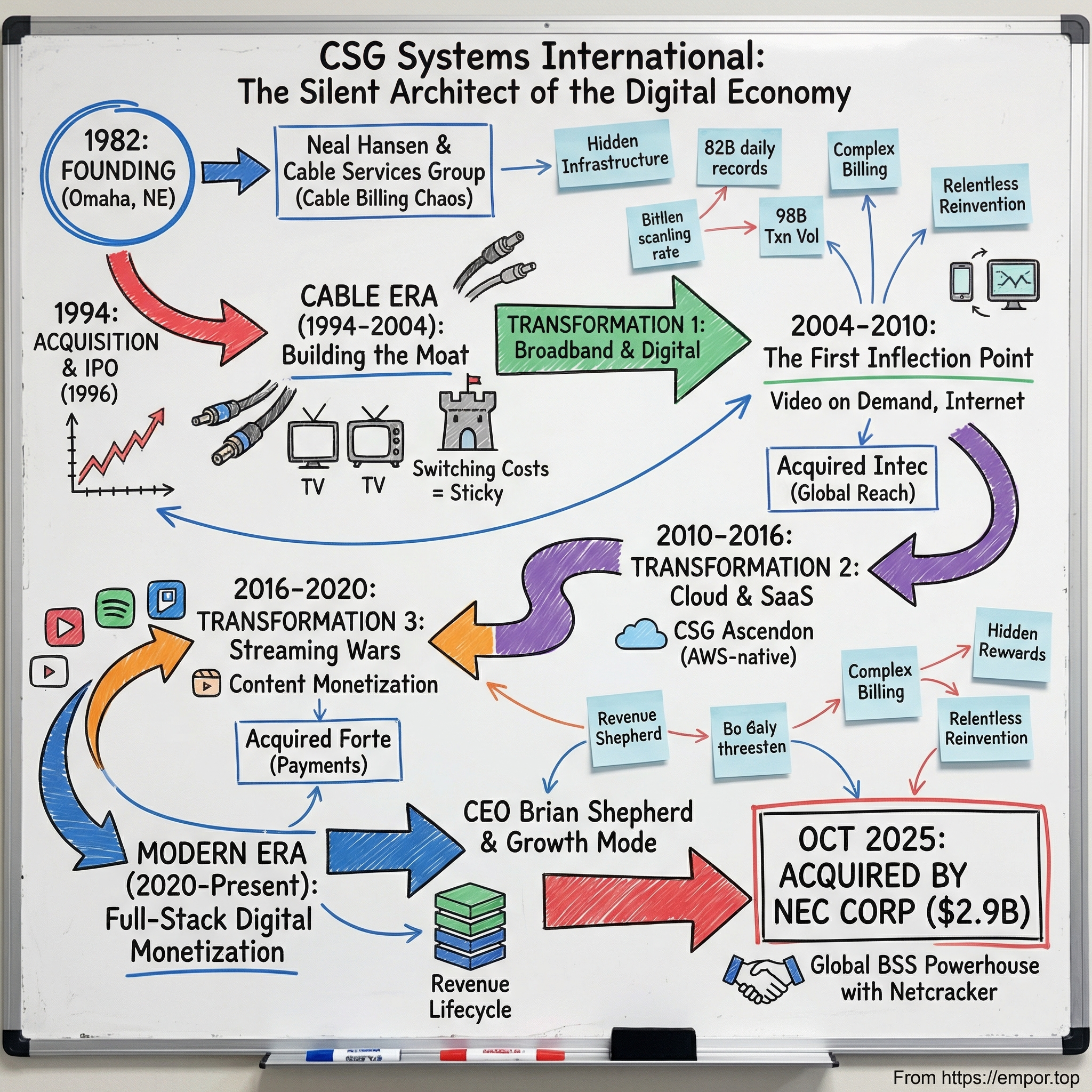
CSG Systems International: The Silent Architect of the Digital Economy
I. Introduction & Episode Roadmap
Somewhere between the moment you tapped "Subscribe" on a streaming service and the instant the charge appeared on your credit card, a piece of software you have never heard of did something extraordinary. It calculated the exact price based on your plan, your region, your promotional discount, and your bundled services. It routed the payment. It generated the invoice. It updated your account in real time. And then it did the same thing for tens of millions of other subscribers, simultaneously, without breaking a sweat.
That software almost certainly ran on infrastructure built by CSG Systems International.
CSG is one of those companies that exists in the invisible layer of the economy, the plumbing beneath the floor, the wiring inside the walls. With over a billion dollars in annual revenue, the company processes more than eighty-two billion call detail records per day. Its payment platform, Forte, handles ninety-eight billion dollars in annual transaction volume. Its billing systems sit at the heart of operations for the majority of the top one hundred communications service providers on the planet. And yet, if you stopped a hundred people on the street, not one of them could tell you what CSG does.
The central question of this story is deceptively simple: How did a cable TV billing software company founded in Omaha, Nebraska in 1982 become essential infrastructure for the streaming economy, the 5G revolution, and the subscription-everything future? The answer involves four decades of relentless reinvention, a series of high-stakes acquisitions, the quietly devastating power of switching costs, and a management team that understood something profound about enterprise software: once you become the system of record for how a company makes money, you become nearly impossible to remove.
This is a story about vertical specialization, about the difference between being a software vendor and being infrastructure. It is about the unsexy brilliance of billing, a category of software so complex, so regulatory-laden, and so deeply integrated into every other system a company operates that it creates moats wider and deeper than almost anything else in enterprise technology.
And it is a story that is reaching its climax right now. In October 2025, NEC Corporation announced it would acquire CSG for approximately 2.9 billion dollars, merging it with NEC's existing Netcracker subsidiary to create one of the two dominant global players in business support systems alongside Amdocs. Shareholders approved the deal in January 2026, and the transaction is expected to close later this year.
The company's five CEO transitions, from founder Neal Hansen through Ed Nafus, Peter Kalan, Bret Griess, and the current leader Brian Shepherd, each marked a distinct strategic era. Hansen built the foundation. Kalan bet on global expansion. Griess navigated the streaming explosion. And Shepherd has been positioning CSG as a full-stack digital monetization platform just as NEC arrived with a 2.9 billion dollar offer. It is a story of institutional evolution, where each leader built on what the last one created while steering toward the next horizon.
But before we get to the ending, we need to understand the beginning. And the beginning starts with cable television, a billing nightmare, and a man named Neal Hansen.
 Subscribe on LinkedIn
II. Founding Context & Early Years (1982–1994)
To understand why CSG exists, you first need to understand the chaos of the American cable television industry in the early 1980s. Cable was exploding. The Cable Communications Policy Act of 1984 had deregulated much of the industry, and suddenly hundreds of local cable operators were scrambling to wire neighborhoods, sign up subscribers, and figure out how to charge them for an ever-expanding universe of channels and services.
The problem was billing. Unlike a phone company, which had decades of experience with usage-based charging, or an electric utility, which measured consumption through a meter, cable operators were dealing with a bizarre hybrid. Some customers had basic packages. Others had premium channels. Some had pay-per-view events. The combinations multiplied as channels proliferated, and the billing systems that existed, often built on mainframes designed for completely different industries, simply could not handle the complexity.
Enter Neal Hansen. Hansen had co-founded First Data Resources in 1971, building it into one of the dominant financial services processing companies in America. When American Express acquired First Data in 1980, Hansen stayed on and saw an opportunity in the cable industry's billing chaos. In 1982, he created Cable Services Group as a division within First Data, headquartered in Omaha, Nebraska, specifically to build billing and customer management software for cable operators.
The timing was impeccable. Cable operators were drowning in spreadsheets, manual processes, and cobbled-together systems that broke every time a new channel package was introduced. Hansen's team built purpose-designed software that could handle the specific idiosyncrasies of cable billing: tiered packages, promotional pricing, equipment rentals, installation scheduling, service calls, and the endless permutations of channel bundles that cable operators used to compete with one another.
Throughout the 1980s, Cable Services Group grew steadily within the First Data umbrella, establishing Omaha's first large-scale billing statement processing center in 1990. But by the early 1990s, American Express had decided to divest the cable billing unit. It was growing, but it was not growing at the velocity of First Data's core financial processing business, and AmEx wanted to focus its capital elsewhere.
This is where the story takes its first dramatic turn. In 1994, Neal Hansen and George Haddix, the division's chief technical officer, assembled an investment consortium and bought Cable Services Group from American Express for 137 million dollars. They renamed it CSG Systems International in November of that year, and immediately began an aggressive restructuring. They cut the workforce from roughly 550 to about 200 employees, a brutal but deliberate move to strip the company down to its engineering core. Then they plowed more than 37 million dollars into software development over the next two years, building out the next generation of billing products including ACSR, their Advanced Customer Service Representative system, and CSG VantagePoint.
The gamble paid off spectacularly. In February 1996, CSG went public on NASDAQ, offering 2.9 million shares at fifteen dollars each. First-year revenues as a public company reached 132 million dollars, and international sales, which had been essentially zero under American Express, grew to eight percent of revenue. The company that Hansen and Haddix had bought for 137 million dollars was now worth roughly five times that amount.
But the IPO was not the real story. The real story was what CSG had built during those two years of intense investment: a billing platform so deeply integrated into the daily operations of cable companies that ripping it out would have been like performing open-heart surgery on a patient who needed to keep running a marathon. This was not a nice-to-have piece of software. This was the system that generated every single dollar of revenue for its customers. And that distinction, between software that supports a business and software that is the business, would define CSG's competitive position for the next three decades.
III. The Cable Era: Building the Moat (1994–2004)
The late 1990s were cable television's golden age of expansion, and CSG rode the wave with a surfboard made of switching costs. As cable operators consolidated from hundreds of regional players into a handful of massive national operators, CSG's platform scaled with them. The company was not just billing for cable television anymore. It was billing for the triple play: cable, internet, and phone service, all on a single bill, all managed through a single platform.
Think about what that means operationally. A cable company like Tele-Communications Inc., at the time one of the largest in America, might have millions of subscribers, each with a different combination of television packages, internet speeds, phone plans, and equipment. Each subscriber's bill needed to reflect promotional pricing, regional taxes, regulatory fees, equipment charges, pay-per-view purchases, and service credits. The number of possible billing permutations for a single large operator ran into the hundreds of millions. And every single one of them needed to be calculated correctly, every single month, or the operator would face customer complaints, regulatory scrutiny, and revenue leakage.
CSG signed one of the most important deals in its history in 1997: a fifteen-year, 1.8 billion dollar Master Subscriber Management Agreement with TCI. The contract, structured around the acquisition of TCI's SummiTrak billing system for roughly 172 million dollars, expanded CSG's billed subscriber base by approximately fifty percent overnight. When AT&T acquired TCI in 1999, CSG inherited what became one of its anchor customer relationships.
By the turn of the millennium, CSG had become the de facto standard for North American cable operators. Revenue climbed from 171 million in 1997 to 322 million in 1999 to over 400 million by 2000, with net income reaching 90.5 million dollars. The company was printing money, and the moat was getting wider by the day.
But CSG's leadership understood something critical about their market position. Being dominant in cable billing was valuable, but cable billing alone was a ceiling. The real opportunity was to become the billing engine for all the digital services that cable operators were beginning to offer. Video on demand, digital video recording, high-speed internet, and eventually voice over IP were all creating new revenue streams that needed new billing capabilities. Each new service added complexity, and complexity was CSG's best friend.
Then came the Y2K opportunity. As the millennium approached, cable operators and telcos faced the massive task of ensuring their billing systems would not collapse when the calendar rolled over to January 1, 2000. Many companies used the Y2K upgrade cycle as an opportunity to modernize their entire billing infrastructure, and CSG was perfectly positioned to capture those projects. The company expanded its footprint with several operators who had been running legacy systems, locking in new long-term relationships.
In 2001, CSG made another transformative acquisition, purchasing the Kenan FX billing software and related assets from Lucent Technologies for 261.6 million dollars. Lucent had acquired Kenan Systems for a staggering 1.48 billion dollars just two years earlier, but the telecom bubble burst and Lucent needed to shed assets. CSG picked up a proven billing and ordering middleware platform at a fraction of what Lucent had paid, estimated to increase CSG's revenue by 38 percent and its headcount by 65 percent. It was the kind of opportunistic acquisition that defines great capital allocators: buying a distressed asset from a seller who had no choice but to sell, at a price that reflected the seller's pain rather than the asset's value.
The competitive landscape during this era was crowded on paper but sparse in practice. Portal Software, Convergys, and Amdocs all competed in adjacent markets, but none of them had CSG's depth in cable-specific billing. Amdocs was the giant of telecom billing, focused primarily on wireless carriers. Convergys was more of a customer management and outsourcing play. Portal Software specialized in internet service provider billing and would eventually be acquired by Oracle. CSG occupied a specific vertical, cable and satellite billing, and it owned that vertical so completely that most competitors did not even bother trying to compete head-to-head.
The one dark cloud during this period came in 2003, when CSG lost a 120 million dollar arbitration ruling related to a contract dispute with AT&T, swinging the company to a net loss of 26.3 million dollars. It was a painful reminder that customer concentration, while driving growth, also created vulnerability. But the setback proved temporary. By 2004, revenue had recovered to 529.7 million dollars with net income of 47.2 million, and the company had absorbed the lesson that would drive its diversification strategy for the next two decades.
For investors, the cable era established two principles that still define CSG today. First, mission-critical billing software creates switching costs that are almost impossible to overcome. Second, customer concentration is a double-edged sword that must be managed through deliberate diversification. The company was about to discover just how urgently that second principle needed to be applied.
IV. The First Inflection Point: Broadband & Digital Services (2004–2010)
By the mid-2000s, the television industry was beginning to fracture. Video on demand was no longer an experiment. DVRs were changing how people watched television. And most importantly, broadband internet was rapidly becoming the most valuable service that cable operators offered. The cable industry was undergoing a subtle but seismic shift: television was no longer the primary product. It was becoming one product among several, and increasingly not even the most important one.
For CSG, this presented both an opportunity and an existential challenge. The opportunity was obvious: as cable operators added more services, billing complexity increased, and CSG's value proposition strengthened. But the challenge was equally clear. CSG had built its business around linear television billing. If the industry moved toward digital services, streaming, and internet-centric models, CSG's core platform would need to evolve dramatically, or risk becoming a legacy system itself.
Neal Hansen had retired in March 2005, handing the CEO role to Ed Nafus, who had been running the Broadband Services Division. Nafus provided stability during the transition but served only until December 2007, when Peter Kalan took the helm. Kalan, who would lead CSG for eight years, inherited a company at a crossroads.
The cable billing market was mature. Growth from existing customers was slowing. And the next generation of digital services, real-time video streaming, usage-based internet pricing, multi-screen content delivery, required billing capabilities that CSG's traditional batch-processing architecture could not easily support. The industry needed real-time rating, convergent charging that could handle multiple service types on a single platform, and the flexibility to create and modify pricing plans on the fly rather than through months of custom development.
Understanding why this is so difficult requires a brief detour into the plumbing of telecom billing. At its core, a billing system does something conceptually simple: it tracks what services a customer uses, applies the correct price, and generates a bill. But in practice, the complexity is staggering. A modern billing system must handle mediation, which means collecting and normalizing billions of raw usage records from network equipment. It must handle rating, which means applying the correct tariff or pricing rule to each usage record based on the customer's plan, the time of day, the type of service, the region, and dozens of other variables. It must handle charging, which means deciding whether to debit the customer's account in real time or accumulate charges for a monthly bill. It must handle settlement, which means dividing revenue among multiple parties when content or services are delivered through partners. And it must do all of this while maintaining regulatory compliance across multiple jurisdictions, supporting multiple currencies, and integrating with dozens of other enterprise systems including CRM, ERP, payment gateways, and content delivery networks.
This is why telecom billing is not a commodity. Building a billing system that can handle this level of complexity for millions of subscribers simultaneously, with zero tolerance for errors that would directly impact revenue, is one of the hardest problems in enterprise software. And it is why companies that solve this problem well tend to keep their customers for decades.
Then came the 2008 financial crisis. Cable operators cut costs aggressively. Technology investments were deferred. CSG felt the pressure as customers delayed upgrades and renegotiated contracts. Revenue growth stalled, and the stock underperformed its peers. But the crisis also clarified something important: the operators that invested in next-generation billing during the downturn were the ones best positioned to capitalize on the broadband boom that followed. CSG used the slowdown to invest in its next-generation capabilities, positioning itself not as a cable billing vendor but as a revenue management partner.
The strategic repositioning during this period was more than cosmetic. CSG began investing in next-generation capabilities like real-time rating and convergent charging, technologies that would prove essential as services moved from predictable monthly bills to dynamic, usage-based pricing. The company also began offering managed services, essentially operating its billing platforms on behalf of customers who did not want to maintain the expertise in-house. This managed services model would become an increasingly important part of CSG's revenue mix, deepening customer relationships and creating yet another layer of switching costs.
The most significant strategic move of this era came in 2010, when Kalan orchestrated the acquisition of Intec Telecom Systems, a UK-based provider of wholesale billing, mediation, and interconnect settlement solutions, for 372 million dollars. This was a transformational deal. Intec brought roughly 1,600 employees, deep expertise in telecom mediation and wholesale billing, and a global customer base that dramatically reduced CSG's dependence on North American cable operators. The company rebranded as CSG International, signaling that it was no longer just a cable billing company.
The Intec acquisition accomplished three strategic objectives simultaneously. It gave CSG a genuine international presence, with operations across Europe, the Middle East, and Asia-Pacific. It added mediation and interconnect capabilities that were essential for the converging telecom and cable world. And most importantly, it began the process of reducing customer concentration, a vulnerability that had haunted CSG since the AT&T arbitration debacle of 2003.
For investors, the Intec deal was a textbook example of using acquisitions to reduce concentration risk while expanding the addressable market. Before Intec, CSG was essentially a North American cable billing company with a few international contracts. After Intec, it was a global revenue management platform with diversified exposure across cable, telecom, and wholesale markets. The premium paid, roughly two times Intec's revenue, was justified by the strategic transformation it enabled.
The first inflection point was complete. CSG had evolved from a cable billing specialist into a broader revenue management platform. But the hardest transformation was still ahead.
V. The Second Inflection Point: Cloud & SaaS Transformation (2010–2016)
The early 2010s brought a question that every enterprise software company of a certain vintage had to confront: Are we a legacy software company? For CSG, the question was particularly urgent. Salesforce had proven that enterprise software could be delivered through the cloud. Zuora was building a subscription billing platform from scratch, cloud-native and API-first. The subscription economy was taking off, and a new generation of billing companies was emerging that had never heard of a mainframe and had no intention of supporting one.
CSG's leadership team, under Peter Kalan, faced an uncomfortable reality. The company's core products were deeply embedded in its customers' operations, which was the source of its competitive advantage. But those products had been built over decades, layer upon layer of functionality optimized for on-premise deployment, batch processing, and the specific requirements of cable and telecom operators. Moving to the cloud was not a simple matter of hosting the same software on AWS. It required rethinking the entire architecture: multi-tenant rather than single-tenant, API-first rather than interface-driven, microservices rather than monolithic, real-time rather than batch.
The risk of this transition was enormous. CSG's revenue at the time came primarily from long-term contracts that included significant perpetual license and maintenance fees. Moving to a cloud subscription model would mean giving up large upfront license payments in favor of smaller recurring fees. In the short term, this would compress revenue and margins. Wall Street, with its relentless focus on quarterly results, would punish the stock. And there was no guarantee that customers who were perfectly happy with their on-premise installations would agree to migrate to a cloud platform, especially when any disruption to their billing systems could directly impact their revenue.
But the alternative, staying on-premise while the rest of the enterprise software world moved to the cloud, was even riskier. New entrants would eventually build cloud-native billing platforms capable enough to compete with CSG's legacy products. And once a customer decided to move to the cloud, they would evaluate all options, including competitors that CSG had never had to worry about before. History is littered with enterprise software companies that clung to their on-premise business models too long: Siebel Systems, which dominated CRM before being displaced by Salesforce and ultimately absorbed by Oracle, is perhaps the most cautionary example. CSG's leadership was determined not to become the Siebel of billing.
The biggest bet of this era was the development of CSG Ascendon, launched in March 2015. Ascendon was a cloud-native digital services platform built on Amazon Web Services, designed from the ground up for the subscription and streaming economy. It featured more than 350 open APIs, a modular architecture that allowed customers to adopt individual components without replacing their entire billing stack, and the ability to support complex digital commerce scenarios including content monetization, subscription management, and real-time charging.
The strategic genius of Ascendon was in its go-to-market approach. Rather than asking existing customers to rip out their proven ACP billing systems and replace them with something new, CSG positioned Ascendon as a complement. An operator could keep ACP running for its traditional cable billing while deploying Ascendon for new digital services, streaming offerings, or direct-to-consumer products. This land-and-expand strategy reduced the perceived risk for customers while giving CSG a foothold in the cloud-native world.
During this period, CSG also pursued a selective acquisition strategy to fill capability gaps. The 2012 acquisition of Ascade, a Swedish company specializing in wholesale business management, for nineteen million dollars added seventy-plus carrier customers across Europe, the Middle East, and Asia. These were modest deals compared to Intec, but they followed a clear pattern: acquire companies with complementary capabilities and customer relationships that CSG could integrate into its expanding platform.
The investment period was painful. Margins compressed as the company invested heavily in cloud development while maintaining its legacy platforms. Revenue growth slowed. The stock underperformed. Peter Kalan announced his retirement in November 2015 after eight years as CEO, handing the reins to Bret Griess, a long-time CSG executive who had served as President under Kalan.
Griess inherited a company in the middle of the most difficult transition in its history. The cloud platform was built but still early in adoption. The legacy business was stable but not growing. And a new wave of disruption was about to hit the media and entertainment industry that would make everything CSG had built suddenly, urgently relevant.
The thesis that had been crystallizing throughout Kalan's tenure was now explicit: CSG was not a billing company. It was a digital monetization platform. The question was whether the market would validate that thesis before patience ran out.
VI. The Third Inflection Point: Streaming Wars & Content Monetization (2016–2020)
In November 2019, Apple TV Plus launched. A week later, Disney Plus arrived. HBO Max followed in May 2020. Peacock came in July. Every major media company on earth was suddenly in the direct-to-consumer streaming business, and every single one of them needed to solve a problem that was vastly more complex than they had anticipated: billing.
The common assumption in Silicon Valley was that billing for a streaming service was simple. You charge a monthly fee. You process a credit card. You send a receipt. How hard could it be? The answer, as every media company quickly discovered, was: extraordinarily hard.
Consider what a modern streaming service actually needs from its billing infrastructure. It needs to support multiple subscription tiers, often with different content libraries for each tier. It needs to handle promotional pricing, free trials, student discounts, and family plans. It needs to manage bundling, because streaming services are increasingly sold as part of bundles with wireless plans, broadband subscriptions, or other streaming services. It needs to handle regional pricing across dozens of countries, each with its own currency, tax regime, and regulatory requirements. It needs to manage partner revenue shares, because content rights holders receive different percentages based on geography, viewership, and contract terms. It needs to process refunds, chargebacks, and subscription pauses. And it needs to do all of this while integrating with payment processors, identity management systems, content delivery networks, and customer service platforms.
This was not a problem that could be solved by buying Stripe and bolting on Salesforce.
The gap between simple payment processing and enterprise-grade revenue management is wider than most people in Silicon Valley appreciate. Stripe is brilliant at payment processing, but it was not designed to handle the kind of complex, multi-party, multi-jurisdiction revenue management that media companies required. And Salesforce is brilliant at customer relationship management, but its billing capabilities were designed for the relatively straightforward world of SaaS subscriptions, not the byzantine complexity of content rights and partner revenue sharing.
CSG's Ascendon platform, the cloud-native system that had been built precisely for this kind of complexity, was suddenly in enormous demand. Comcast deployed Ascendon for its XFINITY On Campus platform. ESPN used it for direct-to-consumer offerings. Sony Pictures Home Entertainment, Cineplex Entertainment, and other content providers adopted the platform for their digital commerce needs.
Under Bret Griess, the acquisition strategy accelerated to add capabilities that the streaming and digital commerce world demanded. In 2018, CSG acquired Business Ink, an Austin-based customer communications management company, for approximately 70 million dollars. Business Ink brought something invaluable: more than 500 customers in healthcare, financial services, and utilities. This was the first major move to diversify CSG's customer base beyond cable and telecom.
The following year, CSG acquired Forte Payment Systems for 85 million dollars, adding a full-fledged payment processing platform that handled transactions for tens of thousands of merchants. Forte gave CSG the ability to offer an end-to-end solution: not just calculating what customers owed, but actually processing the payments. This was the difference between being a billing system and being a revenue engine.
Then came 2020 and the COVID-19 pandemic. For CSG, the pandemic created a paradox. On one hand, streaming adoption accelerated dramatically as hundreds of millions of people around the world were confined to their homes. Every media company that had been contemplating a direct-to-consumer launch moved up its timeline. The demand for CSG's digital monetization capabilities surged. On the other hand, many of CSG's traditional cable and telecom customers were under severe budget pressure, cutting costs and deferring technology investments.
Revenue for 2020 came in at 990.5 million dollars, essentially flat year over year. But beneath the headline number, a profound shift was underway. Revenue from digital and cloud services was growing, while revenue from legacy perpetual licenses and traditional services was declining. The mix was changing, and the mix was everything. There is a telling statistic that illustrates how CSG's world was expanding even as traditional cable was contracting: approximately 45 percent of cable subscribers now opt for bundled services, combinations of television, broadband, phone, and increasingly streaming, each with its own pricing logic, promotional structure, and partner revenue arrangement. Every additional service in a bundle multiplies the billing complexity, and billing complexity is CSG's raw material.
In August 2020, CSG announced that Brian Shepherd would succeed Bret Griess as CEO effective January 2021. Shepherd brought a different profile to the role. He had spent sixteen years at TTEC, the customer experience technology company, and had also worked at Amdocs, CSG's primary competitor in telecom billing. He held an MBA from Harvard Business School and had consulted at McKinsey. His appointment signaled that CSG was ready to shift from transformation mode to growth mode.
Shepherd's background was telling. His years at Amdocs gave him intimate knowledge of CSG's primary competitor. His time at McKinsey gave him the strategic frameworks to think about market positioning and competitive dynamics. And his experience at TTEC, where he spent sixteen years building customer experience operations, gave him a deep appreciation for the importance of customer outcomes rather than just software features. He was, in many ways, the perfect CEO for the next phase of CSG's evolution: someone who understood both the technology and the customer, and who could bridge the gap between what CSG had been and what it needed to become.
The playbook that emerged during this era was elegant in its simplicity: land with one service, typically streaming or digital commerce, then expand into core billing, and finally add analytics and customer experience capabilities. Each expansion deepened CSG's integration into the customer's operations and increased the switching costs that protected the relationship.
VII. The Modern Era: Full-Stack Digital Monetization (2020–Present)
Brian Shepherd took the CEO chair in January 2021 with a mandate to accelerate everything his predecessors had built. Within his first year, he executed three acquisitions in rapid succession. In May 2021, CSG acquired Tango Telecom, an Irish company specializing in real-time policy and charging management for 3G, 4G, and 5G networks. In July, it bought Kitewheel, a customer journey orchestration platform, for 40 million dollars. And in October, it acquired DGIT Systems, an Australian company with configure-price-quote and order management capabilities serving roughly seventy service providers across eighteen countries.
The pattern was unmistakable. CSG was assembling a full-stack platform that could handle every aspect of the customer lifecycle: from the moment a subscriber signed up for a service, through every billing cycle, payment transaction, customer service interaction, and personalized offer, all the way to churn prediction and win-back campaigns.
This was not a billing company anymore. This was a customer revenue lifecycle company. And the acquisitions reflected a clear strategy: each deal filled a specific capability gap in the end-to-end vision that Shepherd was building.
The financial results validated the strategy. Revenue crossed the one billion dollar threshold for the first time in 2021, reaching 1.05 billion dollars. It grew to 1.09 billion in 2022, then 1.17 billion in 2023, then a record 1.197 billion in 2024, and reached 1.223 billion dollars in 2025. More importantly, non-GAAP operating margins expanded from approximately seventeen percent in 2023 to just over twenty percent in 2025, a 310-basis-point improvement driven by the ongoing shift toward higher-margin SaaS revenue.
The customer diversification story was equally compelling. In 2017, Charter and Comcast together represented 49 percent of CSG's total revenue. By 2024, that figure had declined to approximately 36 percent, with Charter at roughly 20 percent and Comcast at 19 percent. But here is the critical nuance: revenue from these two anchor customers had actually grown at a 2.6 percent compound annual rate during that period. CSG did not shrink its way to diversification. It grew its non-cable revenue faster than its cable revenue, expanding into financial services, healthcare, utilities, and retail. Non-cable-and-telecom verticals reached 32 percent of total revenue, with a target of exceeding 35 percent by the end of 2026.
Meanwhile, CSG locked down its anchor relationships with long-term contract renewals. Comcast extended through December 2030 with built-in escalators beginning in 2026. Charter extended through 2031. These are not year-to-year agreements. They are decade-long partnerships that provide revenue visibility rare in the enterprise software industry.
Then came the defining moment. On October 29, 2025, NEC Corporation announced that it would acquire CSG Systems for 80.70 dollars per share in cash, a transaction valued at approximately 2.9 billion dollars including debt. The price represented a 17.4 percent premium over the prior day's closing price and a 23 percent premium to the 30-day volume-weighted average price. CSG shareholders approved the merger on January 30, 2026, and the transaction is expected to close later this year.
NEC's strategic rationale was straightforward: combining CSG with its existing Netcracker subsidiary, which NEC had acquired in 2008, would create one of the two dominant global players in business support systems, the other being Amdocs. Light Reading, the telecom industry publication, described the post-merger landscape bluntly: there would be "two big dogs in the BSS market, Amdocs and Netcracker."
For CSG, the acquisition represented both validation and a new chapter. The 2.9 billion dollar price tag, roughly 2.4 times trailing revenue and 12.8 times non-GAAP operating income, reflected the premium that strategic acquirers are willing to pay for deeply embedded, mission-critical enterprise software with high switching costs and predictable revenue streams. The company's headquarters in Englewood, Colorado and its approximately 5,800 employees would continue as a wholly-owned NEC division.
CSG also reported its final earnings as an independent public company on February 4, 2026, posting full-year 2025 revenue of 1.223 billion dollars and non-GAAP operating income of 226.2 million dollars. Cash from operations reached 155.9 million dollars, and the company generated 146.4 million dollars in adjusted free cash flow. These were the numbers of a mature, well-run platform business firing on all cylinders, and they validated the price that NEC was paying.
The 43-year journey from a cable billing division in Omaha to a 2.9 billion dollar acquisition by a Japanese technology conglomerate is a masterclass in the power of vertical specialization, patient platform building, and the compounding value of switching costs.
VIII. The Product & Technology Deep Dive
To truly understand CSG's competitive position, you need to understand what the company's technology actually does, not at the marketing-slide level, but at the operational level where complexity creates moats.
Start with mediation. Every time a phone call is made, a text message is sent, a gigabyte of data is consumed, or a streaming video is watched, the network generates a raw usage record called a CDR, or call detail record. For a large service provider, the volume of these records is staggering. CSG processes more than 82 billion CDRs per day. Mediation is the process of collecting these raw records from thousands of different network elements, each speaking its own protocol and data format, normalizing them into a consistent format, validating them for accuracy, and routing them to the appropriate downstream systems. Think of mediation as the universal translator that sits between the chaos of network-generated data and the order that billing systems require.
Next comes rating and charging. Once a usage record has been mediated, the system must determine what it costs. This sounds simple until you consider the variables: the customer's specific plan, the time of day, the type of service, whether the usage occurred on-network or off-network, whether a promotional discount applies, whether the customer has exceeded a usage threshold that triggers a different rate, and dozens of other factors that vary by geography and regulatory jurisdiction. CSG's rating engine applies these rules in real time or in batch, depending on the service type, and can handle millions of rating calculations per second.
Then there is billing itself, the process of aggregating all rated usage, applying recurring charges, credits, taxes, and fees, and generating an accurate invoice. For a cable operator offering hundreds of channel packages, multiple internet speed tiers, phone service, and a growing portfolio of streaming and digital services, the number of possible billing combinations for any given customer is astronomical. CSG's Advanced Convergent Platform, the flagship product that has been processing North American cable bills for decades, handles this complexity for operators like Comcast and Charter.
Beyond the core billing stack, CSG has built out a customer engagement layer through its Xponent platform, which uses artificial intelligence to orchestrate customer journeys across channels. Xponent was recognized as a Leader in the Forrester Wave for Customer Journey Orchestration in 2024, earning the highest scores in sixteen of thirty evaluation criteria. The platform enables predictive behavior modeling, real-time decisioning, and micro-segmentation, essentially helping service providers understand when a customer is likely to churn and intervene with a personalized offer before they leave.
The Forte payment platform adds another critical layer: actual payment processing. With 98 billion dollars in annual payment volume across 178 million transactions and more than 98,000 merchants, Forte transforms CSG from a company that calculates what customers owe into a company that actually collects the money. The merchant base has been growing at roughly fourteen percent year over year, and Forte's integrated payment capabilities create cross-sell opportunities that pure billing companies cannot match.
CSG has also been investing aggressively in artificial intelligence. The company launched its Conversational AI solution in 2020, introduced AI-powered offer recommendations within ACP, and most recently unveiled Xponent Agentic Orchestration, a system of intelligent AI agents designed to automate complex customer interaction workflows. Its Bill Explainer.ai product uses generative AI to proactively identify billing anomalies and explain them to customers before they generate complaints.
The integration complexity of this technology stack is itself a moat. CSG's platforms connect to CRM systems, ERP systems, payment gateways, content delivery networks, network management systems, and dozens of other enterprise applications. Each integration is custom-configured for the specific customer's environment, and each one adds another thread to the web of dependencies that makes switching prohibitively expensive.
Why does any of this matter? Because it reveals something fundamental about CSG's competitive position. This is not a company that sells a product. It is a company that operates as the central nervous system of its customers' revenue operations. When something is that deeply embedded, it does not get replaced. It gets renewed.
IX. Business Model & Unit Economics
CSG's business model has undergone a quiet revolution over the past decade. The company began its life selling perpetual software licenses supplemented by maintenance fees and professional services, the classic enterprise software model of the 1990s and 2000s. Today, SaaS and related solutions represent approximately 89 percent of total revenue, a proportion that would make many born-in-the-cloud companies envious.
The revenue model works in layers. At the foundation are long-term contracts, typically five to ten years in duration, that provide recurring revenue from core billing and revenue management services. These contracts often include volume-based pricing, meaning CSG earns more as its customers add subscribers or process more transactions. On top of this foundation, CSG layers professional services for implementation and customization, managed services for customers who want to outsource the operation of their billing systems entirely, and increasingly, cloud-based SaaS solutions that are consumed on a subscription basis.
The contract structure creates remarkable revenue visibility. When your two largest customers have agreements extending to 2030 and 2031 respectively, and your average contract spans multiple years, the base of predictable revenue is substantial. Customer retention rates for core billing services exceed 95 percent, and relationships frequently last for decades rather than years. CSG does not publicly disclose a formal net revenue retention metric, but the qualitative evidence is clear: customers rarely leave, and they tend to expand their usage over time.
Gross margins tell an important story about the business mix. The company's overall gross margin sits at approximately 49 percent, which reflects the blend of high-margin software and SaaS revenue with lower-margin managed services and professional services. Cloud-native SaaS solutions target gross margins above 70 percent, significantly higher than traditional service delivery. As the SaaS mix continues to increase, the blended gross margin should trend upward, which is exactly what has been happening: non-GAAP operating margins expanded from 17.2 percent in 2023 to 20.3 percent in 2025.
The switching cost dynamics deserve special attention because they are the foundation of CSG's entire business model. Implementing a new billing system for a large service provider is a twelve-to-twenty-four month project that costs tens of millions of dollars. The implementation involves migrating decades of customer data, reconfiguring integrations with dozens of other enterprise systems, retraining thousands of employees, and validating that every billing calculation produces the correct result. The risk of getting any of this wrong is existential: billing errors cause customer complaints, regulatory investigations, and revenue leakage. No CTO or CIO at a major cable operator or telecom company is going to bet their career on a billing migration unless there is an overwhelming reason to switch. This is why CSG's customer relationships last for decades.
The go-to-market motion is pure enterprise: direct sales teams with deep industry expertise, long sales cycles that often extend over years, and relationship-based selling where trust and reference customers matter more than marketing. CSG's sales force does not cold-call prospects. They attend the same industry conferences, serve on the same standards bodies, and maintain relationships that span entire careers.
R&D investment runs at approximately 13.2 percent of revenue, a healthy level for an enterprise software company that balances innovation with the stability that its customers demand. Capital expenditure is minimal, at roughly 1.2 percent of revenue, reflecting the asset-light nature of the software business. This combination of high recurring revenue, strong gross margins, and low capital intensity generates substantial free cash flow, with the company producing 146.4 million dollars in non-GAAP adjusted free cash flow in 2025.
The company has returned this cash to shareholders aggressively, with a quarterly dividend that has been paid for thirteen consecutive years (most recently increased six percent to $0.34 per share) and a share repurchase program that together target more than 100 million dollars in annual shareholder returns. The balance sheet carries 565 million dollars in total debt against 180 million in cash, with net leverage of 1.6 times adjusted EBITDA, a conservative level that reflects management's preference for financial flexibility.
X. Competitive Landscape & Strategic Positioning
The billing and revenue management market is an oligopoly masquerading as a competitive landscape. On paper, dozens of companies offer some form of billing or revenue management solution. In practice, when a major cable operator, telco, or streaming platform needs to select a billing system that will handle billions of dollars in revenue, the shortlist has approximately three names on it: Amdocs, Oracle, and CSG.
Amdocs is the industry's eight-hundred-pound gorilla. With approximately 4.9 billion dollars in revenue, it is roughly four times CSG's size and commands an estimated twenty-plus percent share of the global telecom BSS market. Amdocs' strength lies in its dominance of the wireless carrier segment, where it serves virtually every major mobile operator on the planet. But Amdocs' wireless focus has been a double-edged sword. Its products and implementation methodologies are optimized for the mobile world, which means its cable and streaming capabilities have historically lagged CSG's. CSG maintains a meaningful gross margin advantage (49 percent versus Amdocs' 37.4 percent), reflecting a more software-centric revenue mix compared to Amdocs' heavier reliance on services.
Oracle occupies a different position, offering billing solutions primarily for utilities and general enterprise use cases through its acquired portfolio (including the former Portal Software). Oracle's strength is its ability to bundle billing with its broader enterprise software suite, including database, ERP, and cloud infrastructure. But Oracle's billing products are often viewed as generalized tools rather than industry-specific solutions, which limits their appeal in the highly specialized cable and telecom world.
The more interesting competitive dynamics come from below. Zuora, Stripe, and Chargebee have built modern, cloud-native billing platforms that are increasingly capable. Zuora targets the SaaS subscription economy. Stripe has expanded from payment processing into subscription billing and revenue recognition. Chargebee serves the small-to-medium business segment. These companies are nimble, developer-friendly, and designed for the cloud-native world.
But there is a fundamental gap between what these platforms can handle and what a large cable operator or telecom company needs. Stripe can process a credit card payment for a streaming subscription. It cannot handle the complex multi-party revenue settlement that occurs when a cable operator bundles a streaming service with broadband and phone service, each with its own content rights agreements, regulatory requirements, and partner revenue shares across multiple jurisdictions. The complexity gradient between "charge a credit card" and "operate the revenue engine for a multi-billion dollar service provider" is enormous, and it is in that complexity gradient that CSG lives.
The build-versus-buy question has largely been settled. In the early days of the internet, companies like Amazon and Google built their own billing systems because no vendor offered solutions adequate for their unprecedented scale and business model. Today, the consensus in most industries is that billing is not a source of competitive advantage and should not consume internal engineering resources. The shift to cloud-based billing solutions has accelerated this trend, making it easier for companies to adopt vendor solutions without the overhead of managing on-premise infrastructure.
The most significant competitive threat on the horizon comes not from traditional billing vendors but from the cloud platforms themselves. AWS, Microsoft Azure, and Google Cloud all offer native billing and subscription management capabilities that, while still rudimentary compared to CSG's offerings, are improving rapidly. If cloud platforms were to develop billing capabilities sophisticated enough for large-scale telecom and media companies, they could potentially bundle billing into their infrastructure offerings at marginal cost, undermining the standalone billing market.
CSG's defensive strategy against this threat has been to partner with, rather than compete against, the cloud platforms. The company's Ascendon platform runs on AWS and is available through the AWS Marketplace. Its mediation solutions integrate with both AWS and Azure. By positioning itself as a complementary layer that adds domain-specific capability on top of generic cloud infrastructure, CSG avoids direct competition while benefiting from the cloud platforms' distribution channels.
There is a useful analogy for understanding CSG's competitive position. Think of building a billing system for a major cable operator like building a custom house versus buying a pre-fabricated one. Stripe and Zuora are selling pre-fabricated structures: well-designed, quick to install, and perfectly adequate for standard use cases. CSG is building custom mansions: designed from the ground up for a specific client's requirements, taking years to construct, and featuring bespoke integrations with every other system in the client's environment. Once you have built and moved into the custom mansion, you are not switching to a prefab house just because it is cheaper and newer. The cost of tearing down what you have built and starting over is simply too high.
The NEC acquisition reshapes this competitive landscape significantly. The combined CSG-Netcracker entity will have the scale, geographic reach, and product breadth to compete more effectively against Amdocs on a global basis. For the rest of the market, the consolidation sends a clear signal: the BSS market is maturing, and the winners will be the companies with the deepest domain expertise, the broadest product portfolios, and the most entrenched customer relationships.
XI. Porter's 5 Forces & Hamilton's 7 Powers Analysis
Porter's Five Forces
The threat of new entrants into CSG's core market is remarkably low. Building a billing and revenue management platform capable of serving a major cable operator or telecom company requires years of development, hundreds of millions of dollars in R&D investment, and deep domain expertise that can only be acquired through decades of working with complex enterprise customers. The switching costs for existing customers are so high that a new entrant would need to offer a dramatically superior product to overcome the inertia of installed systems. And even then, the risk of migration failure, which could directly impact a customer's revenue, makes operators extremely conservative about change. The last truly new entrant to gain meaningful share in enterprise-grade telecom billing was Zuora, founded in 2007, and it has focused almost exclusively on the SaaS subscription segment rather than competing head-to-head with CSG in cable and telecom.
Supplier bargaining power is low and largely irrelevant. CSG's primary inputs are engineering talent and cloud infrastructure, both of which are available from multiple sources. The company is not dependent on any proprietary component or scarce resource that a supplier could use as leverage. Labor is the most significant cost, and while competition for engineering talent is fierce, CSG's Omaha-and-Denver headquarters give it access to a deep talent pool at lower cost than coastal technology hubs.
Buyer bargaining power is the most nuanced of the five forces. On one hand, CSG's customer base is concentrated: Charter and Comcast alone represent roughly 36 percent of revenue, and the loss of either would be devastating. Large enterprises have significant negotiating leverage in contract discussions, and they use it. On the other hand, the switching costs that protect CSG's revenue also limit buyers' willingness to use their leverage too aggressively. A cable operator that pushes too hard on pricing risks damaging the relationship with the vendor that operates its revenue engine, and the alternative, migrating to a new billing system, is so costly and risky that it functions as a nuclear option that neither side wants to deploy. The result is a dynamic of mutual dependence rather than pure buyer power.
The result is a subtle but powerful equilibrium: CSG's largest customers have significant pricing leverage but limited switching leverage, which keeps margins healthy while preventing predatory pricing.
The threat of substitutes is moderate and concentrated in the lower end of the market. For complex enterprise use cases, there is no true substitute for a purpose-built billing and revenue management platform. But for simpler scenarios, companies can cobble together a combination of payment processing (Stripe), subscription management (Zuora or Chargebee), and CRM (Salesforce) that approximates billing functionality. This substitution threat is real for new, digitally native companies that are building their billing stack from scratch, but it is largely irrelevant for CSG's existing customer base, which has already invested millions in implementing CSG's integrated platform.
The substitute threat is therefore primarily relevant to CSG's growth strategy for new customers rather than its retention of existing ones.
Industry rivalry is moderate and structured more like an oligopoly than a dogfight. The major players, Amdocs, Oracle, and CSG, have carved out distinct verticals and geographies. Competition occurs primarily on features, service quality, and innovation rather than price. Vertical specialization reduces direct head-to-head battles: Amdocs dominates wireless, CSG dominates cable and streaming, and Oracle has its utility and general enterprise niche. When competitive displacement does occur, it typically happens during major technology transitions (such as cloud migration) or organizational upheavals (such as mergers between operators) rather than through routine competitive switching.
Hamilton's Seven Powers
CSG's primary source of competitive power is switching costs, and it may be one of the most extreme examples of this power in all of enterprise software. The implementation of a billing system at a major operator takes twelve to twenty-four months and costs tens of millions of dollars. But the implementation cost is actually the least significant component of the switching cost. The real barriers are data migration risk (billing errors directly cause revenue loss and customer churn), operational risk (the billing system is the revenue engine, and any interruption is existential), organizational knowledge (thousands of employees trained on CSG's systems over years), and integration complexity (CSG's platform connects to dozens of other enterprise systems, each connection representing a dependency that must be replicated in any migration). These switching costs compound over time: the longer a customer uses CSG's systems, the more deeply integrated they become, and the more costly it is to switch.
Scale economies provide a secondary source of power. CSG's R&D investments, which run at approximately 13 percent of revenue, are amortized across a customer base that generates over a billion dollars in annual revenue. This means CSG can invest significantly more in product development than any new entrant could justify, while still maintaining healthy operating margins. The platform nature of the business amplifies this advantage: improvements to the core platform benefit all customers simultaneously, creating a positive feedback loop between scale and product capability.
Process power is CSG's third significant source of competitive advantage. Over four decades, the company has refined its implementation methodology, customer success processes, and R&D prioritization mechanisms to a degree that would be extremely difficult for a new entrant to replicate. These processes are not documented in a playbook that could be copied. They are embedded in the organizational culture, in the tacit knowledge of hundreds of implementation consultants who have deployed billing systems at dozens of different operators, and in the continuous improvement loops that connect customer feedback to product roadmap decisions.
Network effects are present but moderate. CSG does not benefit from traditional network effects in the way that a social network or marketplace does. But there are ecosystem effects: the more widely CSG's data models and APIs are adopted, the more third-party integrations are built for its platforms, and the more consultants and system integrators develop expertise in CSG's technology. These ecosystem effects increase the value of CSG's platform for all participants and raise the barrier for alternative platforms.
Counter-positioning was historically a source of power for CSG, which positioned itself as a vertical specialist against general-purpose ERP and CRM vendors. But this power has faded as the general-purpose vendors have retreated from billing and the competitive landscape has consolidated around vertical specialists. Paradoxically, CSG now faces counter-positioning from nimble SaaS startups that can offer simpler, cheaper, cloud-native solutions for less complex billing use cases.
Branding is moderate but meaningful in enterprise markets. CSG does not have consumer brand recognition, but within the cable, telecom, and streaming industries, the company has a strong reputation built on decades of reliable service. The enterprise equivalent of "nobody gets fired for buying IBM" applies to CSG in its core markets: choosing CSG for billing is the safe, proven choice that a CTO can defend to their board.
Cornered resource is moderate. CSG's forty-plus years of accumulated domain expertise, reference data, and customer relationships represent a resource that would be difficult but not impossible to replicate. The knowledge embedded in CSG's workforce about the edge cases, regulatory requirements, and operational nuances of billing for complex service providers is genuinely valuable and cannot be easily transferred to a competitor.
The overall assessment is that CSG's competitive position rests on a trinity of switching costs, scale economies, and process power. This combination creates a durable moat for existing customers but does not guarantee success in winning new customers or expanding into adjacent markets, which requires continuous innovation and investment. The risk, as with any switching-cost-dependent business, is that a sufficiently disruptive technology shift could reset the playing field. If a new platform emerges that offers ten times better implementation speed at one-tenth the cost, even the most entrenched billing system could be displaced. That has not happened yet in forty years, but the acceleration of AI capabilities makes it a possibility that bears watching.
XII. Bull vs. Bear Case
The Bull Case
The most compelling argument for CSG's long-term value is the secular tailwind of the subscription economy. Every industry, from media to healthcare to transportation to fitness, is moving toward recurring revenue models. Each new subscription business needs billing infrastructure, and the more complex the billing scenario (bundled services, usage-based pricing, partner revenue sharing, multi-jurisdictional compliance), the more valuable CSG's platform becomes. The total addressable market for billing and revenue management is growing from roughly 66 billion dollars today toward an estimated 150 to 200 billion dollars by the early 2030s, driven by 5G expansion, AI-enabled automation, and the continued proliferation of digital services.
CSG's entrenched position with its existing customer base provides a foundation of predictable revenue that few enterprise software companies can match. The long-term contracts with Comcast and Charter, extending to 2030 and 2031 respectively, provide a decade of revenue visibility with built-in escalators. Customer retention rates above 95 percent and relationships that typically last for decades create a compounding effect: each year of continued service deepens the integration, increases the switching cost, and expands the opportunity for cross-selling additional products.
The expansion opportunity is significant. CSG has only begun to penetrate verticals beyond cable and telecom. Financial services, healthcare, utilities, and retail all represent large markets with complex billing requirements and limited purpose-built solutions. The company's target of reaching 35 percent of revenue from non-cable-and-telecom verticals by the end of 2026 is achievable and potentially conservative.
The cloud transition, which compressed margins for years, is now bearing fruit. Non-GAAP operating margins expanded 310 basis points over two years to 20.3 percent, and the continuing shift toward higher-margin SaaS revenue suggests further margin expansion ahead. Cloud-native SaaS solutions target gross margins above 70 percent, significantly higher than the blended 49 percent gross margin, which means every percentage point of mix shift toward SaaS flows disproportionately to the bottom line.
The NEC acquisition provides patient, strategic capital and access to NEC's global sales and distribution network, particularly in Asia-Pacific, where CSG has been under-penetrated. The combination with Netcracker creates a formidable competitor to Amdocs with the scale, breadth, and geographic reach to compete for the largest global telecom and media accounts.
The Bear Case
Customer concentration remains CSG's most significant vulnerability. Despite the progress in diversification, Charter and Comcast still represent more than a third of total revenue. The loss of either customer, while unlikely given the depth of integration and the length of the contracts, would be devastating. The Digicel contract termination, which created an 18.1 million dollar receivable exposure, illustrated that even smaller customer losses can have meaningful financial impact.
The competitive threat from technology platforms is real and growing. Stripe has expanded from payment processing into subscription billing, revenue recognition, and tax compliance. Salesforce offers billing capabilities through its Revenue Cloud. AWS, Azure, and Google Cloud all provide native billing and subscription management modules that are improving rapidly. If any of these platforms develops billing capabilities sophisticated enough for large-scale enterprise use cases, they could bundle billing into their infrastructure at marginal cost, undermining the standalone billing market.
The secular decline in traditional cable television is a headwind that CSG must continue to outrun. Cord-cutting has been accelerating for years, and while the shift to streaming creates new billing complexity that benefits CSG, the company's largest customers are cable operators whose subscriber bases are shrinking. CSG must continuously grow its streaming, broadband, and non-cable revenue faster than its traditional cable billing revenue declines.
Private equity-style ownership through NEC raises questions about long-term investment levels. While NEC is a strategic acquirer rather than a financial buyer, the pressure to generate returns on a 2.9 billion dollar investment could lead to underinvestment in R&D or aggressive cost-cutting that undermines CSG's competitive position. The history of large technology acquisitions is littered with examples of acquired companies that were starved of investment and lost their market position.
Innovation risk is particularly acute in the era of generative AI. If AI makes billing software significantly easier to build, configure, and maintain, it could erode the domain expertise and process power that are central to CSG's competitive moat. A world in which an AI system can configure a billing platform in days rather than months would fundamentally alter the switching cost dynamics that protect CSG's revenue base.
Key Performance Indicators to Watch
For investors tracking CSG's trajectory, whether as a subsidiary of NEC or as a benchmark for similar companies, three metrics matter most.
First, SaaS revenue as a percentage of total revenue. This metric captures the progress of CSG's cloud transition, the single most important strategic initiative of the past decade. SaaS revenue carries higher gross margins, greater predictability, and stronger growth characteristics than legacy perpetual license and maintenance revenue. The trajectory from the current approximately 89 percent SaaS mix toward higher levels will directly drive margin expansion and valuation.
Second, revenue concentration from top two customers. This metric captures the progress of CSG's diversification strategy, the most important risk mitigation effort in the company's history. The decline from 49 percent in 2017 to 36 percent in 2024 is encouraging, but the journey is not complete. Continued progress toward 30 percent or below would significantly reduce the single-customer risk that has been CSG's greatest vulnerability.
Third, non-GAAP operating margin. This metric captures both the SaaS transition benefit and the operating leverage of the platform business model. The expansion from 17.2 percent to 20.3 percent over two years demonstrates that CSG's business model improves as it scales, and continued expansion toward the mid-twenties would validate the thesis that CSG is becoming a higher-quality, higher-margin business.
XIII. Lessons for Founders & Investors
Strategic Lessons
CSG's forty-three-year journey offers a masterclass in vertical specialization as a competitive strategy. In a world obsessed with horizontal platforms and "total addressable market" expansion, CSG built one of the most durable businesses in enterprise software by doing the opposite: going deep rather than broad. The company chose to become the absolute best at billing for cable and telecom operators, rather than trying to be adequate at billing for everyone. This vertical focus created domain expertise so deep that general-purpose competitors could not match it, even with vastly larger R&D budgets.
The lesson about switching costs is perhaps the most important one for founders. CSG's products are not inherently sticky because they are better designed or more feature-rich than alternatives, though they may be. They are sticky because they are deeply integrated into every other system a customer operates. Every API connection, every data migration, every custom configuration, every employee trained on the system adds another strand to the web of dependencies that makes switching prohibitively expensive. The insight for founders is that stickiness is not just about product quality. It is about integration depth. The more deeply your product connects to the rest of a customer's technology stack, the more costly and risky it becomes to replace.
The cloud transition teaches that short-term pain is the price of long-term survival. CSG's management team made the difficult decision to invest heavily in cloud-native platforms while maintaining legacy products, knowing that the transition would compress margins and disappoint Wall Street in the near term. They were right. Companies that delayed the cloud transition, including several of CSG's former competitors, have been marginalized or acquired. The cloud transition is not optional for enterprise software companies; the only question is whether you manage it proactively or have it forced upon you.
The acquisition strategy illustrates a principle that is often overlooked in the startup world: build core, buy periphery. CSG built its core billing and revenue management capabilities organically, investing decades of R&D into the platform that generates the vast majority of its revenue. But it used acquisitions to add adjacent capabilities, payments through Forte, customer journey orchestration through Kitewheel, international expansion through Intec, that would have taken years to build organically. Each acquisition was small enough to be digestible but strategic enough to meaningfully expand CSG's addressable market.
Operating Lessons
Implementation excellence is a lesson that resonates beyond enterprise software. In CSG's world, the product is not just the software. It is the software plus the implementation plus the ongoing support plus the industry expertise that enables customers to extract maximum value. Companies that focus exclusively on product development while neglecting implementation and customer success eventually discover that their customers' experience is defined not by the features they build but by how effectively those features are deployed and supported.
Reference customers are the currency of enterprise sales. In CSG's market, no amount of marketing or sales effort can substitute for the implicit endorsement of a satisfied, long-tenured customer. When a prospective customer learns that CSG has been running Comcast's billing for decades without a major outage, that reference carries more weight than any product demo or analyst report. Building a portfolio of reference customers takes years, which is both the challenge and the moat.
Investment Lessons
The most enduring insight for investors is that boring can be beautiful. Billing software is not glamorous. It does not generate viral social media posts or attract breathless coverage from technology publications. But it generates durable, predictable cash flows protected by switching costs that compound over time. The best infrastructure businesses, the ones that generate outsized returns over long periods, are often the ones that nobody talks about at cocktail parties.
Look for compounding switching costs: businesses where every year of customer usage increases the cost and risk of switching to an alternative. CSG exemplifies this pattern. A customer that has been using CSG's billing system for five years is significantly harder to displace than a customer that has been using it for one year, because every year adds more integrated data, more trained employees, more customized configurations, and more institutional knowledge. This compounding dynamic creates a moat that actually gets wider over time, which is rare and valuable.
Customer tenure predicts future revenue. In a business like CSG's, where relationships last for decades and contracts extend for five to ten years, the historical pattern of customer retention is the single best predictor of future revenue stability. Companies that maintain their customers for twenty years are likely to maintain them for another twenty, absent a catastrophic competitive disruption. This is the essence of durable competitive advantage.
Finally, market position in an oligopoly matters enormously. In consolidated markets where two or three players capture the vast majority of enterprise spending, being one of those players confers advantages that are nearly impossible to dislodge. CSG's position as one of the three major billing and revenue management vendors, alongside Amdocs and Oracle, means that it appears on virtually every enterprise shortlist. Being on the shortlist is half the battle in enterprise sales, and it is a position that takes decades to earn and moments to lose.
XIV. The Future: What's Next for CSG?
As CSG enters what will likely be its final year as an independent public company, the strategic questions it faces are the same ones confronting the entire enterprise billing industry, amplified by the transformational potential of artificial intelligence and the structural changes reshaping telecommunications, media, and commerce.
The most immediate question is what the NEC acquisition means in practice. On paper, the combination of CSG and Netcracker creates a billing and BSS powerhouse with the scale to compete with Amdocs on a global basis. But technology mergers are notoriously difficult to execute. Integrating two complex product portfolios, two engineering cultures, and two customer bases without disrupting service to existing customers is a multi-year challenge that will test NEC's management capabilities. The history of large technology acquisitions suggests that the integration risk is significant: many acquisitions that looked brilliant on announcement day turned into cautionary tales as integration challenges consumed management attention and eroded customer confidence.
AI-native billing represents the most significant technology opportunity ahead. Today, billing platforms are configured by human consultants who translate business requirements into system configurations over months of implementation work. In a world where large language models and AI agents can understand billing rules, generate configurations, and validate results autonomously, the implementation timeline could compress dramatically. This is both an opportunity and a threat for CSG: it could make the company's implementation processes dramatically more efficient, but it could also reduce the switching costs and domain expertise barriers that protect its competitive position.
Vertical SaaS expansion into healthcare, financial services, and IoT represents another growth vector. The Business Ink acquisition in 2018 gave CSG its first meaningful foothold in healthcare and financial services, and the company has been systematically building industry-specific capabilities for these verticals. The IoT opportunity is particularly interesting: as billions of connected devices generate usage data that needs to be mediated, rated, and billed, the same core capabilities that CSG built for telecom become relevant in entirely new contexts. A smart city billing for water usage, parking, and energy consumption requires many of the same underlying technologies as a cable operator billing for television, internet, and phone.
The convergence of billing and payments is another frontier. CSG's acquisition of Forte gave it payment processing capabilities, and the trend toward embedded finance suggests that the line between billing a customer and providing financial services to them will continue to blur. Companies are increasingly offering buy-now-pay-later options, installment plans, and even banking services through their billing relationships. CSG's position at the intersection of billing, payments, and customer data could make it a platform for embedded financial services in verticals from telecom to healthcare to utilities.
International expansion remains the largest untapped opportunity. With nearly 87 percent of revenue coming from the Americas, CSG has barely scratched the surface of markets in Europe, the Middle East, Africa, and Asia-Pacific. The NEC acquisition should accelerate this expansion, particularly in Asia, where NEC has deep relationships and market presence. Recent wins with Telenor Denmark, Lyse in Norway, and Claro in Brazil demonstrate that CSG's products can compete internationally, but scaling a global sales and implementation operation is fundamentally different from dominating a domestic market.
The consolidation of the streaming industry raises an interesting strategic question. As streaming services merge, bundle, and consolidate, the billing complexity increases rather than decreases. A world in which a single subscription provides access to multiple streaming services, bundled with broadband and mobile service, with different pricing tiers and partner revenue shares across dozens of countries, is a world that needs CSG's capabilities more than ever. Streaming consolidation is likely to benefit CSG by creating larger, more complex billing scenarios that only a handful of vendors can handle.
And then there is the existential question that hangs over the entire enterprise software industry: what happens when generative AI makes complex software easier to build from scratch? If an AI system can generate a fully functional billing platform in weeks rather than years, the domain expertise and accumulated code base that represent CSG's core assets could be commoditized. This is not an immediate threat, but it is a longer-term scenario that every enterprise software company must confront. The companies that will thrive are those that use AI to enhance their platforms rather than those that simply hope AI will not make their platforms obsolete.
XV. Epilogue & Reflections
There is a particular kind of business that generates enormous value while remaining almost entirely invisible to the people who benefit from it. You do not think about the company that built the cellular tower that carries your phone call, or the company that manufactured the fiber optic cable that delivers your internet service, or the company that built the payment processing infrastructure that charges your credit card. These businesses exist in the background of modern life, performing functions so essential that their absence would be immediately catastrophic but whose presence is taken entirely for granted.
CSG Systems International is this kind of company. Founded in the same year as Sun Microsystems and Compaq, two companies that no longer exist as independent entities, CSG has outlasted waves of technology disruption that destroyed companies many times its size. For forty-three years, it has sat at the center of how billions of dollars in recurring revenue gets calculated, billed, collected, and distributed. It has survived the transition from analog cable to digital, from linear television to streaming, from on-premise software to cloud, from batch processing to real-time charging. It has navigated recessions, technology disruptions, customer concentration crises, and the relentless pressure of quarterly earnings expectations. And it has emerged as a 1.2 billion dollar revenue company commanding a 2.9 billion dollar acquisition price, a testament to the compounding value of doing one thing extraordinarily well for a very long time.
The switching cost insight that CSG embodies is perhaps the most underappreciated principle in business strategy. Entrepreneurs and investors spend enormous energy thinking about product differentiation, brand building, and network effects. These are all important sources of competitive advantage. But switching costs, the quiet, invisible, compounding friction that makes it progressively more difficult for a customer to leave, may be the most reliable moat of all. CSG's customers do not stay because CSG's billing platform is the most beautiful or the most innovative. They stay because leaving would require a twelve-to-twenty-four month migration that costs tens of millions of dollars and carries the risk of disrupting the very revenue engine that keeps their business running. That is a moat made not of stone but of complexity, and complexity, once created, is extraordinarily difficult to undo.
The reinvention lesson is equally important. A company founded in 1982 to do cable television billing should not still be relevant in 2026. The cable industry that CSG was built to serve is in secular decline. But CSG did not define itself by its original market. It defined itself by its core capability: the ability to monetize complex digital services at enterprise scale. That capability, abstracted from any specific industry, turned out to be relevant to streaming, to telecommunications, to financial services, to healthcare, to any industry where billing is complex enough to require purpose-built infrastructure. The ability to reinvent while preserving what works is the defining characteristic of companies that survive for decades in technology markets where the average lifespan is measured in years. CSG did not chase every technology trend. It did not pivot to mobile gaming or blockchain or whatever the hype cycle of the moment demanded. It stayed focused on the fundamental problem it had always solved, helping companies monetize complex services, and continuously evolved the technology and delivery model through which it solved that problem. That discipline, the willingness to stay in your lane while constantly modernizing what you do within that lane, is rarer and more valuable than most investors appreciate.
CSG Systems International is not a household name. It never will be. But for four decades, it has been the invisible architecture of how we pay for the digital services that define modern life. That is a legacy worth understanding.
XVI. Further Reading & Resources
-
"Subscribed" by Tien Tzuo — The definitive account of the subscription economy's rise and the operational challenges it creates for enterprises transitioning from one-time sales to recurring revenue.
-
"The Innovator's Dilemma" by Clayton Christensen — Essential reading for understanding how CSG navigated the disruptive transition from on-premise software to cloud-native SaaS without being displaced by new entrants.
-
CSG Systems 10-K Filings (SEC.gov) — The primary source for understanding CSG's revenue composition, customer concentration, contract structures, and risk factors in the company's own words.
-
"7 Powers" by Hamilton Helmer — The strategic framework applied in this analysis, particularly useful for understanding how switching costs, scale economies, and process power interact to create durable competitive advantage.
-
"Competing Against Time" by George Stalk and Thomas Hout — A framework for understanding how operational excellence in complex systems, the kind CSG has refined over four decades, creates competitive advantage that is difficult to replicate.
-
"The Business of Platforms" by Cusumano, Gawer, and Yoffie — Relevant for understanding CSG's evolution from a product company to a platform company, and the strategic dynamics that characterize platform competition.
-
Gartner Magic Quadrant for Recurring Billing Applications (2024) — Industry analyst positioning of CSG relative to competitors in the billing market, including evaluation criteria and competitive dynamics.
-
"The Hard Thing About Hard Things" by Ben Horowitz — Context for understanding the management challenges of navigating business model transitions of the kind CSG undertook during its cloud migration.
-
Forrester Wave: Customer Journey Orchestration, Q2 2024 — The analyst report that named CSG Xponent a Leader, providing third-party validation of CSG's expansion beyond billing into customer experience.
-
Light Reading and TelecomTV coverage of the NEC-CSG acquisition — Industry analysis of the competitive implications of the merger and what it means for the future of the global BSS market.
 LinkedIn
 WhatsApp
 Reddit
 Hacker News
 Email
Email Kindle
 RSS Feed
 Spotify
 Apple Podcasts
 Amazon Music
 Audible
 YouTube