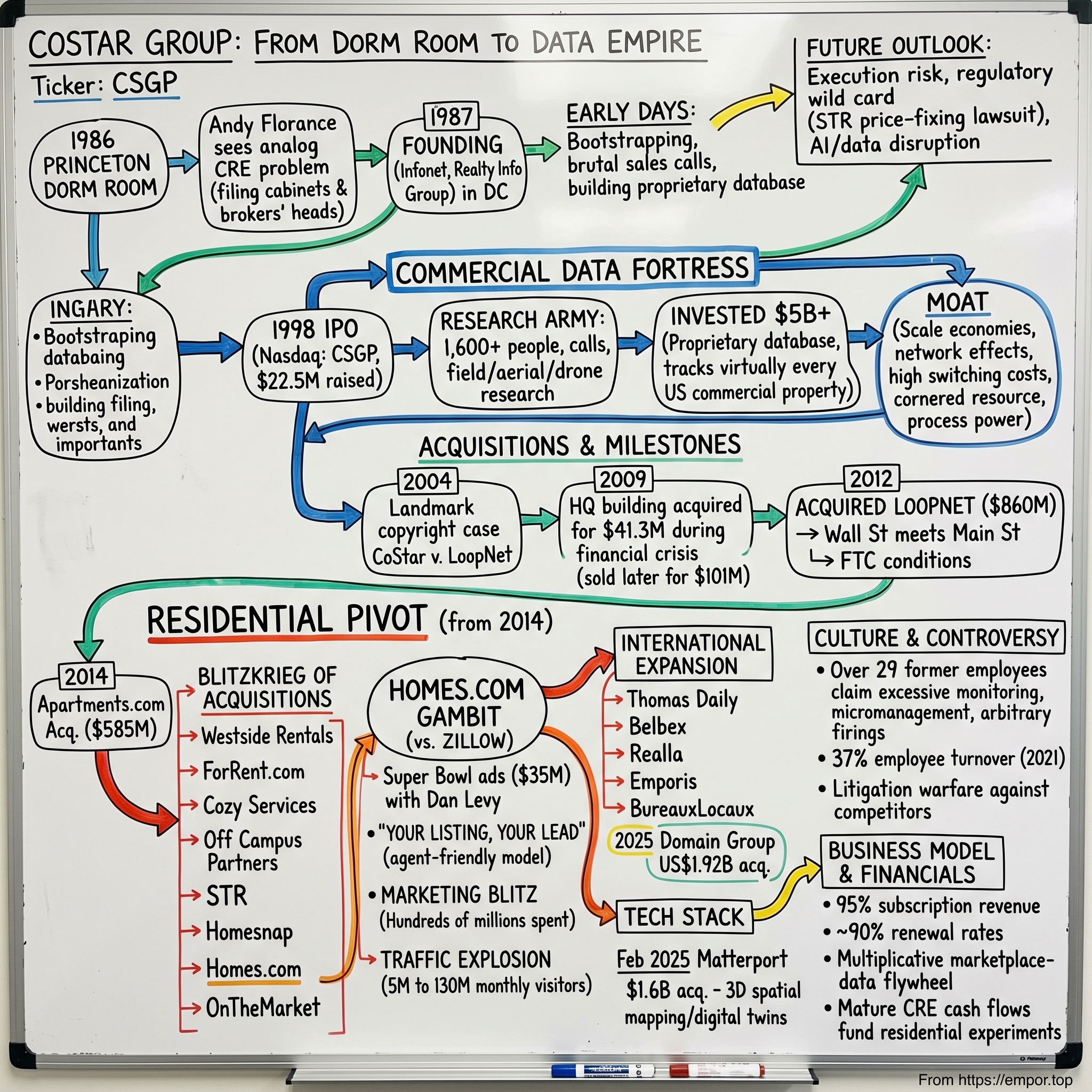
CoStar Group: From Dorm Room to Data Empire
I. Cold Open & The Big Question
On August 5, 2026, Andy Florance did something a founder-CEO rarely does in public: he bought his company's stock on the open market at a price he would have found unimaginable eighteen months earlier. He purchased 83,300 shares for roughly $2.49 million, averaging $29.89 a share, lifting his direct holding to just over 1.8 million shares.1 It was his second such purchase in three months.1
The context made it a statement. CoStar Group closed at $30.91 on September 4, 2026, giving the company a market capitalization of about $12.5 billion — a sharp drop from its 52-week high of $91.01 and well below its 200-day average near $44.2 For a business that had just reported its 61st consecutive quarter of double-digit revenue growth, this was not a rounding error. It was a repudiation.
CoStar was not alone. Zillow Group, its primary residential rival, traded at $34.59 the same day against its own 52-week high of $93.88.2 The entire American real-estate-portal sector had been repriced by roughly two-thirds in a matter of months. Investors were no longer arguing over which portal would win. They were questioning whether portals — the business of aggregating consumer traffic around a search box and monetizing those visitors with agents and landlords — would remain viable once large language models could answer queries like "find me a three-bedroom near a good elementary school in Tampa" without requiring a website visit.
That is the backdrop against which this story unfolds, contrasting sharply with the narrative in CoStar's investor presentation materials. On operating performance alone, 2026 has been strong. Second-quarter revenue reached $925 million, up 18%, while adjusted EBITDA more than doubled year-over-year to $184 million, the second-highest quarterly figure in company history.3 Management held operating cost growth to 2% while revenue grew 18%.3 Meanwhile, the residential segment turned an adjusted-EBITDA profit for the first time since Homes.com launched in early 2024.3
The result is a company delivering the exact profitability inflection it promised — juxtaposed against a stock price that behaves as if that promise were worthless.
The discrepancy stems from a single metric management preferred not to emphasize. Net new bookings — the annualized value of contracts signed in the quarter and the primary leading indicator of future revenue — came in at $69 million, down roughly 26% year-over-year.3 Goldman Sachs analyst George Tong opened the Q2 earnings call with that figure and asked, in effect, what broke.4 Management asserted that it had chosen the decline: cutting Homes.com sales staff, restructuring Ten-X, and refusing to discount at Apartments.com.4 The company cut its full-year revenue guidance while raising its EBITDA guidance.3
That trade-off — securing near-term profitability at the expense of forward growth — captures the central investment question in miniature. And it sits on top of a much older one.
The deeper question facing CoStar is whether the core advantage that built its business is transferable. For thirty-nine years, Andy Florance built one of the most defensible information businesses in America by doing something almost nobody else was willing to do: send human beings to physically inspect and photograph commercial buildings, one at a time, forever. That produced a proprietary dataset — with CoStar now claiming more than 2.4 trillion fields covering roughly 150 million properties — that no competitor has been able to replicate, and a subscription franchise that renews at over 90% year after year.5
Then, starting in 2021, he took the cash that franchise generated and spent billions of it trying to win a consumer brand war against an incumbent with a decade of habit on its side. The key question of this analysis: does the discipline that built a dominant B2B franchise translate into the consumer arena — or is CoStar's residential campaign a category error, funded by a cash cow that its own management has now conceded will not carry the losses past 2030?6
To answer that, start where Florance started: with a college student who noticed that nobody knew what any building in America was actually worth.
 Subscribe on LinkedIn
II. The Origin Story: Andy Florance's Princeton Epiphany (1986–1998)
Picture Washington, D.C. in the mid-1980s. A commercial real estate broker wanted to know what the tenth floor of a building three blocks away last leased for. There was no database. There was no internet. There was a Rolodex, a set of index cards, and a lunch with a competitor who had every incentive to lie. The market for the single largest asset class in the country — American commercial property — ran on gossip.
Andrew C. Florance grew up inside that world without being of it. Born in 1963, he was the son of Coke Florance, a well-known Washington architect.7 Buildings were dinner-table conversation. He went to Princeton, earned a B.A. in economics in 1986, and by 1987 had founded the company that became CoStar Group — starting, in the founder's own telling, out of his college dorm room with the modest ambition of digitizing real estate for a year before going off to get an MBA.7
He never went. That single year turned into thirty-nine.
The founding insight was not simply "build a database." Plenty of people wanted a database. The true insight was about who collects the data. The obvious approach — asking brokers to report their own deals — was the strategy everyone else tried, and it failed for a structural reason: in commercial real estate, transaction terms are the competitive advantage. A broker who discloses the true effective rent on a lease, net of free-rent months and tenant-improvement allowances, hands a rival the ability to underbid them. Consequently, brokers reported selectively, late, and flatteringly. The self-reported dataset was systematically flawed in ways that rendered it useless for pricing.
Florance's solution was expensive and unglamorous: if the market would not tell you the truth, you went and gathered it yourself. CoStar hired researchers to walk buildings, count floors, measure floor plates, photograph facades, phone tenants, pull public records, and cross-check every claim against every other data point. It was closer to running a census than running a software company. The cost structure was appalling by software standards — requiring a permanent staff of researchers that expanded alongside coverage. Yet the output was something no rival could copy without paying the same bill over the same number of years.
This distinction is central to understanding CoStar's evolution and its operational instincts. A company whose core asset is manually collected proprietary information will inevitably become obsessive about two things: exclusivity of access and the legal defense of that exclusivity. Both traits have surfaced repeatedly throughout its history, and both eventually generated litigation.
The commercial challenge in those early years was equally daunting. CoStar was asking brokers to pay a subscription for information those brokers believed they already owned and had spent entire careers hoarding. The sales pitch had to be reframed: CoStar would not disintermediate brokers; it would make them look omniscient in front of clients. The company name gestured at exactly this — a supporting player designed to make the star look better. Distribution evolved from mailed diskettes to CD-ROMs, dial-up software, and eventually the web, with each transition requiring a complete rebuild of the delivery layer while the underlying research operation ground forward.
CoStar went public on July 1, 1998, listing on the Nasdaq under ticker symbol CSGP and raising $22.5 million at $9 a share.8 By the standards of 1998 — a period when tech companies with no revenue raised far larger sums — it was a modest offering. But it ensured CoStar entered the dot-com era as a real business with paying subscribers, allowing it to navigate the subsequent crash while web-native competitors folded.
Testing the first-mover claim. The conventional narrative suggests CoStar's early technology lead created an insurmountable advantage. The historical record does not support that technological claim. CoStar's software throughout the 1990s was repeatedly rebuilt and leapfrogged by competitors; the company was rarely the most sophisticated software developer in real estate. What it possessed instead was a research organization no software competitor was willing to replicate, because building it meant accepting payroll-heavy, low-gross-margin economics for a decade before operational leverage materialized. Financial results show how long that process took: CoStar did not cross $200 million in annual revenue until 2008, twenty-one years after its founding.9
A second piece of evidence underscores the structural importance of that research organization. CoStar entered the dot-com bust as a subscription business with contracted revenue and emerged with an expanded market share, precisely when web-native listing services that had raised significantly more capital were liquidated or recapitalized. That pattern — competitors failing during downturns while CoStar's contracted revenue base holds — recurs so frequently in the company's history that it functions as a core structural feature. Florance referenced this dynamic on the Q2 2026 earnings call, noting that CoStar initially competed against eight to ten providers in multifamily and is now down to two.4
The accurate version of the moat argument is narrower and more durable than the marketing pitch. CoStar's advantage was never about being first to adopt new software. It was a willingness to proceed slowly — accumulating a physical-world dataset at a pace and cost that capital markets would not fund twice. That distinction remains critical today, as critics argue that generative AI will collapse the cost of data aggregation. AI can synthesize information, but it does not collapse the physical cost of walking a building.
The subsequent two decades would test whether that patient asset could be converted into enduring pricing power.
III. Building the Commercial Data Fortress (1998–2010)
By the late 2000s, CoStar's commercial data engine was operating at scale. Every new geographic market required significant upfront spending on field research, followed by subscriber acquisition, which in turn generated the cash flow to finance expansion into the next market. Revenue nearly doubled from $112 million in 2004 to $212 million in 2008.9 During this period, the software evolved from a basic lookup directory into an embedded workflow system — the central platform where leasing brokers compiled property tours, appraisers pulled comparable sales, and lenders verified underwriting assumptions. Once a database becomes the standard reference cited in credit committee packages, cancelling a subscription ceases to be a simple budget cut and becomes an operational disruption.
Two episodes from this era illustrate the company's operating strategy and approach to legal risk.
The lawsuit CoStar lost. In 2004, the U.S. Court of Appeals for the Fourth Circuit decided CoStar Group, Inc. v. LoopNet, Inc. CoStar had sued LoopNet — then an upstart web listing service — for direct copyright infringement after LoopNet users uploaded CoStar's copyrighted building photographs onto its platform. The court ruled against CoStar on the direct-infringement claim, holding that a passive online host is not a direct infringer merely because third parties upload copyrighted content, even if employees perform basic screening.10 The ruling became a landmark precedent in internet copyright law.
While popular narrative often framed CoStar as having established legal protections for commercial property data, the court outcome was actually a defeat on direct liability. What CoStar gained instead was strategic clarity: proprietary building photography was both its most copyable asset and its most legally defensible one. Aggressive enforcement became a permanent fixture of corporate strategy. Twenty-one years later, in July 2025, CoStar sued Zillow over roughly 47,000 watermarked photographs, expanding that figure to about 53,000 in a March 2026 court filing.1112 The legal strategy developed in the mid-2000s remains active today.
The trade that proved they read their own data. In October 2009, near the bottom of the commercial real estate crash, CoStar purchased 1331 L Street NW in Washington, D.C., from the Mortgage Bankers Association for $41.3 million.13 The association had paid $79 million for the newly built headquarters in 2007, financed heavily with debt, before being forced out.13 Roughly sixteen months later, in February 2011, CoStar sold the building to an affiliate of Munich-based GLL Real Estate Partners for $101 million in a sale-leaseback, retaining occupancy while booking a gain of about 145%.14
The transaction provided a striking anecdote — a data vendor successfully trading on its own market insights — and Florance continues to cite it. On the Q2 2026 earnings call, describing CoStar's newly opened Richmond campus, he explicitly noted that the company hoped "to replicate the playbook from our former D.C. headquarters where we achieved 145% value gain."4 While management points to the trade as evidence of balance-sheet optionality, skeptical analysts note that a single real estate transaction offers limited strategic read-through for an enterprise with a $12.5 billion market capitalization.
Testing the recession-proof claim. A central thesis among long-time bulls is that subscription revenue embedded in daily workflow is immune to economic downturns. CoStar's historical income statement offers a more measured reality. Revenue fell from $212.4 million in 2008 to $209.7 million in 2009 — a 1.3% dip that marks the only annual revenue contraction in the company's modern history.9 Growth resumed in 2010 at $226.3 million, but the 7.9% expansion rate reflected a clear deceleration from the mid-to-high teens compounding rate of prior years.9 As brokerage firms cut staff during the downturn, CoStar experienced headwinds from lost user seats.
The historical evidence shows that CoStar's subscription model is resilient rather than immune. The revenue base held up remarkably well during the worst commercial property crisis since the early 1990s, declining by just over 1% while competitors struggled. However, expecting total insulation misjudged the business model in subsequent cycles, including the 2020–2024 office downturn when CoStar-segment growth slowed. Management detailed the underlying driver on the Q4 2025 earnings call: Florance noted that brokers account for only 30% to 33% of CoStar's revenue, with the majority coming from banks, property owners, institutional investors, CMBS sponsors, and government agencies, many of whom subscribe under enterprise arrangements rather than individual seat licenses.5 That multi-decade shift away from relying solely on brokerage clients explains why the business model navigated real estate downturns far more effectively than the brokerage industry itself.
What CoStar did next was buy the company that had beaten it in court.
IV. The LoopNet Landmark: Commercial Marketplace Supremacy (2011–2013)
For most of the 2000s, CoStar and LoopNet were two answers to the same question that barely overlapped. CoStar was the walled garden: expensive, verified, exhaustive, and sold to professionals who needed precise data. LoopNet was the open web: free to browse, cheap to list, massive in traffic, and—from CoStar's perspective—full of unverified listings and uncredited photographs.
The strategic logic of combining them was exceptionally clean. LoopNet held the audience; CoStar possessed the data and the sales engine. A property owner listing for free on LoopNet offered a natural prospect for a paid upgrade. Meanwhile, a CoStar subscriber seeking to market a building, rather than just research one, lacked an internal distribution channel.
In 2012, CoStar acquired LoopNet in a cash-and-stock transaction with a total equity value of approximately $860 million.15 Relative to CoStar's 2012 revenue of $349.9 million, it was a massive transaction—more than double the company's annual sales.9
The regulator's first real objection. The Federal Trade Commission did not clear the deal automatically. The agency required CoStar to divest LoopNet's ownership interest in Xceligent, a smaller commercial real estate data competitor, selling it to DMG Information, a subsidiary of Daily Mail & General Trust, for approximately $4.0 million including debt repayment.15 More unusually, the FTC imposed conduct remedies: CoStar had to lift non-compete provisions and permit customers on longer-term contracts to terminate early, specifically so rivals like Xceligent could recruit them.15 Regulators, in effect, attempted to construct a viable competitor.
The remedy failed, and the manner of its failure provided a clear window into CoStar's competitive position.
What happened to Xceligent. Under DMGT ownership, Xceligent expanded aggressively by undercutting CoStar on price. CoStar sued in Missouri federal court in December 2016, alleging systematic theft of copyrighted content, aided by an Xceligent contractor who stated under oath that they had been directed to copy CoStar's material.16 On December 14, 2017—one year and two days after the filing—Xceligent filed for Chapter 7 liquidation and shut down operations.16 CoStar was awarded a $500 million judgment in 2019, of which insurers ultimately paid $10.7 million.16
The post-collapse pricing shift illustrated the market dynamics. After Xceligent's liquidation removed the sole national alternative, CoStar's average monthly price for new customers jumped roughly 80%, rising from about $255 per broker to about $466.16
That single metric demonstrates the pricing power at play. It provides direct evidence that CoStar's pricing had previously been constrained by a competitor, that the constraint was active, and that its removal unlocked substantial pricing expansion. The episode underscored the strength of CoStar's moat while giving antitrust plaintiffs material for subsequent legal challenges—including three separate federal class actions filed against CoStar in 2026.
Testing the "controlled competition" thesis. The FTC's 2012 intervention was premised on the belief that a divested Xceligent, unburdened by non-competes and equipped with portable customer contracts, could discipline CoStar's market power. Within five years, that competitor was liquidated, and CoStar's realized pricing rose by four-fifths. The historical record refutes the regulatory premise: behavioral remedies failed to establish durable competition in commercial property data. For investors, that outcome offers strong evidence of the underlying moat, even as it explains why regulators and litigation plaintiffs view CoStar through an antitrust lens.
The operational integration of LoopNet proved successful. Cross-selling paid listing upgrades to CoStar's existing subscriber base added a higher-margin revenue layer on top of the core research franchise. LoopNet continued to grow, generating $312 million in revenue in 2025 and $87 million in the second quarter of 2026—up 14% year-over-year—with 220,000 paid U.S. listings.53 Over a decade later, it stands as one of the company's most effective acquisitions.
The success of the acquisition rested on specific operational alignment. CoStar did not pay $860 million for LoopNet's standalone earnings; it acquired an audience to monetize through an established sales force, selling a familiar product to an existing client base on contract. When CoStar subsequently attempted similar expansions without those pre-existing elements—purchasing traffic in categories where it lacked established broker relationships or monetization tools—the process proved slower and considerably more capital-intensive.
That experience demonstrated the structural value of controlling the consumer search gateway alongside the underlying database, setting the stage for CoStar's subsequent move into residential apartments.
V. The Multifamily Bridge: Apartments.com & M&A Playbook (2014–2020)
In March 2014, CoStar agreed to pay $585 million in cash to acquire Apartments.com from Classified Ventures, closing the transaction on April 1.17 At the time, CoStar’s entire annual revenue was $575.9 million.9 Once again, Florance was committing more than a full year of corporate sales to a single acquisition.
The strategic rationale was stronger than the transaction price suggested. Multifamily advertising possesses a structural advantage over commercial property listings: it represents a permanent operating expense rather than an episodic transaction cost. A 300-unit apartment building experiences monthly tenant turnover, requiring property managers to maintain an ongoing marketing budget to sustain occupancy regardless of broader economic conditions. That dynamic generates recurring monthly revenue with high retention rates, as Apartments.com maintained a monthly renewal rate of 99%.3
CoStar followed with a systematic campaign for category dominance. The company rebuilt the core product, launched nationwide marketing campaigns featuring celebrity endorsements, and acquired direct competitors, including ForRent.com in 2017 for $385 million ($350 million in cash and $35 million in stock).18 It also completed smaller acquisitions across rental management software and student housing. Simultaneously, CoStar expanded its direct sales force. By the end of 2025, Apartments.com employed 522 sales representatives who conducted 750,000 client meetings per year, including more than 350,000 in person.5
The financial blueprint of that campaign serves as a critical historical reference. In 2015, at the peak of the marketing expansion for Apartments.com, CoStar recorded a net loss of $3.5 million on revenue of $711.8 million.9 A profitable, high-margin data provider intentionally operated at a temporary loss to capture a consumer category, ultimately growing that segment to $1.25 billion in annual revenue by 2025.5
Management frequently cites this precedent to defend its investments in Homes.com. While the parallel is relevant, key structural differences exist. Apartments.com was acquired with an established lead in web traffic and sold to professional property managers with dedicated marketing budgets. By contrast, Homes.com was purchased primarily as a domain name and monetized through individual real estate agents whose income fluctuates with overall housing transaction volume.
Testing the M&A-execution thesis. CoStar’s dealmaking strategy is often portrayed as consistently successful, but two notable transactions present a more complex record.
The first was RentPath. In February 2020, CoStar agreed to acquire the bankrupt operator of Rent.com and ApartmentGuide for $588 million. The Federal Trade Commission sued to block the deal, arguing that RentPath provided direct competition and that the merger would eliminate price competition in multifamily listing services.[^19] The parties abandoned the transaction on December 31, 2020, and subsequently litigated in bankruptcy court over a $58 million breakup fee.[^19]19 Rather than a minor setback, the regulatory challenge established that CoStar’s market share in multifamily listing services had reached a threshold where further consolidation would encounter antitrust opposition.
The second was Homesnap, acquired in November 2020 for $250 million in cash to secure an application used by hundreds of thousands of residential agents.20 By 2022, CoStar integrated Homesnap’s operations into Homes.com and retired the standalone strategy.21 Regardless of whether the transaction is characterized as an asset integration or a strategic pivot, the original standalone thesis was retired within two years.
Conversely, the acquisition of STR for $450 million in cash, announced in October 2019, demonstrated effective execution.22 STR expanded CoStar into global hotel benchmarking using a model aligned with its core business: property operators voluntarily contribute confidential performance data in exchange for aggregated benchmarks, creating a self-reinforcing network effect. More than 94,000 hotels now provide performance metrics to CoStar.5 By the fourth quarter of 2025, STR generated its highest net new revenue to date and completed the migration of 98,000 users onto the main CoStar platform.5
CoStar's acquisition history reveals clear operational distinctions: the company has reliably integrated proprietary data assets into its core platform and successfully scaled marketplaces where it held an existing audience lead. However, when attempting to acquire its way into categories as a challenger, its expansion has been repeatedly constrained by regulatory enforcement or strategic resets. That operational distinction faced its largest test in the residential market.
VI. The Residential Gambit: Homes.com & Taking on Zillow (2021–2026)
In April 2021, CoStar agreed to buy Homes.com from Dominion Enterprises for $156 million in cash, closing the following month.23 Relative to what came after, it was a rounding error. What CoStar bought was a URL, some legacy traffic, and permission to try.
By D.E. Shaw's estimate, presented during the activist campaign, CoStar will have spent more than $3 billion on Homes.com by the end of 2026, against roughly $80 million of annual revenue at the time of the analysis and more than $2 billion of cumulative losses.24 Management has not disputed the order of magnitude. Its own 2026 outlook disclosed that net investment in Homes.com ran at $850 million in 2025 alone.6
That is the scale of the bet. Now the logic.
Counter-positioning, explained simply. Zillow's economic model is to aggregate consumers searching for homes, then sell the resulting buyer inquiries to agents. The seller's listing agent supplies the inventory that attracts the consumer; Zillow monetizes by routing that consumer to a different agent who has paid for the lead. Listing agents have resented this arrangement for fifteen years and have paid anyway, because Zillow has the audience.
CoStar's pitch — "your listing, your lead" — is to route the inquiry to the actual listing agent, and to sell that agent enhanced marketing of their own listings rather than selling their prospects to rivals. Florance has argued repeatedly that this is not a clever contrarian idea but the global standard: on the Q4 2025 call he listed REA Group, idealista, Rightmove, Scout24, Hemnet and Domain as portals built on marketing listings rather than brokering leads, and asserted that normalized to U.S. GDP those models would generate $4 billion to $21 billion of revenue domestically.5
The counter-positioning is real in the strict Helmer sense: Zillow cannot copy it without cannibalizing the profit pool that funds it. Whether it is sufficient is the question.
What the numbers actually say. By the second quarter of 2026, Homes.com generated $28.5 million of revenue, up 66%, reaching a $116 million annualized run rate.3 Agent subscribers reached over 36,000, more than double a year earlier.3 Trailing twelve-month ARPU was about $265, with June's average subscriber price at $305.3 Subscribers promoted roughly 305,000 active listings, about 9.3% of the 3.2 million U.S. homes for sale.3 Monthly cancellations fell to 2.4% in June 2026 from 6.5% a year earlier — the single most encouraging metric in the whole residential program, because it suggests the agents who buy are getting something they value.3
Set that against the spend and the picture is stark: roughly $116 million of run-rate revenue against an $850 million net investment in the prior year.63 Management's own guidance, published in January 2026, is that Homes.com reaches run-rate profitability in 2029 and full-year positive adjusted EBITDA in 2030, with net investment declining by $300 million in 2026 and $100-plus million a year thereafter.6
That guidance is the most important disconfirming evidence in the bull case, and it comes from the company itself. Management is not claiming Homes.com inflects soon. It is claiming a nine-year path from launch to segment profitability, disclosed after an activist campaign forced the disclosure.
The 2026 reset. Something changed this year, and management's framing of it has been notably candid in some places and evasive in others. The inside sales force built to sell Homes.com was cut from 660 reps at the end of Q4 2025 to about 400, with a new field team of 50 reps concentrated in Washington D.C., Tampa, Atlanta, Dallas and Chicago.3 Florance explained the reversal on the Q2 call: field reps produce roughly twice what inside reps do, but "you don't have that choice when you're starting out a major new sales force," so the company built inside for speed and is now converting.4 Production per rep rose 19%, and net new bookings from Homes.com held flat with Q1 on a 21% smaller average headcount.34
That is a defensible operational answer. But note what it concedes. CoStar hired hundreds of new-graduate salespeople in Richmond because it could hire them fast, discovered a material share were not productive, and reversed course inside eighteen months. Florance said plainly that in Richmond "you're often hiring people right out of college," while in the field "you can actually get the real estate background."4 The plan was not wrong in direction; it was wrong in sequencing, and shareholders paid for the learning.
Marketing has shifted too — away from expensive celebrity production toward product-feature advertising and lower-funnel search marketing, with Florance saying the company was "less than thrilled" with results from linear TV and some streaming.4 For a program whose entire premise was buying brand awareness at Super Bowl scale, that is a significant admission.
Testing the "traffic converts like Apartments.com did" thesis. The mechanism that would break this thesis is customer economics, and the relevant comparison is not traffic but payer quality. A property manager has a budgeted, recurring, non-discretionary marketing line. An individual agent has an income that swings with transaction volume and a marketing budget that is genuinely discretionary. Zillow, meanwhile, has not stood still — its rentals revenue grew 31% year-over-year in Q2 2026 to $209 million, with multifamily up 42%, materially faster than Apartments.com's 9%.25
The falsification test is not settled, and it should not be presented as settled in either direction. What can be said with confidence: the cancellation-rate collapse and the 45% demo-to-close rate Florance cited for June indicate that agents who see the product buy it and keep it.4 The 26% year-over-year decline in company-wide net new bookings indicates the constraint is now getting in front of enough agents at acceptable cost.3 The claim that survives is a narrowed one — Homes.com has product-market fit with a subset of listing agents, and has not yet demonstrated a scalable, affordable distribution channel to reach the other 700,000.
The KPI that resolves it is specific: Homes.com net new bookings, and whether the "Platinum" depth-advertising tier launched in the third quarter of 2026 lifts revenue per subscriber materially above the $305 monthly level.3 Florance has staked a great deal on that product, noting that 70% of Apartments.com customers buy depth advertising and 91% of Domain's revenue comes from it.3 If depth advertising does not take at Homes.com, the $265–305 ARPU is the ceiling, and the arithmetic to $1 billion of revenue requires an agent count the company has no demonstrated path to reaching.
VII. International Footprint, Matterport & Spatial Tech Stack (2016–2026)
If the residential gambit is CoStar's most expensive bet, its international expansion is its most methodical — and, by 2025, its most transformative.
The European strategy began quietly with small data acquisitions: Thomas Daily in Germany and Belbex in Spain in 2016, followed by Realla in the United Kingdom in 2018. These were not immediate growth drivers, but strategic beachheads: local datasets onto which CoStar could graft its research methodology and platform. The payoff took years but eventually materialized. CoStar U.K. reached profitability with a 92% renewal rate, and in December 2025, its primary U.K. commercial competitor, EG Radius — descended from Estates Gazette, the market leader when CoStar entered Britain twenty-one years earlier — shut down.5 CoStar onboarded 166 of EG Radius's former clients, with 75% signing three-year contracts.5 It was the Xceligent competitive outcome replayed in another market, this time without courtroom litigation.
The U.K. residential attack. In December 2023, CoStar acquired OnTheMarket plc for 110 pence per share, valuing the business at approximately £99 million, with over 97% shareholder approval by value.26 The objective was to adapt the Homes.com portal playbook to a market dominated by Rightmove. Operational progress followed: by the second quarter of 2026, OnTheMarket's property inventory had grown 12%, surpassing Zoopla to become the U.K.'s second-largest portal by inventory after 26 consecutive months of positive net new bookings.3 Meanwhile, Rightmove shares traded at 491 pence on September 4, 2026 — well below their 52-week high of 747 pence — reflecting the same portal valuation compression seen in the U.S.2
Australia, and the deal the outline missed. CoStar's largest international move took place in Australia. In February 2025, CoStar purchased roughly 17% of Domain Holdings Australia at A$4.20 per share for about A$452 million. In May 2025, it entered a binding agreement to buy the remaining equity at A$4.43 per share, valuing the enterprise at approximately A$3.0 billion.27 Domain operates as Australia's second-largest residential portal behind REA Group.
Integration proceeded rapidly. Domain's average monthly audience expanded from 6.6 million in July 2025 — the month before the acquisition — to a record 9 million in October, reaching 41 million average monthly visits by the second quarter of 2026, up 35%.53 Domain's residential marketplace generated approximately 28% operating margins in 2025.5 Management announced plans to migrate Domain onto the Homes.com technology platform within 12 to 18 months while divesting non-core Australian software assets by the end of 2026.53
Financially, these acquisitions mean a substantial portion of CoStar's headline revenue expansion is inorganic. Management disclosed that of the company's 20% revenue growth in the first half of 2026, only about half was organic.3 In 2025, Matterport and Domain accounted for roughly 10 of the commercial segment's 18 percentage points of growth.5 Investors evaluating CoStar's streak of 61 consecutive quarters of double-digit revenue growth must weigh that headline metric against the impact of inorganic contributions.
Matterport. In April 2024, CoStar agreed to acquire Matterport, a developer of 3D spatial technology, for $5.50 per share — structured as $2.75 in cash plus 0.03552 CoStar shares — representing an enterprise value of roughly $1.6 billion.28 The transaction closed on February 28, 2025, and Matterport delisted from Nasdaq.29
Matterport's core technology uses specialized camera sweeps to capture property interiors and stitch them into interactive, navigable 3D models. Users can virtually walk through a building, measure dimensions, or inspect floor plans. CoStar's thesis was that this technology would create an exclusive visual and spatial media layer across its property listings, while building a structured dataset resistant to scraping by large language models. Management noted that the platform has accumulated nearly 700,000 Matterport captures alongside billions of proprietary images.5
Testing the "immediate synergies" claim. Matterport was unprofitable as an independent public company, leading CoStar to focus initially on cost reductions rather than product integration. In 2025, the company eliminated approximately $120 million in annualized cash and equity expenses, primarily by removing redundant corporate overhead and executive functions.5 Subsequent operating results improved relative to Matterport's standalone trajectory, with subscription revenue expanding 16% year-over-year in the second quarter of 2026, compared to high-single-digit growth prior to the acquisition.3 In July 2026, CoStar introduced a restructured pricing model that reduced the upfront cost of the Matterport 3 camera to accelerate software subscription adoption, with a next-generation Matterport 4 camera scheduled for release in late 2027.3
These results narrow management's synergy narrative. Initial gains stemmed primarily from rapid cost reduction rather than top-line expansion. Revenue synergies have emerged incrementally: Matterport-backed premium listing tiers drove record upgrades at Domain following their July 1, 2026 launch, while 3D tour engagement on Apartments.com increased following AI integration.3 Whether spatial media establishes an uncopyable data advantage remains an open question. Demonstrating that advantage will require sustained double-digit growth in Matterport subscriptions after the hardware price reductions take effect, proving that the low-margin camera strategy successfully drives higher-margin software revenue.
Which brings the story to the people making these strategic decisions — and to the shareholders who spent 2025 and 2026 attempting to change them.
VIII. Current Management, Capital Allocation & Culture Audit
On the Q2 2026 earnings call, Andy Florance recounted having dinner with CoStar's three former CFOs and cheerfully listed the stock appreciation each had presided over — 489%, 270%, 300% — before challenging the incoming CFO to beat them.4 It was vintage Florance: competitive, numerate, theatrical, and seemingly unbothered that the stock had fallen by roughly two-thirds on his watch.
Thirty-nine years into running the company he founded, Florance remains the most consequential variable in the investment case. His management style is unusually hands-on for an enterprise of 8,000 employees; on the second-quarter call, he mentioned personally reviewing every résumé submitted for the new field sales team.4 Litigious by instinct and obsessive about data verification, he routinely delivers long, discursive prepared remarks that read more like a founder's letter than a canned corporate script.
The compensation problem. The compensation trajectory contrasts sharply with underlying performance. Florance's total reported compensation climbed from $19.4 million in 2022 to $29.2 million in 2023, reaching $37.4 million in 2024 and $36.4 million in 2025, built on a base salary of roughly $1 million.[^31] Over that same period, GAAP net income dropped precipitously from $369.5 million in 2022 and $374.7 million in 2023 down to $138.7 million in 2024 and just $7 million in 2025 — culminating in a GAAP operating loss of $72 million for 2025.9 Meanwhile, CoStar's stock price tumbled from the high $70s to the low $30s.
His direct holding of just over 1.8 million shares represents substantial wealth in absolute dollars but accounts for well under 1% of total shares outstanding.1 Consequently, the founder alignment narrative is weaker than it appears: Florance receives far more compensation through annual equity grants than through long-held ownership, creating an incentive structure that makes multi-year, loss-making bets easier for management to sustain.
The activists. Two of Wall Street's most prominent activist firms reached that same conclusion and intervened. In April 2025, CoStar announced a board restructuring under support agreements with D.E. Shaw and Third Point. Former Disney CFO Christine McCarthy, former S&P Global President John Berisford, and former Etsy CFO Rachel Glaser joined the board, while Michael Klein, Christopher Nassetta, and Laura Kaplan retired. Louise Sams stepped in as independent Board Chair, and most crucially, the company formed a Capital Allocation Committee to review capital structure, strategic priorities, and financial targets, "including its ongoing investment in Homes.com and to ensure an appropriate timeline for profitability."30
That committee's creation explains why CoStar's 2026 financial guidance includes a specific glide path toward Homes.com profitability — a clear case of board governance forcing disclosures management had long withheld.
The settlement proved temporary. On January 31, 2026, CNBC reported that Third Point founder Dan Loeb had written to the board demanding further changes.24 Loeb criticized management in sharp terms, arguing that despite the April agreement, Florance was persisting in "what can only be seen as a reckless drain on a majority of the company's operating income into Homes.com and related acquisitions even as the share price has continued to" fall.24 Shortly thereafter, on April 10, 2026, Reuters reported that Third Point had closed its position and dropped plans for a proxy contest.31
An activist exiting without launching a proxy fight after calling a CEO reckless should not be mistaken for a management endorsement. It signals that the fund deemed a full proxy contest unviable or unlikely to justify the required capital. Yet the intervention yielded lasting structural changes: a board featuring three independent corporate finance veterans, an independent chair, a dedicated capital allocation committee, an explicit timetable for residential profitability, and a $1.5 billion share repurchase authorization.630
Capital allocation, weighed honestly. CoStar executed a $500 million share buyback in 2025, repurchasing 7.1 million shares, before authorizing an additional $1.5 billion.56 Through the second quarter of 2026, the company bought back 13.75 million shares for $587 million. That brought total repurchases since early 2025 to nearly 21 million shares worth approximately $1.1 billion, with management targeting $700 million in total buybacks for 2026.3 Retiring shares around $30 when they traded above $90 twelve months earlier represents far better capital discipline than buying near market highs.
Yet that share repurchase program was instituted largely under activist pressure, taking shape after CoStar had already deployed billions into Homes.com. Meanwhile, large-scale acquisitions have continued: the company acquired Domain Holdings Australia for approximately 3.0 billion Australian dollars in 2025 and agreed to buy housing market data provider Zonda for $800 million in cash in 2026.2732 CoStar did not react to market pressure by scaling back its strategic expansion; instead, it layered a share repurchase program on top of its growth investments, drawing down cash reserves to fund both.
Culture. In February 2022, Business Insider published an investigation into CoStar's workplace practices, reporting strict employee monitoring and a high-pressure management culture.[^35] CoStar defended its corporate environment as a high-performance culture. For investors, the issue is structural rather than ethical: an organization relying on thousands of research employees to manually collect and verify data faces operational risks from high turnover that pure software vendors do not. Operational strain typically manifests first in data integrity before appearing in revenue metrics. Current operational metrics — including a 93% CoStar renewal rate and a record Net Promoter Score of 68 in the second quarter of 2026 — indicate that core data quality remains solid.3 Consequently, human capital risk remains an ongoing operational exposure rather than an active operational failure.
The legal overhang, which is now material. By mid-2026, CoStar was named as a defendant in at least three federal antitrust class actions challenging its commercial real estate data practices. A complaint filed in the Eastern District of Virginia in April 2026 alleges that CoStar unlawfully restricted client relationships with competing providers and maintained a monopoly under Sections 1 and 2 of the Sherman Act.33 A second lawsuit, filed on June 12, 2026, in the Northern District of Illinois, names CoStar alongside major brokerages — including CBRE, JLL, Cushman & Wakefield, Colliers, and Newmark — alleging a "hub-and-spoke" conspiracy where CoStar aggregated and shared non-public lease terms, such as effective rents, concessions, and tenant-improvement allowances.34 A third antitrust lawsuit is pending in Washington, D.C.33
Separately, a class-action lawsuit filed on February 20, 2024, alleging that STR's hotel benchmarking platform facilitated price-fixing among luxury hotel operators, was dismissed on August 29, 2025. Federal Judge Robert Lasnik of the Western District of Washington ruled that plaintiffs failed to plausibly plead an illegal agreement.35 While that dismissal offers a favorable precedent for data benchmarking models, the commercial real estate lawsuits advance distinct legal theories — and the 80% price increase CoStar instituted following Xceligent's liquidation provides private plaintiffs and regulators with potent evidence of market power.
IX. Segment Economics & Financial Architecture
Strip away the narrative, and CoStar in 2026 operates as two distinct businesses stapled together, reported since early 2026 under two reporting segments: Commercial and Residential.
The Commercial engine. In the second quarter of 2026, the commercial segment generated $481 million in revenue, up 8% year-over-year, delivering $172 million in adjusted EBITDA for a 36% margin.3 Within that segment, the flagship CoStar data platform generated $337 million, rising 9%, as subscriber accounts grew 19% year-over-year to 327,000, maintaining a 93% renewal rate while net new bookings to brokers surged 48%, bolstered by a multiyear renewal with its largest brokerage client.3 LoopNet contributed $87 million.3 Other commercial revenue—primarily Ten-X, BizBuySell, and Matterport hardware—fell 5% to $57 million, dragged down by softer transaction activity at Ten-X.3
That 19% expansion in paying seats, achieved while the commercial real estate market was only beginning to emerge from a historic office downturn, provides strong evidence that CoStar's core data franchise remains intact. Growth is driven less by traditional brokerages and more by expansion into institutional owners, lenders, and capital market participants.
The clearest manifestation of that shift is CoStar Debt Solutions, which reached a $100 million annual run-rate by the end of 20255 and generated over $4 million in net new monthly bookings in the second quarter of 2026, up 96%.3 The product replicates a playbook CoStar executed successfully at STR: collecting confidential data from 300 lending clients—covering more than 100,000 active loans totaling over $1.2 trillion in outstanding debt—anonymizing and aggregating the information, and selling the resulting benchmark analytics back to participants.3 Every additional lender strengthens the network effect for existing subscribers. Florance has framed this as a potential billion-dollar-plus opportunity as the platform expands into loan origination workflow in 2027.5 While that projection reflects management optimism rather than a guaranteed outcome, the underlying data-aggregation mechanism rests on proven precedent.
The Residential engine. The residential segment generated $444 million in revenue during the second quarter of 2026, up 33%, and reported a record $12 million in adjusted EBITDA—marking the segment's first profitable quarter since the launch of Homes.com.3 That milestone requires critical context: the segment combines Apartments.com, Homes.com, OnTheMarket, Land.com, and Domain's residential operations. Apartments.com alone accounted for $318 million of that revenue as a mature, highly profitable business, while Domain's residential marketplace operated at roughly 28% margins.35 Segment-level profitability is therefore not evidence that Homes.com has achieved break-even. Indeed, management's own guidance projects that Homes.com will not reach positive adjusted EBITDA until 2030.6
Where the pressure is. Revenue at Apartments.com grew 9% in the second quarter of 2026, driven by a 12% increase in paid property listings to nearly 93,000, even as average revenue per property fell roughly 3.6%.3 Management attributed the lower unit revenue to property mix—faster adoption among smaller communities with lower subscription rates—and a refusal to match aggressive competitor discounting.3 When KBW analyst Ryan Tomasello questioned whether the drop reflected subscription downgrades rather than customer mix, Florance acknowledged that the trend reflected "a combination of both the macro environment"—where elevated vacancy made property owners price-sensitive—"and then there is enhanced competition with a competitor trying to buy share with pricing, with really low pricing."4
That admission highlights competitive pressures that contrast with CoStar's operational metrics. The company cites PERQ data showing that Apartments.com leads convert to signed leases at 2.5 times the rate of its closest rival, supported by 66% unaided brand awareness that leads the industry by 25 percentage points.3 Yet Zillow's rentals revenue surged 31% over the same period, with its multifamily segment expanding 42%.25 Both findings can coexist: CoStar can offer a higher-converting platform while simultaneously losing incremental market spend to a lower-cost competitor in a soft market where nearly 40% of apartment communities offer tenant concessions.3
The consolidated picture. For full-year 2025, consolidated revenue reached $3.247 billion, up 19%, while adjusted EBITDA rose 83% to $442 million alongside record net new bookings of $308 million.95 GAAP net income totaled just $7 million against an operating loss of $72 million, with non-operating interest income on cash holdings bridging the gap.9 Selling and marketing expenses reached $1.56 billion in 2025, up from $1.36 billion in 2024 and $990 million in 20239—meaning sales and marketing absorbed nearly half of total revenue.
A note on the share count, which is easy to miss. CoStar has financed its expansion primarily through cash flow and balance-sheet reserves rather than debt, but existing shareholders have borne dilution. Weighted average diluted shares grew from approximately 394 million in 2021 to roughly 421 million in 2025, with equity issued for the Matterport acquisition serving as the largest contributor.9 Consequently, the share repurchase program initiated in 2025 functions partly as an anti-dilutive offset rather than net capital return. Repurchasing shares near $30 that were issued in transactions priced closer to $80 represents accretion, but the nearly 21 million shares repurchased since early 2025 do not represent an equivalent net contraction in total share count.3 Management's 2026 guidance models approximately 403 million weighted average shares for the third quarter, illustrating where acquisition dilution and buybacks intersect.3
For full-year 2026, management initially projected revenue of $3.78 billion to $3.82 billion, net income of $175 million to $215 million, and adjusted EBITDA of $740 million to $800 million, alongside medium-term targets of approximately 15% annual revenue growth through 2028 and $1.25 billion in 2028 adjusted EBITDA.6 In July 2026, management lowered its full-year revenue target to between $3.715 billion and $3.755 billion, while raising its adjusted EBITDA guidance to $780 million–$820 million and adjusted EPS to $1.32–$1.39.3
That guidance adjustment provides a clear signal regarding current operating dynamics: a business that reduces revenue targets while lifting profit forecasts demonstrates greater control over operating expenses than top-line customer demand. Florance noted that CoStar reduced its projected 2026 operating expenses by roughly $100 million.4 Whether that adjustment represents structural cost discipline or demand-driven retrenchment depends on subsequent net bookings performance. When William Blair analyst Stephen Sheldon asked on the Q2 earnings call what the revised trajectory implied for 2027 growth, CFO Chris Lown declined to comment, citing corporate policy against forecasting net bookings or multi-year targets.4 While standard guidance policy, the response leaves unanswered the key question surrounding long-term growth velocity.
X. Strategic Framework: Hamilton Helmer's 7 Powers & Porter's 5 Forces
Evaluating CoStar through Hamilton Helmer's 7 Powers framework reveals a stark structural division: the commercial enterprise possesses nearly every power, while the residential segment possesses almost none.
Scale economies form the foundation. The cost of researching a building remains fixed regardless of how many users access the information. Distributed across 327,000 CoStar subscribers, the marginal cost of serving an additional seat approaches zero.3 A prospective competitor would need to fund a national research organization for a decade before generating meaningful revenue, competing against an incumbent whose capital expenditure is already amortized. The market demonstrated that this barrier is binding when EG Radius, backed by the corporate descendant of Britain's leading commercial real estate publisher, ceased operations in December 2025 rather than continue absorbing losses.5
Cornered resource represents a second, even stronger power, sharpened by the debate over artificial intelligence. Florance argued on the fourth-quarter 2025 earnings call that only about 25% of CoStar's data is displayed on public marketing portals, leaving the remaining 75% behind authentication walls inaccessible to large language model web crawlers.5 Beyond protected web pages sits a repository of private information that exists nowhere on the public internet, provided directly by clients under confidentiality agreements: performance metrics from over 94,000 hotel properties, loan data from more than 500 financial institutions, millions of lease documents from over 2,000 corporations—including half the Fortune 500—and direct digital feeds from roughly 85,000 apartment managers and 300 homebuilders.5 That proprietary dataset provides the strongest defense against AI-driven disintermediation; a model cannot train on or synthesize documents to which it has never been granted access.
Switching costs are substantial and operational rather than emotional. Once CoStar property comparisons and lease data are integrated into appraisals, underwriting models, and credit committee packages, the database serves as the mandatory audit trail. High retention figures—including a 93% renewal rate across all CoStar subscribers and 94% to 95% among customers of five years or more—reflect that institutional lock-in.35
Network effects operate across CoStar's marketplaces and benchmarking products, where each additional contributing lender or hotel owner enhances the value of the platform for all participants. The classic two-sided marketplace effect—where more property listings attract more renters—functions at Apartments.com and LoopNet. However, consumer portal traffic remains contestable with capital, as CoStar itself demonstrated through its heavy marketing spend at Homes.com.
Process power stems from four decades of proprietary verification standards, error-checking protocols, and specialized data-extraction tools. For example, the CoStar Rent Benchmark, introduced in June 2026, analyzed four million lease documents using artificial intelligence to report net effective rents instead of asking rents.3 Because the underlying inputs consist of confidential contracts supplied directly by property owners, competitors cannot replicate the product through web scraping.
Counter-positioning exists primarily at Homes.com through its "your listing, your lead" model, which avoids routing buyer inquiries to competing agents. However, as established by management's extended timeline to profitability, this strategic defense has not yet translated into economic self-sufficiency.
Brand power is well-established in commercial real estate, where CoStar functions as an industry default. In the residential sector, brand equity has been purchased rather than accumulated over time. The company's tactical pivot away from expensive celebrity marketing toward search engine optimization and targeted digital ads underscored that broad national advertising was not converting efficiently into paying subscribers.4
Porter's five forces reveal a similarly asymmetrical competitive structure. Barriers to entry in commercial data remain formidable due to high capital requirements and lengthy payoff timelines. Buyer power among commercial subscribers is historically limited—evidenced by the 80% price increase CoStar implemented following Xceligent's liquidation—though the three antitrust class actions filed in 2026 represent an effort by corporate clients to challenge that pricing power through judicial remedies rather than market substitution.1633 Conversely, buyer power in the residential segment is high, as real estate agents can easily reallocate discretionary marketing budgets among Zillow, Realtor.com, and Homes.com.
Supplier power poses a critical variable in residential real estate, where portals depend on multiple listing service feeds and industry data-sharing frameworks. Addressing that dynamic on the fourth-quarter 2025 earnings call, Florance noted that the chief executive of a major brokerage suggested agents might discontinue membership in the primary trade association within two years, arguing that any resulting disruption would favor CoStar.5 That assessment represents a strategic projection rather than a certainty; if major brokerages assume direct control over listing distribution, they could bypass external portals entirely.
While substitutes in commercial real estate remain niche and fragmented, competitive rivalry is intense and increasingly fought in federal court. On September 30 and October 1, 2025, the Federal Trade Commission and five state attorneys general sued Zillow and Redfin over a February 2025 agreement in which Zillow paid Redfin $100 million to exit the multifamily rental advertising market.36 On August 24, 2026, the FTC secured a stipulated order requiring Redfin to re-enter the rental business within six months under a ten-year compliance decree.37 Meanwhile, CoStar's separate copyright infringement lawsuit against Zillow continues to move forward.11
In summary, Hamilton Helmer's framework and Porter's five forces confirm that CoStar's commercial enterprise remains one of the most defensibly moated information franchises in public markets. By contrast, the residential business has not yet established equivalent structural defenses, relying on cash deployment to build brand recognition and network effects in a market where rivals can match capital expenditure.
XI. Risk Radar & Skeptical Investor Stress Test
The most useful way to hold CoStar's risks is to separate what would dent earnings from what would break the thesis.
Residential payback risk is the thesis risk. The mechanism is simple: if Homes.com cannot reach enough agents at an acceptable cost, the roughly $3 billion already committed becomes a permanent impairment of return on invested capital rather than an investment with a lag.24 The company's own timeline — profitability in 2030 — means investors are being asked to fund four more years of losses on faith.6 The falsifying evidence would be another year of flat-to-down Homes.com net new bookings alongside a rising subscriber-acquisition cost; the confirming evidence would be depth advertising lifting ARPU well above $305 while cancellations stay near 2.4%.3
AI disruption is the market's stated fear and is more nuanced than the share price implies. The bear version says consumers will stop visiting portals and ask a chatbot instead, collapsing the audience that portals rent to advertisers. There is genuine evidence for the mechanism: CoStar itself launched an Apartments.com ChatGPT integration in 100 markets in April 2026, expanding to 500.3 But Florance's own assessment of the traffic from it was notably unflattering — "you're still single digit right now. So it's more of a window dressing than a reality."4 That candor cuts both ways: the AI front door is not yet a meaningful traffic source, which means it is neither an opportunity nor a threat yet.
On the cost side, the AI story has been unambiguously positive so far. CFO Chris Lown stated the company is running below budget on token consumption costs in 2026, and Florance said cost savings from AI currently exceed token costs — with lease abstraction and rent benchmarking cited as products that eliminated substantial manual labor.4 Homes AI, launched in February 2026, drove a 119% increase in organic traffic in the first quarter versus the prior year, with AI-mode users spending over 17 minutes on site.3 The engagement lift is real; the revenue lift is not yet demonstrated.
The genuinely unresolved question is whether an AI-mediated search world compresses the value of a listing impression even if traffic holds. Nobody has data on that yet, including CoStar.
Antitrust is the risk that has grown fastest. Three federal class actions in a single year, one of them naming the five largest brokerage firms as co-conspirators, represents a step-change in legal exposure.3334 These are early-stage, and the STR benchmarking dismissal shows such theories can fail.35 But the discovery process alone in a hub-and-spoke case about non-public lease economics would put CoStar's data-sharing arrangements under a microscope, and an adverse ruling could constrain the exact practices that make the comps product valuable. This is a genuine tail risk to the core franchise, not a nuisance.
Commercial real estate macro has, notably, turned from headwind to tailwind. Florance reported on the Q4 2025 call that office absorption had turned positive for two consecutive quarters, vacancies were dropping, and commercial sales volumes had climbed 30% year-over-year to above long-term averages.5 That improvement is why CoStar-segment subscriber growth accelerated. It also means the current 8–9% commercial growth rate is being achieved with cyclical help, not against it.
Multifamily macro is the opposite. U.S. apartment vacancy rose to 8.5% at the end of 2025, with four- and five-star buildings near 12%, and roughly 40% of communities offering concessions by mid-2026.53 Deliveries are projected to fall 23% in 2026, which should help eventually.3 Until then, Apartments.com is selling advertising to customers under margin pressure and facing a competitor discounting for share.
Key-personnel risk got more concrete this year. Chris Lown departed to become CFO of Allstate after two years, with Robin Rossmann promoted from running CoStar's international businesses — where he eliminated approximately $50 million, roughly 25% of the European cost structure, while delivering double-digit revenue growth.4 Rossmann's mandate is legible from that résumé. A CFO hired for cost discipline at the moment growth is decelerating is a signal about which lever the board expects to be pulled.
The activist's question, put fairly. A skeptical investor would ask: why should CoStar not stop spending on Homes.com, harvest a commercial business earning 36% segment margins, and return the difference? The arithmetic is uncomfortable for management. Roughly $850 million of 2025 Homes.com investment against a company that generated $442 million of total adjusted EBITDA means the residential program consumed more than the entire enterprise earned.65
Management's answer, in Florance's framing, is that CRE data is a bounded market while residential property in the U.S. is worth roughly $56 trillion against $6 trillion for apartments, and that portals abroad monetize that base at levels no U.S. player has approached.5 The intellectual case is not weak. But it rests on an analogy — that the U.S. can be made to look like Australia or the U.K. — and the U.S. is the one large market where the lead-generation model, not the listing-marketing model, won. Fifteen years of Zillow's success is itself evidence that American agents will pay for leads.
The honest position is that both sides have real arguments and only time and the bookings line will settle it.
XII. Bear vs. Bull Case: The $100B Residential Bet
The bull case begins with an argument the market has arguably stopped pricing: CoStar's commercial franchise remains not only intact, but is expanding into new categories. With subscriber growth reaching 19%, a 93% renewal rate, record Debt Solutions bookings, a lease-benchmarking product constructed from four million abstracted leases, and a launch in France covering 290,000 properties and 385,000 tenants, the core business shows no signs of being disintermediated.3 At a $12.5 billion market capitalization against full-year 2026 adjusted EBITDA guidance of $780 million to $820 million, investors are paying a materially lower valuation multiple than at any point over the past decade for an enterprise whose core franchise is arguably stronger.23
The second pillar of the bull case rests on cost discipline. Former CFO Chris Lown described the first half of 2026 as establishing "a new baseline for expenses that will continue to benefit us moving forward," as the company delivered a 20% adjusted EBITDA margin a quarter ahead of schedule while keeping operating cost growth to 2%.3 If artificial intelligence efficiencies continue to offset token expenses, reaching management's 2028 target of $1.25 billion in adjusted EBITDA appears achievable even with modest revenue expansion.6
The third pillar is low-cost strategic optionality. The acquisition of Zonda, completed on August 21, 2026, for $800 million in cash, brought approximately $170 million in 2025 revenue along with proprietary data on new-home construction—covering land development, community performance, and builder operations across more than 3,000 builders and suppliers in a $400 billion annual market.3238 CoStar had previously identified new-home information as a $200 million to $300 million revenue opportunity prior to buying Zonda.5 The transaction aligns with the company's proven playbook: acquiring niche data assets and integrating them directly into its core platform.
The bear case counters that the positive narrative reflects only half the enterprise, while the residential segment consumes the profits of the rest. Consolidated adjusted EBITDA margins fell to 14% in 2025, compared to margins historically in the 30% range prior to the residential initiative.59 Generating just $7 million in GAAP net income on $3.2 billion in revenue highlights the heavy cost of that expansion, driven by $1.56 billion in sales and marketing expenses.9
The second bear pillar is structural competition. Zillow's brand represents a decade-old consumer habit that persistent advertising cannot easily break. Although CoStar built a broad audience—attracting over 100 million average monthly unique visitors across the Homes.com network in 2025—monetizing that traffic into agent subscriptions has yielded an annualized revenue run rate of just $116 million.53 From a bear perspective, CoStar has demonstrated an ability to purchase web traffic without yet proving it can build durable consumer brand loyalty.
The third bear concern centers on corporate disclosure. Management reorganized reporting segments in early 2026, allowing profitable assets like Apartments.com and Domain to mask ongoing losses at Homes.com within the residential division's "first profitable quarter." Furthermore, net new bookings are disclosed only at the aggregate level, with executives twice declining analyst requests for product-by-product breakdowns.54 When Bank of America analyst Curtis Nagle asked for the bridge to the implied residential EBITDA step-up in the second half, Lown stated he did not have it on hand and would follow up.4 While standard corporate reporting, these practices make independent performance verification challenging during a critical operational pivot.
The synthesis. The analytical evidence points to a clear conclusion. CoStar's commercial real estate moat remains durable across macro recessions, market substitution, regulatory interventions, and emerging artificial intelligence platforms. That core franchise is intact and largely discounted by the current valuation. Conversely, the residential initiative faces a narrower path than management projects: while Homes.com shows product-market fit among a subset of listing agents—supported by declining cancellation rates and high conversion on sales demonstrations—it has yet to establish cost-effective distribution at scale, and management's own financial model forecasts four additional years of losses.36 Historically, CoStar's acquisition strategy has succeeded with core data assets, produced mixed results in competitive marketplaces, and faced major setbacks—evidenced by regulatory blocking of the RentPath deal and the strategic pivot following the Homesnap purchase.[^19]21
What would change the verdict in either direction is not a narrative. It is three numbers.
XIII. Epilogue: The Next Chapter
The five-year vision Florance describes is a single global real estate operating system: one dataset, one AI layer, one commercial marketplace, and one residential marketplace running from Sydney to Paris to Richmond. The company is actively assembling these pieces — folding Domain into the Homes.com platform, scheduling OnTheMarket to follow in 2027, extending LoopNet into Australia and Germany, and launching CoStar in Australia in the second half of 2026 with 124 researchers and photographers deployed.53
While that global integration aligns with CoStar's historical playbook, it represents a multi-year effort being funded at a time when equity markets are repricing portal models over disintermediation concerns.
For long-term investors, three key performance indicators carry most of the analytical weight.
First, Homes.com net new bookings and average subscriber price. This metric condenses the residential thesis into a single forward-looking indicator. While subscriber counts and revenue run-rates reflect past expenditure, net new bookings signal forward demand, and average revenue per user indicates whether high-tier depth advertising is gaining traction. If bookings resume growth as the field sales force expands and monthly ARPU moves meaningfully above the $305 level recorded in June 2026, the bull case gains traction. Conversely, if bookings remain flat through 2027 while ARPU stalls, the campaign's top-line ceiling will become apparent, rendering management's 2030 profitability timeline improbable.
Second, consolidated adjusted EBITDA margin against the published glide path. Management has committed to annual adjusted EBITDA targets through 2030, including a $1.25 billion objective for 2028.64 That provides investors with a clear, time-bound metric for accountability. Missing these targets would represent a structural failure to execute, carrying far greater strategic weight than a routine adjustment to quarterly revenue guidance.
Third, the CoStar-segment renewal rate and subscriber count. These metrics directly measure the strength of the company's core commercial moat. As long as renewal rates remain above 90% and total subscriber counts expand, empirical customer behavior continues to contradict the market's fears of AI disintermediation. A renewal rate drop into the 80% range would provide the first tangible evidence of structural erosion within the commercial real estate data franchise.
Ultimately, the investment case hinges on a core operational contrast. Florance built one of the most defensible information businesses in commercial real estate over three decades by executing a slow, capital-intensive strategy focused on accumulating proprietary physical data. The residential campaign represents a fundamental departure from that history: a high-velocity, capital-intensive effort reliant on shifting consumer habits rather than building uncopyable data assets. Equity markets have priced the stock on the assumption that this strategy will fail — a thesis Florance challenged directly when he purchased shares at $29.89.
XIV. Recent News & Developments
Four developments since the summer of 2026 matter for anyone updating this story.
Zonda closed. CoStar completed its $800 million cash acquisition of Zonda on August 21, 2026, coming just weeks after management noted on the second-quarter earnings call that the transaction was still undergoing regulatory review.323 Because official guidance had explicitly excluded any contribution from Zonda, full-year 2026 results will now incorporate a business that generated roughly $170 million in 2025 revenue and is projected to be accretive to adjusted earnings per share in its first full year of ownership.338 The transaction also drew criticism from the American Economic Liberties Project, which cited it as evidence of further concentration in housing data — highlighting how CoStar's expansion now routinely attracts organized political scrutiny.39
The Zillow-Redfin case resolved, on terms that help CoStar's rivals. On August 24, 2026, the Federal Trade Commission secured a stipulated order requiring Redfin to restart its rental advertising business within six months, appoint dedicated personnel, and invest in its growth, while prohibiting Zillow from restricting Redfin's market competition and granting Zillow's existing clients a nine-month window to renegotiate contracts without penalty.37 Throughout 2026, CoStar had frequently reminded investors that its primary multifamily competitor had expanded its rental market footprint through an agreement under regulatory challenge.3 The settlement resolves that dispute, removing a key talking point from CoStar's narrative while reintroducing a third competitor to a rental market regulators view as insufficiently competitive.
The CFO transition took effect. Chris Lown made his final appearance as CFO on the second-quarter earnings call on July 28, 2026, before leaving for Allstate, with Robin Rossmann stepping into the role.4 For investors, the key focus on Rossmann's initial earnings call will be whether the disciplined cost-control strategy that characterized his tenure leading international operations becomes the framework for the entire enterprise.
The residential campaign entered its efficiency phase. This strategic shift is evident across three concurrent actions: reducing the inside sales force by roughly 40%, pivoting marketing spend from high-profile celebrity campaigns toward product-feature and lower-funnel advertising, and rolling out the Platinum depth-advertising tier priced at significant multiples of standard listings.34 Management frames these adjustments as the natural evolution of a brand campaign that has established baseline awareness and must now focus on monetization. The alternative interpretation is that a $3 billion brand-building initiative failed to deliver its expected conversion economics, prompting the company to optimize its existing base rather than expand according to plan.24
Both interpretations align with the empirical evidence available as of September 2026. The coming four quarters of Homes.com net bookings will ultimately reveal which narrative the market validates.
References
-
CoStar CEO Andrew Florance Buys 83,300 Shares for $2.5 Million. What Does This Tell Investors? — The Motley Fool, 2026-08-10 ↩↩↩
-
CoStar Group Stock Price & Market Data — The Wall Street Journal ↩↩↩↩
-
CoStar Group Q2 2026 Results Mark a Profitability Inflection with Revenue Up 18%, Net Income Increasing 817%, and Adjusted EBITDA More Than Doubling Year-over-Year — Business Wire, 2026-07-28 ↩↩↩↩↩↩↩↩↩↩↩↩↩↩↩↩↩↩↩↩↩↩↩↩↩↩↩↩↩↩↩↩↩↩↩↩↩↩↩↩↩↩↩↩↩↩↩↩↩↩↩↩↩↩↩↩↩↩↩↩
-
Earnings call transcript: CoStar Group tops EPS in Q2 2026, shares sink after hours — Investing.com, 2026-07-28 ↩↩↩↩↩↩↩↩↩↩↩↩↩↩↩↩↩↩↩↩↩↩↩
-
CoStar Group, Inc. (CSGP) Q4 2025 Earnings Call Transcript — Seeking Alpha, 2026-02-24 ↩↩↩↩↩↩↩↩↩↩↩↩↩↩↩↩↩↩↩↩↩↩↩↩↩↩↩↩↩↩↩↩↩↩↩
-
CoStar Group 2026 Outlook and Financial Guidance (Form 8-K Exhibit) — U.S. Securities and Exchange Commission, 2026-01-07 ↩↩↩↩↩↩↩↩↩↩↩↩↩
-
CoStar Group Inc — Form 10-K, Fiscal Year 2005 — U.S. Securities and Exchange Commission ↩
-
CoStar Group SEC Filings Browse — U.S. Securities and Exchange Commission ↩↩↩↩↩↩↩↩↩↩↩↩↩↩
-
CoStar Sues Zillow For Rampant Copyright Infringement — CoStar Group, 2025-07-30 ↩↩
-
CoStar says Zillow copyright infringement now tops 53,000 photos — HousingWire, 2026 ↩
-
CoStar Group Buys MBA Headquarters for $41m — HousingWire, 2009 ↩↩
-
CoStar Group sees nearly 150% return on sale of DC headquarters — HousingWire, 2011 ↩
-
FTC Places Conditions on CoStar's $860 Million Acquisition of LoopNet — Federal Trade Commission, 2012-04 ↩↩↩
-
Amid FTC Probe, CoStar Now Faces The Dreaded Word 'Monopoly' — Bisnow ↩↩↩↩↩
-
CoStar Group buys Apartments.com for $585 million — The Washington Post, 2014-03-03 ↩
-
CoStar Group Inc — Form 8-K, ForRent Acquisition Press Release — U.S. Securities and Exchange Commission, 2017 ↩
-
RentPath terminates acquisition agreement with CoStar — HousingWire, 2020-12-31 ↩
-
CoStar Group Agrees to Acquire Homesnap, a Digital Residential Real Estate Solutions Provider — CoStar Group, 2020-11-23 ↩
-
CoStar Group Integrates Homesnap Operations With Homes.com — CoStar Group, 2022 ↩↩
-
CoStar Group to Acquire STR, a Global Leader in Benchmarking & Analytics for the Hospitality Industry — CoStar Group, 2019-10 ↩
-
CoStar Group Closes Acquisition of Homes.com — CoStar Group, 2021-05-24 ↩
-
Activist Dan Loeb dusts off his poison pen as he seeks a board refresh at CoStar Group — CNBC, 2026-01-31 ↩↩↩↩↩
-
Zillow Group Reports Second-Quarter 2026 Financial Results — Zillow Group, 2026-08 ↩↩
-
CoStar Group Completes Acquisition of OnTheMarket.com With Overwhelming 97% Shareholder Support — CoStar Group, 2023-12-12 ↩
-
CoStar Group Enters Binding Agreement to Acquire Leading Australian Property Marketplace Domain Holdings — CoStar Group, 2025-05-09 ↩↩
-
CoStar Group Announces Agreement to Acquire Matterport — CoStar Group, 2024-04-22 ↩
-
CoStar Group Completes Acquisition of Matterport, Ushering in a New Era of 3D Digital Twins and AI-Powered Real Estate Innovation — CoStar Group, 2025-02-28 ↩
-
CoStar Group Announces Board Refreshment and Corporate Governance Enhancements — CoStar Group, 2025-04-07 ↩↩
-
Third Point won't run proxy fight at CoStar, exits position, letter says — Reuters via U.S. News & World Report, 2026-04-10 ↩
-
CoStar Group Completes Acquisition of Zonda, Expanding into New Home Data, Analytics and Online Marketplaces — CoStar Group, 2026-08-21 ↩↩↩
-
CoStar facing multiple antitrust accusations in lawsuits — Virginia Business, 2026-05-29 ↩↩↩↩
-
New antitrust suit targets CoStar's commercial data empire — Inman, 2026-06-22 ↩↩
-
Court Dismisses Putative Price-Fixing Class Action Over Hotel Benchmarking — A&O Shearman Antitrust Blog, 2025-08-29 ↩↩
-
FTC Sues Zillow and Redfin Over Illegal Agreement to Suppress Rental Advertising Competition — Federal Trade Commission, 2025-09-30 ↩
-
FTC Secures Order Resolving Antitrust Concerns with Zillow-Redfin Agreement — Federal Trade Commission, 2026-08-24 ↩↩
-
CoStar expands home building data reach with $800M Zonda deal — Real Estate News, 2026-05-29 ↩↩
-
CoStar's Acquisition of Zonda Renews Housing Supply Concerns — American Economic Liberties Project, 2026 ↩
 LinkedIn
 WhatsApp
 Reddit
 Hacker News
 Email
Email Kindle
 RSS Feed
 Spotify
 Apple Podcasts
 Amazon Music
 Audible
 YouTube