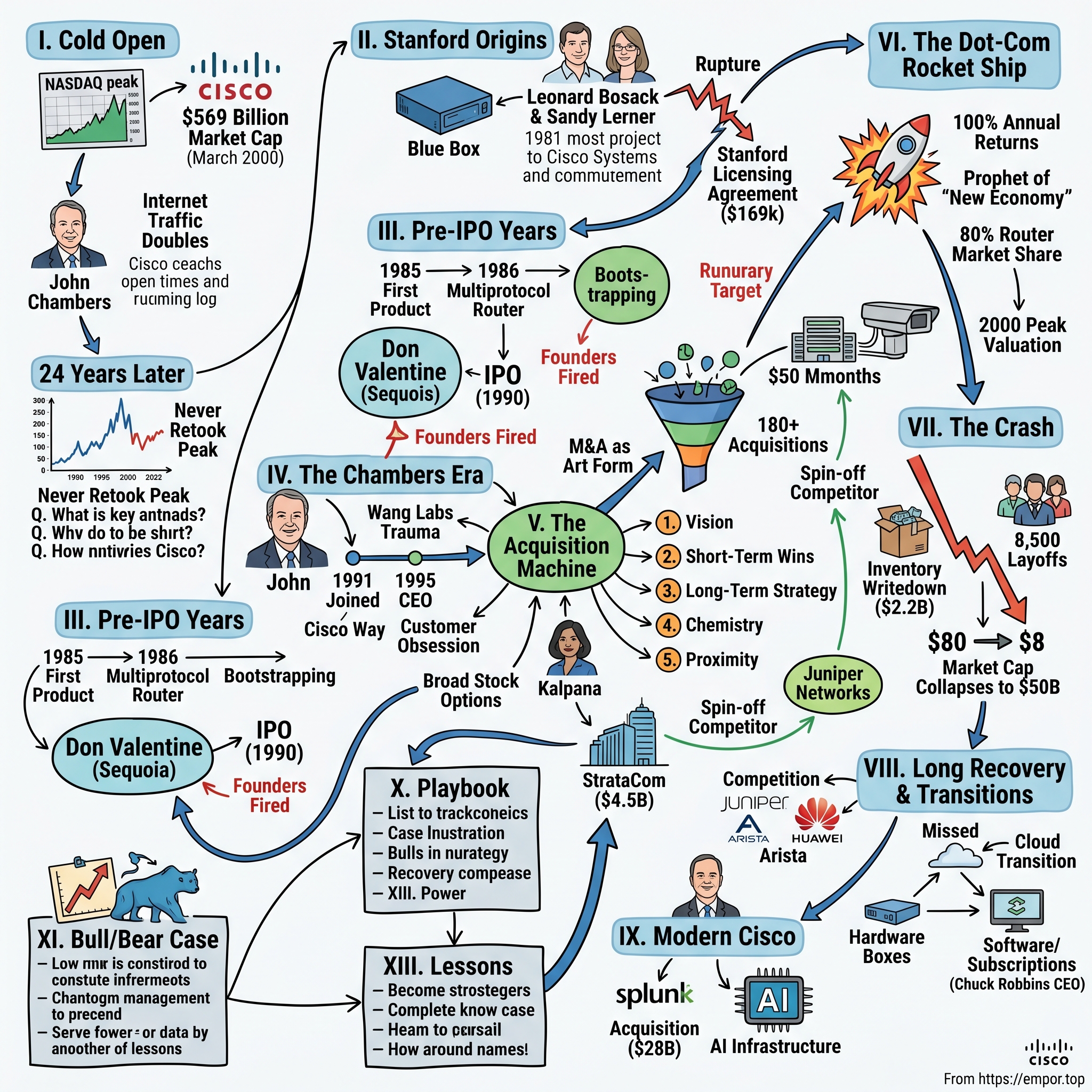
Cisco Systems: From Stanford Routers to Internet Infrastructure Giant
I. Cold Open & Episode Roadmap
On March 27, 2000, Cisco Systems surpassed Microsoft to become the most valuable company in the world. Its shares touched $80.06 that day, giving the San Jose-based networking equipment manufacturer a market capitalization of roughly $569 billion despite earning just 36 cents per share—a multiple somewhere north of 200 times earnings.1 Wall Street consensus held that Cisco would become the world's first trillion-dollar enterprise, viewing the company as the essential provider of hardware infrastructure for the internet expansion.
Then Cisco discovered that its customers had been placing duplicate equipment orders across multiple suppliers to secure allocation during supply shortages.
What followed became one of the most instructive valuation resets in public market history. Within a year, Cisco lost roughly 85% of its market capitalization and recorded a $2.25 billion inventory write-down. For two decades, value investors cited Cisco as a case study in how purchasing a strong business at an excessive valuation results in poor investment returns. Yet on December 10, 2025, Cisco stock closed at a record high for the first time since the dot-com peak—ending a nearly 26-year wait for shareholders who bought at the top and never sold.1
That per-share milestone requires important context. In early September 2026, Cisco's market capitalization stands near $430 billion—still meaningfully below its March 2000 level. The share price reached a record because Cisco spent a quarter century repurchasing its equity. This per-share record reflects capital allocation and treasury management as much as operational expansion, highlighting Cisco's core profile throughout its mature era: a cash-generating enterprise reducing its share count faster than its underlying business grows.
In fiscal 2026, however, operational performance accelerated. Cisco reported revenue of $63.3 billion, up 12% to mark its strongest growth in over a decade, with fourth-quarter product revenue up 24% and product orders up 35%.2 Management guided fiscal 2027 revenue to $72.2–$73.4 billion—implying approximately 15% growth from a company whose long-term model had been 4–6%.3 Chief Executive Officer Chuck Robbins framed the trend as a "networking super cycle."
These developments raise key strategic questions:
How did two Stanford University staff members build the multiprotocol router that unified disparate network protocols—and subsequently lose control of the company? How did former Chief Executive John Chambers execute over one hundred transactions to construct a prolific acquisition engine, yet still preside over one of the largest inventory write-downs in technology history? How did Chuck Robbins spend a decade transitioning hardware revenue toward software subscriptions, even as recurring revenue grows at 3% while hardware revenue expands at 22%? Finally, does the demand for artificial intelligence networking represent a structural re-rating of Cisco's core franchise, or a cyclical infrastructure build-out—especially given inventory purchase commitments that have already risen 126% year over year to $17.2 billion?4
Several core analytical themes emerge from this history: acquisition as externalized research and development; counter-positioning by nimble entrants targeting profit pools an incumbent cannot defend; the severe bullwhip effect in component-heavy supply chains; and the distinction between volume-driven demand expansion and revenue growth achieved by raising prices into market shortages. Evaluating Cisco requires separating these structural and cyclical dynamics.
The story begins where every technology origin story starts: with two founders trying to connect incompatible computer systems.
 Subscribe on LinkedIn
II. The Stanford Origins & Founding Drama
The founding myth of Cisco begins as a love story about email, and like many corporate origin stories, it is only partially true.
In the mid-1980s, Leonard Bosack managed the computer facility for Stanford University's computer science department, while his wife, Sandy Lerner, managed the facility at the Graduate School of Business. Their offices sat a few hundred yards apart, but the local networks inside could not communicate—reflecting a broader technical divide. Enterprise computing was fractured across incompatible proprietary protocols: IBM relied on SNA, Digital Equipment Corporation used DECnet, Xerox used XNS, and the academic community was gradually coalescing around TCP/IP. Without a dedicated translator, a machine on one network could not transmit data packets to a machine on another.
That translator was a multiprotocol router. Conceptually, the campus functioned like a city where each neighborhood spoke a different language and used a distinct postal format. A router operated as a multilingual post office, reading incoming data packets, identifying their destinations, translating the addresses into the target format, and forwarding them across networks at high speeds. Stanford engineers had already constructed a prototype: research engineer William Yeager wrote the routing software, while Andy Bechtolsheim—who later co-founded Sun Microsystems and Arista Networks—contributed hardware designs.5 Campus staff dubbed the resulting device the "Blue Box."
Bosack, Lerner, and colleague Kirk Lougheed soon moved to commercialize the technology. They incorporated Cisco Systems in December 1984, operating out of a private home and funding initial operations with credit cards and personal savings while remaining on Stanford's payroll and, in the university's view, using campus facilities and equipment.6 The company name was shorthand for San Francisco, and the original logo depicted the suspension cables of the Golden Gate Bridge—a visual metaphor for bridging isolated networks.
In July 1986, Stanford forced Bosack and Lougheed to resign under threat of criminal referral for theft of university property. The dispute was resolved in April 1987, when Stanford agreed to license the router software and two circuit board designs to Cisco in exchange for $19,300 in cash, $150,000 in royalties, and product discounts.7 The settlement proved to be a historically lucrative technology-transfer bargain for Cisco, illustrating how early-stage intellectual property valuations often reflect immediate liquidity needs rather than long-term commercial potential.
This initial bootstrapping period established Cisco's operational foundation. The company sold its Advanced Gateway Server (AGS) to universities, research laboratories, and early corporate buyers, generating positive cash flow almost immediately. Unlike many 1980s hardware startups that consumed substantial venture capital before reaching profitability, Cisco funded its growth through customer revenue because its multiprotocol router lacked direct market substitutes. For enterprises operating DEC systems in engineering and IBM mainframes in finance, Cisco provided the sole practical mechanism to unify their IT infrastructure.
Rapid demand growth soon strained the company's working capital. Because manufacturing required purchasing components and assembling circuit boards well before customer payments cleared, Cisco quickly ran low on cash. After rejections from multiple venture firms, Bosack and Lerner secured an investment from Don Valentine at Sequoia Capital. Valentine recognized a rapidly expanding market serviced by an enterprise with the only viable commercial product. In December 1987, Sequoia invested $2.5 million for roughly one-third of Cisco's equity, securing effective board control in the process.8
That ownership structure shaped Cisco's governance trajectory. By surrendering board control to secure working capital for order fulfillment, the founders yielded operational authority. In 1988, Valentine hired veteran executive John Morgridge as chief executive officer. Lerner, who had established an intense, customer-focused culture during the startup phase, resisted corporate oversight. The resulting governance friction quickly escalated into an operational impasse between professional management and the founding team.
Although brief, Cisco's founding period established two enduring strategic themes. First, the company's early economic value derived from acting as a standards translator within a fragmented hardware market. Second, the founders surrendered equity and governance control to finance inventory growth during demand surges. Both dynamics would recur throughout Cisco's corporate history.
III. From Garage to Going Public: The Morgridge Era (1988–1995)
John Morgridge flew coach and required his executive team to do the same. He famously insisted on middle seats and, even after Cisco reached a multi-billion-dollar valuation, kept executive offices in basic cubicles. This was not performative modesty for the annual report; it served as a deliberate operational signal reinforcing the central tenet of Morgridge's corporate culture: gross margins belonged to shareholders rather than internal spending.
Morgridge assumed leadership in 1988 at an enterprise generating roughly $5 million in annual revenue. He inherited a product with rare economic characteristics: enterprise buyers considered it essential, viable commercial alternatives were virtually nonexistent, and customers prioritized network uptime far above unit pricing. To capitalize on this position, Morgridge established three strategic decisions that shaped Cisco for the next three decades.
First, he focused sales efforts exclusively on enterprise and institutional clients rather than chasing consumer or small-business markets. This focus enabled Cisco to build a direct sales organization tailored to corporate IT departments and to maintain gross margins above 60%—an unusually high level for hardware manufacturing. High gross margins provided the capital necessary to fund research, development, and sales coverage, creating barriers for emerging competitors while instilling a corporate bias against low-margin hardware.
Second, Morgridge standardized manufacturing processes and aggressively outsourced component assembly, maintaining an asset-light operating model while scaling production. Revenue expanded from roughly $5 million in fiscal 1988 to $28 million in fiscal 1989, even as headcount remained barely in the triple digits. Revenue per employee became a core operational metric for the company. On its fiscal 2026 earnings call, management highlighted this long-standing metric, claiming Cisco achieved its highest revenue, operating margin, and earnings per employee in thirty years.3
Third, Morgridge established a dual-distribution architecture. Alongside direct enterprise sales, Cisco developed a network of value-added resellers, integrators, and consultants. Rather than relying solely on internal sales staff, Cisco equipment reached Fortune 500 customers through the third-party technical advisors those enterprises already trusted. Resellers managed customer acquisition, installation, and ongoing support, allowing Cisco to capture premium hardware margins. This distribution channel would prove to be one of the company's most durable competitive advantages—outlasting specific chip designs, protocols, and software features.
On February 16, 1990, Cisco completed its initial public offering on the NASDAQ under the ticker CSCO at a valuation of approximately $224 million. The listing coincided with a broader industry transition, as enterprise IT departments abandoned proprietary vendor protocols in favor of TCP/IP. Because Cisco manufactured the primary hardware required to connect disparate networks under TCP/IP, the company functioned as a key infrastructure provider for the expanding protocol standard.
Governance tensions escalated shortly after the public listing. Within six months of the IPO, the board of directors—led by Don Valentine and Morgridge—terminated Sandy Lerner. Leonard Bosack resigned the same day in solidarity. The founders subsequently sold their entire equity stake for approximately $170 million—a substantial payout at the time that nevertheless represented roughly three-tenths of one percent of Cisco's eventual peak dot-com valuation.9
While founder departures are often framed in personal terms, the outcome reflected a structural reality of venture-backed hardware expansion. The economic dilution of the founding team was set when Sequoia Capital provided working capital in 1987; the 1990 board action formalized the operational shift. For enterprise technology investors, the strategic lesson centers on working capital financing: in capital-intensive hardware categories, entities that fund inventory cycles often secure ultimate governance control. Companies whose growth outpaces internal cash generation inevitably yield authority to external capital sources.
By 1993, Cisco was approaching $1 billion in annual revenue, supported by a dominant position in enterprise routing, an established reseller network, and high gross margins. However, the enterprise networking market was beginning to evolve. A new hardware category—the local area network (LAN) switch—emerged to handle internal data traffic, threatening to bypass traditional routers. Cisco had not developed an internal switching architecture.
Addressing that portfolio gap fell to an executive who had spent the previous decade observing the decline of two major American technology incumbents.
IV. The Chambers Era & The Great M&A Engine (1993–2000)
John Chambers joined Cisco in 1991 and became chief executive officer in January 1995. He frequently recounted laying off 5,000 employees at Wang Laboratories as a defining career lesson. Having watched IBM miss the minicomputer transition and Wang miss the personal computer shift, Chambers concluded that the primary strategic risk in technology was reacting too slowly to market transitions. A well-managed company with capable engineers could still be undermined by an architectural shift it recognized too late to capture.
His structural contribution to Cisco was a strategic pivot: when internal research and development proved too slow to keep pace with emerging protocol shifts, the company would acquire the transition instead. Chambers paired this approach with an aggressive sales culture, paying meticulous attention to customer account management and quarterly satisfaction metrics.
The proof of concept occurred before Chambers became chief executive. In September 1993, Cisco agreed to acquire Crescendo Communications, a local area network (LAN) switching startup, in a stock swap valued at roughly $97 million—its first acquisition following nine years of organic product development.10 Crescendo's technology formed the basis of the Catalyst switch family, which expanded into a multi-billion-dollar franchise and remains central to Cisco's enterprise campus business three decades later. Over the long term, it became one of the highest-returning technology acquisitions in corporate history.
The Crescendo transaction established a standard acquisition playbook with specific criteria. Target companies were typically early-stage startups with fewer than 100 employees, limited initial revenue, and physical proximity to Cisco headquarters to facilitate integration. Targets also had to share Cisco's technical architecture so their products could be fully absorbed. Integration began immediately upon closing, encompassing corporate IT systems, personnel, and—most critically—aligning the acquired products with Cisco's sales incentives so thousands of sales representatives were motivated to sell them immediately.
Rather than purchasing existing revenue streams, Cisco acquired technology products and scaled them through its global enterprise distribution channel. Post-merger retention was managed with similar discipline; during the peak era, Cisco maintained annual turnover among acquired staff below 5% and retained roughly 100 former startup chief executives.
Cisco accelerated this M&A engine throughout the late 1990s. In 1996, the company acquired StrataCom for approximately $4 billion to enter the telecommunications carrier market with asynchronous transfer mode (ATM) switching technology. In 1999, Cisco acquired optical networking startup Cerent for roughly $6.9 billion in stock against approximately $10 million in annual revenue—a valuation approaching 700 times sales.
While Cisco's acquisition strategy was widely praised for operational execution, its financial mechanism relied heavily on equity arbitrage. Cisco funded transactions using its own highly valued shares. When a company's stock trades at 200 times earnings, exchanging shares for early-stage startups reflects a trade between two inflated assets rather than a cash commitment. This capital strategy generated exceptional returns while valuation multiples remained high, but it remained vulnerable to any contraction in public equity multiples.
Between fiscal 1994 and fiscal 2000, Cisco's annual revenue expanded from roughly $1.2 billion to $18.9 billion. The company captured market share estimated at 70% or more in enterprise routing and switching while expanding leadership across adjacent networking categories. Gross margins remained in the mid-60% range, and Cisco consistently met or exceeded Wall Street earnings estimates each quarter.
Beneath these top-line figures, structural risks were accumulating. Cisco sold heavily into telecommunications carriers expanding network capacity and venture-backed internet startups—two customer segments funded by the same capital market expansion driving Cisco's valuation. Furthermore, Cisco extended vendor financing to certain buyers, effectively funding customer purchases of its own equipment. Simultaneously, the company optimized its supply chain around a single objective: ensuring product availability to prevent shipment delays.
That supply chain optimization would soon trigger the largest operational reset in Cisco's history.
V. The Dot-Com Rocket Ship & The $2.25 Billion Crash (2000–2003)
In the spring of 2001, a sudden silence settled across Cisco's manufacturing network as customer orders stopped almost overnight.
The market peak had arrived a year earlier, supported by rational logic that ultimately failed to account for structural customer behavior. Internet traffic was doubling rapidly, Cisco controlled the dominant share of networking hardware, and consensus models assumed a business growing above 50% annually with 65% gross margins and a proven acquisition engine could compound indefinitely. What financial models failed to incorporate was that a substantial portion of reported demand was phantom demand.
The mechanism was driven by extended hardware lead times. When delivery schedules stretched to several months, telecommunications carriers and venture-backed startups routinely placed duplicate orders across Cisco, competing vendors, and third-party resellers, intending to accept whichever shipment arrived first and cancel the rest. From Cisco's vantage point, a single customer requirement appeared as three separate orders. Cisco's automated forecasting systems—widely celebrated in business school case studies—extrapolated this inflated signal and converted it into non-cancelable purchase commitments with contract manufacturers for long-lead components.
This dynamic illustrated the classic supply-chain bullwhip effect. Minor shifts in true end-user demand amplify at each upstream supply layer as intermediate participants build safety stock. When end-user demand contracts, the amplification operates in reverse, leaving component buyers holding non-cancelable supplier commitments.
The collapse accelerated in the quarter ended April 2001. Capital expenditures by telecom carriers and internet startups contracted simultaneously. Cisco's order backlog evaporated with unprecedented speed, leaving the company holding inventory built for a business twice its actual size. On May 8, 2001, the company disclosed a $2.25 billion inventory write-down, at the time the largest such charge in corporate history.11
Cisco's stock price, which had already begun falling from its March 2000 peak, eventually bottomed near $8.60 per share in late 2002. The 88% decline erased approximately $480 billion in enterprise market value.
Three primary analytical lessons emerged from the dot-com inventory crash.
First, the collapse disproved the belief that Cisco's supply chain visibility insulated it from hardware cyclicality. Cisco operated the industry's most advanced demand-sensing infrastructure, yet those automated systems accelerated the downturn by responding rapidly to corrupted ordering signals. Sophisticated forecasting systems do not protect against flawed inputs; they accelerate errors.
Second, vendor financing and channel inventory can create the illusion of order backlogs without end-user consumption. When hardware order volumes expand significantly faster than deployed network infrastructure, the divergence signals channel inflation.
Third, Cisco survived the downturn without a balance-sheet crisis. The enterprise carried minimal debt, maintained substantial cash reserves, and generated steady cash flow from recurring maintenance contracts while product orders stalled. Equity value was severely damaged, but the operating business remained solvent—underscoring the structural distinction between purchasing a durable franchise and paying an excessive valuation multiple.
Chief Executive John Chambers responded decisively, eliminating roughly 8,500 positions, absorbing the inventory charge in a single quarter, and acknowledging the forecasting failure. Cisco restored profitability quickly and rebuilt gross margins over subsequent years. However, top-line revenue expansion did not return to dot-com levels; annual growth settled into a mid-single-digit rate, prompting executive leadership to seek new growth avenues through further market expansion.
VI. The Lost Decade: Consumer Missteps & The Arista Disruption (2003–2015)
The defining emblem of Cisco between 2003 and 2015 was a $590 million pocket camcorder in a world that had just introduced the smartphone.
Chambers framed his post-crash strategy around entering "adjacent markets"—targeting as many as thirty separate growth initiatives simultaneously. To govern this expansion, Cisco established a complex matrix of internal councils and boards designed to manage parallel bets. In practice, the structure created administrative friction. Decision rights blurred, accountability diluted, and a company whose core advantage had been rapid execution became bogged down by organizational complexity.
Cisco's capital allocation during this era challenged the long-held assumption that the company possessed a universally applicable acquisition playbook.
In 2003, Cisco acquired Linksys for approximately $500 million to capture the home networking market. However, consumer hardware offered limited software attach rates, low channel margins, and a buyer base unwilling to pay premium prices for corporate-grade support. Cisco struggled to integrate consumer hardware, eventually selling Linksys to Belkin in 2013 on undisclosed terms after a decade of strategic drift.12
In 2009, Cisco acquired Pure Digital, maker of the Flip video camcorder, for approximately $590 million. Just two years later, in April 2011, Cisco shut down the product line entirely as smartphone cameras rendered standalone pocket camcorders obsolete.13 The Flip was a popular consumer device, but its category was rapidly absorbed by smartphones—a structural shift that a networking equipment provider with visibility into mobile data traffic should have anticipated.
Similarly, Cisco acquired pay-television software maker NDS Group in 2012 for roughly $5 billion. The technology failed to gain traction within Cisco's core architecture, and the service provider video assets were later divested at a steep loss.
These transactions revealed a clear structural boundary: Cisco's acquisition engine was fundamentally a distribution machine, not a general-purpose innovation engine. It succeeded when an acquired technology could be routed through Cisco's enterprise sales channel and sold to corporate IT departments with existing Cisco budgets. When a transaction required consumer marketing, retail distribution, or a different business model, Cisco lacked an operational advantage and consistently overpaid.
While consumer acquisitions strained capital, a more direct threat to Cisco's core enterprise business emerged from a lean competitor.
Arista Networks was founded in 2004 by Andy Bechtolsheim—the Stanford engineer who contributed hardware designs to the original Blue Box—alongside Kenneth Duda and David Cheriton. Arista executed a classic counter-positioning strategy. Cisco's high-margin business model relied on bundling custom application-specific integrated circuits (ASICs) with its proprietary Internetwork Operating System (IOS) software and selling through reseller channels. Arista did the reverse: it sourced off-the-shelf merchant silicon from Broadcom, developed a single Linux-based network operating system called EOS, and sold directly to hyperscale cloud providers whose in-house engineering teams required modular software rather than reseller bundles or vendor certifications.
Counter-positioning created an innovator's dilemma. To match Arista's approach by selling open hardware with disaggregated software, Cisco would have had to sacrifice its premium ASIC margins, undermine its proprietary software ecosystem, and alienate tens of thousands of channel partners. Defending its existing profit pools was a rational quarterly decision for Cisco, but cumulatively, those decisions surrendered leadership in the fastest-growing segment of networking infrastructure.
The competitive outcome was stark. Arista detailed this disruption in its 2014 initial public offering prospectus.14 Over the subsequent decade, Arista captured the top market share position in high-speed data center Ethernet switching, surpassing Cisco outright by 2024. By fiscal 2026, Arista was guiding toward approximately $11.5 billion in annual revenue, including roughly $3.5 billion from artificial intelligence deployments.15 Cisco had gone from dominating data center infrastructure to being largely sidelined in hyperscale cloud build-outs.
Cisco suffered a third setback in collaboration software. Cisco acquired Webex in 2007 for approximately $3.2 billion, capturing an early dominant position in enterprise web conferencing. Over time, however, the software stagnated under a heavy desktop client, slow mobile performance, and a friction-filled setup process. Eric Yuan, a senior Webex engineering executive, departed to launch Zoom, focusing on frictionless user access. As remote work accelerated, Zoom gained market share based on product usability, while Microsoft bundled Teams into its enterprise software suite. Cisco's collaboration business was left defending market share between a specialized product leader and a bundled enterprise competitor.
These three episodes illustrated distinct operational vulnerabilities: consumer acquisitions beyond the distribution channel, an inability to counter-position against hardware disaggregation, and product stagnation in early software leads. When evaluating whether Cisco's AI strategy will yield durable advantages, these historical patterns represent critical benchmarks.
By 2015, Chambers had served as chief executive for twenty years. Cisco had grown into a $49 billion enterprise, but annual revenue growth had slowed to low single digits, and the stock price remained essentially flat over a decade. Seeking to reinvigorate the business, the board appointed Chuck Robbins, a veteran sales executive who had joined Cisco in 1997 and previously led its Americas division.
VII. The Chuck Robbins Era: The Software & Subscription Pivot (2015–2023)
Upon assuming the chief executive role in July 2015, Chuck Robbins moved quickly to streamline Cisco's organizational structure. Within months, he dismantled the complex network of councils and boards that had characterized the late Chambers era while restructuring the senior executive leadership team. Robbins—whose public style was markedly more direct and low-key than his predecessor's—framed the reorganization around decision velocity. The underlying strategic objective, however, was financial: whereas Chambers pursued top-line revenue and market share across dozens of categories, Robbins prioritized revenue quality, shifting focus toward recurring, software-attached, and predictable cash flows.
The structural challenge was clear yet difficult to execute. Cisco primarily sold hardware boxes—a business model driven by lumpy, multi-year customer refresh cycles where revenue is recognized upon shipment, leaving growth tied to corporate capital expenditure budgets. Software subscriptions offered the inverse financial profile: smaller upfront commitments recognized ratably over time, recurring renewals, and higher valuation multiples from public markets. Throughout the 2010s, hardware manufacturers sought to execute this pivot, though few succeeded because it required sales organizations to swap large, upfront hardware receipts for deferred subscription streams.
Cisco solved this incentive problem through mandatory product bundling. The primary vehicle was the Catalyst 9000 series switch, launched in 2017, which became the fastest-ramping product line in company history. While technically advanced, the Catalyst 9000 required enterprise buyers to purchase a mandatory three-to-seven-year Cisco DNA software license alongside the physical hardware. Customers requiring Cisco switching accepted the software subscription because opting out meant replacing their broader Cisco campus infrastructure.
This bundling strategy demonstrated Cisco's significant pricing power and customer lock-in within enterprise campus networking, proving that high switching costs allowed the company to mandate software attachments across its installed base. However, it did not prove that enterprise customers valued the software independently of the underlying hardware—a critical distinction when evaluating the compounding potential of Cisco's recurring revenue stream.
Alongside forced bundling, Robbins redirected acquisition capital toward software products that leveraged Cisco's core enterprise distribution channel:
- Meraki, acquired in 2012 for $1.2 billion under Chambers and scaled under Robbins, provided cloud-managed networking hardware administered entirely through a web browser. Meraki expanded into a multi-billion-dollar recurring franchise by leveraging Cisco's reseller network to deliver a simplified management product to small and mid-market enterprises.
- AppDynamics, acquired in January 2017 for $3.7 billion in cash shortly before its planned initial public offering, established Cisco in application performance monitoring, enabling IT departments to monitor software behavior from the end-user perspective.
- ThousandEyes, acquired in 2020 for approximately $1 billion, added network visibility across external internet paths, tracking packet flow across third-party service providers and cloud infrastructure outside corporate boundary controls.
The strategic logic connecting these acquisitions targeted operational diagnostics. When enterprise applications perform poorly, troubleshooting responsibilities are often fragmented across internal network engineers, software developers, cloud hosts, and internet service providers. Cisco's strategy aimed to unify visibility across all four domains—the internal network, application layer, and public internet paths—allowing the company to capture a larger share of enterprise IT operational budgets by serving as the authoritative diagnostic platform.
In aggregate, this pivot reshaped Cisco's financial profile. Annualized recurring revenue expanded from under $14 billion in fiscal 2016 to $29.6 billion by fiscal 2024, subscription sales surpassed 50% of total revenue, and the company's overall revenue base became less vulnerable to single hardware refresh cycles.16
Evaluating this transition against fiscal 2026 performance presents a more nuanced outcome. In the fourth quarter of fiscal 2026, total annualized recurring revenue reached $32.1 billion—a 3% increase—with product ARR growing 5%, total software revenue expanding 11%, and subscriptions representing 48% of overall revenue.3 In contrast, overall revenue grew 12% and product revenue rose 24%. Cisco's recurring revenue base expanded at a significantly slower pace than its hardware business, causing subscription revenue share to fall from 51% two quarters earlier—not due to a contraction in software sales, but because hardware volume surged.17
While a $32 billion recurring revenue stream provides a substantial cushion against cyclical downturns, current performance highlights the limits of the software transformation. Cisco successfully attached software subscriptions to its hardware portfolio to reduce revenue volatility, but it has not demonstrated that its software franchise can compound independently of hardware delivery volumes. The true test of this business model will depend on organic recurring revenue growth during an explicit hardware contraction.
To accelerate its software expansion, Robbins sought an even larger structural acquisition.
VIII. The $28 Billion Bet: Splunk & The Observability/Security Unified Platform (2023–Present)
When Cisco announced the transaction on September 21, 2023, management framed the strategic logic around combining network-level visibility with Splunk's enterprise log-analysis capabilities to create a unified telemetry platform.
Cisco agreed to acquire Splunk for $157 per share in cash—approximately $28 billion, making it the largest acquisition in corporate history by a wide margin—and closed the transaction on March 18, 2024.1819 To fund the purchase, Cisco raised roughly $19 billion of net debt in fiscal 2024, shifting a company that had maintained a fortress balance sheet for two decades into meaningful leverage for the first time.16
Outside enterprise IT, Splunk's technical function warrants explanation. Every server, application, firewall, and switch in an enterprise generates a continuous stream of timestamped log entries. Individually, these logs are raw noise. Collected, indexed, and searchable, they form a digital forensic record of corporate operations, detailing operational failures, system entries, and user activities. Splunk built the dominant platform for ingesting and querying this data stream, serving as the enterprise standard for both observability—diagnosing system performance issues—and security information and event management (SIEM)—detecting active security threats.
The strategic rationale appeared compelling on paper. Cisco already captured network-layer telemetry across switches and routers, alongside application monitoring through AppDynamics and external path diagnostics via ThousandEyes. Splunk contributed the central log layer and an established security operations center presence across the Fortune 500. Combined, Cisco claimed a leading position in enterprise security and observability with approximately $10 billion in combined software revenue, anchored by Splunk's roughly $4.3 billion in annualized recurring revenue (ARR) at signing.
Two and a half years post-announcement, empirical financial results provide a clearer basis for evaluation. Performance across the combined operations remains mixed.
What has worked. Splunk provided scale and an expanded enterprise customer base for cross-selling. Management reported adding over 280 new Splunk customers in the fourth quarter of fiscal 2026, exceeding its full-year target of 1,000 new accounts and recording its highest quarterly volume of competitive wins.3 Splunk components were integrated into Cisco's security portfolio, contributing to multi-product enterprise agreements—the large whole-portfolio deals central to Cisco's direct sales strategy. Consequently, fourth-quarter security revenue expanded 14%.2
What has not. For full-year fiscal 2026—the second full year under Cisco ownership—the security segment generated $8.2 billion in revenue, representing 2% growth, while observability revenue rose 4% to $1.1 billion.2 These growth figures fell short of expectations for a newly acquired software franchise. In the second quarter of fiscal 2026, security revenue declined 4% year over year, with management attributing the contraction to declines in legacy product lines and a customer transition from perpetual on-premises licenses to cloud subscriptions—a shift that temporarily depresses recognized revenue because upfront perpetual software fees are replaced by ratable subscription accounting.17
While accounting revenue deferrals are standard during cloud transitions, they remain difficult to evaluate externally in the short term. The accounting dynamic reversed in the fourth quarter, when management disclosed that the 14% security growth rate benefited from larger, longer-duration on-premises contracts, with Chief Financial Officer Mark Patterson noting that the long-term mix should normalize to roughly two-thirds cloud and one-third on-premises software.3 Thus, revenue recognition mechanics suppressed growth in early fiscal 2026 and inflated it in the fourth quarter, obscuring the underlying growth trend. Because Cisco does not report standalone Splunk ARR, outside investors lack the primary metric required to isolate Splunk's underlying performance.
This disclosure gap represents a key point of investor scrutiny. Cisco committed $28 billion—its largest capital deployment to date—to acquire an asset whose ongoing standalone trajectory cannot be independently verified from public disclosures. Overall annualized recurring revenue growth of 3% across the consolidated company provides the main public benchmark, reflecting modest expansion.
Structural risks identified at deal announcement also persist:
- Portfolio overlap. Cisco maintains two distinct application-monitoring suites: AppDynamics and Splunk Observability. Consolidating the product lines risks alienating customers on the retired platform, whereas maintaining both creates engineering redundancies and sales fragmentation. Cisco has yet to outline a public rationalization plan.
- Cloud-native competition. Competitors like Datadog, Dynatrace, Grafana, and the open-source OpenTelemetry framework continue to target Splunk's market position, while Palo Alto Networks designed Cortex XSIAM specifically to target Splunk's SIEM customer base. Furthermore, Splunk's traditional volume-based ingestion pricing becomes costly for clients as artificial intelligence deployments accelerate log data generation.
- Integration execution during a hardware surge. Cisco's direct sales force is tasked with executing cross-selling initiatives for a complex software platform while simultaneously managing the company's largest hardware ordering surge in two decades. Finite sales capacity creates friction between hardware fulfillment and software adoption.
Evaluating the Splunk acquisition requires distinguishing between immediate portfolio scale and long-term organic acceleration. After two and a half years, the transaction has expanded Cisco's enterprise footprint and product breadth, but it has not yet produced sustained top-line acceleration across the software business. Management guided combined security and observability revenue growth from low single digits in fiscal 2026 to high single digits in fiscal 2027.3 This guidance serves as the benchmark for transaction success; if growth remains below that threshold through fiscal 2027, the return on Cisco's $28 billion investment will remain unproven.
This operational dynamic shifts attention back to the core hardware franchise currently generating the majority of Cisco's financial expansion.
IX. The AI Infrastructure Battle: Silicon One vs. Nvidia & Broadcom
In the fourth quarter of fiscal 2026, Cisco secured $4 billion in artificial intelligence infrastructure orders from hyperscale customers—more than double its total bookings from those clients across all of fiscal 2025.3 Six years earlier, Cisco maintained minimal presence inside hyperscaler data centers after losing market share during the initial cloud infrastructure expansion. The order surge marks a re-entry into a market segment from which the company had previously been sidelined.
Understanding this shift requires examining how artificial intelligence workloads alter networking requirements. Large language models are trained across thousands of graphics processing units (GPUs) operating in parallel. During training, GPUs continuously share intermediate results through an operation known as AllReduce. Because each processor waits for this data exchange to complete before proceeding, network performance directly dictates compute efficiency. A slow network or a single dropped packet forces retransmissions that stall thousands of chips, making low latency, high bandwidth, and zero packet loss essential for AI cluster performance.
To meet these demands, Nvidia promoted InfiniBand—a proprietary, lossless interconnect acquired through Mellanox—and later introduced Spectrum-X, an Ethernet architecture optimized for AI workload fabrics. In response, a broader industry coalition including Cisco, Arista, Broadcom, Meta, and AMD formed the Ultra Ethernet Consortium. The consortium aims to standardize an open, high-performance Ethernet specification for AI deployment, seeking to leverage standard Ethernet infrastructure while avoiding vendor lock-in on proprietary interconnects.
Cisco's primary technical entry is Silicon One, introduced in December 2019 as a unified architecture designed to support both fixed switches and modular routers from a single programmable chip core.[^21] Two key structural factors define its commercial significance.
First, Cisco adopted a disaggregated business model. For the first time, the company agreed to sell standalone silicon to hyperscale customers who designed their own hardware chassis and wrote their own operating software. This shift reversed the proprietary bundling strategy that had cost Cisco market share during the initial cloud expansion. However, selling standalone components captures a smaller portion of the value pool than delivering complete hardware systems bundled with Cisco's proprietary operating software, resulting in lower gross margins.
Second, the architectural transition required several years to translate into material revenue. Although Silicon One launched in 2019, hyperscaler revenue only began scaling in fiscal 2025 and 2026. On the fourth-quarter fiscal 2026 earnings call, Chief Executive Chuck Robbins emphasized that this expansion resulted from deliberate long-term planning rather than external chance, citing a multi-year sequence of investments in silicon, optical networking, and security designed to rebuild relationships with cloud providers.3
The current state of AI operations, based on company disclosures:
- AI infrastructure orders from hyperscalers reached $9.3 billion in fiscal 2026, approximately 4.5 times the fiscal 2025 total of just over $2 billion. Management had initially set a fiscal 2026 order target of $2 billion, which was subsequently raised to $5 billion in February 2026 and to $9 billion in May 2026.32021
- The product mix comprised roughly 60% Silicon One–based systems and 40% optical components.
- Optical transport growth accelerated following the 2021 acquisition of Acacia Communications. The coherent optics unit booked over $1 billion in orders during the fourth quarter of fiscal 2026, bringing cumulative shipments to more than 850,000 400-gigabit and 75,000 800-gigabit coherent pluggable optical modules.3
- Silicon development timelines accelerated, marked by the launch of the P200 routing chip (51.2 terabits per second) inside the Cisco 8223 system in October 2025, followed by the announcement of the G300 switching chip (102.4 terabits per second) at Cisco Live Amsterdam in February 2026.2217
The P200 chip targets an architecture Cisco terms "scale-across," connecting separate AI training clusters across distinct facilities. As power limitations prevent hyperscalers from expanding individual data center campuses endlessly, AI training jobs must increasingly span multiple buildings while functioning as a single unified compute fabric. Connecting these distributed clusters requires deep-buffer long-haul routing and high-capacity coherent optics—capabilities rooted in Cisco's historic service-provider and optical transport portfolio. By contrast, Arista has historically focused on intra-data center switching. Cisco reported three P200 scale-across design wins with orders from three distinct hyperscalers, alongside an optical line-system contract competing directly with established optical suppliers.3
These order gains do not indicate that Cisco has displaced incumbents atop the AI networking sector. Nvidia remains the leading provider of AI cluster interconnects and has integrated Cisco into its broader ecosystem. Cisco's N9100 data center switch relies on Nvidia Spectrum-X silicon, while Cisco Silicon One was included as the sole supported partner silicon within the Spectrum-X architecture under a partnership announced in February 2025 and expanded through 2026 via the Secure AI Factory rack-scale design.2324 While serving as Nvidia's primary Ethernet partner provides commercial volume, it leaves Cisco reliant on a competitor that retains control over the highest-margin interconnect technologies. Furthermore, Arista maintains a larger overall AI networking franchise by revenue.
Additionally, revenue from hyperscale AI infrastructure carries lower profitability than Cisco's core enterprise hardware. On the fiscal 2026 earnings call, Robbins acknowledged that Cisco accepts lower gross margins on certain hyperscaler contracts because the minimal incremental operating expense yields attractive operating income.3 While operating profits drive overall returns, expanding low-margin hyperscaler revenue creates structural pressure on gross margins. In the fourth quarter of fiscal 2026, Cisco's non-GAAP gross margin declined 210 basis points year over year to 66.3%, driven by a 270-basis-point drop in product gross margin.3
Customer concentration presents an additional vulnerability. Management has noted that AI infrastructure demand remains concentrated among fewer than five hyperscale clients, resulting in uneven, non-linear ordering patterns.17 Because these sophisticated buyers possess the internal engineering capacity to switch hardware suppliers or redesign network architectures, high order volumes do not guarantee long-term customer lock-in.
From a total portfolio perspective, hyperscaler AI infrastructure generated approximately 6% of Cisco's total revenue in fiscal 2026, up from less than 2% in fiscal 2025, with management guiding to $7.5 billion in fiscal 2027—representing roughly 10% of projected revenue.3 Although AI networking represents Cisco's fastest-growing product category and served as a catalyst for equity re-valuation, enterprise switching remains the primary foundation of the company's overall revenue and earnings.
X. Business Breakdown & Segment Financials: Where Cisco Makes Its Money
In fiscal 2026, Cisco's operations comprised five primary business segments of disparate scale and financial contribution, with growth concentrated almost entirely within its core hardware portfolio.
Networking — $34.7 billion, up 22%, roughly 55% of revenue. Networking remains Cisco's core operating engine, encompassing enterprise campus switching through the Catalyst line, data center switching via Nexus, enterprise and service-provider routing, Meraki cloud-managed wireless systems, industrial Internet of Things hardware, optical transport, and hyperscale artificial intelligence hardware. Fourth-quarter networking revenue expanded 28%, marking the eighth consecutive quarter of double-digit order growth across the portfolio.23 Gross margins in this segment have historically hovered in the mid-60% range, generating the majority of consolidated operating profitability.
Services — $15.0 billion, flat, roughly 24% of revenue. The services segment includes Smart Net maintenance contracts, technical support, and professional services attached to Cisco's installed hardware base. Fourth-quarter services gross margin reached 71.6%.3 Generating highly predictable recurring cash flows, the services franchise has historically provided balance-sheet stability during hardware contractions. Because maintenance revenue lags physical hardware deployments by a full refresh cycle, services revenue remained flat in fiscal 2026 even as product revenue expanded 24%. Management guided the segment to low single-digit growth in fiscal 2027 as recent hardware shipments enter service contracts.3
Security — $8.2 billion, up 2%, roughly 13% of revenue. The security segment includes network firewalls, Secure Access, Duo multi-factor authentication, Extended Detection and Response (XDR), Hypershield, AI Defense, and the integrated Splunk security portfolio. Despite incorporating Splunk, overall segment growth remained constrained at 2%.
Collaboration — $4.3 billion, up 4%, roughly 7% of revenue. Encompassing Webex, enterprise calling platforms, contact center solutions, and meeting-room hardware, collaboration posted modest growth. Management characterized the fourth quarter as the segment's strongest performance in seven years, highlighted by double-digit order expansion and a 40% surge in video device orders.3 Despite this improvement from a depressed baseline, the unit continues to face intense competitive pressure from bundled enterprise software suites such as Microsoft Teams.
Observability — $1.1 billion, up 4%, under 2% of revenue. Comprising AppDynamics, ThousandEyes, and Splunk Observability, this segment remains financially modest relative to consolidated revenue, despite its central role in Cisco's software diagnostic narrative.
For full-year fiscal 2026, Cisco generated $63.3 billion in revenue, delivering a GAAP operating margin of 24.3% and a non-GAAP operating margin of 34.8%. GAAP earnings per share reached $3.33 compared to non-GAAP earnings per share of $4.33, supported by $14.2 billion in operating cash flow and approximately $12.8 billion in free cash flow.24
Three underlying financial dynamics provide essential context beyond segment reporting.
First, price increases drove a significant portion of revenue expansion. In response to surging global memory component costs throughout fiscal 2026, Cisco implemented hardware price increases across its portfolio. Chief Financial Officer Mark Patterson quantified this impact during the fourth-quarter earnings call, noting that price adjustments contributed approximately five percentage points of top-line revenue growth in the quarter, with management projecting a four-to-five percentage point contribution in fiscal 2027 before comparison metrics normalize.3 Representing roughly one-third of reported growth, these price adjustments demonstrate short-term pricing power to pass through input costs, but they reflect cost inflation rather than expanding unit demand.
Second, a $1.00 per share gap separates GAAP and non-GAAP earnings. Reconciling items primarily comprised $3.8 billion in stock-based compensation, acquisition-related amortization associated with Splunk, and corporate restructuring charges.4 Because stock-based compensation represents a tangible cost that dilutes existing equity, Cisco relies on share buybacks to neutralize dilution. Consequently, gross share repurchases of $6.1 billion in fiscal 2026 yielded a much smaller net reduction in outstanding share count than the total cash outlay implied.
Third, the balance sheet reflects increased financial leverage and inventory exposure. Cisco closed fiscal 2026 with $15.9 billion in cash and investments against $23.0 billion in senior fixed-rate notes and $10.2 billion in short-term debt. The short-term debt balance included $6.7 billion in commercial paper, which nearly doubled from $5.2 billion in the prior year.4 Concurrently, inventories expanded 80% to $5.7 billion, while inventory purchase commitments surged 126% to $17.2 billion—an accumulation management attributed to securing components for artificial intelligence infrastructure and Silicon One production.4 Total fixed contractual obligations reached approximately $53.5 billion.
This substantial rise in purchase commitments mirrors the supply-chain inventory buildup that preceded the 2001 downturn, highlighting heightened exposure should hardware demand suddenly contract.
Ultimately, Cisco remains a networking hardware enterprise experiencing a cyclical demand surge, supported by a predictable services annuity, and attached to a software segment struggling for organic expansion. The revenue mix that management spent a decade steering toward recurring software subscriptions has, over the past eighteen months, shifted back toward hardware. While this shift accelerates near-term top-line growth, it compresses gross margins and indicates that Cisco's multi-year transition toward higher-quality, recurring software earnings remains incomplete.
XI. Playbook: Business & Investing Lessons
Four mechanisms explain most of Cisco's operational trajectory, and each carries a clear boundary condition established by the company's own history.
1. Acquisition as externalized R&D — but only inside the channel.
The buy-versus-build calculus in large technology companies is structurally asymmetric. Internal research and development faces classic innovator's dilemma risks where new products threaten legacy cash cows, internal political friction where executives protect existing revenue streams, and simple organizational math: a startup with forty engineers focused on a single product routinely outpaces an enterprise division managing forty products. Cisco's strategy let venture capital fund early-stage experimentation, allowing the company to acquire proven technologies at commercial validation using inflated equity during boom cycles or operating cash flow in mature eras.
The boundary condition of this model is distribution. Transactions involving Crescendo, Meraki, ThousandEyes, and Acacia succeeded because the acquired products could be routed directly through Cisco's established enterprise sales force to existing corporate clients. Conversely, acquisitions such as Linksys, Pure Digital, and NDS failed because they required consumer marketing, retail distribution, or business models outside Cisco's enterprise core. Evaluating any future Cisco acquisition requires determining which side of that distribution boundary the target occupies.
2. The channel flywheel.
Cisco does not sell primarily to end users; it sells through a global network of value-added resellers, systems integrators, and managed service providers such as World Wide Technology, CDW, and NTT. These partners install hardware, provide ongoing technical support, and earn vendor rebates tied to selling Cisco equipment bundles and multi-year renewals. This reseller architecture represents the company's least glamorous yet most durable competitive asset.
The mechanism functions because partner economics are directly aligned with Cisco's product catalog. Tens of thousands of independent channel partners maintain a clear financial incentive to recommend Cisco equipment. When an enterprise asks an integrator to design a network architecture, the reseller's recommendation is inevitably influenced by vendor rebate structures. Rather than representing an anomaly, this dynamic reflects standard enterprise technology purchasing, and Cisco constructed the industry's most deeply entrenched partner network.
The model's limitation becomes apparent in cloud infrastructure. Hyperscale cloud operators bypass reseller channels entirely; they employ internal network architects, write proprietary operating software, and purchase standalone silicon. Consequently, Cisco's channel moat provided no defensive protection when Arista Networks targeted cloud data centers—explaining why Cisco lost market leadership in hyperscale networking despite its massive enterprise scale.
3. Institutionalized human capital — the certification ecosystem.
In the 1990s, Cisco established the Cisco Certified Network Associate (CCNA) and Cisco Certified Internetwork Expert (CCIE) programs, effectively transforming network engineering into a credentialed profession centered on its own technology. Engineers who spent years mastering Cisco's command-line interface, configuration syntax, and diagnostic protocols became specialized Cisco network engineers. When those professionals subsequently specified enterprise hardware, choosing Cisco represented the familiar, low-risk operational decision.
This labor-market switching cost proved exceptionally durable because it renewed across successive engineering cohorts. However, it remains uniquely vulnerable to artificial intelligence automation. As network management shifts from manual command-line configuration to AI-driven automation, the competitive advantage of command-line fluency diminishes. Cisco has recognized this transition, shaping its fiscal 2026 software initiatives—including Cisco Cloud Control, AI Canvas, and "AgenticOps"—around controlling the overarching management plane for AI-operated networks rather than defending legacy configuration syntax.25
4. Managing the box-to-software pivot.
The operational mechanism Cisco employed to transition toward recurring revenue became an industry template: mandate software subscriptions alongside essential hardware refreshes, utilize the resulting multi-year contracts to expand recurring revenue backlogs, and maintain immediate cash flows through physical hardware shipments. The strategy succeeded because enterprise clients could not defer upgrading their core campus networking infrastructure.
For investors, this approach carries a critical analytical distinction: mandatory software attach rates measure vendor pricing leverage rather than intrinsic software demand. The true test of software adoption occurs during contract renewals when clients are not simultaneously purchasing hardware. Cisco has yet to face that evaluation at scale during a hardware downturn. In fiscal 2026, annualized recurring revenue expanded by just 3% while hardware product revenue surged 22%—indicating that physical hardware sales continue to drive software attach, rather than software demand pulling hardware volume.
XII. Hamilton Helmer's 7 Powers & Porter's 5 Forces Analysis
Strategic frameworks yield value only when applied rigorously, including when the evaluation reveals structural vulnerabilities. Assessing Cisco against Hamilton Helmer's 7 Powers and Michael Porter's Five Forces outlines where the enterprise maintains enduring competitive advantages and where its market positioning remains constrained.
Hamilton Helmer's 7 Powers
Switching Costs — High, and demonstrated. Replacing a Cisco enterprise core network requires re-architecting physical topology, virtual local area networks (VLANs), security policies, firewall rules, and network management tooling—alongside retraining technical staff accustomed to Cisco configuration syntax. This pricing leverage is evident in customer behavior: Cisco mandated multi-year software subscriptions on its primary switch line without alienating its installed base, then successfully passed along single-digit hardware price increases during a memory component shortage with no observable demand destruction or order deferral.317 Enterprise clients with viable alternatives would have migrated.
Scale Economies — High. Fiscal 2026 research and development spending of $9.6 billion finances proprietary silicon development, a broad software stack, and the integration of a $28 billion software acquisition—a combination unmatched by networking peers.4 Scale also provides supply chain advantages: Cisco procures wafers directly from Taiwan Semiconductor Manufacturing Company (TSMC) without a merchant silicon intermediary, entered a strategic supply agreement with Nanya, and increased advance purchase commitments by 73% year over year to secure critical components during supply constraints.317 During industry-wide shortages, balance-sheet scale converts directly into prioritized inventory access.
Process Power — Medium. Cisco maintains deep operational capabilities in global logistics, third-party manufacturing partnerships, and rapid hardware replacement guarantees through its Technical Assistance Center. While these operational capabilities create customer retention, they remain replicable over time with sufficient capital investments. Furthermore, as demonstrated by the 2001 inventory write-down, operational infrastructure cannot fully shield the enterprise from severe supply chain demand distortions.
Branding — Medium. Within traditional corporate IT departments, Cisco retains a trusted reputation that supports premium hardware pricing. However, brand equity provides minimal competitive advantage when negotiating with hyperscale cloud providers, whose purchasing decisions depend strictly on unit economics, open architectures, and technical performance.
Cornered Resource — Weak. Silicon One provides a competitive silicon architecture, and the Acacia business unit delivers an established leadership position in coherent optical modules. However, Broadcom supplies high-performance merchant silicon to the broader market, while Nvidia dominates high-end AI fabric interconnects. Cisco lacks an exclusive input or proprietary asset that market rivals cannot replicate or acquire independently.
Network Economies — Weak. Cisco products do not become inherently more valuable to existing users simply as total network deployments expand, missing the core characteristic of a true network effect. While the company's extensive certification program created a self-reinforcing talent pool, that dynamic reflects labor-market lock-in rather than product-level network economies.
Counter-Positioning — Historically a failure, currently an attempt. Counter-positioning represents Cisco's most prominent historical vulnerability. Responding to Arista's merchant-silicon and open-software architecture would have required Cisco to sacrifice its high ASIC margins and proprietary operating system software. Similarly, matching Zoom's user experience required acknowledging legacy Webex complexity. In both instances, protecting short-term cash flows led to long-term market share erosion. The current disaggregated Silicon One strategy—selling standalone chips for third-party hardware—represents Cisco executing the disaggregation model it resisted a decade earlier. While initial order volumes are encouraging, this expansion reflects surging overall demand in AI networking rather than a permanent resolution of internal incumbent dilemmas.
Porter's Five Forces
Threat of substitutes — Bifurcated across customer segments. In hyperscale cloud environments, white-box hardware paired with open-source network operating systems like SONiC provides a proven substitute—a market shift that previously displaced Cisco from data center build-outs. Conversely, within enterprise campus networks, viable substitutes remain limited. Mid-market IT organizations generally lack the technical staff required to deploy and maintain disaggregated networking, preserving Cisco's premium hardware pricing and gross margins in the campus core.
Bargaining power of buyers — Bimodal across segments. Hyperscale cloud operators exercise substantial buyer power; they design custom hardware, enforce dual-sourcing strategies, and maintain the internal engineering capability to switch suppliers. In contrast, enterprise and public sector clients possess low to moderate bargaining power, constrained by high switching costs, technical complexity, and reliance on third-party channel partners.
Competitive rivalry — Intense and multi-front. Cisco faces specialized competition across every operating segment: Arista Networks in data center switching; Nvidia and Broadcom in AI networking fabrics; Palo Alto Networks and Fortinet in enterprise security; Hewlett Packard Enterprise, following its acquisition of Juniper Networks, in campus networking; and Microsoft and Zoom in collaboration platforms. Consequently, Cisco acts as the entrenched incumbent in enterprise networking while serving as a challenger across its software and adjacent markets.
Threat of new entrants — Low in enterprise, moderate in silicon. Cisco's global distribution channel, technical certification base, and global support infrastructure create high barriers to entry against enterprise startups. Conversely, barrier height is lower in networking silicon, where well-funded engineering teams with foundry access at TSMC and hyperscaler co-design partnerships can introduce competing silicon architectures.
Supplier power — Elevated across key hardware inputs. Memory chip fabricators exercise pricing power during industry shortages, contributing to a 270-basis-point year-over-year decline in Cisco's product gross margin in the fourth quarter of fiscal 2026 despite record shipment volumes.3 Concurrently, TSMC maintains structural leverage over all fabless silicon designers. Cisco mitigates supplier power through capital deployment, prepayment contracts, and volume commitments rather than pricing leverage.
The composite analysis indicates that Cisco possesses two durable strategic powers—high switching costs within enterprise campus networks and global balance-sheet scale—alongside several weak or historically unexploited dimensions. This positioning highlights a durable enterprise business, though not the impregnable monopoly implied by its peak 2000 valuation. Ultimately, the geography of Cisco's competitive moat dictates its economic performance: the enterprise remains highly defensive where client IT teams are lean, yet faces intense structural pressure where customer engineering capabilities are vast.
XIII. Historical Falsification & Skeptical Investor Stress Test
Every core investment thesis for Cisco rests on a small set of load-bearing assumptions. Testing each claim against the strongest disconfirming evidence in Cisco's historical record—rather than generic industry risk factors—yields a clear verdict and identifies the specific metrics investors must monitor to evaluate future performance.
Claim 1: Cisco's networking moat produces durable pricing power.
The disconfirming evidence. Between roughly 2008 and 2024, Arista Networks grew from a startup into the largest Ethernet switch vendor in the data center, capturing the most lucrative profit pool in networking from an incumbent with a hundred times its resources. Arista achieved this using commercial silicon Cisco could have purchased and software Cisco could have written. The loss stemmed not from technical inferiority, but from Cisco's reluctance to disaggregate its proprietary hardware and software bundle.
The weighing. This evidence reflects direct, economically material competition within the same core industry. Arista's momentum continues, with management guiding to approximately $11.5 billion in fiscal 2026 revenue.15 However, this vulnerability is bounded: the competitive loss occurred specifically among hyperscale cloud customers who employ internal network engineering teams. In contrast, within enterprise campus networks and mid-market accounts, Cisco's pricing leverage remains intact. Cisco successfully mandated multi-year software subscriptions across its highest-volume switch line and subsequently implemented single-digit hardware price increases during memory component shortages—contributing roughly five percentage points of revenue growth in fiscal 2026 without triggering material order deferrals.3
Verdict — narrowed, not rejected. Cisco maintains substantial pricing power over enterprise clients with lean IT organizations, but lacks pricing power among hyperscale providers. The claim holds in the enterprise and public sectors, but fails in hyperscale data centers. Investors should analyze these markets as distinct operating environments. What would settle it: Cisco's market-share trajectory in 400-gigabit and 800-gigabit data center switching against Arista, and whether enterprise order volumes hold firm once memory-driven price increases lap in the second half of fiscal 2027.
Claim 2: M&A is a core Cisco competency.
The disconfirming evidence. Cisco's consumer and market-adjacency expansion generated sequential capital destructions: Pure Digital was shut down two years after a $590 million purchase, Linksys was sold to Belkin after a decade of strategic drift, and NDS Group was acquired for roughly $5 billion before being divested at a substantial loss.1213 These transactions occurred under executive leadership praised at the time for acquisition discipline.
The weighing. While those consumer divestitures predate current management and the company has since redirected M&A toward software adjacent to its core enterprise distribution channel, the largest transaction in company history remains unproven. Two and a half years after announcing the $28 billion acquisition of Splunk, full-year fiscal 2026 security revenue grew just 2% and observability revenue expanded 4%. Furthermore, Cisco does not disclose standalone Splunk ARR, preventing independent verification of underlying organic growth.2
Verdict — validated for core-adjacent enterprise deals, rejected outside them, and unproven for Splunk. Cisco's track record demonstrates strong capability when acquiring technologies that can be distributed directly through its enterprise sales channel. The record does not support broader M&A capabilities in consumer or non-adjacent markets, while the Splunk integration remains a live experiment. What would settle it: Whether combined security and observability revenue achieves management's guidance of high-single-digit growth in fiscal 2027, and whether Cisco introduces standalone disclosures for Splunk performance metrics.
Claim 3: Incumbency in enterprise software protects against better products.
The disconfirming evidence. Webex dominated enterprise video conferencing after its 2007 acquisition, yet surrendered market leadership to Zoom—a company founded by a former Webex engineering executive—due to differences in product usability and mobile performance. Cisco's distribution network, corporate brand, and installed base provided time, but failed to prevent market share loss.
The weighing. This outcome illustrates a key structural boundary: distribution slows software substitution but cannot stop it when end users prefer an alternative product. Although collaboration delivered its strongest performance in seven years during the fourth quarter of fiscal 2026, that recovery occurred from a baseline depressed by years of market share erosion.3
Verdict — rejected as stated. Corporate distribution channels buy time rather than permanent protection whenever end users, rather than IT procurement officers, select the software. This dynamic directly impacts Cisco's observability stack, where competitors like Datadog and open-source frameworks compete based on developer preference. What would settle it: Revenue growth trajectories in collaboration and observability relative to Zoom, Microsoft, and Datadog—categories where user experience dictates purchasing decisions.
Claim 4: Cisco's supply chain visibility protects it from demand shocks.
The disconfirming evidence. Cisco's supply chain forecasting has experienced two major failures driven by identical mechanisms. In 2001, automated demand-sensing tools converted duplicate customer orders into non-cancelable component commitments, resulting in a $2.25 billion inventory write-down. Two decades later, post-pandemic supply constraints led customers to place duplicate orders once again, inflating Cisco's backlog before fiscal 2024 brought a guidance reduction and multiple quarters of inventory digestion.[^20]
The weighing. Two severe supply chain distortions occurring twenty-three years apart indicate a structural vulnerability inherent in selling long-lead hardware through reseller channels into corporate capital budgets. That exposure remains heightened: in fiscal 2026, Cisco's inventories expanded 80% to $5.7 billion while inventory purchase commitments rose 126% to $17.2 billion—set against total fixed contractual obligations of roughly $53.5 billion.4 These commitments were executed to secure memory and Silicon One supply based on demand forecasts tied heavily to fewer than five hyperscale clients.
Management noted on its fourth-quarter earnings call that it is leveraging balance-sheet strength to secure direct component supply from TSMC, reporting no significant lead-time constraints and sufficient inventory to exceed revenue guidance.3 However, securing inventory during a supply crunch and building up commitments ahead of shifting customer demand reflect the same operational stance that preceded prior inventory write-downs.
Verdict — rejected outright, with current financial exposure at its highest level in twenty-five years. Cisco remains susceptible to the supply-chain bullwhip effect, with total inventory and commitment levels reflecting significant exposure to potential demand adjustments. What would settle it: The ratio of inventory plus purchase commitments relative to forward revenue, alongside sequential ordering trends among hyperscale customers while purchase commitments remain outstanding.
The activist's angle
A skeptical institutional investor would highlight four additional operational vulnerabilities. First, disclosure opacity: Cisco does not separately report revenue, ARR, or net retention for Splunk, its largest historical acquisition. Second, portfolio complexity: operations span five reported segments, two of which remain subscale and one of which faces structural headwinds. Third, governance alignment: Cisco's fiscal 2025 say-on-pay advisory vote received roughly 77% support, indicating that nearly a quarter of voting shares opposed executive compensation calibration—an unusually high protest vote for a mega-cap technology firm.26 Finally, restructuring timing: Cisco announced up to $1 billion in restructuring charges and cut nearly 4,000 positions in May 2026—the same quarter it raised full-year revenue guidance by approximately $1.5 billion.21 Management framed the cuts as a re-allocation of resources toward artificial intelligence and silicon engineering. While re-allocating headcount into an expanding order book can support operational efficiency, it also serves as a mechanism to expand operating margins while product gross margins experience downward pressure.
XIV. Bear vs. Bull Case & The Forward Investment Thesis
Why Cisco wins from here
The hardware refresh is driven by enterprise replacements rather than artificial intelligence. The primary driver of Cisco's fiscal 2026 top-line expansion stems from four enterprise campus categories—switching, routing, wireless, and industrial Internet of Things—undergoing simultaneous generational upgrades. By the fourth quarter, Wi-Fi 7 hardware accounted for over half of total wireless orders,3 while overall campus orders grew 20%. This demand reflects an installed base purchased primarily between 2015 and 2019 that is reaching end-of-support dates, requiring corporate IT departments to replace legacy hardware independently of AI initiatives.
Cybersecurity threats accelerate hardware replacement timelines. Emerging automated security tools have fundamentally altered enterprise risk management. In April 2026, Anthropic introduced its Mythos model, which demonstrated the capability to autonomously discover thousands of high-severity vulnerabilities across major operating systems and software—including a flaw in OpenBSD that had remained undetected for 27 years. Concurrently, Cisco's security unit noted that the window between vulnerability discovery and automated exploit deployment has compressed from weeks to minutes.27 For corporate IT departments, unpatchable hardware past its support lifecycle represents an active liability. Chief Executive Chuck Robbins noted that enterprise clients are deploying internal assessment tools across thousands of network nodes to inventory unpatchable hardware, while emphasizing that out-of-support competitor equipment presents an immediate replacement target.3 This dynamic shifts network spending from discretionary hardware upgrades to mandatory security compliance.
Artificial intelligence infrastructure has generated material order volume. Cisco secured $9 billion in AI infrastructure orders during fiscal 2026, backed by design wins across distinct hyperscale clients, deployment of its scale-across routing architecture, and an optical networking unit generating over $1 billion in quarterly bookings. These commitments demonstrate tangible commercial traction in high-performance networking.
Shareholder returns remain supported by free cash flow. In fiscal 2026, Cisco returned $12.7 billion to shareholders—representing roughly 99% of annual free cash flow—comprising $6.6 billion in dividends and $6.1 billion in share repurchases,217 while marking its fifteenth consecutive year of dividend increases. Management maintains a formal target to return at least 50% of annual free cash flow to equity holders.
Why the case breaks
Top-line expansion relies significantly on inflation-driven price increases. Approximately five percentage points of Cisco's fourth-quarter revenue growth resulted from passing through memory component cost increases to customers, with management projecting a four-to-five percentage point contribution in fiscal 2027.3 Excluding price adjustments, underlying unit volume expansion appears far more moderate. If top-line growth depends on component cost inflation, revenue deceleration will follow once memory prices normalize.
Hyperscale demand exhibits high customer concentration and ordering volatility. Demand for AI networking hardware remains concentrated among fewer than five hyperscale clients whose ordering patterns are inherently non-linear. To support this demand, Cisco expanded its inventory purchase commitments to $17.2 billion. If hyperscale capital expenditures slow or shift to competing suppliers, Cisco risks holding excess component inventory against non-cancelable supplier commitments.
Product gross margins face persistent pressure. Non-GAAP gross margin contracted 210 basis points year over year in the fourth quarter, with Chief Financial Officer Mark Patterson guiding to continued margin headwinds through fiscal 2027 as hardware shipments outpace software growth.3 While management emphasizes that record non-GAAP operating margins near 35% offset gross margin compression, this dynamic temporarily halts the strategic objective of expanding gross margins through higher software attachment.
Recurring software revenue trails hardware expansion. Annualized recurring revenue expanded just 3% in fiscal 2026, compared to 12% total revenue growth. Set alongside 2% annual growth in the security segment following the $28 billion acquisition of Splunk, software adoption has lagged hardware volume. Rather than an operational breakdown, the primary risk for equity investors is a valuation re-rating: if public markets evaluate Cisco as a cyclical hardware manufacturer rather than a recurring software platform, its earnings multiple may contract when the current hardware refresh cycle moderates.
Balance-sheet leverage has increased. Short-term obligations expanded to $10.2 billion—including $6.7 billion in commercial paper—against $15.9 billion in cash and liquid investments.4 While Cisco maintains an investment-grade credit rating, its net cash cushion has diminished relative to historical levels. Consequently, the enterprise possesses less financial flexibility to absorb potential supply-chain distortions without relying on external financing.
Product integration challenges impede cybersecurity growth. Cisco's security segment functions as a collection of acquired assets competing against single-platform rivals like Palo Alto Networks and Fortinet. Although consecutive quarters of firewall order growth exceeding 30% and 6,400 new product deployments offer positive leading indicators,3 full-year security revenue growth of 2% reflects ongoing friction in consolidating its enterprise software offerings.
Ultimately, the bullish and bearish perspectives highlight the same operational facts across different time horizons. Cisco achieved its strongest financial growth in decades during fiscal 2026, yet the primary catalysts—hyperscale AI infrastructure build-outs, campus hardware refreshes accelerated by security concerns, and component-driven price adjustments—are largely cyclical or event-driven. Conversely, the company's long-term structural transformation toward recurring software subscriptions remains the segment lagging behind.
XV. Management Credibility, Capital Allocation, & 3 KPIs to Watch
Assessing management requires evaluating historical guidance against operational execution across multiple market cycles rather than grading a single quarter.
Chuck Robbins has served as chief executive for eleven years, establishing a distinct operational track record. He pledged to simplify the organizational structure and executed the reorganization. He committed to transitioning Cisco toward software subscriptions, building a $32.1 billion recurring revenue base—though at a slower organic growth rate than the strategy implied. Furthermore, after acknowledging for years that Cisco lacked a meaningful hyperscale footprint, Robbins built one over six years through Silicon One, the Acacia optics acquisition, and a willingness to sell disaggregated components alongside complete hardware systems. During the fourth-quarter fiscal 2026 earnings call, Robbins requested that analysts not attribute these AI results to luck—a reasonable assertion given the multi-year sequence of strategic investments.3
Management credibility appears weaker regarding the fiscal 2024 guidance reduction—when post-pandemic channel inventory digestion drove consecutive quarters of unexpected order declines—and ongoing optimism surrounding the security business. On Cisco's second-quarter fiscal 2026 call, Robbins projected that organic security revenue would approach double-digit growth by fiscal year-end. By the fourth-quarter call, he acknowledged that security exited the year in high single digits, admitting the portfolio was "a little behind where we thought we'd be."173 While a minor variance, this pattern of optimistic security guidance followed by modest shortfalls has recurred across several years, leaving full-year security growth at just 2%.
Mark Patterson assumed the chief financial officer role on July 27, 2025, succeeding Scott Herren, who retired after guiding Cisco through the Splunk transaction and subscription transition.28 Patterson, a 25-year Cisco veteran who previously served as chief strategy officer, represents an internal promotion rather than an external software-focused finance executive. His initial year has been marked by granular disclosures on earnings calls, including quantifying the exact top-line impact of price increases, disclosing year-over-year changes in purchase commitments, and detailing the accounting effects of Splunk's licensing mix shift regardless of whether the adjustments benefited reported growth. Whether this transparency persists during potential operational downturns remains a key observation point for investors.
President and Chief Product Officer Jeetu Patel has spearheaded product consolidation efforts, introducing Cisco Cloud Control and the AI Canvas interface to unify management across a portfolio historically fragmented across dozens of separate dashboards.25
Capital Allocation. Cisco's capital allocation over the past decade marks a clear departure from the speculative consumer acquisitions of the Chambers era. Capital deployment has focused on equity repurchases, dividend growth, core-adjacent software acquisitions, and internal silicon development. Substantial share retirements have allowed per-share metrics to compound faster than underlying operational expansion.
However, two factors complicate the narrative of strict capital discipline. First, share repurchases executed across varying valuation cycles function partly as a mechanical offset to $3.8 billion in annual stock-based compensation rather than purely opportunistic treasury management. Second, deploying $28 billion to acquire Splunk near the peak of enterprise software valuations represents the largest capital commitment in Cisco's history—and one that has not yet demonstrated a return above its cost of capital based on external disclosures. Evaluating capital allocation requires balancing dividend reliability and share retirement against the unproven return on its largest M&A investment.
Three Key Performance Indicators to Watch
1. Total annualized recurring revenue growth. Total annualized recurring revenue (ARR) serves as the primary metric testing Cisco's structural transformation rather than its hardware cycle. Consolidated ARR of $32.1 billion growing at 3% stands in sharp contrast to top-line hardware expansion. If recurring revenue growth fails to accelerate into high single digits during an enterprise hardware expansion, the software transition reflects mandatory bundling mechanics rather than independent software demand.
2. Security and observability revenue growth. Management guided combined security and observability revenue growth from low single digits in fiscal 2026 to high single digits in fiscal 2027—an explicit, falsifiable benchmark for the $28 billion Splunk acquisition. Investors must track this metric quarterly while evaluating whether shortfalls continue to be attributed to cloud transition accounting shifts.
3. Inventory plus purchase commitments relative to forward revenue. Although not highlighted in company presentations, tracking $5.7 billion in inventory alongside $17.2 billion in purchase commitments against a concentrated hyperscale client base provides an essential risk indicator. Rising commitments paired with moderating cloud orders would replicate the inventory buildup that preceded prior cyclical downturns.
Secondary metrics—such as book-to-bill ratios, design win counts, and new customer additions—remain derivative of these three core metrics or reflect selective management disclosures rather than independent operational measures.
XVI. Lessons & Reflections
Valuation is not a detail. In March 2000, Cisco possessed one of the most dominant enterprise technology franchises of its era: leading market share, extraordinary gross margins, an unmatched reseller network, and a direct claim on the expansion of internet infrastructure. Yet an investor who purchased shares at 220 times earnings waited more than a quarter century to break even on a nominal share-price basis, and remains below that peak on a total market-capitalization basis. The enduring lesson is not that Cisco was a flawed enterprise, but that business quality and investment quality are distinct variables—and investment quality always depends on purchase price.
Distribution beats technology, until the customer employs its own engineers. This principle explains both Cisco's enterprise market expansion and its cloud-era setback. Arista's architectural advantage was real, but its victory in hyperscale data centers occurred because cloud providers do not require third-party resellers, technical certification programs, or vendor support contracts. Conversely, Cisco defended its enterprise campus core because mid-market IT departments depend on all three. A distribution moat is worth only as much as the customer's inability to manage technical infrastructure internally, and it must be evaluated against customer capabilities rather than vendor market share.
Acquisition capability is domain-specific, and organizations routinely over-generalize it. Cisco developed a celebrated acquisition playbook around Crescendo Communications, then attempted to apply that model to consumer hardware where none of the underlying distribution dynamics existed. The company's core capability was never general-purpose corporate integration; it was an enterprise sales organization capable of scaling specialized networking hardware across a global customer base. Investors evaluating M&A track records must identify the specific asset driving post-merger value and verify whether subsequent transactions can leverage that same mechanism.
Forecasting sophistication is not the same as forecasting accuracy. When underlying ordering signals are corrupted by customer double-ordering, advanced predictive models accelerate operational errors rather than preventing them. In 2001, Cisco operated the technology sector's most sophisticated demand-sensing infrastructure, which rapidly extrapolated inflated customer signals into binding component contracts. The primary defense against supply-chain distortions is not more complex analytics, but structural discipline regarding non-cancelable supplier commitments—a lesson highly relevant as Cisco manages $17.2 billion in inventory purchase commitments.
The market's memory is shorter than the industry cycle. Having spent two decades as a primary cautionary example of dot-com valuation excesses, Cisco is again positioned at the center of a major infrastructure build-out, framed by familiar narrative themes of mandatory technology transitions and essential hardware provisioning. The current demand surge rests on a stronger financial foundation, as hyperscale AI customers generate substantial cash flows rather than relying on speculative venture funding. However, the structural pattern—rapid order acceleration, high customer concentration, expanding inventory commitments, and arguments for market uniqueness—remains structurally familiar. Recognizing these historical parallels is not a prediction of cyclical collapse, but a rationale for rigorously monitoring balance-sheet commitments against forward customer orders.
XVII. Recent News & Catalysts
Fiscal 2027 guidance represents the largest growth target in a quarter century. Cisco guided full-year revenue to $72.2–$73.4 billion and non-GAAP earnings per share to $5.05–$5.11, implying approximately 15% revenue growth and 17% earnings growth, alongside first-quarter revenue guidance of $18.0–$18.2 billion.2 Excluding the $7.5 billion artificial intelligence infrastructure target, the core enterprise networking business is projected to expand near 10%—roughly double the long-term growth model Cisco presented at its prior investor day. Management attributed this acceleration to a simultaneous enterprise campus refresh, telecommunications carrier network build-outs preparing for AI traffic, and mandatory replacement of out-of-support hardware driven by heightened cybersecurity compliance.3
Company-wide rollout of Silicon One. Cisco committed to expanding its proprietary Silicon One architecture across its high-performance networking portfolio by fiscal 2029, systematically replacing third-party merchant silicon in its own products. Chief Financial Officer Mark Patterson framed the near-term benefits around supply-chain control and faster development velocity, noting that eliminating the stacked profit margins paid to external silicon suppliers will support gross margins over the longer term.3 This vertical integration program carries direct margin implications, representing a distinct internal operational milestone separate from commercial silicon sales to hyperscale cloud providers.
General availability of Cisco Cloud Control. Introduced at Cisco Live US in June 2026, Cisco Cloud Control provides a single management plane and unified data layer spanning the company's product portfolio, integrating the AI Canvas interface and Cisco IQ analytics platform. By the fourth quarter of fiscal 2026, approximately 4,500 enterprise clients had registered for Cloud Control, while Cisco IQ had been deployed across more than 8,600 customer accounts.325 The initiative serves a dual defensive and offensive purpose: Cisco is seeking to maintain its position as the primary operational control point as network management transitions from manual command-line configuration to autonomous AI agents.
Expanded product partnerships with Nvidia and AMD. Cisco's N9100 data center switch became the first partner-developed switch built on Nvidia's Spectrum-X silicon, while Silicon One remains the sole third-party silicon supported within the Spectrum-X Ethernet architecture.23 At Nvidia's March 2026 GPU Technology Conference (GTC), the two companies expanded their Secure AI Factory architecture to deliver rack-scale infrastructure for enterprise AI deployments.24 Separately, Cisco disclosed a planned joint venture with AMD and HUMAIN targeting up to one gigawatt of artificial intelligence infrastructure by 2030, beginning with an initial 100-megawatt phase in Saudi Arabia.17
Continued security product additions and targeted acquisitions. In security software, Cisco introduced Antares, a family of open-weight language models designed to assist security analysts in identifying software code vulnerabilities, while launching resilient infrastructure services built on the Cisco IQ platform.3 Concurrently, the company completed acquisitions of Galileo Technologies and Astrix Security in the fourth quarter of fiscal 2026, expanding its capabilities across application observability and identity security management.3
Workforce restructuring alongside internal AI automation. Despite expanding order volumes, Cisco announced a restructuring plan incurring up to $1 billion in primarily cash charges—with roughly $450 million recognized in the fourth quarter of fiscal 2026 and the balance scheduled for fiscal 2027. The plan eliminates fewer than 4,000 positions, representing under 5% of its approximately 86,200-employee workforce, to reallocate capital toward silicon engineering, optical transport, security software, and internal AI automation.21 Demonstrating this internal automation, Cisco reported that autonomous AI systems resolved 145,000 technical support cases without human intervention in fiscal 2026, while employees submitted 75 million prompts to the company's internal AI assistant in the fourth quarter alone.3 These efficiency metrics underlie management's assertion of achieving peak earnings per employee, while signaling that internal software automation may drive ongoing structural headcount reductions independent of top-line revenue cycles.
The next scheduled catalyst is Cisco's first-quarter fiscal 2027 financial results, scheduled for release on November 12, 2026. The report will offer the initial empirical test of whether the fourth quarter's 35% product order expansion marked a cyclical peak or a sustainable trajectory.3
References
-
Cisco's stock closes at record for first time since dot-com peak in 2000 — CNBC, 2025-12-10 ↩↩
-
Cisco Reports Fourth Quarter and Fiscal Year 2026 Earnings (Form 8-K, Exhibit 99.1) — SEC EDGAR, 2026-08-12 ↩↩↩↩↩↩↩↩
-
Cisco Systems, Inc. (CSCO) Q4 2026 Earnings Call Transcript — Seeking Alpha, 2026-08-12 ↩↩↩↩↩↩↩↩↩↩↩↩↩↩↩↩↩↩↩↩↩↩↩↩↩↩↩↩↩↩↩↩↩↩↩↩↩↩↩
-
Cisco Systems, Inc. Form 10-K for Fiscal Year Ended July 25, 2026 — SEC EDGAR, 2026-09-02 ↩↩↩↩↩↩↩↩
-
cisco Systems — History of Computer Communications, Section 14.21 ↩
-
The Real Story of Cisco's Creation — The Motley Fool, 2013-12-10 ↩
-
Cisco Just Turned 30: This Is The Dramatic Story Of How The Founders Were Ousted — Yahoo Finance / Business Insider ↩
-
Cisco Systems closes $97 million acquisition of Crescendo Communications — UPI, 1993-09-24 ↩
-
Cisco's $2.25 Billion Inventory Charge — The Wall Street Journal, 2001-05-09 ↩
-
Cisco Sells Linksys Home Networking Unit to Belkin — Financial Times, 2013-01-24 ↩↩
-
Cisco to Exit Flip Video Business, Cut 550 Jobs — Bloomberg, 2011-04-12 ↩↩
-
Arista Networks Form S-1 Registration Statement — SEC EDGAR, 2014-03-28 ↩
-
'AI tailwind' keeps Arista at No. 1 spot in data center switching — now Nvidia looms — Fierce Network ↩↩
-
Cisco Systems, Inc. Form 10-K for Fiscal Year Ended July 27, 2024 — SEC EDGAR ↩↩
-
Cisco (CSCO) Q2 2026 Earnings Call Transcript — The Motley Fool, 2026-02-11 ↩↩↩↩↩↩↩↩↩
-
Cisco to Acquire Splunk for $28 Billion — Reuters, 2023-09-21 ↩
-
Cisco Completes Acquisition of Splunk — Cisco Newsroom, 2024-03-18 ↩
-
Cisco Reports Fourth Quarter and Fiscal Year 2025 Earnings — Cisco Investor Relations, 2025-08-13 ↩
-
Cisco to cut about 4,000 jobs in AI-focused restructuring as orders surge — Yahoo Finance, 2026-05-13 ↩↩↩
-
Cisco Introduces the 8223 Router, Powered by Silicon One P200 — Cisco Newsroom, 2025-10-08 ↩
-
Cisco Expands Partnership with NVIDIA to Accelerate AI Adoption in the Enterprise — Cisco Newsroom, 2025-02 ↩↩
-
Cisco Secure AI Factory with NVIDIA Makes AI Easier to Deploy and Secure — Cisco Newsroom, 2026-03 ↩↩
-
Cisco Live 2026: Platform, Silicon, and Security for the Agentic Era — Futurum Group, 2026 ↩↩↩
-
Cisco Systems shareholders elect board, approve executive pay — Investing.com, 2025-12 ↩
-
Updates to Cisco's Executive Leadership Team — Cisco Blogs, 2025-05-14 ↩
 LinkedIn
 WhatsApp
 Reddit
 Hacker News
 Email
Email Kindle
 RSS Feed
 Spotify
 Apple Podcasts
 Amazon Music
 Audible
 YouTube