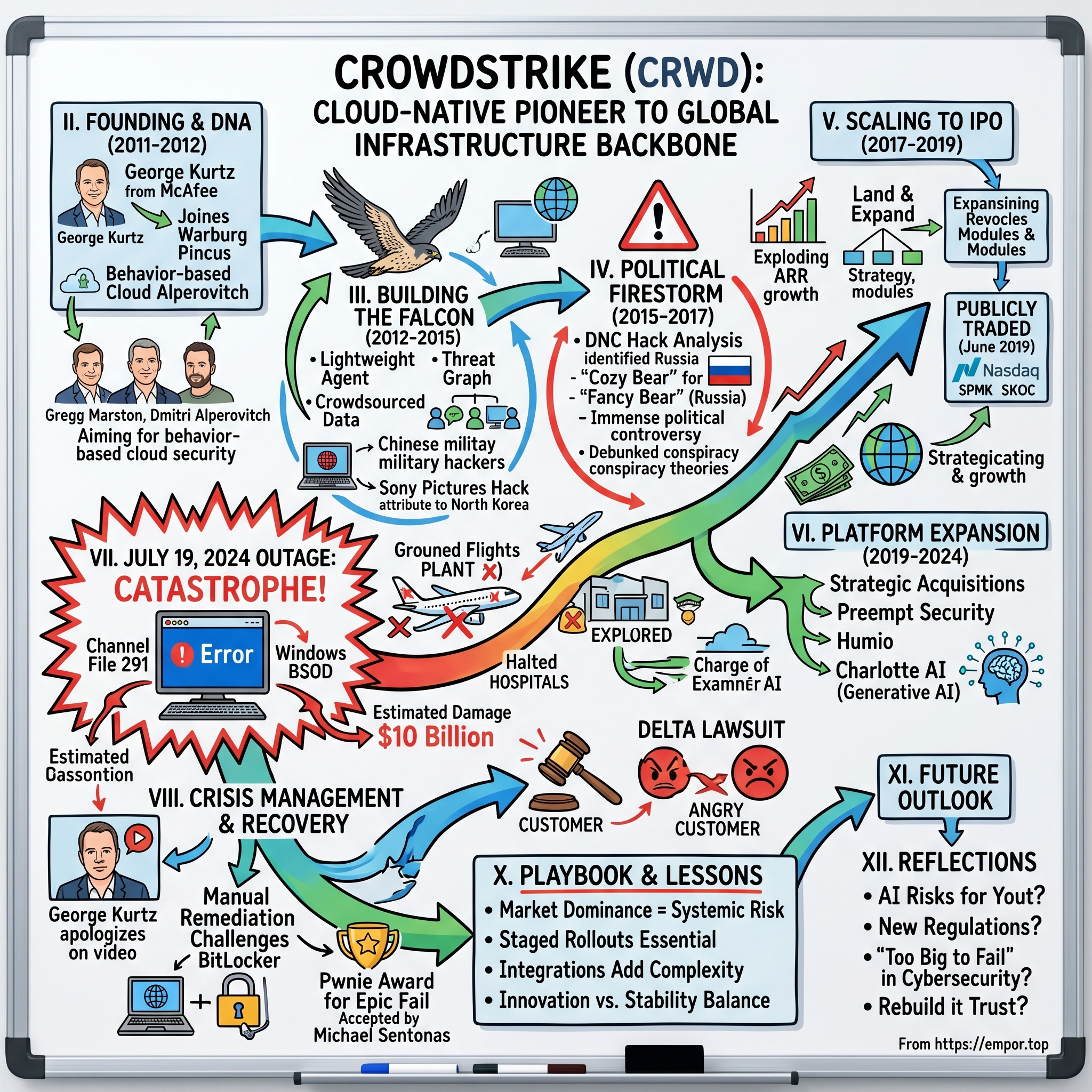
CrowdStrike: From Cloud-Native Pioneer to Global Infrastructure Backbone
I. Introduction & Episode Hook
At 04:09 Coordinated Universal Time on Friday, July 19, 2024, a file smaller than a digital photograph began propagating across the internet. It was not malware, nor was it an exploit. It was a routine configuration update — a small bundle of behavioral rules that CrowdStrike's Falcon sensor uses to recognize specific adversary tactics — signed, validated, and deployed by a leading global cybersecurity firm.
Within roughly seventy-eight minutes, it caused more operational disruption to global commerce than any cyberattack in history.
Airport departure boards in Sydney froze mid-refresh. Check-in agents at Heathrow reverted to handwritten boarding passes. Emergency dispatch centers in Alaska and Arizona lost their computer-aided dispatch consoles. Hospitals in the United Kingdom and Germany postponed elective procedures because electronic patient records failed to load. Broadcasters went dark, and point-of-sale terminals stopped processing payments. The U.S. Cybersecurity and Infrastructure Security Agency issued an emergency advisory that same day, noting that the outage was not caused by a cyberattack.1 Microsoft later estimated that roughly 8.5 million Windows devices were affected — less than one percent of the global Windows installed base, yet sufficient to disrupt major sectors of aviation, banking, healthcare, and logistics worldwide.2
The technical cause, detailed by CrowdStrike three weeks later in an external root-cause analysis, stemmed from a minor mismatch. A new "Rapid Response Content" update shipped with twenty-one input fields, whereas the sensor's Content Interpreter was programmed to expect twenty. Accessing the unexpected twenty-first field caused an out-of-bounds memory read within a kernel driver. Because a memory fault inside the Windows kernel triggers a system crash rather than a standard error notification, machines entered a Blue Screen of Death loop, crashing repeatedly upon boot due to the driver's early initialization sequence.3
Delta Air Lines alone canceled roughly 7,000 flights over five days, impacting about 1.3 million travelers, with its chief executive estimating the direct financial damage at $500 million.4 Scaling that disruption across hundreds of enterprise customers on four continents highlights the systemic operational impact, even without a single definitive global loss figure.
This reliance underscores a central business paradox. CrowdStrike is not a public utility, a telecommunications carrier, or a cloud hyperscaler; it is a subscription software vendor that generated $4.81 billion in annual revenue in its most recent fiscal year.5 Yet a single logic flaw in its update mechanism halted critical operations across three continents within hours. How an enterprise security vendor became load-bearing infrastructure for the global economy, and what that dynamic reveals about the durability and risk profile of its business model, forms the core of the company's story.
CrowdStrike's commercial value proposition depends on deep, privileged access to client operating systems, updated continuously from the cloud at machine speed. The kernel-level architecture that enables Falcon to detect and block threats in real time is the same architecture that enabled the July 19 crash. The competitive moat and the tail risk stem from the same design choice; investors evaluating the former necessarily absorb the latter.
This analysis follows five themes. First, how two former McAfee executives concluded that traditional antivirus architecture was structurally obsolete. Second, the single-sensor cloud architecture that created unit economics distinct from legacy signature-based security vendors. Third, the platform expansion strategy that expanded an endpoint protection company into cloud security, identity protection, log analytics, and AI agent security. Fourth, a critical historical pattern: the July 2024 incident was not the first global Windows outage tied to an automated content update deployed under Chief Executive George Kurtz's leadership. Fifth, the current investment landscape two years after the incident, characterized by renewed growth and stock price recovery alongside an ongoing federal accounting inquiry and high stock-based compensation.
CrowdStrike retained its core customer base following the incident, and by mid-2026, revenue growth exceeded pre-outage levels. Whether this recovery confirms a powerful economic moat or reflects the operational friction of replacing a deeply embedded kernel agent remains the key analytical question.
 Subscribe on LinkedIn
II. The Pre-History & Founding DNA: McAfee, Foundstone, and the 2010 Harbinger
To understand why CrowdStrike exists, start with a book.
In 1999, security consultant George Kurtz co-authored Hacking Exposed: Network Security Secrets & Solutions. It became an operational bible for enterprise defenders, teaching corporate IT how attackers actually think by structuring defense around the adversary's workflow rather than a vendor's product catalog. That attack-first framing would re-emerge fifteen years later as the intellectual core of CrowdStrike's Falcon platform.
The same October, Kurtz founded vulnerability-management provider Foundstone, serving as chief executive until McAfee acquired the company in October 2004.6 He remained at McAfee, rising through executive ranks to serve as executive vice president and worldwide chief technology officer from October 2009 to October 2011.6 By training, Kurtz is an accountant holding a B.S. in accounting from Seton Hall and an inactive New Jersey CPA license.6 That background enabled him to articulate technical strategy in cash-flow terms, establishing a pattern of metric-dense investor communications unusual for founder-led security companies.
The harbinger nobody remembered until 2024.
On April 21, 2010, McAfee released virus-definition update DAT 5958. The update incorrectly flagged svchost.exe — a core Windows process hosting essential system services — as the W32/Wecorl.a virus and quarantined it. Windows XP machines lost networking capability and entered continuous reboot loops, disrupting corporate fleets across North America and Europe. Technicians at universities, hospitals, and police departments spent days physically visiting individual machines with USB recovery drives.78 Although McAfee pulled the file within hours and released a remediation tool, recovery remained manual because disabled machines could no longer access the network to receive updates remotely.8
Comparing that 2010 incident with the July 2024 outage reveals striking structural parallels. Both involved a rapid content update rather than a core engine redesign, automatic validation systems that failed to detect a critical flaw, and a crash loop that severed remote administration, forcing physical IT remediation on affected devices. Kurtz served as McAfee's worldwide CTO during the 2010 incident.6
This historical record matters for a specific analytical reason. It does not indicate that Kurtz personally reviewed DAT 5958 or Channel File 291; no public evidence supports either claim, and executive oversight at major security vendors does not extend to approving routine definition files. What two independent incidents fourteen years apart under the same senior technical leadership demonstrate is that the underlying operational model — centralized, automated content distribution executed with high privileges across millions of endpoints — contains a recurring structural failure mode. Rather than an unexpected black swan event, the operational vulnerability is inherent to real-time content delivery architectures.
Why the old model had to die anyway.
The legacy antivirus model developed by vendors like McAfee, Symantec, and Trend Micro was reaching operational limits by the late 2000s. The traditional approach matched files against static signatures, operating essentially as a digital wanted-poster system. Every new malware variant required a unique signature distributed to every endpoint and scanned against local file systems. As malware creation automated and variant volume exploded, signature databases expanded rapidly. Massive definition downloads and perpetual disk scans degraded system performance, forcing IT departments to schedule scanning windows around business operations. Furthermore, signature matching could not detect novel zero-day exploits or targeted attacks that avoided writing known malware files to disk.
Additionally, legacy management infrastructure relied primarily on on-premises deployments. Each enterprise operated an isolated console, database, and intelligence repository. Threat indicators identified at one institution remained siloed, leaving the broader industry operating as a network of disconnected security environments.
The founding bet.
Kurtz departed McAfee in October 2011.6 Corporate registration moved quickly: CrowdStrike, Inc. was incorporated in Delaware in August 2011, followed by CrowdStrike Holdings, Inc. in November 2011 to acquire operating shares from Warburg Pincus funds.6 Private equity firm Warburg Pincus provided founding institutional capital, having hosted Kurtz as an executive-in-residence prior to the company's launch.9 Kurtz co-founded the business alongside chief technology officer Dmitri Alperovitch, former head of threat research at McAfee, and chief financial officer Gregg Marston, launching publicly in February 2012 from Irvine, California.
The founding thesis aimed beyond incremental antivirus improvements. Instead, CrowdStrike sought to re-architect enterprise security using cloud infrastructure: deploy a lightweight single sensor to the endpoint, offload computational analysis to a multi-tenant cloud engine, and aggregate global telemetry so threat detections on one endpoint immediately protect all clients. The company's financial filings continue to describe this architecture as establishing "a new category called the Security Cloud," drawing explicit parallels to cloud transitions in enterprise software.5
While that positioning served both strategic and marketing goals, the central operational insight was tracking adversary behavior in real time rather than scanning static files. Realizing that strategy required persuading major enterprise clients to grant a startup privileged, kernel-level access inside their primary operating systems — a significant commercial and technical hurdle at the time.
III. Building the Falcon: The Single-Agent Architecture & Early Breakthroughs (2012–2015)
In 2013, CrowdStrike faced a formidable sales pitch. As a young startup without a public track record, it asked Fortune 100 financial institutions to install a driver in Ring 0 across their Windows fleets—the innermost kernel level where the operating system resides, and where an error crashes the entire computer rather than a single application. In exchange, clients had to stream continuous telemetry back to CrowdStrike's cloud platform.
Chief information security officers routinely rejected the proposal; granting an unproven startup privileged kernel access posed an alarming operational risk.
What Ring 0 actually buys you.
A physical security analogy illustrates the architectural trade-off: user-mode software acts like a security guard patrolling a building lobby, whereas kernel-mode software functions like a monitor inside the electrical room, supervising circuits before traffic reaches the lobby. If malware attempts to inject code into another process, escalate privileges, or tamper with security controls, it must interact with core operating system functions. A kernel-resident sensor detects those actions instantaneously and can block them before execution completes. Detection speed is critical; identifying ransomware at the first encrypted file rather than the ten-thousandth marks the boundary between a contained incident and catastrophic system loss.
The cost of this vantage point is the complete loss of fault isolation. When a user-mode application crashes, only that application terminates. When a kernel-mode driver crashes, the entire operating system halts. This design choice represents the central architectural bargain of enterprise endpoint security—a trade-off CrowdStrike embraced deliberately at its inception.
Indicators of attack, not indicators of compromise.
The platform's second defining choice was conceptual. Rather than matching known file signatures against a database, Falcon evaluated whether a sequence of system behaviors signaled an ongoing intrusion. For instance, if one process spawned a second process that accessed the memory of a third before connecting to an unfamiliar external server, the activity triggered an alert regardless of whether the underlying files were previously known. CrowdStrike commercialized this approach as "indicators of attack," enabling the sensor to detect novel malware variants and fileless attacks that relied on legitimate administrative tools.
The third architectural choice tied these capabilities to unit economics: streaming telemetry into a centralized cloud database. Every process execution, network connection, and credential event across the customer base was correlated centrally. CrowdStrike's 10-K describes how the Security Cloud "enriches and correlates trillions of cybersecurity events per week," asserting that aggregated data increases platform intelligence to create "a powerful network effect."5
However, investors should evaluate this network effect carefully. Unlike Metcalfe-style communications networks where each user directly benefits from the addition of other users, CrowdStrike relies on a data-scale learning effect: broader telemetry refines detection algorithms, improving product quality to attract additional clients. This advantage experiences diminishing marginal returns, as the ten-thousandth client provides far less novel threat intelligence than the hundredth. Furthermore, scale alone is not exclusive; Microsoft, with Defender pre-installed across the global Windows ecosystem, captures larger volumes of endpoint telemetry. CrowdStrike's competitive advantage lies in the structure and contextual depth of its data analysis rather than raw telemetry volume.
The incident-response Trojan horse.
CrowdStrike overcame enterprise resistance to kernel installation through its professional services strategy rather than software sales alone.
The company established an elite incident-response consulting practice staffed by prominent digital forensics experts. When major enterprises suffered active breaches—the point at which executive risk tolerance shifts dramatically—CrowdStrike's incident response teams deployed Falcon across tens of thousands of compromised endpoints in hours to establish operational visibility.
Once the incident was remediated, clients rarely removed the sensor after gaining real-time visibility into their networks. The services unit functions structurally as a deliberate loss leader. Professional services accounted for 5 percent of revenue in fiscal 2026 and generated far thinner margins than the core software business. In its most recent quarterly results, professional services yielded $7.3 million in gross profit on $70.6 million in revenue, compared with $1.09 billion in subscription gross profit.10 Management explicitly acknowledges this strategy in regulatory filings, stating in its annual report that it views professional services "primarily as an opportunity to cross-sell subscriptions."5
This go-to-market mechanism allowed CrowdStrike to bypass enterprise trust barriers by deploying its kernel agent at the exact moment client risk aversion favored rapid intervention.
Credibility through public technical work.
Public threat research further established CrowdStrike's enterprise reputation. As nation-state cyber operations gained widespread public attention during the mid-2010s, the firm positioned itself at the center of high-profile disclosures. In November 2014, CrowdStrike attributed the destructive attack on Sony Pictures Entertainment to a North Korean state-sponsored group it designated Silent Chollima. Its analysts cited shared forensic indicators, including an identical misspelling of "security" as "secruity" in malware code used against Sony and earlier targets in South Korea.11 In May 2015, CrowdStrike researcher Jason Geffner disclosed VENOM, a critical vulnerability in the QEMU emulator's virtual floppy-disk controller dating to 2004 that allowed attackers to escape virtualized environments—a major security risk to multi-tenant cloud architecture that was patched prior to public disclosure.12
Geopolitical developments reinforced this commercial narrative. On May 19, 2014, the U.S. Department of Justice indicted five officers of Unit 61398 of China's People's Liberation Army for economic cyber-espionage targeting American industrial firms—marking the first criminal charges against state-sponsored hackers.13 The federal action elevated threat intelligence from specialized vendor marketing into a recognized strategic imperative, validating CrowdStrike's focus on tracking adversary behavior.
These early technical disclosures and high-profile breach responses established CrowdStrike's market standing, laying the groundwork for subsequent enterprise engagements that would ultimately elevate the firm to global prominence.
IV. Public Geopolitics & Brand Inflection: Sony, the DNC, and Threat Attribution (2015–2017)
On the morning of June 14, 2016, The Washington Post reported that Russian government hackers had compromised the Democratic National Committee's network. Roughly thirty minutes later, CrowdStrike published its own technical analysis.
The blog post, authored by Alperovitch, detailed two distinct Russian intrusions: one group CrowdStrike designated as COZY BEAR, present on the network since mid-2015, and a second, FANCY BEAR, which breached the environment in April 2016. Forensic telemetry indicated that the two groups operated independently and appeared unaware of each other's presence, separately harvesting identical credentials from the same systems — a pattern typical of competing intelligence services targeting the same entity without operational coordination.14 Alperovitch assigned confidence levels to the attributions rather than absolute assertions: high confidence that both were state-sponsored Russian entities, medium confidence that FANCY BEAR represented GRU military intelligence, and low confidence that COZY BEAR was affiliated with the FSB.14
Publishing calibrated confidence levels aligned with intelligence standards, but it did not buffer the firm from political fallout. CrowdStrike had stepped into the center of a U.S. presidential campaign.
The firestorm.
The aftermath transformed the firm's profile beyond typical corporate security disclosures. CrowdStrike became a recurring focal point in partisan political debate, most prominently in July 2019 when a conspiracy theory regarding a physical DNC server allegedly retained by the company surfaced during a presidential phone call that became central to federal impeachment proceedings. The claim was unfounded — CrowdStrike conducted its forensic analysis using cloud software telemetry rather than seizing physical server hardware — but the company spent years addressing the misconception, including publishing a detailed accounting of the investigation.14
For investors evaluating operational performance, the critical question is whether political controversy impaired commercial execution. Financial metrics from the period indicate that enterprise demand remained unaffected.
Chief information security officers and security operations teams select endpoint security platforms based on detection accuracy, low false-positive rates, minimal agent overhead, enterprise integrations, and operational reliability. Disclosed metrics show no evidence that political debate slowed customer acquisition or expansion. In the fiscal year ended January 31, 2019 — following the peak of public election coverage — CrowdStrike reported a dollar-based net retention rate of 147%, indicating that existing customer cohorts expanded their annual spending by nearly half.6 Revenue over consecutive fiscal years grew 125% and 110% year over year.6 Enterprise purchasing decisions remained tied to software performance rather than public media coverage.
The intelligence-driven brand effect.
The primary commercial benefit of the high-profile disclosures emerged through threat intelligence as a credentialing asset. CrowdStrike's adversary naming convention — assigning designations like BEAR for Russia, PANDA for China, CHOLLIMA for North Korea, KITTEN for Iran, and SPIDER for cybercrime operators — established an industry vocabulary adopted across enterprise security operations centers. This widespread usage created durable brand mindshare. When corporate boards sought expert intervention for suspected nation-state intrusions, CrowdStrike stood on a short list of qualified vendors, having established technical authority through public research rather than conventional marketing.
Where the credibility claim requires a caveat.
While management's handling of the DNC investigation demonstrated analytical rigor, forensic thoroughness does not guarantee software engineering reliability. The technical attributions published in 2016 withstood external scrutiny, and the firm maintained measured public communications. However, forensic discipline in incident response represents a different operational capability than quality control in kernel-level software release pipelines. Rigorous reporting in threat research operates under different workflow incentives than real-time sensor deployment — an operational boundary highlighted by the July 2024 update failure.
By 2017, CrowdStrike had established its core foundation: a single-agent cloud architecture, enterprise brand recognition, and a consulting practice that converted incident responses into long-term subscriptions. What remained was scaling that platform across the broader enterprise market.
V. Scaling to the Public Markets: The Hyper-Growth Machine & 2019 IPO
CrowdStrike's financial expansion between fiscal 2017 and fiscal 2019 demonstrated rapid enterprise scaling. In the fiscal year ended January 31, 2017, the company generated $52.7 million in total revenue. Two years later, in fiscal 2019, revenue reached $249.8 million, reflecting consecutive annual growth rates of 125 percent and 110 percent. Subscription revenue expanded even faster over the same period, rising from $37.9 million to $219.4 million, while annual recurring revenue climbed from $58.8 million to $141.3 million and eventually surpassed $300 million.6
The composition of this revenue growth provided a key analytical signal. A dollar-based net retention rate of 147 percent indicated that expansion was driven primarily by existing clients increasing their spending—deploying the sensor across additional endpoints and adopting new software modules as the platform broadened.6 This land-and-expand dynamic reduced customer acquisition costs and enabled CrowdStrike to present public investors with a growth model based on deepening customer relationships rather than relying exclusively on winning market share from legacy vendors.
The competitive landscape at the moment of listing.
The endpoint security market in 2019 was undergoing an architectural transition. Legacy incumbents—including Symantec, McAfee, and Trend Micro—were losing enterprise market share because their signature-based products required heavy local agents and on-premises management consoles, just as enterprise workloads migrated to public cloud environments like Amazon Web Services and Microsoft Azure. At the same time, competing next-generation vendors were being acquired: BlackBerry purchased Cylance, and VMware acquired Carbon Black, absorbing two independent competitors into larger corporate entities with broader operational priorities. SentinelOne remained private and smaller in enterprise scale.
This industry consolidation positioned CrowdStrike at its public listing as the largest independent, pure-play cloud-native endpoint security vendor operating at enterprise scale—a distinct market position that attracted strong investor interest.
June 12, 2019.
The initial public offering reflected robust market demand. CrowdStrike initially targeted a price range of $19 to $23 per share, raised the expected range to $28–$30 based on investor interest, and ultimately priced 18 million shares at $34 per share—above the revised range.15 The offering raised $612 million at an initial market valuation of approximately $6.69 billion, marking the largest public listing for a cybersecurity company to that date.1617 On its first day of trading on June 12, 2019, the stock closed up roughly 71 percent near $58 per share, valuing the company at nearly $14 billion—a sharp first-day increase that reflected high investor demand while indicating substantial uncaptured capital that could have accrued to the corporate balance sheet.16
Governance: the structure, and what happened to it.
CrowdStrike completed its public listing using a dual-class share structure common among technology firms. Class A shares carried one vote per share, while Class B shares carried ten votes per share and were convertible one-for-one into Class A stock.6 At listing, this structure concentrated voting power among executive leadership and early venture investors, including Warburg Pincus and Accel.
That governance arrangement subsequently sunsetted. On December 11, 2024, all outstanding Class B shares automatically converted into Class A shares pursuant to provisions in the corporate charter.5 In its annual filing for the fiscal year ended January 31, 2026, the company reported zero remaining holders of record of Class B stock.5 Every common share carries one vote.
This collapse into a single-class equity structure altered CrowdStrike's governance framework. The conversion occurred in December 2024, less than five months after the July 2024 outage, granting public shareholders equal voting rights during a period of heightened regulatory, legal, and reputational scrutiny. While post-outage derivative lawsuits against officers and directors were ultimately dismissed, the single-class structure shifted corporate accountability mechanisms directly to shareholder proxy voting.10
The capital raised in the 2019 public offering provided CrowdStrike with the financial capacity to execute its next strategic phase: acquiring specialized engineering teams and integrating their software capabilities into the Falcon platform.
VI. Platformization & The M&A Flywheel: Building the 30-Module Ecosystem (2019–2024)
Enterprise cybersecurity historically suffered from a recurring operational bottleneck. Large organizations frequently acquired separate, specialized tools for endpoint detection, cloud security posture, identity protection, log management, vulnerability scanning, and SaaS configurations. Each tool required its own endpoint agent, management console, data schema, and alert format. Over time, security teams were forced to manage dozens of disparate consoles while multiple agents competed for system resources on client endpoints—making cross-domain threat tracking across credentials and cloud accounts difficult to achieve.
CrowdStrike addressed this operational complexity by aligning its acquisition strategy with platform consolidation: acquire specialized capabilities and integrate them directly into its existing sensor and unified data model, delivering new capabilities as software modules rather than additional software agents.
The deals, and what they actually returned.
The acquisition pattern began with Payload Security in 2017, which brought automated malware analysis technology that became Falcon Sandbox. That acquisition established a template for subsequent strategic transactions.
Preempt Security, acquired for approximately $96 million in September 2020, provided conditional-access and identity-threat detection capabilities that formed Falcon Identity Protection.18 By the second quarter of fiscal 2027—the three months ended July 31, 2026—the identity business generated $585 million in annual recurring revenue (ARR), up 34 percent year over year.19 Relative to its sub-$100 million purchase price, the transaction yielded strong capital returns, providing clear evidence of CrowdStrike's capability to convert acquired technology into subscription revenue.
Humio, acquired for approximately $400 million in February 2021, presented a longer integration timeline.20 Humio provided a high-throughput log-management engine designed to target the security information and event management (SIEM) market—a category long dominated by Splunk—by lowering log ingestion costs so organizations could centralize telemetry. Humio was initially released as Falcon LogScale before being re-architected into Next-Gen SIEM. By the quarter ended July 31, 2026, that business reached $695 million in ARR, up 60 percent year over year, making it the fastest-growing pillar in the company's portfolio.19
Three subsequent acquisitions filled targeted category gaps: Bionic in 2023 for application security posture management, Flow Security in March 2024 for data security posture management, and Adaptive Shield in November 2024 for SaaS security posture management. CrowdStrike's financial reporting combines smaller transaction costs in aggregate rather than detailing individual deal terms; for instance, the fiscal 2025 cash-flow statement lists $310.3 million in business acquisitions net of cash acquired, covering Flow Security and Adaptive Shield together.5 Because purchase accounting disclosure is required only for material acquisitions, investors cannot independently calculate returns on smaller individual transactions from regulatory filings alone.
The land-and-expand engine, and a disclosure wrinkle.
Management historically used customer module adoption metrics to demonstrate platform consolidation. As of July 31, 2024—the quarter during which the global outage occurred—65 percent of subscription customers deployed five or more modules, 45 percent used six or more, and 29 percent used seven or more.21 By January 31, 2025, those adoption metrics expanded to 67 percent for five or more modules, 48 percent for six or more, 32 percent for seven or more, and 21 percent for eight or more.22
In the fourth quarter of fiscal 2026, CrowdStrike modified its disclosure methodology. The company began reporting adoption metrics on a customer base that excluded Falcon Go, its entry-level small-business offering, while presenting adoption figures for six-plus, seven-plus, and eight-plus modules at 50 percent, 34 percent, and 24 percent, respectively.23 While excluding small-business accounts buying fewer modules provides a clearer view of enterprise platform depth, the redefinition altered a primary performance indicator during a period of heightened market scrutiny, rendering the revised figures non-comparable to historical disclosures.
Falcon Flex: the commercial innovation that mattered more than any acquisition.
Beyond software acquisitions, CrowdStrike introduced a structural shift in its commercial licensing model. Known as Falcon Flex, the contract structure allows customers to commit to an upfront financial pool and draw down against it across any module as security priorities evolve.10 For clients, this structure reduces the procurement friction of negotiating separate module licenses. For CrowdStrike, it expands initial deal sizes and creates a built-in mechanism for contract expansion when clients exhaust allocations early—a motion management terms "reflexing."
Financial results demonstrate rapid market adoption of this licensing model. Flex accounts ended fiscal 2026 with $1.69 billion in ARR, representing year-over-year growth of more than 120 percent across more than 1,600 accounts.23 By the quarter ended July 31, 2026, Flex ARR expanded to $2.29 billion, up 101 percent year over year.19 Disclosures on customer usage further illustrate consumption patterns: during the fourth-quarter fiscal 2026 earnings call, management noted that over 380 accounts expanded their commitments within seven months at an average ARR uplift of approximately 26 percent, while roughly 100 accounts reflexed multiple times, generating an additional 48 percent ARR increase.24
These metrics demonstrate that enterprise clients frequently consume their Flex allocations faster than originally budgeted. However, while rapid consumption aligns with platform consolidation demand, it also reflects a structure that incentivizes upfront commitments. In its quarterly regulatory filings, CrowdStrike explicitly cautions that if customers fail to fully utilize their subscription allocations, "including in connection with our flexible subscription offering," they may renew with shorter terms, fewer modules, or lower contract values, thereby compressing net retention rates.10 The rapid growth in Flex licensing carries an underlying renewal risk that balances headline expansion figures.
Index inclusion, and what it did and did not mean.
On June 7, 2024, S&P Dow Jones Indices announced that CrowdStrike would join the S&P 500 index prior to the market open on June 24, replacing Comerica.25 Reaching S&P 500 benchmark status five years after its initial public offering represented a significant corporate milestone, driving mechanical demand from index-tracking funds. However, inclusion also meant that six weeks later, when the Falcon sensor update disrupted enterprise operations worldwide, CrowdStrike was a core index constituent held broadly across institutional and retail investment portfolios.
VII. The July 19, 2024 Outage: Anatomy of a Catastrophe & The Systemic Risk Paradox
The update that triggered the outage was, in intent, entirely routine — and understanding its routine nature underscores the underlying operational risk.
CrowdStrike's sensor receives two distinct categories of updates. Sensor Content ships with the core software engine and undergoes full software release procedures. Rapid Response Content, by contrast, consists of dynamic configuration data rather than executable code, designed to deliver updated threat detection rules to clients within hours of observing a novel adversary tactic. That rapid deployment capability offers a significant commercial advantage, allowing security operations across millions of endpoints to adapt to emerging threats in real time.
The July 19 update aimed to enhance detection of an attack technique involving named pipes — a Windows inter-process communication mechanism frequently exploited for command-and-control activity. However, the template governing this detection module had been designed to accept twenty-one input fields, whereas the Content Interpreter inside the sensor was programmed to expect only twenty. Because no previous content update had utilized the twenty-first field, this architectural mismatch remained hidden within the codebase.
When Channel File 291 deployed with content referencing that twenty-first parameter, the interpreter attempted to read beyond the end of its allocated memory structure. In user-mode applications, an out-of-bounds memory read typically terminates only the affected program. Within a kernel-level driver, however, reading invalid memory triggers an unrecoverable operating system crash. A logic flaw in CrowdStrike's Content Validator — the automated verification gate designed to intercept malformed files before distribution — permitted the flawed update to pass through to client systems.3
The remediation CrowdStrike published was correspondingly specific: updating the Content Validator to enforce wildcard matching on the twenty-first field, introducing runtime bounds checks into the interpreter, and correcting the input count defined by the template.3 The straightforward nature of these fixes highlighted a fundamental quality-assurance breakdown; the outage stemmed not from a novel computer science problem, but from an absent bounds check and inadequate pre-deployment validation.
Why nothing could be fixed remotely.
The secondary operational failure compounded the initial code defect. Because the kernel crash occurred during early system boot, affected endpoints blue-screened before network interfaces initialized. Deprived of network connectivity, crashing devices could not receive remote updates. Although CrowdStrike released a corrected configuration file within approximately seventy-eight minutes, the quick fix was ineffective for devices locked in a local boot loop.3
Remediation required physical intervention on every affected machine: booting into Safe Mode, manually navigating to the CrowdStrike drivers directory, deleting the corrupted file, and restarting the operating system. For enterprise environments enforcing BitLocker full-disk encryption, entering Safe Mode required a 48-digit recovery key. Complicating matters, many corporate key-management servers had also crashed, creating a circular dependency where IT teams needed encryption keys stored on systems rendered inaccessible by the outage.
This bottleneck transformed a software bug into a widespread economic event. Financial losses mounted because recovery required manual labor per device rather than automated remote updates. Organizations managing tens of thousands of geographically dispersed endpoints — such as airlines operating gate terminals and crew-scheduling systems across hundreds of airports — faced protracted operational delays compared to firms with centralized IT infrastructure. This physical recovery constraint explains why Delta Air Lines experienced five days of operational paralysis involving approximately 7,000 canceled flights, whereas peers with different deployment topographies restored normal operations faster.4
The concentration paradox.
The incident exposed a central structural paradox inherent to vendor consolidation across enterprise security.
The strategic imperative driving platform adoption — deploying a single vendor's agent across every enterprise endpoint — creates systemic concentration risk. When a dominant provider achieves pervasive deployment across Fortune 500 networks, its architecture inevitably becomes a single point of failure for critical global infrastructure. Systemic operational risk is not an unintended glitch in vendor consolidation; it is a direct structural consequence of market consolidation.
Regulators and platform operators responded rapidly. Microsoft, whose flagship operating system absorbed significant public criticism following the failure of a third-party driver, began evaluating structural changes to kernel access privileges for independent security software. Over the subsequent two years, potential restrictions on kernel access emerged as a critical variable in evaluating CrowdStrike's long-term moat and architecture.
Before confronting those long-term architectural shifts, however, CrowdStrike faced the immediate challenge of managing customer retention, financial liability, and brand recovery in the ninety days following the crisis.
VIII. Crisis Response, Customer Commitment Packages, & Management Credibility Test
Just seven weeks after CrowdStrike joined the S&P 500, the company's president stood on a stage in Las Vegas at DEF CON — the world's largest annual hacker conference — to accept the Pwnie Award for Most Epic Fail.
Michael Sentonas did not send a video message. He collected the trophy in person, told the room that winning it was "definitely not the award to be proud of receiving," said his own team had been surprised he came "because we got this horribly wrong," and announced that the trophy would go on display at CrowdStrike's headquarters as a permanent reminder to employees.26 The audience cheered him.
That gesture proved strategically significant. Security is a trust-based market, and the technical community that evaluates security vendors is notoriously resistant to corporate spin while responding to visible personal accountability. Sentonas converted an institutional humiliation into a credibility deposit. Executive leadership had set the tone within hours of the outage, apologizing publicly rather than issuing a lawyer-drafted holding statement.
The formal accounting to government.
The corporate-affairs version came on September 24, 2024, when Adam Meyers, CrowdStrike's senior vice president for counter adversary operations, testified before the House Homeland Security Subcommittee on Cybersecurity and Infrastructure Protection at a hearing titled "An Outage Strikes."27 Meyers accepted responsibility without qualification and delivered the line that survived the hearing: "Trust takes years to make and seconds to break, and we understand that we broke trust and that we need to work to earn it back."28
The substantive commitments mattered more than the contrition. CrowdStrike moved Rapid Response Content through standard software-development lifecycle procedures rather than treating it as configuration exempt from full testing; added runtime bounds checks; introduced staged, ringed deployment so that content reaches a small canary population before general release; commissioned independent third-party reviews of the sensor architecture; and — the change customers had requested for years — gave enterprises granular control to defer, stage, and test content updates on their own schedule rather than accepting whatever updates the vendor pushed.328
Note the commercial cost buried in that last commitment. Handing customers the ability to delay updates degrades the core capability that made Rapid Response Content valuable. CrowdStrike traded some of its speed advantage for reliability because it had no choice, creating a permanent operational shift since enterprise clients are unlikely to relinquish control.
Customer Commitment Packages: what was actually disclosed.
The retention strategy was straightforward in concept and expensive in practice. CrowdStrike offered affected customers what it called customer commitment packages — discounts, additional modules, professional services, flexible payment terms, and subscription-period extensions.10
The disclosed financial mechanics deserve precision, as they are often described loosely. On August 28, 2024, when the company reported its first post-outage quarter, guidance for the remainder of fiscal 2025 included an estimated $30 million subscription-revenue impact in each remaining quarter from these incentives, plus a high-single-digit-million impact to professional services revenue in the second half.21 That represents the disclosed figure — roughly $60 million of subscription revenue across the back half of the year, rather than a headline ARR write-down.
The deeper cost appeared in the growth trajectory. Net new ARR for fiscal 2025 dropped to $806.7 million.5 Fiscal 2026 recovered to $1.01 billion — marking the company's first billion-dollar net new ARR year — leaving the outage year as a visible trough in the series.529 Customer retention held firm: management reported gross retention of 97 percent through fiscal 2026, indicating that client churn remained minimal.23
The most important fact about these commitment packages, however, is that they continue to affect financial results. The quarterly report filed on August 27, 2026 — more than two years after the incident — states that commitment packages "have resulted, and are expected to continue to result, in increased contraction, due to elongated subscription terms, and decreased upsell dollar values," and that sales cycles "may be elongated in future periods."10 That is management's own language in a regulatory filing, directly countering claims that the outage is fully behind the business. The financial mechanism is direct: a customer granted a two-year extension at a fixed price cannot be upsold at renewal because the renewal date has been deferred.
Litigation and regulatory overhang.
The legal exposure has resolved substantially in CrowdStrike's favor — an important and frequently underappreciated development.
Delta Air Lines filed suit in Fulton County, Georgia on October 25, 2024, alleging computer trespass, breach of contract, fraud by omission, product defect, gross negligence, and deceptive practices, and CrowdStrike countersued the same day, arguing Delta had refused offered assistance and that its slow recovery reflected its own IT infrastructure.30 On May 16, 2025, the court granted CrowdStrike's motion to dismiss in part — striking the fraud, product-liability, and deceptive-practices claims while allowing gross negligence and computer trespass to proceed to discovery.1031 The practical effect is that the contractual liability cap in the subscription agreement is likely to govern damages, pointing toward single-digit millions rather than the $500 million Delta had publicized.31 For context on the underlying dispute, Delta separately disclosed an expected revenue impact of roughly $380 million from the outage.32
The consumer class action fared worse for plaintiffs: dismissed by the district court in June 2025, affirmed by the Fifth Circuit on May 20, 2026, with rehearing denied on June 15, 2026.10 Three separate sets of shareholder derivative suits were dismissed between March and April 2026.10
The primary unresolved risk stems not from outage litigation, but from a disclosure in the current quarterly report. The filing notes that the company "has received requests for information from the U.S. Department of Justice and the U.S. Securities and Exchange Commission relating to the Company's recognition of revenue and reporting of ARR for transactions with certain customers, the July 19 Incident and related matters."10 That inquiry traces to reporting in February 2025 that federal investigators were examining a $32 million transaction booked through reseller Carahsoft on the last day of a fiscal quarter for identity software destined for the Internal Revenue Service — products the IRS stated it never purchased or received.3334 Investigators reportedly interviewed former employees regarding pre-booking and channel-stuffing practices and reviewed Sarbanes-Oxley compliance questionnaires, while CrowdStrike has stated it stands by its accounting of the transaction.3334
While no charges have been brought and no restatements have occurred, an open federal inquiry into revenue recognition and ARR reporting represents a significant unresolved risk for the company, given that annual recurring revenue serves as the foundational metric for its valuation.
IX. Competitive Dynamics, Industry Structure & Helmer's 7 Powers Analysis
Comparing the cybersecurity competitive landscape of 2019 to that of mid-2026 reveals a fundamental structural shift. The standalone endpoint security market that CrowdStrike once dominated has effectively dissolved. In its place stands a three-way platform war where competitors compete not for individual product lines, but for consolidated enterprise security budgets.
Palo Alto Networks: the scale competitor.
Palo Alto Networks has pursued platform consolidation aggressively through large-scale acquisitions. In its fiscal fourth quarter ended July 2026, Palo Alto reported next-generation security annual recurring revenue of $9.10 billion, up 63 percent year over year, with total quarterly revenue reaching $3.41 billion, up 34 percent. The company added nearly $1 billion in net new next-generation security ARR in a single quarter and recorded approximately 220 net new platformization deals.35 On the surface, these headline figures significantly exceed CrowdStrike's metrics.
However, the comparison warrants context. Palo Alto closed its approximately $25 billion acquisition of identity-security vendor CyberArk on February 11, 2026, integrating the company into its Cortex and Strata platforms.36 A 63 percent ARR growth rate fueled by a $25 billion transaction reflects inorganic expansion rather than CrowdStrike's organic and tuck-in growth trajectory. Where Palo Alto buys platform consolidation, CrowdStrike relies primarily on internal development and targeted acquisitions. Each strategy presents distinct risks: Palo Alto faces integration friction and goodwill impairment, while CrowdStrike risks a slower pace of capability expansion.
Tactically, competition centers on security operations centers. Palo Alto's Cortex XSIAM competes directly against Falcon Next-Gen SIEM, with Palo Alto frequently offering financial incentives to buy out client contracts from incumbents. CrowdStrike counters with an architectural pitch emphasizing a single kernel agent, unified console, and shared data model, contrasting its approach against a multi-agent portfolio assembled through major acquisitions. The long-term validity of that position depends on how effectively Palo Alto integrates CyberArk and Chronosphere over the coming years.
Microsoft: the structural threat that changed shape.
Microsoft poses a structural challenge by pre-installing Defender within Windows and bundling its enterprise tier into E5 licenses, enabling it to offer endpoint security at virtually zero marginal cost to existing productivity software customers. Although this threat has served as a central bearish argument since CrowdStrike's initial public offering, it has not halted CrowdStrike's expansion, as evidenced by reaccelerating revenue growth through fiscal 2026 and fiscal 2027 alongside widespread Defender availability.
A more consequential post-outage development involves system architecture rather than pricing. Following the July 2024 outage, Microsoft convened security software providers and introduced the Windows Resiliency Initiative, which included a framework enabling antimalware applications to operate outside the kernel in user mode.37 Microsoft subsequently delivered a private preview of the platform to industry partners, with CrowdStrike participating in the initiative and publicly stating that it met the new standards while remaining committed to shipping a compliant product.38
This shift presents two distinct strategic implications. If Microsoft eventually mandates user-mode execution for all third-party security software, CrowdStrike would lose a historical technical differentiator: privileged kernel access. However, because such a requirement would apply equally across all independent vendors—including SentinelOne and Trend Micro—the architectural change would not uniquely disadvantage CrowdStrike. Instead, it would shift competitive differentiation from kernel access to data scale, detection accuracy, and platform breadth, where CrowdStrike maintains an established market position.
The critical long-term test remains whether Microsoft restricts third-party kernel access while retaining privileged access for Defender. An industry-wide mandate shifting all vendors to user mode represents a manageable operational transition, whereas asymmetric kernel restrictions would introduce structural competition issues and potential antitrust scrutiny.
SentinelOne: the scale gap widens.
SentinelOne represents CrowdStrike's closest pure-play architectural peer and illustrates the competitive impact of scale. For the quarter ended July 31, 2026, SentinelOne reported annual recurring revenue of $1.218 billion, up 22 percent year over year, with quarterly revenue of $292 million, up 21 percent, and net new ARR of $56 million.39 By comparison, CrowdStrike reported $5.84 billion in ARR and $332.8 million in net new ARR for the identical quarter.1019 In three months, CrowdStrike added nearly six times as much new recurring revenue as SentinelOne, despite operating from a base nearly five times larger.
This widening gap provides an empirical test of enterprise switching costs. The July 2024 outage created optimal conditions for customer migration to a well-capitalized competitor marketing directly into the disruption. That SentinelOne failed to capture material market share during this window demonstrates the durability of CrowdStrike's enterprise retention.
Helmer's 7 Powers, applied honestly.
High switching costs represent CrowdStrike's most formidable strategic advantage, as highlighted by customer behavior following the 2024 incident. Replacing the Falcon sensor across an enterprise fleet requires re-verifying threat detection coverage, coordinating system reboots, retraining security operations staff on alternative management consoles, rebuilding automation playbooks, and accepting temporary visibility gaps during migration. Maintaining a 97 percent gross retention rate through fiscal 2026 despite severe operational disruption underscores the friction involved in migrating away from the platform.23
Scale economies provide a compounding operational benefit. CrowdStrike directed $1.38 billion to research and development in fiscal 2026 on total revenue of $4.81 billion.5 Competitors operating from smaller revenue bases cannot match this absolute research budget, enabling CrowdStrike to expand into adjacent software categories faster than pure-play rivals can respond.
Data-driven network effects remain functional but bounded, as aggregated threat intelligence improves detection algorithms, though Microsoft commands similar data scale across its enterprise footprint.
Conversely, counter-positioning—once CrowdStrike's core advantage over legacy incumbents tied to on-premises management infrastructure—has diminished as enterprise security competitors have transitioned to cloud-native architectures.
Branding yields mixed effects: CrowdStrike maintains strong recognition in adversary threat intelligence alongside heightened public visibility from the 2024 outage. Neither cornered resources nor proprietary process power provides a primary competitive moat.
Porter, briefly, where it bites.
An evaluation of Porter's Five Forces highlights several persistent pressures. Buyer power increased significantly following the July 2024 outage and has not fully normalized, as evidenced by ongoing commitment-package disclosures in fiscal 2027 filings.10 The threat of substitution from Microsoft's licensing bundles remains a permanent structural factor. Competitive rivalry is intense, characterized by large-scale peers capable of executing multi-billion-dollar consolidations. Supplier power remains low, with software engineering talent serving as the primary operational input compensated substantially through stock-based equity. While the threat of new entrants is low at the overall platform level, it remains high for specialized software modules—such as AI security and data posture management—driving CrowdStrike's continued acquisition of specialized startups.
Overall, CrowdStrike occupies a defensible competitive position, though its underlying advantage has evolved over the past three years from kernel-level technical differentiation toward enterprise scale and distribution efficiency.
X. Strategic Positioning, Financial Engine, & The Investment-Story Spine (Why Win / Why Not)
The people running it.
George Kurtz remains co-founder, president and chief executive — one of a small number of enterprise-software founders still running the company at a $5-billion-plus ARR scale. His public persona is unusually technical for a CEO of this size; he still discusses sensor architecture and adversary tradecraft in detail on earnings calls rather than delegating it. He also races cars competitively, which is either irrelevant or a useful tell about risk appetite, depending on how much stock one puts in such things.
Burt Podbere has been chief financial officer through the entire public-company era, which by the standards of high-growth software is a long tenure and a genuine continuity asset. His financial signature is the balance between growth and cash generation: fiscal 2026 delivered what management characterised as a "Rule of 40" score of 47, combining 22% revenue growth with a 26% free-cash-flow margin.23
Michael Sentonas, as president, owns product and technology and has become the company's most visible technical voice on the outage and its remediation.
The engine, and what the two sets of books say.
CrowdStrike's financial profile requires holding two facts at once, and most commentary picks one.
The cash story is excellent. Fiscal 2026 produced $1.61 billion of operating cash flow and $1.235 billion of free cash flow, a 26% margin, and the first half of fiscal 2027 generated $1.12 billion of operating cash flow — up 56% year over year.51023 Deferred revenue of $4.84 billion across current and non-current balances at July 31, 2026 means customers pay substantially in advance, so the business funds its own growth.10 The balance sheet carries $746 million of long-term debt against several billion in cash and equivalents.10 There is no refinancing risk and no funding constraint on strategy.
The GAAP story is not excellent. Fiscal 2026 produced a loss from operations of $293.3 million and a net loss of $161.2 million on $4.81 billion of revenue — a wider loss than fiscal 2025's $116.4 million operating loss, and a reversal from the $73.4 million of net income the company earned in fiscal 2024.5 The reconciling item is not subtle: stock-based compensation was $1.098 billion in fiscal 2026, up from $861.4 million, equal to roughly 23% of revenue.5 In the most recent quarter it ran at $376.9 million on $1.47 billion of revenue — about 26%.10
State the conclusion plainly, because it is the crux of the valuation debate. CrowdStrike's free cash flow is real cash, but a substantial part of the compensation cost of producing it is paid in shares rather than cash, and that cost is excluded from every non-GAAP metric management leads with. Share count rose from roughly 996 million weighted-average diluted shares in the July 2025 quarter to about 1.044 billion a year later — call it 4-5% annual dilution, partly offset by employee stock purchase inflows.10 The company began buying back stock, repurchasing $150.6 million of shares at an average of $364.57 (pre-split) after the fiscal 2026 fourth quarter and expanding total authorisation to $1.5 billion on April 6, 2026.40 Podbere framed the purchases as exploiting "a growing disconnect between our improving momentum fueled by AI tailwinds and our current valuation."40
That was, on the evidence since, a well-timed call — but note the scale. A $1.5 billion authorisation against roughly $1.1 billion of annual stock compensation is not a programme that shrinks the share count. It is a programme that partially slows dilution. Investors should treat it as compensation-offset spending, not capital return. The company also executed a four-for-one stock split effective July 2, 2026, which changes nothing economically but tells you something about how management reads retail demand.41
Where the growth is actually coming from.
The three "emerging pillar" businesses that management has tracked since fiscal 2025 crossed $1.3 billion of combined ARR that year and exceeded $1.9 billion by the end of fiscal 2026.2223 In the most recent quarter, cloud security stood at $905 million growing 29%, next-generation SIEM at $695 million growing 60%, and identity at $585 million growing 34% — with a fourth line, AI detection and response, nearly tripling sequentially off a small base.19 That last line did not come from internal development: CrowdStrike bought telemetry-pipeline startup Onum in September 2025 and AI-security vendor Pangea for roughly $260 million later the same month, completing the Pangea deal on September 26, 2025 and launching AI detection and response on top of it.542
The honest read on that mix: SIEM is the star and the most defensible strategic prize, because log ingestion creates the deepest data gravity in a security stack and puts CrowdStrike directly against Splunk (now inside Cisco), Palo Alto and Datadog in a market far larger than endpoint. Cloud security decelerating to 29% is the softest number in the set and worth watching, because cloud-native application protection is the category where competition is fiercest and where Palo Alto's Prisma franchise is strongest.
Charlotte AI, the generative assistant layer, remains an attach-rate and pricing lever rather than a disclosed revenue line. On the fiscal 2026 fourth-quarter call, management said Charlotte usage rose more than sixfold year over year with ARR more than tripling, and described eleven security agents operating alongside human analysts.24 Growth rates on undisclosed bases are the weakest form of evidence in enterprise software, and investors should treat them accordingly until a dollar figure appears.
Why win.
The affirmative case rests on three things that are supported by evidence rather than assertion. Buyers are genuinely consolidating, and Flex commitment behaviour — customers exhausting commitments early and expanding, repeatedly — is direct behavioural proof rather than survey data.24 Switching costs were tested under the most adverse possible conditions and held at 97% gross retention.23 And the cash engine is large enough to fund roughly $1.4 billion of annual R&D plus a billion dollars of acquisitions in a single half-year without external capital.510
Why not.
The negative case is equally concrete. GAAP profitability remains negative and the gap is compensation paid in equity. Commitment packages are still suppressing upsell two years on, by management's own written admission.10 The DOJ and SEC inquiry into revenue and ARR recognition is unresolved and strikes at the credibility of the headline metric.1033 The Windows architectural transition is outside the company's control. And the valuation embeds a great deal: the shares roughly doubled between the post-earnings selloff of March 2026 — when the company was buying back stock at an average of $364.57 pre-split, calling its own valuation disconnected from momentum — and the late-2026 highs, which leaves very little room for a growth stumble.40
The KPIs that actually matter.
Three, and only three, are worth tracking closely. First, net new ARR per quarter — the cleanest single read on demand, competitive position and the residual drag from commitment packages, and the metric that turned negative in growth terms during the outage year before recovering to a record $332.8 million in the July 2026 quarter.10 Second, dollar-based net retention, which measures whether the land-and-expand engine still works after Flex changed the contract structure; it improved from 112% in the first quarter of fiscal 2026 to 115% by year-end and improved again sequentially in the most recent quarter.1023 Third, stock-based compensation as a percentage of revenue, which determines whether free cash flow eventually converts into GAAP earnings or remains permanently subsidised by shareholders.
XI. Historical Falsification Pass & Skeptical Investor Stress Test
Every investment thesis relies on a series of core claims. A rigorous analytical pass tests those claims against the company's historical record, identifying the strongest counter-evidence to determine which premises withstand scrutiny.
Claim 1: Kurtz's technical stewardship is a durable execution advantage.
The strongest disconfirming evidence is the pairing already established: an automated content update disrupting Windows fleets globally in April 2010 during his tenure as McAfee's worldwide chief technology officer, and an automated content update causing a global Windows outage in July 2024 under his leadership as CrowdStrike's chief executive.7836 Fourteen years apart, both events involved the same failure class, architectural cause, and recovery bottleneck.
Evaluating that record requires several nuanced considerations. The 2010 incident occurred at a different company with a different engineering organization, and executive leadership at a firm of McAfee's size does not directly review individual definition files. The 2024 outage was remediated through specific, verifiable engineering safeguards, and CrowdStrike subsequently operated for more than two years without a recurrence.310 Furthermore, content-update failures have affected other endpoint vendors over time, though none at a comparable global scale.
Verdict: the historical record does not reject the claim entirely, but it narrows it significantly. The evidence indicates that George Kurtz excels at building category-defining products and managing crisis recovery, rather than establishing fault-tolerant release pipelines. The forward falsification test is straightforward: any subsequent customer-impacting kernel fault caused by a content update, regardless of scale, would confirm a recurring structural vulnerability and undermine the execution thesis far more severely than the 2024 incident alone.
Claim 2: Kernel-level access is an unassailable technical moat.
This claim is substantially disproven by historical evidence, with the strongest counter-proof stemming from CrowdStrike's own strategic adjustments. Microsoft developed a user-mode endpoint security framework in direct response to the July 2024 outage, releasing it in private preview to industry partners; CrowdStrike joined the program and publicly confirmed it met the new architectural standards.3837 A vendor does not engineer compliant software for an environment it believes would render its protection ineffective.
A more realistic assessment acknowledges that while kernel access provided an initial latency and enforcement advantage, operating system vendors are deliberately narrowing that access. In response, CrowdStrike is shifting its competitive foundation toward telemetry volume, platform breadth, and rapid module deployment. The critical forward indicator is whether Microsoft eventually mandates user-mode execution universally or restricts third-party kernel access while retaining privileged access for Defender. Symmetric restriction across all third-party vendors is manageable; asymmetric restriction would represent a thesis-breaking structural risk.
Claim 3: Acquisitions are efficiently converted into platform revenue.
The primary counter-example is Humio, a $400 million acquisition in February 2021 that required extensive re-engineering through Falcon LogScale before emerging as Next-Gen SIEM, reaching $695 million in annual recurring revenue (ARR) by mid-2026—more than five years post-transaction.2019 During that extended integration window, Palo Alto Networks launched Cortex XSIAM and Cisco acquired Splunk, representing real operational delay and competitive opportunity costs.
Conversely, Preempt Security validates the acquisition thesis: a roughly $96 million purchase in 2020 generated $585 million in ARR by 2026.1819 Both outcomes reflect CrowdStrike's broader M&A track record—effective at deep single-agent integration, but prone to extended development timelines. Furthermore, regulatory disclosures aggregate purchase accounting for smaller transactions, preventing independent deal-level verification.5
The recent escalation in transaction scale warrants close examination. In February 2026 alone, CrowdStrike completed two major acquisitions: SGNL.AI for $627.9 million net of cash plus replacement awards, and Seraphic Algorithms for $327.5 million net.10 Spending nearly $1 billion in a single month represents roughly triple the company's entire fiscal 2025 acquisition budget. Purchase accounting details reveal that of SGNL's $627.9 million purchase price, only $87.9 million was allocated to developed technology, while $561.1 million was classified as goodwill attributed to assembled workforce and expected synergies.10 This structure reflects paying primarily for talent and market positioning rather than established intellectual property. While strategic, it marks a clear shift toward larger, less asset-backed transactions, prompting legitimate questions about why a company directing $1.4 billion to annual R&D required a $628 million acquisition to enter an adjacent category.
Verdict: the claim survives in a modified form. CrowdStrike integrates acquired technologies into a unified agent architecture more effectively than legacy consolidators, but does so on extended timelines, at rising acquisition prices, and under financial disclosures that limit independent verification.
Claim 4: Platform lock-in insulates net retention.
The primary counter-evidence appears in historical retention trends. Dollar-based net retention stood at 147 percent at the time of the initial public offering.6 It moderated to 112 percent in the first quarter of fiscal 2026 before ending that fiscal year at 115 percent.23 While deceleration is natural as revenue scales, customer commitment packages exacerbated the trend by extending contract terms and compressing upsell margins—an ongoing drag explicitly noted in corporate filings.10
Verdict: platform lock-in effectively protects gross retention, as evidenced by enterprise customer stability through major operational disruption. However, it does not fully protect expansion pricing, which drives long-term valuation. The key test ahead is whether dollar-based net retention continues its sequential recovery as commitment-package contracts expire, or stabilizes in the mid-110s.
Claim 5: Management consistently achieves its public targets.
CrowdStrike frequently outlines ambitious long-term milestones. In March 2025, leadership reaffirmed confidence in reaching its target operating model "by fiscal year 2029."22 At an investor briefing in September 2025, management introduced a $20 billion ARR goal for fiscal 2036 alongside its existing $10 billion target for fiscal 2031, driving a nearly 13 percent single-day stock increase.43 By April 2026, the $20 billion target was incorporated into a share repurchase announcement.40 The long-term financial framework models operating margins of 28 to 32 percent and free-cash-flow margins of 34 to 38 percent, compared with fiscal 2026 actuals of 22 percent and 26 percent, respectively.23
Near-term guidance performance has been consistently reliable. Initial fiscal 2027 guidance issued in March 2026 projected ending ARR of $6.47 billion to $6.52 billion. By August 2026, management raised full-year net new ARR growth expectations by 630 basis points to approximately 34 percent at the midpoint, while increasing revenue guidance to between $5.99 billion and $6.01 billion from an initial range of $5.87 billion to $5.93 billion.234419 Raising annual guidance twice following a major operational crisis demonstrates conservative initial budgeting and resilient underlying demand.
However, management frequently responds to positive operational momentum by extending target horizons further into the future. A decade-long ARR target announced at an investor conference cannot be validated within standard investment horizons and serves primarily as narrative positioning. Investors should evaluate management based on its two-year guidance execution—which remains strong—while discounting decade-long targets accordingly.
The activist's brief.
A skeptical investment case focuses on four specific vulnerabilities. First, stock-based compensation reaching roughly one-quarter of annual revenue causes reported free-cash-flow margins to overstate true economic earnings, rendering a $1.5 billion share repurchase program a mechanism to offset dilution rather than return capital to shareholders.51040 Second, an ongoing Department of Justice and Securities and Exchange Commission inquiry into revenue recognition and ARR reporting—stemming from a quarter-end reseller transaction for software the end customer stated it never purchased—introduces regulatory risk directly attached to CrowdStrike's primary valuation metric.1033 Third, the May 2025 restructuring that eliminated 500 positions—approximately 5 percent of the workforce—was framed as leveraging artificial intelligence to flatten hiring curves, representing an operational risk in a business reliant on human threat research; the company incurred $36 million to $53 million in associated charges.45 Fourth, changes to customer module-adoption disclosures alongside aggregated acquisition accounting reduce visibility, impairing an independent investor's ability to verify platform cross-selling efficiency.523
While none of these factors invalidates the core business model, each represents a material operational or reporting variable that requires ongoing analytical monitoring.
XII. Playbook: Business & Investing Lessons
1. Deep system access is a leveraged position, and leverage cuts symmetrically.
Ring 0 privileges bought CrowdStrike detection quality that no user-mode competitor could match, but they cost the company the ability to fail safely. The generalizable lesson for investors evaluating infrastructure software is to identify where the fault-isolation boundary sits. If a product's primary advantage stems from operating inside a privilege zone that competitors stay outside of, the same architecture that generates excess returns also generates tail risk—two dynamics that cannot be decoupled by management oversight alone. They can only be mitigated by disciplined process execution. Consequently, the specific engineering safeguards CrowdStrike instituted after July 2024—staged deployment rings and customer-controlled update timing—matter far more to the long-term investment case than executive apologies.328
2. Rebuilding beats bolting on, but rebuilding is slow and the market keeps score during the delay.
CrowdStrike's core architectural distinction against financial roll-up models is that acquired technology is recoded into a single sensor and data schema rather than shipped as a standalone agent. The Preempt transaction validated this model, whereas Humio demonstrated the elapsed time required for full platform integration.1820 The investing takeaway is to model integration timelines in years rather than quarters, while scrutinizing how purchase prices are allocated between developed technology and goodwill. The SGNL allocation—$87.9 million to developed technology against $561.1 million to goodwill—illustrates how heavily enterprise acquirers pay for team talent and strategic market positioning rather than turnkey code.10
3. In trust markets, visible personal accountability is a balance-sheet item.
An executive collecting a humiliation award in person at DEF CON, a chief executive apologizing publicly within hours, and senior leadership acknowledging to Congress that the firm broke client trust represent strategic risk management in a market where buyers are professional skeptics.2628 Paired with commitment packages that offset client costs, these actions helped preserve a 97 percent gross retention rate through a severe self-inflicted software outage.23 The lesson is not that public contrition cures technical failures; it is that in enterprise categories sold to expert buyers, prompt, transparent accountability is far less costly than customer churn.
4. Data-scale advantages are real, bounded, and frequently oversold.
Correlating trillions of security events weekly improves threat detection and creates compounding operational advantages.5 However, that data flywheel eventually saturates, remains available to competitors operating at comparable scale, and is ultimately anchored by Microsoft as the largest holder of endpoint telemetry globally. Investors should evaluate data flywheels primarily as a durable research and development cost efficiency rather than an insurmountable competitive moat. Furthermore, analysts have questioned what happens as frontier artificial intelligence models commoditize the analytical layer—a challenge Chief Executive George Kurtz addressed on recent earnings calls by arguing that CrowdStrike operates as a "net data creator" whose sensors generate proprietary telemetry rather than merely consuming public datasets.2444 That argument provides a logical strategic positioning, though its long-term defensive value remains an open empirical question.
XIII. Epilogue & Future Outlook
On September 1 and 2, 2026, CrowdStrike held its Fal.Con conference and announced Falcon Guardian, a product designed to secure artificial intelligence agents at the point where they execute: on the endpoint, at runtime.46 Management framed the launch around an emerging operational shift: autonomous AI agents now generate more security detections than human users, effectively creating a population of privileged digital actors that operate at machine speed without conventional organizational controls.
Whether AI agent security represents a durable software category or a sophisticated marketing cycle remains unresolved. However, the commercial logic aligns directly with CrowdStrike's historical strategy: identify the operational layer where threats execute, deploy a dedicated sensor, and aggregate telemetry into a unified graph. As Chief Executive George Kurtz observed on the company's recent earnings call, "the agent of today is both a friend and foe" — a formulation that will ultimately be judged by commercial adoption.44
Underlying this product evolution is a broader structural transformation: enterprise cybersecurity has transitioned from discretionary software spending into a regulated utility function. Compliance mandates from insurers, regulatory agencies, and national security directives have elevated security platforms into critical infrastructure — capable, as the July 2024 outage demonstrated, of disrupting global commerce. While utility status reinforces demand durability, it also constrains long-term pricing power. Microsoft's ongoing redesign of Windows endpoint security access represents the initial phase of increased platform oversight across kernel-resident software.
For CrowdStrike, three core operational questions remain unresolved over the medium term. First, whether growth reacceleration driven by AI-related security demand represents a permanent TAM expansion or a temporary procurement wave; while four consecutive quarters of accelerating annual recurring revenue (ARR) growth demonstrate strong momentum, the pattern has yet to be tested across a broader macroeconomic downturn.19 Second, whether the federal inquiry into revenue recognition and ARR reporting resolves without financial impact or forces a restatement of the primary metric governing the company's valuation.10 Third, whether a business directing roughly one-quarter of its annual revenue to stock-based compensation can achieve sustained GAAP profitability without excessive shareholder dilution or key talent attrition.
What the past two years have clarified is the resilience of CrowdStrike's enterprise switching costs. The July 2024 incident served as an extreme real-world stress test of customer lock-in. Two years later, annual recurring revenue reached $5.84 billion, representing 25 percent year-over-year growth, quarterly net new ARR hit a record level, and pure-play competitors failed to capture material market share during the disruption.103919 The platform's enterprise footprint remained intact. The central analytical question for investors is whether customer retention reflects an irreplaceable software product or the severe operational friction of removing a kernel-level agent across thousands of enterprise endpoints.
While both explanations yield identical short-term retention metrics, they imply vastly different outcomes as operating system vendors modify kernel access standards in the years ahead.
References
-
Widespread IT Outage Due to CrowdStrike Update — CISA, 2024-07-19 ↩
-
Helping our customers through the CrowdStrike outage — The Official Microsoft Blog, 2024-07-20 ↩
-
External Technical Root Cause Analysis — Channel File 291 — CrowdStrike, 2024-08-06 ↩↩↩↩↩↩↩↩
-
Delta's CEO says the CrowdStrike outage cost the airline $500 million in 5 days — NPR, 2024-07-31 ↩↩
-
Form 10-K for the fiscal year ended January 31, 2026 — CrowdStrike Holdings, Inc. / SEC EDGAR, 2026-03-05 ↩↩↩↩↩↩↩↩↩↩↩↩↩↩↩↩↩↩↩
-
Form S-1 Registration Statement — CrowdStrike Holdings, Inc. / SEC EDGAR, 2019-05-14 ↩↩↩↩↩↩↩↩↩↩↩↩↩
-
McAfee False Detection Locks Up Windows XP — Krebs on Security, 2010-04-21 ↩↩
-
McAfee false positive bricks enterprise PCs worldwide — The Register, 2010-04-21 ↩↩↩
-
Form 10-Q for the quarterly period ended July 31, 2026 — CrowdStrike Holdings, Inc. / SEC EDGAR, 2026-08-27 ↩↩↩↩↩↩↩↩↩↩↩↩↩↩↩↩↩↩↩↩↩↩↩↩↩↩↩↩↩↩↩
-
Code typo helps tie North Korea to the Sony hack — Computerworld, 2015-02-04 ↩
-
Decade-Old VENOM Bug Exposes Virtualized Environments to Attacks — SecurityWeek, 2015-05-13 ↩
-
U.S. Charges Five Chinese Military Hackers for Cyber Espionage Against U.S. Corporations and a Labor Organization for Commercial Advantage — U.S. Department of Justice, 2014-05-19 ↩
-
CrowdStrike's work with the Democratic National Committee: Setting the record straight — CrowdStrike Blog, 2016-06-15 ↩↩↩
-
CrowdStrike prices IPO at $34, above range — CNBC, 2019-06-12 ↩
-
CrowdStrike hits $612 million for IPO, with an initial market cap of $6.69 billion — Axios, 2019-06-12 ↩↩
-
CrowdStrike Issues the Largest IPO for a Cybersecurity Company — Warburg Pincus, 2019-06-21 ↩
-
CrowdStrike Acquires Preempt Security — CrowdStrike, 2020-09-23 ↩↩↩
-
CrowdStrike Q2 FY27 presentation: record ARR growth, AI security drives adoption — Investing.com, 2026-08-26 ↩↩↩↩↩↩↩↩↩↩
-
CrowdStrike to Acquire Humio and Deliver the Industry's Most Advanced Data Platform for Next-Generation, Index-Free XDR — CrowdStrike, 2021-02-18 ↩↩↩
-
CrowdStrike Reports Second Quarter Fiscal Year 2025 Financial Results (Form 8-K, Exhibit 99.1) — SEC EDGAR, 2024-08-28 ↩↩
-
CrowdStrike Reports Fourth Quarter and Fiscal Year 2025 Financial Results (Form 8-K, Exhibit 99.1) — SEC EDGAR, 2025-03-04 ↩↩↩
-
CrowdStrike Q4 FY2026 slides: record ARR growth, stock slips after hours — Investing.com, 2026-03-03 ↩↩↩↩↩↩↩↩↩↩↩↩↩↩
-
CrowdStrike (CRWD) Q4 2026 Earnings Call Transcript — The Motley Fool, 2026-03-03 ↩↩↩↩
-
KKR, CrowdStrike Holdings and GoDaddy Set to Join S&P 500 — S&P Dow Jones Indices, 2024-06-07 ↩
-
CrowdStrike accepts award for 'most epic fail' after global IT outage — TechCrunch, 2024-08-11 ↩↩
-
An Outage Strikes: Assessing the Global Impact of CrowdStrike's Faulty Software Update — U.S. House Committee on Homeland Security, 2024-09-24 ↩
-
Written Testimony of Adam Meyers, Senior Vice President, Counter Adversary Operations, CrowdStrike — U.S. House Committee on Homeland Security, 2024-09-24 ↩↩↩↩
-
CrowdStrike Reports Fourth Quarter and Fiscal Year 2026 Financial Results (Form 8-K, Exhibit 99.1) — SEC EDGAR, 2026-03-03 ↩
-
Delta, CrowdStrike sue each other over widespread IT outage that caused thousands of cancellations — CNBC, 2024-10-25 ↩
-
Georgia judge dismantles most of Delta's $500M lawsuit against CrowdStrike — Transportation Today, 2025-05 ↩↩
-
Delta expects $380M revenue hit due to CrowdStrike outage — Cybersecurity Dive, 2024-08 ↩
-
Justice Dept., SEC Investigating $32 Million CrowdStrike Deal With Carahsoft — Bloomberg, 2025-02-21 ↩↩↩↩
-
SEC, DOJ investigate CrowdStrike deal with reseller Carahsoft — Computerworld, 2025-02 ↩↩
-
Palo Alto Networks Reports Fiscal Fourth Quarter and Fiscal Year 2026 Financial Results (Form 8-K, Exhibit 99.1) — SEC EDGAR, 2026 ↩
-
Palo Alto Networks Closes $25B Acquisition of Identity Security Company CyberArk — GovConWire, 2026-02-11 ↩
-
The Windows Resiliency Initiative: Building resilience for a future-ready enterprise — Windows Experience Blog, 2025-06-26 ↩↩
-
Microsoft to Preview New Windows Endpoint Security Platform After CrowdStrike Outage — SecurityWeek ↩↩
-
SentinelOne Announces Second Quarter Fiscal Year 2027 Financial Results (Form 8-K) — SEC EDGAR, 2026-08-27 ↩↩
-
CrowdStrike Announces $500 Million Increase to Share Repurchase Program (Form 8-K, Exhibit 99.1) — SEC EDGAR, 2026-04-06 ↩↩↩↩↩
-
CrowdStrike Announces Four-for-One Stock Split (Form 8-K) — SEC EDGAR, 2026-06-03 ↩
-
CrowdStrike Buys Pangea for $260M to Guard Enterprise AI Use — BankInfoSecurity, 2025-09 ↩
-
CrowdStrike pops nearly 13% on upbeat long-term guidance at investor day — CNBC, 2025-09-18 ↩
-
CrowdStrike (CRWD) Q2 2027 Earnings Call Transcript — The Motley Fool, 2026-08-31 ↩↩↩
-
CrowdStrike announces 5% job cuts, says AI is 'reshaping every industry' — CNBC, 2025-05-07 ↩
-
CrowdStrike Unveils Falcon Guardian to Secure AI Agents Where They Execute: On the Endpoint at Runtime — CrowdStrike, 2026-09-01 ↩
 LinkedIn
 WhatsApp
 Reddit
 Hacker News
 Email
Email Kindle
 RSS Feed
 Spotify
 Apple Podcasts
 Amazon Music
 Audible
 YouTube