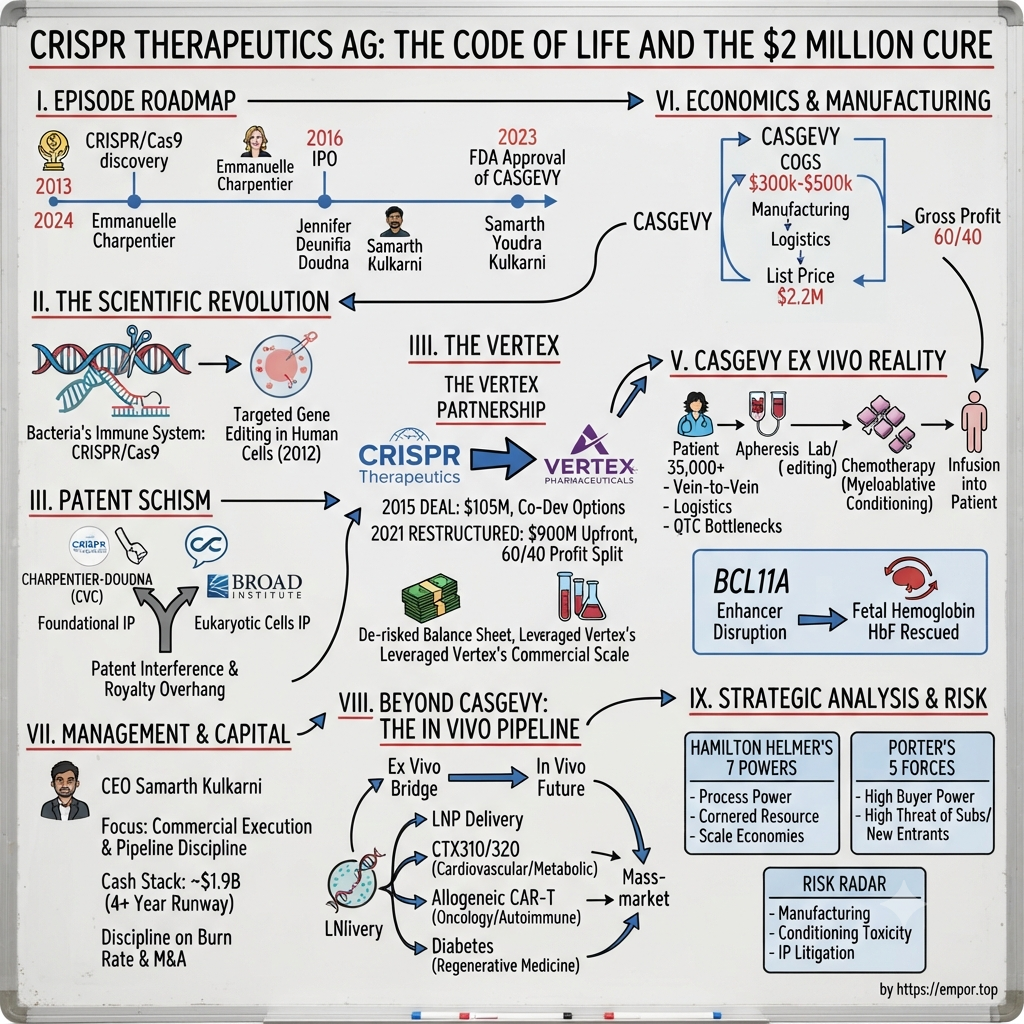
CRISPR Therapeutics AG: The Code of Life and the $2 Million Cure
I. Introduction & Episode Roadmap (00:00 - 08:30)
On the afternoon of December 8, 2023, the U.S. Food and Drug Administration published a press release that read, on the surface, like routine regulatory housekeeping. Two therapies for sickle cell disease had been approved on the same day. One of them, Casgevy, carried a phrase buried in the announcement that marked a turning point in medicine: it was "the first FDA-approved treatment to utilize a type of novel genome editing technology."1
Stripped of regulatory jargon, a government regulator had for the first time approved a medicine that operates by entering human cells and editing their DNA code directly—rather than adding a gene or blocking a protein.
The underlying tool was adapted from basic bacterial biology. Bacteria evolved a molecular archiving system of viral signatures paired with programmable enzymes to cut matching genetic invaders. Researchers subsequently demonstrated how to direct those molecular scissors to specific target sequences. Eleven years after that discovery, a 12-year-old patient with sickle cell disease could receive treatment in Boston, Manchester, or Riyadh and achieve functional relief months later.
This is the story of the company that commercialized that discovery—and faced the reality that regulatory first-mover status does not guarantee immediate profitability.
The strategic paradox. CRISPR Therapeutics AG trades on NASDAQ under the ticker CRSP, maintains its legal domicile in Basel, Switzerland, and directs operations from Boston. The company holds a 40% economic share in the first approved CRISPR therapy. It held roughly $2.36 billion in cash and marketable securities as of June 30, 2026, providing a balance sheet cushion rare among clinical-stage biotechs.2 Its scientific co-founder won a Nobel Prize.3 Yet through mid-2026, the equity market valued the enterprise at about $5.2 billion, with shares closing at $53.52 on August 7, 2026, within a 52-week range of $44.12 to $78.48.4 In effect, public markets have priced the world's pioneering gene-editing franchise at little more than two and a half times its cash balance.
That valuation gap reflects a complex commercial reality. While the core science succeeded, commercial rollout has proven slow, expensive, and constrained by clinical infrastructure. Casgevy generated $116 million in worldwide net product revenue for all of 2025, a modest sum relative to the company's cumulative research investment.5 Only 64 patients were actually infused during that entire year.5
The thesis. The central strategic question facing CRISPR Therapeutics is not whether gene editing functions biologically, but whether the business can bridge the gap between scientific proof of concept and industrial-scale delivery. Management traded away 60% of its lead asset's commercial upside with Vertex Pharmaceuticals to secure a well-funded balance sheet, raising the key issue of whether that liquidity grants enough runway to commercialize its broader pipeline.
This analysis examines the structural terms of the Vertex Pharmaceuticals partnerships that secured the company's balance sheet; the operational mechanics of autologous cell therapy, where hospital throughput presents a primary bottleneck; the long-running U.S. patent litigation involving CRISPR's scientific founders; the ongoing strategic pivot from ex vivo cell modification to in vivo delivery mechanisms; and the competitive landscape alongside Intellia Therapeutics, Beam Therapeutics, Prime Medicine, Editas Medicine, and bluebird bio.
The narrative begins in a Swedish laboratory with an unexpected molecular discovery.
 Subscribe on LinkedIn
II. The Scientific Revolution: Bacteria, Phages, and the Cas9 Scissors (08:30 - 22:00)
Umeå sits close enough to the Arctic Circle that the sun barely clears the horizon in December—an unlikely setting for a revolution in molecular biology. In the late 2000s, French microbiologist Emmanuelle Charpentier was studying Streptococcus pyogenes, the bacterium responsible for strep throat, focusing on how the organism regulates its own RNA. That work led to an unexpected insight into bacterial immunity.
The immune system nobody expected. Bacteria face constant attack from bacteriophages—viruses that inject their DNA into a host cell, hijack its cellular machinery, and replicate until the host bursts. This cellular arms race has operated for roughly three billion years.
Bacteria counter this threat through an adaptive genetic memory. When a bacterium survives a phage attack, it extracts a fragment of the viral DNA and integrates it into a dedicated region of its own genome. These archived fragments sit between short repeated genetic sequences—the clustered regularly interspaced short palindromic repeats that give CRISPR its name. The system functions as a molecular wanted poster archive, storing snippets of viruses that previous cellular generations survived.
The archived sequence alone cannot disable an invader. The defense system relies on Cas9, an enzyme that binds to a copy of the viral RNA sequence, patrols the cell, and compares surrounding DNA against the sequence. Upon identifying a match, Cas9 severs both strands of the viral DNA, disabling the phage.
The missing piece. The mechanism initially presented a biological puzzle: the guide RNA transcribed from the genomic archive could not activate Cas9 independently. In 2011, Charpentier's laboratory identified the required activator: a second RNA molecule, named tracrRNA, which pairs with the guide RNA to form the active enzyme complex.
This discovery established the modular architecture of the system. Because an interchangeable RNA molecule directs the enzyme, modifying the RNA sequence allows researchers to target any designated genomic address.
Charpentier presented these findings at a 2011 conference in Puerto Rico, where she established a collaboration with Jennifer Doudna, a structural biologist at the University of California, Berkeley. Within a year, their combined research teams demonstrated that the guide RNA and tracrRNA could be engineered into a synthetic "single guide RNA." The two-component system could be programmed to target and cut specified DNA sequences in a test tube.3
The Nobel Committee later highlighted the practical reach of the discovery, noting that the technology "revolutionised the molecular life sciences" and created "new opportunities for plant breeding" alongside "groundbreaking new medical treatments."3
Why this was different from what came before. Gene therapy predated the 2012 discovery by two decades. Traditional approaches relied on gene addition: packaging a functional copy of a target gene inside an engineered viral vector, such as a lentivirus or adeno-associated virus, to deliver genetic cargo into target cells.
The primary limitation of gene addition stems from insertion-site unpredictability. Viral vectors integrate cargo semi-randomly across the genome, creating the risk of inserting DNA adjacent to growth-regulating genes and triggering uncontrolled cell division. This mechanism, known as insertional mutagenesis, led to leukemia cases in early clinical trials for primary immunodeficiencies. Although vector engineering reduced this risk, insertion uncertainty persisted. Consequently, bluebird bio's lentiviral sickle cell therapy—approved the same day as Casgevy in December 2023—carries a boxed warning for hematologic malignancy and requires lifelong monitoring.1
Targeted gene editing changed the engineering approach. Rather than introducing an extra gene semi-randomly, programmable enzymes direct a modification to a specific genomic coordinate. In structural terms, the process shifts the clinical strategy from adding an extra page to a genomic manual to modifying a single line of text.
That targeted control underpins the commercial rationale for gene editing. However, precision editing presents its own technical challenges: Cas9 operates by creating double-stranded DNA breaks, leaving the final edit dependent on endogenous cellular repair mechanisms that do not always repair genetic breaks cleanly.
From bench to business. The 2012 publication arrived in a biotechnology venture environment eager for novel platform technologies. Within 18 months, three separate commercial entities formed around the core science: one around the Charpentier and Berkeley intellectual property, a second around the Broad Institute, and a third around an independent academic group. Venture capital investors funded platform development well before human clinical safety or efficacy had been demonstrated.
The entity Charpentier co-founded established its legal domicile in Switzerland, directed operational management from Boston, and spent the following decade proving that biological proof of concept was only the first step toward building a scalable commercial cell therapy business.
III. Founding CRISPR Therapeutics & The IP Patent War (22:00 - 38:30)
In the autumn of 2013, CRISPR Therapeutics began in a modest venture capital office in Basel, Switzerland, operating without a laboratory of its own.
CRISPR Therapeutics AG was incorporated in Basel in October 2013, co-founded by Emmanuelle Charpentier alongside Rodger Novak—an infectious-disease physician turned pharmaceutical executive who previously directed anti-infectives research at Sanofi—and Shaun Foy, with initial financing from Versant Ventures.6 Charpentier served as a scientific founder and advisory board member rather than an operational executive; she did not manage daily operations and later moved on to direct her own research institute in Berlin.6 Novak assumed the chief executive role.
The Swiss domicile served clear strategic functions. It provided a European legal home, favorable corporate structures, and direct access to European patent authorities where the CVC group held a stronger position than in the United States. Operational management, however, quickly concentrated in Cambridge, Massachusetts, positioning the firm near key clinical centers, specialized talent, and life-sciences capital.
Two labs, one invention, a decade of litigation. The foundational science quickly became the subject of an intense intellectual property dispute.
The research led by Charpentier and Jennifer Doudna—designated in legal filings as CVC, representing the University of California, the University of Vienna, and Charpentier—demonstrated programmable Cas9 cutting in test-tube environments. It did not demonstrate editing inside living eukaryotic cells. Within months of CVC's initial disclosure, a research team at the Broad Institute of MIT and Harvard, led by Feng Zhang, published findings applying CRISPR-Cas9 within eukaryotic cells—the cellular structure of plants, animals, and humans.
CVC filed its patent application first. The Broad Institute filed later but requested expedited examination, securing issued patents that explicitly claimed CRISPR-Cas9 applications in eukaryotic cells. Because human therapeutics operate exclusively within eukaryotic cells, Broad's narrower claims covered the primary commercial domain.
What followed was one of the longest patent interference proceedings in biotechnology history. The U.S. Patent Trial and Appeal Board (PTAB) ruled in Broad's favor in 2022. CVC appealed, and on May 12, 2025, the U.S. Court of Appeals for the Federal Circuit vacated the decision and remanded the case, holding that the PTAB had applied an improper legal standard for conception by relying excessively on the Berkeley scientists' documented initial doubts rather than evaluating whether a person skilled in the art could reduce the system to practice using routine methods.7
Following the remand, the patent landscape remained uncertain for roughly ten months. On March 26, 2026, the PTAB issued a new decision that again favored the Broad Institute, finding that even under the corrected standard, CVC failed to establish prior conception of eukaryotic CRISPR-Cas9 editing.8 The ruling preserved the priority position of Broad's 13 issued patents over CVC's 14 patent applications within that interference proceeding.9
What this actually means for the business. While successive adverse legal rulings appeared damaging for a company named CRISPR, platform IP economics function differently in practice.
Commercial resolution occurred via license agreement rather than judicial order. In December 2023, shortly after Casgevy received regulatory approval, commercialization partner Vertex Pharmaceuticals signed a non-exclusive license with Editas Medicine, which holds exclusive rights to Broad's Cas9 patents for human therapeutics. Under the agreement, Vertex paid $50 million upfront, agreed to potential contingent payments of up to $50 million, and committed to annual licensing fees.1011 Editas subsequently monetized a portion of those future licensing revenues, selling them to a subsidiary of DRI Healthcare Trust for $57 million in October 2024.11
In practical terms, freedom to operate was secured through commercial licensing. CRISPR Therapeutics absorbs 40% of those licensing expenses through its profit-sharing arrangement with Vertex—an amount material to operating margins but non-disruptive to commercial viability.
The broader strategic lesson is that foundational gene-editing patents function more like financial tolls than unassailable competitive moats. They levy a tax on commercialized therapies without deciding market leaders. Competitive advantage instead depends on target selection, guide RNA engineering, delivery mechanisms, and manufacturing processes—areas protected by proprietary patent portfolios covering the BCL11A enhancer edit, specific guide RNA chemical modifications, and custom manufacturing workflows.
The residual overhang. CVC maintains stronger legal positions in Europe, and further U.S. appeals remain possible, though the second PTAB loss on remand narrows the available legal paths. The CRISPR IP landscape remains contested but licensable, representing a recurring royalty obligation on Cas9-based therapies rather than an operational barrier.
This reality shifts attention to commercial strategy: if foundational IP functioned as a tollbooth rather than a moat, what positioned CRISPR Therapeutics ahead of competing platforms? The key differentiator was the strategic partnership structured in 2015.
IV. The Deal of the Century: The Vertex Partnership & Capital Strategy (38:30 - 55:00)
Most early-stage biotechnology companies eventually face a stark choice: sell commercial rights to a well-capitalized pharmaceutical partner or risk running out of money before completing pivotal trials. Innovators often surrender long-term commercial upside to secure short-term survival, spending subsequent years watching partners capture the economic returns of their discoveries.
CRISPR Therapeutics departed from that standard script twice. The second of those decisions became the most consequential capital allocation choice in the company's history.
October 2015: the entry point. Vertex Pharmaceuticals and CRISPR Therapeutics announced a four-year research collaboration on October 26, 2015. Vertex committed $105 million upfront—$75 million in cash alongside a $30 million equity investment—for rights to develop up to six gene-edited targets, with up to $420 million in development, regulatory, and sales milestones available on each target, plus royalties.12
The deal's structure reflected unusual leverage for a young biotech. Vertex held the lead on most targets, but for hemoglobinopathies—specifically sickle cell disease and beta thalassemia, which eventually became Casgevy—the companies agreed to split research, development, and commercialization costs and profits equally, with CRISPR Therapeutics leading U.S. commercialization.12
In context, a two-year-old Swiss startup with no clinical-stage assets had negotiated an equal co-development and profit-sharing position on its lead program with an established biopharmaceutical company holding a dominant cystic fibrosis franchise. In 2015, CRISPR gene editing represented one of the industry's most sought-after platform technologies, and Vertex paid in shared economics to secure access.
Vertex brought relevant commercial capabilities to the alliance. As a leader in treatment for rare genetic diseases, Vertex had established experience with cystic fibrosis therapies that Casgevy would later require: identifying small, dispersed patient populations, building networks of specialized treatment centers, and securing reimbursement from cost-conscious payers. Partner selection proved as critical as the financial terms.
April 2021: the trade that defined the company. By early 2021, CTX001—the investigational name for Casgevy—had been administered to more than 30 patients, with follow-up data extending beyond two years demonstrating strong clinical efficacy.13 The clinical risk profile of the asset had decreased substantially.
That milestone coincided with a point of maximum financial exposure for CRISPR Therapeutics. Launching an autologous cell therapy globally required building specialized treatment networks, payer management teams, and complex supply chains across multiple regions—a fixed-cost effort reaching hundreds of millions of dollars that would have been duplicated under a 50/50 arrangement.
On April 20, 2021, the partners restructured their agreement. Vertex paid CRISPR Therapeutics $900 million in upfront cash, plus a commitment for an additional $200 million upon receiving the first regulatory approval. In exchange, Vertex assumed worldwide development, manufacturing, and commercialization responsibilities, increasing its economic share from 50% to 60%. CRISPR Therapeutics reduced its participation to 40% of worldwide profits and costs.13
Jeffrey Leiden, then executive chairman of Vertex, framed the expanded commitment around the strong clinical profile of CTX001, while CRISPR Therapeutics Chief Executive Officer Samarth Kulkarni described the decision as adopting a new operating model to enable a globally coordinated commercial launch.13
Evaluating the valuation trade-off. The strategic decision generated debate over whether CRISPR Therapeutics conceded too much long-term upside.
The critical perspective holds that the company permanently surrendered 10 percentage points of a first-in-class, potentially curative therapy for $900 million. If Casgevy achieved $2 billion in annual global sales, that 10% stake would generate approximately $200 million in annual revenue in perpetuity—suggesting the company exchanged an enduring revenue stream for immediate liquidity.
A counter-analysis suggests the strategic rationale was sound, supported by three primary factors.
First, the 40% allocation applies to net profits and losses rather than gross revenue. During the initial commercial launch phase, the program operated at a net loss. CRISPR Therapeutics recorded a net collaboration expense of $213.5 million for 2025, representing its 40% share of global program costs in excess of revenue.5 Under the original equal split, that expense drag would have been 25% higher. The company transferred a portion of commercial downside during an uncertain ramp.
Second, the $900 million upfront payment was non-dilutive capital raised without issuing equity, providing substantial balance sheet strength for a pre-revenue biotechnology firm in 2021.
Third, Vertex assumed primary operational responsibility for building global commercial and manufacturing infrastructure for a complex therapy. Controlling 40% of an operationally supported rollout provided a more realistic path to commercialization than holding 50% of a launch that strained internal execution capacity.
The 2021 restructuring represents an advantageous trade during a gradual commercial rollout, though it caps upside if product adoption accelerates rapidly. Through mid-2026, commercial adoption has proceeded at a measured pace.
Initial public offering and balance sheet expansion. Before securing major collaboration payments, CRISPR Therapeutics had to access public equity markets. The company priced its initial public offering on October 18, 2016, at $14.00 per share for 4 million shares, raising $56 million in gross proceeds and $54.1 million net, with trading commencing on the NASDAQ Global Market the next day.1415 Strategic partner Bayer purchased an additional 2.5 million shares at the IPO price in a concurrent private placement, contributing approximately $35 million.15
The debut occurred in a challenging biotech market environment, priced below the target range while shadowed by ongoing patent litigation.16 The company went public with modest proceeds relative to its eventual cash position.
In subsequent years, management systematically built liquidity during favorable market conditions. Equity issuances during 2025 expanded the share count, and in March 2026, the company completed an offering of $600 million in convertible senior notes due 2031, yielding net proceeds of $585.4 million.172 The convertible debt structure provided low coupon interest and deferred equity dilution with a conversion premium, bolstering capital reserves.
That accumulated capital supported the broader pipeline transition, even as the lead therapy faced its initial test in human patients.
V. Breakthrough to Commercialization: CASGEVY and the Ex Vivo Reality (55:00 - 01:15:00)
Victoria Gray, a mother of four from Mississippi, had spent her life in and out of hospitals coping with sickle cell disease. In July 2019, she became the first patient in the United States treated with CTX001. Her clinical course—infusion, months of recovery, and subsequent freedom from the vaso-occlusive crises that had previously governed her life—provided a high-profile demonstration of a technology that had previously existed primarily in academic literature.
Understanding the significance of that outcome requires examining the physiological mechanism of sickle cell disease.
Two diseases, one broken gene. Hemoglobin is the protein inside red blood cells responsible for transporting oxygen throughout the body. It consists of two structural subunits: alpha-globin and beta-globin. The genetic code for beta-globin resides in the HBB gene.
In sickle cell disease, a point mutation alters a single nucleotide within that gene—one incorrect letter out of three billion. Under low-oxygen conditions, the mutated hemoglobin molecules stick together and polymerize into rigid rods, deforming flexible red blood cells into stiff crescents. These sickled cells obstruct microvascular blood flow, causing vaso-occlusive crises: severe pain episodes requiring hospitalization and intravenous opioids. Over decades, cumulative microvascular damage leads to strokes, organ failure, and a significantly reduced life expectancy. Approximately 100,000 individuals in the United States live with the disease, predominantly of African descent.1
In transfusion-dependent beta thalassemia, different mutations within the same HBB gene severely impair or eliminate beta-globin production. Patients require lifelong blood transfusions every few weeks, paired with iron chelation therapy to remove excess iron deposited in major organs.
The elegant workaround. Rather than attempting direct gene correction, the engineering strategy relied on an indirect biological mechanism.
Directly repairing the mutated letter in HBB presented significant technical barriers in 2015, as precise sequence replacement remained unreliable and would have required distinct correction strategies for hundreds of thalassemia mutations.
Casgevy circumvents the mutation entirely by exploiting a separate hemoglobin pathway. The human genome contains instructions for gamma-globin, which forms fetal hemoglobin during development. Shortly after birth, a genetic suppressor protein called BCL11A disables gamma-globin expression, transitioning the body to adult beta-globin.
Reactivating that pathway allows red blood cells to produce functional fetal hemoglobin, replacing the missing or defective adult protein regardless of the underlying HBB mutation. The approach was supported by clinical evidence from individuals with hereditary persistence of fetal hemoglobin, a benign condition where adult expression of fetal hemoglobin protects against sickle cell symptoms.
Casgevy utilizes Cas9 to execute a double-stranded cut at a specific locus: the erythroid-specific enhancer region of the BCL11A gene. Disabling that enhancer suppresses BCL11A expression specifically in red blood cell lineages, restoring fetal hemoglobin production.18
Two design choices in this mechanism carry strategic weight for investors. First, the therapy relies on a gene knockout—disabling a functional element rather than inserting or repairing sequence—which represented the most reliable editing outcome achievable with first-generation CRISPR tools. Second, by targeting a cell-type-specific enhancer rather than the primary BCL11A gene, the edit avoids disturbing BCL11A function in non-hematopoietic tissues.
The data that made regulators move. Pivotal clinical trials—CLIMB SCD-121 in sickle cell disease and CLIMB THAL-111 in beta thalassemia—were structured as single-arm studies without a placebo control, a design regulators accept when evaluating severe diseases with predictable natural histories and high treatment effect sizes.
Clinical findings demonstrated robust efficacy. In the sickle cell trial, 29 of 30 evaluable participants followed for at least 16 months remained free of severe vaso-occlusive crises for at least 12 consecutive months, with 27 experiencing no crises.19 In the thalassemia trial, roughly 91% of the 35 evaluable patients—32 of 35—achieved transfusion independence for at least 12 consecutive months, with a median follow-up of approximately 20 months.20
For patient populations accustomed to chronic medical management, complete crisis prevention and transfusion independence represented transformative clinical outcomes.
The FDA approved Casgevy for sickle cell disease in patients aged 12 and older on December 8, 2023, and expanded the approval to transfusion-dependent beta thalassemia on January 16, 2024.121 International regulators followed, approving the therapy in 39 countries across North America, Europe, and the Middle East by mid-2026.2 On July 1, 2026, the FDA approved an expanded label covering pediatric patients down to age two following a 53-day priority review, adding approximately 5,500 newly eligible patients in the United States.222
The uncomfortable footnote. Despite compelling clinical efficacy, important long-term questions remain for investors evaluating commercial risk.
Clinical follow-up currently extends over years rather than decades. Because Cas9 induces double-stranded DNA breaks, theoretical risks surrounding chromosomal rearrangements or off-target edits require ongoing monitoring. Vertex and CRISPR Therapeutics maintain long-term registry studies to track patient outcomes over 15 years. In a single-administration, intent-to-cure therapy, late-emerging adverse events carry asymmetric commercial consequences compared to chronic treatments that can be discontinued.
Furthermore, initial commercial adoption demonstrated that strong clinical trial data does not immediately resolve downstream delivery and infrastructure bottlenecks.
VI. Under the Hood: Economics, Manufacturing, & Segment Breakdown (01:15:00 - 01:32:00)
Consider a patient who decides in January to undergo treatment with Casgevy. Here is what happens next.
She must first be referred to an authorized treatment center—a specialized transplant hospital qualified to administer cell therapies. After evaluation, she undergoes mobilization and apheresis: receiving medication to coax blood-forming stem cells out of the bone marrow and into the bloodstream, followed by sessions on a filtration machine that collects those target cells. The process is far from a single afternoon visit; it often requires multiple multi-day rounds, and if a collection yields insufficient cells, it must be repeated.
Once harvested, her cells are frozen and shipped to a manufacturing facility. There, technicians thaw the sample and perform electroporation—applying a brief electrical pulse that opens transient pores in the cell membrane, allowing the Cas9 protein and its guide RNA to enter. The edited cells are expanded in culture, tested against quality specifications, packaged, and shipped back to the hospital. This manufacturing cycle takes several months.
Upon their arrival, the patient cannot simply receive the infusion. Because her bone marrow remains filled with unedited stem cells, she must undergo myeloablative conditioning: high-dose busulfan chemotherapy designed to destroy her existing marrow and clear space for the new cells. Busulfan carries severe side effects, including nausea, hair loss, mucositis, profound immunosuppression, and a high risk of permanent infertility.
Only after conditioning is complete can the patient receive the infusion. She then spends weeks in protective hospital isolation while the edited stem cells engraft and rebuild her immune system.
Under the best circumstances, the procedure provides a functional cure. Operationally, however, the patient must dedicate nearly a full year to the process.
Why demand is not the constraint. This arduous journey highlights the central operational fact of the commercial business: market demand is not the primary bottleneck.
The addressable patient population is substantial. Management estimates that the eligible population across approved markets exceeds 60,000 individuals—roughly 37,000 across North America and Europe, and more than 23,000 in the Middle East, where sickle cell and thalassemia carrier rates are high.17 By mid-2026, more than 500 patients globally had initiated treatment by completing a first cell collection.17
In contrast, only 64 patients were infused worldwide during all of 2025.5 The disparity between 60,000 eligible patients and 64 treated individuals reflects a physical throughput constraint rather than a lack of interest. Commercial expansion is gated by four structural chokepoints: the number of authorized and fully staffed treatment centers, available apheresis capacity at each hospital, global manufacturing throughput, and patient willingness to undergo busulfan conditioning.
Corporate disclosures highlight management's focus on these operational bottlenecks. In its third-quarter 2025 update, the company reported that 25 treatment centers had each initiated more than five patients, and that at least one center in each primary region—the U.S., Europe, and the Middle East—had initiated more than 20 patients.23 That granular breakdown aimed to show investors that individual centers were climbing the operational learning curve rather than remaining idle. During that same quarter, roughly 300 patients had been referred to treatment centers, about 165 had completed a first cell collection, and 39 had received their final infusion.23
That conversion ratio illustrates the commercial reality: moving patients from initial referral to cell collection and final infusion forms a long-duration funnel with significant lag times and attrition at each stage.
How the money actually flows. Financial reporting for the partnership is frequently misunderstood by public equity investors.
Vertex books 100% of Casgevy's worldwide net product revenue on its top-line income statement. CRISPR Therapeutics does not record Casgevy product sales directly. Instead, it reflects its 40% economic participation as a single line item titled "collaboration expense, net"—which functions as a net expense while the commercial program operates at a loss.
Consequently, when quarterly earnings reports state that Casgevy generated $76 million in worldwide revenue during the second quarter of 2026—a 151% increase year-over-year and 78% sequentially—that figure represents the gross sales recognized by Vertex.224 For that same period, CRISPR Therapeutics reported top-line revenue of roughly $10.2 million, derived primarily from grant and collaboration agreements, while booking $40.3 million in net collaboration expense as its 40% share of program operating losses.225
Investors evaluating the financial model must treat Casgevy as a below-the-line interest rather than a direct revenue driver. The critical inflection point for the income statement will occur when CRISPR Therapeutics' 40% share flips from a net expense to net income.
Unit economics, plainly. Casgevy carries a U.S. list price of $2.2 million per patient.19 Payers evaluate that upfront cost against the cumulative lifetime expenses of managing sickle cell disease, including recurring hospitalizations, blood transfusions, pain management, stroke care, and lost economic productivity.
Against that headline price sits a high-cost manufacturing model. Each dose requires a dedicated production run for a single individual, including cleanroom reservation, individual batch release testing, specialized cryogenic logistics, and financial compensation to treating medical centers. While neither partner discloses per-patient cost of goods sold, full-year 2025 performance illustrates the underlying cost drag: recording $213.5 million in net collaboration expense against $116 million in total program revenue demonstrates that operating expenses significantly exceeded gross revenue during the early rollout.5
Commercial margins depend heavily on volume leverage. Because a major portion of the operational cost structure—including facility overhead, quality systems, technical personnel, and regulatory infrastructure—is fixed, scaling patient volume through existing facilities lowers average unit costs. The first half of 2026 offered initial evidence of this operating leverage, with the program generating $119 million in worldwide revenue over six months—surpassing total 2025 revenue—supported by more patient infusions than in the entire preceding year.224
That acceleration demonstrates that commercial throughput is expanding. However, because the growth originates from a small baseline, percentage gains can obscure the absolute size of the rollout. It remains uncertain whether throughput will continue accelerating or flatten once the initial backlog of highly motivated patients is cleared.
The task of determining how much capital to invest in expanding ex vivo capacity—versus accelerating next-generation technologies that could bypass hospital-based processing entirely—falls directly on corporate leadership.
VII. Current Management & Capital Allocation under Dr. Samarth Kulkarni (01:32:00 - 01:46:00)
The transition from Rodger Novak to Samarth Kulkarni in December 2017 represented a shift in corporate orientation rather than a routine executive rotation.26 Novak was the scientific founder-CEO: an infectious-disease physician-scientist who had led anti-infectives research at Sanofi and possessed the academic credibility needed to rally investors around an early-stage platform. That profile matched the demands of a startup raising capital on scientific promise.
Kulkarni brought a distinctly operational and strategic background. He trained as a biochemical engineer at the Indian Institute of Technology Kharagpur, earned a PhD in bioengineering and nanotechnology at the University of Washington, and spent years as a partner co-leading McKinsey & Company's biotech practice, advising pharmaceutical clients on strategy and operations.26 He joined CRISPR Therapeutics in 2015 as chief business officer, advanced to president, and assumed the chief executive role in late 2017.26
That background has shaped corporate strategy. A former management consultant steeped in pharmaceutical operations views pipeline assets through the lenses of risk allocation, option value, and execution capability. That orientation explains the decision to trade away a portion of commercial upside to secure a well-capitalized partner: the 2021 restructuring of the Vertex alliance was precisely the type of risk-mitigating deal a former McKinsey pharma leader would structure.
The capital allocation record. Judged on the risk that eliminates most biotechs—depleting capital before achieving sustainability—management's balance sheet discipline has been strong.
At the end of the second quarter of 2026, the company held $2.36 billion in cash, cash equivalents, and marketable securities, against roughly $2.65 billion in total assets.2 Management built that capital reserve through three main channels rather than recurring equity dilution: collaboration payments from Vertex, opportunistic equity offerings during favorable market conditions, and a convertible notes issuance in March 2026.
However, the structure of that balance sheet has evolved. Before 2026, CRISPR Therapeutics operated with no long-term debt. It now carries roughly $600 million in convertible senior notes due in 2031, alongside finance lease obligations tied to its manufacturing facilities.2 Total debt stood at approximately $784 million against $2.36 billion in liquid assets as of June 30, 2026—a manageable position, but a departure from the unlevered balance sheet of prior years.2 The note offering secured low-cost, long-dated capital when the stock traded off its highs, though it introduces financial leverage and potential equity dilution if the shares appreciate.
Burn discipline. Operating expenses have trended downward, an unusual pattern for a biotech expanding commercial and clinical operations. Second-quarter 2026 research and development expenses totaled $67.2 million, down from $69.9 million in the prior-year period, while general and administrative costs fell to $17.6 million from $18.9 million.2 Full-year 2025 research and development spending totaled $284.8 million.5
At the same time, interest income from the $2.36 billion cash reserve provides a substantial offset to operating expenses. The net loss for the second quarter of 2026 narrowed to $91.2 million from $208.5 million in the prior-year period, although the 2025 comparison was affected by non-recurring items.2 Sequentially, net losses decreased from $122.9 million in the first quarter of 2026 to $91.2 million in the second quarter, primarily driven by lower net collaboration expenses as Casgevy revenue expanded.172
At this current burn rate, the balance sheet provides several years of operational runway without requiring immediate equity financing. That cash buffer changes the strategic risk profile, converting binary clinical readouts from existential threats into manageable pipeline milestones.
Correcting a consensus narrative. A common misconception in secondary market analysis concerns the company's approach to mergers and acquisitions.
CRISPR Therapeutics did not acquire ViaCyte. Instead, the company entered a joint development agreement with ViaCyte in 2021 to advance gene-edited, stem-cell-derived therapies for type 1 diabetes. In 2022, Vertex acquired ViaCyte directly and subsequently opted out of the gene-edited diabetes collaboration, leaving CRISPR Therapeutics to advance the program independently.27
That distinction alters the strategic narrative. Rather than a distressed asset purchase, the outcome reflects a major commercial partner choosing to withdraw from a program—a notable signal given Vertex's experience in cell therapy and diabetes development.
Beyond that program, management's capital allocation has remained cautious on M&A while selectively pursuing in-licensing deals. In May 2025, CRISPR Therapeutics established a multi-target collaboration with Sirius Therapeutics focused on small interfering RNA therapies, paying $25 million upfront in cash while agreeing to split development costs and profits equally, with CRISPR Therapeutics leading U.S. commercialization and Sirius overseeing Greater China.2328
The Sirius deal introduces a strategic shift. A company built around permanent DNA editing invested in an RNA interference platform—a distinct modality that temporarily silences gene expression rather than modifying the underlying genome. While both modalities target liver tissue and can leverage shared commercial infrastructure, the investment raises questions about capital allocation for a biotech managing multiple clinical-stage programs under a $5.2 billion market valuation. Investors will need to track whether expanding into RNA interference diverts resources from the core gene-editing pipeline.
Executive alignment. Annual proxy disclosures show that management has avoided major open-market share sales following Casgevy's regulatory approval, maintaining meaningful equity exposure. That insider retention offers a modest positive signal regarding leadership alignment.
Ultimately, the primary test for management extends beyond balance sheet management to pipeline execution. The central question remains whether its capital reserves can fund the clinical development needed to deliver next-generation therapies.
VIII. Beyond CASGEVY: The In Vivo Pipeline & Next-Gen Optionality (01:46:00 - 02:00:00)
There is a slide that appears, in one form or another, in nearly every gene-editing company's investor presentation. On the left, a diagram illustrates the ex vivo process: harvesting cells, editing them in a laboratory, administering conditioning chemotherapy, reinfusing the modified cells, and managing a prolonged hospital stay. On the right, a diagram depicts the in vivo alternative: a single intravenous infusion.
That visual contrast encapsulates the strategic argument facing the business. The operational bottlenecks detailed in Section VI—apheresis scheduling, multi-month manufacturing turnaround, high-dose busulfan conditioning, and specialized isolation units—exist because cellular modification occurs outside the human body. Delivering the editing mechanism directly inside the patient bypasses the entire ex vivo clinical infrastructure.
The mechanics of in vivo delivery. The delivery vehicle relies on a lipid nanoparticle—a microscopic lipid sphere utilizing the same broad technology platform that delivered mRNA in COVID-19 vaccines. Instructions for the Cas9 enzyme and guide RNA are encapsulated within the lipid nanoparticle for systemic administration. By natural biological distribution, intravenously infused lipid nanoparticles accumulate overwhelmingly in the liver.
That tissue selectivity offers a distinct commercial advantage, as the liver synthesizes a substantial share of proteins circulating in human blood—including key targets driving common cardiovascular and metabolic disorders. Successfully disabling or correcting a target liver gene through a single infusion creates a repeatable therapeutic platform.
The lead: CTX310 and the cholesterol problem. CRISPR Therapeutics' most advanced in vivo program targets ANGPTL3, a liver gene that acts as a brake on the body's lipid-clearing pathways. Suppressing that gene allows the body to clear triglycerides and low-density lipoprotein (LDL) cholesterol more aggressively. The target carries strong genetic validation: individuals born with naturally inactive ANGPTL3 mutations exhibit low lipid levels and marked protection from coronary disease without apparent adverse health effects.
On November 8, 2025, the company reported Phase 1 trial results at the American Heart Association Scientific Sessions, published simultaneously in The New England Journal of Medicine—a venue reflecting significant medical interest in the clinical data.29 Among 15 participants with at least 60 days of follow-up, a single administration at the highest dose produced mean reductions of 73% in circulating ANGPTL3 (peaking at 89%), 55% in triglycerides (peaking at 84%), and 49% in LDL cholesterol (peaking at 87%).29 The study recorded no treatment-related serious adverse events and no severe liver enzyme elevations.29
Three analytical takeaways extend beyond those headline percentages.
First, the therapeutic response was dose-dependent and durable, confirming that the underlying editing mechanism operated predictably rather than generating biological noise. Second, achieving an LDL reduction near 50% from a single infusion places the candidate in the therapeutic range of chronic PCSK9 inhibitor injections, while eliminating the compliance burden of recurring biweekly or monthly doses. Third, the safety profile showed no evidence of liver toxicity—the specific adverse effect that historically halted earlier liver-directed gene therapy programs.
The company has been conducting a Phase 1b expansion trial, noting plans to present a clinical update at the European Society of Cardiology Congress on August 28, 2026, with additional Phase 1b data anticipated in the second half of the year.2
The rest of the liver portfolio. A second liver program, CTX320, targeted LPA, the gene encoding lipoprotein(a)—an inherited cardiovascular risk factor lacking approved targeted therapies and affecting a broad patient population. Management subsequently introduced a next-generation candidate, CTX321, offering roughly twofold greater potency, while adjusting the program timeline to incorporate emerging insights from the evolving Lp(a) competitive landscape.5
That strategic reprioritization requires careful interpretation. Delaying a program to refine molecular design represents sound engineering discipline; it can also signal that a developer has fallen behind clinical peers. Several major pharmaceutical competitors have advanced Lp(a)-lowering therapies into late-stage clinical trials. Entering that market later with a single-shot gene-editing modality requires demonstrably superior durability and safety to capture market share.
Two additional liver-directed programs entered clinical development during 2026: CTX340, targeting angiotensinogen for refractory hypertension, and CTX460, targeting SERPINA1 for alpha-1 antitrypsin deficiency—the company's first candidate utilizing its proprietary SyNTase editing platform, designed to enable precise in vivo gene correction rather than simple gene knockouts.223 Alpha-1 antitrypsin deficiency presents a complex biological challenge, as an effective therapy must simultaneously stop the production of a misfolded toxic protein and restore functional protein levels.
The cell therapy franchise, renamed and repositioned. The cell therapy program formerly designated CTX112 was renamed zugocabtagene geleucel (zugo-cel)—an allogeneic, off-the-shelf CAR-T therapy targeting CD19, engineered via CRISPR gene knockouts and CAR insertion to evade immune rejection and enhance potency.30
The commercial rationale addresses a major market bottleneck. Approved autologous CAR-T therapies require harvesting each patient's own T cells, creating a custom manufacturing process similar to Casgevy's ex vivo workflow in a significantly larger oncology market. An off-the-shelf product manufactured in batches from healthy donors would substantially reduce both production costs and treatment wait times.
On December 22, 2025, the company disclosed early clinical data across oncology and autoimmune indications.30 Among ten evaluable patients with relapsed or refractory large B-cell lymphoma treated at the recommended Phase 2 dose, zugo-cel achieved a 90% overall response rate and a 70% complete response rate, with grade 3 cytokine release syndrome and grade 3 neurotoxicity each occurring in 17% of participants.30 In the autoimmune cohort, four patients received lower doses, with the initial lupus patient—who had failed nine prior therapies—achieving drug-free clinical remission through six months of follow-up.30
The autoimmune application presents compelling commercial potential. The underlying strategy relies on a systemic "B-cell reset"—depleting the self-reactive B cells driving autoimmune pathology and allowing the immune system to reconstitute without pathogenic memory. Early academic studies evaluating autologous CAR-T in severe lupus yielded promising results; if an off-the-shelf candidate achieves comparable efficacy, the addressable patient population would dwarf oncology indications.
These early clinical findings carry substantial caveats: the data reflect single-digit patient numbers with short follow-up periods, yielding wide statistical confidence intervals around a 90% response rate. To explore broader commercial utility, the firm initiated a combination study with Eli Lilly evaluating zugo-cel alongside pirtobrutinib in aggressive B-cell lymphomas.30 Management projected additional clinical data releases in the second half of 2026.2
The speculative tail. The company's diabetes program, centered on candidate CTX213, aims to develop a deviceless, gene-edited beta cell replacement for type 1 diabetes—utilizing stem-cell-derived pancreatic islet cells engineered to evade host immune rejection without systemic immunosuppression.2 The program remained in preclinical development as of mid-2026. This initiative represents long-term optionality—a high-upside asset held by a firm with sufficient balance sheet liquidity to fund early-stage biological risk.
Taken together, the pipeline reflects a deliberate strategic shift away from the infrastructure constraints that limit the lead commercial therapy. Whether this pipeline transition can outpace competitive platforms remains the central long-term test for the enterprise.
IX. Strategic Analysis: 7 Powers, Porter's 5 Forces & Competitive Landscape (02:00:00 - 02:18:00)
Picture the gene-editing field in 2016: five companies, near-identical pitch decks, all claiming the same platform. Now picture it in 2026. One partner-of-a-partner monetized its patents and pivoted. One was sold for scrap. One has an approved product. Two are racing to redefine the technology entirely.
That shakeout is the most useful lens available, because it shows which advantages were real.
Hamilton Helmer's 7 Powers, applied honestly.
Cornered Resource — weak, and weakening. The founding thesis was that Charpentier's foundational patents constituted an owned, defensible resource. A decade of U.S. adjudication has largely dismantled that thesis, and the practical resolution came through a license purchased from a competitor's patent estate.108 What remains is not nothing—target-specific and guide-specific IP has real value—but it does not function as a cornered resource in Helmer's sense. Investors who bought this company for its patents bought the wrong thing.
Counter-Positioning — genuinely strong against the incumbent, structurally weak against the successor. Against the standard of care, Casgevy is a textbook counter-position. The incumbent business model in sickle cell is chronic management: hydroxyurea, transfusions, pain crisis admissions, and newer agents. An incumbent cannot easily respond to a one-time cure, because a cure cannibalizes the recurring revenue that funds the incumbent. That is a real and durable advantage against chronic therapy.
Against the next generation, the position inverts. Casgevy's own logic—one-time treatment beats chronic management—is exactly the argument a competitor will make about eliminating chemotherapy conditioning. The company is counter-positioned and counter-positionable simultaneously.
Process Power — real but shared, and partly not owned. The know-how required to run a global autologous cell therapy supply chain is not trivially copied. Batch success rates, release testing protocols, cryogenic logistics, and the human relationships that make treatment centers actually schedule patients accumulate slowly. That is genuine process power. But Vertex leads manufacturing and commercialization under the amended agreement, which means a substantial portion of that accumulated capability sits with the partner, not with CRISPR Therapeutics.13 The company benefits from it economically. It does not fully control it.
Scale Economies — borrowed. The scale advantage is Vertex's global commercial and payer infrastructure, accessed through the profit share. It is real and it is rented.
Porter's Five Forces.
Buyer power — high, and the most underappreciated force here. A $2.2 million one-time price collides with a payer system built for annual budgets. In the United States, a disproportionate share of sickle cell patients are covered by Medicaid, which is state-administered and chronically budget-constrained. The federal response was the Cell and Gene Therapy Access Model, launched by CMS in January 2025, under which the agency negotiates outcomes-based agreements directly with manufacturers, offers participating states up to $9.55 million in federal support, and requires rebates if therapies do not deliver.31 Thirty-three states plus the District of Columbia and Puerto Rico signed on, and both Vertex and bluebird's successor entity entered agreements.31 By the end of 2025, management reported that roughly 90% of U.S. patients had covered access.17
That is a meaningful derisking of the reimbursement question. It does not eliminate buyer power; it channels it. Payers have accepted the price in exchange for outcome guarantees, which transfers durability risk onto the manufacturers.
Substitutes — high, and the competitive dynamic is stranger than it looks. The most direct substitute is bluebird bio's Lyfgenia, approved the same day at a $3.1 million list price.19 It uses lentiviral gene addition rather than editing, and it carries the boxed warning for hematologic malignancy discussed earlier.1
In practice, the more instructive fact is what happened to bluebird. In February 2025, the company agreed to be taken private by Carlyle Group and SK Capital Partners at $3.00 per share in cash—a 57% discount to its prior close, valuing the equity at roughly $29 million, with a contingent $6.84 per share tied to sales milestones.32 A pioneer of the entire field, with an approved product for the same disease, sold for less than the annual research budget of its rival.
The lesson is not that CRISPR Therapeutics won. It is that the sickle cell gene therapy market has proven harder than everyone modeled, for structural reasons that apply to both companies. Casgevy is winning a race that has been slower than anyone forecast.
The larger substitute is inertia—chronic management with hydroxyurea, transfusions, and supportive care. For a patient weighing infertility risk and a year of disruption against a disease she has managed for thirty years, "do nothing different" is a live option.
New entrants and next-generation technology — very high. Three specific threats deserve naming.
Intellia Therapeutics has become the benchmark for in vivo delivery. It reported positive Phase 3 results from the HAELO study of lonvoguran ziclumeran in hereditary angioedema, showing an 87% reduction in attacks versus placebo, initiated a rolling BLA with the FDA in April 2026, and has guided to a potential U.S. launch in the first half of 2027.33 If that approval lands, Intellia—not CRISPR Therapeutics—will own the title of first approved in vivo CRISPR medicine.
Beam Therapeutics represents the more direct threat to the existing franchise. Its base editing approach changes a single DNA letter without cutting both strands—chemistry rather than scissors, avoiding double-strand breaks entirely. Its sickle cell candidate risto-cel was published in the New England Journal of Medicine on April 1, 2026, with data from 31 patients showing mean fetal hemoglobin above 60% and no investigator-reported severe crises after engraftment.34 Buried in that release were three operational statistics that should concern any Casgevy investor: a median of one cell collection, a median of 2.9 months to product release, and a median of 4.5 months to dosing.34 Those are throughput numbers, and throughput is the binding constraint. Beam has guided to a U.S. BLA submission as early as year-end 2026.34
Prime Medicine's prime editing is the most ambitious of the three—a search-and-replace mechanism that can in principle write arbitrary sequences without double-strand breaks—and correspondingly the least clinically validated.
Supplier power — moderate. Clinical-grade Cas9 protein, synthetic guide RNAs, lipid excipients, and cell-processing consumables come from a concentrated set of specialist suppliers. Single-source dependencies are a normal feature of cell therapy supply chains and a normal source of batch-level disruption.
Rivalry — high, and increasingly fought over hospitals rather than science. The scarce resource is not molecules. It is qualified transplant centers, apheresis capacity, and the specific hematologists who decide which patients to refer. Beam, Vertex, and bluebird's successor compete for the same finite institutional bandwidth.
Myth versus reality.
Myth: CRISPR Therapeutics owns the CRISPR patents. Reality: the eukaryotic-cell priority in the United States sits with Broad, reaffirmed in March 2026, and the freedom to operate for Casgevy was purchased via license.810
Myth: a $2.2 million price is the barrier to adoption. Reality: roughly 90% of U.S. patients have covered access.17 The barrier is busulfan, hospital throughput, and time.
Myth: the cash pile is a moat. Reality: cash is a shock absorber, not a moat. It buys time to find an advantage. It is not itself an advantage—and competitors are also well capitalized, with Intellia reaffirming a runway into 2028.33
Myth: first-mover advantage in gene editing is decisive. Reality: bluebird was first into sickle cell gene therapy and was sold for $29 million of equity value.32 In this field, first-mover advantage appears to be worth considerably less than manufacturing throughput.
How management talks about these constraints—and whether the story has stayed consistent—is the next test.
X. Earnings Call Forensic Analysis: Management Credibility & Transcript Signals (02:18:00 - 02:30:00)
Quarterly disclosures reveal a management team's true business model—not through adjectives, but through the specific metrics it chooses to highlight.
CRISPR Therapeutics has disclosed an unconventional set of numbers. Rather than leading with top-line sales, the company's quarterly updates through 2025 and 2026 consistently foregrounded funnel mechanics: patient referrals, completed cell collections, delivered infusions, and how many treatment centers had crossed key activity thresholds.235 In the third quarter of 2025, that approach meant reporting roughly 300 referrals, about 165 cell collections, and 39 infusions, alongside the detail that 25 centers had each initiated treatment for more than five patients.23
Highlighting early-stage collections while final infusions lag is a calculated communication choice. It encourages investors to evaluate a multi-month clinical conversion pipeline rather than a single quarterly sales figure. It is the type of disclosure a leadership team provides when it believes operational lag is the central story and seeks credit for leading indicators. Conveniently, it also reframes a sluggish revenue quarter as a timing issue. Both interpretations carry weight.
What has stayed consistent. A review of the company's strategic priorities updates, quarterly releases, and annual results from 2024 through mid-2026 shows three commitments that have remained firm.
First, management consistently framed Casgevy adoption as a multi-year operational build rather than an immediate launch spike. Leadership avoided issuing specific quarterly patient guidance, using language across releases that emphasized steady momentum and infrastructure building over sharp inflection points.2352 That framing avoided setting unrealistic short-term expectations.
Second, the stated purpose of the balance sheet remained focused on funding the transition to in vivo therapies. The company resisted chasing adjacent biotech trends, maintained its core identity, and systematically moved liver programs from preclinical studies into clinical trials on schedule.
Third, management continued disclosing granular funnel metrics quarter after quarter, even when those numbers highlighted operational bottlenecks.
Where the record is less clean. While management maintained conservative guidance on Casgevy, its discipline was less consistent across other pipeline assets.
The Lp(a) program provides a key example. The company's initial in vivo cardiovascular platform featured two co-lead assets: CTX310 and CTX320. However, CTX320 was effectively superseded by CTX321—a candidate described as roughly twice as potent—which pushed back development timelines while management cited an evolving competitive landscape.5 Replacing a co-lead candidate represents a substantive shift in pipeline strategy. While management explained the pivot, such reasoning remains difficult for external investors to independently verify.
The Sirius Therapeutics transaction represents another shift. Acquiring rights to a small interfering RNA asset expanded the company's scope beyond gene editing into RNA silencing. Management justified the expansion by citing shared liver biology and commercial infrastructure, though those synergies were asserted rather than operationally demonstrated.28
What analysts push on. Analyst questions on earnings calls rarely focus on foundational science. Instead, they center on operational mechanics: the duration of the lag between initial cell collection and revenue-recognized infusion; the number of state Medicaid programs with active reimbursement agreements; and whether researchers can replace harsh busulfan conditioning with gentler targeted regimens, such as antibody-based marrow clearance. That third factor holds the greatest potential to alter the commercial adoption curve, yet it remains largely outside the company's control because conditioning innovation is being driven by the broader transplant field rather than CRISPR Therapeutics directly.
The credibility verdict, stated neutrally. Management established conservative expectations for the commercial launch and met them. It funded the balance sheet without emergency capital raises or excessive equity dilution. Furthermore, it maintained transparency around operating metrics that a less confident team might have omitted.
However, leadership has not yet managed a major clinical failure. Most large biotechs eventually encounter trial setbacks, and executive performance is tested more rigorously by managing a Phase 2 failure than by guiding a slow, positive launch. The zugo-cel and CTX310 clinical readouts scheduled for the second half of 2026 represent the first significant tests of that execution record.2
For analytical observers, a broader strategic question remains. CRISPR Therapeutics maintains roughly a dozen programs across four distinct modalities—ex vivo cell therapy, in vivo lipid nanoparticle editing, allogeneic CAR-T, siRNA, and preclinical regenerative medicine—supported by a market capitalization of approximately $5.2 billion and no direct product revenue of its own.4 A skeptical investor would ask whether this breadth represents valuable pipeline optionality or strategic dilution, and whether shareholders would benefit if management concentrated resources on the two or three assets with the clearest path to market. Leadership has chosen breadth—a defensible strategy backed by a strong cash reserve, but also the structural pattern that precedes a difficult restructuring if key clinical readouts disappoint.
Which brings the narrative to the structural risks that could alter the company's trajectory.
XI. The Risk Radar & Skeptical Investor Stress Test (02:30:00 - 02:42:00)
Every investment case rests on load-bearing assumptions. Examining where those assumptions could give way reveals the core operational, financial, and competitive risks facing CRISPR Therapeutics.
1. Throughput risk—the constraint that already binds. Top-line growth is governed not by patient demand for Casgevy, but by institutional hospital capacity. Quality setbacks at manufacturing facilities, shortages of apheresis equipment, or an eventual exhaustion of the initial backlog of highly motivated patients would each manifest identically: cell collection numbers would plateau, followed six months later by a flattening in patient infusions.
The key metric to monitor is whether the conversion ratio of infusions to collections improves over time. If collections expand while infusions lag, the operational bottleneck sits downstream in manufacturing turnaround or hospital scheduling. If collections themselves level off, the constraint shifts to patient demand or willingness to undergo the procedure—a far more fundamental challenge that balance sheet capital alone cannot solve.
2. Conditioning toxicity—the barrier commercial execution cannot eliminate. High-dose busulfan conditioning remains the primary reason patients with manageable chronic disease decline a potential cure. Infertility risks disproportionately affect young adults, the core demographic eligible for treatment. Industry observers note that the required time commitment compounds this friction: patients healthy enough to qualify are typically employed and insured, making a multi-month medical leave difficult to accommodate.35
This biological requirement caps the ultimate market penetration of the ex vivo franchise regardless of pricing, reimbursement coverage, or commercial marketing. Until gentler conditioning regimens reach the clinic, a substantial fraction of the eligible patient population will remain functionally unreachable.
3. IP royalty drag—persistent, but manageable. With the Patent Trial and Appeal Board reaffirming the Broad Institute's priority position, Casgevy's freedom to operate relies on the license Vertex secured, with CRISPR Therapeutics absorbing 40% of those licensing fees through their profit-sharing agreement.810 The primary risk is not product withdrawal, but a permanent royalty burden superimposed on an already high-cost manufacturing model. Because European patent positions differ and further U.S. legal steps remain possible, the situation represents an ongoing legal overhang with quantifiable economic costs rather than an existential threat.
4. Technology obsolescence—the sharpest long-term threat. Competitive developments highlight how rapidly gene-editing technology evolves. Beam Therapeutics' base-editing approach modifies target DNA without creating double-stranded cuts, and its published clinical metrics—a median of one collection cycle and 4.5 months to dosing—describe a streamlined delivery process relative to Casgevy's current workflow.34 If Beam secures regulatory approval and maintains those operational advantages at scale, competition will turn on annual hospital throughput as much as clinical efficacy.
Similarly, if Intellia Therapeutics brings its hereditary angioedema candidate to market in 2027, the distinction of launching the first approved in vivo CRISPR therapy—and the market positioning that accompanies it—will belong to a competitor.33
CRISPR Therapeutics pioneered a first-generation modality that industry peers are now refining. Whether the company's internal in vivo pipeline can advance quickly enough to capture next-generation market share remains a pivotal question in the investment thesis.
5. Reimbursement compression outside the U.S. European single-payer healthcare systems evaluate therapies based on cost-effectiveness thresholds rather than list prices. While Casgevy achieved reimbursement coverage in the United Kingdom, Italy, Austria, Denmark, Luxembourg, and Germany—where Vertex secured coverage in May 2026 for eligible patients aged 12 and older—these international agreements are typically completed at confidential discounts below U.S. benchmarks.52 As the geographic revenue mix shifts toward Europe and the Middle East, the average realized price per patient will decline, causing overall revenue growth to lag unit volume expansion and resulting in structurally lower gross margins on international sales.
6. The activist stress test. A skeptical institutional investor examining the company would highlight four vulnerabilities: broad portfolio scope across four distinct modalities without direct product revenue; the addition of $600 million in convertible debt to a previously unlevered balance sheet while shares trade well below historical peaks; the strategic rationale for in-licensing an external siRNA asset; and the structural reliance on Vertex for Casgevy's commercial execution, which leaves CRISPR Therapeutics with financial exposure but no direct operational control.13
This governance structure presents ongoing strategic friction. If Vertex chooses to allocate capital toward its cystic fibrosis franchise, acute pain pipeline, or internal type 1 diabetes assets over Casgevy commercial expansion, CRISPR Therapeutics must accept its 40% share of whatever commercial effort its partner puts forward.
What is not a material risk. Several commonly cited concerns present minimal near-term risk. The company faces no immediate refinancing pressure, as its convertible notes mature in 2031 against $2.36 billion in liquid assets.2 Demand for sickle cell therapies remains independent of macroeconomic cycles, insulating the franchise from broader economic downturns. Additionally, tariff and geopolitical supply risks remain modest compared to traditional chemical manufacturing, though reliance on specialized single-source biological suppliers remains an ongoing operational factor.
The decisive risks facing the business are biological, operational, and competitive—the core variables governing long-term success in biotechnology.
XII. The Investment Spine: Bull vs. Bear Case & Key KPIs (02:42:00 - 02:53:00)
Stripping away the Nobel Prize and regulatory firsts, the corporate strategy reduces to a central thesis: that the cash flows and clinical credibility of a complex first-generation therapy can bridge the transition to scalable, second-generation platforms.
The investment decision centers on how effectively management executes that transition. Here is how each side of the thesis evaluates the business.
The bull case.
The first pillar rests on signs of commercial momentum. Casgevy generated $119 million in worldwide revenue during the first six months of 2026—exceeding total revenue for all of 2025—supported by more infusions in six months than in the entire prior year and 78% sequential revenue growth in the second quarter.2245 Regulatory approval expanded to pediatric patients down to age two in July 2026, adding approximately 5,500 eligible U.S. patients to the addressable population.22 Meanwhile, authorized treatment centers have demonstrated operational progress, with a growing number of sites processing multiple patients.23 Proponents argue that as patient volume scales against fixed facility overhead, operating leverage will eventually transition the collaboration from a net expense into net collaboration income.
The second pillar highlights balance sheet resilience. Holding $2.36 billion in liquid assets against quarterly operating expenses of roughly $85 million (excluding collaboration line items), the company maintains sufficient financial runway to fund CTX310 and broader liver-directed assets through key clinical readouts without requiring immediate, dilutive capital raises.2 That liquidity cushion isolates clinical development from short-term market volatility.
The third pillar centers on early clinical validation for in vivo editing. Phase 1 data published in The New England Journal of Medicine demonstrated that a single infusion of CTX310 achieved mean reductions of roughly 49% in LDL cholesterol and 55% in triglycerides, with no treatment-related serious adverse events—establishing initial human proof of mechanism for liver gene editing.29 If larger trials confirm durable efficacy and safety, the addressable patient population expands from thousands of rare disease sufferers to millions of cardiovascular patients, shifting the commercial model from complex cell processing toward scalable biologics distribution.
The bear case.
The first pillar warns of an eventual ex vivo adoption plateau. High percentage revenue gains originate from a modest baseline of 64 patient infusions in 2025, leaving open whether growth can be sustained once the initial backlog of highly motivated patients clears. Myeloablative busulfan conditioning remains an unmitigated clinical barrier, and patients willing to accept its severe toxicities are likely overrepresented among early adopters.35
The second pillar emphasizes competitive timing risks across key modalities. Intellia Therapeutics leads the regulatory timeline for in vivo CRISPR editing, having demonstrated an 87% reduction in hereditary angioedema attacks in Phase 3 testing and initiated a rolling Biologics License Application.33 Beam Therapeutics leads on ex vivo operational metrics, publishing faster turnaround times and projecting a sickle cell BLA submission as early as late 2026.34 In contrast, CRISPR Therapeutics' lead in vivo candidate remains in Phase 1b clinical testing.2 Skeptics caution that pioneering a technological platform offers little long-term protection if competitors capture first-mover commercial advantage across specific disease indications.
The third pillar questions capital allocation across a broad pipeline. Managing roughly a dozen programs across four distinct modalities—funded entirely through cash reserves while operating at a net loss and generating no direct product sales—requires consistently high clinical success rates. Clinical failures in oncology, autoimmune, or cardiovascular programs would deplete capital reserves, leaving the business dependent on a partner-managed 40% interest in a slow-scaling cell therapy.
Where the two cases actually diverge. The debate centers neither on biological proof of concept nor on current balance sheet strength; both camps acknowledge that the core editing technology functions and the cash reserve is substantial. The divergence turns entirely on operational timing: can management achieve late-stage validation for its in vivo platform before ex vivo infrastructure limits restrict commercial growth, and before rival platforms establish dominant market positions?
The three KPIs that matter most.
Quarterly patient cell collections, and the conversion of collections into infusions. This sequence serves as the primary leading indicator for Casgevy commercial performance. Cell collection totals reflect patient demand and hospital intake capacity, while the conversion rate to final infusions identifies downstream manufacturing or scheduling bottlenecks. Tracking both metrics—and the lag between them—reveals the true pace of commercial adoption.
Vein-to-vein cycle time. The elapsed time from initial cell harvest to final patient reinfusion determines annual throughput across the authorized treatment network. Turnaround efficiency represents a key point of competitive differentiation, directly highlighted in clinical disclosures by competitors like Beam Therapeutics.34 Shortening this cycle expands effective hospital capacity far more efficiently than expanding marketing expenditures.
In vivo biomarker durability in CTX310 and successor programs. Percentage reductions in ANGPTL3, triglycerides, and LDL cholesterol establish initial proof of mechanism, but durability determines long-term commercial value. A single-administration therapy that maintains target suppression over multiple years represents a transformative cardiovascular platform, whereas rapid waning of effect would undermine the rationale for systemic gene editing.
Together, these three key indicators—two operational and one clinical—encapsulate the enterprise profile: a complex manufacturing and logistics business today, paired with a high-upside technology platform for tomorrow.
XIII. Playbook: Key Business & Investing Lessons (02:53:00 - 03:00:00)
Every compelling business case leaves behind transferable principles. The CRISPR Therapeutics story highlights four lessons that extend well beyond biotechnology.
1. Structure partnerships for optionality, not just for cash.
Most early-stage biotechs negotiate partnerships primarily as financing events. The most effective management teams treat them as structural decisions defining operational roles and risk allocation.
CRISPR Therapeutics' 2015 deal secured co-development economics on its lead program at a moment of maximum scientific valuation, and its 2021 restructuring converted ten percentage points of that economic interest into $900 million of non-dilutive cash while transferring global operational responsibility to a partner with established commercial infrastructure.1213
The crucial nuance is that a 40% profit share cuts both ways. It represents a share of net operating losses as well as profits, capping financial exposure during early commercial rollouts when program spending exceeds revenue. The broader principle: when structuring co-development agreements, management teams must evaluate downside loss-sharing scenarios as rigorously as upside potential, as operating losses materialize long before commercial profits.
2. Proving the technology is the smaller half of the challenge.
A persistent assumption in technology investing holds that scientific proof of concept represents the primary obstacle, after which commercialization follows naturally. The rollout of Casgevy demonstrates otherwise.
The underlying gene editing succeeded on its first pivotal attempt, delivering efficacy metrics that regulators approved based on single-arm trial data.1920 The primary delays emerged downstream across operational execution: credentialing specialized treatment centers, scheduling limited apheresis capacity, streamlining multi-month manufacturing cycles, securing state Medicaid coverage, and navigating patient hesitancy surrounding chemotherapy conditioning and potential infertility.
The underlying constraint is illustrated by the operational numbers: only 64 patient infusions were completed in 2025 out of an eligible global population exceeding 60,000.517 That gap reflects bottlenecks in clinical logistics, reimbursement mechanics, and patient delivery rather than biological efficacy.
For investors, the core takeaway is the necessity of distinguishing between technical risk and adoption risk, recognizing that adoption bottlenecks often require longer to resolve and remain far harder to model from early clinical datasets.
3. A strong balance sheet buys time, not competitive advantage.
The company's $2.36 billion cash position is frequently characterized as a competitive moat.2 In practice, capital reserves function differently.
A substantial cash balance eliminates immediate financing risk. It enables management to fund Phase 1b trials through complete readouts, reject unfavorable partnership terms, and absorb clinical setbacks without executing emergency equity raises at distressed valuations. These capabilities represent significant operational buffers that distinguish the company from less capitalized peers.
However, liquidity alone does not create a durable competitive advantage. Capital does not guarantee clinical success for CTX310 or accelerate turnaround times in cell manufacturing, particularly when peer competitors maintain substantial capital reserves of their own.33 Liquidity serves as a shock absorber that buys time to build an advantage, rather than constituting the advantage itself.
4. In platform transitions, pioneers and long-term economic winners are rarely identical.
This dynamic represents the sharpest structural lesson in emerging biotechnology.
bluebird bio pioneered gene therapy for sickle cell disease, secured FDA approval alongside Casgevy, and ultimately agreed to a private equity acquisition in February 2025 at $3.00 per share—valuing its equity at approximately $29 million.32 Being first to market with unresolved commercial unit economics does not guarantee long-term equity value.
That structural risk extends to the current platform transition. Ex vivo cell therapy established human proof of concept for gene editing and defined the regulatory framework. However, long-term commercial value in gene editing is likely to concentrate in in vivo delivery—replacing hospital-based processing, apheresis, and chemotherapy conditioning with a single systemic infusion. That transition forms the core rationale for the in vivo pipeline, which CRISPR Therapeutics is pursuing alongside competitors operating without legacy cell therapy infrastructure.3334
The overarching pattern remains consistent across technology cycles: first-generation platforms establish proof of concept and absorb initial regulatory costs, while second-generation delivery mechanisms often capture long-term commercial economics. The analytical test for investors is determining which generation an enterprise occupies—and whether its balance sheet and organizational execution can successfully bridge the transition to the next.
For CRISPR Therapeutics, that transition remains underway. The company possesses substantial liquidity, clinical proof of concept, and encouraging early in vivo trial data. Concurrently, it faces nimble competitors in next-generation modalities, an ex vivo franchise constrained by conditioning toxicities it does not control, and reliance on a commercial partner for 60% of its lead asset. The upcoming 18 months of clinical readouts will ultimately determine whether the enterprise can translate scientific leadership into a sustainable commercial franchise.
References
-
FDA Approves First Gene Therapies to Treat Patients with Sickle Cell Disease — U.S. Food and Drug Administration, 2023-12-08 ↩↩↩↩↩
-
CRISPR Therapeutics Provides Business Update and Reports Second Quarter 2026 Financial Results — BioSpace, 2026-08-03 ↩↩↩↩↩↩↩↩↩↩↩↩↩↩↩↩↩↩↩↩↩↩↩↩↩
-
The Nobel Prize in Chemistry 2020: Emmanuelle Charpentier and Jennifer A. Doudna — NobelPrize.org, 2020-10-07 ↩↩↩
-
CRISPR Therapeutics (CRSP) Stock Price, Market Cap and 52-Week Range — StockAnalysis, 2026-08-07 ↩↩
-
CRISPR Therapeutics Provides Business Update and Reports Fourth Quarter and Full Year 2025 Financial Results — GlobeNewswire, 2026-02-12 ↩↩↩↩↩↩↩↩↩↩↩↩↩
-
Dr. Emmanuelle Charpentier — CRISPR Therapeutics Leadership ↩↩
-
Federal appeals court sends CRISPR-Cas9 patent case back to patent office for reconsideration — Berkeley News, 2025-05-12 ↩
-
PTAB sides with Broad Institute over University of California on patent priority for use of CRISPR in eukaryotic cells — Berkeley News, 2026-03-26 ↩↩↩↩
-
PTAB Again Rules in Favor of Broad in CRISPR-Cas9 Patent Dispute — Wilson Sonsini, 2026 ↩
-
Editas Medicine and Vertex Pharmaceuticals Enter into Non-exclusive License Agreement for Cas9 — GlobeNewswire, 2023-12-13 ↩↩↩↩
-
Editas cashes in on CRISPR patent with Vertex deal — BioPharma Dive, 2023-12-13 ↩↩
-
Vertex and CRISPR Therapeutics Establish Collaboration to Use CRISPR-Cas9 Gene Editing Technology to Discover and Develop New Treatments for Genetic Diseases — Vertex Pharmaceuticals, 2015-10-26 ↩↩↩
-
Vertex Pharmaceuticals and CRISPR Therapeutics Amend Collaboration for Development, Manufacturing and Commercialization of CTX001 in Sickle Cell Disease and Beta Thalassemia — GlobeNewswire, 2021-04-20 ↩↩↩↩↩↩
-
CRISPR Therapeutics Announces Pricing of Initial Public Offering — CRISPR Therapeutics, 2016-10-18 ↩
-
CRISPR Closes Initial Public Offering — Goodwin, 2016-11-09 ↩↩
-
CRISPR Therapeutics raises a $56M IPO, but patent battles, potential stock drops loom — Fierce Biotech, 2016-10-19 ↩
-
CRISPR Therapeutics Provides Business Update and Reports First Quarter 2026 Financial Results — GlobeNewswire, 2026-05-04 ↩↩↩↩↩↩↩
-
CASGEVY — U.S. Food and Drug Administration, Vaccines, Blood & Biologics ↩
-
CRISPR therapy for sickle cell approved by FDA in gene editing milestone — BioPharma Dive, 2023-12-08 ↩↩↩↩
-
Most Patients With β-Thalassemia Achieve Transfusion Independence With Exa-Cel Therapy — CGTLive ↩↩
-
FDA Roundup: January 16, 2024 — U.S. Food and Drug Administration, 2024-01-16 ↩
-
Vertex Announces US FDA Approval for Expanded Use of CASGEVY for the Treatment of People Ages 2 Years and Older With Sickle Cell Disease or Transfusion-Dependent Beta Thalassemia — Business Wire, 2026-07-01 ↩↩
-
CRISPR Therapeutics Provides Business Update and Reports Third Quarter 2025 Financial Results — BioSpace, 2025-11-10 ↩↩↩↩↩↩↩↩
-
Vertex Reports Second Quarter 2026 Financial Results — BioSpace, 2026-08-03 ↩↩↩
-
CRISPR Therapeutics Q2 Earnings: CASGEVY Revenue Hits $76M — StockTitan, 2026-08-03 ↩
-
Samarth Kulkarni, Ph.D. — CRISPR Therapeutics Leadership ↩↩↩
-
Vertex cuts ties to CRISPR Therapeutics' type 1 diabetes stem cell therapy — Fierce Biotech ↩
-
CRISPR Therapeutics and Sirius Therapeutics Announce Multi-Target Collaboration to Develop Novel siRNA Therapies — GlobeNewswire, 2025-05-19 ↩↩
-
CRISPR Therapeutics Announces Positive Phase 1 Clinical Data for CTX310 Demonstrating Deep and Durable ANGPTL3 Editing, Triglyceride and Lipid Lowering — BioSpace, 2025-11-08 ↩↩↩↩
-
CRISPR Therapeutics Provides Broad Update on Zugocaptagene Geleucel (Zugo-cel; formerly CTX112) in Autoimmune Diseases and Hematologic Malignancies — BioSpace, 2025-12-22 ↩↩↩↩↩
-
CMS Expands Access to Lifesaving Gene Therapies Through Innovative State Agreements — Centers for Medicare & Medicaid Services, 2025-07-15 ↩↩
-
Bluebird bio gene therapy sells itself to Carlyle and SK Capital — CNBC, 2025-02-21 ↩↩↩
-
Intellia Therapeutics Reports Positive Phase 3 Results in Hereditary Angioedema, Marking a Global First for In Vivo Gene Editing — GlobeNewswire, 2026-04-27 ↩↩↩↩↩↩
-
Beam Therapeutics Announces Publication of BEACON Phase 1/2 Data for risto-cel in Patients with Sickle Cell Disease in The New England Journal of Medicine — Beam Therapeutics, 2026-04-01 ↩↩↩↩↩↩↩
-
Sickle Cell Gene Therapies Casgevy and Lyfgenia Still Lacking Traction 2 Years In — BioSpace, 2026-02-23 ↩↩
 LinkedIn
 WhatsApp
 Reddit
 Hacker News
 Email
Email Kindle
 RSS Feed
 Spotify
 Apple Podcasts
 Amazon Music
 Audible
 YouTube