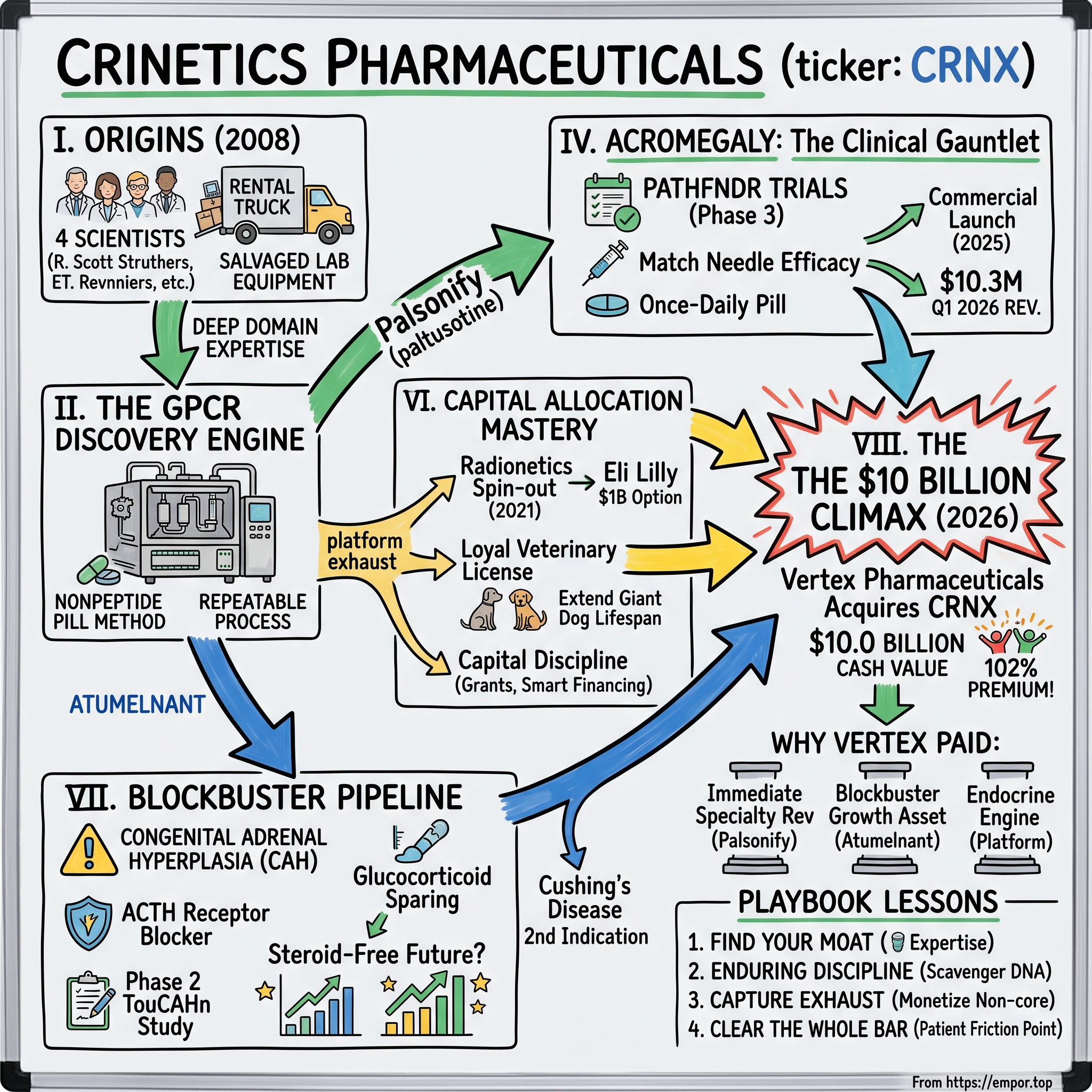
Crinetics Pharmaceuticals: The Oral GPCR Revolution and the $10 Billion Exit
I. Introduction & Episode Roadmap
On Monday, July 6, 2026, the biotech world woke up to a number that did not seem to belong to Crinetics Pharmaceuticals. The stock had closed the previous session at $42.03. Before the market opened, Vertex Pharmaceuticals announced it had signed a definitive agreement to buy the company for $85.00 per share in cash — a 102% premium, and a total equity value of roughly $10.0 billion, or about $8.8 billion net of the cash sitting on Crinetics' balance sheet.[^1]1 For a company that had recorded its first-ever product revenue only one quarter earlier, doubling overnight is the kind of event that demands an explanation.
Here is the "Acquired" question that frames everything that follows: how did a company founded in 2008 by four scientists — cast out of a shuttered endocrinology division at the depths of the Great Financial Crisis, furnishing their first lab with equipment bought secondhand from bankrupt biotechs — become, eighteen years later, the crown jewel that a $100-billion cystic-fibrosis powerhouse was willing to pay a nine-figure-per-day premium to own?
The short answer is chemistry. Crinetics built a discovery engine aimed at one of the hardest problems in drug design: taking endocrine hormone receptors that nature controls with large, fragile peptide molecules — targets that historically forced patients into painful, deep intramuscular depot injections every month — and hitting them instead with tiny synthetic pills that survive the stomach and work once a day. If that sounds like a narrow trick, consider that G protein-coupled receptors, the family Crinetics chose to specialize in, are the targets of roughly a third of all approved medicines. The company did not invent a drug. It industrialized a method.
This is the story of how that method was built, tested, monetized, and finally sold. The roadmap:
- The origins of Crinetics and why GPCRs are simultaneously the most valuable and most stubborn targets in pharmacology.
- Acromegaly: the rare, disfiguring disease behind a $2.5-billion-plus injectable franchise that two European drug giants had quietly owned for decades.
- Palsonify (paltusotine), the once-daily oral pill, and the two Phase 3 trials that had to prove it could match a needle.
- The capital-allocation subplot: how Crinetics spun its "platform exhaust" into an oncology company, an Eli Lilly option worth a billion dollars, and a pill to extend the lives of giant dogs.
- Atumelnant, the pipeline asset many investors believed was worth more than the marketed drug.
- And finally, Vertex: why a company synonymous with one disease paid a full-control premium to enter another.
Throughout, the posture here is independent. Crinetics told a very good story about itself, and much of it appears to be true. But a 102% premium is also a claim about the future, and claims about the future deserve to be tested rather than applauded.
 Subscribe on LinkedIn
II. The Origins: From the Ashes of Neurocrine (2008–2010)
Every origin myth needs a moment of exile, and Crinetics has a clean one. For a decade, Dr. R. Scott Struthers had run endocrinology and metabolism research at Neurocrine Biosciences, a well-regarded San Diego drug developer. He was not a bystander there. Struthers led the discovery work behind elagolix — later marketed as Orilissa — one of the first orally active, small-molecule antagonists of the gonadotropin-releasing hormone receptor, a program that would eventually validate the entire premise that you could hit a peptide-hormone target with a pill.5
Then, in 2008, the premise nearly died with the department. As the financial crisis tightened and Neurocrine restructured around its lead priorities, management decided to deprioritize and effectively shut down the early-stage endocrinology pipeline. For most scientists, that is a résumé event: you update LinkedIn, you find the next job, the compounds gather dust in a freezer. Struthers made the other choice. He decided the science was too good to abandon, and he walked out to build a company around it — bringing with him three colleagues who understood the chemistry as intimately as he did: Frank Zhu, Ana Kusnetzow, and Stephen F. Betz.5
The timing could not have been worse. Late 2008 was, for a fledgling biotech seeking capital, roughly the least hospitable fundraising environment in a generation. Venture money had frozen. IPO windows had slammed shut. And here were four endocrinologists asking investors to bet on a discovery platform that would not produce a marketable product for the better part of a decade.
So they improvised. The story that has followed Crinetics ever since — and that the company itself has never been shy about telling — is the rental-truck story: the founders equipping their first San Diego lab not with pristine new instruments but with benches, centrifuges, and pipettes scavenged at fire-sale prices from other biotechs that the crisis had killed. It is the kind of anecdote that can curdle into self-mythology, and a neutral reader should treat "we were frugal" as a claim companies love to make about themselves. But in this case the behavior left fingerprints. The habit of extreme capital discipline — small, targeted raises, non-dilutive grant money, a refusal to spend ahead of proof — recurs at nearly every subsequent chapter, straight through to a commercial launch run by a deliberately lean specialty sales force. When a cultural claim shows up consistently in a company's actual financing and operating decisions across fifteen years, it stops being marketing and starts being evidence.
What the exile really bought Crinetics was focus. The founders did not have to argue about what the company was for. They had a shared, decade-deep expertise in one narrow, extraordinarily valuable problem — and a crisis that ensured only the most disciplined version of the idea could survive. That combination, expertise plus scarcity, is the foundation the rest of this story is built on. But to understand why their particular expertise mattered so much, you have to understand why the targets they chose had defeated the rest of the industry.
III. Designing the Perfect Nonpeptide: The Peptide GPCR Challenge (2010–2018)
Start with the biology, because the whole investment case rests on it. Your body runs on hormones, and hormones deliver their instructions by docking onto receptors that sit on the surface of cells. A large share of those receptors belong to a single vast family called G protein-coupled receptors, or GPCRs. Think of a GPCR as a lock embedded in the cell wall; the hormone is the key. Turn the lock and the cell does something — releases growth hormone, produces cortisol, triggers a contraction. Because these locks control so much of human physiology, they are the single most productive target family in all of medicine, implicated in roughly a third of approved drugs.
The trouble is the keys. For the endocrine receptors Crinetics cared about — the ones that respond to hormones like somatostatin, ACTH, and GnRH — nature's key is a peptide, a short chain of amino acids. Peptides are big, floppy, and delicate. Swallow one and your digestive system, which is superbly evolved to dismantle exactly that kind of molecule, destroys it before it reaches the bloodstream. That single fact is why so many endocrine and metabolic drugs are injectables: the only reliable way to get a peptide into the body intact is to bypass the gut with a needle.
The holy grail, then, is a nonpeptide — a small, sturdy, synthetic organic molecule, chemically nothing like the natural hormone, that nonetheless fits the same lock precisely enough to turn it on or block it, and is tough enough to survive being swallowed. This is genuinely hard. The molecule has to be small yet selective, hitting one receptor subtype and leaving its near-identical cousins alone, or it causes side effects. It has to be stable, orally absorbable, and long-acting enough for once-a-day dosing. Getting all of those properties into one molecule is closer to lock-picking than to key-cutting, and most of the industry treated these targets as effectively "undruggable" by pills.
What Crinetics built between 2010 and 2018 was not a single such molecule but a repeatable process for finding them — an internal discovery engine designed to systematically convert peptide-binding GPCRs into selective, orally bioavailable, nonpeptide small molecules.5 This is the distinction that separates a lucky drug company from a platform company, and it is the distinction that ultimately justified the acquisition premium. A lucky company finds one pill. A platform company finds a method, and the method keeps producing.
They did it, characteristically, on a shoestring. Through the lean years the company leaned on non-dilutive support — including U.S. government grant funding of the sort awarded through NIH small-business research programs — and tightly scoped venture rounds from biotech-literate investors including 5AM Ventures and Frazier.5 The philosophy was to spend money proving chemistry, not building infrastructure.
The proof point that this restraint had earned came in July 2018, when Crinetics went public on the Nasdaq under the ticker CRNX. The IPO raised roughly $117 million — the largest San Diego life-science offering of that year — and valued the company at over $450 million, a striking mark for a business with no approved product and a lead asset still in early-stage trials.6 Public investors were not buying revenue. They were buying the credibility of the engine. Whether the engine actually worked would be decided by the single program that had to go first: a pill for a disease most people have never heard of.
IV. The Fight for the Pituitary: Palsonify & The Clinical Gauntlet (2018–2025)
To appreciate what Crinetics was attacking, picture a patient whose face and hands are slowly, relentlessly enlarging over years — a change so gradual that old photographs, not mirrors, reveal it. This is acromegaly. It is caused by a usually benign tumor on the pituitary gland that will not stop pumping out growth hormone, which in turn floods the body with insulin-like growth factor-1, or IGF-1. The result is not just enlarged hands, feet, and facial features but debilitating joint pain, sleep apnea, enlargement of internal organs, cardiovascular strain, and, untreated, a materially shortened lifespan. It is rare, chronic, and lifelong — exactly the profile that supports premium-priced specialty medicine.
For decades, the standard of care was a needle, and a nasty one. Two European giants owned the market: Novartis with Sandostatin LAR (octreotide) and Ipsen with Somatuline Depot (lanreotide), together a franchise worth well over $2.5 billion a year. These are somatostatin receptor ligands — they mimic the body's natural "off switch" for growth hormone — but because they are peptides, they had to be delivered as long-acting depot injections. And "depot" is doing heavy lifting in that sentence. We are talking about monthly deep intramuscular or deep subcutaneous injections through large-bore needles, the kind that leave lumps, bruising, injection-site granulomas, and enough discomfort that many patients had to schedule visits to specialized clinics to receive them. The efficacy was real. The experience was miserable. And that gap between clinical benefit and patient burden is precisely the kind of friction a disruptor prays for.
Someone had already tried to exploit it — and, instructively, largely failed. Chiasma developed Mycapssa, an oral form of octreotide, and won approval for it. On paper, it was the pill acromegaly patients wanted. In practice, it carried crippling commercial baggage: low, variable oral bioavailability, a punishing empty-stomach dosing regimen taken twice daily with strict windows around meals, and efficacy that many prescribers found merely adequate. The market voted with its prescriptions. Mycapssa never dented the injectable monopoly. Chiasma was absorbed by Amryt for about $290 million in 2021, and Amryt in turn was bought by Chiesi for roughly $1.48 billion in 2023 — a useful benchmark to file away for later, because it tells you what the market had recently paid for an oral-acromegaly franchise built around a flawed product.
The lesson Crinetics drew from Mycapssa was the one that mattered: patients clearly wanted an oral option, but they would not accept sub-par efficacy or a fussy regimen to get it. So the bar was not "make a pill." The bar was "make a pill that works as well as the needle and is genuinely easy to take." Crinetics' answer was paltusotine — later branded Palsonify — a once-daily, potent, selective nonpeptide agonist of the somatostatin receptor subtype 2, the same target the injectables hit, delivered as a pill with no empty-stomach gymnastics.
Then came the gauntlet, because in this industry a beautiful molecule is a hypothesis until a placebo-controlled Phase 3 trial says otherwise. Crinetics ran two, under the PATHFNDR banner, and they were designed to answer the two questions any endocrinologist would ask.
The first question: if I switch a patient who is already well-controlled on monthly injections over to your pill, do they stay controlled? PATHFNDR-1 tested exactly that, taking biochemically controlled patients off their injectable somatostatin receptor ligands and onto oral paltusotine. In September 2023, the topline read out: 83% of patients on Palsonify maintained tight biochemical control, defined as IGF-1 at or below the upper limit of normal, versus just 4% on placebo.[^9] That placebo arm is the whole point — patients pulled off effective injections and given a sugar pill fell apart, while the ones on paltusotine held.
The second question: what about patients with active, uncontrolled disease — can your pill get them under control in the first place? PATHFNDR-2 enrolled patients with active acromegaly, and in March 2024 it delivered: 56% achieved biochemical control on Palsonify versus 5% on placebo.[^10] The switching number is more dramatic, but the naïve-patient number is arguably the more commercially important, because it establishes Palsonify as a legitimate first-line option rather than merely a maintenance convenience.
Two things are worth saying with an analyst's flatness rather than a cheerleader's. First, these results cleared the bar Mycapssa never did: efficacy in the range of injectables, plus a genuinely simple regimen and, in the trials, favorable tolerability and low discontinuation for adverse events. Second, control-rate percentages from separate trials are not head-to-head proof of superiority over the incumbents, and prescribing habits built over thirty years do not collapse on the strength of a press release. What PATHFNDR established was that Crinetics had earned the right to compete. Whether it could actually take share was the next test — and that test moved from the clinic to the marketplace.
V. Commercial Launch and Regulatory Conquest: Palsonify Hits the Market (2025–2026)
The letter arrived on September 25, 2025. On that date the U.S. Food and Drug Administration approved PALSONIFY (paltusotine) for acromegaly — the first once-daily oral somatostatin receptor ligand cleared for the disease.[^7] For a company founded on the thesis that endocrine peptides could be replaced by pills, it was the moment the thesis became a product you could actually prescribe. Europe followed: in April 2026, the European Commission granted marketing authorization across the EU, opening the second major market.[^8]
Regulatory approval, though, only earns you the right to sell. The harder question is how you sell a specialty drug into a market defended by two entrenched incumbents and decades of physician habit. Crinetics' answer reflected the same discipline that ran through its R&D: concentration. Acromegaly is managed at a relatively small number of specialized pituitary and endocrine centers of excellence — a few hundred in the United States, not tens of thousands of primary-care offices. That concentration is a gift to a small company, because it means the entire addressable market can be covered by a disciplined, lean specialty sales force rather than the sprawling and expensive primary-care commercial machine a broader disease would demand. The launch was led by Chief Commercial Officer Isabel Kalofonos, and the strategy was deliberately narrow: go deep with the specialists who write essentially all the prescriptions, rather than wide.
The first data point on whether any of this was working arrived with the first-quarter 2026 results, reported on May 7, 2026. In its first partial quarter on the market, Palsonify generated $10.3 million in net product revenue, part of $10.7 million in total revenue.4 Read that number carefully — and neutrally. On the one hand, $10.3 million from a standing start, in a rare disease, in a partial quarter, is a healthy signal of eager clinical adoption; management pointed to hundreds of patient enrollment forms and prescriptions from hundreds of unique providers within the first months, with the majority of patients already on reimbursed therapy.4 On the other hand, it is one partial quarter, and a launch curve cannot be extrapolated from its first point. The bull and the skeptic can both cite this number honestly.
What was not ambiguous was the balance sheet. As of March 31, 2026, Crinetics held roughly $1.3 billion in cash, cash equivalents, and investment securities — a fortress position for a company its size, reinforced by about $380 million in net proceeds from a public offering completed in January 2026.4 The timing mattered: raising a large slug of capital in the window between FDA approval and the launch's proof-of-traction let management fund the commercial build-out and keep advancing the pipeline without being forced into dilutive financing at an inopportune moment. That is textbook capital-market discipline, and it is consistent with the frugality thread running back to the rental truck.
The costs behind that ambition were not small. First-quarter research-and-development spending ran about $100.1 million and selling, general, and administrative expense about $50.8 million, producing a net loss of roughly $127.8 million.4 This is the honest arithmetic of a launch: a company spending well over a hundred million dollars a quarter against ten million in sales is betting heavily that the revenue line bends upward fast. The $1.3 billion cushion is what buys the time for that bet to play out. And crucially, Palsonify was never supposed to carry the story alone — because while the sales force was fanning out to pituitary clinics, a second act had been quietly monetized in a way that says as much about how Crinetics thinks as any clinical result.
VI. The Masterclass in Capital Allocation: Spin-outs, Partnerships, and Radionetics (2021–2026)
Here is where the Crinetics story stops being a drug story and becomes a capital-allocation story — and where a skeptical investor should actually lean in rather than roll their eyes, because most biotechs are terrible at this.
A productive discovery engine has a peculiar problem: it produces more than its owner can focus on. Crinetics' platform, aimed broadly at GPCRs, kept generating promising molecules for targets well outside core endocrinology — including in oncology and even animal health. The undisciplined move is to chase all of them, diluting focus and capital across a dozen shiny objects. The disciplined move is to keep the core and find a way to capture value from the rest without letting it distract you. Crinetics chose the latter, repeatedly.
The signature example was Radionetics Oncology. In October 2021, rather than build an in-house radiopharmaceutical program, Crinetics co-founded a separate company, Radionetics, alongside its long-time backers 5AM Ventures and Frazier, and licensed its GPCR-targeted radiopharma intellectual property into it. In exchange, Crinetics took roughly a 25% equity stake plus the potential for commercial milestones exceeding $300 million and single-digit royalties.[^12] The elegance is in what it avoided: Crinetics got exposure to the upside of an entire therapeutic modality without spending its own cash or, more importantly, its own attention on it.
That option paid off faster than anyone had a right to expect. In July 2024, Eli Lilly entered a strategic collaboration with Radionetics, paying $140 million in upfront cash and — the crucial part — acquiring an exclusive option to purchase Radionetics outright for $1.0 billion in cash.[^13] Do the arithmetic that matters to Crinetics shareholders: if Lilly exercises that option, Crinetics' roughly 25% stake converts into approximately $250 million of pure, non-dilutive cash — value created from assets the company had deliberately chosen not to develop itself.[^13] Whether Lilly exercises is not guaranteed, and that caveat belongs in the ledger. But the structure itself is the lesson: Crinetics manufactured a large, asymmetric, cash-settled call option out of what most companies would have treated as background noise.
The pattern repeated in a domain that sounds like a joke until you look at the economics: dogs. In March 2023, Crinetics granted the veterinary-longevity company Loyal an exclusive license to its compound CRN01941 — a somatostatin receptor type 2 agonist, chemically a cousin of its human programs — for veterinary use, in a candidate aimed at extending the lifespan of large- and giant-breed dogs. The terms were modest in absolute dollars: a small upfront payment, preferred stock in Loyal worth roughly $2 million, and single-digit sales royalties if the product is ever approved.9 The dollars are not the point. The point is the mindset: an asset that would otherwise have sat idle in a freezer was turned into equity and optionality at essentially zero cost or distraction to the core business.
Step back and the through-line is unmistakable. Crinetics treated its own scientific output as a portfolio, ruthlessly triaging between "develop ourselves" and "monetize and stay focused." That is a rare and genuinely value-additive discipline in an industry famous for empire-building and pipeline sprawl. It is also, notably, the behavior of the same people who once furnished a lab out of a rental truck. But capital allocation is a supporting character. The reason the company commanded a ten-figure premium was the asset it chose to keep and develop entirely in-house.
VII. The Blockbuster Pipeline: Atumelnant & The CAH Revolution (2024–2026)
If Palsonify was the proof and the near-term revenue, atumelnant was the reason a giant would ever pay $10 billion. Formally CRN04894, it is a once-daily oral antagonist of the ACTH receptor — and in the view of many investors, it, not the marketed drug, was the real prize.
To understand why, meet the disease it targets: congenital adrenal hyperplasia, or CAH. It is a genetic disorder in which the adrenal glands cannot make cortisol properly. The body, sensing the shortfall, floods the system with ACTH — the hormone that tells the adrenals to work harder — and that relentless drive produces a torrent of adrenal androgens, causing serious problems from childhood onward. The cruel part is the standard treatment. Because doctors cannot easily fix the enzyme defect, they suppress the whole cascade with high doses of glucocorticoids — steroids — taken for life. Those doses do control the androgens, but at a brutal, cumulative cost over decades: severe weight gain, osteoporosis, insulin resistance, stunted growth in children, and the full catalog of chronic steroid toxicity. Patients are, in effect, trapped between the disease and its treatment.
Atumelnant proposes to break that trap by blocking the ACTH receptor directly — turning down the signal that drives androgen overproduction, so that patients no longer need to bludgeon the system with high-dose steroids. The Phase 2 data presented at ENDO 2026, the field's major annual meeting, gave that thesis its most serious support to date. In the TouCAHn study, atumelnant produced rapid and large reductions in the key disease biomarkers — androstenedione (A4) and 17-hydroxyprogesterone (17-OHP) — the markers that track exactly the androgen excess CAH treatment is meant to control.[^11]
The headline was not just biomarker suppression but what it enabled: a glucocorticoid-sparing effect. In the trial, controlling the disease at the receptor let patients lower their daily steroid doses toward normal physiological levels while maintaining superior androgen control.[^11] If that result holds up in Phase 3 and in real-world use, it addresses the single thing patients and endocrinologists hate most about managing CAH — the lifelong steroid burden itself. That is the difference between a drug that treats a disease and a drug that changes how the disease is lived with.
The same molecule carries a second shot on goal. Atumelnant also showed rapid cortisol normalization — within roughly ten days — in patients with ACTH-dependent Cushing's disease, a separate condition of cortisol excess.[^11] Cushing's is a smaller opportunity than CAH, but an approvable second indication from one asset is exactly the kind of optionality that makes acquirers salivate.
Sober caveats belong here, because Phase 2 is not Phase 3. These were early studies with limited patient numbers; durability, long-term safety, and performance in larger, more diverse populations remain to be proven, and a competitor was already on the market in CAH. But the strategic reading is straightforward: Crinetics had a marketed drug generating its first revenue and, behind it, a wholly owned pipeline asset with plausible blockbuster economics across two indications. A company with that shape does not stay independent for long — and in July 2026, it didn't.
VIII. The $10 Billion Cash Climax: Why Vertex Paid a 102% Premium (2026)
Rewind to the announcement. On July 6, 2026, Vertex Pharmaceuticals agreed to acquire Crinetics for $85.00 per share in cash, an equity value of about $10.0 billion, or roughly $8.8 billion net of Crinetics' cash — a deal both boards approved unanimously, funded by cash on hand plus debt, with about $4.5 billion of committed bridge financing lined up from Bank of America and Morgan Stanley, and an expected close in the third quarter of 2026.[^1]2 It was Vertex's largest acquisition ever.8
So: why 102% over $42.03? Premiums that large usually signal one of two things — a bidding dynamic, or an acquirer who believes the market has badly mispriced the target. There is no public evidence of a bidding war here, which points to the second explanation. Vertex was buying a specific strategic future, and to understand the price you have to understand Vertex's problem.
Vertex is one of the most profitable companies in biotech, and essentially all of that profit comes from a single disease: cystic fibrosis. Its CF drugs are extraordinary businesses, but they are also a franchise with a mathematical ceiling — a finite patient population that Vertex already dominates. A company that good at one disease, with that much cash, faces a strategic imperative that is almost philosophical: what is the second act? Vertex's answer over the past several years has been to build a portfolio of high-value, specialized, orphan-disease franchises beyond CF — the CRISPR-based sickle-cell therapy CASGEVY, and suzetrigine, a non-opioid acute pain medicine — the search for what the industry calls a "pipeline in a product."
Against that backdrop, Crinetics fits Vertex's template almost suspiciously well, on three counts. First, Palsonify delivers immediate, high-margin specialty revenue attached to an established, highly concentrated endocrine commercial footprint — a beachhead in a new therapeutic area that Vertex would otherwise have to build from scratch. Second, atumelnant offers a Phase 3-ready asset with plausible clinical superiority in CAH and optionality in Cushing's — the growth engine. Third, and most strategically, the GPCR discovery platform itself becomes an internal engine Vertex can point at serious endocrine and metabolic diseases for years. Vertex was not buying two drugs; it was buying a marketed product, a late-stage catalyst, and a factory. The companies framed the combined endocrinology assets as carrying roughly $5 billion in peak annual sales potential — the number that has to be believed for the price to make sense.28
Now the stress test, because a neutral platform owes readers the skeptical version. Is Vertex overpaying? Recall the benchmark from earlier: Chiesi paid about $1.48 billion for Amryt, which owned the flawed oral-acromegaly drug Mycapssa. Vertex paid nearly seven times that. The bull's rebuttal is that the comparison is unfair — Crinetics brings a superior acromegaly drug, a wholly owned second blockbuster candidate, and a validated platform, not a single limping product. The bear's rejoinder is that most of that $10 billion is being paid for things that have not happened yet: atumelnant's Phase 3 success, a Palsonify launch curve visible for exactly one quarter, and platform output that is still theoretical. Both are right, which is another way of saying Vertex bought a call option on execution and paid a premium for certainty of ownership rather than certainty of outcome.
And there is a subtler risk that has nothing to do with clinical data: culture. The thing that made Crinetics special — a lean, frugal, high-selectivity discovery culture that reportedly advanced a strikingly high fraction of its clinical candidates successfully — is exactly the kind of thing that large-corporate integration is famous for smothering. Can Vertex's much bigger machine preserve the scavenger DNA that produced the assets it just paid $10 billion for? That question does not have an answer yet, and it is the one long-term observers should watch most closely. It also happens to be the perfect bridge into what this whole saga teaches.
IX. Playbook: Core Business & Investing Lessons
Strip away the biology and the deal mechanics, and Crinetics leaves behind a compact set of lessons that generalize well beyond drug development.
Lesson 1: Out of the ashes, find your moat. When Neurocrine closed his division, Struthers did not treat a decade of endocrine-chemistry expertise as a sunk cost to walk away from; he treated it as the one asset worth building a company around. The moat was not a patent or a facility — it was deep, hard-won domain knowledge in a specific, valuable, underexploited niche. The strongest technical moats are frequently born this way: from a specialist who refuses to let an institution's decision to abandon a field dictate their own.
Lesson 2: Lean beginnings build enduring capital discipline. The frugality forced on the founders in 2008 was not a phase they outgrew; it appears to have become operating philosophy. It trained the company to prioritize its highest-value targets rather than spray capital across a broad pipeline — and a discovery engine that advances only its best shots tends to post unusually high clinical success rates. Constraint, imposed early, can harden into a competitive advantage.
Lesson 3: Capture platform exhaust. A genuinely productive engine produces more than you can focus on. The disciplined response is not to chase every output but to monetize the non-core ones — through spin-outs, out-licenses, and equity stakes — so they generate non-dilutive cash and optionality without stealing focus from the core. Radionetics and Loyal turned assets that would otherwise have gathered dust into a billion-dollar option and equity upside, at almost no cost to the mission.
Lesson 4: Solve the true patient friction point — but clear the whole bar. Mycapssa proved that patients wanted an oral alternative to painful injections, and it also proved that wanting isn't enough: a pill with weak efficacy and a fussy regimen fails anyway. Crinetics succeeded not by being the first oral option but by being the first to match injectable efficacy while delivering genuine once-daily convenience. Identifying the friction point is half the job; the other half is refusing to ship a solution that only partly resolves it.
The common thread is discipline — of focus, of capital, of standards. Which sets up the harder analytical question: is that discipline a durable, structural advantage, or a story that happened to end well?
X. Analytical Deep-Dive: 7 Powers & Bear vs. Bull Cases
Let's war-game it properly, using two standard lenses.
Hamilton Helmer's 7 Powers. Two of the seven apply cleanly to Crinetics. The first is Cornered Resource: the proprietary nonpeptide small-molecule discovery platform, and — arguably more valuable and harder to replicate — the specific chemistry expertise of the founding team in converting peptide GPCR targets into oral small molecules. A platform can, in principle, be copied; a group of four scientists with fifteen years of shared, tacit knowledge in an esoteric niche is a genuinely cornered resource, though one with an obvious fragility (see the integration risk above). The second is Counter-Positioning, and it is the more interesting one. Crinetics' once-daily oral pills are counter-positioned against the incumbents' greatest assets. Novartis and Ipsen built enormous, profitable businesses around depot-injection manufacturing and specialty distribution. To pivot to orals, they would have to cannibalize those multibillion-dollar franchises — which incumbents are structurally reluctant to do. The classic disruptor's advantage is not that the incumbent can't see the threat; it's that responding would hurt the incumbent's existing profits, so they hesitate. That is textbook counter-positioning.
Porter's Five Forces, briefly. Barriers to entry are high — the chemistry, the trial infrastructure, and regulatory approval are formidable. Buyer power is fragmented across specialists and payers, though payers can pressure price. The threat of substitutes is the live wire: the injectables remain effective and physician-familiar, and, more pointedly, new oral competitors can and will emerge — as Crinetics itself proved is possible. Supplier power is modest. Rivalry is concentrated but intensifying, especially in the pipeline diseases.
The current risk radar. Two mechanisms matter most. First, commercial-execution risk: three decades of prescribing habit is a real barrier. Community endocrinologists comfortable with injectable somatostatin ligands do not switch on the strength of trial percentages; adoption depends on repeated real-world reassurance, and inertia is a formidable competitor. Second, pipeline competition: in CAH, established players are already present — most notably Neurocrine's crinecerfont, a differently-mechanized therapy that reached the market ahead of atumelnant. If a competitor's timeline or data prove meaningfully stronger, atumelnant's eventual share and pricing power could be pressured regardless of how good its own data look.
The bull case. Palsonify's convenience and efficacy let it capture a large slice — think north of 40% — of the $2.5-billion-plus acromegaly market and expand into adjacent indications such as carcinoid syndrome; atumelnant clears Phase 3 and becomes a multi-billion-dollar franchise across CAH and Cushing's; and Vertex's global commercial muscle accelerates international launches that a standalone Crinetics could never have funded as fast. In that world, the combined ~$5 billion peak-sales framing is conservative, and $10 billion looks cheap in hindsight.
The bear case. Prescribing inertia keeps most patients on the needles they know; competitor launches in CAH cap atumelnant's pricing before it scales; and the early-stage platform — the thing supposedly worth a premium — hits the ordinary attrition that eventually humbles every discovery engine. Layer on integration risk, and the scenario is not catastrophe but disappointment: a good business that grows into its price slowly rather than explosively, leaving Vertex to explain a full-control premium paid at the top of a biotech M&A wave.78
Neither case is provable today, which is the honest conclusion. The deal converts Crinetics shareholders' uncertainty into $85 in cash and transfers all of it to Vertex. For observers, the useful move is not to pick a side but to know what to watch.
The KPIs that actually matter. Ignore the noise and track two things. First, the Palsonify net-revenue trajectory — the quarter-over-quarter slope of the launch curve, which is the single cleanest read on whether oral convenience is genuinely overcoming injectable inertia. Second, atumelnant's Phase 3 progression — trial readouts, and specifically whether the glucocorticoid-sparing effect holds at scale — because that asset carries the majority of the acquisition's forward value. Everything else is commentary.
XI. Epilogue & Final Reflections
The distance between the two ends of this story is the whole point. It begins in late 2008 with four scientists and a rental truck, loading salvaged lab benches and used centrifuges bought off dying biotechs, betting a shuttered department's worth of expertise against the worst funding market in a generation. It ends in July 2026 with a definitive agreement to hand that same expertise, now expressed as an approved oral drug, a blockbuster-candidate pipeline, and a validated discovery platform, to Vertex Pharmaceuticals for $10 billion in cash.[^1]
What makes Crinetics instructive is not that it got acquired — biotechs get acquired constantly — but how it earned the price. It stayed narrow when it could have sprawled. It monetized what it chose not to build. It raised capital when capital was cheap and abundant rather than when it was desperate. And it refused to ship an oral drug that merely gestured at replacing the needle; it waited until it had one that could actually match it. In an industry that rewards audacity and punishes indiscipline, Crinetics ran an unusually disciplined playbook — which is a fair claim to make precisely because the discipline shows up in the decisions, not just the retelling.
The deeper resonance is medical, not financial. The core scientific bet — that painful monthly depot injections could be replaced by an elegant once-daily pill for diseases the body governs through peptide receptors — turned out to be real, at least for acromegaly, and plausibly for more. For patients who have spent years bracing for a large-bore needle every month, that is not a capital-allocation lesson. It is the difference between managing a rare disease and being managed by it. Whether Vertex can keep the engine that produced it running at the same efficiency is the open question the next several years will answer.
References
-
Vertex to Acquire Crinetics in $10 Billion All-Cash Deal — Reuters, 2026-07-06 ↩
-
Vertex Plunks Down $10B All-Cash to Buy Crinetics, Entering Rare Endocrine Arena — Fierce Pharma, 2026-07-06 ↩↩
-
Vertex to Acquire Crinetics for $10B to Expand Rare Disease Lineup — BioPharma Dive, 2026-07-06 ↩
-
Crinetics Pharmaceuticals Reports First Quarter 2026 Financial Results and Provides Business Update — Crinetics Pharmaceuticals / GlobeNewswire, 2026-05-07 ↩↩↩↩
-
Form 10-K Annual Report for the Fiscal Year Ended December 31, 2025 — Crinetics Pharmaceuticals / SEC, 2026-02-26 ↩↩↩↩
-
Crinetics Pharmaceuticals SEC CIK 0001658247 Landing Page — SEC EDGAR, 2026-07-17 ↩
-
Vertex Is Paying a 102% Premium to Acquire Crinetics for $10 Billion. Here's Whether the Deal Is Worth It. — The Motley Fool, 2026-07-08 ↩
-
Vertex Acquires Crinetics Pharmaceuticals for $10 Billion as Biotech M&A Soars — STAT News, 2026-07-06 ↩↩↩
-
Announcing Our Partnership with Crinetics Pharmaceuticals — Loyal, 2023 ↩
 LinkedIn
 WhatsApp
 Reddit
 Hacker News
 Email
Email Kindle
 RSS Feed
 Spotify
 Apple Podcasts
 Amazon Music
 Audible
 YouTube