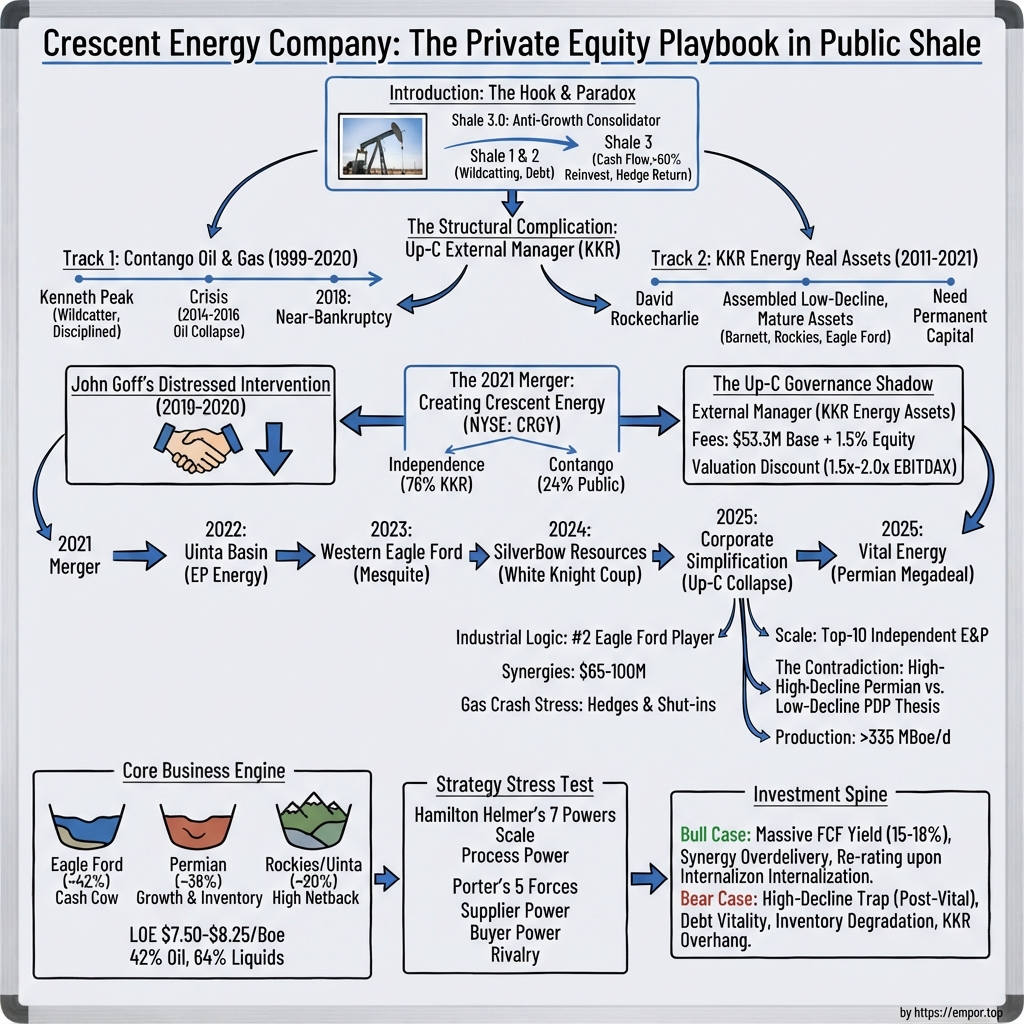
Crescent Energy Company: The Private Equity Playbook in Public Shale
I. Introduction & Episode Roadmap
On a Tuesday morning in August 2026, Crescent Energy's executive team hosted a conference call to report its strongest quarterly operating results to date. Net production reached 335,000 barrels of oil equivalent per day, adjusted EBITDAX reached a record $798 million, and levered free cash flow hit a high of $418 million. Management also raised its synergy target for the Permian Basin acquisition closed eight months earlier, increasing the projected annual run rate from an initial $90 million to $100 million to a revised range of $250 million to $300 million.12
Four and a half years earlier, the company did not exist.
That rapid ascent highlights the defining reality of Crescent Energy: it did not grow organically. It was assembled—pieced together from mature, cash-generating producing properties that private equity firm KKR had acquired since 2011, merged into the corporate shell of a distressed Houston micro-cap named Contango Oil & Gas, and expanded through secondary acquisitions until it entered the ranks of the top ten independent U.S. producers. Along the way, Crescent acquired SilverBow Resources in the middle of a contested proxy battle, purchased Ridgemar's Central Eagle Ford assets for $905 million, divested its legacy footprint across the Barnett, Rockies, Mid-Continent, and DJ Basins, and absorbed Vital Energy—itself a debt-funded Permian consolidator—in a $3.1 billion all-stock transaction.[^3]34
The core paradox. The modern American shale sector has progressed through three distinct eras of capital allocation. The first, from roughly 2005 to 2014, was an exploratory land grab financed by relentless equity dilution. The second, from 2015 to 2020, brought the reckoning: debt-funded drilling campaigns, steep production decline curves that exhausted capital budgets, and widespread bankruptcies that wiped out public equity holders. Crescent was designed as an explicit counterweight to both eras. Its original premise was anti-growth: acquire proved developed producing assets at modest multiples, restrict reinvestment to a fraction of operating cash flow, hedge commodity exposure, maintain low corporate decline rates, and return the remaining cash to shareholders. The strategy prioritized harvesting cash flows over funding greenfield drilling.
Over the past three years, however, Crescent's execution has increasingly mirrored the conventional model it once rejected. The company issued substantial equity, pursued volume-driven scale, initiated an active Permian drilling program, and allowed its corporate base decline rate to climb into the high twenties. Crescent's chief operating officer acknowledged the shift during the August 2026 earnings call, telling analysts that management was working to bring the decline rate down from 29% toward 25% by 2027.2 That metric serves as a direct indicator of how far the operating strategy has drifted from the company's founding thesis.
The structural complication. Crescent also arrived on the New York Stock Exchange under an unconventional governance structure. When the company went public in December 2021, it used an Umbrella Partnership C-Corporation, or Up-C, framework with dual-class voting shares and an external management contract. Its senior executives were not direct Crescent employees; instead, they were assigned under contract by KKR Energy Assets Manager LLC, which collected an annual base management fee of $53.3 million alongside an ongoing 1.5% fee on the net proceeds of future primary equity issuances.5 Public market investors have historically discounted externally managed vehicles across master limited partnerships, mortgage real estate investment trusts, and shipping companies, citing misaligned incentives between external managers and common shareholders. Crescent asked public investors to grant an exception.
For the most part, public markets declined to do so. Crescent traded at a persistent discount to internally managed peers on enterprise value relative to EBITDAX throughout its public tenure—a valuation gap wide enough that management frequently highlighted it in corporate presentations.
What this story covers. The analysis begins with the two corporate lineages that produced Crescent: Kenneth Peak's boom-and-bust Contango Oil & Gas, alongside the counter-cyclical upstream portfolio assembled by David Rockecharlie inside KKR. It traces investor John Goff's restructuring of a distressed Contango, the financial architecture of the Up-C and external management agreement, and the roll-up across the Uinta Basin and Western Eagle Ford. It examines the takeover of SilverBow Resources during an activist battle, followed by the decisive 2025 strategic pivot: collapsing the dual-class equity structure in April and acquiring Vital Energy in August. Finally, the analysis evaluates whether consolidating secondary acreage generates a sustainable competitive advantage, and whether an external manager compensated partly on equity growth can consistently prioritize per-share value over absolute balance-sheet scale.
That question forms the foundation of the chapters ahead.
 Subscribe on LinkedIn
II. The Pre-History: Two Paths to the Post-Shale Reckoning (1999–2020)
Kenneth R. Peak was not a geologist. He was a U.S. Navy officer who became a commercial banker in 1973, earned an MBA from Columbia University, worked through financial and executive roles across the oil business, and in 1999—at an age when most executives are consolidating a career rather than launching one—founded a company in Houston with the knowing name of Contango, the futures-market term for a forward curve priced above spot.6
Track 1: The classic E&P lifecycle. Under Peak, Contango operated as a high-impact, high-risk conventional explorer focused on shallow-water Gulf of Mexico and onshore Gulf Coast prospects, where a single successful well could transform the company's financial profile. What distinguished Contango in the 2000s was its balance sheet discipline. Peak carried little or no debt, repurchased stock, and held a substantial personal equity stake. In an industry that routinely plowed every dollar of operating cash flow back into the ground, Contango stood out as an exploration and production company that treated shareholder capital with unusual conservatism.
Peak was diagnosed with an inoperable brain tumor in August 2012 and died on April 22, 2013, at 67.7 His death coincided with an accelerating structural crisis for the company's business model. Conventional Gulf of Mexico exploration—Contango's founding focus—was in secular retreat, outmatched on capital efficiency by horizontal onshore shale. Successor management responded as many conventional operators did during that window: pivoting onshore into the Southern Delaware Basin of West Texas and the Mid-Continent, acquiring acreage and drilling just as the industry entered the sharpest crude price collapse in a generation.
The financial fallout was swift. For the full year 2015, Contango reported a net loss of $335.0 million, weighed down by $285.9 million in impairment charges driven by the commodity price crash. Production fell 23% the following year, dropping from 93.0 million cubic feet equivalent per day in 2015 to 71.0 million in 2016. Contango posted another $58.0 million loss in 2016, though it managed to cut debt roughly in half to $54.4 million, largely by selling assets and shrinking its footprint.8 Management remained publicly optimistic about the Delaware acreage—with CEO Allan Keel describing it in early 2017 as "one of the few domestic plays that provide return-justified drilling opportunities in the current price environment"8—but the financial arithmetic had already rendered its verdict. An operator with more than $50 million in debt and a declining production base could not drill its way out of a shale downturn. It would either be restructured, acquired, or both.
Track 2: The Fort Worth intervention. John C. Goff made his fortune in Fort Worth real estate, co-founding Crescent Real Estate Equities and later directing the family office Goff Capital. He was not an oilman by background; he was a distressed-value investor operating in a state where distressed assets were routinely denominated in barrels. Beginning in 2018, he accumulated roughly 18.3% of Contango's common stock and joined the board.9
What followed was a textbook sponsor-led restructuring of a beaten-down public shell. Wilkie S. Colyer Jr., then in his early thirties and a Goff Capital executive, took over as interim president and CEO.9 Goff became chairman. The operating premise shifted entirely: Contango abandoned speculative drilling and instead repurposed its public listing as an acquisition currency to absorb producing assets from operators in even greater distress. In 2019, Contango bought properties out of the White Star Petroleum bankruptcy—with Goff affiliates contributing roughly $7 million toward the purchase price—and brought on the Will Energy operating team in the process.10 During the pandemic-induced market shock of 2020, when the front-month WTI contract settled at negative $37 a barrel, Contango continued buying. The company agreed to an all-stock merger with Mid-Con Energy Partners in October 2020 that closed on January 21, 2021, and closed the $58 million Silvertip acquisition of Big Horn, Powder River, and Permian properties on February 1, 2021.11
Track 3: KKR's patient accumulation. While Goff and Colyer executed that turnaround in Houston and Fort Worth, David Rockecharlie was building a fundamentally different upstream portfolio inside KKR. From 2011 onward, KKR's Energy Real Assets platform acquired the mature, cash-generative properties that high-growth shale drillers discarded: low-decline producing wells, non-operated working interests, legacy Eagle Ford acreage, Barnett shale gas, and conventional Rockies fields. The strategy reflected core private equity mechanics: acquire proved developed reserves at a discount to their projected future cash flows, harvest the distributions, and reject exploratory drilling targets. By 2020, KKR had housed these assets within a vehicle named Independence Energy LLC.
That model, however, faced the structural boundary inherent to private equity: funds have finite investment horizons, typically ten years, while Independence's assets were long-lived by design. Holding thirty-year decline curves inside a ten-year fund structure represented a fundamental duration mismatch. KKR needed access to permanent capital.
Testing the Contango story. In retrospect, it is tempting to view pre-merger Contango as a proven roll-up engine—a turnkey acquisition machine that KKR simply plugged into. The historical record does not support that interpretation. Contango's bankruptcy-auction purchases in 2019 and 2020 were opportunistic and disciplined, but they were modest in scale, and they arrived only after five years in which the same corporate shell had wiped out hundreds of millions of dollars in equity attempting to drill onshore shale.
A more rigorous reading is narrower: Goff and Colyer demonstrated that a distressed public shell could serve as an effective tool for counter-cyclical asset purchases at a scale of tens of millions of dollars during the most buyer-friendly market window in modern energy history. What they had not proven—and could not have tested under Contango's balance sheet constraints—was whether that model could function at multi-billion-dollar scale, in mid-cycle commodity environments, and against competing corporate bidders. That next step required capital and an asset foundation Contango simply did not have.
Which is precisely why the two tracks converged.
III. The 2021 Merger: Creating Crescent Energy & The Up-C PE Construct
The transaction announced in June 2021 and completed that December was, mechanically, a reverse takeover. Independence Energy—the upstream vehicle housing KKR's assets—combined with Contango Oil & Gas, with Independence equity holders receiving approximately 76% of the combined company and Contango shareholders roughly 24%. KKR's balance sheet held an outright stake of approximately 17%. Class A common shares began trading on the New York Stock Exchange under the ticker CRGY at the opening bell on December 8, 2021.[^13]
Governance reflected that ownership division. The initial nine-member board comprised five directors designated by legacy Independence, three from Contango, and one unaffiliated independent director. John Goff became non-executive chairman, while David Rockecharlie assumed the chief executive role. Wilkie Colyer, who had guided the Contango turnaround, did not continue in an executive role at the combined company.[^13]
The pitch. The investor proposition Crescent laid out in late 2021 rested on three core pillars, establishing the benchmarks against which its operating history would be evaluated. First, a low corporate decline rate: an asset portfolio weighted heavily toward mature producing wells declines far more gradually than freshly completed shale horizontals, requiring significantly less reinvestment capital merely to hold baseline production flat. Second, a disciplined reinvestment ceiling: allocating roughly 50% to 60% of operating cash flow back into the ground, reserving the remaining cash for balance-sheet debt reduction and shareholder distributions. Third, systematic commodity hedging: maintaining a rolling portfolio of derivative swaps and collars across 12 to 24 months of forward production to insulate operating cash flows from market swings.
To an energy investor scarred by the shale downcycles of 2015 and 2020, that framework presented an appealing alternative. In practice, it resembled a yield-oriented bond fund with a drill bit attached.
The structure. What distinguished Crescent from conventional upstream peers was not its operating philosophy, but its corporate plumbing. Under the Up-C architecture, Class A shares traded publicly on the exchange, while Class B shares carried voting rights without economic participation, paired one-for-one with operating partnership units held by legacy KKR entities. Up-C structures exist primarily for tax efficiency—allowing pre-IPO owners to maintain partnership pass-through treatment—and are familiar across private equity sponsor-backed public listings. Yet they also introduce structural friction: complicating the reported share count, alienating generalist public investors, and establishing two classes of owners whose tax motivations can diverge during asset sales.
The external management agreement presented an even sharper structural friction. Crescent's executive leadership was furnished directly by KKR Energy Assets Manager LLC under a contract mandating a base management fee of $53.3 million per year, paid quarterly, escalating by 1.50% annually of the net proceeds from any future primary equity issuance. The initial contract ran for three years from December 7, 2021, renewing automatically for successive three-year terms. Terminating the manager without cause required 180 days' notice, an affirmative vote by at least two-thirds of the independent directors finding that long-term performance had been unsatisfactory or that fees were "materially unfair and excessive," and payment of a termination fee equal to three times the sum of the average annual management fee and average incentive allocation value over the preceding 24 months.5
A further provision governed proprietary deal sourcing. The agreement required the manager to allocate upstream oil and gas opportunities between Crescent and a KKR flagship private equity fund on a pro rata basis until that fund's capital was fully committed, after which Crescent was guaranteed an allocation of at least 70% of such opportunities.5 In contractual terms, the advisory entity tasked with sourcing accretive acquisitions for a publicly traded company was explicitly permitted to route up to 30% of eligible transactions elsewhere.
Testing the alignment claim. The traditional defense of external management asserts that a private equity sponsor delivers institutional deal origination, capital markets access, credit relationships, and back-office infrastructure that an independent mid-cap producer could never assemble on its own at comparable cost—rendering the advisory fee an efficient substitute for internal general and administrative overhead. Crescent's operational record offered some support for that view: its cash G&A per barrel remained competitive, and its transaction execution operated with an institutional speed rarely seen among smaller internally managed operators.
Yet the contractual architecture embedded structural incentives that operational competence could not resolve. Because the management fee expanded with primary equity issuances rather than per-share value, an equity-financed acquisition that left free cash flow per share unchanged still enlarged the manager's annual revenue stream. A termination penalty climbing well into nine figures rendered internalizing management cost-prohibitive by design. And a 70% deal allocation floor codified an ongoing structural conflict rather than eliminating it.
Public equity markets recognized those trade-offs from the outset. Crescent traded at a persistent discount on enterprise value relative to EBITDAX compared to internally managed mid-cap peers such as Chord Energy, Matador Resources, and SM Energy throughout its public existence; by 2026, third-party valuation commentary placed Crescent's multiple near 3.2 times, compared to a peer group average closer to 4.5 times.12
The analytical challenge, therefore, was not to assume the manager acted extractively. Rather, it was to insist that the burden of proof rested entirely on per-share outcomes—and to scrutinize governance incentives each time the company expanded its equity base.
The first practical tests of that architecture followed in short order.
IV. The Early Roll-Up Playbook: Uinta & Western Eagle Ford (2022–2023)
In February 2022, against the backdrop of Russia's invasion of Ukraine and crude oil surging past $100 per barrel, Crescent announced its first major acquisition as a public company: the Uinta Basin assets of bankrupt operator EP Energy for an unadjusted headline price of $815 million.13 By the time the transaction closed on March 30, the net purchase price had dropped to roughly $690 million, comprising approximately $621 million in cash consideration alongside assumed commodity derivative liabilities.14 That downward purchase price adjustment of nearly $125 million within six weeks illustrated standard upstream deal mechanics: because the transaction's effective date ran backward to prior months, interim operating cash flows accrued directly to the buyer, and a sharply rising commodity price strip significantly expanded the value of that interim production.
What Uinta actually is. The Uinta Basin of eastern Utah yields one of the most distinctive crude oil grades in North America. The oil is exceptionally rich in paraffins, meaning it solidifies at room temperature into a substance resembling candle wax. Transporting waxy crude from the wellhead to a commercial buyer requires insulated pipelines, heated storage tanks, and specialized rail cars or trucks designed to keep the liquid above its pour point throughout transit. For decades, those physical constraints left Uinta producers almost entirely dependent on a small cluster of Salt Lake City refineries specially configured to process waxy feedstock. That geographical concentration created chronic pricing vulnerability: a captive group of sellers faced a handful of local refiners, resulting in realized price discounts that widened sharply whenever a regional facility underwent maintenance or winter weather disrupted transit corridors.
That bottleneck complicated any framing of Uinta acreage as an unconstrained cash engine. While the crude commands attractive premiums from specialty refiners equipped to handle it, realized netbacks remain vulnerable to a physically constrained supply chain. To expand its commercial reach, Crescent progressively contracted unit-train rail capacity to move crude toward deeper refining markets along the U.S. Gulf Coast. Yet contracted rail capacity functions as a transport expense rather than a permanent operational moat, and its relative advantage can narrow as competing basin operators secure comparable logistics. The basin combined attractive wellhead returns with persistent logistical bottlenecks, meaning asset-level cash flows carried underlying market variance.
The Eagle Ford consolidation begins. A second sequence of transactions in South Texas illustrated Crescent's core consolidation strategy more clearly. Crescent already held roughly a 15% non-operated working interest across a Western Eagle Ford position in Dimmit and Webb Counties. In May 2023, the company agreed to acquire operatorship and an incremental ~35% working interest in those same assets from Mesquite Energy for $600 million in cash, closing the transaction on July 3. The purchase increased Crescent's operated position to approximately 63%, adding roughly 32,000 barrels of oil equivalent per day of net production and approximately $1.1 billion in proved developed discounted future net cash flows, or PV-10.15 Three months later, Crescent acquired another 12% working interest in the same properties for approximately $250 million.15
Consolidating working interests in existing acreage represented a distinct, low-risk form of value creation. Buying out minority partners in familiar wells and assuming operatorship generated little market excitement—it introduced no new geological plays and required no exploratory wildcatting. Instead, it converted a passive minority interest into direct operational control over capital programs, lease operating expenses, artificial lift schedules, and hydrocarbon marketing contracts. In practice, the move functioned like buying out a co-owner in a shared commercial property: it eliminated redundant overhead and placed daily operational control under a single management team.
The operating layer. Crescent's operating focus during these years centered on base production optimization rather than exploratory drilling: reconfiguring gas lift systems, installing plunger lifts, overhauling pump jacks, and refracturing mature horizontal wellbores. These low-intensity workovers generated strong capital returns because the incremental capital outlay was modest relative to the incremental barrels recovered from wells that were already drilled, cased, and connected to pipeline infrastructure.
During 2022 and 2023, with West Texas Intermediate trading between $80 and $100 per barrel, equity analysts frequently questioned why Crescent was prioritizing balance-sheet debt reduction and unit repurchases over adding drilling rigs. Management's justification remained consistent: the company underwrote projects for full-cycle returns on invested capital rather than peak-cycle volume, arguing that a low-decline base insulated the business from the temptation to overspend at the top of the commodity cycle. That disciplined reinvestment posture aligned with the company's founding mandate, demonstrating that its cash-harvesting model was functioning as intended during a strong commodity tape.
Then a takeover fight two hundred miles east handed Crescent an opportunity it had not created.
V. The SilverBow Heist: White Knight in an Activist War (2024)
By the spring of 2024, SilverBow Resources was a company under siege from its own largest shareholder.
Kimmeridge Energy Management, holding 12.9% of the Eagle Ford producer, had spent months arguing that SilverBow's board was stale, its capital allocation poor, and its leverage excessive.16 Kimmeridge had proposed combining SilverBow with its own private portfolio vehicle, Kimmeridge Texas Gas; SilverBow's board rejected the proposal in April 2024 as substantially undervaluing the company after taking independent financial and legal advice.17 Kimmeridge then withdrew the merger offer and escalated to a direct proxy contest, publishing a presentation titled "SilverBow Resources: A Board in Need of Change," nominating three dissident directors, and urging shareholders to withhold votes from three incumbents ahead of the annual meeting.18
That confrontation reflected a classic mid-cap energy standoff: an activist with a credible operational critique and a self-interested remedy, an incumbent board with a legitimate valuation objection and no clear strategic alternative, and a shareholder base forced to choose between them at substantial corporate expense.
Crescent's entry. On May 16, 2024, Crescent entered the dispute as a white knight, announcing a definitive agreement to acquire SilverBow for approximately $2.1 billion. SilverBow shareholders were slated to receive 3.125 Crescent Class A shares per SilverBow share, with the option to elect cash at $38.00 per share subject to proration against a $400 million aggregate cash cap.19 Six days later, on May 22, Kimmeridge withdrew its proxy nominees, explicitly citing the pending sale.16 Credit rating agencies responded favorably to the announced transaction, an important validation for a buyer intending to lever up.20 The acquisition closed on July 30, 2024, ahead of the original schedule.21
Strategically, the industrial logic was straightforward. SilverBow's Central and Eastern Eagle Ford position across McMullen, La Salle, Dimmit, and Webb Counties sat directly adjacent to the Western Eagle Ford block Crescent had consolidated throughout 2023. The combination established Crescent as one of the largest operators in the basin by gross operated footprint, behind only ConocoPhillips and EOG Resources.19 Acreage contiguity in shale operations is far more than a slogan: it dictates lateral drilling lengths, multi-well pad configurations, produced-water handling logistics, gathering costs, and how many crews an operator can keep running without moving equipment.
What the deal actually cost. The transaction's timing, however, complicated that clean narrative.
SilverBow's asset base was heavily weighted toward natural gas and natural gas liquids. Crescent acquired that product mix at almost the exact moment domestic natural gas prices slumped under storage surpluses and delayed liquefied natural gas export demand. Management adapted quickly, halting capital allocation to dry gas locations in Webb County and redirecting activity toward liquids-rich drilling windows. On the third-quarter 2024 earnings call, management was explicit that capital allocation to dry gas acreage depended on prevailing prices and the oil-to-gas ratio, while also noting they felt fine about owning more gas optionality at depressed prices.22 Crescent also reduced its active Eagle Ford rig count from four to three, a shift management attributed to faster drilling and efficiency gains rather than retrenchment.22
Both perspectives carried weight. Operational efficiencies were real: Crescent repeatedly raised production guidance across 2024, reporting record production of 219,000 barrels of oil equivalent per day in the third quarter alongside roughly $430 million in adjusted EBITDA and $160 million in levered free cash flow, and it beat the original SilverBow synergy target by more than 20%.22 Yet an operator that has just told investors it is buying a gas-weighted asset base does not shut in dry gas drilling and reassign rigs simply because an integration progressed according to plan; the operational pivot was an unavoidable response to shifting market fundamentals.
Testing the accretion claim. Management asserted that SilverBow was "immediately accretive across all financial metrics"—a customary transaction claim that is nearly unfalsifiable as stated because benchmark metrics can be selected after the fact. What can be tested is whether the acquired asset performed as originally underwritten. On that standard, the evidence proved mixed: operating and cost synergies outpaced expectations, while the commodity thesis embedded in the asset mix did not survive its initial exposure to the natural gas market. Crescent exited the transaction with leverage around 1.5 times and a clear directive to prioritize debt reduction over buybacks.22
The takeaway is not that SilverBow was a flawed transaction; the expanded Eagle Ford footprint provided the cash-generating foundation for Crescent's subsequent scale. Rather, the episode highlighted a critical analytical distinction: Crescent's demonstrated strength lay in operational integration and cost execution, not in commodity timing. Those are different capabilities, and only one of them showed up.
That distinction became far more consequential a year later, when Crescent went shopping in the Permian.
VI. The 2025 Double-Pivot: Corporate Simplification & The $3.1B Vital Energy Megadeal
The year 2025 marked the point where Crescent shifted from a KKR portfolio company that happened to be listed into a major public operator that happened to be externally managed. Across those twelve months, roughly $5 billion in acquisitions and divestitures moved through the balance sheet.23
January: the Ridgemar bolt-on.
The transformation began in South Texas. On January 31, 2025, Crescent closed the acquisition of Central Eagle Ford assets from Ridgemar Energy for upfront consideration of $905 million—$830 million in cash alongside roughly 5.45 million Class A shares—with additional oil-price-contingent payments of up to $170 million.[^3] The transaction brought Crescent's cumulative Eagle Ford acquisitions over the preceding eighteen months to approximately $4 billion.[^3]
The contingent consideration highlighted a disciplined structuring tactic. Oil-price-linked earnouts allow a buyer to lower upfront cash outlays while sharing upside only if commodity benchmarks cooperate, serving as both a seller concession and a buyer's risk-mitigation tool when underwriting conservative price decks. With West Texas Intermediate spending stretches above $90 per barrel through 2026, those contingent payments became considerably more expensive than they appeared at signing. That outcome, however, is precisely what a well-designed earnout structure is intended to do.
April: killing the Up-C.
On April 8, 2025, Crescent announced it had exercised redemption rights effective April 4 to convert all remaining Class B common stock into Class A, eliminating the Up-C structure. Every stockholder now held the identical equity instrument. KKR retained its roughly 10% ownership through an indirect subsidiary for its own account and agreed to a 180-day lock-up. No ownership changed hands.24
Management's stated rationale cited reduced complexity, cleaner financial presentation, lower compliance costs, and a broader potential investor base.24 Those benefits were genuine, with index eligibility serving as the primary unstated prize: single-class capitalization tables clear passive index and benchmark screens that dual-class vehicles cannot.
Yet precision requires separating form from governance substance. The Up-C was the cosmetic half of the governance discount. The external management agreement—the base fee, the equity-issuance escalator, the punitive termination formula, and the 70% deal-allocation threshold—remained untouched. Crescent simplified its capitalization table while leaving the underlying economics of control in place. Investors who viewed the April restructuring as a comprehensive governance turning point received only half of one.
August: the Permian.
On August 24, 2025, Crescent agreed to acquire Vital Energy in an all-stock transaction valued at approximately $3.1 billion, including Vital's net debt, formally announcing the deal the following morning. Vital shareholders received 1.9062 Crescent Class A shares for each share held—representing a 5% premium to the 30-day volume-weighted average price exchange ratio and a 15% premium to Vital's 30-day VWAP as of August 22. Following the merger, legacy Crescent shareholders held approximately 77% of the combined entity on a fully diluted basis, with Vital investors owning roughly 23%. Crescent expanded its board of directors to twelve members, adding two Vital designees. Management guided to $90 million to $100 million in annual synergies, alongside a targeted $1 billion non-core divestiture program designed to reduce leverage below 1.5 times.25 The transaction closed on December 15, 2025.4
Who was Vital, and why did it sell?
That transaction warrants close scrutiny because Vital Energy was not a thriving operator being opportunistically absorbed. In many respects, it was the previous decade's version of an upstream roll-up, pushed to its financial limit.
Vital—formerly Laredo Petroleum—had spent 2023 and 2024 rolling up secondary Permian acreage through aggressive debt-financed deals: a $1.165 billion asset package from Henry Energy, Tall City, and Maple Energy in November 2023, tag-along working interest acquisitions of $55 million in December 2023 and $78 million in February 2024, and an $827 million share of a $1.0 billion Point Energy Partners purchase in Ward and Winkler Counties closed in September 2024 alongside Northern Oil and Gas.26
The financial fallout was swift. For the year ended December 31, 2024, Vital reported a net loss of $173.5 million, dragged down by a non-cash impairment charge on oil and gas properties of $481.3 million.26 By mid-2025, Vital's net debt reached approximately $715 million, with $745 million drawn against its $1.4 billion credit facility.27
In substance, Crescent was acquiring a distressed serial consolidator whose recent purchases had already been written down. That context cut both ways. On one hand, it explained why the purchase price per flowing barrel represented a steep discount to premier Permian transactions, such as Diamondback's acquisition of Endeavor or Occidental's buyout of CrownRock—Crescent was not buying Tier-1 core rock and made no claim to be doing so. On the other hand, it meant the acreage arrived with an established operating track record of failing to generate adequate full-cycle returns under previous ownership. The strategic wager was that Crescent's lower cost of capital, operating efficiency, and scale could extract value where Vital had faltered.
The thesis contradiction.
That operational reality created an immediate tension with Crescent's founding investment thesis. Crescent had originally pitched public markets on a low corporate base decline rate, arguing that mature, proved developed producing wells required minimal maintenance capital to keep volumes flat, leaving the bulk of operating cash flow available for debt reduction and distributions. Vital's asset base represented the opposite profile: young, high-decline unconventional horizontal wells that lose volume rapidly without ongoing drilling.
Management acknowledged that trade-off directly. On the fourth-quarter 2025 earnings call, Chief Financial Officer Brandi Kendall characterized the pro forma corporate base decline rate as sitting "in the high twenties," outlining a stated goal of reaching 25% or lower within twelve to eighteen months.23 By the second quarter of 2026, Chief Operating Officer Jerome Hall framed the effort explicitly as a 29%-to-25% project for 2027, relying on artificial lift optimization across more than 8,000 active wells and the debottlenecking of midstream constraints.2
That operating guidance provided direct confirmation that Crescent's founding structural advantage had been materially diluted. A producer that initially promoted its low reinvestment requirements was now guiding 2026 development capital to a range of $1.325 billion to $1.425 billion, supporting a six- to seven-rig drilling program that included one to two rigs dedicated to the Permian.28 Measured against 2022, when total capital expenditures were a modest fraction of that scale, the capital reinvestment treadmill had become an operational reality.
The other half: selling.
The counterweight to that expanding capital commitment was Crescent's divestiture program. During 2025, the company completed more than $900 million in non-core asset sales, fully exiting its legacy Barnett Shale, conventional Rockies, Mid-Continent, and DJ Basin positions.329 Management framed the full year's portfolio reshaping as executing more than $4 billion in acquisitions at multiples below 3.0 times EBITDA while selling nearly $1 billion in mature assets at multiples exceeding 5.0 times EBITDA.23
If those realized multiples endure, the strategy reflects disciplined capital recycling rather than indiscriminate expansion: divesting mature, slow-growing properties at full valuations and redeploying the proceeds into larger, contiguous basins acquired at meaningful discounts. That divestiture record also provided the most substantive rebuttal to critics of Crescent's external management agreement, since selling assets reduced the total operating base without generating primary equity issuance fees for the external manager.
The scale that resulted.
The resulting operational scale transformed Crescent's financial footprint. Full-year 2025 production averaged 260,000 barrels of oil equivalent per day, with crude oil comprising roughly 40% of the volume. That output generated $2.1 billion in adjusted EBITDAX, $1.7 billion in operating cash flow, and $856 million in levered free cash flow, supported by development capital expenditures of approximately $951 million and year-end net leverage held at 1.5 times.28 Proved reserves at year-end reached 975.5 million barrels of oil equivalent, carrying a proved PV-10 value of $8.6 billion.30
By the first quarter of 2026, with Vital fully integrated, Crescent's production climbed to a record 341,000 barrels of oil equivalent per day.31 Within just over four years, the company had evolved from an assembled collection of micro-cap assets into one of the ten largest independent upstream producers in the United States.
Whether the shares behind that rising production base are worth more per unit than when the journey began remains the central question the subsequent sections continue to explore.
VII. The Core Business Engine: Asset Geography, Economics & Segment Realities
Investors examining Crescent's annual report in search of a clean financial breakdown across the Eagle Ford, Permian, and Uinta will find no such detail. The company reports its operations under a single reportable segment: oil and natural gas exploration and production.30
While common among U.S. independent exploration and production companies rather than an accounting irregularity, this reporting structure means the basin-level granular metrics investors often look for—full-cycle returns by area, well costs across individual geological benches, and realized price differentials by hydrocarbon stream—are disclosed primarily through investor slide decks and quarterly earnings calls rather than audited financial statements. Consequently, the operational picture across individual plays relies on management disclosures rather than segment-level audited reporting.
Three basins, and a fourth business.
Following its 2025 divestiture program, Crescent focused its upstream activity on three core basins—the Eagle Ford, the Permian, and the Uinta—alongside a growing mineral and royalty portfolio concentrated in the Eagle Ford.31
The Eagle Ford functions as Crescent's operational anchor and primary cash flow engine. As the landing ground for the Mesquite, SilverBow, and Ridgemar consolidations, the basin benefits from mature gathering infrastructure and short transit routes to export terminals in Corpus Christi and Houston. It also yields a light sweet crude that prices against Gulf Coast and waterborne benchmarks rather than discounted inland hubs. In the first quarter of 2026, 29 of Crescent's 38 gross operated wells drilled were located in the Eagle Ford.31
The Permian serves as the inventory and growth footprint absorbed through the Vital transaction, spanning Midland Basin acreage across Howard, Upton, Glasscock, and Reagan Counties alongside Delaware Basin positions in Ward, Winkler, Reeves, and Pecos. This footprint delivers the portfolio's highest oil cut but also imposes its steepest base decline rates. In addition, it exposes the company to chronic Permian midstream dynamics: when regional pipeline capacity tightens, local Waha hub natural gas prices have periodically plunged into negative territory, requiring operators to pay midstream handlers to take associated gas away. For an oil-weighted operator, that dynamic represents an operational headwind rather than a balance-sheet crisis, but it remains a structural characteristic of the basin.
The Uinta remains a high-margin yet logistically constrained producing asset. In the first quarter of 2026, Crescent drilled five gross operated wells in the basin.31
Crescent Royalties represents the newest addition to the portfolio. In January and February 2026, Crescent acquired Eagle Ford mineral and royalty portfolios for approximately $47.9 million and $309.9 million, respectively—a combined outlay of roughly $355 million that added approximately 4,000 barrels of oil equivalent per day (55% crude) across roughly 20,000 net royalty acres at an average net revenue interest of 3%.3231 By the second quarter of 2026, the minerals business was producing around 13,000 barrels of oil equivalent per day and, according to Executive Vice President John Rynd on the second-quarter earnings call, was projected to generate about $200 million in EBITDA for the full year.2
Mineral and royalty interests carry fundamentally distinct economics from working interests. A royalty owner collects a contractual percentage of top-line revenue from every barrel extracted without funding drilling, completion, or lease operating costs. While operating margins approach total revenue, the trade-off is a complete lack of operational control over drilling pace, timing, or development decisions. Acquiring royalty interests beneath acreage Crescent already operates resolves that disadvantage, allowing the company to capture royalty income from its own drilling activity alongside third-party activity on the same blocks.
Unit economics and what they show.
Operating cost trajectory has provided the clearest evidence of operational execution. For the second quarter of 2026, Crescent reported total operating expenses of $13.38 per barrel of oil equivalent and adjusted operating expenses excluding production taxes of $10.95 per Boe—roughly 9% below guidance. Following those results, management lowered its full-year adjusted operating expense guidance to a range of $11.00 to $12.00 per Boe, a 4% reduction, while trimming its production tax guidance by 15%.1 That performance followed a 2025 campaign in which well costs improved approximately 15% year over year.28
For full-year 2026, management guided production to a range of 327,000 to 335,000 barrels of oil equivalent per day with a 40% to 42% oil cut, held development capital flat at $1.325 billion to $1.425 billion, and reiterated its expectation of generating more than $1 billion in levered free cash flow.12 Balance sheet obligations remained substantial: total debt stood at $5.17 billion at mid-year, with consolidated net leverage at 1.6 times, available liquidity of roughly $2.0 billion, and approximately 330.3 million Class A common shares outstanding as of June 30, 2026.133
Yet these operational metrics point to a specific, bounded capability rather than a comprehensive validation of the business model. They confirm that Crescent can integrate acquired asset bases and compress cash operating costs per barrel rapidly and repeatedly, as demonstrated across both SilverBow and Vital. What they do not prove is whether those acquired reserves will generate attractive full-cycle returns on invested capital across fluctuating commodity price environments—a longer-term outcome that consecutive quarterly cost reductions cannot resolve on their own.
The hedge book: the cost nobody advertises.
One metric in the second-quarter 2026 operating update underscores the underlying trade-offs of Crescent's risk-management strategy. The company realized $96.61 per barrel on crude oil before hedging settlements, but received only $73.33 per barrel after accounting for derivative contracts. Conversely, natural gas realized $0.52 per thousand cubic feet before hedges, but climbed to $1.74 after derivative settlements.1
On crude, that settlement represented an effective cash sacrifice of more than $23 per barrel across roughly 140,000 barrels per day of net oil output. During a volatile 2026 market environment where geopolitical conflict drove benchmark crude through a nearly $40 trading band within a single month and maritime transit through the Bab el-Mandeb Strait dropped sharply,34 Crescent's derivative book functioned as structured: trading upside participation for revenue predictability. The natural gas hedges worked in the opposite direction, insulating cash flow by raising realizations above depressed local spot prices.
That dynamic illustrates the reality of an aggressive hedging program: risk mitigation carries explicit economic costs. Capping commodity exposure trades price torque for cash flow stability. For public equity investors seeking leverage to rising oil prices, Crescent's derivative posture limits direct commodity upside. The first quarter of 2026 demonstrated that accounting reality in full: the company recorded a GAAP net loss of $419 million even as it posted $690 million in adjusted EBITDAX and record quarterly volumes against rising crude prices, largely driven by unrealized derivative mark-to-market losses.31
That structural tension leads directly to the next critical assessment: whether this combination of low-cost operations, aggressive hedging, and scale consolidation creates an enduring competitive advantage.
VIII. Strategy & Moat Stress Test: Hamilton Helmer's 7 Powers & Porter's 5 Forces
Every oil producer sells an undifferentiated commodity into a global market it cannot control. That fundamental reality anchors any competitive analysis of upstream energy, explaining why few exploration and production companies have ever sustained a premium valuation multiple. Applying competitive strategy frameworks remains valuable, however, because it distinguishes which of Crescent's claimed operational advantages represent genuine economic moats and which are merely borrowed scale.
Helmer's 7 Powers, applied.
Scale economies — moderate and real. At 335,000 barrels of oil equivalent per day, Crescent negotiates pricing for tubular steel, sand, chemicals, and pressure pumping services on terms unavailable to a 40,000-barrel-per-day operator, while spreading corporate overhead across three times the production base it maintained in 2023. The financial evidence appears in the integration track record: Crescent exceeded its initial SilverBow synergy target by more than 20%,22 and management subsequently raised the Vital synergy target from an initial range of $90 million to $100 million to between $250 million and $300 million, with $190 million captured by mid-2026—roughly half generated from field operations and the remainder from corporate overhead, hydrocarbon marketing, and a lower cost of capital.223 Tripling an acquisition synergy estimate is rare. It reflects either genuine operational scale or an initial target set conservatively low. Both explanations carry merit, but declining unit operating expenses indicate that real scale efficiencies contributed to the outcome.
Process power — moderate, and the most compelling claim. Crescent's operational identity centers on base production optimization: artificial lift configurations, well workovers, refracturing, and midstream debottlenecking. The second-quarter 2026 earnings call offered detailed operating context: Chief Operating Officer Jerome Hall described "rightsizing" electric submersible pumps, transitioning from oversized equipment to a "smaller, cheaper ESP that lasts longer," thereby reducing workover frequency and scrubbing power bills.2 This unglamorous engineering routine is executed across more than 8,000 producing wells, providing the operational backbone for the company's base decline reduction initiative.
Does this qualify as power in Helmer's framework—a proprietary capability competitors cannot easily duplicate? In the strictest sense, no. Sizing a downhole pump involves established industry techniques rather than proprietary technology. Yet executing that discipline across thousands of mature wellbores reflects an organizational competence that many serial acquirers struggle to sustain, marking the closest thing Crescent possesses to a repeatable operating edge.
Counter-positioning — weakened, and largely surrendered. Crescent's founding thesis presented the company as an explicit counterweight to conventional drillers: an operator structurally advantaged because public incumbents could not break their addiction to growth. That posture depended on remaining structurally differentiated. By operating six to seven drilling rigs, directing up to $1.425 billion into annual development capital, and managing a corporate base decline rate near 29%, Crescent increasingly resembles a conventional mid-cap producer paired with an unconventional management structure. The original counter-position was effectively traded for balance-sheet scale. While management has maintained that the corporate model has always centered on "growth through acquisition" rather than speculative drilling—a phrase embedded in the company's own disclosures31—the underlying production decline math dictates continuous capital reinvestment regardless of terminology.
The powers Crescent lacks. Crescent possesses no network effects, since crude oil and natural gas are fungible commodities. It holds no switching costs, because commercial refiners purchase feedstock on chemical assay, sulfur content, and delivered price at the pipeline flange, shifting suppliers over minor price differentials. It enjoys no consumer branding power. Most critically, Crescent holds no cornered resource: it does not control Tier-1 acreage in the core Northern Midland or Loving County. Its footprint consists of secondary acreage acquired at discounted entry multiples. Crescent's historical advantage has stemmed from the price it pays for assets, not the unique quality of the rock it holds.
Porter's five forces, applied.
Supplier power — high and cyclical. Rates for drilling rigs, pressure pumping fleets, and oilfield services fluctuate sharply alongside broader industry activity. While Crescent's expanded purchasing volume provides incremental leverage at the negotiating table, it does not shield the balance sheet from sector-wide inflation.
Buyer power — high but manageable. Refiners, midstream operators, and export terminals exert significant bargaining leverage dictated by regional pipeline takeaway capacity. Crescent mitigates this dynamic through physical positioning: Eagle Ford production sits in close proximity to Gulf Coast export docks, while contracted rail capacity provides takeaway optionality out of the Uinta Basin. Neither asset represents a structural moat; both are logistics investments that defend realized commodity pricing.
Threat of substitutes — moderate and long-dated. Vehicle electrification and broader energy transition initiatives represent long-term headwinds for crude consumption growth, even as demand for natural gas in power generation and petrochemical manufacturing remains durable. The primary intermediate risk confronting an upstream producer is not sudden demand destruction, but the higher cost of capital equity markets demand when discounting long-dated hydrocarbon reserves.
Threat of new entrants — very low. Regulatory hurdles, environmental permitting, mineral leasing rights, and public capital markets' reluctance to finance greenfield oil and gas ventures have effectively barred new exploration and production companies from emerging. This barrier provides a durable structural benefit to established operators, explaining why consolidation rather than new company formation defines the modern shale sector.
Rivalry — fierce. Crescent competes directly against mid-cap peers such as Chord Energy, Matador Resources, Permian Resources, Civitas Resources, and a fragmented roster of private operators for drilling rigs, bolt-on acreage, and institutional equity. Crucially, Crescent also competes with these peers for the marginal public energy investor—carrying an external management fee structure that its direct competitors do not bear.
Testing the inventory claim.
In transaction presentations, management highlighted more than a decade of high-quality drilling inventory alongside over $60 billion in potential resource opportunities surrounding its combined asset footprint.25 Stated inventory depth represents both the most critical valuation input and the hardest claim to independently verify across the shale sector. A "drilling location" is an engineering estimate dependent on commodity price assumptions, and the price deck selected determines whether a location is economically viable.
The corporate record provides an important reality check on those marketing claims: Crescent's stated acquisition strategy centers on buying assets from motivated sellers at valuations below 3.0 times EBITDA.23 Operators rarely sell acreage at sub-3.0-times cash flow multiples if they believe the assets contain a decade of premier, high-return drilling inventory. Indeed, the $481.3 million property impairment Vital recorded on assets it had acquired only two years prior offers tangible proof of how quickly underlying shale economics deteriorate under moderate commodity pricing.26
A balanced assessment suggests that while Crescent's deep inventory runway should not be dismissed entirely, the claim warrants significant qualification. Crescent demonstrably controls an extensive inventory of drillable locations whose economic returns remain highly sensitive to prevailing crude prices—locations that generate robust returns at $80 oil, but see margins narrow rapidly toward $60. That profile differs materially from Tier-1 core acreage capable of generating attractive full-cycle returns at $50 crude. The decisive test will be observable in future operating results: whether well productivity per lateral foot across the Eagle Ford and Midland positions holds steady as premier drilling pads are depleted over the next three to four years, and whether development capital required per flowing barrel begins to climb. Third-party reserve data detailing Crescent's exact inventory tiering remains non-public, meaning any precise Tier-1 percentage should be evaluated as an estimate rather than a verified fact.
The competitive analysis ultimately leads back to governance. If Crescent's edge depends on the purchase price negotiated rather than the inherent quality of the rock acquired, shareholder value hinges entirely on the incentives of the managers negotiating the deals.
IX. Corporate Governance, Activist Critique & Management Behavior
There is a fundamental question an investor must ask about any externally managed public company, and it is not whether management is operating in good faith. It is simpler and more consequential: if this arrangement is genuinely advantageous for common shareholders, why does it require a nine-figure penalty to exit?
The people.
David Rockecharlie built KKR's Energy Real Assets platform beginning in 2011 and has led Crescent since its inception. His public demeanor is notably unpromotional by exploration and production standards: he avoids touting gross production milestones as standalone achievements, eschews marketing claims about being the lowest-cost operator in North America, and consistently frames Crescent as an investment vehicle underwriting returns on invested capital. Across five years of earnings calls, his narrative framing has remained remarkably consistent—an analytical observation in a sector where strategic messaging frequently shifts alongside commodity prices.
Brandi Kendall, the chief financial officer, also emerged from KKR's energy team and has served as the primary voice detailing hedging posture, credit covenants, and balance-sheet deleveraging. Her financial forecasting has followed a predictable discipline: Crescent has routinely established operating targets that management subsequently exceeded rather than missed across integration synergies, lease operating expenses, and net production. On the fourth-quarter 2025 earnings call, Kendall outlined capital allocation priorities centered on funding the base dividend, strengthening the balance sheet, and deploying remaining free cash flow toward high-return projects, while setting a net leverage target below 1.5 times by year-end and establishing a long-term goal of 1.0 times to support an investment-grade credit profile.23 By the second quarter of 2026, the company had redeemed $259 million of its 2029 senior notes on July 31 and brought consolidated net leverage to 1.6 times.12
John C. Goff remains non-executive chairman and a major individual shareholder whose capital entered the company through Contango rather than KKR. In a corporate architecture where senior executives are supplied by an external manager, an independently capitalized chairman holding substantial personal equity serves as an important structural counterweight on the board of directors.
Jerome Hall, the chief operating officer, serves as the primary technical voice during investor updates—and the operating executive directly accountable for executing the corporate base decline reduction targets.
The core friction.
Every other governance debate surrounding Crescent remains secondary to the external management agreement. The annual base management fee has expanded from $53.3 million at the company's December 2021 listing to $78.5 million as disclosed in the 2025 Form 10-K—a 47% increase driven primarily by the contractual 1.5% fee on net proceeds from primary equity issuances.530 Crescent's board did negotiate caps on incremental fee growth for its two largest equity-financed transactions: the SilverBow share issuance added an incremental fee capped at $9.0 million annually, while the Ridgemar equity consideration added a fee capped at $5.0 million annually.33 Those caps provide clear evidence that independent directors actively negotiated transaction terms rather than granting unconstrained fee growth.
Yet the underlying structural tension survives those contractual concessions. The external manager's revenue expands alongside the absolute scale of the equity base, while public shareholder returns depend entirely on per-share intrinsic value. Those two metrics align only when corporate acquisitions generate genuine per-share financial accretion; they diverge whenever an equity-funded transaction expands share count and asset scale in equal measure. A skeptical public investor would confront the Vital Energy transaction on precisely those terms: was issuing $3.1 billion in equity to absorb a leveraged, recently impaired Permian operator the most accretive deployment of Crescent's public currency, or was it the transaction most accessible to an external manager whose economics expand with aggregate scale?
On the evidence through mid-2026, the operational results have supported management's underwriting. Synergies substantially exceeded initial forecasts, production per share increased, and unit operating costs declined. Simultaneously, Crescent completed more than $900 million in non-core asset divestitures at valuation multiples exceeding the entry multiples paid for acquired properties—a capital recycling program directly contrary to an asset-gathering fee-maximization strategy.233 The external management critique remains structurally legitimate, even as realized operating outcomes have thus far deferred its most damaging consequences.
That distinction is critical. Favorable execution across two consecutive transactions does not neutralize an embedded structural incentive; it simply confirms that the friction has not yet compromised operating performance.
The conflicts that remain live.
Two structural conflicts remain active within the corporate architecture. First, Crescent's senior executive officers are employed and compensated directly by KKR Energy Assets Manager LLC, meaning their professional reporting lines run to the sponsor while their legal fiduciary duties run to Crescent's public shareholders. Second, the proprietary deal-sourcing provision requires the manager to route at least 70% of eligible upstream opportunities to Crescent only after the flagship KKR private fund has fully committed its capital—a contractual clause formally codifying that up to 30% of proprietary upstream deal flow may be directed elsewhere.5 In its 2025 Form 10-K, Crescent explicitly categorized its operational dependence on manager personnel and conflicts of interest in allocating corporate investment opportunities among its principal risk factors.30
Neither structural conflict has produced a publicly disclosed adverse event. That observation reflects the verified corporate record, rather than a guarantee that misalignments cannot emerge in different market conditions.
Disclosure and audit.
Deloitte & Touche LLP in Houston serves as Crescent's independent registered public accounting firm.30 The company reports operations under a single reportable operating segment, which limits audited basin-level financial visibility. On executive compensation matters, Crescent disclosed in earlier regulatory filings that it had not conducted a non-binding advisory shareholder vote on named executive officer pay, committing to hold one at the first annual meeting where such a vote was legally required—a timing convention resulting from its initial Up-C emergence rather than an administrative omission. Specific shareholder voting percentages for future advisory pay proposals, alongside formal recommendations from proxy advisory firms regarding the management contract, have not been established in public filings to date.
The internalization question.
The external management agreement's current three-year term extends through December 7, 2027, following its automatic renewal in December 2024.33 That date represents the most significant corporate governance milestone on Crescent's horizon, arriving roughly fifteen months away.
What stands out in the corporate dialogue is how thoroughly the topic has been avoided. Across both the fourth-quarter 2025 and second-quarter 2026 conference calls, neither executive remarks nor sell-side analyst questions raised the management agreement, potential contract internalization, or the advisory relationship. Investor discussions focused almost exclusively on synergy delivery, base decline rates, unit drilling costs, and the expanding minerals portfolio.
An optimistic interpretation views that silence as evidence that public markets have grown comfortable with the operating arrangement. A more rigorous interpretation suggests that the board and public shareholders have simply delayed addressing a structural decision that requires 180 days' advance notice, an affirmative vote by two-thirds of independent directors, and a contractual termination payment equal to three times the trailing two-year average of base management fees and incentive allocations. Measured against the current $78.5 million base fee alone, that contractual buyout formula places the cost of internalizing management well into nine figures before accounting for incentive compensation.
In the corporate lifecycle of an externally managed vehicle, silence fifteen months ahead of a contractual renewal window is rarely accidental. It is market data.
X. Investment Spine: Bull Case, Bear Case & Critical Forward KPIs
The central debate surrounding Crescent Energy is not whether it has assembled an operating business. It is whether it has built a different kind of business—one possessing a repeatable mechanism that generates returns beyond what a diversified basket of mid-cap exploration and production peers could achieve, and whether that mechanism can withstand external management fees, secondary asset quality, and the broader commodity cycle.
The case for.
First, cash generation remains the foundation of the positive thesis. For the full year 2025, Crescent generated $2.1 billion in adjusted EBITDAX and $856 million in levered free cash flow.28 The second quarter of 2026 alone produced $798 million in adjusted EBITDAX and $418 million in levered free cash flow, with management guiding to more than $1 billion in levered free cash flow for the full year against an equity valuation that has persistently valued the company at a low single-digit multiple of EBITDAX.12 Whatever structural questions remain, the operational engine has converted flowing barrels into cash at a rate public markets have declined to capitalize at peer multiples.
Second, the operational integration track record provides tangible validation. Outperforming initial synergy forecasts on two consecutive major acquisitions—exceeding the SilverBow target by more than 20% and tripling the initial Vital forecast—offers concrete evidence that the operating playbook delivers measurable results.222 The mechanism is identifiable and repeatable: acquire secondary asset packages where previous operators lacked scale or capital discipline, implement systematic artificial lift optimization, consolidate supply-chain purchasing, lower the corporate cost of capital, and capture the resulting margin spread.
Third, capital recycling has functioned as a value-accretive loop. Acquiring operating positions at multiples below 3.0 times EBITDA while divesting mature, non-core properties at multiples exceeding 5.0 times is not merely a slogan; it is an arithmetic spread that generates shareholder value regardless of the absolute quality of the underlying rock.23
Fourth, a clear catalyst for corporate re-rating exists. The dual-class Up-C structure has been eliminated, and net leverage is tracking toward a 1.0-times long-term target backed by stated investment-grade ambitions.23 If the board elects to internalize the external management agreement before or upon its December 2027 renewal, the most persistent driver of Crescent's valuation discount would be removed. That presents investors with a tangible corporate catalyst tied to a defined contractual timeline.
The case against.
The decline trap. Crescent's founding structural advantage was rooted in simple arithmetic: a low base decline rate required minimal reinvestment capital to sustain baseline production, leaving a large share of cash flow for distributions and balance-sheet protection. That advantage has been largely diluted. With a 29% base decline across roughly 335,000 barrels of oil equivalent per day, the maintenance capital burden is fundamentally heavier than when the company managed a 21% decline on 130,000 barrels per day, as reflected in the guided $1.325 billion to $1.425 billion development budget.223 While reducing that decline rate to 25% would demonstrate operational capability, an operator with a 25% decline rate resembles a conventional shale driller rather than a counter-cyclical cash harvester.
Commodity exposure cuts both ways. Systematic hedging carries substantial opportunity costs during commodity rallies: derivative settlements reduced Crescent's realized crude price in the second quarter of 2026 from $96.61 to $73.33 per barrel.1 While Crescent achieved record financial results in 2026 supported by broader geopolitical disruptions across global oil markets,34 its derivative strategy surrendered a sizable portion of that upside. Conversely, if benchmark crude recedes toward $55 to $60 per barrel and lingers there, the hedge book provides temporary cushion before expiring into a sharply compressed cash flow profile burdened by $5.17 billion in debt and an external management fee that does not decline alongside commodity prices.1
Inventory depth and asset quality. Crescent's acquisition model relies on purchasing assets at valuation multiples implying that sellers and public markets do not assign premium valuations to their underlying drilling inventories. The Permian acreage absorbed through Vital provides clear evidence of that reality, and Vital recorded a $481.3 million property impairment against those assets shortly before the merger.26 If well productivity declines as premier drilling locations are exhausted, sustaining production will require higher development capital per barrel.
Management fees and sponsor overhang. The annual base management fee has grown by 47% since the company's public listing, the contractual termination penalty remains prohibitive by design, and KKR's approximately 10% retained equity stake represents an eventual supply of secondary shares that private equity fund lifecycles must ultimately monetize.2430
Segment disclosure limits. Crescent reports its operating results under a single reportable exploration and production segment, meaning basin-level financial performance, bench-level well returns, and regional cost allocations are presented through management slide decks rather than audited financial statements. While standard practice among independent upstream producers, this reporting structure constrains independent external verification.
What would actually settle the argument.
Conventional industry benchmarks—headline production growth, adjusted EBITDAX, and aggregate free cash flow—provide limited clarity for a serial consolidator because they expand automatically whenever assets are acquired with newly issued shares. Three specific indicators determine whether Crescent's strategy generates genuine per-share shareholder value:
1. Levered free cash flow per diluted share. Aggregate cash flow metrics obscure dilution. The central governance question—whether all-stock acquisitions create true per-share value or merely assemble a larger balance sheet—resolves entirely through this single metric. If free cash flow per diluted share expands as the Vital assets are optimized, the consolidation strategy is functioning as advertised. If total cash generation increases while per-share cash flow stagnates, the acquisition engine is simply converting shareholder equity into sponsor fee growth.
2. Corporate base decline rate trajectory. Management has publicly committed to moving from 29% to 25% by 2027 via the artificial lift program across 8,000-plus wells.2 This represents a clear, measurable operating benchmark. Achieving that target would validate management's process capabilities and meaningfully lower maintenance capital requirements. Failing to reach it—or allowing decline rates to drift above 30% as high-decline Permian wells age—would confirm that the original low-reinvestment thesis has been entirely replaced by conventional shale drilling economics.
3. Measurable steps toward management internalization ahead of December 7, 2027. Clear corporate actions matter far more than rhetorical signals: the formation of a special independent board committee, disclosed negotiations, contract amendments, or formal non-renewal notice. Given the contractual 180-day advance notice requirement, any decision to exit or restructure the advisory agreement at the end of its current three-year term must become public by mid-2027.
Other operational disclosures—quarterly production beats, revised synergy announcements, and active rig adjustments—remain secondary to those three fundamental tests.
XI. Playbook: Business & Investing Lessons
Strip away the specific basin names and exchange tickers, and Crescent's first five years offer a case study in four strategic principles that apply well beyond upstream oil and gas.
Lesson 1: In capital-intensive industries, the entry price often matters more than the asset quality.
The conventional instinct among both investors and corporate operators is to pursue premier assets. In upstream energy, that preference points toward Tier-1 acreage: rock that generates attractive financial returns even through cyclical downturns, that every competitor can readily identify, and that trades at valuations fully reflecting those qualities.
Crescent's operating model inverted that approach. The company acquired properties other operators were selling, in plays that were out of favor or logistically complex, from owners constrained by debt, bankruptcy proceedings, or finite private equity fund lifecycles. Management reported completing acquisitions at valuations below 3.0 times EBITDA while divesting mature properties at multiples above 5.0 times.23 Entry price accomplished the financial heavy lifting that geology alone could not provide.
The critical caveat is one familiar to value investors: discounted assets trade at low multiples for structural reasons. Captive refining markets for waxy crude, regional pipeline bottlenecks, elevated water disposal ratios, and shallower high-return drilling inventories do not disappear simply because an operator paid a lower entry multiple. They reemerge as ongoing lease operating expenses, realized pricing discounts, and heightened capital reinvestment requirements. The valuation spread represents an arbitrage on price net of those operating frictions—and those frictions remain permanent physical realities of the acquired properties. The strategy functions only if the consolidator demonstrates superior operational efficiency, which is why Crescent's execution in artificial lift and base production optimization serves as the foundation of the business model rather than a secondary technical detail.
Lesson 2: Governance discounts are real, quantifiable, and stubbornly persistent.
Public equity markets exhibit erratic pricing across many operational metrics, but remain remarkably consistent on one: they heavily discount externally managed corporate vehicles. Across master limited partnerships, mortgage real estate investment trusts, shipping operators, and business development companies, that valuation discount has persisted across four decades. The penalty endures because the underlying misalignment of incentives is structural rather than personal.
Crescent operated under that valuation discount from its December 2021 public debut, trading at a persistent enterprise value-to-EBITDAX discount relative to internally managed peers.12 Retiring the Up-C dual-class structure in April 2025 eliminated the most visible cosmetic complexity without closing that valuation gap. That outcome provided tangible market confirmation: equity investors were never primarily discounting the dual-class share architecture. They were pricing the base advisory fee, the equity-issuance escalator, and the fiduciary ambiguity inherent to an external management contract.
The broader lesson for investors is that a governance discount functions as an actuarial forecast rather than an inadvertent market mispricing. It represents the market's assessment of the net present value of ongoing corporate leakage, alongside the probability that sponsor incentives will diverge from common shareholder interests during major capital allocation decisions. A governance discount should not be interpreted as an unexploited arbitrage opportunity simply because trailing financial metrics look attractive; the penalty reflects the contractual architecture governing future capital allocation rather than the current quarter's income statement.
Lesson 3: The acquirer's dilemma — scale is purchased with the thing that made you different.
This represents the most consequential strategic tension in Crescent's corporate trajectory.
Crescent was originally conceived around an asset base that declined gradually. That low base decline underpinned its modest reinvestment requirements, strong conversion of operating cash flow into free cash flow, and clear counter-cyclical positioning against growth-driven peers. Yet to secure the balance-sheet scale required for passive index inclusion, credit rating upgrades, supply-chain bargaining power, and institutional relevance, the company acquired a Permian portfolio characterized by steep initial decline curves. That pivot pushed Crescent's corporate base decline rate into the high twenties, establishing an operational challenge management subsequently launched an explicit multi-year initiative to reverse.232
Corporate consolidators pursuing scale through acquisitions frequently absorb the exact operational vulnerabilities their original models were built to avoid, because asset packages available at discounted multiples are often those whose prior owners struggled to manage efficiently. Crescent traded operational differentiation for capital markets scale. Whether that trade proves value-accretive over the long term depends entirely on whether levered free cash flow per diluted share expands across the full commodity cycle—reaffirming why per-share cash generation, rather than gross production volume or aggregate EBITDAX, remains the decisive metric to evaluate.
Lesson 4: The white knight collects the surplus that a proxy fight destroys.
The acquisition of SilverBow Resources illustrates the strategic value of transaction timing in contested corporate situations. Kimmeridge Energy Management and SilverBow's board spent months and substantial corporate capital contesting whether the company was undervalued and who should control the boardroom.1718 An extended proxy contest generates negative-sum friction: both parties incur substantial legal, advisory, and proxy solicitation costs, executive focus is diverted, and operating decisions freeze.
Crescent avoided participating in the public dispute while battle lines formed. It stepped in after positions had hardened, structuring an acquisition that provided both combatants a defensible exit: the activist secured the basin consolidation it demanded, the target board delivered a cash-and-stock premium rather than facing electoral defeat, and the transaction closed ahead of schedule.191621 The third party that resolves a protracted corporate deadlock frequently captures more economic surplus than either original combatant, because both sides ultimately prioritize ending the standoff over negotiating the final dollar of purchase price.
For market participants, public activist campaigns across fragmented industries serve as a valuable screening mechanism. They highlight corporate targets whose boards have already been forced to acknowledge that the status quo is unsustainable—identifying actionable opportunities well before a formal auction process begins.
XII. Epilogue & Outro
During the second-quarter 2026 earnings call, an analyst asked management about its appetite for additional acquisitions. Executive Vice President John Rynd responded that the bar remained high because the company saw "such a unique opportunity to drive value with internal value creation."2
It was a quiet exchange, but it marked a notable pivot in corporate tone. For nearly five years, Crescent's identity was defined by transaction velocity: sourcing deals, structuring equity, absorbing operations, and capturing cost synergies. Signaling that internal optimization now offers higher hurdles than external dealmaking suggests that the corporate roll-up machine may finally be tapping the brakes.
Whether public markets believe that discipline will hold is one question. Whether the external manager's financial incentives reward that pause is another.
Where Crescent stands.
As of mid-2026, Crescent produces roughly 335,000 barrels of oil equivalent per day across the Eagle Ford, the Permian, and the Uinta, complemented by an expanding Eagle Ford mineral and royalty position generating approximately $200 million in annual EBITDA across acreage Crescent largely operates itself.12 The balance sheet supports $5.17 billion in total debt at 1.6 times net leverage, backed by approximately $2.0 billion in available liquidity and roughly 330 million shares outstanding.133 The company distributes a $0.12 quarterly dividend alongside an active share repurchase authorization.311 Proved reserves at year-end 2025 stood at 975.5 million barrels of oil equivalent, carrying a proved PV-10 value of $8.6 billion.30
Its stance on the energy transition reflects neither outright denial nor speculative diversification. Crescent has avoided capital commitments to renewable power or low-carbon ventures. Instead, the business focuses on harvesting cash from mature, existing wellbores as efficiently as possible and distributing a portion back to shareholders—treating the energy transition fundamentally as an asset-duration challenge rather than an engineering pivot. That approach remains economically coherent, but it embeds an implicit wager that global hydrocarbon demand will sustain a longer plateau than transition models anticipate.
The circle to close.
Two central questions confront the company, and both carry defined timelines.
The first is operational and matures in 2027: will the corporate base decline rate genuinely compress toward 25%, or has the Permian acquisition permanently shifted Crescent onto a conventional drilling treadmill masked by strong unit costs? By committing publicly to an explicit numerical target across more than 8,000 wells, management has established a clear standard of operational accountability. Public markets will evaluate whether that engineering promise translates into durable capital savings.
The second question is structural and reaches a contractual milestone on December 7, 2027: will Crescent internalize its management structure, and on what financial terms? An operator that has eliminated its dual-class equity architecture, targets investment-grade credit metrics, and generates over $1 billion in annual levered free cash flow functions, in almost every operational respect, as a mainstream public exploration and production company. The sole remaining anomaly is an external management agreement that costs $78.5 million annually before equity escalators and carries a contractual nine-figure termination penalty.305
David Rockecharlie and John Goff assembled a top-ten independent producer out of a distressed micro-cap shell and a private equity fund's mature cash-generating properties. The more complex transition—evolving a sponsor-backed roll-up into a fully independent, internally managed corporation—remains unresolved. The alternative scenario, where the external advisory arrangement persists until the consolidated asset base is sold to an integrated major, would represent a lucrative monetization for KKR. Whether that outcome proves equally rewarding for public shareholders who purchased the common equity is a separate question—and one that can ultimately be answered only on a per-share basis.
References
-
Crescent Energy Reports Second Quarter 2026 Results (Form 8-K, Exhibit 99.1) — SEC EDGAR, 2026-08-10 ↩↩↩↩↩↩↩↩↩↩↩↩
-
Crescent Energy (CRGY) Q2 2026 Earnings Call Transcript — The Motley Fool, 2026-08-10 ↩↩↩↩↩↩↩↩↩↩↩↩↩↩↩
-
Crescent Sells Barnett, Rockies, Midcon Assets for $700MM — Hart Energy, 2025 ↩↩↩
-
Crescent Energy Closes Transformative Acquisition of Vital Energy — Crescent Energy, 2025-12-15 ↩↩
-
Management Agreement between Crescent Energy Company and KKR Energy Assets Manager LLC (Form 8-K, Exhibit 10.3) — SEC EDGAR, 2021-12-07 ↩↩↩↩↩↩
-
Contango Oil & Gas Company Annual Report on Form 10-K for the fiscal year ended June 30, 2013 — SEC EDGAR, 2013 ↩
-
Contango Mourns Passing of Founder and Friend, Kenneth R. Peak (Form 8-K, Exhibit 99.1) — SEC EDGAR, 2013-04-22 ↩
-
Contango Announces Fourth Quarter and Year Ended 2016 Financial Results — GlobeNewswire, 2017-03-15 ↩↩
-
Colyer named interim Contango president, CEO — Oil & Gas Journal, 2018 ↩↩
-
Contango Oil & Gas Company Form 8-K, Exhibit 99.1 (White Star and Will Energy transactions) — SEC EDGAR, 2019 ↩
-
Contango Oil & Gas Company Annual Report on Form 10-K for the year ended December 31, 2020 — SEC EDGAR, 2021 ↩
-
Crescent Energy (CRGY) Valuation Post Earnings and Expectations — Energy News Beat, 2026 ↩↩
-
Crescent Energy buys EP Energy's Uinta oil and gas assets for $815 million — The Globe and Mail (Reuters), 2022-02-16 ↩
-
Crescent Energy Closes $690 Million Acquisition of EP Energy Uinta Assets — Hart Energy, 2022-03-30 ↩
-
Crescent Energy Company Press Release dated July 10, 2023 (Mesquite Energy Western Eagle Ford acquisition) — SEC EDGAR, 2023-07-10 ↩↩
-
Kimmeridge Withdraws Independent Nominees to SilverBow's Board Following Company's Definitive Agreement with Crescent Energy — PR Newswire, 2024-05-22 ↩↩↩
-
SilverBow Rejects Latest Kimmeridge Proposal, Gears Up for Proxy Fight — Rigzone, 2024-04-02 ↩↩
-
SilverBow Resources: A Board in Need of Change — Kimmeridge Energy Management, 2024-04 ↩↩
-
Crescent Energy to Acquire SilverBow Resources for $2.1 Billion, Creating a Leading Growth Through Acquisition Company with a Premier Eagle Ford Position — Crescent Energy, 2024-05-16 ↩↩↩
-
Crescent Energy Receives Favorable Responses from All Three Rating Agencies on Its Recently Announced Agreement to Acquire SilverBow Resources — Business Wire, 2024-05-22 ↩
-
Crescent Energy Completes Acquisition of SilverBow Resources — Business Wire, 2024-07-30 ↩↩
-
Earnings call: Crescent Energy Q3 2024 results show robust production growth — Investing.com, 2024-11 ↩↩↩↩↩↩
-
Crescent Energy (CRGY) Q4 2025 Earnings Call Transcript — The Motley Fool, 2026-02-26 ↩↩↩↩↩↩↩↩↩↩↩↩
-
Crescent Energy Announces Transition to Single Class of Common Stock and Elimination of Up-C Structure — Crescent Energy, 2025-04-08 ↩↩↩
-
Crescent Energy and Vital Energy Agree to Combine, Creating a Scaled Top 10 Independent E&P Company (Form 8-K, Exhibit 99.1) — SEC EDGAR, 2025-08-25 ↩↩
-
Vital Energy, Inc. Annual Report on Form 10-K for the year ended December 31, 2024 — SEC EDGAR, 2025 ↩↩↩↩
-
Crescent Energy Company Registration Statement on Form S-4 (Vital Energy merger) — SEC EDGAR, 2025 ↩
-
Crescent Energy Reports Fourth Quarter and Full Year 2025 Results (Form 8-K, Exhibit 99.1) — SEC EDGAR, 2026-02-25 ↩↩↩↩
-
Crescent Energy advances $900 million non-core divestiture program with DJ Basin sale — World Oil, 2025-12-03 ↩
-
Crescent Energy Company Annual Report on Form 10-K for the year ended December 31, 2025 — SEC EDGAR, 2026 ↩↩↩↩↩↩↩↩
-
Crescent Energy Reports First Quarter 2026 Results — Crescent Energy, 2026-05-04 ↩↩↩↩↩↩↩↩
-
Crescent Buys $355.3MM in Royalties, Creating Crescent Royalties — Hart Energy, 2026 ↩
-
Crescent Energy Company Quarterly Report on Form 10-Q for the quarter ended June 30, 2026 — SEC EDGAR, 2026 ↩↩↩↩
-
Oil Market Report – August 2026 — International Energy Agency, 2026-08 ↩↩
 LinkedIn
 WhatsApp
 Reddit
 Hacker News
 Email
Email Kindle
 RSS Feed
 Spotify
 Apple Podcasts
 Amazon Music
 Audible
 YouTube