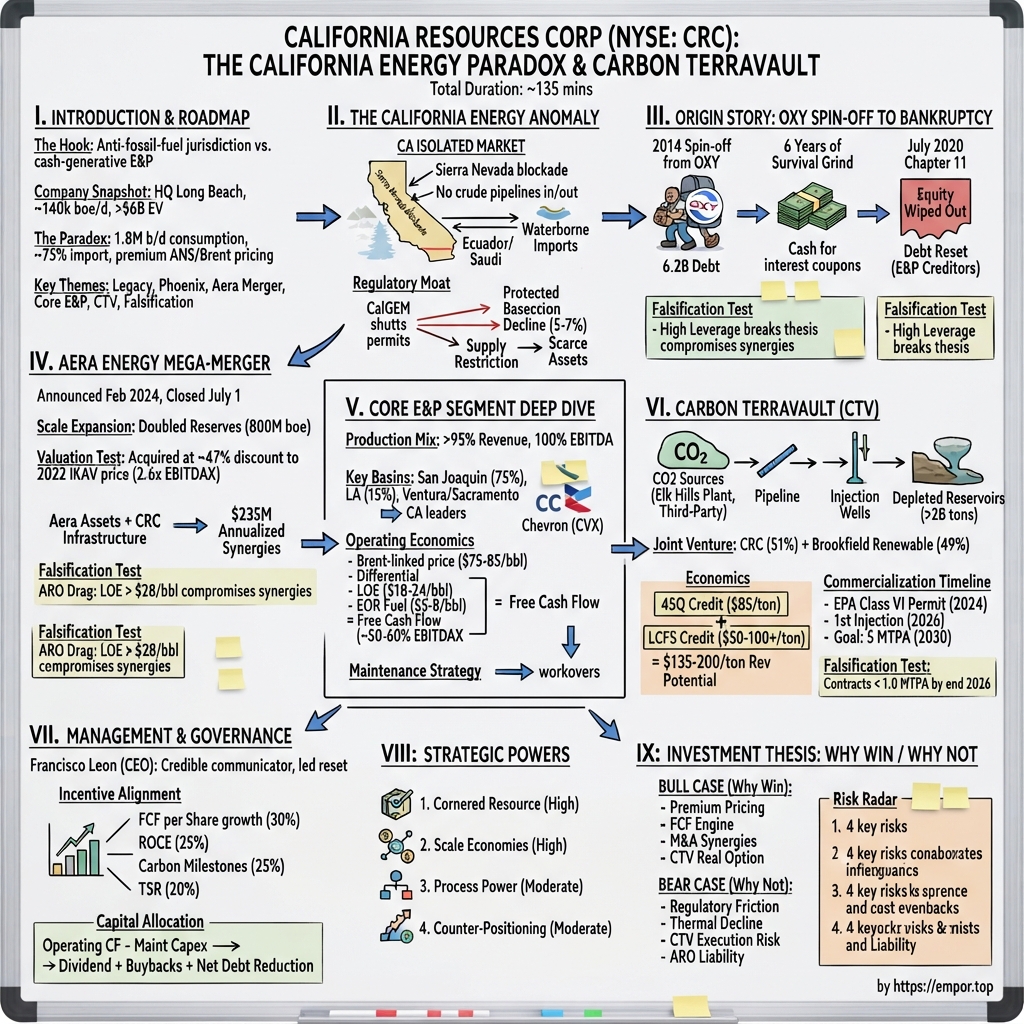
California Resources Corp (NYSE: CRC): The California Energy Paradox, E&P Consolidation, and the Carbon TerraVault Real Option
I. Introduction & Episode Roadmap
On May 26, 2026, in Kern County, California, a stream of compressed carbon dioxide was injected down an onshore well rather than extracting crude oil. Stripped from the nearby Elk Hills cryogenic plant, the dehydrated gas was compressed and pushed more than a mile underground into 26R, a depleted reservoir. The operation marked the first permanent geologic storage of carbon dioxide in California history.1 The initial volume was modest—roughly 270 tons per day, on track for about 100,000 tons per year, or roughly the annual emissions of a mid-sized office park.[^2] The strategic symbolism, however, was substantial.
The operator of the project is California Resources Corporation (CRC), the largest oil and gas producer in California. In the same calendar year it initiated carbon storage, CRC acquired two thousand miles of crude oil pipeline, added active drilling rigs, and informed investors that its long-term drilling inventory extends more than twenty years deep.2[^2]
This dual approach illustrates a central energy paradox: How does a company operating in North America's most aggressively decarbonizing jurisdiction generate robust cash flow as a conventional producer while holding what may be California's largest single-owner portfolio of carbon storage pore space?
The snapshot. CRC is headquartered at One World Trade Center in Long Beach, California, and trades on the NYSE under the ticker CRC.3 For full-year 2025, the company produced an average of approximately 138,000 barrels of oil equivalent per day (MBoe/d), 79% of which was crude oil, from roughly 22,000 net operated wells across 68 distinct fields spanning about two million net mineral acres.2 Financial results for 2025 included $3.6 billion in revenue, $363 million in net income, $1.241 billion in adjusted EBITDAX, and $543 million in free cash flow—its highest annual free cash flow since 2021.24 By the second quarter of 2026, following the integration of a second acquisition, average production reached 149 MBoe/d with crude oil representing 81% of the commodity mix.[^2] The company reported 88,597,474 shares outstanding as of January 31, 2026.5 By mid-2026, net debt stood at approximately $1.3 billion against a $7.1 billion balance sheet, representing leverage of about 1.0x.6
The paradox, stated plainly. California refines far more crude oil than its in-state wells produce, and no interstate crude pipelines cross the surrounding mountains into the state.27 On the company's first-quarter 2026 earnings call, Chief Executive Francisco Leon noted that more than 60% of the crude oil consumed in California originates from foreign imports. He added that in the weeks preceding the call, state oil inventories fell by more than 20% as foreign cargoes bound for California were diverted to Asia to capture higher price premiums.[^2] Consequently, an in-state producer sells into an isolated market that cannot easily be supplied by outside sources on short notice. CRC markets the majority of its production under contracts tied directly to Brent crude rather than local postings—an advantageous arrangement for a domestic onshore producer, given that most U.S. competitors sell at a discount to West Texas Intermediate (WTI).2
What this analysis will test. Five primary threads frame the investment case, each subject to stress-testing against historical execution:
First, the legacy trap: the 2014 Occidental Petroleum spin-off that loaded roughly $6 billion of debt onto the standalone company weeks before oil prices collapsed, initiating a six-year decline that ended in bankruptcy court.89
Second, the phoenix reset: how the 2020 restructuring eliminated over $5 billion in debt obligations, consolidated ownership of the 550-megawatt Elk Hills power plant and cryogenic gas facility, and established the low-leverage capital structure operating today.102
Third, the consolidation engine: two major transactions comprising the $2.1 billion all-stock Aera Energy combination completed on July 1, 2024, and the roughly $717 million all-stock Berry Corporation combination completed on December 18, 2025—the latter of which removed the company's primary public comparable from the board entirely.11122
Fourth, the core engine versus the dark horses: a low-decline, cash-generative conventional oil foundation funding three unproven growth initiatives—Carbon TerraVault, behind-the-meter power for data centers, and an expanded midstream network—none of which currently generates material earnings.
Fifth, the falsification test. Where management asserts long-term strategic advantages, the company's twelve-year public history provides counter-evidence, including a complete equity wipeout of initial shareholders in 2020. That historical precedent serves as a critical counterweight to durability claims.
The story starts with market structure, because in California, market dynamics dictate the business.
 Subscribe on LinkedIn
II. The California Energy Anomaly: Market Structure & Economics
Picture California's petroleum infrastructure as an island—not metaphorically, but physically. The Sierra Nevada and the Mojave Desert form an impenetrable barrier that no crude oil pipeline crosses. Every barrel that feeds a California refinery arrives from one of three sources: a well inside the state, a tanker from Alaska, or a waterborne import from overseas. As CRC stated in its 10-K filing, international waterborne Brent pricing serves as the primary regional benchmark precisely because limited pipeline infrastructure prevents crude from moving overland into California from the rest of the United States.2
This geographic isolation creates pricing dynamics that most domestic onshore producers would envy. In 2025, CRC realized $66.52 per barrel for crude oil before derivative settlements against an average Brent benchmark of $68.22—capturing roughly 97% of the international marker during a period when West Texas Intermediate averaged $64.81 per barrel.2 Through 2026, management guided realized oil prices within a range of 94% to 98% of Brent.[^2] While inland shale operators routinely sell at a discount to West Texas Intermediate, CRC begins its pricing baseline several dollars higher up the global curve. That advantage stems not from operational execution, but from geography—a structural driver far more durable than management initiatives.
The regulatory framework, and why consensus assumptions need updating. For nearly four years, the primary bear thesis on California oil and gas focused on permitting bottlenecks. The California Geothermal and Energy Resources Division (CalGEM) had largely halted new drilling permits, Kern County's environmental impact report was stalled in litigation, and operators were restricted to workovers and sidetracks. A counter-intuitive bull thesis emerged around these constraints, arguing that a regulatory freeze created a protective moat by capping new supply while transforming existing producing wells into scarce assets.
That narrative shifted significantly in late 2025. On September 19, 2025, California enacted Senate Bill 237, deeming the Kern County supplemental environmental impact report sufficient for California Environmental Quality Act (CEQA) compliance within its scope and authorizing CalGEM to approve up to 2,000 new drilling permits annually through 2035—with provisions to raise that cap if in-state production falls below 25% of refinery feedstock demand.131415 The law took effect on January 1, 2026.13 By the first-quarter 2026 earnings call, Chief Executive Francisco Leon reported that CRC held permits in hand for all seven active rigs in its drilling program and was already securing permits for 2027.[^2]
This regulatory reset complicates the moat argument in both directions. For CRC, lifting a four-year growth constraint allows active drilling to resume. However, a competitive advantage built on regulatory prohibition dissipates once drilling resumes across the basin. If 2,000 permits become available statewide each year, the scarcity premium attached to legacy production declines. Sustained competitive advantage must therefore rely on assets CRC directly controls—acreage density, midstream processing, storage capacity, and regulatory execution capabilities—rather than policy-enforced supply limits. Management has systematically oriented its strategy toward these proprietary assets, though whether that positioning is sufficient remains the central strategic question.
Competitive structure across five forces. Assessing the market through standard competitive forces highlights a favorable posture, accompanied by notable structural caveats.
Threat of new entrants remains low, driven less by permit availability than by high capital and structural entry barriers. Entry requires extensive mineral acreage, water and thermal steam infrastructure, established regulatory relationships, and the capacity to navigate complex CEQA reviews. SB 237 lowered permitting costs for existing operators inside Kern County's environmental review envelope; it did not open a simple path for new market entrants.
Buyer power is moderate, though recent events highlight structural vulnerability. While in-state refineries depend on local heavy crude blends—with waterborne alternatives requiring multi-week delivery times—midstream bottlenecks can disrupt realized pricing. In the second quarter of 2026, CRC reported takeaway constraints stemming from commercial disputes with a pipeline operator and specific offtakers. The disruption forced an inventory build of roughly 1,500 barrels per day and reduced quarterly EBITDAX by approximately $25 million.[^2] CRC estimated its realized price differential impact at around $2 per barrel, noting that certain local peers absorbed discounts as high as $20 per barrel.[^2] The event demonstrated that even in a supply-constrained market, single-pipeline dependencies can temporarily impair cash flows.
Supplier power is moderate. Specialized oilfield service capacity within California remains constrained, limiting supplier choices while also restricting competitive bidding. CRC mitigated this exposure by acquiring C&J Well Services alongside Berry Corporation—gaining one of the state's largest well servicing and plugging operations.2 In a jurisdiction with strict regulatory abandonment mandates, integrating well services provides operational insulation and cost control.
Substitutes represent a long-term transition risk rather than an immediate operational threat. While California leads U.S. electric vehicle adoption and targets declining liquid fuel consumption, heavy freight, aviation, and industrial processing cannot easily convert to electric power in the near term. Furthermore, reductions in local crude production are largely offset by increased waterborne imports rather than immediate demand destruction. Management frequently highlights this dynamic, which accurately reflects near-term refining mechanics even as the long-term terminal value of California oil fields remains tied to state decarbonization policy.
Rivalry has consolidated structurally following CRC's acquisition of its primary public competitor, Berry Corporation. Chevron remains the primary major producer in the San Joaquin Basin, holding legacy acreage at a scale CRC cannot match. However, Chevron manages capital across a global asset portfolio, whereas CRC focuses exclusively on California. Concentrated exposure offers operational efficiency, yet leaves the business entirely dependent on a single regulatory environment.
Ultimately, CRC benefits from favorable regional market structure while operating under heightened political and regulatory exposure. The company's long-term outlook depends on whether its restructured balance sheet and consolidated asset base can withstand state regulatory pressures—a test the predecessor corporate entity failed in 2020.
III. Origin Story: The Oxy Spin-Off Debt Trap & 2020 Bankruptcy Reset
The founding transaction was not a true launch. It was an extraction.
In February 2014, Occidental Petroleum announced it would separate its California operations. On November 30, 2014, Occidental distributed 81.3% of California Resources Corporation's shares to Occidental shareholders at a ratio of 0.4 CRC shares for every Occidental share.816 The strategic rationale for Occidental was clear: California represented a mature, capital-intensive, politically complex asset base, whereas Permian Basin growth offered a more compelling narrative for public equity investors. Spinning off the California assets allowed Occidental to simplify its corporate narrative.
The financial execution, however, created immediate leverage risks. Prior to the separation, Occidental required CRC to raise new debt to fund aggregate cash distributions of approximately $6.0 billion back to the parent company.8 Consequently, the newly independent producer debuted on the New York Stock Exchange carrying roughly $6 billion in debt obligations for which it received no cash or asset backing.89
The timing proved severe. Brent crude had traded above $100 per barrel during the summer of 2014, but within months of the spin-off, prices dropped toward $30 per barrel. A company structured to service heavy debt at $90 crude was forced to service that same debt in a $40 market environment.
The subsequent six years illustrate why low-decline conventional oil fields cannot offset an overleveraged balance sheet. CRC's reservoirs performed as expected, delivering steady production with modest maintenance capital. However, operating cash flows that should have funded field upkeep and thermal steam efficiency were redirected to interest payments. Management pursued typical distressed E&P tactics—selling assets, forming financial joint ventures, and conducting debt exchanges to extend maturities without restoring solvency.
The downturn reached its limit in 2020. Global oil demand plummeted during the COVID-19 pandemic while a Saudi-Russian supply dispute flooded the market, pushing front-month West Texas Intermediate prices below zero in April. On July 15, 2020, CRC filed voluntary Chapter 11 bankruptcy petitions in the Southern District of Texas.1710 The pre-arranged plan eliminated more than $5 billion in debt and mezzanine equity, equitizing approximately $4.4 billion in loans and notes.10 The bankruptcy court confirmed the plan on October 13, 2020, and the company emerged from reorganization on October 27, 2020.18
Existing common equity holders received no recovery, transferring full ownership of the reorganized business to creditors.
Two structural outcomes from that reorganization directly shape the company's position in 2026. First, CRC acquired full ownership of the Elk Hills power plant and cryogenic gas processing plant, eliminating the joint venture equity interest previously held by an affiliate of Ares Management in exchange for stock and new notes.10 Second, the transaction consolidated ownership of a 550-megawatt combined-cycle cogeneration facility located adjacent to a 330-million-cubic-feet-per-day gas plant, situated above a depleted reservoir complex on company-owned fee land.2 While market participants placed minimal valuation on these assets in 2020, by 2026, CRC's carbon management, power, and potential data center infrastructure all depend on this consolidated footprint.
The falsification test, applied to the central claim. Management's core thesis—reiterated across investor communications—is that CRC represents a durable, low-decline cash generator capable of navigating commodity cycles. The primary historical counter-evidence is that this identical asset base, under prior management and capital structure, caused a complete loss for common equity within six years of its public listing.
A disciplined assessment clarifies the scope of that historical record. The 2020 restructuring resulted from capital structure design rather than reservoir underperformance. Today's corporate profile features a different management team, board, and ownership base, operating with net debt of approximately 1.0x EBITDAX against $1.2 billion in annual cash flow, compared to six times leverage at spin-off.26 Nevertheless, debt accumulation remains the primary structural vulnerability.
The central thesis therefore holds under a specific boundary: CRC's asset base is durable, but equity value remains protected only while balance sheet leverage remains low. If net debt to EBITDAX rises materially above 1.5x to fund acquisitions, the 2020 insolvency becomes a relevant operational parallel rather than historical context. To date, post-restructuring management has adhered to this constraint—financing major combinations with equity rather than debt, and structuring 2026 refinancings to extend maturities without increasing total debt principal.[^2] That five-year track record provides empirical support, though past restructuring history requires ongoing monitoring of balance sheet management.
Which brings us to how CRC doubled its operational scale without adding net debt.
IV. The $2.1 Billion Aera Energy Mega-Merger: Benchmarking & Synergy Execution
There is a particular kind of asset that private capital buys with enthusiasm and then discovers it does not know how to run. Aera Energy was one of them.
For decades, Aera operated as a joint venture between Shell and ExxonMobil—a quiet, enormous, highly instrumented steamflood business in the San Joaquin Basin, producing from fields like Belridge and Midway-Sunset that had been under continuous development since before the Second World War. In 2022, the majors sold the asset to German asset manager IKAV alongside the Canada Pension Plan Investment Board. Two years later, those private owners sold it again, this time to the operator next door.
On February 7, 2024, CRC announced an agreement to combine with Aera in an all-stock transaction valued at approximately $2.1 billion, including Aera's net debt.1920 The deal closed on July 1, 2024. CRC issued 21,315,707 shares to Aera's owners and paid $990 million to extinguish Aera's outstanding indebtedness, funded through cash on hand and proceeds from an issuance of 2029 senior notes.112
Did CRC overpay? The transaction valuation appears favorable on paper, though the underlying drivers warrant careful scrutiny. IKAV and CPP had reportedly acquired the same business for around $4 billion two years earlier; CRC's headline consideration represented roughly half that figure. That valuation discount was driven less by seller concessions than by broader regional dynamics: between 2022 and 2024, market expectations regarding California drilling permit approvals contracted sharply. CRC acquired a discounted asset in a restricted jurisdiction—and eighteen months later, policy constraints softened with the passage of Senate Bill 237.13 While operational planning contributed to transaction returns, a significant portion of the value re-rate stemmed from favorable regulatory shifts. Investors evaluating deal execution should distinguish between structural synergies and policy tailwinds.
The underlying industrial rationale was specific and geologically aligned. Elk Hills and Belridge are adjacent, geologically similar, multi-stacked sandstone systems. On the fourth-quarter 2025 earnings call, Chief Executive Francisco Leon drew the comparison directly, noting that management views recovery potential at Belridge as comparable to Elk Hills, but at an earlier stage of development—effectively adding twenty years of drilling inventory in an acquainted reservoir.[^2] Belridge also carries a lighter royalty burden relative to basin averages, enhancing realized netbacks.[^2]
Synergy execution—the measurable baseline. CRC initially target $150 million in annual synergies. By the second quarter of 2024, management raised that target to $235 million, incorporating approximately $60 million in reduced annual interest expense and $25 million in incremental operational savings above original targets.21 The company subsequently reported realizing the full $235 million in annual Aera merger-related synergies during 2025.4
Achieving $235 million in recurring annual savings against a $2.1 billion enterprise value transaction equals roughly 11% of deal value, placing execution at the upper end of typical upstream corporate combinations. These efficiencies were reflected in reported operating metrics: consolidated operating costs per barrel of oil equivalent were $26.24 in 2023, $24.51 in 2024, and $25.42 in 2025—with the 2025 figure reflecting a modest increase following the integration of a larger, more thermally intensive asset base.2 Chief Financial Officer Clio Crespy told analysts that run-rate total operating expenses ended roughly $550 million below the pro forma pre-merger baseline, attributing the reduction to structural field consolidation, infrastructure rationalization, and procurement savings rather than service-cost deflation.[^2]
The falsification test, applied to merger claims. Management's core thesis positions Aera as an accretive transaction with manageable integration downside. Three specific operational and financial factors present counter-arguments to that thesis.
First, asset retirement obligations expand alongside scale. Century-old California fields carry substantial remediation requirements. CRC's balance sheet reflects asset retirement obligations of $913 million at year-end 2025, rising to $923 million as of June 30, 2026.6 This growing liability represents roughly one-fifth of the company's equity market capitalization. While Assembly Bill 1866 idle-well mandates require systematic plugging programs, CRC's acquisition of C&J Well Services allows the company to execute remediation at internal cost rather than third-party contractor rates. Nevertheless, net remediation liabilities trend upward as total field count grows.
Second, thermal operations introduce natural gas price sensitivity. Aera's primary fields rely on steamflooding, where steam generation requires natural gas combustion. Because California imports the majority of its natural gas supply, regional operators function as price takers.2 When regional benchmark prices spike—as occurred at the SoCal Border in the winter of 2022–2023—thermal operating costs increase sharply. Management actively hedges natural gas purchases; disclosed figures show that operating costs after gas hedges were $25.94 per Boe in 2025, compared to $25.42 per Boe before hedging settlements.2 On the fourth-quarter 2025 call, Leon acknowledged that regional gas prices can spike rapidly during weather or infrastructure disruptions.[^2] While lower gas prices currently provide a margin tailwind alongside crude oil sales, thermal input costs remain tied to regional commodity cycles.
Third, institutional ownership concentration creates equity overhang. The former Aera owners received a significant equity stake in CRC upon closing. On March 12, 2026, the Canada Pension Plan Investment Board sold 3,500,000 shares via a block trade at $61.10 per share, retaining 7,006,895 shares, or roughly 7.9% of total shares outstanding.5 While executed as an orderly market transaction, the remaining concentrated holding represents a persistent supply overhang as financial sponsors complete their investment lifecycles.
Synthesis and key performance metrics. Empirical evidence supports initial transaction delivery: identified synergies were increased and met in full, while consolidated production levels were maintained on reduced rig activity. However, single-transaction execution does not automatically guarantee long-term operational performance. The ongoing test for investors remains operating cost per Boe. If combined lifting and thermal energy costs rise persistently above the mid-$20s per Boe outside of acute natural gas price spikes, structural cost savings will have proven weaker than projected. Conversely, stable or declining unit operating costs alongside production growth will validate structural synergy claims.
That operating benchmark takes on added importance given that CRC continued to pursue basin consolidation.
V. Core E&P Segment Deep Dive: Operating Economics & Named Competitors
Here is a sentence that would have read as a typo two years ago: California Resources acquired Berry Corporation.
Berry was, in every California E&P primer written between 2018 and 2025, the designated mid-cap comparable — a thermal recovery specialist in Kern County running around 25,000 Boe/d, facing the same regulatory weather as CRC without the scale or the power infrastructure. On September 14, 2025, CRC agreed to combine with Berry in an all-stock transaction valuing Berry at approximately $717 million including net debt, at a fixed exchange ratio of 0.0718 CRC shares per Berry share — a 15% premium.12 The deal closed December 18, 2025. CRC issued 5,572,115 shares; former Berry holders ended up with roughly 6% of the combined company.222
What CRC bought was 56 MMBoe of proved developed reserves, C&J Well Services, and — almost incidentally — roughly 100,000 contiguous net acres in Utah's Uinta Basin.2[^2] The competitive landscape section of the California E&P story now reads: CRC, Chevron, and a long tail. Leon described CRC on the second-quarter 2026 call simply as "the largest producer in the state."[^2]
How the money actually works. Strip away the jargon and CRC's core business is a very old-fashioned proposition. The oil is heavy and shallow — much of the production sits around 2,000 feet down — and it does not flow on its own. You push steam or water into the reservoir to move it. That takes energy and infrastructure, which is why California lifting costs run high relative to the Permian. In exchange, you get reservoirs with recovery factors management describes as 40%-plus on waterfloods and 75%-plus on steamfloods, and decline rates that are gentle rather than violent.[^2]
That last point is the whole economic engine, and it is worth explaining in plain terms. A modern shale well is a firework: enormous initial production, then a 30%–50% collapse in the first year. To hold a shale company flat you must drill relentlessly, forever. A California steamflood is closer to a slow-burning log. CRC disclosed lowering its base decline range to 8%–13% from 10%–15%, and the practical consequence is that far less capital is required to stand still.4 In 2025, permitting-constrained, CRC deployed just $322 million of total capital and still generated $543 million of free cash flow on $1,241 million of EBITDAX.24
What changed in 2026. Permits came back, and the company's own capital efficiency numbers moved fast enough to be worth scrutinizing. Entering 2026 management said maintaining production flat would require seven rigs and roughly $485 million of drilling, completion and workover capital.[^2] By the first-quarter call it said it expected to deliver entry-to-exit growth with an average of five rigs and under $400 million.[^2] By the second quarter, with about 80% of wells drilled year-to-date beating type curve by more than 10% on average and time-to-market down roughly 25%, it cut the normalized California maintenance requirement to six rigs and $450–475 million.[^2]
The correct reaction to a company improving its capital efficiency estimate three times in nine months is interest mixed with caution. Interest, because the drivers management cites are concrete and verifiable over time — continuous drilling campaigns with dedicated rigs and crews, two-thirds of the wells being drilled in fields previously operated by Aera where CRC is applying combined operating practices, and spud-to-production cycles of roughly 30 days.[^2] Caution, because early-time well outperformance is the single most over-extrapolated statistic in the upstream industry, and management itself said conventional wells peak within six to twelve months of coming online.[^2] The 2026 program's real verdict arrives in 2027 volumes, not 2026 press releases. To Crespy's credit, she said something close to this on the call: further upside will not go into the outlook "until we demonstrate it and we are able to sustain it."[^2]
Where the barrels are. The San Joaquin Basin — Elk Hills, Belridge, Midway-Sunset, Lost Hills — is the bulk of the business and the location of essentially all the strategic infrastructure: the 550 MW cogeneration plant, 330 MMcf/d of gas processing, water softening and steam generation, and the storage that lets CRC keep producing through temporary shutdowns.2 The Los Angeles Basin urban fields, principally Wilmington and Huntington Beach, are smaller, older, tightly regulated and highly cash-generative. Ventura and Sacramento contribute conventional gas and lighter oil.
Two assets deserve separate mention because they are not really oil assets at all. Huntington Beach is 90 acres of beachfront in one of the most expensive zip codes in California, producing about 3,000 barrels a day gross while CRC systematically plugs wells and pursues re-entitlement — a city response was expected before the end of 2026, followed by roughly two years of California Coastal Commission review, with about 80 active wells left to abandon at that stage.[^2] Leon has been explicit that CRC will not discuss developer structures until entitlement is secured, on the logic that talking early gives value away.[^2] It is a real option on land, not on hydrocarbons, and it will not resolve before 2028.
The Uinta position is the more instructive one, because it is a case study in management calling its own baby ugly. In the first quarter of 2026 CRC was enthusiastic: over 200 booked Uteland Butte locations, additional prospective benches, offset wells de-risking the acreage, and a rig added to delineate.[^2] By the second-quarter call — four wells drilled at roughly $11.5 million each, ahead of schedule and below authorization — Leon's verdict had flipped: higher capital intensity, higher breakevens, lower crude quality, higher transportation and operating costs, steeper declines, and a roughly 1% drag on corporate realizations. "I don't think it is core to our business," he said, adding that he did not see it competing for long-term capital.[^2]
That is a fast reversal, and it should be read in two ways at once. Charitably: management tested an asset with a small, time-boxed capital commitment and reported the answer plainly rather than defending a prior position. That is the behavior an investor wants. Less charitably: the enthusiasm in May and the dismissal in August were separated by one drilling program, which suggests the May framing was thinner than it sounded. The useful takeaway is not that Uinta matters — it almost certainly does not, financially — but that CRC's stated strategic conviction on non-California assets should be discounted until capital actually follows it.
So what. The core E&P business is doing the thing it is supposed to do: converting a modest, price-gated capital program into substantial free cash flow, with returns management describes at roughly 4.5x invested capital and IRRs in the 60%–70% range at current strip, and a fully-burdened corporate breakeven around $60 Brent including the dividend, carbon management and corporate costs.[^2] Those are strong numbers. They are also unaudited, management-calculated, and hostage to a benchmark price the company does not control. The engine is real. The question is what management does with what it produces — and increasingly, the answer involves businesses that do not yet earn anything.
VI. Carbon TerraVault (CTV): Sizing the Hidden CCS Business & Regulatory Optionality
Chris Gould, who runs Carbon TerraVault, described the May 2026 first injection as "the result of years of dedication."1 The phrasing is worth pausing on, because the years are the story.
CRC announced its carbon management ambition in 2021. It signed a joint venture with Brookfield in August 2022. It received its first EPA permits in December 2024. It injected the first molecule in May 2026.
Nearly five years from announcement to first ton. That timeline is the single most important fact in this section, and it should govern how anyone reads the rest of it.
What CTV actually is. Strip away the acronyms and the proposition is a landlord business. When you produce oil and gas out of a reservoir, you leave behind pore space — the microscopic voids in the rock that used to hold hydrocarbons, sealed by a caprock that demonstrably held pressure for millions of years. CRC's argument is that a depleted field is a proven container in a way that a virgin saline aquifer is not: it comes with decades of seismic surveys, well logs, core samples and production history telling you exactly how it behaves under pressure.
CTV's job is to take carbon dioxide from an emitter, move it, and put it back down that hole permanently. The revenue comes from federal tax credits and state credits rather than from a customer paying for a physical product, which makes it a policy business wearing a geology costume.
The structure. In August 2022 CRC formed the Carbon TerraVault joint venture with Brookfield, with CRC holding 51% and operating and Brookfield holding 49% against an initial $500 million investment commitment.23 CRC's contribution included rights to inject into the 26R reservoir at Elk Hills.
Here is a number that rarely appears in the bullish framing: as of year-end 2025, Brookfield had contributed $92 million.2 The remainder is contingent on permitted storage capacity and, critically, on the joint venture entering into contracts for specified injection volumes into 26R.2 The $500 million headline is a ceiling that unlocks against commercial progress, not a war chest already in hand. That is sensible deal design by both parties. It is also a reminder that the partner's confidence is staged, and roughly 82% of it is still unstaged.
The permits. In December 2024 the EPA issued Class VI underground injection control permits for four CO2 injection wells at the 26R reservoir — the first such permits ever issued in California — effective in early February 2025.224 Construction of capture equipment at the Elk Hills cryogenic plant was substantially complete during 2025, and first injection followed on May 26, 2026.21
CTV I comprises two depleted reservoirs, 26R and A1-A2. The 26R reservoir alone is described as able to store up to 1.46 million metric tons per year and 38 million tons in total.1 As of February 2026 CRC had eight Class VI applications pending with the EPA at various stages, representing roughly 352 million metric tons of submitted capacity.21
The economics, in plain terms. The federal 45Q credit pays $85 per metric ton for carbon captured from industrial and power sources and $180 per ton for direct air capture, with a direct-pay option for a limited period and the ability to sell the credit to an unrelated taxpayer.2 California's Low Carbon Fuel Standard generates tradable credits on top, where the pathway qualifies.25
The LCFS piece is where the arithmetic has recently deteriorated. LCFS credits averaged about $63 per metric ton in the first quarter of 2026.26 That is well below the $100-plus levels that made the "stackable incentives" pitch sing, and it sits close to the level at which a third-party emitter's capture equipment stops penciling within a reasonable payback. CARB's 2025 amendments were designed to tighten credit supply and lift prices, and December 2026 futures traded as high as $72 per ton earlier in 2026 — so the direction is up.26 But the current spot reality is a mid-$60s credit, not a triple-digit one.
Now the materiality test, which is the part that separates analysis from advocacy.
Carbon TerraVault recorded no revenue whatsoever in 2023, 2024 or 2025.2 The segment lost $66 million, $94 million and $86 million in those three years respectively — roughly $246 million of cumulative operating losses before counting CRC's share of joint venture losses.2
At the current run rate of approximately 100,000 tons per year, the 45Q credits attaching to CTV I are worth roughly $8.5 million annually.27 Against $1.24 billion of 2025 EBITDAX, that is a rounding error — about two-thirds of one percent.
So the accurate statement of where CTV stands in August 2026 is: California's first commercial-scale CCS project is operating, it is technically successful, and it is economically immaterial. Both halves of that sentence are true and neither should be dropped.
The falsification test. The bullish claim, in its strong form, is that CTV converts into hundreds of millions of dollars of high-margin infrastructure EBITDA later this decade. What does the record say?
First, the conversion rate from milestone to revenue has so far been zero. CRC has been signing memoranda of understanding and carbon dioxide management agreements with prospective emitters since 2022 — hydrogen developers, biomass projects, industrial gas producers. The 2025 10-K still lists the ability "to convert our MOUs and CDMAs to definitive agreements and enter into other offtake agreements" as a forward-looking uncertainty rather than an accomplishment.2 Five years of announcements have produced one operating project, and its feedstock is CRC's own gas plant. That is not a third-party market; that is a company decarbonizing itself.
Second, permitting remains the binding constraint and it is slow. The 26R permit took roughly three years. Eight more applications are queued.2 Every incremental project carries the same multi-year regulatory clock, which the 10-K acknowledges explicitly as a multi-year process of uncertain duration.2
Third, litigation is live. On November 22, 2024, a group of non-governmental organizations filed a Petition for Writ of Mandate and Complaint for Injunctive Relief against Kern County and its Board of Supervisors over the CTV I project, challenging certification of the environmental impact report under CEQA. That litigation was still ongoing as of the 2025 10-K, and the petitioners have stated an intention to seek a stay.2
Fourth, the regulatory backstop for long-term liability does not yet exist. California missed a January 2025 deadline to establish comprehensive carbon storage rules under its CCS legislation, and CARB had produced only a preliminary outline as of May 2026 — leaving unresolved the question of who is responsible if stored CO2 migrates.27 Reporting on the project has also surfaced a specific technical concern: FracTracker Alliance identified 913 oil and gas wells within a mile of the four injection wells, most unplugged, with a retired federal geoscientist warning that around 204 of them pierce the sealing rock layer. CRC responded that the EPA required approximately 200 wells to be plugged or re-plugged before injection began.27 That the company did the remediation is a point in its favor. That an operator is largely responsible for monitoring the integrity of hundreds of legacy wells it does not inject into is a structural feature of the current rules, and a reasonable person can regard it as thin.
The calibrated conclusion. The evidence does not reject the idea that CTV is valuable. It rejects the idea that CTV is near-term valuable, and it strongly rejects modelling it as an infrastructure business with contracted cash flows today.
What CTV has demonstrably earned is the right to be taken seriously: CRC is now one of a small group of operators anywhere with a permitted, constructed, operating Class VI project, and Leon's argument that having a live project "takes a lot of the mystery away" in customer conversations is plausible.[^2] What it has not earned is a line in a valuation.
The forward falsifier is specific and public. Watch for binding third-party sequestration contracts with volumes attached — not MOUs, not letters of intent, not draft permits. If contracted third-party volume remains below roughly one million tons per annum entering 2027, the correct modelling treatment for CTV remains a real option with an uncertain strike, valued near zero in a base case.
The adjacent bet. The more interesting development in 2026 is that management stopped talking about CTV as a standalone carbon business and started talking about it as an enabler of something with a nearer-term customer: electricity.
Two threads run here. The first is regulatory. California's Public Utilities Commission has begun procuring roughly 6 gigawatts of new clean capacity by 2032, of which about 1.5 gigawatts must be "clean and firm" — always-on, dispatchable, zero-emission.[^2] Solar and batteries struggle to meet that definition around the clock. Natural gas paired with CCS could, if the Reliable and Clean Power Procurement Program admits it. On the first-quarter 2026 call Leon said gas with CCS was not yet eligible but that three of five CPUC commissioners had publicly endorsed inclusion, with the next major update expected in the second half of 2026.[^2] Management sizes the retrofit opportunity at roughly 17 gigawatts of California gas-fired generation, with about 2.4 gigawatts near-term in the Central Valley.[^2] That is a genuine, large, and entirely contingent market.
The second thread is behind the meter. In August 2026 CRC announced a partnership with Beacon Data Centers to develop the Golden Valley Technology Hub — a proposed 275-megawatt campus on roughly 100 acres adjacent to Elk Hills, drawing firm power from the existing 550 MW plant rather than waiting years in a grid interconnection queue, with closed-loop cooling to minimize water use.[^2]28 A conditional use permit has been submitted, with environmental review expected to advance later in 2026.[^2]29 Leon's framing was pointed: other E&P companies are "talking about acquiring land and ordering turbines," while CRC already owns the land, the gas, the plant and the permitting competence.[^2]
He is right that the starting position is unusual. He is also describing a project with a conditional use permit and a co-developer, not a signed hyperscaler contract. Data center announcements from asset owners have a well-documented tendency to arrive years before revenue does, and CRC's own carbon business is the cautionary example. The 2025 incentive scorecard is instructive here: the data center and capture-readiness milestone paid out at only 50% of target, because the company hit level two of three.4 Management's own compensation committee scored the pace as behind plan.
That honesty in the scorecard is a decent bridge into the question of who is running this company and how they are paid.
VII. Management & Governance: Incentive Alignment & Capital Allocation Record
Francisco Leon did not arrive at CRC as a chief executive. He arrived as the executive responsible for explaining the balance sheet.
Leon joined as chief financial officer in 2020—the year the company entered Chapter 11 reorganization—and became president and chief executive in April 2023. He succeeded Mac McFarland, who had served as principal executive officer through April 28, 2023, and who remains on the board, chairing the Carbon TerraVault committee.4
That progression shapes how management operates. Leon's formative experience at the company was not an expansion cycle, but a debt restructuring, a creditor negotiation, and the reconstruction of a balance sheet from scratch. Executives forged in insolvency tend to focus persistently on balance sheet protection.
Leon fits that profile. On the second-quarter 2026 earnings call, Chief Financial Officer Clio Crespy explained a debt refinancing by saying the objective was "to preserve the strength we have built" so the team could "spend less time managing the balance sheet and more time allocating capital."[^2]
The CFO. Clio Crespy became executive vice president and chief financial officer on January 1, 2025, succeeding Nelly Molina. Crespy arrived from investment banking rather than field operations, having served as senior managing director in global energy and power investment banking at Guggenheim Securities, where she led the sustainability practice, following earlier roles at Evercore and BNP Paribas.30
That appointment signaled corporate priorities. Hiring a mergers-and-acquisitions and project-finance banker to lead finance at a company executing major asset combinations, debt refinancings, pipeline acquisitions, and complex commercial structures for power and carbon indicates an ongoing transactional focus.
Executive compensation. Incentive structures reveal how the board directs management attention. While external commentary sometimes asserts that CRC ties a quarter of executive pay to carbon milestones and another quarter to return on capital employed, the company's 2026 proxy statement details a different mix.
The 2025 annual incentive scorecard weighted financial results at 40%—split equally between adjusted EBITDAX and free cash flow. Capital efficiency in exploration and production accounted for 5%. Sustainability metrics represented 30%, split across carbon management first-injection milestones (7.5%), data center and Cal Capture readiness (7.5%), spill prevention (2.5%), pneumatic device replacement and methane certification (2.5%), and combined safety incident rates (10%). Combined CRC and Aera synergies carried the remaining 25%.4
The annual scorecard paid out at 153.6% of target.4 A detailed breakdown of the components illustrates how performance varied across business lines.
Synergies achieved the maximum 200% payout after delivering $85 million in cost savings against a $65 million annual target. EBITDAX reached $1.252 billion against a $1.13 billion target, yielding a 154% payout, while free cash flow of $655 million against a $603 million target generated a 143% payout. Capital efficiency reached 183% of target, and safety met target exactly at 100%.
Conversely, the two strategic growth metrics—carbon storage injection milestones and data center power readiness—each paid out at only 50% of target. The company achieved level two of three on both.4
This outcome shows the compensation committee discounting executive payouts on early-stage initiatives, providing governance verification of the operational pace in carbon management.
Long-term incentives. Annual long-term incentive grants consist of 60% performance stock units (PSUs) and 40% restricted stock units (RSUs), vesting over three years. PSUs pay out between zero and 200% based on cumulative total shareholder return (TSR) on an absolute basis and TSR relative to the companies in the XOP index over a three-year performance period.4
Relative TSR provides a practical benchmark for a commodity producer by removing oil price movements outside executive control. However, it differs from the per-share cash flow metrics management regularly presents to investors.
A second component of executive pay warrants scrutiny. In November 2025, the board issued supplemental RSU retention awards—$4.0 million for Leon and $2.0 million for Crespy—with a back-loaded vesting schedule of 10% in each of 2026, 2027, and 2028, then 30% in 2029 and 40% in 2030.4 Leon's summary compensation table total for 2025 reached $12.08 million, with compensation actually paid of $9.55 million, against $7.99 million in 2024.4
While multi-year retention awards are standard following major corporate integration, these grants vest based strictly on continued employment rather than performance hurdles—meaning a substantial portion of long-term executive compensation depends on tenure rather than operational delivery.
Capital allocation record. The company's capital deployment record provides the clearest evidence of management discipline.
Since emerging from bankruptcy in late 2020, CRC has returned approximately $1.6 billion to shareholders, including roughly $1.2 billion through repurchases executed at an average price around $43.50 per share.[^2] In 2025 alone, the company returned $513 million—comprising $377 million in share buybacks and $136 million in dividends—raising the dividend 5% for a fourth consecutive year and absorbing roughly 94% of annual free cash flow during a year when permitting constraints limited attractive drilling.4
Two analytical takeaways emerge from this capital return strategy. First, share buybacks were executed counter-cyclically during permitting pauses at prices well below subsequent trading levels. Crespy noted that share repurchases kept total share count roughly flat while daily production grew by 50%, which substantially offset the equity issued for two major mergers.[^2]
Second, the framework adjusted when operating conditions shifted. When drilling permits resumed in 2026 and well returns reached roughly 4.5 times invested capital, management redirected cash flow to field development. Repurchases fell to $10 million in the first quarter and to nothing in the second.[^2]
When questioned regarding the repurchase pause on the second-quarter call, Crespy attributed the shift to transaction timing rather than a change in strategy, noting that roughly $600 million remained under the board's repurchase authorization, which extended the program through 2027.[^2]
Strategic expansion and execution risks. An analytical challenge to management's strategy centers on asset portfolio expansion.
Over an eighteen-month period, CRC acquired an onshore producer, a well servicing business, an unconventional acreage position subsequently declared non-core, a pipeline from Phillips 66, and a 2,000-mile common carrier network—while simultaneously developing a carbon storage business that has never earned revenue and a data center campus with no signed tenant disclosed.2[^2]31
Skeptics view this pattern as potential operational distraction. Management maintains that the acquired midstream and servicing assets directly integrate with existing field operations. Crespy made that case explicitly, arguing Crimson "is worth more inside of CRC than it would as a standalone midstream company."[^2]
Transaction pricing reflects disciplined entry multiples: Crimson was acquired for $63 million of cash at roughly 4.4 times estimated 2027 EBITDA, while Line 100 was acquired from Phillips 66 for what management called a nominal amount.[^2]3132
The evidence yields a divided verdict on management. On capital structure, cash returns, and cost synergies, five-year execution has been consistent and corroborated by lower net share count and cost reductions. On commercializing growth ventures—carbon storage, power, and data centers—the business model remains unproven in generating material earnings.
VIII. Playbook & Strategic Powers (Helmer's 7 Powers Analysis)
Hamilton Helmer's competitive strategy framework poses a straightforward question: not whether a business is currently profitable, but what specific structural barrier prevents competitors from replicating its operations, and whether that barrier generates a durable cost or pricing advantage. Applied to California Resources Corporation, the evidence highlights two clear sources of strategic power, while the remaining five offer limited or purely prospective protection.
Cornered Resource — the strongest claim, with a caveat. CRC controls approximately two million net mineral acres across 68 fields and operates about 22,000 net wells, maintaining an average working interest of 89%.2[^2] Beneath this footprint lies stacked, well-mapped reservoir pore space supported by more than a century of production data, alongside eight pending Class VI applications representing roughly 352 million metric tons of submitted carbon storage capacity.21
Competitors cannot replicate this asset base today at any price—not simply due to capital requirements, but because the mineral acreage is locked up and securing regional permits requires a multi-year regulatory process. This asset concentration fits the definition of a cornered resource.
The critical caveat is that company filings acknowledge certain carbon capture and storage projects rely on pore space CRC does not own, introducing risks that the company may fail to secure necessary property rights on acceptable terms.2 The cornered resource advantage is well established at Elk Hills, but it does not extend uniformly across the entire 352-million-ton storage pipeline.
Scale Economies — real, and now measurable. Scale economies represent the clearest power reflected in recent financial performance. In California, fixed regulatory, environmental, and corporate compliance expenses are substantial and largely invariant to operator size. Spreading these fixed burdens across output of roughly 149,000 barrels of oil equivalent per day—rather than a standalone baseline of 55,000 barrels—fundamentally improves operational unit economics.
The financial results demonstrate this effect: $235 million in realized annual synergies from the Aera combination, over $100 million in annualized Berry synergies captured within six months of closing—representing roughly 14% of that transaction's enterprise value—and a cumulative synergy and structural cost reduction target of up to $470 million through 2028, with approximately $400 million already executed by mid-2026.4[^2] Chief Financial Officer Clio Crespy noted that later cost reduction phases reflect permanent operational optimization rather than basic transaction synergies, including connecting acquired Berry fields to CRC's cogenerator to cut third-party power purchases, routing stranded natural gas into central processing to boost liquid recoveries, and streamlining field logistics.[^2]
Process Power — moderate, and hard to separate from scale. Decades of operating complex, thermal recovery projects in multi-layered California reservoirs represents specialized technical know-how. Management's reported 25% reduction in spud-to-total-depth drilling times and type-curve outperformance across legacy Aera fields provide empirical support for operational competence.[^2] However, true process power requires proprietary techniques that competitors cannot easily copy. Much of CRC's execution—such as continuous drilling campaigns, dedicated rig crews, and standardized field procedures across combined acreage—reflects standard best practices executed at scale. Consequently, this advantage remains moderate and closely tied to scale economies.
Counter-Positioning — the most interesting claim, and the least proven. The strategic argument for counter-positioning rests on adopting a business model that incumbent oil majors cannot match without cannibalizing their core identity: framing operations around California's decarbonization goals rather than resisting them. While global producers face institutional constraints in repositioning as state-level transition partners, an in-state operator can leverage that positioning to secure regulatory access and permits.
Empirical evidence supports the access component of this strategy. Chief Executive Francisco Leon's characterization of regulatory permitting as a core competency is reinforced by CRC securing California's first Class VI storage permits and receiving its full slate of 2026 drilling permits.2[^2] However, counter-positioning constitutes a strategic power only when it yields superior financial returns. Because Carbon TerraVault currently generates negative operating cash flow, counter-positioning remains a deliberate corporate strategy rather than an established economic power.
Switching Costs — low in crude, potentially meaningful in new ventures. Crude oil is a homogenous commodity, allowing refiners to switch suppliers based on price and assay fit. However, switching costs could become significant in emerging business lines. An industrial emitter that builds dedicated carbon capture infrastructure linked to CRC's midstream pipeline and storage reservoir faces high locked-in switching costs over the project's lifecycle. Similarly, a data center tenant co-located on CRC's off-grid power island becomes tied to that site's infrastructure. These potential switching costs remain contingent on commercializing these ventures at scale.
Network Effects — none. As a primary commodity producer, CRC operates without network effects. Producing an incremental barrel of crude oil provides no network value to other buyers or market participants.
Brand — none that carries pricing power. In business-to-business crude oil sales to regional refiners, corporate brand confers no pricing premium. Institutional reputation matters for regulatory alignment and community relations, but it does not alter commodity realizations.
The net read. CRC's competitive structure rests on two established, geographically bounded powers: a cornered resource base and scale economies. The remaining two potential advantages—counter-positioning and future switching costs—are prospective. Investors are currently paying for two demonstrated operational powers while receiving real options on two unproven ones. Whether that distribution offers attractive risk-adjusted value depends on valuation and commodity sensitivity, leading directly to the bull and bear cases.
IX. Investment Thesis: The "Why Win / Why Not" Spine & Risk Radar
Every investment case is a bet on which of two stories the next five years confirms. For CRC the two stories are unusually easy to state, because they are about the same set of facts read in opposite directions.
The bull case: why CRC wins from here.
One — the pricing structure is geographic, not managerial. The Brent linkage on the majority of production is a function of the Sierra Nevada, not of a negotiating team, and mountains do not renegotiate.2 Realizations have run in the mid-90s as a percentage of Brent through 2026 even in a quarter with genuine logistics problems.[^2] This is the most durable single element of the case, because it is the one no competitor and no management team can erode.
Two — the free cash flow engine is proven across three very different years. CRC generated $543 million of free cash flow in 2025 with capital deployment of just $322 million and no meaningful ability to drill new wells; then, with permits restored, guided to more than $800 million of free cash flow before working capital in 2026 on higher activity.24[^2] A business that produces heavy cash both when it can invest and when it cannot is structurally different from one that requires a treadmill.
Three — the consolidation playbook has now run twice with measurable results. Delivering $235 million of Aera synergies in full, then capturing more than 100% of the first-year Berry target six months early, is a repeated result rather than a single lucky integration.4[^2] Management's stated cumulative target of up to $470 million of synergies and structural cost reductions through 2028 was roughly 85% actioned by mid-2026.[^2]
Four — the option portfolio is unusually cheap to hold. Carbon storage, behind-the-meter power, the Huntington Beach land, and now a midstream network were each acquired or developed with modest cash outlay: $63 million for Crimson at approximately 4.4 times estimated 2027 EBITDA, a nominal sum for Line 100, a joint venture partner funding the carbon build, and a co-developer funding early-stage data center work.[^2]3132 Optionality bought cheaply is the correct way to buy optionality.
The bear case: what breaks it.
One — the political ground can move back. SB 237 loosened permitting; a different legislature or a different governor can tighten it again. Leon acknowledged the exposure directly when asked about the 2026 gubernatorial race, noting the June primary structure and saying the company supports candidates "more in tune with rational energy policy."[^2] An investment thesis whose central variable is decided at a state ballot box carries a risk that no operational excellence can hedge.
Two — the cost structure is thermally and politically expensive. Operating costs ran $25.42 per Boe in 2025 and $25.94 after hedges on purchased natural gas — high by domestic standards, and structurally so, because heavy California oil has to be heated out of the ground.2 Combine that with a fully-burdened corporate breakeven around $60 Brent and the margin compression in a genuine demand recession is severe.[^2]
Three — the growth businesses have not converted. Three consecutive years of zero carbon management revenue against roughly $246 million of cumulative segment losses is the single most important disconfirming fact in the entire equity story, and it sits directly against management's framing of CTV as a platform rather than a project.2 The 2026 data center opportunity is at conditional-use-permit stage.[^2]
Four — the retirement liability compounds quietly. Asset retirement obligations of $923 million accrete every quarter and grow with every acquisition, and California's regulator has shown willingness to pursue operators aggressively — CRC remitted $25 million to CalGEM under protest over plugged wells at Cat Canyon in Santa Barbara County and filed a complaint in June 2025 seeking reimbursement, while separately carrying a $23 million accrual for two Signal Hill offshore platforms in a dispute with the Bureau of Safety and Environmental Enforcement.6 Neither item is large enough to threaten the company. Both are evidence that the liability tail has teeth and an active adversary.
Myth versus reality. Three pieces of received wisdom about this company deserve correcting.
Myth: the permitting freeze is CRC's moat. Reality: the freeze ended. SB 237 took effect January 1, 2026, and CRC held permits for its entire seven-rig program by the first quarter.13[^2] The moat now has to come from assets and permitting competence, not from a closed door.
Myth: Berry is the natural comparable for benchmarking CRC. Reality: Berry is inside CRC, and has been since December 18, 2025.2 The California mid-cap public comparable set no longer exists in any meaningful form.
Myth: CTV is a hidden business worth sizing today. Reality: it earned nothing in 2023, 2024 or 2025, and at current injection rates the federal credits attaching to the operating project are worth single-digit millions annually.227 It is a real option with a distant strike, and treating it as a segment with cash flows is the most common analytical error made about this company.
The skeptic's question, and the honest answer. The question a short-seller asks is simple: why own an oil producer in a state whose declared policy is to phase out oil?
Management's answer is the demand-gap argument — California consumes far more crude than it produces, the shortfall arrives by tanker, and displacing local barrels raises rather than lowers global emissions while worsening in-state affordability. Leon has made versions of this argument on consecutive calls, and the underlying supply data supports the premise that imports dominate.[^2]7
The argument is factually sound and analytically incomplete. It explains why California should want in-state production. It does not establish that California will want it in 2035, and it does not address the terminal-value problem: a producer in a jurisdiction committed to demand destruction is, over a long enough horizon, a liquidating trust with a good coupon. Whether that matters depends entirely on the horizon, the discount rate, and how much of the current price already assumes decline. Those are judgments each investor makes; the analysis here can only insist that the question be asked rather than answered by slogan.
The risk radar, ranked by mechanism rather than by drama.
Regulatory and political risk — high. The mechanism is direct: fewer permits means fewer new wells, which means base decline of 8%–13% reasserts itself, which means production falls and capital efficiency deteriorates simultaneously.4 A restriction on cyclic steam injection specifically would be more damaging than a drilling restriction, because it would attack the recovery mechanism itself.
Commodity price risk — high. Two-thirds of 2026 oil volumes were hedged, but the hedge book thins fast: roughly 40% of 2027 volumes and about 80% of 2028 volumes were unhedged as of the first quarter of 2026.[^2] That is deliberate — management wants upside participation — but it means the cash flow profile two years out is substantially a leveraged bet on Brent.
Marketing and takeaway risk — newly material. The second-quarter 2026 disruption was the first demonstration that CRC's route to market can be interrupted by counterparty behavior rather than by regulation, and it cost roughly $25 million in a single quarter.[^2] The Crimson acquisition is management's structural answer, and it is a rational one, but the answer requires CPUC approval and integration before it is an answer.31
Credit and refinancing risk — currently low, deliberately so. CRC upsized a $350 million add-on to its 2034 notes in March 2026 with a book more than five times oversubscribed and used the proceeds to redeem its 2029 notes; in the second quarter it refinanced the remaining 2029 paper into new 2035 notes, extending weighted average maturity from 5.5 years to 8 years, cutting annual expense by $5.5 million, and achieving what Crespy described as the tightest credit spread in the company's history.[^2] The revolver was undrawn with no meaningful maturities for seven years.[^2] For a company whose predecessor died of a maturity wall, this is the most thesis-relevant risk-mitigation work being done.
Execution risk in the transformation — moderate and rising. Four businesses, three of them pre-revenue, one management team. The scorecard already shows the strategic milestones lagging the financial ones.4
LCFS price risk — moderate, and specific. At roughly $63 per ton, credits sit near the level where third-party capture projects stop clearing an acceptable payback, which is precisely why binding offtake contracts have not appeared.26 This is not an abstract risk; it is the current explanation for the thing that has not happened.
The spine, stated once. CRC wins if a low-decline, Brent-linked, low-leverage cash engine keeps converting a modest capital program into large free cash flow while management adds cheaply-acquired infrastructure adjacent to what it already owns. It breaks if California policy reverses, if Brent falls materially below the $60s for a sustained period, or if the optionality portfolio consumes capital and management attention without producing contracted revenue. Everything else is detail.
X. Primary Evidence & Transcript Roadmap for Analysts
There is a reason professional investors analyze quarterly earnings transcripts alongside press releases. While prepared remarks reflect committee drafting and legal review, the question-and-answer session forces executives to address operational friction directly, revealing the underlying logic of management strategy.
For CRC, four public disclosures carry disproportionate information value for evaluating execution and disclosure transparency.
The merger announcement call, February 7, 2024. The Aera transaction call provides the baseline for measuring subsequent management execution, establishing the initial promises: a $2.1 billion enterprise valuation including net debt, an all-stock structure, and an initial synergy target.1933 The Form S-4 filed alongside the transaction details the underlying financial mechanics.33 Evaluated today, the transcript functions as a scorecard: management committed to specific cost targets, and the 2026 proxy statement confirms the company delivered $235 million in annual synergies.4 Direct alignment between initial transaction guidance and ultimate realization warrants weight in evaluating disclosure credibility.
The post-closing integration call, August 2024. On this call, management raised its annual synergy target from $150 million to $235 million while disclosing a critical compositional detail: approximately $60 million of the increase stemmed from reduced annual interest expense rather than field operating efficiencies.21 Evaluating the headline figure without that breakdown overstates operational savings by roughly one-quarter. The disclosure highlights the importance of analyzing synergy components even when an operator meets headline targets.
The fourth-quarter 2025 call, March 2, 2026. This call marked an operational transition as management reported expanded 2P inventory of nearly 1.2 billion barrels of oil equivalent (Boe) supporting over twenty years of development, a 350% reserve replacement ratio, proved reserves of 654 million Boe valued at approximately $9 billion under SEC pricing, and the resumption of state drilling permits.2[^2] The transcript also established management's initial maintenance capital baseline: seven active rigs, approximately $485 million in drilling and workover capital, a $58 per barrel Brent oil and gas breakeven, and a fully burdened corporate breakeven of roughly $60 per barrel Brent.[^2]
The Q&A session highlighted key operational questions. Analysts pressed management on the strategic fit of the Uinta Basin, the normalization of resource adequacy payments from the Elk Hills power plant—which management guided to $25 million to $50 million annually for 2026 following elevated 2025 levels—and the structural durability of cost reductions.[^2] Chief Financial Officer Clio Crespy attributed the operating savings to field-level efficiency gains, infrastructure rationalization, workforce consolidation, and centralized procurement, emphasizing that these reductions were achieved during a period of permitting constraints and broader industry cost inflation.[^2]
The first- and second-quarter 2026 calls. Evaluated together, these two calls offer a clear test of management narrative consistency as guidance shifted across three key operational areas.
First, the maintenance capital framework was revised twice—moving from seven rigs and $485 million down to five rigs and under $400 million, before settling at a normalized six-rig program requiring $450 million to $475 million.[^2] While each adjustment lowered capital requirements based on consistent operational drivers, sustained 2027 production volumes will provide the ultimate verification of these efficiency gains.
Second, management reversed its position on the Uinta Basin, shifting from describing the asset as a compelling growth platform in May to declaring it non-core by August.[^2] While management directly cited operational factors—including higher capital intensity, steeper decline rates, lower crude quality, and elevated transport costs—the rapid pivot indicates initial strategic assumptions required material revision.
Third, management disclosed an unexpected takeaway and marketing disruption. Rather than downplaying the event, Crespy quantified the impact at $25 million, detailed the split between timing shifts and pricing differentials, confirmed that most excess inventory cleared by late July, and prudently guided third-quarter realizations to roughly 93% of Brent.[^2] This transparent framing reflects a management team accustomed to public accountability.
What analysts consistently press on, and how management answers. Two strategic questions recur across recent investor calls.
The first centers on the commercialization timeline for Carbon TerraVault. When asked why third-party emitters have not signed definitive contracts, management has maintained that the market remains immature and that the company is prioritizing terms over transaction speed. On the fourth-quarter 2025 call, Chief Executive Francisco Leon stated, "We're not focused on speed. We're focused on getting the fundamentals right and securing the right agreement at the right time."[^2] While commercially logical, this framing is difficult to measure externally, making contracted injection volume—rather than executive commentary—the primary benchmark for commercial progress.
The second involves capital allocation between share repurchases and field reinvestment. Management maintains that capital deployment reflects dynamic allocation toward highest-return opportunities, while capping E&P reinvestment below 40% of operating cash flow.[^2] Crespy urged analysts to evaluate capital discipline through the full-cycle cost of replacing production rather than daily operating costs per barrel. On that basis, CRC's 2026 drilling program delivered new production at $22,000 to $27,000 per flowing barrel—below the $28,000 to $30,000 per flowing barrel implied by the Aera and Berry acquisitions.[^2]
While this analytical framework presents a compelling case for organic reinvestment over acquisitions, investors must benchmark these management calculations against long-term development performance rather than taking early well results as definitive.
XI. Epilogue, Key KPIs to Watch & Final Takeaways
In August 2026, California Resources trades on the New York Stock Exchange with a market capitalization of roughly $4.6 billion, having ranged between about $43 and $72 over the preceding year.3 It is a fundamentally different company from the entity that emerged from bankruptcy court in October 2020—larger, more integrated, more diversified, and operating a portfolio of assets that did not exist four years ago.
Whether it is a better company is a question the next three years will answer, and the evidence will center on a small set of operational metrics.
Three things worth tracking, and nothing else.
First: free cash flow per share, and the portion returned to shareholders. The critical metric is cash flow on a per-share basis rather than in absolute terms, because CRC issued equity twice to complete major acquisitions while repurchasing shares aggressively during intervening periods. The strategic question of whether basin consolidation created per-share value collapses into that single ratio. The historical benchmark shows share count remaining roughly flat while daily production expanded by approximately 50%.[^2] The forward test is whether the 2026 drilling program and midstream expansion generate higher free cash flow per share or merely support a larger corporate footprint. Alongside cash flow generation, monitor capital returns: the company returned approximately 94% of free cash flow in 2025, a payout level that will moderate as field development competes for capital, but a sustained decline toward nominal levels would indicate that long-dated growth options are consuming core cash flow.4
Second: operating cost per barrel, evaluated against the synergy timeline. This metric provides the direct test of whether management's structural cost reductions are durable. Operating costs averaged $25.42 per Boe in 2025 across a larger and more thermally intensive asset base, with management targeting up to $470 million in cumulative savings through 2028.2[^2] If unit operating costs trend upward outside of acute natural gas price spikes while reported synergy tallies continue to climb, the operational data and management targets conflict, signaling that reported synergies are not translating into net lifting efficiencies.
Third: contracted third-party carbon storage volume under binding agreement, measured in tons. This metric excludes permit applications filed, non-binding memoranda signed, or storage capacity submitted for regulatory review. It measures metric tons contracted with counterparties that have taken final investment decisions on capture equipment. This metric alone converts Carbon TerraVault from a development thesis into a commercial business, and it currently reads approximately zero.2 Until binding agreements materialize, the appropriate valuation treatment for the carbon management platform remains a real option with an uncertain strike price rather than a cash-flowing operating segment.
The lesson. There is a temptation to frame CRC as a story of regulatory restriction creating a protected market—a producer benefiting primarily because state policy limited competitive entry. That interpretation was widely held, yet recent developments have partly disproved it. Permitting resumed in 2025 under Senate Bill 237, reducing the scarcity premium attached to legacy California production relative to prior years.
The more durable interpretation is structural. CRC's primary advantage stems not from political hostility toward oil production, but from controlling an integrated physical asset stack in a single basin—two million net mineral acres, a 550-megawatt power plant, a gas processing complex, steam and water infrastructure, internal well servicing operations, thousands of miles of pipelines, and underlying reservoir pore space—combined with established institutional capacity for securing regional regulatory approvals.
That asset stack was assembled progressively through a 2020 balance sheet restructuring and two subsequent mergers executed during periods of regulatory uncertainty. How management deploys this infrastructure represents an operational choice rather than an assured outcome. The financial record since 2021—synergies delivered, net debt maintained near 1.0x EBITDAX, debt maturities extended, and share repurchases executed below intrinsic value estimates—demonstrates consistent capital discipline.[^2]4
Conversely, the record on converting technical milestones into commercial revenue remains unproven. Initial carbon storage injection began in May 2026. The data center development remains at the permit application stage. The expanded midstream network awaits regulatory approval.
An oil producer that initiated geologic carbon storage in May 2026 and agreed to acquire two thousand miles of crude pipelines in August is either building an integrated energy model or hedging long-term decline with capital that could otherwise be returned to shareholders. Based on evidence available in August 2026, both outcomes remain plausible. Determining which path materializes depends on tracking the three core operational metrics.
References
-
California Resources Corporation Achieves First CO2 Injection at Carbon TerraVault I — Decarbonfuse, 2026-05-26 ↩↩↩↩↩↩
-
California Resources Corporation Annual Report on Form 10-K for the year ended December 31, 2025 — U.S. Securities and Exchange Commission, 2026-03-02 ↩↩↩↩↩↩↩↩↩↩↩↩↩↩↩↩↩↩↩↩↩↩↩↩↩↩↩↩↩↩↩↩↩↩↩↩↩↩↩↩↩↩↩↩↩↩
-
California Resources Corporation Investor Relations Overview Portal — CRC Investor Relations ↩↩
-
California Resources Corporation Definitive Proxy Statement (DEF 14A) — U.S. Securities and Exchange Commission, 2026-03-18 ↩↩↩↩↩↩↩↩↩↩↩↩↩↩↩↩↩↩↩↩↩
-
Schedule 13D/A Amendment No. 1 filed by Canada Pension Plan Investment Board regarding California Resources Corporation — U.S. Securities and Exchange Commission, 2026-03-16 ↩↩
-
California Resources Corporation Quarterly Report on Form 10-Q for the period ended June 30, 2026 — U.S. Securities and Exchange Commission, 2026-08-10 ↩↩↩↩
-
Annual Oil Supply Sources to California Refineries — California Energy Commission ↩↩
-
Occidental Petroleum Corporation Form 8-K on the Spin-Off of California Resources Corporation — U.S. Securities and Exchange Commission, 2014-12 ↩↩↩↩
-
California Resources Enters Bankruptcy to 'Finally' Resolve Occidental-inherited Debt — Hart Energy, 2020-07 ↩↩
-
California Resources Corporation Agrees Comprehensive Balance Sheet Restructuring — Business Wire, 2020-07-15 ↩↩↩↩
-
California Resources Corporation Completes Combination with Aera Energy — Business Wire, 2024-07-01 ↩↩
-
California Resources Corporation Announces All-Stock Combination with Berry Corporation — California Resources Corporation, 2025-09-15 ↩↩
-
California Enacts SB 237 to Streamline New Oil Well Permits in Kern County and Increase Output — Greenberg Traurig LLP, 2025-10 ↩↩↩↩
-
Senate Bill 237 Bill Text — California Legislative Information, 2025 ↩
-
Senate Bill 237 Implementation — California Geologic Energy Management Division (CalGEM) ↩
-
Occidental Petroleum to Spin Off California Oil Business — The Wall Street Journal, 2014-02-14 ↩
-
California Resources files for Chapter 11 bankruptcy — Reuters, 2020-07-15 ↩
-
California Resources emergence from Chapter 11 bankruptcy — Davis Polk, 2020-10-27 ↩
-
California Resources to buy Aera Energy in $2.1 bln all-stock deal — Reuters, 2024-02-07 ↩↩
-
California Resources Agrees to Buy Aera Energy for $2.1 Billion — Bloomberg, 2024-02-07 ↩
-
California Resources Reports Second Quarter 2024 Financial and Operating Results — Business Wire, 2024-08-06 ↩↩
-
California Resources completes all-stock merger with Berry — The Globe and Mail, 2025-12-18 ↩
-
CRC and Brookfield Announce Strategic Carbon Management Partnership — Business Wire, 2022-08-11 ↩
-
Class VI Wells Permitted by EPA — U.S. Environmental Protection Agency ↩
-
Low Carbon Fuel Standard Program Overview — California Air Resources Board ↩
-
California LCFS credit shrink lifts prices — Argus Media, 2026 ↩↩↩
-
An oil field became California's first carbon vault. Who's responsible if something goes wrong? — CalMatters, 2026-08-10 ↩↩↩↩
-
Canada's Beacon DC targets 275MW data center campus on California oil field — Data Center Dynamics, 2026-08 ↩
-
CRC proposes West Kern data center with dedicated power, closed-loop cooling — The Bakersfield Californian, 2026-08 ↩
-
California Resources Corporation Names Clio Crespy as Chief Financial Officer — California Resources Corporation, 2024-11-25 ↩
-
California Resources Corporation Expands Integrated California Energy Infrastructure Platform Through Strategic Midstream Acquisition — California Resources Corporation, 2026-08-10 ↩↩↩↩
-
California Resources to acquire 2,000 miles of pipeline assets for $63 million — Pipeline & Gas Journal, 2026-08 ↩↩
-
Form S-4 Registration Statement: CRC and Aera Energy Merger — U.S. Securities and Exchange Commission, 2024-02-07 ↩↩
 LinkedIn
 WhatsApp
 Reddit
 Hacker News
 Email
Email Kindle
 RSS Feed
 Spotify
 Apple Podcasts
 Amazon Music
 Audible
 YouTube