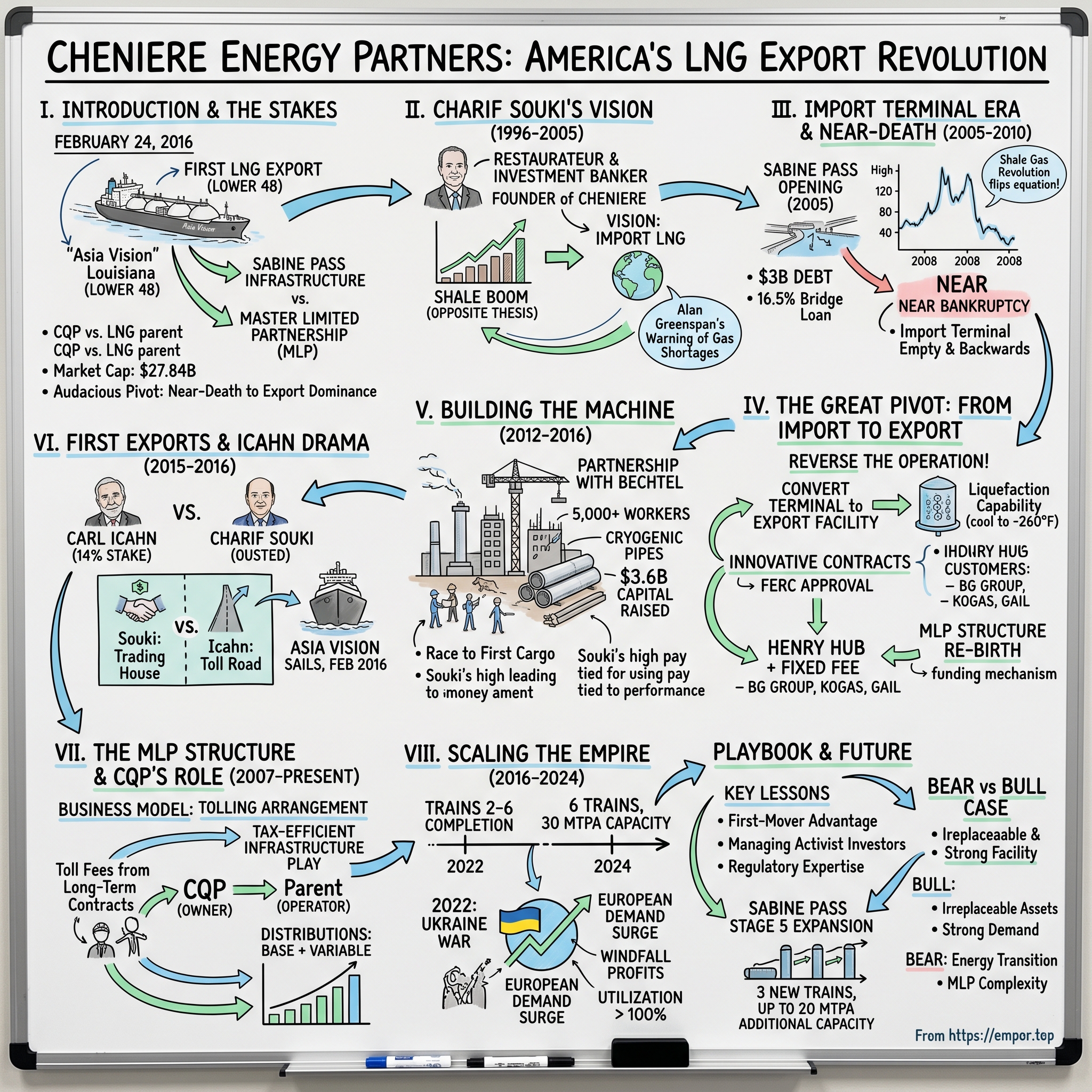
Cheniere Energy Partners: The Landlord of America's LNG Export Machine
I. Introduction & The Puzzle
In Cameron Parish, Louisiana, where the Sabine River meets the Gulf of Mexico, a stretch of marshland defined by shrimp boats, cordgrass, and hurricane scars hosts one of the most valuable industrial sites in the Western Hemisphere. Six liquefaction trains operate there, chilling natural gas to minus 260 degrees Fahrenheit until it condenses into a liquid at one six-hundredth of its original volume—allowing it to be loaded onto tankers and delivered anywhere with a regasification terminal.
Since February 2016, the Sabine Pass facility has loaded more than 3,460 cargoes, totaling roughly 240 million tonnes of liquefied natural gas.1 According to company disclosures, the operation has fulfilled every foundation customer cargo without interruption.2 Each shipment delivers American shale gas to buyers across Asia and Europe, from Seoul and Shanghai to Rotterdam and Mumbai.
Yet market participants often conflate the underlying operating asset with its parent company.
The terminal is owned by Cheniere Energy Partners, L.P., a master limited partnership trading on the NYSE under the ticker CQP. It is distinct from its parent company, Cheniere Energy, Inc., which trades under the ticker LNG. While both entities share executive management, headquarters, branding, and history, their asset bases are separate. Cheniere Energy Inc. owns Corpus Christi—a second, larger export complex in Texas—as well as CQP's general partner, all of CQP's incentive distribution rights, and 48.6 percent of its limited partner units.3 CQP itself owns a single operating asset: the Sabine Pass terminal and the 94-mile Creole Trail Pipeline that supplies it.
Most headlines surrounding the Cheniere name refer to the parent company. The parent directs multibillion-dollar share buyback programs, manages the expansion of Corpus Christi Stage 3, and carries the legacy of founder Charif Souki's departure under pressure from Carl Icahn's board representation. CQP serves strictly as the corporate structure holding the Sabine Pass terminal.
This distinction forms the foundation of the investment case. Stripped of the broader Cheniere brand halo, CQP is a single infrastructure asset secured by long-term, twenty-year contracts designed for income-focused investors. While the physical facility is substantial, the primary economic moat resides in its contract book. That contract book, however, operates under a capital waterfall where the general partner holds priority rights, capturing fifty cents of every incremental dollar in distribution growth.
Consequently, assessing CQP requires asking focused structural questions beyond broader industry trends: How durable is the contract book if a second global supply wave materializes? What is the marginal cost of the general partner's distribution share to limited partners? Does an entity with a 7.9 percent public float and no independent management possess meaningful governance checks on its sponsor? And when executive leadership allocates capital or commercial priority between Sabine Pass and Corpus Christi, which entity takes precedence?
The following analysis examines CQP's origin, details its operational mechanics, dissects its partnership structure, stress-tests its performance history, and maps its competitive environment—including the impact of geopolitical conflicts in the Middle East that, as of mid-2026, have reshaped market expectations for global LNG supply.
 Subscribe on LinkedIn
II. Origins, Compressed: From Import Bet to Near-Death to Pivot (1996–2012)
The Sabine Pass facility was originally constructed for the opposite flow of energy.
Charif Souki founded Cheniere Energy in 1996 as an exploration outfit. By the early 2000s, he adopted an industry-wide consensus: domestic natural gas production was declining, prices were rising, and the United States would need to import energy. The strategy called for building regasification terminals on the Gulf Coast to receive liquefied natural gas from Trinidad, Qatar, and Nigeria, warm it back into gas, and feed it into the domestic pipeline grid.
Cheniere Energy Partners, L.P. was formed in 2003 as the ownership vehicle for that import strategy, going public in March 2007 at a minimum quarterly distribution of $0.425 per common unit.4 Terminal construction at Sabine Pass began in 2005. Within 18 months of the initial public offering, however, two developments undermined the business model: the rapid commercialization of hydraulic fracturing across the Barnett, Haynesville, and Marcellus shales unlocked abundant domestic natural gas, while the collapse of Lehman Brothers in 2008 froze global credit markets. Expanding shale production rendered import terminals obsolete, while the financial crisis severely strained the company's liquidity.
The near-death experience, and why it still matters
This phase of Cheniere's history highlights key structural risks, providing critical context for evaluating claims regarding CQP's balance-sheet resilience.
In August 2008, Cheniere closed a $250 million senior secured convertible loan with Blackstone's GSO Capital Partners at a 12 percent interest rate, with interest accruing for the first three years rather than being paid in cash.5 Proceeds were used to repay a $95 million bridge loan and fund a reserve account. The agreement granted lenders put rights exercisable in 2011, 2013, and 2015. Crucially, the loan was secured by Cheniere's rights and fees under management services agreements with both the Sabine Pass terminal and Cheniere Energy Partners itself.6 To maintain liquidity, the parent company pledged cash flows extracted from the operating partnership that comprises CQP today.
This transaction represented emergency liquidity at distressed pricing during a global credit crunch. The 2011 put option posed an existential refinancing risk that management acknowledged in regulatory filings. Cheniere spent over two years restructuring the agreement, finally negotiating away those put rights in December 2010.7 Meanwhile, ring-fencing provisions within the Sabine Pass LNG bond indenture restricted debt issuance and cash distributions at the operating partnership level.
This period demonstrates that neither the partnership structure nor physical infrastructure provided balance-sheet immunity. The legal entity that faced severe financial distress between 2008 and 2010 is the same partnership that now generates approximately $10 billion in annual revenue with investment-grade credit ratings. The turnaround was driven by shifting the commercial model from merchant import capacity to long-term, take-or-pay export contracts. Assertions that CQP's cash flows are contracted and de-risked reflect the durability of its post-2016 contract book rather than an intrinsic feature of its physical assets or master limited partnership wrapper.
The pivot
In response to shifting supply dynamics, Souki pivoted the company's strategy. With domestic natural gas abundant and cheap relative to oil-indexed Asian and European markets, Cheniere sought to reverse the terminal's flow, converting Sabine Pass into an export facility.
On April 16, 2012, the Federal Energy Regulatory Commission authorized Sabine Pass Liquefaction to site, construct, and operate export facilities at the existing import terminal—marking the first time FERC approved LNG exports from domestic production in the lower 48 states.8 The initial order permitted the construction of up to four modular liquefaction trains.
This regulatory approval transformed CQP's asset base and established the foundation of its modern commercial model. However, successfully executing the operational pivot did not prevent subsequent governance conflicts over corporate leadership and capital allocation strategy.
III. Building the Asset & the Souki-Icahn Coda (2012–2016)
Construction began in January 2012, with Bechtel serving as the engineering, procurement, and construction contractor under a lump-sum turnkey agreement—a structure that transferred cost overrun risks to the contractor. Over the following decade, six liquefaction trains came online in sequence. The project was delivered largely on schedule and within budget, contrasting with the severe cost overruns that affected competing global LNG developments during the same period.
This contractor relationship has spanned fourteen years, providing Cheniere with a consistent track record of capital execution. While facility operations faced later scrutiny, construction execution remained disciplined across multiple expansion phases. As of the second quarter of 2026, the parent company's Corpus Christi Stage 3 project was over 98 percent complete, with Train 6 substantially complete in June 2026 and Train 7 commissioning underway well ahead of its guaranteed 2027 completion date.2
In February 2016, the initial cargo departed Sabine Pass, marking the first commercial LNG export from the lower 48 states in the modern era and launching the U.S. LNG export industry.1
The boardroom ending
Charif Souki did not remain as chief executive to oversee that first departure.
In August 2015, Cheniere reached an agreement with activist investor Carl Icahn, who had disclosed an 8.2 percent stake in a Schedule 13D filing, to add two Icahn designees to its eleven-member board.9 Icahn continued accumulating shares, crossing 9.6 percent by mid-September and exceeding 13 percent by December.41 Icahn argued that a company with substantial embedded asset value was being directed by a founder focused on aggressive expansion rather than capital discipline. Souki favored continued project development, whereas the board increasingly prioritized cash distribution and capital return.
On December 13, 2015, Cheniere's board terminated Souki as chairman, president, and CEO—roughly ten weeks before the initial export cargo shipped.10 A Bloomberg account characterized Souki as a founder impacted twice by the U.S. shale boom: first when surging domestic production rendered his import infrastructure obsolete, and again when rising export asset values prompted shareholders to push for control.11
Jack Fusco succeeded Souki as CEO in May 2016 and joined the board that June.3 Fusco brought more than four decades of energy industry experience, primarily in power generation, including executive roles at Pacific Gas & Electric, Texas-New Mexico Power, Orion Power Holdings, and Calpine Corporation, where he served as CEO for eight years starting in August 2008 and as executive chairman through May 2016. Fusco's background in managing merchant power assets through periods of falling natural gas prices and compressed spark spreads influenced his management approach at Cheniere, prioritizing risk mitigation and contract-backed cash flows over unhedged commodity exposure.
The activist campaign concluded systematically. Icahn reduced his Cheniere position starting in 2018 and finalized his exit in June 2022, when Cheniere repurchased $350 million of shares directly from Icahn Enterprises.12 Currently, neither the parent company nor CQP faces activist pressure, though CQP's corporate structure limits direct limited partner governance intervention.
With facility construction complete and new leadership installed, the focus shifted to the long-term cash flow profile established for unitholders.
IV. How the Machine Actually Works: MLP, GP, and the IDR Question
Read CQP's annual report cover to cover and you will not find a single employee.
"We do not have employees," the partnership states plainly, "and thus we and our subsidiaries have various services agreements with affiliates of Cheniere."3 Every person who operates the Sabine Pass terminal, negotiates its contracts, files its taxes, and signs its financial statements is on Cheniere Energy Inc.'s payroll. CQP reimburses cost plus a fixed monthly fee per train, indexed to inflation, and pays a quarterly non-accountable overhead reimbursement charge of $3 million, also inflation-adjusted. In fiscal 2025 those services agreements ran $177 million through operating and maintenance expense and $93 million through general and administrative.3
This is not a scandal. It is the standard architecture of a sponsored MLP, and it is disclosed in detail. But it means something specific for how you evaluate the business: CQP has no independent management team to assess. Jack Fusco is Chairman, President, and CEO of Cheniere Energy Partners GP, LLC. Zach Davis is CFO of both Cheniere and the general partner. Anatol Feygin is Chief Commercial Officer of both. They are the same people wearing a second hat.
What CQP owns, and nothing else
The asset inventory is short enough to recite from memory, which is itself the point. Six liquefaction trains with over 30 mtpa of total production capacity. Five LNG storage tanks holding roughly 17 billion cubic feet equivalent. Three marine berths, two of which can take vessels up to 266,000 cubic metres. And the 94-mile Creole Trail Pipeline, owned through subsidiary CTPL, which ties the terminal into the interstate and intrastate grid.3
One detail on that list is a fossil in the geological sense. The site still carries vaporizers with regasification capacity of approximately 4 billion cubic feet per day — the machinery of the import business, retained and still under contract, with a customer paying fixed monthly fees for reserved regasification capacity whether or not it uses it.3 The ghost of the original thesis is not merely a story. It is standing equipment on the property, collecting a fee.
What is not on the list matters more. Corpus Christi — larger, faster-growing, and the destination for most of the parent's construction capital — is a sibling asset held directly by Cheniere Energy Inc. CQP has no interest in it, no claim on its cash flows, and no path to acquiring one.
The ownership stack, precisely
As of December 31, 2025, Cheniere Energy Inc. held 48.6 percent of CQP's limited partner interest — 239.9 million common units — plus 100 percent of the 2 percent general partner interest and 100 percent of the incentive distribution rights.3
Affiliates of Blackstone and Brookfield held 41.5 percent of the common units, largely through CQP Target Holdco L.L.C., which is split evenly between a Blackstone entity and a Brookfield entity. That block traces back to Blackstone Energy Partners' original investment in CQP, roughly half of which Blackstone sold to Brookfield in a transaction that closed in September 2020.13
Which leaves the public with 7.9 percent.3
Read that number again, because the market cap of CQP is not small. The aggregate market value of common units held by non-affiliates was approximately $2.2 billion as of June 30, 2025.3 But against a total unit count of 484 million, unaffiliated holders own less than one unit in twelve.
The governance consequences are absolute rather than probabilistic. Unitholders have no right to elect the general partner or its directors on any basis, annual or otherwise. The board is chosen entirely by Cheniere affiliates. Removing the general partner requires a supermajority of outstanding units including those held by the general partner and its affiliates — an arithmetic impossibility given Cheniere's own 48.6 percent. And the partnership agreement strips voting rights from any non-affiliated holder that accumulates 20 percent or more of a class, while barring anyone crossing 15 percent from a business combination without general partner approval.3
There is no activist path here. There is no proxy contest. There is no realistic scenario in which minority unitholders change anything. Anyone underwriting CQP is underwriting Cheniere's continued good behavior, backed by the fact that Cheniere's own 48.6 percent LP stake gives it a large economic interest in that behavior — which is a genuine alignment, but an alignment by coincidence of interest rather than by governance right.
Correcting a common misread: the IDRs never went away
There is a persistent belief in investor commentary that CQP's incentive distribution rights were eliminated in 2018. They were not.
What happened in September 2018 was the merger of Cheniere Energy Partners LP Holdings, LLC — ticker CQH, a tracking-stock layer that held CQP units and did nothing else — into the parent.14 That simplified the org chart by one box. It had no effect whatsoever on the IDRs sitting inside CQP's own partnership agreement.
Those IDRs are alive, disclosed, and expensive. The waterfall, from CQP's own annual report, works like this. Above the initial quarterly distribution of $0.425 per unit, additional cash is split 98/2 between unitholders and the general partner up to $0.489. From $0.489 to $0.531, the split moves to 85/15. From $0.531 to $0.638, it moves to 75/25. Above $0.638 per unit per quarter, it is 50/50.3
CQP has been distributing well above $0.638 for years. The quarterly distribution declared for the second quarter of 2026 was $0.820 per common unit.15
So what does that actually cost? The partnership discloses it directly. For fiscal 2025, CQP declared total distributions of $2,062 million. Of that, $1,597 million went to common unitholders, $41 million to the general partner units, and $424 million to the incentive distribution rights.3 In fiscal 2024, the IDR take was $486 million.
Roughly one dollar in five that CQP distributes goes to the incentive distribution rights before any common unitholder sees it. And at the margin the arithmetic is starker: every incremental penny of quarterly distribution above $0.638 per unit is matched dollar for dollar by a payment to the general partner. Raising the common distribution by $0.10 per unit per quarter costs the partnership roughly $97 million, of which unitholders receive about $48 million.
This is the single most important structural fact about CQP and the one least visible in summary coverage. It does not make the distribution bad. It does mean the distribution is expensive to grow, and that Cheniere Energy Inc. captures a disproportionate share of any upside from Train 7, from higher utilization, from debottlenecking — from anything that increases distributable cash at Sabine Pass.
The conflict the filing itself names
CQP's annual report does not hide the tension. Under a risk factor headed "Our general partner and its affiliates have conflicts of interest and limited fiduciary duties," the partnership states that Cheniere's directors and officers owe a fiduciary duty to Cheniere's owners, "which may be contrary to our interests," that the general partner "controls the interpretation and enforcement of contractual obligations" between CQP and Cheniere, and that it "is allowed to take into account the interests of parties other than us" when resolving conflicts.3
Elsewhere the filing is blunter still: CQP competes "with other natural gas liquefaction projects throughout the world, including our affiliate, Corpus Christi Liquefaction, LLC," and it competes with Cheniere's Corpus Christi projects "for the time and expertise of Cheniere's personnel."3
The same commercial team that decides where a marginal long-term contract lands is employed by the entity that owns 100 percent of the Corpus Christi economics and 48.6 percent of the Sabine Pass economics. There is a conflicts committee, and affiliate transactions can be routed through it. But the structural incentive is what it is, and it points one way.
What that structure sits on top of, though, is a genuinely unusual commercial machine — which is where the actual economics live.
V. The Business Model: Tolling Economics and Why It's the Real Moat
Here is the mental model that makes Sabine Pass legible: CQP does not sell natural gas. It rents out a refrigerator.
A customer signs a sale and purchase agreement — an SPA — for a fixed quantity of LNG per year over roughly twenty years. The price has two parts. The first is a fixed fee per million British thermal units, a portion of which escalates with inflation. The second is a variable fee generally equal to 115 percent of Henry Hub, the U.S. natural gas benchmark.3
That second component is the clever bit. The variable fee is sized to cover the cost of buying feedgas, moving it down a pipeline, and burning some of it to run the compressors. Because the customer pays 115 percent of Henry Hub and CQP buys gas at roughly Henry Hub, movements in the U.S. gas price wash through the income statement with only modest net effect. CQP's exposure is to volume and to plant availability, not to the commodity.
And even volume risk is heavily muted, because the fixed fee is take-or-pay. If a customer chooses to cancel or suspend a cargo — which the SPAs permit with advance notice — that customer still owes the fixed fee on the volumes it did not take.3 The customer is buying an option on liquefaction capacity, and the option premium is non-refundable.
As of December 31, 2025, CQP had contracted roughly 85 percent of the total anticipated production from the Sabine Pass liquefaction project through the mid-2030s, with a weighted average remaining contract life of approximately 13 years.3 That is the asset. Not the trains — the paper.
The hardest test the model has faced
Business models that have never been stressed are hypotheses. This one has been tested, hard, once.
In the spring and summer of 2020, COVID collapsed global gas demand at the same moment a wave of new liquefaction capacity was starting up. Asian and European spot prices fell below the all-in cost of loading an American cargo and shipping it. For the first time in the industry's short export history, buyers found it cheaper to walk away from LNG they had already contracted than to take delivery. More than a hundred U.S. cargoes were cancelled across the industry, and Cheniere's terminals accounted for the majority of them.
The contracts held. For full-year 2020, Cheniere recognized $969 million in LNG revenues associated with cancelled cargoes — cash for ships that never sailed.16 CQP itself remained comfortably profitable, earning $1.18 billion in net income on $6.17 billion of revenue that year, and it did not cut its common distribution.17
Read correctly, 2020 is the strongest available evidence for the tolling claim, not the weakest. The most adverse demand shock the industry has experienced did exactly what the contracts said it would do: it converted a volume problem into a fee-collection exercise. That is what a take-or-pay structure is supposed to accomplish, and it accomplished it under real duress rather than in a model.
But the test was narrower than it looks, and honesty requires naming what was not tested. Buyers electing not to lift cargoes while continuing to pay is the easy failure mode — it is contemplated in the contract and priced. The hard failure modes are a counterparty successfully invoking force majeure to escape the fixed fee entirely, or a counterparty going insolvent. Neither has happened at Sabine Pass. A Chinese buyer's force majeure attempt during the same period was rebuffed. But "has not yet happened" over a ten-year operating history, across roughly ten third-party SPA customers, is a bounded observation rather than proof of structural immunity — particularly since five customers individually representing more than 10 percent of revenues together accounted for 76 percent of CQP's revenues from contracts with external customers in fiscal 2025.3 The counterparty roster is short and it is concentrated: in the prior year's disclosure, BG Gulf Coast LNG and affiliates represented 22 percent of revenues, with 한국가스공사 Korea Gas Corporation and GAIL (India) Limited at 15 percent each, Naturgy at 14 percent, and TotalEnergies at 11 percent.18
That concentration is mitigated by the credit quality of those names — these are national gas utilities and oil majors, not merchant traders. It is not eliminated by it.
What the financials actually say
CQP's reported numbers look far more volatile than the business underneath them, and understanding why is essential to reading the company at all.
Revenue was $9.66 billion in fiscal 2023, $8.70 billion in fiscal 2024, and $10.76 billion in fiscal 2025.19 Net income over the same three years ran $4.25 billion, $2.51 billion, and $2.99 billion. Net income per common unit — the number that actually reaches a unitholder's tax form — was $6.95, then $4.25, then $5.17.3
Almost none of that swing is operating volatility. Revenue moves with Henry Hub, because the variable fee is indexed to it and passes straight through; a high gas price inflates both the top line and cost of sales with limited effect on margin. Net income moves with non-cash mark-to-market on derivatives, principally the integrated production marketing agreements under which gas producers sell gas to Cheniere priced off global LNG indices. Under those deals, the gas purchase is marked to fair value while the corresponding LNG sale is not, producing large accounting gains and losses that never touch cash.
Management finally addressed this in June 2026, designating the normal purchases and normal sales accounting exception for roughly 75 percent of IPM volumes, which stops those agreements from being marked to fair value each period. On the second-quarter 2026 call, Davis quantified the historical distortion with unusual candor: of the 22 quarters since 2021, six produced negative net income solely because of unrealized derivatives, and that count would have been two under the new designation.2
That is a useful disclosure, and it is also a reminder that for five years the headline earnings of a "stable contracted infrastructure company" were substantially an artifact of accounting policy. Investors who anchored on GAAP net income were reading noise. The stable number was always adjusted EBITDA, which came in at $3.7 billion for fiscal 2025.20
The independent scorecard
Management's framing of a de-risking business can be checked against parties with no incentive to flatter it. All three major rating agencies have moved the same direction, and recently. Fitch upgraded CQP to BBB from BBB- with a stable outlook in February 2025. S&P raised CQP's issuer credit rating and unsecured notes to BBB+ from BBB in November 2025.21 Moody's upgraded to Baa2 with a stable outlook in February 2026, citing cash flow from the three operating subsidiaries beneath CQP.22
Three independent credit committees converging on the same conclusion within twelve months is meaningful corroboration of the contracted-cash-flow thesis. It is corroboration of credit quality specifically, not of equity returns, and rating agencies are structurally more interested in whether coupons get paid than in whether unitholders capture growth. But as evidence that the post-2016 business is a genuinely different animal from the 2008 one, it is about as close to third-party verification as this asset class offers.
The two things worth watching from here are contracted-capacity percentage and the weighted average remaining life of the contract book. Everything else — revenue, net income, even EBITDA in a given quarter — is downstream of those two numbers.
Which brings us to what happens when the machine doesn't run perfectly.
VI. Cracks in the Operating Record: Reliability, Compliance, and a Recent Miss
On June 8, 2022, a pipe carrying LNG from a storage tank to the dock at Freeport LNG's terminal on Quintana Island, Texas, over-pressurized and ruptured. The resulting explosion and fire took roughly 2 billion cubic feet per day of liquefaction capacity offline—about 17 percent of total U.S. LNG export capacity at the time.23 Freeport initially told the market it expected partial operations to resume in early September, but the plant remained substantially offline into 2023.24
That incident serves as a primary benchmark for evaluating Sabine Pass's operational track record. Operating along the same coast, under the same regulatory framework, and with comparable technology, Sabine Pass has demonstrated greater facility stability. With cumulative shipments surpassing 3,460 cargoes, the plant has operated above its original nameplate design. Chief Executive Jack Fusco stated on the second-quarter 2026 call that Cheniere has never missed a foundation customer cargo across a decade of operations—a claim that counterparties could easily challenge if inaccurate.2
In the LNG sector, operational reliability functions as a key pricing input. Chief Commercial Officer Anatol Feygin has noted that Cheniere avoids competing in "the race to the bottom of the standardized 20-year offtake agreement," opting instead to sell into "the premium market that values our reliability."2 If that pricing premium holds, operational consistency serves as the primary mechanism defending fixed fees against lower-cost entrants. However, testing this commercial claim requires observing whether new contracts continue to price within management's stated target range of $2.50 to $3.00 per MMBtu as global supply expands.
The record is not spotless
On January 22, 2018, workers at Sabine Pass discovered a crack between one and six feet long in the inner wall of an LNG storage tank, which leaked cryogenic liquid into its outer containment layer. The Pipeline and Hazardous Materials Safety Administration (PHMSA) ordered two tanks shut on February 8. The agency's investigation revealed that LNG had also leaked from a second tank. PHMSA proposed a $2.2 million civil penalty, alleging that the cracking resulted from "incorrect operations" and that management knew the tank design was inadequate for the way it was being run.25
The 2018 tank failure resulted from operational and engineering errors on site during the facility's second year of commercial operation. While the tanks returned to service following repairs and no similar leaks occurred over the subsequent eight years, the event demonstrates that operational risks exist even within major export infrastructure.
Environmental compliance disclosures also show ongoing operational friction across the sector. A 2025 report titled "Terminal Trouble" by the Environmental Integrity Project noted that all seven operational U.S. LNG export terminals violated the Clean Air Act at least once over the preceding five years. Collectively, these facilities released 18.2 million tons of greenhouse gases and 15,733 tons of criteria pollutants in 2023, while facing fifteen enforcement actions and roughly $1 million in total penalties.26 Venture Global's Calcasieu Pass accounted for the most frequent non-compliance—twelve quarters over three years—indicating that regulatory enforcement across the industry has involved modest financial penalties relative to overall emissions.
The guidance test
A clear test of management's operational disclosure occurred in the third quarter of 2025.
CQP reported earnings of $0.80 per unit, falling roughly 25 percent below the Wall Street consensus estimate of $1.06. Net income fell 20 percent year over year to $506 million, even as revenue rose 17 percent to $2.4 billion.27 While derivative mark-to-market accounting created much of the gap between revenue and net profit, physical operations also experienced disruption.
Management attributed the operational slowdown to changing feedgas composition. As new large-diameter pipelines delivered Permian Basin gas into Louisiana, incoming streams showed higher concentrations of nitrogen and heavier hydrocarbons. Because nitrogen does not liquefy at standard operating temperatures, it reduced effective system throughput. Meanwhile, heavier hydrocarbons froze inside heat exchangers, requiring more frequent defrost cycles and specialized cleaning solvents. To maintain processing volumes, Sabine Pass shifted to "wet mode," chilling the gas stream further to maintain throughput.28
The operational strain resembled a processing system designed for a specific input profile suddenly receiving harder feedgas: processing capacity declined while maintenance requirements increased.
This episode highlights two distinct factors for unitholders. First, management provided a technical explanation tied to upstream supply changes and maintained full-year adjusted EBITDA guidance while raising distributable cash flow guidance. Second, the incident demonstrated that volume-linked fees and marketing revenues remain subject to physical input variability, even when fixed take-or-pay contract revenues remain intact.
Subsequent performance supported management's initial diagnosis. By the second quarter of 2026, Fusco reported that nitrogen content in Permian feedgas had stabilized near 1.5 percent. The company implemented mitigation measures, including subcooling to evacuate nitrogen, blending lower-nitrogen gas streams, and routing high-nitrogen gas to on-site power generation. Addressing the issue on an earnings call, Fusco stated that the operational challenges had been identified and fixed and "those seem to be behind us."2 CFO Zach Davis attributed more than two-thirds of the parent company's 2026 production guidance increase to operational resiliency work and reduced downtime and defrost at the existing sites.2
While management identified and addressed this operational challenge within four quarters, ongoing feedgas composition remains a physical factor monitoring teams track alongside long-term contract coverage.
VII. Capital Allocation and the Next Bet: Train 7
To understand CQP's capital allocation, start with what CQP unitholders do not get.
Cheniere Energy Inc. runs one of the most aggressive buyback programs in North American energy infrastructure — an authorization of $18.41 billion running through 2030, under which the parent repurchased roughly 2.2 million shares for $550 million in the second quarter of 2026 alone, and about $1.1 billion across the first half.29 Davis has described a target of working the share count below 200 million and then toward 175 million later this decade.2 The parent also pays a common dividend, declared at $0.555 per share for the second quarter of 2026, with a stated commitment to grow it at least 10 percent annually through the end of the decade.2
None of that touches CQP. There is no CQP unit repurchase program. Unitholders receive a distribution and organic reinvestment, full stop. The value of Cheniere's buyback accrues to Cheniere's shareholders, funded in part by cash that flows up from Sabine Pass through the LP units, the GP interest, the incentive distribution rights, and the services agreements.
The growth bet
CQP's own growth vehicle is the Sabine Pass expansion project, and 2026 was the year it became concrete.
In the second quarter, Sabine Pass Liquefaction signed a lump-sum turnkey EPC contract with Bechtel Energy worth approximately $4.7 billion, covering Train 7 — a replica of the first six large-scale trains, with a design capacity of roughly 5 mtpa — plus a boil-off gas reliquefaction unit expected to add about 1 mtpa across the existing facility, related infrastructure, and tie-ins.2 Baker Hughes supplies the turbines and compressors again, and separately received a multi-year services contract to upgrade the gas turbine fleet across all of Sabine Pass to raise power output. A limited notice to proceed was issued on May 22, 2026, releasing Bechtel to begin early engineering and long-lead equipment procurement.30 Total Phase 1 capacity addition: over 6 mtpa.
The strategic logic is worth dwelling on, because it is the most defensible thing about the project. This is a brownfield expansion in the strictest sense. It requires no new marine berths, no new LNG storage tanks, and no significant new gas pipeline investment — Sabine Pass already has three berths, five tanks, and Creole Trail. A greenfield developer building the same 6 mtpa must acquire land, permit and dredge a ship channel, build storage, secure pipeline capacity, and finance all of it before a single molecule moves. Train 7 bolts onto infrastructure that was paid for a decade ago and is already generating cash.
That is a materially different risk profile from what NextDecade, Woodside, or a first-time developer faces, and any analysis that lumps CQP's growth risk in with new entrants is making a category error.
The financing, and what it costs unitholders
The funding plan, laid out by Davis on the second-quarter 2026 call, is roughly half debt and half equity cash flow. On the debt side, CQP issued $1.0 billion of 5.350 percent senior notes due 2036 and $750 million of 6.050 percent senior notes due 2056 — the partnership's first-ever thirty-year issuance — using proceeds to redeem $1.5 billion of 5.00 percent senior secured notes due 2027 at the SPL level and to fund the limited notice to proceed. Cheniere then launched a senior secured delayed-draw term loan at SPL to complete the debt component.2
Two structural points follow. Refinancing secured SPL notes with unsecured CQP notes reduces the amount of secured debt sitting ahead of unitholders in the capital structure, which is a genuine, if incremental, improvement for equity holders. And extending maturities to 2056 matches the debt stack against contract tenors that now run into the second half of the century.
The equity half is where CQP unitholders pay. In Davis's words, Cheniere will fund the remaining half of project cost "with equity cash flow by continuing to flex the variable component of the CQP distribution."2
That sentence should be read slowly. CQP's distribution has a base component and a variable component. The variable component is the release valve. Train 7 is being funded, in part, by holding back cash that would otherwise have gone out the door to unitholders. That is not hidden — it is stated on an earnings call and reflected in the guidance — and it is arguably the conservative choice versus issuing units or levering harder. But it means the growth project is being financed by the income investors who bought the security for its yield, and it caps distribution growth over the construction period.
Leverage bears watching against that backdrop. At the end of 2025, CQP carried $14.6 billion of total debt against $182 million of cash and $1.8 billion of available credit commitments, with adjusted EBITDA of $3.7 billion.3 That is roughly 3.9 times net debt to adjusted EBITDA — comfortable for a contracted infrastructure asset with investment-grade ratings, and consistent with the rating agencies' own modeling of leverage around 4 times, but not conservative in absolute terms, and it will rise as Train 7 draws down. The credit-rating trajectory from Section V and the leverage trajectory here are the two variables that must stay in tension for the story to work.
Regulatory runway and its recent whipsaw
The permit path is the last open item before a final investment decision, and its recent history is a case study in why political risk in this business is not hypothetical.
In January 2024, the Biden administration paused approvals of new LNG export permits to non-free-trade-agreement countries pending an updated economic and environmental study. In January 2025, the incoming Trump administration reversed that pause.31 One year, two opposite federal postures, on the single regulatory gate that determines whether an American liquefaction project can sell to most of its addressable market.
Cheniere has moved with the reopened window. Sabine Pass Stage 5 — Trains 7, 8, and 9 plus the reliquefaction unit — was filed with FERC, and FERC staff issued a draft environmental impact statement on April 6, 2026, concluding the project would produce "some adverse environmental effects; however, effects would be reduced to less-than-significant levels."32 DOE granted free-trade-agreement export authorization in November 2025; non-FTA authorization and the FERC certificate remained pending as of the fiscal 2025 annual report.3 Management expects the remaining approvals later in 2026 and a formal FID in early 2027.2
A draft EIS with a less-than-significant finding is a strong procedural signal, and Fusco has described the dialogue with Washington — including meetings with the Energy Secretary, the National Energy Dominance Council chair, and the FERC chairman — as "extremely constructive."2 That is a favorable current environment. It is also a reminder that the favorable environment is four years old at most and reversed once within that span. Political support is a real asset for CQP today and a real risk for any project whose FID sits on the far side of another election.
VIII. The Distribution: What Income Investors Are Actually Buying
CQP's first cash distribution went out in the first quarter of 2007, at the minimum quarterly rate of $0.425 per common unit.4 The partnership was, at that point, a levered bet on imported LNG in a country about to be buried in its own gas.
There is an important nuance behind the frequently cited claim that CQP has never cut its distribution. When the partnership went public, its capital structure included subordinated units designed to receive payouts only after common units received their minimum quarterly distribution plus any arrearages. During the severe financial strain of the import era, that subordination mechanism absorbed the cash shortfall: payouts to subordinated units fell to zero while common unitholders continued receiving cash. The precise historical claim, therefore, is that the common unit distribution has never been reduced—a distinction forged during the financial distress outlined in Section II.
Since transitioning to exports, distribution growth has been steady rather than aggressive. Total declared distributions reached $3.29 per common unit in 2025.3 The fourth-quarter 2025 payout of $0.830 per unit consisted of a $0.775 base distribution and a $0.055 variable payout.3 For 2026, management guided to an annual range of $3.10 to $3.40 per common unit while holding the base distribution at $3.10, reconfirming that target in both its first-quarter and second-quarter financial reports.1533
The quarterly distribution trajectory through mid-2026 reflects the capital allocation dynamics outlined in Section VII. The first-quarter payout was $0.790 per unit, combining the $0.775 base with a $0.015 variable distribution.33 The second-quarter distribution rose to $0.820 per unit, retaining the same base while increasing the variable component to $0.045.15 In this structure, the base distribution represents the committed baseline, while the variable component functions as a shock absorber currently absorbing the equity funding requirements for Train 7.
What, then, are income investors actually buying?
They are purchasing a cash distribution stream backed by take-or-pay contracts averaging 13 years of remaining duration across 85 percent of production capacity, generated by an operating asset with an uninterrupted foundation-customer track record, and issued by an entity rated investment grade by all three major credit rating agencies. Few cash flow streams of comparable scale, contract coverage, and credit quality exist in public U.S. capital markets.
However, this payout comes with a structural ceiling. Every incremental dollar of quarterly distribution growth above the top incentive distribution right threshold is matched dollar for dollar by a payment to the sponsor. Capital allocated at the parent level funds share buybacks that do not benefit CQP unitholders, while growth capital at CQP is partially funded by suppressing the variable distribution unitholders receive. Furthermore, with a 7.9 percent public float, minority unitholders possess no governance mechanism to alter this allocation.
The bullish and bearish perspectives on CQP stem from the same fundamental reality: the partnership operates a high-quality yield asset whose financial upside is contractually shared with its sponsor under terms established by the parent.
Whether that distribution maintains its real value over time depends less on partnership governance than on whether expiring contracts can be renewed on comparable terms—a factor governed by broader global industry dynamics.
IX. Industry Structure and the Competitive Map
In June 2026, the global LNG market ran an experiment that no analyst had modeled.
War with Iran effectively closed the Strait of Hormuz to LNG traffic. Qatar and the UAE — the low-cost core of global supply — saw exports collapse. Feygin quantified the damage on the second-quarter call: roughly 18 million tonnes of Middle East LNG supply lost during the quarter. Growth elsewhere, including Cheniere's own Corpus Christi Stage 3 ramp, largely offset it, but global LNG exports still declined by about 3 million tonnes year over year. Even after a mid-June ceasefire, LNG tanker transits through the Strait recovered to under 10 percent of pre-conflict levels by quarter end, against 25 percent for crude — a divergence Feygin attributed to the greater complexity of restarting an integrated liquefaction and shipping chain.2
Asian prices moved to a premium over Europe. U.S. exports to Asia hit a quarterly record of roughly 11 million tonnes. Henry Hub barely moved, because North American gas supply was never the constraint. Europe exited the quarter with an 11 bcm storage deficit versus the prior year — roughly a hundred cargoes' worth — and Feygin told analysts it would be "tough to get to 70 percent, much less 80 percent" of storage capacity before winter.2
That is the market CQP is operating in today, and it has temporarily inverted the consensus that dominated the prior two years.
The oversupply thesis, and why it is deferred rather than cancelled
Before Hormuz, the industry's central expectation was a multi-year glut. Roughly 51 mtpa of new liquefaction capacity entered service in 2025, including the first phase of Venture Global's Plaquemines, with another 37 to 41 mtpa scheduled for 2026 and cumulative 2026–2030 additions in the region of 200 million tonnes.34 Feygin's own tally of new capacity reaching final investment decision — approximately 77 million tonnes in 2025 and another 38 million tonnes in the first half of 2026 — implies the pipeline is still filling faster than demand is arriving.2
قطر للطاقة QatarEnergy is the structural counterweight to any American producer's pricing power. Its North Field program is designed to lift Qatari capacity from roughly 77 mtpa to 142 mtpa by the end of 2030, sitting on the lowest-cost associated gas resource in the world.35 The one crack in that plan: North Field West, the 16 mtpa final tranche, has slipped its first cargo to the end of 2031 from an original 2030 target — a reminder that even the world's most advantaged producer misses schedules.36
The American field is crowded, and the crowding is recent. A translation note first, because the industry uses two units interchangeably: liquefaction capacity is quoted either in millions of tonnes per annum or in billions of cubic feet per day of feedgas, and roughly one Bcf/d corresponds to something on the order of seven to eight mtpa of LNG. The U.S. Energy Information Administration tracks the industry in Bcf/d, and its numbers are the cleanest available.
Venture Global is the most aggressive new entrant. Its Plaquemines facility shipped a first cargo on December 26, 2024 as the eighth U.S. export terminal, with Phase 1 rated at 1.3 Bcf/d nominal and both phases together at 2.6 Bcf/d — a single project roughly comparable in scale to all of Sabine Pass.42 Venture Global also operates Calcasieu Pass, the facility with the Clean Air Act compliance record noted earlier. Sempra Infrastructure runs Cameron LNG and is building Port Arthur. NextDecade is constructing Rio Grande LNG. Woodside took a final investment decision on Louisiana LNG, the former Tellurian project, in April 2025. ExxonMobil and QatarEnergy's Golden Pass joint venture reached first cargo in 2026 after repeated delays. Freeport LNG continues to operate with the reliability record described earlier.
The aggregate matters more than any single name. Once Golden Pass, Rio Grande, and Port Arthur are complete, the EIA has projected total U.S. nominal export capacity reaching 21.2 Bcf/d — about 25.2 Bcf/d at peak — by 2028.42 That is the wave, expressed in the units the physical system actually uses, and it is being built by developers who mostly do not share Cheniere's insistence on contracting before pouring concrete.
Cheniere's combined platform — CQP's Sabine Pass plus the parent's Corpus Christi — remains the largest of them, and Fusco has framed over 40 mtpa in permitting as a path to a platform exceeding 100 mtpa.2 But that is the parent's platform. CQP itself participates only in the Sabine Pass slice, plus whatever Train 7 eventually adds.
The honest reading is that Hormuz has delayed the glut, not repealed it. Anatol's own formulation was that the market "has proven considerably more resilient than many expected, but resilience should not be mistaken for surplus."2 Capacity that reached FID in 2025 and 2026 will arrive between 2028 and 2031 regardless of what happens in the Persian Gulf.
Testing the moat against the strongest contrary evidence
Here is where the analysis has to get uncomfortable, because the contracting story has a real crack in it.
The bull case says Cheniere's contracting position has not eroded despite the supply wave, and points to continued long-dated signings: a twenty-year SPA with 中国石油 PetroChina for approximately 1.8 mtpa running through 2050, signed in July 2022, and a twenty-year SPA with 新奥 ENN for approximately 1.8 mtpa signed in June 2023.3738 Both are real, both are long, both are Henry-Hub-indexed.
Both are also structured with roughly half their volume contingent on Cheniere reaching FID on new capacity — the PetroChina agreement ties about 0.9 mtpa to expansion beyond Corpus Christi Stage 3, and the ENN agreement ties about 0.9 mtpa to the first train of the Sabine Pass expansion.3739
And in March 2026, ENN and Cheniere amended their agreement so that ENN would purchase only half the volumes it had originally committed to, with the reduction tied to Cheniere not yet having taken FID on Sabine Pass Phase 1.40
That is the single most important piece of disconfirming evidence in this story, and it belongs right next to the moat claim rather than in a distant risk section. A twenty-year contract with a Chinese buyer, signed at the peak of post-Ukraine LNG anxiety, was renegotiated downward before the associated train was even financed. It did not fail — the amendment was consensual and the FID-contingency was in the original document — but it demonstrates that headline contracted volumes and delivered contracted volumes are different numbers, and that the gap moves against Cheniere when its own project timelines slip.
Feygin himself has bounded the claim in a way management rarely does. Asked in August 2026 whether Cheniere could contract 20 million tonnes at its target $2.50 to $3.00 per MMBtu margin over the next twelve to eighteen months, he declined: he was "very comfortable" with mid-single-digit millions of tonnes at that pricing, and explicitly "less comfortable" with 20 million tonnes, citing roughly 100 million tonnes of FID'd capacity globally still searching for end users.2
That is management's own guidance that the premium contracting window is real but narrow.
So how should the moat claim be revised? Not rejected — Cheniere is still signing long-dated business at premium pricing while competitors chase volume, and the reliability record that underpins that premium is documented across a decade and 3,460 cargoes. But narrowed, and specifically: the claim that survives is that Cheniere can contract incremental capacity at premium terms in modest increments, with an existing book of 85 percent contracted at 13 years' average remaining life providing the real protection. The claim that does not survive is that its contracting position is unaffected by the supply wave. Its own commercial officer says otherwise, and its own customer amendment proves it.
The falsifiable test is specific and it will resolve within roughly two years: whether the mid-single-digit millions of tonnes Feygin promised over twelve to eighteen months actually get signed at the stated $2.50 to $3.00 margin range, and whether Sabine Pass Phase 1 reaches FID in early 2027 with the ENN volumes restored rather than permanently halved.
Through the strategy frameworks
On Porter's five forces, the picture is genuinely mixed. Barriers to entry are high but falling — permitting a greenfield U.S. terminal remains a multi-year ordeal, yet the current administration is actively accelerating approvals, which erodes the incumbent's advantage. Supplier power is low: American gas is abundant, and the 115 percent Henry Hub pass-through neutralizes what power exists. Buyer power is rising, and the ENN amendment is the evidence. Substitutes are real over a twenty-year contract horizon — renewables, nuclear, and coal all compete for the same power generation load, and Feygin's own account of the Hormuz shock described Chinese buyers responding through fuel switching and domestic production. Rivalry is intensifying as the 2028–2031 wave lands.
On Hamilton Helmer's 7 Powers, two apply with confidence and one is contested. Cornered resource is real: a permitted, operating, brownfield site with berths, tanks, and pipeline already sunk is not replicable by a new entrant on any relevant timescale, and Train 7's economics depend entirely on this. Scale economies are real: Cheniere's platform lets it spread engineering, procurement, and commercial capability across nine-plus trains, and Davis has argued explicitly that scale is what holds the ratio of capital cost to EBITDA near seven times as inflation pushes construction costs up.2 Switching costs cut both ways and should not be counted as a pure positive — a twenty-year SPA locks in revenue, and it equally locks CQP out of upside if spot economics run hot, which during 2026 they did.
Branding, as a power, is the interesting case. In a commodity business it should not exist. Yet "we have never missed a foundation customer cargo" functions as one, and Feygin's premium-market positioning is precisely a branding argument. It is plausible. It has not been tested against a buyer that can source the same molecule 15 percent cheaper from a competitor willing to take the reliability risk. That test is coming.
X. Bear vs Bull Case
Bull Case
The core of the bull case is that CQP owns a contract book, not a factory, and the contract book is good. Eighty-five percent of anticipated production is spoken for at roughly thirteen years' average remaining life, on take-or-pay terms that survived the only genuine demand shock the industry has experienced. The 2020 cancellation wave converted a volume crisis into a fee-collection exercise, and Cheniere recognized nearly a billion dollars for cargoes that were never lifted. That is the mechanism working under load, not in a spreadsheet.
The operating record backing those contracts is measurably better than the most directly comparable peer's. Freeport's 2022 rupture removed roughly a sixth of U.S. export capacity for the better part of a year. Sabine Pass has run past 3,460 cargoes. When feedgas composition degraded in 2025, management named the physical cause, fixed it, and quantified the fix in the following year's production guidance — more than two-thirds of the parent's 2026 guidance increase came from reliability work rather than new trains.
Three rating agencies independently upgraded CQP within twelve months. The next growth project is brownfield rather than greenfield, with a lump-sum turnkey contract signed with a builder that has delivered six trains at the same site, financed half with debt at maturities extending to 2056. And the common distribution has grown steadily since the export ramp without a reduction.
The Hormuz disruption, whatever else it is, has demonstrated something the marketing decks could only assert: that geographic diversification of LNG supply carries a premium, and that American Gulf Coast capacity is the diversification. Buyers who spent 2024 and 2025 assuming a glut spent 2026 competing for cargoes.
Bear Case
The bear case starts with the fact that CQP is one asset. There is no second terminal, no geographic hedge, no portfolio effect. A hurricane, a fire, a compressor hall failure, or a repeat of the 2018 tank cracking event at a worse scale hits 100 percent of the business. Unlike its parent, CQP has no Corpus Christi to fall back on — and no ability to acquire one, because it controls no capital allocation of its own.
The IDR structure is a permanent, quantified economic drag. Four hundred and twenty-four million dollars of 2025 distributions went to the incentive distribution rights before any common unitholder was paid, and at the margin the general partner takes half of everything above $0.638 per unit per quarter. Any thesis built on distribution growth is a thesis in which Cheniere Energy Inc. captures an equal dollar for every dollar the unitholder gains.
Governance offers no recourse. A 7.9 percent public float, a general partner that cannot be removed by arithmetic, no unitholder vote on directors, and partnership provisions that disenfranchise anyone accumulating a meaningful blocking stake. An activist investor of the sort that reshaped the parent in 2015 has no entry point here. That is not a hypothetical: the mechanism that eventually imposed capital discipline on Cheniere Energy Inc. is structurally unavailable at Cheniere Energy Partners.
Leverage is real at roughly 3.9 times net debt to adjusted EBITDA and set to rise through the Train 7 construction period, at a time when the funding plan explicitly contemplates suppressing the variable distribution to fund equity contributions. Unitholders are, in a direct sense, financing the growth project out of their own yield while the sponsor buys back its own shares with an $18.41 billion authorization.
The contracting position is bounded by management's own words. Feygin's refusal to commit to 20 million tonnes at target margins, and the March 2026 halving of the ENN volumes, are the two data points that matter more than any number of press releases about new SPAs. Roughly 100 million tonnes of FID'd global capacity is hunting for buyers, and QatarEnergy's march toward 142 mtpa is a structural, state-financed competitor that does not need to earn a return on the same terms.
And the Hormuz effect cuts against the bull case in one specific way that is easy to miss: the extraordinary 2026 results — a parent-level guidance raise to $7.9–8.4 billion of EBITDA, record Asian export volumes, spot margins Davis described as $8 and above versus a run-rate assumption of $2.50 to $3.00 — are substantially a war premium.2 Davis argued explicitly that $8 billion-plus of run-rate EBITDA is achievable at normalized margins once Corpus mid-scale and Train 7 are built. That is a claim about a future asset base, not a defense of current margins as recurring. Investors extrapolating 2026 realizations into 2028 are extrapolating a geopolitical accident.
Finally, the regulatory environment that makes Train 7 possible reversed once within twenty-four months and could reverse again before the trains are earning.
XI. Playbook: What This Company Teaches About Infrastructure Investing
The moat lives in the contract book, not the concrete. The partnership's 2008–2010 near-collapse provides a case study in asset evaluation: an identical physical site, partnership structure, and management lineage yielded vastly different financial outcomes when the underlying commercial strategy failed. The key variable that reshaped the business was the shift to long-term take-or-pay contracting. Conflating physical infrastructure with durable cash flow overlooks the legal mechanics that generate value. Evaluating an asset requires examining the specific terms of the underlying contracts, their remaining duration, counterparty creditworthiness, and re-contracting risk upon expiration.
MLP wrappers are neutral technology; judge the sponsor by outcomes. CQP's governance structure grants Cheniere Energy Inc. broad operational latitude while insulating it from minority unitholder challenges. Whether this yields a stable income vehicle or an aggressive sponsor extraction depends entirely on corporate behavior. That record can only be judged empirically: whether contracting remains disciplined, leverage stays within targets, and management addresses operational setbacks with technical specifics rather than broad macroeconomic excuses. While CQP's record over the past decade leans favorable, that stability reflects sponsor conduct rather than structural governance rights—conduct that unitholders have no power to enforce if management priorities shift.
Brownfield and greenfield are different asset classes. Train 7 requires no new marine berths, storage tanks, or pipeline connections. That existing infrastructure allows a roughly $4.7 billion EPC contract to add more than 6 mtpa of capacity at an operational facility. Applying greenfield development risk premiums to Train 7—or, conversely, expecting a first-time developer to replicate CQP's capital efficiency—misjudges the economics of both.
Watch the pipeline of promises, not the pipeline of announcements. The 2026 amendment to the ENN agreement illustrates the difference between conditional commitments and delivered cash flow: a signed twenty-year contract was cut in half when project execution timelines triggered an existing contractual contingency clause. Headline contracted volume represents a maximum ceiling rather than a guaranteed floor.
What to track
Evaluating CQP's ongoing performance depends on three core metrics:
Contracted capacity percentage and weighted average remaining contract life. Disclosed annually, these metrics reflect the durability of the commercial model. With capacity at 85 percent contracted and a weighted average remaining life of 13 years, the primary question is whether both metrics can be sustained as the 2028–2031 global supply wave arrives. A key indicator is whether new contracts continue to price within management's stated target range of $2.50 to $3.00 per MMBtu.
The variable distribution component. While the base distribution provides a baseline, the variable component serves as the primary funding mechanism for Train 7. Its trajectory throughout the construction period will indicate whether capital expenditures are being absorbed by surplus cash flow or by reducing payouts to unitholders.
Sabine Pass production volumes against guidance. Headline revenue and net income remain subject to natural gas price pass-throughs and non-cash derivative accounting. Cargoes and trillion Btus delivered, measured against management's annual production guidance, serve as the primary operational check on whether physical throughput matches contracted commitments.
Key upcoming milestones will test this framework. FERC authorization and Department of Energy non-FTA export approval remain pending for late 2026, ahead of a targeted final investment decision on Train 7 in early 2027. Meanwhile, management's projection of mid-single-digit millions of tonnes in new premium contracting will unfold over the twelve to eighteen months following August 2026, right as roughly 115 million tonnes of global supply approved in 2025 and early 2026 begins entering the market toward the end of the decade.
By then, the market will show whether the landlord of America's LNG export machine retains its pricing power.
References
-
Cheniere Partners Reports Second Quarter 2026 Results and Reconfirms Full Year 2026 Distribution Guidance — Cheniere Energy Partners, L.P., 2026-08 ↩↩
-
Cheniere Energy (LNG) Q2 2026 Earnings Call Transcript — The Motley Fool, 2026-08-06 ↩↩↩↩↩↩↩↩↩↩↩↩↩↩↩↩↩↩↩↩↩↩
-
Cheniere Energy Partners, L.P. Form 10-K for fiscal year 2025 — SEC EDGAR, 2026-02-26 ↩↩↩↩↩↩↩↩↩↩↩↩↩↩↩↩↩↩↩↩↩↩↩
-
Cheniere Energy Partners, L.P. Definitive Prospectus (Form 424B4) — SEC EDGAR, 2007-03 ↩↩
-
Cheniere Closes $250MM from GSO Capital Partners — Cheniere Energy, Inc., 2008-08 ↩
-
Cheniere Energy, Inc. Form 10-Q for the quarter ended September 30, 2008 — SEC EDGAR ↩
-
Cheniere Energy Amended Credit Agreement Terminates Put Rights and Conversion Features on 2008 Convertible Loans — Cheniere Energy, Inc., 2010-12 ↩
-
FERC Approves the Sabine Pass Liquefaction Project — Cheniere Energy Partners, L.P., 2012-04-16 ↩
-
Form 8-K Exhibit 99.3: Cheniere agreement with Carl Icahn and board appointments — SEC EDGAR, 2015-08-24 ↩
-
Form 8-K: Termination of Charif Souki as CEO and Chairman — SEC EDGAR, 2015-12-13 ↩
-
How Cheniere Energy's CEO Came Undone Twice in the Shale Boom — Bloomberg, 2015-12-15 ↩
-
Cheniere Announces $350 Million Repurchase of Shares from Icahn Enterprises — Business Wire, 2022-06-14 ↩
-
Blackstone Energy Partners Closes Sale of 42% Stake in Cheniere Energy Partners, L.P. — Business Wire, 2020-09-24 ↩
-
Cheniere Energy, Inc. and Cheniere Energy Partners LP Holdings, LLC Announce Completion of Merger — Cheniere Energy, Inc., 2018-09-20 ↩
-
Cheniere Partners Q2 2026 Results — StockTitan summary of CQP press release, 2026-08 ↩↩↩
-
Cheniere Reports Fourth Quarter and Full Year 2020 Results and Raises Full Year 2021 Guidance — Cheniere Energy, Inc., 2021-02 ↩
-
Cheniere Partners Reports Fourth Quarter and Full Year 2020 Results and Reconfirms Full Year 2021 Distribution Guidance — Cheniere Energy Partners, L.P., 2021-02 ↩
-
Cheniere Energy Partners, L.P. Form 10-K for fiscal year 2024 — SEC EDGAR, 2025-02-20 ↩
-
Cheniere Energy Partners, L.P. SEC EDGAR filing history (CIK 0001383650) ↩
-
Cheniere Partners Reports Fourth Quarter and Full Year 2025 Results and Introduces Full Year 2026 Distribution Guidance — Cheniere Energy Partners, L.P., 2026-02 ↩
-
S&P Global Ratings upgrades Cheniere Energy Partners to BBB+ — Investing.com, 2025-11 ↩
-
Cheniere Energy upgraded to Baa2 by Moody's, outlook stable — Investing.com, 2026-02-27 ↩
-
Fire causes shutdown of Freeport liquefied natural gas export terminal — U.S. Energy Information Administration, 2022-06-23 ↩
-
After explosion at Freeport LNG, repairs could be underway until later this year — Houston Chronicle, 2022 ↩
-
Cheniere fined $2.2 million related to Sabine Pass tank cracks — Houston Chronicle, 2021 ↩
-
Report: Environmental violations found at every operating U.S. LNG terminal in 2024 — Oil & Gas Watch, 2025-10 ↩
-
Cheniere Energy Partners Reports Q3 2025 Results — TipRanks, 2025-10 ↩
-
Earnings call transcript: Cheniere Energy Partners Q3 2025 misses forecasts, stock dips — Investing.com, 2025-10 ↩
-
Cheniere profit surges on robust LNG demand, buyback target lifted — Baird Maritime, 2026 ↩
-
Cheniere Partners Secures $4.7 Billion EPC Contract for Sabine Pass Train 7 — Panabee, 2026 ↩
-
U.S. Department of Energy Reverses Biden LNG Pause, Restores Trump Energy Dominance Agenda — U.S. Department of Energy, 2025-01-20 ↩
-
US FERC issues draft EIS for Cheniere's Sabine Pass expansion project — LNG Prime, 2026-04 ↩
-
Cheniere Energy Partners, L.P. Form 8-K Exhibit 99.1, First Quarter 2026 Results — SEC EDGAR, 2026-05 ↩↩
-
Natural gas and LNG: Top 5 market drivers for 2026 — Kpler, 2026-01-14 ↩
-
QatarEnergy's North Field West LNG Project Startup Slips to 2031 — Natural Gas Intelligence ↩
-
Cheniere and PetroChina Sign Long-Term LNG Sale and Purchase Agreement — Cheniere Energy, Inc., 2022-07 ↩↩
-
Cheniere and ENN Sign Long-Term LNG Sale and Purchase Agreement — Cheniere Energy, Inc., 2023-06-25 ↩
-
Cheniere Boosts Sabine Pass Expansion Offtake with 1.8 MMty ENN Deal — Natural Gas Intelligence, 2023 ↩
-
China's ENN, Cheniere amend LNG SPA to reduce volumes — LNG Prime, 2026-03-05 ↩
-
Cheniere Energy, Inc. Schedule 13D/A filed by Carl C. Icahn — SEC EDGAR, 2015-09-28 ↩
-
The eighth U.S. liquefied natural gas export terminal, Plaquemines LNG, ships first cargo — U.S. Energy Information Administration ↩↩
 LinkedIn
 WhatsApp
 Reddit
 Hacker News
 Email
Email Kindle
 RSS Feed
 Spotify
 Apple Podcasts
 Amazon Music
 Audible
 YouTube