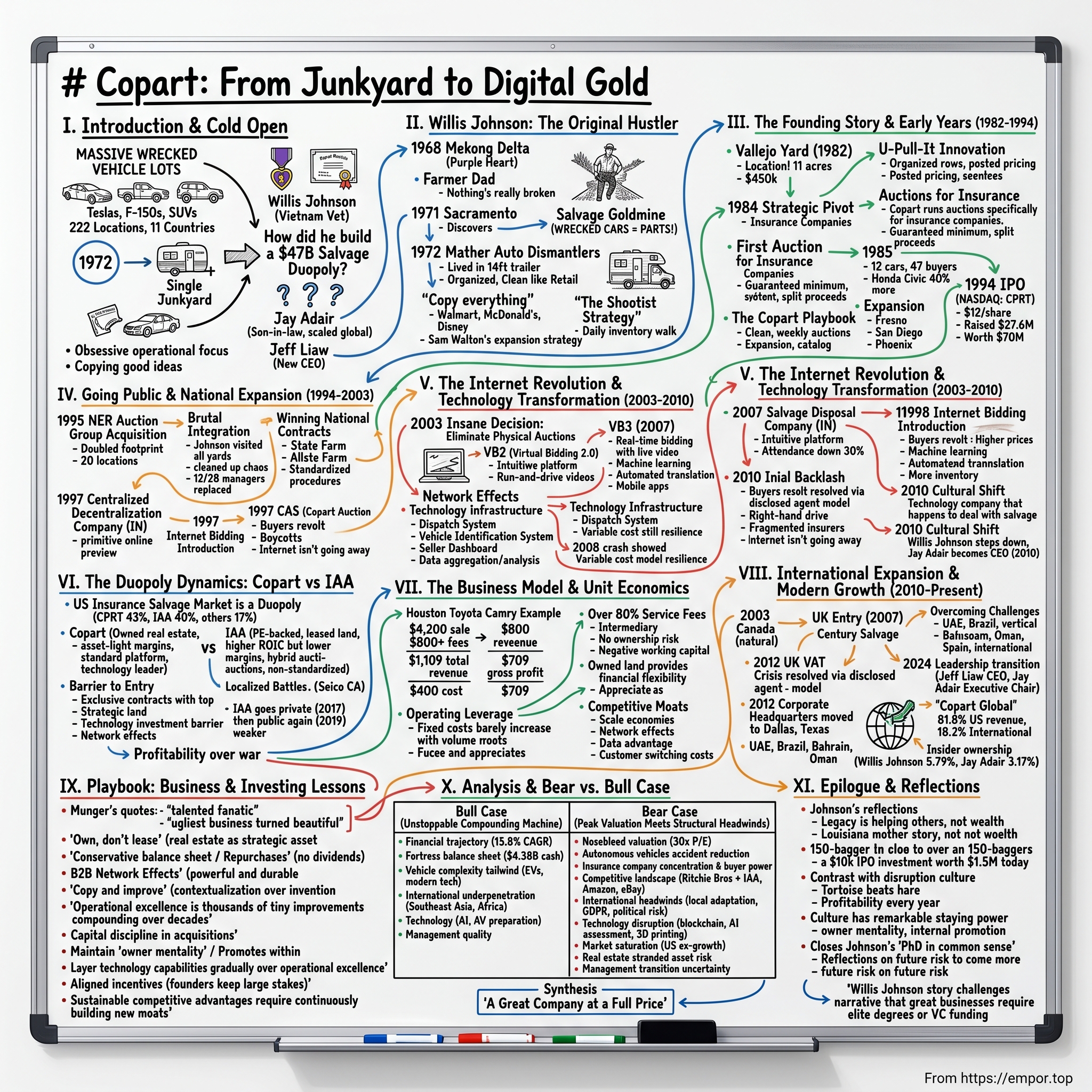
Copart: The Junkyard That Became a Marketplace — and the Marketplace Under Siege
I. Introduction & Cold Open
Somewhere in a gravel lot outside Dallas, a 2021 Toyota RAV4 sits with its front quarter panel folded back like a bent playing card. The airbags have deployed. The radiator rests on a highway shoulder miles away. To the insurance adjuster evaluating the damage, the vehicle is a total loss: the repair estimate exceeded the threshold where issuing a payout for the entire car costs less than repairing it.
To Copart, the vehicle is inventory. Photographed, catalogued, condition-coded, and listed on the company's proprietary platform—Virtual Bidding Third Generation, or VB3—the RAV4 enters a two-stage auction process. First, an open preliminary bidding window allows a feature called BID4U to raise members' proxy bids incrementally on their behalf. Then, a live, internet-only auction takes place where the top preliminary bidders compete in real time.1 The entire process typically resolves within about seven days of the vehicle arriving at the yard.1
The bidders represent a diverse global audience: a rebuilder in Oklahoma, a dismantler in Maine, a parts exporter in Poland, and a used-car dealer in Ecuador. On the company's May 2026 earnings call, then-CEO Jeff Liaw described this exact dynamic—buyers in Poland bidding against buyers in Oklahoma, Canada, and Ecuador, live, on a single damaged car.2 Copart maintains a database of roughly one million registered members and lists approximately 400,000 vehicles a day across a member base spanning more than 165 countries.13
Copart rarely takes ownership of the vehicle. Its revenue model does not depend on which buyer wins. Instead, the company collects transaction fees from both seller and buyer, structured on a scale tied to the final purchase price. That core fee model has driven the company's compounding growth for four decades.
Yet structural pressures are emerging.
In fiscal 2026, the company—which spent three decades establishing what Wall Street widely viewed as an entrenched duopoly—saw several core structural foundations show strain. Its global insurance unit volumes declined in every quarter of the fiscal year, falling 8.4% in the first quarter, 9% in the second, and 2.7% in the third.452 Analysts on those earnings calls repeatedly questioned executive management regarding a shift in salvage vehicle allocation by Progressive—now the largest U.S. auto insurer by policy count—toward Copart's primary competitor.4 Then, on June 29, 2026, the company announced that Jeff Liaw, the first chief executive from outside the founding family, stepped down as CEO and resigned from the board effective July 31, 2026, with Jay Adair, the founder's son-in-law, resuming the chief executive role on the same day.6
Just seven months earlier, Liaw had signed a letter to stockholders declaring that "Copart's best years lie ahead."3
The central question is not whether Copart has been a profitable enterprise. Its financial results remain strong, generating gross margins of 45.2%, operating margins of 36.5%, and $1.55 billion of net income on $4.65 billion of revenue in fiscal 2025, achieved with virtually no debt.7 The strategic question is narrower and more challenging. Copart's investment case relies on three core premises: ownership of the physical land, ownership of the buyer network, and control of insurer relationships. The first two remain evident on the balance sheet and in auction transaction data. The third, however, has shown signs of vulnerability for the first time in two decades.
The trajectory of this transformation extends from a single scrapyard in Vallejo, California, through an acquisition that management continues to reference as an operational lesson thirty years later, a decade of incremental international expansion that included an outright market exit, a $7.3 billion transaction that altered industry structure, and a sudden leadership transition in the middle of these shifts.
 Subscribe on LinkedIn
II. Origins: Willis Johnson and the Making of a Junkyard Playbook (1982–1994)
Willis Johnson returned from Vietnam with a Purple Heart and no formal education, buying a junkyard in Sacramento, California, in 1972 and moving his family into a trailer to fund the purchase.8 Ten years later, in 1982, at age 34, he acquired a salvage yard in Vallejo and named the operation Copart.8
The salvage sector Johnson entered was fragmented and unorganized. In 1982, a typical salvage yard left vehicles to rust in unpaved lots, managed by owners who tracked inventory primarily from memory. Buyers visited in person to haggle over parts. Auto insurers—the primary suppliers of salvage vehicles—treated the channel as an administrative burden rather than a strategic relationship.
Johnson's foundational strategy was straightforward: apply retail operational standards to salvage operations.
That meant replacing mud lots with clean, organized, gravel-and-fence facilities. It required systematic inventory tracking and published cataloguing rather than informal memory. Copart prioritized responsiveness and treated auto insurance adjusters as its primary customers. Because adjusters controlled vehicle supply without inherent loyalty to a specific yard, offering predictable, professional service won their business.
Johnson drew these practices from outside the salvage industry, adapting ideas from high-performing regional competitors, adjacent retailers, and theme parks like Disneyland, which prioritized physical presentation and customer experience. By introducing structured presentation and service standards to a sector accustomed to neglect, Copart operated without immediate competitive response from traditional yard owners.
For a decade, Copart expanded incrementally—one yard at a time, financed through internal cash flow and bank debt, with Johnson overseeing operations directly. Capital constraints eventually limited this growth. As auto insurers consolidated their claims operations, they sought single vendors capable of managing salvage across multi-state regions rather than negotiating with separate local operators. Copart recognized the demand but lacked the capital to fund rapid buildouts.
That financial bottleneck cleared on March 17, 1994, when Copart completed an initial public offering on NASDAQ at $12 per share, raising approximately $26 million.9 Though modest by modern capital market standards—raising less than the cost of acquiring a single major facility for a company that carries a market value near $29 billion—the IPO provided Copart with public equity to pursue nationwide consolidation.10
Many of Copart's core operational strategies trace back to decisions made in this period: a preference for owning land rather than leasing, an explicit focus on carrier relationships over buyer preferences, a standardized service culture, and a founder-family governance structure that would retain influence decades later.
What Johnson did not yet possess was the core asset that would make the business difficult to challenge: a buyer network large enough that no seller could afford to leave. Achieving that liquidity required scale, and scale—as Copart would soon discover—was distinct from integration.
III. Building the Machine: The NER Roll-Up and Going Digital (1994–2010)
Fourteen months after its initial public offering, Copart made the largest acquisition of its history to that point.
In May 1995, it acquired substantially all the operating assets of the NER Auction Group—a cluster of 14 companies operating 20 salvage vehicle auction facilities across 11 states.11 The transaction instantly expanded Copart from a West Coast regional provider into a multi-state network, offering the geographic coverage national insurance carriers demanded.
Operationally, however, the integration proved difficult.
The core friction lay in incompatible business models. Copart operated under its Percentage Incentive Program, or PIP, where fee revenue was tied directly to the final auction price.11 This structure aligned Copart’s incentives with the seller, encouraging aggressive merchandising through detailed descriptions and broader buyer outreach. NER, by contrast, processed nearly all its inventory on a fixed-fee consignment basis, earning identical fees regardless of whether a vehicle sold for $500 or $5,000.11
As a result, acquiring NER diluted Copart's share of higher-margin incentive volume. Yard and fleet expenses rose from 65.0% of revenue in fiscal 1995 to 70.6% in fiscal 1996, reflecting the higher operational cost of processing fixed-fee units.11 Management publicly acknowledged that integrating NER "was more difficult and required a greater period of time than prior acquisitions," taking until July 1996 to shutter the acquired eastern division headquarters.11
This integration struggle reshaped Copart's long-term strategy. While outside narratives often frame Copart as an aggressive serial acquirer, the historic record demonstrates that its most consequential acquisition compressed operating margins for nearly two years and required extensive management intervention. Decades later, on the company's February 2026 earnings call, then-CEO Jeff Liaw cited the acquisition as the defining exception to Copart's strategy, noting that the firm had "by and large, grown the business organically" apart from "one very meaningful M&A transaction some decades ago in the form of New England recovery."12 The NER experience persuaded management that large-scale acquisitions carried substantial operational friction, leading the company to prioritize organic expansion thereafter.
Yet NER provided the essential asset Copart could not build quickly enough on its own: a broad national footprint. By establishing multi-state coverage, Copart could offer nationwide total-loss management to major insurance carriers. For insurers, working with a single provider eliminated the administrative burden of coordinating with dozens of local yards, managing fragmented fee schedules, and handling regional variances in salvage proceeds. This scale established a self-reinforcing dynamic between supply and buyer demand.
The pivotal shift in Copart's trajectory came not through physical expansion, but through digital conversion.
In the early 2000s, Copart abandoned physical auctions entirely in favor of an online-only model. By 2003, the company had fully transitioned its bidding process to the internet, creating what management described as the industry's first online-only salvage marketplace.312 Liaw later characterized this early digital shift as establishing an "almost 2-decade head start in comparison to the rest of the industry."12
The strategic rationale extended beyond operational cost savings. Transitioning online expanded the bidder pool exponentially. While a physical yard auction in Sacramento attracted only local buyers available on sale day, an online auction allowed international buyers—such as rebuilders in Poland—to compete directly. Because auction clearing prices depend on the second-highest bid, expanding international participation directly increased final vehicle valuations.
This dynamic created a compounding marketplace engine: expanding the buyer pool yielded higher vehicle returns for insurance sellers, which encouraged carriers to total more vehicles and direct greater volume to Copart, further enriching inventory for buyers. Copart fortified this digital infrastructure by patenting key elements of its VB3 auction platform in 2008.1
In February 2010, with the digital model established, Willis Johnson stepped down as chief executive while remaining chairman of the board.13 He handed executive leadership to his son-in-law, Jay Adair, who had joined the company as a teenager and advanced through its operational ranks. It marked the first executive transition in Copart's history—a seamless internal succession within the founding family that established a precedent for corporate governance decades later.
IV. Land, Insurance, and the VB3 Flywheel: How the Moat Actually Works
Walk the perimeter of a large Copart facility and the first thing you notice is that it is mostly empty dirt. Not empty in the sense of unused — in the sense of reserved. Copart's South Florida site at Hall Ranch, acquired in fiscal 2025, comprises nearly 400 usable acres held substantially in anticipation of hurricanes that may or may not arrive in any given year.3
No rational tenant would lease four hundred acres to sit idle against a storm that might not come. An owner will, if the owner's whole business depends on being the one company that can absorb 50,000 flooded cars in ten days when everyone else is full.
This is the physical half of the moat, and its scale is unusual. As of fiscal 2025 Copart operated 281 facilities globally across eleven countries, on more than 21,000 acres of land, of which it owned more than 90% outright.13 On the balance sheet at July 31, 2025, land was carried at a gross cost of $2.39 billion and buildings and improvements at $1.68 billion.7 Those are historical costs, not market values, on land accumulated over decades — which means the reported figure is almost certainly conservative relative to what the dirt would fetch.
Ownership does three things a lease cannot. It removes rent inflation from the cost structure permanently. It gives Copart unilateral control over how a site is used during a catastrophe — no landlord conversation, no permitted-use dispute. And it converts operating expense into an appreciating asset. Liaw made the strategic logic explicit on the February 2026 call: "We recognize that long-term stewardship for the industry really requires ownership. Leasing means you don't ultimately control your ability to service the insurance industry."12
The digital half of the moat is the buyer network, and here it is worth being precise about the mechanism rather than repeating the claim. Copart's disclosure is that international buyers purchase approximately 40% of vehicles sold through its US auctions and account for nearly half of gross transaction value.3 More tellingly, the company reports that international bidders participated in more than 90% of auctions for vehicles that are drivable or expected to be rebuilt.3 Participation, not purchase — the point is that they set the floor even when they lose.
Why do foreign buyers pay more? Because the economics of repair differ enormously across jurisdictions. A car with a crumpled front bumper, a destroyed radar sensor, and an intact drivetrain is an economic write-off in Massachusetts, where the sensor module costs a fortune, the labor rate is high, and the insurer must satisfy a regulator and a policyholder. The same car in Central Europe or West Africa, where labor is cheaper and the regulatory regime differs, is a perfectly good car with a fixable nose. Liaw put it well on the November 2025 call: the marginal totaled car is not one you have abandoned, it is one where "you're choosing to let somebody else manage it who has a different cost base, a different regulatory regime, and different economic calculus."4 The company reports that the average vehicle bought by an international buyer is 38% more valuable than the average vehicle bought by a domestic buyer — international demand skews toward lightly damaged, higher-value cars.4
The revenue mix confirms what kind of company this is. Of fiscal 2025's $4.647 billion in revenue, $3.969 billion — roughly 85% — was service revenue, with only $678 million from vehicles Copart actually purchased and resold on its own book.7 Copart is structurally a marketplace operator that clips a fee on transaction value, not a used-car reseller carrying inventory risk. That distinction is why the margins look the way they do.
Run this through a Porter lens and the picture is genuinely strong in three of five dimensions. Barriers to entry are high and rising: a new entrant would need simultaneously to assemble hundreds of permitted vehicle-storage sites in a zoning environment Copart's own 10-K describes as "more challenging and expensive" year by year, build title-processing expertise across fifty states and eleven countries, and recruit a global buyer base from zero.1 Substitution risk is low — there is no scaled alternative channel for total-loss vehicles at national scale. Buyer power is fragmented across a million registered members, none individually material. Through Hamilton Helmer's 7 Powers, the cleanest claims are scale economies (fixed yard, technology, and title-processing costs spread over enormous volume — Copart says its Title Express platform now processes well over one million titles annually)3 and network economies on the buyer side.
The two weaker dimensions are the ones that matter now. Supplier power — insurers — is concentrated: 81% of vehicles processed in fiscal 2025 came from insurance company sellers, down from 83% in fiscal 2023.1 And switching costs, the power most often asserted in Copart bull cases, are the weakest link in the chain. Section VII tests that claim directly, and the evidence there is unambiguous.
There is a second, quieter problem with the moat narrative, and it belongs here rather than in a risk appendix, because it sits in direct tension with how the business is usually described. Copart is routinely framed as an asset-light digital marketplace. Its own capital efficiency says it is becoming the opposite. Return on invested capital ran at roughly 26.5% in fiscal 2019. By fiscal 2023 it was 18.9%, by fiscal 2024 16.0%, and by fiscal 2025 approximately 14.7% — a decline of roughly 45% over six years, during which revenue more than doubled.14
Nothing about that is fraud or failure. Two things drove it: the land programme itself, which converts cash into slow-turning real assets, and a cash pile that ballooned to $4.79 billion in cash and short-term investments by July 31, 2025 while earning a return well below the operating business.7 But an investor should be honest about the implication. Copart has been buying moat with capital, and the price of the moat, measured in returns on that capital, has been going up. A director asked the right version of this question on the November 2025 call: gross property and land was up roughly 155% since 2019 against volume growth of about 30%. CFO Leah Stearns' answer was that some assets are deliberately low-utilization catastrophe capacity, and that the list of regions where Copart still needs capacity is "much smaller today than what it was" five years ago.4 That is a reasonable answer. It is also, read carefully, a statement that the highest-return phase of the land programme is behind the company, not ahead of it.
So the moat is real, and it is physical, and it is not free. The next question is whether the model travels.
V. Going Global — and Learning Where Not To (2007–2018)
In April 2007, Universal Salvage, a publicly traded British firm, agreed to a £57 million cash acquisition by Copart.15 Copart closed the transaction in June 2007, securing ten UK salvage yards along with a remarketing business serving British insurers, before acquiring Century Salvage Sales that September.1617
The UK served as a logical entry point for international expansion: a shared language, familiar insurance structures, an established total-loss claims process, and an incumbent salvage market operating under legacy manual practices. Copart deployed its domestic framework directly: acquiring land, consolidating facilities, transitioning auctions online, and connecting inventory to its global bidder base.
The model gained substantial market share. By 2022, the UK Competition and Markets Authority (CMA) estimated Copart's share of the overall British salvage services market at over 40%, and its share of the insurer-supplied segment at over 60%—more than triple that of its nearest competitor, IAA.[^18]
This concentration triggered regulatory scrutiny. In May 2023, an independent CMA panel provisionally concluded that Copart’s completed acquisition of Hills Motors created a substantial lessening of competition in the UK salvage market, citing the scarcity of providers capable of managing large national insurance contracts.[^18]
The regulator later reversed its stance. In June 2023, following additional customer testimony indicating that Hills Motors posed a weaker competitive threat than initially assessed, the CMA provisionally cleared the transaction.[^18] Although the acquisition proceeded, the investigation established an official record of Copart controlling over 60% of insurer salvage supply in a major market, setting a regulatory benchmark that limits further consolidation within the UK.
Beyond Great Britain, Copart pursued smaller, incremental expansions. Its disclosed acquisition history includes facilities across Canada, the UK, Brazil, the UAE, Germany, Finland, and Spain—a pattern of targeted entry points acquired to secure local carrier relationships and operating permits before implementing Copart's standardized model.1 The financial terms for most of these transactions were not individually disclosed.
The international expansion also revealed clear structural limits.
Copart entered the Indian market around 2016 but suspended salvage operations in fiscal 2018, informing investors that operations would remain paused until market conditions aligned with its business model.18 While management noted the decision had no material impact on financial performance, the exit highlighted a key requirement of the enterprise: the presence of an institutional insurance market that centrally controls total-loss vehicle disposition and delegates salvage management to third-party providers. Absent centralized carrier control, Copart's transaction-based fee model could not effectively attach. The company retained its technology and administrative operations center in India, but ceased local salvage auction activities.
As a result, international operations remain a profitable but secondary contributor to total revenue. International revenue reached $792 million in fiscal 2025, accounting for approximately 17% of total revenue compared to 83% from the United States.1 International volume growth remained steady, with unit sales rising 8.1% in fiscal 2025—led by the UK, Germany, Brazil, and the UAE—while Germany reached a notable shift as a major insurance partner transitioned from vehicle purchasing to a consignment fee structure.3 In the third quarter of fiscal 2026, international unit volume rose 5.9% and international revenue grew 14.1%, even as U.S. insurance volumes contracted.2
However, international growth has not been large enough to offset structural headwinds in Copart's primary U.S. insurance channel—headwinds that intensified during fiscal 2026.
VI. The Business Today: Segments, Unit Economics, and Who's Actually Buying
Here is the strangest fact about Copart's fiscal 2026: the structural tailwind everyone invests in got stronger, and the company's volumes went down.
Start with the tailwind, because it is real and it is enormous. Total loss frequency — the share of auto insurance claims resolved by writing off the vehicle rather than repairing it — has been climbing for four decades. Liaw's own framing on the November 2025 call: it was around 4% in 1980, 5% in 1990, and is now in the low twenties.4 In calendar 2015 it was 15.6%. In calendar 2025 it reached 23.1%, a record, according to CCC Intelligent Solutions' industry data.1912 In the fourth quarter of calendar 2025 it hit 24.2%, and in the first quarter of calendar 2026, 23.6% — an increase of almost five full percentage points over four years.122
The mechanism is easy to explain and hard to reverse. Modern cars are stuffed with sensors, cameras, radar modules, and calibration requirements in exactly the places that get hit in a collision — bumpers, mirrors, windshields, quarter panels. The same technology that makes cars less likely to crash makes them dramatically more expensive to repair when they do. Add labour inflation, parts inflation, and tariff volatility on imported components, and the arithmetic that decides repair-versus-total moves steadily toward total.
Copart's more interesting claim is that it is not a passive beneficiary of this. Because the insurer's decision compares the cost of repair against the net salvage return, anything that raises the auction price makes totalling more attractive. Liaw said it directly in May 2026: "we are very much not passive beneficiaries of an increase in total loss frequency. We have helped to drive it upwards."2 That is a genuinely differentiated position — Copart argues its global buyer base is itself a cause of the industry trend, not just a consequence.
Now the disconfirming half, which belongs in the same breath.
Global insurance unit volumes fell 8.4% in the first quarter of fiscal 2026, 9% in the second, and 2.7% in the third — 5.6%, 4%, and 1.9% respectively excluding prior-year catastrophe volumes.412202 US insurance units were worse: down 9.5%, 10.7%, and 4.2%.4122 Revenue for the nine months ended April 30, 2026 was $3.5 billion, down 0.2% year over year, with net income essentially flat.21
What kept the top line from falling was price, not volume. Average selling prices rose 8.5% in the first quarter, 6% in the second, and 4.6% in the third, and Copart reported seasonally adjusted all-time record US insurance ASPs.4122 Fee revenue per unit rose over 7% in the first quarter.4
State it plainly: for the past year, Copart has been a price story, not a volume story. That is a materially different investment proposition. ASP-driven revenue growth is more exposed to used-vehicle price cycles than unit growth is, and Liaw acknowledged the two-sided nature of that exposure on the February 2026 call — a softening used-car market would make totalling cheaper for insurers and therefore push volume up, but "it could also be to somewhat softer selling prices for us."12 More units, worse unit economics. Investors who conflate the total-loss-frequency tailwind with Copart's own growth rate are the ones most exposed when the two diverge, and in fiscal 2026 they diverged.
Management's explanation for the volume decline has three parts, and they are not equally comfortable.
The first is consumer retrenchment, and the evidence for it is decent. As auto insurance rates rose sharply through 2023–2025, consumers responded by raising deductibles, dropping collision coverage for liability-only, or going without. Copart cited ISS Fast Track data showing earned car years down about 4% year over year while vehicles in operation grew 1.4% — a widening gap between cars on the road and cars actually insured.42 Liaw also pointed to CCC data indicating roughly 25% of repairs are now self-pay, to the point that CCC built a buy-now-pay-later product for consumers absorbing their own repair bills.2 A car whose owner carries liability-only never enters the insurer-mediated total-loss funnel at all. Management insists this is cyclical rather than secular, and the long history broadly supports that; but "cyclical" has no fixed duration.
The second is a shift in policies in force among carriers — some insurers growing faster than others, and Copart's relative position varying by carrier. Liaw's most candid formulation came in February 2026: "We may be in a uniquely or unusually Copart adverse moment in time in that respect."12 That sentence is doing a lot of work, and Section VII unpacks what is behind it.
The third is a deliberate mix decision that makes the headline numbers look worse than the economics. Copart has been shifting low-value units — vehicles with pre-accident value under roughly $1,000, which Stearns described as "very old nondrivable what the industry would consider junk units" — out of its owned Copart Direct inventory and into a "direct buy" referral model where Copart simply earns a fee for connecting a junk buyer to a seller.4 Reported US purchased units fell 23.6% in the second quarter; normalised for the shift, the decline was about 8%.12 This is a margin-accretive decision that mechanically depresses unit counts. It is also, notably, the kind of adjustment that requires investors to take management's normalisation on faith.
Against the insurance softness, the non-insurance book has been the genuine offset. Copart sells for dealers (Copart Dealer Services), for rental fleets, banks and finance companies (the BluCar commercial consignment channel), for powersports, and directly from consumers (Cash For Cars). In fiscal 2025, units sold from commercial consigners rose 15.3%.3 Through fiscal 2026, dealer services grew 5.3%, then 5%, then about 1%; BluCar declined 1%, then 11.8%, then grew over 4%, with fleet and bank/finance volumes growing at a double-digit pace throughout and rental dispositions the volatile piece.4122
The strategic logic here is elegant and worth understanding, because it explains why Copart can plausibly attack a market it has no historical right to. Rising total loss frequency means Copart is increasingly selling repairable, drivable cars rather than piles of parts. A buyer base that shows up for a lightly-damaged three-year-old Lexus is exactly the buyer base a rental company wants for its de-fleeted three-year-old Camry. Liaw described the resulting "crossover buyer" pattern with a specific data point: of more than 30,000 buyers who first came to Copart over the prior three years for a non-insurance vehicle, a strong majority bid on an insurance vehicle within 90 days.2 The flywheel runs both directions.
Two structural facts round out the picture. First, "pure sale" mix — vehicles sold with no reserve price — is at all-time highs among US insurance sellers, and Liaw notes it is not contractual: carriers retain full discretion to impose reserves and have simply stopped doing so, because reserves chill bidding.2 Sellers voluntarily surrendering price protection is genuinely strong evidence of auction liquidity, and it is the single best empirical support for the network-effect claim. Second, the balance sheet: $4.79 billion in cash and short-term investments at fiscal year-end 2025 against $104 million of total debt, all of it finance lease obligations, and no credit rating.7 By the third quarter of fiscal 2026, liquidity stood at roughly $5.5 billion with no debt.2
That balance sheet is not a scoreboard. It is the enabler for everything in Sections VIII and X.
VII. The Duopoly Under Stress: Copart vs. RB Global
For two decades, the US salvage auction market was a war game with only two serious pieces on the board. Copart and Insurance Auto Auctions split the great majority of insurer-sourced total-loss volume between them, with a fragmented tail of regional operators and dismantlers picking up the remainder. Most bull cases on Copart did not analyse this structure so much as assert it: two players, high barriers, sticky contracts, therefore moat.
Then, in November 2022, a heavy-equipment auctioneer from Canada announced it was buying one of the two.
Ritchie Bros. Auctioneers completed its acquisition of IAA on March 20, 2023, in a cash-and-stock transaction valued at approximately $7.3 billion — $12.80 per share in cash plus 0.5252 Ritchie Bros. shares for each IAA share.2223 The combined company rebranded as RB Global. Ritchie Bros. partially financed the cash consideration with $1.35 billion of senior notes: $550 million of 6.750% senior secured notes due 2028 and $800 million of 7.750% senior notes due 2031.24 It also paid its own shareholders a special cash dividend of $1.08 per share on closing.22
Two things about this deal are worth sitting with.
First, the price. At roughly $7.3 billion for IAA, Ritchie Bros. paid a multiple in the low-to-mid teens on IAA's trailing EBITDA — a substantial discount to where Copart itself has historically traded. Copart's enterprise value ran at roughly 24x EBITDA at its fiscal 2023 year-end and about 26x at fiscal 2024 year-end.14 Viewed purely as a capital allocation question, RB Global bought scale in the salvage industry at a fraction of what the market was simultaneously willing to pay for the same economics inside Copart. If the acquirer could operate the asset competently, that was a real arbitrage.
Second, the opposition. A group of IAA shareholders — including Discerene Group, Luxor Capital, Janus Henderson and Eminence Capital — publicly campaigned against the transaction, with Discerene writing to the IAA board describing it as "value-destroying."25 Their argument was essentially that IAA was selling itself cheaply at a moment of structural weakness rather than fixing the weakness. The deal closed anyway. Notably, no US or Canadian antitrust conditions were imposed on the merger itself.
The bull-case rebuttal at the time was that a leveraged, lease-heavy, newly-merged competitor with an unfamiliar management team was in no position to take share from Copart. For roughly two years, that rebuttal held.
Then came the single most important disconfirming data point in this entire story.
Progressive is now the largest US auto insurer by policy count, and it has been a long-term secular share gainer. According to industry reporting in December 2025, RB Global — which had historically held roughly 75% of Progressive's salvage allocation — won "a significant additional piece of Progressive's business," taking its share of that carrier's volume to approximately 90%, with the effect not expected to show up in unit sales until January 2026.26 Analysts at Bank of America characterised the win as material, coming from "one of the most important insurance carriers in the country," and framed it as potentially moving the industry from roughly a 35/65 RB Global-to-Copart split toward something nearer parity.26
Now weigh that properly, because it would be easy to overstate in either direction.
What it disproves: the strong version of the switching-cost claim. The bull case has long held that insurer relationships at Copart are effectively sticky — that once a carrier integrates Copart's systems, title processing, and tow network, moving is impractical. The Progressive evidence says otherwise. A major national carrier reallocated a large tranche of volume, at the margin, in a single decision, and Copart could not stop it. Switching costs exist, but they are a friction, not a lock.
What it does not disprove: the structural moat. This is one carrier, and Copart still holds the larger overall share by every available estimate. It still owns more than 90% of its land while its rival's footprint is far more leased. It still runs the more digitally mature platform. And crucially, no audited market-share number exists — neither company discloses one — so every share figure quoted in this story, including the 35/65 above, is an analyst estimate.
There is a second, subtler piece of evidence that the market has become more contestable: price. Asked directly by Bret Jordan of Jefferies in February 2026 whether the competitive environment had become more price-driven, Liaw did not deny it. He said the industry "has always been price competitive for the years that I've been here and many years before that," and pivoted to arguing that Copart competes on "delivered economic outcomes" — auction price first, cycle time second, and "on a tertiary, maybe further down still than that, the fees that you're paying us."12
Read that as an analyst rather than a fan. Management is telling large customers to stop comparing headline fees and start comparing net proceeds. That is the correct argument if your auction genuinely realises higher prices — and Copart's evidence for that is not trivial: the company claims its US insurance ASP growth ran more than six times Manheim's non-seasonally-adjusted index movement over fiscal 2025, and roughly threefold that of comparable service providers.34 But it is also the argument you make when the fee comparison is not going your way. Sell-side analysts have flagged take-rate pressure from large insurance partners as a contributor to Copart's margin performance, and the reported numbers show the strain: consolidated gross profit fell 6.2% in the second quarter of fiscal 2026 to $492.8 million, with reported gross margin at 45.0%, though management attributes most of the decline to prior-year catastrophe volumes and a $6.8 million one-time international VAT accrual.12
Management's own explanation for the volume gap deserves scrutiny too, because it has been consistent to the point of being conveniently unfalsifiable. Across three consecutive calls, the framing has been: carrier share shifts are "cyclical," consumer under-insurance is "cyclical," and total loss frequency is secular and upward.4122 Pressed by Jordan in November 2025 on whether Copart could win Progressive volume back or needed its own carriers to gain share, Liaw declined to comment on individual accounts and said Copart's focus was on returns, trusting "that the rest of it will take care of itself over the long haul."4
That may prove correct. It is not, however, a plan, and it is worth noting the distinction. Management has offered a thesis about why the problem resolves itself rather than a set of actions that would resolve it.
The calibrated conclusion: the history narrows the moat claim rather than rejecting it. Copart retains a durable structural advantage in physical capacity, auction liquidity, and title-processing scale — the pure-sale mix and the international-participation data are hard evidence, not rhetoric. But the specific claim that insurer relationships are sticky should be downgraded to: relationships are durable in aggregate and contestable account by account, particularly with large, sophisticated, data-driven carriers. The KPI that resolves this is narrow and observable: whether Copart's US insurance unit volume returns to growth once the Progressive reallocation fully laps in the first half of fiscal 2027, and whether any second major national carrier moves. If a second carrier follows, the moat thesis needs rebuilding, not adjusting.
VIII. Capital Allocation: Buybacks, Land, and a Falling ROIC
Copart has never paid a dividend. Not once. Every dollar returned to shareholders in the company's public history has gone through the share count, and the pattern of when it chose to do that is one of the more revealing things in the filings — and considerably lumpier than the "disciplined capital allocator" framing suggests.
The record, laid out chronologically, is a series of bursts separated by long silences.
Fiscal 2011 was the big one: $739.6 million of stock repurchased, including a tender offer, in a year when Copart also raised $375 million of new long-term debt.27 Read that combination carefully — Copart levered up to shrink its equity base. Fiscal 2012 brought another $203.3 million, then the programme went quiet: $15.0 million in fiscal 2013, $0.6 million in fiscal 2014.27 Fiscal 2015 saw $237.3 million, again alongside $348.9 million of debt issuance, and fiscal 2016 another $457.9 million.27 Then nothing in fiscal 2017 and 2018. Then $365.0 million in fiscal 2019.27
And then, for six consecutive fiscal years — 2020 through 2025 — Copart repurchased no common stock at all.27 Not a token amount. Zero.
Those six years covered the most extraordinary period of value creation in the company's history: revenue rose from $2.21 billion to $4.65 billion and net income from $700 million to $1.55 billion, while the stock's own valuation multiple expanded to roughly 26x EV/EBITDA at the fiscal 2024 year-end.714 Cash accumulated to nearly $4.8 billion. Management's public position throughout was that the balance sheet was strategic optionality. Asked directly in November 2025 why the company was not buying stock when the multiple had already compressed close to prior repurchase levels, Stearns gave a careful non-answer about deploying capital "when we see areas that we believe will create meaningful long-term value," and Liaw added that "there for sure will come a day if we do that again," while declining to say when.4
That day came roughly eight weeks later. Copart began repurchasing shares in the open market during its fiscal second quarter, and had bought over 13 million shares for more than $500 million by February 2026.12 By the end of the third quarter, fiscal-year-to-date repurchases stood at over 43.4 million shares for an aggregate of more than $1.633 billion.221
Two honest readings coexist. The generous one: Copart went six years without buying stock at elevated multiples and then deployed $1.6 billion after the price fell substantially. That is textbook countercyclical behaviour, and the arithmetic — roughly 43.4 million shares retired against a base of about 968 million — is a meaningful ~4.5% reduction in a single year.28
The less generous one: this was a sharp change in posture, executed within a quarter of management publicly declining to commit to it, in the middle of a volume downturn and a competitive setback. Asked in February 2026 why now, Liaw was candid to the point of deflection: "there's no particular witchcraft or anything magical to it," a function of valuation multiples, interest rates, and Copart's relative valuation, with "no aspects of that decision that you would find particularly creative."12 Both readings are defensible. What is not defensible is describing a record containing six consecutive zero years as consistent buyback discipline.
The other half of the capital story is land, and it has been remarkably steady. Fiscal 2025 capital expenditure was $569 million, following $511 million in fiscal 2024 and $517 million in fiscal 2023 — heavily weighted toward land acquisition and facility development.27 Liaw traced the origin of the modern programme to an April 2016 initiative internally called "20/20/20": acquire twenty facilities and expand twenty facilities in twenty months.12 A decade of that intensity produced the ownership position described earlier.
Here is where the two threads have to be tied together, because they are usually told separately. Copart has been genuinely disciplined about not overpaying for acquisitions — Liaw has repeatedly described the M&A bar as "very high," noting that in his decade at the company Copart completed "only a tiny handful of acquisitions collectively representing a very tiny percentage of enterprise value."12 That is verifiable and it is unusual. Very few companies with $5 billion of idle cash have shown that restraint.
And simultaneously, Copart has become a structurally more capital-intensive business, with ROIC roughly halving over six years. Both are true. Avoiding bad acquisitions is not the same as generating high returns on the capital you do deploy, and the land programme — the single most-praised element of the Copart moat — is precisely what has driven the denominator up. Stearns' own framing that the future capacity need list is "much smaller" than five years ago cuts both ways: it implies lower future capital intensity, which would help ROIC, but it also implies that the land-driven growth engine is maturing.4
What would change the picture decisively is a large acquisition. That question runs, eventually, into Section X. But first, the leadership question, because the person who would make that decision changed in July.
IX. Current Management and the 2026 Leadership Reset
Jeff Liaw's career at Copart is the story of an outsider who became the inside candidate and then, abruptly, was not.
He arrived as Chief Financial Officer, a background in finance rather than salvage yards, and rose through President to Co-CEO alongside Jay Adair from March 2022, then to sole CEO effective April 1, 2024 — the first chief executive in Copart's history who was neither Willis Johnson nor a member of his family.29 On his final earnings call he referred to "my own personal ten-year journey here at Copart," and the record shows a decade of consistent, technically fluent public communication.4
The disclosed compensation is genuinely unusual for a CEO of a company this size. For fiscal 2025 Liaw's total compensation was $2,072,692 — a $900,000 salary, $1,093,400 of non-equity incentive plan compensation, and $79,292 of other compensation, with no new stock or option awards granted that year.30 Copart's model has long been to grant executives very large, long-dated option packages infrequently rather than annual equity, which makes any single year's summary compensation table misleading in isolation. Even so, roughly $2 million of annual pay at a company earning $1.55 billion is restrained by any peer comparison.
The ownership picture is where the alignment question gets interesting. Liaw's final Form 4, filed after transactions on July 28, 2026, showed him holding 99,641 shares of common stock directly and 178,718 stock options, having sold 27,745 shares at $30.49 that day.31 Jay Adair's stake, by contrast, runs into the tens of millions of shares — a founder-family position measured in hundreds of millions of dollars, not single-digit millions. This is not a criticism of Liaw; a professional CEO cannot manufacture a founder's stake. But it is a material fact about the four-year experiment. The company's operating leader and its economic owner were never remotely the same person, and when the two diverged, only one of them controlled the outcome.
Which is the context for June 29, 2026.
The announcement was short. Liaw would step down as CEO and resign as a director effective July 31, 2026. Adair, Executive Chairman since the 2024 transition, would resume the CEO role the same day. Liaw would serve as Special Advisor to Adair through a transition period.6 Adair's public statement was warm and specific: "Jeff has provided Copart with extraordinary leadership over the past decade — first as CFO, then President, and finally as our third-ever CEO," crediting him with record transaction values and auction liquidity.6 Liaw's own statement called leading Copart "the privilege of a professional lifetime."6
The Item 5.02 disclosure contained the line every governance analyst reads first: "Mr. Liaw's decision to resign was not the result of any disagreement with the Company regarding its financial reporting, policies or practices."32
That sentence is boilerplate, and it should be read as boilerplate — it is a narrow legal representation about accounting disputes, not a broad statement that everything was harmonious. Nothing in the public record contradicts it, and no restatement, material weakness, or auditor issue has surfaced in the filings reviewed for this story; Ernst & Young remains the auditor and was ratified for fiscal 2026.30 But the framing of a "decision to resign" sits uneasily next to what the company simultaneously agreed to pay.
The separation terms are the most analytically interesting part of the filing. Liaw received a $450,000 lump sum, a $200,000 transition-period payment running through July 31, 2027, a $250,000 post-separation payment, his fiscal 2026 bonus under the executive plan, and twenty hours of private aircraft use. More consequentially, Copart waived the ten-year holding period attached to restricted stock units granted on April 1, 2022, eliminated the price hurdles on his performance-based stock options, extended his option exercise window, and fully accelerated vesting of his remaining equity awards.32
Removing performance hurdles from performance-based options on the way out is not a routine housekeeping item. It converts contingent compensation into unconditional compensation at precisely the moment the performance conditions were least likely to be met. Boards do this to secure a clean, cooperative exit. It is a legitimate choice; it is also an expensive one, and it is the strongest available signal that the departure was negotiated rather than volunteered.
Set this against the timing. In the twelve months preceding the announcement, Copart had reported three consecutive quarters of declining insurance unit volumes, absorbed a public reallocation of salvage share at its most important growth carrier, and watched its stock de-rate hard — Liaw's own July 2026 sale executed at $30.49, against a fifty-two-week high near $49.31 The market reaction to the announcement itself was mild; the market had already repriced the story.
Then set it against the narrative record, which is where management credibility is actually tested. On December 8, 2025 — roughly six months before his exit — Liaw signed the annual letter to stockholders. It declared conviction that "Copart's best years lie ahead," described the long-term trends favouring the business as "powerful and enduring," and included this sentence: "Willis and Jay remain deeply engaged in the leadership and direction of Copart, and their involvement today is every bit as active and committed as it has been at any point in the company's history."3
That line reads differently now than it did then. It can be interpreted charitably — as a CEO reassuring shareholders that founder wisdom remained available. It can also be read as a sitting CEO publicly acknowledging that he was not, in any complete sense, in sole control of the company he was running. Either way, the gap between a December letter promising the best years ahead and a June announcement of the CEO's departure is a real consistency problem, and investors are entitled to weigh it.
A few further pieces of governance texture belong here, sized honestly.
Say-on-pay at the December 5, 2025 annual meeting passed with 770.5 million votes for and 63.6 million against — approximately 92.4% of votes cast.28 That is solid support, but not the 97–98% that a wholly uncontroversial pay programme typically attracts, and votes against individual director nominees ranged up to roughly 110 million.28 A real minority is registering dissatisfaction; it is not a crisis.
Following the announcement, a familiar genre of press release appeared: plaintiff law firms announcing "investigations" of Copart on behalf of shareholders. These notices materialise after essentially any large single-day decline at a widely-held company. They are solicitation advertisements, not filed complaints and not findings. They belong in this story only as a note that the situation has attracted the attention of people who monetise attention — nothing more.
Two personnel facts deserve more weight. Jane Pocock became President effective August 1, 2026; she had joined Copart in January 2019 as Managing Director of the UK business and subsequently ran it as CEO, and her elevation was accompanied by a grant of 500,000 stock options struck at $31.61 plus restricted stock units.3331 Promoting the operator of Copart's most successful international market to global President is a coherent signal about where the company thinks its next growth comes from.
And on August 13, 2026, Copart added David J. Berger to its board.34 Berger, 67, is a senior partner at Wilson Sonsini Goodrich & Rosati whose practice centres on corporate governance, mergers and acquisitions, and shareholder activism, and who serves as President of the American College of Governance Counsel.34 A company under no activist pressure, contemplating no transaction, does not typically recruit an M&A-and-activism defence specialist to its board. Five days later, Bloomberg reported Copart was in talks to buy a $4 billion software company.10 Causation is unproven and the sequencing may be coincidence. But the composition of a board is one of the few forward-looking signals a public company sends, and this one points somewhere.
The net read: this is a founder-family business reasserting direct operating control after a four-year experiment with a professional outside CEO, at exactly the moment the competitive story got harder. Adair is not an unknown quantity — he ran Copart from 2010 through 2022, a period covering most of the company's transformation into a global platform. That is genuine continuity. But an internal succession that returns the company to the family after a negotiated exit is not the same thing as a considered succession plan executing on schedule, and investors should not describe it as one.
X. The Next Vector: Purple Wave, and the CCC Intelligent Solutions Question
Copart's adjacency strategy has historically remained small relative to its core salvage marketplace.
On October 6, 2023, Copart acquired an 80% controlling interest in Purple Wave, Inc., an online offsite heavy-equipment auction company, by issuing 2.5 million common shares against a $108.0 million acquisition price, with the GAAP fair value of consideration recorded at $112.1 million and the remaining 20% redeemable noncontrolling interest valued at $25.2 million.35 Substantially all of the consideration was allocated to intangibles and goodwill, indicating that Copart purchased an operational platform, brand, and sales force rather than physical assets.35
The strategic rationale was straightforward: apply Copart's digital auction framework—online bidding, global buyer recruitment, and systematic merchandising—to construction, agricultural, and heavy machinery, sectors where regional physical auctions still dominate. Operational execution has delivered clear momentum. Gross transaction value growth accelerated across fiscal 2026, rising from over 10% on a trailing-twelve-month basis in the first quarter to over 17% in the second and exceeding 25% in the third, driven by expanding its sales footprint from the Central Time Zone to both coasts alongside key enterprise client wins.4122 The commercial team has expanded to roughly two-and-a-half to three times its size at acquisition.2
In financial terms, however, Purple Wave remains incremental. A business acquired for roughly $110 million generating 25% GTV growth represents meaningful optionality and demonstrates that the marketplace model extends beyond automobiles, but it does not materially move the needle against Copart's $4.65 billion revenue base. Furthermore, Liaw acknowledged that tariff uncertainty created "medium-term paralysis" in the heavy equipment sector as buyers and sellers paused to evaluate pricing, signaling that macro conditions temporarily slowed the integration timeline.12
A far larger and more transformative move emerged in late summer 2026.
On August 18, 2026, Bloomberg reported that Copart was in discussions to acquire CCC Intelligent Solutions Holdings Inc., a Chicago-based automotive insurance software provider, competing alongside private equity firms GTCR and Veritas Capital.3610 CCC had retained a financial adviser after activist investor Elliott Investment Management acquired a significant stake and engaged through its private equity arm.10 CCC carried a market capitalization of approximately $4.2 billion at the time of the report, down roughly 27% over the preceding year and below an explored 2023 valuation near $8 billion.10 Reporting emphasized that negotiations remained fluid and no transaction was guaranteed.10
While the report reflects unconfirmed deal speculation without a formal announcement, the potential acquisition warrants close analysis given its strategic implications.
The underlying strategic logic aligns directly with the competitive dynamics reshaping the salvage industry.
CCC provides the central software architecture powering the auto collision claims workflow, spanning repair cost estimating, damage evaluation, parts pricing, and communication between insurance carriers, body shops, and vehicle disposition channels. It also generates the industry-standard total-loss frequency metrics that Copart routinely references on earnings calls.412 In essence, CCC serves as the operating system guiding whether an insurer repairs or totals a damaged vehicle.
Because Copart’s salvage auction pipeline relies entirely on carrier total-loss determinations, gaining ownership of CCC would fundamentally shift Copart's strategic posture. Currently, Copart attempts to influence total-loss decisions externally using tools like ProQuote.ai—an AI application trained on millions of historical vehicle images and auction results designed to help carriers identify borderline total losses earlier, which Copart introduced to the market roughly two years ago.312 Acquiring CCC would transition Copart from an external influence to the direct operator of the decision infrastructure, effectively seeking to convert dominance in salvage auctions into cornered-resource control over upstream claims software.
However, such an acquisition presents major structural and regulatory hurdles. CCC serves the broader auto insurance market, including customers of Copart’s primary rival, RB Global. Placing essential workflow software under the ownership of a direct competitor introduces classic vertical foreclosure risks that would invite intense antitrust scrutiny—far beyond what accompanied the Ritchie Bros. acquisition of IAA. It would also create commercial trust friction among insurance carriers concerned about proprietary claims data managed by a vendor with an explicit economic interest in maximizing salvage auction volume.
An added irony is that Copart’s primary empirical evidence for its secular tailwind—total-loss frequency trends—stems from CCC's industry benchmark data. A successful buyout would bring the baseline metrics supporting Copart's growth narrative inside its own corporate structure.
Financially, Copart possesses the balance sheet strength to fund a purchase, with approximately $5.5 billion in liquidity and zero debt making a $4 billion to $6 billion cash transaction achievable.2 Yet execution risks remain substantial. This would mark the largest transaction in Copart's history by a wide margin—roughly forty times the cost of Purple Wave and larger than the 1995 NER acquisition in inflation-adjusted terms. It would also be launched just five weeks after a major leadership reset, pitting Copart against established private equity suitors unencumbered by antitrust risks. As management previously noted, Copart’s historic strategy relies on organic growth punctuated by "a tiny handful of acquisitions collectively representing a very tiny percentage of enterprise value"—with its sole major historic roll-up standing as an integration lesson three decades later.1211
As a result, a potential bid for CCC represents Copart's highest-optionality and highest-risk capital allocation prospect to date.
XI. Playbook: Business & Investing Lessons
Owning the ground under a simple business can be a moat — and a drag. Copart's land ownership provides structural advantages that a lease cannot: it eliminates rent inflation, enables emergency catastrophe response that competitors cannot match, and converts operating expenses into appreciating real estate. Yet that same capital-intensive strategy is the primary reason the company's return on invested capital roughly halved between fiscal 2019 and fiscal 2025. Describing Copart solely as an asset-light digital marketplace overlooks the hundreds of millions of dollars spent annually on real estate acquisitions. In practice, Copart operates a high-margin digital auction engine attached to a capital-intensive land portfolio, causing overall returns on invested capital to decline even as gross margins remain stable.
Two-firm markets look stickier from the outside than from within. The shift in Progressive's salvage volume allocation provides a clear lesson on customer retention. A competitive dynamic that held for two decades, and which market observers largely expected to persist, changed rapidly following a decision by a single major insurer. Where a small number of large, sophisticated insurance clients control vehicle supply, a duopoly reflects overall market structure rather than guaranteed customer lock-in. The true test of switching costs is not structural precedent, but how clients actually behave when a viable alternative emerges.
Founder-family control provides stability while concentrating authority. The governance model that allows Copart to plan across decades and acquire land for future storm capacity is the same structure that directed its CEO transition back to the founding family rather than conducting an external search. Both dynamics are central to the enterprise, and an accurate assessment requires pricing both rather than selecting only the favorable outcome.
Buyback discipline is easy to praise in hindsight and difficult to execute consistently. Pausing share repurchases for six consecutive fiscal years while multiples remained elevated, then deploying $1.6 billion over nine months following a stock decline, appears countercyclical on its face. However, that capital deployment occurred within a single quarter of management publicly declining to commit to buybacks. Characterizing that history as consistent capital discipline overlooks the long multi-year pauses in execution. Capital allocation is best evaluated by multi-year deployment patterns rather than isolated buyback rounds.
A structural tailwind and short-term performance can diverge for extended periods. Total loss frequency climbed to historic highs even as Copart's insurance unit volumes declined across three consecutive quarters of fiscal 2026. Both trends occurred simultaneously without invalidating each other. Investors face the greatest risk when assuming a broad secular trend automatically translates into immediate unit volume growth for a specific market participant.
Product launches and technical capabilities are distinct from commercial success. From its ProQuote.ai tool and Title Express platform to agentic document processing and long-haul delivery software, Copart maintains an extensive engineering operation supported by roughly 1,000 full-time engineers across North America, Europe, and Asia.12 Yet the ultimate test of any proprietary technology program is whether it drives transaction volume, which contracted in fiscal 2026. Advanced technical capability deployed into a shrinking unit base remains a shrinking unit base.
XII. Bull vs. Bear, Risk Radar, and Why Win / Why Not
The bull case, stated at its strongest
Copart compounded revenue at roughly 15% and net income at over 20% annually for a decade — from $1.45 billion of revenue and $394 million of net income in fiscal 2017 to $4.65 billion and $1.55 billion in fiscal 2025 — with margins that expanded rather than compressed along the way.737 It did so with essentially no leverage, and it ended fiscal 2025 with $4.79 billion of cash and investments against $104 million of finance-lease obligations.7
The demand driver is structural and slow-moving: total loss frequency has risen from roughly 4% in 1980 to 23.1% in calendar 2025, driven by vehicle complexity that is not going to reverse.419 Every sensor added to a bumper strengthens this trend. Liaw's stated expectation is that the industry reaches 25%, then 30%.4
The physical position is genuinely hard to replicate. More than 21,000 acres, over 90% owned, 281 facilities, in a zoning environment that Copart's own risk factors describe as getting harder — which is a barrier that works in the incumbent's favour.13 A leveraged competitor with a lease-heavy footprint cannot buy that position quickly at any price.
And the auction-liquidity evidence is not merely asserted. Pure-sale mix at all-time highs among insurance sellers who could impose reserves and choose not to; international bidder participation in over 90% of drivable-vehicle auctions; unique bidders per auction at record levels since 2022.432 Those are behavioural data points from parties with no incentive to flatter Copart.
The bear case, stated at its strongest
The Progressive reallocation is concrete, recent, and not explicable by macro alone. Consumer under-insurance affects the whole industry equally; a shift from roughly 75% to roughly 90% of one carrier's allocation toward RB Global does not.26 It is the first hard evidence in two decades that the insurer relationship has a ceiling.
The tailwind is not converting. Three consecutive quarters of declining global insurance units, with growth carried entirely by average selling prices.4122 ASP-driven growth is cyclically exposed: used-vehicle values have fallen sharply before, and management itself concedes softer selling prices would follow a softer used-car market.12
Capital efficiency has deteriorated by roughly half in six years while the narrative stayed "asset-light."14 Investors paying a marketplace multiple should confirm they are getting marketplace returns on incremental capital.
The June 2026 CEO exit was abrupt, thinly explained, and came with a separation package that eliminated price hurdles on performance-based options and fully accelerated equity — terms that suggest a negotiated departure rather than a voluntary one.32 Six months earlier the same CEO had signed a letter promising the company's best years lay ahead.3
There is real, recurring regulatory friction from operating hundreds of vehicle-storage yards. In March 2022 Copart paid an $800,000 settlement resolving a California statewide investigation alleging employees cleaning out vehicles disposed of hazardous items — electronic waste, batteries, automotive fluids — in ordinary trash.38 The 10-K acknowledges the company sometimes acquires land with existing environmental issues, including landfills.1 Individually low-severity; collectively a permanent cost of doing business and an ongoing tail risk. Separately, the CMA's documented finding of over 60% insurer-facing share in the UK constrains further British consolidation.[^18]
And a possible CCC acquisition, if it is real, would be the largest and riskiest capital decision in company history, taken by a board and management team mid-transition, with a genuine foreclosure question attached.10
The frameworks, applied honestly
Through Porter: entry barriers are high and rising (land, permits, title expertise, buyer network); substitute threat is low (no scaled alternative disposal channel for total-loss vehicles); buyer power is negligible across a million fragmented members; supplier power is the problem — 81% of vehicles come from insurers, and the largest of them have just demonstrated they can reallocate at will;1 and rivalry, in a two-firm structure where one firm has just been recapitalised and is actively rebuilding, is intensifying rather than settling.
Through 7 Powers: scale economies and network economies are well-evidenced and durable. Cornered resource applies partially to the owned land and to fifty-state title-processing expertise. Process power is arguable — the 2003 online-only transition produced a lead that persists. Switching costs are the weakest claim and should be materially discounted from where consensus has held it. Counter-positioning and branding are not meaningful powers here.
Against the wider competitive set, Copart's 10-K names RB Global (including IAA), Carvana, Openlane, Manheim, and ACV Auctions as the largest US auctioneers, with LKQ the largest dismantler.1 That list is worth noticing: as Copart pushes into non-insurance whole-car volume, it is walking into markets where those firms are incumbents, not challengers. Growth in BluCar and dealer services is the correct strategic response to insurance softness, but it trades a two-player market for a five-player one.
The activist stress test
What would a skeptical investor challenge? First, disclosure: Copart discloses no unit counts in absolute terms, no market share, no customer concentration by name, and no segment detail below US/International. An investor cannot independently verify the share story. Second, the cash: nearly $5 billion earning below the operating return for six years while the company declined to repurchase stock is a real drag on ROIC that management justified as optionality — an argument now being tested by the CCC speculation. Third, accountability: a CEO exit with hurdles removed from performance options, and no explanation offered beyond boilerplate. Fourth, the normalisation habit: nearly every fiscal 2026 metric is presented "excluding catastrophe volumes" or "excluding direct buy," and while both adjustments are legitimate, the cumulative effect is that reported results and management's preferred results have diverged for a year. Fifth, insider behaviour: director Daniel Englander disposed of 80,000 shares in July 2026 at $27.55.31
No activist has publicly surfaced at Copart. That is a statement about what is currently on the public record, not a prediction — and the August 2026 addition of a shareholder-activism specialist to the board suggests the company is at least thinking about the possibility.34
Risk radar, sized to materiality
The genuinely material risks are demand-side and competitive: continued insurance unit decline, further carrier reallocation, and a used-vehicle price cycle that would pressure ASPs. Execution risk in the leadership transition is real but bounded — Adair ran this company for twelve years. Regulatory risk is chronic and low-severity in the US, more pointed in the UK. Cybersecurity risk deserves a mention given that a platform outage would halt the auction entirely, a dependency Copart's own risk factors flag.1 AI disruption is worth watching but is currently running in Copart's favour rather than against it; asked directly about disruption risk in February 2026, Liaw named the defensible assets as physical storage capacity, the global buyer base, the auction platform, and regulatory knowledge across fifty states — and said the company is "hell bent on making sure that we do it first."12 Refinancing risk is effectively nil.
Why it wins from here
If the consumer under-insurance cycle turns as management expects, if the Progressive reallocation laps without a second carrier following, and if the non-insurance book keeps compounding, Copart re-accelerates to mid-single-digit or better unit growth on top of continued ASP gains, with a share count roughly 4.5% smaller than a year ago and a balance sheet still holding several billion dollars of unspent capacity. In that world the last twelve months look like a cyclical air pocket in a structurally advantaged business that the market repriced from roughly 26x EV/EBITDA at the fiscal 2024 year-end to something far lower.14
Why it might not
If the Progressive shift was not a one-off but the first visible instance of large carriers running competitive procurement on salvage — with a recapitalised RB Global able to bid aggressively on fees while Copart's auction-return advantage is real but hard to prove contract by contract — then the volume decline is not cyclical, ASP growth eventually laps, ROIC keeps falling as land absorbs capital that no longer produces proportionate returns, and the company answers with a transformative acquisition into software it has never operated. That is a materially different business than the one the last decade's compounding record describes.
The evidence today supports neither extreme. It supports a narrowed thesis: the physical and liquidity moats are intact and well-evidenced; the customer-relationship moat is weaker than assumed and has been empirically breached at one major account; and management's credibility on narrative consistency took a real hit in June 2026.
XIII. Epilogue: What to Watch From Here
Strip everything else away and three metrics will decide whether the past year was a temporary air pocket or a structural inflection point.
First: U.S. insurance unit volume, year over year. Not revenue, average selling prices, or global volumes—this specific line item has fallen for three consecutive quarters. It serves as the clearest proxy for whether Copart is preserving market share among the insurance carriers that supply 81% of its vehicles. With the Progressive allocation shift expected to fully lap in the first half of fiscal 2027, failure to return to growth would undermine management's argument that volume declines are purely cyclical.
Second: fee revenue per unit compared to average selling price growth. This measures Copart's take-rate power. If fee revenue per unit continues rising alongside vehicle selling prices, the fee structure remains resilient and competitive pressures are confined to unit volume. If revenue per unit lags selling prices, Copart is discounting fees to protect volume, altering its margin profile before volume recovers.
Third: return on invested capital. This metric reconciles Copart's high-margin marketplace narrative with its capital-intensive balance sheet. Whether return on invested capital stabilizes in the mid-teens as land buildouts mature, or continues to decline as cash accumulates, will reveal more about long-term capital efficiency than any single quarterly volume report.
Beyond these metrics, four upcoming developments will shape the company's trajectory: * Whether a second major national insurer follows Progressive in reallocating volume to competitors. * Whether discussions regarding CCC Intelligent Solutions yield a definitive transaction, along with its final valuation and regulatory conditions. * Whether Copart maintains its fiscal 2026 share repurchase pace or returns to multi-year dormancy, revealing whether recent buybacks reflected long-term conviction or tactical support. * How Jay Adair’s second tenure as chief executive differs from Jeff Liaw’s, showing whether the company continues operating under corporate finance principles or reverts strictly to founder-family stewardship.
A familiar narrative frames Copart as a scrapyard transformed into a technology platform—a compounding engine hidden within a dirty industry. Much of that historical expansion is documented in the financial record.
Yet the primary strategic lesson lies elsewhere. From a single Vallejo lot in 1982 to a global marketplace listing 400,000 vehicles a day, Copart's structural advantage has rested on three pillars: land ownership, buyer network liquidity, and carrier relationship control. In 2026, the physical footprint and global buyer base remain intact, measurable, and difficult to replicate. The insurer relationship, however, has demonstrated for the first time in twenty years that customer allocation can move.
Whether that shift represents a brief disruption or an early structural crack is the question the next four quarters will answer.
References
-
Copart, Inc. — Form 10-K, fiscal year ended July 31, 2025 (SEC EDGAR) ↩↩↩↩↩↩↩↩↩↩↩↩↩↩
-
Copart (CPRT) Q3 2026 Earnings Call Transcript — The Motley Fool, 2026-05-21 ↩↩↩↩↩↩↩↩↩↩↩↩↩↩↩↩↩↩↩↩↩
-
Copart — Letter to Stockholders, Fiscal Year 2025 (Jeff Liaw, 2025-12-08) ↩↩↩↩↩↩↩↩↩↩↩↩↩↩↩↩
-
Copart, Inc. (CPRT) Q1 2026 Earnings Call Transcript — Seeking Alpha, 2025-11-20 ↩↩↩↩↩↩↩↩↩↩↩↩↩↩↩↩↩↩↩↩↩↩↩↩↩
-
Copart — Q1 Fiscal 2026 Financial Results (BusinessWire, 2025-11-20) ↩
-
Copart Announces CEO Transition — Form 8-K, Exhibit 99.1, 2026-06-29 (SEC EDGAR) ↩↩↩↩
-
Copart, Inc. — Consolidated financial statements, Form 10-K FY2025 (SEC EDGAR) ↩↩↩↩↩↩↩↩
-
How Copart Is Making A Billion Dollars From A Junkyard — Forbes, 2020-11-16 ↩↩
-
Car-Seller Copart Among Suitors for Car Insurance Software Firm CCC — Claims Journal, 2026-08-19 ↩↩↩↩↩↩↩
-
Copart, Inc. — NER Auction Group acquisition disclosure, 1996 SEC filing (EDGAR) ↩↩↩↩↩↩
-
Copart, Inc. (CPRT) Q2 2026 Earnings Call Transcript — Seeking Alpha, 2026-02-19 ↩↩↩↩↩↩↩↩↩↩↩↩↩↩↩↩↩↩↩↩↩↩↩↩↩↩↩↩↩
-
Copart Chairman Willis Johnson to Quit CEO Job, Names Jayson Adair — RTTNews, February 2010 ↩
-
Copart, Inc. — returns on invested capital and EV/EBITDA computed from SEC-filed financial statements, FY2018–FY2025 (Form 10-K, SEC EDGAR) ↩↩↩↩↩
-
Breaking News: Universal Salvage agrees £57 million Copart bid — Citywire, 2007 ↩
-
Universal Salvage approves £57m sale offer — AM Online, 2007-04-05 ↩
-
Copart builds UK network with purchase of Century Salvage — AM Online, 2007-09-10 ↩
-
Copart, Inc. — Form 10-K, fiscal year ended July 31, 2018 (SEC EDGAR) ↩
-
CCC Crash Course 2026 Report Finds Higher Severity and Record Total Loss Frequency — CCC Intelligent Solutions ↩↩
-
Copart — Q2 Fiscal 2026 earnings release, Form 8-K Exhibit 99.1 (SEC EDGAR) ↩
-
Copart — Q3 Fiscal 2026 earnings release, Form 8-K Exhibit 99.1 (SEC EDGAR) ↩↩
-
Ritchie Bros. Completes Acquisition of IAA, Creating a Premier Global Marketplace Leader — PR Newswire, 2023-03-20 ↩↩
-
Ritchie Bros. Inc. completes acquisition of IAA Inc. for US$7.3B — McCarthy Tétrault ↩
-
Ritchie Bros. Holdings Inc. closes senior notes offerings to partially fund IAA Merger — McCarthy Tétrault ↩
-
Long-term IAA Shareholder Discerene Group Sends Letter to IAA Board Regarding Proposed "Value-destroying" Merger With Ritchie Bros. — BusinessWire, 2023-02-15 ↩
-
RB Global "Rebuild" Takes Hold as Shifting Progressive Behavior Puts New Pressure on Copart — Transportation Today, 2025-12-15 ↩↩↩
-
Copart, Inc. — consolidated statements of cash flows, FY2009–FY2025, as filed with the SEC (EDGAR filing index, FY2025 Form 10-K) ↩↩↩↩↩↩
-
Copart, Inc. — Form 8-K, Item 5.07 Annual Meeting Voting Results, December 2025 (SEC EDGAR) ↩↩↩
-
Copart Appoints Jeff Liaw as CEO and Director, and Jay Adair as Executive Chairman — PR Newswire, 2024-03-11 ↩
-
Copart, Inc. — Form DEF 14A, 2025 Annual Meeting Proxy Statement, filed 2025-10-24 (SEC EDGAR) ↩↩
-
Copart, Inc. — Form 4 insider transaction filings, 2026 (SEC EDGAR) ↩↩↩↩
-
Copart, Inc. — Form 8-K, Item 5.02, filed 2026-06-29 (SEC EDGAR) ↩↩↩
-
Copart Announces Promotion of Jane Pocock to President — BusinessWire, 2026-07-08 ↩
-
Copart Announces the Addition of David J. Berger to Its Board of Directors — BusinessWire, 2026-08-17 ↩↩↩
-
Copart, Inc. — Form 10-Q for the quarter ended October 31, 2024, Note 2 Acquisitions (SEC EDGAR) ↩↩
-
Copart in Talks to Acquire CCC Intelligent Solutions, Sources Say — Bloomberg, 2026-08-18 ↩
-
Copart, Inc. — Form 10-K, fiscal year ended July 31, 2017 (SEC EDGAR filing index) ↩
-
Copart to Pay $800,000 Settlement for Hazardous Waste Disposal in California — CollisionWeek, 2022-03-18 ↩
 LinkedIn
 WhatsApp
 Reddit
 Hacker News
 Email
Email Kindle
 RSS Feed
 Spotify
 Apple Podcasts
 Amazon Music
 Audible
 YouTube