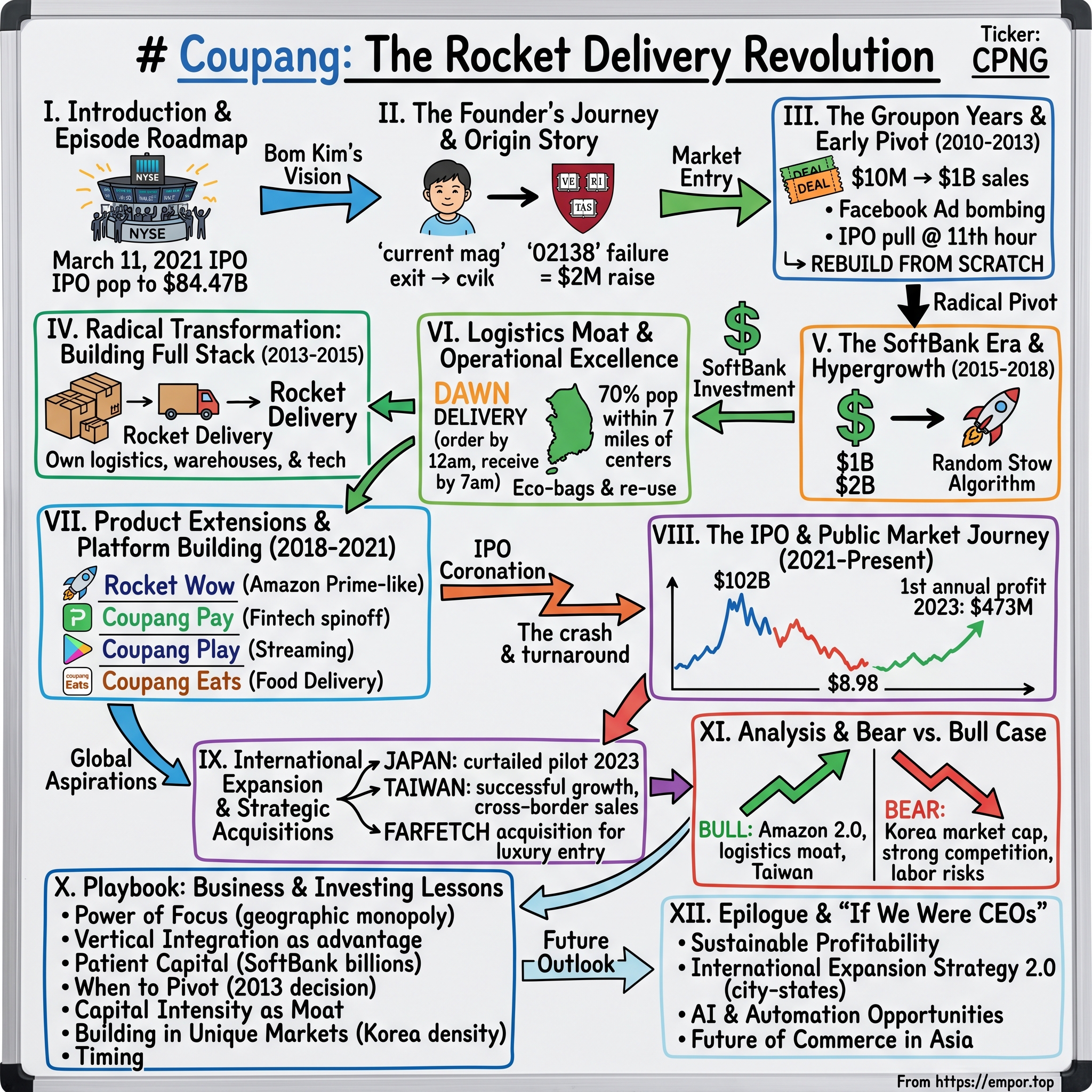
Coupang: The Rocket Delivery Revolution
I. Introduction & Episode Roadmap (00:00:00 – 00:10:00)
On the afternoon of August 4, 2026, 김범석 Bom Kim — founder and chief executive of the largest retailer in South Korea — spent the opening minutes of an earnings call doing something no operator enjoys. He explained why the number the market could see was not the number he wanted the market to look at.
Reported revenue growth in Coupang's core retail segment had come in at 1% in dollars. Strip out a Korean won that had fallen to its weakest level against the dollar in more than fifteen years, and it was 8%. Strip out one more thing — the cohort of customers who walked away after a data breach the previous December and had not come back — and the underlying customer base was compounding its spend at roughly 16%.[^9] Three numbers, one business, an eight-percentage-point spread between the one that hit the tape and the one management wanted investors to underwrite.
That same quarter, Coupang recorded a $556 million operating loss, including $410 million of Korean administrative fines it intends to fight in court, and a net loss of $570 million.8 The stock, which closed its first day on the New York Stock Exchange at $49.25 in March 2021 for a market capitalization of $84.5 billion, changed hands in early September 2026 at roughly $15, for a market value near $27 billion.339
This is a story about what happens when an extraordinary operating machine collides with the three things machines cannot engineer away: a regulator, a demographic, and a single employee with a stolen key.
The hooks. Coupang delivers 99.3% of its orders within twenty-four hours, at no incremental delivery charge, across a country where 70% of the population lives within seven miles of one of its logistics centers.61 It directly employed roughly 108,000 people at the end of 2025, making it one of the largest private-sector employers in Korea.6 It was built by a Harvard Business School dropout who returned to Seoul at thirty-two, raised $2 million from an alumni network that included Bill Ackman, and then — three years later, with the IPO prospectus a week from the printer — cancelled the offering and dismantled the profitable business he had just built.45
The core paradox. Amazon's playbook says a retailer wins by owning inventory, owning fulfillment, and owning the last mile, and that the cost of doing so is a decade of losses. Coupang ran that playbook in a country roughly one percent the land area of the United States, where the addressable customer lives in a high-rise rather than a cul-de-sac. Density made the model work faster and cheaper than it ever could in American suburbia. The question that has defined the last five years is whether the same density that built the moat also builds the ceiling — and whether the model travels.
Where the evidence sits today. Coupang generated $34.5 billion of net revenues in 2025 and $473 million of operating income.7 It generated $24.4 billion of net revenues in 2023 and — to the dollar — $473 million of operating income.9 Revenue grew 41% over two years and consolidated operating profit did not move at all, because everything the Korean retail engine threw off was redeployed into Taiwan, food delivery, streaming, Japan, and a distressed European luxury marketplace. Whether that redeployment is disciplined compounding or an expensive diversification is the central capital-allocation question in this business, and the answer is not yet in the numbers.
The roadmap. The story runs in seven movements. First, Bom Kim's route from a Harvard dorm-room magazine to a Seoul daily-deals site, and why a business doing $1 billion of gross merchandise value was, in his own assessment, structurally worthless. Second, the 2014 decision to buy trucks, hire drivers, and take inventory onto the balance sheet — the bet that made everything else possible. Third, the SoftBank era, when ソフトバンクグループ SoftBank Group supplied $3 billion of ammunition and Coupang burned it faster than any Korean company ever had. Fourth, the anatomy of the moat itself: what "random stow" actually means, why a Rocket driver out-delivers an American one by a multiple, and where the 7 Powers and Porter frameworks say the durability really sits. Fifth, the 2021 listing and the crucible that followed. Sixth, the Developing Offerings portfolio — 쿠팡이츠 Coupang Eats, 쿠팡플레이 Coupang Play, Taiwan, Japan, and Farfetch — where roughly $1 billion a year of EBITDA losses now sit. Seventh, the stress test: the Korea Fair Trade Commission, the November 2025 data breach, the labor record, and the Chinese cross-border platforms.
Then the spine: why Coupang wins from here, what would break the case, and the two or three numbers that will settle it.
It starts, as these things usually do, with someone who could not leave a good business alone.
 Subscribe on LinkedIn
II. Founder's Origin & The Early Pivots (2010–2013) (00:10:00 – 00:45:00)
Bom Kim was born in Seoul in 1978 and moved to the United States at age seven, an early relocation that left him fluent in two commercial cultures. He attended Deerfield Academy and then Harvard College, where his entrepreneurial focus emerged early: he founded Current, a student publication, and sold it to Newsweek in 2001. A second venture followed — 02138, a glossy magazine for Harvard alumni named after the Cambridge zip code — which raised roughly $4 million but folded during the 2009 financial crisis.4
Two magazines, one modest exit, and one failure were not an obvious prelude to building a logistics network. But the experience taught a foundational lesson: distribution, not content, dictates commercial value.
In 2010, Kim enrolled at Harvard Business School but left after six months. His exit was driven by a specific market gap: South Korean e-commerce was fragmented across price-comparison portals and open marketplaces where merchants competed solely on price, leaving no single player in control of the customer relationship. Returning to Seoul, he raised roughly $2 million from an investor network that included Bill Ackman and named the company by combining "coupon" with a Korean onomatopoeia suggesting fun and delight.5
The Groupon mirage. 쿠팡 Coupang launched as a daily-deals site, adopting a model then proliferating globally. Merchants offered products or services at a 50% discount contingent on a minimum volume of buyer commitments, with the platform keeping roughly 15% of the transaction. The model was capital-light, cash-generative, and intensely competitive. Although Coupang launched after rivals 티켓몬스터 TicketMonster and Groupon Korea, it rapidly outpaced both.
Growth was fueled by customer-acquisition arbitrage. Facebook advertising in South Korea in 2011 was underpriced, and Kim purchased ad inventory at scale — placing an estimated average of 72 Coupang advertisements per month before every South Korean resident.5 First-year sales reached approximately $10 million across more than three million customers. By mid-2011, run-rate revenue reached an annualized $300 million with positive cash flow, and by 2013 Coupang led South Korea's daily-deals category with more than five million users.5
By conventional startup metrics, the business appeared to have achieved product-market fit.
The falsification: it wasn't. That initial traction proved misleading, as both Kim's internal analysis and subsequent industry failures revealed. Customers were purchasing deeply discounted items they had little intent to reorder — creating transactional volume rather than customer loyalty. Furthermore, roughly half of all customer complaints centered on delayed or unreliable shipping, a fulfillment function Coupang neither owned nor could fix.5 A business whose primary customer grievance sits entirely outside its operational control does not possess a core product; it distributes discounts.
Subsequent developments reinforced that assessment. In July 2024, TMON and WeMakePrice — direct descendants of that early South Korean social-commerce cohort, by then owned by Singapore-based Qoo10 — collapsed into a liquidity crisis. The platforms failed to remit approximately 210 billion won to merchants and filed for court rehabilitation, prompting the South Korean government to deploy roughly $400 million in emergency financial assistance to affected small businesses.45 The eventual breakdown of the 2010–2013 social-commerce model highlighted its structural flaw: it functioned as a customer-acquisition funnel rather than a durable retail enterprise. Kim's early metrics demonstrated mastery of advertising arbitrage rather than validated retail demand. The decisive strategic pivot lay ahead.
The eleventh-hour pull. By 2013, Coupang had transitioned toward a third-party marketplace where merchants listed products, Coupang took a commission, and the platform avoided handling physical goods. Annual gross merchandise value crossed $1 billion within three years. Investment banks were engaged, an S-1 registration statement was drafted for a Nasdaq listing, and the prospectus was roughly a week from being sent to the printer.
Kim aborted the public offering.
The rationale was structural. As a pure marketplace, Coupang possessed no pricing power; merchants set retail prices, while South Korean consumers relied on 네이버 Naver, a dominant search portal that directed demand to whichever seller was cheapest. Nor did Coupang control fulfillment, relying instead on third-party carriers such as CJ대한통운 CJ Logistics and Korea Post. Owning only the checkout page, the company could not guarantee delivery quality or order timing. Competing against a search incumbent with superior distribution capabilities left Coupang without a defensible asset.
So Kim pulled the offering and directed his team toward a capital-intensive strategy: transforming Coupang into a direct retailer that purchased inventory, managed fulfillment centers, and operated its own last-mile delivery fleet.5
Why this decision deserves the weight it gets. While hindsight often frames this pivot as visionary leadership, the immediate risk was substantial. Coupang was cash-generative and on the verge of a lucrative public listing. The alternative required converting a capital-light intermediary into South Korea's most capital-intensive retail operation — competing against established conglomerates with far larger balance sheets in a country already served by nationwide parcel networks. No empirical data guaranteed success; the strategy rested on a single hypothesis: that in South Korea's dense urban geography, controlling end-to-end fulfillment would ultimately secure customer ownership.
The hypothesis proved correct, but the broader strategic implication is nuanced. Coupang's competitive moat emerged not from incremental optimization, but from an un-validated, high-stakes gamble executed by a founder with absolute voting control — a governance dynamic that provided strategic agility while concentrating risk.
To execute the vision, Coupang needed trucks.
III. The Radical Transformation: Building Full-Stack Logistics (2014–2015) (00:45:00 – 01:25:00)
Consider South Korean parcel delivery in 2013. A merchant handed a package to CJ Logistics or Korea Post. The box entered a hub-and-spoke network optimized for low per-parcel costs, tuned to standard business-day service levels, and arrived in two to three days. No operator in that chain controlled or tracked the end-to-end customer experience, and fresh food could not reliably move through the system at all.
That network was not broken; it was simply built for a different job — moving parcels cheaply. Coupang sought a different outcome: delivering nearly anything to anyone by the next day, and eventually by dawn. That capability could not be purchased as a third-party service; it had to be built from scratch.
The stack. In 2014, Coupang began buying inventory outright — transitioning to first-party retail, which meant taking on working-capital and shelf-space risks across millions of SKUs. It began constructing dedicated fulfillment centers rather than leasing standard warehouse space. In the decision that most defined the company's cost structure and later labor exposure, Coupang directly employed its delivery drivers rather than contracting them. Known initially as 쿠팡맨 Coupang Men and later as Rocket Drivers, they were salaried employees receiving benefits within a South Korean logistics industry dominated by subcontracted per-parcel piece rates.5
Rocket Delivery — 로켓배송 — launched that same year with a straightforward value proposition: order an item today, receive it tomorrow, with no added shipping fee. 새벽배송 Dawn Delivery followed, promising that orders placed before midnight would arrive at the door before 7:00 a.m. In South Korea, where dual-income households are common and high-rise apartment towers aggregate hundreds of consumers within single elevator banks, early-morning delivery moved beyond convenience to restructure household grocery shopping habits.
The requisite capital followed. Sequoia Capital invested $100 million in May 2014, and BlackRock led a round of roughly $300 million several months later.5 By 2016, Coupang had thousands of Rocket couriers on its payroll.
The technology, in plain terms. The least intuitive element of this operation to outside observers was warehouse organization. Traditional warehouses function like supermarkets, organizing inventory by category — shampoo with shampoo, cereal with cereal. While legible to human workers, this layout hinders throughput, as a multi-item order requires a worker to cross multiple departments.
"Random stow" inverts that logic. Arriving inventory is placed into any available empty slot, with the location recorded in software without regard to product category. The warehouse layout becomes indecipherable to a human worker but completely transparent to management software. Because high-demand items arrive continuously, they are distributed across the facility — ensuring a picker is almost always near an item on a pending order. Software then batches orders and computes optimal walking paths, much like a delivery app sequences stops.
Under this system, human intuition is traded for software-driven efficiency. Coupang has consistently described inventory placement, dynamic pricing, and route optimization as the foundation of its cost advantage, and management continues to highlight automation and network design as its primary long-term margin levers rather than price increases.[^11]
The strain. This infrastructure was capital-intensive, and South Korean media coverage was frequently critical. Building fulfillment centers, holding inventory, and paying salaried drivers converted Coupang from a cash-generative intermediary into an enterprise that consumed cash at scale for nearly a decade. The prevailing domestic consensus — that Coupang was burning foreign capital and would ultimately be outmatched by established retail conglomerates like 신세계 Shinsegae or 롯데 Lotte — was a defensible interpretation of the available data at the time.
What the record actually shows about that period. A rigorous evaluation requires looking past retrospective narratives that frame the cash burn as an obvious success. Coupang's IPO prospectus disclosed 2020 net revenues of $11.97 billion against a net loss of $475 million — despite 2020 being an exceptionally strong year driven by pandemic-related demand.1 Cumulative losses during the network build-out ran into the billions, and the company's accumulated deficit reached $4.86 billion as of June 30, 2026, more than a decade after the pivot and three years after its initial profitable year.8 The resulting competitive moat was substantial, but it was also one of the most expensive retail assets ever constructed in South Korea, financed entirely by external capital rather than operational cash flow.
Which raises the question: who was willing to write those cheques?
IV. The SoftBank Era & Capital Intensity (2015–2020) (01:25:00 – 02:00:00)
In June 2015, Masayoshi Son invested $1 billion into the five-year-old retailer at a $5 billion post-money valuation. It was the largest single investment in a South Korean startup up to that point, built on a thesis Son had applied across multiple ventures: in a market with structural density, the operator that controls fulfillment eventually controls the economics.5
In November 2018, the SoftBank Vision Fund invested an additional $2 billion at a valuation reported near $9 billion. That transaction brought total capital raised past $3.4 billion, funding an expansion that grew Coupang's logistics footprint to more than 100 fulfillment and logistics centers spanning over 25 million square feet across more than 30 cities by its public listing.1
Why the geography mattered so much. The prospectus disclosed that 70% of South Korea's population lived within seven miles of a Coupang logistics center — a metric central to the company's operating thesis.1 Operationally, this geographic concentration transformed last-mile economics.
In suburban markets such as the United States, delivery drivers spend most of their workday traveling between spread-out residential single-family homes, making road time the primary driver of per-parcel costs. In Seoul's high-density urban landscape, a driver can park once at an apartment complex, load a delivery cart, and service dozens of households within a single tower without returning to the vehicle. This density increases stop efficiency per hour of labor, spreading fixed costs — vehicles, driver compensation, fuel, and hub infrastructure — across a far higher volume of packages.
This structural efficiency allowed Coupang to offer free next-day delivery on small-basket items while working toward unit-level profitability — a model that eroded margins in less densely populated geographies. The company's competitive moat stemmed less from proprietary software than from physical geography converted into unit economics through heavy asset ownership.
The falsification: was this disciplined capital allocation? While bullish accounts suggest SoftBank's capital funded an unassailable logistics network, historical financials reveal a more complex picture.
Between the 2014 pivot and the COVID-19 pandemic, Coupang reported persistent negative free cash flow, relying on sequential equity rounds rather than operating cash flow to sustain operations. Skepticism from domestic market observers was well-founded: the business had not yet demonstrated an ability to earn its cost of capital. Furthermore, early international expansion plans faltered; a pilot in Japan launched in 2021 was shut down in March 2023 after failing to meet internal return benchmarks.28
While SoftBank's capital secured assets rivals could not match, framing this phase as disciplined capital allocation is unsupported by the 2015–2020 record. Instead, it reflected strong strategic conviction combined with access to patient capital. Capital allocation discipline remains a test for the post-2023 era, when reliance on external funding ended.
The investor coda. SoftBank's subsequent portfolio management reinforces this distinction. After holding roughly 32.4% of Coupang's equity at the end of 2021, the Vision Fund sold 57 million shares for approximately $1.69 billion in September 2021, followed by 50 million shares in March 2022. Continued tranches through 2025 reduced SoftBank's stake to approximately 17.4% by August 2025 as the firm redirected capital toward artificial intelligence and semiconductor holdings.33
While this divestment reflects SoftBank's broader portfolio reallocation rather than an operational failure at Coupang, halving an anchor shareholder's position removed a stabilizing presence from the stock's capital structure. As a result, Coupang's shareholder base transitioned toward public-market investors with significantly shorter investment horizons than SoftBank maintained in 2015.
Those investors evaluate the performance of Coupang's core domestic retail engine — an operation that requires close examination of its underlying mechanics.
V. The Core Business: Product Commerce & Logistics Moat (02:00:00 – 02:50:00)
Product Commerce is the segment that pays for everything else. In 2025 it generated $29.6 billion of net revenues — up 11% reported, 16% in constant currency — and $2.5 billion of segment adjusted EBITDA at an 8.4% margin, serving 24.6 million active customers.7 For scale, that customer count sits against a total South Korean population of roughly 51 million, which means Coupang transacts with something close to every adult household in the country.
The segment bundles four things that look separate and are not: first-party retail, where Coupang owns the inventory; the third-party marketplace, including Fulfillment and Logistics by Coupang, where merchants rent the network; 로켓프레시 Rocket Fresh, the dawn-delivered grocery business; and advertising, where brands pay for placement in front of shoppers who are already at the checkout stage.
Advertising is the quiet compounder. Management has repeatedly grouped it with FLC as the "margin-accretive offerings" still early in their scale curve — the mechanism by which gross margin expands without raising prices.[^9] It also happens to be the business the Korea Fair Trade Commission has spent two years examining, for reasons taken up later.
The competitive map. Coupang does not disclose market share, and neither does anyone else in a way that survives scrutiny — Korean e-commerce statistics vary wildly depending on whether they count gross transaction value through open marketplaces. Monthly active users are cleaner. In the first quarter of 2025, Coupang logged 33.25 million monthly users. AliExpress had 8.57 million and Temu 8 million; 11st had 7.7 million, Naver's Plus Store 7.52 million, and Gmarket 6.9 million.32 Combined, the two Chinese cross-border platforms reached about half of Coupang's audience.
The structural positions matter more than the counts. 네이버 Naver runs an asset-light search-and-marketplace ecosystem: enormous reach, no inventory risk, and a fulfillment alliance stitched together from third-party partners. It is the second force in Korean e-commerce and it competes on a completely different cost structure. 신세계 Shinsegae bought Gmarket for roughly $3 billion and has struggled to fuse a legacy department-store organization to an open marketplace. 롯데 Lotte's digital effort has never achieved conversion proportionate to its physical footprint.
Hamilton Helmer's 7 Powers, applied honestly. Four of the seven are visible here; three are not.
Scale economies are the strongest and most measurable. The fixed cost of a fulfillment network divides across order volume, and Coupang has more Korean order volume than anyone. This is the power that makes free next-day delivery economic.
Process power is real but harder to verify from outside. A decade of iteration on stow logic, batching, routing, and demand forecasting is not something a competitor buys; it is accumulated organizational knowledge. The supporting evidence is the 99.3% under-24-hour figure sustained at national scale.6 The caveat is that process power is the power most vulnerable to being commoditized by general-purpose technology — a point management itself flagged when discussing artificial intelligence as a "multiplier" on existing assets rather than a defensible asset in itself.[^9]
Counter-positioning explains the incumbents' paralysis better than any competence argument. Shinsegae and Lotte could not adopt first-party online fulfillment at scale without cannibalizing high-margin department stores and detonating decades-old relationships with third-party logistics providers. The new model was not merely unattractive to them; adopting it would have destroyed the businesses they were defending.
Switching costs run through 와우 멤버십 WOW membership, which bundles unlimited free delivery, Coupang Eats benefits, and Coupang Play into one subscription. In April 2024 Coupang raised the monthly fee from 4,990 won to 7,890 won — a 58% increase — with existing members transitioning later that year.26 A 58% price increase is an unusually clean pricing-power experiment, and the membership base did not collapse.
The three powers Coupang does not have are worth naming: no meaningful branding power in the luxury-pricing sense, no cornered resource, and no classic network effect — a shopper does not gain from another shopper joining except indirectly through density economics.
Porter, briefly. Buyer power is theoretically high — Korean consumers are famously price-sensitive and one app-switch away from an alternative — and is held down by the membership bundle rather than by any inherent lock-in. Supplier power is low, which is precisely the problem: Coupang's leverage over vendors is the source of its margin and the source of its regulatory exposure. Substitution risk is moderate and runs through Naver's price comparison. Rivalry is severe, and the past year has raised it.
What the recent evidence actually proves. Here is the most important thing an investor can take from the last four quarters, and it is genuinely unusual: Coupang was handed a natural experiment on its own moat.
After the December 2025 data incident, a meaningful slice of customers left. Some stayed away for months — long enough, as Kim put it on the August 2026 call, "to settle in somewhere else." Most came back. And when they returned, according to management, they resumed at their prior spend levels and then exceeded them, rather than splitting their wallet between Coupang and the alternative they had tried.[^9] Total WOW membership subsequently exceeded pre-incident levels.[^9]
That is stronger evidence for switching costs and service differentiation than any pre-incident retention chart, because it was an involuntary test with a real alternative available. It is management-sourced and unaudited, and it should be weighted accordingly. But it is the right kind of evidence, and it points in one direction.
The counterweight sits in the same disclosure. A cohort has not returned, and its absence is the difference between 8% reported growth and 16% underlying spend growth.[^9] Management describes those as lower-spending customers, which is plausible and also conveniently unfalsifiable from outside. The honest reading: the moat survived a shock that would have broken a weaker business, but it did not survive it costlessly, and the recovery is still a management assertion rather than a completed fact.
The company had been through one crucible before this one. It arrived the moment it went public.
VI. The 2021 IPO & The Public Market Crucible (02:50:00 – 03:25:00)
March 11, 2021 was as good as a listing day gets. Coupang priced 130 million shares at $35 — above its initial $32-to-$34 target range — raising $4.6 billion and valuing the company at roughly $60 billion at the offer.2 The stock opened at $63.50 and closed its first day at $49.25, a 41% gain that pushed market capitalization to $84.47 billion.3 It marked the largest U.S. listing by a foreign issuer since Alibaba in 2014.
Buried in the prospectus was the governance structure that continues to shape the company. Class B shares carry 29 votes each, all held by founder Bom Kim, giving him approximately 76.7% of the voting power immediately after the offering.1 The company listed in New York in part because South Korean exchanges did not permit dual-class voting structures at the time.
Then the market took it apart. The subsequent reversal had three primary drivers, none related to physical logistics. Global interest rates rose, de-rating long-duration growth equities. Pandemic-driven e-commerce demand normalized as South Korea reopened. And the Korean won weakened against the U.S. dollar, mechanically shrinking dollar-reported revenues for a business earning almost entirely in won. The stock bottomed near $9 in 2022 — an 80%-plus decline from its first-day close.
The fire. In June 2021, three months after the listing, a catastrophic fire destroyed Coupang's 1.4-million-square-foot Deokpyeong fulfillment center in Icheon. The blaze burned for days, drawing 845 personnel and 239 fire engines from eight neighboring jurisdictions. Kim Dong-sik, a 52-year-old rescue team chief from the Gwangju Fire Station in Gyeonggi Province, died fighting the fire.25 Property and inventory losses were estimated between 400 billion and 600 billion won.24
The commercial damage was recoverable, but the reputational impact proved far more lasting. The disaster crystallized public criticism of Coupang's warehouse working conditions into a widespread consumer boycott, establishing a recurring template of operational crisis, public outcry, and regulatory backlash.
The turn to profit. Starting in 2022, management shifted its primary focus from top-line expansion to operating leverage through sortation automation, tighter supply-chain terms, and the scaling of higher-margin marketplace services and advertising. In 2023, Coupang delivered its first full year of GAAP net income — $1.36 billion on $24.4 billion of revenue, compared with a $92 million net loss the prior year — alongside $1.775 billion of free cash flow.9
Read that number carefully. The $1.36 billion net income figure led media coverage, but it materially overstated the core retail engine's underlying earnings power. Operating income for 2023 stood at $473 million, representing a modest 1.9% operating margin. The gap stemmed largely from an $895 million non-cash tax benefit related to adjustments in tax reserves, including the release of valuation allowances on deferred tax assets.9 That tax release was a legitimate accounting recognition of achieved profitability, but it did not reflect repeatable retail earnings.
The distinction became critical the following year. In 2024, revenue grew 24% to $30.3 billion while net income attributable to shareholders fell to $154 million — a $1.2 billion decline driven primarily by the absence of the one-time 2023 tax benefit, coupled with operating losses from the acquisition of Farfetch.10 Investors who had treated the 2023 headline profit as a new baseline were caught off guard by a shift fully visible in the previous year's footnotes.
The accurate takeaway is more precise: 2023 demonstrated that Rocket Delivery's unit economics worked at scale, that free cash flow could be substantially positive, and that a decade of heavy capital deployment had yielded a self-funding asset. It did not prove that consolidated GAAP earnings power reached $1.4 billion. Two years later, with net revenues 41% higher, consolidated operating income remained unchanged at $473 million.7
Where did the difference go? Into the second segment.
VII. Developing Offerings: Eats, Play, Fintech, Taiwan, & Farfetch (03:25:00 – 04:05:00)
Coupang reports a second segment called Developing Offerings, and the honest description of it is a portfolio of venture bets funded off a retailer's balance sheet. It contains Coupang Eats in Korea, Rocket Now in Japan, Coupang Play, 쿠팡페이 Coupang Pay, the Taiwan retail build-out, and Farfetch.
The financial shape is stark. In 2025 the segment produced $4.9 billion of revenue, up 38%, and lost $995 million of adjusted EBITDA — against $631 million of losses the year before.7 For 2026 management guided to $950 million to $1 billion of segment losses again, and reaffirmed that range in August.[^9] In the second quarter of 2026 the segment delivered $1.43 billion of revenue, up 24% in constant currency, and lost $219 million.8
Three years of roughly $2.6 billion in cumulative segment EBITDA losses is the price of the option. What has it bought?
Coupang Eats: the case that worked. Eats entered a Korean food-delivery market widely regarded as settled, dominated by 배달의민족 Baemin. The lever was the bundle: in 2024 Coupang folded free delivery for WOW members into the subscription, converting a retail membership into a food-delivery acquisition channel at near-zero marginal cost. Coupang Eats' monthly users roughly doubled to 11.36 million in 2025 from 5.53 million in 2023, while Baemin's base stayed roughly flat above 22 million; by July 2026 Eats was at 13.13 million against Baemin's 23.02 million, with the two together holding around 90% of the market.27 Over 70% of Coupang's paid members use Eats.27
On the August 2026 call, Kim described Eats as having completed the full arc — "the cycle is complete when an offering stops drawing on the portfolio and starts funding it" — and stated that Eats in Korea and Rocket Now in Japan are together self-sustaining.[^9] That is a specific, checkable claim, and it is the single best piece of evidence that the Developing Offerings model can work rather than merely spend.
Coupang Play: the bundle's other half. Launched on December 24, 2020, built partly on assets from the collapsed Singapore streaming venture HOOQ, Coupang Play is included free with WOW.31 Its strategy has been live sport: Coupang secured Korean Premier League and FA Cup rights in a deal reported at around $303 million, alongside other marquee events.30 The economics are not disclosed separately and should not be assumed benign — sports rights are a fixed cost that inflates on renewal. The strategic logic is churn reduction rather than streaming profit, and that logic is only as good as the subscription it defends.
Taiwan: the thesis under test. Coupang entered Taiwan in mid-2021, launched Rocket Delivery and 로켓직구 Rocket Overseas there in October 2022 with free delivery above NT$490, opened a second logistics centre in Taoyuan in 2023, established its first overseas delivery subsidiary and a third centre in 2024, and rolled out WOW membership in 2025.[^40]34
The operational progress is genuine. By December 2025, roughly 75% of Taiwanese volume was being delivered next-day through Coupang's own last-mile network, covering nearly 70% of the island's geography, and management stated this came without a meaningful increase in variable unit cost.[^11] By mid-2026, Coupang had begun rolling out dawn delivery in Taiwan — a milestone it took four years to reach in Korea and one year to reach in Taipei, because Taiwan inherits a decade of systems rather than inventing them.[^9]
The skeptical read is equally available. Coupang does not disclose Taiwan revenue, market share, profitability, or capital deployed. Kim declined to provide details when asked directly, saying it was "too early."34 Independent observers note that Coupang's Taiwanese pricing is now broadly aligned with local platforms rather than undercutting them, and that supply-side constraints — brand reluctance to onboard — remain the binding limitation.34 On the August 2026 call, Kim conceded that "sometimes building selection at the right cost structure means stepping back in a category to rebuild it," and that current economics "reflect the stage of our build-out, not the destination."[^9]
The falsification: does the playbook actually export? The strongest disconfirming evidence is Coupang's own record in Japan. It launched a quick-commerce pilot in Tokyo in June 2021 and shut it down in March 2023 — twenty-one months — explicitly to redirect resources to Korea and Taiwan, after the pilot failed to meet internal benchmarks.28 Coupang re-entered Japan in January 2025 with Rocket Now, a nationwide restaurant-delivery service rather than a retail build, which by August 2026 covered 46 prefectures and 420 cities and had passed seven million cumulative downloads.29
How should that be weighed? The Japan exit is genuine evidence for management's willingness to kill things, which is rarer than it sounds and is a real mark in the capital-allocation column. It is also genuine evidence against the claim that the Rocket model travels automatically: Japan is dense, wealthy, and adjacent, and the retail version did not clear the bar. The revised claim that survives is narrower than the promotional version — Coupang's logistics model has demonstrated portability to one additional market, Taiwan, where it is not yet profitable and where the company declines to disclose the metrics that would let outsiders verify the cohort claims. The event that would confirm it is Developing Offerings segment losses inflecting downward while Taiwan revenue keeps compounding. The event that would falsify it is a fourth consecutive year near $1 billion of losses.
Farfetch: the distressed bet. In December 2023 Coupang agreed to acquire the assets of Farfetch Holdings plc, the London-listed luxury marketplace whose equity had gone from a peak valuation above $20 billion to near-worthless, providing $500 million of capital through a bridge structure alongside Greenoaks Capital and completing the transaction on January 31, 2024 through a newly formed vehicle.1617 A group of Farfetch investors objected to the timeline and lost.
The strategic case: buy a global luxury marketplace with millions of customers for a fraction of replacement cost, and apply Coupang's operational discipline. The execution record so far is mixed and improving. Coupang closed the platform-solutions division and other non-core units, shifted away from heavy discounting, and by the fourth quarter of 2024 Farfetch turned a quarterly profit. Farfetch's UK entity narrowed its post-tax loss by roughly 41% to £471.4 million in the year following the acquisition, on revenue down 12% to £1.08 billion — with auditors nonetheless flagging a material uncertainty related to going concern.18 By the fourth quarter of 2025, management reported Farfetch's first quarter of positive year-over-year revenue growth under Coupang ownership with positive overall economics.[^11]
The activist question writes itself: what is a Korean logistics company doing running a European luxury fashion marketplace? The defensible answer is that the price was low enough that the option is cheap. The uncomfortable answer is that "cheap option" was not how the acquisition was framed to investors at the time, and that a shrinking revenue base with a going-concern note attached is not obviously an asset that compounds. Farfetch has narrowed losses; it has not yet demonstrated growth. Those are different achievements and the second one is the one that matters.
While the portfolio was being built, the environment around the core business was turning hostile.
VIII. Regulatory Pressure & Competitive Stress Test (04:05:00 – 04:40:00)
Six weeks earlier, Coupang had reported the best quarter in its history. Third-quarter 2025 revenues were $9.3 billion, up 18%; Product Commerce grew 18% in constant currency; active customers reached 24.7 million, up 10%; and consolidated adjusted EBITDA came in at $413 million with net income of $95 million.38 The company had never looked stronger.
On November 18, 2025, Coupang's security team identified unauthorized access to customer data. Its initial estimate was that roughly 4,500 accounts were affected. It notified Korean authorities approximately 53 hours later, beyond the 24-hour statutory window. On November 29 it disclosed publicly that the true figure was approximately 33.7 million accounts — a number equivalent to about two-thirds of South Korea's population.1415
Everything that has happened to Coupang since flows from that gap between 4,500 and 33.7 million.
What was taken, and what was not. The exposed fields were names, phone numbers, email addresses, delivery addresses and limited order history; the company's forensic investigators, including Mandiant and Palo Alto Networks, found no financial data, passwords or government-issued IDs were accessed, and building lobby entry codes were reached for 2,609 accounts.[^11] The attacker was a former employee who had helped build Coupang's alternative authentication system and retained the cryptographic signing key that underpinned it after departing.13 Unauthorized access ran for months across 2025 before detection.14
The response, and the counter-response. In late December Coupang announced a compensation program of approximately $1.2 billion in customer vouchers, redeemable from mid-January 2026 — an extraordinary sum for a breach with no confirmed financial loss, and an implicit acknowledgment of how much trust was at stake.[^11] Park Dae-jun, chief executive of the Korean subsidiary, resigned on December 10, saying he felt "a heavy sense of responsibility for both the breach and the shortcomings in our response."[^19] Harold Rogers, Coupang Inc.'s general counsel and chief administrative officer, took over the Korean unit on an interim basis — a US parent asserting direct control over the Korean operation.[^19] Bom Kim retained the parent-company chief executive role throughout — a division of accountability that Korean commentators noted at the time, since the founder who controls three-quarters of the votes bore no formal consequence for the largest customer-data failure in the country's corporate history.42
Then the escalation. The National Assembly filed a perjury complaint against Rogers over conflicting testimony; he was questioned by police twice, once for roughly fourteen hours.14 In February 2026 Korea's Ministry of Science and ICT released findings characterizing the incident as a management problem rather than a sophisticated cyberattack.14 On June 11, 2026, the Personal Information Protection Commission imposed a fine of 624.7 billion won — approximately $409 million, the largest privacy penalty in Korean history — split between 423.6 billion won for the breach itself and 201.1 billion won for unauthorized collection of user activity records, concluding that the breach stemmed from "deficiencies in basic safety management."13 Coupang said it would challenge the fine in court.41
The juxtaposition that matters. On the February 2026 earnings call, Coupang read into the record a quotation from Palo Alto Networks stating that "Coupang security controls are aligned with industry standards" and that the incident "was not caused by a systemic failure of security measures."[^11] Four months later the Korean regulator concluded the opposite: not sophisticated hacking, but basic safety management failures.
Both statements can be technically defensible and they cannot both be the operative account. For investors assessing management credibility, the sequence is the data point: an initial estimate off by four orders of magnitude, a late statutory notification, a forceful public framing that emphasized the criminality of a third party, and a regulator that then imposed a record penalty on grounds directly contradicting that framing. Securities class actions followed in the United States, alleging inadequate cybersecurity controls and untimely disclosure over a class period running into December 2025, alongside a shareholder derivative suit.376
The KFTC file, which predates all of this. In June 2024 the Korea Fair Trade Commission fined Coupang 140 billion won — about $102 million — finding that at least 64,250 private-label and first-party products had been systematically ranked at the top of search results between February 2019 and July 2023 through algorithm adjustment, and that 2,297 employees had been mobilized to write positive reviews of private-label goods. The KFTC referred Coupang and its private-label affiliate CPLB to prosecutors.[^14]11 A supplementary penalty covering August 2023 to June 2024 brought the total to roughly 162.8 billion won — indicating the conduct continued during the investigation.11
Coupang's public defense was that curating one's own products is ordinary retail merchandising, the practice every supermarket chain follows with its house brand, and it is appealing. The counterargument is that a supermarket's shelf is understood by shoppers to be curated, while a search results page presents itself as neutral. That is a genuine legal question, and it is unresolved.
In February 2026 the KFTC added a 2.2 billion won fine for pressuring suppliers to cut prices and absorb advertising costs to protect Coupang's margin targets, and for delaying payments across 508,752 transactions with 25,715 vendors between October 2021 and June 2024, totaling roughly 281 billion won of delayed settlements.12 The monetary penalty is trivial. The finding is not: it says, on the regulator's record, that a portion of Coupang's gross margin was extracted from suppliers under duress.
The relationship has since become openly adversarial. In August 2026 Coupang refused KFTC on-site inspections and filed for injunctive relief, the first such refusal under the Large-scale Retail Business Act, arguing that unannounced raids violated statutory notice requirements. The KFTC withdrew. The dispute has acquired a geopolitical dimension: a US House Judiciary Committee report in July 2026 criticized KFTC practice as lacking due process, and the KFTC chair was summoned to a Korean National Security Council meeting on trade concerns.21 Open KFTC matters include the private-label fine litigation, the challenge to Bom Kim's designation as the group's controlling person, a review of whether the WOW bundle constitutes illegal tying, and an investigation into cost-shifting of customized coupons to suppliers.2143
Labor. The regulatory file has a human counterpart. Coupang's overnight delivery model depends on roughly 20,000 short-term night drivers, many classified under "special types of employment" — a designation that limits their ability to report industrial accidents under the Labor Standards Act. Korea does not cap overnight working hours the way several European jurisdictions do. Multiple driver deaths have been attributed to overwork; one driver's log showed more than eleven hours a day, six days a week, mostly at night.35 In December 2025 a delivery workers' union filed a criminal complaint against Bom Kim alleging an attempted cover-up of the circumstances of a worker's death.36 The company has implemented rest requirements and expanded automated sortation.
Then, on July 18, 2026, a fire broke out at Coupang's Incheon logistics centre — an eight-storey, roughly 299,000-square-metre facility. All 121 people inside evacuated; one firefighter was hospitalized. It took 412 personnel and 61 hours to bring under control, and it disrupted deliveries across Seoul, Incheon and Gyeonggi.2223 Coupang estimated the combined carrying value of its own inventory and fixed assets at the site, plus its obligations to sellers whose stock was stored there, at approximately $246 million, and said insurance claims would be pursued with losses and recoveries recognized from the third quarter.[^9]
Five years after Deokpyeong, a second major warehouse fire. Management stated the operational impact was absorbed by network flexibility — which is a genuine demonstration of redundancy, and simultaneously the second data point in a pattern that Korean regulators and the press are now treating as systemic rather than accidental.
The Chinese offensive. Against this backdrop, AliExpress and Temu have built audiences in Korea approaching nine million monthly users each, offering direct-from-factory pricing under favourable de minimis import treatment.32 Coupang's counter is structural rather than promotional: cross-border platforms cannot deliver fresh groceries by dawn, cannot accept an instant domestic return, and cannot guarantee next-day service. On the May 2026 call, asked directly about Chinese competition, Kim declined to engage on competitor tactics and returned to selection, price and service — consistent with how he has answered the question for years, which is either admirable focus or a refusal to address the substance, depending on one's priors.[^10]
The cumulative picture is a company whose commercial machine works and whose social license in its home market has become the binding constraint. Which puts unusual weight on who is accountable, and to whom.
IX. Management, Governance, & Capital Allocation Record (04:40:00 – 05:10:00)
Bom Kim is founder, chief executive and chairman. Gaurav Anand is chief financial officer. Harold Rogers is general counsel and chief administrative officer and served as interim head of the Korean subsidiary from December 2025.[^11]
The voting arithmetic. As of December 31, 2025, Kim beneficially owned all Class B shares — 157.8 million of them, each carrying 29 votes — representing 74.1% of total voting power.6 Against approximately 1.67 billion Class A shares outstanding, his economic ownership is in the high single digits to low teens.6 The practical effect is total: no shareholder vote can be lost, no board seat can be contested, no activist campaign can succeed, and no acquisition proposal can be forced onto the agenda.
The chaebol fight. In April 2026 the KFTC designated Coupang as a disclosure-obligated business group and, for the first time, named Bom Kim personally as the group's "same person" — the legal controller — rather than allowing the corporate entity to serve in that role as it had since 2021. The stated trigger was the finding that Kim's younger brother, Kim Yoo-seok, a Coupang vice president, held de facto executive authority over logistics and delivery operations at a rank equivalent to CEO-level positions at key subsidiaries.2044 Designation would compel disclosure of relatives' shareholdings and affiliate positions and subject the group to rules on intra-group support.
Coupang sued. On July 14, 2026, the Seoul High Court granted an injunction suspending the designation until thirty days after it rules on the merits, finding the applicants had "demonstrated an urgent need to prevent irreparable harm."19
An investor should read this on two levels. Legally, Coupang won a procedural round on a contested administrative action, and its objection to being folded into a chaebol framework designed for a different corporate form is not unreasonable. Substantively, the underlying fact the KFTC identified — a founder's brother running core operations at executive rank — is exactly the kind of disclosure item that concentrated-control structures exist to keep out of view, and Coupang's response was to litigate the disclosure obligation rather than address the substance. When asked about the designation on the May 2026 call, Anand's answer was procedural and offered nothing on governance implications.[^10]
The capital allocation record, tested rather than asserted. Three things belong on the ledger.
In favour. The Japan retail pilot was shut down after twenty-one months rather than defended.28 Buybacks have been executed at scale into weakness rather than announced and ignored: 20.4 million shares for $391 million in the first quarter of 2026, 23.2 million for $459 million in the second, with the board adding $1 billion to the authorization in May 2026.[^10]8 Roughly $850 million of repurchases in a half-year during which the company reported an $836 million net loss is a real allocation decision with real consequences, made possible by $6.1 billion of cash.8
Against. Developing Offerings losses have widened for three consecutive years — $631 million in 2024, $995 million in 2025, guided to $950 million to $1 billion in 2026 — without the company disclosing how that spending splits between Taiwan, Japan, Farfetch and Eats.7[^9] Management has explicitly declined to break it out, describing the segment as "a portfolio of initiatives."[^11] That is a legitimate management choice and it makes independent verification of "disciplined capital allocation" impossible. Investors are asked to accept the discipline claim on the strength of the same disclosure regime that produced it.
Ambiguous. Farfetch. The purchase price was low, the losses have narrowed materially, and a quarter of positive economics has been achieved. The revenue base has also shrunk, the going-concern language persists at the UK entity, and the strategic rationale has been reframed over time from opportunistic distress purchase toward strategic necessity.18[^11]
Narrative consistency across calls. Comparing the February, May and August 2026 calls is instructive. The framing has been remarkably stable: the same three causes for margin compression (supply chain dislocation, elevated reacquisition marketing, fixed capacity sized to a pre-incident demand curve), the same COVID analogy, the same assertion that nothing has structurally changed. Consistency is a credibility asset when the underlying claim proves out, and a warning when it does not.
The guidance has also moved. In February, management expected impacts to diminish "over the course of the year" with margin expansion resuming in 2027. In May, it was "annual margin expansion resuming next year." By August, it had become a specific commitment: Product Commerce adjusted EBITDA margins returning to approximately pre-incident levels by mid-2027, with detailed guidance promised by year-end.[^11][^10][^9] That progression is a tightening rather than a retreat, and it is the most falsifiable thing management has said. It should be held to it.
Incentive alignment. Coupang has publicly emphasized long-term free cash flow per share rather than revenue as the frame for executive incentives, and Kim's language on calls consistently routes back to cohort spend compounding and cash flow rather than headline growth.[^9] With free cash flow at $105 million on a trailing-twelve-month basis as of June 2026 — down from $784 million a year earlier — that metric is currently doing the company no favours, which at least confirms it is not a metric chosen for flattery.8
X. Playbook: Business & Investing Lessons (05:10:00 – 05:45:00)
Seven transferable lessons emerge from this history, and the most useful versions are the qualified ones.
1. Logistics moats are geographic arguments before they are technological ones. The single most important input to Coupang's unit economics is that Korean customers stack vertically. A driver who parks once and delivers forty parcels has a fundamentally different cost curve than one who drives between forty single-family homes. The corollary for investors is a warning: any company promising to replicate a density-derived advantage in a low-density market is proposing to fight physics with software. Test the population geometry before the technology story.
2. The courage to kill a working model is rarer than the courage to start one. Cancelling an IPO a week from printing to abandon a cash-generative marketplace for a decade of capital intensity is the decision on which the entire company rests. But the honest lesson is uncomfortable: this pivot was possible because one person could decide it alone. The same governance structure that enabled the 2013 pivot is the one that today makes shareholder accountability effectively unavailable. Founder control is neither an inherent virtue nor a vice; it is a leverage multiplier on founder judgment, operating in both directions.
3. Counter-positioning beats competence. Shinsegae and Lotte did not fail to build first-party online fulfillment because they lacked capital or talent. They failed because succeeding would have destroyed their department stores and their third-party logistics relationships. When evaluating whether an incumbent will respond to a disruptor, the question is never "can they?" — it is "what would they have to destroy?"
4. Bundling converts one subscription into several markets. WOW turned a retail membership into a food-delivery engine and a streaming distribution channel, and the Eats market-share gains against an entrenched incumbent are the cleanest proof. The caveat regulators have noted: a bundle that leverages dominance in one market to capture an adjacent one is precisely what tying doctrine exists to police, and the KFTC is currently reviewing it.43
5. Capital intensity is a weapon only when the capital is patient and the market is finite. Coupang outspent domestic rivals until scale made the network self-funding. That strategy succeeded because South Korea is a bounded market where the network could actually be completed. In an unbounded market, the same capital intensity is merely a longer runway to the same underlying problem.
6. Self-preferencing is a margin source with a regulatory expiry date. The KFTC's finding — 64,250 products ranked through algorithm adjustment over four years, with the conduct continuing into the investigation period — is the clearest case study available of a platform monetizing the ambiguity between merchant and referee.[^14]11 The lesson is not that private label is illegitimate. It is that when a platform owns both the shelf and the products on it, some portion of reported margin is a policy variable rather than an operating achievement, and investors should discount it accordingly until the litigation resolves.
7. Trust is a balance-sheet item with no dedicated line. A single former employee with a retained signing key erased more equity value in weeks than a decade of competitive pressure had.13 The recovery is real but incomplete. The generalizable lesson for any consumer platform is that the customer relationship built through fifteen years of compounding cohort spend was interrupted by an event unrelated to price, selection, or delivery speed. Restoring that trust — through $1.2 billion in customer vouchers, elevated reacquisition marketing, $409 million in fines, and a still-missing customer cohort — cost far more than a full year of consolidated operating income.
XI. Analysis & Bear vs. Bull Case (05:45:00 – 06:10:00)
Here is the spine, stated plainly. Coupang wins from here if the Korean retail engine returns to its pre-incident margin structure while marketplace, advertising and FLC mix continue to lift gross margin, and if Taiwan converts from a cash drain into a second Korea. It fails if the margin recovery proves structural rather than cyclical, if Korean regulators keep converting its cost advantages into penalties, or if Developing Offerings never stops consuming what Product Commerce produces.
The Bull Case
The engine is genuinely differentiated and it was stress-tested involuntarily. Product Commerce ran at an 8.4% adjusted EBITDA margin in 2025 on $29.6 billion of revenue, and 7.7% in the fourth quarter even as December cratered.7[^11] The customers who left during the incident and returned did so at full prior spend rather than splitting wallets, and WOW membership has exceeded pre-incident levels.[^9] That is the counter-positioning and switching-cost thesis surviving an adversarial test.
Margin recovery is mechanical, not structural — if management is right. The compression traces to fixed capacity and supply-chain commitments sized against a demand curve that a one-off event disrupted, plus deliberate reacquisition marketing that management says will come down in 2027.[^9] Coupang chose to carry underutilized capacity rather than cut it, on the reasoning that unwinding assets with multi-year lead times to rebuild them later is value-destructive. If demand refills the network, the operating leverage runs in reverse.
Monetization levers remain unexercised. The 58% WOW price increase did not break the base.26 Advertising and FLC are described as early in their scale curve and carry structurally higher margins than retail.[^9] Coupang's share of total Korean retail spend remains below what comparable platforms have achieved in more mature markets — a claim management makes and outsiders cannot fully verify, but which is directionally consistent with Korea's still-substantial offline grocery base.[^9]
Taiwan is further along than Japan ever got. Dawn delivery in year one versus year four in Korea, roughly 75% of volume on owned last-mile without variable-cost inflation, and cohort behaviour management describes as tracing Korea's early curve.[^11][^9]
Capital is being returned at depressed prices. Roughly $850 million of buybacks in the first half of 2026 against a $27 billion market capitalization, funded from $6.1 billion of cash.8
The Bear Case
The demographic ceiling is real but the popular version is stale. South Korea's fertility rate rose to 0.80 in 2025 from 0.75 in 2024, with births up 6.7% to 254,300 and marriages up 8.1% — the second consecutive annual improvement and ahead of the government's optimistic projection.40 The correct bear argument is not that Korea's birth rate is collapsing faster than ever; it is that the working-age population still shrinks for decades regardless, and Coupang already transacts with roughly half the country. Domestic volume growth must therefore come from wallet share and category expansion, not customer count — and active customers grew just 3% year-over-year in the second quarter of 2026.8
Regulatory cost has become a recurring line, not a one-off. $409 million of privacy fines, roughly 162.8 billion won of KFTC penalties under appeal, a 2.2 billion won supplier-coercion finding, a prosecutorial referral, a criminal complaint against the founder from a labour union, US securities class actions, a shareholder derivative suit, an open tying review of the WOW bundle, and an active fight over the group's controlling-person designation.13111236374319 Individually survivable. Collectively, they describe a company whose home regulator now treats it as a systemic actor to be constrained.
The Developing Offerings drain has widened every year. From $631 million to $995 million to a guided $950 million–$1 billion, with no segment-level disclosure of where it goes.7[^9] Consolidated operating income was identical in 2023 and 2025 despite 41% revenue growth.97 Until that reverses, every dollar of Korean retail profitability is being consumed by ventures whose returns cannot be independently assessed.
Chinese cross-border pricing caps the general-merchandise ceiling. AliExpress and Temu together reach roughly half of Coupang's monthly audience on non-perishable goods where speed matters least.32 Coupang's defense is strongest exactly where cross-border is weakest — fresh food, instant returns — which is another way of saying the contested ground is the commoditized middle.
Operational tail risk is not theoretical. Two major fulfillment-centre fires in five years, roughly $246 million of exposure at Incheon before insurance, and a warehouse-safety debate that has moved from press coverage to legislative attention.22[^9]35
Frameworks, Re-Tested Post-Incident
The 7 Powers assessment from Section V holds up with one revision. Scale economies and counter-positioning survived the shock intact — no competitor took durable share from the disruption. Switching costs proved stronger than a skeptic would have predicted and weaker than management's framing implies: most customers returned, a cohort did not, and the difference is eight points of reported growth. Process power is the one now most exposed, because if general-purpose AI compresses the value of a decade of proprietary routing and forecasting work, the remaining moat is the physical network and the customer relationship rather than the software. Kim's own framing — AI as a "multiplier" on physical assets rather than a moat in itself — is the correct one, and it is also an admission that the software layer is not where the defensibility lives.
On Porter, the material change is supplier power. The KFTC's February 2026 finding means Coupang's historic ability to dictate terms to vendors is now a supervised activity, and any future margin expansion sourced from supplier terms carries a regulatory cost attached.
An Activist's Angle
A skeptical fund would press five points: break out Developing Offerings by initiative so investors can price the Taiwan option separately from the Farfetch option; explain why a Korean logistics company should own a European luxury marketplace with a going-concern note; explain why a founder holding roughly a tenth of the economics should hold three-quarters of the votes when the company's worst operational failure in its history produced a subsidiary CEO's resignation rather than parent-level accountability; disclose Taiwan's capital deployed and payback assumptions; and reconcile the "security controls aligned with industry standards" characterization with a record regulatory finding of basic safety-management deficiencies.[^11]13
Under the current voting structure, none of those questions can be forced. They can only be asked.
What to Track
Three numbers settle this, and readers can watch them each quarter without doing any arithmetic the company hasn't already done.
1. Product Commerce segment adjusted EBITDA margin. This is the single most falsifiable management commitment outstanding: a return to approximately pre-incident levels — around 8% — by mid-2027, from 5.1% in the second quarter of 2026.[^9]8 If it tracks upward through 2027, the "temporary dislocation" thesis is confirmed and the current valuation looks like a cyclical discount on a structural asset. If it stalls in the 5–6% range, the compression was structural, management's diagnosis was wrong, and everything else in the bull case has to be re-underwritten.
2. Product Commerce active customers and WOW membership. The missing cohort is the whole gap between reported and underlying growth. Active customers were 24.7 million in the second quarter of 2026, having round-tripped from 24.7 million pre-incident through 23.9 million and back.8[^10] Sustained sequential gains through the lapping period in the second quarter of 2027 would confirm the recovery is complete rather than partial.
3. Developing Offerings adjusted EBITDA loss. Three years of widening losses with no segment detail. The inflection — losses narrowing while revenue keeps compounding above 20% — is the only available proof that the portfolio is a disciplined option book rather than an open-ended subsidy. A fourth year near $1 billion would settle the question the other way.
XII. Epilogue & "If We Were CEOs" (06:10:00 – 06:25:00)
Fifteen years after a Harvard Business School dropout returned to Seoul with $2 million and a coupon website, Coupang delivers to roughly half of South Korea's adults, employs more than 100,000 people, completes 99.3% of orders within twenty-four hours, and is valued at less than a third of what it was worth on its first afternoon as a public company.6339
Both halves of that sentence are true, and the tension between them defines the investment thesis. The operating machine is rare, but the equity story has been repeatedly interrupted by challenges outside the warehouse.
Four moves would sharpen the case, offered as business analysis rather than operational advice.
Disclose the portfolio. Breaking out Developing Offerings by initiative — Taiwan, Japan, Farfetch, and Coupang Eats — would cost Coupang a degree of competitive privacy it clearly values. In return, it would provide something essential: the ability for outside investors to independently verify management's capital-discipline claims. Asking the public market to underwrite $1 billion in annual segment losses based on undisclosed cohort data requires a degree of trust that recent operational setbacks have tested.
Put a clock on Farfetch. Operating losses have narrowed and the luxury marketplace has delivered a profitable quarter. What remains unproven is top-line growth. Establishing an explicit timeline for sustained revenue expansion and positive cash generation — paired with a divestment path if targets are missed — would convert an ambiguous venture into a disciplined asset allocation decision.
Settle the regulatory posture rather than escalate it. Coupang is currently litigating a privacy fine, appealing an antitrust penalty, contesting its controlling-person designation, and resisting on-site inspections, while an American congressional committee criticizes South Korean regulators. While each legal position may be defensible, their cumulative effect positions an enterprise that earns virtually all its operating profit in South Korea as an adversary of the state. That creates a precarious long-term posture for a retailer reliant on domestic household trust.
Fix the governance asymmetry before it is fixed externally. Dual-class equity with twenty-nine votes per share provided the founder with the insulation required to execute the 2013 logistics pivot. However, that same structure meant that the largest data breach in South Korea's corporate history led to the resignation of a subsidiary chief executive and an interim appointment from the parent company's legal department, leaving ultimate executive accountability untouched. Introducing a voluntary sunset clause or establishing an independent lead director with binding authority would preserve founder agility while resolving a primary structural objection for institutional investors.
Bom Kim's stated ambition has remained consistent for fifteen years: to create a service so indispensable that customers ask how they ever lived without it.[^9] Operational evidence indicates that vision was largely realized. The unresolved question is whether Coupang can maintain that advantage in a domestic market where its scale has turned its government, suppliers, and workforce into counterparties with powerful competing claims.
The trajectory of Product Commerce margins over the next four quarters will provide the definitive answer.
References
-
Coupang, Inc. Form 424B4 (IPO Prospectus) — SEC EDGAR, 2021-03-11 ↩↩↩↩↩
-
Coupang IPO: CPNG begins trading on the NYSE — CNBC, 2021-03-11 ↩
-
Coupang Closed at $49.25 in Stock Market Debut — TheStreet, 2021-03-11 ↩↩↩
-
Coupang: Harvard dropout Bom Kim built Korea's most valuable start-up — CNBC, 2019-12-04 ↩↩
-
Coupang Business History — Speedwell Research, 2024-08-09 ↩↩↩↩↩↩↩↩↩
-
Coupang, Inc. Form 10-K for fiscal year ended December 31, 2025 — SEC EDGAR, 2026 ↩↩↩↩↩↩↩
-
Coupang Announces Results for Fourth Quarter 2025 (Form 8-K Exhibit 99.1) — SEC EDGAR, 2026-02-26 ↩↩↩↩↩↩↩↩
-
Coupang, Inc. Q2 2026 Earnings Release — Coupang Investor Relations, 2026-08-04 ↩↩↩↩↩↩↩↩↩↩
-
Coupang Announces Results for Fourth Quarter 2023 (Form 8-K Exhibit 99.1) — SEC EDGAR, 2024-02-27 ↩↩↩↩
-
Coupang Announces Results for Fourth Quarter 2024 (Form 8-K Exhibit 99.1) — SEC EDGAR, 2025-02-25 ↩
-
KFTC issues record self-preferencing fine — Global Competition Review, 2024 ↩↩↩↩
-
South Korea watchdog fines Coupang $1.6 million for pressuring suppliers, delaying payments — Reuters, 2026-02-25 ↩↩
-
South Korea hits Coupang with record $409 million fine over data breach — The Record, 2026-06-11 ↩↩↩↩↩
-
The Coupang Data Breach: A Timeline — Korea Economic Institute of America, 2026 ↩↩↩↩
-
Update on Coupang Korea Cybersecurity Incident — Coupang, Inc., 2025 ↩
-
Coupang Completes Acquisition of Farfetch (Form 8-K Exhibit 99.1) — SEC EDGAR, 2024-01-31 ↩
-
Coupang's $500 million Farfetch acquisition is complete, despite investor pushback — Digital Commerce 360, 2024-02-02 ↩
-
Farfetch UK resuscitated: losses narrow following Coupang acquisition — FashionUnited, 2026-01-06 ↩↩
-
Coupang secures injunction in FTC ownership dispute — The Korea Herald, 2026-07-14 ↩↩
-
Bom Kim designated as legal leader of Coupang, faces heavier regulatory scrutiny — The Korea Times, 2026-04-29 ↩
-
"KFTC's Surprise Inspections Lack Due Process": Legal Showdown Looms Between Coupang and KFTC — The Asia Business Daily, 2026-08-26 ↩↩
-
Coupang warehouse fire brought under control after 61 hours — The Korea Herald, 2026-07-20 ↩↩
-
Coupang Incheon logistics center fire disrupts Seoul-area deliveries, raises merchant loss fears — Korea JoongAng Daily, 2026-07 ↩
-
Coupang Warehouse Fire Could Cost Hundreds of Millions in Losses — Sourcing Journal, 2026-07 ↩
-
Coupang Logistics Center Fire, Cause Investigation Accelerates — The Asia Business Daily, 2021-06-20 ↩
-
Coupang increases membership fees by 58% — The Korea Times, 2024-04-12 ↩↩
-
Uber rides Baemin back into Korea's delivery race. What's at stake now? — The Investor, 2026 ↩↩
-
Coupang to exit Japan to focus on Korea, Taiwan — Inside Retail Asia, 2023-03-14 ↩↩↩
-
Coupang's cost-cutting Rocket Now shakes up Japan's food delivery sector — Nikkei Asia, 2026 ↩
-
Son Heung-min transfer clouds Coupang's $303 mil. EPL streaming bet — The Korea Times, 2025-08-11 ↩
-
Coupang Dives into Video Streaming with Launch of Coupang Play — PR Newswire, 2020-12 ↩
-
C-commerce tightens grip on Korea's retail market — The Investor, 2025 ↩↩↩
-
SoftBank sheds $1.6 billion stake in Coupang amid push into AI — Aju Press, 2025-08-26 ↩
-
Coupang Doubles Down on Taiwan — Taiwan Business TOPICS (AmCham Taiwan), 2025-12 ↩↩↩
-
Workplace deaths becoming persistent issue at Coupang — The Korea Times, 2025-11-25 ↩↩
-
Delivery Union Files Criminal Complaint Against Coupang Chairman Over Alleged Cover-Up — Seoul Economic Daily, 2025-12-23 ↩↩
-
Coupang, Inc. (CPNG) Facing Securities Class Action Amid Massive Data Breach, Questions About Timely Disclosure, Executive Departure — Hagens Berman via PR Newswire, 2026 ↩↩
-
Coupang Announces Results for Third Quarter 2025 — Coupang Investor Relations, 2025-11-04 ↩
-
Coupang (CPNG) Stock Price & Overview — Stock Analysis, accessed 2026-09-04 ↩↩
-
Korea's births rise 6.7% to 254,300 in 2025 — The Korea Times, 2026-08-26 ↩
-
Coupang to Challenge Record 624.7 Billion Won Privacy Fine in Court — Seoul Economic Daily, 2026-06-12 ↩
-
Coupang founder avoids responsibility despite catastrophic data breach — The Korea Times, 2025-12-01 ↩
-
Coupang probed again, this time for membership fees — Korea JoongAng Daily, 2025 ↩↩↩
-
Coupang Founder Kim Bom Named Group Head as FTC Cites Brother's Management Role — Seoul Economic Daily, 2026-04-29 ↩
-
Liquidity woes from TMON, WeMakePrice show signs of spreading to consumers — The Korea Times, 2024-07 ↩
 LinkedIn
 WhatsApp
 Reddit
 Hacker News
 Email
Email Kindle
 RSS Feed
 Spotify
 Apple Podcasts
 Amazon Music
 Audible
 YouTube