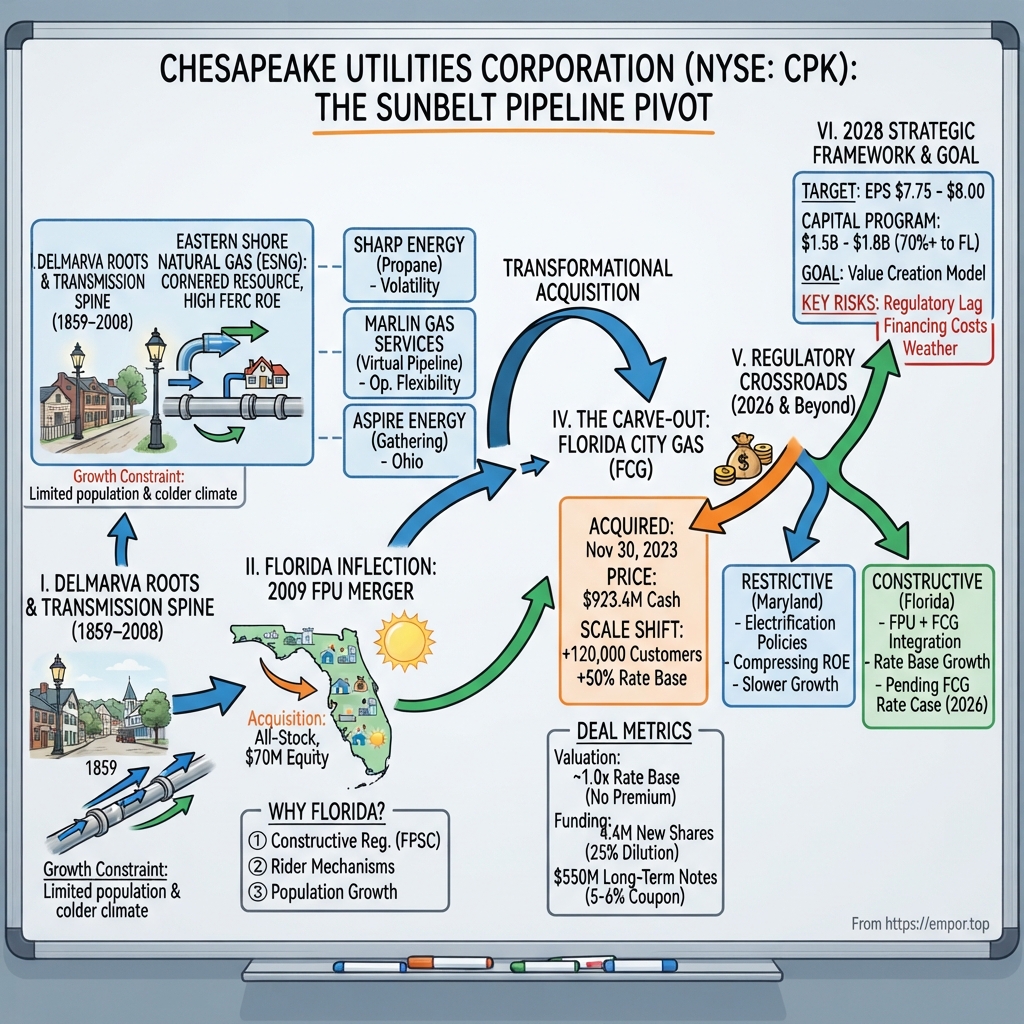
Chesapeake Utilities Corporation (NYSE: CPK): The Sunbelt Pipeline Pivot
I. Prologue & The Hook: The Billion-Dollar Carve-Out in the Sunshine State
On the morning of September 27, 2023, NextEra Energy — the largest utility holding company in the United States by market capitalization, the owner of Florida Power & Light, and the nation's leading developer of renewable power — announced it was selling a natural gas distribution business.2 The buyer was not Southern Company, Dominion Energy, or Enbridge, nor was it an infrastructure fund backed by a Canadian pension. Instead, the buyer was Chesapeake Utilities Corporation, a regional operator unfamiliar to most generalist investors, headquartered in Dover, Delaware, with a market capitalization smaller than the annual capital budget of NextEra's flagship utility.
The price was $923.4 million in cash, and the deal closed on November 30, 2023.1 For NextEra, the sale represented a minor divestiture and a clean portfolio realignment. For Chesapeake Utilities, it was the largest transaction in a corporate history dating back to the installation of Dover's gas streetlights in the 1850s. That single check expanded Chesapeake's regulated rate base by roughly half and added about 120,000 customers across eight Florida counties, extending from Miami-Dade and Broward in the south to Brevard on the Space Coast.1
It was a classic corporate maneuver: a disciplined, smaller operator acquiring an asset that a larger parent had outgrown or deprioritized. Yet transactions like this pose a question that takes years to resolve: did the buyer uncover an overlooked bargain, or did it acquire a business that the seller was entirely right to shed?
The scale shift
Before the transaction, Chesapeake Utilities operated as a two-state barbell: a Delmarva Peninsula natural gas franchise linked to an interstate transmission pipeline, alongside a Florida franchise acquired in 2009 that had steadily expanded into the more dynamic half of the business. After the purchase, Florida was no longer merely a second operating leg; it became the company's core engine. The combined Florida natural gas customer base surpassed 200,000 meters, and Chesapeake's economic center of gravity — the jurisdiction where new capital would be deployed, where rate cases would be litigated, and where population growth would either validate or test the investment thesis — shifted decisively south.1
The episode thesis
Management's investment case relies on a clear operational playbook. Chesapeake argues it possesses a repeatable strategy: acquiring sub-scale or neglected regulated gas distribution assets near book rate base — at times when broader sector transactions command substantial premiums — and earning a regulated return while deploying incremental capital through state-approved infrastructure riders that bypass lengthy base-rate proceedings. If executed consistently, this approach can serve as a dependable value-creation model within the regulated utility sector.
The counterargument is equally concrete. To fund the purchase of Florida City Gas, Chesapeake issued roughly 4.4 million common shares and approximately $550 million in long-term notes at coupons far higher than utility issuers faced three years earlier.3 Common share count expanded by approximately 25 percent in a single transaction, and higher interest expense became a lasting structural drag on earnings. Furthermore, the acquired assets operate in a market where gas consumption differs markedly from the Mid-Atlantic — driven far less by winter space heating and more by water heating and commercial kitchens — all amid ongoing debates over building electrification across the company's operating footprint.
Both perspectives carry weight. The ultimate success of the acquisition depends on how the Florida Public Service Commission treats the capital Chesapeake has deployed into the acquired network, and whether management's long-term earnings guidance of $7.75 to $8.00 per share by 2028, supported by a $1.5 billion to $1.8 billion capital program, withstands regulatory scrutiny.4
The roadmap
The narrative unfolds across six chapters. First, the 170-year Delmarva monopoly and the transmission bottleneck that secured a defensible niche for a modest utility. Second, the 2009 Florida Public Utilities merger that established the two-state footprint and clarified management's core competencies. Third, the unregulated initiatives — virtual pipelines, propane distribution, and Ohio midstream infrastructure — which yielded one strategic asset alongside ventures that struggled to scale. Fourth, the NextEra negotiations and carve-out execution. Fifth, the post-transaction financing structure and dilution dynamics. Finally, the contrasting regulatory landscapes: a Florida commission historically regarded as constructive, set against a Maryland commission advancing in a far more restrictive direction.
To understand why a Delaware gas utility made a transformative acquisition in South Florida, the story begins with the geography that defined its origins.
 Subscribe on LinkedIn
II. Delmarva Roots & The Transmission Bottleneck: 1859–2008
In 1859, a lamplighter walked the streets of Dover, Delaware, at dusk with a taper, igniting gas mantles fed by a small facility on the edge of town where coal was baked in sealed retorts to produce flammable vapor. That manufactured "town gas" was dirty, low in heat content, and laced with carbon monoxide, but it provided municipal lighting that did not depend on candles or whale oil. The Dover Gas Light Company, chartered in 1853 and operating from 1859, is the ancestor of everything that follows.[^2]
Nineteenth-century manufactured-gas systems operated as local monopolies in the most literal sense: isolated networks of underground pipes serving the lamps and buildings of a single municipality. Over the following century, thousands of these municipal franchises were rolled into holding companies. Many were pyramided into speculative financial structures that collapsed in 1929. The survivors were dismantled and reorganized under the Public Utility Holding Company Act of 1935, which broke apart multi-state holding companies and pushed utilities toward geographically integrated, regulated operating units.
Chesapeake Utilities Corporation emerged from that reordering, consolidating in 1947 into the entity that carries the name today.[^2] The postwar decades provided the expansionary tailwinds common across the American utility sector: rapid suburban development, rising appliance adoption, and the arrival of interstate pipeline networks delivering natural gas from the Gulf Coast and Appalachia. The influx of conventional methane rendered manufactured gas obsolete almost overnight and transformed the operating economics of local distribution.
The cornered resource: Eastern Shore Natural Gas
During this expansion, Chesapeake established an infrastructure asset whose strategic significance far exceeded the utility's modest corporate size. Geographically, the Delmarva Peninsula presents unusual distribution constraints. A narrow landmass bounded by the Chesapeake Bay to the west and the Atlantic Ocean to the east, the peninsula sits isolated from the primary interstate natural gas trunklines — Transcontinental Gas Pipe Line (Transco), Texas Eastern Transmission, and Columbia Gas Transmission — which traverse the mainland to the west. Moving gas onto Delmarva required a dedicated transmission spine.
Eastern Shore Natural Gas serves as that spine. It is an interstate pipeline system, regulated by the Federal Energy Regulatory Commission rather than by state utility commissions, and it functions as the single transmission backbone connecting Delaware and Maryland's Eastern Shore to the upstream interstate network.9 Every gas customer on the peninsula — Chesapeake's own retail distribution systems, municipal utilities, poultry processing plants, and heavy industrial loads — depends on capacity across Eastern Shore.
Owning this transmission backbone provided two structural advantages over ordinary distribution mains that shaped the company's long-term business model.
The first advantage is regulatory. Interstate transmission falls under FERC jurisdiction, which has historically authorized returns on equity between 10.5% and 11.5% for pipeline assets — structurally higher than the 9.25% to 10.0% returns state public service commissions typically grant local distribution utilities. For the same capital expenditure on pipeline infrastructure, the allowed return is materially higher solely as a function of which regulatory agency writes the order.
The second advantage is replaceability. While local distribution mains can theoretically be duplicated by a competitor permitted to excavate a municipal street, an interstate transmission corridor crossing coastal wetlands, tidal marshes, conservation easements, and established town centers cannot be replicated under modern environmental permitting frameworks or economically rational capital budgets. The rights-of-way themselves constitute the barrier to entry. While Chesapeake developed Eastern Shore out of operational necessity in the mid-twentieth century rather than deliberate moat-building, the pipeline evolved into a protected, cornered asset. Over subsequent decades, the company systematically expanded its capacity, most recently with the Worcester Resiliency Upgrade, which received its FERC certificate order in January 2025.7
The geography trap
Yet even a protected resource has limits when confined to a peninsula with a finite population.
By the mid-2000s, Chesapeake's growth constraints were increasingly apparent. Delmarva's organic customer meter growth ran in the low single digits annually. The dominant regional electric utility, Delmarva Power (later acquired by Exelon), possessed far greater scale and balance-sheet capacity. Chesapeake, by contrast, traded thinly, maintained a market capitalization that drew little institutional interest, and operated a rate base too small to absorb the capital expenditures required to generate meaningful earnings growth.
In the regulated utility sector, long-term earnings growth is essentially rate-base growth. Because utilities earn an authorized rate of return on invested capital, expanding earnings requires consistently deploying capital into approved infrastructure. Without rate-base expansion, a utility resembles a fixed-income instrument bearing equity volatility. By 2008, Chesapeake was approaching that condition: profitable, stable, and largely stationary. Management faced the dilemma common to small-cap utilities: expand geographically, or eventually become another operator's tuck-in acquisition.
Management chose expansion. The strategic question was where to deploy capital, and the opportunity presented itself amid the financial dislocations of 2008.
III. The Florida Inflection: The 2009 FPU Merger
In the autumn of 2009, capital markets remained severely strained in the wake of the 2008 financial crisis. Debt financing was prohibitively expensive where it was available at all, and small-cap utilities with substantial infrastructure spending needs and thin balance sheets struggled to fund their operations. Florida Public Utilities Company was a case in point.
FPU was a fragmented, capital-constrained enterprise. It operated small natural gas distribution systems scattered across Florida, an electric distribution utility serving Fernandina Beach and Amelia Island in Nassau County near the Georgia border, and a modest propane delivery business. While its operating franchises were legitimate, the company lacked the capital required to modernize its aging distribution networks—a mounting challenge in a frozen credit environment.
Chesapeake completed an all-stock merger with FPU in October 2009, exchanging 0.405 Chesapeake shares for each FPU share in a transaction valuing FPU's equity at roughly $70 million and roughly doubling the combined customer count to around 200,000.11 By the standards of utility consolidation, it was a modest transaction. For Chesapeake, however, it proved transformative: structuring the acquisition as an equity exchange allowed the company to expand without issuing debt into a hostile credit market.
Why Florida, specifically
The underlying strategic rationale centered on regulatory structure rather than geographic diversification.
American utility regulation is not a unified system; it comprises fifty distinct state jurisdictions, and the nuances between them largely dictate whether invested utility capital earns an adequate return. The variables that govern those returns are technical but critical: whether a commission uses a historical test year (establishing base rates on backward-looking costs, which forces utilities to absorb regulatory lag during heavy capital campaigns) or a forward test year (setting rates on projected costs, allowing new capital to begin earning an authorized return immediately); whether regulators permit riders—narrow, fast-track surcharges that recover specific categories of capital, such as pipeline safety replacements, without reopening an entire base-rate case; and whether the franchise territory is gaining customers.
Florida offered favorable conditions across all three measures. The Florida Public Service Commission has long utilized forward test years and approved multi-year rate agreements. It also established the Gas Reliability Infrastructure Program, an accelerated rider mechanism permitting gas utilities to recover the cost of replacing aging cast-iron and bare-steel mains outside of protracted general rate cases. Furthermore, Florida's demographic tailwinds—driven by steady net in-migration—provided an economic dynamic Delmarva structurally lacked: expanding residential and commercial developments requiring new meter connections year after year.
While Delaware's regulatory commission remained manageable, Maryland's regulatory environment progressively tightened. That regulatory contrast reinforced Chesapeake's strategic pivot toward directing growth capital southward.
The playbook forms
Integrating FPU formalized the operating playbook that would govern Chesapeake's capital allocation for the next decade and a half.
The model followed a deliberate sequence: 1. Acquire a sub-scale or capital-constrained utility whose valuation reflects deferred maintenance and limited investment capacity. 2. Identify vintage infrastructure—predominantly aging pipe—that state regulators actively want replaced for public safety and system reliability. 3. Channel capital expenditures through fast-track surcharge riders rather than contested general rate proceedings, converting lengthy regulatory lag into a programmatic spend-and-earn cycle. 4. Allow regional population growth to add customer meters to the modernized network.
Infrastructure riders are standard practice across the natural gas distribution sector; the competitive differentiator lies in execution. Securing rider approval yields returns only if a utility maintains the project management discipline and contract labor capacity to replace pipe at the authorized pace without incurring cost overruns.
The FPU transaction also presented Chesapeake with a structural outlier: a retail electric distribution utility in Nassau County with no operational or geographic link to the rest of the company's network. The electric system has served as a steady, regulated cash generator, though it remains the company's single asset most directly exposed to hurricane landfalls along the Northeast Florida coastline.
With the Florida regulatory model established and a secondary operating hub secured, management turned its attention to unregulated adjacent businesses where returns were not determined by state commissions.
IV. Unregulated Ventures: Virtual Pipelines, Midstream, & Propane
Regulated utilities frequently face the temptation to diversify into adjacent markets. The core regulated model is stable but constrained, and utility boardrooms routinely entertain proposals arguing that existing operational capabilities can generate higher, unregulated returns outside commission oversight. In practice, however, non-utility ventures often prove to be an expensive education.
Chesapeake's pursuit of unregulated growth produced three distinct businesses, whose diverging trajectories illustrate both the opportunities and the boundaries of utility diversification.
First, the sizing
Maintaining perspective requires looking at scale before strategic ambition. In 2024, Chesapeake's Regulated Energy segment generated roughly $196.2 million of operating income, compared with approximately $31.7 million from Unregulated Energy — an 86% to 14% split.[^2] Despite the narrative attention adjacent businesses often attract, unregulated operations represent a clear minority of the company's overall earnings power, functioning as secondary contributors rather than primary growth engines.
Marlin Gas Services: the virtual pipeline
In December 2018, Chesapeake acquired Marlin CNG Services.8 The business addresses a fundamental physical vulnerability in conventional natural gas distribution.
A standard gas utility relies on unbroken physical continuity: gas flows from transmission trunklines into distribution mains, through service lines, and into customer meters without interruption. When a segment must be taken out of service for federally mandated integrity inspections, repairs, or tie-ins for new construction, downstream customers face immediate outages. For a residential subdivision, that disruption is an inconvenience; for a hospital, glass manufacturer, or food processing plant operating continuous thermal processes, downtime can cost tens of thousands of dollars per hour.
A virtual pipeline substitutes tanker trucks for buried steel. Methane is compressed into compressed natural gas or chilled into liquefied natural gas, loaded into specialized high-pressure tube trailers, transported by highway, and decompressed or regasified directly into a customer's piping through mobile equipment. It functions, in effect, as a temporary pipeline on wheels.8
The strategic fit is pragmatic. Marlin addresses three distinct commercial needs: supporting Chesapeake's own distribution networks during planned maintenance and winter peak shaving; serving third-party utilities managing similar outages; and supplying stranded industrial customers that require gas before a permanent pipeline connection is economically justified. It also operates as a mobile off-taker for renewable natural gas projects, transporting biomethane from agricultural digesters and landfills before permanent pipeline interconnections are built.
Yet Marlin remains a specialized niche. It allows Chesapeake to serve select commercial demand without committing underground capital, but its financial contribution is modest. The company does not report Marlin's operating results as an independent line item, reflecting its limited materiality. For investors, the business provides operational flexibility and reliability insurance rather than standalone earnings power.
Sharp Energy and the propane franchise
Sharp Energy delivers bulk propane across the Delmarva Peninsula, into Florida, and in Pennsylvania.[^2] Propane serves rural and suburban territories beyond the reach of utility gas mains—delivered by truck, stored in on-site tanks, and sold at a retail markup over wholesale supply.
A strategically notable variation of this model is the Community Gas System. Rather than installing individual tanks for each property, Sharp installs centralized underground storage tanks and constructs underground distribution piping throughout a new residential subdivision. Homebuilders gain gas-equipped appliances as a selling feature, while Chesapeake secures a dedicated customer base within a developing master-planned community. Crucially, this infrastructure provides future optionality: when regional natural gas mains eventually expand into the corridor, the community system can be converted directly to utility service, transitioning unregulated propane consumers into regulated rate-base customers without the expense of secondary customer acquisition.
However, unregulated propane introduces structural earnings volatility that standard utility narratives tend to overlook. Operating margins depend on the spread between wholesale commodity costs and retail selling prices—an exposure that is only partially hedged and fluctuates alongside broader natural gas liquids and crude oil markets. Furthermore, sales volumes depend heavily on winter heating demand. An unseasonably warm winter, with heating degree days falling 10% to 15% below historical averages, flows directly through to reduced margins. Unlike regulated distribution utilities, unregulated propane distributors operate without weather-normalization adjustments or revenue-decoupling mechanisms. Consequently, Sharp Energy introduces recurring volatility into Chesapeake's quarterly reporting—a structural characteristic rather than a temporary anomaly.
Aspire Energy: the midstream bet that stayed small
In 2015, Chesapeake acquired Aspire Energy of Ohio, a gathering system comprising roughly 2,600 miles of pipeline serving Utica and Marcellus shale production.[^2] The original rationale was straightforward: as Appalachian shale production surged, gathering assets occupied a strategic position upstream, and management believed its pipeline operating capabilities could be transferred to midstream gathering.
More than a decade later, Aspire remains a modest regional gathering operation rather than a scalable midstream platform. It never developed into the foundation for a broader midstream business, nor was it expanded through follow-on transactions into a major regional presence comparable to the Florida franchise. While the asset has not suffered impairments or operational distress—functioning reliably as a steady business—it has not served as a meaningful growth engine.
This outcome challenges a common investor assumption: that acquisition capabilities in utility operations seamlessly transfer to adjacent sectors. The historical record indicates otherwise. Chesapeake's long-term compounding—across Delmarva retail distribution, the Eastern Shore transmission corridor, and the Florida utilities—has occurred almost entirely within rate-regulated frameworks. In those arenas, the company's true competitive advantages apply: navigating state and federal commission proceedings, managing capital expenditure programs eligible for rider recovery, and steadily expanding rate base. Outside that regulated perimeter, in upstream gathering where returns depend on producer drilling schedules, commodity cycles, and regional basis differentials rather than administrative rate orders, those advantages diminish.
The historical takeaway is more focused than a generic claim of acquisition prowess: Chesapeake has demonstrated consistent competence in acquiring and integrating rate-regulated distribution and transmission assets, but it has not demonstrated a similar ability to build scaled, unregulated platforms. That distinction is critical. The transformative transaction that reshaped the company's future occurred entirely within the regulated utility framework.
V. The Transformational Carve-Out: Buying Florida City Gas
In 2023, NextEra Energy faced a capital allocation environment that had tightened considerably.
The company was managing an extensive renewable energy build-out alongside Florida Power & Light's substantial ongoing capital expenditure program. Rapidly rising interest rates pressured capital-intensive utility models and hit NextEra Energy Partners—its yieldco affiliate—raising acute concerns regarding its financing structure and distribution growth targets. With capital becoming increasingly scarce and expensive, every portfolio asset had to compete directly for capital against higher-return alternatives.
Within that corporate portfolio sat Florida City Gas, a natural gas local distribution company NextEra had acquired from Southern Company in 2018 for $530 million.2 Although profitable and fully regulated, the gas distribution business was tangential to NextEra's core identity as a clean-energy developer and electric utility operator. It required ongoing capital commitments and management oversight while contributing less than one percent of consolidated net income.
Carve-outs often hinge on this structural asymmetry: an asset that is strategically marginal to a mega-cap utility holding company can prove transformative to a smaller regional operator. NextEra announced the sale of the gas utility in September 2023.2
The terms
The transaction closed on November 30, 2023, for $923.4 million in cash, which included the retirement of approximately $145 million of intercompany debt.1
The transaction multiple is best evaluated against rate base. In regulated utilities, rate base represents the depreciated original cost of assets approved by regulators to provide utility service, and it serves as the denominator on which a utility earns its authorized return on equity. When a utility acquires an asset at rate base, it earns the authorized return on its invested purchase price. Any acquisition premium paid above rate base cannot be recovered through customer rates; the premium generates no regulated return unless management can expand the rate base through fresh capital deployment or achieve sufficient operating efficiencies to justify the goodwill.
Florida City Gas transferred with an approved rate base of approximately $941 million.1 Against the $923.4 million net purchase price, Chesapeake completed the acquisition at roughly 1.0 times rate base—effectively eliminating the acquisition premium standard in the sector.
That valuation multiple anchors management's investment case. Over the preceding decade, natural gas distribution transactions routinely cleared well above book value. Precedent transactions—including CenterPoint Energy's divestitures in Arkansas and Oklahoma, the take-private of South Jersey Industries by an infrastructure fund, and Dominion Energy's utility sales to Enbridge—frequently commanded premiums between 1.4 and 1.8 times rate base as infrastructure capital competed for steady, regulated cash flows. Against that benchmark, acquiring a Florida gas franchise near book value reflected favorable timing rather than aggressive bidding: a motivated seller, a rising interest rate environment that sidelined leveraged infrastructure buyers, and a transaction size too small to draw attention from mega-cap utilities.
The defensible conclusion is that Chesapeake avoided overpaying. However, acquiring an asset at rate base is not equivalent to buying at a discount to intrinsic value; it simply ensures the buyer earns an authorized, regulated return on its invested capital rather than an extraordinary one. Any excess economic return depends on subsequent operational execution: deploying capital into system modernization, connecting new meters, and achieving administrative cost efficiencies across a combined Florida operating platform.
What came with the check
The acquisition transferred approximately 3,800 miles of distribution mains serving roughly 120,000 customers across eight Florida counties.1 The geographic footprint spans two distinct operating environments. In South Florida, Miami-Dade, Broward, and Palm Beach counties represent mature, densely settled urban territories. High customer density per pipe mile significantly lowers operating costs per meter, while extensive commercial loads in hospitality and food service provide steady, year-round gas demand. Farther north, Brevard County on the Space Coast presents an industrial growth profile, where commercial aerospace manufacturing and launch-related operations have driven continuous industrial build-outs.
When integrated with Chesapeake's legacy Florida Public Utilities network, the combined Florida customer base moved past 200,000 meters, establishing Chesapeake as the second-largest investor-owned natural gas distributor in Florida behind Emera subsidiary TECO Peoples Gas.1
Securing the second-largest investor-owned position in a rapidly growing state at book value offered a compelling strategic foundation. Yet funding a near-billion-dollar carve-out presented immediate balance-sheet realities, shifting the central investment debate from acquisition pricing to capital structure and equity dilution.
VI. Balance Sheet Stress & Equity Dilution: Funding the $923M Bet
Financing a large utility carve-out entails a fundamental timing mismatch: the acquired assets and their funding costs appear on the balance sheet immediately, but the offsetting regulated earnings arrive only on the utility commission's schedule.
Chesapeake funded the Florida City Gas purchase through a conventional utility financing package—free of structured vehicles or minority equity partners—balancing debt and equity to satisfy credit rating agency expectations.
The equity tranche and the dilution
In late 2023, the company issued approximately 4.4 million common shares, raising around $366.4 million in net proceeds.3 That offering expanded the share count from roughly 18 million to approximately 22.8 million—an immediate dilution of about 25 percent, as reflected in the share counts reported in the fiscal 2023 annual filing.10
A 25 percent expansion in the share count carries tangible economic consequences: for legacy shareholders, each dollar of pre-existing earnings was diluted to an eighty-cent claim. To avoid per-share value destruction, the acquired business must generate meaningfully more earnings per dollar of invested capital than the legacy footprint, rather than simply expanding corporate scale.
The economic defense of issuing equity in a regulated utility rests on statutory capital structures. Regulators authorize a utility's return on equity based on an approved capital ratio. Funding a near-billion-dollar acquisition entirely with debt would have breached target leverage ratios, triggered credit rating downgrades, increased subsequent borrowing costs, and prompted commissions to impute a hypothetical, lower-equity capital structure in future rate proceedings. In the utility sector, maintaining equity capitalization is a regulatory prerequisite rather than an optional corporate preference.
However, that regulatory justification holds only if equity proceeds are deployed into an expanding rate base. Issuing shares to acquire static assets merely redistributes earnings claims from legacy shareholders to new investors.
The debt tranche
Alongside the equity, the company issued approximately $550 million of senior unsecured long-term notes with coupons ranging from roughly 5.25% to 6.0%, supplemented by borrowings on its revolving credit facility.3
The timing of that debt placement proved expensive by historical standards. For much of the decade preceding 2022, investment-grade natural gas utilities routinely issued long-dated debt with coupons between 3.0% and 3.5%. Chesapeake financed its landmark acquisition at nearly double those historical yields. While that pricing reflected prevailing capital market conditions rather than poor execution, those higher coupons introduced more than $30 million in incremental annual interest expense against pre-transaction run-rate earnings—a structural obligation that remains in place until the notes mature and refinance.
The falsification test: was it accretive?
Management initially projected that the acquisition would be accretive to earnings per share within the first full year of ownership. Evaluating that projection requires balancing reported performance against the transaction's structural costs.
During 2024, the acquired utility's earnings contribution had to overcome two significant hurdles simultaneously: higher annual debt service and a 25 percent larger share denominator. When the company reported full-year 2024 results in February 2025, management reaffirmed its 2028 guidance.4 Yet reaffirming a long-term target is distinct from demonstrating near-term accretion. The financial architecture of the transaction meant the payoff was back-loaded by design: the ultimate earnings power of Florida City Gas under Chesapeake ownership depended directly on a general rate proceeding that had not yet concluded.
This dynamic illustrates the underlying nature of the transaction. The carve-out did not generate an immediate economic windfall upon closing; instead, it secured a claim on future regulatory outcomes. Investors who accepted the accretion thesis in 2024 were fundamentally underwriting the regulatory posture of the Florida Public Service Commission.
Credit discipline and the leverage question
The transaction also heightened balance-sheet leverage. Debt-to-capitalization rose above the mid-50 percent range—a level common among capital-intensive utilities, but elevated enough to invite rating agency scrutiny and limit discretionary capital spending.
This elevated leverage narrowed strategic flexibility. Operating with balance-sheet constraints, the company could no longer simultaneously fund a major regulated capital campaign, pursue additional utility acquisitions, and expand unregulated ventures. Capital allocation required strict prioritization, reinforcing a retrenchment from non-regulated initiatives. In practice, balance-sheet pressure enforced a degree of capital discipline that strategic planning alone rarely imposes.
The dividend conflict
An additional financial parameter involves corporate dividend policy. Chesapeake has paid dividends for 65 consecutive years and increased them for 22 consecutive years.[^1] While that record serves as a primary selling point for income-focused retail and institutional investors, it also functions as an inflexible cash obligation. A dividend cut would signal corporate distress, making the annual distribution a non-negotiable claim on operating cash flows.
That distribution requirement competes directly with a planned capital program of $1.5 billion to $1.8 billion across 2024 through 2028.4 Funding that volume of infrastructure while maintaining a dividend payout ratio between the mid-50 percent and 60 percent range, in a higher interest rate environment, leaves management reliant on three primary sources: operating cash flow, incremental debt issuance within rating agency tolerances, and additional equity. Any future equity issuance represents the most sensitive variable for existing shareholders, given the dilution already absorbed.
This capital tension will ultimately resolve in one of two ways. Either rate-base expansion outpaces incremental financing costs to support continued dividend growth, or dividend increases will slow to nominal increments that maintain the annual streak without delivering meaningful real growth. Which outcome emerges will depend once again on the regulators—and Chesapeake now operates under two state commissions moving in distinctly different directions.
VII. Competitive Landscape & The Tale of Two Regulators
Consider two utility hearing rooms meeting during the same week. In Tallahassee, commissioners review a gas utility's petition to recover capital deployed for pipeline safety upgrades in a state where legislation preempts municipal bans on natural gas connections. In Baltimore, commissioners work through the implementation of a climate statute directing Maryland toward building electrification, questioning with increasing scrutiny why captive ratepayers should fund four decades of new gas distribution assets in a jurisdiction committed to deep decarbonization.13
Chesapeake Utilities operates in both rooms. That regulatory divergence defines the company's operating reality.
Who it actually competes with
The concept of competition is often misunderstood in regulated utility distribution. Within an exclusive service territory, direct network competition does not exist; no competitor will invest the capital to trench a parallel gas distribution main down an already served street. Instead, distribution competition occurs along three distinct perimeters: against electric utilities for space and water heating loads in new construction, against alternative fuels or direct transmission bypass among large industrial customers, and across the capital markets for investor funding against larger, more liquid utility peers.
In Florida, the investor-owned gas distribution market is effectively a duopoly. TECO Peoples Gas, a subsidiary of Emera, is the dominant player, serving roughly 470,000 customers. Chesapeake's combined Florida Public Utilities and Florida City Gas footprint serves approximately 220,000 meters. Beyond those two investor-owned companies, municipal utilities—such as the City of Tallahassee's gas department and JEA in Jacksonville—serve local populations under tax-exempt financing structures and do not compete for private equity capital.
On the Delmarva Peninsula, Delmarva Power, an operating subsidiary of Exelon, dominates regional electric distribution and provides gas service across northern Delaware. Chesapeake distributes natural gas across central and southern Delaware as well as Maryland's Eastern Shore. While the two companies operate in largely segregated territories, they compete directly for appliance hookups in every newly permitted residential subdivision—a contest increasingly dictated by local building energy codes and appliance installation economics.
In interstate transmission, Eastern Shore Natural Gas operates alongside industry giants, including Williams—operator of the Transco pipeline system—Enbridge, and TC Energy. Eastern Shore does not compete directly against these trunklines; rather, it connects directly to them. It functions as a specialized last-mile transmission provider whose strategic value depends on the fact that those mainline systems terminate on the western side of the Chesapeake Bay.
The bifurcation
Delaware's Public Service Commission has historically maintained a balanced regulatory posture—neither overly generous nor overtly hostile to gas infrastructure investment. Maryland presents a far more challenging operating environment. The state's Climate Solutions Now Act established aggressive economy-wide greenhouse gas reduction targets, and its implementation—including building energy performance standards for large commercial structures—promotes comprehensive building electrification.13 The operational impact on a local gas distribution utility rarely takes the form of an outright legal ban; rather, it introduces persistent regulatory headwinds: heightened scrutiny of capital programs, skepticism regarding the prudence of main extensions to new subdivisions, and growing doubts about whether newly laid pipe will be permitted to earn a return over its full depreciable lifespan.
The depreciation issue is central to utility valuation. The regulated business model relies on the foundational compact that prudent capital outlays will be recovered through customer rates across decades. If regulators conclude that gas distribution networks will face phase-outs well before 2060, the traditional administrative remedy is to accelerate depreciation schedules. While accelerated depreciation recovers capital faster, it increases base rates in the short term, which can incentivize customer switching to electric alternatives. That dynamic leaves remaining fixed system costs spread across fewer billing meters. While this feedback loop is not visible in Chesapeake's reported results, it highlights the regulatory risk embedded in the company's northern gas rate base over a multi-decade investment horizon.
Florida offers a sharp regulatory contrast. The Florida Public Service Commission has long maintained an investor-constructive approach, utilizing forward-looking test years, multi-year rate settlement agreements, and specialized capital recovery riders for pipeline safety, cast-iron and bare-steel replacement, and system storm-hardening. Furthermore, state legislation prohibits municipal governments from restricting utility fuel choice. Combined with steady inbound migration, Florida provides the two variables gas utilities require most: authorized mechanisms to invest capital, and an expanding customer count over which to spread system costs.
The rate case that decides the thesis
These regulatory dynamics converge on Chesapeake's pending regulatory calendar. Rates for Florida City Gas were established under an order dating back to its previous tenure under Southern Company and NextEra Energy. Following the late-2023 closing, Chesapeake directed substantial capital into the acquired network—investments that do not generate authorized returns until formally incorporated into rate base through a comprehensive rate proceeding.
The first base-rate application for Florida City Gas under Chesapeake's ownership was docketed before the Florida Public Service Commission in 2026.6 The filing requests that regulators formally recognize the hundreds of millions of dollars deployed into the network since the previous rate order, while resetting the utility's authorized return on equity to reflect higher capital costs across the broader economy.
This dynamic illustrates regulatory lag: the procedural gap between when a utility spends money on capital improvements and when customer rates adjust to reflect that capital. During this interim period, the utility finances capital spending without earning an offsetting regulated return. In a near-zero interest rate environment, regulatory lag imposes a manageable burden. With debt coupons between 5.25% and 6.0%, however, unrecovered capital creates a noticeable drag on consolidated earnings, explaining why the financial accretion of the acquisition remained back-loaded.
A constructive rate order—recognizing capital additions and granting an authorized return commensurate with prevailing borrowing costs—would validate the acquisition thesis with reported earnings. A restrictive order—marked by disallowances or an authorized return on equity held near historical lows—would leave Chesapeake carrying a major Sunbelt utility financed at modern rates while earning returns tied to past economic conditions.
Resolving this docket represents the central near-term operational catalyst for the company. Understanding how Chesapeake navigates these disparate jurisdictions requires examining the structural protections that defend its existing networks.
VIII. Strategic Moats & Hamilton Helmer's 7 Powers Analysis
Beyond the regulatory proceedings, the underlying business rests on a fundamental competitive question: if a well-funded competitor sought to capture these customers, could it do so? Hamilton Helmer’s 7 Powers framework provides a structured lens for evaluating the durability of those advantages, distinguishing generic claims of utility moats from the specific economic mechanisms at work.
Cornered resource
The clearest structural advantage in the portfolio belongs to Eastern Shore Natural Gas. The underlying mechanism centers on physical rights-of-way and pipeline easements across the Delmarva Peninsula, secured under a federal certificate order and routed through coastal terrain that modern environmental permitting and land-use rules render virtually impossible to replicate. This aligns directly with Helmer's definition of a cornered resource: preferential access to a coveted, non-replicable asset on terms unavailable to potential competitors.
The critical limitation on that advantage is that a cornered resource protects an asset against rival infrastructure, not against declining demand. While Eastern Shore cannot be economically duplicated, its value diminishes if overall regional gas consumption contracts. The moat defends against competing pipeline developers rather than state decarbonization policies. Furthermore, because Eastern Shore represents a minority of Chesapeake's consolidated rate base, its structural protection cannot carry the entire corporate investment thesis.
Scale economies
Gas distribution economics fundamentally center on customer density per mile of main. Buried pipe represents a fixed capital and maintenance cost: it requires routine leak surveys, cathodic protection, integrity testing, and periodic replacement whether it serves ten meters or a hundred. Higher customer density dramatically lowers fixed unit costs per meter, making urban South Florida a structurally superior distribution territory compared to the rural corridors of Delmarva.
Integrating Florida City Gas with legacy Florida Public Utilities operations yielded tangible administrative and operational synergies: unified billing and customer information platforms, centralized dispatch, joint procurement of pipe and fittings, and a coordinated contractor workforce across the Florida peninsula. In a regulated utility, however, operational cost savings do not accrue entirely to equity holders. Over successive rate proceedings, regulatory commissions capture a substantial portion of these efficiencies and pass them back to ratepayers through lower operating expense allowances, limiting the extent to which operational synergies translate into permanent earnings upside.
Switching costs
For an existing residential customer equipped with a gas furnace, water heater, range, and clothes dryer, the friction of abandoning the network is substantial. A full transition to electric appliances—incorporating heat pumps, hybrid water heaters, induction cooking, and frequently an upgraded 200-amp electrical panel with dedicated branch circuits—often requires an upfront outlay ranging from several thousand dollars to well into five figures. In commercial and industrial accounts, switching barriers are even more pronounced. Hotels managing high peak hot-water demand, commercial bakeries, institutional kitchens, and aerospace manufacturing facilities on the Space Coast rely on high-temperature thermal processes that cannot be easily or affordably electrified with existing technology.
Yet switching costs defend only the installed base; they offer no defense at the point of new construction. A developer designing a master-planned community incurs zero switching cost when deciding whether to install gas mains or build an all-electric subdivision. In jurisdictions where building codes and state subsidies favor full electrification, legacy meters may remain secure while net additions grind to a halt. That divergence encapsulates the operating reality Chesapeake faces in Maryland.
Counter-positioning, partially
The company's virtual pipeline operation, Marlin Gas Services, exhibits elements of counter-positioning. Traditional pipeline operators and local distribution utilities operate business models anchored in permanent, buried steel infrastructure, rendering them structurally ill-suited to serve temporary, emergency, or off-system mobile demand. Marlin addresses customers requiring mobile compression, integrity testing bypasses, or temporary off-grid supply—a niche that incumbent transmission operators cannot easily pursue without disrupting their core operating models.
To qualify as an enduring power in Helmer's framework, however, counter-positioning must protect a business at sufficient scale to generate outsized economic rents. Because Marlin represents only a specialized operational niche within Chesapeake's unregulated portfolio, its strategic distinctiveness provides operational flexibility rather than a material driver of enterprise valuation.
Porter, briefly
Applying Michael Porter’s five forces framework reveals an asymmetric competitive landscape. The threat of new entrants is virtually nonexistent; municipal franchise rights and FERC certificates establish statutory barriers that prevent direct network duplication. Supplier power among upstream gas producers is largely neutralized by regulatory design, as wholesale commodity costs are passed directly to end consumers through fuel adjustment mechanisms without an equity markup. While commodity price spikes can strain customer affordability and elevate bad-debt expense, the utility’s regulated earnings remain decoupled from wholesale gas prices. Buyer power is negligible among captive residential consumers, though large industrial off-takers possess the leverage to negotiate discounted transportation tariffs by credibly threatening direct pipeline bypass.
The threat of substitutes represents the primary point of structural divergence between Chesapeake's northern and southern jurisdictions. In Maryland, state climate mandates and efficiency incentives position cold-climate heat pumps as a policy-subsidized alternative to natural gas space heating over the long term. In Florida, where space heating is negligible, natural gas serves water heating, cooking, pool heaters, and commercial thermal demand. In those end uses, electric substitution is economically less compelling, and state policy actively protects consumer fuel choice.
Rivalry within existing franchise boundaries is nonexistent, though competition against electric utilities for new residential hookups remains active across both geographies.
The broader strategic conclusion is clear: Chesapeake's competitive moat protects its physical corridors and territories, not the underlying commodity. The primary threat to its long-term cash flows is not another utility building parallel pipes, but rather legislative and regulatory substitution policies that discourage methane consumption. That vulnerability places disproportionate importance on executive capital allocation—and on management's decision to concentrate future investment in jurisdictions where regulatory policy aligns with infrastructure expansion.
IX. Management, Governance, & Executive Incentives
In a regulated utility, the primary institutional relationship is often not with customers or wholesale suppliers, but with state regulatory commissioners—and that relationship is built over decades through hearing room testimony and defensible accounting.
Jeffry M. Householder brought that regulatory background to the corner office when he became President and Chief Executive Officer in January 2019, succeeding Michael P. McMasters, while also serving as Board Chairman.[^1] Crucially, Householder emerged from Florida Public Utilities—the business Chesapeake acquired in 2009—rather than from the company's legacy Delaware operations. His operational background was formed within Florida utility management and regulatory practice before the Florida Public Service Commission.
That operational background helps explain the company's geographic reorientation. An executive whose career and professional network were established in Tallahassee was positioned to identify a carve-out opportunity in Florida gas, assess regulatory feasibility before the commission, and act quickly when NextEra Energy sought to divest Florida City Gas. The carve-out stands as the defining transaction of Householder's tenure, and his leadership will ultimately be judged on its operational execution and regulatory return.
The CFO transition
In 2026, the company executed a significant senior leadership transition.
Beth Cooper, Executive Vice President and Chief Financial Officer, retired on June 30, 2026, after a 36-year career at the company.5 Having guided Chesapeake's capital markets strategy through multiple expansion cycles and the financing of the largest acquisition in its history, Cooper's departure marked the exit of substantial institutional memory.
The succession choice signaled corporate priorities. Effective July 1, 2026, the CFO role passed to Jeff Sylvester, previously Senior Vice President and Chief Operating Officer.5
Elevating an operations leader into the chief financial seat reflects a deliberate strategy. Boards seeking capital markets financial engineering or portfolio restructuring typically recruit investment bankers or corporate treasurers. Promoting an operating officer indicates that the board views the primary corporate challenge as execution: physically deploying a multi-billion-dollar capital program, keeping field crews on schedule, documenting project costs to satisfy regulatory auditors, and converting construction work in progress into approved rate base.
Viewed constructively, the appointment indicates the board recognizes that long-term earnings growth is an operational and regulatory task rather than a capital-structuring problem. A more skeptical interpretation notes that the company placed an executive without an extensive public-markets finance background into the CFO role at a moment when balance-sheet leverage remains elevated and the equity dilution story requires rigorous defense before institutional investors. Distinguishing between those two perspectives will depend on how financial guidance is managed and met across upcoming reporting cycles.
Incentives
Annual short-term incentive compensation has been benchmarked against consolidated net income, business-unit operating margins, and operational safety and leak-reduction metrics. In natural gas distribution, system integrity metrics carry tangible economic significance, as pipeline safety incidents can quickly erode regulatory goodwill and invite punitive commission oversight.
Long-term incentive compensation has been structured around performance shares tied to three-year relative total shareholder return against a regulated utility peer index, alongside return on equity targets. This structure addresses common agency risks in the sector: relative TSR isolates management performance from broader macro interest-rate fluctuations, while ROE targets discourage spending capital solely to expand rate base regardless of whether regulators permit an adequate return.
Executive stock ownership guidelines require the CEO to hold a meaningful multiple of base salary in common shares. On insider trading behavior, analytical restraint is warranted: an absence of insider sales over a given window provides limited insight into intrinsic value and should not be framed as evidence of corporate conviction.
The credibility test
Evaluating executive performance ultimately depends on delivery against public commitments. Chesapeake's long-term framework—targeting $7.75 to $8.00 in earnings per share by 2028 supported by $1.5 billion to $1.8 billion of capital investment—has been maintained consistently since the Florida City Gas transaction, including in full-year 2024 results and subsequent guidance updates.412 Narrative consistency is a legitimate positive: management has not incrementally trimmed targets or restructured the multi-year capital budget into unrecognizability.
What consistency cannot substitute for is execution. Reaffirming a 2028 earnings target costs little; achieving it requires a constructive rate order for Florida City Gas, disciplined construction delivery, and minimal further equity dilution. While narrative consistency demonstrates that management is not shifting its story opportunistically, a full verdict on management's execution must wait until the pending rate case concludes.
That dependency leads directly to the principal operational and regulatory risks confronting the business.
X. Risk Radar & The Skeptical Investor Stress Test
A short-seller evaluating Chesapeake Utilities would not attack the underlying physical assets. The assets are tangible, the operating franchises enjoy statutory protection, and customers reliably pay their bills. The vulnerability lies instead in the spread between the purchase price paid and the returns authorized by regulators—and in the reality that the company committed a quarter of its equity base to an outcome outside its direct control.
The ROE compression mechanism
The most immediate risk is regulatory arithmetic. Regulated utility earnings are, to a close approximation, the product of three variables: the approved rate base, the authorized return on equity, and the equity layer within the approved capital structure. State regulators dictate every component, including which capital expenditures qualify for inclusion in the rate base.
A reduction of just 50 basis points in authorized return on equity across Chesapeake's combined rate base translates into an annual pre-tax earnings reduction of roughly $8 million to $10 million. For a company of this capitalization, that is not an immaterial adjustment—it represents a substantial share of projected annual earnings growth, wiped away by a single regulatory order.
This is an active risk rather than a hypothetical one. Public utility commissions determine authorized returns with close attention to regional peer precedents and consumer bill sensitivity. After a decade of historically low borrowing costs, regulatory returns across the sector trended downward. A utility that funded an acquisition with senior notes yielding near 6% and subsequently receives an authorized return calibrated to an earlier, lower-rate regime faces an uncomfortable arithmetic: its return on invested capital fails to clear its marginal cost of funds. That dynamic forms the core of the bear case.
Maryland electrification
The second risk unfolds more gradually. Maryland's building energy performance standards and the broader implementation of its Climate Solutions Now Act directly challenge the growth engine of the northern utility business—specifically, new customer connections and main extensions into newly permitted subdivisions.13 The threat is not an immediate, catastrophic asset write-down, but rather an incremental regulatory reclassification: deploying capital into a jurisdiction whose commission has grown increasingly skeptical that fossil-gas distribution mains have a multi-decade operational future.
Assessing this exposure requires perspective. Delmarva no longer represents the majority of Chesapeake's rate base, and tilting the multi-year capital budget heavily toward Florida acts as an intentional hedge. That tilt is the central strategic rationale of the southern pivot. Yet the northern assets do not vanish simply because executive attention has shifted southward, and an eventual terminal-value haircut on that northern infrastructure remains a lingering drag on long-term corporate valuation.
Florida weather
The third risk is familiar to anyone living in the Sunbelt. A major hurricane landfall introduces two distinct operational vulnerabilities. The retail electric distribution network serving Fernandina Beach and Amelia Island faces physical damage to overhead wires and poles—the single most storm-exposed asset class in the corporate portfolio. Concurrently, the natural gas networks across Central and South Florida risk volumetric demand losses when commercial hospitality and industrial accounts suspend operations, coupled with the expense of repairing and re-pressurizing damaged distribution systems.
Florida's regulatory framework provides relatively constructive mechanisms for storm restoration: utilities are permitted to defer recovery costs for commission review and, when appropriate, finance prudently incurred expenses through low-cost securitization bonds. However, cost recovery lags the physical storm by multiple quarters or even years. The cash outlay occurs immediately. For a company operating with heightened balance-sheet leverage, a severe storm represents a pressing liquidity test before it becomes an orderly regulatory filing.
A compounding secondary risk has also emerged across the state. As property insurance premiums have surged throughout Florida, the total cost of homeownership has faced sustained pressure. Because population in-migration is an economic trend rather than a guaranteed constant, any slowdown in new residential construction would directly soften the meter-growth assumptions underpinning the entire Florida expansion.
Cost of capital and refinancing
The long-term debt issued in late 2023 to finance Florida City Gas carries maturities spaced well into the future, providing both insulation and a structural constraint. The insulation is the absence of an immediate debt wall. The constraint is that if benchmark interest rates remain structurally elevated when refinancing windows approach, the blended cost of debt will not ease; it will persist, compressing interest coverage ratios toward thresholds that prompt rating agency action rather than routine commentary. A credit rating downgrade would increase borrowing costs across every incremental capital deployment, constraining the capital program at the exact stage when project delivery is essential.
RNG and virtual pipeline capital discipline
The final risk involves unregulated energy initiatives. While smaller in pure dollar exposure, it represents the area where investor expectations are most easily mismanaged. Development of renewable natural gas projects across the country has slowed considerably, as volatile credit pricing under California's Low Carbon Fuel Standard and the federal Renewable Fuel Standard has made long-term project underwriting unpredictable. Projects that appear viable under favorable environmental credit prices are routinely delayed or shelved when those credits decline.
For Marlin Gas Services, that volatility directly affects market demand, because transporting renewable natural gas was presented as a primary commercial catalyst for expanding virtual pipeline capacity. The governing discipline test is whether management avoids deploying capital into specialized tube trailers and mobile compression units ahead of committed long-term customer contracts. Given the trajectory of Aspire Energy—a logical midstream expansion that failed to build meaningful scale—the prudent stance is to remain skeptical of unregulated growth claims until their contribution is verified in segment operating income.
None of these risks are unique to Chesapeake Utilities. What elevates their significance is capital concentration: having absorbed substantial equity dilution and higher-cost debt to finance its Florida acquisition, the company possesses less balance-sheet cushion than it had prior to the transaction, leaving it with narrower latitude to withstand unexpected regulatory or operational shocks.
XI. Playbook: Business & Investing Lessons
Strip the narrative back and what remains is a set of transferable observations about how smaller operators occasionally outmaneuver industry giants—and the precise conditions under which that maneuver actually generates durable economic value.
Lesson 1: The best assets to buy are the ones your seller has stopped thinking about
Florida City Gas was never an inherently impaired business. Rather, it became an irrelevant one to its corporate parent. Held inside NextEra Energy, a regional gas distribution network was forced to compete for capital and executive bandwidth against gigawatt-scale renewable development pipelines and a flagship electric utility, losing that internal competition on strategic priority rather than standalone merit. The asset's economic value to a focused local operator was structurally higher than to a diversified conglomerate, and that valuation spread is where an acquirer's return takes shape.
The generalizable insight: carve-outs from motivated corporate sellers represent one of the few remaining avenues to avoid competitive auction pricing in mature, highly consolidated industries. Yet the caveat is severe. An acquirer must possess the specific operational discipline required to run the acquired network as well as—or better than—its prior owner. Chesapeake possessed that capability within Florida gas distribution. Conversely, the company lacked that operational edge in non-utility gathering, a reality illustrated by the limited scale achieved with Aspire Energy in Ohio.
Lesson 2: Jurisdiction is a business input, not a background condition
Investors often treat the regulatory environment as a routine risk factor disclosed in annual filings. In capital-intensive infrastructure, however, regulatory jurisdiction operates as a core product specification. The identical foot of pipe, installed by the same crew under an identical depreciation schedule, produces a fundamentally different economic return depending on which commission issues the order, whether rate cases rely on forward-looking or historical test years, and whether fast-track capital recovery riders are available.
Viewed through this lens, Chesapeake's multi-decade migration from the Delmarva Peninsula into the Southeast functions as a deliberate regulatory arbitrage: directing capital away from jurisdictions that increasingly scrutinize the long-term viability of fossil gas infrastructure and toward states that authorize constructive cost-recovery mechanisms. Whether that geographic reorientation was an intentional master strategy or the byproduct of opportunistic dealmaking, the economic outcome remains identical.
The risk, however, is that jurisdictional favor is never permanent. Regulatory constructiveness remains an administrative and political variable subject to mean reversion. Florida's supportive posture reflects current political dynamics, meaning any multi-year utility plan extending through 2028 and beyond is fundamentally underwriting the persistence of an external policy framework that carries no contractual guarantee.
Lesson 3: Mobile capital beats stranded capital when the future is uncertain
The virtual pipeline concept offers a model that applies well beyond gas distribution. In any industry facing uncertain multi-decade demand for fixed infrastructure, serving customers through mobile, redeployable equipment rather than permanent buried assets provides a clear risk-mitigation premium. That advantage does not stem from superior operating margins, but from preserving the option to exit without writing off sunk capital. A tube trailer or mobile compressor can be repurposed, redeployed to another region, or liquidated on the secondary market; a hundred miles of buried steel main cannot.
Nevertheless, this operational lesson must be weighed against its actual financial scale. Chesapeake's virtual pipeline capability through Marlin Gas Services serves as a practical, defensive operational tool rather than a standalone corporate growth engine—a perspective reinforced by management's practice of not disclosing its operating results as an independent segment.
Lesson 4: Dilution is a debt that rate base must repay
The governing discipline across this transaction remains pure balance-sheet arithmetic. Expanding the common share count by roughly 25 percent is economically justifiable in a capital-intensive utility only if the acquired network provides a dependable path to compound approved rate base faster than the equity base diluted—and only if regulators formally authorize compensatory returns on that expanded capital.
This arithmetic explains why the pending Florida City Gas base-rate proceeding is not an incremental regulatory filing, but the defining operational catalyst for the entire transaction. An acquisition funded with substantial equity, purchased at book value, but subsequently subjected to regulatory disallowances or compressed returns on equity becomes structurally value-destructive, regardless of how disciplined the initial purchase multiple appeared.
That tension sets up the final evaluation: what conditions must hold for this Sunbelt pivot to succeed, and what verifiable evidence would indicate the thesis has failed?
XII. The Bull vs. Bear Case & What to Watch
Two coherent stories can be told from the same set of facts, and the discipline of evaluating both is more instructive than endorsing either.
The bull case
The bull case rests on a straightforward operational chain. Rate base compounds at a high single-digit to low double-digit annual rate through 2028, driven by the $1.5 billion to $1.8 billion capital program deployed disproportionately into Florida, where population growth generates new meters and where riders permit near-contemporaneous recovery of safety and replacement capital.4 The Florida City Gas rate proceeding resolves constructively, recognizing the capital deployed since acquisition and setting an authorized return on equity consistent with prevailing capital costs, which converts the acquired network from a partially earning asset into a fully earning one and releases the accretion that 2024 and 2025 results could not show.6
Alongside that regulatory recognition, the combined Florida operating platform delivers administrative and field cost synergies that lift achieved returns relative to authorized levels, enabling the company to deliver on its 2028 earnings framework.12 Meeting a multi-year financial target that public markets heavily discounted would, under standard equity valuation dynamics, support a valuation re-rating toward established high-growth gas distribution peers such as Atmos Energy.
Yet the most compelling version of the bull case does not depend on multiple expansion. It centers instead on entry valuation: Chesapeake acquired a premier Sunbelt regulated franchise at book value during an era when comparable distribution networks commanded steep premiums. Entering at book value, steadily expanding rate base, and operating under a constructive regulatory commission represents an economic combination that can compound quietly over an extended horizon.
The bear case
The bear case requires no operational crisis; it requires only an unexceptional regulatory outcome.
Suppose the Florida Public Service Commission trims a portion of the post-acquisition capital additions as premature or unproven, while capping authorized return on equity below 10 percent. The acquired asset then generates a regulated return that, set against debt financing near 6 percent and a 25 percent larger share count, produces per-share earnings growth that lags Chesapeake's pre-acquisition trajectory. The transaction becomes not a catastrophe, but a persistent disappointment: an expansion of corporate scale that failed to enhance per-share economics.
If interest rates remain structurally elevated, higher debt service will continue absorbing a substantial share of operating income. Dividend growth would slow toward nominal annual increases that preserve the 22-year streak in form rather than purchasing power. Concurrently, Maryland's building electrification mandates continue depressing northern meter growth while introducing scrutiny over depreciable asset lives, pulling consolidated organic growth below 3 percent.
In that scenario, Chesapeake risks trading as an over-leveraged regional hybrid: a natural gas utility burdened with an electric distribution carve-out, a volatile retail propane distributor, a sub-scale midstream gathering system, and a specialized trucking fleet. Valued at a conglomerate discount, the enterprise becomes harder for institutional investors to underwrite than any of its underlying operating units.
An activist critique against that structure is straightforward: divest the non-core unregulated businesses, simplify the portfolio to regulated gas distribution across two core jurisdictions, apply net proceeds to pay down balance-sheet debt, and allow the market to value a cleaner pure-play utility. The counterargument is that the unregulated businesses are too small for their sales to move the balance-sheet needle materially—an observation that underscores why their presence complicates the core corporate narrative.
Where the balance sits
A balanced assessment acknowledges that the entry multiple was disciplined, the strategic logic was sound, the execution risk is real, and the decisive catalyst remains outside executive control. The carve-out has not yet proven accretive on a per-share basis, not because of operational mismanagement, but because of regulatory structure: regulated assets generate returns only when state utility commissions authorize them.
That dynamic is not an indictment of the acquisition. It defines the nature of the wager, demonstrating that the evidence required to judge the transaction arrives on a regulatory calendar rather than a quarterly earnings call.
The three KPIs that matter
Ultimately, the entire corporate thesis distills into three observable operational indicators:
One: consolidated regulated rate base. This is the company's central earnings engine. Management's long-term framework requires rate base to compound from roughly $1.8 billion toward $2.4 billion or more by 2028. If rate-base growth falters—whether through regulatory disallowances, construction delays, or balance-sheet financing constraints—the multi-year earnings framework fails regardless of operational performance elsewhere. Investors can track this level and trajectory directly through annual regulatory and financial filings.
Two: achieved ROE versus authorized ROE. Authorized return on equity represents regulatory permission; achieved return represents operational reality. The spread between them measures regulatory lag and operating efficiency. When consolidated earned return tracks close to authorized levels, rate case decisions are translating directly into investor returns. A persistent shortfall indicates capital is being deployed faster than commission orders can absorb it—a condition that, under elevated debt coupons, erodes shareholder value in real time.
Three: unregulated segment operating income, and specifically whether the virtual pipeline business earns its capital. This metric tests capital allocation discipline. If unregulated operating income expands without requiring continuous surges in maintenance and growth capital, the operational optionality thesis holds. If sustaining those operations requires ever-escalating capital commitments, Marlin risks repeating Aspire Energy's trajectory: a plausible operational adjacency that absorbs executive bandwidth and capital while contributing minimally to consolidated net income. Under that outcome, shareholder capital would be far better directed into Florida's rate base.
Tracking these three measures over the next several years will resolve whether the Sunbelt pivot was an astute piece of regulatory arbitrage or an expensively financed expansion of corporate size without a corresponding transfer of per-share value. Chesapeake Utilities secured an expansive canvas in Florida. What remains to be determined is what state regulators permit the company to paint.
References
-
Chesapeake Utilities Corporation Completes Acquisition of Florida City Gas — chpk.com, 2023-11-30 ↩↩↩↩↩↩↩
-
NextEra Energy Announces Sale of Florida City Gas to Chesapeake Utilities — nexteraenergy.com, 2023-09-27 ↩↩↩
-
Chesapeake Utilities Form 8-K: Financing Details and Common Stock Offering for FCG — sec.gov, 2023-11-28 ↩↩↩
-
Chesapeake Utilities Corporation Reports Full Year 2024 Financial Results & 2028 Guidance Reaffirmation — chpk.com, 2025-02-20 ↩↩↩↩↩
-
Chesapeake Utilities Announces Executive Succession: Beth Cooper Retirement and Jeff Sylvester Named CFO — chpk.com, 2026-04-15 ↩↩
-
Florida Public Service Commission Docket No. 2026-GU: Florida City Gas Base Rate Proceeding — floridapsc.com, 2026-04-30 ↩↩
-
Federal Energy Regulatory Commission: Eastern Shore Natural Gas Worcester Resiliency Upgrade Certificate Order (Docket CP23-536-000) — ferc.gov, 2025-01-16 ↩
-
Chesapeake Utilities Corporation Acquisition of Marlin CNG Services — chpk.com, 2018-12-19 ↩↩
-
Eastern Shore Natural Gas Company Transmission Tariff & System Overview — esng.com ↩
-
Chesapeake Utilities Form 10-K for Fiscal Year Ended December 31, 2023 — sec.gov, 2024-02-23 ↩
-
Florida Public Utilities Company Historical Merger Agreement with Chesapeake Utilities — fpuc.com, 2009-10-28 ↩
-
Chesapeake Utilities Reaffirms Long-Term Capital Investment and EPS Guidance — seekingalpha.com, 2025-11-06 ↩↩
-
Maryland Public Service Commission: Climate Solutions Now Act Implementation and Gas Utility Infrastructure Orders — mpsc.state.md.us ↩↩↩
 LinkedIn
 WhatsApp
 Reddit
 Hacker News
 Email
Email Kindle
 RSS Feed
 Spotify
 Apple Podcasts
 Amazon Music
 Audible
 YouTube