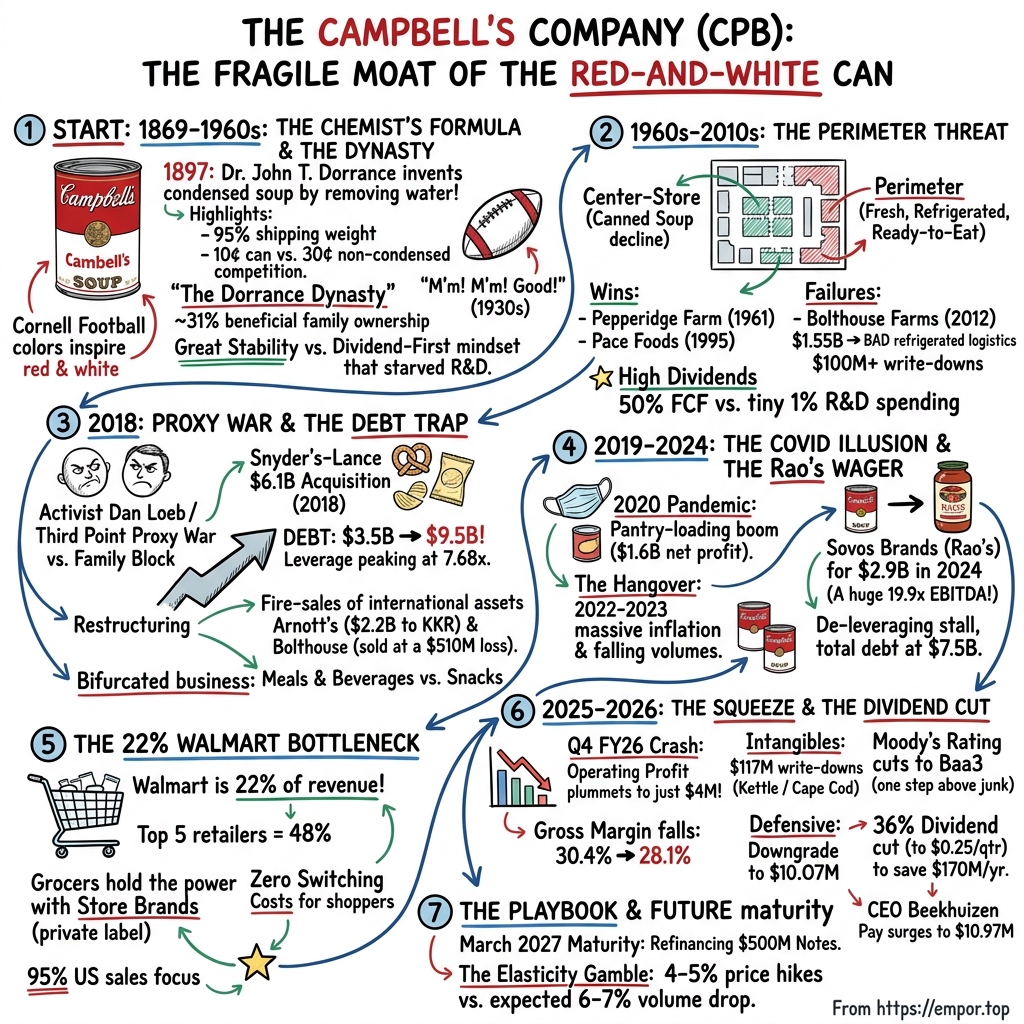
The Campbell’s Company: The Fragile Moat of the Red-and-White Can
I. The Red-and-White Can in the Clearance Aisle
On the morning of September 3, 2026, Mick Beekhuizen walked investors through the worst quarter of his tenure, and arguably one of the worst in the modern history of the company he runs. The Campbell's Company had just closed its 2026 fiscal year, and the fourth quarter alone told the story.
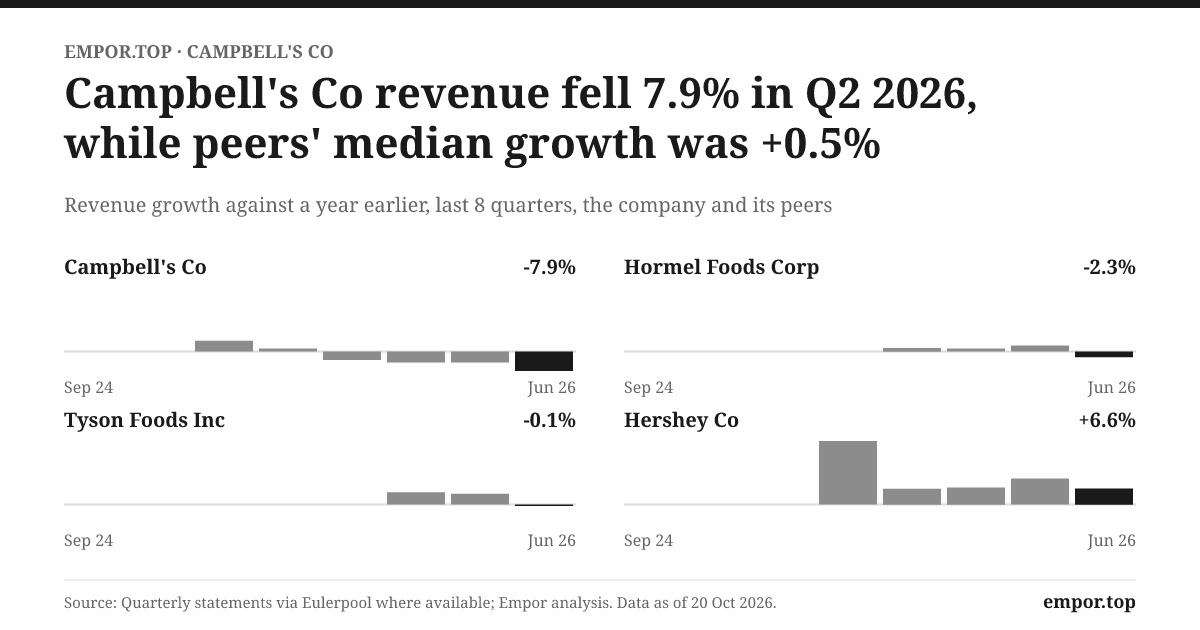
Sales had fallen about 8% from a year earlier. Operating profit, which had been about $269 million in the same quarter of 2025, came in at roughly $4 million.1 After interest and taxes, the quarter ended in a net loss of about $60 million, or about 23 cents a share.1
Then came the part that long-time shareholders had never expected to hear. The quarterly dividend, a payout that generations of retirees had treated as close to a utility bill in reverse, would be cut from 39 cents a share to 25 cents, a reduction of about 36%.1
For fiscal 2027, management guided to organic sales falling about 3%, and explained that it was raising prices by an average of 4% to 5% across roughly 60% of the portfolio while assuming that shoppers would respond by buying less.2
The detail came from the chief financial officer, Todd Cunfer, who described the increase as "fairly modest" and said the company had taken "a prudent approach" to elasticity by assuming 1.5 times, a choice he acknowledged would hurt net sales "because of the volume impact."2 The guidance that followed was blunt.
Adjusted earnings per share, which had been $2.17 in fiscal 2026, were expected to fall to between $1.65 and $1.80, a decline of roughly a fifth, and adjusted operating earnings were forecast to drop between 7% and 12%.1 Beekhuizen did not dress it up. "Our performance is not where it needs to be," he said, "and we are taking decisive action to improve it."1
When JPMorgan's Tom Palmer asked how retailers were taking the price increases, Beekhuizen called the dialogue "appropriately constructive."2 It was a careful phrase, and a revealing one. A company with unquestioned pricing power does not need to describe its conversations with grocers as constructive. It simply raises the price. That tension, between a brand people love and a price they may refuse to pay, runs through everything that follows.
Three weeks later the credit market delivered its own verdict. On September 23, Moody's cut Campbell's senior unsecured rating from Baa2 to Baa3, the lowest rung of investment grade, and its commercial paper rating to Prime-3, keeping the outlook negative.3 The agency put Campbell's adjusted leverage at roughly 4.9 times earnings before interest, tax, depreciation and amortization, and said it expected earnings to weaken again in fiscal 2027.3 One more notch down and Campbell's bonds would be classed as junk.
It is worth pausing on how strange that sentence is. This is the company whose label Andy Warhol painted, by hand, thirty-two times in 1962, one canvas for each soup variety Campbell then sold, and first hung in a row at the Ferus Gallery in Los Angeles like groceries on a shelf.4
The Museum of Modern Art calls the series the signature work of Warhol's career.4 Few corporate logos have become art; fewer still have become shorthand for permanence itself. The red-and-white can was supposed to be the safest thing in the pantry.
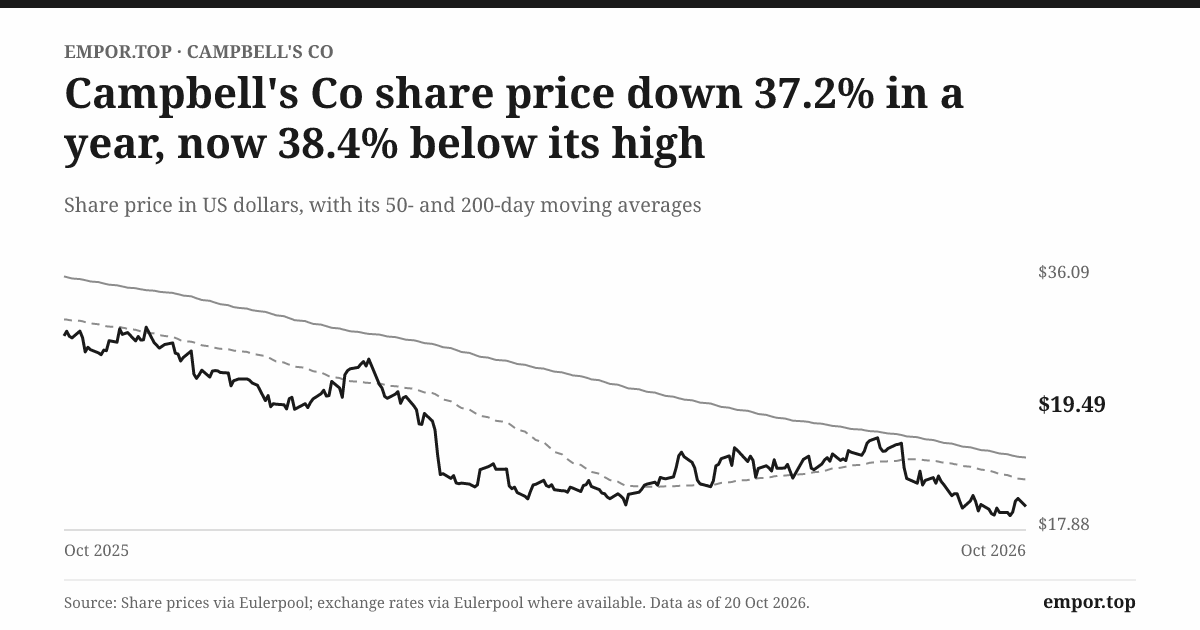
The stock market no longer treats it that way. On October 20, 2026, Campbell's shares traded at about $19.49, roughly 38% below their high of the past year, giving the company an equity value of about $5.8 billion.[^5]
Add the debt and subtract the cash, and the enterprise is worth about $12.6 billion. In other words, lenders now have a larger claim on the business than shareholders do. The family-controlled icon has quietly become a company in which bondholders sit at the head of the table.
The name on the door has changed too. In September 2024 the board proposed dropping the word "Soup" and becoming The Campbell's Company, on the grounds that soup was no longer the whole story; the portfolio now ran from Goldfish crackers and Snyder's pretzels to Rao's pasta sauce.5
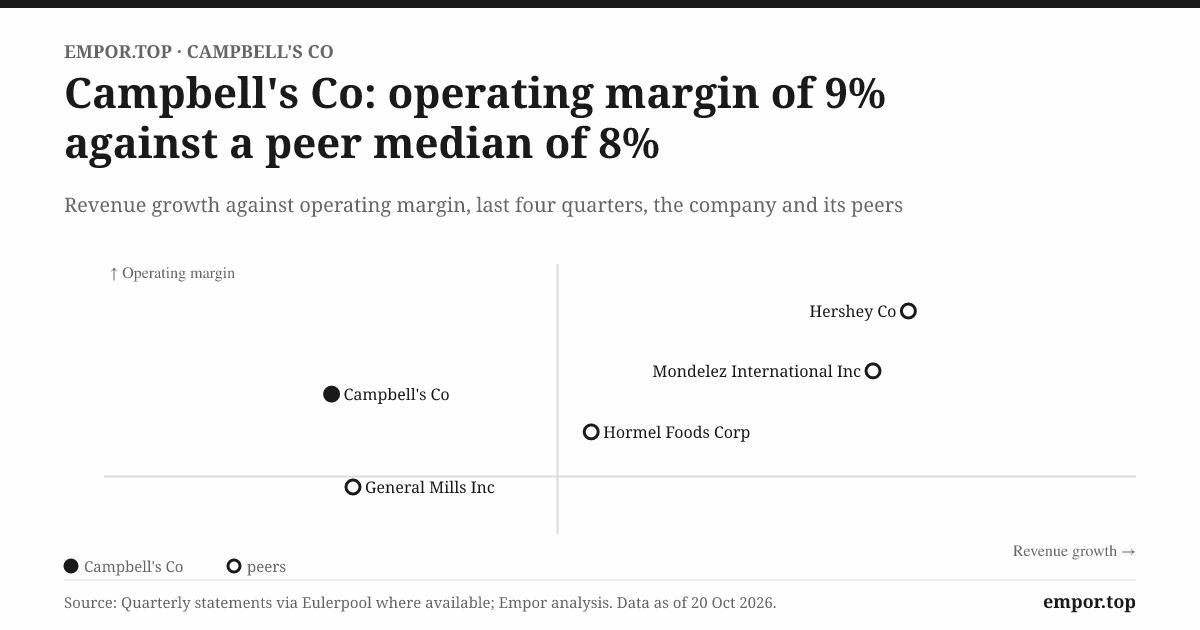
The shares still trade on the Nasdaq Global Select Market under the ticker CPB.6 But fiscal 2026 delivered an operating margin of about 8.7%, the lowest in the past decade outside the disrupted year of the Snyder's-Lance takeover.6
So how did America's most famous grocery brand, backed by more than a century of family control and the kind of steady cash flows that made it a pension-fund staple, end up cutting its dividend while carrying about $7.1 billion of debt?6 That is the question this story sets out to answer, and it breaks into four smaller ones that will follow the reader all the way through.
The first is about pricing. Can Campbell raise prices without triggering volume losses that cost more than the price gains bring in? The second is about margins. Is the collapse in profitability a passing shock from cocoa, potatoes, oils and tariffs, or a permanent erosion of what a branded can of soup can charge in the center of a supermarket?
The third is about cash. Over the twelve fiscal years to 2026, Campbell generated about $10.5 billion of free cash flow; can a machine like that defend $7.1 billion of debt and still pay for reinvention? And the fourth is about intent: is the company investing for organic renewal, or shrinking itself to service what it owes?
The short version of the answer is that Campbell got caught in the classic pincer of consumer staples. On one side sat a pile of debt taken on to buy growth that the core business could not produce. On the other sat retailers and shoppers who had learned, after two years of inflation, to say no.
When those two pressures met in the summer of 2026, the dividend aristocrat became a balance-sheet repair project. To understand why the fortress proved so fragile, it helps to start with why it was ever a fortress at all, and that takes the reader back to a chemist in Camden, New Jersey, who figured out how to sell water by leaving it out.
 Subscribe on LinkedIn
II. The Chemist’s Formula: Condensed Soup and the Dorrance Dynasty (1869–1960s)
The company began without soup. In 1869, Joseph A. Campbell, a fruit merchant, and Abraham Anderson, who had made iceboxes, went into business together in Camden packing canned vegetables, preserves and condiments.7 It was a crowded, low-margin trade. Canned food was heavy, bulky and expensive to ship, and the partners had no particular advantage over the dozens of other packers working the farms of South Jersey.
The advantage arrived in the form of a nephew. By the 1890s the business was run by Arthur Dorrance, and in 1897 he hired his brother's son, John Thompson Dorrance, a young chemist trained in Europe, at a wage that company histories put at $7.50 a week.8 Arthur reportedly thought the lab was a luxury. John thought soup was the opportunity, and he had spotted the one thing that made it uneconomic.
Soup, at the time, was mostly water. A can of ready-to-eat soup sold for around thirty cents, and most of what the customer paid for was the cost of moving liquid by rail and wagon in a heavy tin can.7
Dorrance's insight was to cook the soup concentrated, take most of the water out, and let the customer add it back at home. The same can now held roughly twice the soup. Tin, freight and shelf space per serving fell sharply, and Campbell could sell condensed soup for a dime.7
In business-strategy language, this was a genuine process advantage that fed directly into scale economies. A ten-cent can of soup that competitors could not match at their cost created volume; volume filled the factories; full factories lowered unit costs further; and lower costs protected the ten-cent price. Each turn of that wheel made it harder for a rival to enter. For decades, Campbell did not so much compete in canned soup as define the category.
The Dorrances also understood that a cheap product needed an expensive-looking face. In 1898 the company adopted the red-and-white label, a design that company lore says was inspired by the colors of the Cornell University football team.8
In 1904 came the Campbell Kids, the round-cheeked cartoon children drawn by Philadelphia illustrator Grace Gebbie Drayton.7 Later, radio would carry the "M'm! M'm! Good!" jingle into American kitchens.8 What began as a logistics trick had become one of the most recognizable pieces of consumer iconography in the world.
The ownership story ran in parallel. John Dorrance steadily accumulated control, and the business was renamed Campbell Soup Company in 1922.7 By his death in 1930, he was its sole owner.7 That single fact shaped the next century of the company. Dorrance's heirs inherited not a stake but a dynasty, held through trusts and family vehicles, and even after Campbell sold shares to the public in 1954, the family kept enough of them to decide its fate.9
The concentration has thinned over time but has never disappeared. In 2018, descendants of John Dorrance still owned about 41% of the company.10 Today the largest holders listed in Campbell's proxy are Bennett Dorrance-related entities with about 15% and the Mary Alice Dorrance Malone Revocable Trust with about 10%, alongside BlackRock at about 9% and Vanguard at about 8%.11 A quarter of the company in two family blocs is still more than enough to make any outsider's plan for Campbell a negotiation with Camden.
That control was a gift and a constraint at the same time. It kept the headquarters in Camden through decades when other food companies were bought, merged and moved. It also gave the company a particular culture around money.
A family that lives on its dividends tends to value the dividend. It tends to dislike issuing new shares, because new shares dilute the bloc. And when a family company wants to grow faster than its core product, and it will not sell equity to do it, the money has to come from somewhere else.
That somewhere else, eventually, would be the bond market. But for most of the twentieth century, Campbell did not need it. Condensed soup was a cash machine of rare purity, and the question that would haunt the company later, what to do with the cash when the core stops growing, had not yet arrived. It began to arrive when American shoppers started walking around the edges of the supermarket instead of down its middle aisles.
III. The Perimeter Threat and the Conglomerate Reflex (1960s–2010s)
Walk into an American supermarket in the early 2000s and the geography tells the story. Around the walls sat the fresh produce, the deli counter, the chilled juices, the organic yogurt and the bakery; this was where the growth was and where the store's marketing money went. Down the middle ran the long aisles of shelf-stable goods: cereal, pasta, crackers and, row after row, canned soup. Grocers called it "center store," and for Campbell it was home.
The first moves beyond soup were good ones. In 1961, Campbell bought Pepperidge Farm, the Connecticut baker founded by Margaret Rudkin, bringing with it premium bread, cookies and, eventually, the Goldfish cracker.7 Later the portfolio added Pace salsa, V8 juices and Prego sauce. These were all products that fit the machine Dorrance had built: packaged in a factory, shipped at room temperature, stacked in center store, and sold through the same grocery buyers who already took Campbell's calls.
Then the taste of the country moved. Younger consumers grew wary of sodium, preservatives and anything that came in a metal can. Fresh, chilled and "natural" foods became the aspirational purchase, and the soup aisle started to feel like something your grandparents bought. Campbell's core did not collapse; it simply stopped growing. Over the decade to fiscal 2026, total revenue grew only about 2% a year, and much of that came from acquisitions rather than from more people buying more soup.6
Campbell's answer under chief executive Denise Morrison, who took the job in 2011, was to follow the shopper to the walls.12 In July 2012 the company agreed to buy Bolthouse Farms, a California grower of fresh carrots, super-premium refrigerated juices and salad dressings, from private-equity firm Madison Dearborn for $1.55 billion in cash.13 Campbell said the deal would give it a foothold in a $12 billion packaged-fresh market and pair Bolthouse's drinks with V8.13
Bolthouse had reported sales of $689 million and adjusted operating profit of $92 million in its latest year, so Campbell was paying around seventeen times operating profit for a farm-to-fridge business it had never run.13 Garden Fresh Gourmet, a maker of refrigerated salsa and hummus, followed, and the pieces were combined into a division called Campbell Fresh.
The idea was sound on paper. The execution exposed a mismatch that would recur throughout this story. Campbell's entire system, from its plants to its trucks to its relationships with buyers, was built for products that last a year or more on a shelf. Carrots depend on the weather. Juice spoils in weeks.
A bad crop or a quality lapse cannot be smoothed with inventory. In fiscal 2018 alone, Campbell wrote off the remaining goodwill of the Bolthouse carrot unit, citing weather, tighter quality protocols and higher costs, and then took further impairment charges of $81 million on Garden Fresh and $384 million on the refrigerated beverage and dressing business.14
In April 2019, Campbell agreed to sell Bolthouse Farms to Butterfly Equity for $510 million, roughly a third of what it had paid seven years earlier.15 The fresh-food experiment had been a test of a simple claim: that a great center-store operator could transplant its skills to the perimeter. The record rejected it. Campbell's capabilities were real, but they were tuned to one temperature and one shelf life.
It is worth noticing how the failure surfaced. It did not arrive as a single catastrophe but as a series of quarters in which the carrot crop disappointed, quality protocols had to be tightened and costs ran ahead of plan, each one explained as a temporary setback.14
Only when the write-downs had piled up did the company concede that the problem was the business itself. That pattern, a structural problem reported as a string of transitory ones, is the one investors must keep in mind when they read the explanations for fiscal 2026.
Meanwhile, the cash kept coming, which is the strangest part of the story. A mature packaged-food business throws off more cash than its accounting profit, because it carries large non-cash charges for depreciation and amortization and needs relatively little new investment. Over the twelve fiscal years to 2026, Campbell reported about $8.4 billion of net profit but about $14.8 billion of cash from operations, or 176% of earnings.6 After capital spending, that left roughly $10.5 billion of free cash flow.
Where did it go? About half, roughly $5.2 billion, went straight back to shareholders as dividends.6 Research and development, the seed corn of a consumer products company, ran at about $100 million a year, or around 1% of sales.6 And most of the rest went to acquisitions and the interest on the debt that financed them.
Cash conversion of that quality looks like a moat on a spreadsheet. In practice it only becomes one if the cash is redeployed into something that earns more than it costs, and Campbell's fresh foray had shown that the company's instinct, when its core stalled, was to buy a new business rather than grow the old one.
By the middle of the 2010s, that instinct was about to be tested on a far larger scale. Fresh food had failed, soup was flat, and the board needed a growth story fast. It found one in a pretzel factory in Hanover, Pennsylvania, and in doing so, it set off the most dramatic year in the company's modern history.
IV. The Battle of 2018: Dan Loeb, Snyder’s-Lance, and the Debt Trap
On December 18, 2017, Campbell announced that it would buy Snyder's-Lance, the Charlotte-based maker of Snyder's of Hanover pretzels, Lance sandwich crackers, Kettle Brand and Cape Cod potato chips, and Late July tortilla chips, for $50 a share in cash.16 The equity price was about $4.87 billion; including the debt Campbell would assume, the deal was worth about $6.1 billion.16 It was the largest acquisition in the company's history, and it was paid for almost entirely with borrowed money.
The logic was easy to articulate. Snacking was growing, soup was not, and pairing Snyder's-Lance with Pepperidge Farm and Goldfish would create a snacks business big enough to stand next to Meals & Beverages as an equal half of the company.
The cost was equally easy to see on the balance sheet. Between fiscal 2017 and fiscal 2018, Campbell's total borrowings rose from about $3.5 billion to about $9.5 billion.14 Shareholders' equity at the time was only about $1.4 billion, so debt rose to roughly seven times equity.14
The deal closed in March 2018.14 Two months later, on May 18, Campbell reported a third-quarter loss of $393 million, cut its full-year earnings forecast in part because of costs tied to the acquisition, and announced that Denise Morrison was stepping down as chief executive, effective immediately.12 The company gave no reason. Board member Keith McLoughlin was named interim CEO, the shares fell toward a five-year low, and the board launched a strategic review of the entire portfolio.12
The vacuum attracted a predator. In early August 2018, Daniel Loeb's hedge fund Third Point disclosed a stake of about 6% and said it would work with George Strawbridge, a Dorrance descendant, to push for a sale; its filing said the only justifiable outcome of the review was for Campbell to be sold to a strategic buyer.17
Loeb, famous for scorching letters to boards, did not hide his view that the directors had presided over years of value destruction, from Bolthouse onward. When Campbell's review concluded that the company should sell its international and fresh businesses rather than itself, Third Point escalated.17
In September, Loeb nominated a full slate of twelve directors to replace the entire board.10 Third Point and Strawbridge together held about 8.4% of the shares.10 But the arithmetic of control was against them, because Dorrance descendants owned about 41% of the company, and most of that bloc was not with Strawbridge.10 The family that had built Campbell was now divided, with one branch siding with the activist and the two largest holders, Mary Alice Dorrance Malone and Bennett Dorrance, declining to join him.9
The proxy fight never reached a vote. On November 26, 2018, Campbell and Third Point settled: the board would add two Third Point nominees, and Loeb would drop the full-slate challenge.18 Weeks later, on December 20, the board named Mark Clouse, the former chief executive of Pinnacle Foods, as Campbell's next CEO, effective January 22, 2019, noting that Third Point had provided input into the search and supported the choice.19
Clouse was an unusual figure for a food company: a 1990 graduate of West Point and a former Army officer who had spent his career at Kraft, Mondelez and Pinnacle, the owner of brands like Birds Eye and Duncan Hines.2019 He knew center store intimately, and his mandate was clear. Fix the core, integrate the snacks, and pay down the debt, without selling the company.
Paying down the debt meant selling things, and some of the things were very good. In 2019 Campbell agreed to sell Arnott's, the beloved Australian biscuit maker behind Tim Tams, together with its other international operations, to KKR for about $2.2 billion.21 The sale closed in December 2019 for about $2.29 billion.22 Bolthouse went for its $510 million, and other European businesses followed. Campbell had defended its independence, but the price of that defense was a smaller, more American, more indebted company.
Here the popular account of 2018 deserves a correction. The common version casts the family and the board as having beaten back a raider. The record suggests something more uncomfortable: the activist lost the fight but won much of the argument.
Campbell ended up shedding fresh and international, replacing its CEO with a candidate Third Point endorsed, and adding Third Point's nominees to its board. What the family preserved was control. What it could not preserve was the balance sheet it had before the Snyder's-Lance deal, and that is the legacy that matters most for investors today.
Out of the turmoil came the structure Campbell still has: two roughly equal divisions, Meals & Beverages anchored by soup, broth, V8 and Prego, and Snacks anchored by Goldfish, Pepperidge Farm and the Snyder's-Lance brands.6 The pitch was diversification, a growth engine to offset a mature one. The fine print was a debt load that no longer left much room for error. And then, just as the debt was coming down, a virus sent Americans running back to the soup aisle.
V. The Covid Illusion and the $2.9 Billion Rao’s Wager (2019–2024)
In March 2020, as lockdowns spread across the United States, grocery stores were stripped bare in a matter of days. Toilet paper, flour, pasta and canned soup vanished from shelves. For a company whose product was built to sit in a pantry for a year, the pandemic looked like a homecoming. Parents rediscovered grilled cheese and tomato soup. Goldfish became a work-from-home survival tool. Campbell's plants ran flat out.
The headline numbers for fiscal 2020 looked spectacular. Net profit jumped to about $1.6 billion from about $211 million the year before.22 But most of that leap did not come from soup. Campbell booked a pretax gain of about $1.04 billion on the sale of Arnott's and its other businesses, and continuing operations earned $1.95 a share, up a respectable 24% but nowhere near the headline jump.23 The pantry-loading boom was real; the profit explosion was mainly an accounting echo of the 2019 divestitures.
The cash, however, was genuinely useful. Total debt fell by about $2.5 billion during fiscal 2020 as divestiture proceeds and strong operating cash flow went to the lenders.23 By fiscal 2021, debt was down to about $5.3 billion and debt-to-equity had fallen to about 1.7, a far cry from the near-eight-times peak of fiscal 2019.22 For a brief moment, Clouse's plan seemed to be working. The company had the strongest balance sheet it had enjoyed since before Snyder's-Lance.
Then came inflation. Through 2022 and 2023, the cost of steel cans, tomatoes, wheat, oils, freight and labor all rose sharply. Like every packaged-food company, Campbell pushed through round after round of price increases, and for a while shoppers paid. Reported sales climbed to about $9.4 billion in fiscal 2023.[^25] But underneath the dollar growth, the number of units moving through checkout lines was falling. Price was carrying the top line, and volume was quietly leaking out the bottom.
That is the context in which Campbell made its next big move. On August 7, 2023, it agreed to buy Sovos Brands, the owner of Rao's Homemade pasta sauce, Michael Angelo's frozen Italian meals and noosa yoghurt, for $23 a share in cash, an enterprise value of about $2.7 billion.24 Campbell's own accounts put the total consideration at roughly $2.9 billion.[^25] The Federal Trade Commission cleared the deal in March 2024, and it closed on March 12.2526
Rao's was the prize. It was a genuine phenomenon: a premium, slow-simmered sauce priced at several times the cost of a jar of Prego, made with Italian tomatoes and olive oil, and growing fast enough to make every other sauce maker jealous.
Rao's accounted for about 69% of Sovos's $837 million of adjusted net sales in 2022.24 For a company whose own sauce, Prego, sat in the value tier, owning the brand that was stealing shoppers at the top of the aisle made strategic sense.
The price is where the story turns. Campbell's own investor presentation disclosed that it was paying about 19.8 times Sovos's trailing adjusted EBITDA, falling to 14.6 times if one counted about $50 million of annual cost synergies Campbell expected to achieve within two years.24 Today the market values all of Campbell, debt included, at under ten times EBITDA.[^5] In other words, Campbell paid roughly double its own valuation for growth, and financed it with new debt.24
There is a defensible case for that. Fast-growing premium brands are scarce, and they trade at premium prices because they can compound. But the case rests on growth lasting long enough to grow into the multiple, and on synergies arriving on time.
The record so far is mixed: Rao's has remained a bright spot in Campbell's portfolio, but the company has not shown that it can turn the acquisition into enough operating profit to pull total margins up. Meanwhile, interest rates had moved sharply higher by the time the bonds were issued, so the cost of the wager rose before the first jar was sold under Campbell's ownership.
The cleanup began almost immediately. Campbell sold Pop Secret popcorn and then noosa yoghurt during fiscal 2024 and 2025 to trim the portfolio and raise cash.6 But the debt had already jumped back up: borrowings, which had fallen to about $5 billion, rose to about $7.5 billion at the end of fiscal 2024.[^25] Debt-to-equity went from about 1.4 back to about 2.0.[^25] The pandemic had given Campbell a rare chance to repair its balance sheet. Rao's spent the repair.
In December 2024, the board announced that Clouse would leave to become president of the NFL's Washington Commanders, and that Mick Beekhuizen, who had joined Campbell as chief financial officer in 2019 and had run the Meals & Beverages division since 2022, would take over as CEO on February 1, 2025.27
The man who had built the financial architecture of the Rao's deal now inherited its consequences. It is worth holding on to that detail: the CEO who would eventually cut the dividend had also been the CFO who helped finance the company that needed cutting. To understand why those consequences landed so hard, it helps to look at who actually holds the power in the business of selling food.
VI. Anatomy of Center-Store Grocery: The 22% Walmart Bottleneck
Every year, the commercial teams of America's food companies make their way to Bentonville, Arkansas, to sit across from Walmart's merchants. The meetings are polite and data-heavy. Walmart's buyers know exactly how fast each item sells in each store, what the private-label alternative costs to make and how much shelf each brand deserves. Campbell's people come to argue for price, placement and promotion. Walmart's people come to decide.
To see why those meetings matter so much, start with how Campbell actually makes money. It does not sell to consumers. It sells cases of packaged food, mostly at wholesale, to retailers and food-service distributors.6
The revenue it reports is the gross price of those cases minus a long list of deductions: promotional allowances, temporary price reductions, coupons, slotting fees for new items and volume rebates. There are no subscriptions, no long-term purchase commitments and no recurring contracts.6 Every quarter, Campbell's sales are the sum of thousands of negotiations about price and placement.
And those negotiations are concentrated. In fiscal 2026, Walmart and its affiliates accounted for about 22% of Campbell's net sales, and the five largest customers together for about 48%.6 No other single customer reached 10%.6 Those shares have barely moved in three years, which tells you this is not an accident of one season but the structure of the industry.6 Nearly half of what Campbell sells passes through the hands of five buyers.
What does that concentration mean in practice? When Campbell faces higher costs for tomatoes, cans or cooking oil, it has to persuade those buyers to accept higher list prices. The buyers have their own customers to protect and their own store brands to promote.
If a Campbell price increase makes a can of condensed soup look expensive next to Walmart's Great Value equivalent, the retailer can give the store brand more shelf space, put it at eye level, or simply let the Campbell's item lose its promotional slot. The brand rarely loses a shelf outright. It loses the end-cap, the feature in the weekly circular and the price gap that keeps shoppers loyal.
There is a clue to how this power is exercised in Campbell's receivables. At the end of fiscal 2026, customers owed Campbell about $578 million, roughly the same as a year earlier, equal to about 22 days of sales.6 The allowance against those receivables, which covers cash discounts, bad debts and returns, was only about $18 million, and actual product returns were under 2% of sales.6 Days to collect have actually fallen over the past decade, from about 29 in fiscal 2015.6
The conclusion is counterintuitive. Big retailers are not squeezing Campbell by paying late. They pay quickly and reliably. They extract their margin earlier in the chain, in the promotional dollars and price concessions that are netted out before revenue is ever recorded. A clean receivables ledger, in this industry, is not evidence of pricing power. It is evidence that the negotiation happened somewhere else.
Campbell does have one structural advantage on the retail side: distribution reach. Its snacks business relies in part on a direct-store-delivery network, run by independent contractors who own the routes that put Pepperidge Farm bread and Snyder's pretzels on shelves.
Campbell guarantees roughly 4,600 loans those distributors have taken out to buy their routes, with a maximum potential exposure of about $598 million, though the amount recognized on the balance sheet is not material.6 It is a quiet reminder that even Campbell's distribution advantage comes with a financial tail.
The geographic picture sharpens the point. About 95% of Campbell's sales are in the United States.6 That shields the company from swings in the dollar; its remaining currency exposures are mostly Canadian intercompany flows and the euro costs of a new Italian supplier, hedged with modest forward contracts.6 But it also means Campbell has no escape from the American grocery cycle. When U.S. shoppers trade down, switch to store brands or eat out more, there is no international division to offset it.
So the right mental model of Campbell is not a consumer subscription with brand loyalty locked in. It is a wholesale manufacturer whose pricing is set in negotiations with a handful of extremely powerful customers, and whose brands matter mainly because they give it leverage in those negotiations.
Strong brands make the retailer need you. Weak brands make you need the retailer. In fiscal 2026, more of Campbell's portfolio fell into the second category than management had expected, and that showed up in the worst way possible: in the margins.
VII. The Cost-Push Squeeze and the Q4 Wipeout (Fiscal 2025–2026)
Picture the snack plants in the summer of 2026. Potato prices were up. Cooking oils were up. Cocoa, which goes into Pepperidge Farm cookies, had been at record levels. Packaging was more expensive, in part because of tariffs on imported materials. And the company was in the middle of moving production lines and closing facilities as part of its restructuring, which meant extra costs and inefficiency before any savings arrived.1 Every one of those pressures landed on the gross margin.
Start with the long arc, because it explains why fiscal 2026 hurt so much. Campbell's operating margin was about 15.5% in fiscal 2021, at the tail end of the pandemic boost.22 It slid to about 11.5% by fiscal 2025 as inflation and the Sovos integration weighed on results.6
Then, in fiscal 2026, it fell to about 8.7%.6 Operating profit for the full year came in at about $852 million, down from about $1.12 billion the year before, while sales fell about 5% reported and about 2% on an organic basis.1
The gross margin carries most of the explanation. It fell from about 30.4% to about 28.1%, a loss of more than two percentage points.1 On a business of nearly $10 billion in sales, each point of gross margin is worth almost $100 million of profit, so that decline alone accounts for over $200 million of the operating profit drop.
Management attributed it to cost inflation, supply-chain friction and tariffs, partially offset by productivity savings.1 And because a strong brand can usually price its way through a cost spike, a gross margin that falls this far is itself a clue about how much pricing room the portfolio had left.
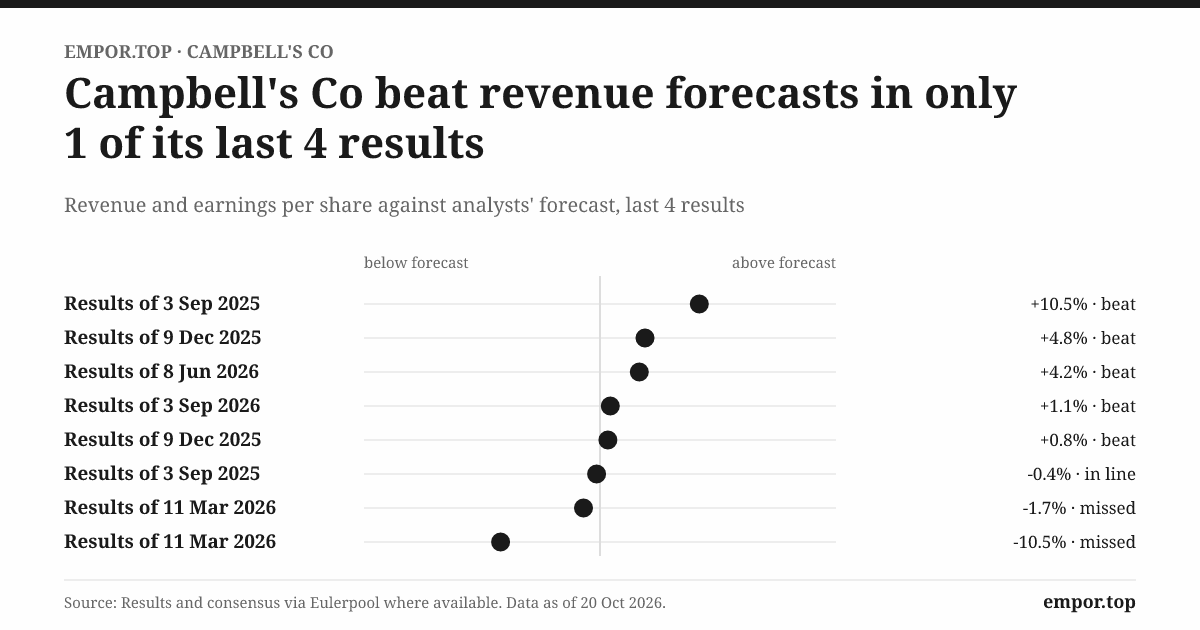
Then came the fourth quarter. Sales fell about 8% to about $2.1 billion, though part of that decline simply reflected an extra week in the prior year's quarter; on an organic basis sales slipped about 1%.1 Operating profit, by contrast, all but disappeared, and the company posted a loss of about 23 cents a share.1 For a staple food company with a century-old brand, that is a remarkable result, and it requires dissection rather than just a shrug at inflation.
The biggest single item was an impairment. Campbell wrote down the carrying value of the Kettle Brand trademark by $60 million and Cape Cod by $57 million, a combined $117 million before tax, or about 29 cents a share.1 Both brands came in with Snyder's-Lance in 2018.
An impairment is an accounting admission: it means the company no longer expects the brand to earn enough future profit to justify what it says the brand is worth on the balance sheet. It costs no cash today, but it is a direct verdict on the price paid eight years earlier.
The segment figures show where the damage concentrated. Meals & Beverages, the soup-and-sauce half of the company, saw full-year operating earnings fall about 14% to roughly $943 million on sales down about 4%.1 Snacks, the half that was meant to carry growth, saw operating earnings fall about 28% to roughly $386 million, on sales down about 6%.1
In the fourth quarter, Snacks organic sales fell about 6%, which management attributed mainly to the salty portfolio and to lower sales of third-party partner brands and contract manufacturing.1 In plain terms, the chips Campbell bought in 2018 were the weakest part of the business, and the meals business it had owned for a century was holding up better than the diversification meant to replace it.
On the call, management sounded more hopeful about some snacks than others. Trends in Goldfish during the quarter were described as "encouraging," but Cunfer warned that the first quarter of fiscal 2027 would see Snacks sales down by a high single-digit percentage, that a margin recovery in the division "really won't happen until the second half," and that chips would "take a little bit longer."2
Deutsche Bank's Steve Powers asked whether earlier investment in capabilities would have changed the outcome, an analyst's polite way of asking whether the problem had been visible, and fixable, sooner.2
The second item was restructuring. Campbell recorded about $67 million of restructuring charges during the year as it closed plants and cut costs.1 Add in litigation charges of about $14 million, partly tied to the Plum Organics baby food business Campbell sold in 2021, and the remaining costs of operating through a difficult period, and the quarter's profit simply vanished.6
It is tempting to read all this as a one-off, and management's adjusted figures encourage that view; adjusted operating earnings fell about 21% for the year, much less than the GAAP decline.1 But the trouble with excluding the impairments is that they are themselves the signal. Premium snack brands that cannot hold their carrying values are brands that cannot pass costs through to shoppers. The snacks division, which was supposed to be the growth engine, delivered the most visible margin pressure.28
There is one more move from fiscal 2026 worth noting, because it shows management thinking about supply rather than demand. In May 2026, Campbell paid $146 million for a 49% stake in La Regina, an Italian tomato processor that supplies Rao's, with up to $140 million more in deferred consideration that may be paid in cash or shares.6
Campbell controls La Regina despite owning less than half, so it consolidates the business and records the remaining 51% as a redeemable noncontrolling interest.6 In plain English, Campbell has taken on the obligation to potentially buy out the rest, at some future date, on terms that are not fully known.
The strategic logic is reasonable: securing tomato supply protects the economics of the best brand in the portfolio. The financial logic is more delicate. Campbell spent cash, assumed contingent liabilities and added euro currency exposure in the same year its profits halved and its credit rating came under pressure. That combination brings the reader to the question bondholders, rating agencies and the board all had to answer in September 2026: how much more strain can the balance sheet take?
VIII. The Balance Sheet Reckoning: Leverage, Downgrades, and Governance
On September 23, 2026, the warning that had been building since spring became formal. Moody's had already affirmed Campbell's Baa2 rating in April but shifted the outlook to negative, citing high leverage after acquisitions and soft operating performance, especially in snacks, with the brand portfolio as the main offset.28
Five months later the agency followed through, cutting Campbell to Baa3, the lowest investment-grade rating, and its commercial paper rating to Prime-3.3 The outlook stayed negative, which means Moody's sees more downside risk than upside from here.3
Why does one notch matter? A company rated Baa3 still borrows as investment grade, which keeps it eligible for the large pools of capital, from insurers to pension funds, that cannot hold junk. But Prime-3 commercial paper is a different matter. Short-term debt markets are far less welcoming at that tier, so cheap overnight funding becomes harder to rely on. And with a negative outlook, the next downgrade would push Campbell's bonds to Ba1, below investment grade, raising its cost of capital for years.
The debt itself breaks down simply. Total borrowings were about $7.1 billion at the end of fiscal 2026, against cash of about $394 million.6 Campbell carried about $6.7 billion of long-term debt, including about $500 million coming due within a year, plus small amounts of finance leases and La Regina's own borrowings.6
Campbell has said it expects to repay or refinance the $500 million of notes due in March 2027.6 Its revolving credit line is essentially unused and carries a covenant requiring adjusted EBITDA of at least 3.25 times interest expense, which leaves headroom today but means that profits cannot fall indefinitely.6
Those March 2027 notes were issued in an era of much lower rates. Refinancing them at today's rates, with a weaker rating, will raise the interest bill. That is the real cost of leverage in a period of falling profits: the cushion that cash flow provides shrinks from both sides, as earnings fall and interest rises.
That is the context for the dividend cut. Campbell paid about $470 million in dividends in fiscal 2026, roughly 117% of its net profit that year.6 With about 298 million shares outstanding, cutting the quarterly payment from 39 cents to 25 cents saves roughly $170 million a year.
Management presented the cut as a deliberate reallocation toward debt reduction and brand investment.1 It was also, very visibly, what a company does when a rating agency is watching and the payout exceeds earnings. Campbell also stopped buying back shares; it has not repurchased any since January 2026 and does not expect to in fiscal 2027.6
Beekhuizen called the reduction "a difficult decision" but "unfortunately a necessary decision."2 The first payment at the lower rate will go out on November 2, 2026, to holders of record on October 1.1 The release framed the purpose in one line: to help accelerate the path to reducing debt.1 Notably, neither the release nor the call put a number on the leverage the company is aiming for, which leaves investors to judge progress by the rating agencies' yardstick rather than management's own.12
The refinancing plan offers a glimpse of how tight the room has become. Asked about capital structure, Cunfer said Campbell was "strongly considering a hybrid" security for the $500 million due in March, an instrument that pays a higher coupon than ordinary senior bonds but that rating agencies treat as half equity.2
He also guided to interest expense about $25 million higher in fiscal 2027.2 A hybrid is a sensible tool for a company protecting a rating. It is also a tool that companies with abundant balance-sheet capacity rarely need.
Against that backdrop, executive pay looks out of step. Beekhuizen's reported total compensation rose from about $4.2 million in fiscal 2024 to about $11.0 million in fiscal 2026, his first full year as CEO.11
Most of the fiscal 2026 figure, about $8.0 million, came from stock awards, with salary and annual incentive pay each around $1.2 million.11 Meanwhile, diluted earnings per share fell to about $1.31 in fiscal 2026 from about $2.01 the year before.11
There is a fair explanation and an unfair one, and the record leaves room for both. The fair one is that a promotion to CEO comes with a bigger grant, and stock awards only pay out if the shares perform; with the shares down sharply, those awards are worth much less today than their grant-date value.
The unfair one is that a board that has just cut the dividend by more than a third is asking shareholders to accept more austerity than its executives. Shareholders gave 99% support to say-on-pay at the 2025 meeting.11 The next vote, along with an amendment to the long-term incentive plan, will come at the annual meeting on November 17, 2026.11
The contingent liabilities are manageable but worth naming. Beyond the Plum litigation, Campbell is negotiating a settlement over wastewater-treatment exceedances at its facilities, and management does not expect the outcome to be material.6
The guarantee of distributor loans, up to about $598 million, would only become a cash cost if many independent route owners defaulted together. The auditor issued a clean opinion on the fiscal 2026 financial statements.6 None of these is a reason to panic, but together they fill in the picture of a company with less slack than its brand suggests.
Put simply, the dividend cut was not the cause of the crisis; it was the cost of avoiding a worse one. A company that cannot both grow its dividend and pay down its debt has to choose, and Campbell chose its credit rating. Whether that was enough depends on a question bigger than the balance sheet: does Campbell's brand portfolio still give it the economic power to earn its way out?
IX. Powers, Moats, and Porter’s Five Forces
Stand in the soup aisle of any big American supermarket and count the options. Campbell's condensed, Campbell's Chunky, Well Yes!, Pacific broths, all from one company. Progresso from General Mills. A row of store-brand cans at a visibly lower price.
Two aisles over, the pasta sauce shelf: Prego and Rao's from Campbell, Barilla, Bertolli, and the store brand again. In the snack aisle, Goldfish and Snyder's pretzels sit next to Ritz and Cheez-It, Pringles and Lay's. This is where the question of Campbell's moat is decided, one purchase at a time.
The cleanest way to test the moat is through Hamilton Helmer's framework of seven powers: the handful of structural advantages that let a business earn returns above its cost of capital over long periods. Campbell has a plausible claim to two of them and a weak claim to the rest.
Branding is the strongest. A brand is a power when customers will pay more for the same functional product because of what the name signals. Rao's clearly qualifies; shoppers pay several times the price of mainstream sauce for it, and it has kept growing through a period of inflation. Goldfish has an emotional hold on parents and children that few snacks can match.
Classic Campbell's condensed soup still holds an extraordinary place in American kitchens. But the record narrows the claim. The $117 million write-down on Kettle and Cape Cod shows that not every brand Campbell owns carries pricing power.1 The brand moat is real, but it belongs to perhaps three or four franchises, not the whole portfolio.
Process power and scale economies were the original moat. Dorrance's condensing method and the scale it unlocked defined the soup business for decades. That advantage has faded. Canning, baking and chip frying are mature, well-understood processes. Contract manufacturers and rival companies can match Campbell's unit costs, and store brands are often made by the same kind of plants. Scale still matters in purchasing and distribution, but it no longer keeps competitors out.
Switching costs, the third power, are close to zero. A shopper who switches from Chunky to Progresso, or from Prego to a store brand, gives up nothing but a habit. Network effects, counter-positioning and cornered resources do not meaningfully apply. A packaged-food company does not get more valuable to each customer as it gains more customers, and nobody is prevented from making pasta sauce.
Porter's five forces complete the picture. The bargaining power of buyers is extreme: with Walmart at about 22% of sales and the top five customers at nearly half, retailers decide how much of any price increase sticks.6 The threat of substitutes is high, because a meal can come from the deli counter, a delivery app, a restaurant value menu or a private-label can. Supplier power is moderate to high, since tomatoes, wheat, potatoes, oils and cocoa all swing with weather and trade policy.
The threat of new entrants is low in canned soup, which demands capital and scale, but high in snacks and sauces, where small upstarts can build a following online and then win shelf space; Rao's itself is proof of how fast a premium brand can grow from a single restaurant's recipe. And rivalry is fierce, with General Mills, Kraft Heinz, Conagra, Mondelez and the private-label manufacturers all fighting for the same promotional dollars.
The most telling evidence on pricing power, though, comes from management itself. For fiscal 2027, Campbell is raising prices on about 60% of its portfolio by an average of 4% to 5%, and has told investors it assumes an elasticity of about 1.5.2 Elasticity is the ratio of volume lost to price gained.
At 1.5, every 1% of price increase costs 1.5% of volume. A 4.5% price rise therefore implies a volume drop of nearly 7% on those products, which means revenue from them falls by roughly 2.5%. Management is, in effect, choosing to raise prices to protect margin per unit while accepting that it will sell fewer units and less in total.
That is not how a company with strong pricing power behaves. A company with real pricing power raises prices and loses little volume; elasticity well below one is what brand loyalty looks like in the data. Campbell's own assumption admits that, across a large part of its portfolio, shoppers are more price-sensitive than loyal.
The historical record tested the claim that Campbell's brands could pass through inflation, and the answer is that they could in 2022 and 2023, with volume losses, and in 2026 they could not without impairments and a dividend cut.
The verdict, then, is narrower than Campbell's iconic status would suggest. The company retains genuine branding power in Rao's, Goldfish and core soup. It has lost the process power that built it. It faces extreme buyer power and near-zero switching costs.
The result is a business whose return on invested capital has fallen from about 20% in fiscal 2017 to about 6% in fiscal 2026, close to or below what its capital costs.146 That is what a fragile moat looks like in the numbers. And it is the backdrop against which the lessons of this story become clear.
X. Playbook: Business & Investing Lessons
Lay the whole Campbell story out on a table and four moments stand out. A chemist removing water from soup in 1897. A food company buying carrot farms in 2012. A board borrowing billions for pretzels and chips in 2018. And a dividend cut in 2026. Each was a decision about how to turn a great product into lasting value, and each holds a lesson that applies far beyond the soup aisle.
The first lesson is that cash conversion is not a moat. Campbell turned 176% of its net profit into operating cash over twelve years, a ratio most companies would envy.6 Yet its return on invested capital collapsed and its shareholders have endured a fall of about 67% from peak to trough over the past five years.[^5] Cash is only as valuable as the place it goes next.
At Campbell, too much of it went to interest on acquisition debt, to dividends that exceeded earnings, and to deals that were later written down. A cash machine pointed at the wrong targets is still a machine for destroying value. The line to remember: Campbell proved that a business can convert every dollar of profit into cash and still leave its owners poorer.
The second lesson is about buying growth to mask decline. When a core business grows at about 2% a year, the temptation is to buy something that grows at 20%. Campbell did it with Bolthouse, with Snyder's-Lance and with Sovos, paying about twenty times EBITDA for the last of them.24
Each deal transferred a large premium to the sellers and left Campbell's own shareholders with the debt. Paying a growth multiple for growth only works if the growth lasts and the core holds; when the core keeps shrinking, the acquired growth simply fills a hole. The line: you cannot borrow your way out of a declining category at a growth company's price.
The third lesson is to respect the boundaries of your distribution engine. Campbell's supply chain was a masterpiece for products that sit on a shelf for a year. It was a liability for carrots that rot in weeks.
The Campbell Fresh write-offs and the sale of Bolthouse for about a third of its purchase price showed that the skills of an ambient-goods company do not transfer to the refrigerated perimeter.1415 Many strategy decks talk about adjacencies; few test whether the operating machine can actually carry them. The line: a can of soup and a bag of carrots share a store, not a business model.
The fourth lesson is that multi-generational family control cuts both ways. The Dorrance bloc kept Campbell independent through the 2018 proxy fight and preserved a century of identity in Camden.10 It also preserved a dividend culture and an aversion to selling equity that, combined, pushed the company toward debt-financed deals whenever growth stalled. Family ownership protects a company from short-term raiders; it does not protect it from slow decisions. The line: the Dorrances saved Campbell from a sale, but not from itself.
The fifth lesson is about who really owns the shopper. When a fifth of your sales go through one customer and nearly half through five, your pricing strategy is ultimately approved in someone else's office.6 Campbell's 2027 price increases, and the volume losses it has already budgeted, are the clearest demonstration. The line that sums it up: in packaged food, the brand owns the label, but the retailer owns the shelf.
These lessons point toward the hardest question of all, the one investors face right now. At today's price, is Campbell a business whose problems are already in the share price, or one whose decline has further to run?
XI. Analysis & Bear vs. Bull Case
Imagine an investment committee meeting in October 2026. On the screen: a household-name food company whose shares have fallen about 38% from their high of the past year, trading at about 14.5 times trailing earnings, with a free cash flow yield of about 11% and a dividend yield of about 7% on the old payout, falling to around 5% on the new one.[^5]
On paper it looks cheap. The debate in the room is whether "cheap" is the right word, or whether the numbers describe a business still in the middle of its fall.
Start with how the market is pricing Campbell. At about 9.9 times EBITDA and about 1.3 times sales on an enterprise basis, Campbell is valued as a mature, low-growth business with real risk.[^5] Book value per share is about $12.83, and the shares trade at about 1.5 times that.[^5]
Return on invested capital is about 6%, down from about 20% in fiscal 2017.6 The price appears to assume that earnings stabilize near current levels but do not return to the old peak. Whether that is too pessimistic or not pessimistic enough depends on which case one believes.
A simple calculation sharpens the picture. Management's own guidance points to adjusted earnings of $1.65 to $1.80 a share in fiscal 2027.1 At about $19.50 a share, that puts the stock at roughly eleven to twelve times next year's adjusted earnings, a multiple that already embeds a decline. Now look at the cash.
If free cash flow holds near fiscal 2026's level of about $680 million, and the new dividend absorbs roughly $300 million, Campbell has something like $380 million a year left for debt reduction before any acquisition, earnout or restructuring cash.6 Against about $7.1 billion of borrowings, that is real progress, but slow progress: a turn of leverage is earned over years, not quarters, which is why the margin recovery matters far more than the dividend cut to the eventual outcome.
The case for the can
The bull case starts with the brands that still work. Rao's is a genuine franchise. It remains one of the fastest-growing premium brands in its aisle and is expanding beyond jarred sauce into frozen meals, dry pasta and other Italian categories, each a chance to apply the brand's pricing power to a new shelf.
Securing its tomato supply through La Regina protects that franchise at its root.6 Goldfish carries a rare emotional bond with families and remains a staple of school lunches and after-school snacking, with steady volume and good margins.
The bull case then turns to cash. Even in a terrible year, Campbell generated about $1.0 billion of operating cash flow and about $678 million of free cash flow.6 Capital spending is expected to fall to about $300 million in fiscal 2027.1
The dividend cut frees roughly $170 million a year. Put those together, and Campbell can repay the March 2027 notes and continue reducing debt without issuing new shares. The leverage ratio does not need to fall dramatically to stop the ratings slide; it needs to stop rising.
Finally, the bull case rests on cost savings. Management has launched a new program targeting about $500 million of savings through fiscal 2030.1 If even a large part of that flows through while input costs ease, operating margins could recover toward 12% or more over a few years. A company that earned 15% margins as recently as fiscal 2021 is not structurally incapable of earning 12%.22
The fine print on that target deserves attention. On the call, Cunfer explained that about $150 million of the $500 million rolls over from an earlier program, so the genuinely new savings are closer to $350 million, drawn from headcount reductions, a large procurement initiative and a network optimization that he said "will take a little bit longer."2
He also expected inflation of around 5% to 6% through fiscal 2027 and gross margin for the year down by perhaps half a point to a full point before improving in the second half.2 And the company's guidance does not assume any impact from new tariffs or changes to existing tariff rates.1 Savings, in other words, are being counted against a cost base that is still rising.
The case against
The bear case starts with the category. Canned soup has been in long, slow decline, and center-store volume is shrinking across the industry. Newer forces may make it worse. Investors across the food industry worry that GLP-1 weight-loss drugs, which suppress appetite, will trim purchases of snacks in particular. Restaurants are fighting for value-seeking diners with promotions. Store brands keep getting better. None of these pressures is specific to Campbell, but all of them land on it.
Then comes the pricing plan. Raising prices by 4% to 5% on 60% of the portfolio with an assumed elasticity of 1.5 is a bet that retailers will accept the increases and that shoppers will behave exactly as modeled.2
If retailers push back, Campbell may lose promotional slots or shelf space, and the volume decline could be worse than planned. If the shopper shifts to store brands, those volumes may not come back. A company that budgets for volume losses is admitting its pricing power is thin, and thin pricing power tends to get thinner when tested.
The snack business is the weak point. The Kettle and Cape Cod impairments show that secondary snack brands lack the pricing power to absorb rising costs.1 Moody's highlighted snacks as the main source of soft performance.28 If the snack division cannot stabilize, the diversification thesis behind Snyder's-Lance looks even weaker.
And the debt keeps the pressure on. Refinancing $500 million of notes at higher rates and a lower rating will raise interest costs, eating into the savings program.6 Moody's expects further declines in fiscal 2027.3 Another weak year would put the company into junk, raising borrowing costs further.
The activist's challenge, if one appeared today, would be pointed. Why does a company with a 6% return on capital still carry about a dozen secondary brands? Why did it pay nearly twenty times EBITDA for Sovos with borrowed money?
Why did executive pay nearly triple in two years while earnings fell? And would the brands be worth more inside a larger food company with more buying power? With the Dorrance family still holding about a quarter of the shares, those questions can be asked, but not forced.11
Three numbers will decide which case is right. The first is organic volume growth, excluding price, in Meals & Beverages and in Snacks. Fiscal 2026 organic sales fell about 2%, and management has guided to about 3% lower in fiscal 2027; the question is whether volume falls by less than the 1.5 elasticity implies.12
The second is gross margin, now about 28.1%, down from about 30.4%; a return above 30% would suggest the cost shock is passing.1 The third is leverage: Moody's puts it at about 4.9 times, and the direction of that ratio after the 2027 refinancing will tell investors whether the dividend cut bought enough room.3 If all three move the right way, the bull case is working. If any one fails, the bear case gains force.
XII. Epilogue: The March 2027 Maturity and the Elasticity Gamble
It is early 2027 at Campbell's headquarters in Camden. In one part of the building, the treasury team is preparing to refinance the $500 million of notes that come due in March.6 In another, the sales team is studying the first weekly scanner data from supermarkets since the winter price increases hit the shelves. These two streams of numbers, one from the bond market and one from the checkout line, will decide the next chapter of the company.
The refinancing comes first. With a Baa3 rating and a negative outlook, Campbell will pay more than it did when the notes were issued.3 A smooth deal at a reasonable spread would signal that credit markets still see Campbell as a durable investment-grade borrower. A difficult one, priced at a wide premium, would tell everyone, including Moody's, that investors already see junk as a real possibility. The difference between those two outcomes will show up in interest costs for years.
The likely shape of that deal is already on the table. If Campbell follows through on the hybrid security its finance chief floated in September, it will pay a higher coupon in exchange for partial equity treatment from the rating agencies.2
That would be a defensible trade, buying rating headroom with income-statement cost, but it would also confirm that the company is now managing its capital structure around the threshold of investment grade. The best outcome is a quiet one: a deal that prices without drama and a rating that holds through the spring results.
The checkout line comes next. Campbell is asking shoppers to pay 4% to 5% more for products like Chunky soup, Pepperidge Farm bread and Goldfish crackers.2 If shoppers accept it with volume losses no worse than the 1.5 elasticity, the plan works on its own terms; margins improve even as volumes slip.
If the losses are worse, retailers will push back, promotions will return, and the margin gains will evaporate. The company has said it is prepared for falling volume. The question is whether it is prepared for falling volume and falling price at the same time.
Inside the company, the workforce has shrunk. Campbell had about 14,400 employees in July 2024 and about 13,500 at the start of August 2026.[^25]6 Restructuring is meant to make the company leaner, but fewer people running fewer plants leaves less margin for error in quality and supply. A recall or a supply disruption in 2027 would cost far more than it would have when the balance sheet had room to absorb it.
Then there is the annual meeting on November 17, 2026.11 Shareholders will vote on executive pay and on changes to the long-term incentive plan.11 The vote will not change the debt or the elasticity, but it will measure whether institutional holders believe the board is holding management accountable for the outcome of the past three years. A big drop from the 99% support of 2025 would be a quiet but meaningful signal.11
Set against the four questions that opened this story, the coming year will deliver early answers. Pricing will show whether the brand still commands loyalty. Gross margin will show whether the cost shock was temporary. The refinancing will show whether cash flow can carry the debt.
And the scale of investment behind Rao's and Goldfish will show whether management is building or merely defending. Campbell's future will not be decided by its advertising or by its legacy. It will be decided by a bond deal and a scanner.
XIII. Outro
Put a single can of Campbell's tomato soup on a kitchen table. The red top, the white bottom, the gold medallion: in its essentials the design has barely changed since 1898.8 It is one of the most stable objects in American commerce. And behind it stands a company that owes its lenders about $7.1 billion and has just cut its dividend by a third.6
In 1897, John Dorrance took the water out of soup so that a working family could buy dinner for a dime. That single idea created one of the great cash machines in the history of American industry, and a family fortune that has lasted more than a century.
What it could not create was a reason for Americans to keep eating soup the way their grandparents did. Faced with that slow decline, Campbell did what many great companies do: it borrowed to buy what it could no longer build.
The red-and-white can was an almost indestructible fortress of consumer loyalty. Then management mortgaged the castle to buy the rest of the grocery store.
References
-
Campbell's Reports Fourth-Quarter and Full-Year Fiscal 2026 Results — The Campbell's Company via SEC EDGAR, 2026-09-03 ↩↩↩↩↩↩↩↩↩↩↩↩↩↩↩↩↩↩↩↩↩↩↩↩↩↩↩↩↩
-
Campbell's Company Q4 Fiscal 2026 Analyst Q&A Transcript — Stock Analysis, 2026-09-03 ↩↩↩↩↩↩↩↩↩↩↩↩↩↩↩↩
-
Moody's Downgrades Campbell's to Baa3 on High Leverage and Weak Earnings — Investing.com, 2026-09-23 ↩↩↩↩↩↩↩
-
Andy Warhol, Campbell's Soup Cans, 1962 — The Museum of Modern Art ↩↩
-
Campbell Soup Changes Name to The Campbell's Company to Reflect Snacking Shift — Food Dive, 2024-09-10 ↩
-
The Campbell's Company Form 10-K for Fiscal Year Ended August 2, 2026 — SEC EDGAR, 2026-09-24 ↩↩↩↩↩↩↩↩↩↩↩↩↩↩↩↩↩↩↩↩↩↩↩↩↩↩↩↩↩↩↩↩↩↩↩↩↩↩↩↩↩↩↩↩↩
-
A Condensed History of Campbell Soup — Supermarket News ↩↩↩↩
-
A Dynasty Divided: The Dorrance Legacy of Control — The Philadelphia Inquirer, 2018-08-07 ↩↩
-
Dan Loeb Pushes to Oust Entire Campbell Soup Board — BNN Bloomberg, 2018-09-07 ↩↩↩↩↩
-
The Campbell's Company Definitive Proxy Statement Schedule 14A — SEC EDGAR, 2026-10-07 ↩↩↩↩↩↩↩↩↩↩
-
Campbell Soup Cuts Earnings Forecast; CEO Steps Down Abruptly — Reuters via CNBC, 2018-05-18 ↩↩↩
-
Campbell to Acquire Bolthouse Farms (Form 8-K Exhibit 99.1) — Campbell Soup Company via SEC EDGAR, 2012-07-09 ↩↩↩
-
Campbell Soup Company Form 10-K for Fiscal Year 2018 — SEC EDGAR, 2018 ↩↩↩↩↩↩↩
-
Campbell Agrees to Sell Bolthouse Farms for $510 Million, Ending Fresh Food Foray — Bloomberg, 2019-04-12 ↩↩
-
Campbell Soup to Buy Snyder's-Lance for $4.87 Billion in Cash — Reuters, 2017-12-18 ↩↩
-
Third Point's Loeb Pushes for Sale of Campbell Soup — CNBC, 2018-08-09 ↩↩
-
Campbell Soup Reaches Settlement with Activist Third Point, Adds Board Members — The Wall Street Journal, 2018-11-26 ↩
-
Campbell Names Mark A. Clouse President and CEO (Exhibit 99.1) — Campbell Soup Company via SEC EDGAR, 2018-12-20 ↩↩
-
Clouse '90 Named CEO of Campbell Soup — West Point Association of Graduates ↩
-
Campbell Sells Arnott's and International Operations to KKR for $2.2 Billion — Financial Times, 2019-08-02 ↩
-
Campbell Soup Company Form 10-K for Fiscal Year Ended July 31, 2022 — SEC EDGAR, 2022 ↩↩↩↩↩
-
Campbell Reports Fourth-Quarter and Full-Year Fiscal 2020 Results (Exhibit 99.1) — Campbell Soup Company via SEC EDGAR, 2020-09-03 ↩↩
-
Campbell to Acquire Sovos Brands: Investor Presentation (Exhibit 99.2) — Campbell Soup Company via SEC EDGAR, 2023-08-07 ↩↩↩↩↩
-
FTC Clears Campbell's $2.7 Billion Deal for Rao's Maker Sovos Brands — Reuters, 2024-03-11 ↩
-
Campbell Soup Completes Acquisition of Sovos Brands — PR Newswire / The Campbell's Company, 2024-03-12 ↩
-
The Campbell's Co. Names New CEO — Food Business News, 2024-12 ↩
-
Moody's Ratings Affirms Campbell's Baa2; Outlook Changed to Negative — Moody's Investors Service via ResearchPool, 2026-04-06 ↩↩↩
 LinkedIn
 WhatsApp
 Reddit
 Hacker News
 Email
 Kindle
 RSS Feed
 Spotify
 Apple Podcasts
 Amazon Music
 Audible
 YouTube