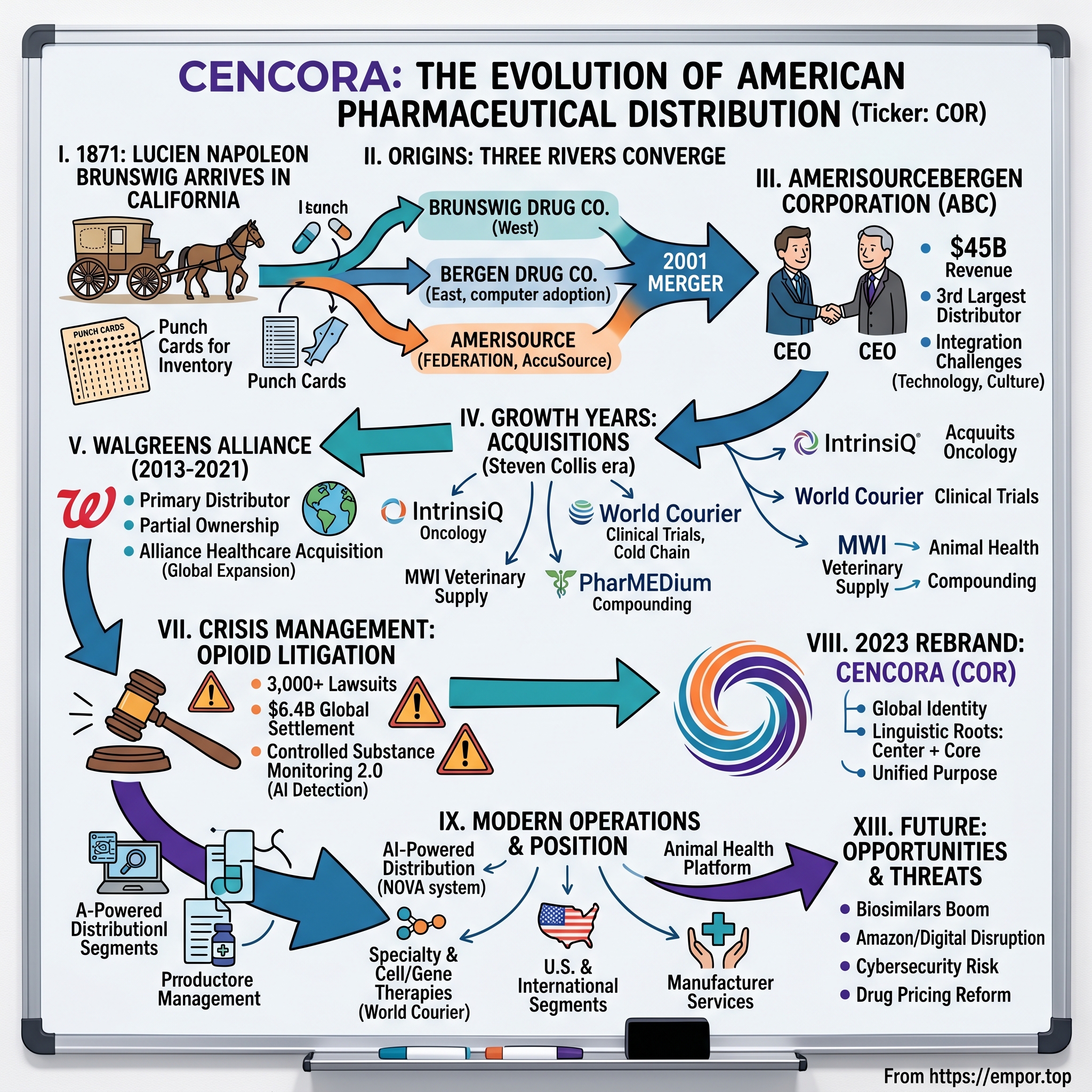
Cencora: The $300 Billion Infrastructure Tollbooth of Global Healthcare
I. Introduction & Episode Roadmap
Inside a distribution center in Bethlehem, Pennsylvania, robotic arms and automated conveyor belts assemble tens of thousands of orders every weeknight: a bottle of atorvastatin, a vial of pembrolizumab, a chilled tote of insulin pens, and a controlled-substance case requiring three separate signatures and a DEA-registered chain of custody. Totes are loaded onto delivery trucks around midnight, and by seven the next morning, an independent pharmacy in rural Ohio, a 400-bed hospital in Tucson, and a retina clinic in suburban Atlanta receive their shipments. The operation runs largely unnoticed outside the pharmaceutical industry, providing essential logistics to the healthcare sector.
The company directing this network is Cencora, Inc., listed on the New York Stock Exchange under the ticker COR and known as AmerisourceBergen until August 2023.[^1] In the fiscal year ended September 30, 2025, Cencora generated $321.3 billion in revenue across its network—a 9.3% increase over the prior year—while employing slightly more than 51,000 people globally.12 Alongside McKesson and Cardinal Health, Cencora is one of three distributors that together handle more than 90% of pharmaceutical distribution revenue in the United States.3 If the nation's drug supply chain were an interstate highway system, these three companies would manage the toll plazas.
The Puzzle of the Profitless Giant
Cencora's financial structure presents a distinct operational model. The company earns roughly three and a half cents of gross profit on every dollar of pharmaceuticals it moves; in the quarter ended June 30, 2026, gross profit reached $3.6 billion on $84.8 billion of revenue.4 After accounting for operating expenses such as warehouses, logistics, technology, and payroll, its operating margin settles near 1.5%. Yet in fiscal 2025, Cencora generated a return on equity exceeding 100% and a return on invested capital of approximately 13%.2
Understanding how a company operating on thin margins generates these returns requires examining its working capital dynamics. The primary engine is float. Cencora collects payments from customers in roughly 29 days while taking about 64 days to pay suppliers, resulting in a cash conversion cycle of approximately negative 11 days.2 In effect, pharmaceutical manufacturers finance Cencora's inventory. The company operates with negative working capital—approximately negative $5.6 billion at the end of fiscal 2025—meaning customer and supplier terms effectively provide billions of dollars in cost-free operational funding.2 Thin margins applied across high-velocity volume, supported by supplier trade credit, produce high returns on the net capital tied up in operations.
However, that working capital structure introduces significant customer concentration risk. Because the model relies heavily on volume and velocity, Cencora is vulnerable to shifts among its largest accounts. Walgreens Boots Alliance accounted for approximately 25% of fiscal 2025 revenue and roughly 38% of accounts receivable, while Cencora's top ten customers represented about 66% of total revenue.2 Walgreens was taken private by Sycamore Partners in August 2025 and subsequently split into five separate businesses.5 Consequently, Cencora's primary source of distribution volume carries the operational and financial risks associated with private-equity ownership and corporate restructuring.
The Roadmap
Cencora's history spans more than a century of industry consolidation. The company traces its origins to a 17-year-old French immigrant selling pharmaceuticals from a wagon in Reconstruction-era Texas and a New Jersey pharmacist who purchased an IBM mainframe in 1959 to automate order processing. The narrative traces the 2001 merger of equals that formed the modern distribution oligopoly, the strategic pivot from generic pills to high-value specialty biologics, and the $2.575 billion acquisition of a sterile compounding business that Cencora eventually shut down entirely.6
The company's modern history features a decade-long alliance with Walgreens that provided unprecedented scale while creating customer concentration risks. It includes a $6.6 billion settlement regarding historical opioid distribution practices that converted logistics operators into government-supervised gatekeepers, a February 2024 cyberattack that resulted in what Bloomberg reported as the largest known ransom payment in history, and a major strategic pivot under current leadership to expand beyond pharmaceutical delivery into direct ownership of physician practices.
Several strategic themes define Cencora's outlook: scale as a primary competitive moat, negative working capital float as the core driver of returns, customer concentration as a persistent structural risk, and a capital allocation record more nuanced than its steady growth in adjusted earnings per share suggests. While Cencora has compounded adjusted earnings per share reliably for over a decade, it has also recorded more than a billion dollars in acquisition write-downs during the same timeframe—a contrast that underscores both the strengths and vulnerabilities of its long-term business model.
 Subscribe on LinkedIn
II. The Origins & Consolidation Engine: Three Rivers Converge (1871–2000)
The Frontier Merchant and the Punch-Card Pharmacist
Lucien Napoleon Brunswig arrived in the United States from France as a teenager, beginning an apprenticeship in the Fort Worth, Texas, drug trade in 1871. At the time, pharmaceutical logistics relied on horses and wagons. Frontier pharmacists had limited visibility into supply chains or product quality, taking delivery of whatever inventory arrived. Brunswig recognized that distribution value lay in delivery reliability rather than drug manufacturing alone. He built distribution routes across the American South and West, eventually anchoring the business in Los Angeles. By the turn of the twentieth century, Brunswig Drug had become a major regional wholesaler along the Pacific Coast.
Three thousand miles east, a separate lineage developed. Emil Martini Sr. founded Bergen Drug Company in Hackensack, New Jersey, in 1947, serving the dense pharmacy corridor of the New York metropolitan area. Where Brunswig managed geographical distance, Martini faced density and operational complexity: thousands of small retail accounts, each ordering dozens of distinct items for daily delivery. Bergen addressed these logistics requirements through early automation, adopting punch-card inventory systems in the late 1940s, transitioning to IBM mainframe processing by the end of the 1950s, and introducing electronic ordering in the early 1970s.
This technological transition laid the foundation for the industry's modern structure. Beyond physical logistics, a drug wholesaler provides data processing: ensuring products arrive on schedule with accurate pricing, documentation, and billing. Distributors that integrated inventory tracking directly into retail workflows embedded themselves into daily pharmacy operations. When Bergen Brunswig launched its AccuSource electronic ordering platform in 1994, it formalized switching costs built over four decades. Replacing a primary distributor required a pharmacy to rebuild its inventory management, automated reordering workflows, and purchasing terms simultaneously.
Alco, AmeriSource, and the Third River
The third lineage emerged from corporate consolidation. Alco Standard Corporation acquired numerous regional drug distributors throughout the 1970s and 1980s before spinning off the consolidated business as Alco Health Services. Following a management buyout, the company was renamed AmeriSource Health Corporation in 1994, operating as an independent wholesaler based in Pennsylvania.
Why the Middleman Was Inevitable
During this period, economic factors reinforced the central role of wholesale distributors within the healthcare supply chain. Individual pharmaceutical manufacturers faced a fragmented customer base consisting of tens of thousands of retail pharmacies, alongside thousands of hospitals, clinics, nursing homes, and medical practices. Maintaining direct distribution—including dedicated shipping fleets, credit administration, and processing returned goods—was cost-prohibitive for individual product portfolios. Wholesale distributors created efficiency by aggregating freight and administration, consolidating shipments from dozens of manufacturers into single deliveries, invoices, and payment streams for each healthcare provider.
Distributors also serve as trade credit intermediaries. Independent pharmacies often operate with tight cash flow, facing delayed insurance reimbursements weeks after dispensing prescriptions. Rather than managing credit risk across thousands of small accounts, manufacturers rely on distributors as creditworthy counterparties that ensure predictable payments. Cencora's roughly $25 billion of accounts receivable at the end of fiscal 2025 reflects this long-standing financial role: the distributor operates as a credit and settlement layer for the pharmaceutical industry alongside its physical logistics operations.2
Regulatory requirements further fortified the distributor's position against potential disintermediation. Pharmaceutical distribution is overseen by federal agencies such as the Drug Enforcement Administration and the Food and Drug Administration, alongside individual state boards of pharmacy. Compliance obligations—including drug security, chain-of-custody tracking, and controlled-substance oversight—represent substantial fixed costs. By centralizing regulatory compliance across industry-wide volume, wholesale distributors amortize these fixed costs far more efficiently than individual manufacturers could by operating direct-to-pharmacy logistics.
By the late 1990s, margin pressures inside pharmaceutical distribution intensified as both drug manufacturers and retail buyers consolidated. Large retail chains such as CVS, Walgreens, and Rite Aid combined purchasing power across thousands of locations. Facing consolidated suppliers on one end and giant retail buyers on the other, regional distributors needed greater scale to maintain bargaining power and operational efficiency. While Bergen Brunswig and AmeriSource were established industry players, neither possessed sufficient standalone volume to compete effectively in the emerging market landscape.
III. The 2001 Mega-Merger: Creating AmerisourceBergen
The Merger of the Also-Rans
Through the late 1990s, aggressive acquisition sprees by McKesson and Cardinal Health pushed both companies far ahead of their rivals in purchasing volume. In an industry where fractions of a percentage point in inventory cost separate profitability from losses, operating as the third- and fourth-largest buyers in a four-player market left AmeriSource Health and Bergen Brunswig structurally disadvantaged.
On August 29, 2001, AmeriSource Health and Bergen Brunswig completed a merger of equals to form AmerisourceBergen Corporation, creating an entity with approximately $36 billion in annualized operating revenue.7 Under the transaction terms, each AmeriSource share converted into one share of the new company, while each Bergen Brunswig share converted into 0.37 shares, valuing the acquisition of Bergen at roughly $2.4 billion including transaction costs.8 The combination established the modern U.S. pharmaceutical distribution oligopoly, consolidating national distribution around three major players.
Leadership of the combined enterprise fell to David Yost, the former AmeriSource chief executive who assumed the role following the merger.7 Yost focused on operational integration. Combining two overlapping distribution networks required consolidating redundant warehouses serving identical geographic markets, unifying inventory management, and merging legacy IT systems. Over subsequent years, management rationalized this facility footprint into a smaller network of large, highly automated primary distribution centers designed to serve entire regions rather than individual metropolitan areas.
This consolidation logic illustrates why physical scale is critical to the distribution business. Facilities operate primarily on fixed overhead: real estate leases, automated sorting equipment, storage infrastructure, and administrative staffing. The marginal cost of processing an additional shipping tote through an existing facility is minimal. Routing double the volume through half the facility footprint significantly improves unit economics without requiring changes to customer pricing. Similar efficiencies apply to transportation: a delivery truck stopping at eight pharmacies incurs marginally higher operating costs than one stopping at five, yet generates 60% more revenue through route density.
Where the Money Actually Comes From
Post-merger integration highlighted the structural power balance between distributors and their institutional clients. Even as AmerisourceBergen reduced operational expenses, gross margins continued to narrow because retail pharmacy buyers were consolidating rapidly. Throughout the 1990s and 2000s, major chains such as CVS, Walgreens, and Rite Aid aggregated thousands of retail locations into centralized purchasing entities, while pharmacy benefit managers gained control over prescription formularies. Negotiating on behalf of 5,000 stores enabled retail chains to command significantly lower wholesale pricing than smaller regional operators could secure. Consequently, operational savings achieved through distribution efficiency were largely passed to retail buyers through competitive pricing terms, driving a multi-decade compression in gross margins despite steady operational gains.
Yost's tenure also coincided with a structural shift in how distributors generate revenue from brand-name pharmaceuticals. Historically, wholesalers earned a portion of their profits through inventory speculation, purchasing product ahead of scheduled manufacturer price increases and selling later at higher list prices. While lucrative during periods of high drug inflation, this model generated earnings volatility, absorbed capital, and aligned distributor incentives with rising drug costs. During the 2000s, the industry transitioned to fee-for-service contracts with brand manufacturers. Under these agreements, distributors receive fixed compensation for specific operational services—such as inventory handling, logistics, and data reporting—rather than capturing price appreciation. As a result, Cencora's brand distribution economics depend primarily on package volume and service scope rather than underlying drug price movements, insulating logistics revenues from potential policy caps on drug prices.
Simultaneously, top-line expansion enlarged the company's working capital float. By taking approximately 64 days to pay drug manufacturers while collecting from pharmacy customers in roughly 29 days, revenue growth automatically expanded the cash balance generated by trade credit terms. This negative working capital model provided predictable internal funding for capital expenditures, strategic acquisitions, and share repurchases without relying on equity dilution or heavy debt issuance.
However, fee-for-service contracts limited long-term margin expansion on brand-name drugs, as fees were negotiated against transparent operating costs. Generic pharmaceuticals offered higher unit profitability because distributors could source competitively and capture broader pricing spreads, but generic drug prices experienced persistent deflation. Between 2015 and 2019, the three major distributors collectively recorded a 12% decline in gross profit dollars despite adding approximately $100 billion in combined top-line revenue.3 Relying solely on conventional retail volume was no longer sufficient to sustain profit growth, forcing AmerisourceBergen to seek higher-margin product categories.
IV. M&A Capital Deployment & The Specialty Pivot (2001–2015)
A different category of pharmaceutical arrived in cardboard boxes packed with dry ice, reshaping how the company generated profits.
Traditional retail distribution relies on high volume and thin margins on low-cost medications. Specialty pharmaceuticals—including oncology infusions, biologics, injectables, and later cell and gene therapies—operate on distinct economics. A single vial can cost thousands of dollars and requires strict temperature control, detailed chain-of-custody tracking, complex insurance reimbursement support, and specialized clinical administration. While standard freight carriers can transport basic oral medications, few logistics organizations can maintain a strict cold chain to a community oncology practice while managing prior authorizations and product returns.
Steven H. Collis recognized this shift early within AmerisourceBergen. Having led the development of AmerisourceBergen Specialty Group, Collis built the division into a primary earnings growth driver before assuming the role of chief executive in 2011. Under his leadership, the specialty segment generated a disproportionate share of operating income relative to its revenue base. Collis operated on the premise that pharmaceutical profit pools were shifting from retail pharmacy counters to physician offices and infusion suites, concluding that controlling the logistics infrastructure for complex therapies offered higher long-term returns than wholesale volume alone.
Three Deals, Three Verdicts
Collis brought an accounting background from South Africa and mid-1990s experience in AmerisourceBergen's specialty division, where operations prioritized reimbursement adjudication and specialized customer needs over traditional route density. His subsequent capital allocation decisions reflected an ongoing attempt to expand the company's high-margin service offerings alongside its core distribution operations.
Three major acquisitions executed during this era tested that strategic direction, yielding contrasting operational outcomes.
World Courier (2012). AmerisourceBergen agreed in March 2012 to acquire World Courier Group for $520 million in cash, closing the transaction on May 1.9 World Courier operated a biopharmaceutical logistics network encompassing more than 137 offices, 13 storage depots, and approximately 2,500 employees across 52 countries, generating roughly $500 million in annual revenue.9
The acquisition focused on transporting clinical trial materials and investigational drugs globally under strict temperature controls. Strategically, the deal expanded specialized logistics capabilities and established direct service relationships with pharmaceutical manufacturers beyond wholesale drug distribution. World Courier remains a core asset within Cencora's international operations.
MWI Veterinary Supply (2015). In January 2015, the company agreed to acquire MWI Veterinary Supply for $190.00 per share—representing roughly $2.5 billion in fully diluted equity value—closing the acquisition the following month.10 MWI was the leading animal health distributor in the United States. Management reasoned that distribution infrastructure could be applied effectively to companion animal health, a market experiencing higher growth than human pharmaceuticals. Operationally, MWI performed steadily over the decade. Strategically, however, it represented a sector diversification rather than an expansion of specialized human health services. In February 2026, Cencora agreed to merge MWI with Covetrus in a transaction valuing MWI at an enterprise value of $3.5 billion. Cencora received $1.25 billion in cash, $800 million in preferred equity, and $1.45 billion in common equity, retaining a 34.3% non-controlling stake in the combined entity.11 After eleven years of ownership, the transaction yielded a modest premium over the purchase price, prompting management to exit full ownership of animal health distribution.
PharMEDium (2015). The third major transaction encountered severe operational and regulatory obstacles. On November 6, 2015, AmerisourceBergen completed the acquisition of PharMEDium Healthcare Holdings for $2.575 billion in cash, acquiring the largest U.S. provider of outsourced compounded sterile preparations for hospitals.6 The strategic logic aimed to capture higher manufacturing margins by supplying pre-mixed intravenous formulations to hospital pharmacies seeking to lower operational costs and compounding risks.
However, sterile compounding is governed by strict Current Good Manufacturing Practice regulations, where contamination risks carry significant regulatory consequences. PharMEDium's Memphis facility suspended production in December 2017 after FDA inspectors raised sterility concerns.12 Remediation costs totaled $48.6 million in fiscal 2019 alone, accompanying a $570 million impairment charge on PharMEDium's long-lived assets.13 In May 2019, a federal judge entered a consent decree of permanent injunction against PharMEDium after the FDA reported patient exposure risks.12 In January 2020, AmerisourceBergen announced it would eliminate the remaining 165 positions and permanently cease operations by the end of that year, recording additional impairment charges exceeding $323 million.12
In total, cumulative impairment charges and remediation costs exceeded $1 billion on top of the original $2.575 billion purchase price, ultimately resulting in the complete wind-down of the acquired business. The outcome highlighted the operational contrast between wholesale distribution compliance and highly regulated pharmaceutical manufacturing. The experience underscored the risks of paying a control premium for assets requiring capabilities outside a distributor's core operational scope—a structural dynamic that resurfaced in 2025 and 2026 as Cencora committed nearly $9 billion toward acquiring physician practice management groups.
V. The Walgreens Anchor Alliance & European Expansion (2013–2021)
On March 19, 2013, AmerisourceBergen entered into a commercial partnership with Walgreen Co. and Alliance Boots.14
The Marriage Contract
The foundation of the arrangement was a ten-year primary distribution agreement covering branded and generic pharmaceuticals for Walgreen Co. and Alliance Boots, positioning AmerisourceBergen as the primary supplier to the largest retail pharmacy chain in the United States.14 Beyond the supply relationship, the agreement included equity provisions: Walgreens and Alliance Boots received the right to purchase up to 7% of AmerisourceBergen's fully diluted equity in the open market, alongside warrants to acquire an additional 16% across two tranches with strike prices of $51.50 and $52.50, exercisable in 2016 and 2017.14 If fully exercised, the agreements allowed the customer to acquire nearly 23% of its primary logistics provider.
For AmerisourceBergen, offering substantial equity ownership secured long-term volume in an environment where losing Walgreens to a rival would have severely diminished its market position. Structuring customer participation through equity transformed a conventional supply agreement into an aligned corporate partnership, securing predictable distribution volume while diluting independent ownership.
A second, highly consequential component of the deal was the creation of Walgreens Boots Alliance Development, a joint generic purchasing venture headquartered in Switzerland. Because generic pharmaceuticals are interchangeable commodities, procurement economics favor buyers with the largest aggregate volume. Pooling AmerisourceBergen's wholesale generic purchasing with the retail volume of Walgreens and Boots across North America and Europe created a global purchasing entity capable of negotiating directly with manufacturers in India, China, and Europe. Securing lower acquisition costs on generic inventory enhanced gross margins, establishing a scale advantage that smaller regional distributors could not replicate.
Europe, and the Unwinding
The alliance expanded further in January 2021, when AmerisourceBergen agreed to acquire the majority of Walgreens Boots Alliance's Alliance Healthcare businesses for approximately $6.5 billion—comprising $6.275 billion in cash and two million shares of common stock—with the transaction closing on June 2, 2021.15
The acquisition served multiple strategic objectives. It established a wholesale distribution network across more than a dozen European countries, provided Walgreens with liquidity to reduce its equity stake in AmerisourceBergen, and extended the primary U.S. distribution agreement by three years through 2029.15
European pharmaceutical wholesaling operates under distinct regulatory constraints compared to the U.S. market. Many European governments mandate drug pricing and directly cap wholesale distribution margins, limiting the fee-for-service structures common in North America. Consequently, European operations generate lower percentage margins and slower growth, deriving strategic utility primarily from international scale and manufacturer relationships. Financial results reflect these structural headwinds: in fiscal 2025, Cencora's International Healthcare Solutions segment generated $30.4 billion in revenue but $648.3 million in operating income—an operating income decline of 9.1% year over year.1
Over subsequent years, Walgreens systematically reduced its equity position in Cencora through open-market sales and prepaid forward transactions, while Cencora selectively repurchased shares—including approximately $50 million in repurchases in February 2025 alongside a concurrent Rule 144 stock sale by Walgreens.16 On August 28, 2025, private equity firm Sycamore Partners completed its acquisition of Walgreens Boots Alliance, subsequently restructuring the retailer into five distinct operating entities: Walgreens, The Boots Group, Shields Health Solutions, CareCentrix, and VillageMD.5
This restructuring altered the dynamics of Cencora's primary distribution relationship. The anchor client that previously held nearly a quarter of Cencora's equity retained virtually no ownership stake, operating under private-equity ownership with an altered capital structure and fragmented business units. While the 2013 partnership provided distribution volume and purchasing scale for over a decade, the ongoing corporate separation presents new operational questions for the contract, which extends through 2029.
VI. Opioid Crisis Management & Legal Settlement Mechanics
The Reckoning
For most of its history, the drug distribution industry's regulatory posture was primarily clerical: fulfill orders, submit paperwork, and satisfy registration requirements with the Drug Enforcement Administration. Then came the legal reckoning.
The allegations brought by state attorneys general, municipal governments, counties, and Native American tribes did not accuse distributors of manufacturing or marketing prescription opioids. Instead, plaintiffs alleged that distributors shipped controlled substances in volumes that could not be explained by legitimate medical need, failing to maintain the anti-diversion controls mandated by federal law. For example, plaintiffs highlighted instances where a single pharmacy in a small West Virginia town ordered hundreds of thousands of hydrocodone doses—a volume that any effective suspicious-order monitoring system should have flagged and halted.
Under federal law, distributors must operate systems that identify suspicious orders—characterized by unusual size, frequency, or pattern deviations—and report rather than fulfill them. Plaintiffs presented evidence indicating that internal monitoring thresholds were routinely raised when key commercial accounts exceeded limits. Per-capita shipment data across multiple jurisdictions documented pill quantities that far exceeded clinical justification, creating existential legal exposure for the industry.
With potential liabilities threatening corporate solvency, the industry sought a comprehensive resolution. In July 2021, the three primary national distributors and Johnson & Johnson reached a landmark global settlement agreeing to pay approximately $26 billion over eighteen years to resolve the bulk of the claims.17 AmerisourceBergen's portion totaled approximately $6.6 billion.18 The Distributor Settlement Agreement became effective on April 2, 2022, and as of September 30, 2025, covered 48 of 49 eligible states and 99% by population of eligible political subdivisions within them.2
The Mechanics of a $6.6 Billion Bill
Because the settlement is structured as annual installments over eighteen years rather than an immediate lump sum, it acts as an ongoing drag on free cash flow rather than a sudden liquidity crisis. Cencora's accrued opioid-related litigation liability stood at $3.881 billion at September 30, 2025, and $3.774 billion at June 30, 2026—a reduction that included a $102.0 million credit recognized in the June 2026 quarter following the dismissal of certain opioid litigation.4 For an enterprise generating roughly $3.0 billion of adjusted free cash flow annually, several hundred million dollars a year of settlement payments represents a persistent tax on cash returns to shareholders, though the obligation remains operationally manageable.1
Board and executive oversight also generated direct legal liabilities. A shareholder derivative suit filed in 2021 by the Lebanon County Employees' Retirement Fund and a Teamsters-managed health plan alleged that management and the board ignored red flags around opioid distribution and failed to properly monitor sales. After being dismissed and subsequently revived, the case settled for $111.3 million following mediation, with the settlement disclosed in Delaware Chancery Court in 2025.19 Cencora recorded an $86.8 million credit related to the derivative lawsuit settlement in the nine months ended June 30, 2026.4 For investors evaluating corporate governance, the court-supervised settlement demonstrated that oversight deficiencies were severe enough to warrant a nine-figure recovery funded through directors' and officers' insurance coverage.
From Order-Taker to Gatekeeper
The legal settlements fundamentally transformed the distributor's operational role from an efficient order processor into an active compliance gatekeeper. Distributors now run automated suspicious-order monitoring systems, enforce quantitative caps on controlled substance orders, and report into an independent national clearinghouse that aggregates purchasing data across all three major distributors. This shared repository prevents pharmacies from bypassing volume limits by splitting orders among different suppliers. In practice, Cencora personnel routinely refuse to fulfill legal orders from licensed pharmacies if the requests exceed compliance thresholds.
This expanded regulatory mandate carries structural implications for Cencora's competitive positioning. Operating suspicious-order monitoring systems and compliance apparatuses adds administrative overhead and introduces commercial friction with pharmacy clients. At the same time, these mandatory compliance standards heighten barriers to entry. A prospective entrant cannot compete simply by acquiring delivery trucks and distribution centers; it must also build a compliance infrastructure capable of satisfying federal regulators, fifty state pharmacy boards, and independent settlement monitors before shipping its first order. While legal oversight imposed severe financial penalties on incumbent distributors, the resulting compliance mandate further insulates the established distribution oligopoly, even as it leaves underlying customer concentration risks intact.
VII. The Rebrand, Cyber Shock, & Current Management Regime (2023–Present)
On August 30, 2023, AmerisourceBergen ceased to exist as a name.[^1] The company became Cencora — a coinage meant to evoke "center" and "core" — and the NYSE ticker moved from ABC to COR.
Corporate rebrands usually deserve scepticism, and this one had an obvious subtext: shedding a name that had become inseparable from opioid headlines. But there was a real organizational logic underneath. "AmerisourceBergen" was the fossilized record of a 2001 American merger, and the company by 2023 employed tens of thousands of people across dozens of countries in businesses — global clinical trial logistics, European wholesaling, manufacturer consulting — that had nothing to do with either legacy entity. A single identity for a genuinely global organization is defensible. Whether it was worth the expense is the sort of judgment on which reasonable investors will disagree; what it unambiguously signalled was ambition beyond American drug trucking.
The leadership transition that followed was more consequential. On March 12, 2024, Cencora announced that Steven Collis would step down as chief executive and become executive chairman, with Robert P. Mauch succeeding him effective October 1, 2024.[^21] Collis had run the company for thirteen years, during which revenue grew from under $80 billion to $294 billion, and the character of that growth is worth noting: it came overwhelmingly from specialty mix shift, the Walgreens relationship, and acquisitions, rather than from any expansion in the underlying margin of moving pills. His successor was not an outsider brought in to change direction. Mauch had spent roughly two decades at the company, most recently as chief operating officer, and had been a principal architect of the US Healthcare Solutions segment.[^21]
An insider succession after a long, successful tenure is a statement that the board wanted continuity of strategy with sharper operational execution. The evidence so far is consistent with that. Mauch has not repudiated anything Collis built; he has accelerated the specialty thesis and pruned everything else, which is a recognizably different emphasis executed within the same framework.
The Incident No Strategy Document Anticipated
How Management Is Actually Paid
Before assessing the decisions, it is worth knowing what the decision-makers are paid for, because incentive design at Cencora is unusually legible. According to the proxy statement filed in January 2026, the fiscal 2025 annual incentive was weighted to adjusted operating income, adjusted EPS, adjusted free cash flow, and a corporate responsibility measure, while long-term performance shares were tied to adjusted EPS compound growth and average annual adjusted return on invested capital, with a relative total-shareholder-return modifier.20
That construction is better than the industry norm in one specific respect and worse in another. Including average adjusted ROIC in the long-term plan is genuinely meaningful for a serial acquirer: it means an executive who buys growth at a bad price is penalized in the metric that captures the price, not merely rewarded for the growth. The free cash flow measure similarly resists earnings that exist only on an adjusted income statement.
The weakness is that nearly every metric is an adjusted one. When a company writes off a billion dollars of goodwill from an acquisition it made, that charge does not reduce adjusted EPS, adjusted operating income, or adjusted free cash flow. It reduces GAAP earnings and it reduces book equity — neither of which appears in the incentive plan. Adjusted ROIC provides a partial correction, since impaired capital eventually shrinks the denominator rather than punishing the numerator, but the direction of that effect can actually flatter the ratio. An investor evaluating whether the MSO strategy is being pursued with appropriate price discipline should not assume the compensation plan will do that work on their behalf.
Then there is the incident that no strategy document anticipated.
On February 21, 2024, Cencora discovered that an unauthorized party had accessed its information systems and exfiltrated data.21 The company disclosed the breach promptly, isolated systems, and reported that data had been taken from a subsidiary handling patient support services — including names, addresses, dates of birth, diagnoses, and prescriptions.21 Cencora stated that the incident did not have a material impact on operations. In September 2024, Bloomberg reported, based on blockchain analysis of the transactions, that the attackers — a group known as Dark Angels — had received a ransom of $75 million in bitcoin paid in three March instalments, the largest known cyber-extortion payment on record, after an initial demand of $150 million.22 Cencora did not confirm the payment.
For investors, the analytical content of this episode is not the dollar figure. It is what the episode reveals about the nature of the asset. The bull case for a distributor rests on physical infrastructure that is expensive and slow to replicate. But the operating asset is software: order management, inventory systems, DEA reporting, temperature monitoring, patient support databases. A sufficiently severe intrusion into those systems does not damage a warehouse; it stops a country's pharmacies from receiving their morning delivery. The February 2024 incident did not reach that threshold. It did demonstrate, concretely and expensively, that the threshold exists — and it converted cybersecurity from a line item into a permanent, escalating cost of doing business. Cencora's capital expenditure guidance of roughly $900 million for fiscal 2026, elevated in part to fund infrastructure and digital transformation, is partly the price of that lesson.1
Which brings us to the current regime's defining decision. In November 2024, Cencora announced the acquisition of Retina Consultants of America, a management services organization for retina specialist practices, and closed it on January 2, 2025 — acquiring approximately 85% of RCA for $4,042.0 million in cash at closing, with certain physicians and managers retaining a minority interest and up to $500 million of contingent consideration payable in fiscal 2027 and 2028 against defined objectives.232 For a company whose last attempt to move beyond distribution ended in a consent decree and a liquidation, spending four billion dollars to buy a physician practice platform was a statement of considerable confidence. Whether it is warranted is the question the rest of this story turns on.
VIII. Modern Segment Operations, Industry Structure & Economics
A shift in Cencora's reporting structure offers insight into how management is repositioning the enterprise.
Through fiscal 2025, Cencora reported under two main segments. U.S. Healthcare Solutions generated $290.98 billion in revenue and $3.57 billion in operating income—up 21.8% year over year—while International Healthcare Solutions delivered $30.37 billion in revenue and $648.3 million in operating income, down 9.1%.1 Beginning in fiscal 2026, management recast financial reporting into three segments by shifting MWI Animal Health, a Brazilian distribution business, legacy U.S. hub services, and portions of PharmaLex into an "Other" category while pursuing strategic alternatives for those assets.24 In the quarter ended June 30, 2026, U.S. Healthcare Solutions generated $74.9 billion in revenue and $966.2 million in operating income, up 15.9%; International Healthcare Solutions brought in $7.7 billion in revenue and $165.9 million in operating income, up 20.8%; and the Other segment contributed $2.3 billion in revenue with operating income increasing 24.8%.4
Isolating non-core assets into an "Other" segment provides clear visibility into the continuing enterprise. It signals which businesses management no longer views as central to long-term strategy, allowing investors to evaluate the core operation without non-strategic drags. At the same time, it highlights the reversal of a decade-long push into broader sector diversification.
The Commercial Engine
Cencora's top-line revenue flows through three distinct financial mechanisms: brand pharmaceuticals, generic drugs, and specialty products.
Brand-name medications operate primarily on a fee-for-service model. Manufacturers pay Cencora for inventory management, cold-chain handling, delivery logistics, and data reporting. Because compensation scales with package volume and service scope rather than underlying drug prices, immense top-line revenue moves through the network at low percentage margins, insulating wholesale revenue from direct policy caps on drug pricing.
Generic pharmaceuticals operate on opposite economics. Cencora buys generic inventory competitively—leveraging its global purchasing scale—and sells at a markup. Although generics represent a small fraction of gross revenue, they generate a disproportionate share of gross profit dollars.
Specialty products serve as the company's primary growth driver. High-value biologics and injectable therapies yield high absolute dollar gross profit per unit, even as they dilute overall percentage margins. These products arrive bundled with specialized services—such as reimbursement management, direct-to-clinic delivery, and group purchasing administration—that command higher margins than standard oral pill distribution.
The surge in GLP-1 medications demonstrates these mix dynamics. In the quarter ended June 30, 2026, sales of GLP-1 treatments for diabetes and weight loss expanded by $2.3 billion, up approximately 25% year over year.25 This influx added substantial revenue at thin percentage margins, mechanically lowering Cencora's overall reported gross margin. However, moving these products requires minimal incremental capital, carries low credit risk given the institutional buyer base, and contributes direct operating profit dollars. Evaluating Cencora solely on gross margin percentage without adjusting for product mix obscures its underlying profitability.
The Competitive Structure
The U.S. drug wholesale market remains dominated by three players. In their most recent fiscal years, McKesson generated $359.1 billion, Cencora generated $321.3 billion, and Cardinal Health generated $222.6 billion—representing a combined revenue of roughly $903 billion and over 90% of U.S. pharmaceutical distribution revenue.3 Market shares shift marginally when major anchor contracts move, but no fourth national distributor has emerged in a quarter-century due to compounding structural entry barriers.
Constructing a competing national network requires massive capital and operational scale. An entrant must establish dozens of automated distribution centers positioned to deliver to nationwide pharmacies and hospitals overnight. It must build a validated cold-chain network with continuous temperature tracking, secure DEA registrations across all operational jurisdictions, and implement suspicious-order monitoring infrastructure. Furthermore, an entrant requires trade credit facilities capable of carrying tens of billions of dollars in receivables, alongside sufficient committed customer volume on day one to achieve operating density. Demonstrating this ongoing capital burden, Cencora is committing approximately $1 billion in supply chain capital through 2030—including a second national distribution center—to maintain and expand its existing network.
Perspectives pointing to potential entry by tech firms often mistake retail pharmacy dispensing for wholesale logistics. While services such as Amazon Pharmacy compete for consumer dispensing transactions, they do not replicate controlled-substance compliance networks, manufacturer fee-for-service contracts, hospital supply agreements, or buy-and-bill physician channels. Parcel delivery capabilities alone are insufficient to disrupt wholesale distribution infrastructure.
The MSO Bet
Following the acquisition of Retina Consultants of America, Cencora expanded further into physician practice management. In 2023, the company partnered with TPG to acquire OneOncology from General Atlantic, taking an approximate 35% minority stake for roughly $685 million at a platform valuation of $2.1 billion, spanning more than 900 affiliated providers across 14 states.26 On February 2, 2026, Cencora acquired the majority of the remaining equity for approximately $4.6 billion in cash, valuing OneOncology at an enterprise value of $7.4 billion and an equity value of around $6 billion, with affiliated practices and management retaining a minority interest.427 The transaction was funded through $3.0 billion in senior notes and $1.5 billion in term loans, with management projecting the deal to be roughly neutral to adjusted earnings per share net of financing costs in its first twelve months.427
This management services organization (MSO) strategy aligns with Cencora's core logistics operations. Community oncology and retina practices administer high-cost infused therapies through a buy-and-bill model, where practices purchase medications, administer them to patients, and bill insurers. Managing administrative services for these practices positions Cencora directly adjacent to the prescribing and purchasing decisions of its primary specialty customers.
Cencora continued expanding this footprint on March 23, 2026, announcing a definitive agreement to acquire the retina business of EyeSouth Partners for $1.1 billion, folding those physicians into RCA—a transaction the company said it did not expect to close before the September 30 fiscal year end, and which it guided to be slightly accretive to adjusted EPS net of financing costs in the first twelve months after closing.28 In total, Cencora committed roughly $9.7 billion across RCA, OneOncology, and EyeSouth to build its physician practice management platform within a sixteen-month span.
However, this strategy carries significant valuation risk. The OneOncology platform that carried a $2.1 billion enterprise value in 2023 was acquired at a $7.4 billion valuation in 2026—a 3.5-fold increase in under three years, reflecting an estimated transaction multiple of roughly 19 times EBITDA. While OneOncology expanded its provider network during that period, Cencora paid peak multiples to private-equity sellers in a competitive market for physician practice roll-ups. Following these transactions, Cencora holds $22.4 billion in goodwill and intangible assets against a small fraction of stockholders' equity.42 In light of past write-downs associated with PharMEDium and PharmaLex, the execution of this MSO expansion remains a critical test for management.
IX. 7 Powers & Porter's 5 Forces Analysis
Evaluating Cencora through strategic business frameworks highlights what protects its market position—and where its structural vulnerabilities lie.
Scale economies represent Cencora's primary competitive advantage. While fixed-cost leverage across distribution centers and delivery routes provides meaningful efficiency, the generic drug purchasing advantage is the decisive factor. Aggregating wholesale distribution volume with global retail pharmacy volume to negotiate directly with drug manufacturers yields a cost of goods that smaller regional distributors cannot match. In an industry where gross margins hover in the single digits, a persistent cost advantage on generic products forms the foundation of Cencora's distribution model.
Switching costs vary significantly by customer segment. For an independent pharmacy, changing a primary distributor requires replacing inventory software, reordering workflows, pricing structures, and vital trade credit arrangements. These operational hurdles create high retention rates among independent accounts, making them Cencora's most profitable customer class. Conversely, for a national retail chain with proprietary systems and standalone scale, changing distributors is primarily a commercial procurement decision. As demonstrated by the 2013 Walgreens agreement, large buyers can shift volume between major distributors. Consequently, switching costs protect small accounts effectively while offering limited defense against major corporate clients.
Process power is moderate, reflected in specialized capabilities accumulated over decades in cold-chain logistics, hazardous materials handling, controlled-substance compliance, and reimbursement support. These capabilities are particularly important in the specialty segment, where operational complexity is high. However, because this expertise resides within organizational routines and human capital, it can be replicated or recruited by peer distributors operating with comparable national scale.
Cornered resource and branding are negligible. Cencora operates without exclusive distribution licenses or consumer-facing brands that can command premium pricing.
Counter-positioning presents a subtle dynamic. As an established incumbent, Cencora is not counter-positioned against market rivals; rather, it faces potential counter-positioning from direct-to-patient distribution models. If pharmaceutical manufacturers establish direct distribution channels for high-value specialty drugs, bypassing traditional wholesalers, Cencora cannot easily respond without cannibalizing its fee-for-service wholesale revenues. While direct-to-patient channels currently represent a small fraction of industry volume, they constitute a more direct structural threat to wholesale logistics than tech-driven retail pharmacy platforms.
Porter, Applied
Applying Porter's Five Forces framework reveals an industry with strong structural barriers against external entrants, balanced by significant pressure from consolidated customers.
Buyer power is highly bifurcated. With Walgreens accounting for roughly a quarter of revenue and the top ten accounts representing about two-thirds of total volume, Cencora's largest counterparties hold substantial bargaining power during contract negotiations.2 In contrast, independent pharmacies possess minimal pricing leverage, generating higher margin percentages for distributors.
Supplier power is moderate. While drug manufacturers rely on the three major distributors to reach healthcare providers efficiently, large pharmaceutical companies negotiate fee-for-service contracts from a position of strength, and owners of single-source patented medications retain pricing power over distribution terms.
Threat of new entrants remains negligible due to high capital requirements, complex compliance infrastructure, and necessary purchasing scale.
Threat of substitutes is low, with manufacturer-direct specialty distribution representing the primary alternative.
Competitive rivalry among the three major distributors is disciplined. Given operating margins near 1.5%, operators avoid sustained price wars that would undermine industry profitability. However, competition for major customer contracts at renewal dates is intense, making market share shifts episodic and tied to multi-year contract cycles.
In summary, Cencora maintains a durable cost moat grounded in purchasing scale and physical infrastructure that protects it against external competition. However, that moat offers limited insulation against margin compression driven by its largest retail customers. This structural imbalance explains the rationale behind Cencora's multi-billion-dollar expansion into physician practice management—a market segment where the company can exert greater commercial leverage directly aligned with specialty drug prescribing.
X. Earnings Call & Transcript Evidence Analysis
The most revealing test of a management team rarely occurs during prepared remarks. Instead, it unfolds when analysts ask the questions executive leadership would prefer to avoid.
November 2025: A Guidance Raise and a Write-Down
During the fiscal fourth-quarter earnings call on November 5, 2025, Cencora raised its long-term financial targets—increasing its target for adjusted operating income growth to between 6% and 9% from 5% to 8%, and adjusted diluted earnings per share growth to 9% to 13%. The company also announced approximately $1 billion in supply chain capital commitments through 2030, which included funding for a second national distribution center and expanded specialty cold-chain capacity.241 Wall Street analysts immediately questioned the sustainability of U.S. operating income growth, which had reached 25% in the quarter, or roughly 13% excluding contributions from Retina Consultants of America. Executives responded that fiscal 2026 guidance—projecting 10% to 12% U.S. operating income growth, excluding the impact of a lost oncology customer—reflected disciplined baseline planning rather than an operational slowdown.24 The response provided specific context while directly acknowledging a major customer loss rather than deflecting the issue.
The same call included a more troubling disclosure: a $723.9 million goodwill impairment charge on PharmaLex, the European pharmaceutical consulting firm acquired on January 1, 2023, for $1.473 billion, of which approximately $1,010.2 million had originally been allocated to goodwill.129 The charge followed a $418 million goodwill write-down on PharmaLex recorded in fiscal 2024.29 Executive leadership attributed the latest impairment to persistent demand challenges, noting that Cencora was simplifying the division around core services—such as pharmacovigilance, market access, and regulatory affairs—while exploring strategic alternatives for non-core units.24
The financial implications of that sequence are straightforward: after paying nearly $1.5 billion for PharmaLex in early 2023, Cencora wrote off more than $1.1 billion of associated goodwill within three years. These write-downs were the primary driver behind the operating income decline in the International Healthcare Solutions segment in fiscal 2025. Because these impairment decisions occurred under the current leadership team, evaluating Cencora's capital allocation record requires weighing its successful specialty distribution expansion against these substantial acquisition write-downs.
August 2026: The Analysts Push on the MSO Bet
By the third-quarter earnings call on August 4, 2026, management signaled confidence in its management services organization (MSO) expansion, prompting detailed questioning from analysts.25 Elizabeth Anderson of Evercore ISI inquired whether initial integration gains were sustainable. Chief Executive Officer Robert Mauch outlined a three-phase growth framework encompassing operational integration, shared capabilities like clinical trial support, and new service development, acknowledging that OneOncology remained at an earlier stage in expanding clinical trials than the more established Retina Consultants of America platform. Chief Financial Officer Eva Boratto confirmed that OneOncology's operating income had outperformed initial projections, while reaffirming that the transaction remained neutral to adjusted earnings per share after accounting for financing costs over its first twelve months.25 This formulation clarified that while operational profits grew, elevated interest expense offset immediate bottom-line expansion.
Erin Wright of Morgan Stanley asked whether potential regulatory scrutiny surrounding corporate ownership of physician practices would limit future MSO growth. Mauch defined clear boundaries for future dealmaking, committing to restrict acquisition activity to bolt-on practices within oncology and retina. He emphasized that Cencora intends to remain pharmaceutical-centric, ruling out expansion into unrelated medical specialties unless a target directly aligns with core pharmaceutical logistics.25 While this explicit boundary establishes clear strategic parameters, its durability will depend on executive discipline in future transactions.
Addressing inquiries from Lisa Gill of JPMorgan and Eric Coldwell of Baird regarding GLP-1 drug margins, Boratto explained that a sequential recovery in specialty utilization reflected broad demand across health systems and medical practices, led by oncology and supported by retina care.25 Glen Santangelo of Barclays highlighted the distinct economics of biosimilar medications: Medicare Part D biosimilars provide modest margin gains but generate less ancillary service revenue when replacing originator drugs, whereas Medicare Part B biosimilars offer superior profitability because the buy-and-bill clinical model connects directly into Cencora's MSO infrastructure, specialty distribution network, and group purchasing organization.25 This economic distinction illustrates the underlying logic of acquiring physician practice management platforms.
Certain disclosures were notable for what they omitted. When Michael Cherny of Leerink questioned customer contract renewals and account stability, Mauch noted that the customer portfolio remained well positioned across healthcare settings, adding there was nothing specific to report regarding renewals.25 However, given that Walgreens Boots Alliance had recently been acquired by Sycamore Partners, split into five operating units, and held a primary distribution agreement set to expire in 2029, the response offered limited transparency into ongoing commercial negotiations. Eight days later, additional context emerged. On August 12, 2026, Cencora filed a Form 8-K revealing that select Walgreens distribution volume—handled under contracts distinct from the core prime vendor agreement—had begun transitioning to another provider effective July 1, 2026. Cencora stated that the primary vendor contract remained intact and represented the vast majority of the relationship, noting that the volume change was reflected in its fourth-quarter outlook while reaffirming full-year adjusted EPS guidance of $17.75 to $17.95.30 Despite the reaffirmed guidance, Cencora's stock declined approximately 4.8%.30
While executive financial targets remained intact, market expectations had not fully incorporated the potential shift in auxiliary business. Although management had factored the volume adjustment into its financial guidance, describing contract renewals as having nothing to report just days prior led investors to assume contract stability across all accounts. For a company where a single client accounts for roughly 25% of total revenue, the market reaction underscored a demand for greater specificity regarding key customer relationships. The event also provided initial confirmation that non-core portions of the Walgreens account are subject to competitive reallocation following its private equity restructuring.
In response to Kevin Caliendo of UBS regarding proposed reforms to average sales price (ASP) reimbursement, Mauch expressed confidence that ASP reimbursement mechanisms would remain stable through 2028, pointing to federal policy recognition of community physician practices as low-cost care settings and ongoing regulatory pilot programs.25 Because this perspective relies on legislative and regulatory outcomes, these assumptions remain subject to policy shifts.
Across both earnings calls, management maintained narrative and operational consistency. The strategic priorities outlined in November 2025—focusing on specialty distribution, portfolio simplification, and pharmaceutical-centric expansion—remained consistent through August 2026, supported by identical segment definitions and stated operating boundaries. Executive leadership did not adjust reporting metrics or modify financial targets between quarters. Nevertheless, detailed disclosures remained limited on two critical factors influencing long-term earnings: the evolving contract dynamics within the Walgreens relationship and the ultimate profitability of the MSO platforms once initial acquisition financing costs subside.
Regarding capital allocation, Boratto disclosed $800 million in term loan repayments linked to the RCA acquisition split between June and July, alongside $1 billion in share repurchases executed during the quarter at an average price of approximately $268 per share. Management maintained its full-year adjusted free cash flow guidance of roughly $3 billion despite capital expenditure rising to $900 million, and flagged a projected fiscal 2027 operating income reduction of about $150 million—or approximately $0.35 in earnings per share—if the pending MWI Animal Health transaction closes mid-year.25 Executing share buybacks at $268 proved beneficial as Cencora's stock approached $338 by early September 2026.31
XI. Financial Analysis, Capital Allocation & Valuation
The Two-Percent Balance Sheet
An examination of Cencora's balance sheet reveals a striking capital structure: at September 30, 2025, total assets stood at $76.6 billion, while total stockholders' equity was just $1.508 billion.2 Only about 2% of the asset base is funded by common equity.
This thin equity base explains—and largely deflates—the company's celebrated return-on-equity metrics. Return on equity exceeded 100% in fiscal 2025, and topped 200% and 300% in the two preceding years, though the trend moved downward primarily because the equity denominator expanded rather than because operating returns deteriorated.2 Book equity remains minimal because $10.3 billion in treasury stock offsets it, reflecting two decades of share buybacks.2 A more representative measure of economic return is return on invested capital, which reached approximately 13.2% in fiscal 2025 compared to roughly 16.9% in fiscal 2024 and 13.5% in fiscal 2023.2 While solidly above the cost of capital, this metric was diluted in fiscal 2025 as the purchase price for Retina Consultants of America entered the capital base before full earnings contributions materialized.
Underlying operating performance showed continued momentum. Fiscal 2025 revenue of $321.3 billion produced adjusted diluted EPS of $16.00, up 16.3%, on gross profit of $11.5 billion, up 15.8%.1 Gross profit expanding nearly in lockstep with top-line revenue reflects the shift toward higher-margin specialty products. GAAP diluted EPS was $7.96—less than half the adjusted figure—with the PharmaLex impairment representing the largest single reconciling item.1 Through the first nine months of fiscal 2026, revenue reached $249.0 billion, up 4.8%, and management raised full-year adjusted EPS guidance to $17.75–$17.95 while lifting consolidated adjusted operating income growth expectations to 13%–14%.4
What the Adjustments Hide
The wide gap between GAAP and adjusted earnings warrants close scrutiny. In the June 2026 quarter alone, adjustments included $0.32 per share of acquisition-related intangible amortization, $0.60 of integration expenses, $0.18 of restructuring costs, and a $0.35 benefit from litigation credits.4 While non-cash amortization of acquired intangibles is a standard add-back, recurring integration and restructuring charges totaling $0.78 per share in a single quarter represent ongoing costs of an acquisition-led growth strategy rather than extraordinary events. A company that acquires continuously and regularly excludes integration expenses presents an adjusted earnings number that masks the recurring operational costs of its expansion strategy.
Cash generation presents a clearer picture. Adjusted free cash flow reached $2.97 billion in fiscal 2025 with guidance of roughly $3.0 billion for fiscal 2026, against capital expenditure rising to about $900 million.14 Nine-month fiscal 2026 free cash flow of $1.18 billion reflects normal working-capital seasonality rather than business deterioration.4
Capital allocation during this period shifted from historical patterns. Fiscal 2025 share repurchases totalled only $435.5 million—a fraction of prior years—because the company was conserving capacity for the OneOncology transaction.1 Diluted share count still fell 2.5% in fiscal 2025 on the strength of earlier buybacks, and management then executed $1 billion of repurchases in the June 2026 quarter alone.125 The board raised the quarterly dividend 9% to $0.60 per share in November 2025, described as the twenty-first consecutive annual increase.32 At a share price of $338.38 on September 2, 2026, that dividend yields well under 1%.31 Share buybacks remain the primary engine of capital return, making the dividend growth streak a secondary consideration for overall shareholder return.
Leverage rose materially to finance the strategic expansion. Net debt to EBITDA was roughly 1.7x at the end of fiscal 2025, before the OneOncology financing.2 At June 30, 2026, total debt stood at approximately $11.7 billion against $2.8 billion of cash, with net interest expense in the quarter of $141 million, up $59 million year over year.4 Management began reducing debt, repaying $800 million of term loans across June and July 2026.25 While this deleveraging path is credible, the balance sheet retains less flexibility than in prior years, coinciding with ownership restructuring and credit profile shifts at Cencora's largest retail customer.
Valuation Framing
On valuation, at $338.38 on September 2, 2026, the market capitalization was approximately $65.8 billion, against a 52-week range of $244.82 to $377.54.31 Relative to fiscal 2026 adjusted EPS guidance, that price represents an earnings multiple in the high teens to roughly twenty times—a valuation built on an adjusted figure that excludes more than $3 per share in annual add-backs. Historically, Cencora has traded between Cardinal Health, which faced operational challenges, and McKesson, which commands a higher-margin services and technology mix. However, the central valuation question is no longer where Cencora trades relative to peer distributors, but whether the market should value it as a distributor at all. With roughly $9.7 billion committed to physician practice platforms in sixteen months, Cencora is deliberately evolving beyond traditional wholesale logistics.
XII. Historical Falsification Summary & Stress-Test Matrix
Every investment thesis rests on a series of core claims. A useful analytical exercise is to test each assumption against the company's historical record to identify disconfirming evidence.
Claim 1: The tollbooth is unassailable. The moat against prospective entrants withstands scrutiny: no fourth national distributor has emerged in twenty-five years, supported by a structural purchasing scale advantage. However, the thesis as broadly stated is overly broad. In 2013, AmerisourceBergen granted a major customer the option to acquire nearly a quarter of its equity to secure a primary distribution agreement.14 Companies with unassailable market positions rarely grant such equity concessions. In fiscal 2025, losing a single oncology client created an operational headwind significant enough for management to guide around it for an entire year.24 Furthermore, with Walgreens Boots Alliance accounting for roughly 25% of revenue and 38% of accounts receivable, Cencora faces substantial credit and customer concentration risks—particularly with Walgreens under private equity ownership and undergoing corporate restructuring.25
The clearest recent evidence of this customer vulnerability occurred in August 2026, when non-core distribution volume outside the primary vendor contract began shifting to a competitor. While the lost volume was small enough to preserve full-year financial guidance, the core contract has proven durable while peripheral business remains subject to reallocation.
The revised claim: Cencora's moat remains unassailable against new entrants and durable against incumbent rivals, but it provides limited pricing power over its largest customers. Key tests for this revised thesis include the terms of any extension or replacement of the Walgreens contract prior to its 2029 expiration, as well as Cencora's ability to retain distribution volume from Walgreens store closures through alternative care channels.
Claim 2: Capital allocation is disciplined. The historical record challenges this claim in its strongest form. PharMEDium remains the primary example: acquired for $2.575 billion in 2015, the business received an FDA consent decree in 2019, ceased operations in 2020, and generated over $1 billion in cumulative impairments and remediation costs.61213 While that transaction could be viewed as an isolated misstep under prior leadership, the acquisition of PharmaLex repeated the pattern under the current executive team. After deploying approximately $1.5 billion for PharmaLex in January 2023, Cencora recognized more than $1.1 billion in goodwill impairments across fiscal 2024 and fiscal 2025.291 Across a decade, two capability-adjacent acquisitions resulted in severe write-downs. Conversely, World Courier has operated successfully for fourteen years, Alliance Healthcare met several strategic milestones, and the MWI Animal Health divestiture is slated to close at a modest premium to its original cost.91511
The revised claim: Cencora executes effectively on acquisitions that extend its core logistics and distribution capabilities, but has repeatedly overpaid for and mismanaged acquisitions requiring distinct operational competencies. The forward test rests on whether Retina Consultants of America and OneOncology maintain organic growth and operating margin stability as owned platforms, and whether the $500 million in contingent consideration for RCA is earned in fiscal 2027 and 2028.2
Claim 3: The infrastructure is reliable. This claim requires refinement rather than rejection. The February 2024 cyber intrusion compromised sensitive patient information and required temporary system isolation, yet physical distribution continued without material disruption—demonstrating operational resilience during a major security incident.21 However, the reported $75 million ransom payment underscores the high financial stake in preventing operational downtime.22 The revised claim holds that Cencora's physical delivery network proved resilient during a major cyber incident while its digital data assets proved vulnerable. Future tests of this thesis will depend on whether any subsequent breach interrupts customer order fulfillment rather than exposing data records.
Claim 4: Regulation protects incumbents. Regulatory oversight produces opposing effects that require nuanced evaluation. Comprehensive compliance requirements establish high barriers to entry. However, regulatory enforcement also led to a $6.6 billion global opioid settlement, with $3.774 billion in accrued liabilities remaining on the balance sheet as of June 2026, alongside a $111.3 million derivative settlement resolving board oversight claims.18419 Regulatory density functions both as a competitive moat and as the source of the company's largest realized historical liabilities. Ongoing regulatory exposures include proposed reforms to average sales price reimbursement ahead of 2028—where executive optimism has not yet been validated by policy outcomes—and potential adjustments to the 340B drug pricing program.25 Additionally, FTC scrutiny of the proposed Covetrus-MWI transaction introduces regulatory uncertainty regarding the timing and completion of Cencora's animal health exit.33
XIII. Bear vs. Bull Case
The Bull Case
The bull case for Cencora rests on its position as an indispensable chokepoint in healthcare infrastructure. Moving roughly one-fifth of U.S. prescription pharmaceuticals, the company operates within an oligopoly that has not admitted a new national competitor in a generation—a structure fortified by generic procurement economies of scale that smaller distributors cannot match.
Beyond core distribution, a favorable product mix shift continues to strengthen financial results. Gross profit expanded faster than top-line revenue in fiscal 2025, while U.S. Healthcare Solutions operating income increased nearly 16% in the quarter ended June 30, 2026, despite revenue growth under 5%.14 This margin expansion demonstrates the operational leverage of specialty pharmaceuticals, driven by a long-term industry migration toward complex, physician-administered biologics.
The expansion into management services organizations (MSOs) projects that logic directly into care delivery channels. Management reported that OneOncology outperformed initial expectations within two quarters of its close, while Retina Consultants of America has contributed steadily to earnings since early 2025.25 Meanwhile, approximately $3 billion in annual free cash flow supports opportunistic share repurchases, capital expenditures for expanding cold-chain infrastructure and constructing a second national distribution center, and a growing dividend.124 Reflecting operational momentum, management raised long-term financial guidance in November 2025.24
The Bear Case
The bear case begins with the structural vulnerability underlying Cencora's high-volume model. Generating roughly 25% of revenue from Walgreens Boots Alliance and 66% from its top ten customers leaves Cencora highly exposed to counterparty concentration.2 Walgreens is now private, leveraged, and split into five operating units following its acquisition by Sycamore Partners, while its primary distribution agreement expires in 2029.5 Initial attrition emerged in mid-2026 as non-core Walgreens volume transitioned to a competitor, and executive assertions that renewals showed "nothing specific to report" offer limited insight into ongoing commercial negotiations.25
A second major risk centers on capital allocation execution. Cencora's history includes major write-downs on capability-adjacent acquisitions, yet the enterprise recently committed approximately $9.7 billion toward physician practice management—a sector involving complex clinical, regulatory, reimbursement, and corporate-practice-of-medicine dynamics.2327 The valuation of OneOncology expanded 3.5-fold in under three years before Cencora acquired control, contributing to a balance sheet where $22.4 billion in goodwill and intangibles overshadows $1.5 billion in book equity.42 Any eventual impairment across these practice platforms would dwarf prior historical write-downs.
Regulatory and legislative shifts introduce additional headwinds. Drug price negotiations under the Inflation Reduction Act, proposed average sales price (ASP) reimbursement reforms, and potential modifications to the 340B program directly affect the buy-and-bill channel supporting Cencora's MSO investments. Executive expectations that ASP reimbursement structures will remain stable through 2028 rely on legislative outcomes rather than contractual guarantees.25
Finally, thin operating margins leave narrow room for operational errors. With gross margins near 4.5% and operating margins around 1.5%, Cencora possesses limited financial cushion against wage inflation, logistics cost spikes, or severe credit impairment among major accounts. Furthermore, manufacturer list price adjustments created a $2.4 billion top-line headwind in U.S. Healthcare Solutions in recent quarters, underscoring that revenue growth remains vulnerable to external pricing decisions.25
Synthesis Through the Frameworks
Analyzing Cencora through competitive strategy frameworks highlights the boundaries of its business model. The 7 Powers model demonstrates that Cencora's durable advantage rests on purchasing scale, while switching costs primarily protect smaller, independent accounts. Porter's Five Forces framework confirms strong barriers to entry, low substitute threats, and disciplined rivalry, offset by substantial buyer power from consolidated clients. Both analytical models indicate that while Cencora's distribution moat remains durable, its organic growth within wholesale logistics is structurally constrained. Expanding into specialty services and physician practice management provides a logical path toward higher-margin channels. However, executing this strategy requires management to succeed in managing complex, non-distribution assets—an operational domain where past acquisitions encountered significant challenges.
XIV. Playbook: Strategic & Operating Lessons
Velocity substitutes for pricing power. The most counterintuitive lesson in Cencora's model is that an enterprise can generate high returns on invested capital while operating on thin profit margins, provided it turns capital rapidly and finances operations using supplier trade credit. Cencora turns its inventory roughly fifteen times a year and maintains a negative cash conversion cycle, running the business on supplier and customer float rather than substantial equity capital.2 The corollary is unforgiving: any disruption to velocity—whether from a systems outage, customer restructuring, or tightened payment terms—exerts disproportional pressure on earnings, as low margins offer little structural cushion to absorb operational shocks.
Know which competence is actually being acquired. The PharMEDium and PharmaLex write-downs share a clear structural pattern. In both instances, the acquired businesses appeared adjacent on an organizational chart—hospital compounding and pharmaceutical consulting—yet were governed by distinct operational requirements: sterile manufacturing under strict regulations in one case, and project-based professional consulting in the other. Distribution efficiency transferred to neither asset. The critical test prior to any transaction is not whether an acquisition serves existing customers, but whether its binding operational constraint aligns with a demonstrated organizational capability.
Anchor customers are a loan against a distributor's future negotiating position. The Walgreens partnership provided AmerisourceBergen with the volume density required to optimize its distribution network economics for more than a decade. However, issuing equity to a customer represents an upfront pricing concession, while concentrating volume in a single counterparty surrenders strategic optionality. The primary defense against counterparty concentration is cultivating alternative profit pools outside the anchor client's reach—the underlying objective of Cencora's specialty distribution and physician practice management expansion a decade after establishing that concentration.
Compliance is an operating requirement, not a cost center. The global opioid settlement shifted regulatory compliance from a back-office administrative duty into a primary operating capability, complete with automated order monitoring and nationwide clearinghouse reporting. Distributors that integrate compliance functions early establish higher structural barriers to entry; operators that treat oversight as discretionary risk exposure eventually pay for it in court. The $111.3 million directors' settlement reflects the financial consequence of addressing oversight vulnerabilities retroactively.19
Read adjusted numbers and GAAP results as a single picture. Cencora's adjusted diluted earnings per share provides insight into ongoing operations, yet it excludes significant recurring expenses. In a single recent quarter, adjusted metrics omitted $0.78 per share in integration and restructuring costs for an enterprise pursuing continuous acquisition growth.4 For a serial acquirer, integration expenses represent an ongoing component of the business model, requiring investors to evaluate adjusted earnings alongside reported GAAP results.
XV. Final Analysis, Key KPIs & Takeaways
Where the Company Stands
Cencora enters the final months of fiscal 2026 in the midst of a deliberate strategic evolution. The core wholesale distribution business—the physical warehouses, fleet logistics, negative working capital float, and established oligopoly dynamics—remains the operational foundation, growing top-line revenue in the mid-single digits while operating income expands roughly three times faster due to specialty product mix.4 However, management has committed approximately $9.7 billion in capital to acquire physician practice platforms across oncology and retina, agreed to merge MWI Animal Health away subject to regulatory review, simplified PharmaLex following heavy goodwill write-downs, and reclassified non-strategic assets into a separate reporting category.112433 Executive leadership has established explicit parameters for this expansion—restricting acquisitions to oncology and retina practices within pharmaceutical-centric services—and future performance will demonstrate whether management maintains that operational discipline.25
The long-term investment thesis rests on three core pillars: that scale-driven cost advantages in core wholesale distribution remain durable; that specialty and services expansion continues driving gross profit growth ahead of top-line revenue; and that current leadership can manage physician practice platforms more effectively than predecessors operated legacy compounding or consulting acquisitions. The first pillar is well established by industry structure. The second is demonstrated across recent operating performance. The third remains unproven, capital-intensive, and the primary determinant of shareholder returns over the next five years.
The Three KPIs That Matter
Three core performance metrics provide the clearest indication of Cencora's strategic trajectory.
Specialty and services gross profit growth relative to revenue growth. This metric serves as the primary indicator of strategic execution. When gross profit expands at a faster rate than top-line revenue, product mix is shifting toward high-value specialty therapies and the core expansion thesis remains intact. If those growth rates converge, the enterprise reverts toward low-margin logistics performance regardless of segment reporting classifications.
Walgreens volume retention through 2029. Rather than focusing solely on static customer concentration percentages, investors should track volume trajectory. The August 2026 transition of non-core distribution volume provides an early template for counterparty reallocation. Key monitoring factors include whether prescription volume lost to Walgreens store closures is recaptured through Cencora's independent pharmacy, regional chain, and mail-order channels, alongside formal disclosures regarding prime contract renewal terms leading up to 2029. This trajectory represents the primary operational variable capable of structural earnings re-rating rather than modest growth adjustments.
Free cash flow conversion after opioid settlement payments, and what it funds. Annual adjusted free cash flow of approximately $3 billion—after deducting several hundred million dollars in ongoing legal settlement obligations and elevated capital expenditures—defines the capital pool available for debt reduction, share buybacks, and acquisition funding. Tracking how management allocates this capital, alongside whether physician practice platforms generate organic cash flow rather than consuming recurring integration expenses, offers the most direct test of corporate strategy and execution.
References
-
Cencora Reports Fiscal 2025 Fourth Quarter and Fiscal Year End Results — Cencora Investor Relations, 2025-11-05 ↩↩↩↩↩↩↩↩↩↩↩↩↩↩↩
-
Cencora, Inc. FY2025 Form 10-K Annual Report — SEC EDGAR, 2025-11-25 ↩↩↩↩↩↩↩↩↩↩↩↩↩↩↩↩↩↩↩↩
-
US Drug Wholesalers: How McKesson, Cencora & Cardinal Control 90%+ of Distribution — IntuitionLabs, 2026 ↩↩↩
-
News Release of Cencora, Inc. — Fiscal 2026 Third Quarter Results (Exhibit 99.1) — SEC EDGAR, 2026-08-04 ↩↩↩↩↩↩↩↩↩↩↩↩↩↩↩↩↩
-
Private equity firm completes Walgreens buyout — Axios, 2025-08-28 ↩↩↩↩
-
AmerisourceBergen Completes Acquisition of PharMEDium Healthcare Holdings (Form 8-K, Exhibit 99.1) — SEC EDGAR, 2015 ↩↩↩
-
AmeriSource and Bergen Brunswig Merge to Create New Industry Leader, AmerisourceBergen — Cencora Investor Relations, 2001-08-29 ↩↩
-
AmerisourceBergen Corporation 2001 Form 10-K — SEC EDGAR, 2001 ↩
-
AmerisourceBergen to Acquire World Courier Group, Inc. — Cencora Investor Relations, 2012-03-06 ↩↩↩
-
AmerisourceBergen Completes Acquisition of MWI Veterinary Supply, Inc. — Cencora Investor Relations, 2015-02-24 ↩
-
Covetrus and MWI Animal Health to Merge (Form 8-K, Exhibit 99.1) — SEC EDGAR, 2026-02-18 ↩↩↩
-
AmerisourceBergen closes PharMEDium unit, cuts 165 jobs — Becker's Hospital Review, 2020-01 ↩↩↩↩
-
AmerisourceBergen Reports Fiscal 2019 Fourth Quarter and Full Year Results (Form 8-K, Exhibit 99.1) — SEC EDGAR, 2019-11 ↩↩
-
AmerisourceBergen Announces Strategic, Long-Term Relationship with Walgreens and Alliance Boots — Cencora Investor Relations, 2013-03-19 ↩↩↩↩
-
AmerisourceBergen Completes Acquisition of Alliance Healthcare Businesses — Cencora Investor Relations, 2021-06-02 ↩↩↩
-
Cencora Announces Common Share Repurchase From Walgreens Boots Alliance — Cencora Investor Relations, 2025-02-06 ↩
-
Drug Distributors Reach Landmark $26 Billion Opioid Settlement — Wall Street Journal, 2021-07-21 ↩
-
National Opioid Settlement Official Portal & Master Agreement Terms — National Opioid Settlement ↩↩
-
Cencora directors agree to $111M settlement over alleged opioid mismanagement — Healthcare Dive, 2025 ↩↩↩
-
Cencora, Inc. 2026 Proxy Statement (Form DEF 14A) — SEC EDGAR, 2026-01-22 ↩
-
Cencora says data was exfiltrated during February cyberattack — Reuters, 2024-05-22 ↩↩↩
-
Hackers Got Record Ransom of $75 Million for Cencora Breach — Bloomberg Law, 2024-09-18 ↩↩
-
Cencora Completes Acquisition of Retina Consultants of America — Business Wire, 2025-01-02 ↩↩
-
Cencora (COR) Q4 2025 Earnings Call Transcript — The Motley Fool, 2025-11-05 ↩↩↩↩↩↩↩↩
-
Cencora (COR) Q3 2026 Earnings Call Transcript — The Motley Fool, 2026-08-12 ↩↩↩↩↩↩↩↩↩↩↩↩↩↩↩↩↩
-
TPG and AmerisourceBergen to Acquire Leading Specialty Practice Network OneOncology From General Atlantic — Cencora Investor Relations, 2023 ↩
-
Cencora accelerates OneOncology acquisition — Cencora Newsroom, 2025 ↩↩↩
-
Cencora to Expand Retina Consultants of America Through Acquisition of EyeSouth Partners' Retina Business (Form 8-K, Exhibit 99.1) — SEC EDGAR, 2026-03-23 ↩
-
Cencora, Inc. FY2024 Form 10-K Annual Report — SEC EDGAR, 2024-11-26 ↩↩↩
-
Cencora says Walgreens volumes shift, reaffirms guidance, shares sink — Investing.com, 2026-08-12 ↩↩
-
Cencora Reports Fiscal 2025 Fourth Quarter and Fiscal Year End Results — Business Wire, 2025-11-05 ↩
-
FTC Takes a Closer Look at Proposed Cencora-Covetrus Merger — Vet Candy, 2026-08-06 ↩↩
 LinkedIn
 WhatsApp
 Reddit
 Hacker News
 Email
Email Kindle
 RSS Feed
 Spotify
 Apple Podcasts
 Amazon Music
 Audible
 YouTube