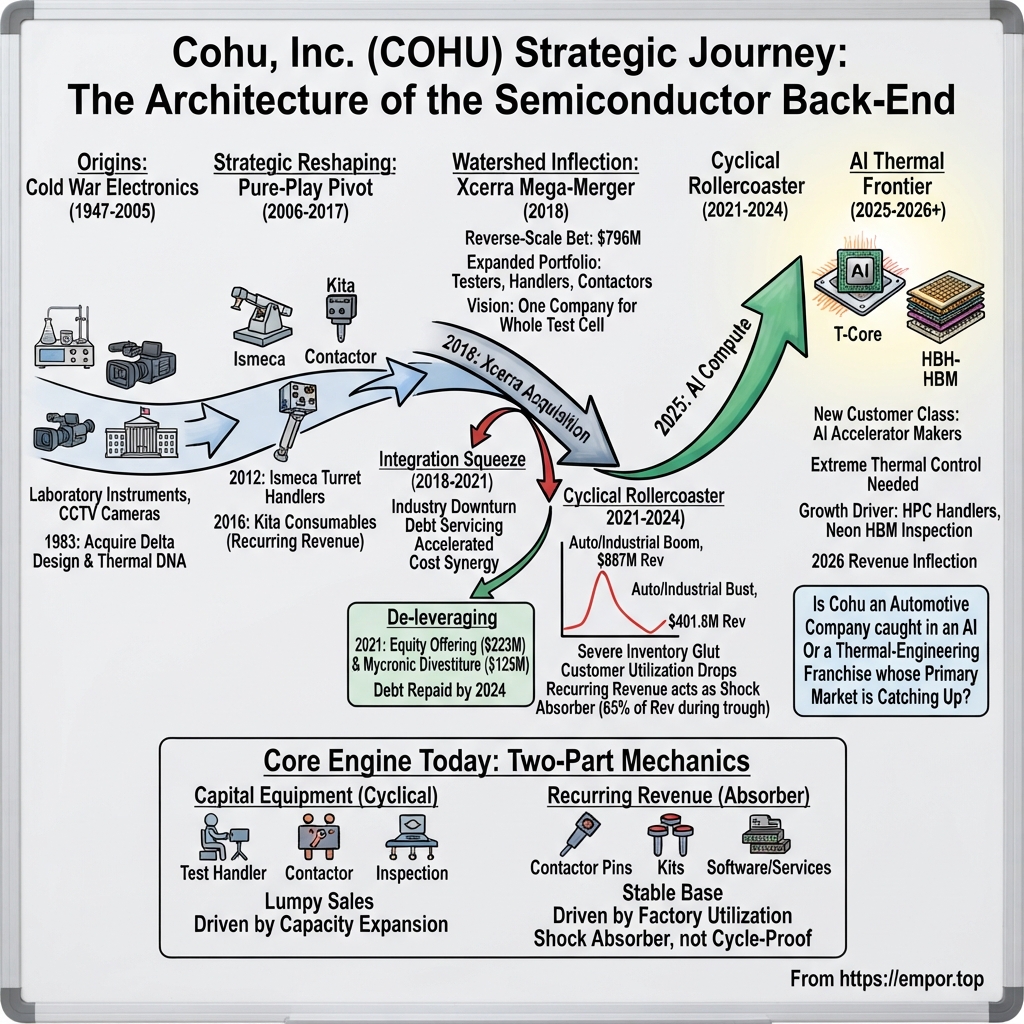
Cohu, Inc. (NASDAQ: COHU): The Architecture of the Semiconductor Back-End
I. Introduction & Episode Roadmap
Picture a factory floor in Melaka, Malaysia, at three in the morning. There is no cleanroom glamour here, no bunny suits bathed in yellow light, and no $200 million lithography machine humming behind glass. Instead, there are rows of refrigerator-sized machines, each swallowing trays of finished, packaged chips and spitting them out again. Inside, a robotic arm lifts a chip smaller than a fingernail, plunges it into a chamber chilled to the temperature of a Siberian winter, presses it onto a socket bristling with hundreds of spring-loaded needles, and holds it there while a tester fires electrical signals through it. A fraction of a second later, the chip is sorted into "good" or "reject," and the arm reaches for the next one.
This is the semiconductor back-end, where the industry's grand narratives collide with physical reality. While public attention centers on extreme ultraviolet lithography, two-nanometer transistors, and trillion-dollar fabs, every chip destined for a car's braking system, a radar module, or an AI server must still survive this final interrogation. It must be handled without cracking, subjected to the extreme temperatures it will encounter in the field, connected electrically without scarring microscopic solder balls, and verified to standards where a single escaped defect can trigger a recall.
Cohu, Inc. builds the machines and consumables that perform that interrogation. The company describes an active installed base of more than 25,000 systems serving over 280 high-volume manufacturing facilities for 108 customers in 31 countries.1 Its fiscal 2025 annual report lists its principal executive office in San Diego, a relocation from the long-time Poway campus that many investors still associate with the company.1 It manufactures test handlers (the robots that move and thermally condition chips), contactors (the sockets that make electrical contact), inspection and metrology systems, a line of automated test equipment, and data-analytics software.1
Cohu is also one of the more instructive corporate survival stories in American technology. It began in the 1940s building laboratory instruments and closed-circuit television cameras, spending decades as a small, disparate conglomerate. Then, in less than a decade, it divested everything outside semiconductor test and made a high-stakes bet: in 2018, it agreed to acquire Xcerra Corporation, a larger rival that a Chinese state-linked buyer had just failed to purchase, in a deal valued at roughly $796 million.2
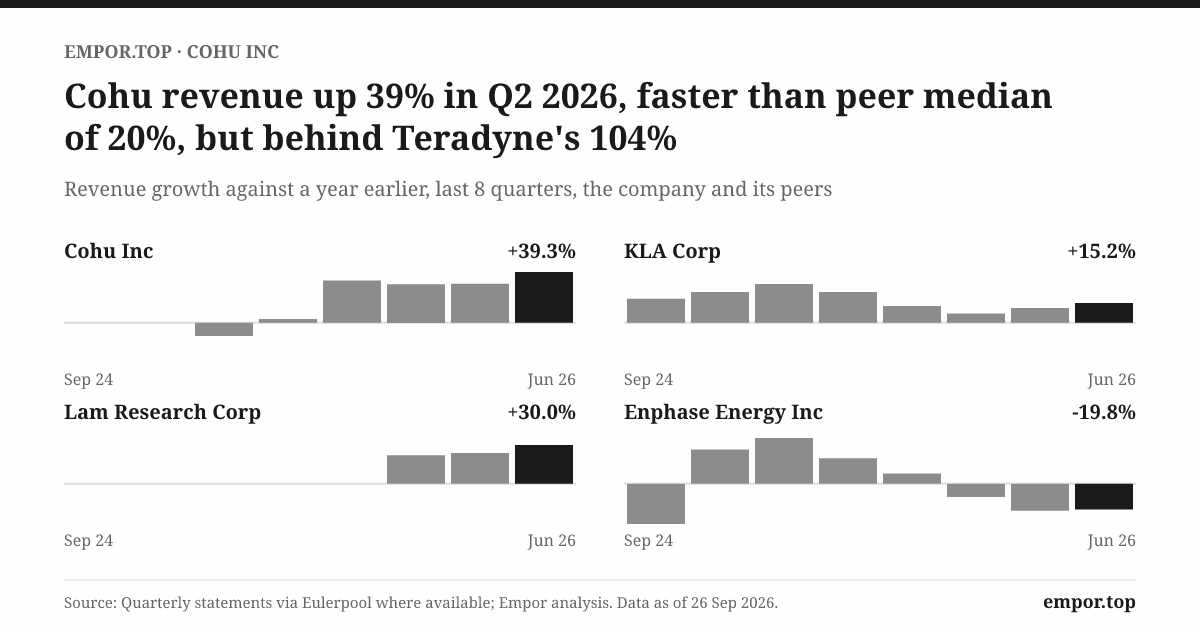
What followed was a cyclical rollercoaster. Revenue reached a record $887.2 million in 2021 during the pandemic chip shortage.3 It then collapsed to $401.8 million in 2024 as automotive and industrial customers worked through severe inventory gluts.4 Just as an automotive recovery kept slipping further out, a new customer class arrived: makers of AI accelerators that generate so much heat they require the precise thermal control Cohu had spent four decades refining. In the second quarter of 2026, Cohu reported revenue of $149.0 million, up 38% from a year earlier, and guided the third quarter to around $170 million.5 On that quarter's earnings call, management reported that computing represented 46% of system orders, while automotive orders were down 24% year over year.6
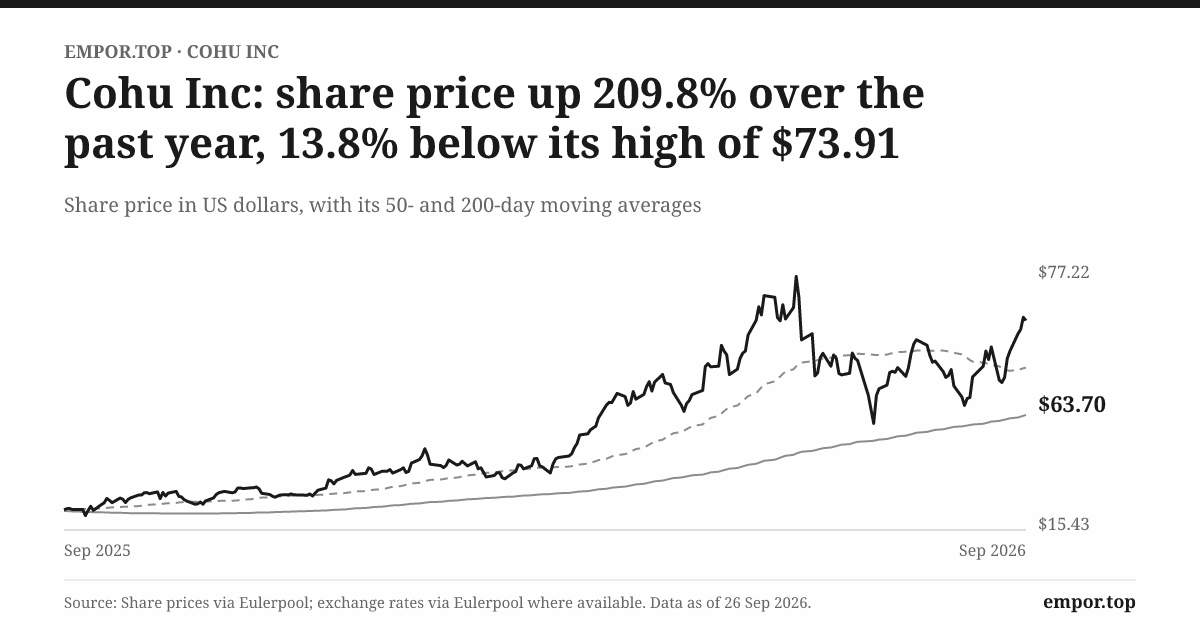
The stock market responded. Cohu's shares closed at $67.00 on September 25, 2026, compared with a 52-week low of $18.67.7 That dramatic re-rating raises the central question of this story: is Cohu an automotive-focused test company that caught a cyclical AI updraft, or a thermal-engineering franchise whose primary market has finally caught up to its capabilities?
The roadmap runs as follows: the company's origins, from Cold War-era electronics to the 1983 purchase of Delta Design; the pivot years under a Teradyne-trained engineer from Brazil; the Xcerra transaction and its geopolitical backstory; the integration and subsequent de-leveraging, including what actually paid down the debt; the 2021 boom and the 2023–2024 bust, traced through management's shifting commentary on earnings calls; the economics of handlers versus contactors, and why recurring revenue proved less defensive than advertised; the competitive landscape, from 株式会社アドバンテスト Advantest and Teradyne to emerging Korean and Chinese challengers; a strategy-framework stress test; the bull and bear cases; and finally, the AI thermal frontier that has recast the company's outlook in 2026.
 Subscribe on LinkedIn
II. Origins: From Cold War Electronics to the Back-End Test Floor (1947–2005)
A laboratory in postwar San Diego
In 1945, as service members returned through San Diego's naval port, Dr. David Kalbfell established a partnership called Kalbfell Laboratories.8 Southern California was rapidly transforming into a major defense manufacturing hub, dense with naval yards, aerospace facilities, and military contractors, creating steady demand for custom instrumentation. The business was incorporated in California in 1947 as Kalbfell Lab, Inc., rebranded as Kay Lab in 1954, and renamed Kintel Electronics in 1956.9
The company adopted its enduring corporate identity in 1957. That year, aviation executive Lamott T. Cohu and an investor group purchased the firm's assets and liabilities, reincorporating the business in Delaware as Cohu Electronics, Inc.89 The corporate name was shortened to Cohu, Inc. in 1972.9 Its early catalog reflected mid-century aerospace and commercial electronics: closed-circuit television cameras and broadcast equipment, alongside voltmeters, ohmmeters, and other precision measuring instruments.8
This product line established an enduring operational theme: from its inception, Cohu specialized in measurement and visual verification. Precision laboratory meters and television cameras shared a fundamental technical mission with modern semiconductor test and optical inspection: providing automated, repeatable verification that a critical component performs precisely to specification.
Delta Design and the thermal DNA
The transformative acquisition occurred in 1983, when Cohu acquired Delta Design, a manufacturer of environmental test chambers and semiconductor handling equipment.8 At the time, Delta Design appeared to be simply another disparate division; ultimately, it became the foundation of the entire enterprise.
Delta Design addressed a critical bottleneck in semiconductor manufacturing. Early integrated circuits operated primarily in benign office or consumer environments, such as desktop calculators and televisions. As silicon expanded into automotive engine compartments, telecommunications infrastructure, and military hardware, testing at room temperature proved insufficient. A microchip operating reliably at 25°C might fail at minus 40°C in a cold climate or above 100°C beside an automotive engine block. Verifying reliability required subjecting devices to operational temperature extremes, demanding robotic handlers that could heat or chill each microchip with extreme precision immediately prior to and during electrical testing.
This requirement created a complex electromechanical and thermal challenge: heating or cooling hundreds of miniature semiconductor packages to uniform target temperatures within seconds, securing them against electrical test sockets without mechanical damage, and sorting them at high volume. Delta Design’s gravity-feed and pick-and-place handlers, built with integrated thermal soak chambers, solved that production-line problem. That core capability—precise thermal control at high throughput—became the engineering foundation that continues to anchor Cohu four decades later.
The conglomerate years
Cohu operated for decades as a diversified mini-conglomerate rather than a dedicated semiconductor capital equipment supplier. Around 1984 it bought Broadcast Microwave Services (BMS), a maker of microwave transmission equipment used for news gathering and surveillance.8 Concurrently, its electronics division continued building industrial video cameras, while Delta Design supplied test handlers into the volatile semiconductor cycle.
This portfolio lacked structural synergy. The camera and microwave divisions were mature, low-growth operations with stable cash flows, whereas the semiconductor unit experienced sharp cyclical swings between industry shortages and downturns. When chip capital spending expanded, semiconductor equipment generated the bulk of operating profits; when spending collapsed, losses in handling equipment weighed down total corporate earnings. Public markets applied a standard conglomerate discount, as investors struggled to value a volatile semiconductor supplier burdened with unrelated legacy hardware units.
Management eventually rationalized the portfolio in the 2010s. Cohu sold its video camera business to Costar Technologies for $9.5 million in cash plus a small contingent payment, closing the sale in June 2014; the division had generated $15.7 million in 2013 sales.[^10] A year later, in June 2015, it sold BMS to an affiliate of StoneCalibre for up to $8.0 million, including earn-outs.[^11]
The transaction terms reflected the economic reality: legacy businesses housed within Cohu for decades yielded modest single-digit millions upon divestiture. The sales were designed not to generate windfall capital, but to streamline corporate focus and eliminate operational drag. For investors, the lesson was clear: Cohu’s long-term competitive value resided not in multi-industry diversification, but in the specialized engineering required to move and thermally condition semiconductors under high-volume production conditions.
III. The Strategic Reshaping: Pure-Play Semiconductor Pivot (2006–2017)
An engineer from Florianópolis by way of Teradyne
The executive who would guide that transformation arrived at Delta Design in 2005 with an unusual technical pedigree. Luis A. Müller had earned bachelor's and master's degrees in mechanical engineering at the Universidade Federal de Santa Catarina in Brazil, followed by a Ph.D. in mechanical engineering from MIT.[^12] Before joining Cohu, he spent nine years at Teradyne, one of the two dominant automated test equipment manufacturers.[^12] That background gave him direct insight into how the tester side of the test cell functioned: what interface tolerances it demanded, how automated test instrumentation operated, and where mechanical handoffs between machines were vulnerable to failure.
Müller rose steadily through the operating units. He became vice president of high-speed pick-and-place handlers in 2008, managing director of Rasco GmbH, Cohu's German handler operation, in 2009, and president of the Semiconductor Equipment Group in 2011. He was appointed president and CEO of Cohu in December 2014.[^12] He also serves on the board of Ralliant Corporation.[^12]
His finance partner had an even longer tenure. Jeffrey D. Jones had been vice president of finance and controller at Delta Design since 2005 and was named Cohu's chief financial officer in 2007.10 Jones still signed Cohu's filings as CFO in 2025.11 That shared run makes the Müller–Jones partnership one of the longest-standing executive pairings among small-cap semiconductor equipment suppliers, meaning that nearly every major strategic decision and capital allocation across this era traces back to the same leadership team.
Ismeca: a Swiss turret
The first major acquisition of this period arrived in December 2012, when Cohu agreed to acquire Ismeca Semiconductor Holding from Schweiter Technologies for $54.5 million plus acquired cash, funded entirely from existing balance sheet cash.12 Ismeca had generated sales of approximately $84 million over the twelve months through June 2012.12 The transaction closed around the turn of the year.13
The strategic rationale turned on handling mechanics. Delta Design focused on pick-and-place and gravity-feed handlers, which suited larger, more complex packages requiring extended thermal soak times. Ismeca brought turret handlers: rotary carousels that index miniature components through test, inspection, laser marking, and packaging stations at high operational speeds. Turret architectures are the industry standard for small discrete components, passive devices, and sensors, where unit throughput and cycle time take precedence over thermal conditioning. Ismeca also contributed specialized optical inspection technology, establishing the capabilities that Cohu later expanded into a dedicated inspection and metrology line.
Acquiring a business generating $84 million in revenue for roughly two-thirds of annual sales was not an expensive transaction on paper. Realizing that value in practice depended on whether Cohu could cross-sell turret platforms into its existing customer accounts, a viable thesis given substantial customer overlap across automotive and industrial chipmakers.
Kita: the quiet move into consumables
The more revealing strategic transaction was also the smallest. In November 2016, Cohu announced an agreement to acquire Kita Manufacturing, a Japanese producer of precision spring probe contacts, for $15 million in cash plus assumed debt and up to $3 million in earn-outs; the deal closed in early January 2017.1415
The strategic logic reflected what happens at the exact point of test contact. A handler positions each packaged chip directly against a contactor—a specialized socket studded with hundreds of miniature, spring-loaded pins. Each pin presses against a microscopic solder ball or lead to complete the electrical circuit to the tester. These pins endure punishing mechanical cycles: they wear down, collect solder debris, and experience spring fatigue under continuous production. Test floors must clean, refurbish, and periodically replace them on schedules dictated directly by unit test volumes.
While a handler is a lumpy capital expenditure purchased every several years, contactor pins are recurring consumables tied directly to customer factory utilization. Kita represented Cohu's initial step toward a classic razor-and-blades model, shifting a fraction of its revenue base away from volatile customer capital budgets and toward recurring operational spending.
By early 2017, Cohu had completed its initial repositioning: it had shed its non-semiconductor legacy divisions, added high-speed turret handling and optical inspection, and established a foothold in consumables. It was a focused semiconductor test supplier for the first time in its history. It was also still small. Its next acquisition would alter that scale overnight, catalyzed by Washington's escalating scrutiny of Chinese investments in American technology.
IV. The Watershed Inflection: The 2018 Xcerra Mega-Merger
The deal that Washington killed
In April 2017, Xcerra Corporation announced an agreement to be acquired for $10.25 per share in cash—roughly $580 million on a fully diluted basis—by Unic Capital Management, an affiliate of the state-backed Sino IC Capital in China; the transaction agreement was later assigned to an acquisition vehicle named Hubei Xinyan.16 Xcerra was itself the product of extensive industry consolidation. LTX-Credence, a Massachusetts-based automated test equipment manufacturer, had purchased handler maker Multitest and contactor specialist Everett Charles Technologies from Dover Corporation in 2013 for $93.5 million, rebranding the combined entity as Xcerra in 2014.17 The company also owned atg-Luther & Maelzer, a German manufacturer of printed circuit board test systems.17
The timing proved precarious for a Chinese buyer. U.S. regulatory scrutiny over foreign investment in domestic semiconductor technology was intensifying, placing the Committee on Foreign Investment in the United States (CFIUS) on the front line of national technology policy. In February 2018, after CFIUS signaled that regulatory clearance was "highly unlikely," Xcerra and the consortium signed a termination agreement, with neither side paying a termination fee.18
The scuttled transaction left an attractive business, an engaged board, and an unresolved sale process on the open market. Müller moved within three months.
The reverse-scale bet
On May 8, 2018, Cohu agreed to acquire Xcerra for $9.00 in cash plus 0.2109 Cohu shares per Xcerra share, a package valued at $13.92 per share at announcement.2 The consideration implied an equity value of approximately $796 million and an enterprise value of about $627 million after accounting for Xcerra's cash balance.2 Upon closing, Xcerra shareholders were set to own roughly 30% of the combined company.2
The relative scale of the two businesses made the transaction an audacious reverse-scale bet. Over the preceding twelve months, Cohu had generated roughly $367 million in revenue, compared with approximately $461 million for Xcerra.2 The smaller player was absorbing the larger one. The pricing also commanded attention: at $13.92 per share, Cohu was paying substantially more than the $10.25 per share the Chinese consortium had offered a year earlier, though the cash-and-stock structure ensured Xcerra's shareholders remained tied to the combined company's future operational performance.
When the acquisition closed on October 1, 2018, Cohu funded the purchase by paying approximately $503 million in cash and issuing about 11.8 million shares, backed by a $350 million senior secured term loan facility led by Deutsche Bank.19 Xcerra directors David Tacelli and Jorge Titinger joined Cohu's board of directors.19 For Cohu, which had long operated with a conservative, net-cash balance sheet, the transaction marked a fundamental financial departure: it was now saddled with hundreds of millions of dollars in floating-rate debt.
Did Cohu overpay?
On headline valuation metrics, the purchase price appeared disciplined. An enterprise value of $627 million against trailing twelve-month revenue of $461 million represented an enterprise value-to-sales multiple well below 1.5 times. By comparison, dominant automated test equipment manufacturers historically commanded substantially richer multiples. Judged by that baseline, Cohu had secured a combined portfolio of testers, handlers, and contactors at an industrial hardware valuation.
Yet mergers and acquisitions in semiconductor capital equipment carry an inherent structural hazard: strategic buyers often acquire assets near cyclical peaks. Xcerra’s trailing financial results reflected the robust industry upcycle of 2017 and 2018. Within months of the October 2018 closing, semiconductor capital spending contracted sharply, pulled down by broader weakness in memory and smartphones throughout 2019. A valuation multiple that seemed modest against peak earnings expanded rapidly as profits compressed at the cyclical trough—and the newly incurred debt burden did not contract alongside top-line revenue.
Myth vs. reality: the geopolitical bargain
A persistent narrative surrounding the acquisition suggests that CFIUS handed Cohu an underpriced asset: that with the Chinese consortium disqualified, Xcerra became a distressed seller that Cohu acquired at a steep discount. The transaction economics tell a different story. Cohu’s offer carried an implied value of $13.92 per share at announcement, representing an 8.4% premium over Xcerra’s prior closing price, a 15.4% premium over its 30-day volume-weighted average, and a meaningful step up from the $10.25 per share the Chinese buyer had negotiated a year earlier.216 Far from selling under duress, Xcerra’s board secured a superior valuation, structuring the payout so its equity holders retained roughly 30% of the combined company's upside.2
What regulatory intervention actually provided Cohu was not a distressed valuation, but a cleared field of competitors. A domestic handling equipment supplier acquiring an American test business posed none of the national security concerns that had derailed the cross-border transaction, and few alternative strategic suitors possessed the requisite scale and industrial fit. Geopolitics made the transaction feasible; it did not make it inexpensive. That distinction is critical, because it placed the burden of investment returns squarely on post-merger execution and operational integration, rather than on an initial acquisition discount.
The vision: one company for the whole test cell
Müller’s strategic logic was conceptually straightforward. A semiconductor back-end test cell comprises three primary elements: the automated tester that generates and analyzes electrical signals, the handler that physically moves and thermally conditions the device, and the contactor socket that establishes mechanical and electrical contact between them. Historically, chipmakers procured each subsystem from independent vendors, leaving integration and interface troubleshooting to their own manufacturing engineers. By bringing all three disciplines under one roof, Cohu contended that it could holistically optimize the high-frequency electrical signal path, thermal dissipation, and mechanical tolerances, thereby improving production yields and reducing a customer’s total cost of test. Management initially targeted more than $20 million in annualized run-rate cost synergies within two years, expanding that goal at closing to include an additional $20 million over three to five years.219
On an investor slide, the integrated test-cell architecture presented an intuitive commercial rationale. Whether semiconductor manufacturers would willingly abandon best-of-breed purchasing habits to buy integrated suites from a single supplier was an entirely separate question—one that would take several years and a complete industry cycle to answer.
V. Integration Squeeze, De-leveraging, and Portfolio Pruning (2018–2021)
A downturn on day one
The timing penalty materialized almost immediately. In 2019, Cohu's first full year with Xcerra, net sales fell to $583.3 million, resulting in a GAAP net loss of roughly $69 million, or $1.68 per share.20 Revenue from two businesses that had collectively generated more than $800 million annually contracted sharply, leaving the company to service a $350 million term loan in the teeth of an industry downturn.
Management responded by accelerating cost reductions. By May 2019, leadership had raised its annualized synergy target to $40 million by year-end, doubling the original two-year objective.21 That effort required consolidating overlapping facilities, merging regional sales forces, and rationalizing redundant handler architectures across legacy Delta Design, Rasco, Ismeca, and Multitest product lines. Accelerating cost targets during an industry slump is invariably a blend of operational discovery and balance-sheet necessity, but the speed of the intervention preserved liquidity when cash flow was under severe pressure.
Integration momentum had begun even before the slump deepened. At closing, Cohu reported that approximately $9.1 million of run-rate savings were already in place.19 Consolidating two competing handler lineages is notoriously difficult. Each product family possessed its own engineering cadre, proprietary component suppliers, loyal customer accounts, and specialized communication protocols for docking to automated testers. Retiring platforms prematurely risked alienating chipmakers that had qualified a specific handler for an automotive or industrial production line—the exact qualification barrier that underpins customer switching costs in the back end. Integration therefore demanded a delicate balance: ruthlessly eliminate duplicate overhead while maintaining long-term technical support for the fragmented installed base. Cohu managed that rationalization without triggering customer defections, though cyclical demand weakness across the industry made market-share shifts difficult to discern in real-time order books.
What actually paid down the debt
A common narrative surrounding Cohu's balance-sheet recovery attributes the turnaround to disciplined portfolio pruning: selling a non-core asset to extinguish debt. That accounts for only part of the capital.
The divestiture was genuine. In May 2021, Cohu agreed to sell atg-Luther & Maelzer and its printed circuit board test group to Sweden's Mycronic AB for approximately $125 million in cash.2223 The PCB test business had generated sales of $52.9 million over the preceding twelve months, and Cohu planned to use expected net proceeds of roughly $95 million to $100 million to repay term loan principal.22 Carving out printed circuit board test—a technology distinct from semiconductor component testing—represented logical portfolio pruning at a respectable valuation.
Yet two months earlier, in March 2021, Cohu had tapped an even larger source of capital. Capitalizing on a surging equity valuation during the pandemic semiconductor rally, the company priced an upsized public offering of 4.95 million shares at $41.00 each, generating net proceeds of approximately $223 million after underwriters exercised their overallotment option.24 That equity offering delivered more than double the cash proceeds of the Mycronic divestiture. Combined with strong cash flows in 2021 and 2022, the equity cushion allowed Cohu to whittle down the loan; it accelerated principal prepayments in 2023 and repaid the remaining $29.3 million in February 2024.25
This distinction reshapes the evaluation of management's capital allocation. Acquiring Xcerra had required $350 million in senior debt and roughly 11.8 million newly issued shares; repairing the balance sheet required issuing nearly 5.7 million additional shares. Selling stock at $41.00 near the peak of a cyclical upswing was opportunistic financial management that insulated Cohu from debt covenants before the severe 2023–2024 automotive slump arrived. However, de-leveraging was not achieved through operating cash flow alone: shareholders absorbed substantial dilution to clean up the balance sheet.
A tuck-in to fill a gap
Alongside broader portfolio pruning, Cohu pursued targeted bolt-on acquisitions to fill specific handling niches. In January 2023, the company acquired MCT Worldwide, a U.S. business with its primary manufacturing in Penang, Malaysia, which added strip, film-frame, and laser-marking handling.26 Strip handlers test semiconductor devices while they remain attached to the lead-frame strip on which they were assembled, a high-throughput architecture widely adopted for compact automotive sensors and power discretes. The price was not disclosed.26
Myth vs. reality: the turnkey test cell
Myth: Owning the tester, the handler, and the contactor would allow Cohu to cross-sell its proprietary automated test equipment into its massive handler installed base and crack the Advantest–Teradyne duopoly.
Reality: Industrial purchasing habits rejected single-vendor bundling. Years after the merger, Cohu's annual report still described its automated test equipment business as facing "two dominant suppliers headquartered in the U.S. and Japan" that were "substantially larger," while identifying Cohu as the leading global supplier of test handlers.27 Advantest's investor materials underscored that market concentration, estimating that Advantest and Teradyne together held approximately 80% of the tester market.28 Tellingly, Cohu does not break out its standalone tester market share in public filings—a clear indication that automated test systems remained a secondary product line rather than a core growth driver.
The underlying software economics explain why the turnkey thesis stalled. Test engineers write complex, device-specific test programs tailored to a tester's proprietary operating system and digital architecture. Migrating to an alternative tester requires rewriting and requalifying that software code base at considerable expense and operational risk. In contrast, handlers are valued for modular interoperability. An outsourced assembly-and-test subcontractor insists on docking a Cohu handler to an Advantest tester for one production run and reconfiguring it for a Teradyne system the next morning. Forcing a proprietary bundled stack ran counter to the operational flexibility that high-volume manufacturing demands.
Consequently, the original Xcerra thesis narrowed in practice. What endured was not a turnkey monopoly across the test cell, but a more focused technical synergy: co-engineering handlers and contactors provided distinct competitive advantages at the mechanical, thermal, and electrical contact interface. Cohu's ambition to leverage mechanical handling dominance into a mainstream tester challenge failed to materialize. Yet with its balance sheet repaired and non-core distractions shed, the company was financially stabilized just as the semiconductor industry entered one of the most volatile supply-chain cycles in modern history.
VI. The Great Auto/Industrial Cycle: From 2021 Peak to 2024 Hangover
The shortage
In early 2021, assembly lines across Detroit, Wolfsburg, and Nagoya ground to a halt, idled not by shortages of structural steel or internal combustion engines, but by a sudden deficit of microchips costing only a few dollars apiece: microcontrollers, power management integrated circuits, and analog sensors. A modern vehicle relies on hundreds of these components. When pandemic disruptions fractured global logistics, automakers confronted the brutal reality that a missing one-dollar part could prevent the delivery of a fifty-thousand-dollar automobile.
The commercial reaction was an aggressive capital expenditure ramp across the analog, power, and microcontroller sectors. Integrated device manufacturers such as Texas Instruments, Analog Devices, NXP, STMicroelectronics, and Infineon, alongside outsourced assembly-and-test subcontractors such as 日月光投資控股 ASE Technology Holding and Amkor, expanded packaging and test capacity as rapidly as equipment could be delivered. A substantial share of that tooling required tri-temperature capability—the electromechanical ability to test chips under extreme cold, ambient, and scorching operating conditions. That environmental verification was Cohu's historic core franchise.
The boom in numbers
The resulting demand surge transformed Cohu's operating profile. In 2021, revenue expanded 39% to a record $887.2 million, generating GAAP net income of $167.3 million and non-GAAP earnings of $3.20 per share.3 Customer concentration was significant: Analog Devices alone represented 14.1% of total sales that year.29 The momentum carried into 2022, with revenue holding near peak levels at $812.8 million, delivering GAAP net income of $96.8 million and non-GAAP earnings of $2.91 per share.30
Buoyed by that unprecedented expansion, management established an aggressive mid-term financial model in December 2021, targeting $1 billion in annual revenue and $4.00 in non-GAAP earnings per share.31 Those targets reflected a widespread corporate conviction that the pandemic chip crunch had permanently elevated the structural baseline of semiconductor test demand. Nearly five years later, Cohu has yet to reach either milestone—a discrepancy that serves as a useful calibration point whenever leadership presents multi-year financial roadmaps.
The bullwhip
The cyclical reversal illustrated the classic supply-chain bullwhip effect, in which marginal shifts in retail demand trigger wild, destabilizing swings upstream as each tier over-orders during shortages and cuts procurement during inventory corrections. Back-end semiconductor test equipment sits at the far end of that bullwhip.
By 2023, as component delivery caught up with underlying vehicle assembly, automakers, industrial equipment producers, and component distributors realized they had accumulated massive component stockpiles. Chipmakers responded by throttling production lines to digest inventory. When chipmakers cut factory throughput, capital spending on test capacity freezes immediately, because the test handlers already installed on factory floors are suddenly operating with idle capacity. Cohu's 2023 revenue dropped to $636.3 million, though operating discipline kept the company profitable with GAAP net income of $28.2 million.32 STMicroelectronics stood as its largest customer that year, accounting for 12.0% of sales.1 In 2024, the cyclical contraction turned severe: revenue fell to $401.8 million, and Cohu recorded a GAAP net loss of $69.8 million.4 Within three years, top-line revenue had contracted by more than half from its 2021 peak.
The call autopsy: a recovery that kept moving
The most illuminating record of this downcycle is found not in the lagging financial statements, but in how executive guidance shifted across quarterly earnings calls.
On the second-quarter 2023 call, Müller told investors that customers had hit "the pause button on orders in June" and asserted that the company was "passing the trough of the cycle," forecasting that automotive and industrial demand would "start picking up to normal levels in Q1 of next year."33
By the first-quarter 2024 call, the timeline had slipped. Müller described the company as navigating "through the eye of the storm," cautioned that operating conditions would persist "at this level for another quarter or 2 before we start seeing improvement," and deferred the turning point to "a 2025 recovery."34 Customer test-cell utilization, an operational metric Cohu tracks across its global installed base, languished at 72%.34
On the fourth-quarter 2024 call in February 2025, Müller characterized end markets as "crossing the chasm of a downturn." Questioned by an analyst on the recurring delays, he shared a candid observation on the semiconductor cycle: "people seem to always indicate that it's six months away." He nevertheless projected "another 2 quarters before our customers in that segment turn the corner."35
Reviewed chronologically, the forecasting pattern is unmistakable. Management called the cyclical bottom in mid-2023, a determination that proved early by roughly eighteen months. The automotive and industrial inflection anticipated for early 2024 had still not fully materialized by mid-2026: on the second-quarter 2026 call, Müller noted that he did not expect automotive customer utilization to recover to the benchmark 80% threshold "up until probably late Q1 or Q2 of next year."6
To be fair, forecasters across the analog and automotive semiconductor supply chains broadly misjudged the duration of this inventory glut, and Müller's admission that recoveries perpetually seem "six months away" captured real industry frustration. Cohu's explanations remained consistent, and management transparently disclosed its core operational gauge—customer factory utilization—every quarter. Even so, the historical sequence underscores that executive cycle-timing calls should be treated as low-confidence projections. The company's underlying operational health is better understood through its installed-base utilization metrics than through management's recovery timetables.
The turn that came from an unexpected direction
When the top-line recovery finally took hold, it diverged sharply from the automotive inflection management had long telegraphed. In the first quarter of 2025, revenue troughed at $96.8 million, and Cohu took advantage of the depressed equity valuation to repurchase 432,288 shares for approximately $8.6 million.36 In the second quarter, revenue stepped up to $107.7 million, customer test-cell utilization crept up to 75%, and the company secured a $28 million design-win order spanning mobile and automotive accounts.37 By the third quarter, revenue reached $126.2 million, accompanied by a quarterly announcement that would have looked improbable during the 2021 automotive scramble: Cohu highlighted that it was "accelerating in AI data center markets" behind its Neon high-bandwidth memory inspection systems and Eclipse test handlers.38
For the full year 2025, revenue rebounded 13% to $453.0 million on a 29% increase in total orders, though bottom-line results remained in the red with a GAAP net loss of $74.3 million.39 Cohu's annual report attributed that top-line recovery primarily to "stronger demand for AI-based computing applications."1 In short, the upturn Cohu had spent two years projecting from traditional automotive and industrial buyers arrived first from advanced computing architectures. That distinction is crucial for evaluating corporate performance: management misjudged the timing of its primary market, but preserved technological readiness so that when enterprise computing demanded advanced thermal dissipation, Cohu had commercial platforms ready to deploy. Cyclical survival often combines engineering preparation with market fortuity; Cohu's 2025 turnaround relied on both.
Yet this severe cycle raises a fundamental operational question: when capital equipment purchases evaporate for two consecutive years, what stabilizes the business? The buffer management repeatedly emphasized was recurring consumables and service revenue.
VII. The Core Engine Today: Segment Mechanics & The Recurring Revenue Moat
One segment, two businesses
Cohu reports a single operating segment, but its financial performance is driven by two fundamentally different economic engines.1 Understanding the divergence between them is central to diagnosing the company's cyclical swings.
Engine 1: the machines
The first engine is capital equipment, anchored by test handlers. The company's 2024 annual report details an extensive portfolio spanning pick-and-place, turret, gravity, strip, film-frame, laser-marker, MEMS, and thermal subsystem architectures.27 Each mechanism targets a distinct packaging format: gravity-feed systems let chips slide down rails, offering speed and mechanical simplicity for leaded packages; turret handlers spin miniature components around a carousel at high operational speeds; and pick-and-place systems use robotic arms to transfer chips between trays and test sockets, serving as the workhorses for complex, thermally demanding devices.
Thermal control remains the core technical differentiator. Automotive and industrial semiconductors are routinely subjected to tri-temperature testing: extreme cold, ambient room temperature, and scorching heat. A handler must bring every chip to its target temperature, maintain that envelope within tight tolerances, and sustain that control at high production throughput. If a device drifts by even a few degrees during test, it may either fail erroneously—destroying manufacturing yield—or pass erroneously, risking a field failure in an automobile or industrial installation. Cohu's T-Core platform, which the company describes as proprietary active thermal control, extends this capability to high-power processors deployed in AI data centers.27
The second capital equipment line is optical inspection and metrology, an outgrowth of the vision technology acquired with Ismeca: automated systems that inspect packaged devices from all angles to detect micro-cracks, chipping, and surface defects. The third line is automated test equipment, led by the Diamond x tester for system-on-chip and mixed-signal devices and the PAx tester for radio-frequency front-end modules.27
Engine 2: the blades
The second engine is recurring revenue, defined in Cohu's regulatory filings as interface products, spares, kits sold separately from systems, software, and services.1
Interface products are the contactors: consumable sockets whose spring-loaded pins wear down with every mechanical insertion. Kits comprise the change parts required whenever a manufacturer shifts a handler to a different package footprint, because a system configured for one chip geometry cannot accommodate another without customized trays, nests, and plungers. Services and maintenance keep the aging installed base operating. Software includes DI-Core, Cohu's data platform for test-cell monitoring, alongside AI-driven process-control tools added in January 2025 through the acquisition of Tignis for roughly $34.9 million in net cash plus a potential $5.0 million earn-out.40 That earn-out was ultimately not paid after the acquired business missed its performance targets.41
What "utilization" actually measures
Because it recurs throughout the company's financial narrative, the factory utilization metric requires clear operational framing. Cohu tracks how intensively customers run the test cells across its installed base—measuring the proportion of available handler time spent actively testing silicon. The dynamic resembles hotel occupancy: when rooms sit empty, operators do not build an additional wing; they add capacity only when guests risk being turned away. Semiconductor manufacturers behave the same way. When fleet utilization languished in the low 70% range throughout much of 2024, customers had idle equipment sitting on factory floors, giving them little incentive to place new machine orders.34 Only as utilization approaches the 80% threshold do bottlenecks emerge and capital spending resume.
Utilization also bridges the two operating engines. Higher utilization generates more insertions per contactor socket, accelerating mechanical pin wear and driving replacement orders. As a result, consumable spending typically inflects before system orders recover. That pattern emerged in late 2025, when management highlighted four consecutive quarters of recurring revenue growth.42 The dynamic also clarifies Cohu's software ambitions: DI-Core and Tignis are designed to monetize data generated by the test cell, and management has begun bundling software subscriptions with equipment sales, including an inspection software subscription tied to a Krypton inspection system order for automotive driver-assistance processors.42 Whether software matures into a standalone profit driver or functions primarily as a commercial feature that aids hardware sales remains unproven in Cohu's reporting.
Myth vs. reality: the recurring revenue floor
The claim: Recurring revenue provides Cohu with a durable financial floor that insulates the business from cyclical contractions in capital equipment.
The evidence: Evaluated as a percentage of total sales, recurring revenue performed precisely as advertised. It accounted for 37% of revenue during the 2021 peak and 42% in 2022.29 It then climbed to 49% in 2023 and reached 65% in 2024 before settling at 60% in 2025.1
Yet percentages can distort underlying realities. Translating those proportions into absolute dollar terms shows that recurring revenue generated approximately $330 million to $340 million annually in 2021 and 2022, dropped to roughly $260 million during the 2024 trough, and rebounded to around $270 million in 2025. The recurring revenue share expanded not because consumable sales grew, but because capital equipment shipments collapsed. In dollar terms, the purported floor sank by roughly a quarter.
The underlying operational mechanics explain the drop. Contactor pin consumption depends on total unit test volume, not the absolute number of handlers in the field. When customers run production lines at 70% utilization rather than 90%, socket pins wear down more slowly and replacement cycles lengthen. Similarly, conversion kits depend on new chip introductions, which slow down during industry slumps. Recurring revenue is tied to factory output, and factory output remains cyclical—even if its swings are less volatile than capital equipment expenditures.
The empirical record therefore qualifies the thesis: recurring revenue acts as a shock absorber, not a cycle-proof fortress. It preserved Cohu's gross margins during the trough, supporting a non-GAAP gross margin of 45.0% in 2024, but it could not prevent GAAP net losses in both 2024 and 2025.439 Validating the stronger version of the recurring revenue moat would require dollar volumes that expand through a full cycle, rather than simply claiming a higher percentage of a shrinking revenue base.
Understanding the mechanics of these two engines also clarifies Cohu's competitive positioning, because each subsystem within the test cell contends with a distinct roster of rivals.
VIII. Competitive Dynamics & Industry Structure
Three battlefields
The back-end semiconductor test cell functions across three distinct operating arenas. On one side sits the automated tester, generating electrical signals and analyzing chip responses. In the center operates the handler, providing robotic movement and precision thermal conditioning. At the interface sits the contactor, maintaining microscopic electrical contact between silicon and test socket. Cohu competes across all three, but its strategic standing in each differs fundamentally.
The ATE wall
In automated test equipment, the landscape remains dominated by two established leaders. 株式会社アドバンテスト Advantest estimates that together with Teradyne, it controls roughly 80% of the tester market, with its own share climbing to 58% in 2024.28 Their flagship platforms test high-value computing silicon: graphics processors, artificial intelligence accelerators, mobile application processors, and high-bandwidth memory stacks. Cohu's testers, by contrast, address narrower, more price-sensitive niches across mixed-signal, analog, and radio-frequency devices, with corporate filings explicitly acknowledging that dominant automated test equipment suppliers are substantially larger.27 That requires an ongoing research-and-development commitment in an arena where software ecosystems reinforce scale, and scale resides firmly with rivals.
The handler stronghold
In mechanical handlers, Cohu describes itself as the leading global supplier.27 Because independent market-share data across the back end is not publicly tracked, the precise scope of that market lead remains undisclosed. Cohu's fiscal 2025 annual report identifies its primary competitors across product lines as Advantest, Teradyne, Hon Precision, KLA, and other Asia-based equipment manufacturers.1
Two competitors stand out. The first is Taiwan's 鴻勁精密 Hon Precision. On Cohu's second-quarter 2026 earnings call, management characterized Hon Precision as essentially its only direct rival in high-power AI thermal handlers, the fastest-growing corner of Cohu's order book.6 That dynamic creates a head-to-head contest in the niche driving Cohu's recent equity re-rating.
Evaluating procurement dynamics from the chip designer's perspective clarifies the competitive stakes. A manufacturer ramping a kilowatt-class AI processor requires two things from equipment vendors: thermal dissipation precise enough to ensure reliable test yields, and secondary sourcing to prevent any single vendor from dictating pricing or lead times. That multi-sourcing instinct previously constrained Cohu's turnkey test-cell ambitions, and it operates just as powerfully in thermal handling. A plausible upside for Cohu is securing durable incumbent share at accounts where its systems were qualified first. The structural risk is that early customer qualifications establish baseline technical specifications that competitors replicate, eventually triggering price competition across subsequent product cycles. Management's report that its pipeline includes four already-qualified customer accounts provides evidence of early traction, though it does not yet establish unit-share allocation within those fabs.6
The second notable rival is South Korea's 테크윙 Techwing, an established supplier of memory test handlers to manufacturers including 삼성전자 Samsung Electronics. In June 2026, Techwing reportedly secured an initial order from SK하이닉스 SK hynix for its HBM Cube Prober, a system engineered to test 256 stacked-memory dies simultaneously across an operating envelope spanning minus 40°C to 150°C.43 That win underscores that high-bandwidth memory testing is an intensely contested arena, demonstrating that Cohu's optical inspection presence in memory packaging does not automatically confer entry into high-volume memory handling, where specialized peers remain entrenched.
The Chinese challengers
A longer-term structural challenge is developing in mainland China. Domestic equipment supplier 长川科技 Hangzhou Changchuan Technology reported 2025 revenue of 5.29 billion yuan, an increase of 45%, comprising 1.57 billion yuan in handlers and 3.20 billion yuan in automated test systems.44 Meanwhile, 华峰测控 Beijing Huafeng Test & Control posted 2025 revenue of 1.35 billion yuan, up nearly 49%.45 Both suppliers have expanded rapidly under state initiatives promoting domestic semiconductor self-reliance, finding immediate adoption among domestic assembly-and-test subcontractors such as 长电科技 JCET, 通富微电 Tongfu Microelectronics, and 华天科技 Huatian Technology.
Cohu's direct revenue exposure to China remains limited. Mainland accounts contributed $17.6 million, or roughly 12%, of Cohu's $149.0 million in second-quarter 2026 revenue, with Malaysia representing its largest single geographic market.41 Management has framed that modest footprint as a defensive advantage that shields the company from regional trade volatility.42 Yet limited exposure carries trade-offs. It leaves Cohu largely excluded from the industry's fastest-expanding volume of packaging and test capacity, while Chinese peers build operating scale within a protected domestic ecosystem before expanding abroad. Changchuan's handler revenue alone has grown to represent a substantial proportion of Cohu's total equipment turnover. The strategic concern is not immediate customer churn, but future price competition as Chinese manufacturers export mature-node handling platforms into competitive manufacturing hubs across Southeast Asia.
Contactors
The contactor market, which Cohu's filings characterize as fragmented, represents the most granular competitive arena.27 Socket design is contested package by package, customer by customer, against specialized pin and interface manufacturers worldwide. Fragmentation cuts both ways. While the absence of a consolidated rival protects Cohu from being excluded from major test floors, it also prevents any single participant, including Cohu, from exercising meaningful pricing power over consumable hardware.
The giants next door
A core structural tension governs Cohu's competitive positioning: the two dominant automated test equipment manufacturers whose systems interface with Cohu's handlers on factory floors worldwide are simultaneously direct rivals. Cohu's annual report explicitly lists Advantest and Teradyne among its primary competitors across product lines, not merely in automated test instruments.1 Both corporations dwarf Cohu in financial scale and maintain primary commercial relationships with the leading computing architects whose processors require advanced handling. Were either supplier to decide that active thermal conditioning is indispensable to controlling the advanced packaging test cell, both possess the balance-sheet depth, engineering resources, and customer access to enter the category aggressively.
For now, commercial developments reflect a different equilibrium: the primary competitor Cohu identifies in AI thermal handling is Hon Precision rather than either tester giant.6 That suggests the automated test leaders have chosen to leave high-power thermal handling to specialized mechanical engineering suppliers rather than commercializing proprietary high-power handler platforms. Yet that balance remains contingent. The market expansion that makes high-power thermal handlers lucrative for Cohu also elevates the segment's visibility for larger capital equipment peers.
Cohu's competitive advantages are distinct but localized: highly defensible where mechanical and thermal physics govern test yields, but constrained where proprietary software standards or national industrial policies shape procurement. Testing those competitive dynamics against established strategic frameworks clarifies how durable that positioning is likely to prove.
IX. Strategy Frameworks: Porter's 5 Forces & Hamilton Helmer's 7 Powers
Hamilton Helmer's 7 Powers
Hamilton Helmer's strategy framework examines what enables a business to generate economic returns above its cost of capital on a sustained basis against capable rivals. Applied to Cohu, the model reveals one durable competitive power alongside several partial advantages.
Switching costs represent the company's most defensible attribute. Once an automotive chip is qualified on a specific handler and contactor configuration, replacing that hardware requires requalifying the entire test flow. For automotive and industrial silicon that remains in high-volume production for a decade, manufacturers are reluctant to incur that expense and operational disruption without an overwhelming commercial catalyst. Yet this switching cost operates at the individual device level rather than across the overarching enterprise relationship. Every time a chipmaker introduces a new device family, the handling socket is reopened to competitive bidding. Consequently, Cohu's installed base of more than 25,000 systems remains highly sticky, but securing incremental design-ins requires contesting each new product cycle from scratch.
Scale economies are moderate. A global operating fleet supports regional field engineering and maintenance personnel across Asia, Europe, and North America, while distributing research-and-development expenses over a larger hardware volume than subscale handler manufacturers can match. In automated test equipment, however, the dynamic reverses: pitted against Advantest and Teradyne, Cohu is the decidedly subscale participant.
Process power and cornered resources present the most intriguing strategic dynamic. Cohu's thermal engineering expertise—embodied in its proprietary T-Core active thermal control architecture and four decades of handler development—is the closest equivalent the business possesses to an inimitable operational asset. The current expansion into artificial intelligence acceleration serves as an empirical test of whether that specialized engineering constitutes a defensible cornered resource. If Cohu captures a decisive share of high-power thermal handling sockets against competitors such as Hon Precision, it will indicate that its electromechanical expertise is difficult to replicate. If the market instead fragments evenly, that thermal capability functions as valuable technical know-how rather than a structural cornered resource.
Myth vs. reality: switching costs
The switching-cost hypothesis warrants rigorous empirical testing against customer purchasing patterns. If switching barriers were absolute at the enterprise level, customer concentration should remain broadly consistent, with core integrated device manufacturers contributing predictable revenue shares across successive annual filings.
The historical record reveals a far more volatile procurement pattern. Cohu's largest customer accounts fluctuate significantly from year to year. Analog Devices represented more than 10% of total sales in 2021 but fell below that threshold in 2022; STMicroelectronics exceeded 10% of revenue in 2023 before dropping below that level in 2024 and 2025; and in 2025, no individual customer accounted for 10% of total annual sales.291
Part of this volatility reflects independent capital spending cycles at individual chipmakers rather than outright market-share defection. Even so, that rotation demonstrates that installed-base stickiness does not translate into stable, recurring machine demand. The evidence narrows the operational claim: switching costs protect the recurring consumables and service streams attached to qualified production lines, but they offer little insulation for new capital equipment orders, which competitors contest design cycle by design cycle.
Other powers within Helmer's taxonomy remain largely absent. Counter-positioning and network effects do not apply to modular back-end hardware. Similarly, branding power—defined as the capacity to extract pricing premiums for functionally equivalent offerings—is minimal in an engineering-led capital goods market where procurement teams subject equipment to exhaustive yield benchmarks.
Porter's Five Forces
Bargaining power of buyers is substantial. In fiscal 2025, Cohu's ten largest customer accounts generated 60% of total revenue.1 These clients comprise sophisticated global integrated device manufacturers and outsourced assembly-and-test subcontractors that deliberately qualify multiple vendors and exert aggressive pricing leverage during industry downcycles. Individual accounts periodically dominate annual results: Analog Devices contributed 14.1% of total sales in 2021, STMicroelectronics generated 12.0% in 2023, and a single industrial customer exceeded 10% of revenue in the second quarter of 2026.2916
Bargaining power of suppliers is moderate. Although precision-machined assemblies, high-speed motion robotics, optics, and specialized thermal components require tight manufacturing tolerances, Cohu procures most input materials from multiple specialized merchant suppliers.
Threat of substitutes remains low for physical back-end verification as a whole, because packaged semiconductors must undergo final functional screening before deployment. At the structural margin, however, substitution risks are genuine. Test content can shift upstream toward wafer-level probe testing, or downstream into complex multi-chip system-level test cells. Each architectural migration alters which equipment class captures capital expenditure budgets.
Threat of new entrants bifurcates by engineering complexity. Developing ambient-temperature handlers for commoditized consumer electronics packaging presents relatively modest technical barriers, an entry point that mainland Chinese suppliers have successfully commercialized. In contrast, engineering tri-temperature handlers capable of operating continuously across extreme thermal gradients without mechanical jamming, or active thermal conditioning systems dissipating continuous kilowatt-class loads from AI processors, demands decades of accumulated mechanical and thermal refinement.
Competitive rivalry is intense. Cohu confronts focused Asian handler specialists, state-backed Chinese equipment manufacturers, and the two automated test equipment leaders, both of which maintain handling operations alongside their dominant tester franchises.
The synthesis
Evaluated together, these strategic frameworks describe a business with a genuine yet circumscribed competitive moat. Switching costs shield its mature installed base, while deep thermal engineering secures positions in the industry's most demanding environmental test niches. Conversely, high customer concentration grants buyers meaningful leverage, the automated test equipment division remains structurally subscale, and mature-node handling platforms face growing price pressure from Asian entrants. The overarching investment thesis centers on whether Cohu can leverage that thermal engineering discipline into structurally higher gross margins in the high-performance computing era—a transition that shifts the analytical focus directly to the management team tasked with executing it.
X. The Investment Spine: Bull vs. Bear Stress Test & Management Credibility
Who runs Cohu, and who owns it
Müller and Jones have run Cohu for more than a decade. Their ownership is modest. According to the 2026 proxy, Müller owned 464,672 shares, less than 1% of the company, and all directors and executive officers together owned about 3.05% of the roughly 47 million shares outstanding.46 This is a professionally managed company, not an owner-operated one.
Incentives are tied to growth and relative shareholder return. The annual bonus is based on year-over-year revenue growth, four-year cumulative sales growth, and non-GAAP pretax margin, and the 2025 payout was 32% of target.46 Long-term equity is 60% performance shares tied to three-year relative total shareholder return and 40% time-based restricted stock.46 A skeptic would note that none of these measures is a return-on-capital metric, which matters for a company that has spent heavily on acquisitions and diluted shareholders along the way.
Shareholders have been broadly supportive. At the May 2026 annual meeting, about 98.5% of votes cast approved executive pay, and shareholders approved an increase in authorized shares from 90 million to 150 million.47 One director, William Bendush, drew about 3.6 million votes against, markedly more than his peers.47 No activist has filed a Schedule 13D. The shareholder base is institutional, led by BlackRock at about 14.6% at the proxy record date, and Capital World Investors disclosed a new 5.8% stake as of June 30, 2026.4648
The credibility audit
The record has real strengths. Management integrated Xcerra under severe pressure, cut costs quickly, and doubled its synergy target in a downturn. It divested non-core businesses rather than clinging to them. It sold equity at a high price and paid off its term loan before the downturn deepened. It disclosed customer utilization each quarter, which gave investors a way to check its narrative.
The record also has clear weaknesses. The December 2021 mid-term targets of $1 billion in revenue and $4.00 of EPS remain unmet.31 The recovery calls of 2023 and 2024 were early by more than a year. The turnkey test-cell thesis that justified the Xcerra deal has not delivered a meaningful ATE breakthrough. And the balance sheet, repaired once with equity, has taken on new debt: in September 2025, Cohu issued $287.5 million of 1.50% convertible notes due 2031 with an initial conversion price of about $27.18 per share, alongside capped calls intended to limit dilution up to about $41 per share.49 With the stock now far above that cap, the converts represent potential dilution that shareholders will bear in one form or another.
The convertible raise was well timed. It locked in cheap capital shortly before the AI-driven rally and left Cohu with cash and investments of $498.2 million at the end of the second quarter of 2026 against total debt of about $304 million.56 But a skeptical investor would ask a pointed question: if the balance sheet was strong enough to weather 2024, what is the new capital for? Management has pointed to capacity expansion in Malaysia, where it plans to double output of HPC handlers by the end of 2026 or early 2027.6 Investors should watch whether the capital is deployed into organic capacity with high returns or into another round of acquisitions.
Management will present a new long-term financial framework at an investor day in New York on November 10, 2026.6 Given the fate of the 2021 targets, the credibility of that framework will depend on how conservatively it is built.
The activist's questions
A skeptical long-short investor or activist looking at Cohu would likely press on four points.
The first is the ATE business. Cohu spent $92.2 million on research and development in 2025, in a year when it posted an operating loss of $69.8 million.1 Management has not broken out how much of that spending goes to testers, a line where, as shown earlier, Cohu faces two much larger rivals. An activist would ask whether that capital would earn more in thermal handling and inspection, where Cohu leads, or even in a sale of the tester line to a larger player.
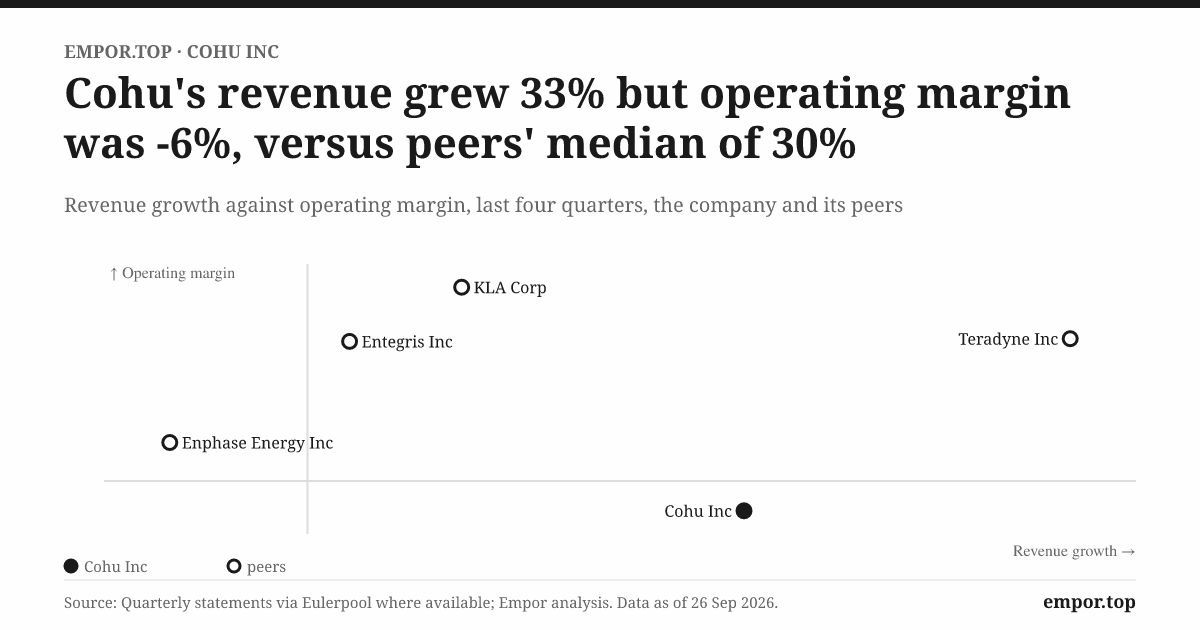
The second is the gap between the business model and reported profits. Cohu reported GAAP net losses in 2019, 2024, and 2025, and its non-GAAP figures exclude amortization of acquired intangibles, restructuring, and stock compensation.20439 Those adjustments are standard, but the accumulated acquisition amortization is the accounting shadow of the Xcerra purchase price. A shareholder is entitled to ask how much economic value that deal created net of the dilution and restructuring it required.
The third is the footprint. Headcount fell from about 3,024 at the end of 2024 to about 2,857 a year later, and Cohu has been running a restructuring that includes transitioning volume manufacturing away from Poway.141 Consolidating production in lower-cost Asian plants such as Melaka is logical, but restructurings in equipment companies often coincide with surging demand, when execution mistakes are most costly.
The fourth is the through-cycle promise. On the first-quarter 2024 call, Müller described through-cycle revenue of "$750 million to low $800 million" and set a target gross margin of 50% at $1 billion of revenue.34 The company's own guidance implies roughly $610–615 million for 2026.6 The investor day will need to explain how the AI business bridges that gap, and at what margins.
None of these questions implies bad faith. They are the questions a company that has asked shareholders to finance two capital raises in five years should expect to answer.
The bull case
The bull case rests on three pillars.
First, AI compute has handed Cohu a new, high-value market. High-power AI processors generate so much heat during test that they need active thermal control, and Cohu has a proven product in its Eclipse handler with T-Core. Management raised its 2026 HPC revenue outlook to $100–110 million and described a pipeline of about $850 million, of which about $190 million is from four customers already qualified.6
Second, the automotive and industrial recovery has not yet arrived. Customer utilization reached 80% in the second quarter of 2026, a level management described as "typically, a turning point for capex by our core IDM customer base."6 If automotive follows industrial, whose orders rose 87% in that quarter, Cohu could enjoy two upcycles at once.6 The long-term electrification thesis also still holds: Infineon estimates that a battery electric vehicle contains about $1,400 of semiconductors versus about $750 for a combustion car.50
Third, operating leverage. Jones has laid out a margin ladder: gross margin approaching 48% at around $150 million of quarterly revenue and reaching 48% at a normalized $160 million.42 With the company guiding the third quarter of 2026 to about $170 million, it is entering that range.5
The bear case
The bear case rests on four vulnerabilities.
First, concentration in AI. The HPC pipeline is concentrated in a handful of customers, and a single $26 million Eclipse order can move a quarter.6 Qualification is not revenue: $445 million of the $850 million pipeline was described as early engagement, the least certain stage.6 The AI race has one dominant competitor, Hon Precision, and a customer seeking a second source can shift share quickly.
Second, the automotive thesis has disappointed repeatedly. Automotive orders were down 24% year over year in the second quarter of 2026, and management does not expect automotive utilization to reach 80% until 2027.6 If the shift to centralized vehicle computers means fewer distributed microcontrollers and more complex processors tested on ATE-centric flows, Cohu's traditional tri-temperature automotive franchise could grow more slowly than the electrification story implies.
Third, China. Changchuan and Huafeng are growing quickly with state support, and the mid-range handler market in Asia could see sustained price pressure.
Fourth, valuation and expectations. After a rally of nearly 200% in the first half of 2026, Cohu traded at about 5.3 times forward sales, versus a five-year median of about 2.2 times, according to Zacks.51 That kind of re-rating assumes the AI business becomes durable. The history of this company is that its best years are followed by severe downturns, and margins have historically compressed in those downturns: non-GAAP gross margin was 43.3% in 2025 and 40.8% in the fourth quarter of 2025, when inventory charges hit.39
The risk radar
Beyond the core bull and bear arguments, a handful of specific risks deserve attention because of how Cohu's business actually works.
Geography is the first. Cohu's largest owned manufacturing sites are in Melaka, Malaysia, and Calamba, in the Philippines, with further operations in Germany, Japan, Switzerland, and the U.S.1 That footprint keeps costs competitive and places Cohu close to the OSATs of Southeast Asia, but it also exposes the company to trade policy, tariffs, and export controls on semiconductor equipment. Its relatively low China sales limit the direct damage from U.S.–China tech restrictions, but any escalation that disrupts the region's back-end supply chain would affect its customers.
Dilution is the second. The 2025 convertible notes convert well below today's share price, and shareholders approved a large increase in authorized shares in May 2026.4446 Neither is a sign of imminent issuance, but together they mean the share count is a variable, not a constant, and per-share results could lag company-level growth.
Cyclicality is the third, and it is the risk investors most often forget at the top of a cycle. The record here is unambiguous: revenue more than halved from 2021 to 2024. An AI-driven upcycle does not repeal the pattern; it adds a new cycle, driven by hyperscaler capital budgets, on top of the old ones driven by cars and factories.
The KPIs to track
Three metrics capture the investment case better than any others.
The first is customer test-cell utilization, which Cohu reports every quarter. It was 72% in early 2024 and 80% in the second quarter of 2026.346 Sustained readings above 80% have historically preceded capex upturns; a slide back toward the low 70s would signal another pause.
The second is recurring revenue in dollars, not as a percentage of sales. The percentage flatters during downturns; the dollar figure shows whether the installed base is truly becoming more productive through the cycle.
The third is non-GAAP gross margin through the cycle. It shows whether the AI mix and the recurring base give Cohu pricing power, or whether margins will again compress when volumes fall. A margin that holds in the high 40s through the next downturn would be strong evidence of a structurally better business.
Those KPIs point toward the one question the next decade will answer: whether the thermal frontier becomes Cohu's defining market.
XI. Epilogue & The Next Frontier: Thermal AI and Chiplets
A chip that cooks itself
When a modern artificial intelligence accelerator powers up during functional testing, it can draw hundreds—or even upwards of a thousand—watts of electrical power within a package no larger than a coaster. In an enterprise data center, that thermal surge is managed by massive vapor chambers, copper heat sinks, or liquid cooling loops. On a back-end test floor, however, the unencapsulated chip sits pressed against an electrical socket, where an unmanaged thermal spike can destroy the silicon in milliseconds. Compounding the challenge, the handler cannot simply blast the package with refrigerant: test protocols require verifying electrical performance at precise operational temperatures, because a processor that passes only under artificial sub-cooling risks failing the moment it encounters field workloads in a server rack.
Controlling that extreme thermal volatility is the engineering problem Cohu's active thermal control was built to solve. Its Eclipse handler, integrated with proprietary T-Core technology, dynamically injects or extracts heat to keep junction temperatures stable as test patterns cycle through peak power states. In the first quarter of 2026, management estimated the total addressable AI compute handling market at roughly $750 million, targeting 2026 high-performance computing revenue of $80 million to $100 million.52 By the second quarter, leadership raised that forecast to between $100 million and $110 million.6
Commercial traction followed in rapid sequence. In March 2026, Cohu announced a second multi-unit Eclipse order from a leading U.S. semiconductor manufacturer and foundry services provider.[^56] In April, the company secured $30 million in follow-on high-performance computing orders across two customer accounts.53 By July, it booked a single $26 million Eclipse order, scheduled primarily for fourth-quarter delivery.6
Memory, inspection and the HBM stack
Alongside thermal handlers, Cohu has established a foothold in high-bandwidth memory inspection. Its Neon inspection and metrology platform, engineered to inspect all six sides of stacked-die memory architectures for micro-cracks and surface flaws, entered the high-bandwidth memory market in October 2024 through an order from a U.S. memory manufacturer.54 By September 2025, the company had shipped its first system configured for the HBM4 standard and raised its full-year HBM revenue forecast to between $10 million and $11 million.55 In the second quarter of 2026, Cohu shipped Neon tools spanning HBM3, HBM4, and HBM4E configurations to a U.S. device maker and qualified the platform at a Taiwanese outsourced assembly-and-test subcontractor.6 These wins represent strategically valuable design-ins, though at roughly $10 million to $15 million annually, they remain a modest component of Cohu's overall top line.
Chiplets and the multiplication of test
A broader architectural transformation underpins this demand: the semiconductor industry's migration from monolithic silicon dies to multi-die chiplet packaging. Leading-edge processors are increasingly assembled from disparate dies—logic compute cores, input/output controllers, and stacks of high-bandwidth memory—bonded together over silicon interposers within a single package.
That multi-chip packaging alters the economic penalty of manufacturing defects. If an unverified die fails after being bonded into an advanced package alongside several expensive, functional chips, the entire multi-thousand-dollar module must be scrapped. To mitigate that yield loss, semiconductor manufacturers are multiplying test insertions: screening individual memory stacks and bare dies thoroughly before packaging, and then interrogating the fully assembled module under demanding power and thermal loads.
This expanded verification flow creates commercial openings across Cohu's portfolio. Neon optical systems inspect memory stacks for mechanical defects before they are committed to an assembly, while Eclipse handlers stress fully integrated modules under simulated operating conditions. Furthermore, the steep economic cost of a packaged defect makes semiconductor manufacturers less price-sensitive regarding test tooling that protects finished package yields.
Yet this structural evolution carries strategic counterweights. Earlier test insertions at the wafer and bare-die stage inherently favor automated test equipment and wafer-probe specialists over final-package handlers. The dominant automated test equipment suppliers possess every commercial incentive to expand their reach across these emerging test stages. While chiplet architectures multiply the total number of test steps, they do not guarantee that Cohu captures them.
Manufacturing capacity represents the operational bottleneck in the near term. On the second-quarter 2026 earnings call, management stated that expanding its Melaka, Malaysia facility should double high-performance computing handler production capacity by late 2026 or early 2027, with an operational pathway toward tripling output.6 In capital equipment upcycles, hardware suppliers that cannot meet aggressive production schedules risk seeing customers reallocate sockets to rivals like Hon Precision, making manufacturing execution in Malaysia as decisive as thermal engineering.
What the history says about the frontier
Cohu's long-term commercial record provides a cautious lens for evaluating these frontier opportunities. Management's ambition to create a turnkey automated test franchise following the Xcerra acquisition failed to dislodge the established duopoly, and software-led initiatives have encountered friction: Tignis, acquired to expand AI-driven process control, failed to meet the operational targets required to trigger its earn-out consideration.41
Conversely, Cohu's core handling business has repeatedly converted specialized mechanical and thermal engineering into enduring market positions. The current high-performance computing orders reflect firm commercial commitments rather than speculative evaluations. The empirical record thus supports a measured thesis: Cohu has established itself as a credible contender in high-power AI thermal handling, but the long-term defensibility of its market share against Hon Precision remains unproven. The decisive test will be whether management successfully converts its qualified pipeline into profitable, sustained deliveries through 2027 without ceding unit share or diluting operating margins.
The survivor
Across nearly eight decades, Cohu has continually reinvented its corporate identity. It has operated as a Cold War laboratory instrument maker, a closed-circuit television camera manufacturer, an industrial conglomerate, a leveraged acquirer, and a casualty of semiconductor cyclicality. Yet through each iteration, the company has preserved an underlying technical competence: the precise physical handling, conditioning, and measurement of critical electronic hardware.
That specialized capability has repeatedly outlived the end markets that initially financed it. For investors, the enduring takeaway of Cohu's trajectory is how a mid-tier equipment maker endures alongside multi-billion-dollar capital equipment giants: not by attempting to match their scope across the entire production line, but by dominating the most punishing physical and thermal constraints on the factory floor—and maintaining the engineering readiness to capitalize when the broader semiconductor industry inevitably collides with those physical limits.
References
-
Cohu, Inc. Form 10-K for Fiscal Year Ended December 27, 2025 — SEC EDGAR, 2026-02 ↩↩↩↩↩↩↩↩↩↩↩↩↩↩↩↩
-
Cohu to Acquire Xcerra (Form 8-K Exhibit 99.1) — Cohu / SEC EDGAR, 2018-05-08 ↩↩↩↩↩↩↩↩
-
Cohu Reports Fourth Quarter and Full Year 2021 Operating Results — Business Wire, 2022-02-10 ↩↩
-
Cohu Reports Fourth Quarter and Full Year 2024 Results (Form 8-K Exhibit 99.1) — Cohu / SEC EDGAR, 2025-02-13 ↩↩↩↩
-
Cohu Reports Second Quarter 2026 Results (Form 8-K Exhibit 99) — Cohu / SEC EDGAR, 2026-07-30 ↩↩↩
-
Cohu (COHU) Q2 2026 Earnings Call Transcript — The Motley Fool, 2026-07-30 ↩↩↩↩↩↩↩↩↩↩↩↩↩↩↩↩↩↩↩↩↩
-
Cohu, Inc. Form 10-K for Fiscal Year Ended December 28, 2019 — SEC EDGAR, 2020-03 ↩↩↩
-
Cohu Announces Appointment of Jeffrey D. Jones as Chief Financial Officer (Form 8-K Exhibit) — SEC EDGAR, 2007-08-30 ↩
-
Cohu Form 10-Q Exhibit 32 Certification — SEC EDGAR, 2025-08-01 ↩
-
Cohu to Acquire Ismeca Semiconductor (Form 8-K Exhibit 99.1) — Cohu / SEC EDGAR, 2012-12 ↩↩
-
Sale of Ismeca Semiconductor Completed — Schweiter Technologies, 2013 ↩
-
Cohu to Acquire Kita Manufacturing (Form 8-K Exhibit 99.1) — Cohu / SEC EDGAR, 2016-11-15 ↩
-
Cohu Completes Acquisition of Kita — Business Wire, 2017-01-05 ↩
-
Xcerra to Be Acquired by Unic Capital Management (Form 8-K Exhibit 99.1) — Xcerra / SEC EDGAR, 2017-04 ↩↩
-
LTX-Credence Announces Agreement to Purchase Multitest and Everett Charles Technologies — GlobeNewswire, 2013-09-06 ↩↩
-
Xcerra Form 8-K: Termination of Merger Agreement — SEC EDGAR, 2018-02 ↩
-
Cohu Completes Acquisition of Xcerra (Form 8-K Exhibit 99.1) — Cohu / SEC EDGAR, 2018-10-01 ↩↩↩↩
-
Cohu Reports Fourth Quarter and Full Year 2019 Operating Results — Business Wire, 2020-02-12 ↩↩
-
Cohu Reports First Quarter 2019 Results (Form 8-K Exhibit 99.1) — Cohu / SEC EDGAR, 2019-05-06 ↩
-
Cohu to Sell PCB Test Group to Mycronic (Form 8-K Exhibit 99.1) — Cohu / SEC EDGAR, 2021-05-10 ↩↩
-
Mycronic to Acquire atg Luther & Maelzer — Mycronic AB, 2021-05 ↩
-
Cohu Prices Public Offering of Common Stock (Form 8-K Exhibit 99.1) — Cohu / SEC EDGAR, 2021-03 ↩
-
Cohu, Inc. Form 10-Q for Quarter Ended March 30, 2024 — SEC EDGAR, 2024-05 ↩
-
Cohu, Inc. Form 10-K for Fiscal Year Ended December 28, 2024 — SEC EDGAR, 2025-02 ↩↩↩↩↩↩↩
-
Advantest Investors' Guide — Advantest Corporation, 2025-04-25 ↩↩
-
Cohu, Inc. Form 10-K for Fiscal Year Ended December 24, 2022 — SEC EDGAR, 2023-02 ↩↩↩↩
-
Cohu Reports Fourth Quarter and Full Year 2022 Results (Form 8-K Exhibit) — Cohu / SEC EDGAR, 2023-02-16 ↩
-
Cohu Investor Day: Mid-Term Financial Targets (Form 8-K Exhibit) — Cohu / SEC EDGAR, 2021-12-14 ↩↩
-
Cohu Reports Fourth Quarter 2023 Results — Business Wire, 2024-02-15 ↩
-
Cohu, Inc. (NASDAQ:COHU) Q2 2023 Earnings Call Transcript — Yahoo Finance, 2023-08 ↩
-
Cohu, Inc. (COHU) Q1 2024 Earnings Call Transcript — Seeking Alpha, 2024-05-02 ↩↩↩↩↩
-
Cohu, Inc. (COHU) Q4 2024 Earnings Call Transcript — Seeking Alpha, 2025-02-13 ↩
-
Cohu Reports First Quarter 2025 Results (Form 8-K Exhibit) — Cohu / SEC EDGAR, 2025-05-01 ↩
-
Cohu Reports Second Quarter 2025 Results (Form 8-K Exhibit) — Cohu / SEC EDGAR, 2025-07-31 ↩
-
Cohu Reports Third Quarter 2025 Results (Form 8-K Exhibit) — Cohu / SEC EDGAR, 2025-10-29 ↩
-
Cohu Reports Fourth Quarter and Full Year 2025 Results (Form 8-K Exhibit) — Cohu / SEC EDGAR, 2026-02-12 ↩↩↩↩
-
Cohu, Inc. Form 10-Q for Quarter Ended March 29, 2025 — SEC EDGAR, 2025-05 ↩
-
Cohu, Inc. Form 10-Q for Quarter Ended June 27, 2026 — SEC EDGAR, 2026-07 ↩↩↩↩
-
Cohu (COHU) Q4 2025 Earnings Call Transcript — The Motley Fool, 2026-02-12 ↩↩↩↩
-
Techwing Wins First SK hynix Order for HBM Cube Prober — The Elec, 2026-06-17 ↩
-
长川科技2025年年报解读 (Changchuan Technology 2025 Annual Report) — Sina Finance, 2026-04-25 ↩↩
-
华峰测控2025年业绩 (Huafeng Test & Control 2025 Results) — East Money, 2026-04-29 ↩
-
Cohu, Inc. Definitive Proxy Statement (DEF 14A) — SEC EDGAR, 2026-03-26 ↩↩↩↩↩
-
Cohu, Inc. Form 8-K: Results of 2026 Annual Meeting of Stockholders — SEC EDGAR, 2026-05 ↩↩
-
Schedule 13G: Capital World Investors Stake in Cohu, Inc. — SEC EDGAR, 2026-08-11 ↩
-
Cohu, Inc. Form 8-K: 1.50% Convertible Senior Notes Due 2031 — SEC EDGAR, 2025-09 ↩
-
Infineon Q4 FY25 Investor Presentation — Infineon Technologies, 2025-11-12 ↩
-
Is Cohu Stock Still Worth Buying? — Zacks via Yahoo Finance, 2026-07-02 ↩
-
Cohu Reports First Quarter 2026 Results (Form 8-K Exhibit) — Cohu / SEC EDGAR, 2026-04-30 ↩
-
Cohu Announces $30 Million Follow-On Orders for High-Performance Computing Test — Semiconductor Digest, 2026-04 ↩
-
Cohu Enters HBM Memory Market with Neon Inspection and Metrology Platform — Business Wire, 2024-10-31 ↩
-
Cohu Secures Additional Neon Orders, Raises 2025 Forecasted HBM Revenue to $10–$11 Million — Business Wire, 2025-09-16 ↩
 LinkedIn
 WhatsApp
 Reddit
 Hacker News
 Email
Email Kindle
 RSS Feed
 Spotify
 Apple Podcasts
 Amazon Music
 Audible
 YouTube