Cogent Biosciences: The Precision TKI Revolution and the Rebirth of a Biotech
I. Introduction & Episode Roadmap
There is a particular kind of ghost story that circulates in Cambridge and Waltham, the two poles of the Massachusetts biotech corridor. It is the story of the company that raised money on a beautiful idea, watched the idea break in a hospital ward, saw its stock fall through the floor until the market valued it at less than the cash in its bank account, and then faced the loneliest decision in corporate life: hand the money back to shareholders and turn off the lights, or bet what remained on someone else's molecule.
Most of those companies choose the lights. Cogent Biosciences is the rare one that chose the molecule — and, five years later, has a shot at turning that bet into a commercial franchise.
To understand why this story is worth three-plus hours of your attention, hold two images side by side. The first is Unum Therapeutics in early 2020: an engineered cell-therapy company whose lead programs had been tied to patient deaths and repeated clinical holds, trading below net cash, its founding scientific thesis effectively dead.1 The second is Cogent Biosciences in mid-2026: a company sitting on roughly $866 million of cash, with two New Drug Applications for a single small molecule already accepted for review by the U.S. Food and Drug Administration and a third on the way, preparing for two commercial launches in the second half of the year.2 Same corporate shell. Same CIK number at the SEC. Almost nothing else in common.
The molecule at the center is bezuclastinib (originally PLX9486, later CGT9486), a highly selective, orally dosed tyrosine kinase inhibitor — a "TKI," the class of drugs that revolutionized cancer treatment by jamming the specific molecular switches that make tumor cells grow. Bezuclastinib's switch is a mutated form of a receptor called KIT, and specifically the KIT D816V mutation that drives a cruel and under-appreciated disease called systemic mastocytosis, along with a second, better-known cancer, gastrointestinal stromal tumor (GIST).3
Here is where the drama sharpens into a genuine business case. Cogent did not invent this disease biology. A company called Blueprint Medicines did the pioneering work, brought the first KIT D816V drug — Ayvakit (avapritinib) — to market, built a franchise generating roughly half a billion dollars a year, and validated the entire category so thoroughly that pharma giant Sanofi paid up to $9.5 billion to buy Blueprint in 2025.4 Cogent's entire commercial thesis is that it can walk into a market its competitor created and take share by being safer — that bezuclastinib was engineered to stay out of the brain and off a set of related targets, sidestepping the cognitive side effects and bleeding risks that shadow the incumbent drug.
That is the promise. This episode is about whether the evidence supports it.
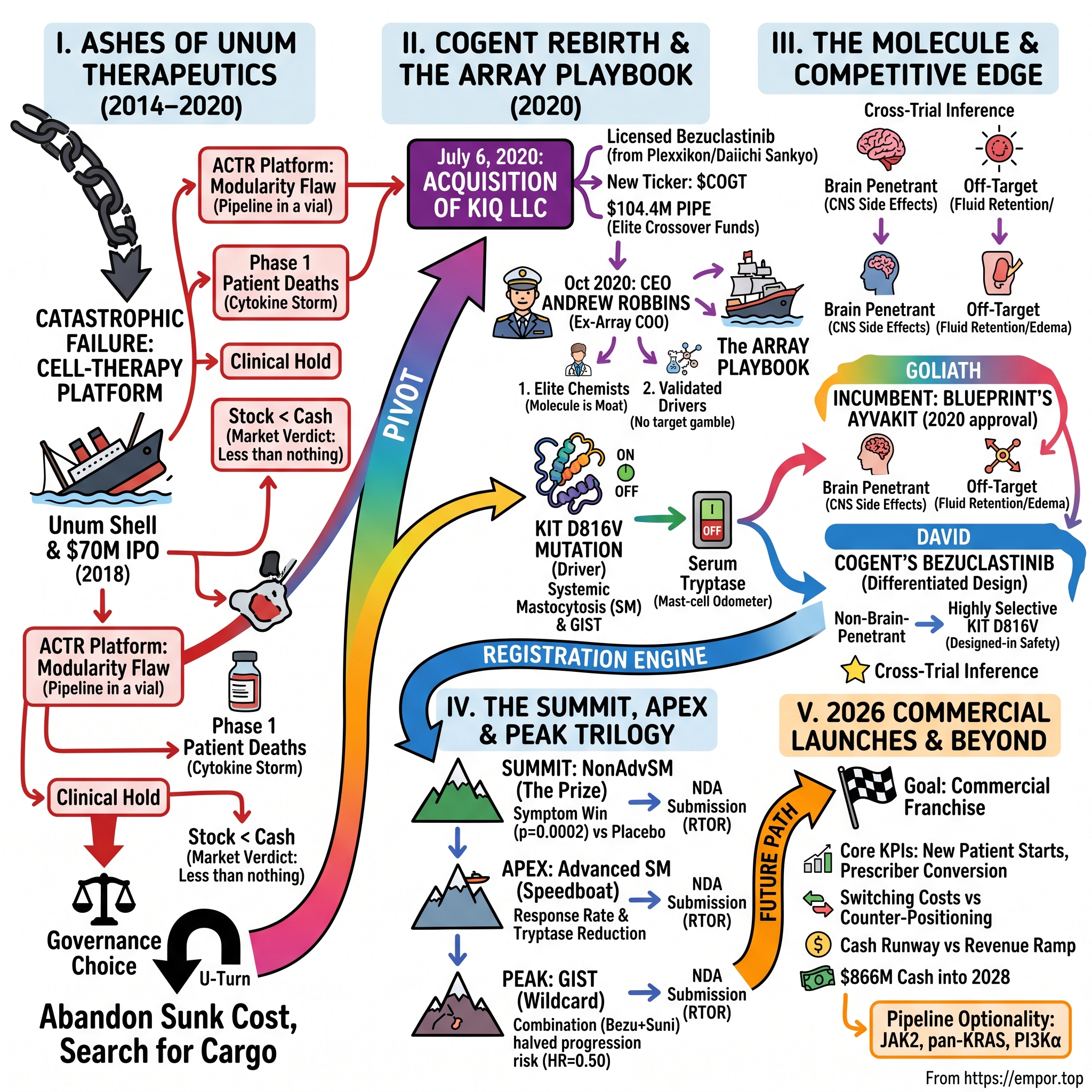
Our roadmap runs in five movements. First, the catastrophic failure of Unum's cell-therapy platform — a case study in how a board decides that a founding technology is worth abandoning. Second, the 2020 corporate rebirth: the acquisition of a private company called Kiq LLC, the in-licensing of PLX9486 from Plexxikon (a 第一三共株式会社 Daiichi Sankyo Company, Limited subsidiary), and the recruitment of a CEO steeped in the most admired precision-oncology playbook of the last decade. Third, the biology: why a single amino-acid substitution in a kinase can dictate whether a drug works, whether it's safe, and whether it wins commercially. Fourth, the registration trilogy — SUMMIT, APEX, and PEAK — three trials that, remarkably, have all now read out. And fifth, the investor's reckoning: unit economics, capital discipline, management credibility, and an honest "why win / why not win" spine that refuses to take management's word for anything.
Let's begin where every great pivot begins — in the wreckage of the thing that came before.
 Subscribe on LinkedIn
II. The Ashes of Unum Therapeutics: Anatomy of a Biotech Failure (2014–2020)
In 2014, cellular immunotherapy was the hottest idea in oncology. CAR-T — chimeric antigen receptor T-cell therapy — had produced near-miraculous remissions in certain blood cancers, and the whole industry was hunting for the next architecture. Into that fervor stepped Unum Therapeutics, founded around a genuinely clever concept called the Antibody-Coupled T-cell Receptor, or ACTR.
The elegance of ACTR was in its modularity. A conventional CAR-T cell is hardwired to recognize exactly one target; change the target and you must re-engineer the cell from scratch. Unum's idea was to build a "universal" T-cell that carried a docking receptor instead of a fixed target, and then to steer that cell with off-the-shelf therapeutic antibodies — pair the cells with rituximab and they attack CD20-positive lymphomas; pair them with trastuzumab and they go after HER2-positive tumors. One cell platform, many targets, in theory a way to escape the crippling economics and rigidity of single-target CAR-T. It was the kind of pitch that raises money, and it did.
The company was founded in 2014 by Chuck Wilson and Seth Ettenberg, and it embodied the intellectual confidence of the cell-therapy boom. The pitch married the target flexibility of monoclonal antibodies — off-the-shelf, well-understood, precisely engineered proteins — with the serial-killing power of a living T-cell that can proliferate, persist, and hunt through tissue. On paper it was the best of both modalities. The venture community agreed, funding the company through private rounds before it took the well-worn path from Kendall Square to the Nasdaq bell.
The company rode that promise onto the public markets, capturing roughly $70 million in its 2018 IPO and selling investors a vision of a programmable cell therapy that could finally crack solid tumors where CAR-T had stumbled.5 For a moment, the story held. Analysts modeled a platform that could spin out program after program simply by swapping the antibody; management talked about a pipeline in a single vial. This is the seductive logic of platform biotech — the idea that you are not funding one drug but a factory for drugs — and it commands premium valuations precisely because the upside is theoretically unbounded.
Then the biology answered back, and it answered brutally. The trouble with borrowing the immune system's full firepower is that the immune system does not have a volume knob you can trust. In the Phase 1 trials, Unum's engineered cells combined with antibodies produced exactly the toxicities that haunt the entire cell-therapy field — cytokine release syndrome, the inflammatory storm that can crash blood pressure and organs, and neurotoxicity, the still-poorly-understood brain injury that accompanies aggressive T-cell activation. In the ACTR087 program, patients died: multiple deaths tied to severe cytokine release syndrome, sepsis, and neurotoxicity across the dosing cohorts.6 In July 2019, the FDA placed the program on clinical hold, and Unum's shares nosedived on the news.7
A biotech can survive one clinical hold. What it cannot easily survive is the slow realization — visible in the data before it is admitted in the press release — that the problem is not a dose or a protocol but the platform itself. By late 2019 Unum was already narrowing its focus, quietly demoting the troubled combinations and elevating a lower-dose candidate, the corporate body language of a company backing away from its own thesis.8 By early 2020, the stock had collapsed by more than 90% from its highs and was trading below the value of the cash on the balance sheet — the market's blunt verdict that Unum's science was worth less than nothing, that every dollar the company spent developing it destroyed value.
This is the moment that defines the episode, and it is worth sitting with, because it is a governance decision more than a scientific one. When a company trades below net cash, the "rational" move for a board is often simply to liquidate — return the cash, spare shareholders the burn. The alternative, clinging to the founding platform out of institutional pride, is how good money chases bad. Unum's board did neither. It recognized that the ACTR platform was a sunk cost — that the tens of millions spent and the founders' reputations invested were, from the perspective of the next dollar, completely irrelevant — and it went looking for a better use of the shell, the cash, the Nasdaq listing, and the tax attributes it still controlled.
There is a broader pattern worth naming here, because it recurs across the platform-biotech graveyard. The failure mode of the "pipeline in a vial" is that a single platform-level flaw kills every program at once. If the flaw had been in one antibody pairing, Unum could have swapped it out and carried on — the whole point of modularity. But the toxicity emerged from the shared mechanism: hand a T-cell the full authority to attack and it will sometimes attack too hard, regardless of what antibody is steering it. Modularity, the feature that justified the valuation, could not save the company, because the problem lived below the modular layer. Investors who bought the platform premium were, in effect, short a single point of failure they had been told did not exist.
The lesson here is one every biotech investor should tattoo somewhere visible: the willingness to abandon an internally developed, high-profile technology when the data proves it flawed is a feature of good governance, not a betrayal of it. Most management teams cannot do it. The narrative identity is too strong; the admission of failure too painful. Unum's board could, and that single act of intellectual honesty is the reason there is a Cogent Biosciences to talk about at all. It helped, cynically, that trading below cash concentrates the mind — when the market says your science is worth less than nothing, the psychological cost of admitting it has already been paid by the stock price. The board's real credit lies in what it did next: rather than liquidate and hand the cash back, it went hunting for an asset worth more than the shell it had left.
But abandoning a platform only solves half the problem. A public shell with cash and no science is a vessel waiting for cargo. The question was what to load into it — and who would captain the ship.
III. The Great Pivot & The Array BioPharma Playbook (2020)
The cargo arrived on July 6, 2020. On that day, Unum announced it was acquiring Kiq LLC, a small, privately held biotech backed by the specialist life-sciences investor Fairmount Funds. Kiq's entire reason for existing was a single asset: worldwide rights to PLX9486, a selective KIT D816V inhibitor that had been discovered at Plexxikon, the small-molecule powerhouse best known for the melanoma drug vemurafenib, and which sat inside the 第一三共株式会社 Daiichi Sankyo Company, Limited group.1
The financial engineering around the deal was as important as the asset itself. Simultaneously with the acquisition, Unum raised a $104.4 million private placement — a PIPE — selling Series A preferred stock at $880 per share (equivalent to $0.88 on an as-converted basis) to a who's-who of specialist biotech crossover investors: Fairmount, Venrock Healthcare, BVF Partners, Atlas Venture, Perceptive Advisors, RTW Investments, OrbiMed, Samsara BioCapital, Logos Capital, Ally Bridge Group, and Commodore Capital, among others.1 Read that investor list the way a poker player reads the table. These are not retail tourists; they are the funds that underwrite the majority of credible clinical-stage oncology in the United States. Their willingness to put fresh capital into a shell that had just been left for dead was the market's first signal that the asset — not the old platform — might be worth something.
Then came the rebrand. Unum Therapeutics became Cogent Biosciences, Inc., the ticker moved to COGT, and PLX9486 was rechristened CGT9486 — later bezuclastinib. The company anchored itself in Waltham, Massachusetts. A failed cell-therapy company had, in the span of a single announcement, become a precision small-molecule oncology company. The transformation was so complete that only the corporate plumbing survived.
The final piece was leadership, and this is where the story acquires its strategic spine. On October 26, 2020, Cogent named Andrew Robbins as President and CEO, succeeding Chuck Wilson, who had run Unum through the pivot.9 Robbins was not a caretaker hire. He had most recently been Chief Operating Officer of Array BioPharma, and to biotech insiders that credential carries enormous weight.
Array is one of the great precision-oncology success stories of the last decade. It built a medicinal-chemistry engine that produced a string of targeted kinase inhibitors, and it commercialized two of them — Braftovi (encorafenib) and Mektovi (binimetinib) — into a melanoma and colorectal-cancer franchise. In 2019, Pfizer acquired Array for roughly $11.4 billion, or $48 per share in cash.10 Robbins had helped orchestrate the development and commercial strategy that produced that outcome.
What Robbins brought to Cogent was less a résumé than a method — what this episode will call the Array playbook, and what you should watch for as the through-line of everything that follows. The playbook has four moves. First, hire elite kinase medicinal chemists, because in precision oncology the molecule is the moat. Second, target oncogenic drivers that are already biologically validated — don't gamble on whether the target matters, gamble only on whether you can drug it better. Third, design for best-in-class selectivity, because in a crowded target class the winner is usually the cleanest molecule, not the first one. And fourth, run fast, tightly focused registration trials and resist the temptation to sprawl.
It is worth understanding why the Array playbook is so hard to copy, because that difficulty is itself part of the investment thesis. Each of its four moves is individually sensible and collectively rare. Targeting validated drivers sounds obvious, but it requires the discipline to not chase the exciting, novel, unproven target that wins conference applause and loses in the clinic. Designing for best-in-class selectivity requires world-class medicinal chemists who are in short supply and expensive to retain. Running focused trials requires the institutional self-restraint to say no to the dozen adjacent indications a promising drug invites. Most biotech teams have one or two of these instincts; assembling all four under one roof, with the operational muscle memory of having done it before, is what made the Array alumni network — the informal "Array mafia" that seeded several precision-oncology companies — a genuinely scarce resource. When Cogent hired Robbins, it was buying a method, and, through him, access to the people who could execute it.
You can see the discipline in the very first capital-allocation decisions. Cogent shut down the legacy cell-therapy spend immediately, redirecting essentially all of its capital into bezuclastinib rather than keeping a foot in the old world to soothe egos. And the entry valuation was deliberately modest — the licensing and Kiq acquisition were struck before the clinical world fully appreciated how bezuclastinib's therapeutic window might compare to Blueprint's avapritinib. In venture terms, Cogent bought low on an asset the market had not yet re-rated. The crossover funds that led the PIPE were, in effect, underwriting exactly that arbitrage: a de-risked target, a differentiated molecule, and a management team with a proven method, wrapped in a public shell trading for scrap.
None of this, it must be said, guaranteed anything. A great playbook applied to a mediocre molecule still fails. To judge whether Cogent bought a winner, we have to descend into the biology — into the specific bend of a specific protein where this entire company's fortune is decided.
IV. Biology & Industry Structure: KIT D816V, Systemic Mastocytosis, and GIST
Picture a light switch on the outside of a cell. In its normal state, the switch flips on only when a specific signal arrives, tells the cell to grow or survive, and then flips off. The switch is a receptor tyrosine kinase called KIT, and it governs the life cycle of several cell types — most importantly, mast cells, the immune sentinels that sit in your skin, gut, and bone marrow and release histamine and other mediators when they detect a threat. That is why a mast cell going haywire feels like the worst allergic reaction of your life: flushing, itching, cramping, plummeting blood pressure, sometimes full anaphylaxis.
Now imagine the switch jams in the "on" position. That is the KIT D816V mutation — a single amino-acid substitution in what biologists call the "activation loop" of the kinase, encoded in exon 17. The mutation locks KIT into a permanently active shape, so the cell receives an unrelenting "grow and survive" command that no external signal is required to sustain. In mast cells, the result is systemic mastocytosis (SM): a clonal army of abnormal mast cells accumulating in the bone marrow and organs, primed to dump their inflammatory payload at the slightest provocation, or at no provocation at all.3
To make the "activation loop" concrete: a kinase is a molecular machine with moving parts, and the activation loop is the hinged lid that swings open to let the machine work and closes to shut it off. In the normal enzyme, the lid's position is regulated. The D816V substitution — valine swapped for aspartic acid at position 816 — changes the chemistry of that hinge so the lid stays open. This matters enormously for drug design, because a mutation inside the active machinery is a different target than a mutation on the surface, and drugs that bind the resting, closed shape of a kinase often fail against a kinase that is permanently open. It is the reason older, broad TKIs like imatinib barely touch KIT D816V even though they shut down other KIT mutations cold — they were built to grip a lock that D816V has redesigned.
The crucial commercial fact about KIT D816V is that it is a driver mutation — not a passenger, not a marker, but the actual engine of the disease. Roughly 90-95% of systemic mastocytosis patients carry it. That makes SM a textbook precision-medicine target: hit the driver, and in principle you switch the disease off at its root, the way imatinib once transformed chronic myeloid leukemia. This is the biological bet underneath Cogent's entire valuation.
There is one more piece of plumbing worth installing before the disease discussion, because it recurs throughout the trial data: serum tryptase. Tryptase is an enzyme mast cells carry in their granules, and its level in the blood is a reasonably faithful proxy for how many abnormal mast cells a patient harbors — a "mast-cell odometer." That is why nearly every SM trial reports the percentage of patients achieving a ≥50% tryptase reduction: it is a clean, objective, biological readout of whether the drug is actually killing the clone, sitting underneath the messier, subjective question of whether the patient feels better. When you see tryptase and symptom scores both move in the same direction, you are watching cause and effect line up — the drug shrinks the mast-cell burden, and the symptoms follow.
A word on why this disease hid in plain sight for so long, because it bears directly on the market-size debate that dominates the investment case. Systemic mastocytosis is chronically under-diagnosed. Its symptoms — flushing, fatigue, gut trouble, brain fog, anaphylaxis — masquerade as a dozen more common conditions, from irritable bowel syndrome to anxiety to ordinary allergy. Confirming the diagnosis has historically required a bone-marrow biopsy and sensitive genetic testing for the KIT D816V mutation, an invasive workup that many patients never receive because no one thinks to look. The practical consequence is a large reservoir of patients who are either undiagnosed or diagnosed but under-treated — a reservoir that is simultaneously the bull case (an addressable population far larger than current treatment rates suggest) and the bear case (a population that has to be found before it can be sold to).
Systemic mastocytosis splits into two very different commercial opportunities, and conflating them is a common analyst error. About 85% of patients have non-advanced SM (NonAdvSM). These patients are not, for the most part, dying of their disease — they live largely normal lifespans. But "not dying" undersells a genuinely miserable existence: chronic brain fog, unpredictable flushing and hives, bone pain, gut distress, and the ever-present dread of anaphylaxis triggered by heat, stress, food, or nothing identifiable at all. Imagine organizing your life around avoiding triggers you can't fully identify, never sure whether the next meal or the next warm room will send you to the emergency department. For decades these patients were managed with antihistamines, mast-cell stabilizers, and symptom control — bailing a leaking boat rather than fixing the hull. Because the population is large and the treatment is chronic and lifelong, NonAdvSM is the multi-billion-dollar prize, and it is where more than 70% of Cogent's long-term value is thought to sit.
The other 15% have advanced SM (AdvSM) — a group of genuinely life-threatening malignancies including aggressive systemic mastocytosis, SM with an associated hematologic neoplasm, and mast cell leukemia, with historically grim median survival measured in months to a few years. AdvSM is a smaller, orphan-sized market, but it offers something strategically precious: a faster regulatory path. When patients are dying and options are scarce, the FDA will accept a single-arm trial and a strong response rate as evidence, letting a company reach approval, build a commercial infrastructure, and plant its flag before tackling the larger chronic indication. This is why, as we'll see, Cogent runs both — AdvSM as the speedboat, NonAdvSM as the aircraft carrier.
The second disease is gastrointestinal stromal tumor (GIST), the most common sarcoma of the digestive tract, and here the KIT biology twists in an instructive way. Most GIST is driven not by D816V but by primary KIT mutations in exons 9 and 11, which imatinib (Gleevec) famously shuts down as first-line therapy. The problem is resistance. Under the selective pressure of imatinib, GIST tumors evolve secondary mutations, and they do so in two different neighborhoods of the kinase: the ATP-binding pocket (exons 13/14) and the activation loop (exons 17/18) — the same activation-loop region that houses D816V.11
GIST itself deserves a moment of context, because it is one of oncology's foundational precision-medicine stories and it shapes how prescribers think about the whole category. Before imatinib, metastatic GIST was a near-untreatable sarcoma with dismal survival; imatinib turned it, for many patients, into a manageable chronic condition and became the proof-of-concept that a single pill targeting a driver kinase could rewrite a cancer's natural history. That history cuts both ways for Cogent. On one hand, GIST oncologists are sophisticated about kinase biology and resistance — they will understand and value a mutation-matched combination. On the other, they have watched a long parade of later-line TKIs — sunitinib, regorafenib, ripretinib — each extend progression-free survival by increments, and they are appropriately hard to impress. A drug entering this space is judged against a demanding benchmark set by decades of incremental progress.
This resistance geography is the entire rationale for Cogent's GIST strategy, and it is genuinely clever. The existing second-line drug, sunitinib, is good at covering the ATP-pocket mutations but weak against the activation-loop mutations. Bezuclastinib is the mirror image — potent against the activation loop, quiet on the ATP pocket. Put them together and, in theory, you cover the full resistance spectrum with two drugs whose weaknesses and toxicities don't overlap. It is combination therapy designed from the mutational map outward, rather than the usual approach of throwing two drugs together and hoping.
So the target is validated, the diseases are real and underserved, and the biological logic is sound. But biological logic has bankrupted a hundred biotechs. The question that actually determines whether Cogent wins is not whether you can inhibit KIT D816V — Blueprint already proved you can — but how cleanly. And that turns out to be a story about the brain.
V. David vs. Goliath: Bezuclastinib vs. Blueprint's Ayvakit & The CNS Differential
Every David-and-Goliath story needs a Goliath, and Cogent's is formidable. Blueprint Medicines got to KIT D816V first and executed beautifully. Its drug Ayvakit (avapritinib) won its first FDA approval in 2020 for a rare PDGFRA-driven form of GIST, expanded into advanced systemic mastocytosis in 2021, and then, critically, into non-advanced (indolent) SM in 2023 on the strength of the PIONEER trial.12 By doing so, Blueprint didn't just launch a drug; it created the category — it taught hematologists that SM was a druggable driver disease, built the diagnostic pathways, and turned a neglected condition into a commercial market.
The 2023 indolent-SM approval is worth dwelling on, because it is both Blueprint's masterstroke and the source of its vulnerability. That approval rested on the PIONEER trial, which studied avapritinib at a low 25 mg daily dose — a fraction of the dose used in advanced disease — precisely because the company was trying to hold the drug's toxicity in check for a chronic, non-fatal population. Think about what that dose reduction implies: the incumbent already knew that its molecule's tolerability was the binding constraint in the large market, and it managed the problem by turning the dial down rather than by changing the molecule. That is a rational response, but it is a defensive one, and it leaves an opening for a competitor whose molecule does not need to be throttled to be tolerable.
The financial results validated the whole thesis. Ayvakit's net product revenue roughly doubled from about $204 million in 2023 to $479 million in 2024, and Blueprint guided to roughly $700–720 million for 2025, on its way to a projected $2 billion for the drug and a $4 billion systemic-mastocytosis franchise opportunity by 2030.13 Those numbers did two things. They proved that patients and physicians will adopt a targeted TKI for SM — de-risking the market even as they raised the competitive stakes — and they attracted an acquirer. In June 2025, Sanofi agreed to buy Blueprint for $129.00 per share, about $9.1 billion in equity value and up to $9.5 billion including milestone payments tied to an early-stage asset.4 Cogent's competitor is now backed by the balance sheet of a global pharmaceutical company. Keep that in mind for the bear case.
The strategic logic behind Sanofi's purchase reframes the competitive stakes, so it is worth reading correctly. Sanofi did not pay up merely for a half-billion-dollar drug; it bought a franchise thesis. Ayvakit was the marketed anchor, but the milestone-linked value in the deal — the contingent payments tied to an early clinical asset — signals that Sanofi is underwriting the mast-cell biology as a durable platform extending beyond today's SM indications into broader allergic and inflammatory disease, a far larger prize. For Cogent, the implication is sobering: it is no longer fighting a focused mid-cap defending one product, but a diversified pharma that views KIT and mast-cell biology as a strategic beachhead worth defending across an entire therapeutic area, with the sales infrastructure, payer relationships, and research budget to match. Counter-positioning is easiest against an opponent with everything to lose in one product; it is hardest against one for whom this fight is a single front in a larger campaign.
Now, the Achilles' heel. Avapritinib is a superb KIT inhibitor, but it was not designed to stay out of the brain, and it hits some neighboring targets it would rather leave alone. Two consequences follow. First, central nervous system penetration: avapritinib crosses the blood-brain barrier meaningfully, and its labeling and trials surfaced CNS toxicities — intracranial hemorrhage serious enough that advanced-SM use carries platelet-monitoring requirements, and cognitive effects (memory problems, confusion, mood changes) that are especially unwelcome in a chronic, largely non-fatal disease where the whole point is quality of life. Second, off-target inhibition of related kinases such as PDGFRα and VEGFR2/KDR, which is associated with fluid-retention side effects like peripheral and periorbital edema — the puffy, swollen appearance that patients notice and dislike.
Here is the sharp strategic point. In a life-threatening cancer, patients and doctors will tolerate substantial toxicity for efficacy. But in non-advanced SM — where the patient will live for decades and is taking the drug to feel better — the tolerance for cognitive side effects and disfiguring edema is far lower. Safety, in this population, is not a footnote to efficacy. Safety is the commercial strategy. And that is precisely the seam Cogent aimed for.
Bezuclastinib was engineered around two design goals: be non-brain-penetrant, so that CNS toxicities simply cannot occur by exposure that isn't there; and be highly selective for KIT D816V while sparing PDGFRα and VEGFR2, so that the edema and cognitive liabilities of the incumbent are designed out from the start.3 If avapritinib is a powerful floodlight that illuminates the target but also spills into rooms you wanted dark, bezuclastinib was built to be a laser.
The critical caveat — and a neutral platform has to insist on it — is that there is no head-to-head trial. Cogent has never run bezuclastinib against avapritinib in the same study, so every claim of superior safety is a cross-trial inference, comparing bezuclastinib's own trial results against avapritinib's separately reported profile. Cross-trial comparisons are notoriously treacherous: different patient populations, different definitions, different eras of supportive care. What Cogent can legitimately point to is the absence, in its own trials, of the specific signals that dog the incumbent — no requirement for routine platelet monitoring, no reported intracranial hemorrhages, no cognitive-toxicity signal, and clean reductions in the disease biomarkers that matter. That is meaningful evidence for a differentiated profile. It is not the same thing as proven superiority, and investors should hold both ideas at once.
Which brings us to the actual data — the three trials that had to deliver for any of this counter-positioning to matter. As of mid-2026, remarkably, all three have.
VI. The Registration Engine: APEX, SUMMIT, and PEAK Phase 3 Strategy
If the Array playbook has a signature, it is the registration engine: a small number of well-designed trials, run fast, aimed squarely at labels. Cogent built three — one for each opportunity — and named them like a mountaineering expedition: SUMMIT, APEX, and PEAK. What makes the 2026 vantage point so different from where this story stood a year earlier is that the reader no longer has to guess how they turned out. The results are in.
SUMMIT was the big one — the trial that underwrites the majority of Cogent's value because it addresses the large chronic NonAdvSM market. It was a randomized, double-blind, placebo-controlled study, the gold standard, with a primary endpoint of the change in Total Symptom Score at 24 weeks. The choice of a symptom endpoint is itself a strategic tell: in a disease defined by how patients feel, a placebo-controlled symptom benefit is the single most persuasive piece of evidence you can bring to a skeptical physician or payer.
It is worth pausing on how demanding a placebo-controlled symptom trial actually is, because it explains why the result carries so much weight. Symptom scores are subjective and prone to a large placebo response — patients enrolled in any trial tend to improve simply from the attention and hope, which is exactly what SUMMIT's placebo arm showed. To win, a drug must beat not zero but that inflated placebo baseline, and it must do so on a patient-reported measure that regulators and physicians know is easy to move by suggestion alone. Blinding both patients and investigators is the defense against that bias, and clearing the bar under those conditions is far harder than posting a big number in an open-label study where everyone knows who got the drug. This is the methodological reason a placebo-controlled symptom win is the most bankable currency in the NonAdvSM market.
On July 7, 2025, Cogent reported the top-line result, and it was unambiguous. Bezuclastinib hit the primary endpoint with high statistical significance — a mean Total Symptom Score reduction of 24.3 points versus 15.4 points on placebo, a placebo-adjusted improvement of roughly 8.9 points at 24 weeks (p=0.0002), with statistically significant benefit across all key secondary endpoints as well.14 The biomarker data were even more striking: about 87% of bezuclastinib-treated patients achieved at least a 50% reduction in serum tryptase — the blood marker of mast-cell burden — versus zero patients on placebo.14 A large, clean, placebo-controlled effect on both symptoms and the underlying disease is exactly the profile a company needs to argue for broad community use. On the strength of it, Cogent moved to file its NonAdvSM NDA.
APEX was the speedboat — a registration-directed trial in advanced SM, where a strong response rate can carry a drug to approval faster. The early Part 1 data, presented at the December 2024 ASH meeting, set the tone: an overall response rate of 52% by the rigorous mIWG criteria, rising to 83% at the 100 mg twice-daily dose and 100% among TKI-naïve patients at that dose, with roughly 94% of patients achieving a ≥50% tryptase reduction and a median time to response of just over two months.15 The registration-directed Part 2 results, reported in December 2025, confirmed the picture with objective response rates in the 57% (mIWG) to 80% (pure pathologic response) range, and Cogent moved toward an AdvSM filing.16 AdvSM is a small market, but it is the beachhead — the indication that lets Cogent stand up a commercial hematology infrastructure that the far larger NonAdvSM launch can then use. This sequencing is the Array playbook applied to commercialization, not just development: win a fast, narrow approval first to build the field force, the reimbursement pathways, and the relationships with the specialist centers that treat these patients, so that when the big chronic indication arrives, the machine is already running rather than being assembled under launch pressure. It is the same logic a retailer uses when it opens a flagship in a new city before rolling out neighborhood stores — the first location is as much about learning and infrastructure as about its own economics.
PEAK was the wildcard — the Phase 3 GIST trial testing the mutational-map combination logic: bezuclastinib plus sunitinib versus sunitinib alone in patients whose disease had progressed after imatinib, with progression-free survival as the primary endpoint. This was the trial most independent of the SM story, and arguably the one carrying the most binary risk, because combining two kinase inhibitors in fragile late-line patients invites cumulative toxicity. On November 10, 2025, Cogent reported that PEAK worked, and worked convincingly: median progression-free survival of 16.5 months for the combination versus 9.2 months for sunitinib alone — a hazard ratio of 0.50, meaning the combination roughly halved the risk of progression or death, with a p-value below 0.0001 — and an objective response rate of 46% versus 26%.17 Detailed data followed at the 2026 ASCO meeting, and, importantly, the safety readout showed no unique toxicities beyond sunitinib's known profile.18 Cogent submitted the GIST NDA on April 1, 2026, under the FDA's Real-Time Oncology Review program with prior Breakthrough Therapy designation.19 Two pieces of regulatory jargon there are worth decoding, because they are genuine advantages. Breakthrough Therapy designation is the FDA's signal that a drug shows substantial improvement over existing options on a serious condition, and it unlocks intensive agency guidance. Real-Time Oncology Review lets the FDA begin evaluating pieces of the application as they are completed rather than waiting for the full package — compressing the review clock. Together they mean the agency is leaning in, not merely processing paperwork, and they are the reason a company Cogent's size can plausibly run three near-simultaneous regulatory campaigns.
Step back and appreciate what this three-for-three outcome means analytically. Clinical-stage biotech is a business of coin flips, and most companies with three registration trials would expect at least one to disappoint. Cogent's clean sweep is either extraordinary molecule quality, disciplined trial design, or some measure of both — and it is the strongest possible evidence that the Array playbook was more than a slogan. It is also the closest thing yet to a second data point for the "process power" claim examined later: the same team, the same molecule, succeeding across three distinct diseases and endpoints suggests the underlying method travels. One caveat keeps that from being conclusive — all three wins ride on a single molecule, so they test the drug's quality far more than they test the company's ability to produce the next drug. Process power is proven when the second molecule succeeds, not the fourth indication of the first. It does not, however, tell you the drug will sell. Trials measure efficacy under controlled conditions; markets are decided by labels, sales forces, payers, and physician habit. That is the next test, and it is one Cogent has never faced before.
VII. Capital Allocation, Pipeline Optionality, and Management Credibility
The most revealing thing about a management team is not what it says on the good days but the pattern of promises kept over years. By that standard, Robbins and his team have built genuine credibility — and the way to see it is to line up what Cogent said it would do against what it actually did.
Start with guidance discipline. Across a stretch when much of small-cap biotech was starved of capital and slipping timelines, Cogent enrolled and read out three registration trials, and it did so roughly on the cadence it had signaled. Management repeatedly framed 2025–2026 as the years the data would land, and the data landed. On the first-quarter 2026 update, Robbins described 2026 as "a pivotal year," focused on completing the commercial build ahead of two launches — the language of a team executing a plan it laid out in advance rather than improvising after a miss.2 For investors, hitting self-imposed clinical timelines is one of the most reliable early signals of operational quality, precisely because it is so hard and so rarely faked.
Now the capital allocation, which is where discipline is truly tested. As of March 31, 2026, Cogent held about $866.4 million in cash and marketable securities, with a stated runway into 2028 — through the anticipated launches and past the near-term regulatory events.2 That is a deliberately conservative posture: raise well ahead of catalysts so you are never forced to finance from weakness. The cost, of course, is dilution. A clinical-stage company with no revenue funds itself by selling shares, and Cogent has done so repeatedly to build that war chest. The honest framing is that shareholders have traded ownership for survival and optionality — a reasonable trade if the launches succeed, an expensive one if they don't.
The spending itself is climbing as the company shifts from R&D to commercial. First-quarter 2026 R&D expense rose to $75.4 million from $63.0 million a year earlier, while G&A more than doubled to $28.2 million from $11.9 million — the unmistakable fingerprint of a company hiring a sales force, medical science liaisons, and market-access staff ahead of launch. The net loss widened to $97.4 million for the quarter.2 These are not alarming numbers for a pre-commercial biotech on the cusp of two launches, but they are a reminder of the burn: Cogent is spending at a pace that only makes sense if bezuclastinib generates real revenue soon. The doubling of G&A in particular is the number to sit with — it is the cost of building a commercial engine before there is a dollar of revenue to feed it, a bet that the launches will land close enough to justify carrying the overhead now.
The dilution deserves its own honest accounting, because it is the flip side of every "conservative balance sheet" story. That $866 million did not appear from operations — Cogent has never earned a commercial dollar. It came from repeatedly issuing equity into strength: after positive data prints, when the share price was elevated and capital was cheap. That is textbook-good financing behavior, and it is far preferable to raising in a crisis. But the cumulative effect is that today's shareholders own a materially smaller slice of the company than early backers did, and the per-share value of eventual success has been spread across a much larger base. A neutral reading is that management has traded ownership for staying power at attractive prices — a good trade if and only if the commercial value ultimately created exceeds the ownership surrendered to create it. That verdict cannot be rendered until the launches are on the board.
On pipeline optionality, the outline's instinct is correct even if the specific programs have evolved. Cogent has quietly built a discovery engine — staffed heavily with talent carrying the Array pedigree — and has advanced several earlier precision-oncology programs, including an ErbB2 inhibitor, a PI3Kα inhibitor, a pan-KRAS(ON) inhibitor, and a JAK2 V617F program, moving toward or into early clinical testing.20 The materiality verdict is the important part: these assets are real long-term call options, but they contribute a small fraction of today's intrinsic value, which remains overwhelmingly a bet on bezuclastinib's commercial execution. To the team's credit, they have resisted the classic biotech temptation to "diworsify" — to fund a sprawling pipeline that dilutes focus — keeping the great majority of capital on the lead asset. Whether that discipline survives the first commercial year, when the temptation to chase new stories with fresh cash is strongest, is itself a thing to watch.
The stress test a skeptic would apply here is straightforward: is management's discipline real, or merely untested? Cogent has never had to make a hard capital-allocation choice under commercial pressure — it has always had the luxury of a fresh raise. The true measure of this team arrives only once revenue starts, expectations calcify, and the choices become genuinely costly. Credibility earned in the clinic does not automatically transfer to the market. It transfers only if the same discipline shows up when the incentives get harder.
That transition — from a clinical organization to a commercial one — is where the investment case now lives, and it is best understood through the lens of competitive strategy.
VIII. Strategic Frameworks: Helmer's 7 Powers & Porter's 5 Forces
Strip away the biology and the trial acronyms, and what remains is a competitive-strategy question: does Cogent have a durable advantage, or is it merely a fast follower that got lucky with a clean molecule? Two frameworks help discipline the answer — Hamilton Helmer's 7 Powers and Michael Porter's Five Forces — and applied honestly, they yield a more mixed verdict than the bull case would like.
Begin with Helmer, and with the power the outline rightly identifies as primary: Counter-Positioning. This is the power a challenger holds when the incumbent cannot copy its business model without damaging its existing franchise. Cogent's version is molecular. Blueprint built a franchise on avapritinib, a brain-penetrant molecule; it cannot simply "add" non-brain-penetrance to an approved drug, because the chemical structure that crosses the blood-brain barrier is the molecule itself. To match bezuclastinib's design goals, the incumbent would have to develop an entirely new chemical entity and run it through years of trials — and every dollar and every physician-conversation spent doing so implicitly concedes that its blockbuster has a safety problem. That is a real strategic bind, and it is the strongest single element of Cogent's case.
But counter-positioning has a shelf life, and here is where neutrality demands caution. The incumbent is no longer a mid-cap that must protect a single asset — it is now inside Sanofi, which can afford to develop next-generation molecules, run its own comparative studies, defend formulary position aggressively, and simply outspend a company a fraction of its size. Counter-positioning works best against an incumbent trapped by its own economics. An incumbent with a global pharma's balance sheet behind it is a far less trapped adversary.
The second power, Cornered Resource, is Cogent's composition-of-matter and formulation patent estate around bezuclastinib — the legal exclusivity, reportedly extending well into the late 2030s and beyond, that lets it be the only seller of this specific molecule. This is genuine and it is the bedrock of pharmaceutical economics, but note that it protects this molecule, not the category. It does nothing to stop a differently structured competitor.
The third, Process Power, is the Array-derived precision-chemistry engine — the claim that Cogent can reliably manufacture best-in-class kinase inhibitors, not just this one. It is the most speculative of the three, because process power is proven only by repetition, and Cogent has exactly one late-stage success. One data point is a promising anecdote, not yet a process.
Turn to Porter's Five Forces for the industry's structural economics. Bargaining power of buyers — payers and pharmacy benefit managers — is moderate to high in the U.S.: they demand comparative evidence and will press on price, but in an orphan disease with high symptom burden and few alternatives, drugs in this class command $300,000–$400,000-plus per patient per year, and that pricing power is real. Threat of substitutes is low: the older non-selective TKIs like midostaurin and imatinib are structurally poor against KIT D816V, which is the entire reason this category exists. Threat of new entrants is low in the near term — the barriers of trial duration, orphan exclusivity, and patents are formidable — though the same forces that let Cogent challenge Blueprint could someday let a third molecule challenge Cogent. Supplier power is low: small-molecule API is a globally commoditized business. And the force that dominates all the others is competitive rivalry, which is high and concentrated: a direct fight with a Sanofi-backed incumbent for the mindshare of the same specialist hematologists, over the same hard-to-find patients.
It is worth naming the powers Cogent conspicuously lacks, because their absence defines the risk. There are no scale economies — a small biotech has no cost advantage over a global pharma; if anything the reverse. There is no network effect — a drug does not become more valuable to one patient because another patient takes it. And there are, crucially, weak switching costs running in Cogent's favor and strong ones running against it: a physician who has spent years learning to dose, monitor, and manage the incumbent drug has built exactly the habitual comfort that makes switching to a newcomer effortful, and that inertia protects the incumbent, not the challenger. Cogent must overcome switching costs; it does not yet enjoy them. This is the structural reason the "safer drug" thesis, even if fully validated, converts to market share slowly rather than overnight.
The synthesis is this. Cogent's edge is best understood as product differentiation protected by patents, aimed at a genuine flaw in a validated incumbent — a strong position, but a narrower and more contestable one than the language of "seven powers" can make it sound. The moat is the molecule and its label. Everything else — distribution, brand, switching costs, scale — Blueprint and now Sanofi already possess and Cogent must still build from scratch.
Which is the perfect setup for the only question that ultimately matters: from here, does Cogent win?
IX. Investment Spine & Risk Radar: Bull vs. Bear Analysis
Let's make the spine explicit, because a neutral platform owes readers both sides argued at full strength — and then a test of which side the evidence actually supports.
Why Cogent wins from here. The bull case is now unusually well-evidenced by clinical-stage standards. Three registration trials succeeded, and the flagship SUMMIT result — a large, placebo-controlled, statistically robust symptom benefit in the big NonAdvSM market, without the specific CNS signals that shadow the incumbent — is exactly the profile needed to win share among community hematologists who prize tolerability in a chronic disease.14 The PEAK win opens a second, largely independent commercial pillar in GIST, with a halving of progression risk that is hard for prescribers to ignore.17 The company has the balance sheet to fund its own launches into 2028 without financing from weakness,2 and it is led by a team that has run this exact playbook to an $11.4 billion exit before. If bezuclastinib converts its trial profile into a real-world safety reputation, Cogent captures a durable slice of a franchise that Sanofi values in the billions.
Why Cogent may not win. The bear case is equally concrete, and it lives almost entirely in the gap between approvable and commercially dominant. First, first-mover entrenchment: the incumbent has been in the market since 2020, has trained the prescribers, holds the formulary positions, and now has Sanofi's commercial machine behind it. Physician habit is sticky, and "somewhat safer in cross-trial comparison" is a harder sell than "clearly more effective." Second, the market-size risk: if NonAdvSM diagnosis rates grow more slowly than the bulls assume — SM is chronically under-diagnosed — the total addressable market caps out below expectations, and two companies fight over a smaller pie. Third, the financing risk: commercial build-outs routinely cost more and ramp slower than planned, and if revenue lags the burn, the "runway into 2028" becomes another dilutive raise at whatever price the market offers.
Before the risk radar, it is worth testing the bull and bear cases against each other rather than letting them stand as parallel monologues, because that is where the real judgment lives. The bull's strongest card is that the clinical uncertainty — the part of the business that destroys most biotechs — is now largely resolved: three trials, three wins, a differentiated profile, and a balance sheet to launch. That is a genuinely unusual position, and it deserves weight. The bear's strongest card is that Cogent has resolved the easy uncertainty and now faces the hard one. Drug development, for all its difficulty, is a contest with a clear finish line and an objective referee; commercial competition against an entrenched, better-resourced rival has neither. The company has proven it can make a drug the FDA will likely approve. It has proven nothing about whether it can take share from a competitor that owns the prescribers, the payers, and now a global parent. On the evidence available today, both statements are true simultaneously, and an honest investor holds them in tension rather than resolving them prematurely in either direction.
Then there is the risk radar proper. Execution risk is the dominant one and deserves emphasis: Cogent has never sold anything. Building a specialty sales force, field reimbursement teams, medical science liaisons, and specialty-pharmacy distribution — simultaneously, for two indications, against an entrenched competitor — is a genuinely hard operational problem that many good drugs have flubbed. Regulatory and labeling risk is live: the drug's commercial thesis depends on a clean label, and if the FDA imposes class-based warnings or restrictive language — TKIs as a class carry cardiac, hepatic, and hemorrhagic cautions — the differentiation narrative erodes at the exact point of sale. Combination-toxicity risk in GIST is now largely retired by PEAK's safety readout, but real-world use in frailer, unselected patients can still surface signals a trial did not. And a diligent skeptic would flag the cross-trial-comparison risk one more time: the entire "safer" story rests on inference, not a head-to-head trial, and Sanofi has every incentive and resource to commission real-world or comparative data that muddies it.
Now the activist-style stress test — the argument a skeptical long/short investor would press hardest. It is not about accounting or governance here; Cogent's disclosure is clean and its balance sheet conservative. It is about the premise: "Is NonAdvSM really the multi-billion-dollar market the bulls claim, or are those numbers an extrapolation from a single incumbent's launch curve?" The honest answer cuts both ways. The bear notes that the entire market-size case rests on the same source — the incumbent's own franchise projections — and that a second entrant does not expand a market so much as split it. The counter-evidence is that avapritinib's revenue trajectory did prove patients and physicians will adopt a targeted TKI, and that persistent under-treatment — a large share of eligible patients still managed on antihistamines or left on the sidelines by tolerability concerns — leaves genuine room for a differentiated second drug to expand the treated population rather than merely divide it. A safer drug can grow the market by pulling in patients who would never have accepted the incumbent's side-effect profile. Whether that dynamic is worth billions or merely hundreds of millions is the single most important unresolved question in the entire investment case, and no one — including management — yet knows the answer.
The way to resolve it is not to argue. It is to watch the right numbers.
X. Playbook: Business & Investing Lessons
Every good business story leaves behind a few transferable lessons, and Cogent's arc offers four that generalize well beyond biotech.
First, sunk costs are irrelevant — and acting on that truth is rarer than it sounds. Unum's board did the single hardest thing in corporate life: it looked at a failed, high-profile, internally developed platform and decided the next dollar was worth more spent on someone else's molecule than on defending its own identity. The value created since flowed entirely from that willingness to walk away. For investors, the lesson is to prize management teams that treat prior commitments as data rather than as vows, and to be deeply wary of the far more common team that throws good money after bad to protect a narrative.
Second, in precision medicine, safety is the commercial strategy, not a compliance checkbox. The instinctive assumption is that the most effective drug wins. Cogent's entire thesis inverts that: in a chronic, non-fatal disease, efficacy gets you into the guidelines, but tolerability decides market share, because the patient is optimizing for how they feel over decades. Finding the disease where the incumbent's safety flaw matters most — and building a molecule around exactly that seam — is a more durable strategy than trying to be marginally more potent.
Third, experienced operators with a specific, repeatable method are worth paying up for. The "Array playbook" was not luck; it was a discipline — validated targets, elite chemistry, best-in-class selectivity, focused trials — that a team carried from one company to the next. In mid-cap biotech, where execution variance is enormous, a management team that has run the exact play before delivers disproportionate value. The caveat, which the bear case insists on, is that a method proven in the clinic still has to prove itself in the market.
Fourth, counter-positioning against a flawed blockbuster is one of the highest-yield strategies in specialty pharma — but only until the incumbent gets a rich parent. Attacking a high-efficacy drug on its side-effect profile lets a challenger enter a validated market at lower biological risk. The vulnerability, as Cogent now learns, is that the incumbent's flaw can be inherited by an acquirer with the resources to defend it. Timing matters: the counter-positioner wants to land its blow before the Goliath finds a bigger Goliath to stand behind.
These lessons frame the story. What remains is to say, plainly, what an investor should actually watch from here.
XI. Epilogue & 3 Core KPIs to Watch
The journey from Unum's cell-therapy collapse to Cogent's 2026 launch year is, at its core, a story about the difference between an idea and an asset — and about a management team that understood which one it was holding. It is also a reminder that in biotech, unlike almost any other industry, a company can die and be reborn without ever changing its legal skin: the same Nasdaq listing that once carried a doomed cell-therapy thesis now carries three positive Phase 3 readouts and a pair of pending FDA decisions. The continuity is an accident of corporate structure; the transformation is the product of a deliberate, disciplined choice to treat sunk costs as sunk and to redeploy what remained toward the highest-probability use. As of mid-2026, the science question is largely answered: three registration trials succeeded, and bezuclastinib sits before the FDA with a NonAdvSM PDUFA date of December 30, 2026, a GIST application under Real-Time Oncology Review with a target action date of November 30, 2026, and an advanced-SM filing following behind.219 The remaining questions are commercial, and they are the ones that will determine whether Cogent becomes a durable franchise or a good drug that never found its market.
Rather than track everything, focus on the three numbers that carry the most signal:
1. NonAdvSM launch trajectory — new patient starts and prescriber conversion. This is the whole ballgame. Once bezuclastinib is approved for non-advanced SM, the metric that matters is the quarterly pace of new patient starts and, within that, how many prescribers switch from the incumbent or initiate treatment in previously untreated patients. This single trend will reveal, in real time, whether the "safer drug" thesis converts into actual prescriptions against an entrenched, Sanofi-backed competitor — the exact question the frameworks and trials cannot answer.
2. The real-world safety and label profile as launch unfolds. The entire counter-positioning case rests on tolerability. Watch the approved label language for any class warnings, and watch post-launch adverse-event reporting for whether the clean trial profile — no cognitive signal, no intracranial hemorrhage requirement — holds up in broad, unselected use. A pristine safety reputation is the asset Cogent is really selling; any erosion of it is the fastest way the bull case breaks.
3. Cash runway versus revenue ramp. With roughly $866 million funding operations into 2028, the critical question is whether commercial revenue arrives fast enough to close the gap before the next financing.2 Track the burn rate against the revenue ramp: if sales build ahead of plan, Cogent may reach self-sufficiency without heavy dilution; if the launch is slow, the balance sheet becomes the constraint, and shareholders pay for the delay. In a pre-profit biotech turning commercial, the race between the cash-out date and the cash-flow-positive date is the number that governs everything else.
Cogent Biosciences has done the hard, improbable part: it turned a dead company into a drug the FDA is about to rule on. What it has not yet done is sell a single pill. The next chapters of this story will not be written in a laboratory or a clinical-trial database. They will be written in the prescribing habits of a few thousand hematologists — and that is a test no pivot, however brilliant, can pass in advance.
References
-
Unum Therapeutics Inc. Announces Acquisition of Kiq LLC — Cogent Biosciences, Inc., 2020-07-06 ↩↩↩
-
Cogent Biosciences Reports Recent Business Highlights and First Quarter 2026 Financial Results — BioSpace, 2026 ↩↩↩↩↩↩↩
-
Cogent Biosciences Pipeline & Bezuclastinib Overview — Cogent Biosciences, Inc. ↩↩↩
-
Sanofi to acquire Blueprint Medicines for up to $9.5B — BioPharma Dive, 2025-06-02 ↩↩
-
FDA safety concerns halt ACTR087 B-cell non-Hodgkin lymphoma clinical trial — Lymphoma Hub ↩
-
Unum Therapeutics shares nosedive as FDA places hold on cell therapy trial — MedCity News, 2019-07 ↩
-
Unum Therapeutics Announces Strategic Focus on Developing Best-in-Class Cellular Therapies for Solid Tumor Cancers — GlobeNewswire, 2019-11-04 ↩
-
Cogent Biosciences Appoints Andrew Robbins as Chief Executive Officer — PR Newswire, 2020-10-26 ↩
-
Array BioPharma Inc. — Form SC TO-T (Pfizer tender offer, $48/share) — U.S. Securities and Exchange Commission, 2019 ↩
-
PEAK: A Phase 3 Study of Bezuclastinib Plus Sunitinib Versus Sunitinib Alone in Patients With Gastrointestinal Stromal Tumors — ClinicalTrials.gov (NCT05208018) ↩
-
Ayvakit (avapritinib) Prescribing Information and Safety Warnings — Blueprint Medicines Corporation ↩
-
Blueprint Medicines Provides 2025 Outlook and Highlights Strategy for Continued Growth — PR Newswire, 2025-01 ↩
-
Cogent Biosciences Announces Positive Top-line Results Achieving Statistical Significance Across All Primary and Key Secondary Endpoints from the SUMMIT Trial — GlobeNewswire, 2025-07-07 ↩↩↩
-
Cogent Biosciences Announces Positive Updated Data from Ongoing Phase 2 APEX Trial Evaluating Bezuclastinib in Advanced Systemic Mastocytosis — BioSpace, 2024-12 (ASH 2024) ↩
-
Cogent Biosciences Announces Positive Top-line Results of APEX Trial of Bezuclastinib in Patients with Advanced Systemic Mastocytosis (AdvSM) — Cogent Biosciences, Inc., 2025-12 ↩
-
Cogent Biosciences Reports Positive Results from Bezuclastinib PEAK Phase 3 Trial in Gastrointestinal Stromal Tumors (GIST) — Cogent Biosciences, Inc., 2025-11-10 ↩↩
-
Cogent Biosciences Announces Detailed Clinical Data from PEAK Phase 3 Trial at the 2026 ASCO Annual Meeting — GlobeNewswire, 2026-05-30 ↩
-
Cogent files new GIST drug after trial cut progression risk 50% — StockTitan (NDA submission, RTOR), 2026-04 ↩↩
-
Cogent Biosciences Announces Anticipated 2026 Commercial and Clinical Milestones for Bezuclastinib and Precision Therapies Portfolio — Cogent Biosciences, Inc., 2026-01 ↩
 LinkedIn
 WhatsApp
 Reddit
 Hacker News
 Email
Email Kindle
 RSS Feed
 Spotify
 Apple Podcasts
 Amazon Music
 Audible
 YouTube