The Vita Coco Company: The Coconut Water Empire That Beat Big Soda
I. Introduction & The $500M Hydration Anomaly (0:00 – 0:15) [15 mins]
Picture a Manhattan bar on a cold winter night in 2003. Two friends in their twenties, Michael Kirban and Ira Liran, struck up a conversation with two Brazilian women. Liran would later marry one of them. When the discussion turned to what they missed most about home, the answer was neither samba nor football. It was água de coco, coconut water drunk straight from a green coconut on the beach.1
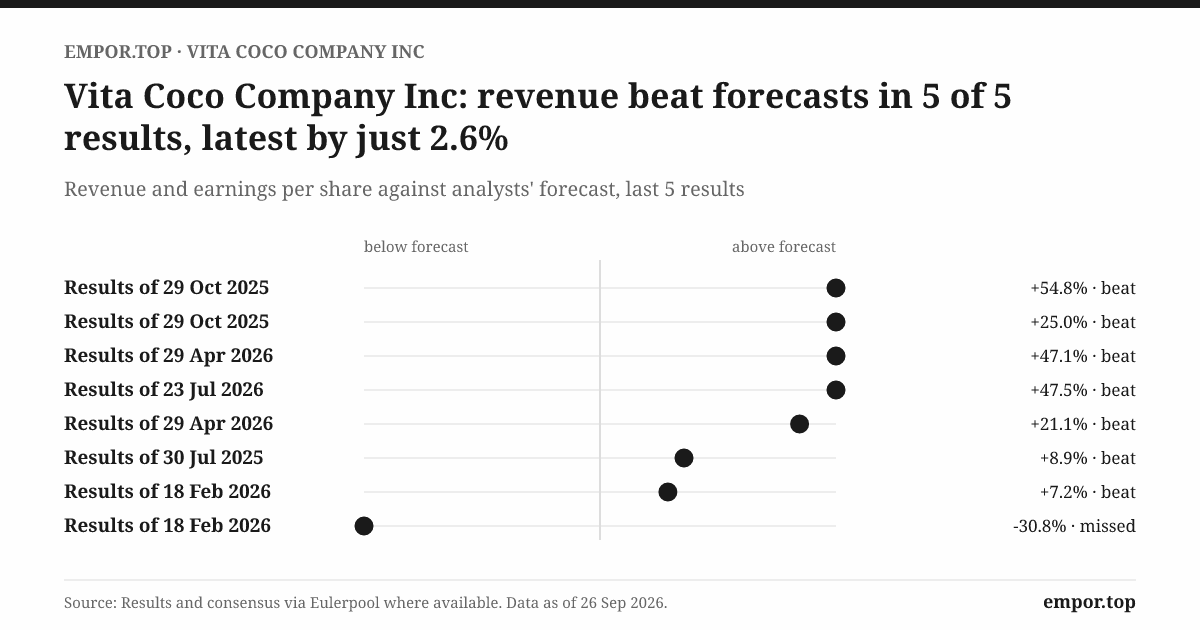
Neither founder had worked in beverages. Neither had supply-chain experience, a food-science background, or a distributor's phone number. Two decades later, the company they built from that encounter had outlasted rival coconut water brands owned by The Coca-Cola Company and PepsiCo. Vita Coco closed fiscal 2025 with $610 million of net sales, 18% growth, and no debt at all.2 In July 2026, the company raised its full-year 2026 outlook to $790–805 million of net sales, a range that included a newly acquired premium coconut water business.3
That operational tension is the anomaly this story examines. On a whiteboard, coconut water looks like one of the least promising packaged goods an investor could back. It is mostly water. It is harvested by smallholder farmers across the tropics, cracked open in co-packing facilities the company does not own, sealed into cartons, and shipped across oceans in steel containers whose freight rates the brand cannot control. It carries no patent and no network effect. A shopper facing an empty shelf can easily substitute a cheaper store-brand carton.
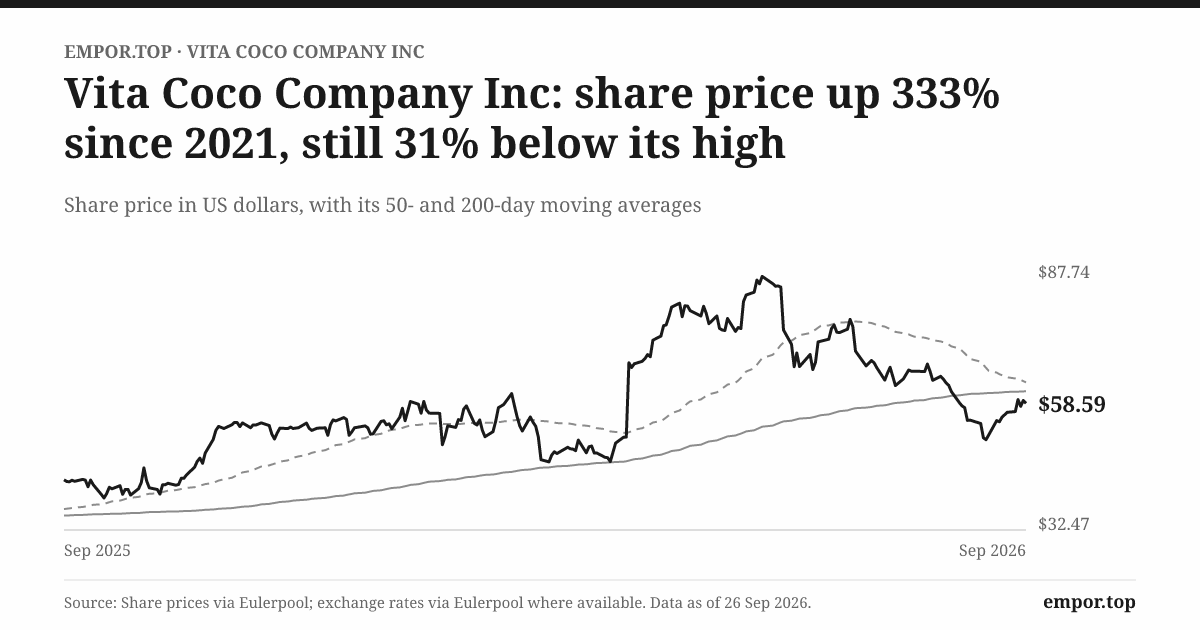
Yet the business has emerged as a durable public-market performer. On September 25, 2026, the shares closed at $58.59, giving the company a market capitalization of roughly $3.5 billion.4 That valuation was nearly four times the initial public offering price set in 2021, and roughly eight times the low the stock touched during the 2022 freight crisis.
 Subscribe on LinkedIn
The two ways to see this company
The bear framing is straightforward and grounded in structural risk. In this view, Vita Coco is an asset-light middleman buying a commodity from contract manufacturers, paying whatever ocean carriers demand to move it, and selling it to a handful of major retailers who can replace it with private-label alternatives at will. Its gross margin fell to roughly 24% in 2022 when ocean container rates spiked.5 In 2025, tariffs compressed margins again.2 Meanwhile, every brand-extension bet the company attempted outside coconut water has been written off or discontinued.67
The bull framing presents the opposite case. Vita Coco spent more than two decades assembling an overseas sourcing network that its rivals—including the world's two largest beverage companies—could not replicate profitably. It took an agricultural byproduct that factories once discarded and turned it into a premium, branded staple. Led since 2019 by an experienced beverage operator from Boston Beer, the business has converted its asset-light model into a growing pile of cash.13
Both perspectives rest on demonstrable evidence. The goal of this story is to weigh that evidence rather than take a side.
The roadmap
The story unfolds in nine movements:
- The founding in a Brooklyn and lower-Manhattan bodega network, and the celebrity cap table that followed;
- The coconut water wars against Coca-Cola's Zico and PepsiCo's O.N.E.;
- The Southeast Asian supply chain that turned factory waste into inventory;
- The arrival of institutional capital from Verlinvest and Reignwood Group (华彬集团), and of Martin Roper as operator;
- The 2021 IPO and the freight crisis that followed almost immediately;
- The segment and private-label economics;
- A historical falsification test of the main bull claims;
- The strategic frameworks and the bull-versus-bear debate;
- The lessons, and the Copra acquisition that opened a new chapter in 2026.
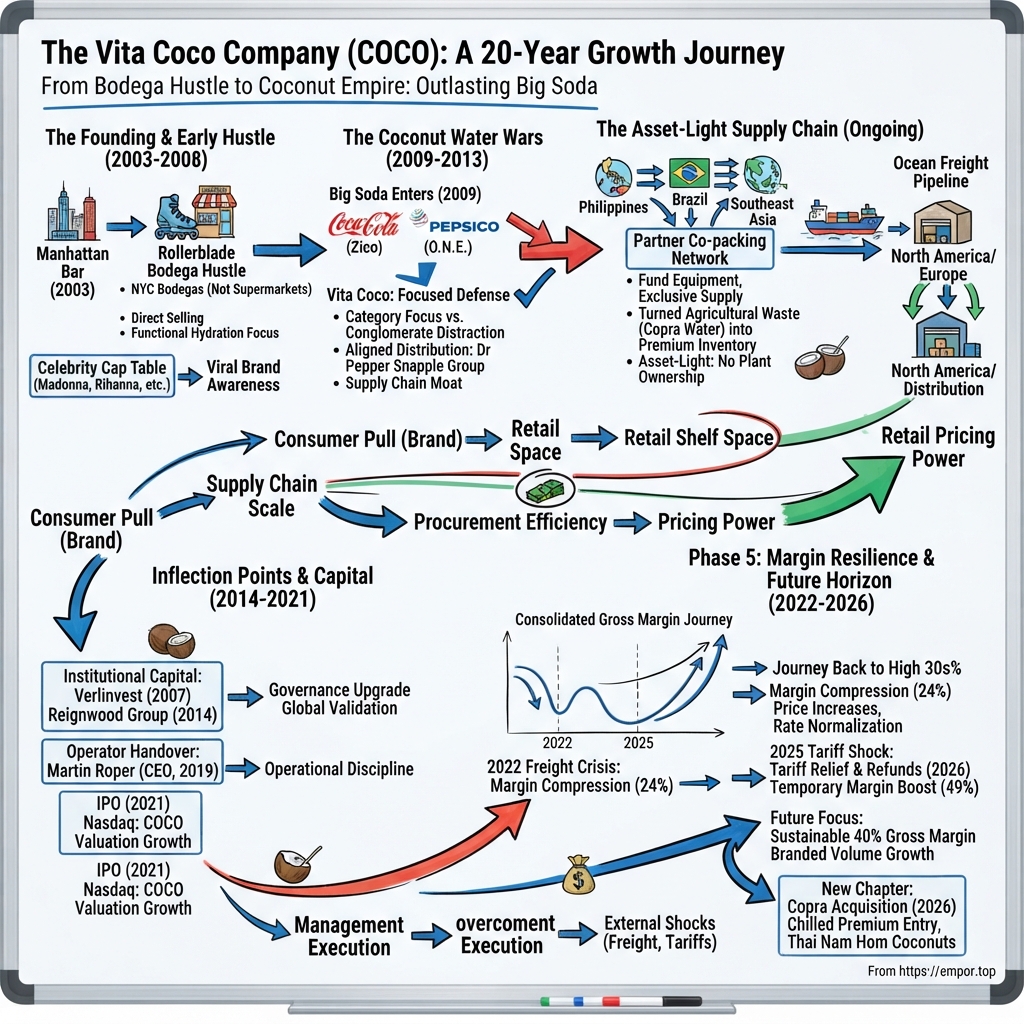
One number frames the whole debate. Consolidated gross margin swung from about 30% in 2021, to 24%, to nearly 39%, back to 37%, and then to a tariff-refund-boosted 49% in a single quarter of 2026.5823 A company whose core margin fluctuates that widely is not a sleepy consumer-staples compounder. It is a supply-chain business that happens to own a prominent brand, and the story begins with how that brand was built.
II. The Manhattan Bar & The Rollerblade Bodega Hustle: 2004–2008 (0:15 – 0:35) [20 mins]
In Michael Kirban's telling, establishing that early brand presence involved a pair of rollerblades. The founders had lined up a contract manufacturer in Brazil and a small distributor serving Brooklyn and lower Manhattan. Kirban's job was to move product off the shelves, so he "rollerbladed from store to store."1 His target was New York City's least glamorous retail footprint: the corner bodega.
Why bodegas, and why that mattered
In 2004, coconut water barely existed as a mainstream beverage category in the United States. Where it appeared at all, it was typically relegated to ethnic grocery aisles, often canned and heavily sweetened. Breaking into Whole Foods or a national supermarket chain required slotting fees, broker relationships, and an established track record that the founders lacked.
Bodegas operated by different rules. Independent store owners made purchasing decisions on the spot, and shelf space was negotiated one cooler door at a time. A founder willing to walk in, pitch the product, and return the following week to check inventory could secure distribution without paying listing fees. As Vita Coco later noted in its IPO prospectus, New York's bodega network was where the brand "got our start."1
That distribution choice also shaped the brand's identity. Vita Coco was never pitched as an ethnic specialty item. From the beginning, the founders positioned it around functional hydration: natural electrolytes, abundant potassium, and no added sugar, aimed at yoga studios, gyms, and morning-after recovery. It was a premium lifestyle beverage incubated across the city's most everyday convenience channel.
The first shipments go wrong
Getting that product into cooler doors, however, exposed a fragile early supply chain. Liran had moved to Brazil and found a co-packer there.1 But the initial shipments ran into regulatory delays with the U.S. Food and Drug Administration, forcing the inventory to be diverted to the Bahamas in 2004.9 For a self-funded startup with no revenue, a detained container was not an operational line item—it was an existential threat.
A quick lesson in why coconut water is hard
To understand why the logistics were so unforgiving, it helps to look at what happens to coconut water once it leaves the nut. Inside an unopened green coconut, the liquid is effectively sterile. The moment the shell is cracked, exposure to ambient air and microbes begins to spoil the water, degrading its delicate flavor within hours. That is why drinks sold on Brazilian beaches are opened directly in front of the consumer.
Selling that same beverage in a New York bodega months later requires industrial processing. The liquid must be heat-treated to neutralize bacteria and sealed into sterile packaging without re-exposure to air. The standard solution is the aseptic carton—the layered paper, plastic, and aluminum package commonly used for shelf-stable milk and juice. It acts as a sealed, lightproof barrier that preserves the drink at room temperature. The operational tradeoff is taste: applying more heat extends shelf life and microbial safety, but pushes the flavor further from that of a freshly cracked coconut. Every coconut water brand operates somewhere along that spectrum, and that choice dictates both its product profile and its supply chain.
This tension established a pattern that would repeat across the next two decades. Vita Coco's product was simple; moving it from a tropical processing facility to an American convenience-store cooler, safely and on schedule, was not. The company's competitive advantage and its operational vulnerabilities both stemmed from that transit.
The formal corporate entity followed later. The business was incorporated in Delaware as All Market Inc. on January 17, 2007, and did not adopt the name The Vita Coco Company until September 2021, shortly before its IPO.6 Liran became the company's director of sourcing in February 2007, a position he held for years afterward—a division of labor that reflected where the founders saw their primary operational bottleneck.1
The celebrity cap table
By the end of the decade, Vita Coco faced a very different problem. It had a product consumers liked and a category that was beginning to expand, but it lacked the marketing budget of an established beverage company.
The solution came from an unconventional source. In January 2010, reports confirmed that Madonna had invested nearly $1.5 million in the company in a transaction arranged by her manager, Guy Oseary, who also invested. The investor group expanded to include Matthew McConaughey, Demi Moore, and Red Hot Chili Peppers frontman Anthony Kiedis, with the celebrity syndicate collectively securing a minority stake for less than $10 million in total capital.10 Vita Coco's prospectus later disclosed that a roster of prominent figures, including Madonna, Rihanna, Moore, and McConaughey, invested across 2010 and 2011.1 Rihanna also fronted a marketing campaign for the brand in the United Kingdom during the summer of 2011.11
The capital itself was modest, but the publicity leverage was substantial. For an emerging brand, an unscripted photograph of a celebrity carrying an aseptic carton generated cultural reach and consumer awareness that a startup could never afford to purchase through traditional advertising channels. The cap table helped turn what had been an obscure functional drink into a recognizable lifestyle product.
What the early years say about the business
It is easy to romanticize that era, but the more useful reading is structural. Vita Coco won its first customers through direct selling across a fragmented retail channel, and it captured attention through a cap table that doubled as a marketing department. Neither tactic constituted a durable moat. Both simply bought time.
What they bought time for was scale. And scale was precisely what drew the two largest beverage companies in the world into the category, with far deeper pockets than a founder on rollerblades.
III. The Great Coconut Water Wars: How Vita Coco Beat Coke and Pepsi (0:35 – 1:05) [30 mins]
In September 2009, the category drew its first corporate backing from Big Soda. Zico, a Hermosa Beach, California brand founded by Mark Rampolla in 2004—the same year as Vita Coco—announced a $15 million funding round in which The Coca-Cola Company acquired a minority stake of less than 20%.12 Fifteen months later, in December 2010, PepsiCo expanded its own presence, partnering with private equity firm Catterton to take a majority stake in rival brand O.N.E. (One Natural Experience), with founder Rodrigo Veloso staying on as CEO.13
The message to the beverage industry was unmistakable. Coconut water had gained enough traction that the giants wanted a seat at the table.
Why Big Soda wanted in
The strategic rationale was straightforward. American consumers were steadily shifting away from sugary carbonated soft drinks toward beverages marketed as natural, functional, and better for you. Coconut water aligned closely with those secular tailwinds: it offered natural electrolytes without added sugar, carried an intuitive hydration proposition, and was expanding rapidly off a small baseline.
On paper, the beverage giants possessed every structural advantage needed to control the category. Coca-Cola and PepsiCo commanded mature direct-store-delivery networks, deploying dedicated truck fleets and field merchandisers to stock cooler doors in convenience stores and supermarkets nationwide. Paired with entrenched retail buyer relationships and marketing budgets capable of reshaping shelf space overnight, the incumbents appeared well equipped to outmuscle independent upstarts.
The alliance that changed the fight
Vita Coco's response was not to match Big Soda's direct-store-delivery networks truck for truck. Instead, it borrowed an established route to market.
In June 2010, six months before PepsiCo took its majority stake in O.N.E., Dr Pepper Snapple Group announced an agreement to distribute Vita Coco, starting across Florida and Georgia. At the time of the announcement, the distributor stated that Vita Coco commanded more than 60% of the U.S. coconut water category.14
The structural advantage of that partnership was easy to overlook. Dr Pepper Snapple—now Keurig Dr Pepper—wielded national delivery reach but owned no coconut water brand of its own. Unlike products inside the Coca-Cola or PepsiCo ecosystems, Vita Coco was not competing for a route driver's attention against a corporate parent's flagship cola; it was an incremental growth product the distributor actively wanted on shelves. The commercial alignment proved durable: by 2020, the relationship with Keurig Dr Pepper accounted for 19% of Vita Coco's net sales.1
What went wrong for the giants
Coca-Cola continued to deepen its commitment, acquiring majority control of Zico in 2012 and full ownership on November 22, 2013, with Rampolla transitioning to a non-executive advisory role. The purchase price was not disclosed.15 (Widely circulated press estimates suggesting Coca-Cola paid "$200 million or more" remain unverified.)
What followed offers a clear lesson in beverage industry dynamics: Zico never unseated Vita Coco. In October 2020, as part of a broad portfolio pruning of underperforming brands, Coca-Cola announced plans to discontinue Zico. In January 2021, it sold the brand back to PowerPlant Ventures—the private equity firm Rampolla had co-founded—for an undisclosed sum. Even at the point of divestment, Zico remained the second-largest coconut water brand in the United States behind Vita Coco.16 PepsiCo's O.N.E. followed an equally quiet exit path: the brand was reportedly divested in 2021 as part of the sale of Tropicana and other juice assets.9
Why did the corporate beverage giants fail to capture the category? Disclosed corporate records offer no definitive post-mortem, but the operational evidence points to three distinct structural explanations.
First, focus. Inside Coca-Cola and PepsiCo, coconut water was a rounding error within multi-billion-dollar global portfolios. For Vita Coco, the category was the entire enterprise. When an account needed a tailored pack size, regional merchandising support, or shelf-level troubleshooting, an independent operator had every incentive to act swiftly, while a multi-category conglomerate directed its commercial resources toward core soft-drink and snack franchises.
Second, distribution economics. Traditional direct-store-delivery networks are engineered to move high-velocity, high-volume products where route drivers are compensated primarily on total case volume. A slower-turning, premium-priced carton struggled to command priority from delivery personnel managing flagship colas. Vita Coco's distribution partner, by contrast, had intentionally added the brand to fill an empty product lane rather than inheriting an orphaned corporate mandate, establishing durable commercial alignment across distributor incentives.
Third, supply. Winning in coconut water requires securing a dependable volume of quality liquid across a fragmented network of tropical processing plants at manageable cost. That agricultural procurement model demanded relationship-intensive, hands-on operational management—an asset-light sourcing architecture that Vita Coco had spent years assembling, and the subject of the next section.
The war-game view
Seen through the lens of corporate strategy, the contest came down to an asymmetry of payoffs. For The Coca-Cola Company, Zico functioned as an inexpensive call option on an emerging beverage trend. If coconut water expanded into the next sports-drink category, Coca-Cola secured early category control; if the category stalled, the downside was negligible relative to the conglomerate's scale. That calculus made holding the asset rational, but it also meant winning was never mandatory—only limiting the loss.
For Vita Coco, the stakes were existential. Losing distribution and premier shelf space at major retail accounts meant the enterprise had no secondary product lines or corporate balance sheet to fall back on. That divergence in urgency showed up in day-to-day execution: quicker turnaround on retailer merchandising requests, more aggressive trade spending across key accounts, and tighter scrutiny over supply-chain reliability. More than a decade after Coca-Cola made its initial investment, the brand it backed still trailed the independent market leader, and the beverage giant chose to exit rather than continue funding the fight.16
Myth versus reality
The popular version of this story holds that a scrappy startup beat Coca-Cola and PepsiCo. That is broadly true, but the outcome carries two important caveats.
First, the beverage giants did not lose because of managerial incompetence. They retreated from a niche category that never grew large enough to justify an all-out corporate defense. Second, Vita Coco did not defeat Big Soda's direct-store-delivery networks single-handedly; it borrowed an established route to market through its partnership with Dr Pepper Snapple.
The takeaway for investors is narrower and more useful than the folklore. In a modest, operationally complex category, a focused brand owner with commercially aligned distribution can outlast a much larger, distracted incumbent. That structural advantage holds only as long as the category remains small enough for conglomerates to deprioritize, or the logistics troublesome enough to deter them. In coconut water, that operational friction centered on the tropical supply chain—and that is where the story turns next.
IV. The Supply Chain Architecture: Turning Agricultural Waste into an Asset-Light Moat (1:05 – 1:35) [30 mins]
When Vita Coco's founders first approached coconut processors in the Philippines, the factory managers laughed at the proposal. As Kirban recounted in his letter to IPO investors, to the processing plants, "the water was a by-product."1
That reaction pointed directly to the economic logic of the business model.
The copra economy
Across Southeast Asia, coconuts have long been processed primarily for their flesh, which is converted into desiccated coconut, coconut oil, and other commercial products. In that established processing trade, the liquid inside the nut was historically treated as an operational waste stream. According to the prospectus, facilities had been "discarding the coconut water as an un-needed byproduct" before Vita Coco arrived.1
Vita Coco's strategy was to fund processing and packaging equipment inside those partner facilities in exchange for exclusive supply agreements.1 The operational logic resembled a beverage maker installing collection taps on a dairy farm that had been washing liquid whey down the drain: the farm continued its core business, the brand secured a steady stream of raw material that would otherwise be lost, and the facility operator monetized what had been discarded.
That arrangement anchored Vita Coco's asset-light economics. The company did not need to purchase tropical plantations or construct standalone factories from scratch. Instead, it had to find industrial processors already cracking open coconuts in volume, persuade them to capture the liquid, finance the equipment required to process it safely, and secure the output under exclusive contract.
Why Brazil could not carry the category alone
Though the brand got its start in Brazil, relying on that market alone proved untenable as volume surged. The founders' initial supply had come from a single local co-manufacturer.1 To sustain national retail distribution in the United States, Vita Coco required far larger quantities at materially lower unit costs.
That search led the company to Southeast Asia. By the time of its 2021 initial public offering, Vita Coco's prospectus described a procurement network spanning ten countries, including the Philippines, Sri Lanka, Malaysia, Thailand, Brazil, Indonesia, and Vietnam. Roughly two-thirds of its supply originated in Asia and one-third in Latin America, supported by 15 factories and 5 co-packers that collectively cracked approximately 2.5 million coconuts a day.1
Over subsequent years, the footprint tightened. By the time the company filed its fiscal 2025 annual report, the processing base had consolidated to roughly 16 factories across six countries.7 Discussing that structure on the fourth-quarter 2024 earnings call, Chief Financial Officer Corey Baker outlined sourcing as concentrated primarily in the Philippines and Brazil, supplemented by other Southeast Asian suppliers alongside regional co-packers in Canada and Mexico.17
The asset-light model, explained
In its prospectus, Vita Coco described its operational structure as "asset-lite," owning none of the manufacturing facilities that process or package its coconut water.1
In practice, the company operates as a brand owner, procurement agent, and global logistics coordinator. Contract manufacturing partners own the physical plants, maintain the equipment, and employ the production workforce. Vita Coco sets quality specifications, commits to purchase volumes, coordinates international and domestic transit, and manages commercial sales.
The primary operational advantage is capital efficiency. Without the burden of allocating heavy capital expenditure toward constructing or maintaining factories, a higher share of operating income converts directly into cash. That conversion is visible on the balance sheet: the company has operated with zero debt, and cash and cash equivalents grew from $133 million at the end of 2023 to $197 million at the end of 2025, even as it repurchased shares.182
The operational trade-off is control. When a partner facility suffers production downtime, an exporting country imposes trade restrictions, or a tropical typhoon disrupts coconut harvests in a primary growing corridor, Vita Coco can exert contractual influence but lacks direct operational command. The company's formal risk disclosures designate geographic supply concentration and regional weather disruptions as material operational vulnerabilities.7
The floating pipeline
Beyond processing bottlenecks lies the ocean. Once coconut water is sealed into shelf-stable cartons, it must travel thousands of miles from Southeast Asia and Latin America to reach warehouses across North America and Europe. Because cartons filled with liquid are heavy and carry a relatively modest value per cubic meter, ocean shipping represents an unusually large component of the product's delivered cost.
That dynamic effectively turns the supply chain into a floating pipeline. At any given moment, a sizable portion of inventory sits at sea. Managing that transit requires a delicate balance: dispatching too little volume risks out-of-stock shelves during the peak summer selling season, while dispatching too much ties up working capital and inflates domestic warehousing expenses. The fragility of that pipeline surfaced clearly in 2024, when shipping disruptions in the Red Sea forced ocean carriers to reroute around southern Africa, triggering transit delays and container shortages that drove up freight costs that summer.7
The hidden job: quality control at a distance
One dimension of that asset-light architecture receives far less scrutiny than ocean freight: quality control across a fragmented overseas manufacturing footprint. Without direct factory ownership, product integrity depends on strict commercial specifications, regular audits, and dedicated personnel on the ground. For a brand positioned around natural purity, an off-flavor carton or a compromised batch poses immediate reputational risk. Liran's extended tenure directing global sourcing underscored how much of the company's operational weight resided far from New York, inside partner facilities where the founders had to navigate unfamiliar agricultural ecosystems from the ground up.1
Capacity constraints revealed the reverse side of that reliance during the private-label service disruptions of 2025. When output tightens across co-packing facilities, an asset-light brand owner must decide which retail accounts receive product and which face delayed shipments. Order shortfalls and customer friction are the inevitable trade-offs of choosing not to own the underlying manufacturing capacity.17
So is this a moat?
That history requires a careful distinction. The overseas sourcing network is durable, operationally complex, and a genuine barrier to new entrants. The fact that Coca-Cola and PepsiCo possessed the balance sheets to assemble a comparable footprint and ultimately walked away is tangible evidence of how difficult the category is to operate.
Yet that network primarily protects Vita Coco against a competitor replicating its procurement base. It does not protect gross margins against the cost of moving heavy cartons across an ocean or absorbing trade tariffs. As the 2022 freight crisis and the 2025 tariffs demonstrated, the supply chain functions as a barrier to entry, not an operational shield for profitability.
Financing and managing that global pipeline also demanded institutional capital and corporate governance that two founders could not provide alone. That operational necessity opened the door to professional investors.
V. The Global Capital Inflection & The Playbook Upgrade: Reignwood, Verlinvest, and Martin Roper (1:35 – 1:55) [20 mins]
In July 2014, that institutional capital arrived at scale. Trade reporting in Beverage Industry announced a transaction valuing Vita Coco at roughly $665 million. The buyer was Reignwood Group (华彬集团), the Thai-Chinese conglomerate behind Red Bull's business in China, which agreed to acquire 25% of the company. The trade press estimated Vita Coco's revenue for the prior year at about $250 million.19
The first institutional partner: Verlinvest
Yet Reignwood was not the brand's first institutional backer. That role belonged to Verlinvest, the Belgian investment firm, which invested in Vita Coco in 2007.20 Verlinvest's Eric Melloul joined the board in 2008.1 (The size of Verlinvest's original stake has not been publicly disclosed.)
Verlinvest provided what founder-led consumer brands often lack: patient capital and board-level governance in consumer packaged goods. That backing proved durable through the company's public listing and beyond: the 2026 proxy statement showed the firm still owning about 5.4% of the company.21
Reignwood and the China question
Reignwood's founder, 严彬 Chanchai Ruayrungruang (Yan Bin), built a fortune distributing Red Bull across China. His group became a principal shareholder in 2014, and under an agreement dated October 1, 2019, it was also Vita Coco's exclusive distributor in China.1
On paper, the strategic logic appeared sound: Reignwood had demonstrated how to build an imported functional beverage into a mass-market brand in China. In practice, the partnership never turned China into a material contributor to the business. Vita Coco does not break out China sales, and its International segment, at $101 million in 2025, remained small compared with the Americas.2 China's coconut drink market also featured entrenched domestic competitors, including the Hainan-based 椰树集团 (Coconut Palm Group).
The relationship also partially unwound before the public listing. In January 2021, ahead of the IPO, Vita Coco repurchased shares from Reignwood's holding entity for about $50 million.1 Whatever the strategic ambitions of 2014, the practical outcome was that a prominent Asian partner bought in, provided capital and commercial validation, and later sold a portion of its stake back.
The operator arrives
A more consequential leadership decision arrived in September 2019, when Vita Coco hired Martin Roper as president.22
Roper's background explained the strategic logic. He had spent more than two decades at The Boston Beer Company, maker of Samuel Adams, serving as chief operating officer from 1994 to 2001 and then as chief executive from 2001 to 2018.1 Over that period, Boston Beer grew from a craft brewer into a large, diversified beverage producer. Roper had earned a reputation as the operational counterpart to founder Jim Koch: the executive who managed organizational discipline, supply-chain scale, and commercial execution while the founder championed the brand.
The leadership transition at Vita Coco unfolded gradually rather than all at once. Roper became co-CEO alongside Kirban and joined the board of directors in January 2021.1 In May 2022, Kirban stepped down as co-CEO to become executive chairman, leaving Roper as sole CEO.23 (Commentary stating that Roper took over as chief executive in 2019 conflates his initial appointment as president with that later executive succession.)
What the operator actually changed
Management's account of the operational upgrade centered on the standard playbook of a seasoned beverage executive: tighter inventory planning, enhanced supply-chain visibility, and more disciplined contracting with packaging partners and ocean carriers. Some of that discipline showed up in disclosed procurement practices. On the second-quarter 2026 earnings call, for instance, Roper noted that new fixed-rate contracts covered approximately 50% of the company's ocean freight requirements for the remainder of the year.24
That transition also altered the company's governance and culture. Founder-led consumer brands often falter when operational leadership changes hands, as early entrepreneurial instincts clash with corporate systems and process. Vita Coco managed that handoff more gradually than most: Roper served more than a year as president and another eighteen months as co-CEO before assuming the sole chief executive post.123 Kirban did not depart; he transitioned to executive chairman and continued to front major strategic announcements, including the Copra transaction in 2026.25
Yet a neutral assessment requires distinguishing managerial execution from external tailwinds. The founder-to-operator handoff offers a neat corporate narrative, and the company's financial rebound after 2022 did coincide with Roper's tenure. But the public record shows no clean, isolated before-and-after test of his operational interventions: much of that gross-margin recovery also coincided with a steep drop in global ocean freight rates, an external variable management could not control.
The real test of the operator arrived almost immediately after the company went public.
VI. The IPO, The Pandemic Hangover, and The 2022 Ocean Freight Crucible (1:55 – 2:20) [25 mins]
On October 21, 2021, The Vita Coco Company began trading on the Nasdaq under the ticker COCO. The public debut met a subdued reception: bankers had marketed the shares at $18 to $21, but the offering priced at $15, below the targeted range.26
Reading the prospectus
The structure of the transaction revealed more than the headline price. The offering totaled 11.5 million shares, raising $172.5 million gross. But only 2.5 million of those shares were sold by the company, with existing shareholders accounting for the remaining 9.0 million. After underwriting fees, the company received roughly $35 million of the proceeds, while selling shareholders took about $126 million.27
In practical terms, the public debut functioned primarily as a liquidity event for early backers rather than a capital infusion for the business. That distinction was essential for understanding the balance sheet: the cash reserves Vita Coco built in subsequent years were generated by ongoing operations, not by public equity financing.
Keurig Dr Pepper also used the listing to deepen its commercial relationship with the brand. An affiliate agreed to purchase $20 million of stock from Verlinvest at the IPO price.27 While buying secondary shares from an existing shareholder injected no fresh cash into the corporate treasury, the purchase offered a tangible sign of strategic alignment from the company's most important distributor.
The storm arrives
Vita Coco completed its public listing at an exceptionally difficult moment for its cost structure. Global container shipping had seized up during the pandemic, and ocean freight rates on key corridors from Asia to the United States surged to multiples of historical norms.
For an asset-light business moving heavy cartons of water across oceans, the financial impact was severe. Gross margin contracted from 29.8% in 2021 to 24.2% in 2022, while net income dropped by more than half, from $19 million to $8 million, and adjusted EBITDA fell from $37 million to $20 million.5
On the second-quarter 2022 earnings call in August, management put a concrete figure on that operational drag. Then-Chief Financial Officer Kevin Benmoussa estimated that elevated transportation costs had reduced gross profit by close to $30 million in the first half of 2022 compared with 2020.28
Public equity markets reflected that margin compression. The stock touched an all-time low of roughly $7.39 in November 2022, trading at about half its initial public offering price.29
The promise made at the bottom
The most revealing record from that downturn was not the income statement, but what Martin Roper told investors on the August 2022 earnings call.
Roper stated that he expected total transportation costs to peak around late 2022 or early 2023, outlining what he characterized as "a journey back to sort of high 30s gross margins." He also noted that the company planned price increases in late 2022 to help offset elevated costs.28
It was a specific, falsifiable commitment—and a clear benchmark against which to measure the company's subsequent recovery.
The promise versus the outcome
The subsequent results matched that guidance. Consolidated gross margin rebounded to 36.6% in 2023 and reached 38.5% in 2024, while net income rose to $47 million in 2023 and $56 million in 2024.188 Measured against Roper's public benchmark, the business delivered the margin recovery within roughly the timeframe management had outlined.
Yet two caveats qualify that turnaround. First, the margin expansion was driven substantially by the normalization of global ocean freight rates—an external macro swing management anticipated but did not control. Second, retail pricing held. Vita Coco retained most of the price increases it implemented during the crisis even after ocean shipping costs receded, providing tangible evidence of pricing power across its retail footprint.
How pricing actually worked
Why those price increases held is central to the investment debate. For most consumers, coconut water is an occasional, functional purchase bought for a distinct use case: post-workout hydration, a cocktail mixer, or morning-after recovery. A shopper standing in front of a cooler door is rarely comparing a carton of coconut water against a bottle of soda; they are comparing Vita Coco with an adjacent coconut water carton or a store brand. During 2022, every importer across the category absorbed the same container shipping inflation. When an entire category's cost base rises simultaneously, the market leader can implement price increases without conceding an immediate pricing advantage to shelf rivals.
The more demanding test arrived during the subsequent recovery. When ocean shipping rates fell in 2023, the market leader could have discounted product to capture retail volume and pressure smaller rivals. Vita Coco largely held its shelf pricing, and customer demand did not falter: net sales still grew 15% in 2023, to $494 million, while net income nearly sextupled.18 The widening spread between receding transit costs and sticky retail prices converted directly into operating leverage.
A skeptical interpretation cautions that this dynamic succeeded partly because contract packers and store-brand suppliers also needed higher shelf prices to recover from their own freight losses. Vita Coco did not encounter a well-funded competitor willing to initiate a price war during the freight thaw. If an aggressive rival or a retailer-backed private-label program attempts to undercut category pricing in a future logistics cycle, that pricing power could face a much stiffer test.
The shocks keep coming
That margin recovery did not mark the end of external disruptions. Ocean shipping rates climbed again when Red Sea transit disruptions struck in 2024, and in 2025 another cost shock arrived in the form of import tariffs, an issue examined in the segment analysis below. What 2022 established is that Vita Coco can absorb an acute cost spike without breaking its brand, but not without sacrificing a year or more of earnings along the way.
VII. Segment Economics & The Portfolio Reality Check: Americas, International, and The Private-Label Bargain (2:20 – 2:45) [25 mins]
Walk into a Costco warehouse, and two coconut water cartons often sit side by side. One carries the familiar Vita Coco branding. The other carries a store brand and a lower price. The open secret of the category is that both may have moved through Vita Coco's own supply chain.
The two segments
The company reports results across two operating segments: the Americas and International.
In 2024, the Americas contributed $442 million, or roughly 86% of net sales, while International accounted for $74 million.8 In 2025, International expanded at a faster pace, reaching $101 million, or about 17% of total revenue, as net sales in the Americas rose to $509 million.2
The Americas segment remains the business's core, anchored by long-standing brand awareness and the company's largest retail partners. Yet International showed meaningful momentum: led by the United Kingdom, International grew Vita Coco-branded volume 32% in 2025, outpacing the 19% branded volume growth in the Americas.2 That performance suggests the brand can travel into developed overseas beverage markets, though the segment remains too small to alter the broader corporate investment case on its own.
A critical nuance sits inside that International growth. Private-label volume in the segment expanded 36.5% in 2025, even as private-label volume collapsed in the Americas.2 That geographic divergence indicates that the company's private-label troubles that year were primarily driven by regional co-packing and service disruptions in the Americas, rather than a systemic decision by retailers worldwide to abandon Vita Coco as a contract supplier. For investors evaluating whether the 2025 customer disruptions signaled a structural vulnerability in the asset-light model or a temporary operational setback, the balance of evidence—reinforced by the commercial recovery in 2026—points toward an execution problem that management could isolate and repair.
The product mix
Yet for understanding the economics of the business, the more consequential breakdown is by product rather than geography.
Vita Coco Coconut Water is the branded core. Its net sales rose from $393 million in 2024 to $496 million in 2025.82 That represented roughly four-fifths of total revenue in 2025, and it is where the company's retail pricing power resides.
Private label is coconut water Vita Coco supplies to retailers to sell under their own store brands. That business brought in $109 million in 2024 and $89 million in 2025.82
Other products, including coconut milk and peripheral beverages, contributed about $25 million in 2025.2
The company does not disclose gross margins separately for branded and private-label products. Any precise margin figure cited for the private-label contract business is an external estimate rather than a reported number.
Why the market leader makes store brands
At first glance, supplying private-label inventory looks counterintuitive, if not self-defeating. Why would a category leader help retailers sell a cheaper substitute right beside its own flagship carton?
The strategic rationale rests on three operational mechanisms, none of which the company quantifies directly in its financial filings.
Scale. Private-label volume helps fill partner factory capacity and ocean shipping containers, spreading fixed procurement, packaging, and logistics costs across a much larger base of units.
Defense. If a major retailer decides to launch a store brand, an alternative supplier will step in to pack it. By taking on the contract itself, Vita Coco keeps that production inside its own sourcing network rather than allowing a rival processor to build the scale and shipping leverage needed to compete against it.
Relationships. Supplying a retail partner across both branded and private-label lines deepens commercial alignment. Managing both tiers provides broader visibility across shelf space and inventory planning, turning Vita Coco into an essential category partner rather than a single vendor competing solely for branded cooler doors.
The 2025 private-label stumble
Private label is also where the operational model has exposed its clearest vulnerabilities. On the fourth-quarter 2024 earnings call, Roper cautioned that the company expected to lose regional volume with certain private-label retail partners during 2025, attributing the losses to inadequate customer service levels.17 That warning proved accurate: consolidated private-label volume fell 13.7% in 2025, weighed down by a 26.4% decline in the Americas.2
The underlying cause was revealing. The company surrendered that volume not because competitors undercut its pricing, but because Vita Coco could not fulfill orders reliably amid tight co-packing capacity and maritime shipping friction. In store-brand coconut water, retail buyers treated the category leader not as an indispensable partner, but as an interchangeable vendor when delivery schedules slipped.
That commercial dynamic swung back once packaging constraints eased. In the second quarter of 2026, private-label volume surged 78%.3 On the second-quarter 2026 earnings call, Baker projected that U.S. private-label volume would grow 90–100% for the full year, a forecast that incorporated the newly acquired Copra business.24 That recovery demonstrated that Vita Coco could recapture lost store-brand volume and integrate additional processing capacity, but the episode highlighted the transactional nature of contract manufacturing: while the branded carton commands consumer loyalty, private-label supply remains entirely dependent on operational execution.
Customer concentration
That reliance on operational execution is magnified by how concentrated the company's customer base remains. Corporate filings no longer identify its largest accounts by name, referring to them instead as Customer A and Customer B. In 2024, those two customers together accounted for roughly 48% of total net sales. In 2025, that combined figure was about 44%, and across the first half of 2026, each accounted for approximately 22% of net sales.730
Based on earlier disclosures, one account is likely Costco and the other Keurig Dr Pepper's distribution network, though the company does not confirm those identities in recent filings.
For investors, the structural takeaway is straightforward. When two commercial partners generate more than 40% of net sales, an adverse shift in either relationship can move the entire business. As the private-label contract disruptions of 2025 demonstrated, that concentration risk is not theoretical—it is a documented reality of the operating model.
The first tariff shock
In 2025, import tariffs introduced another severe cost shock. According to the company's annual report, an initial 10% baseline tariff was compounded in August 2025 by reciprocal duties of roughly 20% on its Asian sourcing countries and 50% on Brazil, driving Vita Coco's weighted average tariff rate to approximately 23% by the end of the third quarter.7
Relief arrived in two stages. On November 14, 2025, an update to the executive order exempted coconut water from the reciprocal tariffs, retroactive to November 13, which the company stated reduced its average tariff rate from about 23% to roughly 6%.31 Then, on February 20, 2026, the U.S. Supreme Court ruled that the emergency tariffs were unlawful. In the second quarter of 2026, the company received approximately $15.6 million in customs refunds, recorded as a reduction to cost of goods sold.30
That recovery explained why consolidated gross margin reached 48.7% in the second quarter of 2026. Management disclosed that the tariff refunds contributed roughly 700 basis points—or seven percentage points—to that quarterly figure.3 For investors assessing underlying earnings power, that windfall represented a one-time accounting benefit rather than a permanent operational baseline, as management's full-year 2026 outlook called for a gross margin of approximately 40%.3
The segment dynamics therefore point to a business whose core branded carton commands genuine pricing power, whose store-brand contracts provide valuable operating scale but remain vulnerable to service execution, and whose gross margins remain exposed to global trade and shipping policy. The next question is how well the strategic claims surrounding that operating model hold up under scrutiny.
VIII. Management, Governance, and The Historical Falsification Layer (2:45 – 3:10) [25 mins]
In June 2018, Vita Coco's parent company acquired the assets of Runa, a small energy-drink brand made from guayusa, an Ecuadorian leaf.32 It was the company's primary bet that it could expand beyond coconut water. Five years later, it stopped selling Runa entirely.6
That arc offers an instructive starting point for evaluating management, testing a question central to long-term value: can the business build or scale anything beyond its core category?
The leadership team
At the executive level, leadership has remained stable. According to the company's 2026 proxy statement, co-founder and executive chairman Michael Kirban owned about 5.6% of the company, CEO Martin Roper held about 3.6%, and co-founder Ira Liran owned roughly 1.8%. Together, all directors and executive officers held about 12.9% of the shares.21
That equity base provides meaningful alignment between corporate insiders and public shareholders, with the founders and chief executive retaining a substantial portion of their personal wealth in the stock. The largest outside institutional holders were BlackRock at about 11.6%, Fidelity's parent FMR at 9.0%, and Verlinvest at 5.4%.21
Corey Baker serves as chief financial officer, having succeeded Kevin Benmoussa, who served as finance chief on the August 2022 earnings call during the height of the ocean freight crisis.2128 Baker's conference-call presentations are notable for detailed variance bridges rather than corporate slogans, walking analysts through ocean freight rates, tariff exposures, and pricing realization in concrete dollar terms. The company's independent auditor is Deloitte & Touche, which has audited its financial statements since 2012.217
Management has not publicly announced a formal CEO succession plan. Roper led The Boston Beer Company for 17 years and has guided Vita Coco, across several executive roles, since 2019. While executive succession is not an acute concern, it remains an unresolved governance question.
Claim 1: "Vita Coco is a platform, not a product"
The claim. The company's brand equity and distributor network can support new beverage lines beyond coconut water.
The test. Examine every major brand-extension attempt the company has mounted outside its core category.
The evidence.
Runa, the energy-drink asset acquired in 2018, included an earnout provision that could have paid up to $51.5 million based on future sales growth. By the end of 2020, management had written the fair value of that earnout down to zero, recognizing a $16.4 million non-operating gain.1 The accounting reversal reflected a stark commercial reality: Runa was generating virtually none of the projected expansion. Vita Coco subsequently recorded a $6.7 million impairment charge against Runa's intangible assets in 2022, halted commercial sales in December 2023, and wrote off the remaining residual assets in September 2025.67
Ever & Ever, an aluminum-bottled water brand introduced in 2019 to ride consumer demand away from single-use plastics, ceased production in 2024.17
The "Other" reporting line, which captures non-coconut-water products alongside coconut milk, generated about $25 million in 2025, remaining a minor fraction of overall revenue.2
The verdict. The historical record refutes the platform thesis in its broad form. The company has demonstrated no ability to build, acquire, or scale a standalone beverage brand outside its primary category. A narrower version of the thesis holds: Vita Coco can extend its trademark into close adjacencies such as coconut milk, and it can license its name to commercial partners. For investors, however, any platform optionality beyond the coconut remains unproven until a new beverage demonstrates material, sustained revenue.
Claim 2: "The supply chain protects the margins"
The claim. The overseas sourcing network gives Vita Coco structurally protected margins.
The test. Examine gross margin performance when the supply chain came under acute external stress.
The evidence. Consolidated gross margin contracted by nearly six percentage points in 2022 when ocean freight rates spiked.5 It fell again in 2025 under the impact of import tariffs, dropping from about 39% in 2024 to roughly 37% for the year, even as the company raised prices.2 Both shocks originated outside the factory gate—precisely the segment of the transit pipeline that exclusive co-packing contracts cannot control.
The verdict. The historical record refutes the strong version of this claim. The supply chain is difficult to replicate, but it does not insulate operating margins from shipping inflation or tariff policies. A more defensible formulation is that Vita Coco can recover from those external shocks over time, primarily by passing through price increases—a dynamic supported by the financial rebound across 2023 and 2024.
What would confirm or falsify it from here. Management guided to a full-year 2026 gross margin of approximately 40%.3 If gross margin holds in the high 30s through periods of moderate freight or packaging inflation, the recovery thesis holds. If margins contract sharply whenever transit or trade costs rise, the claim narrows further: the supply chain serves as an effective barrier to entry, but not as an economic shield for profitability.
Claim 3: "Retailers need Vita Coco"
The claim. Major retailers depend on Vita Coco as the category leader.
The test. Compare how major retail partners treat the flagship branded carton versus store-brand supply contracts during commercial disruptions.
The evidence. The branded business continues to secure premier shelf placement. On the fourth-quarter 2024 earnings call, for example, management pointed to a juice-aisle reset at Walmart that expanded Vita Coco's shelf presence.17 Retailers allocate prominent cooler doors and shelf facings to the flagship carton because consumer demand and brand recognition drive category velocity at premium price points.
The contract manufacturing business, however, revealed the limits of that retailer dependence. When packaging bottlenecks and shipping friction compromised order fulfillment in 2025, retail partners demonstrated little hesitation in shifting store-brand volume to alternative suppliers when fulfillment slipped.172 While commercial accounts view the branded product as a traffic-driving staple, they treat store-brand supply as an interchangeable commodity where delivery reliability supersedes vendor loyalty.
The verdict. The historical record validates the claim for the branded carton, but refutes it for contract manufacturing. Retailers need the Vita Coco brand to satisfy consumer demand; they do not need Vita Coco as a private-label supplier. That distinction is critical for evaluating the business: the company's commercial bargaining power resides entirely in the consumer pull of its branded packaging, while its private-label volume remains strictly transactional.
Management credibility
The strongest evidence for management's credibility rests on that August 2022 commitment. In the depths of the ocean freight crisis, Roper outlined a return to high-30s gross margins, and the business delivered on that timeline.288 Management also demonstrated a willingness to communicate bad news early, warning investors on the fourth-quarter 2024 earnings call that private-label volume losses were coming.17 In a packaged beverage sector where leadership teams often rely on qualitative reassurance during downturns, setting measurable targets and flagging operational friction in advance built goodwill with institutional shareholders.
The counterweight to that operational execution lies in capital allocation. The write-offs of Runa and Ever & Ever both occurred under the current executive leadership. While Runa's acquisition predated Roper's appointment, Ever & Ever launched the same year he arrived as president, and both assets were ultimately written down to zero.
That mixed record frames the strategic question the next section examines: what exactly protects this company, and how strong is that protection?
IX. Strategic Frameworks: Porter's 5 Forces & Hamilton Helmer's 7 Powers (3:10 – 3:30) [20 mins]
Imagine a shopper in the beverage aisle of a supermarket in Ohio. In front of them are electrolyte powders, sports drinks, enhanced waters, energy drinks, and a coconut water section with several brands and a store label. The shopper can buy any of them, or none. Every framework in this section is ultimately an inquiry into that retail choice—and why that consumer reaches for a blue Vita Coco carton.
Hamilton Helmer's 7 Powers
Hamilton Helmer's 7 Powers framework assesses whether a business commands a structural advantage that enables it to generate persistent economic rents—earning returns above its cost of capital—and what prevents rivals from arbitrating that advantage away. Applied to Vita Coco, the model clarifies where the company's competitive moat actually resides, and where it falls away.
Scale Economies — Strong. As the largest coconut water player across its core markets, Vita Coco commands procurement and distribution efficiencies that sub-scale rivals cannot match. Its sheer volume allows it to secure dedicated processing lines across multiple tropical origins, negotiate volume-discounted container freight rates with ocean carriers, and spread corporate overhead, marketing campaigns, and retail broker fees across hundreds of millions of cartons. A sub-scale entrant faces structurally higher unit procurement, packaging, and shipping costs at every stage of the pipeline.
Branding — Strong, but bounded. The flagship trademark commands genuine consumer pull, selling at a measurable premium to store brands while sustaining strong category velocity. Consolidated branded volume grew 21% in 2025 even as prices rose.2 That resilience demonstrates that consumer brand equity can protect top-line growth through inflationary price increases. Yet the boundary of that brand power is narrow: as the write-offs of Runa and Ever & Ever demonstrated, the equity fails to transfer to beverage categories outside coconut water.
Process Power — Moderate. Two decades spent managing a decentralized footprint of tropical processing facilities, maintaining microbial safety and flavor standards on an easily spoiled agricultural liquid, and operating a rolling, ocean-borne inventory pipeline represent substantial accumulated know-how. This tacit operational competence cannot be duplicated overnight. It is not insurmountable, however: competing co-packers and specialty players such as Copra have proven that high-grade coconut water can be sourced and processed by alternative operators.
Cornered Resource — Weak. Vita Coco owns no coconut plantations, processing plants, proprietary extraction machinery, or unique coconut cultivars. While long-term supply and packaging agreements with partner facilities create near-term hurdles for challengers, coconuts remain an agricultural commodity grown widely across the tropics. The company controls no scarce physical or intellectual asset that competitors are legally or structurally prevented from accessing.
Switching Costs — Weak. For a retail shopper standing in front of a cooler door, the cost of reaching for a competing brand or store label is zero. Supermarkets and mass retailers face modest administrative friction when switching private-label suppliers—such as vetting packaging specifications and onboarding delivery logistics—but as the 2025 service disruptions proved, retail buyers will readily reallocate store-brand contracts to alternative co-packers when fulfillment slips.
Network Effects — Absent. The business exhibits no direct or indirect network dynamics. One consumer purchasing a carton of Vita Coco generates no incremental value or utility for any other consumer.
Counter-Positioning — Historical only. During the 2000s, Vita Coco effectively counter-positioned its natural hydration proposition against the high-sugar formulations of legacy soft-drink giants, exploiting the incumbents' reluctance to cannibalize their flagship soda franchises. That structural asymmetry has entirely dissipated: global beverage conglomerates have spent more than a decade investing heavily in functional waters, sports drinks, and better-for-you product lines.
A peer comparison
That structural positioning becomes clearer when measured against other beverage operating models. A global soft-drink conglomerate pairs vast scale economies with entrenched brand equity and proprietary direct-store-delivery networks that competitors cannot easily duplicate. A leading energy-drink producer pairs daily consumer habit with exceptionally high gross margins, benefiting from a high value-to-weight ratio and low manufacturing costs relative to retail shelf prices.
Vita Coco operates in a far more demanding physical reality. Its core product is heavy, perishable, and expensive to transport across oceans relative to its retail price, while consumer switching costs at the cooler door are virtually nonexistent. In that context, the company's ability to sustain gross margins in the high 30s on an imported agricultural commodity offers the clearest evidence that its scale and brand equity provide genuine economic advantages.
Under Helmer's taxonomy, Vita Coco commands two real powers—scale economies and branding—reinforced by accumulated process power. That combination creates a durable commercial position. It does not create an impenetrable fortress.
Porter's Five Forces
Buyer power — High. Mass retailers, supermarkets, and warehouse club stores control access to cooler doors and shelf facings. With two retail partners together accounting for more than 40% of net sales, buyer power represents the most significant external constraint on the enterprise.30 As the 2025 store-brand disruptions demonstrated, major accounts can readily reallocate private-label contract volume when fulfillment slips, even if consumer pull compels them to keep the flagship branded carton on shelves.
Supplier power — Low to moderate. Individual processing facilities possess limited pricing leverage because Vita Coco distributes procurement across multiple countries in Southeast Asia and Latin America. However, regional coconut supply remains vulnerable to adverse weather and harvest cycles, while packaging materials face persistent cost inflation. At an investor conference hosted by Piper Sandler in September 2026, management indicated that it viewed certain packaging cost increases as permanent.33
Threat of substitutes — Very high. The broader functional beverage landscape is intensely crowded. For hydration and refreshment, coconut water contends not only with direct category rivals, but with sports drinks, electrolyte powder packets, enhanced waters, ready-to-drink teas, energy drinks, and plain tap water. Because consumer switching costs at the shelf are effectively zero, the product must constantly justify its premium price point through marketing and functional positioning.
Threat of new entrants — Moderate. Replicating a national-scale, shelf-stable supply chain requires establishing overseas co-packing agreements, coordinating international maritime freight, and securing distributor slotting—hurdles that deterred even the world's largest beverage companies. However, entering at the regional or premium tier is far more accessible: smaller specialty operators focusing on organic or chilled formulations can gain traction across natural grocers and upscale retail channels, a path demonstrated by Copra before Vita Coco acquired the business.
Rivalry — Moderate. With Coca-Cola and PepsiCo having divested or deprioritized their coconut water assets, category rivalry across ambient, shelf-stable cartons has settled into a stable pattern. Vita Coco commands an uncontested leadership position in the core packaged segment, competing primarily against retailer-owned private label on price and refrigerated specialty brands, such as Harmless Harvest, on flavor and product format.
The Copra deal through this lens
The July 2026 acquisition of Copra illustrates how these competitive dynamics intersect in practice. Copra is a chilled, premium coconut water producer using Thai Nam Hom coconuts, an aromatic variety prized for its naturally sweet flavor. Operating a processing facility in Thailand and selling primarily across the Americas, Copra pairs an emerging consumer brand with an established store-brand packaging business. At the time of the transaction, its net sales were projected to exceed $100 million in 2026, following a 48% compound annual growth rate over the preceding three years.25
To acquire the business, Vita Coco agreed to pay $175 million upfront—roughly 80% in cash and 20% in equity—alongside a contingent earnout payable in 2029 based on 2028 financial performance, bounded by a floor of $45 million and a cap of $100 million.25
From a strategic perspective, the transaction neutralizes a fast-growing challenger while expanding Vita Coco into the premium refrigerated case, an upscale retail channel where its ambient shelf-stable cartons held little presence. It also integrates a dedicated Thai processing facility and introduces a distinct agricultural variety to the company's procurement mix.
Yet the write-downs of Runa and Ever & Ever offer a cautionary backdrop for any acquisition structured around an earnout. The critical difference is category focus: Copra produces coconut water, serves many of the same supermarket and club-store buyers, and relies on an aligned tropical supply chain. It represents a direct product adjacency rather than a foray into unfamiliar beverage segments. Whether that operational proximity translates into durable commercial integration remains the central test for management heading into 2027 and 2028.
These frameworks describe the company's structural position. The next section examines what an investor should actually watch to assess how that position holds up in practice.
X. The Investment Thesis Spine: The 3 Core KPIs, Bull vs. Bear, and The Activist Stress Test (3:30 – 3:50) [20 mins]
In June 2026, Vita Coco shares reached an all-time high of about $85.83.29 Three months later, they closed at $58.59, roughly a third lower.4 Nothing about the company's cartons or coconuts changed in those three months. What shifted was the market's assessment of how durable that 2026 surge would prove to be. That divergence frames the fundamental debate over the stock.
The three KPIs that matter
1. Vita Coco Coconut Water case-equivalent volume growth. This metric tracks physical unit demand for the flagship carton, stripped of pricing actions and currency fluctuations. Because dollar sales can rise simply by passing along higher ocean shipping or tariff expenses, volume growth provides the clearest measure of genuine consumer pull. Branded volume rose 5.8% in 2024, accelerated to 21.3% in 2025, and grew 15% in the second quarter of 2026.823
2. Consolidated gross margin. This represents the primary barometer of how effectively the business balances ocean transit rates, import tariffs, packaging inputs, and wholesale pricing. For full-year 2026, management targeted a gross margin of approximately 40%.3 Because one-time tariff refunds distorted mid-2026 results, evaluating the business requires isolating that underlying margin from temporary customs recoveries.
3. Branded net price realization. This measures the company's ability to preserve shelf pricing when transportation costs recede and pass through increases when input expenses climb, all without surrendering volume to private-label alternatives. On the second-quarter 2026 earnings call, Roper noted that if elevated cost pressures persisted, the company could evaluate additional price increases in early 2027.24 Consumer elasticity in response to that potential adjustment will offer a direct test of the brand's pricing power.
The bull case
The bull case begins with category momentum. At the Piper Sandler conference in September 2026, management cited U.S. coconut water category growth of about 28% year to date.33 As the category leader, Vita Coco has converted that tailwind into double-digit branded volume growth since early 2025. Unlike 2023, when top-line gains leaned primarily on pricing actions, recent expansion has been driven by physical carton volume—a structurally healthier foundation for operating leverage.
That unit volume also reinforces a favorable product mix. Branded coconut water represents the company's most profitable tier, and it continues to grow faster than the rest of the business. As higher-margin branded cartons claim a larger share of net sales, underlying margin architecture improves. Geographically, International provides an extended runway: branded volume in the segment expanded more than 30% in 2025, establishing an overseas growth corridor that remains only a fraction of the Americas footprint today.2
That operating efficiency has fundamentally strengthened the balance sheet. Adjusted EBITDA expanded from $20 million in 2022 to $98 million in 2025, and the company's updated 2026 outlook projected $154–161 million.523 Crucially, that cash generation has accumulated with zero debt.
Finally, management has demonstrated operational execution by meeting the margin recovery targets set during the 2022 freight crisis. The 2026 Copra acquisition adds an immediate growth vector in the fast-expanding chilled premium case, while securing additional co-packing volume to absorb overhead across the broader processing network.
The bear case
The skeptical counterargument begins with the quality of recent earnings. The company's 2026 financial performance was substantially boosted by one-time customs tariff refunds and the cyclical normalization of ocean container rates—external tailwinds rather than permanent operational breakthroughs. At the same time, physical constraints loom over future expansion: on the second-quarter 2026 earnings call, management disclosed that partner processing plants were running at roughly 95% of capacity, leaving narrow room to accommodate further volume gains without onboarding new overseas co-packers.24
Underlying that operational bottleneck sits acute structural concentration. The enterprise remains fundamentally tied to a single beverage category, a sourcing pipeline reliant on a handful of developing tropical markets, and two commercial accounts that together generate more than 40% of net sales. Any disruption to a single retail relationship, maritime shipping corridor, or regional coconut harvest exposes the entire business to immediate operational friction.
Furthermore, rapid category expansion may invite the very competition that threatens the company's economics. Category growth approaching 30% inevitably attracts well-funded challengers and could prompt legacy beverage conglomerates to re-examine a market they exited years earlier. A renewed corporate push from Big Soda, or an aggressive pricing offensive from retailer-owned store brands, would test Vita Coco's pricing power under competitive conditions far harsher than the synchronized, industry-wide freight inflation of 2022 to 2024.
Quiet cost inflation poses a parallel threat to margins. At the Piper Sandler conference in September 2026, management acknowledged that certain packaging cost increases were likely permanent.33 If consumer price sensitivity prevents the brand from passing through those elevated input costs, gross margins will suffer structural erosion even in the absence of another shipping or trade shock.
Finally, the Copra acquisition introduces meaningful integration risk. Vita Coco is deploying substantial capital to acquire a business that relies on cold-chain distribution, chilled retail coolers, and a distinct agricultural variety, backed by an earnout structure that could reach $100 million. For investors with a long memory, that deal structure carries an uncomfortable resonance: the company's prior earnout-based acquisition, Runa, ended in complete asset write-downs and commercial withdrawal.
The activist stress test
What would a skeptical activist investor push on?
Capital allocation. Cash reached $279 million by June 2026.3 Applying the disclosed 80% cash mix to the $175 million upfront purchase price implies that roughly $140 million went out the door in July for the Copra deal, before any earnout.25 Share repurchases have been modest by comparison: $12.8 million in 2024 and $11.3 million in 2025, though the board added $40 million to the repurchase authorization in July 2026.823 An activist would question whether management is accumulating a cash pile to fund further acquisition bets rather than returning more capital to shareholders.
Customer concentration. An activist would press management on commercial risk, asking what concrete steps the company is taking to reduce reliance on its two largest accounts, given that together they generate more than 40% of total net sales.
Governance. Separating the executive chairman and chief executive roles reflects sound governance practice. However, the board has identified no formal successor to a CEO who has spent three decades running beverage companies.
None of these questions points to an enterprise in distress. Instead, they describe a profitable, growing business facing the discipline of public-market maturity: demonstrating that it can manage customer concentration and allocate substantial capital wisely at a larger scale. That transition leads directly to the broader lessons of the Vita Coco story.
XI. Playbook: Durable Business & Investing Lessons (3:50 – 4:05) [15 mins]
Go back to that winter night in 2003. Two founders with no beverage experience heard two women describe a drink they missed from home. The distance between that conversation and a multibillion-dollar public company contains four lessons that apply well beyond coconut water.
1. Focus beats scale when the category is small enough to ignore
Coca-Cola and PepsiCo commanded overwhelming advantages in capital, distribution reach, and retail relationships. They entered coconut water through Zico and O.N.E. and later exited.169 Vita Coco prevailed by making the category its entire business and by choosing a distribution partner whose commercial incentives matched its own.14
The boundary of that lesson is critical. Focus beats scale only while the incumbent is distracted. If category growth accelerates to the point where it commands corporate priority at a global beverage conglomerate, the competitive calculus changes.
2. The best supply chain advantages often start with someone else's waste
Vita Coco did not invent coconut water. It identified industrial processors that were discarding the liquid as waste and financed the equipment to capture it under exclusive contract.1
Durable procurement advantages often begin by turning another operator's disposal headache into an incremental revenue stream. When a commercial partner monetizes what it once washed down the drain, it has every incentive to preserve the arrangement—and a competing entrant faces a steep hurdle to dislodge a relationship that is already pure profit.
3. Match the leader to the stage of the company
Kirban established the brand through direct retail selling and early celebrity backing, but scaling required a different discipline. The company recruited Roper, who brought decades of beverage manufacturing and distribution experience from Boston Beer, and executed the leadership transition gradually across three years.123
Founder-led consumer businesses often struggle when corporate operating systems replace early entrepreneurial instincts. A phased succession—in which the founder steps back from day-to-day operations to serve as executive chairman while an experienced operator manages supply-chain scale and distributor execution—can install institutional discipline without extinguishing the commercial agility that created the brand.
4. A strong brand does not mean a strong platform
Consumer brand equity in one aisle does not automatically transfer to another. Shoppers trusted Vita Coco for packaged coconut water, but that equity failed to carry over to a guayusa energy drink or aluminum-bottled water.67 The subsequent write-downs demonstrated that treating a single-product success as an all-purpose beverage platform is often wishful thinking. For investors, platform optionality remains speculative until a company proves it can scale a second product line profitably.
That distinction frames the company's strategic crossroad in 2026, as the acquisition of Copra represents its largest capital allocation to an outside brand since Runa.
XII. Epilogue & The Future Horizon (4:05 – 4:15) [10 mins]
In July 2022, Diageo announced a partnership with Vita Coco to create a line of canned cocktails blending Captain Morgan rum with Vita Coco coconut water, featuring piña colada, strawberry daiquiri, and lime mojito flavors. Under the arrangement, Diageo agreed to produce, distribute, and market the drinks, which were scheduled to arrive on retail shelves in early 2023.34
That collaboration illustrated how Vita Coco adapted its approach to category adjacencies after the write-down of Runa: license the brand name to an established corporate partner willing to absorb the underlying manufacturing, logistics, and operational risk. For an asset-light brand owner, partnering with a global spirits conglomerate offered a capital-efficient mechanism to explore consumer demand in adjacent aisles like ready-to-drink alcoholic beverages. Yet it also underscored a clear boundary: collecting licensing royalties generates low-risk, incremental cash flow, but it does not turn a single-category franchise into a diversified beverage enterprise.
The smaller experiments
Alongside licensing partnerships, the company has continued to test product extensions closer to its core. In January 2023, it launched Barista MLK, a coconut-based milk formulated for coffee that debuted exclusively through the Los Angeles chain Alfred Coffee.35 It also introduced PWR LIFT, a protein-infused water designed to explore functional fitness beverages.36
Neither initiative has emerged as a material commercial contributor. Both sit inside the company's "Other" reporting line, which remained small relative to the core branded coconut water business in 2025.2
The calls worth rereading
Three earnings calls offer the clearest perspective on management's operating playbook and communication style under pressure.
The second-quarter 2022 call in August 2022, at the depth of the ocean freight crisis, is where Roper outlined the company's path back toward "high 30s" gross margins.28
The fourth-quarter 2024 call in February 2025 is where management flagged impending private-label volume losses and stated that it would raise prices if import tariffs were enacted.17
The second-quarter 2026 call in July 2026 is where leadership detailed customs tariff refunds, fixed-rate ocean shipping contracts, processing facilities running near full capacity, and potential price increases in 2027.24
Together, these calls illustrate a consistent operating pattern: identifying external bottlenecks in advance, committing to quantifiable operational plans, and evaluating performance against those benchmarks. For investors tracking the business, monitoring whether subsequent disclosures sustain that degree of transparency and accountability remains a central gauge of management execution.
The 2026 surge in context
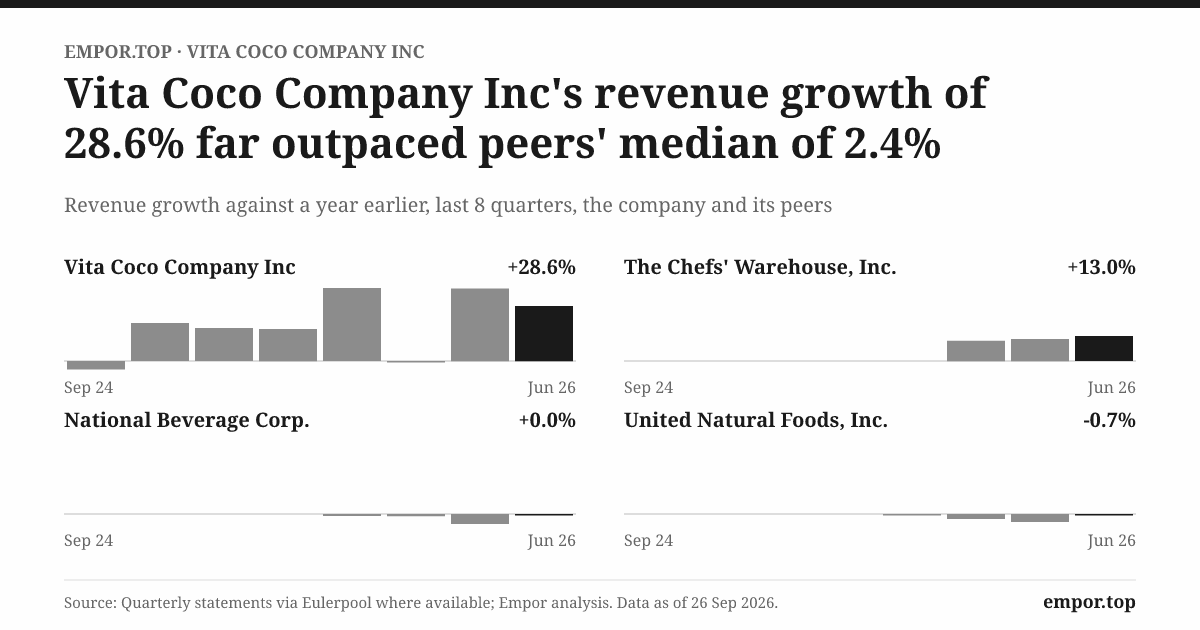
The first half of 2026 was the strongest in the company's history. First-quarter net sales rose 37% to $180 million, gross margin reached 40%, and management raised its full-year outlook from $680–700 million to $720–735 million of net sales.37 Three months later it raised the outlook again, to $790–805 million, this time including Copra.3
Two raises in one year signal real momentum, and they came from volume, not just price. But the pace of revisions also illustrates how much the 2026 picture depends on variables outside the company: tariff refunds, lower ocean freight, and a category growing far faster than beverages overall. The original February 2026 guidance, which called for gross margin of about 38% and assumed more promotional spending, is a useful reminder of what management considered normal before those tailwinds arrived.2
What to watch next
The third-quarter 2026 results are still ahead. They will be the first full quarter to include Copra, and the first to show how much of the second quarter's margin surge carries over once the tariff refunds are behind the company.
Vita Coco showed that a coconut water brand could become a large public company, as long as it controlled its supply chain and kept its pricing power. Its next chapter will test whether it can do the same with a second brand, a new coconut variety, and a cold-chain business, at a larger scale and with more money at stake.
References
-
Form S-1 Registration Statement — The Vita Coco Company, Inc., 2021-09-27 ↩↩↩↩↩↩↩↩↩↩↩↩↩↩↩↩↩↩↩↩↩↩↩↩↩
-
The Vita Coco Company Reports Fourth Quarter and Full Year 2025 Results (Exhibit 99.1) — The Vita Coco Company via SEC EDGAR, 2026-02-18 ↩↩↩↩↩↩↩↩↩↩↩↩↩↩↩↩↩↩↩↩↩↩
-
The Vita Coco Company Reports Second Quarter 2026 Results (Exhibit 99.1) — The Vita Coco Company via SEC EDGAR, 2026-07-23 ↩↩↩↩↩↩↩↩↩↩↩↩↩
-
The Vita Coco Company (COCO) Stock Price & Overview — StockAnalysis, 2026-09-25 ↩↩
-
The Vita Coco Company Reports Fourth Quarter and Full Year 2022 Results (Exhibit 99.1) — The Vita Coco Company via SEC EDGAR, 2023-03-08 ↩↩↩↩↩
-
Form 10-K Annual Report for Fiscal Year 2023 — The Vita Coco Company, Inc., 2024-02-28 ↩↩↩↩↩
-
Form 10-K Annual Report for Fiscal Year 2025 — The Vita Coco Company, Inc., 2026-02-18 ↩↩↩↩↩↩↩↩↩↩
-
The Vita Coco Company Reports Fourth Quarter and Full Year 2024 Results (Exhibit 99.1) — The Vita Coco Company via SEC EDGAR, 2025-02-26 ↩↩↩↩↩↩↩↩
-
Two decades after its founding, Vita Coco is still fighting to silence skeptics — Food Dive, 2024-01-22 ↩↩↩
-
Vita Coco adds Rihanna to celebrity endorsement umbrella — Marketing Week, 2011-05-11 ↩
-
Coca-Cola invests in ZICO coconut water company — NBC News (Associated Press), 2009-09-01 ↩
-
PepsiCo Increases Investment in O.N.E., One Natural Experience — PepsiCo, 2010-12-08 ↩
-
Dr Pepper Snapple Group to Distribute Vita Coco — PR Newswire, 2010-06-08 ↩↩
-
Coca-Cola fully acquires Zico — Beverage Industry, 2013-11-22 ↩
-
Coca-Cola sells Zico coconut water to PE firm founded by brand's creator — Food Dive, 2021-01-14 ↩↩↩
-
The Vita Coco Company (COCO) Q4 2024 Earnings Call Transcript — Seeking Alpha, 2025-02-26 ↩↩↩↩↩↩↩
-
The Vita Coco Company Reports Fourth Quarter and Full Year 2023 Results (Exhibit 99.1) — The Vita Coco Company via SEC EDGAR, 2024-02-28 ↩↩↩
-
Vita Coco sells 25 percent stake to Reignwood Group for $665 million — Beverage Industry, 2014-07-14 ↩
-
Definitive Proxy Statement (DEF 14A) for the 2026 Annual Meeting — The Vita Coco Company, Inc., 2026-04-22 ↩↩↩↩↩
-
Why Vita Coco's parent company hired the former Boston Beer CEO as president — Food Dive, 2019-09-20 ↩
-
Form 8-K: Leadership Changes — The Vita Coco Company, Inc., 2022-05-02 ↩↩↩
-
The Vita Coco Company (COCO) Q2 2026 Earnings Call Transcript — Seeking Alpha, 2026-07-23 ↩↩↩↩↩
-
The Vita Coco Company Acquires Copra (Exhibit 99.1) — The Vita Coco Company via SEC EDGAR, 2026-07-22 ↩↩↩↩
-
Vita Coco prices IPO below expected range at $15 per share — Food Dive, 2021-10-21 ↩
-
Final IPO Prospectus (Form 424B4) — The Vita Coco Company, Inc., 2021-10-21 ↩↩
-
The Vita Coco Company (COCO) CEO Martin Roper on Q2 2022 Results Earnings Call Transcript — Seeking Alpha, 2022-08-10 ↩↩↩↩↩
-
Form 10-Q for the Quarter Ended June 30, 2026 — The Vita Coco Company, Inc., 2026-07 ↩↩↩
-
Vita Coco Update on Coconut Water Tariff Exemption (Press Release) — The Vita Coco Company via SEC EDGAR, 2025-11-17 ↩
-
Vita Coco's parent company acquires natural energy drink Runa — Food Dive, 2018-06-22 ↩
-
Vita Coco at Piper Sandler Conference: Growth, Costs and Copra — Investing.com, 2026-09-16 ↩↩↩
-
Diageo and The Vita Coco Company Collaborate for Premium Canned Cocktail Line — Diageo, 2022-07-05 ↩
-
Vita Coco Expands Non-Dairy Coconut Milk Offering Launching Barista MLK Exclusively with Alfred Coffee — GlobeNewswire, 2023-01-30 ↩
-
Vita Coco parent enters new functional beverage segment with Pwr Lift protein water — Food Dive ↩
-
The Vita Coco Company Reports First Quarter 2026 Results (Exhibit 99.1) — The Vita Coco Company via SEC EDGAR, 2026-04-29 ↩
 LinkedIn
 WhatsApp
 Reddit
 Hacker News
 Email
Email Kindle
 RSS Feed
 Spotify
 Apple Podcasts
 Amazon Music
 Audible
 YouTube