PC Connection, Inc.: The Business Behind the Boxes
I. The Ad That Started Ringing
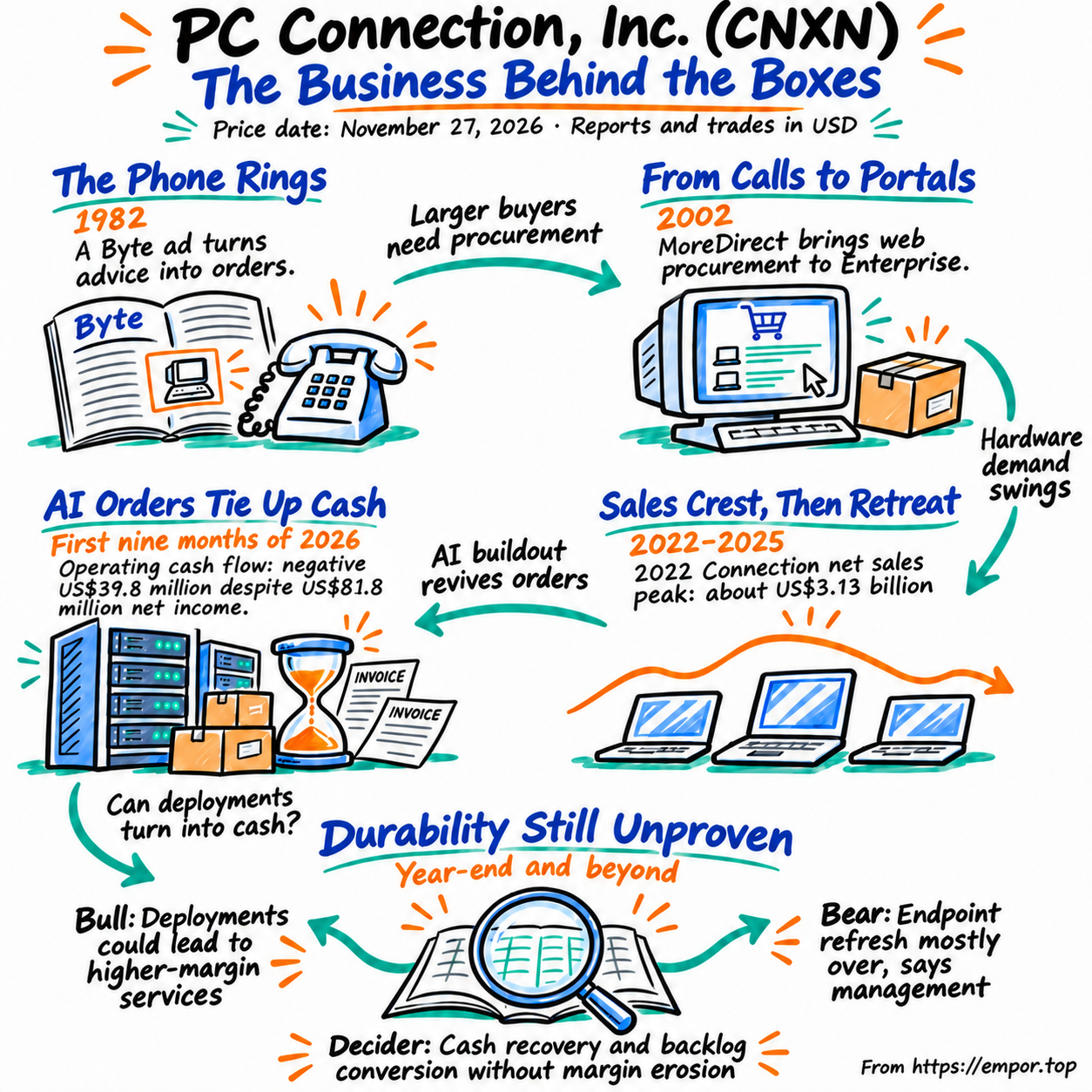
In 1982 the personal computer was still a hobbyist's machine with a business future nobody could quite price. The people who bought one read Byte magazine, a thick monthly full of circuit diagrams, programming listings and small advertisements from anyone who could ship a disk drive. Into that crowded back section, Patricia Gallup and David Hall placed an ad that took up one-ninth of a page.1 Behind it sat about $8,000 of inventory and a phone number.1 Then, as the company tells its own origin story, nothing happened for two days. And then the phone started to ring.1
Hold that picture, because it is the whole business in miniature. Two people in rural New Hampshire did not make computers, did not write software and did not own a brand anyone had heard of. What they offered was simpler and, for a confused early buyer, more valuable: someone who would pick up the phone, explain which printer worked with which machine, and put the right box on a truck. Everything that followed over the next four decades, the catalogs, the government contracts, the enterprise procurement portals, the configuration labs, is an elaboration of that service. The products changed. The role stayed the role.
Now jump forward forty-four years. On October 28, 2026, the company that grew out of that ad reported third-quarter sales of about $874 million, up 23% from a year earlier, with its largest segment, Enterprise Solutions, growing faster still at about 27%.[^2] For the first nine months of the year, sales were up 12.9% and net income up almost 30%.[^2] The driver, management said, was customers building out what it calls AI-ready infrastructure: servers, networking, security and a refresh of the laptops and desktops that sit on every employee's desk.2 A business that spent most of the previous decade growing at a crawl suddenly looked like it had found a second gear.
The scale needs a sentence of its own. PC Connection, which trades on the NASDAQ Global Select Market under the ticker CNXN and now does business simply as Connection, sold about $2.9 billion of technology products and services in 2025 through three customer-facing segments: Enterprise Solutions for large companies, Business Solutions for small and mid-sized ones, and Public Sector Solutions for federal, state, local and education buyers.3 That makes it a real company, with roughly 2,500 employees, but a small one next to the giants it competes with.4 It is a middleman in an industry that has been predicting the death of middlemen for as long as the internet has existed.
So this story is built around three questions, and none of them has a comfortable answer yet. The first is whether 2026 is a new base rate or a deployment cycle. A 13% growth year is spectacular for a company that took a decade to add about 12% to its sales, but spectacular years in hardware resale have a habit of borrowing from the years after them. The second is whether the service work Connection layers around its boxes, the advice, configuration and managed services, can protect margins in a business where the boxes themselves earn very little. The third is about money in motion. Connection ended 2025 with no borrowings and more than $400 million of cash and short-term Treasury bills.3 It also spent heavily on buying back its own stock. Then the 2026 growth spurt arrived and began pulling cash into customer receivables and warehouse inventory at a startling rate: in the first nine months of the year, operating cash flow was negative even as the company reported more than $80 million of profit.5
That last point is the tension that runs underneath every section that follows. A reseller makes money twice: once when it marks up a product, and again when it collects the cash from the customer before it has to pay its own supplier. When growth is steady, the two line up neatly. When growth surges, the reseller has to buy the servers, stage them, ship them and wait to be paid, and the profit on the income statement can sit for months as an IOU on the balance sheet. Connection's 2026 is the cleanest test in years of whether its place in the technology supply chain earns not just accounting profit but cash.
The founders bet in 1982 that customers would pay for someone to help them navigate a confusing market. The market has been confusing ever since. What remains to be proven is whether that help is still worth a durable slice of the transaction, or whether it is a service customers can buy just as easily from someone bigger. To answer that, it helps to see how the phone number in Byte became a public company, and how little its basic job changed along the way.
 Subscribe on LinkedIn
II. From Mail Order to a Public Company
The early 1980s mail-order computer business was a scramble. Dozens of dealers advertised in the same magazines, quoted the same machines and fought over the same small pool of buyers, most of whom had no idea what they needed. Gallup and Hall chose to compete on something other than the lowest price in the ad. They sold access to products, but they wrapped that access in technical advice and customer service, the promise that a knowledgeable person on the other end of the line would help get the purchase right.1 It sounds obvious now. In a market where many dealers were little more than a post-office box and a warehouse, it was a positioning decision.
The founders made a habit of that kind of decision. Gallup in particular would become the long-serving public face of the company and, eventually, its controlling shareholder, a position that still shapes its governance today.4 The partnership built the company's culture around a rural New Hampshire base, far from the Silicon Valley and Boston corridors where the hardware was designed. That location, and the founders' insistence on owning the customer relationship rather than the technology, gave the company a particular personality: practical, service-oriented and deliberately unglamorous.
For the first fifteen years the company grew as a private business, and its expansions all followed the same pattern: find a new kind of customer who needs help buying technology, and build a sales team that speaks that customer's language. The federal government was one such customer. Connection's federal effort, which began life as ComTeq Federal, eventually became GovConnection, the forerunner of today's Public Sector Solutions segment.1 Large enterprises were another. Their procurement departments wanted electronic catalogs, negotiated pricing and integration with their own purchasing systems, which is a very different conversation from selling a modem to a hobbyist over the phone.
In 1998, sixteen years after the first ad, the founders took the company public. The registration statement for the IPO was filed with the Securities and Exchange Commission in February that year, and the shares began trading on NASDAQ.6 The public listing did two things. It gave the founders a currency and a measure of liquidity after a decade and a half of building, and it put the company's reseller economics on public display, every thin quarterly margin visible to anyone with a filing cabinet. The following year, in 1999, annual sales topped $1 billion for the first time.1 For a business started on $8,000 of inventory, that was a remarkable arc. It was also a reminder of what kind of business it was: a billion dollars of sales generated by moving other companies' products, with profit measured in pennies on each dollar.
The most consequential expansion of the early public years came in 2002, when Connection bought MoreDirect, a business that sold to large enterprises through a web-based procurement platform.7 MoreDirect matters to this story because it is the seed of today's Enterprise Solutions segment, the one now driving the AI-era growth spurt. Enterprise customers did not want to call a sales rep for every purchase; they wanted a portal that knew their approved products and contract prices, aggregated inventory across distributors and fed purchase orders into their own systems. MoreDirect gave Connection that capability, and the price paid for it is a story worth returning to shortly.
Over the following decade, the company kept adding brands aimed at different customer groups, and for years it operated as something of a federation: PC Connection Sales for small and mid-sized businesses, MoreDirect for enterprises, GovConnection for the public sector. Each had its own sales culture. Each did the same basic thing.
Here is where the founding myth meets the record. The story most people tell about long-lived resellers is that decades of customer service compound into an advantage that gets wider over time. Connection's own numbers do not support that version, at least not yet. In 2015 the company reported net sales of about $2.57 billion.8 Ten years later, in 2025, it reported about $2.87 billion.3 That is growth of roughly 12% over a decade, barely more than 1% a year and below inflation. Along the way, sales actually peaked in 2022 at about $3.13 billion and then slid.3 Net income did better, rising from about $47 million to about $84 million over the same decade, which says the company got more efficient and benefited from interest on its cash.83 But a service story that leaves sales below where they stood three years earlier is not, by itself, evidence of a widening moat. It is evidence of survival, competence and cost control, which are valuable, but they are different things.
That does not make the history irrelevant. It tells an investor what kind of company this has been: a disciplined, founder-controlled intermediary that has rarely made a bet large enough to change its economics. The closest it came in the last decade was a pair of acquisitions in 2016 that added software expertise and the ability to source products around the world. To judge whether those deals changed anything, it is first necessary to understand exactly what Connection sells today, and how thin the margin is on each box that leaves its warehouse.
III. Three Businesses, One Thin-Margin Middleman
Picture a large hospital system that has decided to modernize. It needs several thousand new laptops imaged with its own software and security settings, a rack of servers for a new data workload, network switches for three buildings, a stack of software licenses, and someone to make sure all of it arrives at the right loading dock, in the right order, at the right time, with the old equipment carted away. The hospital could call Dell, HP, Cisco and Microsoft separately. It could buy through a distributor. Or it could hand the whole problem to a company like Connection, which will source the products, advise on what fits together, configure the machines in its own facility, ship them, and if asked, design, implement and manage the result.3
That is the business. The question at the heart of this section is whether the coordination work is valuable enough to keep Connection in the chain, or whether it is a convenience customers can easily get elsewhere.
What the middleman actually earns
Start with how the money is counted, because the accounting is unusually important here. When Connection sells a laptop or a server, it generally records the full price as revenue and the full cost as cost of sales, because it acts as the principal: it controls the product before handing it to the customer.3 Software that runs on the customer's own machines is treated the same way. But cloud software subscriptions and many maintenance contracts work differently. There, Connection is acting more like an agent arranging a sale between the customer and the vendor, so it records only its commission, the net amount, as revenue.3 A $100 cloud subscription on which Connection keeps $8 shows up as $8 of revenue and $8 of gross profit, a 100% gross margin on that line.
That choice, principal or agent, is a judgment call with real consequences, which is why Connection's auditor, Deloitte, singled it out as the critical audit matter in its 2025 report.3 It is not an accusation of anything; it is the auditor saying this is where the numbers are most sensitive to management's judgment. And it explains a puzzle that will recur through the rest of this story: Connection's reported gross margin can move a lot without anything fundamental changing, simply because the mix shifts between gross-recorded hardware and net-recorded software. In the third quarter of 2026, total gross margin fell to 18.5% from 19.6% a year earlier, partly because netted software contributed a smaller share and the customer mix shifted toward lower-margin large deals.5 The company sold much more hardware. The percentage fell because the denominator ballooned.
With that lens, the three segments look like three different businesses sharing one name.
Enterprise Solutions is the biggest by sales and the thinnest by margin. In 2025 it accounted for about 45% of Connection's revenue but only about a third of segment gross profit, earning a gross margin of about 14.5%.3 For every $100 a large corporation spent, Connection kept about $14.50 to pay its salespeople, engineers and warehouses and leave some profit. That is the nature of selling to big buyers with procurement departments, competitive bids and the bargaining power that comes with buying in bulk. It is also the segment growing fastest right now, which is both good news and a margin headwind.
Business Solutions, which serves small and mid-sized companies, is the opposite. It produced about 38% of sales in 2025 but roughly half of segment gross profit, at a gross margin of about 25%.3 In dollars, that was about $272 million of gross profit, against about $186 million from Enterprise on substantially larger sales.3 Smaller customers have fewer IT staff, less leverage and more need for advice, so they pay more per dollar of product. They also buy more of the cloud software that gets recorded net, which flatters the percentage. This is the profit engine of the company, even though it rarely makes the headlines.
Public Sector Solutions, selling to federal agencies, state and local governments and schools, contributed about 18% of sales at a 16% gross margin, producing about $81 million of gross profit.3 It is the most lumpy of the three, because government buying follows budgets, contract awards and project timetables rather than steady demand.
Put together, the picture is of a company where most of the revenue comes from the cheapest work and most of the profit from the smaller customers. That matters for the investment debate, because the current boom is concentrated in exactly the segment with the lowest margins.
The war game
Who else wants this customer? Connection names its leading rivals as CDW, SHI and Insight.3 The scale gap is stark. CDW reported net sales of about $22.4 billion in 2025, almost eight times Connection's.9 Insight reported about $8.2 billion, close to three times.10 SHI is privately held and does not publish comparable financial statements, so no honest market-share comparison with it is possible. Then there are the vendors themselves: Dell, HP, Lenovo, Microsoft and the cloud providers all sell directly to big customers when it suits them. And there are the distributors that sit upstream of Connection, the wholesalers who also supply its rivals.
Run the competitive forces once, carefully. On the customer side, Connection's base is broad: no single customer accounted for 10% or more of sales in any year from 2023 through 2025, and the company says losing any one customer would not materially hurt a segment.3 That diversification is a genuine strength; no one buyer can hold the company hostage. But broad does not mean loyal. Large customers routinely multi-source, splitting purchases across two or three resellers to keep prices honest, and the company's backlog consists mostly of open purchase orders that customers can cancel.3 There are no long-term minimum commitments in the filings to lock anyone in.
On the supplier side, the concentration runs the other way. In 2025, about 25% of Connection's product purchases came from TD SYNNEX, about 21% from Ingram Micro and about 13% from Microsoft, meaning three suppliers accounted for roughly 59% of everything it bought.3 The two distributors are giant wholesalers that also supply Connection's competitors, so they do not offer Connection a special advantage. They give it convenience and breadth. The company says alternatives exist for its major vendors, and that is plausible: the products are widely available.3 But the arithmetic is clear. The power in this chain sits with the technology makers who set prices and partner incentives, and with the big customers who can shop the deal. Connection sits in the middle, earning a fee for coordination.
What the customer is really buying
So why does anyone use an intermediary at all? The honest answer is the hospital scene. Coordinating many products from many vendors, configured and delivered on a timetable, through one purchasing relationship and one invoice, is genuinely hard. A reseller that does it well saves the customer staff time, reduces the risk of mistakes and offers a single throat to choke when something goes wrong. Connection's configuration and integration facilities, its engineers and its account managers are the assets that deliver that value, and they are hard to replicate quickly for a small company.
Now test the claim the way a skeptical investor would. If the service wrapper creates real switching costs, it should show up somewhere measurable: in customer retention rates, in renewal rates on managed services, in the share of revenue that recurs, or in the ability to raise prices without losing customers. Connection does not publish any of those numbers.3 It does not disclose a recurring-revenue share, standard contract lengths or customer retention.3 The case for durable advantage therefore rests on inference: four decades of survival, a stable customer base with no dominant account, and margins that have held up better than a pure box-mover's would. That is a reasonable starting claim. It is not proof.
The same caution applies to the AI story. Connection does not build AI chips, does not write models and has no traditional research and development group; its capital spending runs at about a quarter of one percent of sales, mostly for computers and internal software.3 What it sells is AI-ready servers, networking, storage and endpoints made by others, plus the labor to deploy them. That is real demand, and the ability to deliver a complex deployment on time is a real capability. But it is not a proprietary product. Every rival named above is selling the same servers to the same kinds of customers. The AI boom is a tide, and Connection is a boat that floats on it. Whether it floats higher than the others depends on execution and relationships, not on owning the technology.
That brings the story back to the most important strategic move Connection made in the past decade, the one meant to widen what it could deliver: the 2016 acquisitions that added deeper software skills and a global sourcing network.
IV. The 2016 Bet on Software and Global Reach
By 2016, the shape of the technology budget was changing under Connection's feet. Companies were moving workloads to the cloud and buying software as subscriptions instead of boxed licenses. Big customers wanted to equip offices in many countries through one supplier. A reseller that could only ship hardware inside the United States risked becoming the vendor of choice for a shrinking slice of the wallet. So Connection went shopping, and it bought two businesses that year.
The first was Softmart, a software licensing and services specialist. Connection paid about $31.9 million for it, net of cash acquired, with the stated aim of expanding its software-services capabilities: helping customers manage their licenses, navigate vendor agreements and buy enterprise software more efficiently.11 The second was GlobalServe, which ran a global procurement portal and a network of in-country suppliers that let a customer buy and deliver IT equipment in many countries without dealing with dozens of local vendors. That one cost about $11.1 million.11 Today, GlobalServe uses in-country suppliers in more than 150 countries, which gives Connection a way to serve multinationals even though substantially all of its own sales are still to U.S. customers.3
Around the same time, the company did something symbolic that mattered more than it might appear. It brought its portfolio of brands, PC Connection, MoreDirect, GovConnection and the newly acquired businesses, under a single name: Connection.1 For years the federation of brands had let each sales team keep its own identity. The rebrand was a bet that customers would value a single, larger partner more than a collection of specialized ones, and that the company could cross-sell software and global services to customers who had previously known only one of its faces.
What the price tells, and what it cannot
Were these good deals? This is a case where the honest answer is that the disclosed numbers are too thin to say. In its 2016 filing, Connection stated that neither acquired business had revenue or operating income material enough to warrant separate pro forma results.11 That sentence is doing a lot of work. It means the company did not have to tell investors how much revenue or profit Softmart and GlobalServe brought with them, and so outsiders cannot calculate what multiple of sales or earnings Connection paid. Without that, any claim that the 2016 prices were bargains or overpayments would be invented.
The older MoreDirect deal offers a more transparent, though incomplete, benchmark. When Connection closed the MoreDirect purchase on April 5, 2002, the upfront consideration, including acquisition expenses, came to about $22.7 million.7 MoreDirect had reported 2001 sales of about $219 million and pretax earnings of about $9.2 million.7 On those figures, the initial price was startlingly low, roughly two and a half times the target's annual pretax profit. But the headline hides the structure. The merger agreement contemplated a three-year earn-out tied to MoreDirect's earnings, and Connection went on to accrue earn-out liabilities of about $10.8 million, $11.6 million and $6.9 million for 2002, 2003 and 2004.12 Added together, that is roughly $29 million more, which takes the effective price to somewhere around $52 million, still modest against what the business was earning, but more than double the number on the closing date. Even so, judged by what MoreDirect became, the foundation of the company's largest segment, it looks like the most consequential capital Connection has deployed. The lesson from MoreDirect is not that Connection is a brilliant acquirer. It is that small, capability-driven deals sized to the balance sheet have been the company's habit, and that the payoff, when it came, took years to show.
Did the 2016 deals earn their cost? The cleanest piece of evidence is the absence of bad news. At the end of 2025, Connection carried about $73.6 million of goodwill on its balance sheet, the accounting residue of paying more than the book value of acquired assets, and it recorded no goodwill impairment in 2023, 2024 or 2025.3 That tells an investor the company has not had to admit a write-down recently. It does not tell anyone that the acquisitions earned an attractive return, because goodwill tests only ask whether a business unit is worth more than its carrying value, not whether the original price was wise.
What the broader record does show is modest. After the 2016 deals and the rebrand, Connection's financial history still reads like a reseller scaling gradually, not like a company transformed. Software and global procurement became capabilities in the toolkit, and they plausibly help explain why Business Solutions can earn a 25% gross margin and why Enterprise customers can hand Connection more of a deployment. But they did not change the slope of the sales line in the way a transformative acquisition would.
That is the backdrop for the most important recent stretch in Connection's history: a peak, a slide and a recovery that has not yet reclaimed the high-water mark.
V. The Sales Peak That the Recovery Hasn't Reclaimed
The pandemic years were a gift to anyone who sold laptops. Offices emptied, kitchens became workstations, schools handed devices to every student, and corporate IT departments that had stretched hardware refresh cycles suddenly bought in bulk. Connection rode that wave to its high-water mark: about $3.13 billion of net sales in 2022.3 Then the wave receded. Sales fell to about $2.85 billion in 2023 and slipped again to about $2.80 billion in 2024.3 Two consecutive years of decline, after a peak that had been flattered by a once-in-a-generation buying spree, is the part of the story that the 2026 headlines tend to skip.
Hold the two pictures side by side. In the first nine months of 2026, sales rose 12.9% and net income almost 30%.[^2] Over the full decade from 2015 to 2025, sales rose only about 12% in total, and 2025's roughly $2.87 billion was still below the 2022 peak.83 The recent acceleration is real. But it is arriving at a company whose revenue line has been more of a sawtooth than a staircase, and that history is the first and best piece of evidence against treating any single strong year as the new normal.
Inside the 2025 mix
The full-year 2025 numbers show a business moving in two directions at once. Total sales grew about 2.5%, a modest rebound.3 Underneath, Enterprise Solutions grew about 8.6% as large customers began new projects, and Business Solutions grew about 3.1%.3 Public Sector Solutions went the other way, falling about 11.1%, with declines in both state, local and education sales and in federal sales.3 A segment that had been nearly a fifth of the company shrank by more than a tenth in a single year.
What did management say about it? On the fourth-quarter call in February 2026, the explanation was specific rather than sweeping: a large contract that would not repeat, and project rollouts that customers had delayed.13 That is worth noting for its candor. Management did not blame "the macro environment" or an industry-wide slump; it named the mechanism. The subsequent evidence partly supports the explanation. A non-repeating contract is, by definition, a one-time hole, and delayed rollouts tend to arrive eventually. But it also exposes the structural weakness of public-sector resale. Government business comes in big, competitively bid chunks, and when a contract ends or is not renewed, there is nothing contractual to replace it. The 11% decline was not a sign that the company had lost its edge with government buyers so much as a reminder that, in this segment, its edge has to be re-won one award at a time.
The company's response was to cut costs. During 2025 it reduced its workforce and recorded about $6 million of severance charges.3 Management told analysts it expected $7 million to $8 million of annual savings from actions taken in late 2025 and January 2026.13 In context, that is not a dramatic restructuring. Connection's selling, general and administrative expenses run to several hundred million dollars a year, so the savings amount to a trim, not a transformation. And savings in a service business have a hidden risk: if the people let go were the ones answering customer calls or configuring deployments, the cut can show up later as slower response times or lost accounts. The claim that the savings were clean will be settled only when lower costs persist without a dent in service or growth.
Where the profit went
Here is the puzzle of 2025. Sales rose, gross margin improved, and yet net income fell. The company earned about $83.7 million, down about 3.9% from the year before.3 How does a business sell more at a better margin and earn less?
The answer has two parts, and neither is about operations. The first is interest income. Connection keeps hundreds of millions of dollars in money-market funds and short-term Treasury bills, and when rates were high in 2024, that pile earned about $18.7 million. In 2025, with lower balances after the buybacks and lower rates, interest income fell to about $14.4 million.3 That $4 million drop accounts for essentially all of the decline in pretax income, which slipped from about $117.5 million to about $113.7 million.3 The second part is the severance: about $6 million of one-time costs that reduced reported operating income.3
That decomposition matters because it changes what the 2025 decline means. Strip out the interest swing and the severance, and the underlying operating business was modestly better in 2025 than in 2024. Gross margin had improved to about 18.8% from 18.0% two years earlier, helped by Business Solutions' rise to a 25.2% margin.3 But the decomposition cuts both ways. It also shows how much of Connection's bottom line depends on something that has nothing to do with selling technology. A company earning around 13% of its pretax income from Treasury interest is partly a cash-management vehicle, and as cash is pulled into receivables or spent on buybacks, that support erodes. The quality of earnings, in other words, depends on the business generating profit from operations, not from the cash it happens to be sitting on.
That is why the 2026 rebound has to be judged on gross profit and operating income, not on sales alone. A sales surge driven by low-margin enterprise hardware can produce impressive revenue growth while gross profit grows more slowly, and that is exactly what happened next. Enterprise margin had already slipped about 70 basis points in 2025, even before the AI build-out began.3 The growth that was about to arrive would come through the company's thinnest pipe.
The record, then, delivers a verdict on the narrow question of the base rate: the ten-year history and the 2022 peak reject the idea that Connection has already stepped onto a permanently higher growth path. Enterprise and Business Solutions have grown; Public Sector remains exposed to project timing and non-renewals. What the record cannot yet say is whether the 2026 surge marks the start of a new cycle or a bulge within the old one. The answer depends on what the surge is made of, and what it costs to deliver.
VI. The AI Buildout Arrives With a Working-Capital Bill
The third quarter of 2026 was the best quarter in Connection's history by several measures. Sales rose about 23% to roughly $874 million.[^2] Enterprise Solutions sales jumped about 27% to roughly $407 million, a record, and the company reported record backlog in that segment as well.[^2]2 On the earnings call on October 28, CEO Timothy McGrath had the kind of numbers chief executives wait years to discuss.
Then an analyst asked about next year, and the answer was more careful than the quarter. McGrath said that most of the endpoint upgrade cycle, the replacement of laptops and desktops that had driven much of the recent demand, was now behind the company, and that endpoint demand might be slightly lower in 2027.2 He expected on-premises servers, networking, security and software to remain solid.2 In a single exchange, the CEO had bounded the boom. The part of the business that had been carrying growth was expected to ease, and the burden would shift to other categories.
That statement belongs right next to any claim that the AI cycle has structurally changed Connection's growth rate, because it comes from management itself. When the person with the best view of the order book says the biggest current driver is mostly done, a careful investor should treat the 2026 surge as a cycle with a visible top, not a new floor.
What AI demand actually looks like at a reseller
It helps to translate the phrase "AI-ready infrastructure" into what Connection physically does. When a company decides to run AI workloads in its own data centers instead of renting them from a cloud provider, it needs powerful servers, often packed with specialized chips, plus faster networking to move data between them, more storage, and tighter security. On the desktop, aging corporate laptop fleets and a new generation of machines marketed for AI work gave buyers a reason to replace thousands of devices at once. Connection sells all of those things, and it configures, images and ships them.
None of it is proprietary. The servers, chips and software all come from manufacturers that also sell through every one of Connection's rivals. Connection's contribution is the coordination: knowing which configurations work, staging large rollouts and delivering them on schedule. That is a capability, and a growing order book suggests customers value it. But a capability that every major rival also sells is not a moat, and the AI boom should be read as demand flowing through Connection's channel rather than as evidence that Connection has captured something others cannot.
The margin numbers show what that demand is worth per dollar. Third-quarter gross profit rose about 16.8%, solid growth, but slower than sales.[^2] Gross margin fell 110 basis points to 18.5%.5 The steepest drop came not in Enterprise but in Business Solutions, whose margin fell about 270 basis points, partly because netted software revenue contributed less and customers bought a different mix of products.5 Recall the accounting quirk from the middle of this story: software recorded net carries a 100% gross margin, so when hardware surges and software holds steady, the percentage falls even if nothing about pricing has changed. Some of the decline is optical. Some of it is real, because large hardware deployments genuinely earn less per dollar than advisory and software work. The company does not break down how much is which.
Following the cash
Now the harder part. Every server Connection ships to a large customer has to be bought first. It sits in inventory while it is configured, then ships, and then the customer has typically 30 days to pay, though big customers often take longer.3 Meanwhile Connection owes its own suppliers. When growth is gentle, the timing nets out. When growth surges, the gap widens, and cash goes out the door before it comes back in.
The warning sign appeared in 2025. Operating cash flow that year was about $65.5 million against net income of about $83.7 million, and it had fallen from about $173.9 million the year before.3 Receivables absorbed about $38 million and inventory about $49 million, partly offset by more money owed to suppliers.3 Management attributed the inventory build to purchases for customer rollouts and the receivables build to delivery timing.3
In 2026, the gap became a chasm. In the first nine months, Connection reported about $81.8 million of net income but negative operating cash flow of about $39.8 million.5 Receivables absorbed about $145 million and inventory about $83 million, offset by about $75 million of additional payables.5 Net receivables climbed from about $648 million at the end of 2025 to about $790 million by September.5 Put simply, every dollar of profit Connection earned in 2026, and then some, was sitting in customers' unpaid invoices and in servers waiting to ship.
What is the right reading? Management's explanation, again, is timing: large deliveries and rollouts that consume working capital before they generate cash.5 There is real evidence for that view. Days sales outstanding, the average number of days it takes customers to pay, was 74 days at September 30, 2026, exactly where it was a year earlier.5 If customers were paying more slowly, that number would be rising; it is not. The receivables grew because sales grew, not because collections deteriorated.
But the counterevidence sits in the same filing. The cash conversion cycle, which combines how long it takes to collect from customers and turn inventory, minus how long Connection takes to pay suppliers, lengthened to 50 days from 46 a year earlier.5 At the end of 2024, it had been 40 days.3 Flat DSO with a lengthening cycle means the stretch is coming from inventory and supplier terms rather than from slow-paying customers. That is less alarming than a collections problem, but it is still a real cost: each extra day of the cycle ties up roughly another $9 million to $10 million of cash at the current sales pace. A 10-day stretch since 2024 is, in round numbers, close to $100 million of capital that the business now needs just to keep running.
It is important to keep credit risk in proportion. At the end of the third quarter, Connection held about $343 million in cash and short-term investments, with no borrowings outstanding.5 Its old $50 million receivables-backed credit facility expired in March 2025 and was not replaced, and there had been no borrowings under it.3 The company also uses a supplier-finance program, through which some vendors are paid by a bank on Connection's behalf; those balances, about $58.6 million at the end of 2025, sit in accounts payable and carry no interest cost to the company.3 No customer default, bankruptcy or unusual credit term has been disclosed as driving the receivables build, and the allowance for credit losses was only about $3.1 million at the end of 2025.3 This is a question about the timing and scale of cash, not an imminent liquidity crisis. Connection can comfortably finance the build-out from its own balance sheet.
The issue is what that financing displaces. Cash tied up in receivables does not earn Treasury interest, and it cannot be used for buybacks or dividends. The AI boom is, for a reseller, a working-capital-intensive boom. The settling evidence will come with the year-end numbers: whether operating cash flow recovers as deliveries complete, whether receivables and inventory unwind, whether the cash conversion cycle returns toward its 2024 level, and what margin the AI-related deployments finally earn once they are delivered and paid for.
All of which leads to an uncomfortable question about decisions already made. In 2025, the year cash flow first started to lag profit, Connection returned more money to shareholders than its operations generated.
VII. A Founder's Control Meets a $91 Million Return of Capital
In 2025, Connection handed shareholders about $91.4 million: about $76.1 million through share repurchases and the rest through dividends.3 In February 2026, with the receivables build already under way, the board added $50 million to the repurchase authorization.3 Three months later, at the annual meeting on May 13, 2026, shareholders cast their votes on the board. Every director was re-elected, as they always are at a company with a controlling owner. But about 3.5 million shares were withheld from Patricia Gallup, the co-founder and controlling shareholder, compared with roughly 307,000 to 509,000 withheld from each of the other directors.14 Shareholders who could not change the outcome chose to register their dissent anyway, and they aimed it at the founder.
Those two moments, the cash returned and the votes withheld, frame the governance question. Connection is run by experienced managers with a clean balance sheet and a controlling owner whose interests are, in large part, aligned with long-term value. It is also a company whose minority shareholders have no realistic way to change its direction, and whose capital allocation in 2025 deserves scrutiny in light of what 2026 demanded.
The people at the controls
Timothy McGrath has been chief executive since 2011.4 Fifteen years in the job means he has run the company through the cloud transition, the pandemic boom, the post-pandemic slump and now the AI build-out. In October 2026, the company named Matt Zafirovski president and chief operating officer, taking the president title McGrath had held alongside the CEO role.15 It is too early to read much into the appointment, but adding an operating chief during the most working-capital-intensive growth spurt in years is at least consistent with a company that knows execution is the whole game. Thomas Baker is chief financial officer.4
Gallup's role is the defining fact of Connection's governance. As of March 2026, the co-founder beneficially owned about 54.6% of the shares, counting stock held directly and through trusts and the estate arrangements that followed David Hall's death.4 After Hall died, the voting trust the founders had set up in 1998 was liquidated in 2021, and shares were moved among trusts for estate administration; in 2024 Gallup transferred 2 million shares to the Abbott Brook Trust as part of estate planning, not through an open-market sale.16 Gallup's disclosed stake was about 56.3% in the 2020 proxy and about 52.4% in September 2024.1716 The recent rise back toward 55% is a quiet side effect of the buybacks: when the company retires shares and the founder does not sell, the founder's percentage goes up. Repurchases, in other words, have reinforced control.
That control makes Connection a "controlled company" under Nasdaq rules, which lets it skip some governance requirements. It has no lead independent director and no standing nominating committee, though the committees it does have are made up of independent directors.4 In practice, the board's composition and the company's strategy are whatever the controlling shareholder accepts. This is not inherently bad: a founder with a majority stake and a long horizon can resist short-term pressure that afflicts widely held companies. But it means that the withheld votes, while unable to change any outcome, are the only formal channel minority holders have, and the gap between roughly 3.5 million votes withheld from Gallup and a few hundred thousand from everyone else is a genuine signal that some investors want something different. The company has not publicly explained what it takes from that vote.
Pay, targets and results
Executive pay at Connection rose sharply over three years in which earnings did not. Net income was about $83.3 million in 2023, $87.1 million in 2024 and $83.7 million in 2025, essentially flat.4 McGrath's total reported compensation went from about $1.9 million to about $5.1 million to about $7.5 million over the same years.4 His base salary held at about $1.27 million; the 2025 total included about $1.19 million of cash incentive and about $5.04 million of stock awards measured at their grant-date value.4 Baker's 2025 total was about $3.4 million and Gallup's about $3.35 million, both dominated by stock awards.4 The CEO directly owned 284,278 shares, about 1.1% of the company.4
Most of the increase came through equity, which in principle ties executives' fortunes to shareholders'. But the comparison with the targets is revealing. The 2025 cash bonus plan for the named officers set a goal of $95.2 million of adjusted net income and selling, general and administrative costs at 10.26% of billings. The company delivered $88.1 million of adjusted net income, and costs came in at 10.54% of billings.4 Both targets were missed, and the cash incentive plan paid the three named officers about $1.8 million in aggregate.4 That is the system working as designed on the cash side. On the equity side, rising grant values amid flat earnings are harder to justify by performance alone, and a skeptical holder would ask what the larger awards were meant to buy.
Was the buyback disciplined?
The 2025 repurchases are the sharpest test of capital allocation. At about $76.1 million, the buyback was larger than the year's entire operating cash flow of about $65.5 million.3 Treasury repurchases had been only about $12.4 million in 2024 and about $5.4 million in 2023, so 2025 marked a step change.3 On a narrow view, buying back shares when the business has more than $400 million of cash and Treasury bills and no debt is entirely defensible. A company sitting on cash earning a few percent can reasonably decide its own shares are a better use of capital.
The broader view is less comfortable. The buyback accelerated in the same year that working capital began to absorb cash, and the authorization was expanded just as the company entered a growth phase that, nine months later, had consumed more cash than it generated. Connection can afford both; that is not in question. The question is whether the board anticipated the scale of the 2026 working-capital need when it committed to the larger repurchase program, and whether future buybacks will be calibrated to cash flow rather than to the cash pile. A buyback that reduces the cushion just before customers ask the company to finance their rollouts is not reckless, but it is not obviously disciplined either. The year-end 2026 cash flow will show which description fits better.
The smaller governance questions
Two further matters are worth sizing honestly, because both sound worse than they are. The first is related-party real estate. Connection rents facilities, including in Merrimack, New Hampshire, from affiliates connected to Gallup and the Estate of David Hall. In 2025 that rent came to about $1.68 million, roughly 0.06% of sales, and an affiliated entity, G&H Post, reimbursed the company about $122,000 for facilities and administrative services.34 The leases have expired and the properties are occupied month to month; the company says the terms are comparable to arm's length.4 No related-party loans, guarantees, royalties or management fees appear in the filings.3 The money is trivial. The arrangement is not quite: a public company occupying its founder's buildings on rolling monthly terms is the kind of loose end an independent board would normally want tied up with a long-term, independently reviewed lease.
The second is the audit. Deloitte's opinions on the 2023 to 2025 financial statements were unmodified, and internal controls over financial reporting were reported effective in 2025, with no material weakness.3 The critical audit matter, the principal-versus-agent revenue judgment described earlier, is an area of complexity, not a qualification. The company also discloses potential state sales and use tax exposure related to past sales and ordinary-course legal claims, neither of which management expects to be material.3
The verdict on management is therefore mixed in a specific way. Operationally, the team has been candid about misses, has cut costs when sales fell and has kept the balance sheet clean. On capital allocation and pay, the record raises fair questions, and on governance the founder's control is durable, the dissent is real and the related-party loose ends are small but unresolved. None of that, though, answers the question the market is actually pricing: what the business is worth if the 2026 surge proves cyclical.
VIII. Analysis & Bear vs. Bull Case
On November 27, 2026, Connection's shares closed at about $83, valuing the company at roughly 20.5 times its trailing twelve months of earnings.18 With about 25 million shares outstanding, implied by the founder's 13.8 million shares representing 54.6% of the company, that puts the equity at a little over $2 billion, of which about a sixth is the cash and Treasury bills on the balance sheet.45 The multiple sits modestly above the company's own history: its five-year average price-to-earnings ratio is about 19.5 and its ten-year average about 18.9.18 Against peers the gap is wider. A FactSet-based industry comparison as of September 30, 2026 put Connection's enterprise value at about 14.5 times EBITDA, against about 11.2 times for CDW and about 9.9 times for Insight.19
Read plainly, the market is paying a little more than usual for Connection relative to its own past, and noticeably more than it pays for its far larger rivals. Investors are treating the 2026 surge as at least partly durable. A small company with a clean balance sheet often trades at a premium to larger, more leveraged peers, because there is less debt standing between the operations and the shareholder, and Connection's cash pile inflates the earnings-based multiple less than the enterprise-value comparison does. Even so, the premium is a claim to be explained, not a verdict in itself. What would have to be true to justify it?
The case for the boat
The bull case starts with momentum that is real and recent. Enterprise Solutions is growing at a rate not seen in years, with record backlog behind it, and customers are buying not just boxes but deployments that need Connection's configuration and logistics skills.[^2]2 Business Solutions, meanwhile, is the higher-margin engine, earning about a quarter of every sales dollar as gross profit, and it contributes roughly half of the company's gross profit from well under half its sales.3 If the enterprise relationships built during the AI build-out become footholds for higher-margin services, software and managed work later, the mix could improve as the hardware cycle cools. The balance sheet gives the company room to wait for that: hundreds of millions of dollars of liquidity, no borrowings and a founder with no reason to sell.5 And the cost actions of 2025 and early 2026 should make each dollar of gross profit go a little further.13
The case against
The bear case starts with the structure of the industry, and it is worth running the competitive forces once, with the evidence attached.
Buyer power is high. Connection's customers are numerous, which protects it from any single loss, but large customers multi-source and run competitive bids, backlog consists mostly of cancelable purchase orders, and no disclosed contract locks anyone in.3 Supplier power is also significant. Three suppliers account for about 59% of purchases, and two of them, TD SYNNEX and Ingram Micro, sell the same products to every rival.3 Manufacturers set partner incentives and can change them; the threat of substitution is a vendor deciding to sell direct to a big account, or a cloud provider absorbing workloads that used to require on-premises hardware. Rivalry is intense, with CDW nearly eight times Connection's size and Insight almost three times larger, each able to spread fixed costs over a larger base.910 The barrier to entering resale is low, though the barrier to doing complex, multi-vendor deployments well at scale is meaningfully higher. That last distinction is where Connection's case lives.
Now apply Hamilton Helmer's seven powers, the durable sources of advantage that let a company earn more than its cost of capital for a long time. Scale economies favor the rivals, not Connection: purchasing volume, vendor incentives and the cost of national sales coverage all reward size, and Connection is the smallest of the named leaders. Network economies do not apply; one customer's purchase does not make the service more valuable to another. Counter-positioning is absent, because nothing about Connection's model is something incumbents refuse to copy. A cornered resource, such as an exclusive vendor relationship or proprietary technology, does not exist in the filings. Brand matters a little in a trust-based service relationship, but nobody pays a premium for a laptop because Connection shipped it.
That leaves two possible powers. Switching costs would exist if a customer's procurement systems, configured images, managed services and institutional knowledge were so embedded with Connection that moving to CDW would be expensive and risky. That is plausible for the deepest enterprise relationships and the managed-services customers. But the company discloses no retention rate, no renewal rate, no recurring-revenue share and no price-realization data that would let anyone measure it.3 Process power, the hard-to-copy organizational skill of doing complex work reliably, is the other candidate, and four decades of survival in a brutal industry is at least circumstantial evidence for it. The trouble is that process power should eventually show up as superior margins or faster growth than peers, and over the decade from 2015 to 2025, Connection's sales grew by only about 12% in total, which is not what a business with a widening process advantage usually looks like.83
So here is the moat question, answered once. The history does not reject the claim that Connection's service wrapper creates an advantage; four decades of survival, a diversified customer base and a 25% gross margin in small-business sales are real. But the history narrows it considerably. Connection has an operating capability, not a structural moat, and the evidence suggests it is strongest among smaller customers who need advice and weakest among large enterprises who can shop the deal. The revised claim, that Connection earns a modest, defensible premium for coordination among customers that value it, is intact but unproven. It would be confirmed by disclosed retention or recurring-service metrics, or by Enterprise margins that hold steady as volumes grow. It would be falsified by gross profit that stalls once the 2026 deployments finish.
What an activist would ask
A skeptical long-short investor reading the same filings would press on four points. Why did the company accelerate buybacks just before a working-capital surge that pushed nine-month operating cash flow negative? Why does executive equity pay keep climbing while net income stays flat and bonus targets are missed? Why do related-party leases sit on month-to-month terms rather than independently reviewed long-term leases? And why, after the dissent registered against the founder's re-election, has the board offered no public response? None of those questions threatens the company's survival. All of them bear on whether a minority shareholder is being paid for the risk of owning a controlled company at a premium multiple.
Three numbers to watch
If an investor could follow only three indicators, these would carry the story. The first is segment gross profit and gross margin, because gross profit dollars, not sales, are what the service wrapper earns. In the third quarter, total gross profit rose about 17% while gross margin fell 110 basis points to 18.5%, a direction that has to stabilize for growth to be worth what the market is paying.[^2]5 The second is operating cash flow measured against net income, together with DSO and the cash conversion cycle. The latest reading is negative operating cash flow against positive earnings for the first nine months, with DSO flat at 74 days and the cash conversion cycle widening to 50 days, a direction that is currently moving the wrong way.5 The third is whether the record Enterprise backlog converts into sales without further margin dilution, which is the single clearest test of whether the AI build-out is good business or merely big business.2
The material risks, then, are mechanisms rather than headlines. Endpoint demand may soften after customers pulled purchases forward, as management itself has signaled.2 Supplier concentration can squeeze price and availability if vendors change incentive programs or allocate constrained products to larger partners. Public-sector projects can roll off without replacement, as 2025 showed. And working capital can keep growing faster than earnings, turning a profitable year into a cash-hungry one. Each of those is visible in the record already. None of them is yet decisive.
IX. Business & Investing Lessons
Go back to that one-ninth-page ad in Byte and the $8,000 of inventory behind it.1 The founders did not have the products, the brands or the capital that the computer makers had. They had a phone line and a willingness to explain. Forty-four years later, Connection's account managers and engineers are doing a vastly more complicated version of the same job: coordinating thousands of laptops, racks of AI servers and stacks of software licenses for customers who would rather not do it themselves. The products changed beyond recognition. The value proposition barely moved. The lessons that follow belong to this company, and they travel.
The first lesson is about what an intermediary is really selling. A good intermediary earns its keep every time the customer has to coordinate a complicated purchase. Connection's highest-margin business is the one where customers need the most help, small and mid-sized companies with thin IT departments, and its lowest-margin business is the one where customers need the least, large enterprises with procurement teams and bargaining power. The hospital rolling out a new data center pays for coordination. The giant corporation buying ten thousand identical laptops mostly pays for price. For founders building any marketplace or middleman, the implication is direct: your margin is set by the complexity you absorb, and the moment the complexity disappears, so does the margin. For investors, the implication is to look past revenue growth at which customers the growth is coming from.
The second lesson concerns cash. Growth that consumes the cash it reports is a question, not a victory lap. In 2025 Connection earned about $84 million and collected about $66 million in operating cash.3 In the first nine months of 2026 it earned more than $80 million and collected less than nothing from operations.5 Management's timing explanation may well prove right; flat DSO supports it. But a reseller's real product is the turnover of its working capital, and a boom that lengthens the cash conversion cycle from 40 days to 50 days is, in cash terms, a bill for roughly $100 million that the income statement never shows.35 The founders who started with $8,000 of inventory understood that better than anyone: in distribution, the business is the cash cycle.
The third lesson is about capital returns. A buyback is only disciplined if the business can still fund the next customer rollout. Connection's 2025 repurchases exceeded its operating cash flow, and the board enlarged the program just as the AI deployments began to demand capital.3 The company could afford both, and that is the point: affordability is not discipline. Discipline is sizing the return of capital to the cash the business generates across a cycle, not to the cash it happens to be sitting on at a quiet moment. The quiet moment in this case lasted about three months.
The final lesson is the most modest, and that modesty is the lesson. A history of service is a starting claim, not a moat. Four decades of customer care kept Connection alive and profitable in an industry that has reinvented itself several times since the catalog era. But longevity is not the same thing as advantage. Retention data, pricing data and margins that hold through a weak demand year are what would turn the claim into proof, and Connection has not yet published that evidence. Founders often believe their service culture is their moat. Investors should ask to see the numbers that would show it.
X. Epilogue
Tonight, at the end of November 2026, Connection stands at a strange kind of high point. It has just reported the strongest quarter in its history, with record Enterprise sales and backlog.[^2] Its CEO has told investors that the biggest single driver of that growth, the endpoint refresh, is mostly in the rearview mirror.2 Its balance sheet is clean, its cash flow is negative, its founder is firmly in control and a noticeable minority of its shareholders has said, in the only formal way they can, that they are not entirely comfortable with that.14 The market is paying a premium to the company's own history and to its larger peers.1819 Every element of the story is in motion at once.
The next decisive moment arrives early in 2027, when the company reports its full-year 2026 results and files its annual report. That document will turn the deployment year into a complete record. If the fourth quarter brought the completed deliveries that management's timing explanation implies, operating cash flow for the full year should recover substantially, receivables and inventory should begin to unwind, and the cash conversion cycle should move back toward the low 40s. That outcome would vindicate the timing story and make the 2025 buybacks look like a reasonable bet on a temporary bulge. If instead receivables keep climbing and cash flow stays weak, the explanation shifts from timing to structure: a business whose new customer mix simply needs more capital per dollar of sales, which would lower the value of every dollar of reported growth.
The second moment unfolds across 2027's quarterly calls. Management expects servers, networking, security and software to remain solid as endpoint demand eases.2 That is a testable claim. If Enterprise sales hold their level as laptop orders slow, the AI build-out will have shown itself to be more than a refresh cycle with a new name. If Enterprise growth fades in tandem with endpoints, 2026 will join 2022 as another peak in a sawtooth record. The segment economics matter just as much as the totals: can Enterprise grow without further gross-margin pressure, and can Business Solutions recover the margin it gave up in the third quarter and keep its outsized share of the company's gross profit?
The third moment is the next proxy season. Shareholders will see whether the board explains the withheld votes, whether the related-party leases move to independently reviewed long-term terms, and whether repurchases are tuned to cash generation rather than cash balance. A controlled company owes its minority holders nothing formally. It owes them a great deal if it wants the premium multiple to persist.
Put those three moments against the questions this story opened with. Is 2026 a new base rate or a deployment cycle? Management's own words already lean toward cycle, and the 2027 numbers will say how big a cycle. Can service work protect margins in a low-margin resale business? Business Solutions says yes, Enterprise says not yet. Does the return of capital make sense while working capital swells? The year-end cash flow will answer that more bluntly than any argument here. What remains, tonight, is a company with real momentum, a real capability and a real cash bill, waiting for the numbers that will tell it which of the three will define the next chapter.
XI. Outro
It is easy to forget, amid the backlog figures and cash conversion cycles, how this began. Two people placed an ad the size of a business card in a computer magazine, with a few thousand dollars of inventory and a phone number. For two days nothing happened. Then the phone rang, and somebody on the other end needed help buying a computer.1
The phone has been replaced by a procurement portal, a configuration lab and a loading dock stacked with AI servers headed for some company's new data center. The question underneath has not changed in forty-four years: is there enough value in helping customers buy technology that they will keep paying a company to do it, even when the technology itself is available everywhere? PC Connection began by answering when the computer market called. Its future depends on whether customers still need it to pick up.
References
-
PC Connection (CNXN) Q3 2026 Earnings Call Transcript — The Motley Fool, 2026-10-29 ↩↩↩↩↩↩↩↩↩
-
2025 Annual Report on Form 10-K — PC Connection, Inc., 2026-02-24 ↩↩↩↩↩↩↩↩↩↩↩↩↩↩↩↩↩↩↩↩↩↩↩↩↩↩↩↩↩↩↩↩↩↩↩↩↩↩↩↩↩↩↩↩↩↩↩↩↩↩↩↩↩↩↩↩↩↩↩↩
-
2026 Proxy Statement — PC Connection, Inc., 2026-03-27 ↩↩↩↩↩↩↩↩↩↩↩↩↩↩↩↩
-
Q3 2026 Quarterly Report on Form 10-Q — PC Connection, Inc., 2026-10-28 ↩↩↩↩↩↩↩↩↩↩↩↩↩↩↩↩↩
-
Form 8-K/A, Acquisition of MoreDirect, Inc. — PC Connection, Inc., 2002 ↩↩↩
-
2015 Annual Report on Form 10-K — PC Connection, Inc., 2016 ↩↩↩↩
-
CDW Reports Fourth Quarter and Full Year 2025 Earnings — CDW Corporation via Business Wire, 2026-02-04 ↩↩
-
Insight Enterprises Inc. Reports Fourth Quarter and Full Year Results — Insight Enterprises via Business Wire, 2026-02-05 ↩↩
-
2016 Acquisition Disclosures, Form 10-K XBRL — PC Connection, Inc., 2017 ↩↩↩
-
2004 Annual Report on Form 10-K — PC Connection, Inc., 2005 ↩
-
PC Connection (CNXN) Q4 2025 Earnings Call Transcript — The Motley Fool, 2026-02-04 ↩↩↩
-
2026 Annual Meeting Voting Results, Form 8-K — PC Connection, Inc., 2026-05-13 ↩↩
-
President and COO Appointment, Form 8-K — PC Connection, Inc., 2026-10-14 ↩
-
PC Connection P/E Ratio History — FinanceCharts, 2026-11-13 ↩↩↩
-
Valuations of Publicly Traded Tech Services Firms, Q3 2026 — CFA Society of Washington, 2026 ↩↩
 LinkedIn
 WhatsApp
 Reddit
 Hacker News
 Email
 Kindle
 RSS Feed
 Spotify
 Apple Podcasts
 Amazon Music
 Audible
 YouTube