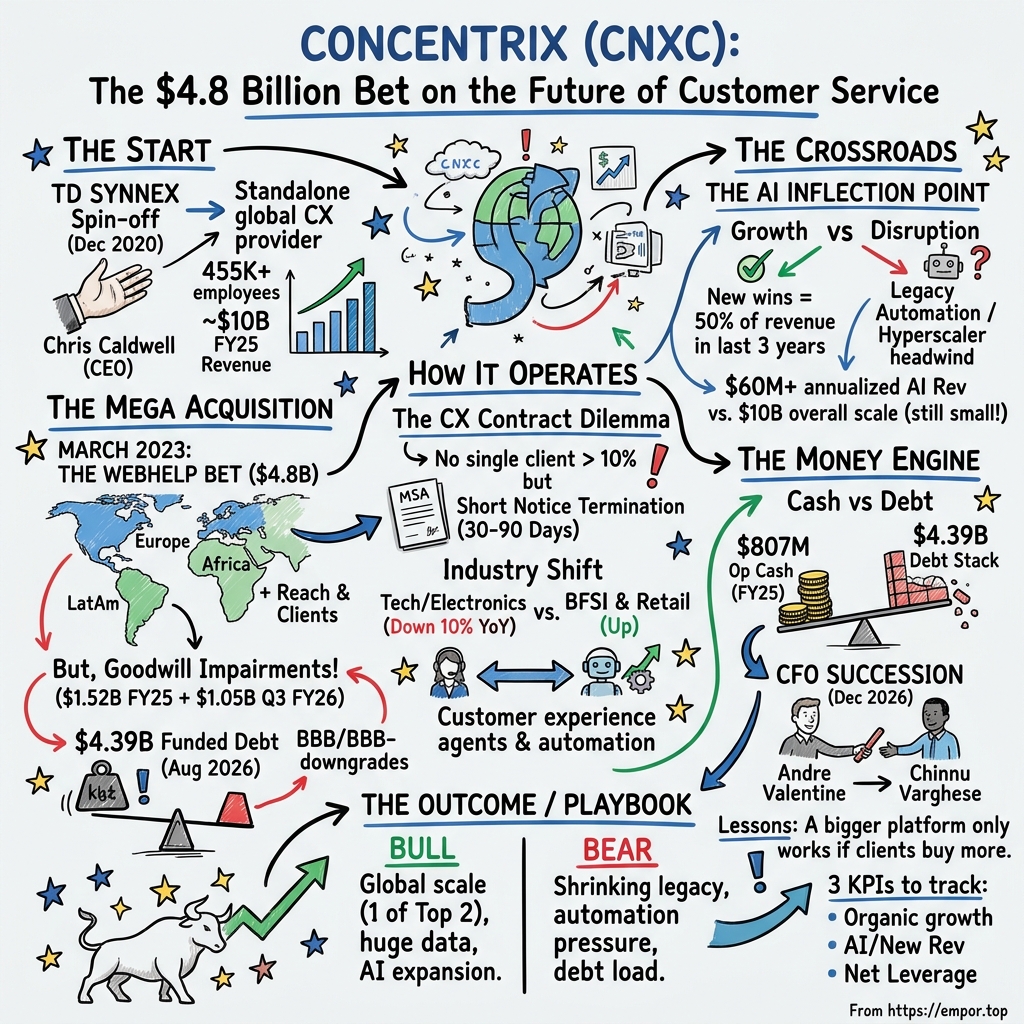
Concentrix: The $4.8 Billion Bet on the Future of Customer Service
I. The Call Center That Became an AI Company
On September 29, 2026, Chris Caldwell opened Concentrix's third-quarter call with a milestone, not an apology. "This quarter," he told analysts, "we crossed the mark that 50% of our revenue now comes from businesses that we generated in the last 3 years."1 For a company most investors still filed under "call centers," it was a deliberate reframing. The pitch was that Concentrix is no longer a warehouse of headsets in Manila, Bogotá and Casablanca waiting for the phone to ring. It is, in management's telling, a company that has spent three years rebuilding its revenue base around automation, analytics and AI, and that has come out the other side with a business half new.
Then the numbers arrived, and they told two stories at once.
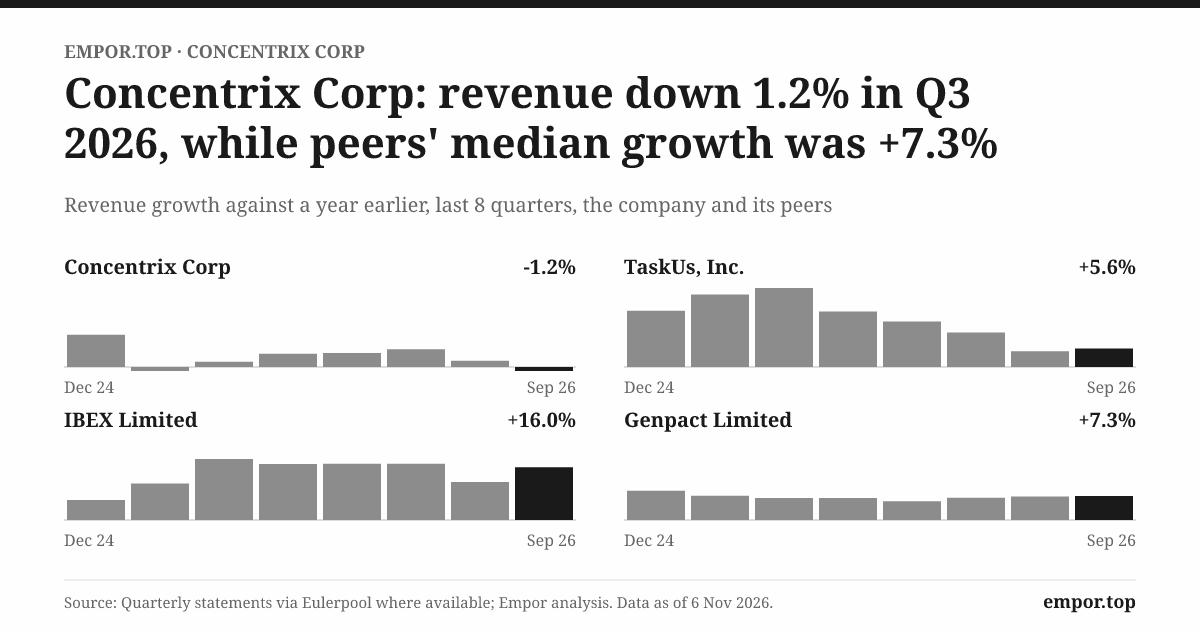
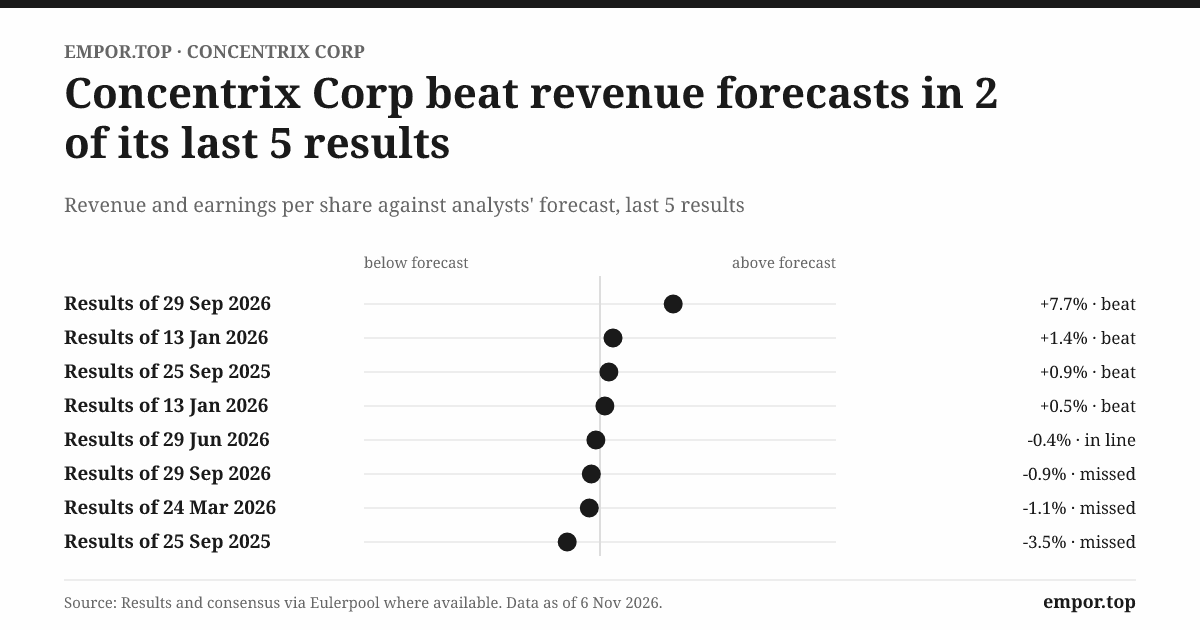
The first story was the one management wanted heard. Revenue of about $2.45 billion was down just 1.2% from a year earlier, and only 0.5% in constant currency.2 On the company's own adjusted measure, operating income was $309 million and the margin climbed to 12.6%, up three-tenths of a point year over year.1 Adjusted free cash flow in the quarter was $218 million, which the CFO, Andre Valentine, called the best third quarter since the company became independent in 2020.1 Read that way, Concentrix was a disciplined operator holding its margins through a soft patch.
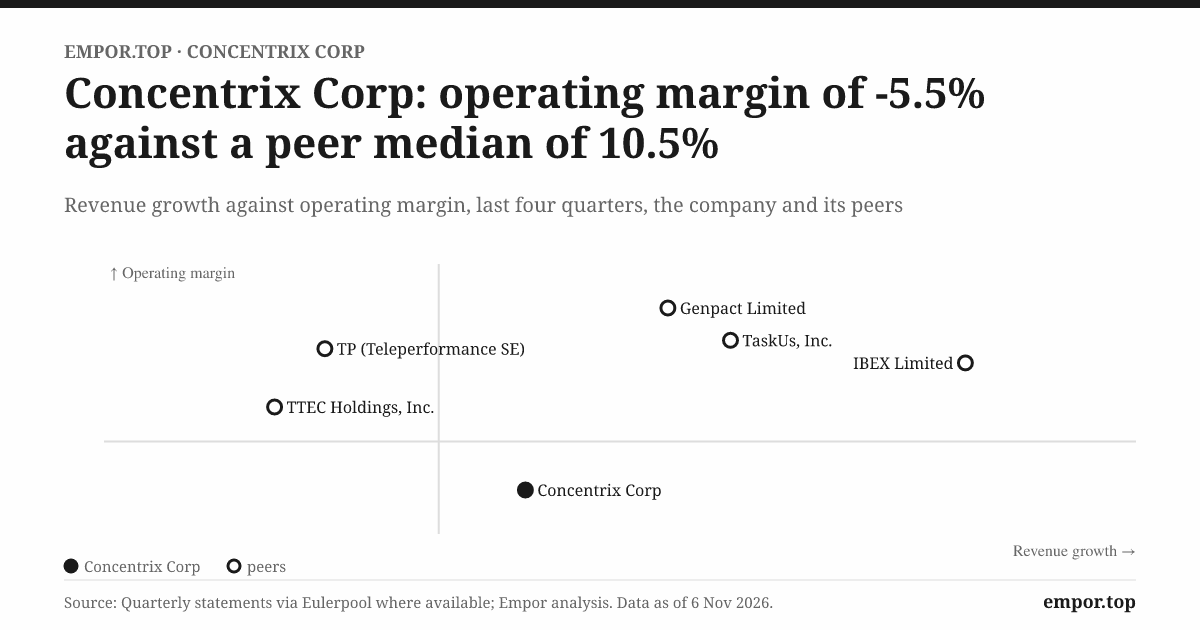
The second story was the one written in the GAAP statements. The same quarter carried a $1.05 billion noncash goodwill impairment, which Valentine said was "triggered by the trading range of our stock."1 That single charge turned a profitable quarter into a reported operating loss of about $910 million and a net loss of $988 million, or more than $16 a share.2 It was the second giant write-down in under a year: the fourth quarter of fiscal 2025 had already brought a $1.52 billion charge.3 A company that says half its revenue is new was, in the same breath, telling its auditors that the businesses it had bought were worth billions less than it had paid.
Both stories are true, and the tension between them is the whole investment debate. A 12.6% adjusted margin on falling revenue says the machine is still efficient. A billion-dollar impairment says the market and the accountants no longer believe the machine's future cash flows justify what was paid for its parts. And a 0.5% constant-currency decline, which Valentine conceded was slightly below the bottom of the range the company had guided to in June, says the new business is not yet growing fast enough to more than replace the old.1 Management's guidance made that plain: it expected fourth-quarter revenue to fall between 3% and 5% in constant currency.1
The scale of what is at stake is easy to underestimate because the product is so familiar. Concentrix booked about $9.8 billion of revenue in fiscal 2025, the year ending in November, and employed roughly 455,000 people.3 It reports as a single operating segment, which means every client, country and service line flows into one set of numbers.3 When a bank's customer disputes a card charge, when a shopper chases a late parcel, when a streaming subscriber cannot log in, there is a meaningful chance the voice or the chat window on the other end belongs to Concentrix, working under the client's brand. Few people know its name. Many have talked to it.
That anonymity is part of what makes the story hard to judge. Concentrix sells labor, process and increasingly software into other companies' customer relationships, and the technology now sweeping through those relationships can do two opposite things to it. AI can make each Concentrix advisor more productive and create new consulting and deployment work. It can also answer the customer's question before a human ever gets involved, which is the work Concentrix has been paid to do for decades.
Four questions follow, and the rest of this story is an attempt to answer them. The first is whether the 2023 combination with Webhelp, a $4.8 billion bet on global scale, created value or simply created a larger version of the same business. The second is whether AI-led services can grow fast enough to replace the revenue AI itself is eroding. The third is whether the company's cash flow, which has stayed robust through the accounting carnage, can bring down a debt load that the rating agencies now watch closely. The fourth is whether the management team that made these bets, and that is now changing its chief financial officer, can deliver the transition it has promised.
The "AI company" label settles none of them. Commercial results will. To see why the results are so contested, it helps to go back to a time when Concentrix was not a company at all, but a division tucked inside a computer-parts distributor.
 Subscribe on LinkedIn
II. A Business Built Inside Someone Else's Company
For most of its life, Concentrix had a parent, and the parent's business was moving boxes. SYNNEX, later TD SYNNEX, was one of the largest distributors of computer hardware and software in the world, a thin-margin, high-volume operation whose expertise was logistics and credit. Its customer-service arm began as a way to support the products it distributed and grew, acquisition by acquisition, into something its parent's investors struggled to value: a labor-intensive services business with entirely different economics from the distribution engine beside it.
The man who ran that services business for most of its growth was Chris Caldwell. He joined SYNNEX in 2004, arriving through the distributor's acquisition of EMJ Data Systems, and spent the following years in business development before taking charge of Concentrix as its general manager and then president.4 By the time of the spin-off he had run the unit for the better part of a decade, which matters for how to read his later decisions. Caldwell is not a turnaround hire brought in to fix someone else's strategy. The footprint, the client book and the acquisition habit are largely his.
The defining move of the pre-spin era came in June 2018, when SYNNEX agreed to buy Convergys, an Ohio-based customer-management company with a long history serving American telecom and technology clients. The deal valued Convergys at an enterprise value of about $2.8 billion, paid in a mix of cash and SYNNEX shares, and the price worked out to roughly 8.4 times Convergys's trailing EBITDA.5 Convergys was folded into Concentrix, and the revenue line shows what that meant: from about $2.5 billion in fiscal 2018 to about $4.7 billion in fiscal 2019, close to a doubling in a single year.3 The services arm had become a heavyweight almost overnight, and it had done so through the purchase of a rival rather than organic growth.
The spin-off came in December 2020, when SYNNEX distributed Concentrix shares to its stockholders in a tax-free transaction and the business began trading on Nasdaq as an independent company.3 Independence gave Concentrix three things it had lacked: its own currency in the form of listed stock, its own access to bond markets, and its own board answering to investors who had chosen to own a customer-experience business rather than a distributor. It also gave Caldwell a scoreboard. Every quarter from then on, the strategy he had built inside SYNNEX would be judged in public.
A word of caution about the long-run record is in order here. The revenue and profit figures before 2020 describe a business living inside a larger company, with costs, capital and financing set by its parent, and with Convergys arriving partway through. They are useful for understanding how large and how efficient the operation was. They are not a clean standalone track record. Even after the spin-off, the headline growth rate flatters organic momentum: revenue compounded at about 15.8% a year from fiscal 2020 to fiscal 2025, but that span includes Webhelp's consolidation and other deals.3 In fiscal 2025, the first full year in which Webhelp was in both comparison periods, growth was just 2.2%.3
The early independent years looked like a vindication. Fiscal 2021 revenue rose about 18% to roughly $5.6 billion and the operating margin jumped to about 10%, a level the business had never reached under its parent.3 Net profit more than doubled to about $405 million.3 The pandemic had pushed consumers online and onto support lines, and clients needed partners who could stand up remote agents quickly. Concentrix began paying a dividend and buying back stock in 2021, behaving like a mature, cash-generative company that had earned its independence.3
There was another relationship that survived the separation. TD SYNNEX remained a customer, paying Concentrix about $55.5 million for customer-experience services in fiscal 2025, well under 1% of revenue, and the board describes the arrangement as arm's length.4 Two TD SYNNEX executives, Dennis Polk and Ann Vezina, also sit on the Concentrix board.4 The former parent's commercial footprint is small. Its presence in the boardroom is a reminder of where the company came from.
The shape of the business by 2022, then, was clear. Concentrix was a scaled, efficient operator with a strong North American and Asian delivery network, solid cash flow and a CEO with long tenure and a record of growing through acquisition. Its weakness was equally clear. Webhelp's own pitch later described it as "primarily based outside of North America," with strength in Europe, Latin America and Africa, which was a polite way of naming the regions where Concentrix was thinner.6 Clients increasingly wanted a single global partner, and the industry's other giant, the French group Teleperformance, already had that reach.
Caldwell's answer was to buy it. The decision almost doubled Concentrix's debt, handed a fifth of its equity to a European investment group, and became the transaction against which every later result would be measured.
III. The $4.8 Billion Webhelp Bet
On March 29, 2023, Concentrix announced it would combine with Webhelp, a Paris-based customer-experience company, in a deal valued at $4.8 billion.7 On the investor call that morning, Caldwell called the combination the creation of "a diversified global CX leader," and Valentine walked through the price and the structure.6 Reuters framed it more bluntly: Concentrix was looking beyond North America.8
The structure said a lot about how much Concentrix wanted the deal and how stretched it was willing to be to get it. Webhelp's owners, led by the Belgian holding company Groupe Bruxelles Lambert and Webhelp's co-founder Olivier Duha, would receive about 14.9 million new Concentrix shares, €500 million in cash at closing, and a €700 million note payable two years later at 2% interest.6 Concentrix would also refinance about €1.55 billion of Webhelp's net debt.6 A further 750,000 shares would vest only if Concentrix stock traded above $170 within a specified period.6 After closing, Webhelp's former owners would hold about 22% of the combined company.6
Each piece of that consideration had a purpose. The shares conserved cash and gave the sellers a stake in the outcome. The seller note, effectively a two-year loan from Webhelp's owners at a rate far below what Concentrix could borrow at in the open market, deferred a large slug of the price. The new debt filled the gap. Look at what the $170 earn-out implied: the sellers were promised extra shares if the stock rose meaningfully above where it traded at the time. The stock now trades near $30.9 That earn-out is a small artefact, but it captures how far apart the deal's expectations and its outcome have drifted.
What Concentrix thought it was buying
Webhelp brought roughly $3 billion of expected 2023 revenue and about $500 million of adjusted EBITDA, more than 1,000 clients, and a record of strong organic growth.6 It added delivery in Europe, Latin America and Africa, and practices Concentrix had less of, including anti-money-laundering and know-your-customer checks, fraud management, payment services and collections.6 The pro forma company would operate in more than 70 countries, serve about 2,000 clients and split its revenue roughly into thirds across the Americas, Europe-Middle East-Africa and Asia-Pacific.6 Its delivery mix would be about 43% onshore, 30% offshore and 27% nearshore.6
The price, about 9.5 times Webhelp's expected 2023 adjusted EBITDA before synergies, dropped to roughly 7.6 times once the promised savings were counted.6 Was that expensive? Precedent gives a rough frame. SYNNEX had paid about 8.4 times trailing EBITDA for Convergys five years earlier.5 In 2021, Sitel Group agreed to buy Sykes Enterprises, a large American peer, in an all-cash deal valued at about $2.2 billion.10 Those transactions differ in timing, interest rates, geography and growth profile, and Webhelp was billed as a faster grower than Convergys had been. The fair reading is that Concentrix paid a full but not outlandish price for a business of Webhelp's quality, and that the deal's value rested less on the entry multiple than on whether the promised synergies, growth and deleveraging arrived on schedule.
Those promises were specific. Management targeted $120 million of annual cost savings by the third year, ramping from $75 million in year one and $100 million in year two, drawn from IT, procurement, real estate and corporate overhead.6 Revenue synergies were explicitly excluded from the model.6 Adjusted earnings per share would rise by more than 7% in the first full year after closing and by double digits in the second.6 Net leverage would be about three times adjusted EBITDA at closing, and Caldwell said it was "important for us to get back close to 2x within a short period of time"; the target was close to two times within two years.6
The deal closed on September 25, 2023.11 Recorded purchase consideration net of acquired cash came to about $3.75 billion.11 The balance sheet changed overnight. Borrowings, about $2.7 billion at the end of fiscal 2022, reached roughly $5.8 billion a year later.3 Fiscal 2024 revenue jumped 35% to about $9.6 billion, almost all of it the arithmetic of consolidation.3
The promise meets the record
Here is the most revealing comparison in the entire story. The pro forma combined company that management presented in March 2023 had about $9.8 billion of 2023 revenue.6 Two full years later, in fiscal 2025, Concentrix reported about $9.8 billion of revenue.3 Management's own guidance for fiscal 2026 is $9.83 billion to $9.88 billion, a constant-currency decline.1 Currency moves and accounting differences make this an approximate comparison, not a precise one. But the direction is unmistakable: the combined company has not grown since the day it was assembled. A deal pitched as "accretive to revenue growth" has, so far, delivered a business that is roughly the same size it was on paper before it closed.6
The cost side tells a more mixed story. Management has repeatedly said integration savings were on track, and adjusted margins have held up. Yet the company's adjusted operating income fell about 5% in fiscal 2025, from $1.32 billion to $1.25 billion.4 Whatever the synergies contributed, something else was taking it away, whether pricing pressure, the cost of moving work to cheaper locations, or lost volume. The two-year deleveraging target also slipped. Two years after closing, Fitch measured leverage at 3.2 times EBITDA for fiscal 2025, and management now targets about 2.6 times net leverage by the end of fiscal 2026 and about 2.2 times by the end of fiscal 2027.121 "Close to 2x within two years" has become something closer to "2.2x within four."
Then came the write-downs. The $1.52 billion impairment in fiscal 2025 and the further $1.05 billion in the third quarter of fiscal 2026 together erased about $2.6 billion of goodwill, leaving $2.64 billion on the balance sheet at August 2026.313 Goodwill sits across a single reporting unit rather than being tagged to Webhelp alone, and the trigger cited was the stock's collapse, so the charges cannot be read as a precise verdict on the French deal.
The auditor's critical audit matter for fiscal 2025 was the goodwill test itself, with the judgment resting on forecasts of revenue growth, EBITDA margins and the discount rate.3 Still, when a company writes off goodwill equal to roughly two-thirds of the price it recorded for Webhelp within three years of buying it, the implication is plain: the cash flows the market and the accountants now expect from the combined business fall well short of what justified the price.
Does that prove Concentrix overpaid? Not by itself. Impairments are partly a mark-to-market of the company's own valuation, and the shares of every large customer-experience provider have been crushed by fears of AI. A buyer who paid 9.5 times EBITDA in early 2023 for a peer of Teleperformance would probably be underwater on paper regardless of execution. But the deal's thesis was never just "buy a good asset at a fair price." It was "buy scale, extract $120 million of savings, grow faster than either company alone, and pay down debt quickly." On the evidence of three years, the savings are the only leg standing firmly. Growth has not appeared, and deleveraging is running about two years late.
The deal leaves behind a question that goes deeper than price. Concentrix bought a larger footprint on the theory that global scale is worth more to clients than regional strength. What, exactly, does a global customer-experience platform sell, and how much control does it have over the economics of what it sells? The answer lies in the contracts.
IV. What a Customer-Service Contract Is Really Worth
Picture the paperwork. A large consumer-electronics brand decides to outsource part of its technical support. It signs a master services agreement with Concentrix, a long document covering confidentiality, data security, liability and pricing frameworks. Then the actual work arrives in statements of work: this many chat advisors for this product line, in these languages, at these service levels, from these delivery centers. The contracts can run from less than a year to more than five years.3 And here is the sentence that matters most to an investor. Clients can generally terminate them on 30 to 90 days' notice.3
That is the shape of almost all of Concentrix's revenue. It is recurring in the sense that the work goes on month after month, often for years. It is not recurring in the sense that a software subscription is, with a contracted annual fee and a renewal date. Concentrix does not disclose a recurring-revenue percentage, a backlog of committed future revenue, or minimum-volume guarantees.3 What it has instead is a deep book of ongoing operations that clients could, in principle, cut back within a quarter.
The pricing mechanics explain why. Most revenue is earned at flat unit rates, chiefly per transaction or another output measure, with staffing hours also used, and service-level bonuses or penalties can push the bill up or down.3 About 99% of revenue is recognized as the services are performed.3 In plain terms, Concentrix gets paid for each call answered, each chat handled, each fraud alert reviewed. If the client's customers call less, because the product is simpler, because a chatbot answers first, or because the client is selling less, Concentrix bills less. The revenue line is a direct read on someone else's activity.
The work itself has become broader than the old picture of a phone bank. Concentrix handles customer support across voice, chat, email and social channels; sales and retention for subscription businesses; content moderation for online platforms; back-office processing such as claims and collections; and an increasing layer of technology services, from analytics to the design and deployment of automated agents.3 The Webhelp combination added the risk, compliance and payments work that sits closer to a client's regulatory obligations.6
Where the money comes from has shifted sharply in the last year. In the third quarter of fiscal 2026, revenue from technology and consumer-electronics clients, historically Concentrix's anchor vertical, fell about 10% year over year.2 Retail, travel and e-commerce grew about 6%, and banking, financial services and insurance grew about 12%.2 That divergence is the clearest operating evidence in the story. The clients most exposed to AI-driven automation, and with the deepest in-house AI capability, are the ones pulling back.
The clients with heavier regulatory and compliance needs, where a human in the loop is still required or desired, are growing. Caldwell has attributed part of the technology weakness to two hyperscale clients that are stopping support for certain sets of their own customers; he originally expected the effect to run from the third quarter of fiscal 2026 into the second quarter of 2027, but now says it will be "completely finished by the end of Q4," concentrating the pain into a sharper near-term drop.1 He added that both clients "are actually growing with us in other areas."1
Customer concentration is the next piece of the puzzle. No single client accounted for more than 10% of revenue in fiscal 2023 through 2025, or in the first nine months of fiscal 2026.313 That sounds reassuring, and in one sense it is: the loss of any one relationship would not sink the company. But Fitch reports that the top five clients made up about 19% of fiscal 2025 revenue.12 That is roughly $1.9 billion of revenue spread across five buyers, each with procurement departments, multiple vendors and 30-to-90-day exits. Concentrix does not disclose its top-ten share, customer-level retention or the revenue lost to specific contract exits. The absence of a single dominant customer limits catastrophic risk. It does not remove buyer power.
The operating levers explain how two providers with the same revenue can earn very different margins. Staffing mix determines how many senior and junior advisors handle a program. Location decides whether an hour of work costs the wage of Texas, Poland, Colombia or the Philippines. Automation reduces the handling time per transaction. Utilization measures how much of each paid hour is actually billable. Attrition, notoriously high in the industry, forces constant hiring and training.
And the per-transaction pricing creates a subtle trap: if Concentrix makes its advisors faster, it delivers more value per contact but may bill less per hour of labor unless it can renegotiate the unit price. Caldwell acknowledged one version of this on the third-quarter call, describing shifts in delivery location as about a 3% revenue headwind in the quarter.1 Moving work offshore is often good for the client and can be good for margins, but it shrinks revenue because the same work is billed at lower rates.
Receivables offer a practical check on whether the billing model is healthy. Debtor days, the receivables balance measured against a day's revenue, improved from about 140 in fiscal 2018 to about 74 in fiscal 2025, a sign that the business collects more efficiently than it did in its pre-spin form.3 But the composition matters. At the end of August 2026, net receivables were about $1.97 billion, of which roughly $908 million was unbilled: work Concentrix had done but not yet invoiced.13
The company explains that it performs most services before billing and usually invoices the following month or under contract-specific terms.13 The allowance for bad debts was small, about $24 million, and its non-recourse factoring of receivables was trivial.13 Collection is not the visible problem. The large unbilled balance is a reminder, though, that revenue is recognized on the company's measurement of work delivered, with the client's invoice following later.
The verdict on the contract is nuanced. Scale, delivery experience and integration into a client's systems matter: switching a 5,000-person, multilingual support program to a new provider is disruptive and risky. But the paperwork protects volume very little. Concentrix's revenue recurs because clients keep choosing to send it work, not because they are contractually bound to. That makes the short notice period the most important clause in the business, and it leads directly to the competitive question: with so little legal lock-in, what keeps a client from shifting the work to someone else, or automating it away?
V. The Scale Advantage—and Its Limits
Imagine the request for proposal landing on the desks of the world's largest outsourcers. A global airline, a top-ten bank or a consumer-technology giant wants one partner to run support in twenty languages across four continents, with follow-the-sun coverage, strict data-security controls and the ability to absorb a sudden spike when a product launches or a storm grounds a fleet. Very few companies can bid credibly on that work on their own. At the top of the industry, two names dominate the shortlist.
One is Teleperformance, the French group that reported about €10 billion of revenue in 2025 and estimates its own share of the global market at roughly 10%.14 The other is Concentrix, with about $9.8 billion of fiscal 2025 revenue and roughly $10 billion over the twelve months to August 2026.32 Measured in dollars, the two are close peers in size. Behind them, the market fragments quickly. Sitel, after agreeing to buy Sykes, expected the combined company to pass $4 billion of revenue.10 Listed specialists such as TTEC and TELUS Digital are smaller still. Thousands of regional providers and captive in-house centers make up the rest. If Teleperformance's 10% estimate is roughly right, the two leaders together hold perhaps a fifth of a highly fragmented market.
The strategic logic for scale is straightforward. A provider with delivery centers in dozens of countries can move work to wherever the cost, language skills and time zone fit best. It can bid on the largest multilingual programs that smaller rivals cannot staff. It can spread the cost of security certifications, compliance teams, analytics platforms and AI tooling across thousands of clients. And it can tell procurement departments, which increasingly prefer to consolidate vendors, that it can take over work from several smaller suppliers at once. Caldwell has leaned on that last point: on the third-quarter call he said 2027 growth should benefit from consolidation in the industry.1
The evidence that scale wins and keeps clients is real but thinner than the narrative suggests. The strongest public data point is relationship length. Fitch reports that Concentrix's top 30 clients have an average tenure of about 16 years.12 Relationships that long are not accidental; they imply that, for its most important clients, Concentrix has repeatedly been the provider of choice through technology shifts, recessions and procurement cycles. Fitch also lists market position, customer diversity, retention and cash generation among the company's credit strengths.12
Now test the claim through the mechanisms that would break it. A moat in this industry would show up as pricing power, low churn and share gains. On pricing, Concentrix discloses no measure of price realization, and the per-transaction model, combined with clients' push to move work offshore, works against it. On churn, long average tenure among the top 30 says nothing about how much work those clients send each year; a client can stay for 16 years while halving its volume, which is exactly what the hyperscale clients appear to be doing in certain programs.
On share, the company does not publish win rates or lost bids, and the combined business has not grown since it was assembled. Multi-sourcing compounds the problem. Large clients rarely give one provider all their work. They split programs across two or three vendors and use the competition to discipline price, which makes it easy to shift volume between incumbents without the risk of a full transition.
The cost structure tells the rest of the story. Labor is the core input. Most of the company's 455,000 people are advisors delivering client work, so wage inflation in delivery countries, attrition and the cost of training replacements flow directly into margins.3 Fitch flagged higher offshore costs and excess capacity among its concerns.12 Excess capacity is the quiet killer in this business: a delivery center built for a client's peak volume becomes a fixed cost when that client automates or moves work, and seats sitting empty still need rent, power and supervisors. Operating lease liabilities of about $906 million at August 2026 are the balance-sheet trace of that physical footprint.13
Currency is part of the cost equation too. About 54% of fiscal 2025 revenue was priced in U.S. dollars, with material exposure to the euro, sterling, yen and Brazilian real.3 Concentrix often earns revenue in one currency and pays advisors in another, a natural feature of offshore delivery, and it hedges portions of those exposures with forwards, options and swaps.3 In fiscal 2025, currency moves helped gross profit by about $65 million.3 That is useful, but it is not a competitive advantage that can be relied upon.
So how does Concentrix compare with Teleperformance in practice? Both run global footprints, both have built AI platforms of their own, and both have seen their shares de-rated sharply on fears that automation will shrink the industry. Neither has proven that its scale translates into pricing power. Their service mixes differ in detail, and their margins and balance sheets differ meaningfully, so the comparison is useful for framing rather than for ranking.
The conclusion is that scale wins bids but does not guarantee keeping them. Scale gets Concentrix into the room for the largest, most complex global programs. What keeps the work is delivered quality, cost and measurable outcomes for the client, and in an era when the client's own engineers can build an automated agent, those outcomes increasingly involve doing more with fewer people. That brings the story to the technology that could either rescue the model or hollow it out.
VI. Can AI Grow the Business Before It Shrinks It?
On the same third-quarter call where he celebrated the 50% milestone, Caldwell delivered a warning in the same breath. Shifts in "hyperscaler spend priorities," he said, "will have a larger impact than previously expected on our revenue in the fourth quarter."1 In other words, the very clients building the AI models that are supposed to transform customer service were cutting the human-delivered work they buy from Concentrix faster than expected. That is the AI paradox in one quarter: the technology is both the company's best growth story and the clearest threat to its existing revenue.
The mechanism cuts in two directions. On one side, AI tools can make each Concentrix advisor more productive: summarizing a customer's history before the call starts, suggesting answers in real time, drafting follow-up emails, translating on the fly. That can lower Concentrix's cost per transaction and let it win business on price or quality. AI also creates new work: designing automated agents, training them on a client's data, monitoring their accuracy, and handling the hard cases they escalate. On the other side, every customer question an automated agent answers without escalation is a transaction Concentrix is no longer paid to handle. The company's per-transaction pricing makes the arithmetic brutal. Automate half the contacts in a program, and the revenue from that program can fall by roughly half unless Concentrix captures the automation fees itself.
The honest way to judge Concentrix's progress is to keep three things separate: technical capability, commercial adoption and financial materiality.
Capability is not in doubt. The company says it has built its own iX Suite of AI products for human and digital advisors, and brought 61 opportunities live on the platform, covering more than 30,000 advisors.1 Caldwell described the company as having built technology comparable to recently announced agentic-shopping products from Meta and OpenAI, and said he sees agentic shopping "becoming more and more prevalent."1 Launches, partnerships and internal builds show that the company can engineer the tools. They do not show that it can sell them profitably.
Adoption is where the claims get large. Caldwell said about $3 billion of revenue comes from clients that "have either gone through heavy transformation or has AI influencing the revenue," including about $1.3 billion of traditional services now being compressed through the iX Suite platform and about $700 million from new, higher-value services such as risk and compliance.1 He said this new-business revenue was expected to grow by 30% in fiscal 2026, that its retention rate was "4x higher," and that he expected new-business revenue to exceed $6 billion in 2027.1 Net new-logo sales involving AI rose 63% from the prior quarter, and three of the four largest iX Suite wins came from existing clients.1
These are management's definitions, and they deserve careful reading. "Business generated in the last 3 years" includes new programs with existing clients, new clients and newer service lines, much of it still delivered by human advisors. "AI influencing the revenue" is not the same as AI revenue. The $1.3 billion running through the iX Suite is, by Caldwell's own description, traditional work being compressed: the same services delivered with fewer human hours. That can be good for margins while still shrinking revenue.
Financial materiality is where the evidence is thinnest. The most concrete disclosure is modest. In its fiscal 2025 annual report, management said annualized AI revenue exceeded $60 million and that its AI investments had reached breakeven.15 Set against roughly $10 billion of revenue, that is about six-tenths of one percent. On the third-quarter call, Caldwell said the company expected to exit 2026 with software-licensing annual recurring revenue of about $120 million, having cut iX Suite spending.1 Doubling a small number is encouraging. It is still a small number. Fitch's view, when it moved the outlook to negative in February, was that the AI offerings were early-stage and that it did not yet expect a significant revenue transformation.12 S&P, which cut the rating to BBB-minus, had earlier highlighted AI disruption, competition and execution risk.1617
The historical record also matters. Concentrix has spent years marketing technology-led services, and the revenue line through fiscal 2025 shows that those efforts did not prevent organic growth from slowing to low single digits once the acquisition boost ran out. That does not mean AI will follow the same path; generative AI is a far more powerful tool than earlier automation waves. But it does mean that "we have the technology" has not historically translated into revenue acceleration at Concentrix, and the burden of proof sits with the new numbers, not the old narrative.
The test, then, is specific. Concentrix needs to disclose AI and new-services revenue separately, with its gross profit, consistently over several quarters, alongside the legacy volume lost to automation or client insourcing. If the new revenue is growing at 30% and the old is shrinking at less than half that rate, total revenue grows and the thesis holds. If the old is shrinking as fast as the new is growing, the company is running hard to stand still. Management's guidance for a 3% to 5% constant-currency decline in the fourth quarter suggests that, for now, the old is winning.1
Whatever happens on that front, the transition has to be financed, and Concentrix is carrying a large debt bill while it waits for the answer.
VII. The Cash Machine Meets the Debt Bill
Fiscal 2025 produced the kind of financial statements that confuse casual readers. The income statement showed a net loss of about $1.28 billion.3 The cash-flow statement, for the same twelve months, showed $807 million of cash generated by operations.3 One of those numbers says the company is losing money at an alarming rate. The other says it is a reliable cash machine. Both come from the same audited accounts.
The reconciliation is worth walking through, because it explains why the cash survived. Start with the $1.28 billion loss. Add back the $1.53 billion goodwill impairment, which was an accounting judgment about the value of past acquisitions, not cash leaving the building.3 Add back about $434 million of amortization of acquired intangible assets, largely the customer relationships and other assets booked when Webhelp was bought, and about $226 million of depreciation of computers, fit-outs and other physical assets.3 Add back about $96 million of share-based compensation, which is a real cost to shareholders through dilution but does not require cash.3 Working capital absorbed some cash, with receivables and other operating items using about $114 million between them.3 What remains is roughly $800 million of operating cash, and after about $234 million of capital spending, free cash flow of about $572 million.3
That reconciliation cuts both ways. It confirms that the impairment did not drain cash. It also shows that a large part of the gap between profit and cash is the amortization of what Concentrix paid for its acquisitions. That cost was paid in cash and shares years ago, through the purchase price and the debt that financed it. Over nine years, from fiscal 2017 to fiscal 2025, the business generated about $4.6 billion of operating cash against only about $527 million of cumulative net profit.3
The headline ratio, operating cash at almost nine times profit, looks spectacular. It is inflated by the accounting treatment of acquisitions, and should not be read as a normal conversion rate of earnings into cash. The more useful reading is that the underlying operations, before acquisition accounting, have turned roughly 4.5% to 7% of revenue into free cash flow in each of the last three years.
That cash now has a large claim on it. As of August 31, 2026, gross funded borrowings were about $4.39 billion.13 The stack includes $800 million of notes due 2028, $600 million of 6.5% notes due 2029, $550 million of notes due 2033, term loans, and about $621 million drawn under a facility secured by receivables.13 A $1.1 billion revolving credit line was undrawn.131 Separately, operating lease liabilities on delivery centers and offices came to about $906 million.13 Leases are a real obligation but a different kind, tied to the physical footprint and not to be lumped with funded debt.
The refinancing record this year has been orderly. In February 2026, Concentrix sold $600 million of 6.5% notes due 2029 to refinance part of its 6.65% notes maturing in August 2026, at a yield three percentage points above comparable Treasuries.17 It redeemed the remaining $200 million of those notes when they came due in August.131 That left term loans as the nearest maturity: about $450 million was classified as current at quarter end, and management said $375 million of term loans mature in December 2026.131 Valentine said the company expects to repay more than $550 million of gross debt this fiscal year and to finish the year with net debt of about $3.8 billion, after funding the purchase of CastleHill in the fourth quarter, and to repay another $550 million or more in fiscal 2027.1
The rating agencies are watching that plan closely, and their verdict is the market's guardrail. Fitch affirmed Concentrix at BBB but moved the outlook to negative in February 2026, citing fiscal 2025 EBITDA leverage of about 3.2 times, slower deleveraging, industry softness, higher offshore costs, excess capacity and AI disruption risk.12 Its downgrade triggers include leverage staying above 2.5 times and free-cash-flow margins below 3%.12 S&P rates the company BBB-minus and Moody's Baa3, both the lowest rung of investment grade.17 Concentrix's debt sits one notch above junk at two of the three agencies. Losing investment grade would raise the cost of every future refinancing, and with notes maturing in 2028 the company needs the bond market open.
Management's leverage targets of about 2.6 times net leverage by the end of fiscal 2026 and about 2.2 times, with net debt below $3.3 billion, by the end of fiscal 2027 are measured on its own adjusted EBITDA definition.1 Fitch's measure runs differently. The practical test is simple: does net debt fall by roughly the amount management promised, and does EBITDA hold while it does? Falling revenue in the fourth quarter puts pressure on the second half of that equation.
Then there is the question of what competes with debt repayment for the cash. Concentrix has paid a dividend since fiscal 2021 and raised it to $0.37 a share per quarter on the third-quarter call.13 Over the nine years to fiscal 2025, dividends used only about 9% of cumulative free cash flow, a modest claim.3 Buybacks were larger in recent years, about $169 million in fiscal 2025, but the company made no repurchases in the third quarter of fiscal 2026, and about $397 million of authorization remained.13 The choice is visible: for now, debt comes before buybacks. At a share price near $30, the dividend yields close to 5%, so the payout is a meaningful part of the equity return for shareholders.9
The fair verdict is that the cash generation is real but not unlimited. Management's guidance of about $630 million to $650 million of adjusted free cash flow this year can service and steadily reduce the debt if it holds.1 It cannot absorb a prolonged revenue decline, a sharp rise in labor costs and a refinancing at much higher rates all at once. Debt is manageable as long as the cash keeps coming and the leverage keeps falling, which places enormous weight on the credibility of the people promising both.
VIII. The Promises, the Incentives, and the CFO Handoff
On November 3, 2026, Concentrix announced that Chinnu Varghese would become chief financial officer on December 1, and that Andre Valentine, who had held the role through the Webhelp deal and both impairments, would remain with the company through May 2027 to support the transition.18 The announcement was brief and orderly. Its timing was not neutral. A new finance chief takes over just as the company must report a weak fourth quarter, set guidance for fiscal 2027 and deliver on a debt-reduction plan the rating agencies are monitoring. Whoever explains those numbers in January will shape how investors judge the turnaround.
Caldwell's own tenure is best judged through behavior rather than rhetoric. He led the company through the spin-off and the strong pandemic years, made the decision to buy Webhelp at a full price with substantial debt, and has since presided over integration, slowing growth and two impairment charges totalling about $2.6 billion.313 His style on calls is confident and forward-looking; he tends to present new metrics, such as the 50% new-business figure and the $3 billion of AI-influenced revenue, that frame the business favorably. He has been less inclined to dwell on misses, though he did acknowledge that the hyperscaler headwind would hit harder than expected.1
The promises-versus-delivery ledger is uncomfortable. At the Webhelp announcement in 2023, management promised more than 7% adjusted EPS accretion in the first full year, double-digit accretion in the second, revenue-growth accretion, and leverage close to two times within two years.6 What followed was a combined business with flat revenue, lower adjusted operating income in fiscal 2025, leverage still above three times two years after closing, and a stock that fell far below the $170 earn-out threshold.312 Adjusted EPS may have benefited from the deal's financial engineering, but the outcomes investors care most about, organic growth and deleveraging, have lagged badly.
How executives are paid is relevant here. Caldwell's reported total compensation rose from about $10.2 million in fiscal 2023 to about $13.3 million in fiscal 2025, while GAAP net income moved from about $314 million to a loss of about $1.28 billion.4 Most of his fiscal 2025 package, about $10.5 million, came as stock awards.4 Valentine's pay rose from about $2.5 million to about $4.2 million over the same two years.4
The short-term incentive plan reveals what the board rewards. For fiscal 2025, 65% of the annual bonus for named executive officers was tied to non-GAAP operating income and 35% to revenue.4 Adjusted operating income came in at about $1.25 billion against a target of $1.33 billion, about 94% of target, while revenue landed essentially on target after the committee applied a negative currency adjustment of about $140 million.4 The plan paid about 82% of target overall.4
The impairment, the amortization of acquisition intangibles and other excluded costs did not touch the bonus metric. That is standard practice, and there is a reasonable argument for not punishing managers for accounting charges. But it means that the costs of the acquisition strategy, the largest swing factor in shareholder outcomes, sit largely outside the yardstick used to pay for annual performance. The long-term plan is more aligned: at least half of executive officers' long-term awards are performance-based, and EPS growth and total shareholder return were added as metrics for 2025.4
Ownership is meaningful but small relative to the company. As of January 2026, Caldwell beneficially owned about 332,000 shares including exercisable options and units, under 1% of the company, and directors and executive officers as a group held about 0.9%.4 At recent prices, Caldwell's directly owned shares are worth several million dollars, a real stake but a modest one beside his annual pay.
Shareholders have mostly backed the board, with one notable exception. At the March 2026 annual meeting, say-on-pay passed easily, with about 50.9 million votes for and 1.37 million against.19 The proposal to add 3.7 million shares to the equity incentive plan passed too, but with about 15.8 million votes against and 36.5 million for, roughly 30% opposition.19 That is a meaningful signal. Investors were broadly content with how executives are paid, but a large minority balked at the dilution of issuing more stock at a depressed price.
The ownership base itself has shifted. Groupe Bruxelles Lambert, Webhelp's largest former owner, held about 14.3% of the company at the January 2026 record date.4 On April 29, 2026, GBL sold 6 million shares in a block trade at $22.25 each, cutting its stake to about 2.77 million shares, or 4.55%, below the 5% reporting threshold.20 The price was a sharp discount to the Webhelp-era valuation, and the sale removed the seller's largest remaining exposure to the deal it had struck.
GBL's board-nomination rights under its investor-rights agreement depend on its affiliated holders retaining specified fractions of the shares originally issued in the combination; neither the company nor GBL has publicly confirmed whether those thresholds are still met after the sale, and a GBL executive sat among the director nominees in 2026.4 On the other side, BlackRock disclosed in October that it held about 7.51 million shares, about 12.3% of the company, as of September 30.21 The largest Webhelp seller has largely exited; a large index-and-active manager has built up.
A further governance aside: the company replaced KPMG with EY as auditor after the fiscal 2024 audit, and EY gave an unqualified opinion on the fiscal 2025 statements and internal controls, with the goodwill impairment test as its critical audit matter.34 EY's ratification drew 99% support.19 Changing auditors is not a red flag in itself, and no material weakness was reported, but the goodwill judgment remains the most important accounting estimate in the company.
The CFO handoff becomes the checkpoint. What should investors watch from the incoming finance chief? Whether fiscal 2027 guidance is set conservatively and met; whether the company begins disclosing AI and new-services revenue with gross margins; whether debt reduction stays ahead of buybacks; and whether misses are explained with specifics rather than new metrics. With management and incentives assessed, the question becomes how the market is pricing all of this, and what the bull and bear cases look like when the moat is tested in full.
IX. Analysis & Bear vs. Bull Case
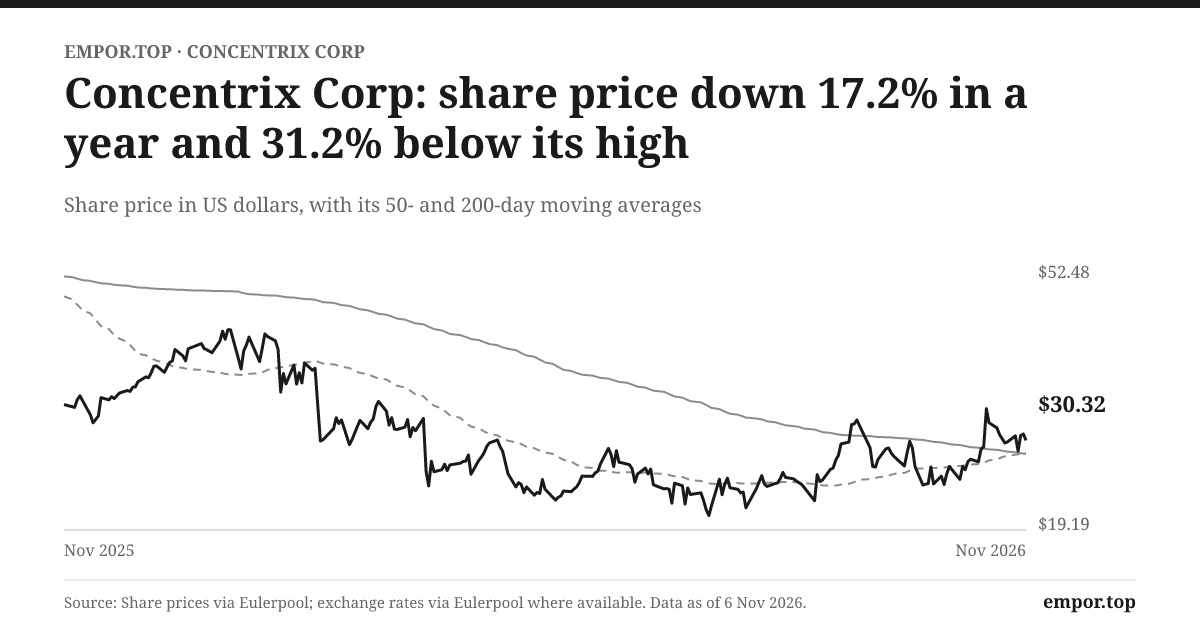
On November 6, 2026, Concentrix shares closed at $30.32, about 31% below their 52-week high of $44.07 and roughly half again above the low of $20.97.9 Over the preceding five years, the stock had at one point fallen almost 90% from its peak.9 At that price, the whole company was worth about $1.9 billion on the stock market, but about $6.0 billion once its debt, net of cash, was added.9 That gap is the first thing to understand about the valuation. Roughly two-thirds of the enterprise belongs, in economic terms, to lenders. Small changes in what the business is worth produce large changes in what the equity is worth, in both directions.
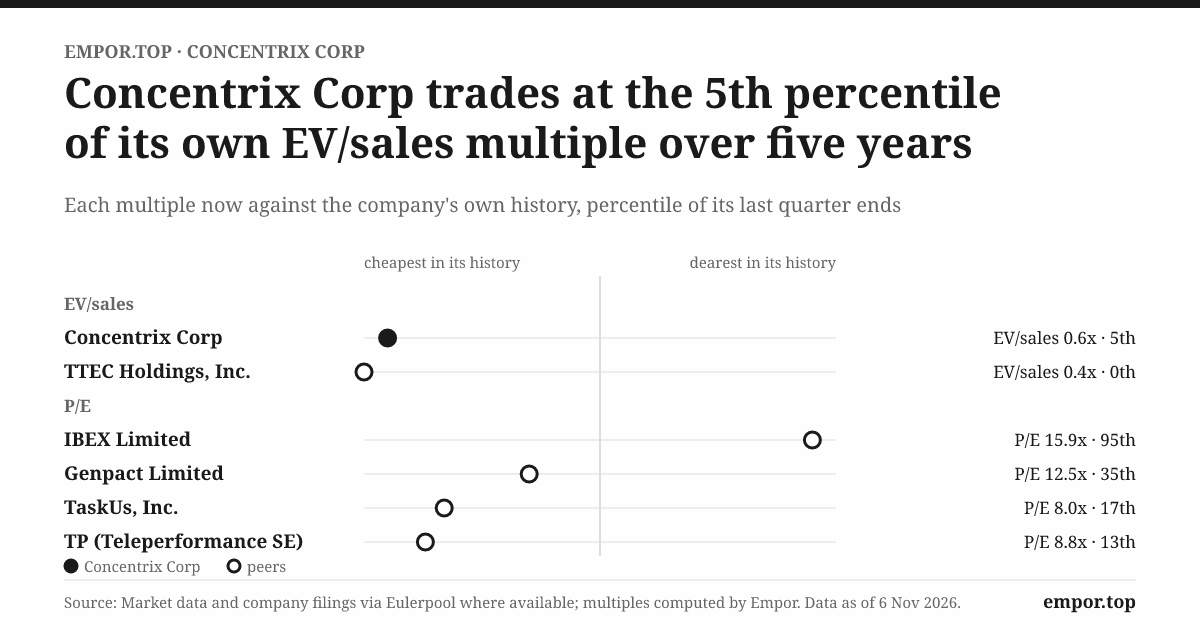
The multiples look absurdly low at first glance. Enterprise value is about 0.6 times sales, and the market value about 0.2 times sales.9 Free cash flow of $572 million in fiscal 2025 against a $1.9 billion market value implies a free-cash-flow yield of about 30%.93 Management's own guidance for fiscal 2026 adjusted EPS, roughly $11, would put the shares under three times adjusted earnings.1 Even the quoted price-to-earnings ratio of about 10 times compares favorably with a five-year median of about 17.9
Each of those comparisons needs an asterisk. The 10 times P/E uses earnings for the twelve months to August 2025, before the impairments; on the latest twelve months, reported earnings are deeply negative, so a trailing P/E is meaningless.213 Adjusted EPS excludes the amortization of acquired intangibles and share-based compensation, both of which are real economic costs. And the 30% free-cash-flow yield accrues to the equity only after debt holders are served, with the company itself committing more than $550 million a year to repaying borrowings.1 A more honest framing is that the market prices Concentrix as though it expects revenue to shrink for years, margins to compress as automation spreads, and much of the cash to go to lenders rather than shareholders.
Peers frame the price. Teleperformance traded at about 0.83 times its estimated 2026 sales on an enterprise-value basis in early November, and TTEC, which also reported a trailing net loss, at about 0.45 times.2223 Concentrix sits between them. The peer group has been de-rated together, which suggests the market is pricing an industry-wide fear about AI as much as anything company-specific. Margins, service mix and balance sheets differ across all three, so the comparison is a rough guide to sentiment rather than a ranking of value.
The bull and the bear
The bull case starts with position: a global provider with long client relationships and positive free cash flow in every year of its public life.6312 The bull argues that the AI transition will consolidate the industry rather than destroy it: clients will want fewer, larger partners who can combine humans and machines, and smaller providers without the capital to invest in AI will lose share to the leaders.
Growth in banking and retail, along with management's AI sales figures, are, in this view, early signs that the platform is converting.21 If revenue stabilizes and debt falls as promised, a business producing about $600 million of free cash flow a year should not be valued at a fraction of that in equity terms for long.
The bear case starts with direction: revenue is falling, legacy work is exposed to automation, and the AI business remains small.12315 The bear points to the deal's stalled growth, impairments and elevated leverage.31312 In this view, Concentrix is a leveraged incumbent whose best customers are learning to need it less, and its cheap multiple reflects a shrinking terminal value rather than a mispricing.
The capital-allocation record sharpens the debate. An activist reviewing the company would focus on the Webhelp deal, incentive design and buybacks.13 An activist would likely argue for all free cash flow to go to debt reduction until leverage is safely below Fitch's thresholds, for AI revenue to be disclosed with gross margins, and for long-term incentives to be tied to organic constant-currency growth and return on invested capital. Return on invested capital, as it happens, fell from about 11% in fiscal 2021 to about 6.5% in fiscal 2025 even before the impairments made the latest twelve months negative.3
Forces and powers
The industry's structure explains why the fight is hard. Using Michael Porter's five forces: buyer power is high, because large clients multi-source, can terminate on short notice and can build in-house or automated alternatives. Supplier power, which here means labor, is moderate and rising: wages in delivery countries climb, and attrition forces constant hiring. The threat of new entrants is low at the global tier, where scale, security certifications and delivery networks are hard to replicate, but higher in niches where AI-native startups can offer automated services without the cost of human footprints. The threat of substitutes is the dominant force: automated agents built by hyperscalers, software vendors or clients themselves can replace the transaction itself. Rivalry is intense, with Teleperformance, the combined Sitel and Sykes, and dozens of regional players bidding against each other on price.
Hamilton Helmer's seven powers offer a stricter test of whether Concentrix has a durable advantage. Scale economies are real but partial: spreading compliance, technology and delivery-center costs over a larger base helps margins, though labor, the largest cost, scales almost linearly with volume. Switching costs exist at the program level, because transitioning a large multilingual operation is disruptive, but the short termination rights and multi-sourcing show that clients can and do shift volume without full transitions. Network effects are absent; one client's use of Concentrix does not make the service more valuable to another.
Counter-positioning is the most interesting power, and it currently works against the incumbents: an AI-native provider that charges per resolved outcome rather than per human transaction can price in a way that would cannibalize Concentrix's revenue if Concentrix copied it. Cornered resources, branding and process power are limited; the company's operating know-how and data are valuable, but competitors have similar assets. The honest conclusion is that Concentrix has a credible competitive position built on scale and process, but no demonstrated lock-in, pricing power or AI-driven margin advantage.
Why might it win from here? Because the largest clients will still need someone to run the messy, regulated, multilingual edge of customer service that automation does not fully reach, and because Concentrix has the delivery footprint, operating data and client relationships to be one of the few who can do it at scale while also selling the automation. The evidence for that is the growth in banking, financial services and insurance and in retail, the long tenure of top clients, and steady cash generation. Why might it not? Because the same labor-heavy footprint that supports global delivery exposes it to wage pressure and excess capacity when clients automate, because the BBB-minus and BBB ratings leave little room for error, and because the company has not yet shown that its AI revenue can grow faster than its legacy revenue shrinks.
Three numbers will tell investors which story is unfolding. The first is organic constant-currency revenue growth, ideally by vertical: it was minus 0.5% in the third quarter and is guided to minus 3% to minus 5% in the fourth, so the direction is negative.1 The second is AI and new-services revenue with its gross profit; the clearest disclosed figure, software-licensing recurring revenue, is expected to exit the year at about $120 million, rising, but gross profit is not disclosed.1 The third is net leverage after debt repayment, targeted at about 2.6 times by year end and falling.1 If the first turns positive while the third keeps falling, the bull case gains ground. If the first keeps falling while the second remains small, the bear case strengthens.
The lessons the story offers go beyond Concentrix's own numbers, and they begin with the moment the bet was made.
X. Playbook: Business & Investing Lessons
Go back to March 29, 2023, and the slide that promised a global platform, synergies, earnings accretion and quickly falling leverage.6 Every part of that pitch was coherent. The industry was consolidating, clients wanted global partners, Webhelp filled Concentrix's geographic gaps, and the cost savings were specific and achievable. What the slide could not capture was what would happen to demand for the core product. The first lesson follows from that moment.
A bigger platform is only an advantage if clients buy more from it. The combined business has not grown since the deal was assembled, despite the integration savings; growth depended on clients choosing to send more work. For founders and investors, the wider point is that scale bought through acquisition is a cost advantage first and a demand advantage only if customers prove it. When a deal's case rests on cross-selling and growth acceleration, those claims deserve far more skepticism than the cost savings, and the cleanest test is whether the combined revenue grows faster than the two companies did apart.
Fiscal 2025 again showed the gap between an accounting loss and operating cash.3 It is tempting to treat that gap as proof that the business is healthier than the accounts suggest, and in one sense it is. The impairment did not drain cash.
But the gap also exists because acquisition costs were paid up front, with debt and shares, and are now being recognized slowly through amortization and suddenly through write-downs. The cash flow tells investors the operation is still viable. It does not tell them the price paid was right. The broader lesson is that in acquisition-heavy companies, cash flow and returns on invested capital must be read together; strong cash with falling returns on the capital deployed is a sign of a business that works but was bought too expensively.
When your customer can automate the work, selling the transition may matter more than defending the old volume. The hyperscaler pullback is a sign that clients are rebuilding customer service around automation.1 Concentrix's best response is not to fight that transition but to be paid for running it: designing, deploying and managing the automated agents, and handling the complex cases they escalate.
That requires changing how the company charges, from per human transaction toward per outcome or per platform, and accepting lower revenue on some programs in exchange for higher margins and stickier relationships. The company's iX Suite work is an example of that bargain.1 For any services company facing automation, the lesson is that the business model, not only the technology, must change, and the companies that cannibalize themselves deliberately tend to fare better than those that wait for clients to do it for them.
A fourth lesson concerns incentives. Annual bonuses tied to adjusted operating income rewarded the team for running the combined business efficiently, and the plan paid out at about 82% of target in a year when shareholders lost heavily.4 The plan was not unreasonable, but it measured the quality of operations and left the quality of capital allocation to the long-term awards. When a company's largest decisions are acquisitions, the metrics that pay executives should include the returns on those acquisitions.
These lessons carry Concentrix's story into its next chapter, which will be written over a handful of specific dates.
XI. Epilogue
Tonight, Concentrix stands at a strange midpoint. It is still one of the two largest customer-experience providers in the world, still generating hundreds of millions of dollars of free cash a year, still serving thousands of clients across more than 70 countries. It is also shrinking on a constant-currency basis, carrying more than $4 billion of debt, rated at the lowest rung of investment grade by two agencies, and about to hand its finance function to a new CFO.131718 The next several months will decide which of those facts defines the company.
The first moment is the December term-loan maturity, a test of the debt-repayment plan already laid out.1 Meeting that milestone on time would confirm that the deleveraging plan is on track. Missing it, or refinancing rather than repaying, would undercut the promise to put debt reduction first.
The second is the fourth-quarter report, expected early in 2027, the first under the new CFO. Management guided to a constant-currency revenue decline of 3% to 5% for the quarter and to adjusted free cash flow of $630 million to $650 million for the year.1 If the decline lands within that range and is clearly concentrated in the two hyperscale programs Caldwell described, investors may treat it as a one-time reset. If the decline spreads into banking, retail or communications, it would suggest that pressure on the core is broader than the explanation offered.
The third is fiscal 2027 guidance. Caldwell has said growth should return in 2027, weighted to the second half, helped by industry consolidation and catch-up in automation deployments.1 Whether the new CFO frames that guidance conservatively or aggressively will be an early read on how the company intends to rebuild credibility. A guide that assumes a sharp acceleration, followed by a miss, would deepen skepticism. A cautious guide that is met would begin to restore it.
The fourth is disclosure: whether Concentrix gives investors the AI and legacy-volume detail needed to test its thesis. The company expects to exit the year with about $120 million in software-licensing recurring revenue.1 Separate, consistent disclosure of AI-related revenue and profit would let investors test the thesis directly.
The fifth is the balance sheet as judged by others. Fitch's negative outlook and its 2.5 times leverage sensitivity mean that the next ratings review carries weight.12 A stabilized outlook would lower refinancing risk ahead of the 2028 maturities. A downgrade below investment grade by any agency would raise the cost of capital at the worst possible moment.
Finally, investors can track delivery against the Webhelp promises and the status of GBL's nomination rights as the transition continues.204
The case can change quickly in either direction. Revenue that returns to growth while debt falls would support the idea that Concentrix is a platform able to sell the AI transition. Continued decline or missed cash targets would strengthen the view that AI and integration are not offsetting pressure on its core work. The company has bought itself time with its cash flow. What it has not yet bought is proof.
XII. Outro
Return to that third-quarter call. Caldwell, confident, telling analysts that half of Concentrix's revenue now comes from business won in the last three years, the age of AI.1 Valentine, minutes later, explaining a billion-dollar write-down triggered by a stock price that no longer believes the story.1 Both men were describing the same company, and both were telling the truth.
Concentrix's largest asset is not a technology or a patent. It is the ability to organize hundreds of thousands of people across dozens of countries into a reliable machine for handling other companies' customers. That ability made it one of the two largest players in its industry and justified a $4.8 billion bet on global scale. Now it must prove that the machine can survive a technology designed to need fewer of the people who make it run. Concentrix is trying to sell the future of customer service while still paying for the cost of buying its way to the top of the present one.
References
-
Concentrix (CNXC) Q3 2026 Earnings Call Transcript — The Motley Fool, 2026-09-30 ↩↩↩↩↩↩↩↩↩↩↩↩↩↩↩↩↩↩↩↩↩↩↩↩↩↩↩↩↩↩↩↩↩↩↩↩↩↩↩↩↩↩↩
-
Concentrix Reports Third Quarter 2026 Results, Exhibit 99.1 — Concentrix Corporation, 2026-09-29 ↩↩↩↩↩↩↩↩
-
2025 Form 10-K — Concentrix Corporation, 2026-01-28 ↩↩↩↩↩↩↩↩↩↩↩↩↩↩↩↩↩↩↩↩↩↩↩↩↩↩↩↩↩↩↩↩↩↩↩↩↩↩↩↩↩↩↩↩↩↩↩
-
2026 Proxy Statement — Concentrix Corporation, 2026-02-13 ↩↩↩↩↩↩↩↩↩↩↩↩↩↩↩↩↩
-
Convergys to Be Acquired by SYNNEX, Exhibit 99.2 — SEC, 2018-06-28 ↩↩
-
Webhelp Combination Investor Call Transcript, Exhibit 99.5 — Concentrix Corporation, 2023-03-29 ↩↩↩↩↩↩↩↩↩↩↩↩↩↩↩↩↩↩↩↩↩
-
Concentrix to Combine with Webhelp, Creating a Diversified Global CX Leader — Concentrix Corporation, 2023-03-29 ↩
-
Concentrix Looks Beyond North America with $4.8 Billion Deal for Webhelp — Reuters via MarketScreener, 2023-03-29 ↩
-
Investor Relations Overview and Stock Information — Concentrix Corporation, accessed 2026-11-07 ↩↩↩↩↩↩↩↩
-
Sitel Group to Acquire SYKES, Employee FAQ, Form DEFA14A — Sykes Enterprises, 2021-06-18 ↩↩
-
2023 Annual Report and Form 10-K — Concentrix Corporation ↩↩
-
Fitch Revises Concentrix Outlook to Negative; Affirms IDR at 'BBB' — Fitch Ratings, 2026-02-02 ↩↩↩↩↩↩↩↩↩↩↩↩
-
Q3 FY2026 Form 10-Q — Concentrix Corporation, 2026-10-07 ↩↩↩↩↩↩↩↩↩↩↩↩↩↩↩↩↩↩
-
2025 Universal Registration Document — Teleperformance (TP) ↩
-
Concentrix Outlook Rationale — S&P Global Ratings, 2024-10-16 ↩
-
Pricing Term Sheet, 6.500% Senior Notes due 2029 — Concentrix Corporation, 2026-02-12 ↩↩↩↩
-
Concentrix Announces Chief Financial Officer Succession — Concentrix Corporation, 2026-11-03 ↩↩
-
2026 Annual Meeting Results, Form 8-K — Concentrix Corporation, 2026-03-25 ↩↩↩
-
Groupe Bruxelles Lambert Schedule 13D Amendment — SEC, 2026-05-01 ↩↩
-
Teleperformance SE Valuation — MarketScreener, accessed 2026-11-07 ↩
-
TTEC Holdings Statistics — Stock Analysis, accessed 2026-11-07 ↩
 LinkedIn
 WhatsApp
 Reddit
 Hacker News
 Email
 Kindle
 RSS Feed
 Spotify
 Apple Podcasts
 Amazon Music
 Audible
 YouTube