Cohen & Steers: The Specialist Bet on Real Assets
I. The Inflow That Couldn’t Stop the Market
On the afternoon of October 15, 2026, Cohen & Steers put out a quarter that read two ways at once. Clients had handed the firm about $1.6 billion more than they took out over the three months to September, its fifth straight quarter of organic growth and its strongest flow period since the final quarter of 2021.12 Wealth advisers had sent money into its mutual funds, its young active ETFs and its offshore funds. Institutions had funded new mandates. The closed-end funds had raised capital. By the yardstick that matters most to an asset manager, people were choosing it again.
The scoreboard said something else. Assets under management, which had touched $100 billion at the end of June, finished September at $95.9 billion.1 The market had marked down the firm's real estate, preferred securities and infrastructure holdings by roughly $5 billion during the quarter, about three times the new money coming in, and the funds had paid out more than $600 million in distributions on top.1 The firm grew its client base and shrank its asset base in the same ninety days.
That split screen is the whole company in miniature. Cohen & Steers earns its living as a percentage of what it manages, so its revenue depends on two forces at once: what clients decide to entrust to it and what the markets decide those assets are worth. The first force is the franchise. The second is weather. In the third quarter, the franchise did its job. Revenue came to about $157 million, up roughly 11% on a year earlier, and net income attributable to shareholders was about $42 million, almost exactly what it had been twelve months before.1 More money flowed in, more revenue followed, and almost none of it reached the bottom line.
Hold onto that last detail, because it is the thread that runs through this story. Revenue rose faster than profit in 2025 too, when sales grew almost 10% and net profit grew a little over 1%.3 A firm that once converted nearly 45 cents of every revenue dollar into operating profit now converts closer to 31 cents.43 The question for an outside shareholder is not whether Cohen & Steers can attract money. Plainly it can, at least when its asset classes are in favor. The question is whether that money can become durable earnings growth, or whether market swings and rising costs will keep deciding the outcome for it.
There are three sub-plots inside that question. The first is the durability of the specialist edge. Cohen & Steers built itself around listed real estate at a time when Wall Street treated real estate investment trusts as a backwater, and it still manages most of its money in real assets and the income securities that sit near them. Is that focus a moat, or simply a concentrated bet on one corner of the market? The second is breadth. The firm is pushing into active ETFs, a non-traded private real estate vehicle and multi-strategy real asset portfolios. Will those become engines, or remain options attached to the old core? The third is control. Two founding families still own about two-fifths of the company, and the board has recently sold new shares to fund seed capital.56 Do those arrangements serve the minority investor who buys the stock today?
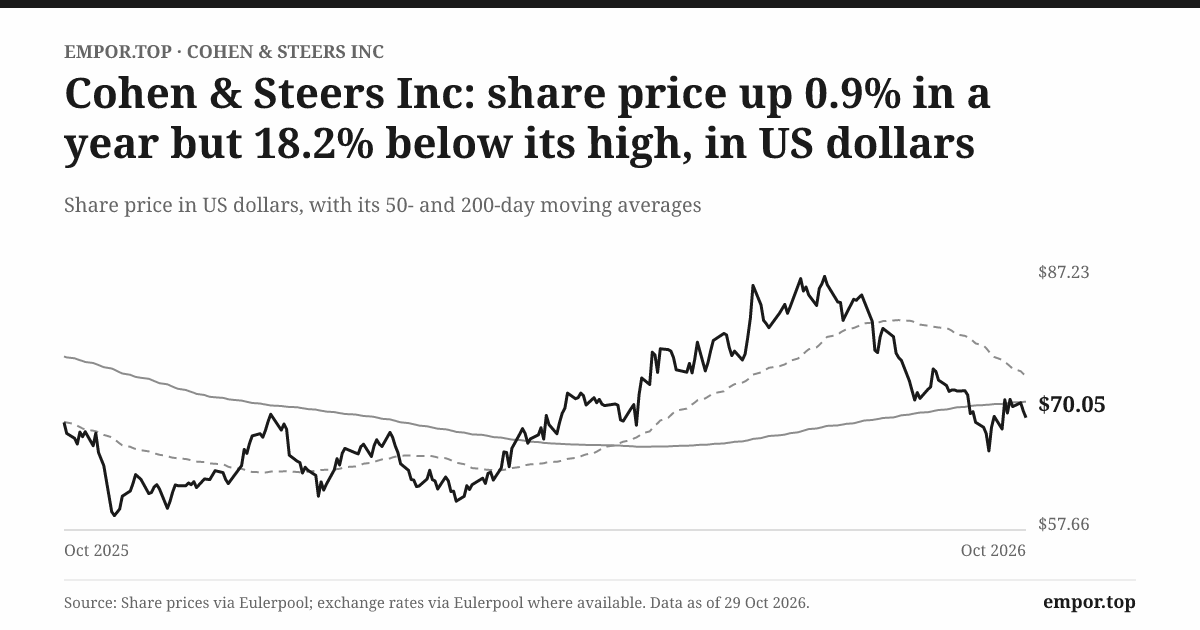
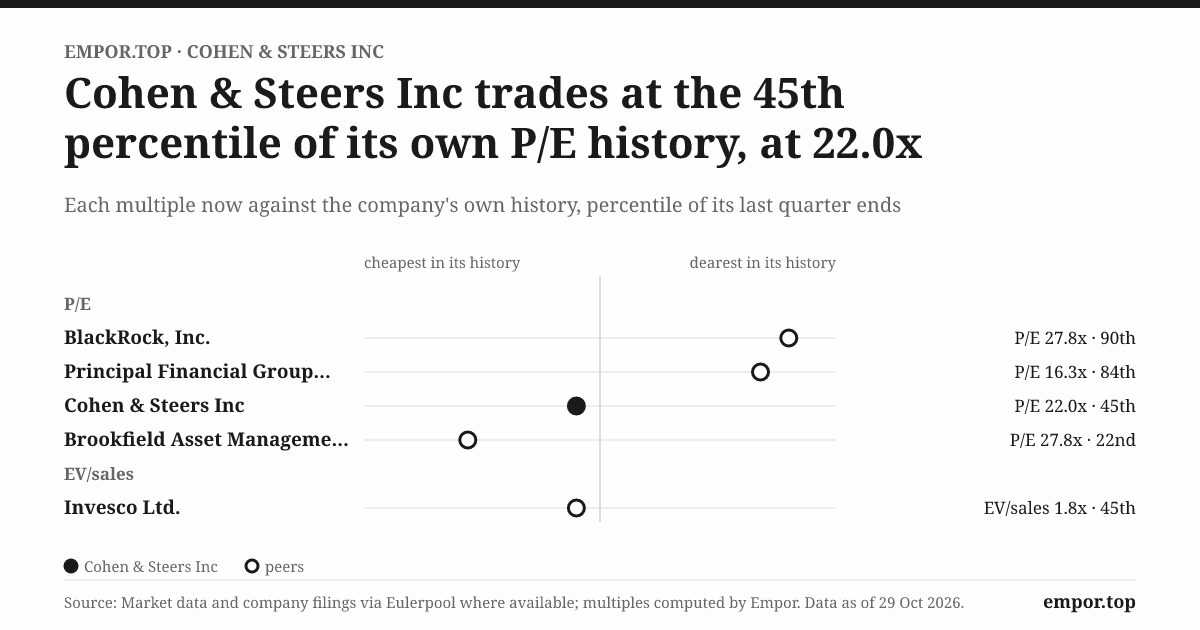
Tonight that investor is looking at a $3.6 billion company trading at $70.05 a share, about 18% below its high of the past year. The stock carries a dividend yield of about 3.8% on a quarterly payment of 67 cents, and it sells for about 22 times trailing earnings, almost exactly its own five-year median of about 23 times.1 The market, in other words, is not pricing a crisis or a boom. It is pricing a company somewhere in the middle of its own cycle, and asking whether the next turn goes up or down.
To answer that, the story has to go back to a pair of bank analysts who thought a neglected kind of security deserved a firm of its own.
 Subscribe on LinkedIn
II. Two Founders, One Unusual Bet
In the late 1970s, two young analysts sat in Citibank's New York offices covering, among other things, real estate. Martin Cohen was a Brooklyn native who played classical guitar. Robert Steers had grown up in Rye, a commuter town north of the city, and would still live there decades later.7 Neither came from the world of commercial property developers. They came at real estate as securities analysts, and that angle shaped everything that followed.
In 1980 Steers left Citi to become chief investment officer of National Securities and Research Corporation in Greenwich, Connecticut, and he hired Cohen.7 There, in 1985, the two men launched what Institutional Investor later described as the first mutual fund focused on REITs.7 A year later they left to open their own firm. Cohen & Steers was founded in 1986 in New York City, built around a single conviction: ordinary investors and big institutions ought to be able to own commercial real estate the way they owned stocks, through liquid, publicly traded securities rather than illiquid buildings or limited partnerships.17
It is worth pausing on how unfashionable that idea was. In the mid-1980s, the REIT market was tiny, much of American commercial property sat in private hands and in the tax-shelter partnerships of the era, and big brokerages had little reason to staff up coverage of a sector that generated small trading commissions. To a large financial firm, listed real estate was a rounding error. To two analysts who had studied it closely, it was an under-researched market where specialist knowledge could earn a premium. The insight was less about property than about information: if no one else is doing the work, the people who do it have an edge.
The early years tested the conviction. The property market rolled over at the end of the decade, and by 1989 the downturn was severe enough that, by one account, the founders were recruiting their wives to work for free.7 That detail matters because it shows the shape of the risk from the very beginning. A firm built on one asset class does not get to opt out of that asset class's bad years. It just has to survive them.
Survive they did, and the product sequence that followed built the franchise piece by piece. In 1991 the firm launched an open-end mutual fund dedicated to real estate securities, a launch it traced to a suggestion from Stanford.7 That fund gave individual investors a daily-priced, redeemable way to own a diversified REIT portfolio, and it coincided almost perfectly with the great REIT initial public offering wave of the early 1990s, when property owners short of bank credit turned to public markets for capital. The specialists who had been there first were now the obvious managers for a fast-growing asset class.
The firm then extended outward from its core, but in a disciplined direction. Closed-end funds, which raise a fixed pool of capital and trade on an exchange, gave it permanent money to manage. Global real estate followed U.S. real estate. In 2003 the firm launched a preferred securities fund, an income strategy that sat next to REITs in many investors' portfolios, and in 2004 it began managing listed infrastructure, the toll roads, pipelines, utilities and towers that behave a little like real estate with a regulatory wrapper.7 Each step moved into an adjacent corner of what the industry would come to call real assets and income. None was a leap into something unrelated.
In 2004 the founders took the firm public on the New York Stock Exchange. The shares priced at $13, and the offering raised about $104 million, money earmarked to expand the business and seed new investments.87 The founders kept large stakes. Nearly a decade later, founders and employees still owned about 60% of the company, a figure that helps explain why Cohen & Steers has always behaved more like a partnership with a ticker than a conglomerate subsidiary.7
That listing created the version of the company investors know today: a focused manager, controlled by its founders, whose fortunes would now be visible to anyone each quarter. Visibility cuts both ways. The cycle still mattered. Four years after the IPO, it arrived in its most violent form.
III. The 2008 Shock That Tested the Specialism
Picture the REIT market at the end of 2008. The listed property sector had just lost more than a third of its value in a single year, the broad REIT index down almost 38%.7 Credit markets had frozen. Many REITs had borrowed heavily in the boom and now faced maturing loans with banks that would not refinance them. For a few months the question was not whether REIT prices would recover, but whether some well-known landlords would survive at all.
For Cohen & Steers, this was existential in a precise way. Its revenue was a percentage of client assets, and client assets were collapsing on two fronts. Market losses shrank every portfolio, and frightened clients pulled money out. By one contemporary account, the firm's assets under management plunged to about $15.1 billion by the end of 2008, roughly half their level a year earlier, and net outflows for the year were about $3.4 billion.7 Its flagship U.S. real estate composite lost about 34% that year, a little better than the index but cold comfort to anyone holding it.7 The arithmetic of a fee business is unforgiving: halve the assets and you roughly halve the revenue, while rent, salaries and research costs do not fall nearly as fast.
What the firm had going for it was a clean balance sheet. It carried no debt and held cash of about $4.55 a share, and the firm met redemptions in part by selling its European and Asian REIT holdings and drawing on about $500 million of reserves.7 That is the first lesson of the crisis for an asset manager: the parent company's survival depends less on the brilliance of its research than on whether it has borrowed against a revenue stream that can vanish.
Then came the move that turned the crisis into part of the firm's legend. In 2009, with REITs desperate for equity and investors afraid to supply it, Cohen & Steers helped organize capital for an industry recapitalization. It offered to put money behind REITs that would use its endorsement to raise equity and refinance their debt, effectively lending its credibility as a cornerstone buyer to issuers who needed someone credible to go first.7 More than a dozen REITs took the money, including names such as Prologis, AMB Property and Simon Property Group.7 The REIT sector went on to raise large amounts of equity that year, repairing its balance sheets and setting up the recovery.
It is tempting to read the recapitalization as proof of a permanent moat. That would overstate it. What the episode demonstrated was access and standing: when the market broke, issuers and co-investors were willing to follow a specialist's lead, which is not something a generalist fund with a small REIT sleeve could have offered. It also put the firm's own clients into deeply discounted securities at what turned out to be a generational low. But reputation in a crisis is not the same thing as a lock on clients in good times.
The recovery that followed needs the same careful reading. Clients came back quickly. Net inflows in 2009 were almost $4 billion, about 81% of them institutional, and in 2010 and 2011 combined the firm raised roughly $13.5 billion of net new money, again mostly from institutions.7 By the end of 2012, assets stood at about $45.8 billion, well above the $29.8 billion of December 2007.7 Some of that rebound was earned: institutions rewarded a manager that had kept its head and its research team in the worst year. Some of it was simply the REIT market roaring back from its lows, which would have lifted any portfolio full of REITs regardless of who chose them. And the comeback was not linear. In 2012 the firm suffered about $950 million of net outflows, mostly from Japan, a reminder that even the strongest post-crisis franchise could lose money when one large distribution channel changed its mind.7
So the 2008 shock leaves a test that every later moat claim must pass. What would keep clients and assets when performance and markets turn against the firm? In 2009, the answer was a balance sheet with no debt, a research reputation strong enough to lead a recapitalization, and institutions willing to buy the dip with a trusted manager. None of those things changed the basic machine underneath, which still converts client assets into fees at a rate the market sets every day. To see why that machine is so profitable in good years and so exposed in bad ones, you have to open the fee table.
IV. The Fee Machine Behind the Funds
Buried in the 2025 annual report is a table that explains more about Cohen & Steers than any mission statement. It lists, by vehicle, how much the firm earned for each dollar it managed over the year. Open-end funds, the mutual funds sold through wealth advisers, earned an effective rate of about 67 basis points, or 67 cents on every $100 of assets. Institutional accounts, the separate mandates run for pension funds, sovereign funds and other managers, earned about 39 basis points. Closed-end funds earned about 89 basis points.3 Same research team, same analysts, often the same underlying securities, and yet a dollar in a closed-end fund pays the firm more than twice what a dollar in an institutional account does.
The basic mechanism is simple. Advisory and administration fees are calculated on daily average assets at rates set in each fund's or client's contract.3 Multiply the average balance by the rate, and that is the revenue. A small amount comes from distribution and service fees, and an even smaller amount from performance fees, which in 2025 came to just $1.7 million out of more than half a billion dollars of revenue.3 This is not a hedge fund living off a share of the upside. It is a toll on the size of the assets, collected every day those assets stay put.
That makes the revenue recurring, but it does not make it a subscription. Software companies sign multi-year contracts with minimum commitments. Cohen & Steers' clients can reduce or terminate their mandates, and the company does not disclose standard contract lengths or minimum commitments in its filings.3 A mutual fund investor can redeem any business day. An institution can fire a manager with a phone call and a notice period. The fees recur only because, in most months, most clients choose to stay. Revenue is a moving product of three things: how much money clients keep with the firm, what the markets do to that money, and the mix of vehicles it sits in.
The mix is where the economics get interesting. The closed-end funds earn the richest rate because their capital does not shrink when investors sell their shares. Once a closed-end fund raises its pool, investors who want out sell their shares to other investors on the exchange; the fund itself does not shrink when they leave. That makes those assets both stickier and more lucrative, which is why the occasional rights offering, in which an existing closed-end fund raises fresh capital, is such a meaningful event for the firm. In the third quarter of 2026, the costs of one such offering for a large preferred and income fund pushed up expenses, a reminder that this capital structure comes with an upfront bill.1
Institutional money sits at the other end. It arrives in big blocks, it is priced competitively, and the clients are sophisticated buyers who run searches, compare managers and can move quickly. The firm's largest institutional client, 大和アセットマネジメント (Daiwa Asset Management) in Japan, accounted for about 8.7% of assets but only about 4.5% of revenue in 2025, which tells you exactly how much a big institutional relationship is discounted relative to the firm's average.3 Open-end funds sit in between, earning respectable rates but competing in wealth channels where fee pressure from cheaper vehicles is relentless.
Put those pieces together and the firm's blended fee rate becomes one of the most important numbers in the story. In the third quarter of 2026, on the company's adjusted basis, the business earned about 58 basis points across all its assets, down slightly from the prior quarter.1 That small drift is not alarming on its own. But the direction of travel matters, because new growth is coming disproportionately from institutions, ETFs and offshore funds, and some of those carry lower rates than the legacy mutual funds and closed-end funds.
That leaves the operating question that carries through the rest of this story. Can Cohen & Steers grow its assets with new strategies and distribution channels without diluting what each dollar earns, or without spending so much on launches and salespeople that the margin never recovers? At those margins, the business is wonderful when the assets are rising. But the machine has no shock absorbers. When the market falls, the toll falls with it, and the firm discovered just how far the toll could fall in the years after its greatest peak.
V. When the AUM Peak Turned into a Trough
At the end of 2021, Cohen & Steers looked like a firm that had finally escaped gravity. Assets under management reached a record $106.6 billion.4 Clients had sent it about $9.5 billion of net new money during the year, and the markets had added roughly $21 billion more as real estate and infrastructure securities rallied out of the pandemic.4 Revenue for the year came to about $584 million, up more than a third, and the firm's operating margin hit 44.7%.4 Nearly 45 cents of every revenue dollar dropped to operating profit. Net income more than doubled from a depressed 2020 to about $211 million.4
The record year is worth dissecting, because it is easy to tell it as a franchise story and harder to tell it honestly. Of the roughly $30 billion by which assets grew in 2021, about a third came from clients choosing the firm and about two-thirds came from the market lifting what it already managed.4 Neither number alone tells the whole truth. The inflows were real and impressive, the best organic year in the company's history. But the profit explosion owed more to market appreciation, because a fee business with largely fixed costs turns every extra dollar of market-driven assets into almost pure margin.
Then the Federal Reserve began raising rates at the fastest pace in four decades, and the assets Cohen & Steers specializes in were among the most rate-sensitive in the market. REITs, infrastructure and preferred securities are all, in different ways, long-duration income assets: their value depends on cash flows stretching far into the future, and higher interest rates make those future cash flows worth less today. By the end of 2022, assets under management had fallen to $80.4 billion, a drop of about a quarter in twelve months, and the decline came almost entirely from market depreciation even though net flows remained positive for the year.4 Clients mostly stayed. The value of what they owned did not.
The revenue line lagged the market by a few months and then followed it down. Revenue slipped slightly in 2022, then fell almost 15% in 2023 to about $489 million.9 Operating margin compressed from 44.7% to 33.6%.94 That is the operating leverage of an asset manager running in reverse. The firm had hired, built technology and expanded distribution in the good years, and those costs did not fall when the fee base did. Net profit fell from about $211 million in 2021 to about $129 million in 2023, a decline of nearly 40% in two years.49
The recovery since has been real at the top line and much weaker in the middle. Revenue rose about 6% in 2024 and about 10% in 2025, reaching roughly $567 million, close to the 2021 peak.93 Yet the operating margin kept drifting down, to about 33% in 2024 and 31.3% in 2025.93 Net profit grew about 17% in 2024 and then barely moved in 2025, rising roughly 1% to about $153 million.3 Over the ten years to 2025, revenue grew about 5.6% a year and net profit about 9.1% a year, a perfectly respectable compounding record. Over the latest three years, though, revenue was essentially flat and net profit fell about 3.6% a year.34
One wrinkle deserves a sentence, because it matters for anyone comparing figures. Cohen & Steers reports results under accounting rules and also on an "as adjusted" basis that strips out items such as the results of consolidated funds, seed investment gains and certain one-off costs. The two can differ meaningfully. In the third quarter of 2026, the adjusted operating margin was 37.2% while the reported margin was 32.4%.1 Management prefers the adjusted figure, and it is a reasonable view of the core fee business. An outside investor should simply remember that the cleaner number is the one the company chooses, and that the reported number is the one the auditors sign.
Why has margin not snapped back with revenue? The cost lines answer most of it. Compensation is the largest expense, and management has guided to it running at about 40% of revenue.2 General and administrative costs have grown as the firm launched ETFs, built offshore funds, added a private real estate vehicle and hired distribution staff. Fund launch and rights-offering costs, more than $5 million in the third quarter of 2026 alone, hit expenses before the new assets pay their way.1 The firm has been investing through the trough rather than cutting back, which is a defensible strategic choice and a real drag on near-term earnings conversion.
The verdict from the cycle is two-sided. The long record shows a powerful operating model when markets and flows align, and the 2022 drawdown proved that clients largely stayed loyal through a brutal year. But the recovery in revenue has not restored peak margins, so a return to record assets alone would not prove that the firm's earnings power is back. It matters, too, where that revenue comes from, and the answer is more concentrated than the firm's hundreds of strategies and vehicles might suggest.
VI. Four Funds, One Adviser
Four ticker symbols tell a quiet story about where the money actually comes from. CPX, the Cohen & Steers Preferred Securities and Income Fund, generated about 11.8% of the firm's total revenue. CSI, the flagship Cohen & Steers Real Estate Securities Fund, produced about 11.6%. CSR, Cohen & Steers Realty Shares, the descendant of the firm's original 1991 vehicle, produced about 11.5%. CSIR, the Cohen & Steers Institutional Realty Shares fund, contributed about 10.6%.3 Four funds, each above the 10% threshold that triggers disclosure, together accounting for roughly 45% of revenue.
Step back further and the concentration grows. Across all affiliated funds, the open-end, closed-end and other vehicles that Cohen & Steers sponsors and advises, the company earned about $410 million of advisory, administration, distribution and service fees in 2025, close to three-quarters of its revenue.3 Daiwa, the largest outside client, accounted for less than 5% of revenue.3
It is important to be precise about what this concentration is and is not. These four funds are sponsored products, not single customers. Thousands of individual investors and financial advisers sit behind each of them, and the firm does not disclose how concentrated the ultimate holders are. A fund with $8 billion of assets spread across hundreds of thousands of accounts is a very different risk from a pension plan with $8 billion that can fire the manager in a board meeting. In that sense, the fund complex gives the firm something valuable: its own distribution shelf, its own pricing, and products whose boards rarely change advisers.
But the concentration still bites, through a different mechanism. If the U.S. real estate category falls out of favor with wealth advisers, three of those four funds suffer at once, because they all draw from the same pool of investors making the same asset-allocation decision. If one flagship fund has a bad year against its benchmark and lands on the wrong side of a consultant's screen, the revenue hit is immediate and visible. The firm's fortunes rest on a small group of vehicles whose health, flows and fees determine the bulk of the income statement.
The relationship also runs both ways on the balance sheet. At the end of 2025 the affiliated funds owed the company about $39 million in receivables, while the firm's non-traded private real estate vehicle, known as CNSREIT, owed it another $11 million or so, against less than $1 million the parent owed to its funds.3 The CNSREIT balance is essentially an advance: the company has fronted organizational and offering costs, to be repaid over 60 months starting no later than the earlier of December 2026 or the vehicle reaching $750 million of net asset value.3 That clock is now very close, and the repayment schedule turns a receivable into a modest test of whether the private real estate vehicle can carry its own weight.
What the filing establishes is that the fees charged to the funds are contractually determined and approved by the funds' boards, the standard structure for American mutual and closed-end funds. What the company does not quantify is anything resembling a brand charge or management fee levied on affiliates beyond those advisory contracts, and nothing in its disclosure suggests such arrangements exist.3 The related-party loop is the business model, not a governance problem.
The institutional side, meanwhile, has its own lumpiness, and the third-quarter call put a number on it. CEO Joseph Harvey told analysts the firm had been notified of about $400 million of partial account rebalancing outflows from two institutional clients, adding that these were not related to investment performance. One client was eliminating an asset class from its portfolio; the other was being acquired and changing strategy for part of its accounts.2 As Harvey put it, institutional flows "can be uneven from quarter to quarter."2 Those notices had not yet left the building; they were warnings of future redemptions.
Set against that, the firm reported a won-but-unfunded institutional pipeline of about $1.9 billion, up from $1.6 billion the prior quarter and, by management's description, its second largest ever, with new mandates spread across real estate, listed infrastructure and multi-strategy portfolios and across North America, Europe and Asia.2 Harvey said the lag from award to funding typically runs about four months.2 If those mandates fund on schedule, the $400 million of notified outflows will be more than replaced. If they slip, the institutional channel, which contributed only about $49 million of net inflows in the third quarter, will look flat.1
The test, then, is whether new clients and new vehicles broaden the franchise enough that the revenue share of the largest funds starts to fall. That is precisely what the new vehicles are supposed to do, and it is time to measure them.
VII. New Vehicles, Old Questions
In 2025, a firm whose founders had built their name on mutual funds and closed-end funds did something it had never done before: it listed its first active exchange-traded funds.3 By August 2026 it had launched the seventh, CSRA.1 The move was overdue by industry standards and strategically sensible. Wealth advisers have been moving client money out of traditional mutual funds and into ETFs for more than a decade, drawn by lower costs, intraday trading and, above all, tax efficiency. A mutual fund that sells winners to meet redemptions can hand every remaining shareholder a capital gains bill. An ETF, thanks to the way shares are created and redeemed in kind, can usually avoid that. For a manager whose clients hold income-heavy real asset strategies in taxable accounts, an active ETF wrapper is a way to keep the same research in a package advisers now prefer.
The early numbers are encouraging. Active ETF assets grew about 22% in the third quarter of 2026 to roughly $1.3 billion, and ETFs took in about $274 million of net new money during those three months.21 Now set that against the whole firm. At $1.3 billion, the ETFs represent about 1.4% of the $95.9 billion Cohen & Steers manages.1 Even if they doubled every year for the next three years, they would still be a single-digit share of the business. The ETF line is a plausible future distribution channel. It does not, today, change the economics of the company.
The same honesty applies to the firm's other new vehicles. Its offshore funds for non-U.S. investors, the SICAVs, reached about $2.2 billion.1 Multi-strategy real assets, which combine real estate, infrastructure, commodities and other inflation-sensitive holdings in one portfolio, drew almost $900 million of inflows in the first nine months of 2026, according to Harvey, and stood at about $3.7 billion at the end of September.21 Harvey highlighted one open-end fund in this family that had grown to about $2.1 billion from $150 million in 2020.2 Those are real proof points that the firm can commercialize something beyond U.S. REITs. They are also small next to the roughly $62 billion still sitting in real estate strategies.1
The shape of the third quarter's flows shows where the new distribution is working. Of the roughly $1.55 billion of net inflows, about $1.3 billion came through wealth channels: about $727 million into the traditional mutual funds, about $290 million into the offshore funds and about $274 million into the ETFs.1 In other words, the old mutual fund franchise was still the largest single engine, and the new wrappers added roughly as much again between them. That is a healthier pattern than either extreme. If the ETFs were simply cannibalizing the mutual funds, the firm would be trading higher-fee assets for lower-fee ones; if the mutual funds were the only source of growth, the firm would be leaning on a shrinking vehicle. For now, both are growing. To push the brand further into those channels, the firm appointed a new chief marketing officer, Erik Schneberger, in July 2026, and it sells from offices in London, Dublin, Hong Kong, Tokyo and Singapore as well as its New York headquarters.1
The most ambitious extension is private real estate. CNSREIT, the firm's non-traded REIT for wealthy individuals, owns twelve properties and, by Harvey's account, about $900 million of total assets with roughly $400 million of equity.12 He called it "the number one performing nontraded REIT" since its inception, and noted it would complete a three-year track record in January, the threshold many wealth platforms require before adding a product.2 That is a management claim about relative performance among a small peer group of vehicles, not an audited ranking. And Harvey himself conceded that real estate remains a less favored strategy at the big wirehouse brokerages, where infrastructure and private credit currently draw the attention.2 Sized by disclosed equity and fee contribution, private real estate is an option, not yet a growth driver.
Funding these launches requires seed capital, and here the firm has been active. It made about $49.8 million of seed investments in 2025 to give new strategies the starter assets and track records that outside buyers demand.3 Seed money is the asset manager's version of research and development: it rarely makes money directly, and its success is measured by how much outside capital it attracts. A seeded fund that never grows past the firm's own money is a cost, not a product.
What has not risen is physical reinvestment. Purchases of property and equipment fell from about $57 million in 2023, when the firm was fitting out new offices, to about $12 million in 2024 and about $6 million in 2025, while headcount rose only from 411 to 424 people over 2025.39 This is a low-capital operating model. The money that matters goes into people, seed capital and distribution, not buildings or machines.
How should a skeptical investor weigh the new push against the firm's history of launches? The record is mixed in an instructive way. Preferred securities and listed infrastructure, launched in 2003 and 2004, became genuine franchises that now manage about $18 billion and $12.5 billion respectively.71 The real assets fund launched in early 2012 took the better part of a decade to reach meaningful scale.7 The lesson is that this firm can turn adjacent strategies into businesses, but slowly, and usually only when an asset class comes into favor. A technical launch and a pot of seed capital are milestones, not evidence of commercialization.
The scorecard for the new vehicles is therefore simple to state: ETF assets and net flows, the realized fee rate on those assets compared with the legacy funds, and, eventually, whether the new lines produce incremental operating profit rather than just incremental expense. All of that requires cash, and the cash statement is where Cohen & Steers looks most confusing on first read.
VIII. What the Numbers Say About Cash and Capital
Open the 2025 cash-flow statement and the first line of operating activities seems to describe a different company from the income statement above it. Cohen & Steers reported net income in the hundreds of millions of dollars. Yet cash from operations for the year was negative, about $120 million out the door, and free cash flow, after a small amount of capital spending, came to about negative $126 million.3 A quick screen would flag this as a business burning cash. It is not, and understanding why is the key to reading this company's accounts.
The reconciliation tells the story. Inside operating cash flow sits about $319 million of securities purchased by investment funds that Cohen & Steers consolidates onto its own books, because it owns a controlling stake in them, usually as the seed investor.3 When those funds buy securities, accounting rules count the purchases as an operating use of cash for the consolidated group. Much of the money to buy them did not come from the parent at all. Outside investors in those same funds contributed about $229 million, which appears down in financing activities as contributions from noncontrolling interests.3 Separately, stock-based compensation of about $46 million was a real expense on the income statement that consumed no cash.3
Think of it like a landlord who manages a building and also owns a controlling slice of a property fund. If the fund uses its investors' money to buy apartments, the landlord's consolidated accounts show a big cash outflow, even though the landlord's own bank account barely moved. That is what happened here. Consolidated cash flow is a poor stand-alone measure of the parent adviser's cash economics, because fund activity dominates the movement. The company does not publish a full parent-only cash bridge each year, which leaves investors to reconstruct one.
The balance sheet gives a clearer picture of the parent's liquidity. At the end of 2025, Cohen & Steers held about $146 million in cash, about $110 million in U.S. Treasury securities and about $148 million of net seed investments in liquid assets.3 By the end of September 2026, the company put cash, Treasuries and seed investments together at about $388 million.1 Not all of that is equally spendable. Seed positions support live products and cannot be pulled without consequences for the funds that depend on them, and some seed positions are in less liquid strategies altogether. The firm also had about $74 million of unfunded commitments to investments.3 The "investments" line of the balance sheet, which has grown to more than $430 million, should not be mistaken for cash.
The liabilities side is lighter than it looks. Data providers often tag about $138 million as borrowings, but that figure is the firm's office lease liabilities, not funded debt.3 Cohen & Steers has a $100 million revolving credit facility running to August 2029, undrawn, and it reported compliance with all covenants at the end of 2025.3 Any leverage inside the closed-end funds belongs to those funds and their shareholders, not to the parent.
That cushion does more than sit there. In 2025 it produced about $26.9 million of non-operating income, roughly 13% of pretax profit, made up of about $22.0 million of interest and dividends and about $8.7 million of investment gains, partly offset by a foreign-exchange loss of about $3.8 million.3 For a business whose reported profit grew by only a couple of million dollars that year, income from the treasury and seed book is not a rounding error; a swing in rates or in seed-investment marks can move earnings per share as much as a good quarter of flows. The currency line has a similar story. The firm earns most of its revenue in North America but also bills clients in Japan, Europe and Asia-Pacific, and it uses forward contracts to hedge the non-dollar advisory fees, while its sponsored funds run their own hedges.3 The corporate hedges cost only a few hundred thousand dollars in 2025; the larger derivative losses that appear in the consolidated accounts belong mostly to the funds.3 Here again, the consolidated statements blend two businesses that an investor should read separately.
Against that liquidity, the dividend record tells its own story of intent. Cohen & Steers has always treated the dividend as the main way of returning money to owners. Over the twelve years from 2014 to 2025, dividends paid ranged from about 63% of net profit in a strong year to about 161% in 2020, with a median near 97%; in 2025 the payout was about 83%.3 In several of those years the firm paid out more than it earned, often through special dividends in the period before 2021, when cash had accumulated. The pattern describes a company that treats its surplus capital as belonging to shareholders. It also means the dividend leans on market-sensitive earnings, so a deep market drawdown would test it.
The one notable capital-raising decision in recent years went the other way. In April 2024, the company sold about 1.0 million new shares through an at-the-market offering at an average price of about $69.60, raising roughly $68.4 million net of costs and about $70 million gross, for general corporate purposes including seeding new investment strategies.610 It then terminated the program.6 That was modest dilution, roughly 2% of the share count, but it was dilution by a company that pays out most of its earnings as dividends, which is equivalent to paying shareholders cash with one hand and asking for some of it back with the other. Notably, the new shares were sold at almost exactly where the stock trades today.
The same year, the company filed a shelf registration that also allowed existing holders to register potential share sales.11 Registration is not the same as selling, and the founder-family stakes reported in the latest proxy are essentially unchanged from a year earlier.53 Share purchases shown in 2025 were tax withholding on employee stock awards, not a buyback program.3
So the money trail resolves into a calmer picture than the headline cash flow suggests. The adviser generates healthy cash, pays most of it out, carries no funded debt and keeps a sizeable liquid cushion. The open question is how well the money it now chooses to retain, the seed capital and the 2024 equity raise, will be deployed. That is a question about the people who make those decisions, and about the families who still own the room.
IX. The Founders Still Own the Room
The 2026 proxy statement contains a short table that tells you who really decides the company's direction. Robert Steers and his family hold about 23.5% of the shares. Martin Cohen and his family hold about 17.7%.5 Together, the two founding families control roughly 41% of the company they started nearly forty years ago. The next-largest holders are index giants: BlackRock with about 8.4% and Vanguard with about 6.5%, according to their own ownership filings.5 Those two stakes are largely passive. For practical purposes, no meaningful decision about strategy, capital or control happens without the founders' agreement.
Day-to-day leadership, though, has passed to a second generation of managers who grew up inside the firm. Chief executive Joseph Harvey joined in 1992, within a year of the flagship open-end fund's launch, and rose through research and portfolio management to run the company.75 He is a portfolio manager by training who talks about real estate cycles with an investor's vocabulary. Jon Cheigh, the president and chief investment officer, was promoted to global head of real estate in 2012 and now oversees investments across the firm.72 On calls, Cheigh tends to frame the macro story in compressed, quotable lines; in October he described the year's performance as "a real yield story" and argued that "rates matter, but valuations and fundamentals matter more."2 The chief financial officer, Amit Muni, is new, appointed in June 2026 after his predecessor resigned in October 2025.125 The transition matters only as context: the team explaining margins and flows this year includes a finance chief still learning the firm's books.
How is that team paid, and for what? The board said 2025 incentives considered revenue, adjusted operating income, net income, operating margin, organic growth and assets under management.5 That is a sensible mix on paper: some measures reward growth, some reward profitability, and one, organic growth, specifically rewards winning client money rather than riding the market. Harvey's reported compensation moved from about $6.5 million in 2023 to about $5.6 million in 2024 and about $7.0 million in 2025.5 Over the same three years, net profit rose from about $129 million to about $151 million and then about $153 million.93 Pay fell in the year profits recovered most and rose in the year profits barely moved, which is not the tight alignment one might hope for, though 2025 was also the year organic growth turned positive and revenue grew fastest. The pay is not extravagant for the chief executive of a publicly listed manager of nearly $100 billion, but it is not obviously tied to margin quality either.
Shareholders seem broadly comfortable. At the April 2026 annual meeting, say-on-pay received about 45.1 million votes in favor and about 1.9 million against, roughly 96% support.13 The one sign of friction was in the director elections, where independent director Edmond Villani received about 5.7 million votes against.13 With the founders' 41% voting for management's slate, those votes against represent a far larger share of the unaffiliated shareholders, a modest but genuine protest that is worth watching rather than treating as a governance crisis. The board itself has nine members, a majority independent, and the chair and chief executive roles are separate.5
The fairest way to judge management credibility is through the record rather than the personalities. On the positive side, this team has navigated multiple brutal market cycles without borrowing against the business, without a wrenching acquisition and without abandoning its specialist identity. It returned to positive organic growth in 2025 after the outflows of the rate shock, and its long-term investment performance, as the next chapter shows, is strong. On the other side, the revenue recovery has not yet restored prior margins, and management continued to grow costs through the trough. It is a defensible choice that has not yet paid off in earnings.
An activist looking at this company would stress-test one decision above all: the 2024 equity raise. The firm sold new shares to fund seed capital and general purposes at a time when it was paying out the large majority of its earnings as dividends and holding hundreds of millions of dollars in cash, Treasuries and seed investments. The follow-up question writes itself. Have the strategies seeded since then gathered meaningful outside assets and begun to earn returns on that capital? The early ETF numbers are a partial yes. The full answer will take several more years. Founder control makes that question harder for outsiders to force onto the agenda, but it also means the people making the bet are wagering their own families' wealth alongside everyone else's.
Whether the bet pays depends on whether the firm's specialist edge can keep winning mandates against far larger competitors.
X. The Specialist’s Edge, and Its Limits
Imagine a consultant presenting manager options to a public pension fund's investment committee. On one slide is BlackRock, which can offer a REIT index fund for a few basis points, an active real estate team, and a hundred other products on the same platform. On another is Vanguard, offering the cheapest passive exposure in the industry. On a third is T. Rowe Price or a similar diversified active manager with a real estate sleeve. And on the last slide is Cohen & Steers, which can offer nothing but real assets and income strategies, but can say it has done little else since 1986. Which one wins the mandate?
The honest answer is that it depends on what the client is buying. If the client wants cheap exposure to the REIT index, Cohen & Steers loses, and has no business competing. If the client wants a team that will try to beat the index by picking the right landlords, data centers and pipelines, the specialist has a real case. That is the arena: Cohen & Steers competes with large diversified managers, with specialist real asset and income managers, and increasingly with passive products, and its scale is a small fraction of the giants'. Broad asset-under-management comparisons mean little here, because the giants' totals mostly sit in unrelated strategies.
The company runs as a single reportable segment, an asset management business, with fees tied to a handful of strategy families and vehicles rather than a set of unrelated businesses.3 Real estate remains the heart of it, with about $62 billion of the $95.9 billion under management; preferred securities, listed infrastructure and multi-strategy real assets account for most of the rest.1 This concentration is the strategy, not an accident.
It also means the firm's fortunes now ride on themes far from the shopping malls and office towers people picture when they hear "REIT." On the October call, Cheigh said data centers make up about 10% of the U.S. real estate portfolio, and that about a third of the infrastructure portfolio sits in utilities, many of them racing to supply power to those same data centers.2 Asked whether the artificial intelligence build-out risked overcapacity, he answered plainly: "We don't believe there's excess capacity of compute."2 Harvey added that private infrastructure allocations at big institutions were leveling off and argued that listed infrastructure was not coming at the expense of private infrastructure.2 These are management views, and they could prove wrong. But they show how the specialist pitch has evolved: the firm is no longer selling REITs as a generic income asset, but as a way to own the physical plumbing of the digital economy with daily liquidity. If that framing persuades allocators, the franchise widens. If the data-center trade cools, the same exposure becomes a new source of volatility.
Here is the moat argument, made once. Cohen & Steers has accumulated nearly four decades of specialist research in a corner of the market that generalists cover thinly. It has a recognizable brand in that corner, long-lived fund products with sticky shareholder bases, a closed-end fund complex that provides permanent capital, and global distribution through wealth channels in the United States and institutional relationships in Japan, Europe and elsewhere. Those assets help it win mandates when clients want active real asset expertise.
The evidence for the edge is its recent long-term investment record. On the October call, management said 98% of its assets were in strategies outperforming their benchmarks over five years, and 97% over three years.2 Those are exceptional figures by industry standards, where active managers as a group tend to struggle to beat benchmarks after fees.
Now test the claim against the mechanisms that would actually break it. The first is short-term performance. The one-year figure on the same scorecard was 57%, and it had been worse: in the second quarter of 2026, only about 40% of assets were outperforming over the latest quarter, with U.S. real estate at 15% and global real estate at just 2%.2 The third quarter brought a sharp rebound, with U.S. real estate at 86% and global real estate at 67%.2 Consultants watch these numbers, and a stumble in the firm's core strategy, even a temporary one, is exactly the moment a pension plan reconsiders a mandate. Long-term outperformance builds the reputation; short-term underperformance creates the opening for a competitor.
The second mechanism is passive substitution and fee compression. The company itself identifies passive products and fee pressure as competitive risks.3 Every year, more real estate exposure moves into index funds and ETFs that cost a tiny fraction of the firm's fees. The firm's blended fee rate is high by modern standards precisely because its products are active and specialized, and that premium has to be earned over and over.1
The third mechanism is client behavior. Institutions multi-source; they split mandates across several managers and can rebalance without firing anyone, which is exactly what the $400 million of notified outflows represented. Clients can move a real estate allocation to another manager in weeks.3
The fourth is the asset class itself. If investors decide that real assets are a less attractive home for capital, because of higher rates, a shift toward private markets or simply fashion, even a best-in-class specialist will suffer. Harvey's comment that real estate remains a less favored strategy at major wirehouses is a reminder of this.2
So what remains of the moat? The evidence supports specialist expertise and strong recent long-term relative performance. It does not establish switching costs or pricing power; the fee schedule alone says nothing about whether the firm can hold its rates. The edge is real but narrow: it is the reason Cohen & Steers wins mandates when clients want active real asset management, not a guarantee that clients will keep wanting it.
The broader risk radar follows the same mechanism. Interest rates and market levels feed directly into assets and fees. Artificial intelligence and automation could lower the firm's operating costs, but the company also flags them as forces that could intensify competition and accelerate substitution.3 Cybersecurity and regulation matter through client trust and fund operations rather than as standalone threats. The auditors, Deloitte, issued a clean opinion on the 2025 accounts and flagged the valuation of hard-to-price Level 3 investments as the critical audit matter, a reasonable focus for a firm holding seed capital in less liquid strategies.3
That reduces the ongoing scorecard to three measures. First, organic growth, including the annualized rate above 6% that management reported for the third quarter.2 Second, investment performance weighted by assets, especially the one-year figure, which stood at 57%.2 Third, operating margin alongside the realized fee rate.31 With the scorecard in hand, it is time to weigh the whole case.
XI. The Case for a Better Cycle—and the Case Against It
That symmetry frames both sides of the debate. The market is pricing roughly the past five years' average outcome. The question is whether the next five will look better or worse.
Start with the bull case. Five consecutive quarters of organic growth suggest that client demand is broadening, with inflows across wealth channels, closed-end funds and institutions, and across real estate, preferred securities, infrastructure and multi-strategy portfolios.11 The institutional pipeline is near a record.2 On the company's adjusted basis, operating margin through the first nine months of 2026 was about 36%, up from about 35% a year earlier, showing that margin can expand when revenue grows.1 The balance sheet carries no funded debt, an undrawn $100 million revolver, and a liquid cushion of cash, Treasuries and seed.3 Return on equity over the past twelve months was about 24%, a level few financial businesses reach without leverage.13
Now the bear case, which has a clear mechanism. The third-quarter inflows did not prevent another market-driven decline in assets, and the firm's revenue is still, at bottom, a bet on the prices of real estate and income securities.11 Profit growth still trails revenue as costs rise with the growth initiatives.31 Reported operating margin remains well below its 2021 peak.34 Nearly three-quarters of revenue comes from affiliated funds, and four of them each contribute more than a tenth.3 And a skeptical investor might ask whether executive incentives, which include asset levels, can rise with market appreciation without any improvement in client retention or margin quality.
A wider lens helps settle which case has more weight. Consider the forces that shape this industry. Buyer power is significant: institutions are sophisticated, multi-source and negotiate fees hard, as the gap between institutional and closed-end fee rates shows, though individual fund investors are fragmented and weaker. Supplier power is mostly the power of talent; the scarce input is skilled portfolio managers and analysts, which is why the company says compensation runs at about 40% of revenue.2 The threat of substitutes is the most serious force: passive REIT and infrastructure ETFs deliver the asset-class exposure at a fraction of the fee. The threat of new entrants is moderate; launching a fund is easy, but building a forty-year record and a closed-end complex is not. Rivalry is intense, because every large manager can offer some version of the firm's strategies.
Hamilton Helmer's seven powers framework sharpens the point. Cohen & Steers lacks scale economies against BlackRock or Vanguard, lacks network effects, and has weak switching costs. It has no proprietary cornered resource beyond its people, and talent can leave. What it has is a version of branding, in the sense that specialist reputation lowers a client's perceived risk of picking it, and a modest form of process power in its research and portfolio construction, demonstrated by the long-term record. The closed-end funds add something close to a structural advantage, because that permanent capital cannot walk away. Those powers are real, but they are the softer powers, the kind that need continual re-earning through performance rather than the hard powers that compound regardless.
Valuation follows from that. On a trailing basis the stock trades at about 22 times earnings, an earnings yield of about 4.6%.1 Diversified listed active managers such as T. Rowe Price and AllianceBernstein traded at roughly 10 to 11 times earnings in October 2026.1415 Those firms differ in scale, mix and structure, and AllianceBernstein's partnership form complicates comparisons, so the gap is descriptive rather than a verdict. Still, it says something. The market pays Cohen & Steers roughly double the multiple of large diversified active managers, which implies an assumption that its specialist franchise will grow faster, hold fees better or recover its margin. A 22 times multiple on earnings that have been flat for three years assumes recovery is coming.
The resolution, then, is that the business has a credible answer to the question of why it can win: focused expertise, a strong long-term record and improving flows. It does not yet have proof that growth will be broad, durable and margin-accretive. The bull case requires several more quarters like the third; the bear case requires only one bad year in real estate markets. What the company's history teaches about which of those to expect is the subject of its lessons.
XII. Lessons from a Fee Business Tied to Real Assets
Go back to the two pictures that frame this story. In 2009, the firm acted when others fled; in 2022, after a year of record assets and a 45% margin, it watched about a quarter of its assets disappear in twelve months while its clients mostly stayed put.74 The first moment shows what specialism can do. The second shows what it cannot. Between them lies a set of lessons that belong to this company and no other.
The first comes from the recapitalization. When the listed property market broke in 2008, the firm that understood it best was able to act. That trust later helped bring clients back.7 The lesson for founders and investors is that specialist reputation is built in the worst years and harvested in the following ones. A specialist earns its reputation when the market breaks, not just when the market rises.
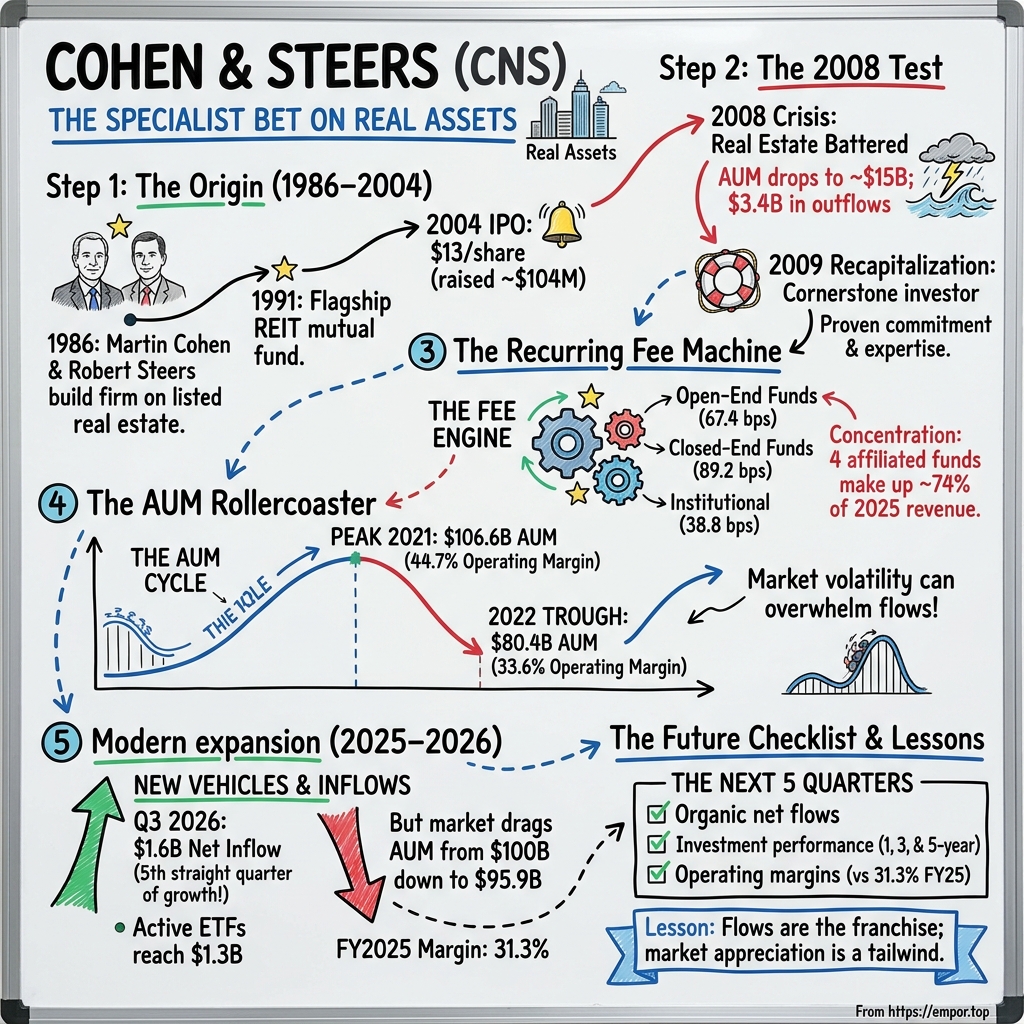
The second comes from the great peak and the trough that followed it. At the peak, market appreciation accounted for most asset growth; when the market reversed, those gains unwound while client inflows largely stayed.4 Any investor judging an asset manager should separate the two numbers before deciding how good the business really is. Flows are the franchise; market appreciation is a tailwind.
The third comes from the cash-flow statement, where consolidated fund activity made a profitable firm appear to lose cash.3 The lesson travels well beyond Cohen & Steers: modern asset managers seed and consolidate funds, and reported cash flow can mislead in either direction. When the funds sit inside the accounts, read the cash bridge before judging the adviser.
The fourth comes from the new products: some adjacent strategies became franchises, while others took years to scale.71 The current launches remain unproven. Founders tend to measure new products by whether they launched; investors should measure them by whether outside clients stay. A launch is a promise; outside assets and lasting fees are the proof.
Taken together, these lessons describe a company whose history rewards focus and patience, but which has never found a way to smooth away the beta of its asset classes or to guarantee that rising assets translate into rising shareholder cash. Expertise is the reason it survives cycles. It is not a reason the cycles stop. Which way the current one turns will become visible over the next five quarters.
XIII. The Next Five Quarters
Cohen & Steers stands tonight at an awkward midpoint. It has more momentum with clients than at any time since 2021, a stock price roughly where it sold new shares two and a half years ago, and earnings that have barely moved in a year.16 The story's central questions will be answered not by any single event but by a sequence of quarterly reports, and the evidence that matters is clear enough to describe in advance.
The first thing to watch is whether flows broaden. The five-quarter run of organic growth needs to survive the next market wobble. The real test is whether positive flows show up across several strategies and channels at once, wealth and institutional, real estate and infrastructure, U.S. and international, rather than leaning on one hot product or one closed-end fund offering. Management's annualized organic growth rate is the cleanest single measure.2
The second is the institutional ledger. The notified outflows have yet to leave, and the won-but-unfunded pipeline has yet to arrive; management says awards typically fund within about four months.2 If the pipeline converts on schedule, the institutional channel will show net growth despite the departures. If funding slips or awards shrink, the narrative of broadening demand will look thinner.
The third is margin conversion. Against the 31.3% reported operating margin of 2025, the questions are whether revenue growth continues to outrun expense growth, whether compensation holds near management's 40% guide, whether the fee rate holds near 58 basis points as the mix shifts, and whether launch costs begin to fade.321 Management has guided to general and administrative expenses growing at a mid-single-digit rate over 2025 and to an effective tax rate of about 25% to 26%, which gives investors a concrete yardstick: if revenue keeps growing at double digits while those costs grow in single digits, the margin should finally start to widen.2 If it does not, the explanation will have to come from somewhere other than the guidance. The CNSREIT repayment clock, which starts by December 2026 at the latest, is a small but concrete test of whether the private real estate vehicle begins paying back the parent.3
The fourth is the investment record. The one-year figure was weak earlier in 2026 and rebounded sharply in the third quarter.2 If it holds, consultants and wealth platforms have no reason to cut allocations, and the long-term record continues to sell itself. If U.S. real estate stumbles again, the window for competitors opens.
And finally, the ownership questions. Investors will watch founder-family stakes in future proxy statements, any new share issuance, and evidence that the seed capital raised in 2024 has attracted external money at scale.
If flows broaden, the record holds and the margin rises, the market's assumption of recovery will look justified. If flows stall, performance slips or the margin keeps drifting, the stock's 22 times multiple will look like a price for a recovery that did not arrive. The next calls should show which part of that chain is holding.
XIV. The Specialist’s Promise
In 1986, Martin Cohen and Robert Steers bet that public markets could open real estate investing to anyone with a brokerage account, and that two analysts who understood those markets better than anyone else could build a firm around that idea.7 Nearly four decades later, the firm they built remains a real assets specialist, and the public company is worth about $3.6 billion.1 The bet worked. It also never stopped being a bet.
That is what makes Cohen & Steers unlike another asset manager. Its focus helped it survive 2008, lead a recapitalization, and win billions in new mandates. That focus is also the reason its fortunes still rise and fall with interest rates and property prices it does not control.
The next inflow may come from a wealth adviser buying one of the new ETFs or a pension plan funding a newly won mandate. The firm has earned that trust through decades of specialist work. The market will decide how much it is worth.
References
-
Q3 2026 Earnings Release — Cohen & Steers, 2026-10-15 ↩↩↩↩↩↩↩↩↩↩↩↩↩↩↩↩↩↩↩↩↩↩↩↩↩↩↩↩↩↩↩↩↩↩↩↩↩
-
Q3 2026 Earnings Call Transcript — Stock Analysis, 2026-10-16 ↩↩↩↩↩↩↩↩↩↩↩↩↩↩↩↩↩↩↩↩↩↩↩↩↩↩↩↩↩↩
-
2025 Form 10-K — Cohen & Steers, 2026-02-20 ↩↩↩↩↩↩↩↩↩↩↩↩↩↩↩↩↩↩↩↩↩↩↩↩↩↩↩↩↩↩↩↩↩↩↩↩↩↩↩↩↩↩↩↩↩↩↩↩↩
-
2022 Annual Report and Form 10-K — Cohen & Steers, 2023-02 ↩↩↩↩↩↩↩↩↩↩↩↩↩
-
Cohen & Steers Raises $70 Million in Gross Proceeds from At-the-Market Equity Offering — Cohen & Steers, 2024-04-22 ↩↩↩↩
-
Cohen & Steers Looking Beyond REITs and Real Estate — Institutional Investor, 2013-03-26 ↩↩↩↩↩↩↩↩↩↩↩↩↩↩↩↩↩↩↩↩↩↩↩↩↩↩
-
2026 Annual Meeting Voting Results — Cohen & Steers, 2026-04-30 ↩↩
 LinkedIn
 WhatsApp
 Reddit
 Hacker News
 Email
 Kindle
 RSS Feed
 Spotify
 Apple Podcasts
 Amazon Music
 Audible
 YouTube