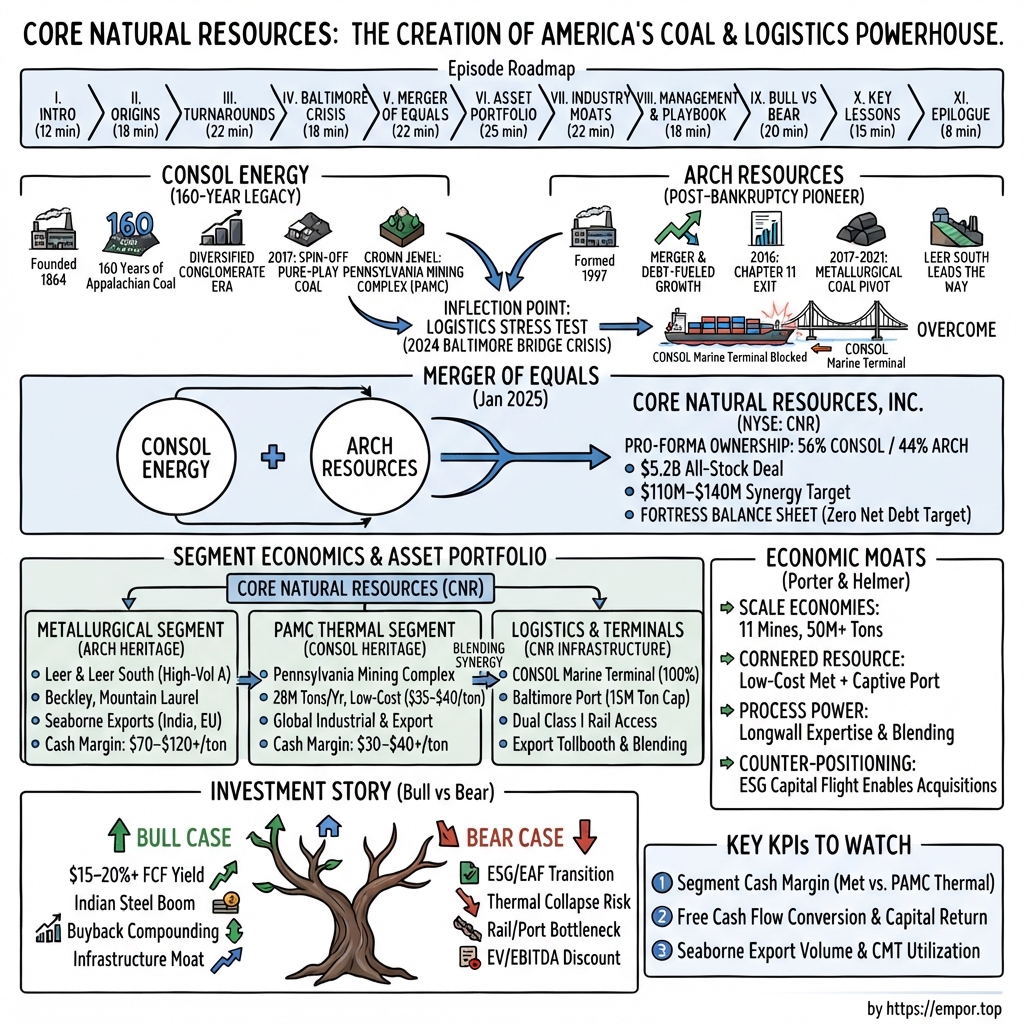
Core Natural Resources: The Creation of America's Coal & Logistics Powerhouse
I. Introduction & Episode Roadmap
On the morning of January 14, 2025, in a conference room in Canonsburg, Pennsylvania, the final closing documents cleared. CONSOL Energy — a company whose corporate roots date back to 1864 — and Arch Resources, the post-bankruptcy metallurgical coal specialist based in St. Louis, ceased operating as standalone public entities to form Core Natural Resources, Inc., trading on the New York Stock Exchange under the ticker CNR.3 The transaction represented the most significant consolidation in the American coal sector since a wave of bankruptcies reshaped the industry a decade earlier.
A merger and a mine, one day apart
Twenty-four hours earlier and roughly 250 miles to the south, an operational crisis unfolded. Deep inside Leer South — Arch's newest, most capital-intensive metallurgical mine in Barbour County, West Virginia — monitoring equipment detected combustion-related activity in a previously mined section. The longwall system was halted immediately and would not cut coal again for 339 days.10
This contrast defined Core Natural Resources' first eighteen months. On one side stood a strategically aligned merger of equals executed without a premium or added debt by two management teams that spent the prior decade restructuring their balance sheets. On the other lay the reality of underground coal mining, where unexpected geological events can abruptly disrupt operational plans.
The combined enterprise is larger and more complex than initial merger presentations suggested. Core operates eleven mining complexes across six states, including eight longwall systems — mechanical shears up to 1,000 feet wide that slice through coal seams and allow the roof behind them to collapse in controlled fashion.2 For 2026, management projected total sales between 87.3 million and 92.4 million tons.1 That volume reflects a heavy weighting toward Powder River Basin sub-bituminous coal from Wyoming — the lowest-energy, thinnest-margin fuel in the portfolio. In the second quarter of 2026, Core sold 10.2 million tons of Powder River Basin coal at a cash margin of negative 57 cents per ton.1
This dynamic highlights a critical distinction within Core's business model: headline sales volume diverges sharply from profit generation. Earnings stem primarily from two assets — high-calorific-value thermal coal from the Pennsylvania Mining Complex and High-Vol A metallurgical coal from the Leer complex — alongside a marine export terminal in Baltimore that operates as a high-margin logistics gatekeeper.
Core's early financial results were further complicated by significant non-recurring items. For full-year 2025, the company posted a net loss of $153.2 million on revenues of $4.16 billion.4 In the second quarter of 2026, performance rebounded to a net income of $126.5 million and adjusted EBITDA of $323.6 million. However, that EBITDA figure included $125.4 million in recognized insurance proceeds following the settlement of the Leer South claim at its $154.5 million policy limit.1 Excluding those insurance proceeds, underlying EBITDA improved sequentially by approximately 15%, a dynamic highlighted by Jefferies analyst Chris LaFemina during the company's August 6, 2026 earnings call.15
What this story has to resolve
The central question facing investors is not whether Core's valuation is modest, but whether an integrated coal producer and infrastructure owner can convert scale into durable free cash flow amidst soft metallurgical coal prices and declining domestic thermal demand. Currently, the company carries a market capitalization of approximately $4.8 billion across roughly 49.6 million shares outstanding.6
Analyzing this enterprise requires examining the two distinct paths that led to the merger: CONSOL's decade-long transition from natural gas back to a pure-play coal focus, and Arch's post-bankruptcy strategic shift away from thermal coal toward metallurgical production. It also requires reviewing the March 2024 Baltimore bridge collapse, which served as a real-world stress test for the company's combined export infrastructure.
Subsequent evaluation hinges on deal synergies, segment-level mining economics, and direct peer comparisons against Alpha Metallurgical Resources, Warrior Met Coal, Peabody Energy, and Alliance Resource Partners. Furthermore, scrutiny of management execution is essential, following a chief executive transition ten months after closing, multiple upward revisions to synergy targets, and recurring analyst questions regarding cost guidance.
Ultimately, Core serves as a case study for a broader market trend: how capital-constrained, politically challenged natural resource industries function after consolidating into a small group of disciplined operators relying entirely on internally generated cash flow.
 Subscribe on LinkedIn
II. Predecessor Foundations & Divergent Trajectories (1864–2016)
CONSOL: 160 years of being an energy company
The corporate roots of CONSOL trace back to 1864, when Consolidation Coal Company was formed in western Maryland during the Civil War to combine mines along the Georges Creek valley. Its coal was prized by the U.S. Navy for burning hot and clean in ship boilers, and Core Natural Resources still carries that founding date on its corporate identity today.6 The enterprise that became CONSOL helped power American industrialization, surviving economic crises, labor shifts, and the long decline of Appalachian mining employment while developing an enduring corporate philosophy: management viewed CONSOL not merely as a coal producer, but as a broader energy company.
That strategy created severe operational friction by the 2000s. CONSOL housed two fundamentally conflicting businesses under a single leveraged balance sheet: a legacy coal franchise in southwestern Pennsylvania and a fast-growing Marcellus and Utica natural gas position. Capital allocation became an ongoing structural conflict. Gas drilling demanded heavy capital and attracted investor enthusiasm, whereas coal generated steady cash flow but faced growing capital market skepticism. Simultaneously, the coal segment carried significant legacy obligations, including retiree healthcare, federal black lung liabilities, reclamation bonding, and long-term mine closure costs that persist well beyond a seam's operational life.
Resolving this tension took years of structural re-engineering. On November 28, 2017, CONSOL Energy split into two independent public entities: the natural gas business retained the NYSE ticker CNX and rebranded as CNX Resources, while the coal operations — comprising the Pennsylvania Mining Complex and the Baltimore marine terminal — were spun off as a new CONSOL Energy under the ticker CEIX, with shareholders receiving one CEIX share for every eight CNX shares held.9 Then-CEO Nicholas DeIuliis framed the transaction around classic corporate unbundling logic, asserting that the separation allowed two distinct companies to maintain a "singular focus" on their respective industries.9
The liabilities inherited by the standalone coal entity offer essential context for its performance over the subsequent seven years. Beyond its physical assets, the spun-off company absorbed legacy obligations accumulated over a century and a half of underground mining: pension and healthcare commitments for retired workers, federal black lung benefit exposures, and perpetual water treatment obligations. These legacy liabilities represent ongoing cash commitments that continue long after active mining ceases. Consequently, financial analysts evaluate coal producers on an enterprise value basis rather than equity value alone. For a pure-play coal producer with a modest market capitalization, these obligations represent a substantial proportion of enterprise value, requiring any evaluation of net cash positions to be weighed against total legacy liabilities.
Arch: scale bought with borrowed money
Arch's history followed the opposite trajectory — not a conglomerate divesting assets, but a serial consolidator that leveraged its balance sheet ahead of a market downturn. Arch took shape in its modern form during the coal sector consolidation of the 1990s and expanded aggressively during the 2000s, acquiring scale across the Powder River Basin and Appalachia on the assumption that the prevailing commodity supercycle was structural rather than cyclical.
That assumption proved flawed. Between 2003 and 2011, rapid expansion in Chinese steel manufacturing and coal-fired power generation absorbed global coal supply faster than producers could add capacity. As prices surged, producers extrapolated demand growth into their long-term planning, treating Asian demand expansion and seaborne supply deficits as permanent structural shifts. In reality, the industry was responding to a localized capital expenditure peak in China, committing capital to long-lead mine developments that came online just as Chinese fixed-asset investment growth began to decelerate.
Arch executed its largest transaction at the peak of this cycle. On June 15, 2011, Arch acquired International Coal Group for $3.4 billion, funding the transaction through a combination of newly issued debt and equity.8 The strategic rationale was compelling on paper: ICG contributed 431 million tons of metallurgical-quality reserves, positioning Arch as the second-largest U.S. metallurgical coal producer, while management targeted 15 million tons of annual metallurgical output by 2015 alongside $70–80 million in annual synergies.8 CEO Steven Leer framed the acquisition as expanding Arch's footprint "into every major U.S. coal supply basin."8
The aftermath illustrated the risk of debt-funded cyclical acquisitions. Arch purchased ICG at the peak of the metallurgical coal market. Within three years, seaborne coking coal prices collapsed, Chinese steel demand slowed, and domestic shale gas development undercut thermal coal in U.S. power generation. Overburdened with acquisition debt during a dual-market downturn, Arch filed for Chapter 11 bankruptcy protection in January 2016.
The ensuing restructuring cleared Arch's balance sheet. On October 5, 2016, Arch emerged from bankruptcy having eliminated approximately 93% of its debt, leaving $363 million in term loans and capital leases against more than $300 million in cash reserves, accompanied by projected 2017 capital expenditures of $55 million and annual debt service of approximately $33 million.7 CEO John Eaves described the restructured business as possessing a "clean balance sheet" with "top-tier assets."7
While accurate, those assessments highlighted a stark reality for equity investors: creditors absorbed the loss from the ICG acquisition, wiping out original shareholders, while post-bankruptcy equity holders inherited high-quality assets at a written-down cost basis. This structural dynamic — where core operational assets outlast the financial leverage used to acquire them — explains the persistent valuation discount applied to coal equities.
A secondary lesson from the ICG acquisition bears directly on how investors should evaluate Core's current strategy. Arch's targeted annual synergies of $70–80 million on the ICG deal were technically achievable,8 yet they proved immaterial relative to a $3.4 billion purchase price and its associated debt service burden. While reported synergy targets reflect operational integration progress, overall transaction success ultimately depends on purchase price and capital structure discipline rather than operational cost savings alone.
By late 2016, the two companies stood in symmetrical positions. CONSOL was one year away from spinning off its coal operations, anchored by a high-capacity longwall complex but burdened by legacy obligations. Arch held a deleveraged balance sheet alongside a mandate to deploy cash flow prudently. Both companies responded by narrowing their operational focus — a strategic shift that ultimately enabled their merger eight years later.
III. The Twin Turnarounds: CONSOL's Spin & Arch's Post-Bankruptcy Pivot (2016–2021)
Inflection one: a company built around three longwalls
The strategic importance of the Pennsylvania Mining Complex stems from its underlying geology rather than its corporate structure. The Pittsburgh No. 8 seam runs beneath Greene and Washington counties in southwestern Pennsylvania in a thick, remarkably consistent, low-sulfur band. In longwall mining, geological consistency dictates operating efficiency. A longwall system operates as an underground factory: a mechanical shearer traverses a face up to 1,500 feet wide, supported by hundreds of hydraulic roof shields that advance in sequence, feeding coal onto a conveyor while the mined-out roof caves in controlled fashion behind. Installing a longwall system requires hundreds of millions of dollars in capital, and unit economics depend on continuous operation. Operational disruptions — whether from fault lines, sandstone intrusions, water ingress, or methane gas — impair profitability for the duration of the delay.
Core operates three longwall mines along that seam: Bailey, Enlow Fork, and Harvey, which in 2025 produced roughly 11.0 million, 10.0 million, and 5.6 million tons, respectively.5 The three operations feed a centralized preparation plant and a single rail loadout. This shared surface infrastructure allows the complex to distribute fixed operational costs across more than 25 million annual tons, historically placing its cash costs in the lowest tier of North American coal production.
When Jimmy Brock assumed leadership of the newly independent CONSOL Energy in 2017, he brought operational experience built over decades within the mines, having served as longwall coordinator, mine foreman, superintendent, and chief operating officer.12 His strategy prioritized operating efficiency, unit-cost discipline, corporate simplification, and an aggressive pivot toward export markets to counter domestic utility retirements. Corporate simplification involved repurchasing the affiliated master limited partnership, CONSOL Coal Resources, which had been carved out prior to the spinoff. The master limited partnership structure had split cash flows between two separate investor bases, creating structural friction that weighed on equity valuation.
In the mid-2010s, energy companies routinely carved out stable assets into publicly traded partnerships, selling units to income-focused investors while retaining incentive distribution rights that directed an increasing share of cash flows back to the parent entity. Designed for an era of low interest rates and expanding distributions, the structure became inefficient once equity markets grew hostile to coal. The dual structure created duplicate governance, overlapping disclosure requirements, and divided cash flows that impeded unified capital allocation. Reabsorbing the partnership did not generate growth on its own, but it eliminated capital allocation friction and signaled management's commitment to funding future operations strictly through organic cash generation.
The export expansion proved even more critical. By the first quarter of 2024, export sales generated approximately 65% of CONSOL Energy's total recurring revenues.18 That export capability relied on a specific quality of the coal itself: yielding roughly 13,000 BTUs per pound, high-calorific-value coal from the Pennsylvania Mining Complex absorbs rail and ocean transport costs to compete effectively in European, North African, and Asian markets against Colombian and South African producers. While low-heat thermal coal cannot absorb seaborne freight costs, high-calorific coal remains globally marketable, insulating the complex from domestic demand declines that threaten lower-grade thermal operations.
Inflection two: capital walks from Wyoming to West Virginia
During the same period, Arch pursued a contrasting capital allocation strategy. Following its 2016 restructuring, Arch owned extensive surface thermal operations in Wyoming's Powder River Basin — high-volume, low-cost mines facing long-term structural decline as domestic power plants closed. Conversely, the company also owned Leer, a High-Vol A metallurgical longwall in Taylor County, West Virginia, that operated among the lowest-cost coking coal mines globally.
Management chose to treat the Powder River Basin as a self-funding asset in harvest mode while concentrating growth capital on metallurgical coal. The flagship project of this strategy was Leer South, a second longwall in the same Tygart seam developed during the late 2010s and commissioned in the fourth quarter of 2021. Reflecting this strategic shift, the company rebranded from Arch Coal to Arch Resources in 2020 to emphasize its focus on steelmaking raw materials.
The distinction between thermal and metallurgical coal is fundamental to Core's economic model. Thermal coal is burned directly to generate electricity. Metallurgical, or coking, coal is heated in oxygen-free ovens at temperatures near 1,000 degrees Celsius to produce coke — a porous, carbon-rich material essential to blast-furnace steelmaking. In the blast furnace, coke serves three simultaneous functions: fuel, a chemical reducing agent to extract iron from ore, and a structural medium maintaining gas permeability. No commercially proven alternative fulfills all three roles at industrial scale. Coking coals are classified by their plastic behavior during heating; High-Vol A, the grade produced at the Leer complex, functions as a premium blending coal that enhances coke strength and fluidity when combined with hard coking coals.
The development of Leer South represented Arch's central strategic investment following its restructuring. Developing a second longwall within an established seam offered lower execution risk than typical greenfield projects: reserve geology was thoroughly mapped, existing preparation plant capacity could be expanded, and customer relationships for High-Vol A coal were already established through the original Leer operation. Compared with acquiring external metallurgical assets at prevailing market prices, organic development offered a compelling risk-adjusted return on paper — contingent on consistent mine execution.
That operational assumption proved vulnerable when underground thermal activity halted Leer South production in January 2025.
By 2021, CONSOL and Arch had converged on similar operational models from different origin points: focusing on low-cost longwall assets, limiting growth capital, and prioritizing shareholder returns over volume expansion. Yet each lacked the other's complementary strengths. CONSOL remained a thermal producer reliant on a single mining complex, albeit supported by proprietary export terminal ownership. Arch possessed premier metallurgical production and a declining thermal footprint, but lacked its own East Coast export facility.
A subsequent surge in global energy and steelmaking coal prices generated record cash flows for both companies, setting the stage for their eventual combination.
IV. The Catalyst & Stress Test: Baltimore Bridge Collapse & Export Logistics (2022–2024)
The night the channel closed
At 1:28 a.m. on March 26, 2024, the container ship Dali lost power leaving the Port of Baltimore, drifted into a support pier of the Francis Scott Key Bridge, and brought the span down into the Patapsco River. Six construction workers died. The federal shipping channel into Baltimore — the second-largest coal export gateway in the United States — was closed by the wreckage.18
For CONSOL Energy, this was not a remote risk; it was an immediate operational crisis that severed the primary physical pathway for its export revenue. Because the CONSOL Marine Terminal sits upriver from the bridge site, the blocked channel left roughly 65% of the company's revenue base with no immediate route to a customer.18
The disaster occurred immediately following one of the most profitable stretches in modern coal history. Russia's invasion of Ukraine in February 2022 had forced European utilities to secure emergency replacements for Russian thermal coal, driving seaborne prices to historic highs. In 2023, at the crest of that pricing cycle, the combined CONSOL and Arch businesses generated approximately $5.7 billion in pro forma revenue, $1.8 billion in adjusted EBITDA, and $1.4 billion in free cash flow.2 Both management teams deployed the cash windfall identically by retiring debt and repurchasing equity, establishing a combined net cash position of approximately $260 million by June 30, 2024.2
That market surge was driven primarily by natural gas supply shocks rather than structural coal demand growth. When Russian pipeline gas deliveries to Europe ceased, European utilities restarted or ramped up coal-fired power units where capacity existed, competing directly with Asian importers for non-Russian seaborne cargoes. Because coal was the only utility-scale fuel capable of expanding supply within a single winter, thermal coal pricing captured a massive premium. For thermal coal producers, sudden pricing upside typically stems from supply chain disruptions in substitute fuels rather than secular demand expansion — a market dynamic Core's commercial team cited during 2026 discussions regarding Middle East liquefied natural gas disruptions and their knock-on effects on Indian demand.15
Following the bridge collapse, vessel departures from CONSOL's marine terminal remained halted for nearly two months. When shipments resumed on May 20, 2024, operations faced severe logistical constraints: the temporary channel width of 350 feet fell short of the 400 feet required for fully loaded ocean vessels. As a result, ship loadings were restricted to roughly 56,000 net tons — well below the normal 140,000-ton capacity — while night-time vessel transits remained prohibited.28 Responding to the partial reopening, Chief Executive Jimmy Brock noted that operations were still constrained, adding that the company was hopeful to resume normal throughput as quickly as possible.28
What the outage really proved
The Baltimore outage highlighted a fundamental dual reality regarding Core's logistics infrastructure. On one hand, direct terminal ownership provides a distinct competitive advantage: Core controls its dedicated berth, storage stockpiles, and vessel loading schedules without queuing behind third-party shippers or paying merchant terminal tariffs. In an era where regulatory barriers effectively block new U.S. coastal coal export terminal construction, proprietary infrastructure represents a scarce operational asset.
Conversely, proprietary terminal control creates a concentrated single point of failure. While the channel was blocked, terminal ownership could not move coal; mines continued producing into surface stockpiles while cash inflows ceased. Financial recoveries eventually offset a portion of the loss, as Core settled its Baltimore business interruption claim for a net $40 million — receiving $10 million in the first quarter of 2025 and booking approximately $23.9 million in the fourth quarter of 2025.4 However, insurance proceeds offset short-term cash flow deficits without restoring lost shipping windows or customer delivery schedules.
This asset concentration became even more critical following the merger, as Core began routing metallurgical volumes alongside thermal output through the Baltimore gateway. Infrastructure vulnerability was underscored again on June 14, 2026, when severe winds exceeding 80 miles per hour destroyed one of two stacker-reclaimers at Dominion Terminal Associates in Newport News, Virginia — an East Coast export facility in which Core holds a 35% stake alongside Alpha Metallurgical Resources' 65% interest. While Alpha issued force majeure notices to affected customers,20 Core Chief Financial Officer Mitesh Thakkar informed analyst Nick Giles of B. Riley during the August 2026 earnings call that the operational impact was small relative to Core's minority position, with marketing adjustments keeping full-year guidance intact.15
Beyond export ports, Core remains reliant on eastern rail monopolies to move production to tidewater. Coal from Greene County, Pennsylvania, and Taylor County, West Virginia, depends entirely on rail lines operated by CSX Transportation and Norfolk Southern. For high-volume coal transport, no viable trucking or inland waterway alternatives exist. Terminal ownership grants Core control over final vessel loading, but leaves the producer exposed to rail freight rates across hundreds of miles of inland transit. Because seaborne competitiveness is dictated by delivered costs to European and Asian buyers, unexpected rail tariff increases compress profit margins just as directly as rising mine operating costs.
Experiencing two terminal disruptions within twenty-seven months demonstrates that infrastructure ownership, while enhancing cash margins under standard operating conditions, offers limited protection during severe logistics bottlenecks. Evaluating Core's export platform requires accounting for both its cash-flow premium in normalized markets and its exposure to systemic supply-chain interruptions.
By mid-2024, with the Baltimore shipping channel restored and both companies holding net cash balance sheets, the strategic logic for consolidation coalesced. Two disciplined, well-capitalized, yet structurally constrained coal producers were competing for identical export capacity, rail allocations, and capital from a shrinking pool of public market investors.
V. The Merger of Equals: Architecture of Core Natural Resources (2024–2025)
A deal designed to be un-lose-able
The announcement came on August 21, 2024, and the structure was the message.2 There was no premium. There was no cash. There was no financing condition, because there was no financing. Arch shareholders would receive a fixed 1.326 shares of CONSOL for each Arch share, leaving Arch holders with approximately 45% of the combined company and CONSOL holders approximately 55% on a fully diluted basis.2 The combined market capitalization at announcement was about $5.2 billion.27
Governance was split down the middle in the way that genuine mergers of equals are: eight directors, four nominated by each company. Brock would serve as executive chairman; Arch's Paul Lang would be chief executive; CONSOL's Mitesh Thakkar would be president and chief financial officer. Headquarters in Canonsburg, with a continued St. Louis presence. Arch was advised by Perella Weinberg with Latham & Watkins and Gibson Dunn; CONSOL by Moelis with Wachtell Lipton and McGuireWoods.2
Set that structure against the industry's history and the discipline is striking. Arch's own $3.4 billion ICG acquisition in 2011 was the archetype of what not to do — a premium paid in borrowed money at a cycle peak. The 2024 transaction inverted every variable: no premium, no leverage, no cycle timing bet. If the market went against the combined company, no creditor could force the outcome. That is not a small design choice; it is arguably the most important decision in the entire story.
Two structural features of the deal deserve more attention than they usually get. First, the transaction was designed to be tax-free for U.S. federal income tax purposes, which matters enormously to long-term holders in a sector where cost bases are often far below current prices.2 Second, the exchange ratio was fixed rather than floating. A fixed ratio means neither side is protected if the other's share price moves between signing and closing; it is a statement that both boards believed the relative — not absolute — value of the two companies was correctly struck. In a merger of equals, that is the only bet that can be made honestly, because there is no premium to argue about.
And here is where a widely repeated description deserves a correction. The phrase "merger of equals" is used loosely in financial media, and it is often a euphemism for an acquisition with better manners. In this case, the structure genuinely was balanced — split board, split executive suite, no premium, no control payment. But structures are static and companies are not. Within nine months, the CEO from one side had departed and the chairman from the other had taken both roles. Investors reading the 2024 deal documents as a description of how Core is governed in 2026 would be reading a snapshot of a negotiation, not of an outcome.
The synergy escalator
The synergy case rested on three pillars: logistics optimization and coal blending across a shared terminal network, procurement scale, and the elimination of duplicate corporate overhead. Management guided initially to $110–140 million of annual cost and operational synergies within six to eighteen months of closing.2 Then the number moved, twice, and quickly. In the first quarter of 2025 — barely four months after close — Core raised the range roughly 10% at the midpoint to $125–150 million.17 By the second quarter of 2025, the target had gone to $150–170 million, roughly 30% above the original midpoint. By the first quarter of 2026, Thakkar told investors the achieved run rate exceeded $160 million, tracking toward the top end of about $165 million, driven by SG&A reductions, improved marketing execution, and lower financing costs.14
Raising a synergy target twice inside twelve months is unusual and generally a credibility positive — it is the opposite of the more common pattern where deal synergies quietly disappear into "underlying cost inflation." But it deserves one caveat that analysts raised directly. On the February 2026 call, questioners pressed on why unit costs were not visibly lower if $150 million of synergies were real. Thakkar's answer was candid rather than defensive: tariffs "not envisioned at the time of the announcement" had offset part of the supply chain savings, and general inflation absorbed more.16 That is the correct disclosure, and it also means the synergies are best understood as an offset to cost creep rather than a step-change in margin. Investors modeling $165 million of incremental EBITDA on top of an unchanged cost curve will be disappointed.
The financing side got cleaned up early. In March 2025, Core refinanced its tax-exempt bond stack, upsizing from $276 million to $307 million, extending to a March 2035 maturity, converting the bonds to unsecured, and reducing the weighted average coupon to 5.3% — with 39 institutional investors participating in a book that was oversubscribed more than six times.19 For a coal issuer in 2025, an oversubscribed unsecured tax-exempt deal is a genuinely meaningful data point. It says the debt market, unlike the equity market, is willing to price these assets on cash flow rather than on ideology. Core carried roughly $1.0 billion of total liquidity as of the second quarter of 2026.1
The part nobody solved
What the deal did not do, and this matters, was resolve the portfolio's internal contradiction. Core inherited Arch's Powder River Basin assets — Black Thunder and Coal Creek, together roughly 49 million tons of 2025 production.5 These are not strategic assets in any forward-looking sense. They are enormous, low-margin, and exposed to a domestic thermal market in structural decline. Management has never described a plan to exit them. On the numbers, they consume working capital, diesel, and rail capacity for margins that in the second quarter of 2026 were slightly negative.1 A skeptical investor is entitled to ask whether the merger simply attached a large runoff business to a good one and hoped the good one would carry the narrative.
There is also a less discussed benefit to the combination that has nothing to do with cost: commercial optionality. A producer with only metallurgical coal must sell into whatever the steel cycle offers. A producer with met coal, high-BTU thermal, and terminal capacity can shift its product mix toward whichever market is paying better in a given quarter — including selling the thermal byproduct that inevitably comes out of a metallurgical mine into the export market rather than dumping it domestically. On the August 2026 call, Braithwaite was asked why the metallurgical segment's thermal byproduct was realizing around $55 per ton against prior levels in the $40s, and explained that the pricing depends on export market access and API2 index levels, with the $50–55 range expected to hold for the remainder of the year.15 That is a small number in isolation. Multiplied across several hundred thousand tons of byproduct, it is the merger's blending thesis showing up in an actual line item.
The counterargument, which management makes explicitly, is diversification: metallurgical coal is violently cyclical, high-BTU thermal is contracted years ahead, and Powder River Basin volumes are largely committed under multi-year utility agreements. That argument would be more persuasive if PRB earned a positive cash margin consistently. It does not.
VI. Business Model, Segment Economics & Asset Portfolio Deep Dive
Four businesses wearing one ticker
Core Natural Resources reports financial results across four operating segments. Evaluating the consolidated enterprise requires analyzing each segment individually, as their underlying cash economics, cost structures, and market dynamics diverge sharply.
The thermal engine
High Calorific Value Thermal. This segment combines the Pennsylvania Mining Complex with West Elk, a longwall mine in Gunnison County, Colorado, that produced roughly 3.2 million tons in 2025.5 In the second quarter of 2026, the segment sold 8.4 million tons at an average realized revenue of $58.11 per ton against cash operating costs of $38.58, generating a cash margin of $19.53 per ton as unit costs fell 9% sequentially.1 The segment operates as the company's primary profit generator, supported by strong revenue visibility. As of August 2026, Core had 30.9 million tons of 2026 high-CV thermal volume committed and priced at approximately $58.00 per ton, effectively covering nearly the entire full-year guidance range of 31.5 million to 33.0 million tons.1 For 2027, management reported that the order book was more than 50% contracted, with Indian export deliveries priced near $60 per ton and West Elk volumes in the upper $40s to low $50s range.15
This commercial contracting structure provides structural stability. Rather than exposing cash flows entirely to spot-market swings, the high-CV thermal portfolio functions as a forward sales pipeline with predetermined volumes and prices, subject primarily to counterparty performance and rail logistics.
The steel business
Metallurgical. The segment comprises the Leer, Leer South, Beckley, Mountain Laurel, and Itmann mining complexes.5 In the second quarter of 2026, total metallurgical sales reached 2.6 million tons — including 2.3 million tons of coking coal — realizing $114.13 per ton against cash costs of $85.65, yielding a cash margin of $28.48 per ton as operating costs declined 7% sequentially.1 That performance represented an operational rebound from the first quarter of 2026, when coking coal realizations stood at $122.11 per ton against costs of $92.35 per ton.13
However, a $28.48 per ton cash margin contrasts sharply with historical performance at Leer. During the 2021–2022 metallurgical coal market peak, High-Vol A assets generated unit margins several times that level. The 2026 results reflect a low-cost operational base selling into a depressed pricing environment. Core's realized coking coal prices sit below Australian hard coking coal benchmarks, reflecting both standard market discounts for High-Vol A and High-Vol B blending grades and broad demand softness across Chinese and Indian steel markets throughout 2026. Management framed these results on its August 2026 earnings call as executing effectively "in soft market conditions."15
Smaller, specialized operations complement the Leer longwalls and explain why segment-wide realizations differ from pure coking coal benchmarks. Beckley, located in Raleigh County, West Virginia, produced approximately 1.2 million tons of low-volatile metallurgical coal in 2025 using room-and-pillar continuous miners. Itmann, in Wyoming County, contributed roughly 453,000 tons of low-vol coal, while Mountain Laurel in Logan and Boone counties produced about 1.2 million tons of High-Vol B metallurgical coal.5 Continuous-miner operations incur higher per-ton operating costs than longwalls, but they extract coal qualities unavailable in the Tygart seam, enabling Core to offer steelmakers a multi-product portfolio.
This product diversity offers commercial utility. Blast-furnace steelmakers require specific coal blends combining varied volatile matter, fluidity, and ash profiles to achieve target coke strength. A producer capable of supplying multiple blend components under a single contract, shipped through a single export terminal, establishes a structural commercial advantage over single-product sellers by simplifying supply-chain logistics for overseas buyers.
The Wyoming question
Powder River Basin. Surface mining operations at Black Thunder and Coal Creek in Campbell County, Wyoming, generated 2025 production of roughly 47.4 million tons and 1.5 million tons, respectively.5 Second-quarter 2026 shipments fell to 10.2 million tons from 11.9 million tons in the first quarter, which management attributed to weak spring shoulder-season utility demand compounded by low domestic natural gas prices. Management characterized the quarterly dip as "principally a timing issue," pointing to approximately 50 million tons already contracted for full-year 2026.15 Realized revenue for the quarter stood at $14.28 per ton against cash operating costs of $14.85 per ton, resulting in a negative cash margin of 57 cents per ton.1 Generating negative cash margins across 40% of total corporate sales volume highlights the drag low-grade thermal assets exert on consolidated financial performance.
Core's commercial disclosures distinguish between contracted volumes that are fully priced and those left unpriced. Utilities enter multi-year supply agreements that establish volume commitments while leaving final pricing tied to future market indexes. For 2026, Core had fully committed and priced virtually its entire high-CV thermal sales guidance by mid-year, whereas roughly two-thirds of guided coking coal volume was priced.1 This contracting mix leaves residual spot-market exposure concentrated in metallurgical coal, leaving corporate cash flows positioned to capture upside if metallurgical prices recover while remaining vulnerable if market weakness persists.
The tollbooth
Core Marine Terminal. Core wholly owns the Baltimore marine export facility, which features approximately 20 million tons of annual throughput capacity, 1.1 million tons of ground storage, and direct access to two Class I railroads.5 The terminal handled 4.8 million tons of coal in the first quarter of 2026 compared to 5.0 million tons in the fourth quarter of 2025, generating approximately $16 million of adjusted EBITDA in each quarter.14 Combined with Core's 35% ownership stake in Dominion Terminal Associates in Newport News, Virginia, the network provides approximately 25 million tons of aggregate annual export capacity across two Mid-Atlantic ports.2
The Baltimore terminal functions as a high-margin logistics gatekeeper, generating fee-based EBITDA insulated from coal commodity price swings. Because regulatory constraints effectively preclude constructing new U.S. East Coast coal export terminals, the asset represents non-replicable infrastructure. Furthermore, it enables operational coal blending, allowing Core to combine Arch's metallurgical output with PAMC's high-calorific thermal coal at tidewater to meet specific buyer specifications.
However, the precise financial benefit of coal blending remains unquantified in public financial reporting. Core includes blending value within its total reported synergy figures, making it difficult for external investors to separate logistics savings from general administrative cost cuts. Reductions in cash overhead — with annual SG&A expenses falling from a combined $153 million toward a targeted run rate near $100 million — appear to drive the majority of reported synergy gains.14
In addition to its core mining and logistics assets, Core holds non-coal development projects. In July 2026, the Department of Energy selected CONSOL Innovations, a Core subsidiary, for a federal grant to construct a pilot facility extracting rare earth elements and critical minerals from coal refuse tailings at the Pennsylvania Mining Complex, subject to final contract negotiations with the DOE.26 Separately, Core's Touchstone advanced composites business was selected by Northrop Grumman as an aerospace component supplier.26 While these initiatives provide exposure to high-tech supply chains, neither generates material revenue today, leaving Core's investment thesis anchored entirely on mining execution and capital allocation discipline.
VII. Industry Structure, Competitive Landscape & Economic Moats
A rationalized field
An inspection of the modern U.S. coal landscape reveals a consolidated field dominated by a handful of survivors pursuing remarkably unified strategies. Following the 2015–2016 wave of bankruptcies, remaining operators adopted a shared operational playbook: avoid volume expansion, restrict financial leverage, and return excess cash flow to shareholders. Consequently, the industry functions less like a growth sector and more like a collection of independently disciplined liquidating trusts.
Alpha Metallurgical Resources provides the most direct comparison to Core's metallurgical segment. In the second quarter of 2026, Alpha generated revenue of $492.9 million, down 10.4% year-over-year, while posting a net loss of $12.3 million. Its adjusted EBITDA fell 44.5% to $25.6 million on 3.5 million tons of coal sales, yielding a cash margin of $15.64 per ton.23 Citing persistent market weakness, Alpha lowered its 2026 metallurgical sales guidance from a range of 14.4 million to 15.4 million tons down to 13.2 million to 14.0 million tons.23 These results yield two critical insights for Core investors. First, Core's metallurgical cash margin of $28.48 per ton during the same quarter significantly outperformed Alpha's $15.64, validating the cost advantage of the Leer longwall complex. Second, Alpha holds a 65% controlling stake in Dominion Terminal Associates, challenging the assumption that Core holds an exclusive infrastructure advantage in seaborne metallurgical transport.20
Warrior Met Coal represents the market's pure-play premium hard coking coal producer. Its Blue Creek development in Tuscaloosa County, Alabama, marks the most significant domestic metallurgical supply expansion in a decade. Representing a $1 billion investment in a single longwall system, Blue Creek is projected to average 6 million short tons annually over its first decade, expanding Warrior's nameplate production capacity by approximately 75% across a mine life exceeding 40 years.22 This influx of low-cost tonnage into a soft global pricing environment presents a direct competitive headwind, effectively capping seaborne price recoveries.
Peabody Energy highlights the structural operational risks inherent to underground mining. Peabody agreed to acquire Anglo American's steelmaking coal portfolio for $3.78 billion, but terminated the transaction on August 19, 2025, after a March 31, 2025 ignition event at the Moranbah North mine left the restart timeline uncertain and carrying costs running at an estimated $45 million per month, prompting Anglo to dispute the material adverse change claim and enter arbitration.21 This event closely mirrored the underground thermal activity at Leer South. That two major metallurgical mining operations were disrupted by combustion events within the same cycle underscores that geological volatility represents a broad sector risk rather than a company-specific flaw.
Alliance Resource Partners completes the peer group as a domestically focused thermal coal producer operating as a master limited partnership. Alliance emphasizes a distribution-first capital return model while maintaining minimal metallurgical or East Coast export terminal exposure. This model offers an instructive contrast in corporate finance. While a partnership distributes cash directly to unitholders as taxable income, a corporate entity repurchasing shares converts free cash flow into per-share equity value, deferring tax liability until realization. For long-term investors in a mature industry, share repurchases offer superior compounding potential—provided the repurchased shares trade below intrinsic value.
The substitution question, in plain terms
Evaluating the long-term investment thesis for metallurgical coal requires examining the technological realities of global steelmaking. Approximately 70% of primary steel produced worldwide relies on the traditional blast furnace route, which requires metallurgical coke derived from coking coal. Alternative manufacturing methods face clear physical and economic constraints. Electric arc furnaces process recycled scrap steel using electricity, eliminating coal consumption entirely; however, scrap availability depends on legacy steel inventories from past infrastructure cycles, and scrap-based steel struggles to meet the strict purity standards required for automotive and appliance sheet steel. Direct reduced iron technology uses natural gas or hydrogen to remove oxygen from iron ore, creating a raw material for electric furnaces. While green hydrogen-based direct reduction could eventually eliminate coal demand, it demands vast supplies of low-cost renewable energy and substantial capital expenditure—and most announced European commercial projects have experienced schedule delays.
Consequently, transition timing is more critical to equity valuation than ultimate technological direction. While the eventual displacement of coking coal appears probable over a multi-decade horizon, near-term substitution risks remain modest over the next five to ten years. This is particularly evident in India, where expansion continues along the blast furnace route as the most cost-effective method to scale steel output using available domestic iron ore and power supplies. Therefore, an investor's perspective on Core's metallurgical segment depends on assessing how rapidly equity markets discount this transition—with current equity valuations pricing in technology displacement well ahead of operational reality.
Reading the powers honestly
Applying Hamilton Helmer's 7 Powers framework to Core yields a mixed strategic profile.
Scale economies exist but are narrower than overall production volumes suggest. Operating eight longwall systems distributes fixed overhead effectively, and the Pennsylvania Mining Complex's shared preparation plant provides a clear cost advantage. However, scale in the Powder River Basin yields little economic benefit, as those surface operations generated negative cash margins in the second quarter of 2026 despite high output volumes.1
Cornered resource represents the company's strongest strategic position. High-Vol A reserves in the Tygart seam are geologically scarce, while the Baltimore export facility is regulatorily scarce, as environmental permitting barriers make constructing replacement coastal terminals practically impossible. Both assets provide clear operational moats, though neither conveys pricing power over seaborne commodity markets.
Process power is plausible but primarily demonstrated through operational recovery. Successfully recovering 209 hydraulic roof shields, along with the shearer, face conveyor, stage loader, crusher, and power system, from a sealed underground mine with limited equipment damage after eleven months represents a notable engineering feat.10 Similarly, West Elk's operational transition into the B seam while managing elevated methane levels and water influx demonstrates technical capability.16 However, technical expertise demonstrated during emergency recovery differs from process power that generates structurally lower steady-state operating costs.
Counter-positioning remains the weakest claimed advantage and is frequently mischaracterized. The strategic exit of major international miners—including BHP, Rio Tinto, and Anglo American—from coal assets did not grant Core an exclusive advantage. Instead, it provided the entire surviving industry with a cheaper asset acquisition environment alongside a permanently reduced institutional investor base.
Porter's five forces analysis highlights additional structural dynamics. The threat of new entrants is virtually non-existent, given that permitting greenfield underground coal mines or coastal export terminals in the United States is practically impossible—representing the sector's most durable barrier to entry. Buyer power is moderate to high, as primary steelmakers such as Tata Steel, JSW Steel, ArcelorMittal, Nippon Steel, and Baowu Steel operate with substantial scale and reference index pricing in contract negotiations. Supplier power is modest for mining equipment but high for logistics: CSX Transportation and Norfolk Southern control the sole rail routes connecting inland mines in Pennsylvania and West Virginia to tidewater, allowing freight rate increases to pass directly through to mine-gate realizations.
Meanwhile, competitive rivalry has been fundamentally reshaped by prior restructuring cycles. Prior to 2016, domestic producers competed aggressively on production volume funded by accessible debt markets. Remaining operators now compete on unit cost while returning capital to shareholders. Alpha lowering its 2026 volume guidance rather than producing unprofitable tons into a soft market provides a clear example of this capital discipline.23 The risk remains that supply discipline is an informal industry norm rather than a binding constraint; Warrior's development of Blue Creek demonstrates that producers will still deploy capital when presented with a high-grade deposit.22
In conclusion, Core's structural advantages in production cost and logistics infrastructure are genuine, but they operate within a mature, contracting sector rather than conferring market pricing power. That distinction remains central to determining the enterprise's long-term valuation.
VIII. Management Credibility, Capital Allocation & Financial Playbook
The transition nobody explained
On October 8, 2025 — nine months after the merger closed and with Leer South still idle — Core announced that Paul Lang had departed as chief executive officer and director, effective immediately, with Executive Chairman Jimmy Brock assuming the CEO role while Lang provided transition consulting through year-end.12
The corporate press release thanked Lang for his leadership during merger execution and integration, quoting Brock as expressing excitement to expand his leadership at a "pivotal time in Core's innovation and growth."12 However, official disclosures offered no explanation for why the chief executive of a newly formed merger of equals departed abruptly less than a year after closing.
In corporate governance, that silence isChoice-bearing. A true merger of equals relies on a carefully negotiated balance of power, reflected in Core's initial governance design of a split eight-member board, a chairman from CONSOL, and a CEO from Arch. When the chief executive steps down without a stated reason and the chairman consolidates both roles, that balance resolves in favor of one legacy team. In this instance, governance consolidated around CONSOL's leadership during a period when the company's primary operational crisis originated at a legacy Arch asset. Core now operates under a combined chairman and CEO structure — a model facing scrutiny from institutional investors — introduced without detailed rationale for shareholders to evaluate.
Brock's executive credentials reflect extensive operational history, spanning more than four decades in the coal industry as he rose from mine foreman to longwall coordinator, superintendent, and chief operating officer before leading CONSOL from 2017 through the merger. He has also served as board chair of America's Power and the Pennsylvania Coal Alliance, and as past chair of the National Mining Association.12 Meanwhile, President and Chief Financial Officer Mitesh Thakkar served as the principal architect of Core's liability management and debt refinancing strategies.19 Completing the leadership team, Robert Braithwaite was elevated to chief commercial officer, consolidating sales, marketing, and export logistics under a single executive — a structural alignment suited for a commercial strategy built on coal blending and export terminal optimization.
Testing the record
Evaluating management credibility requires comparing operational results against public commitments.
Areas of operational delivery. Core raised its annual synergy targets twice following the merger, reporting an achieved run rate exceeding $160 million.14 The company also executed debt refinancings on terms more favorable than broader coal sector cost-of-capital benchmarks would suggest.19 On operational disruptions, management communicated the Leer South recovery timeline transparently, providing regular updates through its initial sealing, June 2025 evacuation following elevated carbon monoxide readings, re-sealing, equipment recovery, and final December 18, 2025 restart.1011 Furthermore, Leer South hit its internal production targets in January 2026, its first full month of operation.16
Areas of ongoing scrutiny. Guidance on cash operating costs has drawn recurring questions from equity analysts, with management often offering directional guidance rather than specific quantitative targets. During the February 2026 earnings call, when analysts at Jefferies inquired whether cost reductions would accelerate, management noted that second-half performance should outperform the first half without detailing specific financial milestones.16 On the August 2026 call, UBS analyst George Eadie questioned the sustainability of second-quarter cost reductions. Brock attributed the progress to operating efficiencies and schedule adjustments at Leer South, describing the improvements as sustainable while promising further gains — an explanation that requires several quarters of reported results to verify.15 Similarly, when Texas Capital analyst Matthew Key pressed for 2027 metallurgical volume targets, Brock guided the Leer complex to between 8.5 million and 9.0 million tons but declined to commit to net growth, emphasizing operating consistency instead.15 While disciplined, that conservative stance leaves operational leverage projections dependent on management commentary rather than explicit guidance numbers.
Incentives and the safety question
While specific metric weightings appear in Core's proxy statements, management behavior provides a clear operational signal. Executive leadership has consistently declined to chase un-contracted volume expansion. Brock's refusal to commit to an expanded 2027 metallurgical production target — during a quarter when equity markets would have welcomed optimistic volume guidance — demonstrates that discipline.15 That behavior aligns with a compensation structure designed to prioritize per-share cash flow generation over gross volume.
Safety oversight represents a core operational variable rather than a secondary compliance metric. In underground longwall mining, safety discipline and operational performance remain directly linked: ventilation management, gas monitoring, and roof control dictate whether an asset operates continuously or faces prolonged shutdowns. Brock's background as a longwall coordinator and mine foreman provides relevant technical experience when managing underground gas anomalies.12 However, the Leer South incident demonstrates that operator experience mitigates geological risk without eliminating operational volatility.
The playbook, and whether it is being followed
Core's capital allocation framework establishes clear priorities: first, fund sustaining capital expenditures and mine safety, guided to between $325 million and $375 million for 2026; second, maintain a conservative balance sheet, carrying roughly $323 million in total debt against approximately $1.0 billion in total liquidity; and third, return roughly 75% of free cash flow to shareholders, emphasizing share repurchases over cash dividends.116
However, initial capital deployment surpassed generated free cash flow. In 2025, Core returned $245.1 million to shareholders — comprising $224.3 million in share buybacks at an average price of $72.61 alongside $20.8 million in dividends — during a year when operating cash flow stood at $305.8 million and net free cash flow finished near break-even after capital expenditures.4 Repurchasing approximately 6% of outstanding shares during a net-loss fiscal year represented a balance-sheet-funded bet on cost-curve recovery rather than a pure distribution of organic cash flow.16 Equity investors should recognize that 2025 capital returns drew partially upon cash balances inherited from the merger.
Capital returns normalized alongside operational recovery in 2026. Core returned $47.0 million to shareholders in the first quarter of 2026 — representing about 85% of quarterly free cash flow — followed by approximately $68 million in the second quarter, which included $63.0 million spent repurchasing 719,904 shares.131 Cumulatively, Core returned $360.1 million under its capital return program between February 2025 and mid-2026, retiring 4.27 million shares, or roughly 7.9% of its public float, leaving $670.8 million in remaining repurchase authorization.1 Management indicated plans to accelerate buybacks during the second half of 2026 as insurance proceeds and working capital convert into available cash.15
For long-term equity holders, share repurchases represent the primary mechanism for value creation. Given institutional ESG mandates that constrain broad equity demand for coal producers, Core creates value by reducing its overall share count. At approximately 49.6 million shares outstanding, deploying $100 million into repurchases at prevailing equity valuations retires roughly 2% of total shares.6
IX. Bull vs. Bear Stress Test & Strategic Risk Radar
Two investors, one press release
Evaluating Core's financial trajectory depends heavily on how investors interpret its reported results. Consider two market participants reading the company's August 2026 earnings release. One focuses on $323.6 million in quarterly adjusted EBITDA from an enterprise valued near $4.8 billion. The other notes that $125.4 million of that figure stemmed from a non-recurring insurance settlement for Leer South, while Core's largest segment by sales volume lost money on every ton shipped.1 Both interpretations draw from the same disclosures, defining the central investment debate surrounding the consolidated producer.
The case for Core. The bullish argument begins with cost positioning, the primary performance metric supported by direct peer comparison. Core's second-quarter 2026 metallurgical cash margin of $28.48 per ton significantly outperformed Alpha Metallurgical Resources' $15.64 per ton over the same period, validating that the Leer longwalls operate low on the global cost curve.123 Meanwhile, cash costs at the high-calorific-value thermal segment fell 9% sequentially to $38.58 per ton against average realizations of $58.11, demonstrating operating leverage as Leer South and West Elk normalize.1
Second, commercial revenue visibility. Core's high-CV thermal volume is effectively fully committed for 2026 at approximately $58 per ton and more than 50% contracted for 2027.115 Within the metallurgical segment, 6.0 million tons of coking coal are committed and priced at $120.86 per ton against full-year guided sales of 8.8 million to 9.4 million tons.1 This contracting structure insulates near-term cash flows from immediate spot-market price drops.
Third, geographic positioning in expanding seaborne markets. Chief Commercial Officer Robert Braithwaite highlighted demand momentum in India, where 2027 high-CV thermal deliveries were contracted near $60 per ton to support infrastructure, housing, and cement manufacturing, while noting that Middle East liquefied natural gas disruptions and potential petroleum coke supply constraints enhance the addressable market for imported high-heat thermal coal.15 Because Indian cement kilns rely heavily on petroleum coke as a primary fuel, petcoke supply tightening makes high-calorific coal the direct operational substitute.
Fourth, policy and regulatory tailwinds. Metallurgical coal was added to the Section 45X critical minerals credit under legislation enacted on July 4, 2025, granting a tax credit equal to 2.5% of production costs for domestic metallurgical output from 2026 through 2029.24 Simultaneously, U.S. coal-fired power plant retirements decelerated in 2025: of roughly 8,500 megawatts of planned retirements, only about 2,600 megawatts shut down, as federal emergency orders delayed approximately 3,240 megawatts across five plants citing grid-adequacy concerns tied to data center electricity demand.25 Together, these regulatory shifts extend the operational horizon for domestic assets.
Fifth, aggressive equity contraction. Core retired nearly 8% of its public share float within eighteen months of closing the merger, supported by substantial remaining authorization under its board-approved buyback program.1
The case against
The bear case does not require a broader industry collapse; it requires only that prevailing market weakness persists.
Seaborne metallurgical coal prices remained soft throughout 2026, while new low-cost supply entered global trade—most notably Warrior Met Coal's Blue Creek project, which adds approximately 6 million short tons of annual capacity.22 If Core's realized coking coal prices remain near $114 per ton while cash costs hover between $85 and $95 per ton, the metallurgical segment generates a unit margin that barely covers its proportion of annual sustaining capital expenditures.
Furthermore, domestic thermal demand decline has been deferred rather than canceled. U.S. utility operators still plan to retire roughly 6,500 megawatts of capacity in 2026, while Industrial Info tracking identifies 36,341 megawatts scheduled for decommissioning by 2030.25 Each retired domestic unit forces additional volume from the Pennsylvania Mining Complex onto seaborne export markets, where Core functions as a price taker competing against Colombian, South African, and Russian suppliers.
The challenges in the Powder River Basin appear structural rather than temporary. Shipping 10.2 million tons of sub-bituminous coal at a negative cash margin of 57 cents per ton in the second quarter of 2026 consumes working capital, executive focus, and rail capacity without delivering positive returns.1 While management characterized the quarterly loss as a demand timing issue, sustained negative margins in surface operations raise questions about whether those low-grade thermal assets represent long-term reclamation liabilities rather than productive equity assets.
Logistics concentration presents a recurring operational vulnerability. Core's export platform depends on two Class I railroads, a single shipping channel in Baltimore, and a 35% stake in Dominion Terminal Associates in Virginia, which temporarily operated on a single stacker-reclaimer following storm damage in mid-2026.20
Finally, the sector's structural cost-of-capital discount remains firmly entrenched. Broad institutional ESG exclusions restrict equity demand, forcing Core's shares to trade on direct cash returns rather than earnings multiple expansion. While a depressed valuation multiple allows share repurchases to retire a larger portion of outstanding float, it caps multiple expansion and leaves total shareholder returns entirely dependent on continuous operational execution and free cash flow generation.
Myth versus reality
Three consensus narratives surrounding the company warrant critical examination.
Myth: Core is a metallurgical coal producer with incidental thermal production. The financial reality indicates the reverse. In the second quarter of 2026, high-CV thermal generated a lower per-ton margin than the metallurgical segment but on more than three times the sales volume, backed by forward price contracts.1 The metallurgical segment provides upside price optionality, while high-CV thermal generates baseline corporate cash flow.
Myth: The primary merger benefit is terminal-level coal blending. While product blending enhances byproduct realizations, the verifiable majority of reported synergy gains stems from corporate overhead elimination, commercial marketing alignment, and reduced debt financing costs.14 External investors should distinguish corporate administrative cuts from operational blending gains.
Myth: Export terminal ownership insulates Core from logistics risk. The 2024 Baltimore channel closure and the 2026 Newport News equipment failure demonstrated that infrastructure ownership optimizes transport margins during normal operations but offers minimal protection against physical supply-chain disruptions.2820
The skeptic's question, answered and re-examined. Why would a producer that spent years marketing itself as a pure-play metallurgical specialist merge with a thermal coal miner? Management argued that the Pennsylvania Mining Complex's 13,000-BTU coal is export-competitive, low-cost, and contracted forward, mitigating metallurgical price volatility. Post-merger results validate that rationale: high-CV thermal has provided stable earnings in every quarter since closing, and in the second quarter of 2026 it generated nearly twice the aggregate cash margin of the metallurgical segment on more than three times the tonnage.1 The portfolio diversification logic has functioned in reverse from initial expectations—thermal cash flow has supported metallurgical operations through market softness rather than the opposite.
What an activist investor would target. With a conservative balance sheet and an active share buyback, potential activist scrutiny focuses on three specific operational and governance areas. First, corporate governance: consolidating the chairman and chief executive roles under Jimmy Brock nine months after closing a merger of equals, without detailed public explanation for Paul Lang's departure, represents a classic governance vulnerability.12 Second, the Powder River Basin: operating tens of millions of tons of sub-bituminous production at negligible or negative cash margins invites arguments for divesting, restructuring, or placing those surface assets into explicit runoff.1 Third, synergy disclosure transparency: reporting a single aggregate synergy run-rate figure prevents outside investors from separating permanent structural savings from cyclical overhead cuts.14
Risk radar. Beyond commodity price fluctuations, four structural factors warrant monitoring. First, rail freight rate escalation, given the absence of alternative transport routes to tidewater. Second, regulatory and permitting constraints, including MSHA safety enforcement and tightened methane and water-discharge regulations. Third, industry-wide legacy liabilities, highlighted by Alpha Metallurgical Resources' disclosures regarding potential collateral requirements for black lung self-insurance and litigation under New York's Climate Change Superfund Act.23 Fourth, underground combustion hazards, which events at Leer South and Anglo American's Moranbah North confirm as persistent risks in deep longwall mining that insurance coverage mitigates but cannot eliminate.
X. The Playbook: Key Lessons for Founders & Investors
Lessons that travel
Strip away the coal and five core lessons remain, each tested by this specific company's history rather than asserted in the abstract.
1. In cyclical industries, deal structure matters more than deal logic. Arch's ICG acquisition and the Core merger were both defensible strategically. One nearly destroyed the company; the other did not. The difference was not the quality of the underlying assets or the accuracy of the strategic thesis — it was that the first was funded with $3.4 billion of borrowed money at a cycle peak, whereas the second was executed using equity at no premium.82 Debt converts a flawed demand forecast into a solvency crisis; equity converts a flawed forecast into survivable dilution. When a management team in a cyclical sector proposes a leveraged acquisition on the premise that market cycles have structurally changed, historical precedent warrants skepticism.
2. Owning the chokepoint improves economics but does not eliminate tail risk. The Baltimore terminal is an irreplaceable asset — given that regulatory barriers preclude permitting new coastal coal export facilities in the United States — and it transforms Core from a merchant producer into an integrated shipper controlling product blending, rail sequencing, and vessel loading. However, the facility delivered zero shipping throughput for nearly two months when a bridge collapsed into the channel, and the Newport News stacker-reclaimer failure two years later illustrated the same vulnerability on a smaller scale.2820 For investors, infrastructure ownership should be evaluated as an operational margin enhancer during normal market conditions, not as catastrophic insurance. Physical concentration risk is not eliminated simply because a company owns the underlying asset.
3. When the market denies a valuation multiple, repurchase shares instead of arguing. Core cannot unilaterally alter its cost of capital. Institutional exclusion of coal equities represents a policy constraint rather than a temporary valuation inefficiency awaiting market correction, and investor relations campaigns will not reverse it. Management's response — returning roughly 75% of free cash flow, weighted toward share repurchases, and retiring nearly 8% of the public float within six quarters — represents a rational strategic adaptation.116 The broader principle is clear: when an equity trades at a persistent structural discount for reasons beyond management control, per-share compounding through share count reduction becomes the primary engine of value creation. The corollary, as Core's 2025 performance demonstrated, is that this model functions only when buybacks are funded by durable operating cash flow rather than drawn from declining cash balances.
4. Strategic focus enhances returns until concentration becomes fragility. Both predecessor companies unlocked value by divesting non-core operations: CONSOL by separating natural gas from coal, and Arch by halting growth capital in the Powder River Basin to focus on a single metallurgical seam.97 Operational focus created the low-cost asset base that enabled the merger. Yet that same concentration explains why a single underground combustion event at one mine could erase a year of net profitability, and why a single blocked shipping channel could temporarily halt the majority of corporate export revenues.418 Concentration simultaneously elevates returns and amplifies operational variance; management commentary that highlights return efficiency while downplaying operational vulnerability presents an incomplete risk picture.
5. Insurance is a balance sheet tool, not an operational remedy. Core recovered $154.5 million for the Leer South disruption and a net $40 million for the Baltimore outage, but in both instances financial proceeds arrived long after operational damage had occurred.14 Insurance restored cash balances, but it could not recover lost shipping windows, customer delivery allocations, or a year of lost operating leverage. For capital-intensive enterprises with single-point infrastructure dependencies, prudent financial planning models operational outages as severe revenue disruptions with delayed cash offsets, rather than assuming insurance coverage restores operational continuity.
A sixth lesson warrants equal consideration: an operationally efficient enterprise in a declining industry remains subject to secular headwinds. Core's mining operations rank among the lowest-cost facilities in North America, its operating cost advantages are empirically verifiable against peers, and its balance sheet carries minimal leverage. Yet these operational strengths do not alter the broader structural reality: blast-furnace steelmaking is gradually giving way to scrap-based electric arc furnaces and hydrogen-based direct reduction, while coal-fired power generation in developed economies remains on a multi-year decline trajectory. The fundamental investment thesis hinges not on whether the industry survives, but on whether free cash flow can be extracted faster than terminal value decays.
XI. Epilogue & 1–3 KPIs to Watch
Where the company actually stands
As of mid-August 2026, Core Natural Resources trades near $96 per share, giving it a market capitalization of roughly $4.8 billion across approximately 49.6 million shares outstanding, within a 52-week range of $68.78 to $114.80.6 That 67% swing over twelve months highlights the volatility inherent in owning the business.
The company enters the second half of 2026 in sounder operational condition than at any point since its formation. Leer South resumed production following 339 days of idle time. West Elk completed its B-seam transition and, according to management, is operating at high productivity.16 Financial recoveries from both the Baltimore bridge outage and the Leer South underground combustion event have been settled and largely collected.14 Meanwhile, annual merger synergies have surpassed a $160 million run rate,14 backed by 16 million tons of new sales commitments secured during the second quarter.1 Consequently, management raised full-year sales volume guidance to between 87.3 million and 92.4 million tons.1
The regulatory climate has also turned temporarily favorable. Metallurgical coal benefits from inclusion in the Section 45X critical minerals tax credit, while domestic coal plant retirements have slowed as federal emergency orders cite power grid adequacy needs. Additionally, the Department of Energy selected a Core subsidiary to construct a pilot facility extracting rare earth elements from coal waste. Chief Executive Officer Jimmy Brock publicly applauded the administration for "seeking to unlock America's coal resources' full potential," reflecting a company capitalizing on policy tailwinds.26 However, investors must recognize that regulatory shifts reflect changing political priorities rather than permanent structural changes in energy market economics.
What remains unproven is Core's performance through a full year of uninterrupted operations. Financial results during its initial six quarters as a merged entity were distorted by operational disruptions and subsequent insurance recoveries. The second quarter of 2026 offered the clearest view of underlying operational performance to date, though interpreting core earnings still required adjusting for $125.4 million in recognized insurance proceeds.
The three numbers that matter
Three key performance indicators provide the clearest measure of whether Core's operational strategy is succeeding.
KPI 1: Cash margin per ton, reported separately for High-CV Thermal and Metallurgical. Core discloses quarterly realized revenue and cash operating costs for each segment. The margin between those figures isolates operational efficiency from broader commodity price volatility. In the second quarter of 2026, Core generated unit cash margins of $19.53 per ton in high-calorific thermal and $28.48 per ton in metallurgical production.1 The critical test is whether sequential cash cost reductions—9% in thermal and 7% in metallurgical—can be sustained over multiple quarters, as management asserted and equity analysts questioned.15 Operating cost performance reflects management execution, whereas revenue remains dictated by seaborne market pricing.
KPI 2: Free cash flow conversion and the percentage of free cash flow actually returned. Core generated $250.4 million in operating cash flow and $148.0 million in free cash flow during the second quarter of 2026, up from $119.4 million and $55.5 million in the first quarter.113 Management's capital allocation policy targets returning approximately 75% of free cash flow to shareholders.16 Investors should monitor two variables: whether cash conversion accelerates as working capital unwinds in the second half of 2026, and whether share repurchases are sustained strictly through organic cash generation rather than drawing down legacy balance sheet cash, as occurred during 2025.4 Distinguishing between cash generated by active operations and cash distributed from inherited reserves remains vital to assessing capital return sustainability.
KPI 3: Export tonnage and Core Marine Terminal throughput. The Baltimore terminal handled 4.8 million tons in the first quarter of 2026 relative to its roughly 20 million tons of annual throughput capacity.145 Terminal volume serves as the direct operational test of Core's integrated logistics thesis, reflecting seaborne demand, product blending execution, rail delivery performance, and facility utilization. Furthermore, export throughput generates fee-based EBITDA insulated from commodity price fluctuations, making terminal utilization the central indicator of infrastructure value.
This evaluation deliberately omits several commonly cited financial headlines. Consolidated adjusted EBITDA has been distorted by non-recurring insurance proceeds in three of the past six quarters, while net income reflected merger expenses, debt extinguishment fees, mine suppression costs, and legal settlements. Total sales volume is similarly deceptive, given that sub-bituminous Powder River Basin coal accounts for roughly half of total output at negligible or negative margins. Finally, reported synergy run rates represent management estimates that lack direct external verification. By contrast, unit cash margins, free cash flow conversion, and terminal throughput provide transparent, audited operational metrics.
Core Natural Resources represents neither a turnaround play nor a growth enterprise. It functions as a cash extraction vehicle built around low-cost mining assets within a secularly contracting industry. The merger was executed without added leverage or premium, the balance sheet carries modest debt, and unit cost advantages are supported by peer results. However, its initial eighteen months of operations demonstrated that even low-cost underground mines and export infrastructure remain vulnerable to geological volatility, severe weather, and maritime logistics disruptions.
Whether this consolidated platform generates long-term per-share value depends on sustained execution across unit cash margins, cash conversion, and export throughput—and on whether management maintains capital discipline when commodity cycles turn.
References
-
Core Natural Resources Reports Second Quarter 2026 Results — PR Newswire, 2026-08-06 ↩↩↩↩↩↩↩↩↩↩↩↩↩↩↩↩↩↩↩↩↩↩↩↩↩↩↩↩↩↩↩
-
Arch Resources and CONSOL Energy to Combine in All-Stock Merger of Equals to Create Core Natural Resources — PR Newswire, 2024-08-21 ↩↩↩↩↩↩↩↩↩↩
-
Core Natural Resources Announces Successful Completion of Merger of Equals Combining Arch Resources and CONSOL Energy — PR Newswire, 2025-01-14 ↩
-
Core Natural Resources Reports Fourth Quarter 2025 Results — PR Newswire, 2026-02-12 ↩↩↩↩↩↩↩
-
Core Natural Resources (CNR) Stock Price & Overview — StockAnalysis, 2026-08-14 ↩↩↩↩
-
Arch Coal Successfully Completes Financial Restructuring and Emerges from Chapter 11 — PR Newswire, 2016-10-05 ↩↩↩
-
Arch Coal Completes Acquisition of International Coal Group — PR Newswire, 2011-06-15 ↩↩↩↩↩
-
CNX Resources Corporation Completes Spin-Off of CONSOL Energy Inc. — CNX Resources, 2017-11-29 ↩↩↩
-
Core Natural Resources Announces Resumption of Longwall Mining at Leer South — PR Newswire, 2025-12-18 ↩↩↩
-
Core Natural Resources Reports Third Quarter 2025 Results — PR Newswire, 2025-11-04 ↩
-
Core Natural Resources Announces Leadership Change — PR Newswire, 2025-10-08 ↩↩↩↩↩↩
-
Core Natural Resources Reports First Quarter 2026 Results — PR Newswire, 2026-05-07 ↩↩↩
-
Core Natural (CNR) Q1 2026 Earnings Call Transcript — The Motley Fool, 2026-05-14 ↩↩↩↩↩↩↩↩
-
Earnings call transcript: Core Natural Resources posts strong Q2 2026 profit jump — Investing.com, 2026-08-06 ↩↩↩↩↩↩↩↩↩↩↩↩↩↩
-
Earnings call transcript: Core Natural Resources Q4 2025 reveals $79M loss — Investing.com, 2026-02-12 ↩↩↩↩↩↩↩↩↩
-
Core Natural Resources Reports First Quarter 2025 Results — PR Newswire, 2025-05-08 ↩
-
Baltimore bridge collapse blocks coal exports at CONSOL Marine Terminal — Reuters, 2024-03-27 ↩↩↩↩
-
Core Natural Resources Announces Completion of Highly Successful Refinancing Effort — PR Newswire, 2025-03-28 ↩↩↩
-
Stacker Reclaimer Equipment at Dominion Terminal Associates Damaged by High Winds — PR Newswire, 2026-06-18 ↩↩↩↩↩
-
Peabody Terminates Planned Acquisition with Anglo American — PR Newswire, 2025-08-19 ↩
-
Warrior Met Coal celebrates Blue Creek Mine project opening — International Mining, 2026-01-09 ↩↩↩
-
Alpha Metallurgical Resources Q2 2026 Quarterly Earnings Report (Form 10-Q) — StockTitan, 2026 ↩↩↩↩↩
-
Navigating the One Big Beautiful Bill Act: Metallurgical Coal Added as "Critical Mineral" for Section 45X Tax Credits — Hunton Andrews Kurth, 2025 ↩
-
U.S. Coal-Fired Power Plant Retirements Slowed in 2025, Future is Uncertain — Industrial Info Resources, 2026 ↩↩
-
US Department of Energy Announces Selection of Core Natural Resources' Innovations Group to Pursue Critical Mineral and Material Extraction from Coal — PR Newswire, 2026-07-06 ↩↩↩
-
Arch Resources, CONSOL Energy to combine in $5.2 bln all-stock deal — Reuters, 2024-08-21 ↩
-
CONSOL Energy Coal Shipments Resume from Its Marine Terminal in Baltimore — PR Newswire, 2024-05-20 ↩↩↩↩
 LinkedIn
 WhatsApp
 Reddit
 Hacker News
 Email
Email Kindle
 RSS Feed
 Spotify
 Apple Podcasts
 Amazon Music
 Audible
 YouTube