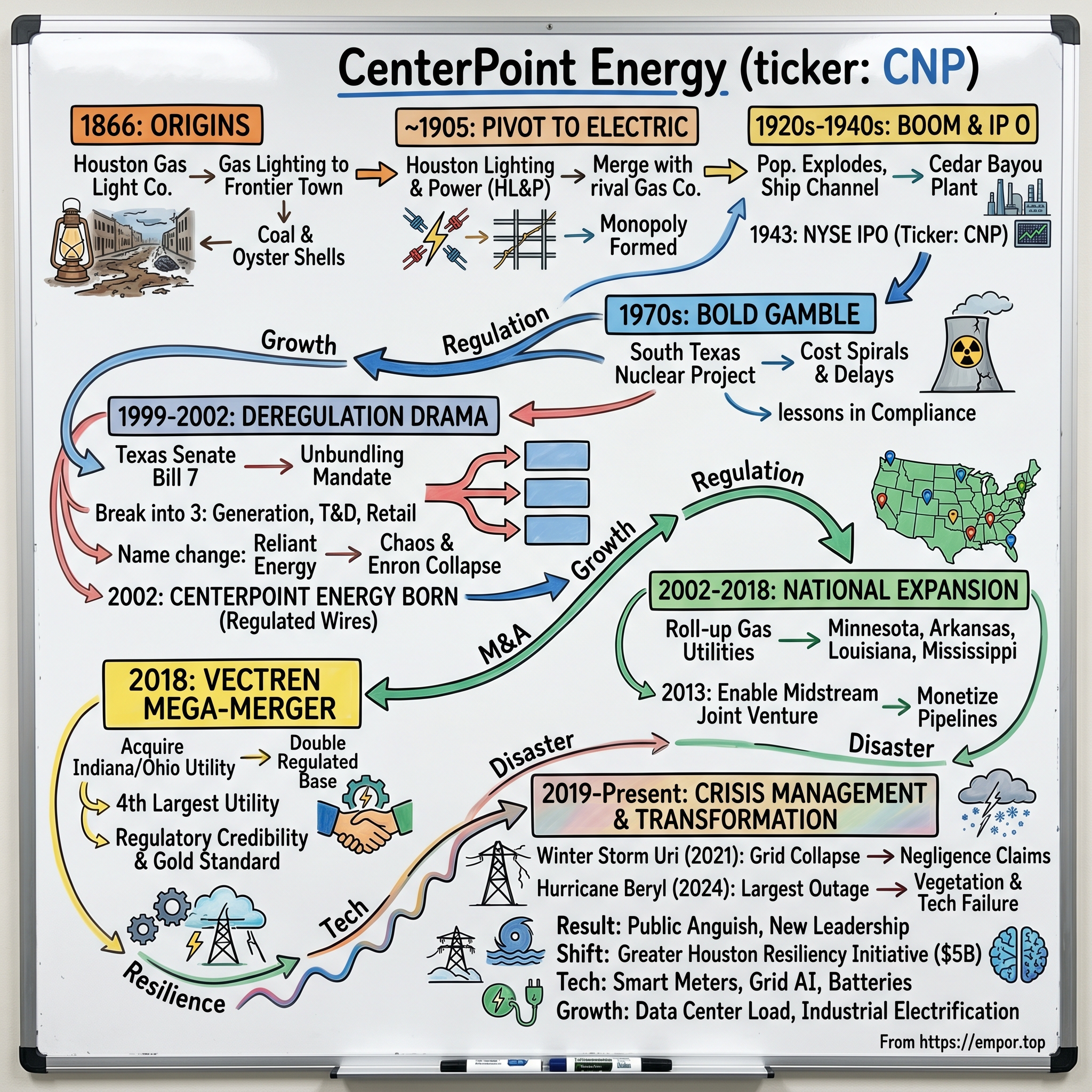
CenterPoint Energy: Powering the Heartland
I. Introduction & Episode Roadmap
In 1866, a year after the Civil War ended, a company in Houston began burning a mixture of oyster shells and coal to manufacture gas, piping it to street lamps in a swampy bayou trading post.5 One hundred and sixty years later, the corporate descendant of that gas-lamp venture stands at the center of a central bottleneck in the American economy: whether there is enough wire, steel, and transformer capacity in Greater Houston to connect the data centers demanded by the artificial-intelligence build-out.
That descendant is CenterPoint Energy, listed on the New York Stock Exchange under the ticker CNP. As a regulated delivery utility, CenterPoint moves electricity and natural gas without marking up the underlying commodities for profit. It operates with a regulated asset base of roughly $33 billion in 2026 and generates about $9.4 billion in annual revenue.21 In July 2026, management raised its 10-year capital investment plan for 2026 through 2035 to approximately $66.7 billion — a spending program larger than the entire market capitalization of the company planning to build it.1
Driving that investment plan is a significant demand surge in the American utility sector. CenterPoint submitted more than 17 gigawatts of large-load projects into the Electric Reliability Council of Texas's new "Batch Zero" interconnection queue and told investors it expects roughly 14 gigawatts to qualify as base load or studied load — an increase of more than 65% over the roughly 21 gigawatts of peak demand its Houston system serves today.3 For context, that single utility's queue represents a meaningful fraction of the peak demand of entire mid-sized countries. If even a majority of these projects connect, Houston Electric's rate base will expand at a rate rarely seen in an industry historically prized for its stability.
This rapid expansion also highlights the central vulnerability in the investment case. In July 2024, CenterPoint's distribution grid failed when Hurricane Beryl — a Category 1 storm — knocked out power to more than 2.6 million customers, leaving some without electricity for over a week in Gulf Coast summer heat that the Public Utility Commission of Texas later linked to more than 23 deaths.16 The company had also leased a fleet of large mobile generators for roughly $800 million, funded by ratepayers, yet deployed none of the largest units when the storm hit.15 Consequently, CenterPoint's 10-year growth story now depends on the goodwill of the same Texas political establishment angered by those operational failures.
This creates a clear tension for investors. On one side stands a strong demand tailwind, a monopoly wires franchise, and a management team that has met its financial targets. On the other lies a documented record of operational failure, a regulator and legislature with broad authority, a governor who in August 2026 ordered a verification audit of every data center trying to enter the queue,4 and a balance sheet funding a spending plan that consumes far more cash than the business generates.
The narrative runs in five movements. First, the origins — a 19th-century gas-lamp monopoly, a Houston electric company that grew alongside the Sunbelt, and a 1970s nuclear venture that exposed Texas utilities to severe cost overruns. Second, the deregulation earthquake of 1999–2002 that split the integrated utility apart, leaving the remaining company burdened with debt and stranded-cost litigation. Third, the diversification era — marked by an ill-fated midstream partnership and a costly Indiana acquisition — which culminated in a dividend cut and an activist intervention. Fourth, the severe operational crises: Winter Storm Uri, Hurricane Beryl, the generator deployment affair, and the resulting credibility reckoning. And fifth, the present: the data-center surge, segment economics, analytical frameworks, and an accounting of what would have to occur for the current spending plan to succeed.
The story begins where every utility story starts — with a franchise, a city council, and a promise.
 Subscribe on LinkedIn
II. The Gas Lamp Era: Origins & Early History (1866–1940s)
In 1866, Houston was a modest settlement of a few thousand residents, with unpaved streets that turned to mud in the rain and a bayou economy built on cotton, timber, and shallow-draft steamboats. The city had no oil industry, no ship channel, and no modern skyline. It did, however, present a clear commercial opportunity: manufacture gas out of coal using oyster shells as a source of lime, pipe it under those unpaved streets, and sell the community something it had never owned — light after dark.
That was the founding insight of Houston Gas Light Company, whose manufactured gas lit the coastal town's streets and whose corporate lineage connects directly to today's CenterPoint.5 The underlying economics of that venture remain remarkably recognizable 160 years later. Constructing a gas distribution network required heavy upfront capital investment to generate modest, long-term cash flows. Investors required an essential guarantee before committing capital: assurance that a competitor would not dig up the same street the following year. Thus, the foundational utility bargain was established from the outset: territorial exclusivity in exchange for public accountability.
Electricity arrived sixteen years later. In 1882 — the same year Thomas Edison opened the Pearl Street Station in Manhattan — Houston Electric Light & Power began delivering electric service to an expanding city. The company was chartered by Emanuel Raphael, a local banker who wagered on a technology most Americans had yet to see firsthand.56 The early electric market was fragmented and consolidated rapidly, reorganizing in 1901 and again in 1905 into the entity that would operate as Houston Lighting & Power (HL&P) for most of the twentieth century.6
What followed is a chapter modern investors often overlook, yet it represents the first real test of whether a territorial utility franchise functions as an unassailable moat. HL&P did not spend the early twentieth century as an independent monopoly compounding capital. Instead, it operated as an asset owned by outside holding companies. In 1906, it was acquired by Isadore Newman & Sons; in 1922, it was absorbed by Electric Bond & Share, one of the dominant utility holding pyramids of the era.6 Only in 1942 did HL&P achieve true independence, when its parent holding company, National Power & Light, was forced to divest it.6 That divestiture was not a voluntary strategic choice; it was mandated by federal legislation aimed at dismantling the leveraged utility holding structures that had contributed to the 1929 financial crash.
Historical falsification: was the franchise ever really a moat?
The conventional wisdom among utility investors holds that a territorial franchise represents a near-permanent competitive advantage. CenterPoint's early record offers a more nuanced reality.
The disconfirming evidence is structural rather than anecdotal. First, the franchise protected the service, not the owner. Between 1906 and 1942, control of HL&P changed hands repeatedly at the discretion of financiers and federal regulators; equity holders in the overarching holding companies experienced the Houston franchise's exclusivity largely from afar.6 Second, the franchise was a negotiated instrument granted by municipal authorities, coming bundled with price caps and subject to renegotiation by local politicians accountable to ratepayer-voters. Third, state authority eventually superseded municipal oversight entirely, establishing in the mid-1970s a statewide regulatory regime under the Public Utility Regulatory Act that standardized how Texas utilities set rates and earn returns.[^7]
The takeaway is not that the utility moat is illusory, but that it is narrower than commonly assumed: CenterPoint's exclusivity remains durable against competitors, but strictly conditional regarding returns. While competing distribution networks will not be built in Houston, the prices CenterPoint charges to use its wires — and the return it earns on the capital sunk into them — have always been set by external authorities: initially city councils, later a state commission, and today a legislature responding to widespread storm outages. That distinction remains central to evaluating CenterPoint's long-term business model, as political and regulatory dynamics directly dictate corporate profitability.
Gaining independence in the 1940s positioned HL&P for decades of rapid expansion, just as Houston's population and industrial footprint were poised to grow.
III. Building the Texas Energy Empire (1940s–1990s)
Post-war Houston provided an ideal setting for utility expansion: cheap land, no zoning, a dredged ship channel, an oil industry that established the Gulf Coast as a global refining hub, and air conditioning. In many respects, the growth of the American Sunbelt was an electrical phenomenon. Before mechanical cooling, Houston summers severely constrained commercial activity; after its widespread adoption, the city became a year-round industrial center. Every newly cooled office, refinery, and residential neighborhood added a meter to HL&P's growing distribution system.
The composition of HL&P's load was distinct, and it continues to shape CenterPoint's economics today. Houston developed not primarily as a residential lighting market, but as a heavy industrial power center. Petrochemical complexes along the Houston Ship Channel drew immense quantities of continuous power, alongside expanding port operations. In 1961, NASA established the Manned Spacecraft Center — later the Johnson Space Center — in Clear Lake, adding a high-profile federal research campus to the network. Continuous industrial demand represents an efficient load profile for an electric utility: it maximizes system utilization, flattens the daily demand curve, and helps fund infrastructure that also serves residential customers. This industrial foundation explains why CenterPoint's distribution footprint has historically maintained high demand density, and why hyperscale data centers find the territory attractive decades later.
The nuclear adventure, and the lesson Texas learned
Capital allocation faced its first major test in the early 1970s. Spurred by the 1973 oil embargo, HL&P joined a consortium with the cities of Austin and San Antonio and a neighboring investor-owned utility to construct a two-unit nuclear facility on the Gulf Coast known as the South Texas Project. Originally targeted for completion within a decade, construction stretched over fifteen years into the late 1980s. The project suffered severe cost escalation, stricter post-Three Mile Island safety mandates, and bitter litigation between the municipal partners and the operating utility.6
The lasting impact of the South Texas Project was institutional rather than purely financial. The project signaled to Texas regulators, lawmakers, and municipal authorities that a monopoly utility undertaking a capital-intensive project under cost-plus regulation faced limited structural incentives to control expenses, leaving ratepayers to absorb cost overruns. Subsequent regulatory disputes over CenterPoint's rate structures — including scrutiny over its deployment of leased mobile generators following Hurricane Beryl — reflect this long-standing skepticism. Modern legislative oversight of the utility's capital spending traces directly to the cost overruns incurred on the Matagorda County coast.
Two fuels, three companies, one system
While the electric utility managed nuclear construction, the gas distribution network that forms the other half of today's company was developing outside Texas. The Minneapolis gas distribution network traces back to Minneapolis Gas Light Company, which initiated service along the Mississippi River in 1870, while the Indiana electric and gas operations originate with Southern Indiana Gas and Electric Company, established in Evansville in 1912.5 In 1990, three regional energy entities merged to form NorAm Energy Corp. Seven years later, NorAm combined with Houston Industries — the parent holding company of HL&P — to create a large integrated utility operating both electric wires and natural gas pipelines.5
The 1997 merger established CenterPoint's dual-fuel profile based on a core strategic premise: that owning gas distribution in the Upper Midwest would offset the operational and weather risks of running an electric network on the Gulf Coast. While regional diversification offers distinct regulatory cycles independent of Texas weather, its protection remains limited by a single corporate balance sheet and shared credit rating. Operational or financial distress in Texas cannot be fully insulated by Midwestern earnings; instead, those out-of-state assets primarily serve as liquidity sources that can be divested to cover balance-sheet shortfalls — a dynamic that resurfaced nearly three decades later.
Just as the combined enterprise reached peak scale, the Texas Legislature enacted sweeping structural reforms that ended the era of vertically integrated utilities in the state.
IV. Deregulation Drama & Corporate Restructuring (1999–2002)
In 1999, Texas enacted the Texas Electric Choice Plan, fundamentally altering the structure of the state's electric utilities. The law required integrated utilities within the Electric Reliability Council of Texas (ERCOT) to separate into three distinct businesses: retail electricity sales, power generation, and transmission and distribution.8 The policy logic was based on standard market design: while power generation and retail sales could operate competitively, electricity transmission and distribution remained a natural monopoly. Consequently, the wires business stayed regulated, earning a fixed rate of return while remaining insulated from commodity price fluctuations.
Under this structure, the Houston electric system functions much like a toll road. Before 1999, the utility owned the road, the freight trucks, and the cargo, earning profits across all three functions. After restructuring, the company retained only the road, collecting a regulated fee for every unit of power delivered over its grid regardless of whether wholesale electricity prices were high or low. This separation eliminated CenterPoint's direct commodity risk in its Houston operations — and explains why the billing entity on a consumer's electric invoice is rarely CenterPoint itself.
The mechanical unbundling proved financially complex. The integrated utility's power plants had been constructed under rate-of-return regulation and carried book values premised on guaranteed cost recovery. In a competitive market, those assets risked substantial devaluation. This gap between book value and market value — termed "stranded costs" — became the central financial issue of the Texas restructuring. In December 2001, the predecessor company recorded a $2.0 billion regulatory asset in anticipation of recovering these stranded costs, an accounting decision that recognized expected future revenue before state regulators had formally approved recovery.7
The birth of CenterPoint Energy
On August 31, 2002, CenterPoint Energy became the parent holding company of the restructured enterprise.7 The corporate separation proceeded over the following months: on September 30, 2002, CenterPoint distributed approximately 83% of its ownership in Reliant Resources — the unregulated retail and power trading business — to shareholders. On January 6, 2003, it distributed roughly 19% of Texas Genco Holdings, the merchant generation entity, while retaining an 81% stake.7 What remained inside CenterPoint were the two regulated operations that continue to define the company: CenterPoint Energy Houston Electric, the Gulf Coast electric transmission and distribution utility, and CenterPoint Energy Resources Corp., the natural gas distribution business.7
Historical falsification: did the split create a clean, low-risk utility?
A common narrative suggests that deregulation immediately provided CenterPoint with a low-risk, pure-play regulated monopoly while shifting operational risk elsewhere. Corporate disclosures from the era reveal a far more turbulent transition.
The primary evidence lies in the company's debt structure. In February 2003, CenterPoint refinanced a $3.85 billion credit facility to extend its maturity from October 2003 to mid-2005. To secure the extension, CenterPoint pledged its remaining 81% stake in Texas Genco to lenders and granted them warrants for up to 10% of its common stock.7 Healthy utilities rarely pledge major equity stakes or issue equity warrants to secure bank financing; these terms reflected limited negotiating leverage when facing substantial near-term debt maturities.
Simultaneously, the recovery of stranded costs remained unresolved for years through true-up proceedings that began in 2004 and eventually reached the Texas Supreme Court. CenterPoint Houston was ultimately authorized to recover approximately $5 billion in stranded costs, associated charges, and interest. The company monetized most of this sum by issuing transition bonds through special-purpose subsidiaries, with roughly $2.3 billion in principal still outstanding at the end of 2015.8 That timeline highlights the duration of the transition: a 1999 restructuring law initiated a process that required a 2004 regulatory filing, extended appellate litigation, and securitization debt that remained on the balance sheet more than fifteen years later.
Ultimately, unbundling did establish the low-commodity-risk wires model that characterizes CenterPoint today, but only after prolonged financial strain and reliance on regulatory approvals. The mechanism that stabilized CenterPoint's balance sheet — state-authorized securitization, where bankruptcy-remote bonds are repaid via dedicated customer surcharges — established a template the utility would reuse following subsequent crises, including winter storm gas expenses and hurricane restoration costs. This securitization mechanism serves as both an effective financial risk mitigant and an ongoing reminder of the utility's dependence on state legislative support.
Having survived the restructuring, the company spent the following fifteen years seeking expansion — leading to two major acquisitions that would again test its financial stability.
V. The Expansion Era: Going National (2002–2018)
The strategic challenge facing CenterPoint management in the mid-2000s was straightforward to state yet difficult to resolve. The company had emerged from deregulation as a wires-and-pipes utility burdened with heavy debt, modest growth prospects, and geographic concentration: its most valuable asset operated on a hurricane-prone coastline under a single state's regulatory jurisdiction. Management faced a clear mandate: diversify or stagnate.
Natural gas distribution offered an immediate avenue for expansion. CenterPoint's gas footprint already extended far beyond Texas; its 2002 corporate filings documented natural gas distribution operations across six states, including local distribution utilities in Minnesota, Arkansas, Louisiana, Mississippi, and Oklahoma.7 Gas local distribution companies (LDCs) represent a steady business model characterized by modest demand growth, low volatility, and regulatory frameworks that frequently permit periodic cost recovery for pipeline replacement without full rate proceedings. Functionally, these operations served as the fixed-income core of the company's portfolio.
However, fixed-income returns proved insufficient to deliver the dividend growth utility shareholders sought during the low-interest-rate environment of the 2010s. Consequently, management pursued higher-yielding opportunities outside pure utility distribution.
The midstream trap
In May 2013, CenterPoint combined its midstream pipeline assets with OGE Energy and affiliates of ArcLight Capital Partners to form Enable Midstream Partners, a master limited partnership organized to gather, process, and transport natural gas across the Anadarko and Arkoma basins. CenterPoint retained a controlling limited-partner interest of roughly 55.4%.8
The strategic rationale presented to investors was straightforward. Midstream master limited partnerships generated substantial cash distributions, which could fund dividend growth at the parent company without requiring additional utility equity issuance. Effectively, CenterPoint attached a high-yield commodity infrastructure engine to its regulated utility base. Executive leadership framed midstream assets as natural extensions of the core business, arguing that pipelines represented stable infrastructure regardless of regulatory classification.
That framing conflated two structurally distinct risk profiles. Regulated distribution utilities earn a authorized return on invested capital irrespective of throughput volumes or commodity prices. By contrast, midstream gathering and processing fees depend directly on producer drilling activity, which fluctuates with hydrocarbon market prices. Describing both as "infrastructure" obscured a critical operational difference: a utility operates as a toll road with guaranteed revenue, whereas a midstream gathering system operates as a toll road whose traffic contracts sharply when commodity prices fall.
Historical falsification: did midstream optionality pay?
Testing the diversification thesis against empirical results reveals whether non-regulated cash flows stabilized the parent utility or transferred commodity risk directly onto its balance sheet.
The historical record demonstrates clear structural failure. As natural gas and natural gas liquids prices softened during the late 2010s before dropping sharply in early 2020, Enable's cash flow contracted. In the first quarter of 2020, CenterPoint reported a net loss of $2.44 per diluted share, driven by $1,568 million in after-tax non-cash impairment charges and losses on assets held for sale — including a $1,166 million impairment on its Enable investment alone.12 Years of accumulated cash distributions were erased as the parent wrote off more than a billion dollars in asset value.
Furthermore, the operational risks failed to remain contained within the partnership. Because midstream distributions had been allocated to support parent-level dividend growth, reduced payouts from Enable forced a corresponding dividend reduction at CenterPoint. Rather than insulating the regulated utility, the unregulated asset compelled the parent company to cut a dividend payout that underlying utility earnings had never been structured to sustain independently.
The evidence rejects the diversification hypothesis outright. Midstream ownership did not fund utility capital expenditures without shareholder equity dilution; instead, it generated severe impairments, prompted a dividend reduction, and ultimately required expensive equity financing. This record stands as a critical precedent in CenterPoint's history, demonstrating that the company's subsequent return to a purely regulated business model resulted from costly operational lessons rather than inherent strategic restraint.
The timing of management's next major transaction compounded these balance-sheet pressures.
VI. The Vectren Mega-Merger: Doubling Down (2018–2019)
By spring 2018, utility mergers and acquisitions were accelerating across the industry. Low interest rates and a scarcity of regulated assets encouraged mid-cap utilities to pursue scale. On April 23, 2018, CenterPoint announced an agreement to acquire Vectren Corporation — an Indiana-based utility with natural gas and electric operations spanning Indiana and Ohio — for $72.00 per share in cash, representing an equity value of roughly $6 billion.910
The strategic rationale appeared straightforward. Vectren added more than one million gas customers and approximately 145,000 electric customers, expanding the combined enterprise to serve over seven million metered customers across eight states with an enterprise value of approximately $27 billion.9 The transaction established a second regulated electric jurisdiction in the Midwest under the Indiana Utility Regulatory Commission, diversifying regulatory oversight beyond the Public Utility Commission of Texas. Additionally, Vectren included infrastructure and energy services units that executive leadership presented as complementary growth vectors.
Market reaction reflected immediate skepticism. CenterPoint shares declined approximately 5% upon announcement, reflecting a prevalent market consensus that the company had overpaid.9 Vectren's stock had already risen from roughly $65 into the high $60s and low $70s prior to the announcement, leaving a modest headline premium relative to the undisturbed share price — a structure that typically indicates a competitive bidding process, premature market disclosures, or an acquirer negotiating under strategic pressure.9
What the price actually bought
Evaluating whether CenterPoint overpaid requires examining the underlying mechanics of regulated utility valuation. A utility's earning power is determined by its authorized return on approved rate base — the net depreciated capital invested in system infrastructure. When an acquirer pays a substantial premium above rate base, the excess purchase price is recorded as goodwill, which earns no regulatory return. Because regulatory frameworks prevent utilities from passing transaction premiums on to ratepayers, an acquisition generates value only through operational cost synergies, accelerated rate-base expansion, or favorable financing arbitrage.
Under that framework, the Vectren transaction's primary vulnerability lay in its timing and capital structure rather than the acquisition multiple alone. The transaction was funded through a combination of debt and equity, closing on February 1, 2019 — just one year before the midstream cash flows intended to support the consolidated balance sheet suffered a major downturn.912 Consequently, CenterPoint entered 2020 highly leveraged from the transaction just as its highest-yielding asset faced an impairment exceeding one billion dollars.
The merger also introduced an important structural shift in CenterPoint's risk profile. Vectren's Indiana electric utility was vertically integrated, maintaining ownership of power generation facilities. After spending seventeen years positioning itself to investors as a pure distribution utility without generation exposure, CenterPoint assumed ownership of aging coal-fired plants in the Ohio Valley. These assets required a long-term, capital-intensive transition toward natural gas and renewable generation under state regulatory oversight — a transition that remains underway in 2026. This dynamic explains why CenterPoint functions as a pure-play regulated utility, yet not strictly a pure-play transmission and distribution utility.
Operational integration proceeded cleanly, with the Houston and Indiana electric organizations consolidating into a unified operating structure in 2020.5 By 2026, the Indiana platform has developed into a strategic asset hosting a growing queue of large-load interconnections. Ultimately, the Vectren acquisition represented a fully priced transaction executed at an unfavorable moment in the market cycle, securing assets whose long-term strategic value materialized only after severe financial turbulence and a subsequent restructuring of executive leadership.
VII. The 2020 Crisis, Activist Intervention & Pure-Play Pivot (2020–2021)
The first week of April 2020 presented a harsh environment for a heavily leveraged utility. Credit markets had tightened, crude oil prices collapsed into freefall, and energy infrastructure assets were repricing violently. Against that backdrop, CenterPoint announced it was cutting its quarterly common dividend nearly in half — from $0.29 to $0.15 per share — after distributions from Enable Midstream were slashed.1112
For a utility, cutting the dividend is more than a financial adjustment; it is an admission of structural vulnerability. Regulated utility investors disproportionately buy shares for reliable income, treating the quarterly distribution as the primary investment return. A dividend cut directly undermines that rationale, signaling that prior capital allocation decisions left the company unable to meet its financial commitments from organic operating cash flow.
Elliott Investment Management intervened within weeks. In May 2020, CenterPoint announced a $1.4 billion capital injection through Series C mandatory convertible preferred stock, backed by Elliott and BEP Special Situations, alongside board seats and the creation of a committee to evaluate strategic alternatives.13 The structure highlights the steep cost of financial distress. Mandatory convertible preferred stock functions as equity disguised as debt: investors collect preferred dividends before contractually converting into common shares at a later date. The arrangement provided CenterPoint with immediate liquidity and partial equity treatment from rating agencies, but subjected existing shareholders to structured equity dilution. Elliott did not simply acquire shares on the open market; it supplied rescue financing in exchange for direct governance influence.
David Lesar and the return to boring
The board appointed David J. Lesar as president and chief executive officer, effective July 1, 2020. Lesar was an unconventional choice for a utility: a certified public accountant and former chief executive of oilfield services provider Halliburton, who had spent decades in industries defined by volatile project execution and litigation risk. He had joined CenterPoint's board shortly before taking the chief executive role and had led the committee reviewing strategic options.
Lesar's strategic plan relied on simplification: divest non-core operations, exit midstream assets, pay down debt, and reallocate capital into regulated rate base — where returns are underwritten by regulatory frameworks. The company sold its infrastructure services and energy services businesses and initiated the unwind of its Enable partnership.
The Enable exit was executed through a merger rather than a cash sale. In December 2021, Energy Transfer LP completed its acquisition of Enable Midstream after CenterPoint and OGE Energy — which together held roughly 79% of Enable's outstanding common units — approved the transaction.14 CenterPoint received Energy Transfer equity units rather than cash, subsequently liquidating them over time, including a contingent forward sale of 50 million units that settled at closing.14
That transaction structure complicates a simple exit narrative in two ways. Converting an illiquid, non-controlling partnership stake into publicly traded units and systematically liquidating them was a disciplined unwind that generated proceeds above the asset's marked-down carrying value. However, accepting an all-equity deal meant CenterPoint remained exposed to midstream equity price fluctuations throughout the liquidation period. Management completed the divestiture, but the eventual recovery must be evaluated against the heavy impairments recorded when acquiring and holding the asset.
By the end of 2021, the corporate transformation was structurally complete. CenterPoint emerged as a pure-play regulated utility with a restored balance sheet, an activist investor on its register, and a ten-year capital spending plan focused on Texas and Indiana. The strategic roadmap was clear, but management still faced the operational challenge of demonstrating it could reliably run a distribution grid.
VIII. Storm Crisis & Scrutiny: Uri, Beryl & The Generator Scandal (2021–2024)
Two storms tested that question, and CenterPoint failed the second one in public.
Uri: the system-wide failure
In February 2021, Winter Storm Uri froze Texas. Gas wellheads iced over, power plants tripped offline, and ERCOT came within minutes of a total grid collapse that would have taken weeks to restore. To prevent it, transmission and distribution utilities across the state — including Houston Electric — were ordered to shed load, dropping customers in rolling blackouts that in practice lasted for days.
Uri was not primarily a CenterPoint failure. The wires company was executing instructions from the grid operator, and the root causes lay in generation and gas supply. But Uri produced two lasting consequences for the company. The first was financial: natural gas prices spiked to extraordinary levels during the freeze, saddling gas utilities with enormous fuel costs that no monthly bill could absorb. Texas responded with legislation enabling securitization, and CenterPoint's Texas gas customers ended up repaying roughly a billion dollars of Uri-era fuel costs through a dedicated charge stretching out over more than a decade — the same regulatory machinery that had earlier absorbed stranded costs.
The second consequence was the one that detonated three years later. In the aftermath of Uri, Texas policy encouraged utilities to procure temporary emergency generation, and CenterPoint leased a fleet from a vendor called Life Cycle Power: fifteen large units rated at roughly 27 to 32 megawatts each, plus five smaller 5-megawatt units, under leases running through 2029 at a cost of approximately $800 million.1521 The PUCT found the expenditure prudent in 2023.15 The costs went into customer rates.
Beryl: the failure that was CenterPoint's
Hurricane Beryl made landfall near Houston on July 8, 2024 as a Category 1 storm — the weakest hurricane category, the kind of storm a well-maintained coastal grid is expected to absorb with localized damage. Instead, more than 2.6 million CenterPoint customers lost power. Restoration stretched past a week for hundreds of thousands of them, in July heat, and the PUCT's subsequent investigation counted more than 23 deaths associated with the storm and its aftermath, alongside an estimated $1.2 billion to $1.3 billion of infrastructure damage.16
The operational failures were specific and, damningly, mundane. CenterPoint's outage tracker — the map customers use to learn when their power might return — failed before the storm even arrived, leaving people with no information at all; the company launched a replacement in August.16 Vegetation contact with distribution lines caused numerous outages, pointing at tree-trimming cycles that had not kept pace. Storm drills had been run internally rather than with neighboring utilities, local governments, and emergency services. The commission issued more than a dozen recommendations spanning emergency planning, vegetation management, infrastructure hardening, and customer communication.16
One finding in that report deserves particular attention from investors, because it explains the legislative reaction better than any quote. The PUCT noted that the maximum penalty available against a utility — on the order of $25,000 per day — was often lower than the cost of the repairs that would prevent the violation.16 In other words, Texas regulators concluded that under the existing enforcement regime, deferring maintenance could be economically rational for a utility. That is a devastating thing for a regulator to write down, and it reframed the entire post-Beryl debate from "did CenterPoint make mistakes" to "does the system give CenterPoint any reason not to."
The generator affair
Then came the detail that turned a bad storm into a political crisis. During Beryl, not one of the fifteen large 32-megawatt units was deployed. CenterPoint instead used smaller generators obtained through mutual assistance, which ran roughly 3,000 hours during the recovery.15
The explanation was technically coherent and politically catastrophic. The large units require cranes to assemble and were designed for load-shedding events on the transmission system — a Uri-type scenario — not for restoring power to neighborhoods where wind had knocked down distribution poles. They were, as company leadership put it, one tool in a toolbox that this particular job did not call for.15 Nor could CenterPoint simply walk away: the leases lacked cancellation provisions absent vendor non-performance, so the company was contractually committed through 2029 to a fleet it could not use in the most likely emergency, with the costs already deemed prudent and flowing to customers.15
At the PUCT, Commissioner Lori Cobos told the company, "I feel like there's a lot of talking out of both sides of your mouth on this issue," while Commissioner Courtney Hjaltman pressed CenterPoint to explore subleasing or renegotiating the contracts.15 The Texas Senate held hearings on the Beryl response,18 the attorney general opened an investigation, and lawmakers publicly attacked the procurement.19
The credibility test — and what the record actually shows
CEO Jason Wells apologized, repeatedly and specifically. He acknowledged that the company "should have communicated more clearly to our elected officials about the cost and limitations" of the generators, and in September 2024 unveiled the Greater Houston Resiliency Initiative: a roughly $5 billion, three-phase resiliency program, with the company committing to forgo approximately $110 million in profits to accelerate the work and to absorb about $70 million in storm-hardening costs.17 Phase One, executed in the weeks immediately after the storm, completed 39 of 42 stated commitments, including vegetation work around 2,000 miles of power lines, installation of more than 300 automation devices, and more than 1,000 composite poles.17[^21] Wells also told investors that Beryl restoration could ultimately cost customers around $1.3 billion, adding roughly 2% to bills over fifteen years.17 He described the response as "inexcusable" in testimony and refused calls to resign, arguing that a leadership change would delay the fixes.[^28]
Here the outline's conventional narrative requires correction, and the correction is material. The widely circulated version of events holds that Wells accepted personal accountability by giving up his 2024 short-term incentive bonus. The compensation record does not support that. Wells received a 2024 short-term incentive payout, and his total compensation for 2025 rose roughly 30% to more than $12 million, disclosed in the March 2026 proxy statement — this despite the same proxy showing performance below target on operational excellence and below threshold on customer satisfaction.[^28][^29]
That is the single cleanest test of post-Beryl accountability available, and it came back negative. A board that genuinely re-weighted its incentive system toward reliability had an obvious opportunity to demonstrate it in the pay outcome and did not take it. Investors should treat the reliability metrics now embedded in short-term incentive plans as a stated intention rather than a demonstrated constraint, until a year arrives in which missing them visibly reduces what executives are paid.
That said, the operational and regulatory rebuild that followed was real, and it is where the story turns.
IX. The Modern Utility: Electrification & Data Center Surge (2025–Present)
The rebuild began with CenterPoint making targeted rate concessions to restore its standing with state regulators and local municipalities.
In August 2024, weeks after Hurricane Beryl, the utility took the unusual step of withdrawing a pending Houston Electric rate case rather than seeking higher rates during widespread public outcry — a costly delay given that rate proceedings serve as the primary mechanism for converting capital expenditures into regulated earnings. When CenterPoint re-engaged regulators, it pursued a negotiated settlement. On January 29, 2025, the company announced an agreement with the City of Houston, regional municipalities, and intervening parties that reduced annual revenue by approximately $50 million through roughly 2029, lowering a typical residential bill by about $0.82 per month, with the Public Utility Commission of Texas issuing its final order in March 2025.20 The settlement was notable for its terms: despite having invested roughly $8 billion in grid infrastructure since its previous rate case in 2019, CenterPoint emerged from the proceeding collecting less annual revenue than before.20
The company next addressed its controversial mobile generation assets. In April 2025, testifying before the Texas Senate Committee on Business and Commerce, CenterPoint proposed removing the large emergency generation units from Houston Electric customer rates entirely and relocating all fifteen 32-megawatt units to the Greater San Antonio area under an ERCOT arrangement, forgoing all revenue and profit on the assets for a proposed two-year period. The proposal was structured to reduce residential customer bills using 1,000 kilowatt-hours per month by as much as $2.00 by 2027.21
Strategically, these concessions functioned as a deliberate trade of near-term revenue to rebuild political goodwill, forfeiting roughly $50 million in annual income and earnings on an $800 million asset in order to secure regulatory approval for expanded future capital deployment. In June 2025, CenterPoint reached a settlement with intervening parties on its 2026–2028 Systemwide Resiliency Plan, securing approval for more than $3 billion in electric distribution investment alongside approximately $2 billion in transmission spending. The plan called for installing roughly 130,000 reinforced poles rated for 110-to-132 mile-per-hour winds, implementing a three-year vegetation management cycle across all distribution lines, and deploying self-healing grid automation for the vast majority of customers. To soften the immediate bill impact to approximately $1.40 per month, settling parties agreed to defer more than $240 million of cost recovery into late 2029.22 Management projected that these upgrades would reduce storm-related outage duration by more than 913 million customer minutes across its 2.8 million electric accounts by 2029.22
This regulatory compromise — surrendering earnings on past capital expenditures to clear a path for major future investment — established the foundation for CenterPoint's modern expansion strategy.
The demand shock
The scope of that planned expansion expanded dramatically with the rapid growth of artificial intelligence and hyperscale computing. Houston Electric's peak system demand historically averaged around 21 gigawatts. In its Electric Reliability Council of Texas "Batch Zero" interconnection submissions, CenterPoint put forward more than 17 gigawatts of large-load projects, expecting roughly 14 gigawatts to qualify — including approximately 10 gigawatts with completed ERCOT studies classified as base load, roughly 4 gigawatts designated as studied load, and an additional 3 gigawatts submitted awaiting study approval.3 Management also identified roughly 2 gigawatts of incremental distribution-level demand driven by regional manufacturing and population growth, along with over 500 megawatts of smaller interconnection requests received in 2026 that fell below the 75-megawatt large-load threshold.25
To put those numbers in perspective, a single gigawatt represents the generating capacity of a major power plant, while a single hyperscale artificial intelligence data center campus can draw hundreds of megawatts to over a gigawatt of continuous power. CenterPoint was not projecting incremental demand growth, but an incoming wave of new load over five years equal to two-thirds of the total capacity serving the entire Greater Houston area.
Under the company's energization timeline, system additions were scheduled at roughly 3 gigawatts in 2027, expanding to approximately 9 gigawatts by 2028 and reaching the full 14 gigawatts by 2031.2 Management framed this massive buildout as a mechanism to reduce customer rates overall, contending that hyperscale industrial loads absorb a significant share of fixed grid infrastructure costs and could generate over $5 billion in residential and commercial bill savings over a decade. During the second-quarter 2026 earnings call, Chief Executive Jason Wells detailed the underlying math: connecting 14 gigawatts of large load creates an estimated $800 million annual revenue requirement, of which commercial and industrial customers would pay roughly 65%, or $500 million annually — accumulating to approximately $5 billion over ten years.25 However, that financial benefit depends entirely on whether those projects are completed, connected, and continuously billed.
What could break it
That assumption faced immediate regulatory friction in mid-2026. On August 3, 2026, Texas Governor Greg Abbott directed ERCOT to implement a formal verification process before advancing any large-load data center interconnections, mandating a comprehensive audit of grid and water usage, public financial assistance, onsite power generation, community impact, and project ownership.4 In response, ERCOT paused Batch Zero classifications and halted energization authorizations for large computational loads pending audit completions, establishing an extended Batch Zero study deadline of April 9, 2027.4
While not invalidating the underlying demand, the state intervention demonstrated that political authorities retain the power to dictate the pace of grid expansion. The bottleneck resulted not from utility operational missteps, but from broader state scrutiny regarding the economic terms and local impacts of data center deployment. Even prior to the governor's directive, Wells acknowledged on the July earnings call that the timeline remained uncertain for the 3 gigawatts of proposed load still awaiting study approval, noting that "it's unclear what that path exactly looks like."25
Meanwhile, CenterPoint's Indiana territory emerged as a secondary growth vector. Management disclosed progress on a major large-load customer in Indiana, with site engineering underway and equipment ordered, promising further details before year-end 2026 while cautioning that required power generation infrastructure would be incremental to existing capital plans and likely funded through equity issuance.25 The Indiana platform continues to execute a clean energy transition under Indiana Utility Regulatory Commission oversight, replacing legacy coal capacity with solar and natural gas generation; Wells noted that while existing infrastructure can absorb up to 1.5 gigawatts of new load, additions beyond that threshold may necessitate a separate generation entity structure.25
Ultimately, while the underlying demand queue is real and independently documented in state utility filings, converting that pipeline into realized regulated revenue remains subject to political, regulatory, and capital execution risks.
X. Business Model & Financial Architecture
Behind its historical evolution, CenterPoint in 2026 operates as three distinct regulated businesses under a single holding company structure, each generating earnings under a different regulatory framework.
Houston Electric serves as the primary growth engine: a pure-play transmission and distribution utility operating within ERCOT with no power generation assets or commodity price exposure. Its earnings stem directly from its authorized return on rate base, which reached approximately $18.5 billion in 2026 — accounting for more than half of CenterPoint's total $33 billion rate base — with an authorized return on equity of 9.65% applied to an approved equity capital layer of 43.25%. Driven by large-load interconnection requests, management projected Houston Electric's rate base to grow by more than 18% annually over the next three years.2
Indiana Electric represents a structural exception within the portfolio: a vertically integrated utility regulated by the Indiana Utility Regulatory Commission that owns power generation facilities alongside transmission and distribution lines. While smaller and slower-growing, it carries the operational risks inherent in power plant ownership as it transitions from coal to natural gas and renewable generation, while providing secondary exposure to prospective large-load data center demand in the Midwest.
Natural Gas Distribution acts as the earnings stabilizer, encompassing local distribution utilities delivering natural gas across Texas, Minnesota, Indiana, and — pending sale completion — Ohio. Growth in these operations relies on pipeline replacement programs and customer additions, with capital expenditures recovered between formal rate cases through mechanisms such as Texas's Gas Reliability Infrastructure Program, which approved a $62 million rate increase for CenterPoint in 2026.25
That natural gas footprint has contracted through targeted divestitures. In April 2025, Delta Utilities, backed by Bernhard Capital Partners, completed the acquisition of CenterPoint's Louisiana and Mississippi gas distribution operations, covering approximately 380,000 customers and 12,000 miles of main.23 In October 2025, CenterPoint agreed to sell its Ohio natural gas utility to National Fuel Gas Company for $2.62 billion — a valuation equal to roughly 1.9 times its 2024 rate base. Covering approximately 335,000 metered customers and 5,900 miles of pipeline, the transaction was structured to yield $1.42 billion in 2026 cash proceeds and a $1.20 billion seller note due in 2027, with management planning to redeploy more than $2 billion into its remaining electric and gas capital programs.24 On the July 2026 earnings call, Chief Financial Officer Chris Foster targeted the transaction's closing for October 1, 2026.25
The strategic rationale for these sales reflects both capital recycling efficiency and balance-sheet discipline. Selling low-growth gas assets at nearly double their rate base allows CenterPoint to monetize book value and redeploy proceeds into higher-yielding electric infrastructure. Crucially, recycling capital in this manner also allows the company to fund its expanding capital expenditure program while mitigating the need for immediate equity dilution.
The financial architecture, and its central tension
CenterPoint's operating results demonstrate consistent earnings expansion. For full-year 2025, the utility reported revenue of approximately $9.4 billion and non-GAAP earnings of $1.76 per share.1 For 2026, management guided to an earnings target of $1.89 to $1.91 per share — representing roughly 8% growth at the midpoint — and reaffirmed that outlook at mid-year following second-quarter net income of $244 million, or $0.37 in GAAP earnings and $0.40 in non-GAAP earnings per share.1 Over the longer term, management committed to delivering annual non-GAAP earnings-per-share growth of 7% to 9% through 2035.2
The central financial tension sits within the cash flow statement rather than the income statement. CenterPoint planned to invest approximately $6.8 billion in 2026 alone, having deployed $1.5 billion in the second quarter to reach roughly 40% of its annual plan by mid-year.25 Because rate-base growth utilities fund infrastructure expansion beyond organic operating cash flow, CenterPoint operates with negative free cash flow by design. The capital shortfall is funded through debt, asset sales, and equity, with management targeting a capital structure of roughly 47% equity and 53% debt alongside approximately $4 billion of common equity issuance through 2035.225
Balance-sheet credit metrics, historically a key constraint, showed improvement in mid-2026. Adjusted funds-from-operations to debt reached 13.4% for the twelve months ended June 2026 — up nearly a full percentage point from the first quarter — supported by clarified Corporate Alternative Minimum Tax rules and expected Ohio sale proceeds.25 Credit ratings held at Baa2 from Moody's and BBB from both S&P and Fitch, backed by roughly $3.5 billion in available liquidity.2
The primary risk facing CenterPoint's equity story centers on its long-term financing commitments. Management has repeatedly asserted that the recent $1.2 billion increase in its capital plan requires no additional common equity beyond the amount already assumed.25 Under questioning from equity analysts during the July earnings call, management offered a bounded response: while the current plan increment requires no new equity, significant additions to Indiana power generation or major transmission projects likely would.25 That boundary represents the key risk for investors, as an expanding capital program that requires higher equity issuance could ultimately dilute the per-share growth the investment plan was designed to generate.
XI. Governance, Management Credibility & Activist Stress Test
CenterPoint is led by two former PG&E executives, a leadership structure that carries distinct implications for the company's strategic direction.
Jason P. Wells joined CenterPoint as chief financial officer in 2020 after thirteen years at PG&E Corporation, where he served as executive vice president and CFO of a $60 billion enterprise that had recently emerged from wildfire liabilities and bankruptcy. He became CEO in January 2024, six months before Hurricane Beryl. His background is financial and regulatory rather than operational: he is fluent in rate base calculations, credit metrics, and commission proceedings. His public management during the Beryl crisis reflected both the strengths and limitations of that preparation — precise on financial data and remediation plans, but slower to anticipate how a technically defensible generator procurement would be received by residents without power.
Christopher A. Foster followed a parallel path, becoming executive vice president and CFO in May 2023 after holding the CFO role at PG&E. His public communication has consistently emphasized balance-sheet repair, credit metric improvement, and equity dilution management.
Having two top executives from the same predecessor company — both trained during the aftermath of the largest utility liability crisis in modern American history — lead a Gulf Coast utility facing severe hurricane exposure and heightened regulatory scrutiny presents a distinct strategic posture. It reflects either a tailored focus on financial restructuring or an over-indexing on balance-sheet repair relative to field operations, with 2026 performance supporting arguments on both sides.
Credibility, weighed by mechanism
Evaluating management requires measuring commitments against operational and financial outcomes over time.
On capital allocation and financial guidance, the record since 2021 shows consistent execution. Management completed the midstream exit and repaired the corporate balance sheet. On August 20, 2026, Moody's upgraded the outlook on CenterPoint Energy and Houston Electric from negative to stable, raised CenterPoint Energy Resources Corp.'s senior unsecured rating to A2 from A3, and reported that parent-level funds from operations to debt reached 13.2% for the twelve months ended June 2026, up from 12.3% at year-end 2025 — the first time the metric exceeded 13% since Hurricane Beryl.26 Financial guidance has been consistently met, and non-core assets have been divested at premiums above rate base.
On operations, performance remains questionable and only partially remediated. Regulatory findings from the Public Utility Commission of Texas regarding outage tracking, vegetation management, and emergency drills revealed major operational gaps.16 While current resiliency spending is substantial, capital deployment has not yet translated into demonstrated storm durability. The ultimate test will be whether future severe weather events demonstrate the outage minute reductions projected in the company's settlement.22
On accountability, executive compensation outcomes diverged from corporate messaging following the storm crisis.[^28] This dynamic raises broader questions regarding board oversight. Wells serves as both board chair and chief executive, concentrating authority at a time when independent operational oversight is critical.
The activist stress test
A skeptical investor's thesis centers on four primary operational and structural vulnerabilities.
First, the equity funding gap. A short-seller's core thesis assumes that as the 10-year, $66.7 billion capital plan expands — driven by additional Indiana generation requirements and major transmission additions — the company's "no new equity" commitment will give way to substantial stock issuances. This dilution would convert double-digit rate-base expansion into modest single-digit per-share earnings growth, a mechanism management acknowledged on its July 2026 earnings call.25
Second, the durability of the load forecast. Signed facility extension agreements alongside approximately $900 million in customer cash commitments and deposits demonstrate significant commercial interest.3 However, deposits do not guarantee energized load, and Governor Abbott's verification directive demonstrated that politically motivated audits can stall commercially committed projects.4
Third, regulatory retaliation risk. CenterPoint resolved its emergency generator controversy by voluntarily surrendering economic returns rather than facing a formal disallowance ruling.21 While avoiding a direct write-off, this outcome established a precedent that political pressure can compel the utility to forfeit authorized earnings. In a rate-regulated business, a demonstrated willingness to concede returns under political scrutiny creates ongoing risk in future rate proceedings.
Fourth, portfolio coherence. Following the divestiture of its gas distribution footprints in Louisiana, Mississippi, and Ohio, the strategic logic for retaining remaining out-of-state gas assets becomes questionable. An activist could argue that non-Texas natural gas assets hold greater value for third-party buyers than for a utility whose primary growth driver is concentrated in Greater Houston — particularly given the valuation benchmarks set by CenterPoint's recent sales.
The counter-argument to these criticisms is that each risk is recognized, partially priced into the equity, and subject to active management strategy. That represents a structural shift from the company's position in 2020, when balance-sheet vulnerabilities were largely unaddressed until the dividend was cut.
XII. Strategic Frameworks: Helmer's 7 Powers & Porter's 5 Forces
Utilities are the easiest business in the world to describe with strategy frameworks and the hardest to evaluate with them, because the frameworks assume open competition while utilities operate under a franchise monopoly. The useful analytical exercise is therefore inverted: asking not where competitive advantage lies, but where that advantage leaks.
Through Hamilton Helmer's Seven Powers, CenterPoint's position appears strong on paper yet remains conditional in practice.
Cornered resource is the company's strongest genuine power. The rights-of-way, easements, poles, substations, and franchises across Greater Houston constitute physical assets no competitor can replicate at any price — an operator cannot simply buy the right to dig up every street in the fourth-largest city in the United States. This power is both real and durable.
Switching costs are absolute at the physical distribution layer. A Houston household can change retail electricity providers freely under the state's competitive market structure, but the distribution wires delivering the power belong to CenterPoint regardless. The customer relationship is nominal; the physical connection is unbreakable.
Scale economies are moderate and primarily financial rather than operational. The principal advantage is capital market access — the ability to raise billions of dollars annually at investment-grade spreads, supported by a solid credit profile and roughly $3.5 billion in available liquidity.2 Compared with industry peers such as NextEra Energy, Sempra, or American Electric Power, CenterPoint remains a mid-tier borrower rather than a privileged one; its 2020 liquidity crunch demonstrated how rapidly financial scale power can evaporate under balance-sheet stress.
Process power represents a clear operational vulnerability. Storm restoration, vegetation management, and customer communication are precisely the repeatable organizational capabilities Helmer defines as process power, yet the Public Utility Commission of Texas documented their absence during recent severe weather events.16 Rebuilding those operational capabilities is the explicit objective of the company's resiliency program, though whether it succeeds remains an empirical question.
Network effects do not apply. Branding is weak to negative — the brand's primary function is regulatory compliance rather than consumer preference, and Hurricane Beryl converted public indifference into active hostility.
The dominant force, and one for which Helmer's framework lacks a dedicated category, is countervailing regulatory power. The Public Utility Commission of Texas, the state legislature, and the governor's office hold asymmetric authority to disallow capital costs, adjust authorized returns, pause interconnections, and mandate rate refunds. In 2026, all four of those regulatory levers were visibly deployed.41621
Through Porter's Five Forces, the structural dynamics tell a similar story.
Threat of new entrants is effectively zero: statutory exclusivity combined with multi-billion-dollar sunk capital forecloses competitive entry entirely.
Supplier power represents an underrated operational risk. High-voltage transformers, breakers, and switchgear are produced by a concentrated group of global manufacturers, and the same artificial intelligence demand wave filling CenterPoint's interconnection queue is filling order books across the utility sector. Consequently, a capital plan of this scale depends not only on regulatory approval but also on physical equipment arriving on schedule. Management's working baseline of roughly $8 million per mile for transmission construction — within a broad planning range of $5 million to $20 million depending on routing — illustrates the width of that supply and cost uncertainty.25
Buyer power splits into two distinct categories. Individual retail customers possess no buyer power. The state, acting as a proxy buyer for ratepayer interests, holds almost all of it. A third category has emerged in the hyperscale data center customer, representing a structural shift: a counterparty capable of contributing $900 million in commitments and cash deposits, while retaining the option to develop in another state, is not a captive ratepayer.3 That dynamic accelerates investment opportunity while introducing customer concentration risk.
Substitutes remain limited in the near term. Behind-the-meter solar with battery storage and industrial microgrids modestly erode volumetric demand, while large commercial loads increasingly evaluate self-generation — the precise issue that prompted Governor Abbott's directive mandating audits of onsite power generation.4 Over a ten-year horizon, self-generation poses a genuine strategic challenge to the volumetric component of utility revenue.
Rivalry within the service territory is non-existent. Rivalry for capital, however, is intense: CenterPoint competes for investor capital against every other growth-oriented utility, where management credibility serves as the primary currency.
In synthesis, CenterPoint's structural position is near-unassailable, but the returns earned on that position remain entirely contingent on political consent. While that condition is inherent to the regulated utility business, the gap between CenterPoint's underlying structural strength and its realized returns is unusually wide because its relationship with state leaders and regulators was recently and severely damaged.
XIII. Playbook: Business & Investing Lessons
Four broad lessons emerge from CenterPoint's corporate trajectory.
Conglomerate discounts are earned, not imposed. The market's refusal to value CenterPoint's midstream stake at parity with its regulated utility earnings was not irrational; it was an early and accurate appraisal. Investors who argued that the sum of the parts was undervalued learned that public markets were simply faster than management to recognize that a fee-based business tied to drilling volume does not belong on a regulated utility's balance sheet. The broader principle is clear: when two businesses carry fundamentally different risk profiles, housing them under one holding company does not average the risk — it transmits the higher cost of capital to the combined enterprise.
Political capital is a depreciating asset that requires constant maintenance. The Public Utility Commission of Texas observed that routine maintenance costs frequently exceeded maximum statutory penalties, describing an incentive structure where a utility might rationally defer upkeep.16 What that narrow calculation overlooked — and what CenterPoint learned through $50 million in annual rate concessions and forfeited returns on an $800 million generator fleet — is that the true penalty is rarely the formal fine. It is the loss of political latitude over tens of billions of dollars in subsequent capital deployment. Deferred grid maintenance functions as a high-interest loan drawn against regulatory goodwill, with the interest rate set after the storm.
Utility consolidation must clear a higher bar than traditional corporate M&A, because goodwill earns no regulatory return. Any purchase premium paid above asset rate base represents capital on which regulators will not authorize a return. While premiums are not inherently irrational — operational synergies and expanded growth platforms can create real value — the buyer must fund that excess from organic future cash flows while assuming full operational risk. Funding an acquisition premium with debt immediately before a market downturn in the asset meant to service that debt demonstrates how an ambitious expansion strategy can compel a dividend cut.912
Rate base expansion does not automatically equal per-share earnings growth. Because regulatory lag requires a utility to spend capital long before collecting revenues, the business must finance the cash gap. CenterPoint's reliance on specialized trackers and interim mechanisms — including the $73 million distribution capital tracker at Houston Electric, state gas infrastructure riders, and forward-looking rate cases in Minnesota and Indiana — exists precisely to shorten that recovery delay.25 The willingness of regulators to preserve these interim mechanisms matters far more to net investor returns than headline spending targets, yet it commands only a fraction of market attention.
XIV. Analysis, Investment Perspective & Risk Radar
The three KPIs that matter
While utility financial statements generate extensive reporting data, three primary metrics determine CenterPoint's ultimate investment outcome.
First, the earned-versus-authorized return on equity spread at Houston Electric. The authorized figure stands at 9.65% on a 43.25% equity layer.2 Whether the company actually earns near that authorized level or loses two hundred basis points to regulatory lag, unrecovered storm expenses, and disallowances serves as the cleanest single measure of regulatory stability. It addresses the fundamental question every other metric implies: whether CenterPoint can reliably collect authorized returns on the capital it deploys.
Second, energized large-load capacity — actual gigawatts in service rather than prospective queue submissions. Management's schedule projects roughly 3 gigawatts connected in 2027 and about 9 gigawatts by 2028.2 Against the backdrop of ERCOT's energization pause and the state verification audit,4 the year-by-year energization tally serves as the critical test for the growth thesis. Interconnection queues represent commercial intent; energized meters generate realized revenue.
Third, funds-from-operations to debt. Reaching 13.2% to 13.4% under credit rating agency methodologies as of mid-2026,2625 this ratio acts as the primary constraint dictating whether the expanded capital plan is funded through debt, asset sales, or equity issuance — determining how effectively rate-base growth translates into per-share earnings growth. It is the benchmark that decides how much underlying corporate growth accrues to equity holders.
Risk radar
Regulatory and political risk dominates all other strategic considerations, operating through two distinct channels. The first is traditional cost recovery — the risk that regulatory commissions disallow capital expenditures or trim authorized returns. The second, newly visible in 2026, is permission to grow: the governor's verification directive and ERCOT's energization pause demonstrate that even fully approved, funded, and customer-committed interconnections can be delayed by state policy mandates.4
Severe weather represents a recurring, uninsurable risk to earnings and balance-sheet stability. Hurricane Beryl caused over a billion dollars in infrastructure damage, structured for recovery from customers over fifteen years.17 While securitization mitigates immediate cash flow strain, it does not erase political friction, and each major storm forces a reset of regulatory goodwill.
Cost of capital and equity dilution constitutes a quiet structural risk. Interest expense reached roughly $903 million in 2025 against operating income of about $2.1 billion.27 A utility spending far above organic operating cash flow remains structurally dependent on continuous access to capital markets on favorable terms; the emergency equity warrants issued during the 2003 credit refinancing illustrate the costs of capital market disruption.7
Supply chain constraints physically limit capital execution. High-voltage transformers and circuit breakers carry multi-year equipment lead times industry-wide, and regulatory approvals cannot manufacture specialized grid hardware on demand.
Customer concentration in the growth portfolio represents a novel operational vulnerability. Historically, utility demand risk was diversified across millions of residential and commercial ratebase customers. Concentrating a two-thirds expansion in system peak demand into a limited group of hyperscale counterparties within a single, capital-intensive industry creates a distinct risk profile — one whose financial correlation has never been tested through a cyclical downturn in artificial intelligence capital expenditure.
Bull versus bear
The bull case rests on three verifiable pillars. Demand is documented independently through a regional grid operator's queue rather than relying solely on executive projections.3 The regulatory relationship has been visibly repaired through rate concessions, an emergency generator settlement, and an approved resiliency investment plan.202122 Furthermore, balance-sheet credit metrics recovered sufficiently for Moody's to remove its negative outlook and upgrade a key operating subsidiary.26 If Houston Electric's rate base compounds near management guidance while earning returns close to authorized levels, the enterprise offers pure-play utility stability paired with growth rates typically confined to unregulated sectors.
The bear case does not require catastrophic operational breakdown. It requires only that the gap between capital projections and realized execution widens. Energization schedules slip as project verification audits extend toward the April 2027 study deadline.4 Incremental Indiana power generation and major transmission builds expand the capital budget, prompting the equity issuances management acknowledged would accompany major project additions.25 A subsequent storm tests grid hardening efforts mid-execution, with outage durations falling short of settlement targets. Meanwhile, regulatory lag expands as rising customer bills heighten political friction. Individually, none of these setbacks breaks the corporate enterprise; collectively, they compress a 7% to 9% per-share growth target into conventional utility returns at a valuation that already prices in full execution.
The balanced position sits between these extremes: the underlying demand tailwind is the strongest in CenterPoint's history and is supported by third-party grid filings; however, the political consent and execution variables required to convert that demand into per-share earnings growth remain unproven under current leadership, while the clearest test of corporate accountability — executive compensation following documented operational failures — yielded no financial consequence.[^28]
XV. Epilogue & Final Thoughts
There is a symmetry to this narrative. In 1866, a fledgling utility earned the exclusive right to light Houston's streets by promising municipal leaders reliable public service in exchange for monopoly protection. In 2024, that company's successor demonstrated what happens when territorial exclusivity remains intact while service reliability falters.
CenterPoint Energy illustrates the central paradox of the modern regulated utility. It operates an exceptionally durable asset — an irreplaceable physical network in one of the fastest-growing industrial centers in the United States — at the precise moment that artificial intelligence and data-center expansion have made power delivery a primary economic bottleneck. Yet the company cannot unilaterally dictate its returns, which remain subject to state authorities accountable to ratepayers who endured a week without power in Gulf Coast summer heat.
The enterprise operating in 2026 is fundamentally restructured compared to the company that cut its dividend in 2020. Midstream asset exposure has been eliminated, non-core natural gas utilities have been sold at premiums to rate base, and credit metrics have improved sufficiently to secure rating upgrades. The company's 10-year capital program is its largest ever, directed primarily toward connecting documented large-load growth rather than simply replacing aging distribution assets.
What remains unproven is the asset most difficult to rebuild. Financial discipline can be demonstrated across a few quarters, but operational reliability requires a storm season, and political trust takes years to earn. Executive leadership has stabilized the balance sheet and negotiated immediate regulatory settlements, but CenterPoint has yet to prove its grid can withstand severe weather. Similarly, the board has yet to demonstrate that operational failures will carry financial consequences for executive compensation.
The key indicators to monitor are clear. Track the energization tally against corporate schedules to see whether large-load demand converts into realized revenue or remains stalled in regulatory review. Track outage durations when the next major storm hits the Gulf Coast, which will provide the true test of grid resiliency investments. Finally, examine proxy statement disclosures following future operational crises, which will reveal whether board governance genuinely aligns executive pay with system reliability.
XVI. Recent News (As of Mid-2026)
The summer of 2026 produced a dense sequence of consequential news, with key developments unfolding immediately after second-quarter earnings.
The capital plan grew again, and the market did not celebrate. On July 28, 2026, alongside second-quarter results, CenterPoint expanded its ten-year capital spending plan by $1.2 billion to approximately $66.7 billion. Management allocated roughly $800 million of the increment to system upgrades tied to prospective Batch Zero projects and about $400 million to the Downtown Houston revitalization project, with spending spread over five years and — leadership emphasized — no change to equity funding assumptions.125 Electric operations represent roughly $47.5 billion of the total ten-year plan and natural gas distribution about $19.0 billion, with at least $10 billion in additional identified opportunities not yet formally included.2 Investors greeted the larger budget cautiously, sending shares lower in premarket trading following the announcement.
Texas hit pause on the data centers. Governor Abbott's August 3, 2026 directive and ERCOT's subsequent suspension of Batch Zero classifications introduced a direct external check on the load expansion thesis. ERCOT stated it will not authorize large computational loads to energize until verification concludes, extending the study deadline to April 9, 2027.4 The pause directly affects near-term momentum: six projects had targeted energization in the first quarter of 2027, while seventeen were potentially eligible for the second quarter.4
The credit story gained independent confirmation. On August 20, 2026, Moody's revised the rating outlooks for CenterPoint Energy and Houston Electric to stable from negative, while upgrading CenterPoint Energy Resources Corp. to A2. The agency cited funds-from-operations-to-debt improving to 13.2% at the parent level and rising to 15.1% at Houston Electric, up from 12.7% at year-end 2025.26 The rating action provided concrete third-party verification that post-Beryl balance-sheet repair has met its target benchmarks.
Analysts trimmed expectations even as fundamentals improved. Through August 2026, several sell-side firms lowered price targets on the stock, leaving shares trading meaningfully below their 52-week high. The divergence underscores how equity markets are weighing state regulatory friction and energization timing risks against reported results, prioritizing execution timelines over historical financial performance.
Portfolio simplification reached its final step. The sale of the Ohio natural gas utility to National Fuel Gas remains scheduled to close on October 1, 2026. The transaction will deliver an initial $1.42 billion cash tranche toward the $2.62 billion total valuation, completing the multi-year effort to concentrate CenterPoint's gas footprint exclusively in Texas, Minnesota, and Indiana.2425
Regulatory recovery machinery kept turning. Meanwhile, routine regulatory cost-recovery mechanisms continued to operate. Houston Electric filed its second distribution capital tracker requesting a $73 million annual revenue increase, while Texas Gas secured approval for a $62 million infrastructure recovery adjustment. Forward-looking rate cases in Minnesota and Indiana remain scheduled before year-end 2026 — representing the essential regulatory mechanics through which capital expenditures translate into authorized earnings.25
References
-
CenterPoint Energy reports strong Q2 2026 results; provides update on ERCOT's Batch Zero process; increases 10-year capital plan — CenterPoint Energy press release via StockTitan, 2026-07-28 ↩↩↩↩↩
-
CenterPoint Q2 2026 slides: demand surge drives capital plan boost — Investing.com, 2026-07-28 ↩↩↩↩↩↩↩↩↩↩
-
CenterPoint says 14 GW likely eligible for Texas' 'Batch Zero' large-load interconnection — Utility Dive, 2026-07-28 ↩↩↩↩↩
-
Texas Large Load Interconnection Update: ERCOT Batch Zero Pause and Verification Process — Baker Botts, 2026-08 ↩↩↩↩↩↩↩↩↩↩↩
-
Houston Industries Incorporated — International Directory of Company Histories via Encyclopedia.com ↩↩↩↩↩↩
-
CenterPoint Energy, Inc. Form 10-K for fiscal year 2002 — U.S. Securities and Exchange Commission, 2003 ↩↩↩↩↩↩↩
-
CenterPoint Energy, Inc. Form 10-K for fiscal year 2015 — U.S. Securities and Exchange Commission, 2016 ↩↩↩
-
CenterPoint Energy to buy Vectren in $6B deal — Utility Dive, 2018-04-23 ↩↩↩↩↩↩
-
CenterPoint Energy to buy Vectren in $6 billion cash deal — Reuters, 2018-04-23 ↩
-
CenterPoint Energy secures investor backing, slashes dividend — S&P Global Market Intelligence, 2020-04-01 ↩
-
CenterPoint Energy Reports First Quarter 2020 Loss of $2.44 Per Diluted Share — Form 8-K exhibit, U.S. Securities and Exchange Commission, 2020-05-07 ↩↩↩↩
-
Elliott takes stake in CenterPoint in $1.4 billion capital raise — Bloomberg, 2020-05-06 ↩
-
Energy Transfer Completes Acquisition of Enable Midstream Partners — Energy Transfer, 2021-12-02 ↩↩
-
CenterPoint cannot cancel $800M lease for large mobile generators unused during Beryl — Utility Dive, 2024-08-16 ↩↩↩↩↩↩↩
-
Texas Public Utility Commission Reports on CenterPoint Energy's Beryl Response — Insurance Journal, 2024-11-26 ↩↩↩↩↩↩↩↩↩
-
CenterPoint proposes $5B investment into grid resiliency in the Houston area — Renewable Energy World, 2024-09-05 ↩↩↩↩
-
Texas Senate special committee hearings on Hurricane Beryl response — Texas State Senate, 2024 ↩
-
CenterPoint Energy faces lawmaker backlash over $800M mobile generators — Houston Chronicle, 2024-07-30 ↩
-
CenterPoint Energy reaches settlement agreement with parties to lower bills for customers in its 2024 Houston Electric Rate Case — PR Newswire, 2025-01-29 ↩↩↩
-
CenterPoint Energy proposes to lower costs for Houston Electric customers and provide increased reliability for Texas — PR Newswire, 2025-04-03 ↩↩↩↩↩
-
CenterPoint Energy Reaches Settlement Agreement with Parties on 2026-2028 Systemwide Resiliency Plan — T&D World, 2025-06-17 ↩↩↩↩
-
Bernhard Capital-Backed Delta Utilities Completes Acquisition of CenterPoint Energy's Natural Gas Distribution Businesses in Louisiana and Mississippi — PR Newswire, 2025-04-01 ↩
-
CenterPoint Energy announces sale of its Ohio natural gas business to National Fuel Gas Company for $2.62 billion — BIC Magazine, 2025-10-21 ↩↩
-
Earnings call transcript: CenterPoint Energy beats Q2 2026 estimates — Investing.com, 2026-07-28 ↩↩↩↩↩↩↩↩↩↩↩↩↩↩↩↩↩↩↩↩
-
Moody's upgrades CenterPoint Energy Resources rating on stronger parent credit — Investing.com, 2026-08-20 ↩↩↩↩
-
CenterPoint Energy, Inc. SEC filings and annual reports — U.S. Securities and Exchange Commission EDGAR, CIK 0001130310 ↩
 LinkedIn
 WhatsApp
 Reddit
 Hacker News
 Email
Email Kindle
 RSS Feed
 Spotify
 Apple Podcasts
 Amazon Music
 Audible
 YouTube