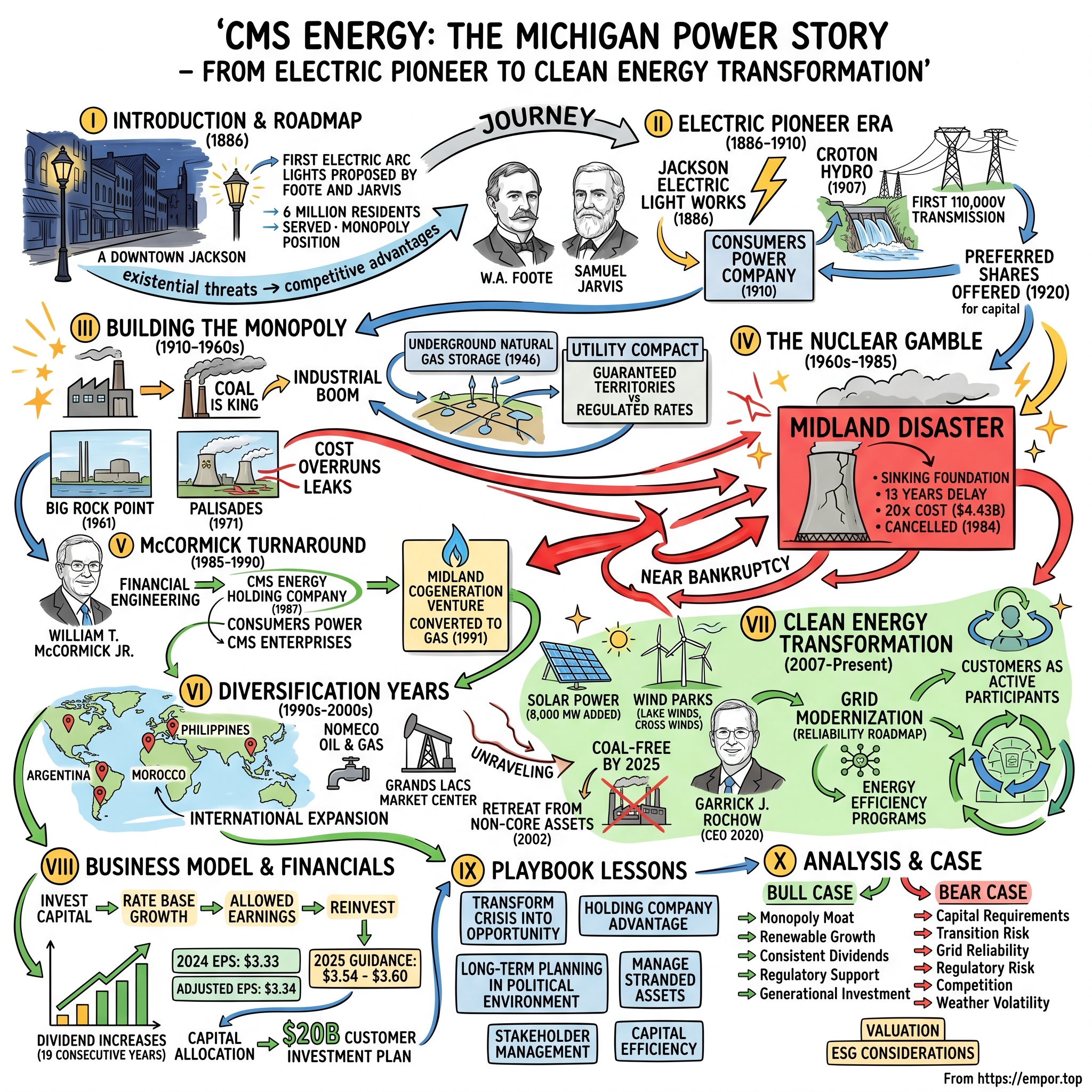
CMS Energy: The Michigan Monopoly That Keeps Retreating to Its Core
I. Introduction & Episode Roadmap
On the morning of July 28, 2026, a utility CEO named Garrick Rochow got on a conference call and told Wall Street that his company was going to do less.
Not less investing — CMS Energy is spending more than it ever has. Less variety. After what he called "a comprehensive strategic review," CMS announced it was exiting the non-utility renewables development business it had spent nearly two decades assembling, retaining only a handful of Michigan assets, and steering toward a state where "nearly 100% of our earnings and future growth will be rate-based driven within the utility."4 The phrase landed like a promise. For anyone who has followed this company for thirty years, it should have landed like an echo.
Because CMS Energy has said a version of this before.
Start with what the company actually is. CMS Energy is the holding company for Consumers Energy, the regulated electric and natural gas utility that serves roughly 1.9 million electric customers and 1.8 million gas customers across Michigan's Lower Peninsula.1 It is not the Detroit utility — that is DTE Energy, a separate investor-owned company operating under the same state regulator. Consumers Energy is the rest of Michigan: Jackson, Grand Rapids, Kalamazoo, Muskegon, Saginaw, Flint, the farm towns and the lakeshore and the sprawl in between. Its franchise territory is a monopoly granted by the state, and its permitted profit is set by a commission in Lansing.
In fiscal 2025 that business produced $8.54 billion of operating revenue and $1.061 billion of net income available to common shareholders, or $3.53 per share on a reported basis and $3.61 per share on the adjusted basis management guides to.12 Management has guided 2026 adjusted earnings to $3.83–$3.90 and, in the same July announcement that shrank the company's footprint, introduced 2027 guidance of $4.08–$4.17.3 Shares changed hands near $68 in early September 2026, valuing the equity at roughly $21 billion — toward the low end of a 52-week range that topped $80.
So here is the question this story is built around, and it is not a friendly one.
CMS Energy has now spent three distinct eras trying to be something larger than a regulated Michigan monopoly. In the 1960s and 1970s it bet the company on nuclear power and nearly went bankrupt doing it. In the 1990s it built an international independent power producer with plants on four continents and an oil and gas exploration arm, then dismantled the whole thing. From 2007 onward it built NorthStar Clean Energy, a merchant renewables developer operating across multiple states — and in July 2026 it announced it was getting out of that too.6 Three attempts to escape the utility. Three retreats.
The company's pitch today is that this is a feature, not a bug: that discipline means doing one thing, and CMS has finally learned to do one thing. That may well be right. But "we've learned our lesson" is a claim, and claims deserve testing against the record of the same company making them. This piece will do exactly that, section by section, and will be equally rigorous about the bull case — because the strongest argument for CMS is not rhetorical, it is arithmetic, and it is genuinely powerful.
Along the way there is a second, stranger story. In 2021, Consumers Energy announced it would stop burning coal by 2025, fifteen years ahead of its previous schedule, and it made the 1,388-megawatt J.H. Campbell complex the public face of that commitment.16 As of September 2026, Campbell is still running — not because CMS changed its mind, but because the U.S. Department of Energy has issued a rolling series of emergency orders forcing it to stay online.7 A company's single most publicized strategic commitment of the past decade has been overridden by the federal government, and customers across eleven states are paying for it.
Four themes run through what follows: the economics of a regulated monopoly and why they compound; the recurring, expensive temptation to be more than one; data-center demand as the newest and possibly best growth story this company has had in a generation; and the uncomfortable reality that a utility's strategy is only as durable as the politics surrounding it.
To understand why CMS behaves the way it does — why its management is so allergic to surprise, so obsessive about incremental rate cases, so proud of a two-decade streak — you have to go back to a hole in the ground in Midland, Michigan.
 Subscribe on LinkedIn
II. Origins, Compressed: From Jackson's Arc Lights to Near-Bankruptcy
In December 1886, a flour miller named William Augustine Foote — who had sold his mill the previous year and gone looking for something newer — persuaded the city fathers of Jackson, Michigan to let him light their downtown with electric arc lamps.8 Foote and his partner Samuel Jarvis were not scientists. They were operators with a feel for a technology that was, at that moment, roughly as speculative as anything in commerce.
What made Foote's company survive when hundreds of other local light works did not was that he understood, early, that electricity is a business of scale and water. He built Michigan's first large-scale hydroelectric dam on the Kalamazoo River in 1898, then the Rogers and Croton dams on the Muskegon, and for three decades those rivers supplied western Michigan's power.8 Long-lived assets, financed with debt, generating a regulated toll on a captive population: the shape of the business has not changed in 140 years. Only the size of the numbers has.
The consolidation came fast. Foote's western Michigan electric properties merged with the eastern Michigan gas companies of Anton Hodenpyl and H.D. Walbridge, and in 1910 the combination incorporated as Consumers Power Company — instantly the largest utility in the state.8 Consumers spent the next three decades inside the Commonwealth & Southern holding-company structure, one of the sprawling utility pyramids that the New Deal eventually dismantled; when Commonwealth & Southern was dissolved in 1946, Consumers Power emerged as a standalone Michigan utility with a grid, a gas system, and a postwar boom to serve.8
Then it discovered the atom.
Consumers Power signed contracts for Big Rock Point in 1959, broke ground in 1960, and had an operating license by 1962 — the fifth commercial nuclear plant in the United States, on the shore of Lake Michigan near Charlevoix, built in 29 months for $27.7 million.9 By the standards of the era it was a triumph, and it made the company's engineers believe something that would prove enormously expensive: that they were good at this.
Palisades followed, entering commercial operation in 1971 — and the second plant was not like the first. It arrived with construction cost overruns, delays driven by environmental intervention, and operating problems severe enough that the company's stock fell from $54 to $30.8 That should have been the warning.
Instead, in December 1967, Consumers Power announced Midland: twin reactors, roughly $300 million, complete by 1975, with the added twist that the plant would also sell process steam to Dow Chemical's enormous adjacent complex.9 It was elegant on paper. On the ground it became one of the great construction disasters in American industrial history. By December 1972 the cost had reached $764 million. By the end of 1974, nearly a billion. Regulatory standards kept changing mid-build; interest rates during construction ran wild; quality assurance failed repeatedly; and — memorably, damningly — the foundation began to sink into the soil beneath it. By 1983 the reported cost stood at $4.43 billion, and the plant was 85% complete and thirteen years behind schedule.9
On July 16, 1984, the board gave up. Consumers Power abandoned the Midland nuclear project outright — the most expensive power plant ever abandoned in the United States. Chairman John Selby explained that the company could not reach agreement with industrial ratepayers over who would absorb the roughly $4.12 billion still required to finish even one of the two reactors.10 The company had declared a cash emergency. It had gone, in the words of one historical account, "from being the nation's 11th largest utility company to being on the verge of bankruptcy."9
This is the formative event. Everything about how CMS Energy is run today — the annual rate-case cadence, the refusal to make big bets, the almost liturgical repetition of "we deliver" on earnings calls — descends from a management culture that watched its predecessors nearly destroy the company with one enormous, irreversible capital commitment.
It is worth pausing on why Midland failed, because the failure modes are not exotic and they recur. The project committed to a fixed technology and a fixed customer decades before delivery. It was financed through a period when interest rates during construction compounded viciously. Its regulatory requirements were rewritten mid-build, most dramatically after Three Mile Island. And it had no off-ramp: a half-finished reactor is worth approximately nothing, which meant every year of overrun increased rather than decreased the pressure to keep spending.
Compare that profile to what CMS builds today — distribution poles and wires, gas mains, solar arrays, batteries — and the contrast is the point. Modern utility capex is granular, modular, and recoverable in tranches. The company learned to replace one enormous irreversible bet with thousands of small reversible ones. That is not a marketing claim; it is visible in the composition of the capital plan.
The recovery itself was genuinely clever. William McCormick arrived in 1985 to restructure a nearly broken utility. He created CMS Energy as a holding company in 1987, listed it on the New York Stock Exchange, and — in the move that defines his tenure — converted the stranded Midland carcass into a natural gas–fired cogeneration facility in partnership with Dow Chemical.8
Think about what that required. Billions of dollars of concrete, steel, turbines, piping, and switchyard built for one purpose had to be re-engineered for another, with a new fuel, a new thermodynamic cycle, a new anchor customer, and a new financing structure — while the company was still fighting over who would pay for the original mistake. Combined with rate relief, it restored the business to profitability and turned the single worst capital allocation decision in the company's history into an operating asset.
The lesson McCormick drew, though, was not "never make big bets." It was closer to the opposite: that the regulated utility was a cage, that a holding-company structure could hold other things, and that the growth was outside Michigan. Within a decade, CMS Energy would be building power plants in Argentina, the Philippines, India, and Morocco.
That is the first documented instance of this company betting on being more than a regulated utility. It would not be the last, and the second attempt would go worse than most investors today remember.
III. Diversification Attempt #1 — and Retreat #1 (1990s–2000s)
The logic of the mid-1990s was not stupid. Everyone in the industry believed the same three things: that electricity was about to be deregulated everywhere, that regulated returns would compress toward nothing, and that the emerging world needed enormous quantities of generating capacity and would pay handsomely for it. Enron built its entire mythology on that thesis. CMS Energy bought a smaller ticket to the same show.
By the end of 2001, CMS Generation held interests in approximately 9,494 gross megawatts of power plants — about 4,423 megawatts net to CMS — spread across the globe, with another 1,992 gross megawatts under construction or in development.11 For perspective, that gross figure was in the neighborhood of the entire generating fleet Consumers Energy owned in Michigan. Alongside it, CMS Oil and Gas (built out from the acquired NOMECO business) held exploration and production acreage in Argentina, Venezuela, Colombia, and Equatorial Guinea, among others.11 A Michigan utility had become, in about seven years, an emerging-markets infrastructure fund with a regulated cash cow attached.
The thesis broke on contact with reality. Currency devaluations, political risk, and contract renegotiation in Latin America and Asia hit the international portfolio hard. Deregulation in the United States did not arrive in the sweeping form the industry had modeled. And the collapse of the merchant energy sector in 2001–2002 slammed shut the capital markets that had funded the whole adventure.
The FY2001 annual report reads like a controlled demolition. CMS announced it would discontinue its international energy distribution business entirely, halt "all new development outside North America," narrow its independent power operations from four regions to two — the U.S. and the Middle East/North Africa — and "sell designated assets and investments that are under-performing, non-region focused and non-synergistic."11 In January 2002 it sold its interest in Atlantic Methanol in Equatorial Guinea; by October 2002 it had exited oil and gas exploration and production altogether.
And then it got worse, in a way that belongs in any honest assessment of this company's governance history. Between the third quarter of 2000 and the third quarter of 2001, CMS Marketing, Services and Trading executed prearranged "round-trip" energy trades — simultaneous buy-and-sell transactions at identical prices, with no economic substance — that inflated reported trading volumes and overstated revenue by approximately $5.2 billion. The company restated its 2000 and 2001 financials. In March 2004 the SEC entered a settled cease-and-desist order against CMS Energy, and separately pursued former officers.13 The trading books were sold and the Houston operation closed.
Two decades later, none of the individuals involved remain, the businesses involved no longer exist, and the internal control environment has been rebuilt many times over. But the episode matters for a specific analytical reason: it is the clearest evidence available that when this company operated outside its regulated core, it did so with materially worse discipline than inside it. That is not a moral judgment; it is a base rate.
The retreat continued through the mid-2000s. The capstone came in 2007, when Consumers Energy sold the Palisades nuclear plant to Entergy for $380 million, simultaneously signing a 15-year agreement to buy back 100% of the plant's output — keeping the cheap nuclear power for customers while shedding the ownership risk. The Michigan Public Service Commission directed $255 million of net proceeds to be returned to customers as bill credits over the following 18 months.12 It was a clean, well-executed exit from an asset class that had nearly killed the company forty years earlier.
By roughly 2008, CMS Energy was what it had been in 1985: a Michigan regulated utility with a modest tail of other things.
It is worth being precise about what that round trip cost, because "we sold the assets and refocused" understates it. The company spent most of a decade building a portfolio it then spent most of another decade dismantling, during a period when its regulated Michigan business was compounding quietly the entire time. The opportunity cost was not the impairments alone; it was management attention, balance sheet capacity, and a credibility discount that took years to work off. Shareholders who owned CMS through the full arc did not get diversification. They got a detour.
That is the honest frame for what follows, and it is the reason the second attempt deserves scrutiny rather than applause.
Here is why this history is not merely color. When management announced the NorthStar exit in July 2026 and framed it as a step toward higher-quality, simpler earnings, the correct analytical response was not to evaluate the claim in isolation. It was to note that the same corporate entity had already run this experiment once — built a large non-utility growth platform, discovered the returns were worse and the risks larger than modeled, and unwound it at a cost. One retreat is a data point. Two is a pattern, and a pattern should permanently discount the credibility of any future "adjacent growth platform" pitch from this company, regardless of who is holding the microphone.
Which raises the obvious question: if the non-utility ventures keep failing, how good is the thing they keep coming back to?
IV. The Regulated Core Today: How the Money Actually Gets Made
Very good, is the answer — provided you understand exactly what you are buying, because the mechanism is unlike almost any other business a public-market investor will encounter.
Start with where the money comes from. In fiscal 2025, the electric utility generated $719 million of net income, the gas utility $409 million, NorthStar Clean Energy $71 million, with corporate and interest costs of roughly $138 million running the other way.1 Round it off: about 94 cents of every dollar of segment earnings came from delivering electricity and natural gas to Michigan households and businesses under state regulation. Everything else in this story — the renewables platform, the cogeneration plant, the strategic reviews — is a rounding error dressed up as a strategy.
Now the mechanism, in plain language.
A regulated utility does not earn a margin on what it sells. It earns a return on what it owns. The state commission determines the utility's "rate base" — essentially the depreciated capital it has prudently invested in poles, wires, pipes, substations, generation, and meters — and then sets customer rates at a level designed to recover the utility's operating costs, its debt service, and an allowed return on the equity portion of that rate base. Fuel and purchased power generally pass through. The utility's profit is, to a first approximation, rate base multiplied by equity ratio multiplied by allowed return on equity.
Read that formula again and its strategic implication becomes obvious: the only way to grow earnings meaningfully is to invest more capital. Not to sell more, not to raise prices on a product, not to win customers from a competitor. To spend.
Which is precisely what CMS does. The current five-year plan calls for roughly $24 billion of utility capital investment, which management says drives a 10.5% compounded annual growth rate in rate base.4 Over five years, a 10.5% compounding rate nearly doubles the asset base on which the company earns. Apply a roughly constant allowed return to a near-doubling asset base, subtract the dilution from funding it, and you land almost mechanically in the 6–8% adjusted earnings growth range management guides to. That is the entire investment thesis, and it is worth stating plainly: CMS Energy is not a growth company in any conventional sense. It is a capital deployment machine with a regulated toll attached.
The regulator is therefore not a risk factor — it is the counterparty to the entire business model. In the electric rate case filed in June 2026, Consumers requested a $456 million annual revenue increase, a 10.25% return on equity, and a 51.75% equity ratio, along with a two-year investment recovery mechanism to speed cost recovery on grid hardening.4 In the concurrent gas case, the company revised its request down to $232 million and raised its equity ratio ask to match.4
How well does that work in practice? The record is genuinely constructive but decidedly not a rubber stamp, and 2026 provided an unusually clean natural experiment.
In February 2026 the Michigan Public Service Commission cut DTE Energy's electric request down to roughly $242 million.20 Six weeks later, on March 31, 2026, it approved $276.6 million for Consumers against an ask of $436 million plus a $24.3 million surcharge — an 8.9% increase in electric rates, effective May 1.19 On the April call, Rochow characterized the outcome as the commission approving "over 65% of our ask" while maintaining a 9.9% authorized return on equity.14
Two things follow. First, a company asking for 10.25% and receiving 9.9% is being disciplined, not indulged — and the gap between requested and authorized returns is a live variable, not a constant.
Second, the political temperature is rising. Michigan Attorney General Dana Nessel publicly called the increase "unsustainable," noting the commission had approved nearly $800 million of annual revenue increases for Consumers since 2020, and Commissioner Katherine Peretick warned that "many customers are already struggling to pay their utility bills."19
When Consumers announced its intent to file another electric case seven days after the last one was approved, Nessel escalated. Her office has pressed sector-wide on what it characterizes as inappropriate costs embedded in rate filings — corporate jet travel for executives and board members, and executive incentive compensation tied to shareholder returns.21
Strip away the rhetoric and there is a real analytical point buried in that last item. If a meaningful share of executive pay is tied to total shareholder return, and total shareholder return is driven by rate-base growth, and rate-base growth is funded by customers, then the intervenor's argument is that ratepayers are financing the incentive to ask them for more. That argument does not win every case. But in an election year, in a purple state, with bills rising, it is not a fringe position — and CMS files rate cases annually.
Now the balance sheet, which is where the model's cost shows up.
CMS Energy has generated negative free cash flow in every year from 2020 through 2025 without exception. In 2025 it produced about $2.24 billion of operating cash flow and spent roughly $3.82 billion on capital expenditure, a gap of nearly $1.6 billion — before paying $663 million of common dividends.1 Net debt to EBITDA stood near 5.7x at year-end 2025.1 This is not distress; it is the defining characteristic of a growth-capex utility, and every peer running a large investment program looks similar. But it means two things are structurally load-bearing rather than optional: continuous access to debt markets, and continuous issuance of equity.
CFO Sri Maddipati laid out the equity math on the July call. The five-year plan assumed $3.75 billion of new common equity. About $700 million is planned for 2026, of which nearly $500 million was already priced through forward contracts at what the company described as attractive levels, leaving roughly $3 billion across the remainder of the plan — and the NorthStar proceeds are expected to remove at least $350 million of that.4 Existing shareholders should read that plainly: the growth is partly funded by selling them a slightly smaller slice each year, and reducing planned issuance by roughly a tenth is a real but modest improvement.
There is one wrinkle in the "pure rate base" description worth understanding, because it is genuinely unusual and management treats it as a differentiator.
Michigan's energy law creates two earnings streams for utilities that are not classic rate base. The first is energy efficiency incentives: the utility is paid for helping customers use less of its product, which inverts the normal incentive of a company that profits from volume. The second is the financial compensation mechanism, or FCM, which lets the utility earn a return on power purchase agreements — contracts to buy electricity from third parties — rather than only on plants it builds itself. Think of it as being paid a fee for arranging supply instead of owning it.
Maddipati was explicit about how these two are trending in opposite directions. Energy efficiency, he said, "remains a component of our long-term plan" but is "a relatively mature program" — meaning the easy savings have been harvested and it is not a growth engine. The FCM, by contrast, "has the potential to drive additional opportunity through this decade and the next" as Consumers procures the renewables, clean energy, and battery storage that Michigan's energy law mandates.4 For investors, that is a small but real hedge: as the state pushes more supply toward contracted third-party resources rather than utility-owned generation, CMS still earns something. It is not large enough to change the shape of the thesis, but it does mean the company is not purely a "build it or earn nothing" machine.
The affordability side of the equation deserves the same plain treatment, because it is the constraint that governs everything else. Hayes described the internal test bluntly on the April call: "for almost twenty-five years, we do not take a plan to our board, let alone to the street, unless it passes the laugh test from an affordability perspective." His stated arithmetic is that while rate base has grown at high single digits historically and low double digits in the current forecast, roughly two-thirds to three-quarters of that growth is self-funded — offset by cost reduction through the CE Way lean operating system, episodic savings, and energy waste reduction — so customer rates and bills still land in low single digits.14
That is the honest version of the flywheel, and it is worth restating in the negative: if the self-funding ratio slips, the whole model runs into the affordability ceiling and the rate-case cadence has to slow. The company's cost performance is therefore not a nice-to-have margin story. It is the permission structure for the capital plan.
There is a credit-quality wrinkle worth flagging. On the April 2026 call, then-CFO Rejji Hayes disclosed that Moody's and Fitch had reaffirmed the company's ratings in March, but that Moody's had moved the utility to a negative outlook — specifically because of the size of the five-year capital plan relative to the timing of cost recovery, "particularly for large projects with protracted construction cycles."14 Hayes said the company was "evaluating a variety of countermeasures." That is a rating agency saying, in its own dialect, that the flywheel spins faster than the cash comes back. It is also part of the context for why a 51.75% equity ratio request matters more than it sounds.
One more structural observation, and it cuts in CMS's favor. Much of the utility sector's growth over the past two decades has come through acquisition — and 2026 has featured a wave of large-scale utility combinations, including a mega-merger involving Dominion that has dominated sector conversation.28 CMS has done essentially none of this. Its capital deployment is overwhelmingly organic: poles, pipes, substations, solar, storage. That means the usual acquisition-discipline questions — did they overpay, did the synergies materialize, did goodwill get written down — largely do not apply. It also means there is very little to benchmark on that axis, and honesty requires saying so rather than manufacturing a comparison. CMS should be judged on execution of organic capex and on rate-case outcomes. Those are the scoreboard.
Which brings us to the one place where the scoreboard has recently, and publicly, gone the other way.
V. The Coal Retirement That Isn't Retiring: A Live Falsification of the "Clean Transition" Claim
On June 23, 2021, Consumers Energy stood up in Jackson and announced something genuinely ambitious: it would end the use of coal by 2025, fifteen years earlier than previously planned.16
The flagship was the J.H. Campbell complex on the Lake Michigan shore — Units 1 and 2 retiring six years early, the 840-megawatt Unit 3 retiring fifteen years early — alongside more than 1,100 megawatts at the Karn site coming down in 2023. The broader plan targeted 90% clean energy resources by 2040, more than 60% renewable capacity, nearly 8,000 megawatts of solar, and a pathway to net zero. The company estimated approximately $650 million of customer savings through 2040.1617
Understand why an early coal retirement saves money at all, because the intuition runs backwards for most people. A coal plant that is already built and mostly depreciated still costs a fortune to run: fuel, a large permanent workforce, environmental compliance capital, and maintenance on machinery designed in another era. If the replacement — solar, wind, storage, gas peaking — carries lower total operating cost over the remaining life, retiring early is a savings decision, not a sacrifice. That was the arithmetic the company put in front of regulators, and the commission accepted it.
It was the single most publicized strategic commitment CMS has made in the modern era. And it made a specific, testable promise: that retiring coal early would save customers money.
Here is what actually happened.
On May 23, 2025 — eight days before Campbell's scheduled retirement — the U.S. Department of Energy issued an emergency order compelling Consumers Energy to keep the plant running, citing grid reliability. Then it issued another. And another. As of the extension issued on August 15, 2026, Campbell must operate at least through November 14, 2026 — the fifth extension of the original order, keeping a plant online more than a year past a retirement date that the Michigan Public Service Commission had approved and that MISO, the regional grid operator, had signed off on.7
The costs are documented. Through September 30, 2025 alone, an Earthjustice filing calculated total costs of running Campbell under the orders at $164 million, offset by $84 million of power sales revenue, for a net $80 million — averaging over $615,000 per day. Those costs are socialized across ratepayers in eleven states through MISO, not borne by Michigan alone.18 By March 2026, the Michigan Attorney General put the cumulative customer cost at roughly $180 million.7
And the reliability rationale is contestable on the operating record. Over July through September 2025, the three Campbell units were offline 27%, 80%, and 32% of days respectively, and MISO's available resources on peak demand days exceeded Campbell's output by more than tenfold.18 A plant kept running for reliability that was unavailable four days in five, in a market with an order of magnitude more spare capacity than it provides, is a difficult story to tell on the operating merits.
So what does this mean for the investment case? Three things, and it is important to be precise about each.
First, the "clean transition on schedule" claim is falsified in fact, though not in intent. CMS did not renege. The company sought and obtained the approvals, planned the replacement resources, and was prepared to close the plant. A federal agency stopped it. This is not a management failure and it should not be scored as one.
Second — and this is the part that actually matters for valuation — it demonstrates that a load-bearing assumption underneath every forward-looking commitment this company makes is outside management's control. The Clean Energy Plan's 2040 targets, the resource mix in the Integrated Resource Plan, the retirement schedules that free up capital for redeployment: all of them assume that when CMS decides to close a plant, and the state regulator agrees, and the grid operator agrees, the plant closes. That assumption just failed in real time, repeatedly, for eighteen months and counting. Investors should treat "coal exit by 2025" and "net zero by 2040" as regulatory-political variables with meaningful variance, not as locked-in achievements to be modeled at par.
Third, the economics of the forced operation are not a CMS earnings problem — the costs flow through MISO cost allocation and regulatory mechanisms rather than through the income statement — but they are an affordability and political capital problem. Every dollar customers pay to run a coal plant nobody wanted running is a dollar of goodwill unavailable when Consumers walks into its next rate case asking for $456 million.
The confirm-or-deny event is scheduled and specific: does the DOE order lapse on November 14, 2026, or does a sixth extension arrive? A lapse would suggest the episode was a transitional federal policy artifact. Another extension — particularly one extending into a new planning cycle — would suggest that "when does Campbell actually close" is now a question about federal energy politics, and that the retirement dates in the company's public materials carry a wider distribution than their presentation implies.
There is a certain irony in a company being penalized for retiring a plant too early at exactly the moment when the industry's problem became finding enough electricity for everyone who wants it. Which is the next story.
VI. Palisades and the Data-Center Demand Story: What's Actually New
Before the growth story, a piece of housekeeping — because two of the most-discussed energy assets in Michigan are routinely and incorrectly attributed to CMS Energy.
Palisades, the nuclear plant on the Lake Michigan shore in Covert Township, is not a Consumers Energy asset and has not been one since 2007. Entergy shut it down in 2022. Holtec International bought it out of shutdown and is attempting something no one has done in the United States: restarting a commercial reactor that had already entered decommissioning.
On August 25, 2025, the NRC formally transitioned Palisades from decommissioning status back to operations status — a genuine regulatory first — though the plant was not yet generating electricity, and Holtec said extensive work remained, including reassembling the main generator and turbine.23 The project has federal loan guarantee support of up to $1.52 billion and $150 million from the State of Michigan.22 Its output is committed to electric cooperatives — Wolverine Power Cooperative and Hoosier Energy — not to CMS.23
The restart has been harder than advertised. Inspectors found thousands of cracked steam generator tubes, which Holtec addressed by sleeving rather than replacing the component, pushing the target from end-2025 into 2026.22 In February 2026, original weld-reporting records for the reactor were found to be missing, and Holtec sought regulatory relief to substitute modern engineering analysis; in March 2026 it sought further exceptions relating to construction that does not comply with modern standards, including unauthorized nozzle welds at the bottom of control rod tubes.2524
That is worth a paragraph in a CMS story for exactly one reason: it is a live demonstration of how brutal the economics and execution risk of non-utility generation can be, on an asset this company sold at what now looks like a well-timed exit. It is context, not exposure. CMS bears none of it.
Now the thing that is new.
Michigan has become an object of desire for hyperscale data center developers, and Consumers Energy has spent two years building the commercial architecture to serve them. In November 2025 the company put a large-load tariff in place — Rochow has called it "one of the most constructive frameworks in the country" — whose central design principle is that new large-load customers bear all costs to serve them.144 That is the crux. In a normal utility, a giant new customer requiring new generation and transmission risks pushing costs onto everyone else. Under a properly structured large-load tariff, the data center pays for its own supply resources and infrastructure, and its contribution to fixed system costs gets spread across the existing customer base — lowering, not raising, everyone else's bill.
Management has quantified it two different ways in two different quarters, which is itself informative. In April, Rochow said each gigawatt of data center load "will reduce our average customer rate by 2% annually over a five-year period."14 In July, the framing became "approximately $7.50 per month of bill benefit" for the average residential electric customer per gigawatt of new large load.4 Different units, same claim, and both are company estimates rather than realized outcomes.
On July 28, CMS announced it had reached a signed agreement under the large-load tariff, covering both the extraordinary facilities agreement and the rate agreement — the two contractual pieces that together commit a hyperscaler to pay.4 Utility Dive reported the counterparty as a roughly one-gigawatt Microsoft project near Grand Rapids and noted the broader pipeline sits around 9 GW, with roughly 135 MW energized in 2026 and one to two gigawatts in final contracting.6
Here is where an investor has to be disciplined, because management was — to its credit — quite explicit about the limits.
The agreement is contingent on local zoning approval, which had not been secured as of the July call. Rochow described Michigan's roughly 2,800 local units of government, planning commissions, and township boards, said "the zoning is still underway," and declined to predict a date.414 The Gaines Township process had been tabled on April 15, 2026.14 And Maddipati stated flatly on the July call: "the capital plan that we have today doesn't reflect that load growth."4
That last sentence is the single most important thing said about data centers on either 2026 call. The $24 billion plan, the 10.5% rate-base growth, the 6–8% earnings guidance — none of it includes this.
Which cuts both ways. It means the guidance is not propped up by an unsigned contract; the base case stands on its own. It also means that anyone valuing CMS on the data center story is valuing something that is not yet in the numbers, is not yet zoned, and has no disclosed drop-dead date.
When Wells Fargo's analyst asked directly whether the twenty-year contract survives if zoning "drags materially or fails outright," the answer was not a term-sheet provision. It was that there is more than one customer and more than one location, and that the tariff, being a tariff, travels with the customer anywhere in the service territory.4 That is a genuine structural advantage — the commercial framework is portable even if a specific site fails — but it is not the same as an answer to the question that was asked.
What is the honest weighting? Two things support taking it seriously. It is rate-based: any capital Consumers deploys to serve this load earns a regulated return, which is a fundamentally higher-quality earnings stream than merchant renewable development ever produced. And there is a sensitivity attached — Hayes told investors in April that each gigawatt of converted large load implies $2 billion to $5 billion of incremental capital investment, with the low end assuming storage plus a simple-cycle gas turbine and the high end assuming combined-cycle gas plus additional substations and wires.14 Against a $24 billion base plan, one converted gigawatt is not a rounding error.
Two things argue for restraint. Load ramps do not start until roughly 2028 with material volume in the next decade, and Hayes was careful to say it was "premature" to suggest this would push earnings growth above the existing range.14 And the company's own separate disclosure of $3 billion of other identified capital upside — $2 billion of utility renewables under the approved renewable energy plan and $1 billion of electric distribution reliability work, neither in the plan4 — is a reminder that this company never lacks for places to put money. The scarce resource is not opportunity. It is regulatory approval and financing capacity.
The rest of the demand story deserves proportion rather than excitement. Roughly 135 megawatts of manufacturing and industrial load contracted year-to-date in 2026, against about 110 MW in the first quarter alone and roughly 100 MW signed in all of 2025 — with named wins like Michigan Potash and Salt, bringing 130 jobs and over $1.3 billion of investment.144 Michigan ranked sixth in CNBC's top states for business for a fourth consecutive year.4 This is healthy, ordinary economic development consistent with the 2–3% annual sales growth in the plan. It is not a step change, and it should not be priced as one.
The tell that the data center story is being taken seriously internally, though, is what happened to the rest of the company one week after that agreement was signed.
VII. Diversification Attempt #2 — and Retreat #2: The NorthStar Unwind
Rewind three months. On the April 28, 2026 earnings call, a Jefferies analyst — noting press speculation and where independent power producer multiples were trading — asked Rochow whether anything had shifted in how the company thought about NorthStar strategically, or whether the Dearborn cogeneration plant was still something CMS saw itself owning well into the next decade.
Rochow's answer was unambiguous: "Consistent with how we have talked about it in previous investor meetings and earnings calls, there is no change."14
Earlier in that same call he had described NorthStar's renewables business with a baseball analogy that has become the company's standard framing: "we hit singles and doubles. We are not aiming for home runs. These are solid projects. We do one or two of them a year — maybe three in a busy year — utility-like returns or better, with a contracted off-taker, long-term contracts." Roughly 5% of the earnings mix.14
Ninety-one days later, the company announced it was exiting the business.
What NorthStar was: the non-regulated arm CMS built out after the 2007 retreat, developing and owning wind, solar, and biomass generation across multiple states — roughly 1.8 GW of generation spanning Michigan, Ohio, Texas and elsewhere — alongside Dearborn Industrial Generation, a 770-megawatt waste- and gas-fired cogeneration facility near Detroit, plus gas peakers.6
What is going: the out-of-state renewables, both operating and in development, plus some Michigan assets. What is staying: DIG, two small Michigan gas peakers Rochow named as Kalamazoo and Livingston, and four Michigan commercial solar projects.4
The financial architecture of the decision has three legs, and Maddipati walked through them on the call. First, the current five-year plan had roughly $1.7 billion allocated primarily to non-utility renewables; that capital is freed. Second, the retained assets require little incremental capital while generating strong contracted cash flow, which now offsets parent-level funding needs instead of being recycled into development. Third, proceeds from selling the non-Michigan assets further reduce external funding. Together, management sized the benefit at over $500 million of funding offset through 2030.46
Beyond 2027, NorthStar's earnings are expected to come primarily from Dearborn and the peakers — Maddipati confirmed to Wolfe Research that roughly $70 million a year pretax is the right way to think about the residual non-utility earnings.4 Asked by Mizuho's analyst why Dearborn was not simply sold along with everything else, he gave the most economically candid answer of the call: the plant "generates significant cash flow, and it doesn't require significant incremental CapEx to get that cash flow," it is a core capacity and energy position the company knows well, and "you'd have to get significant value for that."4 That is a company retaining an asset because it is worth more inside than the market will pay — which is the correct reason to keep something, and notably different from retaining it out of attachment.
The execution risk sits in the third leg. The $500 million offset assumes the out-of-state wind, solar, and biomass portfolio clears at values consistent with plan, at a moment when a great many renewable development platforms are looking for buyers in the same market. Management set a target of completing the restructuring by the end of 2026 and promised interim updates.4 Sale proceeds that land materially below assumption would not break the earnings guidance — the guidance is driven by the utility — but they would erode the equity-issuance relief that is the concrete benefit shareholders were sold.
Maddipati's own summary was refreshingly direct: "We're reallocating capital away from NorthStar so more of the upside and more of the growth will come from the utility."6
Then Jefferies came back, and the exchange is worth dwelling on because it is a small case study in what a concrete answer looks like versus what a qualitative one looks like.
Julien Dumoulin-Smith asked, twice, essentially the same question: how accretive or dilutive is this by 2030, and what would the sold assets have contributed under the prior plan? Maddipati's answer both times avoided a number. "Our outlook, our long-term growth trajectory hasn't changed, 6% to 8%. What really this plan does is it doesn't change our growth outlook. It changes the composition of growth." Pressed again, he added that the retained assets' earnings and cash offset parent drag over time, "so as you're thinking about — you're kind of modeling out to 2030, you're seeing more — the outlook for the utility stays the same." When Dumoulin-Smith tried once more to establish whether the sold assets had been a positive earnings contributor in 2030, the response was: "the way I think about it, Julien, is 6% to 8%."4
Set the tone aside and assess the substance fairly. The company did give investors something concrete and falsifiable: 2027 guidance of $4.08–$4.17, issued a full year earlier than normal practice, explicitly to demonstrate that the restructuring does not reset the base. Rochow was blunt about the purpose: "what you should read through that is no rebase."4 Maddipati acknowledged on the call that CMS does not typically guide this early and did so specifically because of the strategy change.4 A company willing to put a number on the year after a divestiture is not hiding. Committing to a range that still compounds 6–8% off 2025 actuals after removing a business is a testable promise with a date attached.
But the specific question asked — what was NorthStar's development business worth in the out-years, and is the swap accretive — was not answered numerically, and it is answerable. Barclays' Nick Campanella framed the problem crisply on the call: NorthStar contributed roughly $0.30 per share last year, of which perhaps half was the renewables development piece. Removing it and replacing it with reduced parent financing costs is a real trade, but its net effect on 2030 earnings power is exactly the sort of thing management models internally. Investors were given a growth rate and asked to trust that the base underneath it is unchanged.
Now the falsification test, which is the heart of this story.
CMS Energy has now built and dismantled a non-utility growth platform twice in thirty years. The first time — international power and oil and gas — ended in a multi-year forced liquidation, an accounting restatement, and an SEC order. The second time is ending far more gracefully: NorthStar was small, profitable, and is being sold from a position of choice rather than distress. Nobody should equate the two in severity.
But the direction of the conclusion is identical, and that is what matters. On both occasions, management assembled a portfolio of non-regulated energy assets on the thesis that they would add growth and diversification; on both occasions, after a period of years, management concluded that shareholders would be better served by redeploying that capital into the Michigan rate base. Two for two. When a company runs the same experiment twice and gets the same answer twice, the reasonable prior for the third run is not neutral.
The practical application is forward-looking. There will be a third pitch. It might be data center co-location, or storage-as-a-service, or transmission development outside the franchise, or a stake in something adjacent and exciting. When it comes, the base rate to apply is this one — and the burden of proof should sit with management to explain what is structurally different this time, not with skeptics to explain why it might fail.
There is one more strand: how the decision was communicated. The exit landed eight weeks after an abrupt executive change. On June 3, 2026, Rejji Hayes retired as CFO of CMS Energy and Consumers Energy after roughly nine years, with Srikanth Maddipati — age 43, twelve years at CMS, previously assistant treasurer, then vice president and treasurer from 2016 to 2023, then Consumers' head of electric supply — appointed effective the same day.26 The next morning, Jefferies downgraded CMS to Hold, citing uncertainty around the leadership transition, data center execution, and NorthStar's direction, describing NorthStar as the primary overhang and noting management had provided little clarity on long-term plans.27 KeyBanc cut its rating in July.
On the merits, the succession looks continuity-oriented rather than alarming: an internal promotion of a long-tenured executive who had run treasury and operations, with a compensation package of $775,000 base salary, a target incentive of 80% of base, and a $750,000 tenure-based restricted stock grant vesting on a three-year cliff — retention economics, not a rescue package.26 The 8-K states explicitly that there were no arrangements or understandings pursuant to which he was elected.26
Still, the sequence is what the market reacted to: a nine-year CFO departs with immediate effect, and eight weeks later his successor announces a strategic reversal that the prior management had denied was under consideration three months before that. Both statements can be technically true — a board can complete a review between April and July, and Rochow's "no change" may have been accurate on the day. But the honest read is that the April framing left investors less informed than the underlying situation warranted, and the stock's slide toward the low end of its 52-week range through the summer reflects a market pricing in exactly that ambiguity.
Which makes the question of how much to trust this management team's word a live one — and, fortunately, a testable one.
VIII. Management Credibility: Rochow, Maddipati, and the Incentive Structure
There is a moment on the July 2026 call that tells you most of what you need to know about Garrick Rochow's operating style. Asked about storm costs after a difficult Fourth of July, he did not reach for the weather. He said he had been out in the field himself the entire day of the fourth, talking to customers and crews, and then: "There are some things we did really well, but there's also some areas where we need to improve."4
Rochow has been President and CEO since December 2020, an internal promotion in a company where internal promotion is the norm — he joined Consumers Energy in 2001 and worked his way up through operations. He talks like an operator rather than a financier: process, lessons learned, tree trimming cycles, the "CE Way" lean operating system, restoration times. On the April call he answered a question about election-year affordability politics by describing himself as an "honest broker" who meets with all the gubernatorial candidates and carries "two pages of ideas for policymakers."14 It reads as folksy. It is also, in a business where the regulator sets your profit, arguably the most important skill in the job.
So: promises versus outcomes. Where does this management team actually stand?
The case for credibility is real and quantitative. CMS raised its annual dividend by $0.11 to $2.28 for 2026, the twentieth consecutive annual increase.2 It has reaffirmed the same 6–8% adjusted EPS growth range across years and through a strategic restructuring, without rebasing. It exceeded its own 2025 guidance, delivering $3.61 of adjusted EPS, and raised 2026 guidance rather than merely reaffirming it.2 Rochow's standard sign-off — "23 years now of consistent industry-leading performance regardless of circumstances"4 — is the kind of line that invites scrutiny, and on the specific dimension of hitting the annual number, the record supports it.
Then there is the Q2 2026 print, which was ugly. Adjusted earnings came in at $0.37 per share against $0.71 in the prior-year quarter; first-half adjusted EPS was $1.50 versus $1.73.3
What matters more than the miss is how it was explained. Maddipati gave an itemized bridge for the first half: new rates net of investment costs contributed a positive $0.20; unfavorable operations and maintenance, driven primarily by storms, cost $0.19; weather comparisons cost $0.08; and roughly $0.16 of the year-over-year decline came from parent and other items, largely because 2025's first half had benefited from liability management gains that were always contemplated in the 2026 plan.4 He then walked forward: $0.22 of rate benefit in the second half, $0.25 from O&M including an assumed constructive outcome in a pending storm cost deferral docket, and $0.16–$0.23 from the absence of prior-year pull-aheads, DIG's improved contribution, and conservatively modeled non-weather sales.4
That is a specific, checkable account of a bad quarter, with named mechanisms and a stated regulatory assumption an investor can verify when the docket resolves. It is the opposite of blame-shifting, and it should be credited.
Where to push harder is whether storms are weather or execution. CMS took a significant ice storm in March 2026 — bigger than the prior year's — and a difficult July storm on top of it, and both flowed through O&M.144 Rochow's own framing is the most useful evidence available, and it is candid: "we were once a fourth quartile company. Now we're solidly in third quartile approaching second quartile in terms of performance," with 92% of customers restored within 24 hours over the first half of 2026, a reliability roadmap filed with the commission reflecting an independent Liberty audit, and a five-year tree-trimming cycle that is new for the company.4
Read that carefully. A utility that was in the fourth quartile of reliability was, by definition, one of the worst performers in the country — and the tree-trimming cycle it is "just getting rolling on" is table stakes elsewhere. So the honest conclusion is neither "bad luck" nor "management failure," but something more useful: the storm cost pattern is partly the tail of a genuine historical underinvestment problem that management inherited, acknowledged, and is spending real money to fix, with measurable improvement. The risk is that the fix takes longer than the storms allow, and that repeated reliance on storm cost deferrals eventually meets a less accommodating commission — a risk Scotiabank's analyst raised directly on the July call, asking whether the company worried about "overusing the mechanism."4
On incentives, the proxy discloses a long-term incentive design built on three-year performance periods with two equally weighted metrics: relative total shareholder return and relative long-term-incentive EPS growth, with payouts capped at target if three-year absolute total shareholder return is not positive.15
That structure is defensible, and the absolute-return cap is a real piece of investor protection — it prevents executives from being paid handsomely for outperforming a peer group that is itself losing money. But note what it rewards: EPS growth and shareholder return, both of which are functions of deploying capital into rate base. It is precisely the structure the Attorney General's office objects to seeing recovered in rates, and the alignment question is not whether management is aligned with shareholders — it clearly is — but whether that alignment sits comfortably alongside a duty of prudence toward customers who cannot leave.
The governance data itself shows no dissent. Shareholders approved the 2025 say-on-pay proposal with roughly 93% support, and the board comprises eleven directors of whom 91% are independent, with fully independent audit, compensation, finance, and governance committees.15 That is a well-constituted board by any conventional standard, and there is no voting signal suggesting institutional holders are unhappy with how this company is run.
Stock ownership guidelines require named executive officers to hold shares, excluding options and unvested performance awards, which in practice means executives build ownership through compensation vesting over time rather than through discretionary open-market purchases.15 That is standard, and it means insider transaction patterns at CMS carry less information than they might at a founder-led company — an absence of signal, not a signal of absence.
The calibrated verdict: management credibility at CMS survives the test on the dimension that matters most for a regulated utility — annual guidance delivery, dividend consistency, and willingness to explain a miss concretely. It is narrowed on two dimensions. Strategic communication was less than fully forthcoming in April 2026, and the accretion math on the NorthStar exit remains undisclosed. Those are not disqualifying. They are the specific things to watch: whether the fourth-quarter call quantifies the NorthStar earnings swap, and whether 2027 is delivered inside the range that was pre-announced to prove no rebase.
IX. Industry Structure, Moat, and the Bull/Bear Case
Run Porter's five forces on Consumers Energy and four of them come back close to zero, which is the whole point of owning a utility.
Threat of new entrants: effectively nil. Nobody is building a competing distribution grid across the Lower Peninsula. The barrier is not capital or technology — it is a state-granted exclusive franchise. Competitive rivalry within the territory: also effectively nil. DTE Energy operates the other Michigan investor-owned utility, in Detroit and the southeast, under the same commission and the same political weather, at similar scale — around $28 billion of market capitalization against CMS's $21 billion. But the two do not compete for customers. They compete only in the sense that their rate-case outcomes are compared to each other in Lansing, which is a real form of pressure but not commercial rivalry.
Buyer power: constrained but not zero, and this is the subtle one. Customers cannot switch suppliers, so their power is expressed politically — through the Attorney General's interventions, through commissioners responsive to affordability, through legislators in an election year. That channel produced an 8.9% approved rate increase against a substantially larger ask, and a public "unsustainable" from the state's chief legal officer.19 Buyer power in a monopoly does not disappear; it migrates to the ballot box and the docket.
Supplier power: limited in the ordinary course, because fuel and purchased power largely pass through to customers. But 2026 introduced a genuine wrinkle: the data center construction boom has strained supply chains for transformers, turbines, and grid equipment industry-wide, lengthening lead times and raising costs.29 For a company committing $24 billion over five years, equipment inflation and delivery delays are not abstract — they show up as capital cost overruns that must be justified as prudent in a rate case, and as project timing that pushes cost recovery further from cash outlay, which is exactly the concern Moody's flagged.
Substitutes: real but marginal. Rooftop solar and distributed generation chip at the edges of load. The much larger substitution risk runs the other way — electrification pulling load toward the utility.
Now translate that into Hamilton Helmer's framework, because "regulated moat" is a phrase people use without examining it. CMS does not have scale economies in the competitive sense, network effects, counter-positioning, a cost advantage, brand, or switching costs in any meaningful form. What it has is closest to a cornered resource: an exclusive, state-conferred right to serve a defined geography, one that cannot be bought, replicated, or competed away. It is arguably the purest cornered resource in public markets.
But be precise about what that moat does and does not do. It guarantees that CMS keeps its customers. It does not guarantee the return earned on them. The allowed return on equity is redetermined periodically by an elected-official-appointed commission, in public, with intervenors. The moat protects the revenue base; it does not protect the profit rate. That distinction is the entire risk profile of the equity, and any investor who conflates "monopoly" with "pricing power" has mis-specified the business.
The bull case, stated at its strongest. A near-doubling rate base over five years under cost-of-service regulation produces earnings growth that is close to mechanical, and CMS has a documented multi-decade record of converting that mechanism into delivered results, including twenty consecutive dividend increases and guidance met through a pandemic, an inflation shock, a rate cycle, and now a strategic restructuring.24 The regulatory jurisdiction is genuinely constructive — Michigan's energy law provides pre-approval pathways through the integrated resource plan, renewable energy plan, and five-year distribution plan, plus mechanisms like the investment recovery mechanism that reduce regulatory lag.14
Affordability, the binding constraint on all of this, is being actively managed rather than assumed away: Michigan's electric bills rank fourteenth lowest in the nation, and management's stated arithmetic is that most of rate base growth is self-funded through cost reduction rather than passed to customers.14 Simplification removes a distraction, reduces parent financing needs by over $500 million, and cuts planned equity issuance.4 And a genuinely higher-quality demand driver has appeared — one where, under the large-load tariff, the utility captures the investment that would previously have leaked to a merchant subsidiary.
The bear case, stated at its strongest. Every dollar of that growth is externally funded. Free cash flow has been negative in each year of the recent record, and the plan requires roughly $3 billion of additional equity plus continuous debt issuance in a higher-for-longer rate environment, with a rating agency already signaling that capital intensity is outrunning cost recovery.1414
The regulatory relationship is constructive on average and adversarial at the margin — a 65% approval rate on the last electric case is a good outcome that is also a 35% denial, and the Attorney General is running an active public campaign against the cadence and content of these filings in an election year.1921 Political risk is not hypothetical here: the federal government has already overridden the company's marquee strategic commitment for well over a year running.7
Reliability execution has produced dollar-quantified misses in consecutive quarters, against a self-described history of fourth-quartile performance.4 The data center story — the reason anyone is excited — is pre-zoning, not in the capital plan, and has no disclosed contractual backstop if a site fails.4 And the strategic record on non-utility capital deployment is two-for-two negative over thirty years.
Weighing those two lists against each other, the fair conclusion is not a tie. The bull case rests on a mechanism that has demonstrably worked for two decades and does not require anything new to happen. The bear case rests on the observation that the mechanism's inputs — regulatory generosity, capital market access, and political tolerance for rising bills — are all trending modestly less favorable at the same time, and that the one genuinely new source of upside is unconfirmed. That is a business whose base case is intact and whose distribution of outcomes has widened. It is not a business whose thesis has broken.
Myth versus reality, three ways.
Myth: a regulated utility is a bond proxy — safe, boring, and largely insulated from operating risk. Reality: CMS carried net debt of roughly 5.7 times EBITDA at the end of 2025 and has not covered its own capital spending from operations in any year of the recent record.1 A business that must access debt and equity markets every single year to execute its plan is exposed to the cost of capital in a way a genuine bond proxy is not. When rates rise, the utility's own borrowing costs rise and the discount rate applied to its dividend rises, which is precisely why the sector trades poorly in tightening cycles despite earnings being unaffected.
Myth: monopoly means pricing power. Reality: Consumers cannot set a price. It can request one, publicly, in a contested proceeding, and receive roughly two-thirds of what it asked for while the state's Attorney General calls the result unsustainable.19
The pricing decision sits with a commission whose members are appointed by an elected governor in a state that regularly changes parties. That is a fundamentally different animal from a company that can raise prices because customers will pay.
Myth: exiting renewables means CMS is retreating from clean energy. Reality: the opposite, mechanically. The renewables CMS is selling were owned outside the utility, where they earned merchant or contracted returns and consumed parent capital. The renewables CMS is still building — the $2 billion of additional capital opportunity under the already-approved renewable energy plan, plus the battery storage and solar that Michigan's energy law requires — sit inside the utility, in rate base, earning a regulated return.4
The company is not building less clean energy. It is building clean energy only where the state pays it a guaranteed return to do so. That is a statement about capital allocation, not about decarbonization — and investors should resist reading the NorthStar exit as an environmental signal in either direction.
Risk radar, restricted to what is actually material here. Cost-of-capital and refinancing risk is the dominant one, for the reasons above. Regulatory and political risk is second, and it is idiosyncratic rather than macro — it lives in specific dockets and specific election outcomes. Supply chain risk is newly relevant because of equipment lead times.29 Execution risk in storm restoration and grid hardening is live and quantified. Two commonly cited risks are largely irrelevant to this story: technology disruption, because nobody is disintermediating a distribution grid this decade, and demand weakness, because the entire industry's problem is the opposite. Cybersecurity risk is real for any grid operator and is one of the stated justifications in the company's reliability investment case,19 but there is no disclosed incident to analyze — which is the correct level of specificity to leave it at.
The activist stress test. What would a skeptical concentrated investor actually push on? Three things, none of them the usual suspects. First, disclosure: demand the quantified earnings bridge on the NorthStar exit that Jefferies asked for and did not get, because a company unwilling to publish accretion math on a divestiture it chose to make invites the assumption that the math is unflattering. Second, the equity program: with the stock near 52-week lows and issuance front-loaded in the plan, question whether the pace of capital deployment should flex to the cost of equity rather than the reverse — Hayes's April comments about opportunistically pricing forwards when the stock traded above plan assumptions show the tool exists; the question is whether it is used symmetrically.14 Third, affordability as a strategic constraint rather than a talking point: if intervenor pressure compresses authorized returns or slows the rate-case cadence, the flywheel decelerates directly, and there is no offsetting lever.
Valuation context, without a verdict. CMS trades roughly in line with the regulated utility peer group — DTE, Evergy, Alliant, FirstEnergy — none of which is priced at a conspicuous discount or premium to the others. There is no valuation anomaly to arbitrage here. The case for CMS specifically, if there is one, rests on the quality of the Michigan regulatory construct and the rate of rate-base growth relative to that peer set, not on the multiple. And the sell-side is genuinely split: two downgrades in the summer of 2026 on leadership and strategy uncertainty, against maintained positive ratings elsewhere.27
X. Durable Lessons and What to Watch
The most useful thing about CMS Energy is not its earnings algorithm. It is that the company has, twice in living memory, run a clean experiment on a question that every regulated monopoly eventually asks itself: should we be more than this?
Both times the answer came back no. The first time the answer was delivered by currency crises, a collapsing merchant energy sector, a restatement, and a regulatory settlement. The second time it was delivered by a management team's own strategic review, at a moment of strength, with the business still profitable. The improvement in how the answer arrived is real and worth crediting — that is what learning looks like. But the answer itself did not change.
The generalizable lesson is that in a cost-of-service business, the market rewards rate-base compounding with a consistency that diversification almost never matches, because the regulated return is contractual in a way that merchant returns are not. A utility that adds a non-regulated growth arm is not adding growth; it is adding volatility, complexity, parent-level financing needs, and a strategic distraction, in exchange for earnings its investors will discount anyway because they bought the stock for the regulated part. CMS has now paid tuition for that lesson twice. The relevant question for the next decade is whether the institution retains it after the people who learned it have moved on.
Three KPIs matter more than everything else in the disclosure package.
One: realized rate-base growth against the 10.5% target. This is the numerator of the entire thesis. It is not a market variable — it is a function of whether CMS can physically execute $24 billion of construction, on schedule, through an equipment supply chain the whole industry is fighting over, and get it into rate base. Watch actual rate base against the trajectory, not capex spent.
Two: authorized return on equity and equity ratio relative to the ask, case by case. This is the denominator. The company requested 10.25% and 51.75%; the last electric order held the authorized return at 9.9%.414 With annual filings, this metric refreshes constantly, and the trend — widening or narrowing gap between ask and award — is the single cleanest read on whether the Michigan regulatory construct is holding under affordability pressure.
Three: resolution of the data-center large-load agreement. Specifically, zoning approval and whether the load appears in the Integrated Resource Plan filed in September 2026. This is the binary that determines whether the growth story of the next decade is the existing algorithm or the existing algorithm plus several billion dollars of incremental rate base.
And what would change the thesis? Four events, all with dates or triggers attached.
Whether the DOE emergency order on Campbell lapses on November 14, 2026 or is extended a sixth time, which recalibrates how much confidence to place in any announced retirement schedule. Whether the fourth-quarter 2026 call quantifies the NorthStar earnings swap or continues to answer the accretion question with a growth rate. Whether a second consecutive quarterly miss arrives without an itemized bridge — the itemization, not the beat, is what has earned this management team the benefit of the doubt. And whether the NorthStar asset sales actually clear at values consistent with the roughly $500 million funding offset, in a market where a lot of renewable development portfolios are looking for the same buyers at the same time.
None of that resolves the deeper tension. CMS Energy is a company whose growth requires spending more than it earns, whose profit rate is set by officials answerable to the customers paying it, and whose most publicized strategic commitment is currently being overridden by the federal government. That it has nonetheless delivered on its numbers for two decades is either evidence of a remarkably robust business model, or evidence that the model has not yet been properly tested. The next three years — the rate-case cadence, the zoning decision, the coal plant, the 2027 number that was pre-announced specifically so it could be checked — will go some distance toward telling which.
XI. Recent News
July 28, 2026 — Q2 results, NorthStar exit, and 2027 guidance. CMS reported second-quarter adjusted earnings of $0.37 per share against $0.71 a year earlier, and first-half adjusted earnings of $1.50 versus $1.73, while reaffirming full-year 2026 guidance of $3.83–$3.90.3 Concurrently, the board approved an exit from non-utility renewables development, retaining Dearborn Industrial Generation, two Michigan gas peakers, and four commercial solar projects, and the company introduced 2027 adjusted EPS guidance of $4.08–$4.17.34 Reuters noted the 2027 outlook came in below consensus estimates.5
June 3, 2026 — CFO transition. Rejji Hayes retired as executive vice president and CFO of CMS Energy and Consumers Energy; Srikanth Maddipati, a twelve-year company veteran most recently running Consumers' electric supply business, was appointed effective the same day.26 Jefferies downgraded the shares the following day.27
August 15, 2026 — Campbell coal plant ordered to keep running. The Department of Energy issued a fifth extension of its emergency order, requiring the J.H. Campbell complex to operate at least through November 14, 2026, more than a year past its approved retirement date.7
Ongoing — data centers and the IRP. The signed large-load tariff agreement remains contingent on local zoning approval, and CMS moved its Integrated Resource Plan filing to September 2026 specifically to incorporate the associated load growth. Management has stated the associated capital is not in the current five-year plan.4
XII. Links & Resources
- CMS Energy investor relations, including quarterly results, presentations, and webcast archives.30
- CMS Energy Corporation Form 10-K for fiscal year 2025, SEC EDGAR — segment results, rate base, regulatory proceedings, and risk factors.1
- CMS Energy Corporation DEF 14A proxy statement, 2026 — executive compensation design, board composition, and say-on-pay results.15
- CMS Energy second-quarter 2026 results and NorthStar strategic decision, Form 8-K exhibit, SEC EDGAR.3
- CMS Energy second-quarter 2026 earnings call transcript, including analyst Q&A on the NorthStar accretion question, data center zoning, and storm cost deferrals.4
- CMS Energy first-quarter 2026 earnings call transcript — useful as the direct point of comparison on management's pre-announcement framing of NorthStar and credit ratings.14
- Michigan Public Service Commission rate case orders for Consumers Energy electric and gas, 2026, and Michigan Attorney General filings and press releases on rate case intervention.1921
- Department of Energy emergency orders regarding the J.H. Campbell plant, and Consumers Energy's own Campbell complex retirement page.731
References
-
CMS Energy Exceeds Earnings Guidance in 2025, Raises 2026 Adjusted EPS Guidance — PR Newswire, 2026-02-10 ↩↩↩↩
-
CMS Energy Q2 2026 Results / NorthStar Strategic Decision, Form 8-K Exhibit 99.1 — SEC EDGAR, 2026-07-28 ↩↩↩↩↩
-
CMS Energy Corporation (CMS) Q2 2026 Earnings Call Transcript — Seeking Alpha, 2026-07-28 ↩↩↩↩↩↩↩↩↩↩↩↩↩↩↩↩↩↩↩↩↩↩↩↩↩↩↩↩↩↩↩↩↩↩↩↩↩↩↩↩
-
CMS Energy forecasts 2027 profit below estimates, exits non-utility renewables business — Reuters, 2026-07-28 ↩
-
CMS Energy plans to sell renewable assets to focus on regulated utilities — Utility Dive, 2026-07-28 ↩↩↩↩↩
-
Michigan coal power plant, set to close more than a year ago, is again ordered to keep running — Michigan Public, 2026-08-15 ↩↩↩↩↩↩
-
History of Consumers Power Co. — International Directory of Company Histories via FundingUniverse ↩↩↩↩↩↩
-
Consumers Power Company — Midland, Big Rock — Michigan in the World, University of Michigan ↩↩↩↩
-
Entergy completes purchase of Palisades Nuclear Plant from Consumers Energy, Form 8-K Exhibit — SEC EDGAR, 2007 ↩
-
In the Matter of CMS Energy Corp. and Terry Woolley, Administrative Proceeding 33-8403 — U.S. Securities and Exchange Commission, 2004-03-17 ↩
-
CMS (CMS) Q1 2026 Earnings Call Transcript — The Motley Fool, 2026-04-28 ↩↩↩↩↩↩↩↩↩↩↩↩↩↩↩↩↩↩↩↩
-
CMS Energy Corp DEF 14A Proxy Statement, 2026 — SEC EDGAR ↩↩↩↩
-
Consumers Energy Announces Plan to End Coal Use by 2025, Lead Michigan's Clean Energy Transformation — Consumers Energy, 2021-06-23 ↩↩↩
-
CMS Energy 2021 Clean Energy Plan announcement, Form 8-K Exhibit — SEC EDGAR, 2021 ↩
-
Cost of the Trump Administration's Emergency Orders to Force a Michigan Coal Power Plant to Operate Exceed $80 Million — Earthjustice, 2025-10-30 ↩↩
-
MPSC approves $276.6 million Consumers Energy rate increase — Spectrum News, 2026-03-31 ↩↩↩↩↩↩↩
-
MPSC approves $242.2 million rate increase for DTE customers — Michigan Advance, 2026-02-19 ↩
-
Attorney General: Consumers Energy Announces Another New Rate Hike Case 7 Days After Last Rate Hike Approved — Michigan Department of Attorney General, 2026-04-06 ↩↩↩
-
Palisades nuclear plant restart plans pushed back to "early 2026" — Michigan Public, 2025-12-17 ↩↩
-
Palisades becomes first decommissioned US nuclear plant to reach 'operations' status — Utility Dive, 2025-08-26 ↩↩
-
Palisades Nuclear Plant — U.S. Nuclear Regulatory Commission Reactor Status ↩
-
Company can't find documents showing safety of welding at Palisades nuclear plant — Michigan Public, 2026-02-09 ↩
-
CMS Energy CFO change, Form 8-K — SEC EDGAR, 2026-06-03 ↩↩↩↩
-
CMS Energy downgraded at Jefferies on CFO departure, unresolved problems — Seeking Alpha, 2026-06-04 ↩↩↩
-
Now Is a Good Time to Buy Into America's Mega Utility Merger — The Wall Street Journal, 2026-06-10 ↩
-
US power companies scramble to secure equipment as surging data center demand strains supplies — Reuters, 2026-07-09 ↩↩
 LinkedIn
 WhatsApp
 Reddit
 Hacker News
 Email
Email Kindle
 RSS Feed
 Spotify
 Apple Podcasts
 Amazon Music
 Audible
 YouTube