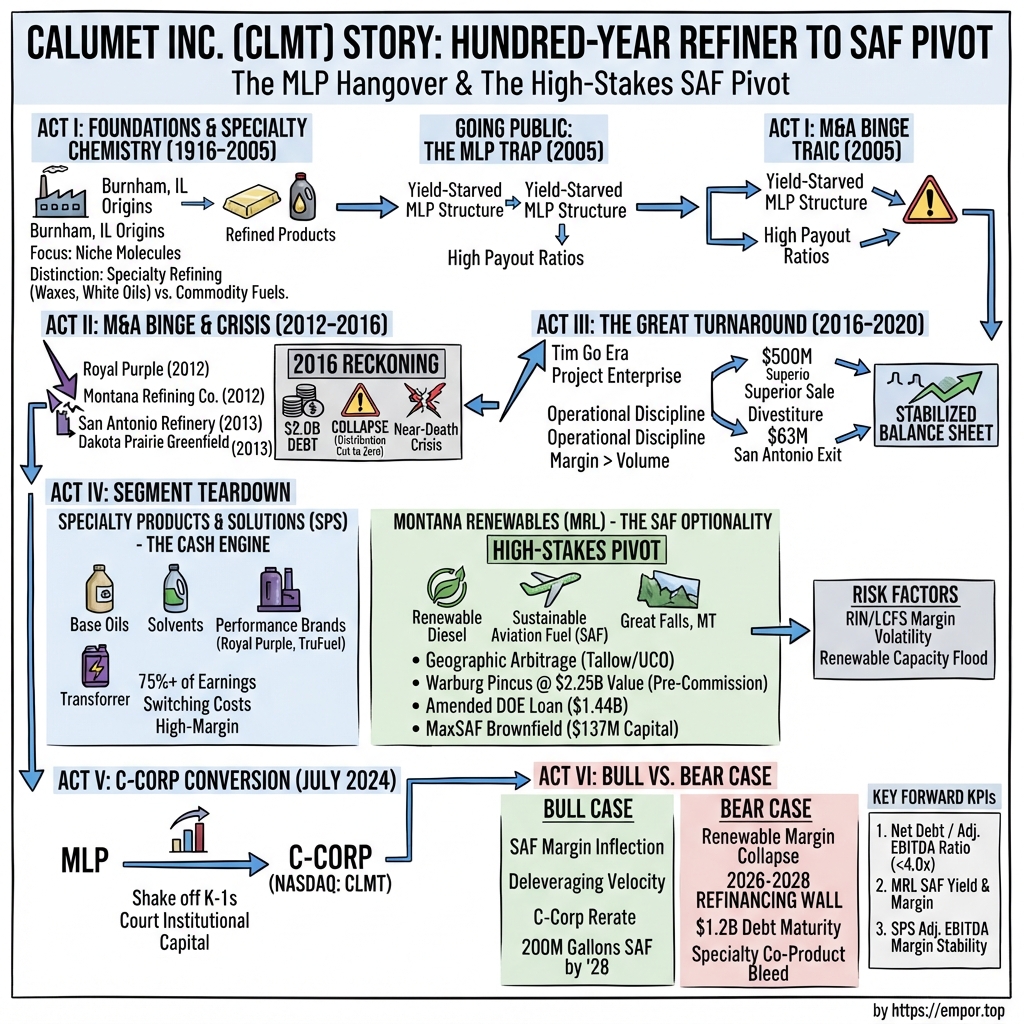
Calumet Inc.: The Hundred-Year Specialty Refiner, the MLP Hangover, and the High-Stakes SAF Pivot
I. Introduction & Episode Roadmap
On September 1, 2026, Calumet Inc. did something companies rarely do: it announced the cancellation of a $1.2 billion construction project and framed the decision as the best news of the year.
The project was Phase 2 of MaxSAF, the expansion designed to turn Montana Renewables in Great Falls, Montana, into one of the largest sustainable aviation fuel producers in the world. In its place, Calumet and the U.S. Department of Energy amended their loan guarantee agreement so that the remaining project capital fell to $137 million, with the DOE's remaining commitment cut from as much as $658 million to a single final draw of $34 million. The rest would be funded out of Montana Renewables' own earnings, with no third-party equity and no shareholder dilution. Instead of shipping a second reactor up from the Gulf Coast, the company plans to repurpose equipment at its adjacent crude refinery — including an installed hydrotreater, a hydrogen plant, and a naphtha splitter — to reach roughly 200 million gallons of annual SAF production by the end of 2028.1
Management framed the trade bluntly: roughly 70% of the original project's benefit for roughly 15% of the original Phase 2 capital.1 That framing raises an obvious question: if a comparable outcome was achievable for one-eighth the capital, what exactly was the original plan?
That question — the gap between what Calumet announces and what Calumet ultimately builds — is the spine of this story.
The company itself is an unusual corporate hybrid. Its roots trace to 1916 as a specialty petroleum processor in the Chicago industrial belt. It spent eighteen years operating as a master limited partnership, distributed cash it did not generate, cut its payout to zero after nearly going under, and finally converted to a Delaware C-corporation in July 2024.2 Today, it produces cosmetic-grade white oils for moisturizers, dielectric fluids to insulate electrical transformers, food-grade waxes, Royal Purple synthetic motor oil, TruFuel canned engine fuel sold through Home Depot — and jet fuel refined from beef tallow.
Public markets have repriced the business dramatically. Calumet's stock traded as low as $17.08 over the past fifty-two weeks before closing near $53 in early September 2026, giving it a market capitalization of roughly $4.6 billion.3 Calumet did not transform into an entirely different operating company over those twelve months. What changed was the price of a regulatory credit.
That dynamic highlights the central tension in the business. Calumet operates two distinct economic engines bolted to a single corporate balance sheet. One is Specialty Products and Solutions, the century-old business of refining crude oil into precisely specified molecules for industrial customers who face high switching costs. In the second quarter of 2026, that segment produced $161.7 million of adjusted EBITDA, more than double the $66.8 million it earned a year earlier.4 The other engine is Montana Renewables, an unrestricted subsidiary that private equity once valued at $2.25 billion before it had produced a gallon,5 and which produced $10.7 million of adjusted EBITDA in the same quarter.4
The central question this episode addresses is not whether Calumet is cheap or expensive. It is narrower and more practical: how much of the recent earnings surge reflects a durable operational advantage, and how much stems from a regulatory policy window that could close as quickly as it opened?
Answering that question is difficult because Calumet is effectively two businesses with opposing risk profiles sharing one capital structure. The specialty business sells small volumes of highly tailored molecules to customers who spent months qualifying them; its risk lies in cyclical margin compression rather than lost accounts. Montana Renewables sells a fungible, drop-in commodity into a market where operating margins are created primarily by government regulation; its fundamental risk is policy change. One business is mature, steady, and difficult to displace. The other is capital-intensive, fast-moving, and structurally exposed to Washington. Consolidated financial statements blend them into a single number that obscures both.
An additional structural dynamic remains hidden in headline figures. Because Calumet's Louisiana refineries are obligated parties under the federal Renewable Fuel Standard, the company is simultaneously a producer of renewable fuel credits in Montana and a buyer of them in Louisiana. When the price of those credits rises — as it did sharply across 2026 — one subsidiary gains value while another incurs an expanding liability. Rather than an accounting footnote, this regulatory mismatch is the primary reason reported results and underlying operational economics diverged so sharply over the past two quarters, an issue that will resurface throughout this study.
The roadmap unfolds in ten parts. Act I examines the origins and physics of specialty refining — why producing white oil is fundamentally distinct from making gasoline. Act II details the 2012–2015 acquisition spree and the near-insolvency that followed. Act III analyzes the turnaround and asset divestitures. Act IV examines the specialty and consumer-brand segments. Act V reviews Montana Renewables in depth, including its early operational setbacks. Act VI evaluates the corporate conversion, the management team, and their historical execution against guidance. Act VII applies strategic frameworks, Act VIII runs an activist stress test, Act IX weighs the bull and bear cases alongside key operational metrics, and Act X draws broader lessons.
The story begins with a refinery in Louisiana that has never treated gasoline as its primary product.
 Subscribe on LinkedIn
II. Foundations & The Specialty Chemistry Paradigm
At a conventional oil refinery, the operating logic centers on volume. Crude enters one end, and gasoline, diesel, and jet fuel flow out the other, sold into a commodity market where products are fungible, prices are set on a screen, and margins equal the crack spread minus whatever operating costs can be pared away. Drivers rarely ask who refined the gasoline in their tanks.
At Calumet's Shreveport complex in northwest Louisiana, that logic inverts: the customer dictates the precise molecular formula. A pharmaceutical company purchasing white mineral oil for skin cream requires a hydrocarbon stripped so thoroughly of aromatics and sulfur that it complies with United States Pharmacopeia and National Formulary standards—the same purity regime governing active drug ingredients. An electric utility buying transformer oil needs a fluid with sufficient dielectric strength, oxidation resistance, and viscosity stability to prevent degradation over decades inside energized equipment. A food packager buying wax requires material approved by the Food and Drug Administration to contact food directly.
The technical distinction lies in processing severity and fractionation. Conventional fuels refining takes broad cuts of the crude barrel and cracks them aggressively. Specialty refining takes narrow cuts, hydrotreats them severely—saturating molecules with hydrogen under high temperatures and pressure until the impurities that impart color, odor, and chemical reactivity are removed—and blends them to a customer's exact recipe. The process is slower, consumes more energy per barrel, and yields far less volume. In exchange, it generates bespoke molecules that customers have tested, qualified, and, across many regulated end markets, registered with government agencies.
That qualification process underpins the segment's underlying economics. Changing base-oil suppliers inside a pharmaceutical, food, or military supply chain is not a routine procurement decision; it is a prolonged, costly requalification project. That friction creates high switching costs, forming the foundation of Calumet's competitive position.
A second technical distinction centers on feedstock crude. Base oils divide broadly into paraffinic and naphthenic families. Paraffinic oils, refined from waxy crude slates, serve as the workhorses of motor and industrial lubrication. Naphthenic oils, derived from rarer naphthene-rich crude, maintain fluidity at sub-zero temperatures and dissolve chemical additives with ease—qualities essential for electrical transformers operating through northern winters or tire manufacturers dispersing process oils into synthetic rubber. Because the requisite crude slates are scarce, naphthenic refining represents only a fraction of global base-oil capacity and remains concentrated in a handful of facilities worldwide. Calumet's refinery in Princeton, Louisiana, is one of them.
That feedstock scarcity provides structural protection for the specialty franchise, even if it does not confer scale. Calumet competes against ExxonMobil, Chevron, HF Sinclair (through its Sonneborn white-oils business), and Ergon—rivals that are substantially larger, backward-integrated into their own crude supply, or both. Calumet does not disclose market share by product line, and reliable third-party data for technical and food-grade white oils is not publicly available. What can be established with confidence is narrower: this is an oligopoly protected by rigorous qualification hurdles, a small group of approved suppliers, and an absence of new domestic entrants.
The company's modern public structure was assembled from assets historically held by Calumet Lubricants Co., Limited Partnership, contributed into a new partnership formed in September 2005.6 Ownership of the general partner rested with The Heritage Group, the Fred M. Fehsenfeld, Jr. family, and the F. William Grube family—an industrial dynasty based in Indianapolis rather than Houston's energy corridor.6 The initial operating footprint centered on northwest Louisiana: refineries in Shreveport, Princeton, and Cotton Valley, anchored by an industrial terminal in Burnham, Illinois.6
Then came the capital structure that dictated corporate behavior for the next eighteen years. Calumet Specialty Products Partners, L.P. completed its initial public offering on January 31, 2006, and returned to the equity market later that year, selling 3.3 million common units at $32.94 apiece for net proceeds of roughly $103 million.6 It listed as a master limited partnership with a minimum quarterly distribution of $0.45 per unit and incentive distribution rights that escalated the general partner's share of incremental cash to as much as 50% above a $0.495 quarterly threshold.6
That architecture created powerful, distortive incentives. An MLP functioned as a cash-distribution vehicle valued primarily on yield, meaning the path to a higher unit price ran through steadily rising payouts. The IDR ladder ensured the general partner earned disproportionately more as distributions climbed. And because MLPs paid out virtually all available cash to unitholders, growth had to be financed by issuing new units and taking on debt rather than by retaining earnings.
For an interstate pipeline supported by contracted, inflation-linked, take-or-pay cash flows, that structure can be a defensible design. For a refiner—a business subject to volatile commodity margins, multi-year maintenance turnarounds, and heavy capital expenditure cycles—it proved to be a slow-motion structural flaw. The partnership's initial disclosures laid bare that vulnerability: specialty products accounted for about 52.2% of gross profit in 2005, rising to 72.7% in the first quarter of 2006.6 Even in its most specialty-oriented periods, roughly a quarter to a half of the profit pool came from commodity fuels, whose margins no refiner controls.
For a decade, the machine ran. Then management decided to make it bigger.
III. The M&A Binge, Capital Overreach, & The 2016 Near-Death Crisis
Between the summer of 2012 and the end of 2013, Calumet went shopping with a speed that in retrospect looked less like strategy and more like unbridled appetite.
The opening move was defensible and strategically sound. On July 3, 2012, Calumet completed the acquisition of Royal Purple, Inc. for aggregate consideration of approximately $333 million.7 Royal Purple was an established consumer and industrial brand in high-performance synthetic lubricants—a premium product with retail shelf presence, pricing power, and operating margins far wider than anything a merchant fuels refiner could generate. It fit the specialty thesis squarely.
Everything after that drifted away from the core.
On October 1, 2012, Calumet completed the purchase of Montana Refining Company from Connacher Oil and Gas for $120 million plus working capital, bringing aggregate consideration to roughly $201 million.8 What it bought was a modest refinery in Great Falls, Montana—with roughly 10,000 barrels per day of crude capacity—producing gasoline, middle distillates, and asphalt for regional markets across Montana, Idaho, Washington, and Alberta.9 The commercial pitch rested on access to discounted heavy Canadian crude and a captive local customer base. Nobody at the time described it as the future of aviation fuel.
On January 2, 2013, Calumet closed on NuStar's San Antonio refinery and associated pipeline, terminal, and logistics assets for total consideration of approximately $117.9 million net of cash acquired—a 17,500-barrel-per-day facility manufacturing diesel, jet fuel, gasoline, and select specialty solvents.9 The rationale centered on capturing the steep discount on Eagle Ford shale crude. Yet that discount was merely the temporary byproduct of a regional pipeline bottleneck—and in energy markets, pipeline bottlenecks eventually get debottlenecked.
On December 10, 2013, the company acquired Bel-Ray Company for approximately $53.6 million net of cash acquired, adding a manufacturer of high-performance lubricants and greases for industrial, powersports, and mining customers.9 It was compact, sensible, and on-strategy.
And then came Dakota Prairie. Calumet took a 50% interest in a joint venture with WBI Energy, a subsidiary of MDU Resources, to build a greenfield diesel refinery in Dickinson, North Dakota, aimed at processing Bakken crude.10 Greenfield refineries had not been built in the United States in decades, for reasons that severe winter weather, construction delays, and cost inflation promptly re-demonstrated: the facility's final cost reached roughly $430 million, about 40% above initial estimates.11
Taken together, the underlying pattern was unmistakable. A company whose entire public rationale rested on being insulated from commodity refining spent three years acquiring commodity refineries. Worse, it funded that expansion with debt at the top of the commodity cycle, right before crude prices collapsed in 2014 and 2015 and erased the very regional price differentials the acquisitions were engineered to capture.
The bill arrived in 2016.
Refining margins deteriorated sharply through late 2015 and into the first quarter of 2016. In April 2016, the board of the general partner voted unanimously to suspend the quarterly cash distribution of $0.685 per unit—or $2.74 annualized—effective for the quarter ended March 31, 2016.12 For a master limited partnership held overwhelmingly by retail unitholders for its cash yield, the suspension was the financial equivalent of a controlled demolition. Days later, on April 15, 2016, the partnership priced a private placement of $400 million of 11.5% senior secured notes due 2021.12 The double-digit coupon told the story better than any management commentary: this was rescue financing.
Then the greenfield project was dismantled. On June 24, 2016, WBI Energy agreed to sell all of Dakota Prairie Refining to Tesoro. Under the accompanying arrangement, Calumet received $28.5 million in gross consideration—an amount immediately erased by its required repayment of $36.0 million in borrowings under Dakota Prairie's revolving credit facility.10 Calumet effectively paid $7.5 million net to walk away, recording a loss on the sale of an unconsolidated affiliate of $113.9 million for the year.13 MDU, for its part, guided to an after-tax impairment of $150 million to $160 million on the same asset.10
Testing the claim: can this company execute large industrial growth projects profitably?
This question matters enormously in 2026, because that execution capability is precisely what the sustainable aviation fuel expansion demands. The historical record, viewed across the relevant decade, offers clear warning signs. On the greenfield build, Calumet committed capital to a project that incurred cost overruns of roughly 40% and exited for net negative cash proceeds and a nine-figure loss.101113 On the acquisition side, both commodity refineries purchased between 2012 and 2013 were eventually divested, one at a steep discount to what Calumet paid. The single acquisition from that era that delivered durable value—Royal Purple—was an established, branded specialty business, not a capital-intensive construction venture.
That history does not prove Calumet cannot build complex infrastructure. It does, however, establish an empirical base rate and narrows the investment thesis considerably: the company's demonstrated operational strength lies in running and optimizing existing assets, not in delivering massive new-build capital projects on time and on budget. That context is vital when evaluating Calumet's September 2026 decision to abandon a billion-dollar megaproject in Montana in favor of repurposing installed equipment. That pivot is either proof that management internalized the hard-won lessons of the past—or evidence that it required fourteen years and a second near-miss to avoid repeating them.
Whichever interpretation proves correct, in early 2016 the company needed leadership with direct refining operating experience. It went and got one.
IV. The Great Turnaround: De-Risking & The Specialty Re-Focus
Timothy Go took over as chief executive effective January 1, 2016, stepping into a company facing an imminent liquidity reckoning.14 His background was rooted in refining operations rather than corporate finance, spanning nearly two decades in senior operations and management roles at ExxonMobil followed by an appointment as Vice President of Operations at Flint Hills Resources, the refining subsidiary of Koch Industries.14 Both organizations share a rigorous operational culture centered on continuous measurement, asset reliability, and strict adherence to margin per barrel.
That operational discipline matched Calumet's immediate needs. After four years of debt-fueled expansion, Go reversed the company's trajectory: stabilize existing facilities, divest non-core assets, and enforce disciplined capital allocation.
The operational side of the turnaround was systematic and unglamorous. Management targeted supply-chain efficiencies, reduced overhead, and prioritized quick-payback capital projects over multi-year speculative builds. Structurally, operating metrics shifted from chasing gross throughput volume to maximizing net margin per barrel—a vital distinction in a business where incremental commodity barrels can easily trade below the cost of feedstock.
The portfolio restructuring proved far more drastic.
In 2017, Calumet sold its Superior, Wisconsin refinery—a 47,500-barrel-per-day facility and by far the partnership's largest merchant fuels asset—to Husky Energy. The transaction closed on November 8, 2017, for total consideration of $492 million, comprising a $435 million base purchase price plus $57 million for working capital, inventories, and capital spending reimbursements.15 Calumet directed the net proceeds toward retiring expensive debt. Strategically, the divestiture acknowledged an inescapable reality: Calumet lacked the regional scale to compete effectively as an independent mid-continent fuels refiner.
Two years later, the second merchant fuels asset was sold. Calumet divested the San Antonio refinery alongside its related crude terminal and pipeline infrastructure to Starlight Relativity Acquisition Company for $63 million in cash plus adjustments, effective November 1, 2019.16 Having acquired the facility for roughly $118 million six years earlier, Calumet exited at $63 million.916 Beyond the language of portfolio optimization, the transaction represented an unhedged capital-allocation failure.
What emerged from these divestitures was the corporate structure that exists today: a high-margin specialty products business, a portfolio of branded consumer and industrial lubricants, and the Great Falls, Montana refinery—which was then still a conventional crude refinery producing local asphalt and fuels rather than a renewable fuels hub.
That structural reset reshaped Calumet's capital-allocation incentives. Under master limited partnership governance, assets had been judged primarily by their capacity to generate distributable cash flow. Under the post-2016 framework, facilities had to satisfy two stricter criteria: whether they delivered acceptable risk-adjusted margins per barrel, and whether Calumet possessed any competitive advantage in owning them. Both Superior and San Antonio failed that standard. Yet it had taken an eliminated distribution, an 11.5% rescue bond, and an external chief executive to force that admission.
Assessing the turnaround also requires separating operational survival from balance-sheet repair. Between 2017 and 2019, Calumet raised roughly $555 million across the two refinery divestitures.1516 Yet the partnership still entered 2024 carrying $2,100.2 million of total debt and a stockholders' deficit of $(711.9) million.20 The asset sales bought solvency and time, but they did not resolve the enterprise's underlying leverage. The heavy debt load that management continues to work down in 2026 remains the direct financial hangover of the 2012–2015 acquisition spree.
The pandemic-era demand shock of 2020 served as the ultimate stress test for that reorganized footprint. Global transportation fuel demand collapsed, crack spreads turned negative in regional markets, and several leveraged merchant refiners sought bankruptcy protection. Calumet survived without filing for Chapter 11 or restructuring its debt in court. That resilience, however, owed far more to the fortunate timing of the 2017 and 2019 asset sales—which removed the large fuels refineries whose cash burn would have proved catastrophic—than to any sudden insulation in the broader macro environment.
Corporate leadership changed twice more over the next two years. Go stepped down in early 2020, and board member Steve Mawer—who had retired as president of Koch Supply & Trading after a 27-year career across trading, risk management, and refining—assumed the chief executive role in April 2020 on an accelerated schedule as the pandemic escalated.17 Mawer led the partnership until May 2022, when Todd Borgmann, Calumet's former chief financial officer and a fifteen-year company veteran, took over as President and CEO.18
By the time Borgmann took the helm, the specialty business was carrying the financial weight of the enterprise. Examining how that business generates cash explains how Calumet stayed afloat—and where its durable competitive advantages truly lie.
V. Inside the Cash Machine: Specialty Products & Performance Brands
In the second quarter of 2026, Calumet's Specialty Products and Solutions segment generated $161.7 million of adjusted EBITDA on adjusted gross profit of $195.6 million—a dramatic rebound from $66.8 million and $75.6 million, respectively, in the prior-year period.4 The segment processed 62,903 barrels per day to establish an all-time production record, keeping specialty sales above 20,000 barrels per day for a seventh consecutive quarter.419
When financial performance inflects that sharply in a century-old refining operation, the explanation rarely lies in operational changes within the plant gates. It reflects structural shifts in the macro environment.
Management's commentary during the August 2026 earnings call offered specific, verifiable context. Chief executive Todd Borgmann pointed to a global base-oil market where more than 10% of total capacity sat offline, creating an acute supply deficit—the combined consequence of Middle Eastern operating disruptions and European plant closures stemming from the war in Ukraine, with premium Group III grades facing severe shortages.19 Commercial executives informed analysts that the company expected this regional tightness to persist through the remainder of 2026.19 Capitalizing on the supply crunch, Calumet implemented more than twenty specialty price increases during the first quarter, achieving full realization across its contracts by the second.19
The sober assessment: this surge represents a genuine cyclical windfall that Calumet's asset base allowed it to capture, not proof of a structural step-change in competitive advantage. Securing price increases when one-tenth of global industry capacity is shuttered reflects temporary market dislocation rather than permanent pricing power. The definitive test will come once that idled capacity returns to production.
That reality leads directly to the core competitive claim underpinning the company's valuation.
Testing the claim: is the specialty business decoupled from commodity refining margins?
The company's own operating history rejects the strongest version of that thesis. Segment adjusted EBITDA for Specialty Products and Solutions fell from $251.2 million in 2023 to $193.6 million in 2024—a 23% contraction—even as specialty sales volumes held steady.20 The volatility stemmed from co-product economics. Shreveport operates as a specialty facility, but it still runs a conventional crude slate: the fractions of each crude barrel that cannot be fractionated into white oils, waxes, or solvents must be cracked into commodity gasoline and diesel, then sold at Gulf Coast crack spreads over which Calumet exercises zero control.
Recent quarterly swings demonstrate the same commodity exposure in reverse. In the first quarter of 2026, serving the same customer roster from the same physical refineries, the segment generated $44.3 million of adjusted EBITDA—down from $56.3 million a year earlier.21 Three months later, it generated $161.7 million.4 A division whose quarterly operating earnings can nearly quadruple sequentially without material changes in plant capacity, long-term contracts, or customer mix is not, in any functional sense, decoupled from commodity energy markets.
The appropriate conclusion is therefore a refinement, not a dismissal. High customer switching costs remain genuine—an industrial client with a validated, pharmaceutical-grade white-oil recipe will not switch suppliers over minor price differentials—and those barriers show up as stable volumes and the ability to pass through raw material inflation. What they cannot do is insulate operating margin. The defensible investment proposition is narrower: Calumet's specialty franchise commands steady baseline volumes and privileged access to protected niches, but it remains tethered to an underlying margin cycle that fluctuates with broader refining fundamentals. The empirical test of that proposition will be whether specialty margin per barrel can preserve the roughly $60-per-barrel baseline management cited during the soft macro environment of 2025 once offline base-oil capacity returns to the market.22
The company's second operational engine is smaller and governed by different commercial dynamics. Performance Brands—encompassing Royal Purple, Bel-Ray, and TruFuel—delivered $57.4 million of adjusted EBITDA in 2024, up from $47.9 million in 2023.20 TruFuel stands out as the most strategically distinctive asset in the portfolio: pre-mixed, ethanol-free small-engine fuel packaged in retail cans and distributed through home-improvement chains to consumers seeking to protect lawn equipment from ethanol corrosion. It transforms a standard refinery stream into a packaged consumer staple sold at consumer-packaged-goods retail price points.
Yet Performance Brands carries its own operational vulnerabilities, which became apparent in mid-2026. In the second quarter, segment adjusted EBITDA fell to $6.3 million from $13.5 million in the prior-year quarter, despite achieving 18% volume growth.419 The margin compression was mechanical: raw-material input costs spiked immediately, whereas retail shelf price adjustments typically lag by 60 to 90 days, and last-in, first-out (LIFO) inventory accounting imposed an additional $7 million headwind.19 Management captured the dynamic succinctly on the call, noting that the surge in base-oil feedstock costs that compressed retail lubricant margins was the exact driver producing windfall profits across Calumet's specialty refining operations.19
That dynamic reveals an important corporate reality: the two segments function as partial operating hedges rather than independent growth engines, providing consolidated earnings stability at the expense of consolidated upside.
Calumet has also simplified this segment. In early 2025, the company agreed to divest the industrial lubricants portion of Royal Purple for $110 million while retaining the core consumer brand and the manufacturing facility in Porter, Texas;20 the industrial assets were acquired by Lubrication Engineers, an Aurora Capital portfolio company.23 Monetizing a portion of a branded asset purchased thirteen years earlier for $333 million to accelerate balance-sheet deleveraging represented pragmatic capital allocation for an indebted firm. It also highlighted the lingering financial legacy of the 2012–2013 acquisition campaign.
Neither of these legacy businesses, however, explains the dramatic market re-rating Calumet experienced in 2026. That re-rating centered entirely on a converted refinery in central Montana.
VI. The Montana Renewables (MRL) Optionality Bet
For most of its operating life, the Great Falls refinery was a regional afterthought: a 10,000-barrel-per-day facility converting Canadian crude into asphalt and local fuels for a market of a few hundred thousand people.9 It was too small to offer scale and too remote to warrant major modernization.
Around 2020, executive vice president Bruce Fleming and chief executive Todd Borgmann saw an overlooked industrial asset inside the fence line: an installed hydrotreater.
The technical logic behind that observation formed the entire basis of Calumet's renewable fuels pivot. Renewable diesel and sustainable aviation fuel produced through the hydroprocessed esters and fatty acids (HEFA) pathway are chemically near-identical to their petroleum-derived counterparts. A processor takes biological fats—used cooking oil, meatpacking beef tallow, distillers corn oil from ethanol plants, or camelina seed oil—and feeds them alongside hydrogen into a reactor under elevated temperature and pressure. That hydrotreating process strips out oxygen atoms and saturates the hydrocarbon chain, yielding a drop-in fuel that moves through existing pipelines, fuel farms, and jet engines without modification.
Because severe hydrotreating is the identical process Calumet uses to strip aromatics from crude fractions to manufacture white mineral oils, specialty refining complexes are inherently rich in hydroprocessing infrastructure. Great Falls already held the high-pressure reactors, hydrogen supply, product tankage, rail connectivity, and industrial operating permits. Repurposing existing hardware converted what would have been an extended greenfield construction build into an accelerated brownfield retrofit, allowing Montana Renewables to achieve commercial production years faster and at significantly lower initial capital cost than a clean-sheet plant.
Calumet split the Great Falls facility into two separate operating units. One train continued running Canadian crude into regional asphalt and fuels under Calumet Montana Refining. The second became Montana Renewables, LLC, organized as an unrestricted subsidiary positioned outside the credit covenant boundary of the parent company's debt, granting it the independence to raise third-party equity and project debt directly.
The site's commercial logic rested on specific geographic advantages. Great Falls sits adjacent to the Canadian prairies and the American northern plains, shortening transit distances to low-carbon agricultural and livestock feedstocks. Under both the federal Renewable Fuel Standard and California's Low Carbon Fuel Standard (LCFS), the financial value of a renewable gallon depends on its lifecycle carbon-intensity score, where feedstock selection and transportation mileage represent decisive variables. Access to Montana's hydroelectric grid lowered the facility's internal utility emissions, while direct rail connections provided export access to clean-fuel markets across the Pacific Northwest, California, and British Columbia.
Private capital validated the concept well before commercial operations stabilized. On August 5, 2022, private equity firm Warburg Pincus committed $250 million to Montana Renewables through a non-interest-bearing preferred equity instrument carrying minimum return thresholds and a seat on MRL's four-member board of managers, pricing the venture at an implied pre-commissioning enterprise value of $2.25 billion; the capital retired an earlier $300 million convertible investment from Oaktree Capital Management.5 A subsidiary with zero commercial renewable operating history was marked at more than double the entire public market capitalization of its parent company.
Testing the claim: does technical capability in renewables translate into margin?
Initial operational results contradicted the initial valuation thesis. Montana Renewables generated segment adjusted EBITDA of $30.2 million in 2023 and $16.7 million in 2024.20 In 2025, operating economics deteriorated further, producing an adjusted EBITDA loss of $(50.8) million.24
The operational shortfall stemmed primarily from macro and regulatory dislocations rather than mechanical failure. A large wave of renewable diesel capacity—anchored by well-capitalized Gulf Coast and West Coast refinery conversions—entered service simultaneously, flooding regional environmental compliance markets. California LCFS credit prices, which had traded above $150 per metric ton at their peak, dropped into the low double digits. Simultaneously, federal D4 biomass-based diesel Renewable Identification Number (RIN) prices suffered steep declines. That margin squeeze was compounded by regulatory friction as the statutory expiration of the federal $1.00-per-gallon blender's tax credit and its transition to the Inflation Reduction Act's Section 45Z Clean Fuel Production Credit created prolonged commercial uncertainty over baseline gallon values.
The resulting losses demonstrated an inescapable structural reality of the renewable fuels sector: in a government-mandated market, physical hardware is secondary to the regulatory credit architecture. Montana Renewables met its engineering benchmarks—it completed commissioning, hydrotreated non-food feedstocks, secured fuel certifications, and entered airline supply agreements—yet operated at a cash deficit because the realized value of its product was determined by policymakers in Washington and Sacramento rather than commercial supply and demand.
Two subsequent interventions reshaped the subsidiary's cash trajectory.
The first was balance-sheet restructuring. On January 10, 2025, Montana Renewables executed a $1.44 billion conditional loan guarantee agreement with the U.S. Department of Energy, followed in February by an initial disbursement of roughly $782 million alongside a $150 million supplemental equity infusion from Calumet.2526 The facility provided fifteen-year debt priced at the U.S. Treasury rate plus 37.5 basis points.26 Rather than primarily funding speculative new hardware, the low-cost federal facility enabled MRL to extinguish high-cost mezzanine project capital, delivering approximately $80 million in annual cash interest savings according to management's fourth-quarter 2025 disclosures.22 For an operating unit that had generated an adjusted EBITDA deficit that year, eliminating $80 million of fixed carrying costs provided immediate liquidity relief.
The second shift was a sharp regulatory reset. On March 27, 2026, the Environmental Protection Agency finalized Renewable Fuel Standard volumetric requirements for 2026 and 2027, establishing statutory blending obligations of 25.82 billion RINs for 2026 and 25.98 billion for 2027; the rule increased biomass-based diesel quotas roughly 65% above 2025 levels and introduced a 70% reallocation of previously exempted small-refinery volumes back into the compliance pool.27 D4 RIN values, which had hovered near $0.50 during the 2024–2025 trough, rallied to $2.41 by early June 2026.28 Concurrently, California's revised LCFS program tightened credit benchmarks, lifting first-quarter 2026 credit prices to an average of approximately $63 per ton.29
On Calumet's first-quarter 2026 earnings call, Borgmann observed that the EPA's volumetric rulemaking had "fundamentally transformed" industry margins.21 Operating data supported that assessment: by the second quarter of 2026, industry renewable diesel margins expanded to approximately $2.60 per gallon.19
That regulatory surge returned Montana Renewables to operating profitability while highlighting the ongoing volatility of its earnings base. The subsidiary delivered $10.7 million in segment adjusted EBITDA for the second quarter of 2026—or $26.6 million when including earned tax credits—even while absorbing an estimated $40 million margin hit during a planned maintenance turnaround to load the MaxSAF-150 catalyst system.419 Operational SAF production reached an annualized run rate of 60 million gallons, alongside guided targets of 80 to 100 million gallons by late 2026, 120 to 150 million by spring 2027, and roughly 200 million gallons by 2028 under the restructured program.191 Unit operating costs declined to $0.41 per gallon, marking a 60% operational reduction over two years, while commercial offtake contracts secured approximately 100 million gallons of forward SAF deliveries at realized premiums of $1.00 to $2.00 per gallon above prevailing renewable diesel pricing.22
That pricing premium remains central to Calumet's long-term margin thesis. During the fourth-quarter 2025 earnings conference, when TD Cowen analyst Jason Gabelman asked how contractual SAF premiums insulate the business against underlying swings in RIN, LCFS, and production tax credit values, Fleming stated that commercial agreements deliberately balanced Scope 1 and Scope 3 environmental attribute delivery alongside indexation to baseline renewable diesel margins to buffer policy shifts.22 While structurally sophisticated, this framework does not eliminate regulatory dependency: contracts indexed to compliance credits or voluntary corporate decarbonization targets remain tied to administrative carbon policy. Addressing analysts in August 2026 on the durability of voluntary corporate SAF demand compared to statutory European blending mandates, Fleming noted that North American voluntary uptake had exhibited continuous demand without an observed pricing floor.19 The absence of an observed correction, however, does not constitute a guaranteed pricing floor.
The historical track record falsifies the aggressive thesis that Montana Renewables could harvest hundreds of millions of dollars in steady green premiums independent of compliance markets.2024 The realistic operating profile is more focused: MRL functions as a low-cost, feedstock-advantaged processor whose net realized margins represent a highly levered derivative of federal and state environmental credit values. The critical long-term test will be whether the plant can generate satisfactory capital returns during future periods when compliance credit values retreat from cyclical highs.
Calumet's September 2026 capital reallocation must be interpreted through that lens. Rescinding the $1.2 billion standalone Phase 2 build in favor of a $137 million brownfield integration project that still delivers roughly 200 million gallons of annual SAF capacity and 17,000 barrels per day of total liquid yields by late 2028 significantly reduces project execution risk; the plan also recovers 20 million gallons of saleable renewable propane and butane while maintaining existing industrial headcount in Great Falls.1 The operational tie-in turnaround is scheduled for the fourth quarter of 2026, with debt amortization beginning in March 2029 through a final maturity in December 2039.1 Management characterized this revised route as faster, lower-risk, and materially cheaper than executing a megaproject.19 That assessment is mechanically correct. The lingering governance question is why a capital-constrained refiner spent two years pursuing a $1.2 billion capital build—and negotiated a massive federal loan facility to match—before deciding that existing equipment could accomplish nearly the same operational outcome for a fraction of the cost.
Examining how executive leadership navigated that capital cycle leads directly into how the company is governed.
VII. The C-Corp Conversion, Governance, & Management Track Record
On July 9, 2024, Calumet's unitholders voted on the corporate architecture that had defined the business for eighteen years. Approximately 99.6% of votes cast supported converting from a master limited partnership into a conventional C-corporation.2 The transaction closed the following day, and Calumet, Inc. common stock began trading on the Nasdaq on July 11 under the same ticker symbol.2
Near-unanimity in a public shareholder vote typically signals an uncontroversial routine; here, it registered as collective relief.
The operational and governance implications of that change warrant clear definition, as their immediate financial impact is often exaggerated. A C-corporation issues an annual Form 1099 rather than a Schedule K-1. That technical distinction eliminates a significant structural obstacle: K-1 tax packages generate unrelated business taxable income for tax-exempt institutions and create administrative friction for retail investors, leading most equity index funds and many institutional mandates to exclude partnerships entirely. The corporate conversion broadened Calumet's eligible shareholder base and cleared the procedural path toward index inclusion. It also replaced an MLP general-partner governance model—under which the sponsor owes restricted fiduciary duties and retains unilateral board control—with a conventional corporate board elected by common shareholders.
What the conversion did not alter was Calumet's physical assets, debt obligations, or operating cash flows. The subsequent tripling of the share price owed far more to surging RIN compliance credits and global base-oil deficits than to tax filings. Attributing the equity rally from $17 to $53 to corporate restructuring confuses legal form with commodity market timing.
Executive leadership. Todd Borgmann has served as chief executive since May 2022, following more than fifteen years at Calumet across various operational and financial leadership posts, including chief financial officer, and joined the board upon corporate conversion in July 2024.182 As an internally promoted executive, Borgmann inherited an enterprise burdened by legacy capital decisions made prior to his tenure—a circumstance that distinguishes his position from an outside executive defending past capital commitments.
David Lunin assumed the role of executive vice president and chief financial officer in January 2024, joining from Goldman Sachs, where he had worked from July 2010 through May 2023, most recently as a managing director.30 That background represents a capital-markets hire rather than an industrial operations accountant, and his tenure has concentrated primarily on aggressive liability management and debt refinancing.
Bruce Fleming serves as executive vice president for corporate development and leads Montana Renewables as the primary architect of the Great Falls renewable conversion.30 As the executive voice presenting the subsidiary's long-term commercial upside on quarterly earnings calls, his forward-looking projections require disciplined discounting—even while recognizing that he steered Montana Renewables through a Department of Energy Loan Programs Office underwriting process that has derailed numerous competing ventures.
The execution track record. Evaluating management against its public commitments reveals a stark divergence between balance-sheet execution and capital-project delivery.
On liability management, the team has delivered on its stated deleveraging targets. Restricted-group recourse debt fell by more than $220 million across 2025, bringing net recourse leverage down from 8.2 times to 4.9 times adjusted EBITDA.22 In January 2026, operating subsidiaries placed $405 million of 9.75% senior notes due 2031—upsized from an initial $350 million offering—directing the proceeds to retire both the 11.00% notes due 2026 and the 8.125% notes due 2027 in full, eliminating near-term refinancing risk. Calumet followed that placement on March 17, 2026, with an additional $150 million add-on of the 2031 notes to pay down revolving credit borrowings, while extending its $500 million asset-based lending facility by four years, from January 2027 to January 2031.212431
By the second quarter of 2026, restricted-group leverage declined below 4.0 times. In July, Calumet redeemed $100 million of its 2028 senior notes at 102.438% of par and retired $15.5 million in Montana terminal debt,419 while guiding leverage to drop below 3.0 times during the third quarter.19 That steady retirement of high-coupon debt represents verifiable balance-sheet discipline, providing the strongest evidence of management execution in the current era.
On the commercial growth front, however, the record has been characterized by shifting targets and delayed liquidity events. The MaxSAF project was resized twice—first in engineering scope, then in capital structure—while forward production milestones were repeatedly recalibrated across quarterly calls. Furthermore, institutional analysts have consistently questioned the timing of an initial public offering or minority stake sale for Montana Renewables, an equity monetization pathway management has discussed since Warburg Pincus first invested in 2022 that has yet to materialize. As of September 2026, Calumet has established no formal timetable for an MRL public listing.
Guidance transparency remains relatively detailed. Management provides granular, verifiable operating parameters—including SAF yield splits, catalyst cycle timing, unit operating costs per gallon, and feedstock margins—offering clearer technical insight than many independent refiners disclose. Executives have also acknowledged operational missteps directly: foregone margin from an extended maintenance turnaround in Montana was explicitly quantified on earnings calls rather than buried in aggregate operating costs.19
Accounting judgments requiring scrutiny. Two reporting practices warrant careful analysis.
The first is management's presentation of "Adjusted EBITDA with Tax Attributes." This non-GAAP metric credits the notional value of future Section 45Z Clean Fuel Production Credits directly into adjusted EBITDA. In 2025, that methodology allowed Montana Renewables to present $31.3 million of adjusted EBITDA with tax attributes—incorporating $82.1 million of notional credit value—against an actual segment adjusted EBITDA loss of $(50.8) million.24 On a consolidated basis, Calumet reported 2025 adjusted EBITDA of $211.2 million, which climbed to $293.3 million once tax attributes were credited.24 While these credits represent genuine economic value, and Calumet successfully monetized more than $90 million of them, the non-GAAP measure highlights earnings supported by federal subsidy mechanisms that remain subject to statutory guidance, regulatory discretion, and third-party monetization discounts.
The second issue centers on the mark-to-market accounting of Calumet's Renewable Identification Number obligations. Because the company's Shreveport and Princeton refineries are obligated parties under the Renewable Fuel Standard, rising credit values generate an expanding compliance liability. In the first quarter of 2026, this regulatory dynamic produced a $147.4 million non-cash RIN charge and $102.7 million in unrealized derivative losses, contributing to a GAAP net loss of $317.0 million—even as management emphasized fundamental operating improvements.21 Across the first six months of 2026, Calumet generated a consolidated GAAP net loss of $412.9 million against positive adjusted EBITDA.4 This discrepancy reflects the central structural contradiction in Calumet's portfolio: the exact regulatory surge that lifted Montana Renewables into operating profitability simultaneously increased compliance costs at the Louisiana crude refineries. The company operates structurally long RINs in Montana and structurally short RINs in Louisiana.
That compliance drag eased partially on August 31, 2026, when the EPA approved full small refinery exemptions on two petitions covering the 2025 compliance year, extinguishing a balance-sheet liability of 71 million RINs valued at roughly $170 million as of June 30. A remaining obligation of approximately 129 million RINs—valued at about $309 million—remains on the balance sheet, encompassing partial exemptions for 2022 through 2024 that remain under administrative review and federal court challenge alongside petitions from other independent refiners.32
This regulatory dispute has already reached the highest appellate level. In EPA v. Calumet Shreveport Refining, L.L.C., decided on June 18, 2025, by a 7–2 vote, the U.S. Supreme Court held that EPA small refinery exemption denials fall under the Clean Air Act's "nationwide scope or effect" venue exception and must be litigated exclusively in the D.C. Circuit, vacating the Fifth Circuit ruling Calumet had secured below.33 While the Supreme Court resolved only the legal venue rather than the substantive merits of the exemptions, the decision returned Calumet's compliance obligations to active administrative and judicial contestation.
Investors should evaluate that remaining $309 million RIN liability as a live, volatile swing factor capable of impacting the balance sheet in either direction depending on agency discretion and federal court rulings.
VIII. Strategic Analysis: 7 Powers & Porter's 5 Forces
If an investor were war-gaming a competitive attack on Calumet, where would the vulnerabilities emerge?
The analysis begins with what is genuinely defensible. Under Hamilton Helmer's 7 Powers framework, the advantage Calumet most clearly commands is process power—accumulated, difficult-to-replicate operational know-how. Executing severe hydrotreating to pharmaceutical-grade purity, holding narrow distillation cuts, and blending to hundreds of proprietary customer recipes across a multi-refinery network is a capability built across decades. An independent fuels refiner armed with superior capital and direct crude access cannot simply pivot into technical white oils; it lacks the specialized units, environmental registrations, and prolonged customer qualifications. That operational moat is real, and maintaining specialty production above 20,000 barrels per day for a seventh consecutive quarter offers tangible operating proof.19
Switching costs represent Calumet's second authentic power, though they remain highly asymmetric across the corporate footprint. In pharmaceutical, food-contact, transformer fluid, and military-qualified applications, changing suppliers requires costly requalification that customers do not undertake casually. In renewable diesel and sustainable aviation fuel, by contrast, switching costs are precisely zero. These are fungible, drop-in, specification-defined commodities where a commercial buyer evaluates offers strictly on delivered price per gallon net of regulatory credits. Calumet's most capital-intensive growth venture resides in the exact segment with the lowest customer stickiness—a structural friction that public equity markets have yet to value with precision.
Cornered resource is the most frequently cited and least defensible advantage. Montana Renewables benefits from a genuine logistical head start, including direct geographic proximity to northern plains and Canadian prairie feedstocks, access to hydroelectric power, and rail connections into Pacific clean-fuel markets. Yet the core processing technology is standard licensed hydroprocessing available to any well-capitalized refiner, while feedstocks are procured on competitive open markets against far larger agribusiness buyers. Rather than a defensible cornered resource, Calumet holds a localized cost position. That distinction is critical: regional cost advantages inevitably erode whenever a rival constructs processing units closer to the agricultural waste stream.
Branding provides tangible pricing power within Performance Brands, where Royal Purple and TruFuel command premium shelf pricing that unbranded commodity fuels cannot achieve. Yet the segment's consolidated financial contribution remains modest and, as margin compression in 2026 demonstrated, remains exposed to raw-material cost lags.4
The remaining powers in Helmer's taxonomy—network economies, counter-positioning, and enterprise-level scale economies—are entirely absent. Calumet is not the largest producer in any market it serves, and its corporate cost of capital remains materially higher than that of the integrated oil majors it competes against.
Applying Michael Porter's five forces model reveals an equally lopsided competitive architecture.
Supplier power is high and structural. On the conventional refining side, Calumet depends on Canadian heavy crude reaching Great Falls and specialized crude slates feeding Louisiana. On the renewable fuels side, supply concentration is even more acute: animal tallows and vegetable oils are controlled by a handful of massive agricultural processors and renderers, with competing hydrotreaters worldwide bidding for the identical feedstocks. Because raw material costs represent the overwhelming variable expense in HEFA economics, Calumet operates as a pure price taker.
Buyer power is bifurcated along product lines. An industrial customer with a qualified Calumet white-oil formulation possesses negligible bargaining leverage because of the operational cost of switching. Conversely, an airline or fuel distributor purchasing SAF exercises substantial bargaining power, continually benchmarking offers against renewable diesel netbacks and alternative compliance values. Calumet's contracted SAF premiums of $1.00 to $2.00 per gallon above renewable diesel exist because government policies mandate and subsidize them, not because commercial airlines lack alternative options.22
Threat of new entrants is low across specialty refining. No operator is permitting a new grassroots specialty petroleum refinery in North America, where capital intensity, environmental permitting, and qualification hurdles are virtually insurmountable. This dynamic represents the single most durable structural shield around Calumet's core operations, explaining why its specialty franchise has survived three decades of industry consolidation.
Threat of substitutes operates across divergent timelines. Vehicle and power-equipment electrification presents a slow, structural headwind for passenger motor oils and packaged small-engine fuels. The addressable market for TruFuel and consumer Royal Purple will contract as vehicles and lawn care transition to batteries, though on a timeline measured in decades rather than quarters. Conversely, commercial aviation lacks a viable electrification pathway for long-haul flight through at least 2040, which is precisely why sustainable aviation fuel exists as a subsidized regulatory priority. In an ironic strategic symmetry, the substitution risk confronting Calumet's legacy consumer brands helps fund the corporate case for its newest industrial fuel.
Rivalry remains the most formidable force. In base oils and process oils, Calumet contends with ExxonMobil, Chevron, HF Sinclair, and Ergon—rivals possessing integrated crude supplies, global scale, and substantially cheaper financing. In renewable fuels, it faces Neste and Valero's Diamond Green Diesel joint venture, global operators whose volume and distribution networks dwarf Great Falls.
Myth versus reality. Evaluating Calumet's valuation requires dismantling three persistent consensus narratives.
The myth of the specialty chemicals company. Genuine specialty chemical producers generate steady mid-teens returns on invested capital across full economic cycles. Calumet's specialty segment earnings nearly quadrupled sequentially in a single quarter of 2026, driven by an acute macro supply dislocation.421 Calumet remains a specialty refiner—a hybrid whose product slate commands high switching costs, but whose operating margins remain tethered to the broader commodity refining cycle.
The myth that corporate conversion unlocked the equity's value. Calumet finalized its conversion from a master limited partnership to a C-corporation in July 2024.2 The dramatic equity re-rating occurred nearly two years later, following the EPA's volumetric rulemaking in March 2026 and an acute global shortage of base oils. The corporate conversion removed a structural barrier to institutional ownership, but federal environmental policy and commodity dislocations provided the real catalyst.
The myth that Montana Renewables carries an intrinsic $2.25 billion valuation. That headline figure was a pre-commissioning private equity valuation of a preferred equity security carrying guaranteed return thresholds, struck at the cyclical peak of renewable-fuel enthusiasm.5 It preceded three consecutive years in which the operating unit generated segment adjusted EBITDA of $30.2 million, $16.7 million, and an operating loss of $(50.8) million.2024 The transaction represents a historical pricing benchmark for a specific preferred security, not an ongoing appraisal of operating asset value.
Which is precisely the argument an activist or skeptical investor would assemble.
IX. Activist & Skeptical-Investor Stress Test
Consider how a well-capitalized activist investor would frame the case against Calumet's corporate structure.
The core argument is structural rather than emotional: Calumet operates three distinct businesses with three divergent risk profiles, three separate buyer universes, and a single corporate balance sheet. A defensive specialty refining franchise with high customer switching costs and modest top-line growth commands one valuation multiple. A branded consumer lubricants business warrants another. A policy-levered renewable fuels developer backed by a fifteen-year government loan calls for a third—and almost certainly attracts a different investor base. Bundling them together creates a composite security that specialty chemical investors avoid for its cyclical volatility and energy-transition investors pass over for its legacy debt burden.
Then comes the balance sheet, which sits at the center of any activist campaign. Total long-term debt stood at $2,225.2 million as of June 30, 2026, against cash and equivalents of $109.8 million and restricted cash of $40.0 million.4 The capital structure is heavily layered: $555 million of 9.75% senior notes due 2031, $425 million of 9.75% notes due 2028 across two tranches, $200 million of 9.25% senior secured notes due 2029, a $500 million asset-based lending facility, and, at the subsidiary level, $825.2 million drawn under the DOE loan facility as of March 31, 2026.31 At the end of 2024, the company carried a stockholders' deficit of $(711.9) million—negative book equity—against $2,100.2 million of total debt.20
At those high single-digit coupons, an activist would emphasize that Calumet pays roughly nine to ten cents on the dollar for corporate debt while the DOE lends to its operating subsidiary at the Treasury rate plus 37.5 basis points.26 Retiring high-coupon parent debt generates an immediate economic return that rivals incremental operational gains—a reality management implicitly acknowledged by designating balance-sheet deleveraging as its top priority.
From that premise, the activist playbook is straightforward: complete the portfolio rationalization initiated with the Royal Purple industrial divestiture by selling or spinning off Performance Brands entirely; monetize Montana Renewables through an initial public offering or outright sale to a strategic operator with lower capital costs and established environmental credit desks; and direct every dollar of net proceeds toward retiring parent-level debt. What would remain is a pure-play specialty refiner with genuine customer switching costs, manageable debt maturities, and an aligned shareholder base.
Management's counterargument, however, is grounded in operational realities that a purely financial analysis overlooks.
The operational integration between the two Great Falls facilities is physical and structural. The September 2026 brownfield expansion works precisely because Calumet Montana Refining operates adjacent to Montana Renewables: the hydrotreater, hydrogen plant, and naphtha splitter being repurposed are legacy CMR assets, and shared on-site utilities, hydrogen supplies, and infrastructure overhead reduce the remaining capital requirement from $1.2 billion to $137 million.1 Legally separating the two businesses earlier would have eliminated the very operational synergies that enabled a billion-dollar capital savings. Furthermore, management has quantified the cash CMR generates during this transition, highlighting roughly $50 million of incremental earnings captured along the way alongside normalized Montana asphalt EBITDA guidance of $30 million to $50 million.1922
The timing defense also carried weight during the downturn: attempting to monetize Montana Renewables during the 2024–2025 renewable diesel margin collapse would have locked in trough valuations. Yet that defense loses force in mid-2026, with D4 RIN credits trading near historic highs and Great Falls scaling production. If management views a monetization as the ultimate objective, market conditions provide a far more receptive window than during the downturn, meaning continued deferral risks being interpreted by market participants as strategic reluctance rather than disciplined patience.
A more formidable defense—one management rarely emphasizes publicly—stems from the DOE loan structure itself. The facility represents fifteen-year project debt priced at the Treasury rate plus 37.5 basis points, with principal amortization deferred until March 2029.1 That subsidized financing is not readily portable to a third-party acquirer, meaning any sale or spin-off would have to generate sufficient consideration to offset the forfeiture of an extraordinarily cheap credit line.
The subsidiary structure also creates corporate governance complications that warrant scrutiny. Montana Renewables is an unrestricted subsidiary, meaning it sits outside the covenant boundary of Calumet's parent-level indentures and can incur its own debt without triggering parent restrictions—the exact mechanism that made the DOE facility possible. However, public equity investors hold shares in Calumet Inc., not the underlying asset. Warburg Pincus holds a participating preferred equity interest in Montana Renewables with cumulative return thresholds and board representation on MRL's four-member board of managers.5 In any eventual liquidity event, that preferred instrument holds a senior claim on cash proceeds ahead of common equity holders.
The practical question for public investors centers on how cash moves between the two balance sheets. On the second-quarter 2026 earnings call, Bank of America analyst Greg Brody pressed executives on the treatment of the intercompany payable between Montana Renewables and the parent alongside the timing of specialty capital allocation; management replied that detailed discussion of cash settlement versus intercompany loans would accompany broader project disclosures.19 The question is fundamental: the value of parent equity depends directly on whether cash generated in Great Falls can flow back to parent accounts. Because Calumet plans to fund the remainder of the MaxSAF expansion out of Montana Renewables' retained cash flow,1 every dollar held inside the unrestricted subsidiary to build aviation fuel capacity is a dollar unavailable to extinguish 9.75% parent notes—a capital allocation trade-off that management has resolved in favor of expansion over debt retirement.
Ultimately, the skeptic's strongest argument rests on corporate history rather than balance-sheet mechanics. Over the past decade, Calumet's major capital deployment ventures have frequently diverged from initial projections: a greenfield Bakken refinery that resulted in a $113.9 million net loss upon exit,13 a merchant fuels refinery in San Antonio acquired for $118 million and later divested for $63 million,916 and a renewable venture valued at $2.25 billion by private equity that slid into an operating EBITDA loss three years later.524 Given that empirical base rate, an investor evaluating Calumet's target of 200 million gallons of annual SAF capacity by 2028 need not adopt a cynical view of the technology. The prudent approach is simply to demand proof in the operating cash flows, quarter by quarter.
X. Bull vs Bear Case & Key Forward KPIs
The bull case.
The affirmative case rests first on cash generation already reflected in reported results rather than investor decks. In the second quarter of 2026, Calumet generated $90 million in operating cash flow, earned $175.2 million of adjusted EBITDA with tax attributes, reduced restricted-group net leverage below 4.0 times, and retired $115 million in debt over the following month.419 Rather than an unproven forecast, the balance sheet is deleveraging in real time out of operating cash. Management's guidance that leverage will drop below 3.0 times during the third quarter serves as the immediate benchmark for that progress.19
The second pillar centers on tight global specialty supply. With more than 10% of global base-oil capacity offline and premium Group III grades facing acute shortages, Calumet has captured price increases in an oligopolistic market where high customer switching costs prevent volume losses.19 Even after that supply dislocation normalizes, record throughput and steady volume expansion suggest a higher baseline earnings capacity than the segment maintained entering the current cycle.
The third pillar is that Montana Renewables' operating economics have aligned with regulatory incentives. Renewable diesel margins near $2.60 per gallon, unit operating costs down to $0.41 per gallon, approximately 100 million gallons of forward SAF contracted at premiums of $1.00 to $2.00 per gallon above renewable diesel, and a revised route to roughly 200 million gallons of annual SAF capacity for $137 million of remaining capital present a substantially lower-risk proposition than the standalone megaproject pursued a year earlier.19221 The SAF premium forms the operational crux: commercial aviation is the one major transportation segment lacking a near-term electrification pathway, allowing Calumet to capture incremental value simply by upgrading molecules it already processes.
The fourth advantage is the subsidized financing secured at the subsidiary level: a fifteen-year loan guaranteed by the Department of Energy priced at the U.S. Treasury rate plus 37.5 basis points, with principal amortization deferred until March 2029.126 In a capital-intensive sector where competing project financing carries significantly higher borrowing costs, that subsidized credit line provides a structural carrying-cost advantage for as long as the facility remains intact.
The bear case.
The primary counterargument is that the company's recent operating surge remains overwhelmingly policy-driven. Volumetric blending quotas under the Renewable Fuel Standard are established by administrative rulemaking and can be revised by future administrations; the 70% reallocation of exempted small-refinery volumes remains contested; California LCFS credit values are administratively managed; and Section 45Z Clean Fuel Production Credits remain exposed to legislative revisions and shifting Treasury guidance. Calumet's own operating track record underscores how quickly administrative tailwinds can reverse: the identical Great Falls hardware generated a segment adjusted EBITDA loss of $(50.8) million in 2025 before swinging into profitability in 2026 without any fundamental change to the plant.24 An investor purchasing the stock near multi-year highs is taking a concentrated bet on the durability of an administrative and regulatory consensus.
The second risk is that the specialty refining windfall proves transient. Global base-oil capacity idled by regional conflict and operating disruptions will eventually return to service. If the more than twenty price increases implemented in early 2026 reflected temporary market tightness rather than an expansion of Calumet's structural pricing power, those gains will erode, potentially pulling segment adjusted EBITDA back toward the $193.6 million generated in 2024.1920 A normalization of that scale would curb the surplus cash flow currently underwriting both debt retirement and the brownfield expansion in Montana.
The third vulnerability is project execution, which is now compressed into an operating window over the next two years. The physical tie-in turnaround at Great Falls is scheduled for the fourth quarter of 2026, followed by a phased production ramp extending through spring 2027 and into 2028.1 Calumet has absorbed material turnaround-related margin penalties in consecutive years, including an estimated $40 million impact in the second quarter of 2026 alone.19 An unplanned outage or mechanical complication at Great Falls or Shreveport while the company relies on operating cash flow to fund capital expenditures and debt service would quickly derail the deleveraging schedule.
The fourth challenge is the net Renewable Identification Number liability. Approximately 129 million RINs valued at roughly $309 million remain unsettled on the balance sheet, reflecting unresolved small refinery hardship petitions for compliance years 2022 through 2024 that remain under EPA administrative review and federal judicial challenge—a dispute unfolding after Calumet lost a key procedural venue ruling at the U.S. Supreme Court.3233 Because rising RIN values expand compliance expenses at the Shreveport and Princeton crude refineries while increasing revenue at Montana Renewables, Calumet operates with an internal regulatory hedge whose net corporate impact management does not disclose with sufficient granularity for external investors to model cleanly.
The fifth concern is corporate cost of capital. Interest coupons between 9.25% and 9.75% on parent-level senior notes reflect the borrowing costs of a levered, cyclical credit.31 Until consolidated leverage is brought down permanently across a full commodity downcycle, refinancing and liquidity risks will remain embedded in the equity.
The three metrics that decide this.
Consolidated and restricted-group net leverage. This is the master financial variable, dictating refinancing terms, borrowing costs, and whether the common equity trades as a distressed call option or a normalized operating enterprise. Management reduced restricted-group net leverage from 8.2 times to below 4.0 times, while guiding to drop below 3.0 times during the third quarter of 2026.2219 The critical test is whether that deleveraging pace can be sustained when the specialty base-oil margin cycle normalizes, rather than solely during an acute supply deficit.
Montana Renewables SAF sales volumes and realized net margin per gallon. The decisive operational metric is not headline nameplate capacity or press release targets, but actual commercial deliveries of certified SAF and the realized cash margin captured above feedstock and processing costs. The current 60 million gallon annualized run rate, the guided 120 to 150 million gallon target for spring 2027, and the roughly 200 million gallon milestone slated for 2028 represent the sequential verification checkpoints.191 This is where the distinction between technical certification and commercial profitability applies most rigorously: Montana Renewables has produced specification-compliant fuels for several years, but has achieved sustained operating profitability only recently.
Specialty margin per barrel. This figure provides the cleanest indicator of whether Calumet's legacy refining franchise functions as a defensive, high-switching-cost specialty business or a cyclical commodity operation. Management cited holding gross margins above approximately $60 per barrel during the macro trough of 2025.22 Whether that baseline margin holds once idled global base-oil capacity returns to the market will determine the durable earnings floor supporting the entire enterprise.
XI. Epilogue & Playbook Lessons
There is an image implicit in this story worth holding: a modest crude refinery in Great Falls, Montana, acquired in 2012 for roughly $201 million,8 being partially repurposed in 2026 so that its hydrotreater and hydrogen plant can be integrated into the renewable fuels facility built inside its own fence line.1 The asset originally purchased to run discounted Canadian crude is being consumed to feed the venture designed to replace it.
That image encapsulates the core lessons of Calumet's history.
The MLP trap is a design flaw, not merely a management failure. Applying a yield-capitalized, high-payout structure with an escalating incentive distribution ladder to a cyclical industrial business with heavy maintenance capital creates relentless pressure to grow distributions through debt-funded acquisitions. Calumet's 2012–2015 expansion spree was the logical outcome of that structural mandate. The distribution fell to zero in 2016, and the partnership structure itself was not dismantled until 2024.122 When evaluating any yield vehicle, the critical question is not whether the payout is covered today; it is whether the capital structure will force value-destroying decisions at the peak of the commodity cycle.
Brownfield conversions beat greenfield builds, and the evidence sits in Calumet's own filings. The company's greenfield Bakken diesel refinery exceeded its budget by roughly 40% and was eventually exited at a nine-figure net loss.1113 Conversely, converting an existing hydrotreating complex into a renewable fuels facility reached commercial production faster and far cheaper than any comparable new build, and the September 2026 pivot doubled down on that exact principle by prioritizing installed equipment over new construction.1 The broader takeaway for industrial investors is clear: heavily discount announced greenfield economics, and pay attention when management opts for the unglamorous retrofit.
Separate technical capability from margin realization. Montana Renewables produced certified sustainable aviation fuel, secured commercial airline offtake agreements, and finalized a $1.44 billion federal loan guarantee—all while generating negative segment adjusted EBITDA.2425 Technical milestones, quality certifications, and blue-chip customers are necessary operational achievements, but they are not sufficient to generate cash. In policy-created markets, the regulatory credit architecture is the product, and the refinery is simply the machine that manufactures compliance.
Unrestricted subsidiaries cut both ways, and investors must understand the legal structure before the growth narrative. Ring-fencing Montana Renewables is what made a $1.44 billion federal loan possible without violating or renegotiating parent bond indentures.25 Yet that identical ring-fence places private equity preferred equity ahead of public common shareholders in any liquidity event, while making intercompany cash sweeps a contested strategic question rather than an administrative detail.519 When an enterprise houses its primary growth engine in an unrestricted subsidiary, investors must determine who holds claims on that cash flow, and in what order.
A final lesson the historical record insists on: distinguish operational skill from macro weather. Calumet's common equity more than tripled in a year driven by a confluence of external catalysts—an EPA volumetric rule, a war-driven base-oil shortage, and a regulatory exemption decision—that no executive inside the company controls.271932 Management deserves credit for structuring the balance sheet to survive long enough to capture that windfall. But an investor must remain clear-eyed about which portion of the gain reflects durable operational improvement and which represents cyclical fortune. The definitive test of the business will be whether leverage continues to fall once the macro weather changes.
References
-
Montana Renewables Announces Innovative, Capital-Efficient Expansion — Calumet, Inc. via StockTitan, 2026-09-01 ↩↩↩↩↩↩↩↩↩↩↩↩↩↩
-
Calumet Specialty Products Partners, L.P. Unitholders Approve Conversion to a C-Corporation — PR Newswire, 2024-07-09 ↩↩↩↩↩↩
-
Calumet Reports Second Quarter 2026 Results — PR Newswire, 2026-08 ↩↩↩↩↩↩↩↩↩↩↩↩↩
-
Calumet Announces Series of Transactions at Montana Renewables — PR Newswire, 2022-08-05 ↩↩↩↩↩↩
-
Calumet Specialty Products Partners, L.P. Form 424B1 Prospectus — U.S. Securities and Exchange Commission, 2006 ↩↩↩↩↩↩
-
Calumet Specialty Products Partners, L.P. Completes Acquisition of Royal Purple, Inc. — PR Newswire, 2012-07-03 ↩
-
Calumet Specialty Products Partners, L.P. Completes Acquisition of Montana Refining Company, Inc. — PR Newswire, 2012-10-01 ↩↩
-
Calumet Specialty Products Partners, L.P. Form 10-K for fiscal year 2013 — U.S. Securities and Exchange Commission, 2014 ↩↩↩↩↩↩
-
MDU Resources Group, Inc. Form 8-K/A — U.S. Securities and Exchange Commission, 2016 ↩↩↩↩
-
Dakota Prairie Refinery sold to Tesoro at a loss, hurt by oil price slump — The Dickinson Press, 2016 ↩↩↩
-
Calumet Specialty Products Partners, L.P. Provides Strategic Update — PR Newswire, 2016-04 ↩↩↩
-
Calumet Specialty Products Partners, L.P. Form 10-K for fiscal year 2016 — U.S. Securities and Exchange Commission, 2017 ↩↩↩↩
-
Calumet Specialty Products Partners, L.P. Names Timothy Go as Incoming CEO — PR Newswire, 2015-09-14 ↩↩
-
Husky Energy acquires Superior, Wisc., refinery — Oil & Gas Journal, 2017-11 ↩↩
-
Calumet Sells San Antonio Refinery and Terminal for $63 Million — Inspectioneering, 2019-11-14 ↩↩↩↩
-
Calumet Specialty Products Partners, L.P. Announces CEO Transition — PR Newswire, 2020-03-09 ↩
-
Calumet taps Borgmann as new CEO; Mawer to become Chairman — Seeking Alpha, 2022 ↩↩
-
Earnings call transcript: Calumet's Q2 2026 revenue beats, but EPS miss weighs on shares — Investing.com, 2026-08 ↩↩↩↩↩↩↩↩↩↩↩↩↩↩↩↩↩↩↩↩↩↩↩↩↩↩↩↩
-
Calumet Reports Fourth Quarter and Fiscal Year 2024 Results — PR Newswire, 2025-02-28 ↩↩↩↩↩↩↩↩↩
-
Calumet Reports First Quarter 2026 Results — PR Newswire, 2026-05 ↩↩↩↩↩
-
Calumet (CLMT) Q4 2025 Earnings Call Transcript — The Motley Fool, 2026-02-27 ↩↩↩↩↩↩↩↩↩↩
-
Lubrication Engineers Carves Royal Purple Industrial from Calumet — PE Professional, 2025-03 ↩
-
Calumet Reports Fourth Quarter and Fiscal Year 2025 Results — PR Newswire, 2026-02-27 ↩↩↩↩↩↩↩↩↩
-
Montana Renewables Announces Closing of $1.44 Billion DOE Loan Facility for Renewable Fuels and Biomass Energy Facility — PR Newswire, 2025-01 ↩↩↩
-
Montana Renewables Receives First Drawdown from $1.44 Billion DOE Loan Facility — PR Newswire, 2025-02 ↩↩↩↩
-
Final Renewable Fuel Standards for 2026 and 2027 — U.S. Environmental Protection Agency, 2026-03-27 ↩↩
-
Higher blending targets drive RIN prices close to record highs — U.S. Energy Information Administration, 2026 ↩
-
Calumet, Inc. Form 10-Q for the quarter ended March 31, 2026 — U.S. Securities and Exchange Commission, 2026 ↩↩↩
-
Calumet Provides Update After Latest U.S. EPA Small Refinery Exemption Decision — PR Newswire, 2026-09-02 ↩↩↩
-
Environmental Protection Agency v. Calumet Shreveport Refining, L.L.C., No. 23-1229 — Supreme Court of the United States, 2025-06-18 ↩↩
 LinkedIn
 WhatsApp
 Reddit
 Hacker News
 Email
Email Kindle
 RSS Feed
 Spotify
 Apple Podcasts
 Amazon Music
 Audible
 YouTube