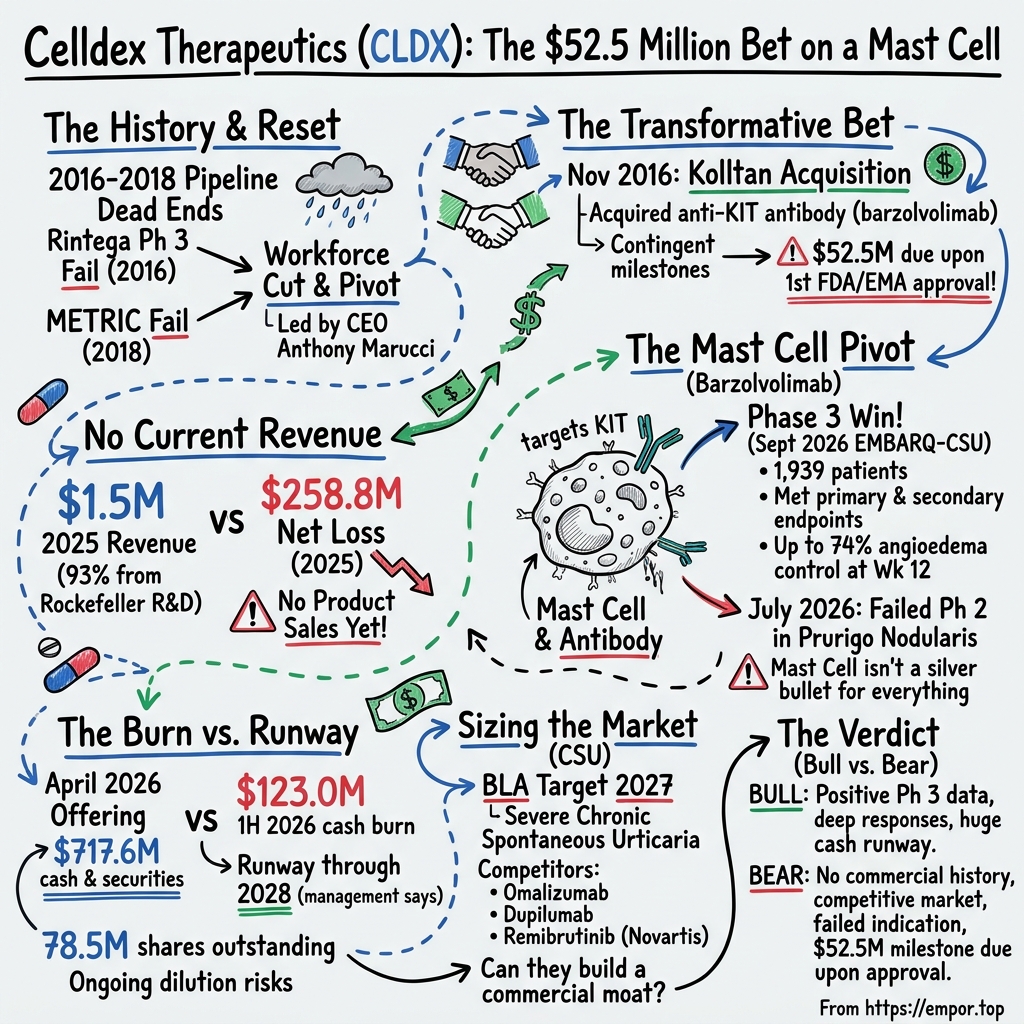
Celldex Therapeutics: The $52.5 Million Bet on a Mast Cell
I. Two Trial Readouts, One Company
On the morning of September 22, 2026, a small biotechnology company headquartered in Hampton, New Jersey, put out the press release it had spent seven years working toward. Celldex Therapeutics announced that both of its Phase 3 trials of barzolvolimab, an antibody for a stubborn and miserable skin disease called chronic spontaneous urticaria, had met their primary endpoints and every key secondary endpoint.[^1]
Two trials, run side by side across 43 countries and more than 500 clinical sites, had randomized 1,939 patients between them.1 On the most important measure, the weekly itch-and-hives score, patients on the drug improved by about 20 points, while patients on placebo improved by about 10, and the statistical confidence was so extreme that the p-values had four zeros after the decimal point.1
For a company of Celldex's size, this was the kind of morning that rewrites history. Celldex had been a public company for well over a decade. It had seen a lead cancer drug fail in Phase 3, then watched its next big hope fail too. It had rebuilt its pipeline around an antibody it acquired, almost as a side asset, from a privately held Connecticut company in 2016.
Now that antibody had produced two clean pivotal readouts, and on the conference call that morning, chief executive Anthony Marucci said the company was "excited about the next phase as we prepare to become a commercial stage organization."1
And then the market did something that tells you most of what you need to know about this story. Celldex shares had closed at $37.89 the night before. On the day of the announcement they closed at $33.51, down more than 11%, and by October 23 they had slid to $29.25.2 Two positive Phase 3 trials, and the stock fell by almost a quarter in a month.
To see why the readout mattered so much to the people inside the trials, picture the disease itself. Chronic spontaneous urticaria means hives that keep coming back, day after day, for six weeks or more, with no allergen to blame and no obvious trigger to avoid. The welts itch intensely, often worst at night.
In many patients they come with angioedema, swelling deep under the skin that can close an eye, distort a lip or, frighteningly, swell the throat. Patients in the EMBARQ trials had an average quality-of-life burden that clinicians classify as very large.1 For them, a week with no hives and no itch at all is not a statistic. It is a week of normal life.
That gap between scientific success and market enthusiasm is the subject of this episode. On one side sits a set of pivotal results that most small biotechs would trade almost anything for. On the other sits a business that, as of today, has never sold a product. Celldex reported just $1.55 million of revenue in all of 2025, most of it for contract work, against a net loss of $258.8 million.3 It ended June 2026 with $717.6 million in cash and marketable securities, a large war chest, but one it was drawing down at roughly $20 million a month.4
So the question is not whether barzolvolimab did something in a clinical trial. It clearly did. The question is whether Celldex can turn that result into a durable business before its cash and its clinical lead run down. That breaks into three smaller questions, and they recur throughout the story.
First, does barzolvolimab work beyond one disease, or is it a one-indication drug wrapped in a platform narrative? Second, can an asset that Celldex bought rather than invented, and over which it later fought its former owners, support a company? And third, can Celldex reach approval and launch without materially diluting the shareholders who funded it this far?
Before going further, it helps to draw the boundary of the story. Celldex is the listed operating company itself, a Delaware corporation trading on Nasdaq under the ticker CLDX, consolidating only itself and a wholly owned subsidiary.3 It is not a unit of some larger pharmaceutical group, and there is no parent whose economics need to be separated from the issuer's. The one outside institution that looms large in its revenue line, Rockefeller University, is a customer, not a disclosed affiliate or owner.3 What you see in Celldex's filings is the whole company.
The reaction on September 22 also deserves a fair reading rather than a cynical one. Investors had bid the shares up into the readout, and on the call analysts zeroed in on two cases of anaphylaxis, on the fact that the full dataset was still being worked through, and on a 52-week study that was not yet finished.1
A positive topline result answers the first question a regulator asks. It does not answer the questions a physician, a payer and a shareholder ask next. To understand why those later questions matter so much here, it helps to look first at what kind of business Celldex actually is today, while it waits.
 Subscribe on LinkedIn
II. The Company That Sells Research Time
Picture the income statement of a company that, a month ago, announced two successful Phase 3 trials enrolling nearly two thousand patients. You might expect a revenue line with some heft: licensing income, a partner's upfront payment, perhaps royalties on an older product. Celldex's top line in 2025 was $1.55 million.3 That is less than many dental practices bill in a year. And the largest single source of it was not a pharmaceutical partner at all but Rockefeller University, the Manhattan research institution, which accounted for 93% of Celldex's 2025 revenue, all of its revenue in 2024, and 95% in 2023.3
What was Rockefeller buying? Celldex describes the revenue as service revenue under manufacturing and research-and-development agreements with the university, alongside a sliver of grant income.3 In plain terms, Celldex has antibody manufacturing capacity and development expertise, and it rents some of that time and skill to an academic institution that needs clinical-grade material made. It is a little like a restaurant with a fine kitchen that caters the occasional university event while it waits for its own dining room to open. The catering pays a few bills. It tells you nothing about whether diners will come.
That distinction matters, because it is tempting to treat any recurring customer relationship as a seed of something larger. Here, the evidence says otherwise. Celldex does not disclose the pricing unit of the Rockefeller agreements, their length, any minimum commitments, or what share of the revenue might recur from year to year.3
At June 30, 2026, it did report $1.8 million of contract liabilities for work billed in advance, which it expected to recognize over the following 24 months.4 That suggests some forward visibility on the contract work, but at a scale that rounds to zero against a quarter-billion-dollar annual loss. This is not subscription revenue and not commercial demand for a Celldex medicine. Until a drug is approved and sold, revenue depends on contracted work and grants.
The long run makes the point even more starkly. A decade ago, Celldex reported $5.48 million in revenue for 2015.5 By 2025 that had fallen to $1.55 million.3 Over the same stretch the losses grew. The net loss grew from $141.4 million in 2023 to $258.8 million in 2025.3 Read naively, that looks like a business shrinking at the top while bleeding faster at the bottom.
Read correctly, it shows that revenue was never the scoreboard. The real growth at Celldex over the past three years has been growth in spending: more trials, larger trials, more manufacturing, more people. Celldex is investing well above its own historical rate. It is not growing commercially at all, because there has been nothing to sell.
The concentration on Rockefeller raises a reasonable second question, which is whether a single dominant counterparty might be a channel for value leaking out of the company. In some listed companies, a large customer turns out to be controlled by insiders, and revenue or costs flow through it on terms nobody can see. At Celldex, the filings point the other way.
Rockefeller is not identified as a related party, and the 2026 proxy statement says that since January 1, 2025, there have been no related-person transactions other than executive and director compensation arrangements.6 There is no disclosed parent, no management fee to an affiliate, no intercompany loan. The risk here is plain customer concentration on a tiny revenue base, not extraction.
There is one modest clue in the balance sheet worth reading as a clue rather than as a signal. Accounts and other receivables stood at about $2.0 million at the end of 2025 and fell to roughly $0.23 million by June 2026.4 A collapse like that in a growing business would be alarming. Here it is more likely to reflect the lumpy timing of contract billing and collection than anything about Rockefeller's ability to pay.
Celldex says it has never historically experienced credit losses on receivables and carries no allowance for doubtful accounts.3 It does not publish an aging schedule, so an outsider cannot test that comfort directly, but the sums involved are small enough that it barely matters. Celldex reported no contract assets at either date because its rights to payment were unconditional.4
So what is the honest description of today's Celldex business? It is a research-and-development organization with a small contract-services sideline. The sideline proves the company can make antibody material to a standard an elite research institution will pay for. It does not prove that anyone will prescribe, reimburse or prefer a Celldex medicine.
There is one indirect benefit worth naming, though: a company that runs its own antibody manufacturing work, even at small scale, keeps in-house the know-how it needs to supervise the outside manufacturers that make its drug, and that skill will matter the day an FDA inspector asks how barzolvolimab is made.
For a long-term investor, the revenue line should be treated almost as noise. The signal lies elsewhere, in where the money goes: into the laboratories, trial sites and contract factories that a biologic needs before a single patient can be treated outside a study. That is where the real economic engine of Celldex sits.
III. What It Takes to Make a Biologic
If you walked through Celldex at the end of 2025, you would have met 198 full-time employees. Of those, 166 were engaged in or directly supporting research and development.3 That ratio, roughly five in six, is the organizational chart of a company built to test drugs, not sell them. There was no sales force calling on allergists and dermatologists, no market-access team negotiating with insurers, no patient-support hub helping people navigate prior authorizations. Celldex itself says, plainly, that it lacks the sales, market-access, patient-services and distribution capabilities it would need to commercialize products on its own.3
What it did have was a fast-growing development budget. Research and development expense rose from $118.0 million in 2023 to $163.6 million in 2024 and then to $245.1 million in 2025, roughly doubling in two years.3 The money went chiefly to barzolvolimab, to its sprawling global trials and to the contract manufacturers that make the antibody. That is what it takes to make a biologic, and it is worth slowing down for a moment on why.
A biologic like barzolvolimab is not a pill pressed from a chemical recipe. It is a large protein, an antibody, grown in living cells inside steel bioreactors, then purified and formulated into an injectable drug. Making it consistently, at clinical and eventually commercial scale, takes specialized facilities and regulators who inspect them.
Testing it takes thousands of patients, hundreds of hospitals and clinics, and an army of contract research organizations, the outsourced firms that recruit patients, monitor sites and collect data. Most of Celldex's 2025 R&D expense, and most of a $33.3 million R&D accrual on its year-end balance sheet, related to those contract research organizations and contract manufacturers, known in the industry as CROs and CDMOs.3
That accrual is worth a short aside. Because vendors often invoice weeks or months after the work is done, Celldex has to estimate how much clinical and manufacturing work has been performed but not yet billed at each quarter-end. Its auditor flagged those estimates as a critical audit matter in the 2025 audit, precisely because invoices can lag and management judgment fills the gap.3
This is standard for a company of this kind and not a red flag on its own, but it means the reported quarterly R&D expense is partly an estimate. Celldex does not disclose how concentrated its spending is among individual suppliers.
A crowded room for an itchy disease
Now give the therapy a market, not just a mechanism. Patients with chronic spontaneous urticaria (CSU) typically start on antihistamines, frequently at doses well above the label. Sanofi has estimated that more than 300,000 adults and adolescents in the United States have CSU that remains symptomatic despite antihistamine treatment.7 Those are the patients for whom an advanced therapy becomes a conversation.
For years that conversation had essentially one answer: omalizumab, sold as Xolair, an injected antibody that soaks up the allergy antibody IgE. Then the room got crowded. In April 2025, the FDA approved Sanofi and Regeneron's dupilumab, sold as Dupixent, for CSU, which the companies described as the first new targeted therapy for the disease in more than a decade.7 And on September 30, 2025, the FDA approved Novartis's remibrutinib, sold as Rhapsido, a twice-daily tablet for adults with CSU who remain symptomatic despite antihistamines, on the strength of two trials enrolling 912 patients.89
Remibrutinib deserves a closer look, because it is the competitor that most changes the shape of the market Celldex will enter. It is a small-molecule inhibitor of an enzyme called Bruton's tyrosine kinase, which relays the activation signal inside mast cells and basophils, so it stops the cells from releasing histamine without removing them.9 Its label calls for a 25-milligram tablet twice a day, with or without food.9 It carries a warning for mucocutaneous bleeding, such as bruising or nosebleeds, which occurred in 9% of patients on the drug versus 2% on placebo, and it has to be paused around surgery.9
And the current label covers not only CSU but also symptomatic dermographism, the condition in which scratching or rubbing the skin raises welts, which happens to be one of the diseases Celldex is studying in its own Phase 3 program.9 Novartis, in other words, is not merely waiting for Celldex in CSU.
It is already standing in the next room too. So by the time barzolvolimab read out, physicians already had an injectable biologic with a long track record, a second injectable from one of the best-selling drug franchises in the world, and an oral pill from a company with a vast dermatology and immunology sales operation.
How is barzolvolimab different? The drug targets KIT, a receptor on the surface of mast cells. Mast cells are the immune system's grenade-carriers, the cells packed with histamine and other inflammatory chemicals that burst open to produce hives and swelling. KIT is the receptor through which mast cells receive the survival signal they need to live.
Block it, and mast cells wither away. Omalizumab and dupilumab dampen the signals that trigger mast cells. Remibrutinib blocks an enzyme inside the cell that relays the trigger. Barzolvolimab, by contrast, removes the grenade-carriers themselves. If the others are trying to keep the pins in the grenades, barzolvolimab is trying to clear the grenades from the field.
That mechanism is the source of Celldex's differentiation claims. On the Phase 3 call, management emphasized severe disease, patients who had failed omalizumab, and angioedema as the areas where it believes barzolvolimab stands apart.1 Teri Lawver, the executive who presented Celldex's commercial plan, said the placebo-adjusted improvement in the trials was "the best that's been seen by far with any CSU medicine in any publication."1
Keep the comparison honest, though. The EMBARQ trials compared barzolvolimab with placebo, not with Xolair, Dupixent or Rhapsido. Comparing effect sizes across separate trials, with different patient populations, baselines and time points, is a notoriously unreliable exercise; a statement that one drug's placebo gap is the biggest ever published is a management claim, not head-to-head evidence. Nor does the September release establish what barzolvolimab will cost, whether insurers will cover it without hurdles, what physicians will prefer, or how much of the market it might win.[^1]
Run the industry structure through the moat question once, briefly here, and fully later. Developing and approving a biologic is genuinely hard, and that difficulty keeps the number of credible entrants small. But the barrier protects the category, not any one drug within it. Physicians and payers already have multiple choices, and switching between therapies in CSU is a matter of writing a new prescription. Celldex has no proven sales channel, no installed base of patients, and no demonstrated pricing power.
The key distinction to carry forward is this: barzolvolimab's ability to hit its target and produce clinical activity are scientific proof points. Neither, on its own, establishes a durable commercial franchise. Celldex has a capable antibody-development organization and a potentially differentiated target. It does not yet have a moat. And the best way to judge how much weight to put on its ability to convert promise into product is to look at what happened the last times it tried.
IV. The Pipeline That Had to Be Rebuilt
On Monday, March 7, 2016, Celldex disclosed that an independent data safety monitoring board had reviewed an interim analysis of ACT IV, its Phase 3 study of Rintega in glioblastoma, and recommended that the study be stopped because it was unlikely to meet its primary endpoint of overall survival.10 The trial had enrolled 745 patients with newly diagnosed glioblastoma, the most aggressive form of brain cancer.10 Patients on Rintega had a median overall survival of 20.4 months; patients in the control group, 21.1 months.11
Rintega was an immunotherapy designed to teach the immune system to attack tumors bearing a specific mutation called EGFRvIII, and it was Celldex's primary drug.11 It had collected nearly every regulatory honor a development-stage drug can earn. It held orphan drug designation in the United States and Europe and fast track status, and in February 2015 the FDA granted it Breakthrough Therapy Designation, a label reserved for drugs whose early evidence suggests substantial improvement over existing treatment.5 ACT IV had finished enrolling in December 2014.5
For a year, Rintega looked like a drug the regulators themselves were rooting for. The company had ended 2015 with about $290 million in cash and seven clinical trials running across five products.11 Glioblastoma typically kills patients within about 15 months, which is why the earlier Phase 2 data had excited so many people. The cruel twist was that Rintega performed roughly as it had before, while the control group significantly outperformed expectations.11 The shares roughly halved in early trading that day.11 "We are extremely disappointed for patients that the ACT IV study was not successful," Marucci said.11
The lesson of that morning is one this story will return to. A Breakthrough designation is the FDA's judgment about a drug's promise, made on early and often small datasets. It is not approval, and it is certainly not revenue. Celldex had a lead asset with regulatory momentum, a large randomized trial fully enrolled and a decade of investor patience behind it, and the control arm still won.
That failure undercut Celldex's lead program and forced a reset. The next great hope was glembatumumab vedotin, itself an acquired asset: Celldex had obtained its rights through the 2009 acquisition of CuraGen Corporation, along with licenses to antibodies against ten other targets.5 Glembatumumab vedotin was an antibody-drug conjugate, a kind of guided missile that carries a toxic payload to cancer cells displaying a protein called gpNMB.
The cell-killing payload, a toxin called MMAE, and the chemical linker that attached it came under license from Seattle Genetics, the pioneer of the technology.5 Celldex ran a Phase 2b trial called METRIC in metastatic triple-negative breast cancer, one of the hardest-to-treat forms of the disease. In April 2018, it announced that METRIC had failed its primary endpoint: median progression-free survival was 2.9 months on glembatumumab vedotin versus 2.8 months on the comparator.[^13] Celldex then discontinued glembatumumab vedotin development across indications.[^13]
The consequence was practical and painful. In May 2018, management said it was prioritizing its programs and evaluating its workforce and operating needs to extend its financial resources.[^14] In biotech, those words have a well-known meaning: fewer programs, fewer people, and a company trying to buy time.
How should that record bear on the present? Start with continuity. Marucci, whom the proxy describes as Celldex's founder, has been president and chief executive since September 2008, after years as the company's chief financial officer, and before that in senior finance roles at Medarex, the antibody company later bought by Bristol-Myers Squibb.6 He holds an MBA from Columbia University.6
A finance executive, rather than a physician-scientist, at the top has shaped a company that has repeatedly managed its way through setbacks by cutting, prioritizing and raising capital. The same leader who presided over the Rintega and METRIC failures is the one now presiding over the EMBARQ success. Celldex has remained focused throughout on antibody-based clinical development. But before barzolvolimab, none of its candidates became a product.
What changed the trajectory was not a breakthrough in the Hampton laboratories. It was a transaction. In 2016, the same year Rintega failed, Celldex acquired Kolltan Pharmaceuticals, a privately held company whose portfolio included an antibody against KIT.12 That anti-KIT program, after detours, became barzolvolimab. In other words, the asset at the center of today's investment case came from outside, at a moment when Celldex's internal pipeline was collapsing.
Look across the decade and a pattern appears. Two of Celldex's biggest bets after Marucci became chief executive in 2008 came through acquisitions: CuraGen in 2009, which brought glembatumumab vedotin, and Kolltan in 2016, which brought the anti-KIT antibody.512 The first produced a high-profile failure. The second produced the EMBARQ success. That is a reasonable record for a company that treats deal-making as a substitute for an internal discovery engine, but it is a record of one hit in two large swings, and it says something about where Celldex's real skill lies: less in inventing molecules than in picking, developing and redirecting them.
It is worth weighing this history carefully rather than either dismissing it or letting it overwhelm the present. The old failures were in oncology, with different drugs, different mechanisms and different endpoints. Glioblastoma survival and triple-negative breast cancer progression are among the hardest bars in all of medicine to clear. A failed cancer vaccine does not make a mast-cell-depleting antibody less likely to reduce hives.
So the history does not reject the current CSU results. What it does reject is a particular style of reasoning that investors in Celldex were invited to adopt in the past: that a promising Phase 2 signal, a novel mechanism and a broad pipeline add up to commercial value. Rintega had promising earlier data. Glembatumumab vedotin had a compelling mechanism. Breadth did not save either.
The record therefore supports cautious confidence in Celldex's clinical execution, enough to run a large, clean, global Phase 3 program, which it has now done, but not a presumption of approval, and certainly not a presumption of commercial success. The test that should be applied going forward is simple.
For each new indication, require clinical benefit and a plausible position in treatment. Target engagement alone, the demonstration that the drug does what it is supposed to do to the biology, is not enough. As the story will show, that test has already been applied once in 2026, and barzolvolimab failed it. But first, the deal that brought the drug to Celldex, and what it really cost.
V. The Kolltan Deal: Asset, Liability and Second Chance
Kolltan Pharmaceuticals was a New Haven company built around the laboratory of Joseph Schlessinger, the Yale scientist renowned for his work on receptor tyrosine kinases, the family of cell-surface switches to which KIT belongs.12 Kolltan's idea was to block those switches with antibodies rather than with small-molecule pills, and in doing so to get around the resistance that tumors often developed to existing kinase inhibitors.12
By 2016 it had three programs: KTN0158, an antibody inhibiting KIT that was in a Phase 1 study in a rare gut tumor called GIST; KTN3379, an antibody against a receptor called ErbB3, with early responses in head and neck cancer; and a preclinical discovery effort against a trio of targets called TAM.12
On November 1, 2016, Celldex announced it would buy Kolltan in an all-stock deal.12 The upfront payment represented an equity value of about $62.5 million, and Kolltan's shareholders could receive up to $172.5 million more in milestone payments tied to development, regulatory and commercial goals.12 Marucci said the acquisition gave Celldex "a truly unique platform of antibodies targeting receptor tyrosine kinases" that complemented its work in immuno-oncology.12 The deal closed on November 29, 2016.[^16] On the share count Celldex reports today, it issued about 1.22 million shares in exchange for Kolltan's shares and debt interests, plus the milestone promises.3
Pause on the timing. Celldex had just lost its lead program eight months earlier. Its stock had halved. Paying cash for a pipeline would have drained a treasury it needed for survival. Paying in stock, with most of the value deferred into contingent milestones, let Celldex add three programs while putting relatively little at risk upfront. The structure was, in effect, an option: Celldex would pay big only if the assets succeeded.
The program that would not die
Then came the difficult middle. Celldex renamed KTN0158 as CDX-0158 and studied it, but eventually discontinued it.3 In its place, Celldex advanced a new anti-KIT antibody, CDX-0159, the drug that became barzolvolimab, and steered it away from oncology toward mast-cell diseases such as chronic urticaria. Kolltan's former owners took a view that will be familiar to anyone who has negotiated an earnout. They disputed whether barzolvolimab was effectively a continuation of the program they had sold, in which case the milestone payments would still be owed, or a new drug that escaped the contract.3
The parties settled. Under the settlement, Celldex paid $15.0 million in 2022 and another $12.5 million after successful completion of a Phase 2 study.3 A further $52.5 million is due upon the first approval by the FDA or the European Medicines Agency of a product of the surviving company, and Celldex may pay that final amount in cash, shares or a combination.4
Add it up and the economics become clear. The original contingent package was up to $172.5 million across many triggers. The settlement collapsed what remained into a total of $80 million: $27.5 million already paid and $52.5 million riding on approval.3 Celldex's former Kolltan holders, in other words, will share in barzolvolimab's success, but in a fixed, capped way. If barzolvolimab is approved, the final check becomes due; if it never is, the remaining $52.5 million never comes due at all.
Did Celldex overpay? The honest answer is that the price is unresolved rather than obviously cheap or expensive. The upfront equity value was modest, and most of the maximum package was conditional. Celldex has not published a risk-adjusted valuation of the deal, and there is no clean comparable transaction for an early anti-KIT antibody that later found its home in urticaria. What can be said is narrower.
Kolltan's full portfolio did not become a set of commercial products: CDX-0158 was dropped, and the ErbB3 and TAM programs did not become marketed medicines. One asset, re-engineered and redirected, carried the whole deal. That is the nature of biotech portfolios, but it cautions against calling the acquisition a masterstroke of platform-building. It was a bet that paid off through one program, after a costly dispute.
The capital-allocation lesson cuts both ways. In Celldex's favor, the barzolvolimab program is real optionality now. Against it, the approval-linked payment means that the moment Celldex achieves its first approval is also the moment it owes $52.5 million, at the very time it will need cash for a launch. That is the second chance and the liability bundled into a single event.
There is a broader lesson in how this earnout played out, and it applies to any company that buys science with promises rather than cash. A contingent milestone written around a specific program invites a fight the moment the buyer changes that program. Kolltan's sellers believed they had sold an anti-KIT idea; Celldex could argue it had bought one antibody and later built another.
The settlement resolved the argument at a price, but it also shows that milestone language which seemed precise in 2016 became ambiguous once the science moved. For Celldex shareholders, the cost of that ambiguity is now fixed and known. That alone is worth something, because an unresolved claim hanging over an approval would have been far worse.
All of which leaves one concrete question hanging. The acquired asset reached pivotal success in CSU. Can that success survive detailed data review, an unfinished 52-week study, and a treatment market already full of competitors? That is the question of the EMBARQ readout itself.
VI. Two Positive Trials, One Disease at a Time
The conference call on September 22 began, as such calls do, with prepared remarks that sounded like a victory lap. Then the questions started, and the story got more interesting.
The trials, called EMBARQ-CSU1 and EMBARQ-CSU2, enrolled adults whose CSU remained symptomatic despite H1 antihistamines.1 They randomized 963 and 976 patients respectively, evenly split between three arms: barzolvolimab at 150 milligrams every four weeks after a loading dose, barzolvolimab at 300 milligrams every eight weeks after a larger loading dose, and placebo.1 The placebo-controlled period ran 24 weeks, after which placebo patients were switched to active drug for the remainder of a 52-week study that remains blinded until completion.1
About two-thirds of patients had severe disease at baseline, and many had substantial angioedema.1 Of those randomized, 288 were omalizumab-refractory, meaning they had already failed Xolair under a strict definition.1 The quality-of-life burden was heavy: average scores on the dermatology life-quality index ran between 14 and 16, a range that clinicians read as a very large effect on daily life.1
The design choices matter for how much the results can be trusted. Celldex powered each trial at 90% to detect a difference of at least ten points on the activity score, not only in the overall population but also in the omalizumab-refractory subgroup, which is why the refractory results are a designed test rather than a lucky slice of data.1 About 84% of patients, 1,634 people, completed the 24-week placebo-controlled period.1 That completion rate is respectable for a large global trial, though it means a sixth of patients left early, a point analysts would return to.
Walk through the results as a listener would want to hear them. Both trials met the primary endpoint at both doses.1 More striking were the measures of complete control, where patients report no hives and no itch at all for a week.
Up to 46% of barzolvolimab patients reached that state at Week 12, and up to 54% by Week 24.1 Among patients who had already failed omalizumab, up to 55% achieved complete response at Week 12.1 Among patients with angioedema at baseline, up to 74% achieved complete angioedema control at Week 12.1 Management said efficacy was sustained or deepened from Week 12 to Week 24 across the primary and key secondary endpoints, with responses seen as early as two weeks.[^1]1
It helps to hold these numbers up against the newest competitor's label, carefully. In Novartis's two remibrutinib trials, patients on the pill improved by about 20 points on the same activity score at Week 12, while patients on placebo improved by roughly 12 to 14 points; around 28% to 31% of remibrutinib patients reached complete control at Week 12, versus 7% to 11% on placebo.9
On the surface, barzolvolimab's gap over placebo looks wider and its complete-response rates higher, which is exactly the argument Lawver was making. But the trials enrolled different patients, in different places and years, with placebo groups that behaved differently, and the absolute improvement on each drug was strikingly similar. Cross-trial comparisons like this are the reason head-to-head studies exist. They can suggest where barzolvolimab might win; they cannot prove it.
For a disease where patients often describe years of sleepless nights and swollen faces, "complete control in half of patients" is a powerful message. It also explains why Celldex emphasizes severe cases and angioedema, where it argues that current labels do not establish comparable control.1 Marucci described the angioedema difference versus placebo as "much better than what you would experience with other drugs out there."1
Here is where the competitive scene must sit inside the same frame. Omalizumab, dupilumab and remibrutinib, the three competitors already discussed, all have FDA approvals in CSU.87 They bring the familiarity of omalizumab and dupilumab's established franchises, while remibrutinib offers an oral option.9
Barzolvolimab, by contrast, will launch, if approved, as an injection administered in a physician's office; Lawver described in-office administration as "the base case for the launch," with an auto-injector for at-home use planned roughly 18 months after initial approval.1 Public information does not establish precise CSU market shares for any of these drugs, and there is no direct comparative trial showing barzolvolimab superior to any of them.
What the analysts wanted to know
The question-and-answer session revealed a different call from the prepared remarks. Analysts from Leerink, TD Cowen, Guggenheim, Cantor and LifeSci Capital pressed on onset of action, discontinuation rates, hyperpigmentation, labeling and above all anaphylaxis.1 Management disclosed two adjudicated cases of probable anaphylaxis after a first barzolvolimab dose, one with onset about ten minutes after dosing and one about two and a half hours after; one patient was hospitalized, while the other was treated in the clinic and discharged.1
Across roughly 2,400 patients in the subcutaneous program, those were the only two probable cases, which Marucci said "compares very favorably with other biologics."1 Exposure-adjusted rates had not yet been calculated, and management said it expects the eventual label to carry a hypersensitivity and anaphylaxis warning similar to other biologics.1
There was a further wrinkle that showed how much remained to be untangled: a third probable case occurred after a first placebo injection in the 300-milligram arm, in a patient who had received an initial barzolvolimab dose four weeks earlier.1 Among other treatment-related serious events, management listed a case of grade 3 anemia and neutropenia on the higher dose, which resolved, and a case of urticaria, angioedema and throat tightness on the lower dose.1 None of this is unusual for a large biologic program. All of it is exactly what an FDA reviewer will scrutinize line by line.
Other safety signals were tied to the mechanism. Because KIT also matters for pigment cells and blood cell production, depleting mast cells via KIT can affect skin color and white blood cells. Neutropenia, a drop in a type of white blood cell, was reported in 9.1% of patients on the 150-milligram dose and 11.7% on the 300-milligram dose, mostly mild to moderate, with infection rates balanced against placebo.1 Hyperpigmentation had appeared in about 4% of patients in Phase 2 and was described as mostly mild and reversible.1 Sixteen percent of patients discontinued during the placebo-controlled period, chiefly because of withdrawn consent and adverse events.1
Perhaps the most revealing moment was a simple admission. Marucci said the team was "still going through the data," which had only recently arrived, and that not every question could be answered on the call.1 Quality-of-life data were expected early in 2027, and the 24-week dataset was being submitted for presentation at the American Academy of Allergy, Asthma and Immunology meeting in February.1 An investor reading the call honestly should hold two things at once: the topline results are unambiguous, and the evidence needed to judge the drug's place in practice is still incomplete.
The disease that said no
Now apply the strongest disconfirming evidence the company has itself produced. The broader bull case for barzolvolimab has long rested on the idea of a pipeline in a product, a mast-cell depleter with uses across many diseases where mast cells misbehave. On July 21, 2026, just two months before the CSU triumph, Celldex reported that its Phase 2 study in prurigo nodularis, a chronic condition of intensely itchy skin nodules, had failed its primary endpoint and key secondary endpoints.[^17]
The trial randomized 140 adults with moderate-to-severe disease to placebo or one of two barzolvolimab doses for 24 weeks.[^17] Here is the crucial detail: barzolvolimab produced profound mast-cell depletion, evidenced by a large drop in the blood marker tryptase, and yet there was no improvement in itch or skin lesions versus placebo.[^17] Celldex concluded that mast cells may not be the key driver of the disease and discontinued the program.[^17]
That result does not undermine the CSU data; in CSU, the mast cell is the central villain, and barzolvolimab's results show it. But it decisively narrows the broader thesis. The drug does exactly what it is designed to do to the biology, everywhere it goes. Whether that helps patients depends entirely on whether mast cells are clinically relevant to the disease.
That is the lesson of Rintega and METRIC restated in a new key: target engagement is not efficacy. One successful indication is not proof of a franchise. Each new disease, including atopic dermatitis, whose Phase 2 data Celldex expects in the fourth quarter of 2026, and the Phase 3 trials in cold urticaria and symptomatic dermographism, must earn its own verdict.1
The next proof points are therefore clear. Complete 24-week data in a peer-reviewed forum, 52-week safety and efficacy, the planned 2027 Biologics License Application, and the FDA's review.1 The Phase 3 signal is a major inflection point and supports a credible path to that filing. The "best-in-disease" positioning remains a management claim until those later chapters are written. And every one of those chapters costs money, which brings the story to the balance sheet.
VII. The Runway Behind the Runway
In April 2026, five months before the readout, Celldex did what clinical-stage biotech companies do when they can: it sold stock. The offering of about 11.9 million shares raised $323.8 million in net proceeds.134 By June 30, Celldex held $717.6 million in cash, cash equivalents and marketable securities.4 In the first half of the year, its operations consumed $123.0 million of cash.4 Management has said current planned operations are funded through 2028.[^19]
Those numbers deserve to be translated. At the first-half pace of roughly $20 million a month, $717.6 million would last about three years. That is the arithmetic behind the 2028 runway. But arithmetic built on a past pace assumes the future looks like the past, and for Celldex, it will not. Trials are winding up in CSU but running in other indications; a BLA filing carries its own costs; and a commercial launch, if Celldex builds one, means hiring the sales and access functions the company does not now have.
Start with why accounting losses and cash burn differ. Over 2023 to 2025, Celldex's cumulative net losses were about $558 million, while cumulative operating cash outflow was about $476 million.3 The roughly $82 million difference came mostly from noncash stock compensation, about $94 million over the three years, and from depreciation, partly offset by the way the company accounts for premiums paid on bonds in its portfolio and by working-capital movements.3
In 2025 alone, the $258.8 million net loss translated into about $210.9 million of operating cash use.3 Stock compensation is real cost to shareholders, paid in dilution rather than cash, so the narrower cash burn is not free money. And because Celldex expenses research as incurred, there is no capitalized development asset quietly flattering the income statement.3
Where does the capital go? R&D reached $245.1 million in 2025 and $140.5 million in just the first half of 2026, an annualized pace above $280 million, driven primarily by barzolvolimab trials, contract manufacturing and headcount growth.34 This is a company accelerating spending into its decisive moment, not one trimming toward a filing.
Now put the dilution in sequence, because it is the other side of the funding story. Celldex raised net proceeds of $216.2 million in November 2023, $432.3 million in 2024, and the $323.8 million in April 2026.34 Shares outstanding rose from 47.2 million at the end of 2022 to 78.5 million at June 30, 2026, an increase of about two-thirds in three and a half years.34
A $300 million at-the-market facility, which lets the company sell shares into the market in dribs and drabs, remained entirely unused at mid-year.4 The financing has given Celldex its runway. It has also made clinical execution dependent on periodic access to equity markets, and each share held since 2022 now represents about 40% less of the company than it once did.
There is also a cushion that does not come from science at all. Celldex earned $28.6 million of investment and other income in 2025, after $37.2 million in 2024.3 That income reduced the 2025 operating loss by about a tenth. It comes from parking hundreds of millions of dollars in money-market funds, government obligations and high-grade corporate debt, so it depends on how much capital Celldex has raised and on interest rates, not on product economics.34 As the cash is spent, or if rates fall, that cushion shrinks.
Weigh the liabilities proportionately. Celldex reports no financial borrowings, no covenants and no refinancing pressure.4 Operating lease liabilities rose to about $4.9 million in June 2026 after an amendment expanded its Hampton facility, adding $3.5 million of lease obligation.4 That is small. The obligations that compete for runway are larger and less visible on the balance sheet: the approval-linked Kolltan payment, which at the first-half burn rate equals roughly two and a half months of operating cash use, and the cost of preparing a commercial organization.4
A word on the limits of financial comfort. The 2025 financial statements received an unqualified audit opinion with no reported material weakness, though the auditor flagged the R&D accrual estimates.3 Celldex reported no tax-examination liability or unrecognized tax benefits at year-end.3 It uses no derivatives, so it does not hedge currency, and while it runs trials in 43 countries, it does not quantify its foreign-currency exposure.31 That is unlikely to be decisive, but it is an unmeasured sensitivity in a global trial program.
So what does the runway really mean? It is a statement that today's plan is funded through 2028, not a guarantee that approval, launch costs and the Kolltan milestone can all be covered without more equity. The KPIs that will tell this story are quarterly operating cash use, R&D spending and share count, tracked through the BLA filing and launch preparation.
Each is a dial that shows whether Celldex is spending to a plan or spending to a hope. A simple worked example shows why. Start with the $717.6 million at June 30. Take out the $52.5 million Kolltan payment on approval, and roughly $665 million remains.
At the first-half pace of about $20 million a month, that is still close to three years of operations. But if R&D keeps running at its first-half annualized pace near $280 million while a sales force, medical-affairs team and patient-support hub are layered on top, the monthly figure rises, and every step up shortens the runway in proportion. Celldex has not disclosed what a launch would cost, so the arithmetic cannot be finished from outside. It can only show which way the pressure runs. And who is deciding how fast those dials spin is the question of the next section.
VIII. A Founder's Scorecard
In April 2026, Celldex's board sent shareholders its annual proxy statement, and buried in the compensation discussion was a sentence that captures the strange arithmetic of judging a biotech chief executive. The compensation committee had reviewed performance against 2025 corporate goals, including stretch goals, applied its discretion, and set the payout factor at 100% of target.6 Bonuses were paid at target. In 2025, net loss grew from $157.9 million the year before to $258.8 million.3
Is that a scandal? Not necessarily. In a development-stage biotech, a larger loss can be evidence of success: it means trials enrolled faster and the company spent to accelerate. Celldex's corporate goals focused on developing its lead programs, managing cash, funding near-term development and pursuing partnerships.6
The EMBARQ trials did finish and read out on the timetable the company had set.[^17][^1] But the 100% score deserves scrutiny of the goals themselves. Celldex does not publish the specific goal list or weightings, so shareholders cannot see whether "achieved" meant ambitious targets met or comfortable targets set. The right response is not to assume impropriety; it is to ask the board to show its work.
Marucci's 2025 total reported compensation was about $5.4 million, made up of about $0.8 million in salary, $0.5 million in bonus and $4.0 million in option awards.6 That was down from $9.2 million in 2024, largely because of the varying value of option grants.6 Options are a reasonable instrument for a company whose only route to value is a large stock-price move.
They also mean the chief executive's pay is heavily tied to the same equity that keeps getting diluted. Marucci beneficially owned about 1.5% of the company as of April 10, 2026.6 For a chief executive of a company now worth more than $2 billion, that is a meaningful personal stake and real alignment with shareholders.
Weigh that ownership against dilution, though. Equity awards add a slower, continuous stream of new shares on top of the offerings. At the June 2026 annual meeting, shareholders approved a 3.4 million-share increase to the equity incentive plan, with 1.65 million votes against.14
The say-on-pay resolution received 59.3 million votes for and 1.0 million against, while Marucci himself received 60.2 million votes for re-election and 0.3 million against.14 Those are comfortable majorities. But the gap between support for the man and support for his pay is a mild warning signal: some holders who back the leadership are uneasy about the incentive structure. It is a signal to watch, not a verdict.
The ownership register helps explain why the vote was calm. Celldex has no controlling shareholder. As of April 10, Wellington Management held 10.3%, Kynam Capital 8.3% and FMR 6.2%.6 With no single holder in control and the largest three together owning roughly a quarter of the company, the register gives management a supportive but not captive base.
Now assess behavior over time, which matters more than any single vote. The Rintega failure in 2016 and the METRIC failure in 2018 were followed by real responses: discontinued programs, reprioritization and workforce evaluation rather than denial.[^14] In between, Marucci's team made the Kolltan deal on contingent terms that limited upfront exposure, then advanced the Kolltan-derived barzolvolimab into Phase 3, settled the dispute with its former owners, and ran a clean global pivotal program. That is a credible execution record in clinical development. It is not yet a record in approval or commercialization, because Celldex has never done either.
There is also the matter of consistency in how management tells the story. In the July 2026 prurigo nodularis release, Celldex said plainly that the study did not meet its endpoints and that it was discontinuing the program, and it offered a scientific explanation rather than a spin.[^17] It reaffirmed then that Phase 3 CSU topline data were expected in September or October and atopic dermatitis data in late 2026.[^17] In its August second-quarter update, it reiterated that its cash funded planned operations through 2028.[^19]
On September 22 it delivered the CSU data on that schedule.[^1] On timing, then, management has been consistent across 2026. The more contested area is breadth. The language of a mast-cell franchise sat awkwardly beside a disease where profound mast-cell depletion did nothing, and on the September call the emphasis shifted firmly to CSU, severe disease and angioedema.1 Investors should notice whether that narrower framing persists or whether the platform language returns before the data justify it.
Governance evidence is proportionate and mostly reassuring. Eight of the nine directors are independent, all key committees are fully independent, and Marucci is the only non-independent director.6 The audit found no material weakness.3 The founder holds both chief executive and board roles, but nothing in the reviewed record suggests extraction or entrenchment.
The scorecard reads as a seasoned clinical-development leader with genuine skin in the game, paid largely in options, whose board is generous in its goal assessment and whose shareholders have tolerated heavy dilution because the science delivered. Whether that tolerance survives depends on what the market thinks the science is worth.
IX. Analysis & Bear vs. Bull Case
On October 23, 2026, Celldex shares closed at $29.25.2 Multiply by the 78.5 million shares outstanding at June 30 and the company carries a market value of roughly $2.3 billion.4 Subtract the $717.6 million of cash and securities it held at mid-year, and the market is valuing the business itself, the drug, the pipeline, the people, at something like $1.6 billion, and somewhat more than that in reality, since the company has spent cash since June.4 Against that sits revenue of $1.55 million.3
A conventional revenue multiple on those numbers would be absurd, well over a thousand times, and meaningless, because the revenue is contract work for Rockefeller, not drug sales. Earnings multiples are undefined for a company losing a quarter of a billion dollars a year. The only sensible way to think about the price is as a probability-weighted bet on future cash flows from barzolvolimab, minus the cost of getting there.
It is also worth noticing where the price sits relative to the company's own recent history. Before the readout, the shares closed at $37.89.2 In the month since, the shares traded mostly between about $27.50 and $32.50 and never recovered the pre-readout level.2 The market, in effect, valued Celldex more highly when the CSU result was uncertain than after it was known. That is not as paradoxical as it sounds.
Expectations had been building toward a clean, differentiated result, and the readout came with anaphylaxis cases, unanswered questions, a drug administered in the office against an oral competitor, and the July reminder that the platform story had limits. The market seems to be saying that it believes the drug works in CSU but doubts how much of the CSU market Celldex will capture, at what price and at what cost.
What the market is weighing
Make the bull case concrete. Celldex has two successful pivotal trials in nearly 2,000 patients, with deep, durable responses and particularly strong numbers in the hardest-to-treat patients: those with severe disease, angioedema, or failure on omalizumab.1 It has a large cash balance, a stated runway through 2028, no debt, and a planned 2027 BLA.41 It has a mechanism that is genuinely different from every approved CSU therapy, which gives it a plausible role for patients who fail or cannot tolerate others.
Lawver has argued that the second-line market, patients still symptomatic on approved therapies, could exceed the first-line opportunity within about two years of launch, and estimated that roughly a fifth of first-line advanced-therapy patients, those with severe disease or angioedema, would be a fit.1 If barzolvolimab becomes the go-to drug for the sickest patients in a market already validated by three approved products, a $1.6 billion enterprise value could prove modest.
Make the bear case equally concrete. Celldex has no product sales and has never launched a drug. There is no head-to-head evidence against approved therapies. Another indication failed despite perfect target engagement. Pricing and market access are unknown. The drug will launch as an in-office injection, with a warning for hypersensitivity likely on the label, against an oral pill from Novartis and an injection from the Sanofi-Regeneron franchise.19 Spending is accelerating, the approval payment to Kolltan's former holders is fixed, and further funding could dilute holders again, just as it did by two-thirds over three and a half years.
Now run the industry through Michael Porter's five forces, once and in full. The threat of new entrants is moderated by the cost and difficulty of biologic development, but not eliminated: three approvals in two years have validated CSU as a market worth entering, which invites the next wave of entrants. The bargaining power of buyers is high. In American specialty pharmacy, insurers and pharmacy benefit managers control access through formularies and step edits, and with several approved options they can force discounts or require patients to fail cheaper drugs first.
The bargaining power of suppliers is moderate: Celldex relies heavily on contract manufacturers and research organizations, it does not disclose supplier concentration, and its own facilities provide only partial self-sufficiency.3 The threat of substitutes is high and rising; CSU patients can choose an anti-IgE injection, a broad immunology injection or a pill.
And rivalry is intensifying as Novartis, Sanofi and Regeneron, companies with commercial organizations many times Celldex's entire headcount, fight over the same allergists and dermatologists. The substitute that most worries a barzolvolimab bull is the pill. A patient offered either a tablet at home or a trip to the clinic for an injection, possibly with observation after the first dose for allergic reactions, will often take the tablet first, and remibrutinib's label already reaches into symptomatic dermographism as well.9
Barzolvolimab's counter is depth of response and its effect in patients who fail other options, which is a real argument but a second-line one. That points toward a specific shape of success: not a mass-market leader, but a drug for the patients for whom everything else has not been enough.
Hamilton Helmer's seven powers offer a sharper test of whether Celldex has a moat. Scale economies: none yet; the giants have them in sales and distribution. Network economies: not relevant to a prescription drug. Counter-positioning: arguably a small one, since incumbents are unlikely to cannibalize their own franchises to chase mast-cell depletion, though nothing stops them from competing for the same patients.
Switching costs: low; a patient whose hives return can switch with a new prescription, and a patient whose hives vanish has little reason to switch away, which cuts both ways. Branding: none in the market yet. Cornered resource: the closest thing Celldex has is barzolvolimab itself, protected by patents and by data exclusivity once approved, which grants a period of protection from biosimilar copies, but this protects the molecule, not its share of prescriptions.
Process power: Celldex's antibody-development capability is real but not unique; dozens of companies can run trials and make antibodies. The verdict is that barzolvolimab's differentiation is promising, but it is not yet a moat.
The history of the company's earlier failures, the July miss and the crowded market narrow the claim to this: a differentiated drug with a plausible niche among severe and refractory patients, and no demonstrated distribution advantage, retention, price realization or approved-product franchise. What would confirm a larger claim is clear: label language that supports use in severe or omalizumab-refractory patients, payer coverage that does not force it to the back of the line, and early prescription data after launch.
The partner-or-build question
Picture a skeptical long-short investor reading the June balance sheet. Celldex has $717.6 million in cash and spent $123.0 million in six months.4 It is preparing to become a commercial organization in a market where its competitors have armies. Why should it build its own sales force rather than partner with a large company that already calls on allergists and dermatologists, taking an upfront payment and royalties, and reducing both risk and dilution? Conversely, why should shareholders accept a partnership that hands much of the upside to someone else after Celldex has borne all the clinical risk?
Celldex's own disclosures concede that it lacks commercial infrastructure, and the 10-K lists collaboration economics, including research funding, licensing fees, milestones and royalties, as a possible path.3 Management has not disclosed which route it will take. Of all the decisions ahead, the commercial one is perhaps the most important capital-allocation choice since the Kolltan deal, and the evidence that should justify spending ahead of approval would be a convincing plan for reaching the severe and refractory patients where the drug's advantage is clearest.
A scenario framework, rather than a target, is the right way to use the valuation. In an approval scenario where barzolvolimab wins a meaningful share of severe and refractory CSU at a specialty-biologic price, the value of the drug could exceed the current enterprise value several times over; in that scenario, the $52.5 million Kolltan payment and the cost of a launch are manageable, though both reduce the cash available, and further dilution may still occur to fund the build-out.
In a muted-approval scenario, with a restrictive label or payers forcing it behind cheaper alternatives, sales could ramp slowly enough to require another raise at a lower price, compounding dilution. In a regulatory-setback scenario, with longer-term safety, especially anaphylaxis or blood counts, becoming a problem, the company would be left largely with its cash and a pipeline that has already shown, in prurigo nodularis, that mast-cell depletion is not a universal answer. The market's price sits somewhere among these outcomes, with the post-readout decline suggesting investors weigh the middle scenario heavily.
Three measures will reveal which scenario is unfolding. The first is the complete 52-week safety and efficacy data, the dataset that will either confirm durability and a manageable safety profile or erode both. The second is quarterly operating cash use and share count, which stood at $123.0 million for the first half and 78.5 million shares in June and have both been rising.4 The third is the commercial plan: whether Celldex partners, builds or does both, because that choice will determine how much of barzolvolimab's value reaches Celldex shareholders. None of these resolve tomorrow, which is why the next year matters so much.
X. Epilogue
Tonight, Celldex sits in an odd and familiar biotech limbo. The most important uncertainty, whether the drug works in its lead disease, has been answered. Every other uncertainty remains.
The first moment that will move the story is scientific. Celldex has said it will submit the 24-week EMBARQ data for presentation at the allergy community's February meeting.1 That presentation will put detailed numbers in front of physicians and competitors, with all the subgroup analyses, discontinuation patterns and safety tables that a press release can omit. If the angioedema and omalizumab-refractory results hold up in the full dataset, Celldex's positioning argument gets real evidence behind it. If they soften under scrutiny, the positioning becomes a marketing problem.
The second moment is the 52-week follow-up. Because barzolvolimab works by eliminating a cell population, the long-term questions are distinctive: what happens to blood counts, pigmentation and infection risk over a year of continuous mast-cell depletion, and does the anaphylaxis signal stay at two cases among thousands? Clean 52-week data would strengthen the BLA; a new signal would reshape it.
The third moment is the filing itself. Celldex has guided to a BLA in 2027.1 The FDA's review will decide the label, and in a crowded market the label is the product. Language that supports use in severe or refractory patients would give the commercial team its opening; a narrower or more cautious label would hand the advantage to the incumbents.
Running alongside the CSU story is the question of breadth. The July prurigo nodularis miss has already forced Celldex to drop one indication.[^17] Atopic dermatitis data are due in the fourth quarter of 2026, and Phase 3 trials continue in cold urticaria and symptomatic dermographism.1 Positive atopic dermatitis data would revive the idea of a multi-indication drug in the largest inflammatory-skin market of all.
Negative data would reinforce an indication-by-indication strategy, where each disease earns its place and the platform language goes quiet. And the inducible urticarias carry their own twist: in symptomatic dermographism, a positive Phase 3 would send barzolvolimab into a disease where Novartis's pill already holds a label.9 Every expansion, in other words, is a fresh competitive fight rather than an extension of the first victory.
Then comes the commercial decision. Will Celldex partner barzolvolimab, keep full rights and build a specialty sales organization, or split the difference by geography? Each path implies a different cash need, a different dilution path and a different share of the eventual economics. The answer will also say a great deal about how management weighs control against risk, a judgment the company has never had to make, because until now it has never had a product to sell.
And finally, there is the check. If and when the FDA or the European regulator approves barzolvolimab, Celldex will owe the former Kolltan holders $52.5 million, payable in cash, shares or a combination.4 It is a small footnote to a multibillion-dollar question and yet perfectly emblematic of it: the day Celldex finally becomes a commercial company will also be the day it must decide whether to spend precious launch cash or issue yet more stock to settle a bill from 2016.
Put the central questions back on the table one last time. Does barzolvolimab work beyond one disease? So far the answer is yes in CSU, no in prurigo nodularis, and pending everywhere else. Can an acquired asset support a business? It has supported a late-stage clinical company; whether it supports a commercial one depends on a label and a launch that do not yet exist.
Can Celldex get there without materially diluting its holders? The cash says it can fund the plan through 2028; the history of three offerings in under three years says the plan has a way of growing. Over the next twelve months, each of those answers will move from forecast toward fact.
XI. Outro
Go back to that September morning. Two Phase 3 trials, nearly 2,000 patients, a result that most biotech companies never get to announce, all for an acquired drug.
That arc is what makes Celldex an unusual story in biotech right now: the company turned an acquired scientific possibility into a late-stage clinical bet, and paid for the privilege in shares, settlements and patience. It has the data and the cash to pursue approval.
Now it must show that patients, regulators and the market will follow. If they do, a $52.5 million check will be the cheapest thing Celldex ever paid for. If they do not, it will be a reminder that in biotech, a mast cell can be cleared from the skin far more easily than doubt can be cleared from a stock.
References
-
Celldex Therapeutics Phase 3 Topline Results Call Transcript — EarningsAPI, 2026-09-22 ↩↩↩↩↩↩↩↩↩↩↩↩↩↩↩↩↩↩↩↩↩↩↩↩↩↩↩↩↩↩↩↩↩↩↩↩↩↩↩↩↩↩↩↩↩
-
Celldex Therapeutics (CLDX) Stock Price History — StockAnalysis, 2026-10-23 ↩↩↩↩
-
2025 Form 10-K — Celldex Therapeutics, Inc. (SEC), 2026-02-25 ↩↩↩↩↩↩↩↩↩↩↩↩↩↩↩↩↩↩↩↩↩↩↩↩↩↩↩↩↩↩↩↩↩↩↩↩↩
-
Q2 2026 Form 10-Q — Celldex Therapeutics, Inc. (SEC), 2026-08-06 ↩↩↩↩↩↩↩↩↩↩↩↩↩↩↩↩↩↩↩↩↩↩
-
2015 Form 10-K — Celldex Therapeutics, Inc. (SEC), 2016-02-26 ↩↩↩↩↩↩
-
2026 Proxy Statement — Celldex Therapeutics, Inc. (SEC), 2026-04-29 ↩↩↩↩↩↩↩↩↩↩
-
Dupixent approved in the US as the first new targeted therapy in over a decade for chronic spontaneous urticaria — Sanofi, 2025-04-18 ↩↩↩
-
Drug Trials Snapshot: Rhapsido — U.S. Food and Drug Administration ↩↩
-
Rhapsido (remibrutinib) Full Prescribing Information — DailyMed, 2025 ↩↩↩↩↩↩↩↩↩↩
-
ACT IV Phase 3 Discontinuation Disclosure, Form 8-K — Celldex Therapeutics, 2016-03-07 ↩↩
-
In high-profile failure, Celldex's cancer vaccine crashes in Phase 3 — BioPharma Dive, 2016-03-07 ↩↩↩↩↩↩
-
Celldex to Acquire Kolltan Pharmaceuticals, Form 8-K Exhibit 99.1 — Celldex Therapeutics (SEC), 2016-11-01 ↩↩↩↩↩↩↩↩
-
Form 424B5 Follow-on Offering Prospectus Supplement — Celldex Therapeutics, 2026-04-02 ↩
-
2026 Annual Meeting Voting Results, Form 8-K — Celldex Therapeutics, Inc. (SEC), 2026-06-26 ↩↩
 LinkedIn
 WhatsApp
 Reddit
 Hacker News
 Email
 Kindle
 RSS Feed
 Spotify
 Apple Podcasts
 Amazon Music
 Audible
 YouTube