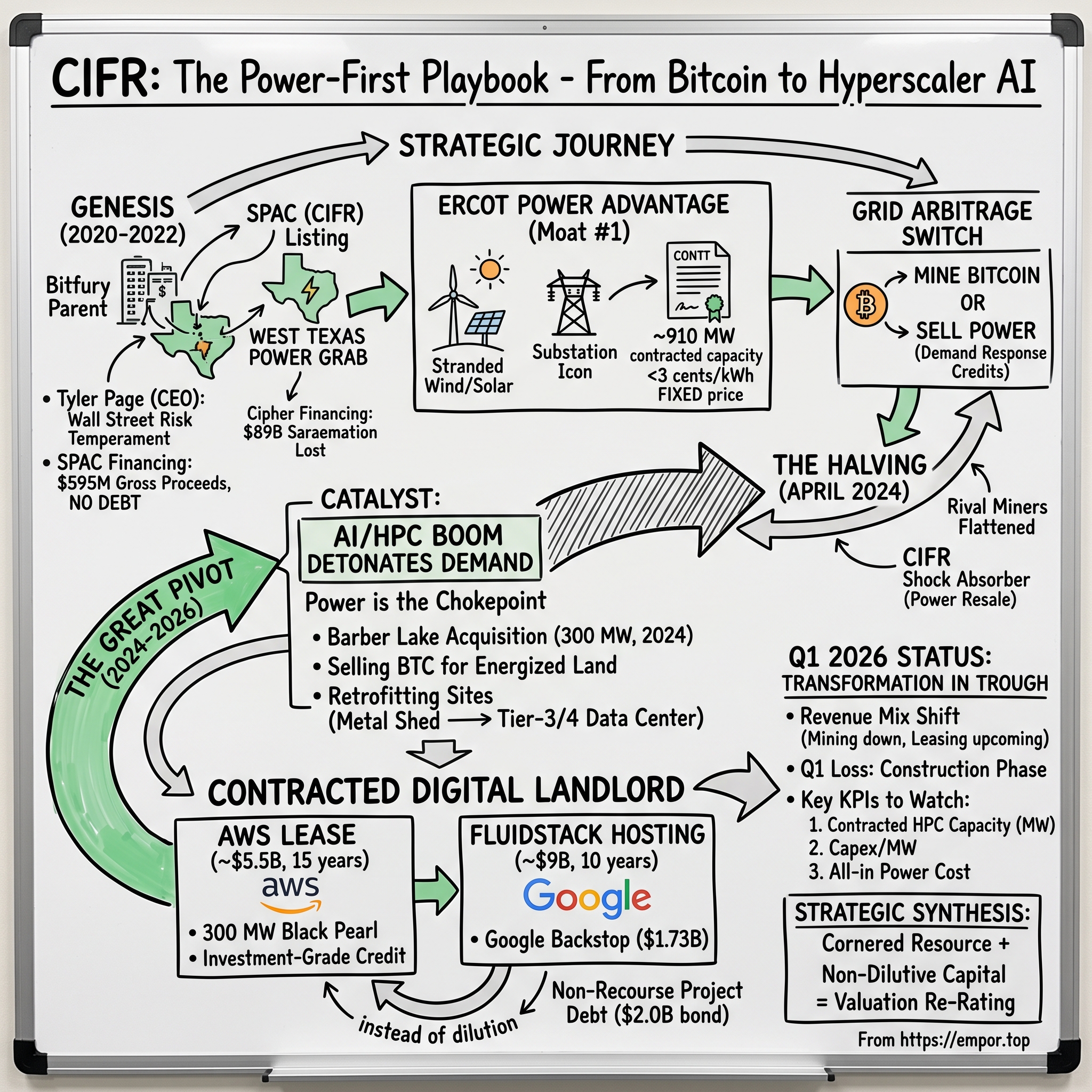
Cipher Mining Inc. (CIFR): The Power-First Playbook from Bitcoin Mining to Hyperscale AI Infrastructure
I. Introduction & Episode Roadmap
Picture a flat, wind-scoured stretch of West Texas caliche near Odessa in the spring of 2021. There is almost nothing there — a fenced pad, a half-built substation, a construction trailer, and the low hum of transformers waiting for a load that has not yet arrived. To a passing rancher it looks like a substation to nowhere. To the men negotiating the power contracts, it is something stranger: a bet that the scarcest commodity of the coming decade would not be chips, or capital, or code, but raw, grid-connected electricity — and that whoever locked it up cheaply and early would own an option on a future nobody had yet named.
That bet is the whole story of Cipher Mining. On paper, Cipher spent its first four years as a Bitcoin miner: rows of application-specific machines in metal sheds, converting cheap Texas power into digital gold. But the more revealing way to read the company is as a power-rights business that happened to monetize its megawatts with Bitcoin while it waited. When the artificial-intelligence boom detonated demand for electricity in 2024 and 2025, Cipher already held what the hyperscalers suddenly could not buy at any price: energized land, signed interconnection rights, and long-term fixed-price power at under three cents per kilowatt-hour.
The pivot that followed was among the most abrupt re-ratings in the sector. In late 2025, Cipher signed a roughly $5.5 billion, 15-year lease with Amazon Web Services and a multi-billion-dollar hosting arrangement with Fluidstack backstopped by Google, converting a crypto miner into a contracted digital-infrastructure landlord almost overnight.56 By the first quarter of 2026, management was pointing to $11.4 billion of contracted revenue across three hyperscale leases and a development pipeline measured in gigawatts.8
This is the central thesis to test, not to accept: that Bitcoin mining was never really about crypto, but about acquiring power grid interconnections, land, and multi-decade power purchase agreements ahead of a demand shock — and that in an AI-starved world, energy availability is the moat. It is a seductive narrative, and Cipher's management tells it well. The job of this episode is to ask what evidence actually supports it, and what could falsify it.
A few questions frame everything that follows. How did Cipher lock in sub-three-cent power inside the notoriously volatile ERCOT grid while peers ran unhedged and got flattened by price spikes? Why abandon the familiar economics of self-mining for the unfamiliar discipline of building tier-3/4 data centers to hyperscaler specification — and does a 15-year AWS lease really beat mining Bitcoin? And the capital-allocation test at the center of it all: how did CEO Tyler Page finance $5 billion of construction with mostly non-recourse project debt rather than the relentless equity dilution that hollowed out shareholders at rival miners?8
It helps to sit for a moment with how violent the re-rating was, because it explains why this company is worth an episode at all. For most of its life as a public company, Cipher traded the way crypto miners trade — as a leveraged, high-beta proxy for the Bitcoin price, lurching up and down with the coin, valued by the market at a low single-digit multiple of whatever cash it could scrape from mining. Miners are, to the equity market, a kind of derivative: you buy them when you want Bitcoin exposure with operating leverage, and you sell them when the coin turns. Nobody assigned them the sober, boring multiples that infrastructure earns. Then, in the space of a single autumn, Cipher announced contracts that — if honored — would generate more cumulative revenue than the entire company had produced in its history several times over, from counterparties whose credit ratings are among the best in the world. The market's problem became almost philosophical: is this still a crypto miner that happens to have signed some leases, or an infrastructure company that happens to have started in crypto? The answer is worth billions of dollars of multiple, and it is not yet settled.
The other reason to slow down is that the story is genuinely instructive beyond Cipher. It is a clean case study in how a scarce physical resource — grid power — quietly became the chokepoint of the most-hyped technology wave in a generation, and in how a company that positioned itself for one gold rush (crypto) found itself, almost by accident of geography and patience, holding the shovels for the next one (AI). That kind of optionality is rarely designed on purpose; more often it is the residue of a disciplined bet on a durable input. Cipher's leadership will tell you they saw it coming. The independent question is how much was foresight and how much was luck rewarding preparation — and whether the same discipline that acquired the option can execute the far harder job of exercising it.
The roadmap runs from Bitfury's ASIC labs and a 2021 SPAC, through the ERCOT power-arbitrage engine and the brutal 2024 halving, into the Barber Lake and Black Pearl transformations, a close reading of the earnings calls where analysts pressed management on cost and concentration, and finally a Helmer and Porter war-game of whether this edge is durable or merely early. Throughout, the discipline is the same: separate what Cipher has proven from what it has merely promised, and hold management's live words up against its filings and its track record. We begin where the power did — at the grid.
 Subscribe on LinkedIn
II. Genesis & The ERCOT Power Advantage (2020–2022)
Every origin story needs a parent, and Cipher's was one of crypto's oldest industrial names. Bitfury, founded in 2011 by Valery Vavilov, had spent a decade as a picks-and-shovels company — designing Bitcoin mining ASICs, building data centers, and running infrastructure — while flashier token projects came and went. By 2020, Bitfury's leadership saw an opening in the United States: a chance to build an American, institutionally-capitalized mining company at industrial scale, seeded with Bitfury's hardware and know-how. The vehicle they created was Cipher Mining Technologies, and the man they put in charge was not a crypto native at all.
Tyler Page was a Wall Street lifer. He had begun as an attorney at Davis Polk & Wardwell, earned his J.D. from the University of Michigan and his undergraduate degree from the University of Virginia, then spent two decades on derivatives and fund-solutions desks — Lehman Brothers, Goldman Sachs, Guggenheim Partners, Stone Ridge Asset Management, and the New York Digital Investment Group (NYDIG), the institutional crypto platform.3 That résumé matters because it explains the company's temperament. Page thought like a fixed-income structurer: obsessed with downside, hedging, and contract terms, congenitally suspicious of the leverage-and-hope mentality that defined the first mining cycle. Before Cipher, he ran business development for Bitfury's digital-asset infrastructure arm; when he described the industry as historically full of "smaller, poorly capitalized, less experienced companies" ill-equipped for Bitcoin's price swings, it read less like marketing than a thesis statement.1
Consider what that background does to how a company is built. A founder who cut his teeth trading options and structuring funds does not look at a mining farm and see hash rate; he sees a portfolio of exposures to be hedged. Where a crypto native might chase the biggest machines and the fattest coin bags, a derivatives person asks what happens in the bad state of the world — when the coin halves, when power spikes, when the debt comes due — and structures backwards from that. This is why Cipher's earliest and most consequential decisions were not about mining equipment at all. They were about the terms of power contracts, the seniority of the capital structure, and the optionality embedded in each site. The mining rigs were almost an afterthought — the depreciating, replaceable part of a business whose real assets were contracts and interconnections. That inversion of what a miner is "for" is the single most important thing to understand about the company, and it flowed directly from who was running it.
The public debut came through the SPAC machine at its 2021 peak. On March 5, 2021, Cipher announced it would merge with Good Works Acquisition Corp. (Nasdaq: GWAC) at a $2.0 billion enterprise value, and the deal closed that August with shares listing under the ticker CIFR.12 The financing structure is worth pausing on, because it foreshadowed the discipline to come. Cipher raised roughly $595 million in gross proceeds — $170 million from the SPAC trust and a $425 million fully committed PIPE anchored by Fidelity and Morgan Stanley's Counterpoint Global, with Bitfury itself rolling in $50 million in-kind.1 Crucially, the combined company emerged with a large cash balance and essentially no debt, at a valuation that looked almost conservative next to the moonshot projections other SPACs were peddling.1
Then the SPAC market imploded. Through 2022, dozens of de-SPAC'd companies — including several crypto miners that had raised on aggressive hash-rate forecasts and cheap-looking convertible debt — collapsed as rates rose and Bitcoin fell. The 2022 crypto winter was especially brutal for miners who had borrowed against their machines or their coins: as Bitcoin fell and power costs bit, several of the best-known names slid toward restructuring or bankruptcy, their equity wiped out by debt they had taken on in the euphoria of 2021. Cipher's advantage in that wreckage was almost boringly structural: it had cash, no near-term maturities, and had promised power economics rather than a token price. It could keep building while others restructured. In a cycle that punished leverage and rewarded liquidity, being the disciplined, over-capitalized, slightly boring miner turned out to be a competitive advantage — a preview of the capital-allocation temperament that would define the company's later, far larger bets. The lesson management appeared to internalize was that surviving to the next cycle is itself a form of winning, because the assets you patiently accumulate become priceless exactly when your weakened competitors can no longer bid for them.
And what it built was a power strategy, not just a mine. The decision to plant itself in West Texas was deliberate. ERCOT — the Electric Reliability Council of Texas — runs an isolated, deregulated grid famous for two things: abundant, often stranded wind and solar generation in the west, and gut-wrenching price volatility when demand spikes.11 Most miners saw only the cheap power. Page's team saw the volatility as a feature. By signing long-term, fixed-price power agreements — the company has cited a weighted-average price around 2.7 cents per kilowatt-hour across roughly 910 megawatts of contracted capacity — Cipher effectively bought insurance against ERCOT's spikes while retaining the right to resell that power back into the grid when prices soared.18 Its anchor was the Odessa site, a 207-megawatt facility that would become the operational workhorse for years.8
To see why ERCOT is the right place to run this play, it helps to understand what makes the Texas grid unlike almost any other in North America. ERCOT is an electrical island — it barely connects to the two big U.S. interconnections, which means Texas keeps its own power inside its own borders and lets prices float on a deregulated, real-time market rather than a regulated utility rate. West Texas, in particular, is drowning in wind and solar generation that was built out ahead of the transmission lines needed to carry it east to the cities. The result is chronic congestion: power that is dirt cheap, sometimes even negatively priced, precisely because there is nowhere for it to go. A giant, flexible electricity buyer that can sit right next to that stranded generation is doing the grid a favor by soaking up supply — and can negotiate accordingly.11
The genius of this arrangement is best understood as a switch. During a summer heatwave or a winter storm, when ERCOT wholesale prices can leap from a few cents to several dollars per kilowatt-hour, Cipher could power down its miners and sell its contracted electricity into the grid, pocketing the spread as demand-response credits. The Bitcoin it didn't mine during those hours was worth far less than the power revenue and grid payments it collected instead. In effect, the fixed-price PPA turned a cost line into an optional revenue line — a hedge that paid. Think of it like a homeowner who signed a fixed-rate mortgage and then discovered they could sublet the house at the market's peak rents whenever they wanted to travel: the fixed cost never moves, but the income side has an option attached to it. Most miners bought only the cheap electricity and left that option on the table; Cipher bought the option too.
There is a subtlety worth naming, because it is where the independent scrutiny belongs. The grid-arbitrage story is genuinely real and repeatedly demonstrated across Texas's extreme-weather events — but its magnitude depends on ERCOT's market rules staying friendly to large flexible loads and on the price volatility that makes the switch valuable. Volatility is a friend here, not an enemy; a placid grid would make the option nearly worthless. That means part of Cipher's cost advantage is, in effect, a bet that Texas power stays chaotic and that regulators keep paying loads to be flexible. It has been a good bet for years. It is not a law of nature.
The other, quieter land grab was the interconnection queue. Getting a large industrial load connected to a grid requires years of transmission studies and approvals; securing high-voltage substation transformers can take well over two years given global supply backlogs. Cipher spent 2021 and 2022 building substations and banking interconnection rights across a portfolio of sites long before anyone was talking about AI power shortages. That patience — accumulating energized megawatts nobody yet wanted — is the setup for the entire second act. First, though, the company had to survive the business it was actually in: mining Bitcoin.
III. The Core Engine: Bitcoin Mining Economics & Grid Arbitrage
To understand why Cipher's power obsession mattered, you have to understand how miserable the underlying business can be — and Bitcoin mining, stripped of romance, is a commodity conversion business with a brutal twist. A miner buys specialized computers, feeds them electricity, and they race the entire global network to guess a number and win a block reward. The prize is fixed and shared across everyone hashing; add more machines to the network and each miner's slice shrinks. So a miner's fate rests on three variables it mostly cannot control — the Bitcoin price, the ever-rising network difficulty, and the block reward — and one it can: the cost of power.
A quick primer, because the mechanics govern everything. "Hash rate" is simply how many guesses per second a miner's machines can make, measured in exahashes — quintillions of guesses. "Difficulty" is the network's self-adjusting thermostat: as more miners join and the total guessing speed rises, the protocol automatically makes the puzzle harder so that a block is still found roughly every ten minutes. The consequence is a treadmill. If you stand still — keep the same machines while everyone else adds more — your share of the rewards steadily shrinks, because difficulty keeps climbing. To hold your slice, you must keep buying newer, more efficient machines just to run in place. "Fleet efficiency," measured in joules per terahash, is the miner's fuel economy: how much electricity it burns per unit of guessing. Lower is better, and it is one of the few levers a miner actually controls.
Cipher scaled the controllable part aggressively. Its Odessa fleet grew from a standing start into the double-digit exahash range, running successive generations of Bitmain machines — including redeploying newer, more efficient S21-class units as it upgraded. By the first quarter of 2026 — even as the company was pivoting away from mining — Odessa was still producing roughly 11.6 exahash per second at a fleet efficiency of 17.2 joules per terahash, mining about 346 Bitcoin in the quarter at a power cost near 2.8 cents per kilowatt-hour.8 That power cost is the number that matters. Two miners with identical machines but different power prices live in different universes: the one paying three cents keeps mining profitably deep into a downturn, while the one paying seven cents is underwater the moment the coin dips. In an industry where all-in electricity cost per coin separates the survivors from the casualties, running near the bottom of the cost curve is the difference between minting money and bleeding it — and it is an advantage that compounds precisely when the market is worst, because that is when high-cost competitors are forced to switch off, difficulty eventually eases, and the low-cost survivor's share of the remaining rewards rises.
The stress test arrived in April 2024. Bitcoin's protocol halves the block reward roughly every four years, and this one cut the reward from 6.25 to 3.125 BTC per block. Overnight, the entire industry's revenue per unit of hashing was cut in half while its costs stayed put. For high-cost miners paying six or eight cents a kilowatt-hour, the halving pushed marginal production toward — or past — breakeven; for the unhedged and over-levered, it was fatal. The halving is the closest thing the sector has to a periodic culling, and it is designed to be one.
It is worth dwelling on how unusual the halving is as an industry event, because there is nothing quite like it in ordinary business. Imagine if, on a date fixed years in advance and known to everyone, every airline's revenue per seat were cut in half overnight while jet-fuel prices held steady — and imagine this happening on a predictable four-year clock, forever. That is Bitcoin mining. The supply of new coins is throttled by code, indifferent to how much capital or hope the miners have poured in. Rational operators spend the two years before a halving preparing for it — upgrading to efficient machines, locking in cheap power, strengthening the balance sheet — while the undisciplined treat each cycle's good times as permanent and get carried out when the reward drops. The 2024 halving separated the two groups with unusual violence, precisely because it landed after a period of aggressive, debt-fueled expansion across the sector.
Here is where Cipher's power architecture acted as a shock absorber. A miner locked into cheap fixed-price power simply had a lower breakeven to defend. But the more interesting mechanism was the resale optionality built into those contracts. When mining margins compressed — because the reward fell, difficulty climbed, or the coin price dropped — Cipher could lean harder on selling power back to the grid rather than burning it on marginal Bitcoin. The company had, in effect, two ways to monetize the same megawatt: hash it, or sell it. High-cost pure-play miners had only one, and after the halving that one frequently ran negative. The lesson management drew, and later leaned on hard, was that the durable asset was never the mining rig; it was the power contract underneath it.
None of this was accidental, and it traces back to the temperament at the top. Page ran Cipher as a risk manager first. Rather than chasing vanity hash-rate headlines — the "we'll be the biggest miner in the world" boasts that defined the last cycle — he emphasized return on invested capital per megawatt, downside protection, and procurement discipline in buying machines from suppliers like Bitmain and Canaan. The choice of yardstick is itself revealing. Most miners in the 2021 cycle managed to a single number — total hash rate — because it was the metric that moved the stock and fed the growth narrative. But hash rate is a vanity figure if it is bought with expensive power or dilutive equity; it measures size, not profitability. Managing instead to return on capital per megawatt is a quieter, harder discipline that penalizes exactly the empire-building that felt so good in the boom. A management team that optimizes for returns rather than headline scale will, almost by construction, look too conservative at the top of a cycle and vindicated at the bottom. Cipher's behavior through 2022 fit that pattern, and it is the throughline that connects the cautious miner to the later, audacious infrastructure bettor: the audacity was always in service of returns, not of size for its own sake. Whether that discipline holds now that the company is deploying billions rather than tens of millions is the open question its future hinges on. The company also managed a delicate overhang: Bitfury, as founding shareholder, held a large block of stock that had to be distributed into the market over time without triggering a panic, a housekeeping problem management addressed methodically across its early years.
The Bitfury overhang deserves a word of its own, because it is the kind of quiet structural risk that sinks post-SPAC companies. When a company goes public carrying a founding shareholder that owns an enormous block of stock, every investor knows those shares must eventually be sold, and that expectation alone can cap the price — a permanent seller in the order book is a permanent headwind. Managing that distribution methodically, rather than in a single panic-inducing dump, is unglamorous work, but Cipher navigated it without the kind of blow-up that has torched other de-SPAC names. It is a small credibility marker, but a real one: the people running the company understood market structure, not just mining.
There was also a leadership continuity question worth flagging honestly. The finance seat turned over: longtime CFO Edward Farrell announced his retirement in 2025, with Gregory Mumford named as successor — a transition that landed just as the company was taking on billions in new project debt and remaking its business model, exactly the moment when financial continuity matters most.10 Investors should watch whether the capital discipline that defined the mining era survives the far larger data-center build; a CFO handoff at peak leverage is precisely the sort of governance detail an activist would circle. It is worth noting that Cipher, as a relatively young company built by Wall Street veterans, has leaned on institutional-grade advisers and disclosure from the start — but leadership transitions test whether a culture of discipline is embedded in the institution or resident in individuals.
By 2023 and into 2024, the mining business was doing its job — throwing off Bitcoin and, more importantly, proving out the power playbook. But the world was about to hand Cipher a use for its megawatts that made Bitcoin look almost quaint. The AI industry was running out of electricity.
IV. The Great Pivot: From Crypto Miner to AI/HPC Infrastructure Giant
The macro backdrop shifted with startling speed. Through 2024 and into 2026, the hyperscalers — Microsoft, Amazon, Google, Meta — discovered that the binding constraint on training ever-larger AI models was not GPUs or capital but grid-connected power. Utilities quoted multi-year interconnection timelines; transformer lead times stretched past two years; and the choicest thing in American infrastructure became a large block of energized megawatts that could be delivered soon. Suddenly the substation-to-nowhere in West Texas was a substation to everywhere.
Cipher had spent three years quietly assembling exactly that inventory, and the arbitrage was stark. A megawatt earning variable, volatile revenue from Bitcoin might clear something like $50–$100 per megawatt-hour in a normal market; the same megawatt wrapped in a 15-year hyperscaler lease could earn predictable, contracted, far higher-margin rent. The strategic question was no longer whether to hash or sell power — it was whether to keep mining at all when a landlord's economics were sitting right there.
The right way to frame the difference is the quality of the cash flow, not just its size. Bitcoin mining produces revenue that is volatile, uncontracted, and correlated to a single wildly cyclical asset — the kind of income the capital markets rightly refuse to lend against on generous terms. A signed, multi-year lease to an investment-grade tenant produces the opposite: smooth, contracted, forecastable cash flow that banks and bond investors will finance cheaply and that public markets will capitalize at a high multiple. Converting a megawatt from the first kind of income to the second does two things at once — it raises the cash flow and it lowers the discount rate applied to it. In valuation terms, that double effect is enormous; it is the entire reason a data-center landlord can be worth several times a crypto miner sitting on identical physical assets. Cipher's pivot, stripped to its financial essence, was an arbitrage between two costs of capital.
There is a deeper signal in a hyperscaler's willingness to sign at all. Amazon does not lease 300 megawatts in a remote corner of West Texas for fifteen years on a whim; it does so because it has run out of better options closer to home. When a company with Amazon's resources and its own vast data-center construction machine chooses to contract with a former Bitcoin miner on rural Texas caliche, it is publicly conceding that grid power has become the binding constraint on its ambitions — that it would rather pay a third party a premium than wait years in a utility interconnection queue. The tenant proof point, in other words, is not just revenue for Cipher; it is evidence about the state of the entire industry. The scarcity Cipher bet on in 2021 was, by 2025, being validated by the checkbooks of the most sophisticated infrastructure buyers on the planet. That validation is the strongest single piece of evidence for the bull thesis — and it is external, not self-reported.
The move that pre-positioned the pivot came in September 2024. Cipher closed the acquisition of the Barber Lake site near Colorado City, Texas — 300 megawatts of front-of-the-meter capacity with a newly constructed, fully energized substation and 250 acres of land — for $67.5 million in cash plus a $3-per-megawatt-hour variable fee for the first five years after energization.4 At roughly $225,000 per megawatt of ready-to-build power rights, it was a fraction of what comparable capacity would cost to originate from scratch. Tellingly, Cipher funded it by selling part of its Bitcoin treasury — and Page framed the trade with unusual candor: the company had "exchanged one rare and valuable asset for an even more rare and more valuable asset."4 That sentence is the whole thesis in miniature: Bitcoin was the means; energized land was the end.
Barber Lake became one anchor; a second, the Black Pearl development in West Texas, was retrofitted from planned crypto infrastructure toward tier-3/4 data-center specification. The retrofit logic is elegant and worth appreciating: much of what makes a site valuable to a hyperscaler — the interconnection rights, the substation, the energized power, the land, the ERCOT market access — is exactly what Cipher had already assembled for mining. What changes is the building on top, from an open-air shed to a sealed, cooled, redundant data hall. Cipher was, in effect, upgrading the tenant of land it already controlled rather than starting from raw dirt, which is both faster and cheaper than greenfield development and is the crux of its speed advantage over incumbents who must originate power from scratch.
Cipher also began simplifying its corporate structure, monetizing and unwinding legacy joint-venture interests to concentrate capital on the HPC build rather than diluting shareholders. Earlier in its life, Cipher had grown partly through joint ventures on several sites — a sensible way for a young, capital-constrained miner to control more megawatts than its balance sheet could fund alone. But minority JV stakes are precisely the wrong ownership structure for a company that now wants to sign fifteen-year leases and raise project debt against wholly-owned assets; lenders and hyperscalers want clean title and undivided control. Streamlining the portfolio was thus not mere housekeeping but a prerequisite for the leasing model — a quiet example of corporate structure following strategy. The stage was set for the deals that re-rated the company.
They arrived in a rush in the autumn of 2025. First, in September, Cipher signed a 10-year hosting agreement with Fluidstack — an AI cloud provider — to fill Barber Lake, a deal worth roughly $3 billion over its initial term and backstopped by Google, which guaranteed $1.4 billion of Fluidstack's obligations and took a minority equity position in Cipher.57 Google's role is the subtle part: a startup AI cloud is not investment-grade, so the credit that makes the lease financeable is effectively Google's, not Fluidstack's. In November, Fluidstack expanded to take the entire 300 megawatts at Barber Lake, adding 39 megawatts of critical IT load for about $830 million more over ten years — bringing the total contracted revenue with extension options toward $9 billion — while Google raised its backstop to $1.73 billion.67
The Google backstop deserves a beat of skepticism as well as admiration, because it is doing quiet, heavy lifting. Fluidstack is an AI-cloud upstart, not a household-name balance sheet; a bank will not lend billions against a fifteen-year promise from a young company that could evaporate in a downturn. By stepping in to guarantee a large slice of Fluidstack's rent, Google effectively lends its own creditworthiness to the deal, transforming an un-financeable lease into a financeable one. That is clever structuring, and it is also a tell: the arrangement exists precisely because the tenant, on its own, is not strong enough to anchor the debt. Investors reading the $9 billion Fluidstack headline should keep both facts in view at once — the cash flow is real and credit-enhanced, and the enhancement is there because the underlying tenant needs it.
Then came the headline. On November 3, 2025, Cipher announced a 15-year lease with Amazon Web Services worth approximately $5.5 billion, providing 300 megawatts of turnkey, liquid- and air-cooled capacity for AI workloads at its Black Pearl site, with delivery in two phases beginning July 2026 and rent commencing that August.5 With AWS's investment-grade credit anchoring the largest contract, Cipher's combined AI-hosting backlog reached roughly $8.5 billion, and Page declared that Tier 1 hyperscalers turning to Cipher "in non-traditional areas in Texas" had validated the company's entire thesis.5 Alongside it, Cipher unveiled majority control of "Colchis," a planned 1-gigawatt joint-venture campus targeted for 2028.5 The AWS deal was the one that changed the company's identity in the market's eyes, and for a simple reason: Amazon is one of the most creditworthy tenants on Earth. A fifteen-year lease to AWS is about as close as a real asset gets to a government bond with a data center attached. The moment that contract was signed, the argument that Cipher was "just a crypto miner" became much harder to make.
It is worth being precise about what "turnkey" and "liquid-cooled" mean here, because they are the crux of the cost debate that follows. A modern AI training cluster packs so many power-hungry chips into a rack that air can no longer carry away the heat; the machines must be cooled by circulating liquid directly to the hardware. Delivering that — along with the redundant power, backup systems, and near-perfect uptime a hyperscaler demands — is a categorically harder and costlier build than the open-air metal sheds that house mining rigs. When Cipher promises AWS a turnkey, liquid-cooled hall, it is promising to construct a genuine tier-3/4 data center, not to bolt servers into a barn. That promise is the source of both the higher revenue and the far higher capital cost that would dominate every subsequent earnings call.
The financial engineering underneath deserves as much attention as the leases. Rather than issuing equity into the build — the reflex that diluted rival miners by staggering amounts — Cipher funded Black Pearl with a $2.0 billion bond carrying a 6.125% coupon and a $200 million revolving facility, structured largely as non-recourse project debt sitting against contracted, hyperscaler-backed cash flows.8 For Barber Lake, it leaned on tenant and Google credit support plus a separate $333 million debt raise.7 This is the difference between financing a speculative asset with your shareholders' ownership and financing a contracted asset with its own cash flows.
The word "non-recourse" is doing a lot of work, and it cuts both ways. Non-recourse project debt means the borrowing is secured against a specific project's assets and cash flows; if that one project fails, lenders can seize it but generally cannot reach back to sink the whole company. For shareholders, that ring-fencing is protective — it caps the damage any single site can do to the equity. But the same structure concentrates risk at the project level and demands that each ring-fenced asset stand on its own two feet operationally. And a 6.125% coupon on $2 billion is roughly $120 million a year in interest that must be paid whether or not the AWS hall energizes on time — the debt does not care about construction delays. This is the essential tension of the whole model: contracted revenue justifies the leverage, but leverage removes the margin for error that an all-equity balance sheet would have provided. Cipher has chosen to protect its shareholders from dilution at the price of committing them to flawless execution. That the market has, so far, rewarded the choice does not make the trade-off disappear. Whether it works depends entirely on execution — and execution was exactly what analysts started probing.
V. Conference Call Transcripts & Earnings Q&A Analysis
Earnings calls are where a strategy meets its skeptics, and Cipher's calls across 2025 and into 2026 document a company mid-metamorphosis — sometimes speaking two languages at once. The vocabulary itself tells the story: prepared remarks that once opened with exahash and Bitcoin production increasingly opened with contracted megawatts, net operating income, and lease terms. On the first-quarter 2026 call in May, management framed the business almost entirely around its data-center portfolio — 907 megawatts operating and contracted, $11.4 billion of contracted revenue over 10-to-15-year terms, and average annual net operating income of roughly $787 million projected across the initial AWS and Fluidstack lease windows — with mining reduced to a single operating site and a source of opportunistic cash.89
Listen to a Cipher call from 2023 and then one from 2026 back to back, and you are almost hearing two different companies. The early calls are the language of a miner: coins produced, exahash deployed, cost per Bitcoin, treasury holdings. The recent ones are the language of a landlord: contracted revenue, net operating income, lease terms, delivery milestones, credit quality of tenants. This is the single most important thing to track across the transcripts — not any one number, but the migration of the vocabulary itself, because it reveals what management now believes the business is. A skeptic will note that vocabulary can change faster than reality; a fair reading is that the words shifted because the contracts genuinely shifted, and the filings back that up. The tell to watch for is whether the two languages ever contradict each other — whether mining is quietly propping up numbers the leasing story claims to have outgrown.
The numbers behind the narrative were mixed, and management didn't hide it. Q1 2026 revenue was about $35 million, down from $60 million the prior quarter as machines were redeployed and mining de-emphasized, and the company posted a GAAP net loss of roughly $114 million, or $0.28 per share.8 To read that income statement correctly you have to understand what stage the business is in. Cipher in early 2026 was, financially, a company that had torn down one revenue engine (mining) faster than it had switched on the next one (leasing), spending heavily on construction in between. The losses and the shrinking revenue are not signs of a failing operation so much as the visible cost of a deliberate gap — the trough between the old business winding down and the contracted rents beginning. That is a legitimate way to build, but it is also a period of maximum vulnerability, when the company is spending and borrowing against income that has not yet arrived. For a company carrying about $5.2 billion of mostly non-recourse debt against $715 million of unrestricted cash and $3.5 billion in restricted construction accounts, the story is entirely forward-looking: today's income statement is a construction site, and the payoff is the contracted NOI that begins flowing once AWS and Fluidstack take delivery.8 That is a legitimate way to build; it is also a bet that the buildings get finished on time and on budget.
Which is precisely where analysts pushed. The most consequential question in the whole story is capex per megawatt. A crypto shed costs a few hundred thousand dollars per megawatt to build; a hyperscale, liquid-cooled, high-reliability AI data center can cost several million dollars per megawatt — an order-of-magnitude jump.6 Analysts pressed management repeatedly on the difference between "shell-and-core" delivery (Cipher provides the building and power; the tenant brings the servers) and full turnkey fit-out, because the answer determines both the capital Cipher must raise and the returns it keeps. Management's framing has been that colocation leasing offers superior risk-adjusted returns to owning the compute itself, though on the Q1 2026 call it acknowledged it would consider owning compute at sites like Reveille only with strong credit support behind the AI-cloud tenants — a revealing hedge about where it will and won't take counterparty risk.8
Why does capex per megawatt matter so much that analysts return to it every call? Because it silently determines the return on the whole enterprise. If Cipher can deliver a shell-and-core building — walls, power, and cooling infrastructure, with the tenant supplying the expensive servers — at a manageable cost per megawatt, then the contracted rents translate into attractive yields on invested capital. If, instead, the true all-in cost creeps toward the millions-per-megawatt figures that full turnkey AI facilities can command, the same rents produce mediocre returns and the debt starts to look heavy. The gap between those two outcomes is the difference between a wealth-creating infrastructure platform and a heavily-levered contractor working for thin margins. Management's insistence that colocation leasing beats owning the compute is, at bottom, a statement about staying on the capital-light side of that line — providing the building and the power, and letting the tenant shoulder the fast-depreciating silicon.8
The second pressure point was physical: transformers and water. High-voltage transformer lead times running well beyond two years, and the challenge of sourcing water for liquid cooling in arid West Texas, are the kinds of supply-chain constraints that turn confident timelines into penalty clauses. This is not an abstract worry — a data-center lease typically carries hard delivery dates, and missing them can trigger financial penalties or, in the worst case, give the tenant an exit. So the entire multi-billion-dollar backlog is only as good as Cipher's ability to pour concrete, install transformers, and energize halls on a schedule set by the most demanding customers in the world. Management's counter has been to point at delivery proof: Barber Lake's building topped out in 127 days with a million labor hours and no lost-time incidents, and Black Pearl's Phase I was reported over 90% equipped by Q1 2026.89 Delivering energization on schedule despite bottlenecks is the single strongest data point in the credibility column, because in this business, a slipped date is a breached lease. But it is worth being clear-eyed: topping out a structure and energizing a fully-commissioned, tenant-accepted AI hall are different milestones, and the harder ones are still ahead.
A third recurring theme in the Q&A was pricing power, and here management's tone was notably confident. On recent calls it has spoken about commanding premium rents for near-term capacity, precisely because the supply of deliverable megawatts is so tight relative to hyperscaler demand.8 That confidence is, for now, corroborated by the deals themselves: you do not extract multi-billion-dollar fifteen-year commitments from Amazon unless you hold something genuinely scarce. But an analyst's proper follow-up — and the one worth listening for on future calls — is what happens to that pricing power at renewal, or on the next tranche of pipeline capacity, if the industry's frantic build-out finally catches up with demand. Premium pricing born of scarcity is a wonderful thing to enjoy and a dangerous thing to extrapolate. The most telling management answers will be the ones that acknowledge this rather than assuming today's tightness is permanent.
A fourth exchange worth flagging concerns the legacy mining assets and the Bitfury overhang. Management has been careful, rather than definitive, about the future of Odessa — describing it as a candidate for eventual HPC conversion while continuing to run it as a mine and a source of opportunistic cash.8 That careful positioning is defensible; it keeps options open on a valuable, energized site without over-promising a conversion that has not been engineered or financed. But "careful" and "evasive" can look similar in a transcript, and a skeptic is entitled to ask whether the mining segment is being kept alive because it is genuinely valuable or because winding it down would crystallize losses and dent the numbers. The honest reading is that Odessa is a real, cash-generating asset with genuine optionality — but investors should watch whether management's language around it ever shifts from "evaluating" to concrete commitment, because vagueness that persists too long is itself information.
On credibility more broadly, the record is genuinely mixed and worth stating plainly. In the company's favor: a consistent power-first narrative held across five years and multiple market regimes, disciplined non-dilutive financing that matched promises to actions, and the Bitfury overhang cleared without a blow-up. On the other side of the ledger: a business model that has changed shape faster than any single call can fully explain, a CFO transition mid-transformation, and a set of returns that remain, for now, contracted-on-paper rather than realized-in-cash.810 The honest scorecard is that management has earned the benefit of the doubt on power sourcing and financing, and has not yet earned it on hyperscale construction execution — because that chapter hasn't finished. The calls tell you what to watch; the buildings will tell you who was right.
VI. Playbook: Business & Investing Lessons
Step back from the megawatts and the bond coupons, and Cipher offers a compact set of transferable lessons — the kind that outlive any single company.
1. Energy rights are real-estate options. The deepest insight here is that in digital infrastructure the binding constraint migrated from capital and hardware to the grid interconnection queue. Money is abundant; NVIDIA will sell you chips; but you cannot buy a decade of transmission studies and a fully energized 300-megawatt substation on Amazon's timeline. Cipher's edge was recognizing, years early, that owning energized megawatts under long-term fixed PPAs was the cornered resource — and that Bitcoin mining was simply the cash-flowing tenant that let it hold the option until a better tenant arrived. The generalizable move is to identify which input in your industry is becoming un-buyable, and to acquire it before the scarcity is priced.
2. Beware the single-asset narrative trap. The miners that died after the 2024 halving were, in a sense, killed by their own identity. "We are a pure-play Bitcoin miner" felt like conviction; it was actually a refusal to see that the underlying asset was generic compute infrastructure, not crypto. Cipher's willingness to view-switch — to treat its sites as fungible power-and-real-estate rather than as mines — is what unlocked the enterprise value. Dogma about what business you are in is one of the most expensive mistakes a capital-intensive company can make.
3. Non-dilutive capital allocation is a moat of its own. In a sector where several peers funded growth by issuing equity through at-the-market programs — quietly diluting existing holders by large double-digit percentages year after year — Cipher's use of project-level bonds and tenant-backed debt is a structural advantage, not just a financing preference. Matching contracted cash flows to non-recourse debt keeps the equity intact and lets shareholders actually capture the value the assets create. The discipline only works, however, if the contracted cash flows are real and the construction lands; leverage rewards execution and punishes slippage symmetrically.
4. Dual-speed operations are genuinely hard. Running a high-margin, interruptible crypto load — where a few hours of downtime during a price spike is a feature — next to a hyperscale AI workload demanding 99.999% uptime requires two different engineering cultures, two different risk postures, and two different balance-sheet treatments under one roof. Consider what "99.999% uptime" actually demands: no more than about five minutes of unplanned outage in an entire year. A mining operation that cheerfully switches itself off whenever power prices spike is culturally the opposite of a facility that must never, ever go dark for its hyperscale tenant. The redundancy, backup power, monitoring, and operational rigor required for the second are alien to the first. The mining business tolerates volatility; the leasing business is destroyed by it. Management's willingness to de-emphasize the very business that built the company, rather than let its habits contaminate the new one, is the kind of decision that looks obvious only in hindsight — and the transition risk it creates is one of the least-discussed items on the bear's list, because operational excellence in one discipline does not automatically transfer to the other.
There is a fifth lesson lurking underneath the other four, and it is about timing versus foresight. Cipher did not invent the AI power crunch, and there is no evidence anyone at the company predicted the exact shape of the hyperscaler land rush in 2021. What they did was acquire a durable, scarce, cash-flowing asset — cheap contracted power — and hold it patiently through a business (mining) that paid the carrying costs while they waited. When the demand shock arrived, they were positioned to catch it. This is the difference between forecasting and preparedness: you cannot reliably predict which gold rush comes next, but you can own the riverbank. The investing lesson is that optionality of this kind is most valuable precisely when it is cheapest to acquire — before the crowd understands what the underlying asset is for. By the time "AI needs power" was a headline, energized megawatts were no longer cheap. Cipher's edge was buying the riverbank when it still looked like a barren field near Odessa.
The through-line of all five lessons is the same: Cipher won its option by being early and disciplined, but options only pay if you exercise them cleanly. That takes us from the abstract playbook to the concrete competitive terrain — where the question is whether these advantages are durable or merely a head start.
VII. Strategic Position, Hamilton Helmer's 7 Powers & Porter's 5 Forces
Strategy frameworks can feel like academic exercises, but they earn their keep when a company's advantages are genuinely mixed — some durable, some fragile — because they force you to separate the two rather than swallow the story whole. Cipher is exactly such a case. Its bulls describe an unassailable moat; its bears describe a commoditizing race. Both are partly right, and the frameworks are how you locate the seam between them. Line Cipher up against Hamilton Helmer's 7 Powers and a clear picture emerges of an edge that is real but unevenly distributed — strong where it rests on physics and geography, weaker where it rests on being early.
Cornered Resource (strong). This is Cipher's best claim. High-voltage ERCOT interconnection rights, secured substation transformers, and sub-three-cent fixed-price power contracts across hundreds of active and pipeline megawatts are, by definition, scarce and hard to replicate on any near-term timeline.811 You cannot conjure a five-year-old interconnection application. The caveat is durability: the contracts are cornered, but the underlying advantage erodes as ERCOT approves more capacity and the queue eventually clears. It is a strong power with a shot clock.
Scale Economies (moderate to strong). Building multi-hundred-megawatt single-site campuses lowers cost per megawatt and confers procurement leverage on transformers, cooling distribution units, and construction labor — Barber Lake's 127-day topping-out is partly a scale-and-repetition story.9 But Cipher is not uniquely large; the hyperscalers and larger data-center developers enjoy far greater scale, so this is an advantage over other converted miners more than over the industry.
Counter-Positioning (strong versus legacy data centers). Incumbent data-center REITs like Equinix and Digital Realty cannot easily offer a 300-megawatt single-site campus at West Texas power pricing without massive greenfield or brownfield commitments in locations they don't control — their footprint and cost base are built for a different product. Cipher's rural, power-first campuses are a genuinely different animal. The vulnerability is that this is counter-positioning against legacy players; it offers less protection against other power-first entrants doing the same thing.
Process Power (moderate). ERCOT grid participation, automated curtailment software, and dispatch optimization are real operational skills honed over years of mining. But they are increasingly table stakes among sophisticated Texas operators rather than a proprietary secret.
Run Porter's Five Forces and the same nuance holds. The threat of new entrants is low in the near term — three-to-five-year interconnection waits and transformer backlogs are a formidable moat around anyone with energized capacity today. Buyer power is the surprise: with hyperscalers rationed by power scarcity, a landlord holding deliverable megawatts has real pricing leverage, and management has spoken openly about premium pricing on near-term leases.8 But that force can reverse — if the power shortage eases or overbuild arrives, the hyperscalers' bargaining position flips, especially given how concentrated the tenant base is. Supplier power is high for the scarce inputs (NVIDIA chips, Eaton/Schneider electrical gear, transformers) and low for raw energy thanks to the fixed PPAs — an unusual and favorable inversion of the typical data-center cost structure. Substitutes are effectively nil: AI compute cannot bypass physical electricity. And rivalry is intensifying fast among the converted-miner cohort — IREN, Core Scientific, TeraWulf and others are chasing the same hyperscaler dollars — so differentiation comes down to site size and, above all, execution speed.
The competitive set is worth naming, because it clarifies what "differentiation by execution" really means. The most direct rivals are the other converted miners — IREN, Core Scientific, TeraWulf, Riot, and a lengthening list — all of whom discovered the same arbitrage at roughly the same time and are all now waving power capacity at the same handful of AI tenants. This is the crowded part of the field. Then there are the true infrastructure incumbents — the data-center REITs and the private-equity-backed developers — who have the construction pedigree and balance sheets Cipher lacks, but who did not spend the prior decade acquiring rural, ultra-cheap Texas power. And looming over everyone are the hyperscalers themselves, who are building their own capacity as fast as they can and who lease from third parties like Cipher mainly as a pressure-release valve for demand they cannot satisfy in-house. That last point is the quiet ceiling on the whole model: Cipher's tenants are also, in a sense, its potential competitors, and the day the power shortage eases is the day their willingness to pay premium rents softens.
Put the two frameworks together and the strategic picture sharpens. Cipher's durable advantages are the ones grounded in physics and geography — it genuinely holds cheap, energized, hard-to-replicate power in the right place at the right time, and legacy players genuinely cannot easily match its cost and site profile. Its fragile advantages are the ones grounded in timing — being early to sign hyperscalers, which every peer is now racing to replicate, and enjoying buyer-favorable pricing that exists only while power is scarce. The honest synthesis: Cipher's powers are strongest exactly where they derive from hard physical scarcity — cornered power rights and counter-positioning against slow incumbents — and weakest where they derive from being first, since first is a position competitors are racing to copy. The bull and bear cases are really an argument about which of those forces dominates over the next five years.
VIII. Bull vs. Bear Case & Key KPIs to Watch
The bull case is a re-rating story. If AWS, Google-backed Fluidstack, and future hyperscale tenants deliver on long-term, investment-grade-adjacent cash flows, Cipher stops being valued as a volatile crypto miner — a business the market prices at low single-digit multiples of cash flow — and starts being valued like contracted digital infrastructure, closer to a data-center REIT or tower company. The analogy to towers and data-center REITs is instructive: those businesses earn their premium valuations not because their assets are technologically special but because their cash flows are long-dated, contracted, and boring in the best sense — exactly the qualities a fifteen-year AWS lease imparts. A tower company that leases the same steel to the same carriers for decades trades at a multiple a mobile handset maker could only dream of, because investors pay up for durability and predictability. That is the neighborhood Cipher is trying to move into. That is the entire equity thesis: the same cash flows, wrapped in a lower-risk contract, command a structurally higher multiple. Layer on a gigawatt-scale pipeline beyond Black Pearl and Barber Lake — Reveille, Colchis, and the 3.3 gigawatts of grid-approved expansion management points to — and the bull sees a top-tier independent AI-infrastructure platform in North America, with residual Bitcoin mining as free optionality during crypto upcycles.89 Roughly $787 million of average annual net operating income, once the anchor leases season, is the number that would make this case concrete.8
The bear case is that every dollar of that future depends on flawless execution against a stack of interlocking risks. Execution and retrofit risk comes first: transformer and cooling-system supply chains, construction timelines, and the sheer difficulty of delivering tier-3/4 facilities on hyperscaler schedules mean a slipped date can trigger lease penalties or cost overruns — and the debt doesn't wait. ERCOT regulatory risk is real and specific: Texas has repeatedly debated policy toward large flexible loads and ancillary-service pricing, and a rule change targeting big industrial consumers could impair the grid-arbitrage economics that underpin the low-cost story. Tenant concentration is the starkest number in the whole analysis — a multi-billion-dollar backlog resting on essentially two counterparties, AWS and Fluidstack, with the latter creditworthy only by virtue of Google's backstop.56 And the leverage cuts both ways: roughly $5.2 billion of debt against a business still posting net losses means the model has no tolerance for sustained operational disappointment; the same non-recourse structure that protects the equity also concentrates the pain at any single project that stumbles.8
There is also a demand-side tail risk the bull case tends to wave away: the durability of AI compute demand itself. The entire re-rating rests on an assumption that hyperscalers will keep paying premium rents for power-dense capacity for a decade or more. If AI model training becomes dramatically more efficient, if the current build-out overshoots real demand, or if a broader AI investment winter arrives, the scarcity that gives Cipher its pricing power could ease faster than fifteen-year leases can be signed. Cipher's existing contracts are locked with strong counterparties and would likely survive such a shift; but the pipeline — the 3.3 gigawatts of future capacity the bull case capitalizes so richly — is only worth building if tenants keep showing up at attractive rents. The company's value is thus split between a contracted core that looks quite defensible and a speculative growth option whose worth depends entirely on the AI cycle continuing.
An activist skeptic would press three sore points. First, the CFO transition mid-transformation invites questions about financial-controls continuity precisely as leverage peaks.10 Second, the "contracted revenue" headline figures span 10-to-15-year terms and bake in extension options — a $9 billion Fluidstack figure that assumes two five-year renewals is a very different claim than cash in hand.7 Third, the reliance on Google's credit backstop to make the Fluidstack lease financeable is an elegant structure that also quietly concedes the tenant itself would not stand on its own — a dependency worth watching if AI-cloud economics wobble. A fourth line of attack writes itself: the sheer speed of the strategic transformation. A management team that reinvents its business model this quickly is either admirably adaptive or dangerously restless, and the honest answer will only be knowable once the concrete is poured and the first hyperscale rents actually clear the bank. Until then, the prudent posture is to treat the contracted core as substantially proven and the gigawatt dream as a well-financed but unproven promise.
Between the bull and bear lies the question a fundamental investor actually has to answer: which of these is the base case and which is the tail? The most defensible reading is that the contracted core — the AWS and fully-leased Barber Lake cash flows, funded and under construction — sits closer to the bull's world, provided the buildings are delivered, while the gigawatt-scale pipeline that the most exuberant version of the story capitalizes sits closer to the bear's, dependent on an AI cycle that no one can underwrite for a decade. The stock, in other words, embeds both a relatively derisked near-term asset and a highly speculative long-term option, and reasonable people will weight them differently. What is not reasonable is to treat the pipeline's promise as if it were already contracted, or to dismiss the signed leases as if they were vaporware. The discipline is to hold the two apart.
Cutting through all of it, three KPIs matter most and are worth tracking quarter by quarter. First, contracted HPC capacity and total power pipeline in megawatts — operational megawatts actually energized and delivering revenue versus the in-flight queue, because signed leases only become cash once the power flows. This is the master metric: it collapses the whole thesis into one honest number — how many megawatts are actually earning rent today, not promised for tomorrow. Second, all-in power cost after curtailment credits, in cents per kilowatt-hour — the metric that has anchored the entire cost advantage since 2021 and the one most exposed to ERCOT policy; if this number ever drifts materially above the sub-three-cent level that defines the moat, the low-cost story is quietly breaking. Third, HPC retrofit capex per megawatt — the single number that determines whether the returns management promises survive contact with a supply chain that charges millions per megawatt for tier-4 delivery; it is the difference between an infrastructure platform and an over-levered contractor. Watch those three and you are watching the thesis itself get proven or disproven. Everything else — quarterly Bitcoin production, headline backlog figures, the coin price — is noise by comparison.
IX. Epilogue & The Future Horizon
Return, finally, to that windswept pad near Odessa. What looked in 2021 like a modest Bitcoin miner betting on cheap Texas power turned out to be a company accumulating something the world did not yet know it would desperately need. Cipher Mining's journey — from a Bitfury SPAC spin-out, through the grinding economics of the halving, to a contracted AI-infrastructure landlord with billions in hyperscaler backlog — is one of the more striking strategic pivots in recent infrastructure history, precisely because the pivot required changing almost nothing about the physical assets and almost everything about the story attached to them.
Whether it becomes a durable triumph or a cautionary tale about leverage and concentration is genuinely unresolved, and this account has tried to keep it that way. The power rights are real; the contracts are signed; the financing is disciplined. But the buildings are not finished, the tenants are few, the debt is large, and the competitive race is on. Management has earned credibility on sourcing power and structuring capital, and has not yet earned it on delivering hyperscale data centers at scale — because that verdict is still being written in steel and transformers across West Texas.
For the long-term investor, the useful frame is not "is this a good company or a bad one" but "which parts of the story are proven and which are still a wager." The proven part — cheap power secured early, capital raised without gutting shareholders, a marquee tenant signed — is a genuine achievement and would have been enough to make Cipher a notable case study on its own. The wager is everything that follows from it: on-time delivery, tenant durability, a decade of AI demand, and a gigawatt pipeline funded on the assumption that the last few years were the beginning of a boom rather than its peak. The two halves are joined at the hip, because the leverage taken on to fund the wager rests on the cash flows of the proven part. An investor's real question is whether the margin of safety in the contracted core is wide enough to survive the ways the wager could go wrong.
The ultimate takeaway is the one Cipher's own history keeps insisting on: in the AI era, the decisive advantage may not belong to the model builders or the chip designers, but to whoever controlled the grid when the world ran short of electricity. Cipher made that bet before it was obvious. The next few years will reveal whether being early was the same thing as being right.
References
-
Bitfury Unit to Merge With SPAC to Create Bitcoin Mining Company With $2B Enterprise Value — CoinDesk, 2021-03-05 ↩↩↩↩↩
-
Cipher Mining to go public via $2 bln SPAC deal — Reuters, 2021-03-05 ↩
-
Cipher Mining Announces the Closing of its Acquisition of Barber Lake 300 MW Data Center Site — GlobeNewswire, 2024-09-24 ↩↩
-
Cipher Mining Surges 19% on $5.5B Amazon Web Services Deal — CoinDesk, 2025-11-03 ↩↩↩↩↩↩
-
Cipher Mining Signs Additional 56 MW, 10-Year AI Hosting Agreement with Fluidstack — GlobeNewswire, 2025-11-20 ↩↩↩↩
-
Cipher Mining lands full-site Fluidstack lease, moves to raise $333 million for Texas expansion — The Block, 2025-11-20 ↩↩↩↩
-
Cipher Mining (CIFR) Q1 2026 Earnings Transcript — The Motley Fool, 2026-05-05 ↩↩↩↩↩↩↩↩↩↩↩↩↩↩↩↩↩↩↩↩
-
Cipher Mining Q1 2026 slides: $11.4B contracted revenue, HPC shift — Investing.com, 2026-05-05 ↩↩↩↩
-
Cipher Mining Inc. Investor Relations Portal — Cipher Mining Inc. ↩↩↩
-
Electric Reliability Council of Texas (ERCOT) Grid & Power Market Operations — ERCOT ↩↩↩
 LinkedIn
 WhatsApp
 Reddit
 Hacker News
 Email
Email Kindle
 RSS Feed
 Spotify
 Apple Podcasts
 Amazon Music
 Audible
 YouTube