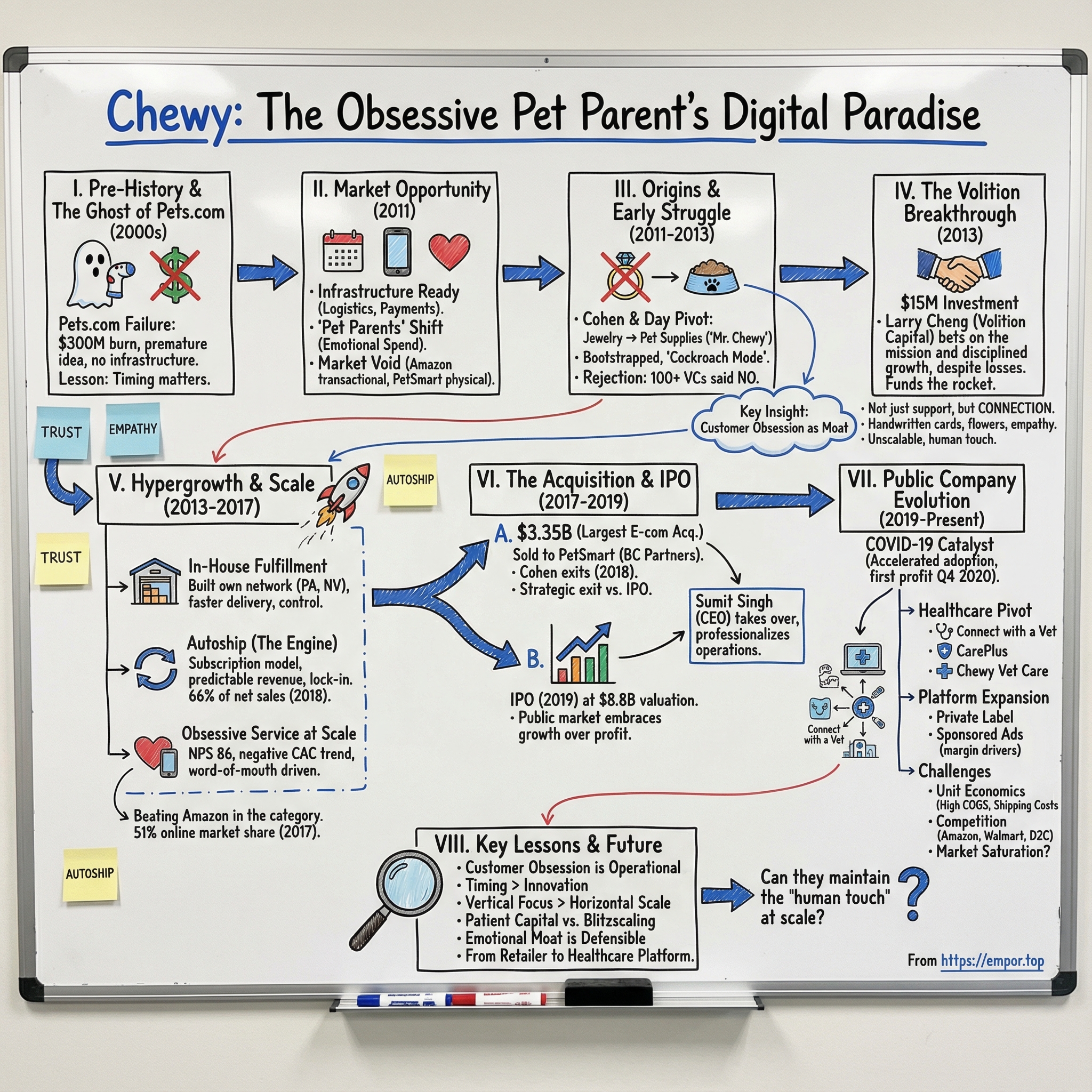
Chewy, Inc.: The Last E-Commerce Pure-Play Standing
I. Introduction & Episode Thesis
There is a particular kind of package that arrives at American front doors several million times a week: a brown box, roughly the size of a carry-on suitcase, heavy enough that the delivery driver braces before lifting it, printed on the inside flap with a cartoon dog. Inside is thirty pounds of kibble, a bag of clumping litter, and a couple of chew toys that the customer added almost as an afterthought. The economics of that box — heavy, cheap per pound, ordered on a schedule, delivered to a residential address — are the single most important fact in this story. They killed one famous company in 2000 and built another one after 2011.
On September 2, 2026, Chewy, Inc. trades on the New York Stock Exchange at $24.13 a share, a market capitalization of roughly $9.9 billion, inside a fifty-two-week range that runs from $17.40 to $43.50.1 For fiscal 2025, the year that ended February 1, 2026, the company reported net sales of $12.60 billion, up 6.2%, with gross margin of 29.8%, net income of $222.8 million, adjusted EBITDA of $719.2 million, and record free cash flow of $562.4 million.2 It served 21.3 million active customers at year-end and collected $591 from each of them over the trailing twelve months.2 By the first quarter of fiscal 2026, active customers had reached 21.5 million and spend per customer $597.3
Put those two paragraphs side by side and the central puzzle of Chewy appears. Here is a business generating more than half a billion dollars of genuine free cash flow, with no debt drawn, growing mid-single digits in a category that is not shrinking, run by the same operator for eight years — and the market values it at roughly eight-tenths of one year's sales. The stock has not revisited its pandemic-era highs. For five years, an investor who bought at the top has watched a company execute reasonably well and a share price go nowhere.
So the question this episode asks is not "how did Chewy win?" That part is settled. Chewy survived where Pets.com, Petsy, and a graveyard of pet e-tailers died. It out-executed Amazon inside its own category for the better part of a decade, in a country where Amazon usually wins by default. The question is harder and more current: is the thing that made Chewy win still working, and who actually controls the answer?
Three threads run through what follows.
The first is whether "customer obsession" — the handwritten cards, the pet-loss condolence flowers, the 24/7 phone line staffed by people who will talk to you about your dog — is still a moat, or has curdled into a marketing slogan. This is a testable claim, and Chewy's own record tests it harshly. Between fiscal 2021 and fiscal 2023, the active customer count fell for two consecutive years, from 20.663 million to 20.405 million to 20.1 million.45 Management at the time called it discretionary softness. A later industry survey found something less comfortable: customers left, and roughly half of the ones who left cited price.6 Obsession, it turns out, is porous.
The second thread is what it means to be a public company that six years after its IPO is still legally a "controlled company." As of the record date for the 2026 annual meeting, affiliates of BC Partners held approximately 43.2% of Chewy's outstanding shares and approximately 88.4% of its total voting power, courtesy of Class B stock carrying ten votes each; six of Chewy's fourteen directors are BC Partners partners or managing directors.7 That structure is not an abstraction. In October 2023 it produced a transaction that a Delaware stockholder sued over, and in 2026 it produced a $29.5 million settlement.8
The third thread is Chewy Health — the pharmacy, the telehealth line, the insurance products, and now a chain of veterinary clinics that quadrupled in size overnight when Chewy paid $400 million in cash for Modern Animal in May 2026.9 Is that a second profit engine, or a capital-intensive science project that management itself has told investors will not contribute EBITDA dollars until 2027?10
Those three threads — the moat, the controller, and the option — are the whole investment case. Everything else is arithmetic. And to understand why the moat exists at all, you have to start with the company that proved it shouldn't.
 Subscribe on LinkedIn
II. The Pets.com Ghost & Why 2011 Was Different
On November 7, 2000, Pets.com issued a press release announcing that it would "begin the orderly wind down of its operations." It laid off roughly 255 of its 320 employees the same day. The company disclosed that it had been trying to raise capital since early summer, that it had hired Merrill Lynch to approach more than fifty potential buyers, and that "fewer than 8 were even prepared to visit with the company." It had nearly 570,000 customers and planned to sell its inventory, its distribution-center equipment, its URLs, and its Sock Puppet.11
The Sock Puppet is what everyone remembers — the shaggy hand puppet with a microphone that appeared in a Super Bowl ad and became the mascot of an entire era's excess. What matters analytically is the sentence buried underneath it. Pets.com had a distribution center, a customer base approaching six hundred thousand, and a brand that a majority of Americans could identify. And it could not find eight people willing to fly out and look at it.
The reason was not the marketing budget, though the marketing budget was absurd. The reason was arithmetic. Pet food and cat litter are dense, low-value-per-pound, and consumed on a metronome. A forty-pound bag of dog food might carry a retail price of thirty dollars and a gross margin of perhaps five dollars. In 1999, shipping that bag across the country to a residential address cost more than the margin. Every order was a small, cheerful loss, and the more the company grew, the faster it lost money. This is why the venture became the canonical cautionary tale: it was not a bad idea executed poorly so much as a good idea executed against a cost curve that did not yet exist.
By 2011, three things had changed, and none of them had anything to do with pets.
The first was the ground network. UPS and FedEx had spent the intervening decade building out residential ground delivery at industrial scale, chasing the volume that e-commerce generally — not pet food specifically — had created. The marginal cost of moving a heavy parcel five hundred miles fell, and kept falling.
The second was consumer behavior. Broadband was ubiquitous, the smartphone was three years old, and buying a recurring household staple online had stopped being an act of technological adventurism. Crucially, replenishment — the boring, scheduled repurchase — was becoming a normal internet behavior rather than a novelty.
The third was the category itself. American pet spending was large, growing, and unusually resistant to the ordinary logic of discretionary retail. By 2025 the American Pet Products Association would put total U.S. pet industry spending at $158 billion, growing 3.7% year over year, across 95 million pet-owning households, with a 2026 projection of $165 billion.12 Even in a soft consumer year, people who will skip a vacation will not skip the dog's food.
Here is the strategic subtlety that defines everything after. The same economics that killed Pets.com — heavy, low-margin, replenishment goods, unpleasant to ship — are precisely the reason a specialist could exist at all. Amazon is a general merchant that optimizes for breadth and velocity. A category where every unit is dense, cheap, and margin-thin is the least attractive corner of Amazon's opportunity set, and for years it received correspondingly modest attention. That neglect was not permanent, and it was never a moat. But it was a door, and it was open for about a decade.
The company that walked through it was started by two twenty-somethings who had never worked in retail.
III. Founding to First Scale: Ryan Cohen and the Customer-Obsession Playbook (2011-2017)
Ryan Cohen and Michael Day met in a Java chat room. Cohen was doing affiliate marketing; Day was a University of Georgia dropout who could code. Their first venture together was an online jewelry business into which they put $150,000 of their own money, and which they eventually abandoned.13 The pivot from jewelry to dog food is the kind of detail that gets told as a joke, but it contains the actual insight: jewelry is a considered, infrequent, emotionally loaded purchase with terrible repeat rates. Dog food is an unconsidered, frequent, emotionally loaded purchase with perfect repeat rates. Cohen had stumbled into the difference between a transaction and a relationship.
They launched as "Mr. Chewy" in June 2011, found a fulfillment partner in Pennsylvania, and started buying pet products from distributors.13 Then came the part of the story that has hardened into Silicon Valley folklore and happens to be true in its essentials: nobody would fund them. Cohen pitched over a hundred venture firms. He flew from Fort Lauderdale to Palo Alto and walked into half a dozen Sand Hill Road offices unannounced, and did not get past the receptionists. The consensus objection was not subtle. Investors had watched Pets.com burn through roughly $300 million a decade earlier, and here were two kids with no retail background proposing to do it again.
The pattern-break came from Larry Cheng at Volition Capital, who had passed once, then looked again after Chewy blew through the sales projections it had given him, and led an investment in 2013. By late 2013 the company had raised $236 million in venture capital, eventually including T. Rowe Price and BlackRock.13 The lesson embedded here is not "persist and you will be funded." It is that in a category with a famous failure, the affirmative evidence has to be operational, not rhetorical. Cheng did not change his mind because Cohen was persuasive; he changed it because the cohort data was.
The service playbook. What Chewy built with that money was, on the surface, absurdly unscalable. Customer service representatives sent handwritten holiday cards. When a customer wrote in to cancel an Autoship subscription because their dog had died, Chewy sent flowers and a sympathy note, and in some cases commissioned a hand-painted portrait of the animal. The phone line was staffed 24 hours a day, seven days a week, by human beings who were explicitly not measured on call duration. In an industry where the online precedent was a shopping cart and an email address, this was an alien approach.
The analytical case for why it worked is worth stating precisely, because it is frequently stated imprecisely. Chewy was not buying warm feelings. It was buying two specific, measurable things: a lower rate of subscription cancellation, and a lower cost of new-customer acquisition through word of mouth in a category where pet owners talk to each other constantly. A retailer with 20% gross margins cannot outspend Amazon on advertising. It can, however, spend money on a service experience that generates unpaid advertising, and route the resulting demand into a subscription that renews without further spending. That is the actual mechanism. The flowers are the marketing budget.
The logistics build. Warm feelings do not move forty-pound bags. In early 2014, Chewy opened its first owned fulfillment center in Pennsylvania — a project the founders later described as harder and more expensive than they had anticipated, with roughly everything that could go wrong going wrong. By the time of the IPO filing, the network had grown to seven fulfillment centers, positioned to reach approximately 80% of the U.S. population with overnight delivery.14 That density is what converted the Pets.com death sentence into a viable cost structure: if the box only has to travel one zone, the freight math changes entirely.
The growth that followed was violent. Net sales went from $900.6 million in fiscal 2016 to $2.10 billion in fiscal 2017 — better than doubling — as Chewy became the largest online pet retailer in the United States.14
And here is the part of the origin story that gets skipped. Chewy was not profitable during any of it. Fiscal 2016 produced a net loss of $107.2 million on gross margin of 16.6%. Fiscal 2017 produced a net loss of $338.1 million on gross margin of 17.5%.14 The company was, in the most literal sense, buying revenue. Whether the underlying unit economics could ever support a durable operating margin was, in 2017, entirely unproven — a fact worth holding onto, because it explains the decision that came next and it frames every margin claim made in this story for the following nine years.
One more correction to the folklore, since it recurs in secondary coverage. Autoship was not a late add-on that slowly grew from a small base. It was foundational: Autoship customer sales were already 62.8% of net sales in fiscal 2016 and 61.5% in fiscal 2017.14 Chewy was a subscription business that happened to look like a store, from very early on. What has changed since is penetration at the margin, not the existence of the model.
By early 2017, Cohen had a business doing over $2 billion in revenue, losing a third of a billion dollars a year, backed by investors who had been in for four years, in a public market that had shown no appetite whatsoever for unprofitable e-commerce. Two strategic buyers came knocking.
IV. The PetSmart Sale: Benchmarking the Largest E-Commerce Acquisition of Its Time (2017)
On April 18, 2017, PetSmart announced it had agreed to acquire Chewy. The press release did not disclose a price. It said Chewy "will continue to be led by CEO Ryan Cohen and operate largely as an independent subsidiary," and it quoted PetSmart CEO Michael Massey describing Chewy's "high-touch customer e-commerce service model and culture centered around a love of pets" as "the ideal complement to PetSmart's store footprint."15 The number that leaked and then became canonical was $3.35 billion — at the time, the largest acquisition of a U.S. e-commerce company ever completed, larger than Walmart's purchase of Jet.com the year before.13
The process had two bidders. Petco wanted to pay in stock. PetSmart — privately held since a 2014 leveraged buyout led by BC Partners — offered all cash. Cohen took the cash.
So was $3.35 billion a good price? This is the benchmarking question, and it deserves an honest answer rather than a hindsight verdict.
At roughly $2.1 billion of trailing revenue, the deal valued Chewy at about 1.6 times sales, for an asset growing north of 100% a year and losing money at a rate that would have alarmed any public-market investor. Two years later, Chewy's IPO priced the equity at $22 a share; the stock rose sharply on debut and the company would go on to trade at a substantial multiple of the take-out valuation during the pandemic. On that comparison, PetSmart got a historically good price and Cohen left an enormous amount on the table.
But that comparison is the wrong one, because it benchmarks a 2017 decision against a 2021 market that nobody in 2017 could see. Consider the world as it actually looked. Unprofitable e-commerce had no reliable public bid; the IPO window for cash-burning consumer companies would not really open until 2019 and would not become euphoric until 2020. Chewy's investors had been in since 2013 and wanted liquidity. And the company's own losses were accelerating, not narrowing, which meant an IPO would have required either a much larger equity raise at an uncertain price or a demonstrated path to profitability that did not yet exist. Selling for certain cash to the one buyer with a strategic reason to overpay is not obviously a mistake; it is a legitimate trade of upside for the elimination of financing risk. The fair conclusion is that the exit was a strong outcome achieved by taking certainty at a moment when certainty was scarce, and that the "he sold too early" critique depends almost entirely on a subsequent bull market that no rational actor was underwriting.
The acquirer's motive matters more than the price. PetSmart in 2017 was a leveraged, brick-and-mortar specialty retailer with declining comparable-store sales, buying growth it could not generate organically. The purchase was financed with debt layered onto a capital structure already built for an LBO. That decision set the terms of the next six years: Chewy's fate would be entangled with a sponsor's portfolio-level balance sheet, not just with its own operating performance. Every governance question in this story descends from that single financing choice.
Cohen's exit. On March 16, 2018 — eleven months after the deal — Chewy announced that Ryan Cohen was stepping down from day-to-day leadership. His successor was Sumit Singh, who had joined as chief operating officer in November 2017 from Amazon, where he had run Amazon Fresh, and before that from Dell.16 The reasons were not explained publicly at the time. Cohen has been a highly visible figure since, principally as chairman of GameStop, and data feeds still occasionally attach the "Co-Founder" label to his Chewy association. Chewy's 2026 proxy lists a fourteen-member board, and Cohen is not on it.7 The residual belief that Cohen has any influence over Chewy today is simply wrong, and it matters because it distorts how some investors read the stock.
What Cohen left behind was a service culture, a subscription base, and an unsolved profitability problem. What arrived was an Amazon operations executive whose entire professional formation was in cost per unit, throughput, and network design. That substitution — founder-merchant out, operator-engineer in — is the hinge of the modern company.
V. Becoming a Public Company Owned by Its Own Parent's Owner (2019-2023)
On June 13, 2019, Chewy priced its initial public offering at $22 per share — above the marketed range — selling 46.5 million shares for gross proceeds of roughly $1.02 billion. Only 5.6 million of those shares were newly issued by Chewy; the other 40.9 million came from a PetSmart subsidiary cashing out. The stock listed on the NYSE the following morning under the ticker CHWY, with Morgan Stanley, J.P. Morgan and Allen & Company leading, and BC Partners Securities sitting in the syndicate as a co-bookrunner on the sale of shares by its own portfolio company.17
The structure of that offering told you everything about who the company belonged to. After the IPO, PetSmart retained roughly 70% of outstanding shares but approximately 77% of combined voting power, because its Class B stock carried ten votes per share against one vote for the Class A shares sold to the public.14 Chewy was a New York Stock Exchange "controlled company" from its first trading day. Public investors were buying a minority economic interest with essentially no governance interest — a structure that is common enough among founder-led technology companies and comparatively rare when the controller is a private equity sponsor with its own portfolio to manage.
The financials underneath were still unproven. Fiscal 2018 delivered net sales of $3.53 billion, up 68%, on gross margin of 20.2%, and a net loss of $267.9 million. Active customers stood at 10.6 million, spending $334 each.14 The bull case at the time was straightforward: the losses were front-loaded customer acquisition, the cohorts paid back, and gross margin was climbing 250 to 300 basis points a year as scale improved purchasing terms and freight density. The bear case was equally straightforward: this was a low-margin distribution business with no proprietary product, competing against the most formidable logistics operator in the history of retail.
Then the world closed. The pandemic did not merely accelerate Chewy — it changed the shape of the company. Fiscal 2020 net sales reached $7.15 billion, up 47%, with gross margin expanding 190 basis points to 25.5% and the customer base growing 43%.18 In the fourth quarter of that year, on $2.04 billion of net sales up 51%, Chewy reported net income of $21.0 million: the first profitable quarter in the company's history, nine and a half years after founding.18 Sumit Singh's framing on that release — "the Internet's preeminent neighborhood pet store" — was the first time management could claim, with evidence, that the Pets.com arithmetic had been beaten.
Two things happened at once, and separating them is the whole analytical exercise. Millions of Americans adopted pets. And millions of Americans who already had pets shifted their existing spending online. The first is a permanent addition to the category. The second is a channel shift that can partially reverse, and did.
The falsification test. Here is where the "customer obsession equals durable moat" claim meets its strongest disconfirming evidence, drawn from Chewy's own reporting rather than from a critic.
Fiscal 2021 closed with 20.663 million active customers, net sales of $8.89 billion, a net loss of $73.8 million, and net sales per active customer of $430 — which management correctly described as a company high.194 Fiscal 2022 closed with 20.405 million active customers, down 1.2%, and spend per customer up 15.1% to $495. Management's explanation in that release was "continued softness in discretionary spending," coupled with an expressed confidence in returning to positive customer growth during 2023.4
That confidence was misplaced. Fiscal 2023 closed with 20.1 million active customers, down another 1.6%, on net sales of $11.1 billion.5 Two consecutive years of customer decline, against a prediction of reversal made at the start of the second one.
The company's framing throughout was demand normalization: the pandemic pulled forward adoptions, the pull-forward unwound, and the remaining customers were spending more. That story is partly true and mechanically visible in the numbers — spend per customer rose every single year through the decline.
But it is not the whole story. A September 2024 RBC Capital Markets survey of 1,540 respondents found that Chewy had lost roughly 7.2% of its customers over the measured period. Among those who left, 49.6% cited price and 12.5% cited delivery. The biggest beneficiaries were Amazon, which took 63.8% of Chewy's departing customers, followed by Walmart at 32.5% and Petco at 31.3%.6 Independent reporting on the 2023 slowdown reached similar conclusions about a price-sensitive consumer trading down and multi-sourcing.20
Weighing it. The evidence does not reject the claim that Chewy's service model creates loyalty — spend per customer rising through a customer decline is exactly what a loyal core looks like. But it decisively narrows the claim. What survives is: Chewy has a sticky Autoship base that deepens over time. What does not survive is: Chewy's customer relationships are immune to price and convenience competition. Nearly half of departing customers left over price, in a category where the largest competitor can subsidize price indefinitely. The moat is a retention accelerant, not a retention guarantee. The metric that would confirm or falsify the revised claim is not the raw active-customer count but the quarterly trajectory of Autoship net sales growth relative to total net sales growth — if the subscription base stops growing faster than the whole, the accelerant has stopped accelerating.
And in the middle of that operational soft patch, the ownership changed shape. On October 30, 2023, Chewy executed a set of transactions with BC Partners affiliates that restructured the sponsor's ownership and separated Chewy from PetSmart, which BC Partners was partly selling to Apollo Global Management.21 The headline read like liberation: Chewy would no longer be an appendage of a leveraged brick-and-mortar chain. Customers finally re-inflected upward thereafter, reaching 21.327 million by the end of fiscal 2025 and 21.497 million by the first quarter of fiscal 2026, alongside nearly 200,000 net additions in that quarter.23
But the mechanism of that October 2023 separation is where the story turns, and it is not a story about customers at all.
VI. The Governance Overhang: BC Partners, the $1.9B Tax Liability, and What It Says About Capital Allocation
Strip away the corporate-finance vocabulary and the October 2023 transaction worked like this. BC Partners held Chewy and PetSmart through a holding-company structure. It wanted to sell part of PetSmart to Apollo. Selling out of that structure would trigger tax. So the holding entities through which BC Partners controlled Chewy were merged downward into a newly created Chewy subsidiary — a "downstream merger" — which had the effect of unlocking significant tax efficiency for the sponsor while moving the associated tax obligations onto Chewy's balance sheet.
The amounts are not small and they are not disputed. BC Partners affiliates transferred approximately $1.9 billion in cash to Chewy to fund the tax obligations of its affiliates that Chewy inherited in the transaction, along with related expenses.9 So the popular shorthand — "BC Partners stuck Chewy with a $1.9 billion tax bill" — is imprecise. The cash to pay it came across.
The stockholder complaint filed in Delaware Chancery Court on November 20, 2024 by Eric Gilbert made a more specific and more interesting argument.2122 It was not that Chewy received nothing; it was that Chewy assumed a large, uncertain, long-tailed liability on behalf of its controller and was compensated for that risk on terms a genuinely arm's-length party would never have accepted. Specifically, the complaint alleged that against the funded reserve, BC Partners agreed only to capped, non-recourse indemnification — a maximum of $246 million, including $196 million for taxes — satisfiable solely by escrowing Chewy shares rather than cash. It alleged that the three-member special committee had initially demanded substantial cash consideration, then "readily abandoned" that demand when BC Partners refused, settling instead for the assignment of a pharmacy business, governance concessions, and a conditional share-price payment that never materialized. It alleged that committee members had personal relationships with BC-affiliated directors, and that both company counsel and the financial advisors carried conflicting BC Partners relationships.21
Note what this means for the standard defense. Chewy did use a special committee of independent, disinterested directors, and the board approved the transaction on that committee's recommendation.9 The process box was checked. The complaint's theory was that checking the box is not the same as bargaining hard — which is, in the end, the entire recurring problem with controlled companies.
The resolution. On April 6, 2026, a Special Litigation Committee composed of two newly appointed independent directors, together with the company and the BC Partners-affiliated defendants, entered into a stipulation of settlement with Gilbert. The consideration was $29.5 million. Chancellor Kathaleen St. Jude McCormick approved it at a hearing on June 23, 2026, with $5.5 million awarded to plaintiff's counsel and a $5,000 incentive award to Gilbert. The SLC characterized the settlement as providing "certain (and meaningful) financial benefit without further risk." There was no admission of wrongdoing.823
How much should this weigh? Honest answer: it should temper the management-quality thesis materially without demolishing it, and it should be weighed on scale, recency, and structure rather than on outrage.
On scale, $29.5 million against a transaction that moved roughly $1.9 billion of tax obligations is a recovery of about 1.5 cents on the dollar of the headline exposure — though the headline exposure overstates the economic harm, since the cash was funded. A fairer read is that the settlement is small relative to the risk Chewy absorbed and modest relative to a company generating over half a billion dollars of annual free cash flow. On recency, this is not ancient history: the transaction was three years ago, the settlement was two months ago, and the same controlling shareholder holds the same 88.4% of voting power today.7 On structure, the settlement changed nothing about the dual-class arrangement itself. The mechanism that produced the conflict is fully intact.
That is the crux. An investor in Chewy is not merely underwriting Sumit Singh's operating ability. They are underwriting the proposition that a private equity sponsor with a large, complex portfolio will not again find it convenient to route a portfolio-level need through a company whose minority holders cannot vote it down. Founder control creates its own risks, but a founder's wealth is typically concentrated in the one company. A sponsor's is not, and its incentives are governed by fund-level returns and exit timing across many holdings.
The counter-evidence, stated fairly. Two things cut the other way.
First, BC Partners has been steadily selling. In June 2024, Chewy repurchased $500 million of Class A stock directly from BC Partners at $28.49 per share — 17.55 million shares, cancelled and retired — funded from internal capital, with the company explicitly arguing the purchase was accretive because it came at a discount to the market price.24 In December 2024 a further secondary offering was accompanied by a $50 million concurrent repurchase. On June 23, 2025, Buddy Chester Sub LLC sold nearly 24 million shares at $41.95 in an upsized offering of roughly $1.0 billion, with Chewy again repurchasing $100 million alongside it.25 The Class B share count has come down steadily as a result.
Second, and more important for capital allocation, all of it has been paid for out of cash flow. As of May 3, 2026, Chewy had no outstanding borrowings under its $800 million asset-based credit facility, with $783.1 million of capacity available, and held $485.2 million of cash plus $34.9 million of marketable securities.9 The board raised the buyback authorization by $500 million on April 7, 2026, bringing the cumulative program to $1 billion, of which $550 million remained available at quarter-end after $200 million of repurchases in the quarter.9 Fiscal 2025 repurchases totaled $262.5 million.2 A company retiring stock from its controller, at a discount, with operating cash rather than borrowed money, is behaving better than the average sponsor-controlled retailer.
So the balanced conclusion: capital deployment has been disciplined and self-funded; capital stewardship — the board's willingness to protect minority economics when the controller's interests diverge — has one significant, recent, documented failure that cost real money to resolve. The forward marker is not whether BC Partners keeps selling; it is what happens at the next related-party transaction, and whether an independent committee this time is willing to walk away rather than settle for governance concessions and a conditional payment that never arrives.
VII. Current Management: Incentives, Track Record, Credibility
Sumit Singh has now run Chewy for eight and a half years — longer than Ryan Cohen did, and long enough that the "founder-less company" framing has become lazy. Chewy is not a company missing its founder; it is a company on its second and considerably longer operating regime.
Singh's formation is visible in the numbers. He came from Amazon Fresh, a business whose entire problem is moving heavy, perishable, low-margin goods to residential doors profitably — which is to say, exactly Chewy's problem with an even worse cold chain. Before that, Dell, another exercise in configure-to-order supply chains and thin margins. What Singh has done at Chewy is essentially what an operations executive would be expected to do: take a merchant's brand and a subscription base and grind out cost. Gross margin has gone from 20.2% at the IPO to 29.8% for fiscal 2025 and 30.1% in the first quarter of fiscal 2026, while adjusted EBITDA margin has moved from 3.3% in fiscal 2024 to 5.7% in fiscal 2025 and 7.5% in the most recent quarter.142326 That is a real, sustained, eight-year record of turning a lossmaking distributor into a cash-generating one.
Incentives. Chewy's 2026 proxy shows a pay structure weighted heavily toward equity, with performance-based restricted stock units carrying a maximum realizable value for Singh of $30.0 million for fiscal 2025 if the highest performance conditions were achieved.7 The proxy also discloses that "other compensation" for Singh included $1,320,747 for personal security-related services in fiscal 2025 — a large number by the standards of a mid-cap retailer, and one that shareholders are entitled to ask about, even if the underlying justification is not public.7 The design point that matters is that the bulk of the CEO's realizable pay is equity that only pays out on performance conditions and share price, which aligns him with the same outcome public holders are waiting for. The design point that should concern an activist is that the board setting those conditions is one on which six of fourteen seats belong to the controller.7
The CFO seat. This deserves more scrutiny than it usually gets, because the outline version of the story is tidier than the record. On May 12, 2025, Chewy announced that CFO David Reeder would depart to become a chief executive in the semiconductor industry. He remained through the June earnings announcement and assisted with the transition; Singh's public comment was that "our long term plan remains intact, our business momentum remains strong."2728 No interim CFO was named in that release, and the company said it would run a search.
The search took until February 24, 2026 — more than nine months — when Chewy appointed Chris Deppe, who had joined the company in 2022 as VP of supply chain and operations finance and had previously spent over sixteen years at Amazon in transportation and fulfillment finance. Will Billings, the chief accounting officer, served as interim principal financial officer through the gap.29 Singh's framing of Deppe was operational rather than strategic: "a proven finance leader who delivers results, builds strong partnerships, and executes with discipline."29
Two readings are available. The charitable one: Chewy promoted from within, chose an operator-CFO whose background mirrors the CEO's, and had a competent chief accounting officer holding the seat, which is exactly what a well-run company does. The skeptical one: a public company of this size going nine months with an interim principal financial officer, having lost its permanent CFO after roughly fifteen months in the job, indicates a finance function that has been less stable than the operating record suggests. Both readings are defensible; the tiebreaker will be whether Deppe's disclosure practices differ from his predecessor's — specifically on the advertising business discussed later, where Chewy's opacity is the single largest gap in its own margin story.
Capital allocation record. Buybacks funded from free cash flow, no dividend, no debt drawn, and — until very recently — almost no acquisitions. That last item is now changing, and it changes the grading problem.
In October 2025, Chewy agreed to acquire SmartEquine from Covetrus, an equine health business with subscription supplement programs; the price was not disclosed and the deal was expected to close in the fourth quarter of fiscal 2025, with management saying it would be adjusted EBITDA margin accretive on closing.30 In April 2026 came Modern Animal, closed on May 21, 2026 for $400 million in cash from the balance sheet.109 That is the first sizable acquisition since Chewy became an independent company. There is, therefore, no long deployment record to bless or indict — a point worth stating plainly rather than papering over with either praise or suspicion. The honest position is that Chewy's M&A capability is untested at scale, and that a $400 million cash purchase representing over 80% of quarter-end cash is a meaningful concentration of an unproven capability.
The guidance stress test. The most revealing management moment of 2026 came on June 10. Chewy reported a first quarter that beat on nearly every line: net sales of $3.357 billion, up 7.7%; gross margin up 50 basis points to 30.1%; net income of $94.8 million; adjusted EBITDA of $253.1 million, up 31.3%, for a margin of 7.5%; free cash flow up 45.4% to $70.8 million.3 And simultaneously cut the full-year outlook to $13.40-$13.55 billion, roughly 6.3% to 7.5% growth, citing a more discerning consumer, softening premiumization, and weaker product attachment rates.3132
Beating the quarter and cutting the year is an unusual combination, and analysts pushed hard. Michael Morton of MoffettNathanson noted the apparent contradiction: gross adds and churn had improved in May, yet guidance now pointed to the low end of the quarterly net-add range. Singh's answer was that "nothing has changed relative to how we had forecasted the curve of the year."31 Doug Anmuth of JPMorgan asked point-blank how Chewy separates macro weakness from competitive pressure. Singh's evidence chain was that industry-level trends weakened in the quarter while Chewy's absolute site clicks "increased mid-single-digit percentages year-over-year," and that "competitive data across the industry suggests" continued share gains. On Amazon specifically he said Chewy was "not seeing any change to competitive environment" and described the promotional backdrop as "rational and consistent."31
Assess that answer on its merits. It is specific, it cites a leading indicator rather than a lagging one, and it is falsifiable — click growth and share data are things third parties can check. That is better than the evasive alternative. But it is also, structurally, the same answer management gave in early 2023: the weakness is the consumer, not us. That prior version of the answer was followed by a second year of customer decline and, later, survey evidence that price-driven defection to Amazon was real.456 An investor is entitled to weight the current version accordingly — not to dismiss it, but to treat "it's macro" as a hypothesis with a poor track record at this specific company rather than as an established fact.
Notably, Singh also declined the obvious lever. Pressed by Anna Andreeva of Piper Sandler on whether promotions would be deployed to reaccelerate growth, he rejected the framing: "We don't view promotions [as a lever]. We view investment in the business broadly," and referenced 2023, when "we essentially ran sort of cash acquisition offers" that "just don't have high ROI."31 That is a management team declining to buy a metric it knows investors watch, and citing its own failed experiment as the reason. It is the single most credible thing said on that call.
VIII. The Core Business Today: Industry Structure, Competitors, and How Chewy Actually Wins or Loses
Walk into a Chewy fulfillment center and the first thing you notice is that it does not look like a technology company. It looks like a food warehouse. Pallets of kibble stacked to the rafters, conveyor lines groaning under bags that weigh more than a small child, and a labor force whose job is fundamentally physical. Chewy employed approximately 18,000 full-time and part-time people as of February 1, 2026, and sells roughly 190,000 product and service offerings from about 4,000 brand partners.3334 This is a distribution business with a software layer, not the reverse — and everything about the investment case follows from that.
Sizing what matters. Pet food, treats, litter, medication and hardgoods — the core retail business — represent well over 90% of net sales and effectively all of the gross profit. Chewy has described consumables and health as roughly 85% of sales, which is precisely why the business held up through the 2022-2023 discretionary slump.5 Everything in the two sections that follow — veterinary clinics, insurance, advertising, private label — is a layer on top of this. If the core is broken, nothing else rescues it. If the core is fine, the layers determine whether the margin story continues.
Market structure: nobody owns this category. The most useful frame is not market share; it is share of wallet. The RBC survey data is instructive because it measured shopper overlap rather than dollars: 79.6% of online pet-supply shoppers bought from Amazon, 53.1% from Chewy, and 32.9% from Walmart.6 Those numbers sum to well over 100% because pet owners routinely use three or four retailers — Amazon for the impulse toy, Chewy for the monthly food delivery, the grocery store for a forgotten bag of litter.
Third-party estimates of dollar share vary widely and should be treated with caution: depending on the methodology and the definition of the category, Amazon is credited with anywhere from roughly 45% to over half of U.S. online pet sales, with Chewy the clear number two. The estimates disagree enough that no single figure deserves to anchor an investment case. What the data agrees on is the structural point: Chewy's advantage is depth within its own base — $597 of annual spend per active customer and rising — rather than exclusivity.3 Chewy does not own its customers. It owns their kibble subscription.
The competitive field, one antagonist at a time.
Amazon is the permanent problem. It has the largest logistics network ever built, a Prime membership that subsidizes shipping across every category, and enough scale to price pet food as a loss leader indefinitely if it decided to. It is also, per the RBC survey, the destination for the largest share of customers who leave Chewy.6 What Amazon has never built is a pet-specific replenishment and health ecosystem: an Autoship program tuned to a specific animal's food, a pharmacy that fills a veterinary prescription, a telehealth line, and now clinics. Amazon's push into same-day grocery is a live escalation, and Singh's non-answer on the Q1 call — "No real comments," followed by a statement that Chewy keeps competitors "in the rearview mirror" — was the least satisfying moment of the quarter.31 Confidence is not evidence.
Walmart is the price anchor. Its gains have come disproportionately from the inflation-stressed switcher, and 32.5% of Chewy's departing customers landed there.6 Walmart cannot match Chewy on selection or service, but it does not need to; it needs to be twelve percent cheaper on the one item that dominates the basket.
Petco is the cautionary tale on the other side of the trade. S&P Global Ratings downgraded Petco's issuer credit rating from B+ to B in April 2024 on expectations that profitability would remain pressured, amid continued comparable-store declines and customers drifting to online sellers and mass merchants.35 Petco's omnichannel pitch — in-store vet clinics and grooming as a defense against pure e-commerce — is intellectually coherent and has not translated into online share gains against Chewy.
PetSmart, with roughly 1,700 stores and the debt load inherited from its 2014 buyout, is now unaffiliated with Chewy and serves as the counterfactual: it is approximately what Chewy would have been had it stayed a subsidiary of a leveraged store chain.36 The separation, whatever its governance cost, was strategically correct.
Temu and marketplace discounters are a lower-conviction threat confined mostly to non-perishable hardgoods — toys, beds, accessories — where price transparency is high and brand matters least. They are unlikely to touch prescription diets or veterinary pharmacy.
The Autoship moat, quantified and stress-tested. In the first quarter of fiscal 2026, Autoship customer sales were $2.83 billion, or 84.4% of net sales, growing 10.5% year over year — faster than the 7.7% total.3 For the full fiscal 2025, Autoship was $10.50 billion, or 83.3%.2 Track that against the earlier record: 62.8% in fiscal 2016, 65.7% in fiscal 2018, 70.2% in fiscal 2021, 73.0% in fiscal 2022, roughly 76% in fiscal 2023.1445 That is a decade of steady, uninterrupted penetration gains.
Why does it matter economically? Two reasons that are frequently conflated and shouldn't be. The first is switching friction: a customer who has set up a recurring delivery of a specific food, at a specific interval, for a specific animal, must take a deliberate action to leave. Defaults are powerful. The second, and arguably more valuable, is demand predictability: knowing what will ship next month lets Chewy position inventory closer to the customer, buy from brands on better terms, and run its fulfillment network at higher utilization. In a business where the cost of moving heavy freight is the binding constraint, foreknowledge of demand is worth real basis points.
Now the stress test, and it must sit right here rather than in a distant risk section. Autoship penetration rose through fiscal 2022 and 2023 — the exact two years the customer base shrank. Penetration going up while customers go down means the subscription did not prevent defection; it concentrated the survivors. Autoship subscribers themselves churned when the price-value proposition weakened. And the growth rate is decelerating: Autoship net sales grew 10.5% in the most recent quarter and 14.8% a year earlier, against 20%-plus rates in earlier years.326 The revised, defensible claim is that Autoship is a powerful retention accelerant and demand-planning asset that materially raises the cost of leaving — and that it has never been demonstrated to hold customers who conclude they are overpaying. The KPI is the spread between Autoship growth and total net sales growth. As long as it is positive and wide, the base is deepening. If it compresses toward zero, the moat is being arbitraged away by price.
Unit economics: where the margin actually came from. Gross margin has climbed from 16.6% in fiscal 2016 to 20.2% at the IPO to 29.8% in fiscal 2025.142 That is nearly a doubling, and it did not come from the food. Cost of goods still consumes roughly 70% of every dollar, because the underlying products are heavy, branded, and competitively priced. What changed is mix: high-margin sponsored advertising and private-label products layered on top of a low-margin base, plus a decade of freight and fulfillment leverage.
This is where an investor should push back hardest. Management has repeatedly identified sponsored ads as the principal driver of gross margin expansion, and has never disclosed the revenue in dollars.33 On the Q1 fiscal 2025 call the CFO characterized the business as sitting "in the one to three percent" range of net sales with margins "slightly lower" on off-site than on-site but "still pretty high."26 That is a range wide enough to encompass roughly $130 million to $400 million of high-margin revenue — a spread that changes the entire earnings-quality analysis. Amazon and Walmart both disclose advertising revenue as a line item. Chewy does not. The 10-K for fiscal 2025 mentions the sponsored ads offering and provides no figures.33 An investor cannot independently underwrite the largest single driver of the company's margin re-rating, and should discount the claim accordingly rather than accepting it on management's characterization.
The five forces, applied honestly. Supplier power is weak: Chewy is a must-have distribution partner for pet food brands, roughly 4,000 of them, none of which can afford to be absent from the largest specialist online channel.34 Buyer power at the individual level is low — one household cannot negotiate — but buyer power in aggregate is high, because switching at the category level is trivial and price comparison is one tab away. Threat of new entrants into pure pet e-commerce is low, because the fulfillment network is genuinely expensive to replicate; threat of entry from adjacency is severe, because Amazon and Walmart already own the network. Substitutes are limited: pets eat. Rivalry is intense but, per management's own characterization, currently "rational" on promotion.31
In Hamilton Helmer's 7 Powers vocabulary, what Chewy has is best described as scale economies in fulfillment density and purchasing, plus a modest form of switching costs at the individual subscription level, plus a real but soft branding power in a category with unusual emotional loading. What it does not have is network economies — no Chewy customer becomes more valuable to another Chewy customer — and it does not have cornered resource. That is a defensible position, not an impregnable one, and the distinction is the whole reason the stock trades where it does.
One genuinely defensive characteristic. On the tariff question, Chewy's exposure is unusually low for specialty retail. Reeder told analysts in June 2025 that "the vast majority of our portfolio is 85% plus consumables with domestic input source streams," resulting in minimal tariff impact, while noting that even tariff-exposed hardgoods were substantially covered by inventory already onshore at suppliers.26 The 10-K does not quantify China sourcing as a percentage of cost of goods sold, so the precise figure is not disclosed.33 But the structural point holds: a company selling mostly domestically produced food and litter is far less exposed to trade policy than one selling mostly imported hardgoods. That is an evidenced advantage rather than a talking point.
The net of all this: Chewy wins from here if it keeps deepening a subscription base it already dominates and keeps stacking high-margin layers on a low-margin core. It loses if the price gap to Amazon and Walmart widens enough that the Autoship default stops being worth paying for. The 2022-2023 record shows that gap opening once already.
IX. Chewy Health & Vet Care: Real Optionality, Still Proving Itself
The most expensive room in the pet economy is not the aisle where the kibble is. It is the exam room. Veterinary care is where a pet owner's spending becomes least price-sensitive and most urgent, and it is the part of the $158 billion U.S. pet market that a pure e-commerce retailer structurally cannot touch.12 Chewy has spent six years trying to touch it anyway.
This section is included because it is plausibly material to the future case — genuine new addressable market, extending wallet share into the highest-margin part of pet spend — and not because it is material today. That distinction should be held throughout.
The timeline is the falsification test. Connect With a Vet, a telehealth service linking customers to licensed veterinarians, launched in late 2020. CarePlus, a suite of wellness and insurance plans built with Trupanion and later Lemonade, launched on August 4, 2022 in 31 states, with wellness plans starting at $20 a month and insurance tiers at $20, $60 and $100.37 Chewy Vet Care — actual physical clinics offering routine appointments, urgent care and surgery — was announced on December 14, 2023, with the first practice opening in South Florida in early 2024.38
That is more than three years from the first health product to the first clinic door, and roughly five and a half years from telehealth launch to meaningful scale. By the end of fiscal 2025, after two full years of building, Chewy had 18 clinics.33 Eighteen. For a company with 21 million customers and 190,000 SKUs, that is a pilot program, and any framing of Chewy Health as a "hidden growth engine" has to be reconciled with the fact that it took five years to reach a footprint smaller than a regional dental chain.
Then Chewy bought its way past the constraint. On April 8, 2026, Chewy announced the acquisition of Modern Animal, a technology-forward veterinary platform with 29 owned clinics, over 100,000 member families, and more than $125 million of annualized run-rate revenue. The transaction closed on May 21, 2026 for $400 million in cash from the balance sheet, taking Chewy Vet Care from 18 to 47 locations, with management guiding to roughly 60 clinics by the end of fiscal 2026.109
The strategic logic is sound. Modern Animal was built around the membership model and a proprietary software stack, generating over twice the industry average revenue per location and, at maturity, EBITDA margins above 20%.10 Chewy's argument is that a clinic visit is the highest-intent moment in a pet owner's year, and that owning it converts into food, pharmacy and insurance revenue downstream. The supporting data management offered on the June call was genuinely interesting: veterinary clinic customers reach roughly $900 of annual net sales per active customer — about 50% above the company average — and roughly 40% of clinic customers are entirely new to Chewy.31 If those cohort economics hold, this is customer acquisition that pays for itself, not a diversification.
But management's own words bound the claim, and they belong right here. CFO Deppe told analysts that Modern Animal would be "generally adjusted EBITDA dollar neutral in 2026," with a modest drag on margin rate, and that the clear line of sight to contribution begins in 2027. Chewy guided the acquired business to roughly $70 million of net sales in fiscal 2026.3110 That is management telling investors, explicitly, that this is a multi-year investment and not an immediate profit center. Any narrative that treats vet care as a near-term earnings driver is contradicted by the company itself.
Size it honestly. Combine the clinics, telehealth and CarePlus, and Chewy Health remains a low-single-digit percentage of a business approaching $13.5 billion in annual revenue. The clinics are real, growing, and now at genuine scale for the first time; they are not yet a second core business, and by management's guidance they will not be one in this fiscal year.
There is also an integration question that has no answer yet. Chewy is a high-volume, low-margin, algorithmically managed distribution company. Veterinary practice is a labor-constrained professional services business where the binding input is licensed veterinarians in a market with documented burnout problems — a pain point Chewy's own chief medical officer named at launch.38 Those are different businesses with different cultures, and Chewy has never integrated an acquisition of this size. The KPI worth watching is not clinic count, which management will hit because opening clinics is a capital decision. It is whether Modern Animal's above-industry revenue per location survives contact with Chewy's ownership, and whether the 2027 contribution guidance is reiterated or quietly pushed.
X. Margin Levers: Sponsored Ads and Private Label (Chewy Made)
If Chewy has a genuinely elegant idea, it is this one: the customer who is already on your site looking at dog food is worth more to a pet brand than any impression that brand could buy anywhere else, and monetizing that attention costs almost nothing.
Chewy Ads launched in May 2023 as a retail media network — the industry term for a retailer selling advertising space against its own first-party shopper data. The mechanics are simple to describe and lucrative to run: a brand pays to appear at the top of a search for "grain-free puppy food," Chewy collects the fee, and the incremental cost of serving that placement rounds to zero. Unlike selling a bag of food, there is no freight, no inventory, and no shrink. Every dollar of ad revenue drops through at close to full margin, which is why it shows up so visibly in gross margin without changing anything about the underlying retail business.
The trajectory has been steep. Reporting on the network describes advertiser and campaign counts roughly doubling year over year into 2026, with revenue up more than sixfold and advertiser participation expanding nearly twentyfold across the network's first three years.39 Chewy completed a migration to its own first-party ad platform, added video and self-service capability, and pushed into off-site placements where demand exceeded internal expectations.26 On the June 2026 call, Singh cited roughly 40% advertiser adoption of the newer Cmax offering and noted the business helps "offset some part of the fuel pressures" — meaning the ads margin is partly funding cost inflation elsewhere.31
And still: not a single disclosed dollar figure. The most consequential driver of the company's margin re-rating exists in public filings only as a qualitative mention.33 This is the article's sharpest criticism of Chewy's disclosure practice. It is not an accusation of impropriety; it is an observation that investors are being asked to credit a structural margin improvement they cannot size, from a company whose two largest competitors disclose the equivalent line. An activist investor's first demand of this management team would be a quarterly ad revenue disclosure, and the demand would be reasonable.
The second lever is private label, and it works on the opposite principle: instead of adding a costless revenue stream, it replaces a low-margin branded product with a higher-margin owned one. In May 2026, Chewy consolidated its legacy owned brands — American Journey, Tiny Tiger, True Acre Foods, Bones & Chews, Frisco and Tylee's among them — under a single master brand, Chewy Made, spanning food, treats, litter, waste management and everyday essentials, with natural and premium food lines to follow.40 The stated ambition is penetration in the low-to-mid teens as a share of net sales, at roughly 500 basis points of margin advantage over comparable branded product.40
Reconcile that against the filings and a gap appears immediately. The fiscal 2025 10-K names the private brands and states that millions of customers have tried and reordered at least one of them — and discloses no penetration percentage at all.33 Secondary sources place the legacy portfolio in the low-to-mid single digits of net sales before the rebrand, which would imply the Chewy Made target requires roughly tripling penetration. That is a large operational ask in a category where brand loyalty for pet food is famously sticky, because owners who find a food their animal tolerates do not experiment. Treat the low-to-mid-teens target as an aspiration with no disclosed baseline, not as guidance.
Taken together, these two levers explain how a business whose cost of goods is anchored at roughly 70% of revenue moved its gross margin from the low twenties to roughly 30% without any heroic assumption about the food business changing character. They also explain the fragility of that improvement: both levers are mix effects layered on a core that has not become structurally more profitable. If advertising demand softens in a recession — and advertising is the most cyclical revenue in retail — the margin story reverses without anything happening to the pet business at all.
XI. Playbook: Durable Lessons for Founders and Investors
Fifteen years of Chewy's history produce a handful of lessons that generalize beyond pet food, and each of them is sharper for having been tested against the company's own disappointments rather than its press releases.
Lesson 1: A service culture is a moat only where it shows up as retention math. Chewy's handwritten cards are the most-cited example of "customer obsession" in modern American retail, and they are genuinely unusual. But the thing that appears in the financial statements is not niceness — it is an 84.4% subscription penetration rate and a spend-per-customer figure that rose in every single year, including the two years the customer count fell. The correct formulation is that the service culture is what made the subscription worth defaulting into, and the subscription is what made the service culture pay for itself. Founders reading this should note the ordering: warmth without a recurring-revenue mechanism to capture it is a cost center. And the 2022-2023 defections establish the boundary condition — the cultural premium is worth something, but it is not worth an unlimited price gap.
Lesson 2: Selling to a strategic buyer for cash is a trade, not a surrender. Cohen's 2017 exit looks cheap against 2021 and reasonable against 2019 and defensible against the counterfactual where the IPO window stayed shut for a lossmaking retailer. The generalizable point is that exit-timing critiques are almost always constructed with information the founder did not have. The right question is not "what multiple did they get" but "what was the distribution of outcomes they were choosing between, and how much financing risk did the certain option retire?"
Lesson 3: Founder departure is not the end of the story, and the succession that works is usually the unglamorous one. Chewy replaced a merchant-founder with an operations executive from Amazon Fresh, and the result was that gross margin roughly doubled and the company crossed into sustained profitability. Singh has not produced a second act of Cohen-style category creation; he has produced eight years of cost engineering. That is what the company needed, and boards routinely get this backwards by hiring another visionary when the problem has become arithmetic.
Lesson 4: Sponsor control is a different animal from founder control, and it should be priced differently. This is the most transferable lesson in the story. Dual-class structures are usually debated as if the controller is a founder whose net worth and identity are fused to the single company. A private equity sponsor is not that. It holds a portfolio, it answers to limited partners, it has fund lives and exit clocks, and its needs at any moment may originate entirely outside the company whose votes it controls. The October 2023 downstream merger was not a case of a controller mismanaging Chewy; it was a case of a controller using Chewy to solve a problem that belonged to a different asset in the same fund. Founder-controlled dual-class rarely produces that specific failure mode, because founders rarely have another asset to solve for. Investors should read the sponsor's fund position, not just the company's board charter.
Lesson 5: Adjacent optionality runs on multi-year clocks, and the press cycle runs on multi-week ones. Telehealth in 2020, insurance in 2022, the first clinic in 2024, eighteen clinics by early 2026, and a $400 million acquisition to get to forty-seven — with management guiding contribution to begin in 2027. That is roughly seven years from first health product to first meaningful profit contribution, assuming the 2027 guidance holds. The discipline this demands of an investor is simple and rarely practiced: calibrate your holding period to management's own stated timeline rather than to the launch announcement, and treat the launch announcement as the beginning of a capital commitment rather than the arrival of a business.
There is a sixth lesson lurking underneath all of them, and it is about disclosure. A company that identifies a business line as the primary driver of its margin expansion and declines to size that line is asking investors to extend credit on faith. Sometimes that faith is warranted. It should never be free.
XII. Bull vs. Bear Case
The bull case, argued on evidence.
Start with the subscription. Four out of every five dollars Chewy collects arrive on a schedule the customer set, from a base that has grown penetration every year for a decade and is still growing faster than the total. This is not a soft claim; it is a disclosed, quarterly, auditable operating metric, and it produces both switching friction and inventory-planning advantage. There is no comparable disclosed metric at any competitor.
Second, the margin structure has genuinely changed shape. A company whose gross margin was 16.6% in fiscal 2016 now runs at roughly 30%, and it got there by adding two high-margin layers rather than by squeezing suppliers into an unsustainable position.143 Both layers remain early: the retail media network is three years old, and the private-brand consolidation under Chewy Made is four months old.
Third, veterinary care is a real expansion of addressable market into the part of pet spending that is least price-elastic, and after Modern Animal, Chewy operates it at genuine scale for the first time, with clinic customers spending roughly 50% more than the company average and a large minority arriving as brand-new customers.31
Fourth, the balance sheet is clean in a way that is rare among leveraged specialty retailers: no borrowings drawn, a nearly untouched revolver, buybacks funded from operating cash, and no dividend obligation.9 In a category where the second-largest bricks-and-mortar player carries a downgraded credit rating and roughly $1.6 billion of long-term debt, Chewy's financial position is itself a competitive asset — it can invest through a downturn that forces competitors to cut.35
Fifth, the category is still migrating online. Even on the most aggressive estimates, roughly 44% of U.S. pet care spending happened online in 2025, and pet food specifically remains predominantly an in-store purchase. The runway does not depend on Chewy taking share from Amazon; it depends on the channel continuing to shift, which it has done every year for two decades.
The bear case, argued on the same standard.
The customer base has already been shown to shrink. Fiscal 2022 and 2023 were not a hypothetical stress test; they were an actual one, and Chewy failed it on the metric management itself had guided to. The June 2026 guidance cut — beat the quarter, cut the year, blame the consumer — rhymes uncomfortably with the language used at the start of that earlier decline.431
Control is not going away. A sponsor holding 88.4% of the vote with six board seats has already, once, routed a portfolio-level need through this company in a way that cost $29.5 million to resolve and produced no structural change.78 The stake is shrinking, but the voting structure that made the episode possible is untouched, and no public commitment to sunset the Class B shares has been disclosed.
The margin story cannot be independently verified. The single largest driver of gross margin expansion is a business Chewy will not size in dollars, in a period when the peers it is implicitly benchmarked against do disclose it.33 An investor underwriting the durability of 30% gross margin is underwriting an undisclosed number.
The competitive asymmetry is structural and permanent. Amazon and Walmart do not need pet supplies to be profitable. Chewy does. Any competitor that can treat your entire business as a loss leader has an option you cannot match, and the survey evidence shows they have already exercised it against roughly seven percent of Chewy's base.6
And the newest growth engine is, by management's own guidance, EBITDA-neutral this year with contribution beginning next year — a claim that has not yet been tested by a single reporting period of integrated ownership.31
The frameworks, applied to the disagreement. The five-forces analysis in Section VIII explains why this is a share-of-wallet contest rather than a winner-take-most category: entry from adjacency is easy for the giants, buyer switching at the category level is free, and no participant has pricing power. In the 7 Powers vocabulary, Chewy's position rests on scale economies and switching costs — the two powers most vulnerable to a larger competitor with superior scale economies of its own. That is the honest structural summary. It is also why the market applies a distribution-business multiple rather than a platform multiple, and why arguing that Chewy is undervalued requires arguing that the market is mispricing the durability of the subscription base, not that it has missed a hidden moat.
The three KPIs that settle the argument. An investor tracking this company quarter to quarter needs surprisingly few numbers. First, the spread between Autoship net sales growth and total net sales growth — the direct measure of whether the subscription base is deepening or being arbitraged away on price. Second, net sales per active customer, which is where wallet-share gains and trade-down both show up first, and which held up through the last customer decline. Third, gross margin, which is where the advertising and private-label story either continues or reverses, and which is the only public window into a disclosure gap the company has chosen not to close.
XIII. Risk Radar
Demand sensitivity is real, and the "recession-proof pet category" story is oversold. The non-discretionary core — food, litter, medication — genuinely does hold up. What does not hold up is the premium layer sitting on top of it: upgraded diets, supplements, treats, toys, and the attachment items that ride along with a food order. Management's own explanation for the fiscal 2026 guidance cut named exactly this mechanism, softening premiumization and weaker attach rates.31 Because the premium layer carries better margins than the base, a mix shift toward the base costs more in profit than it does in revenue. The APPA's own 2025 survey found 22% of pet owners spending less on their pets that year, which is the industry-level version of the same finding.12
Competitive share loss is documented rather than hypothetical. This distinction matters for how it should be weighted. Most risk sections describe competition as a thing that might happen; here there is survey evidence of it already having happened, with named beneficiaries and stated reasons.6
Integration risk is now live and concentrated. Chewy has committed $400 million of cash — the majority of its quarter-end balance — to acquire a professional-services business staffed by a scarce, licensed labor pool, and it has no prior record of integrating anything of that size.9 The specific failure mode to watch is not financial; it is that Modern Animal's above-industry economics depended on a distinctive care model and software stack, and acquirers routinely destroy exactly that.
Governance risk persists as a structural feature, not a resolved event. The settlement closed a lawsuit. It did not close the mechanism. Related-party transactions with the controller remain possible on the same terms, and Chewy still carries a $19.2 million non-current indemnification receivable from BC Partners affiliates tied to the 2023 transactions — a small number, but a live reminder that the arrangement is still on the balance sheet.9
Disclosure opacity limits independent verification. Neither advertising revenue nor private-brand penetration is quantified in the fiscal 2025 10-K, and both are central to the margin thesis.33 This is not an accounting irregularity — the financial statements are conventional and the auditor's report unqualified — but it does mean an investor's confidence in the margin trajectory rests partly on management characterization rather than on disclosed figures.
A second-order item worth a sentence: Chewy's freight and last-mile cost base is exposed to fuel and carrier pricing in a way that most e-commerce is not, because its average parcel is unusually heavy. Singh's comment that advertising helps "offset some part of the fuel pressures" is an acknowledgment that the two are linked in the P&L.31 Watch input-cost commentary alongside the margin story, not separately from it.
XIV. Grading & Final Thoughts
Consider where this story started. In 2000, a company with a beloved mascot and six hundred thousand customers could not find eight parties willing to look at it, because shipping heavy goods to houses was a losing proposition. In 2026, a company doing the same thing generates over half a billion dollars of free cash flow with no debt drawn. The intervening difference is roughly equal parts logistics infrastructure that someone else paid for, a subscription mechanic applied early and relentlessly, and a decade of unglamorous cost engineering.
On founding and execution, the record is strong and not seriously contestable. Building a durable business in a category that had already produced the internet's most famous corpse, against the incumbent that eats specialists for a living, is a genuine achievement. The qualifier is that profitability arrived only in 2020, nine and a half years in, and only after a pandemic supplied a demand shock — the company had not proven it on its own terms before that.
On the 2017 exit, the fair assessment is that it was a good outcome achieved under real constraints, and that the case against it is built substantially on hindsight. What is harder to defend is not the price but the acquirer's capital structure, which imported six years of sponsor-driven complexity into a company that otherwise had a clean operating story.
On management since 2018, the operating record and the governance record point in different directions and both are real. Singh has delivered margin expansion, cash generation, and a genuine strategic extension into health, while declining to buy short-term metrics with promotions he has publicly called low-ROI. The same board that oversaw that execution approved a related-party transaction that ended in a Chancery settlement, and the finance function went more than nine months without a permanent CFO. Those facts coexist. An investor who treats the operating record as a reason to stop asking governance questions is making an error the record does not support.
On capital allocation, the deployment has been self-funded and the buybacks have been executed at discounts to market from the controller. But the acquisition record consists of two deals, one of which closed three and a half months ago, and neither has produced a reporting period of integrated results. There is no track record here to praise or condemn — only a first test in progress.
The overall case is intact but narrower than the story it started as. The original claim was that customer obsession created something Amazon could not replicate. The record narrowed that to something more specific and more defensible: Chewy has built the largest, deepest subscription relationship in American pet retail, and that relationship deepens as long as the price gap to larger competitors stays inside what customers will pay for convenience and service. When the gap widened in 2022, customers left. When it closed, they came back. That is not a fortress; it is a well-defended position that requires continuous defending.
The optionality bets — vet care, retail media, private label — are real and are being funded from operating cash rather than from leverage or dilution. They are also, by management's own timeline, mid-decade contributors rather than current ones. The investor's question is therefore less about whether Chewy can win and more about whether it will be allowed to keep the winnings: whether the subscription holds its price premium, whether the margin layers grow into disclosed numbers, and whether a controlling shareholder with 88.4% of the vote finds another portfolio problem worth routing through a company whose minority holders cannot vote no.
The next data point arrives in one week.
XV. Recent News
September 9, 2026 — Second quarter results ahead. Chewy has announced that it will report fiscal second quarter 2026 results before the market opens on Wednesday, September 9, 2026, with a management call at 8:00 a.m. Eastern.34 Two things make this print more consequential than a routine quarter. It is the first period to include Modern Animal as an owned business, which will test the "EBITDA-dollar neutral, margin-rate drag" characterization management offered in June. And it is the first quarter reported entirely under the lowered full-year outlook of $13.40 billion to $13.55 billion, with second-quarter net sales guided to approximately $3.30 billion to $3.33 billion, or roughly 6% to 7% growth.31
June 23, 2026 — Derivative settlement approved. The Delaware Court of Chancery approved the $29.5 million settlement resolving the stockholder challenge to the October 2023 restructuring, with fees and an incentive award allocated as described earlier.823 The governance structure that produced the dispute was not altered by the resolution.
May 21, 2026 — Modern Animal closed. The $400 million all-cash acquisition completed, funded from the balance sheet, taking Chewy Vet Care to 47 locations against a stated year-end target of roughly 60.910
May 2026 — Chewy Made launched. The consolidation of the legacy owned-brand portfolio under one master brand went live, with the stated ambition of low-to-mid-teens penetration of net sales at roughly a 500 basis point margin advantage over comparable branded product.40
April 7, 2026 — Buyback authorization doubled. The board increased the repurchase authorization by $500 million to a cumulative $1 billion; $200 million was executed in the first quarter, leaving $550 million available at quarter-end.9
February 24, 2026 — Permanent CFO named. Chris Deppe was appointed chief financial officer, ending a nine-month interim period.29
XVI. Links & Resources
Primary filings and investor materials are the best starting point for anyone continuing this research. Chewy's investor relations site hosts quarterly results, the webcast archive and legal notices.41 The Form 10-K for the fiscal year ended February 1, 2026 contains the competitive discussion, the private-brand description and the risk factors relating to BC Partners' control.33 The Form 10-Q for the quarter ended May 3, 2026 contains the Modern Animal subsequent-event disclosure, the buyback authorization detail and the related-party receivable.9 The 2026 proxy statement is where the board composition, controlled-company disclosure and executive compensation design live; the 2025 proxy provides the prior-year comparison and the fuller description of the October 2023 transactions.742
For the founding and IPO era, the Form S-1/A filed June 3, 2019 remains the single best document on Chewy's early unit economics, with fiscal 2016 through 2018 financials and the original Autoship penetration disclosures.14 The earnings-call transcripts for the first quarters of fiscal 2025 and fiscal 2026 are the most useful for testing management's narrative consistency on tariffs, advertising, vet care and the consumer.2631 The fiscal 2022 third-quarter results exhibit is a useful primary artifact of how the company described its customer-count decline in real time.43
On the litigation, the Bloomberg Law and Law360 coverage summarize the settlement and the original complaint respectively, and the company posted the settlement stipulation and notice to its investor relations site.82223 On the competitive landscape, the RBC-based survey coverage of customer defection, the Retail Dive reporting on Petco's credit downgrades, and the comparative work on Petco and PetSmart's diverging trajectories provide the outside-in view.63536 Modern Retail's reporting on the retail media build and PetfoodIndustry's coverage of the Chewy Made consolidation cover the two margin levers.3940 For category-level context, the American Pet Products Association's annual state-of-the-industry release is the standard reference.12
References
-
Chewy, Inc. (CHWY) Stock Price and Statistics — StockAnalysis.com, 2026-09-02 ↩
-
Chewy Announces Fiscal Fourth Quarter and Full Year 2025 Financial Results — Chewy, Inc. Investor Relations, 2026-03 ↩↩↩↩↩↩↩
-
Chewy Announces First Quarter 2026 Financial Results — Chewy, Inc. Investor Relations, 2026-06-10 ↩↩↩↩↩↩↩↩
-
Chewy, Inc. — Form 8-K, Fiscal 2022 Fourth Quarter Results Exhibit — U.S. Securities and Exchange Commission, 2023-03 ↩↩↩↩↩↩
-
Chewy posts 4.2% sales gain in Q4 even as active customers decline — Retail Dive, 2024-03 ↩↩↩↩↩
-
Petco and Chewy's Customer Losses Fuel Amazon's Growth in Online Pet Retail — GlobalPETS, 2024-09-18 ↩↩↩↩↩↩↩↩↩
-
Chewy, Inc. — Form DEF 14A, 2026 Proxy Statement — U.S. Securities and Exchange Commission, 2026 ↩↩↩↩↩↩↩↩
-
BC Partners, Chewy Settle Restructuring Suit for $29.5 Million — Bloomberg Law, 2026-06 ↩↩↩↩↩
-
Chewy, Inc. — Form 10-Q for the quarter ended May 3, 2026 — U.S. Securities and Exchange Commission, 2026-06 ↩↩↩↩↩↩↩↩↩↩↩↩↩
-
Chewy to Acquire Modern Animal Accelerating Evolution to a Fully Integrated Healthcare Ecosystem — Chewy, Inc. Investor Relations, 2026-04-08 ↩↩↩↩↩↩
-
Pets.com, Inc. — Form 8-K, Announcement of Orderly Wind Down — U.S. Securities and Exchange Commission, 2000-11-07 ↩
-
U.S. Pet Industry Reaches $158 Billion in 2025, Poised for Continued Growth in 2026 — American Pet Products Association, 2026 ↩↩↩↩
-
Meet the Young Founders of Chewy.com, Which PetSmart Just Bought for $3.35 Billion — Inc. via Volition Capital, 2017-04 ↩↩↩↩
-
Chewy, Inc. — Form S-1/A, IPO Prospectus — U.S. Securities and Exchange Commission, 2019-06-03 ↩↩↩↩↩↩↩↩↩↩↩
-
PetSmart Announces Agreement to Acquire Chewy, A Leading Online Pet Retailer — Chewy, Inc. Investor Relations, 2017-04-18 ↩
-
Chewy founder leaves as former Amazon exec takes over — Retail Dive, 2018-03-16 ↩
-
Chewy Announces Pricing of Initial Public Offering — Chewy, Inc. Investor Relations, 2019-06-13 ↩
-
Chewy Announces Fiscal Fourth Quarter and Full Year 2020 Financial Results — Chewy, Inc. Investor Relations, 2021-03-30 ↩↩
-
Chewy, Inc. — Form 8-K, Fiscal 2021 Fourth Quarter Results Exhibit — U.S. Securities and Exchange Commission, 2022-03 ↩
-
Amid an Economic Slowdown, Chewy's Revenue Growth Slows and User Base Shrinks — Modern Retail, 2023 ↩
-
Litigation Coverage: Chewy Shareholder Sues BC Partners, Management — Octus, 2024-11 ↩↩↩
-
Chewy Investors Sue BC Partners in Del. Over PetSmart Deal — Law360, 2024 ↩↩
-
Chewy Reaches Settlement Agreement in Derivative Lawsuit — TipRanks, 2026 ↩↩↩
-
Chewy Announces $500 Million Repurchase of Shares from BC Partners — Chewy, Inc. Investor Relations, 2024-06-26 ↩
-
Chewy, Inc. Announces Pricing of Upsized Offering of Class A Common Stock by Selling Stockholder and Concurrent Repurchase — Chewy, Inc. Investor Relations, 2025-06-23 ↩
-
Chewy (CHWY) Q1 2025 Earnings Call Transcript — The Motley Fool, 2025-06-11 ↩↩↩↩↩↩
-
Chewy CFO David Reeder to Depart Chewy, Company Reaffirms First Quarter Guidance — Chewy, Inc. Investor Relations, 2025-05-12 ↩
-
Chewy CFO to Depart for CEO Role in Semiconductor Industry — Market Inference, 2025-05-12 ↩
-
Chewy Appoints Chris Deppe as Chief Financial Officer — Chewy, Inc. Investor Relations, 2026-02-24 ↩↩↩
-
Chewy to Acquire SmartEquine, Expanding Leadership in the Equine Health Category — Chewy, Inc. Investor Relations, 2025-10-30 ↩
-
Chewy (CHWY) Q1 2026 Earnings Call Transcript — The Motley Fool, 2026-06-10 ↩↩↩↩↩↩↩↩↩↩↩↩↩↩↩↩
-
Chewy Flags Weaker Consumer, Trims Guidance Despite Topping Q1 Estimates — Benzinga, 2026-06-12 ↩
-
Chewy, Inc. — Form 10-K for the fiscal year ended February 1, 2026 — U.S. Securities and Exchange Commission, 2026-03-25 ↩↩↩↩↩↩↩↩↩↩
-
Chewy Announces Fiscal Second Quarter Financial Results Conference Call — Chewy, Inc. Investor Relations, 2026 ↩↩↩
-
Petco faces downgrades amid sales, profit and share declines — Retail Dive, 2024-04-08 ↩↩↩
-
Two Giants, One Aisle: The Diverging Fates of Petco and PetSmart — MMC G Invest ↩↩
-
Chewy Launches CarePlus, Making Wellness and Insurance Plans Available to Millions of Pet Parents — Chewy, Inc. Investor Relations, 2022-08-04 ↩
-
Chewy to Open Its First Veterinary Practices with Launch of Chewy Vet Care — Chewy, Inc. Investor Relations, 2023-12-14 ↩↩
-
Inside Chewy's push to build a pet-focused retail media network — Modern Retail ↩↩
-
Chewy Consolidates Private Label Pet Brands Under Chewy Made — PetfoodIndustry, 2026-05 ↩↩↩↩
-
Chewy, Inc. — Form DEF 14A, 2025 Proxy Statement — U.S. Securities and Exchange Commission, 2025 ↩
-
Chewy, Inc. — Form 8-K, Fiscal 2022 Third Quarter Results Exhibit — U.S. Securities and Exchange Commission, 2022 ↩
 LinkedIn
 WhatsApp
 Reddit
 Hacker News
 Email
Email Kindle
 RSS Feed
 Spotify
 Apple Podcasts
 Amazon Music
 Audible
 YouTube