Charter Communications: From Cable Consolidator to the Last Great Broadband Bet
I. Introduction & Episode Roadmap
On the morning of July 24, 2026, Charter Communications' management team dialed into an investor call that would, within hours, knock more than a tenth off the company's market value. The numbers themselves were not catastrophic in any single-quarter sense: revenue of $13.5 billion, down 1.7% year over year; adjusted earnings that actually beat the consensus estimate.25 What broke the stock was a single operating line. Charter had lost 172,000 internet customers in three months, against 116,000 lost in the same quarter a year earlier.25 The losses were not slowing. They were widening.
Chief Executive Christopher Winfrey did not dispute the reading. "Softer gross additions remains the primary driver of our Internet customer growth weakness, while churn remained largely unchanged," he told analysts — a careful sentence that means, in plain English, that Charter's existing customers were staying, but far fewer new ones were walking in the door.1 The stock fell to roughly $111 in pre-market trading, below what had been its 52-week low.25
Four weeks later, on August 20, 2026, the same company completed the largest transaction in its history: the $34.5 billion combination with Cox Communications, closed simultaneously with the absorption of Liberty Broadband, the John Malone-controlled vehicle that had been Charter's largest shareholder for thirteen years.3 Overnight, Charter became a business with services available to more than 70 million homes and businesses across 45 states, roughly 37 million customer relationships, about $67 billion of annualized revenue and $28 billion of annualized EBITDA.13 It is, by passings and by customer relationships, the largest cable operator in the United States.
Hold those two facts next to each other, because the entire investment question lives in the gap between them. This is a company that filed the largest prearranged bankruptcy in American history in 2009 under a $21.7 billion debt load,7 rebuilt itself into a cash machine, retired roughly 188 million shares and units for about $80.6 billion since 2016,5 and has now levered up again — pro forma net debt of approximately $110 billion — to buy its biggest private rival.1 And the stock, which traded near $286 within the past year, closed September 2, 2026 at $156.53.4 A drawdown of roughly 45%, delivered during the most aggressive buyback program in the industry's history.
So which is it? Is this financial engineering finally colliding with a deteriorating asset, or is it a generational mispricing of an irreplaceable network?
The honest answer requires holding several ideas at once. Charter has never been anything other than a consolidator financed by debt — that is the company's founding DNA, not a recent turn. The John Malone playbook it adopted, hold leverage near a target multiple and convert EBITDA growth into share-count reduction, is genuinely powerful when EBITDA grows. It is arithmetic in reverse when EBITDA shrinks. And cable's historical advantage — a last-mile duopoly against telephone-company copper — is being contested in real time by fiber overbuilders and fixed-wireless carriers who reach the same households from entirely different cost structures.
What follows traces how a rural Michigan cable operator became the biggest broadband company in America; how it went bankrupt once already doing exactly what it is doing now; how a proxy fight over subscriber counts became a proxy fight over whether scale still buys anything; and what specific, observable evidence would settle the argument in either direction.
 Subscribe on LinkedIn
II. Origins & the Cable Industry Context (1980–1998)
Cable television in 1980 was not a technology business. It was a local government relations business with coaxial cable attached.
A cable operator's asset was a franchise — an exclusive-in-practice right, granted by a city council or county board, to string wire on utility poles and sell television to the households along that route. Winning one meant showing up at municipal meetings, promising channels and local access studios, and outlasting rivals in a process that had more in common with securing a liquor license than launching a product. The economics were brutally simple and brutally capital-intensive: spend heavily to build plant past every home in the territory, then spend years slowly converting those homes into paying subscribers. Everything after break-even was gravy, because the marginal cost of adding one more customer on a wire that already ran past their house was close to nothing.
That structure — huge fixed cost, negligible marginal cost, geographically fragmented ownership — made cable the most acquisitive industry in America for the next three decades. If density lowers your cost per home passed, the fastest route to profit is not building; it is buying the operator next door.
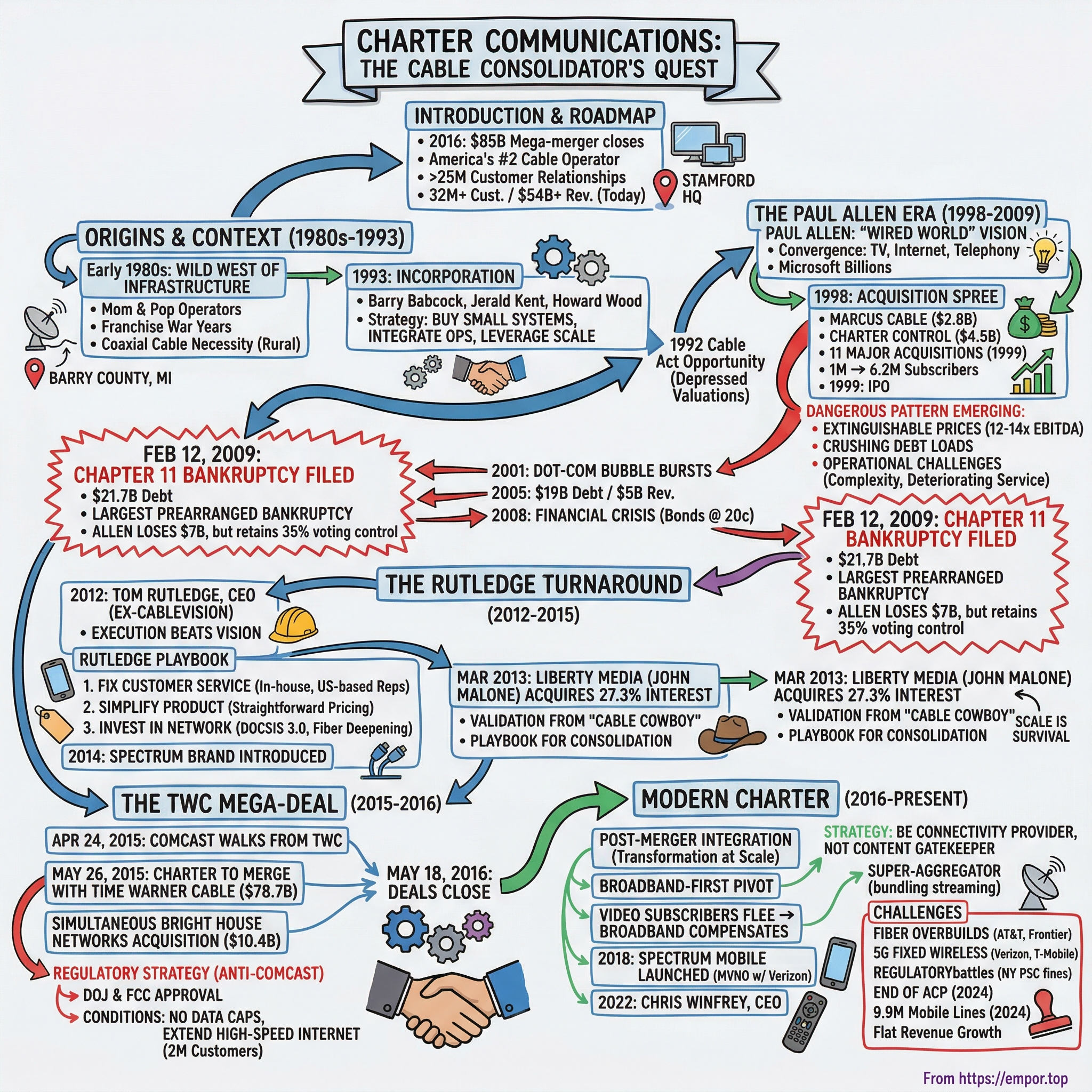
Charter Communications began at the smallest possible end of that world. The original Charter Communications CATV Systems was founded in 1980 in rural Michigan. The company that matters to this story, though, was assembled in January 1993, when three former executives of Cencom Cable Associates in St. Louis — Barry Babcock, Jerald Kent, and Howard Wood — consolidated a set of systems under the Charter Communications name.6 They were not inventors. They were operators who had already run the consolidation playbook once at Cencom and wanted to run it again with their own equity.
Their timing was pointed. The Cable Television Consumer Protection and Competition Act of 1992 had just reimposed rate regulation on an industry that had spent the late 1980s raising prices aggressively. Regulation compressed the returns on simply owning a system and raised the returns on owning many systems: scale bought programming discounts, spread overhead, and made the regulatory compliance burden per subscriber smaller. The Act, intended to protect consumers, functionally rewarded consolidators.
Charter's first move set the template. In February 1994, barely a year old, the company committed nearly $200 million to acquire ten cable systems in Louisiana, Georgia, and Alabama, serving roughly 100,000 subscribers.6 That works out to something on the order of $1,500 to $2,000 per subscriber — a price that only makes sense if you believe you can push more product through each of those homes than the seller could, and if you can borrow most of the purchase price.6
Both assumptions held for a while. Charter bought fragmented rural and small-city systems, clustered them so that a single headend and a single truck roll served more homes, layered on new services, and financed the whole thing with debt secured against the acquired cash flows. It is worth pausing on how completely this defines the company. Charter did not invent a technology, pioneer a programming format, or build a consumer brand from scratch. It bought density and financed it. Every chapter that follows — Paul Allen's spending spree, the Time Warner Cable acquisition, the Cox combination — is a variation on the same two-instrument composition.
The question an investor should carry forward is not whether Charter is good at this. It demonstrably is, in the mechanical sense: the company has closed and integrated more cable systems than almost anyone. The question is what happens to a pure consolidation strategy when the industry being consolidated stops growing — and whether the debt that makes the strategy work in expansion becomes the thing that breaks it in contraction. Charter has already answered that question once, expensively, and the man who paid for the lesson was one of the richest people in the world.
III. Paul Allen's Bet and the Road to Bankruptcy (1998–2011)
Paul Allen had a thesis, and it was not a small one.
Having co-founded Microsoft and left in 1983, Allen spent the 1990s assembling what he called the "wired world" — a portfolio premised on the belief that broadband pipes into the home would become the central nervous system of digital life, and that whoever owned those pipes would own the tollbooth on everything that flowed through them. He was, it turns out, directionally correct about the internet and catastrophically wrong about the price at which that correctness could be bought.
In April 1998, Allen agreed to acquire Marcus Cable for roughly $2.8 billion. In July of that year he bought a controlling interest in Charter Communications for $4.5 billion — about $3,800 per subscriber, roughly double what Charter itself had paid four years earlier — and merged the two, creating the seventh-largest cable operator in the country with about 2.4 million customers.6 Note the escalation embedded in that number. Charter's founders had paid $1,500–$2,000 per subscriber in 1994. Allen paid nearly double that in 1998, and then kept going.
What followed was one of the most concentrated buying sprees in American corporate history. Charter went public in November 1999, selling 170 million shares at $19 each and raising $3.2 billion — roughly 60% of the company's equity, with Allen retaining control through high-vote Class B stock and injecting a further $750 million of his own money.6 By the end of that year, eleven major acquisitions had lifted the subscriber base to approximately 6.2 million, making Charter the fourth-largest cable operator behind AT&T, Time Warner, and Comcast.6
Here is the mechanism that mattered, and it is the single most important thing to understand about the Allen era. Charter was not buying with cash. It was buying with a combination of new equity and debt — and critically, much of the debt came bundled with the assets. Every system Charter acquired arrived with its own borrowings, which consolidated onto Charter's balance sheet. The company was simultaneously paying top-of-cycle prices and inheriting top-of-cycle leverage. In a rising market, that is a return amplifier. When cable valuations reset after the dot-com collapse — and when satellite competition from DirecTV and EchoStar began taking video share that Charter's models had assumed was captive — it became a vise.
Charter spent most of the 2000s in slow-motion financial distress: refinancing, exchanging notes, selling systems, and posting losses. The end came on March 27, 2009, when Charter and a long list of subsidiaries filed voluntary Chapter 11 petitions in the Southern District of New York.7 The debt load stood at $21.7 billion, and the filing was prearranged — Charter had negotiated restructuring agreements with major noteholders and with Allen personally before walking into court, which is why the process moved unusually fast for its size.7 The bankruptcy court confirmed the plan on November 17, 2009, and it became effective on November 30.7
The outcome is worth reading carefully, because it reveals who actually held power. Existing common equity was cancelled with no recovery.7 Noteholders and rights-offering participants took the new equity. Allen received 2.2 million shares of Class B stock carrying 35% of the voting power, warrants for roughly 4.7 million additional Class A shares, and four board seats — control retained, economics devastated.7 The equity that emerged was held substantially by credit-focused investors: Apollo, Oaktree, Crestview and their peers, firms that had bought the debt cheap and converted it into ownership.
That detail — that Charter's post-bankruptcy register was full of distressed-debt funds with finite holding periods rather than strategic owners — is what made the next chapter possible. Those funds wanted an exit. Within four years, they would find one in John Malone.
There is a temptation to file the Allen era as closed history: a different management team, a different credit cycle, a lesson learned. That framing is too comfortable. The instrument that broke Charter in 2009 — large acquisitions financed with debt secured against subscriber cash flows assumed to be stable — is precisely the instrument Charter is using in 2026, at a pro forma net debt figure roughly five times the 2009 number.1 What differs is the quality of the collateral: broadband is a far better business than analog video ever was, the debt has a weighted average life of 11.7 years and a weighted average cost of 5.2%,1 and the acquisitions have been made at lower multiples rather than higher ones. Those are real, material differences, and they are addressed directly in the sections on the Cox transaction and on capital allocation.
But the structural vulnerability is identical in kind. Leverage is a bet on the stability of the cash flow underneath it. In 2009 that bet lost because video subscribers turned out to be less captive than the models assumed. The open question in 2026 is whether broadband subscribers are proving less captive than a newer generation of models assumes. Charter's own quarterly disclosures are, at present, the strongest evidence on that question, and they are not reassuring.
IV. The Rutledge Turnaround and Malone Enters (2012–2016)
When Charter's board announced on December 19, 2011 that Thomas Rutledge would become President and Chief Executive Officer effective February 13, 2012, the hire read as an indictment of everything the company had been.8
Rutledge was not a dealmaker. He was a plant guy. He had started in 1977 at American Television and Communications, a Time Warner Cable predecessor, rose to president of Time Warner Cable, and then spent nearly eight years as Chief Operating Officer of Cablevision Systems, from April 2004 to December 2011.8 At Cablevision he had built a reputation as the industry's best pure operator — the executive who understood that a cable system's value came from how many products each household bought and how rarely they called to complain, not from how many households the company had acquired.
His diagnosis of Charter was that it had spent fifteen years as a financial construct and almost no time as a product company. Charter's plant was under-invested. Its pricing was a thicket of promotional tiers designed to obscure the real price, which trained customers to call and negotiate — expensive, adversarial, and corrosive to retention. Its analog video channels consumed bandwidth that could have carried broadband.
The remedy was operationally unglamorous and strategically radical: convert the entire footprint to all-digital, freeing spectrum on the cable for internet speeds; replace the promotional maze with simplified, uniform pricing; insource customer service and field operations that had been outsourced and offshored; and raise minimum broadband speeds rather than charge more for them. The company also relocated its headquarters to Stamford, Connecticut, putting management in the same time zone as the capital markets and the same commuting radius as the industry's talent pool.
The strategic logic was that a better product at a clearer price would raise the number of products per household, and that more products per household would lower churn — a compounding loop rather than a promotional treadmill. It largely worked through the mid-2010s, and it rehabilitated Charter's credit profile enough to make the company an acquirer again rather than a target.
Which is exactly what John Malone noticed.
On March 19, 2013, Liberty Media agreed to acquire approximately 27.3% of Charter for $2.617 billion — roughly 26.9 million shares and 1.1 million warrants at $95.50 per share — purchased directly from the distressed-debt funds that had taken ownership out of bankruptcy.9 Liberty secured the right to designate up to four directors, including Malone himself and Liberty CEO Greg Maffei, and agreed to a standstill capping ownership below 35% until January 2016 and below 39.99% thereafter.9
Malone's arrival changed Charter's character in a way no operational program could. Malone had spent a career at TCI establishing the template that American cable would follow for forty years: maximize the cash flow available to service debt, minimize reported earnings and therefore taxes, borrow against the cash flow, and use the proceeds to buy more cable systems or retire more stock. He did not think of leverage as risk. He thought of it as the cheapest form of equity available to a business with contractual, recurring revenue. Charter, freshly deleveraged by a bankruptcy court and freshly professionalized by Rutledge, was the ideal vehicle to run that playbook again.
The first attempt failed. Charter pursued Time Warner Cable through 2013 and 2014 and was rebuffed; TWC agreed instead to a $45 billion merger with Comcast. Then regulators intervened. The Comcast-TWC combination collapsed in April 2015 under Department of Justice and Federal Communications Commission opposition, and the asset Charter had been chasing was suddenly available again — to a smaller buyer whose acquisition would not create a dominant national operator.
The deal Charter struck in May 2015 was enormous and, viewed with a decade of hindsight, expensive. Charter offered $195.71 per Time Warner Cable share in cash and stock, valuing TWC's equity at $56.7 billion and its enterprise value at $78.7 billion including $22.7 billion of net debt.10 The presentation Charter gave investors put the price at 9.1 times TWC's estimated 2015 adjusted EBITDA, falling to 8.3 times after roughly $800 million of expected annual run-rate cost synergies and the present value of tax benefits.10 Alongside it, Charter agreed to acquire Bright House Networks for $10.4 billion — $2.0 billion cash, $2.5 billion of convertible preferred units, and $5.9 billion of common partnership units — at 7.6 times 2014 EBITDA, below 6.5 times with synergies and tax benefits.10
Remember those multiples. They are the benchmark against which Charter's 2025 acquisition of Cox must be judged, and the comparison turns out to be the strongest single piece of evidence on whether this management team's capital discipline actually improved.
The Federal Communications Commission approved the combined transactions on May 6, 2016, and the deal closed on May 18, creating the second-largest pay-television operator in the country behind Comcast and folding both acquired companies into the Spectrum brand Charter had launched in 2014.1112 Approval came with conditions, and they mattered. The FCC required Charter not to impose broadband usage caps or usage-based billing on its customers, not to charge interconnection fees to online video providers such as Netflix and Hulu, and to offer a low-cost standalone broadband product.12 Separately, state regulators attached their own build-out obligations.
Those conditions look, from a distance, like standard regulatory theater. They were not. Within two years, one of them would produce the single clearest documented failure of merger integration in Charter's modern history — a failure that is directly relevant to how much benefit of the doubt the Cox integration deserves today.
V. Scaling the Machine: Buybacks Begin, Mobile Is Born (2016–2022)
With Time Warner Cable absorbed, Charter had what Malone's playbook required: a very large, very predictable pool of subscriber cash flow, and a balance sheet with room to borrow against it.
In September 2016, four months after closing, the company began buying back its own stock. It has essentially never stopped. Through the second quarter of 2026, Charter had repurchased approximately 188.0 million shares and partnership units for about $80.6 billion.5 To put that in perspective, the cumulative repurchase spend exceeds the entire enterprise value at which Charter acquired Cox Communications, and it dwarfs the company's market capitalization today.4
The mechanics deserve a plain-English explanation, because the strategy is widely admired and widely misunderstood. Charter did not fund those buybacks purely from free cash flow. It ran the balance sheet to a target leverage ratio — for most of this period, four to four and a half times net debt to EBITDA.31 As EBITDA grew, the same leverage multiple supported more absolute debt. Charter borrowed that incremental capacity and used it to retire stock. In effect, every dollar of EBITDA growth was converted into roughly four dollars of new borrowing capacity, and that borrowing bought shares.
When EBITDA compounds, this is close to a perpetual motion machine for per-share value: fewer shares, growing cash flow, and interest expense that grows more slowly than the cash flow servicing it. Charter's management and its largest shareholder both understood this arithmetic intimately. It is also, and this is the part that gets lost in admiration, entirely dependent on the first variable. Reverse EBITDA growth and the machine runs backward — the same leverage ratio now supports less debt, forcing deleveraging precisely when the stock is cheapest.
Underneath the financial engineering, the operating business through this period looked genuinely strong, and the product-line detail in Charter's filings shows exactly where the strength came from. Residential internet revenue grew from $9.3 billion in 2016 to $23.0 billion in 2023.13 Commercial revenue nearly doubled, from $3.9 billion to $7.1 billion over the same span.13 Those two lines carried the company.
Residential video told a different story, and the shape of it is instructive. Video revenue rose from $12.0 billion in 2016 to a peak of roughly $17.6 billion around 2019–2021, then began an unmistakable decline — to $16.4 billion in 2023, $15.1 billion in 2024, and $13.7 billion in 2025.13 Cord-cutting was not a sudden event; it was a slow puncture that took a decade to become visible in the revenue line and is now unmistakable.
The single most consequential new business of this era started from zero. On June 30, 2018, Charter soft-launched Spectrum Mobile, going to full market that September.14 The service ran as a mobile virtual network operator — an MVNO — on Verizon's wireless network, with initial pricing of $45 per month for unlimited data or $14 per gigabyte.14 Charter also formed a 50/50 mobile operating platform joint venture with Comcast in April 2018 to share back-end systems and bring scale to the unglamorous plumbing of running a wireless business.14
The strategic idea was elegant. Charter already carried the overwhelming majority of its customers' mobile data traffic over WiFi in their homes. If most of a phone's data usage happens on a network Charter already owns, then Charter only needs to buy wholesale cellular capacity for the minority of traffic that occurs away from WiFi. That is why the business could scale without Charter buying spectrum or building towers — a genuinely capital-light entry into a capital-intensive industry.
It is also, structurally, a rented business. Charter does not own the cellular network underneath Spectrum Mobile; it buys capacity from Verizon under a wholesale agreement.14 However well the product sells, a meaningful share of the economics accrues to the network owner, and the terms of that arrangement are negotiated rather than owned. That constraint does not make the business bad. It does bound how much margin Charter can ultimately capture, and it is the reason this business should be sized carefully rather than celebrated loosely — a point taken up in detail in the next section.
Meanwhile, the merger conditions attached to the Time Warner Cable deal came due, and Charter did not meet them. Charter had committed to New York regulators, as a condition of the state's January 2016 merger approval, to extend broadband service to at least 145,000 additional addresses in underserved areas.15 It repeatedly missed interim targets. Worse, in the regulator's account, the company attempted to count ineligible properties — including newly built condominiums in New York City — toward what was supposed to be a rural build-out obligation.15
On July 27, 2018, the New York State Public Service Commission rescinded its approval of the merger in the state and ordered Charter to produce a transition plan.15 Commission Chair John Rhodes stated that "Charter's repeated failures to serve New Yorkers and honor its commitments are well documented and are only getting worse," and the commission cited what it called the company's "brazenly disrespectful behavior toward New York State and its customers."15
The matter was ultimately settled in July 2019. Charter agreed to complete the 145,000-address build entirely in Upstate New York by September 30, 2021, with frequent interim milestones, an estimated investment exceeding $600 million, $12 million toward additional broadband expansion projects selected by regulators, and an escrow payment of $2,800 for every address where it missed a construction deadline.16 At the time of settlement, roughly 65,000 of the 145,000 addresses had been passed.16
Reasonable people can read that episode two ways. The generous reading: a dispute over the definition of eligible addresses, remediated through a negotiated settlement with enforceable milestones, and completed. The unforgiving reading: a company that made a specific, quantified regulatory promise to win approval for a transformative acquisition, failed to keep it, tried to satisfy it with addresses that did not qualify, and only performed when a state regulator threatened to unwind the deal. Both readings are supported by the record. What is not supportable is treating Charter's merger-integration promises as self-executing.
One further caution about this era. Broadband demand in 2020 was inflated by a pandemic that moved work, school, and entertainment into the home simultaneously. Residential internet revenue jumped from $16.7 billion in 2019 to $18.5 billion in 2020 and $21.1 billion in 2021.13 Some portion of that was durable adoption. Some was a pull-forward of household connections that would otherwise have happened over several subsequent years — connections that, once pulled forward, are unavailable to fill later quarters. Any model that extrapolates the 2020–2021 subscriber trend as a normal run-rate is extrapolating a one-time event.
By 2022, the machine was running at full speed and the founder-era leadership was ready to hand it over.
VI. Leadership Transition: The Winfrey Era Begins (2022–2024)
Succession at Charter was unusually undramatic, which in an industry full of personalities was itself notable.
On September 21, 2022, Tom Rutledge announced he would step down as Chief Executive.17 His successor was Christopher Winfrey, who had been Charter's Chief Financial Officer for more than a decade before becoming Chief Operating Officer — an internal promotion that signaled continuity rather than redirection. Winfrey became President and Chief Executive Officer effective December 1, 2022, with Rutledge remaining as Executive Chairman until his retirement in November 2023.1718
The choice of a finance executive to run an operating turnaround is worth dwelling on. Winfrey had spent his Charter career on the side of the business that constructed the leverage-and-buyback machine, not the side that fixed the product. He inherited a company whose financial architecture he had largely built and whose operating challenge — competition arriving simultaneously from fiber and from wireless — was the kind of problem that no capital structure can solve.
The compensation record from this transition is a legitimate governance data point, and it should be read in full rather than in fragments. Rutledge's departure package was substantial: approximately $39 million for 2022 and approximately $19 million for 2023, the latter largely option awards.18 Winfrey's 2023 compensation totaled roughly $89 million — $1.7 million in base salary, $3.5 million in cash bonus, $8.7 million in stock awards, and $75 million in option awards, the last a large front-loaded grant with time and stock-price vesting conditions.18
Institutional Shareholder Services, the largest proxy advisory firm, was explicit in its assessment ahead of the shareholder meeting, describing a front-loaded equity grant "the aggregate magnitude of which is considered excessive."18 That is not an inference drawn by a commentator; it is a sourced criticism from the firm most institutional investors rely on for pay analysis.
Context matters in both directions. Because the 2023 grant was front-loaded — intended to cover several years of equity compensation in a single award — the headline number is not a recurring run-rate. Winfrey's total compensation fell to approximately $5.75 million in 2024 and approximately $6.5 million in 2025 once the one-time award rolled off, with the 2025 figure comprising roughly $1.8 million of salary, $4.3 million of bonus, and $0.4 million of other compensation.19 Reporting only the $89 million figure would misrepresent the ongoing cost. Reporting only the later figures would erase a governance criticism that was made, on the record, by a major proxy advisor about a new chief executive's first full-year pay decision.
There is a related structural detail that reduces how often shareholders get to weigh in. Charter's 2025 proxy statement asked shareholders to vote on four items — director elections, an employee stock purchase plan, auditor ratification, and a shareholder proposal on political expenditures — and did not include an advisory vote on executive compensation.21 The 2026 proxy did include one, alongside thirteen director nominees, an increase in shares under the 2019 stock incentive plan, auditor ratification, and again a political-spending proposal.19 A say-on-pay vote that appears in one year and not the next is consistent with a multi-year rather than annual cadence. That structure is entirely legal and not rare, but it does mean shareholders register direct feedback on pay less frequently than at annual-vote peers — a fact worth knowing when weighing how much of a check the ISS criticism actually represented.
The forward-looking pay arrangement is the more interesting number, because it commits the company for years. In December 2025 Charter's compensation committee approved an amended and restated employment agreement with Winfrey, effective December 1, 2025 and running through December 1, 2028. It set a base salary of at least $2.5 million, a target annual bonus of 300% of base salary, and — beginning in 2027 — annual stock option grants with a grant-date fair value of at least $23 million, vesting in full on the third anniversary of each grant.20 The committee also approved a one-time $6 million top-up option award in January 2026 to bridge the gap between his prior equity target and the new one, and a contingent grant tied to the Cox closing equal to 1.5 times his long-term incentive target, split evenly between options and restricted stock units.20
This locks in a very large ongoing pay opportunity at exactly the moment the operating business turned negative on revenue growth. That is the criticism, and it is fair. The structural counterpoint is equally real and equally worth stating: the dominant component is stock options, which are worthless unless the share price exceeds the strike, and they were struck during a period when the stock had already fallen substantially. An option-heavy package granted near a multi-year low is a genuinely leveraged bet on recovery — management does not get paid for treading water. Whether that alignment is adequate compensation for shareholders who have already absorbed a 45% drawdown is a judgment call, not a fact.
What is not a judgment call is that the operating results arriving during Winfrey's tenure have consistently underperformed the strategy's stated logic. Which brings the story to the heart of the matter.
VII. Industry Under Siege: Why the Broadband Moat Is Being Tested
Ask any cable investor to describe the industry's advantage in 2015 and you would have heard some version of the same sentence: cable owns the only pipe fast enough to matter, and the telephone companies' copper cannot compete.
That sentence was true, and it was the entire investment case. Understanding why it stopped being sufficient requires a short detour into what these networks physically are.
The technology, in plain terms. Charter's network is hybrid fiber-coaxial, or HFC. Fiber optic cable — glass strands carrying light — runs from Charter's facilities out to neighborhood nodes. From the node, the last few hundred yards to each home travel over coaxial copper, the same cable that carried television channels in 1980. Think of it as a fiber highway that ends in a coaxial driveway shared among nearby houses. It is fast, it is already built, and upgrading it means changing equipment at the ends rather than digging up streets. Charter's chief executive described the footprint on the second-quarter call as a "fully deployed and fully converged gigabit-plus network across our entire footprint."1
A fiber-to-the-home network, by contrast, runs glass all the way to the wall. It is faster in the upstream direction, has more headroom, and costs a great deal more to build because it requires physically running new cable past every house. Fixed wireless — T-Mobile Home Internet, Verizon 5G Home — is different again: it uses spare capacity on cellular networks to deliver home broadband over the air, requires no new construction at all, is generally slower and more variable, and is typically priced well below cable.
Porter's Five Forces, applied honestly. For two decades cable's structural position was excellent. Rivalry was muted because each franchise area had one cable operator competing against telephone-company DSL that was slower by an order of magnitude. The threat of new entrants was near zero because building parallel plant destroyed the economics of both operators. Substitutes were weak. Buyer power was low because switching meant accepting materially worse service. Supplier power was the one genuine weakness — programmers extracted rising fees for content cable had to carry.
Every one of those forces has moved against cable, and the movement is not cyclical. Rivalry has intensified as fiber overbuilders — Verizon, AT&T, Frontier, Brightspeed and a long tail of private-equity-funded regional builders — extend plant into cable footprints. The threat of substitutes has become severe: fixed wireless attacks price-sensitive households at a cost structure cable cannot match, because the wireless carrier is monetizing capacity it already built for phones. Buyer power has risen mechanically, because a household with three or four viable options behaves differently from a household with one.
7 Powers, applied honestly. Under Hamilton Helmer's framework, it is tempting to describe Charter's advantage as a network effect. It is not — one Spectrum subscriber gains nothing from another. The accurate labels are narrower. Charter has genuine scale economies within its clustered footprint: more homes per node and more customers per truck roll lower the cost of serving each one, and national scale extracts better programming and equipment pricing. It has something resembling a cornered resource in plant already in the ground and franchises already granted, an asset a competitor must spend billions and several years to replicate. Winfrey made exactly this claim on the second-quarter call: "Our network is a unique and strategic asset, which can't be replicated."1
What Charter does not have is high switching costs. Changing internet providers costs a household an afternoon and a returned modem. Bundling helps — Charter's own data show internet customers who also buy mobile churn nearly 40% less, and internet customers who take video churn over 40% less1 — but that is a retention program, not a lock-in. Enterprise software this is not.
The disconfirming evidence, stated directly. Here is the problem with the "irreplaceable network" claim: the network is not preventing share loss. It is, at best, slowing it.
Charter lost 109,000 internet customers in the third quarter of 2025, against 110,000 in the same quarter a year earlier.22 It lost 119,000 in the fourth quarter, ending 2025 with 29.7 million internet customers, down 1.3% year over year.23 Then the trend broke worse. First-quarter 2026 losses reached 120,000 against 59,000 a year earlier — more than double.24 Second-quarter losses of 172,000 compared with 116,000.25 Total internet customers stood at 29.4 million at mid-year, down 1.7%.25
Revenue followed. Third-quarter 2025 revenue fell 0.9% to $13.7 billion; fourth-quarter revenue fell 2.3%; first-quarter 2026 revenue fell 1.0%; second-quarter revenue fell 1.7% to $13.5 billion.22232425 Four consecutive quarters of year-over-year revenue decline. Adjusted EBITDA declined 1.5% in the third quarter of 2025, 2.2% in the first quarter of 2026, and 4.3% in the second quarter — 3.2% excluding Cox transition expenses.22241 Management guided to full-year 2026 standalone EBITDA declining around 1%, having previously expected better.1
That last point deserves emphasis, because it is a guidance revision, not just a weak result. Asked directly by New Street Research's Vikash Harlalka what had changed in six months, CFO Jessica Fischer answered with unusual specificity: expectations around broadband subscribers and ARPU had deteriorated "based on some of those things that we had done around offers that we thought might work, but that didn't work out as well," plus pressure in controllable expenses including fuel and medical costs.1
Management's explanation, weighed. Charter's account of the subscriber losses has three parts: fewer households moving (movers are the single biggest source of new-customer opportunity in this industry), growth in mobile-only households that never buy fixed broadband at all, and direct competition from fiber and fixed wireless. Fischer enumerated them on the second-quarter call: "We continue to see expanded fixed-wireless competition versus a year ago, including lower sales from low-income consumers, ongoing mobile substitution, and fiber overlap growth at a rate similar to prior quarters with aggressive promotions by certain competitors."1
Two of those three are genuinely industry-wide demand phenomena rather than Charter-specific failures — a sluggish housing market suppresses gross additions for every wireline operator equally, and mobile substitution is a secular consumer behavior shift. But the third is competitive share loss, and no amount of macro framing converts it into something else. Fischer's own counterpoint was that Charter "continue[s] to lead the market in converged connectivity pricing at connect and ha[s] higher market share than our fiber competitors even in our mature fiber overlap."1 That is a meaningful defense if true, though it is a company assertion rather than independently verified data, and holding higher share in an overlap market is compatible with steadily losing share in it.
The honest conclusion is calibrated rather than binary. The claim "Charter's network is a structural moat" is not rejected by this evidence — the company still serves nearly 30 million internet customers, retains them at stable churn, and holds a cost position no new entrant can match quickly. But the claim must be narrowed. What the evidence supports is a cost and coverage advantage that slows share loss and preserves pricing in a contested market, not a moat that produces growth. The specific event that would confirm a broader version of the claim is straightforward and management has named it themselves: a return to positive quarterly broadband net additions. The specific evidence that would falsify it is continued acceleration in losses through 2027 even after Cox integration and after the fiber build-out wave passes its peak.
Winfrey's own framing on the second-quarter call was notably hedged in a way worth quoting: the company expects to "stabilize and return to broadband growth over time," but "the timing of all that is hard to predict."1 Management is not claiming a near-term inflection. Investors should not assume one.
Video: a managed decline, not a turnaround. Video subscriber losses actually improved sharply — down just 21,000 in the second quarter of 2026 against 80,000 a year earlier, driven by fewer downgrades, lower churn, and higher upgrades following the inclusion of programmers' streaming apps in Spectrum video packages.1 Fifty-five percent of eligible video customers had activated at least one included app, averaging more than four apps each.1
It would be a mistake to read this as a video recovery. Video revenue is declining faster than video subscribers, because the packages customers are choosing are lighter and because a growing share of what customers pay is allocated away to the streaming apps included in the bundle — $251 million of costs allocated to programmer streaming apps and netted within video revenue in the second quarter alone, against $67 million a year earlier.1 Winfrey has been consistent and candid about the purpose: video exists to support broadband acquisition and retention.23 That is a defensible strategy for a declining asset. It is not a growth business, and it should not be modeled as one.
Spectrum Mobile: sized correctly. The genuine bright spot is wireless, and it has crossed the threshold from novelty to materiality. Charter added 406,000 mobile lines in the second quarter of 2026, reaching more than 12.5 million lines, up 16% over twelve months during which it added 1.7 million lines.1 Residential mobile service revenue grew from $2.2 billion in 2023 to $3.1 billion in 2024 to $3.8 billion in 202513 — a business built from a standing start in 2018 into something approaching the scale of a mid-sized wireless carrier.
The strategic value runs beyond the revenue line. Mobile penetration of Charter's internet base is only about 20%, at just under two lines per mobile customer, which means the churn-reduction benefit is available to four-fifths of the base that has not yet taken it.1 Across the post-Cox footprint there are roughly 164 million mobile lines, of which Spectrum will serve about 13 million — 8% penetration.1 The runway is real.
The constraint is equally real and structural. This growth rides on wholesale agreements — principally Verizon on the residential side, with T-Mobile recently added for business.1 Charter offloads 87% to 88% of mobile traffic onto its own WiFi and CBRS spectrum, and Winfrey argued on the call that this makes Charter "the largest facilities-based wireless provider in the country" in a somewhat expansive sense.1 But the 12% to 13% of traffic that rides the cellular network is purchased, not owned, and Charter has explicitly declined to change that: "there's no driving need for us to build a network of any type, given the partnerships that we have and the economic setup that we have today."1 That is a rational capital-allocation choice. It also means a meaningful share of the long-run economics of a fast-growing business belongs, contractually, to someone else.
Rural expansion and advertising. Charter's offensive counter-move is building where competition is thinnest. Subsidized rural passings grew by 127,000 in the second quarter of 2026 and 487,000 over the trailing twelve months, generating 47,000 net customer additions in the rural footprint in the quarter — one of the few genuinely positive subscriber lines in the company.1 The economics are attractive because government subsidy covers part of the build and because a rural household typically has no fiber alternative. The scale is small relative to a base approaching 30 million broadband customers, and payoffs arrive over years.
Advertising, meanwhile, is in the same structural decline as the linear television it depends on: $1.88 billion in 2022, $1.55 billion in 2023, $1.78 billion in 2024 (a political-election year), and $1.47 billion in 2025.13 The second quarter of 2026 showed 12.3% growth on political spending, but excluding political, advertising revenue fell 4.6%.1 Political cycles create the illusion of stability in a line that is otherwise shrinking.
The strategic response to all of this — competition on multiple fronts, a core business losing customers, a growth business that is rented — was not to retrench. It was to get much, much bigger.
VIII. Two Deals That Redefine Charter: Cox Communications and the Liberty Broadband Endgame
Cox Communications was the great unlisted prize of American cable. Family-controlled since the 1960s through Cox Enterprises, it had never gone public, never been broken up, and was widely regarded as one of the best-run networks in the industry — well-invested plant, strong service reputation, and attractive metropolitan footprints including Phoenix, Las Vegas, San Diego and parts of Los Angeles.
In May 2025, Charter announced it would combine with it.27 The structure mattered as much as the price. Cox Enterprises contributed Cox Communications' residential cable business into Charter Holdings, the operating partnership, while retaining Cox's commercial fiber and managed IT and cloud businesses.27 Consideration to Cox Enterprises totaled $21.9 billion of equity value: $11.9 billion in Charter partnership common units (33.6 million units exchangeable into Charter stock), $6.0 billion in convertible preferred units carrying a 6.875% annual dividend and a 35% conversion premium, and $4.0 billion in cash — on top of $12.6 billion of assumed net debt, for the headline $34.5 billion enterprise value.26
The multiple, and why it is the most important number in this article. Charter's own investor presentation valued Cox at 6.44 times 2025 estimated adjusted EBITDA — a multiple equal to Charter's own trading multiple at the time — falling below 6.0 times when adjusted for run-rate synergies and the present value of tax benefits.26
Set that against the record. In 1998, Paul Allen paid roughly $3,800 per subscriber for Charter, roughly double what its founders had paid four years earlier.6 In 2015, Charter paid 9.1 times forward EBITDA for Time Warner Cable, 8.3 times adjusted, and 7.6 times for Bright House.10 In 2025 it paid 6.44 times, below 6.0 times adjusted.26 On pure multiple discipline, this is the cheapest large acquisition in the company's history, and the direction of travel across three management regimes is unambiguous.
Two honest caveats keep this from being an unqualified endorsement. First, paying a multiple equal to your own trading multiple is accretive by construction and is not, by itself, evidence of a bargain — it is evidence that the buyer's own currency was cheap. Cable multiples had compressed industry-wide by 2025 precisely because the subscriber trends discussed above were visible to everyone; Charter bought cheaply in a market that had marked the whole asset class down. Second, the transaction was paid substantially in Charter equity and units at a moment when that equity was near multi-year lows, which is the least favorable condition under which to issue stock. Charter issued the equivalent of just over 46 million Charter shares to Cox Enterprises in common and preferred partnership units, partly offset by a net reduction of about 4.7 million shares from the Liberty Broadband transaction, bringing total shares on an as-converted, as-exchanged basis to about 177 million.1
By the time of the second-quarter call, the arithmetic had moved further in Charter's favor for an uncomfortable reason. Because the equity component was fixed in units rather than dollars and Charter's share price had fallen, Fischer noted that at the then-current share price the implied transaction enterprise value for Cox was $27 billion — roughly 5 times transaction EBITDA, or 4.4 times including $800 million of synergies.1 A buyer whose stock falls between signing and closing pays less in economic terms for a stock-funded deal. That is a real benefit to Charter shareholders and a real cost to Cox Enterprises, which agreed to take equity in a declining currency.
Synergies: a moving number. At announcement, Charter guided to approximately $500 million of annualized transaction cost synergies achieved within three years.26 By the first quarter of 2026 that had been raised to $800 million,24 and on the second-quarter call Winfrey said the company still expected "run rate transaction expense synergies of at least $800 million per year" and added his personal view that "it will grow to $1 billion," while noting the estimate would be formally updated after close and that these figures exclude any operating or capital expenditure synergies.1
Rising synergy guidance before a deal closes is a mixed signal. It can reflect genuine diligence-driven discovery. It can also reflect the pressure to justify a transaction to a skeptical market. The distinguishing evidence will be disclosure discipline after close, and here Charter has committed to something specific and useful: it will report customer and revenue data for legacy Charter and legacy Cox separately for several quarters, will continue to report transition expense and capital, and will provide estimates of synergies realized so investors can isolate organic performance.1 It has also said plainly what it will not do — it will not report expenses or capital expenditures by legacy entity, because programming, overhead, and centralized capital are genuinely shared.1 That is a reasonable limitation, honestly stated, and the promised organic disclosure is the right thing for investors to hold management to.
The integration stress test. Charter's case for smooth execution rests on experience. Winfrey pointed to a repeatable playbook: "The bundling and migration approach we'll deploy at Cox is the same we successfully used with Bresnan in 2013, TWC and Bright House in 2016 and with ourselves really over the past 2 years," and claimed confidence in executing "at a faster pace than previous integrations."1 Concretely, Charter has been recruiting well over 1,000 new residential and business sales positions in Cox territories, and will onshore and in-source all call center activity currently handled substantially by offshore contractors, moving to 24/7 coverage within a year.1
That plan is specific, which is more than most integration narratives offer. But the same company's last mega-integration produced a regulator-documented failure to meet a quantified merger commitment, a rescinded state approval, and a settlement with escrow penalties for missed construction deadlines — the New York episode described earlier.1516 Note carefully what that history does and does not prove. It does not show that Charter cannot merge billing systems or migrate customers onto Spectrum pricing; the commercial integration of Time Warner Cable was, by most operational measures, completed. It shows that Charter's regulatory and build-out commitments proved unreliable under the pressure of a large integration. That is the specific risk to watch here: not whether Cox customers get Spectrum pricing in mid-September 2026 as planned,3 but whether commitments made to the FCC in its February 2026 approval and to state regulators — most consequentially the California Public Utilities Commission, whose process delayed closing from spring into August — are met on schedule.1
There is also a second, quieter execution risk. Cox's own operating trends are slightly worse than Charter's. Asked directly by Wells Fargo's Steven Cahall, Winfrey said Cox's "trends on both subscribers and revenue has been a couple of clicks lower than here at Spectrum, and that continues to be the case."1 Charter is buying a business declining marginally faster than its own and expecting to reverse that with better pricing and a new brand. That may work — a new entrant with a better bundle in a market that has known one provider for decades genuinely has an opportunity. But it is an assertion about future execution, not a demonstrated result.
Transition costs are already running hot: $65 million in the second quarter alone, which Fischer acknowledged had "been coming in a bit higher than expected," attributed partly to closing delays and partly to a shift in the mix between operating expense and capital expenditure.1
The Liberty Broadband endgame, resolved faster than expected. The other half of the story closed on the same day, and it ends a thirteen-year chapter.
In November 2024, Charter and Liberty Broadband announced an all-stock merger in which each Liberty Broadband share would convert into 0.2900 Charter Class A shares.29 A condition of that merger was the separation of Liberty Broadband's Alaska-focused subsidiary, which was completed on July 14, 2025 when GCI Liberty was spun off as an independent public company.28 Originally the Charter merger carried a long outside date; in connection with the Cox transaction, Liberty Broadband agreed to accelerate closing to occur contemporaneously with the Cox combination — which is exactly what happened on August 20, 2026.283
The strategic logic for Malone was one he had spent a career on the other side of. Holding companies that own stakes in operating businesses persistently trade below the value of what they hold — the discount that has defined the Liberty complex for decades. Collapsing Liberty Broadband into Charter eliminated that discount and gave Liberty Broadband holders direct, liquid ownership of the underlying asset. The Cox transaction diluted what Liberty Broadband's holders would own of the combined company,30 but a smaller percentage of an undiscounted asset can be worth more than a larger percentage of a discounted one.
The resulting governance structure is genuinely new. Cox Enterprises now holds approximately 26% of the combined entity's fully diluted shares on an as-converted, as-exchanged basis, with ownership and voting capped at 30%.326 Alex Taylor, Chairman and Chief Executive of Cox Enterprises, became Chairman of Charter's thirteen-member board; Eric Zinterhofer became lead independent director; Cox appointed Dallas Clement and Mark Greatrex as directors; Advance/Newhouse retained two designees.3 The corporate parent will be renamed Cox Communications within one year of close, while every customer-facing market converges on the Spectrum brand.333
One family-controlled owner has replaced another as the anchor shareholder. Whether that changes the company's capital-allocation instincts is the subject of the next section.
IX. Management, Capital Allocation, and Credibility Under the Microscope
State the claim plainly, the way its proponents would: Charter's leverage-funded buyback program has been a disciplined, value-creating capital-allocation strategy.
The affirmative evidence is genuinely impressive in scale. Roughly 188 million shares and units retired for about $80.6 billion since 2016 is one of the largest sustained repurchase programs any American company has run relative to its own size.5 Executed against growing EBITDA, it compounded per-share cash flow at a rate few businesses matched.
The disconfirming evidence is equally concrete, and it comes from the same period. Charter bought back 7.6 million shares for $2.2 billion in the third quarter of 2025, at an average well above current prices.22 It bought 2.9 million shares in the fourth quarter at an average of $259.23 It bought 4 million shares in the second quarter of 2026 for $838 million, at an average of $210.1 The stock closed September 2, 2026 at $156.53, within a 52-week range of $111.55 to $285.82.4
The mechanical lesson is not that buybacks are bad. It is that buybacks change the denominator, not the numerator. A shrinking share count multiplied by a shrinking per-share cash flow trajectory can still produce a falling stock — and 2025 into 2026 is close to that exact scenario. Adjusted EBITDA fell in three of the last four reported quarters, revenue fell in all four, and management has guided full-year 2026 standalone EBITDA down about 1%.2223241 Against that backdrop, retiring shares at $259 was, with hindsight, value-destroying relative to retiring them at $157 — and the company's own capital allocation was procyclical rather than opportunistic.
This is the clearest available evidence that financial engineering has limits when the underlying subscriber business turns, and it should temper any characterization of the program as uniformly disciplined. The strategy was excellent in the expansion phase and expensive in the transition phase, and the same management team ran both.
What management did in response, which is the more interesting story. Charter did not defend the old framework. On the second-quarter call it changed it, and the sequence of changes is worth tracing because it reveals responsiveness.
The original leverage target was 4.0 to 4.5 times net debt to EBITDA. In connection with the Cox announcement in May 2025 that was lowered to 3.5 to 4.0 times, expected within two to three years of closing — a change Fitch cited when it placed Charter's BB+ long-term issuer default rating on Rating Watch Positive on May 19, 2025.31 Then in July 2026, Fischer went further: "we are lowering our post-transaction leverage target to a flat 3.5x, which we expect to achieve with consistent progress along the way within 3 years of the close."1 Winfrey was explicit about why: "Jessica and I listened to feedback, and we heard both equity and debt investor preference for lower leverage."1
Three separate downward revisions to the leverage target in roughly fifteen months is either admirable responsiveness or evidence that the original target was never anchored to anything durable. Both readings have merit. What distinguishes them is whether the new target is accompanied by mechanism, and here Charter provided unusual specificity. The company repurchased over $1.2 billion of its own bonds in the open market for $1 billion cash during the second quarter, capturing roughly $250 million of discount and reducing total leverage.1 It launched a capped exchange offer targeting $20 billion of par value of investment-grade-rated debt trading below par, offering participating bondholders new par bonds at 12- or 15-year maturities plus, in some cases, cash.1 And it paused share repurchases entirely through the third quarter of 2026, expecting to restart in the fourth quarter.1
That pause is the single most important capital-allocation datapoint in this story, because it is the first time in a decade Charter has chosen the balance sheet over the buyback. Fischer's stated expectation was that net debt to trailing EBITDA — 4.18 times at the end of the second quarter, 4.21 times pro forma — would fall to just above 3.9 times by the end of the third quarter including the Cox and Liberty Broadband transactions, the second-quarter debt repurchases, and a successful exchange offer.1
The free-cash-flow argument, and why it is the crux. Charter's case for why the current stock price is wrong rests almost entirely on capital expenditure. The company spent approximately $12.1 billion over the trailing twelve months and expects approximately $11.4 billion for standalone Charter in 2026, but says run-rate capital expenditure falls below $8 billion per year once the network evolution and rural expansion programs conclude.1 Fischer quantified the implication starkly: that reduction alone is "equivalent to over $30 of free cash flow per share based on our June 30 share count," and substituting expected 2028 capital expenditure into 2026 consensus free cash flow would imply, at the then-current share price, "a free cash flow multiple of a bit over 2x and a free cash flow yield of nearly 50%."1
That is an extraordinary claim, and it is the bull case in a single sentence. It is also a claim conditioned on three things simultaneously being true: that capital expenditure really does fall as promised, that EBITDA stabilizes rather than continues declining, and that broadband subscriber losses do not require competitive spending that erodes the savings. Charter has a strong record on the first — its capital programs have generally landed near guidance. It has no recent record on the second. And the third is unknowable today. An investor evaluating this argument is really evaluating whether a company can cut investment sharply in a market where competitors are investing heavily, and hold its position while doing so.
The activist stress test. What would a skeptical investor challenge? Several things, and they are all legitimate.
The buyback was procyclical: heaviest at high prices, paused at low ones. The leverage target moved three times in fifteen months, which invites the question of what it will be if EBITDA declines faster than planned. The company is simultaneously promising to deleverage, to resume buybacks, and to integrate a $34.5 billion acquisition — three claims on the same cash flow. Transition costs are running above plan.1 Advertising and video are in secular decline with no reversal case. And the departure of the Chief Financial Officer who authored the new leverage framework, announced weeks after she presented it, removes the executive most associated with it — Jessica Fischer steps down October 15, 2026 to relocate for another opportunity, with Chief Accounting Officer Kevin Howard, who led financial integration for the Bresnan, Time Warner Cable, Bright House and Cox transactions and served as interim CFO once before in 2010, taking the role on an interim basis while a search proceeds.32 Charter stated it has not modified its financial outlook or financial policy in connection with the transition.32 That is the right disclosure to make, and the right thing to verify against the next several quarters rather than accept on assertion.
Governance, weighed rather than listed. The three flags in Charter's record — ISS's "excessive" characterization of the 2023 equity grant, a say-on-pay cadence that is less than annual, and the New York merger-condition failure — are real, sourced, and worth knowing. They are also, examined together, narrow or dated rather than evidence of chronic governance failure. The pay criticism concerned a single front-loaded grant whose reported cost normalized within a year.1819 The New York matter was settled with enforceable milestones and financial penalties for non-performance.16 There is no auditor qualification, restatement, or going-concern issue in the record examined here; KPMG's ratification was a routine item in both the 2025 and 2026 proxies.2119
The verdict this evidence supports is that Charter's governance is unremarkable rather than exemplary or alarming, with a documented weakness in honoring quantified regulatory commitments under integration pressure. That weakness is specific enough to monitor and is directly relevant to the Cox conditions.
One structural change deserves flagging. Liberty Broadband, as a large external shareholder with board designees and a proprietor's interest in capital-allocation discipline, functioned as an outside check for over a decade. That entity no longer exists as a separate voice; its stake has been absorbed into the combined cap table and its designees replaced by Cox appointees.263 Cox Enterprises is now the anchor holder, with the chairmanship and three of thirteen board seats.3 Whether a family holding company that has just sold its cable business into Charter equity exercises the same scrutiny over leverage that a Malone vehicle did is an open question with no evidence yet either way.
The test that resolves this. The forward-looking question is simple to state and will be simple to observe. If leverage approaches the top of its trajectory while broadband net additions remain negative, does Charter slow buybacks, or does it buy back stock regardless? The company has already given one data point in the right direction by pausing repurchases through the third quarter of 2026.1 The meaningful test comes at the resumption: whether the pace resumes at pre-pause levels or is subordinated to reaching 3.5 times.
X. Playbook: Business & Investment Lessons
Step back from Charter specifically, because the patterns here generalize.
Consolidation is a strategy with a shelf life. Rolling up a fragmented industry works when the industry's underlying demand is stable or growing and the acquirer can extract density economics the seller could not. Cable satisfied both conditions for forty years. Neither is guaranteed forever. Once an industry begins losing units to substitutes, consolidation stops being value creation and becomes cost management — still worth doing, but a fundamentally different proposition with fundamentally different returns. Charter's Cox acquisition may well be sensible cost management. It is not the same trade as buying subscriber growth, and it should not be valued as though it were.
Debt is neither reckless nor wise in the abstract. It is a bet on the stability of the cash flow it is levered against. Charter has now made that bet twice: once against analog video subscribers who proved less captive than assumed, and once against broadband subscribers whose captivity is currently being tested in public. The first bet ended in the largest prearranged bankruptcy of its era. The second is being run at roughly five times the debt quantum, but against a far better asset with a far longer weighted-average maturity and a far lower cost of debt.17 The lesson is not "avoid leverage." It is that the correct question about leverage is never "how much?" but "levered against what, and how confident are you about that cash flow in the worst plausible case?"
Multiple discipline beats deal size as a predictor. The headline of an acquisition is the dollar figure. The determinant of shareholder outcome is the multiple relative to the buyer's own cost of capital and the durability of the acquired cash flow. Charter's record across three regimes is a clean natural experiment: escalating per-subscriber prices in the Allen era preceded bankruptcy; 9.1 times for Time Warner Cable produced scale but a decade of debate about whether it was worth it; 6.44 times for Cox is the most defensible price the company has ever paid for a large asset.61026 Direction of travel is the signal.
Buybacks are not a substitute for a healthy core business. This is the least-appreciated lesson of the past two years and Charter is the textbook case. Repurchases mechanically reduce share count. They do not create demand, defend market share, or reverse a competitive dynamic. When the cash flow being divided by that shrinking count is itself shrinking faster, the per-share result falls anyway. A company that repurchases heavily into a deteriorating operating trend is converting balance-sheet capacity into a bet that the deterioration is temporary. Sometimes that bet is right. It is still a bet.
Regulatory promises in franchise businesses have teeth. Cable is not a business you can simply exit from a jurisdiction that is unhappy with you. Franchises are granted locally, licenses are transferred with state approval, and merger conditions are enforceable. Charter learned in 2018 that a state regulator can rescind approval of a completed acquisition. Any investor evaluating a franchise-based, state-regulated acquirer should read merger conditions as operating commitments with real capital and timing consequences, not as boilerplate.
Finally: the most important number in a subscriber business is the direction of subscribers. Every other metric — ARPU, EBITDA margin, free cash flow per share — is downstream of whether more people are buying the product than leaving it. Charter's own management framed the point on the second-quarter call: "the biggest value driver opportunity for us going forward is returning to growth."1 That is the correct diagnosis from the people running the company, and it is the frame investors should adopt.
XI. Bear vs. Bull Case
The Bull Case
Post-Cox scale is real and hard to replicate. More than 70 million passings, roughly 37 million customer relationships, 45 states, and about 1.3 million route miles of network create purchasing leverage in programming and equipment that few can match, and Charter's own framing is that this leaves a selling opportunity into nearly 35 million passings without a customer relationship today.13 In Helmer's terms, this is a genuine scale economy layered on a cornered resource in plant already built.
Spectrum Mobile has crossed from novelty to materiality and still has structural runway, with penetration of only about 20% of internet customers and about 8% of mobile lines in footprint.1 Its churn-reduction effect on the core broadband business is measurable in company data and, unlike most bundling claims, is quantified.
The Cox transaction was priced better than any large acquisition in company history, and better in economic terms than at signing because the equity consideration was fixed in units.261 The rural build-out is producing positive net additions in a lower-competition environment.1 The Liberty Broadband structure has been resolved, removing a holding-company discount from the ownership chain.283 And the capital expenditure cliff — from roughly $12 billion trailing to below $8 billion once network evolution and expansion conclude — is the single largest identifiable source of future free cash flow, though it remains a management projection rather than a delivered result.1
Management's compensation is now dominated by options struck near multi-year lows, which pay only on recovery.20
The Bear Case
The core thesis has not produced evidence it is working. Broadband subscriber losses accelerated in the first half of 2026 relative to the prior year, after two full years of bundling, pricing simplification, and app-inclusion initiatives.2425 Management's own bundling data are strong, and losses widened anyway. That combination is the most uncomfortable fact in the story.
Revenue declined in four consecutive quarters and EBITDA is guided down for the full year.2223241 Video and advertising are in secular decline with no credible reversal case.13 The mobile business, the growth engine, is built on wholesale agreements that Charter has explicitly chosen not to replace with owned infrastructure, bounding its long-run margin capture.1
Pro forma net debt of approximately $110 billion funds both a major acquisition and, after the current pause, a resumed buyback in an industry facing multi-front competition.1 A second mega-integration follows a first that produced a regulator-rescinded approval and an escrow-penalty settlement.1516 The CFO who designed the current deleveraging framework departs weeks after presenting it.32 And the roughly 45% drawdown from the 52-week high, delivered through a period of record capital return, is itself the market's verdict on the bull case's core assumptions.4
Governance flags — the ISS "excessive" characterization and a less-than-annual say-on-pay cadence — are secondary but real.182119
Five Forces, scored. Rivalry: high and rising, from fiber overbuilders and fixed wireless simultaneously. New entrants: moderate — building parallel plant is expensive, but fixed wireless requires no plant at all, which is precisely why it is dangerous. Substitutes: high, including mobile-only households that never buy fixed broadband.1 Buyer power: rising with choice. Supplier power: mixed — programming leverage improves with scale, but Charter's mobile economics depend on wholesale terms it does not control.
Seven Powers, scored. Scale economies: present and strengthened by Cox. Cornered resource: present in plant and franchises. Switching costs: modest, improved by bundling but not high. Branding: weak — connectivity is bought on price and reliability. Network effects: absent. Counter-positioning: absent; Charter is the incumbent being counter-positioned against by fixed wireless. Process power: arguable in integration and insourced service, but the New York record cuts against overclaiming it.
The calibrated conclusion. The evidence does not reject the claim that Charter owns a valuable, hard-to-replicate asset. It narrows it. What the record supports is a cost-advantaged incumbent with a durable installed base, real bundling economics, and a large identifiable free-cash-flow inflection ahead — losing units in a contested market, unable so far to demonstrate that its strategic response reverses the trend, and financing a major acquisition and continued capital return with substantial leverage. That is a specific, testable proposition rather than a moat story.
The KPIs that matter. Three, and only three, are worth tracking closely:
-
Quarterly broadband net additions. This is the master variable. Everything else in the model — ARPU realization, EBITDA trajectory, the credibility of the free-cash-flow argument — is downstream of it. Watch the trend across consecutive quarters, not any single print.
-
Spectrum Mobile line growth and mobile service revenue growth rate. This measures whether the convergence bet is genuinely offsetting broadband weakness or merely growing alongside it. Deceleration here while broadband stays negative would remove the last growth vector.
-
Net debt to EBITDA against the 3.5x target, read alongside the pace of buybacks. These two must be read together, not separately. Buyback resumption at pre-pause intensity while leverage stalls above target would answer the capital-discipline question one way; subordinating repurchases to the deleveraging path would answer it the other.
XII. Epilogue & "What Would We Do?"
Two weeks after the Cox transaction closed, Charter's situation resolves into a single, unavoidable question. Is this now a cleaner, simpler infrastructure company — the largest broadband network in America, about to shed several billion dollars of annual capital expenditure and convert it into free cash flow — or is it a larger version of the same subscriber-loss problem, financed with more debt?
Both descriptions are supported by the evidence, which is exactly why the stock trades where it does.
The convergence bet is the pivot on which the answer turns. Charter's argument is that the winning product in American connectivity is not the fastest pipe or the cheapest wireless plan, but the two sold together at a price neither a pure fiber operator nor a pure wireless carrier can match — because Charter carries the overwhelming majority of mobile data over infrastructure it already owns, and can therefore price wireless as a retention tool rather than a profit center. The measurable support for this is real: the roughly 40% churn reduction among internet customers who also take mobile, and mobile penetration of only about 20% of the base.1 The unmeasured part is whether that bundle can win new households rather than merely retain existing ones. Two years of accelerating gross-addition weakness suggest it has not yet.
There is also a newer, more speculative strand in management's narrative that deserves skeptical handling. On the second-quarter call, Winfrey argued that Charter provides "mission-critical AI infrastructure," pointed to network demand and data center connectivity, and noted that completing the network evolution will leave the company with over 250 megawatts of available capacity at edge facilities that already have fiber, backup power and cooling.1 That is an interesting asset and a legitimate strategic option. It is also, today, an option and not a revenue line — no contracts, no disclosed customers, no guidance. Charter's own history with adjacent-business optionality argues for patience: Spectrum Mobile took seven years to reach $3.8 billion of annual revenue from a standing start, and it had the advantage of being sold to an existing customer base through an existing sales channel.13 Applying the same base rate, an edge data center business would be a 2030s revenue contributor at the earliest, if it materializes at all. It should not carry weight in a current valuation.
What would move the balance fastest? Two things, in opposite directions, and both are observable within a year.
On the constructive side: two consecutive quarters of positive broadband net additions. Not one quarter, which could reflect a promotional push or a seasonal artifact — two, which would indicate that the combination of Spectrum pricing in Cox markets, the bundling economics, the insourced service push under the new Chief Operating Officer who joined September 1, 2026,1 and the natural exhaustion of the current fiber build-out wave has genuinely changed the trajectory. That would validate the free-cash-flow argument and make the capital expenditure decline a windfall rather than a lifeline.
On the destructive side: continued deterioration through 2027 even after Cox synergies land and even after capital expenditure begins falling. That would indicate the losses are not a competitive-intensity cycle but a structural share shift toward fiber and wireless, and it would mean the company is deleveraging into a shrinking asset — the same position it occupied in 2007, with better collateral and more zeros.
The final reflection is the one the whole history points toward. Charter has been, from 1993 onward, an expression of a single idea: that scale plus leverage equals shareholder value in a business with recurring, contractual cash flows. That idea has now been tested twice by the same mechanism — a moment when the underlying subscriber trend turned against it. The first test ended in bankruptcy court. The second is being conducted in public, quarter by quarter, with far better assets, a far more experienced operating team, and a market that has already priced in a substantial probability of failure.
Which is why the interesting question is not whether Charter's network is valuable. It plainly is. The question is whether an industry that has spent forty years consolidating its way to profit has anything left to consolidate — and whether a company whose entire institutional identity is built on buying growth can learn to manufacture it instead.
XIII. Recent News
Second-quarter 2026 results (reported July 24, 2026). Revenue fell 1.7% year over year to $13.5 billion, a fourth consecutive quarterly decline; adjusted EBITDA fell 4.3%, or 3.2% excluding Cox transition expenses.251 Internet customers declined by 172,000 against 116,000 a year earlier; video losses narrowed to 21,000 from 80,000; Spectrum Mobile added 406,000 lines to exceed 12.5 million.251 Free cash flow was $969 million and capital expenditure $2.9 billion.25 Management guided full-year standalone EBITDA to decline around 1%, lowered the post-transaction leverage target to a flat 3.5 times, and paused share repurchases through the third quarter with resumption expected in the fourth.1 The stock fell roughly 12% in pre-market trading on the release.25
Cox and Liberty Broadband transactions closed August 20, 2026. The $34.5 billion Cox Communications combination and the Liberty Broadband merger completed concurrently, creating a company with services available to more than 70 million homes and businesses across 45 states.3 Cox Enterprises holds approximately 26% of fully diluted shares on an as-converted, as-exchanged basis; Alex Taylor became Chairman of the thirteen-member board; Eric Zinterhofer is lead independent director; Chris Winfrey continues as President and Chief Executive Officer.3 Headquarters remain in Stamford, Connecticut with a significant presence in Atlanta.3 Spectrum offerings were scheduled to launch across all Cox markets in mid-September 2026, and the corporate parent will be renamed Cox Communications within one year of close.333
Chief Financial Officer transition announced. Jessica Fischer steps down as Chief Financial Officer effective October 15, 2026 to relocate for another professional opportunity. Kevin Howard, Executive Vice President and Chief Accounting Officer and Controller, assumes the role on an interim basis while Charter conducts a search for a permanent successor. The company stated it has not modified its financial outlook or financial policy.32
Leadership addition. Nick Jeffery joined Charter as Chief Operating Officer on September 1, 2026, a hire Winfrey framed as a catalyst for improving go-to-market capability and Net Promoter Score.1
Liability management underway. Charter repurchased over $1.2 billion of par value of its own debt in the open market during the second quarter for $1 billion in cash, and launched a capped exchange offer targeting $20 billion of par value of investment-grade-rated debt trading below par, with new bonds at 12- or 15-year maturities.1
2026 proxy items. Shareholders voted on thirteen director nominees, an increase in shares under the 2019 Stock Incentive Plan, an advisory vote on named executive officer compensation, ratification of KPMG as independent auditor, and a shareholder proposal regarding reporting on political expenditures.19
References
-
Earnings call transcript: Charter shares sink after Q2 2026 results — Investing.com, 2026-07-24 ↩↩↩↩↩↩↩↩↩↩↩↩↩↩↩↩↩↩↩↩↩↩↩↩↩↩↩↩↩↩↩↩↩↩↩↩↩↩↩↩↩↩↩↩↩↩↩↩↩↩↩↩↩↩↩↩↩↩↩↩↩↩↩↩↩↩
-
Charter Announces Second Quarter 2026 Results — Charter Communications Investor Relations, 2026-07-24 ↩
-
Charter and Cox Communications Complete Transaction Benefiting Customers, Local Communities, Employees and Shareholders — PR Newswire, 2026-08-20 ↩↩↩↩↩↩↩↩↩↩↩↩↩↩↩
-
Charter Communications (CHTR) Stock Overview — StockAnalysis.com, accessed 2026-09-02 ↩↩↩↩
-
Charter Communications, Inc. Form 10-Q for the quarter ended June 30, 2026 — SEC EDGAR ↩↩↩
-
History of Charter Communications, Inc. — International Directory of Company Histories via FundingUniverse ↩↩↩↩↩↩↩↩
-
Charter Communications, Inc. Form 8-K on Chapter 11 plan of reorganization — SEC EDGAR, 2009 ↩↩↩↩↩↩↩
-
Charter Communications Names Thomas M. Rutledge as President and CEO — PR Newswire, 2011-12-19 ↩↩
-
Liberty Media Buys 27.3% of Charter for $2.6B — Telecompetitor, 2013-03 ↩↩
-
Charter/Time Warner Cable transaction investor presentation, Form 8-K Exhibit 99.02 — SEC EDGAR, 2015-05 ↩↩↩↩↩
-
Charter, Time Warner Cable and Bright House Networks Complete Transactions — Charter Communications Investor Relations, 2016-05-18 ↩
-
FCC Approves Charter/Time Warner Cable Deal with Public Interest Conditions — Public Knowledge, 2016-05-06 ↩↩
-
Charter Communications, Inc. Form 10-K for fiscal year 2025 — SEC EDGAR ↩↩↩↩↩↩↩↩
-
Charter's Spectrum Mobile goes full market — Light Reading, 2018-09 ↩↩↩↩
-
New York Regulators Move to Kick Charter Out of the State — Fortune, 2018-07-27 ↩↩↩↩↩↩
-
New York PSC Approves Settlement Deal With Charter Communications — Stop the Cap!, 2019-07-15 ↩↩↩↩↩
-
Tom Rutledge, Who Turned Charter Into a Cable Powerhouse, to Step Down as CEO — CNBC, 2022-09-21 ↩↩
-
Charter CEO Chris Winfrey Sees $89 Million Compensation Package In 2023 — Deadline, 2024-03 ↩↩↩↩↩↩
-
Charter Communications, Inc. Form DEF 14A — 2026 Proxy Statement, SEC EDGAR, 2026-03-12 ↩↩↩↩↩↩
-
Charter Communications, Inc. Form 8-K — amended and restated employment agreement with Christopher L. Winfrey, SEC EDGAR, 2025-12-03 ↩↩↩
-
Charter Communications, Inc. Form DEF 14A — 2025 Proxy Statement, SEC EDGAR ↩↩↩
-
Charter Announces Third Quarter 2025 Results — PR Newswire, 2025-10-31 ↩↩↩↩↩↩
-
Charter Communications Q4 2025 slides: Mobile growth offsets revenue decline — Investing.com, 2026-01-30 ↩↩↩↩↩↩
-
Charter sees less TV, broadband churn during Q1 2026 — The Desk, 2026-04 ↩↩↩↩↩↩↩
-
Charter Q2 2026 slides show broadband losses amid mobile growth — Investing.com, 2026-07-24 ↩↩↩↩↩↩↩↩↩↩↩
-
Charter/Cox merger investor presentation, Form 8-K Exhibit 99.2 — SEC EDGAR, 2025-05 ↩↩↩↩↩↩↩↩
-
Charter Communications and Cox Communications Announce Definitive Agreement to Combine Companies — Charter Corporate Newsroom, 2025-05 ↩↩
-
Liberty Broadband Corporation Completes Spin-Off of GCI Liberty, Inc. — Liberty Broadband, 2025-07-14 ↩↩↩
-
John Malone's Liberty Broadband to Be Acquired by Charter in All-Stock Deal — The Hollywood Reporter, 2024-11 ↩
-
With Charter-Cox Megadeal, John Malone's Liberty Broadband Will Lose Ownership Stake in Charter — Variety, 2025 ↩
-
Fitch puts Charter Communications on positive rating watch — Investing.com, 2025-05-19 ↩↩
-
Charter Announces Chief Financial Officer Transition — PR Newswire, 2026-08 ↩↩↩↩
-
Charter-Cox Deal Is a Wrap, With Spectrum Brand to Take Over Within a Year — Light Reading, 2026-08 ↩↩
 LinkedIn
 WhatsApp
 Reddit
 Hacker News
 Email
Email Kindle
 RSS Feed
 Spotify
 Apple Podcasts
 Amazon Music
 Audible
 YouTube